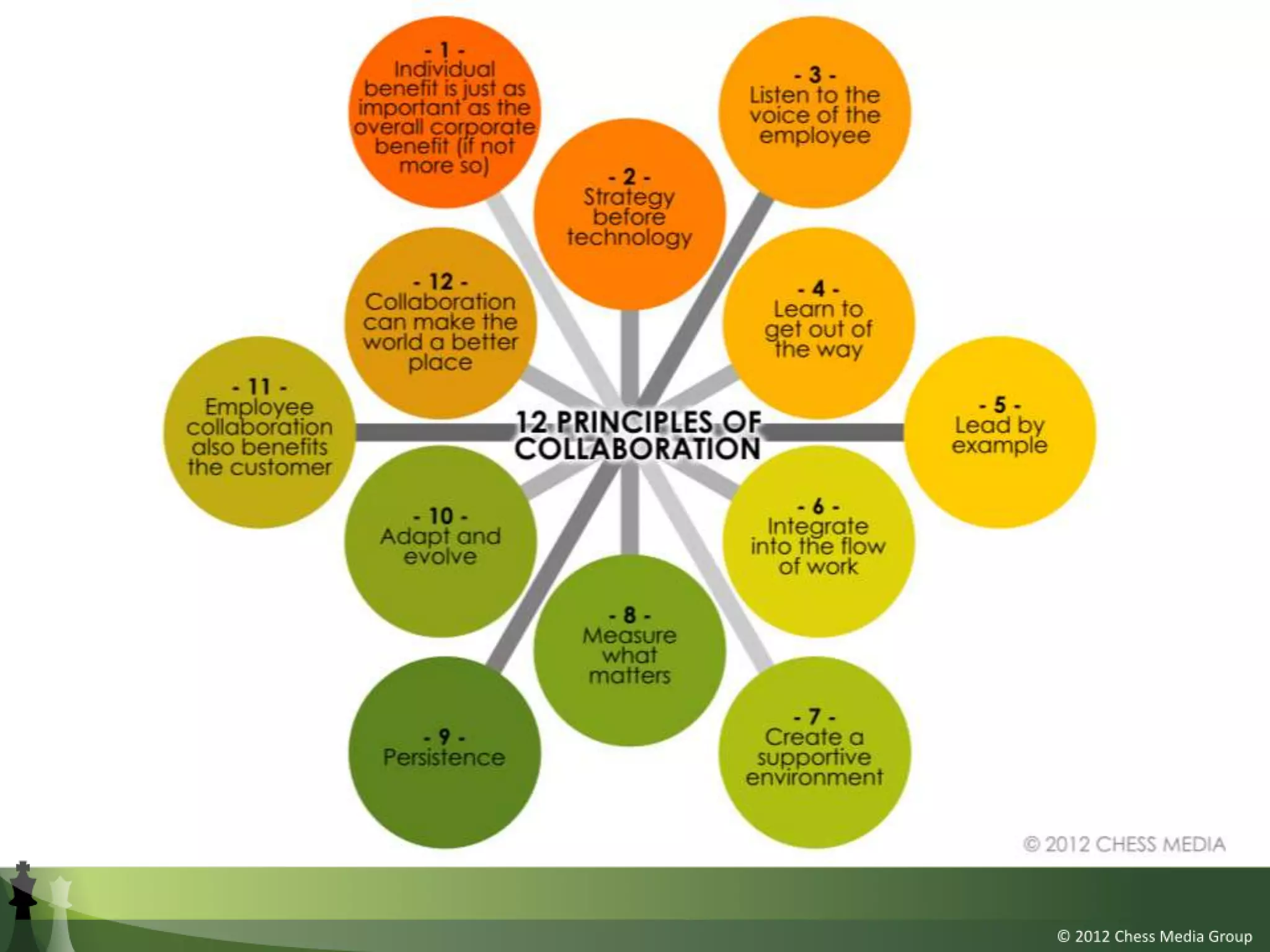
12 Principles of Collaboration
         Jacob Morgan
Slides, Case Studies, and Strategy
                Resources

ChessMediaGroup.com/Resources
•   Around a dozen in-depth case studies
•   State of Enterprise 2.0 Collaboration Report
•   Unique strategy resources to help you with collaboration efforts
•   Updated Regularly!
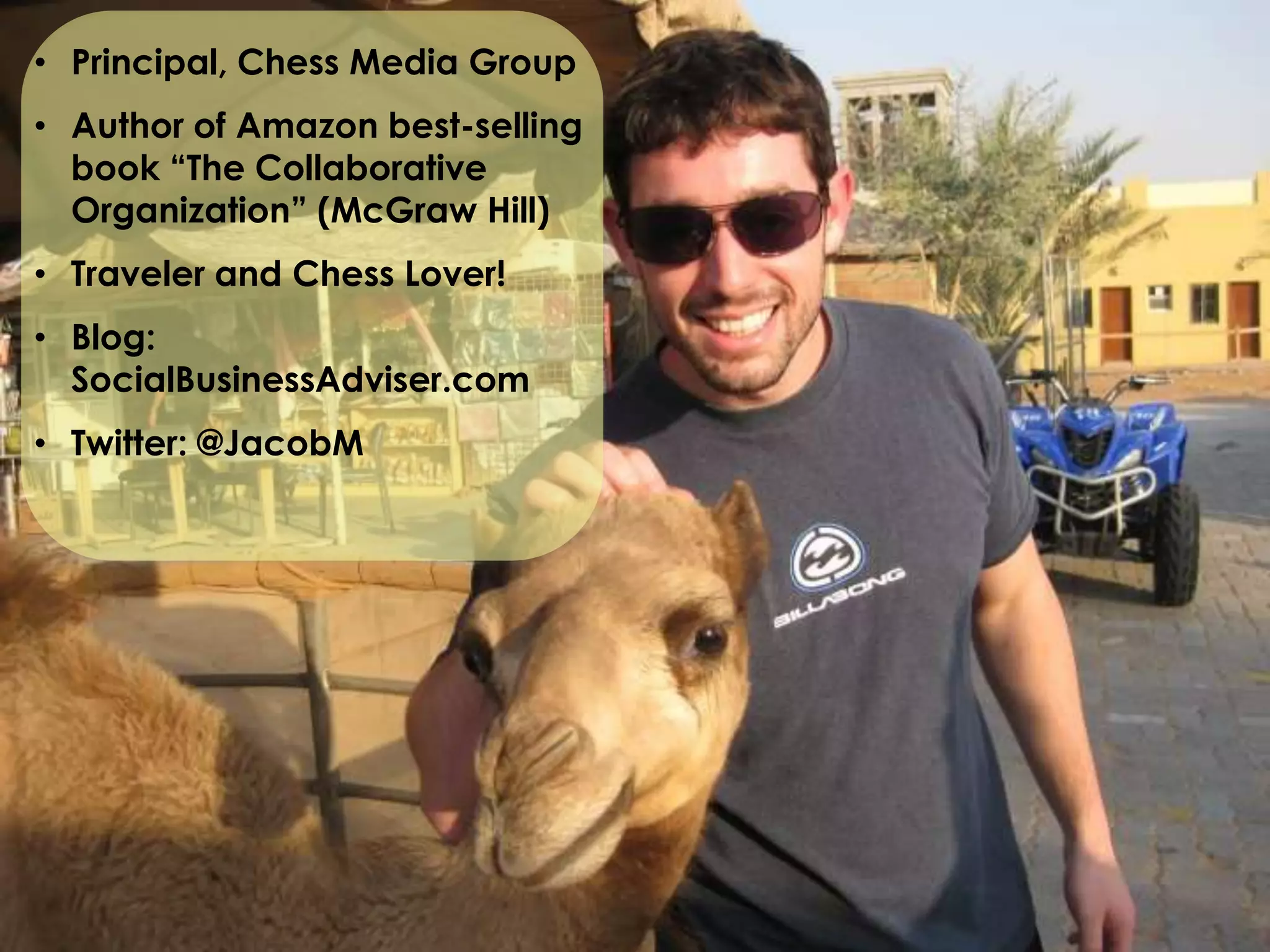
• Principal, Chess Media Group
• Author of Amazon best-selling
  book “The Collaborative
  Organization” (McGraw Hill)
• Traveler and Chess Lover!
• Blog:
  SocialBusinessAdviser.com
• Twitter: @JacobM
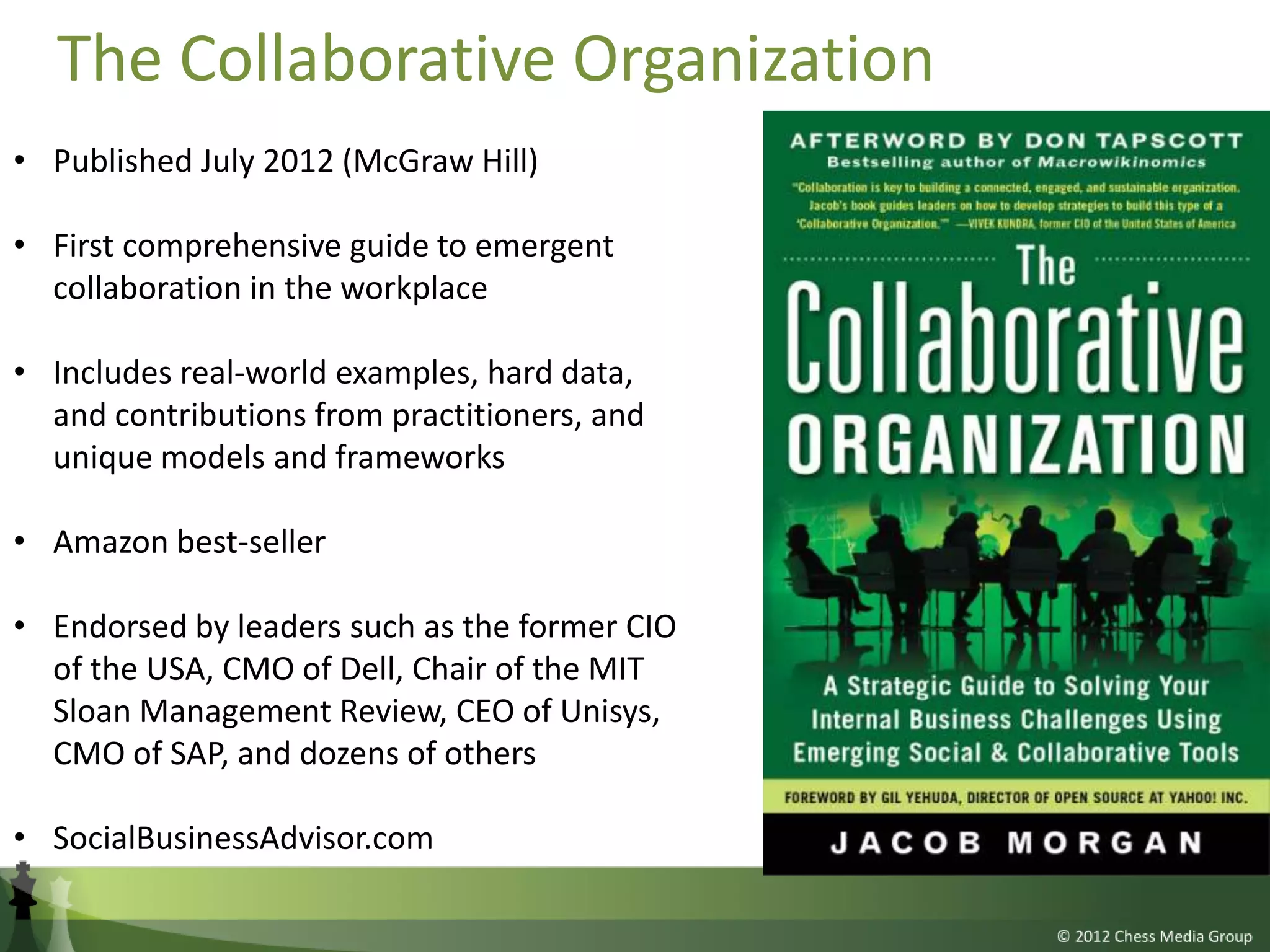
The Collaborative Organization
• Published July 2012 (McGraw Hill)

• First comprehensive guide to emergent
  collaboration in the workplace

• Includes real-world examples, hard data,
  and contributions from practitioners, and
  unique models and frameworks

• Amazon best-seller

• Endorsed by leaders such as the former CIO
  of the USA, CMO of Dell, Chair of the MIT
  Sloan Management Review, CEO of Unisys,
  CMO of SAP, and dozens of others

• SocialBusinessAdvisor.com
The Ultimate Puzzle
The number of possible ways of
playing the first four moves for
both sides in a game of chess is
318,979,564,000

There are more possible chess
moves then there are atoms in the
entire universe

There are more possible Chess
moves then there are seconds that
have elapsed since the big bang
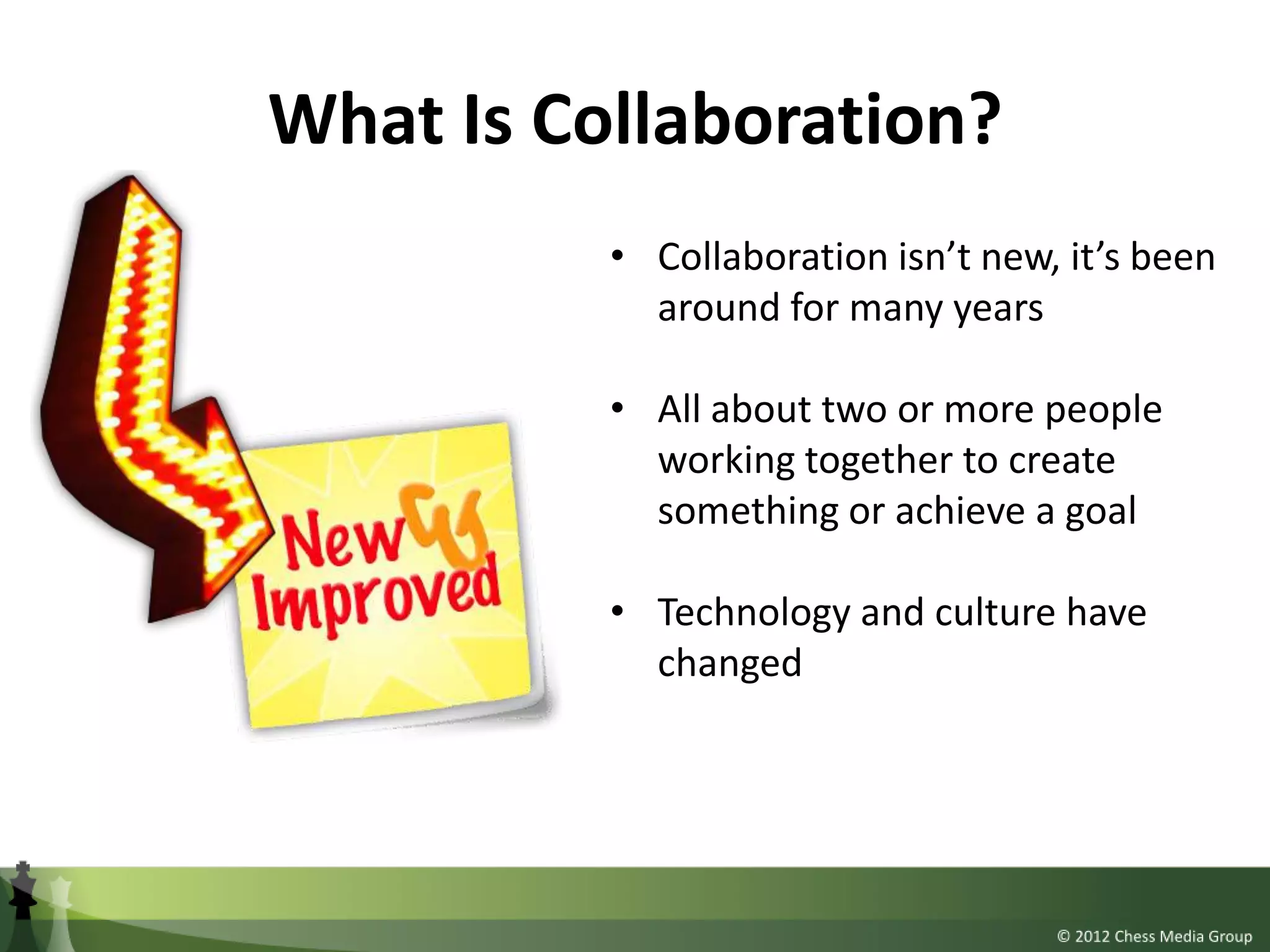
What Is Collaboration?
          • Collaboration isn’t new, it’s been
            around for many years

          • All about two or more people
            working together to create
            something or achieve a goal

          • Technology and culture have
            changed
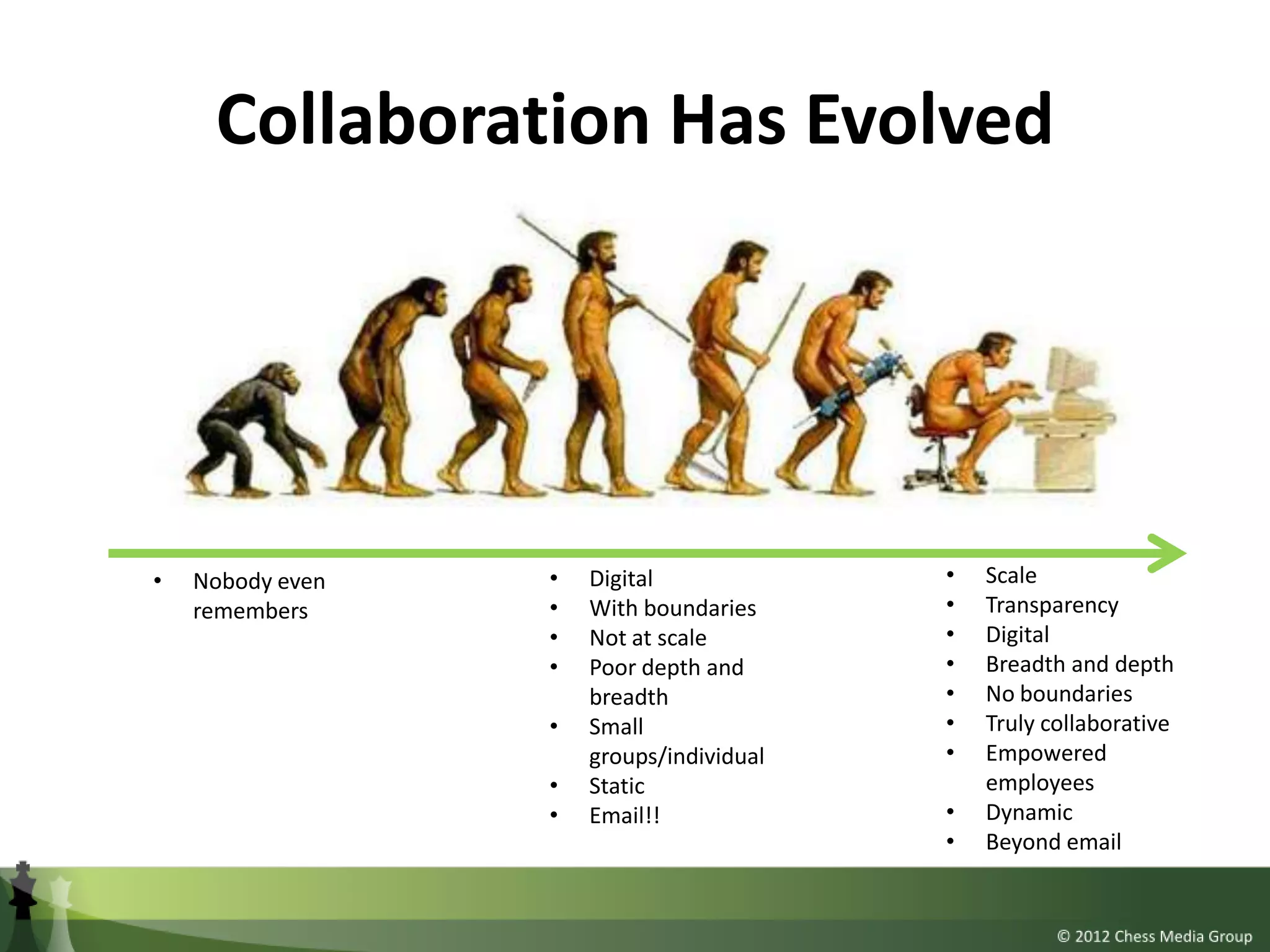
Collaboration Has Evolved


•   Nobody even   •   Digital             •   Scale
    remembers     •   With boundaries     •   Transparency
                  •   Not at scale        •   Digital
                  •   Poor depth and      •   Breadth and depth
                      breadth             •   No boundaries
                  •   Small               •   Truly collaborative
                      groups/individual   •   Empowered
                  •   Static                  employees
                  •   Email!!             •   Dynamic
                                          •   Beyond email
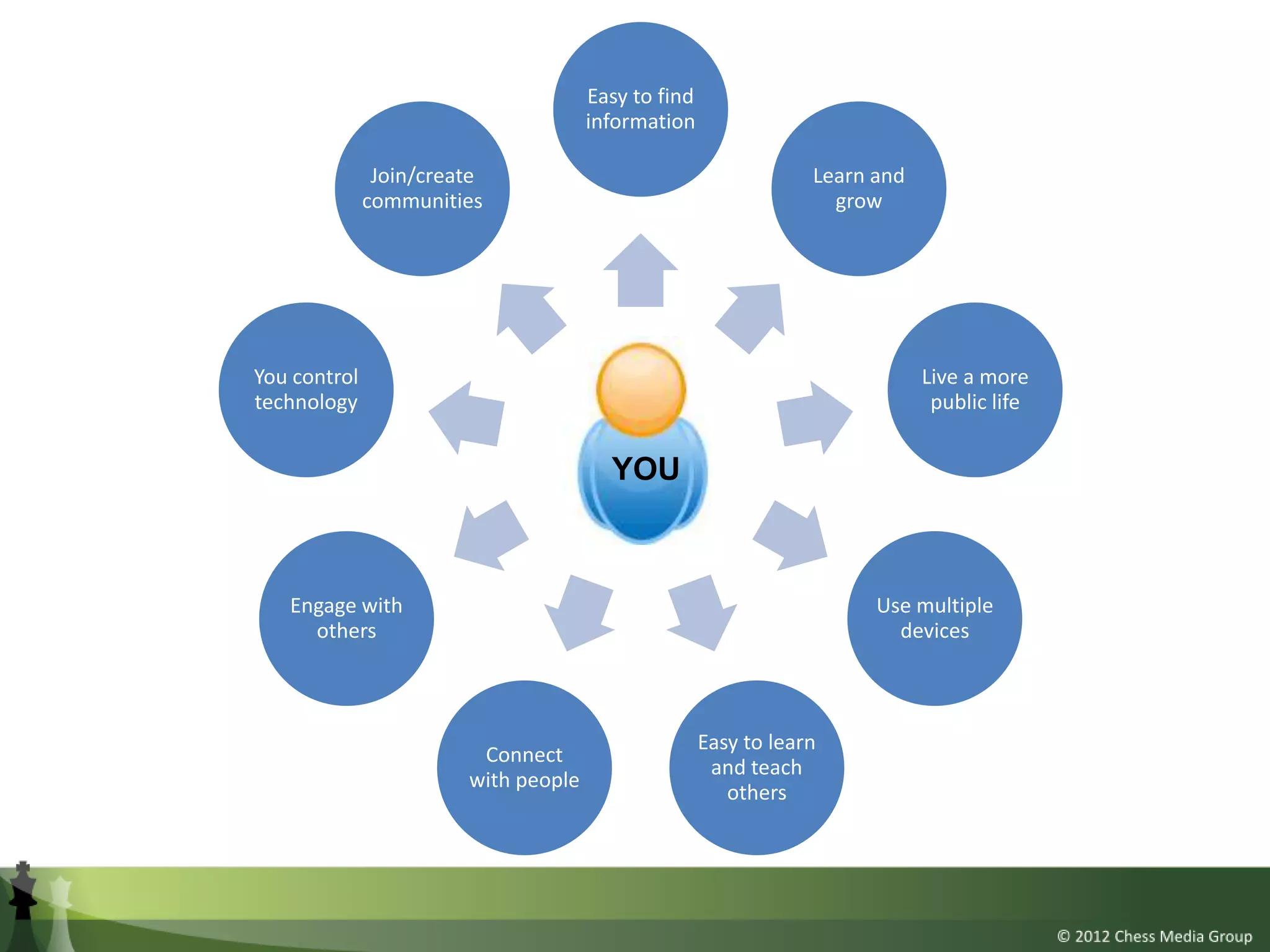
Easy to find
                                      information

               Join/create                                       Learn and
              communities                                          grow


You control                                                                  Live a more
technology                                                                    public life


                                        YOU


   Engage with                                                         Use multiple
     others                                                              devices


                                                     Easy to learn
                         Connect
                                                      and teach
                        with people
                                                        others
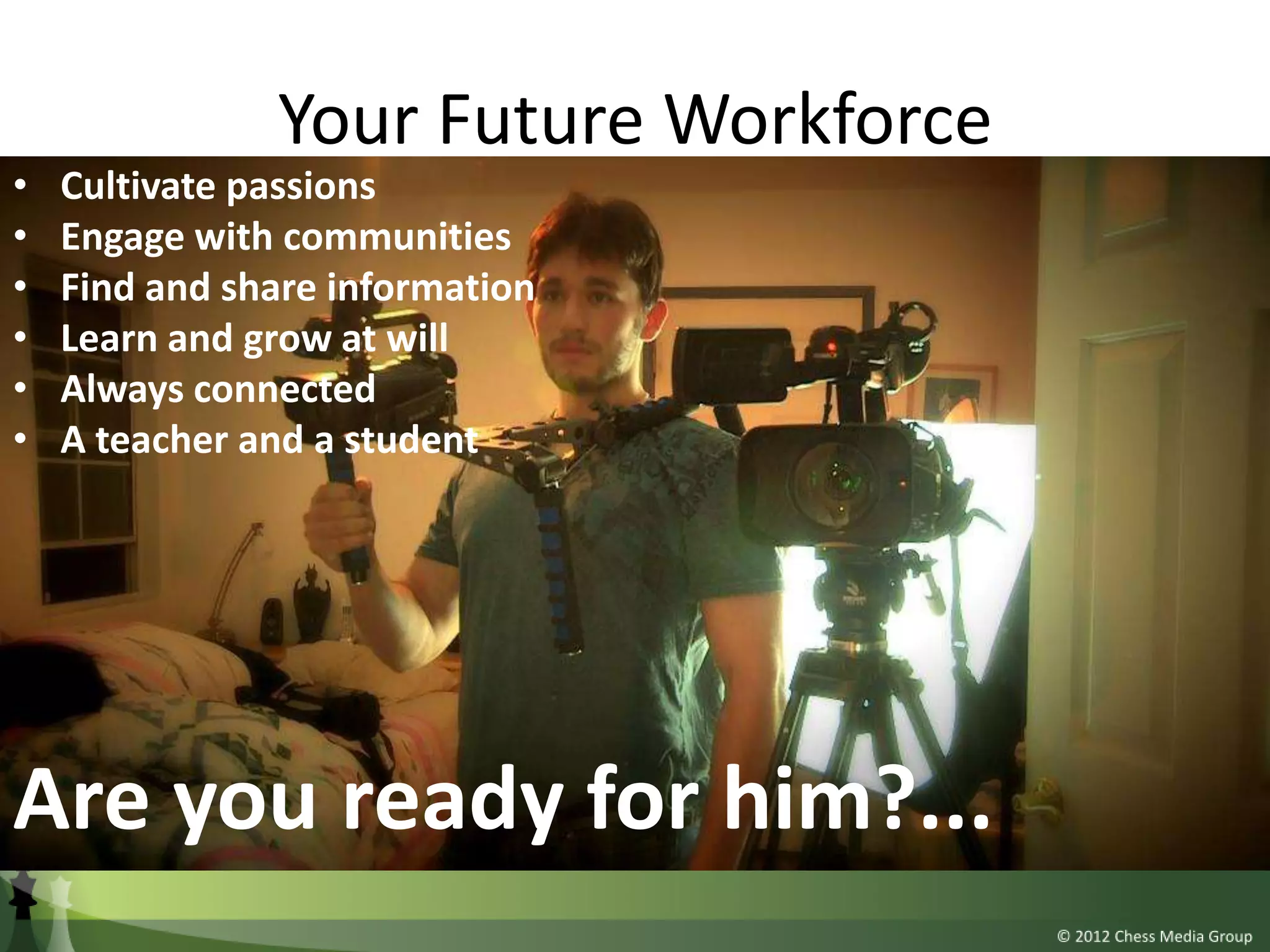
Your Future Workforce
•   Cultivate passions
•   Engage with communities
•   Find and share information
•   Learn and grow at will
•   Always connected
•   A teacher and a student


Are you ready for him?...
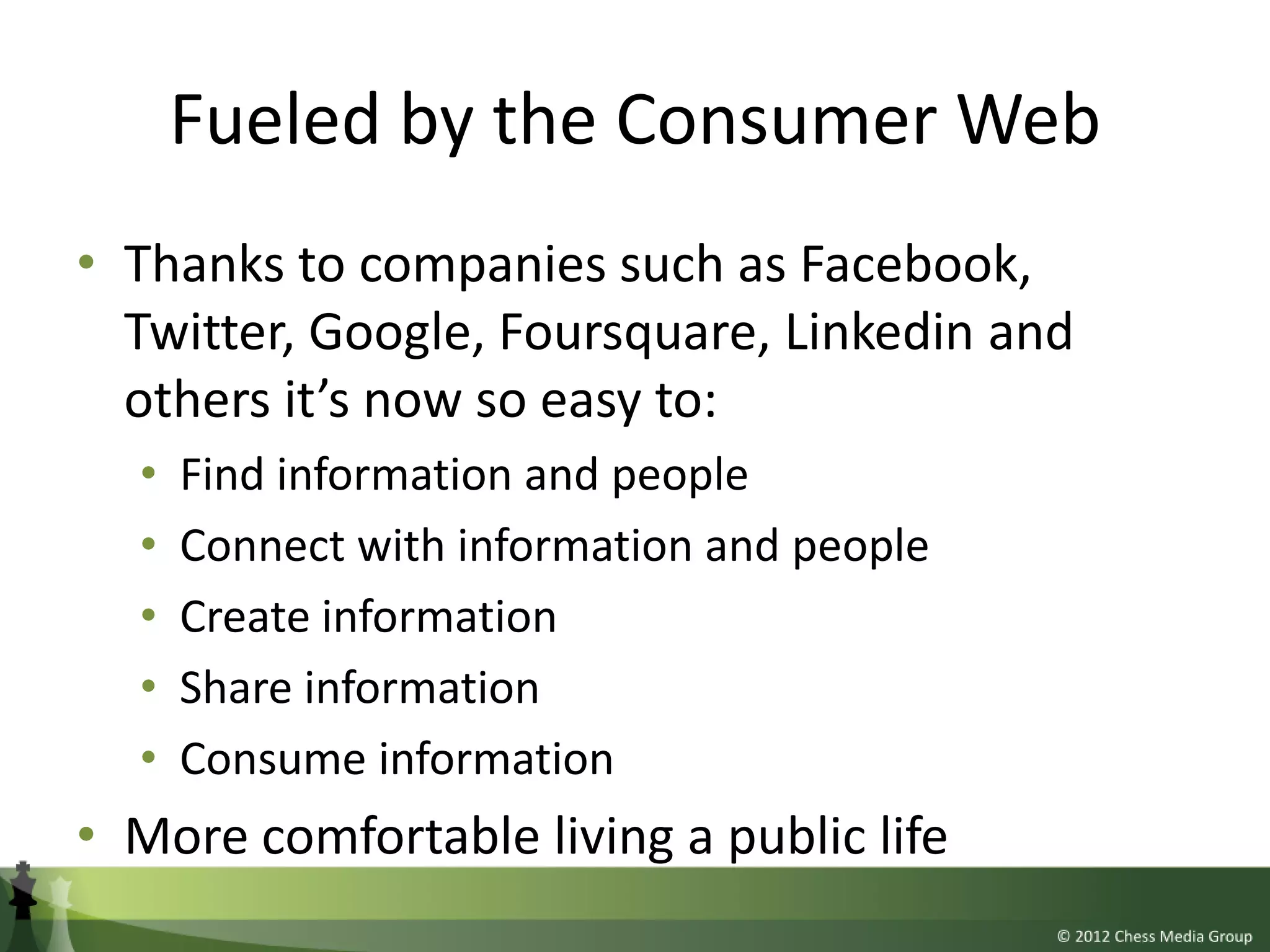
Fueled by the Consumer Web
• Thanks to companies such as Facebook,
  Twitter, Google, Foursquare, Linkedin and
  others it’s now so easy to:
  •   Find information and people
  •   Connect with information and people
  •   Create information
  •   Share information
  •   Consume information
• More comfortable living a public life
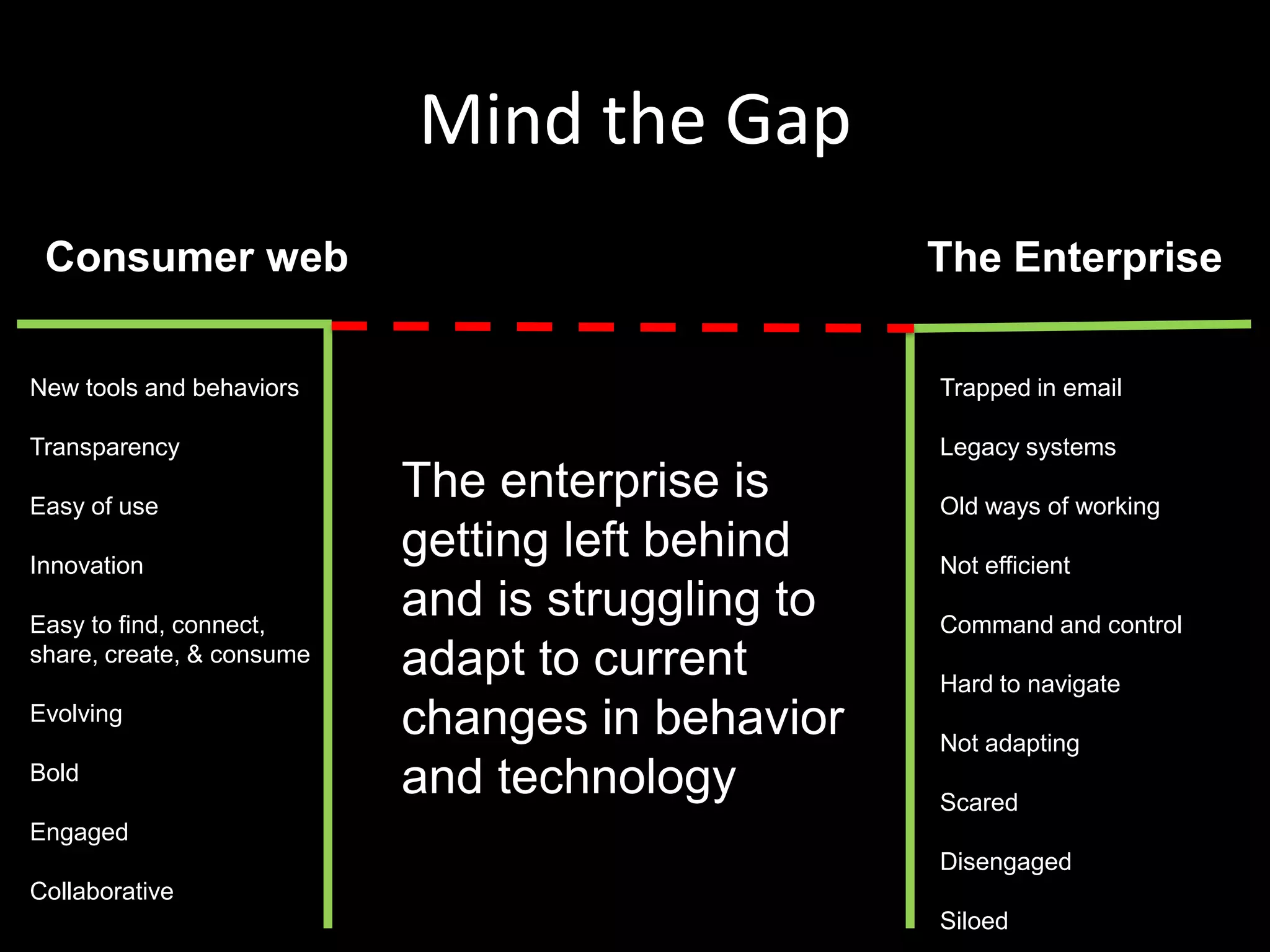
Mind the Gap
 Consumer web                                     The Enterprise

New tools and behaviors                           Trapped in email

Transparency                                      Legacy systems

Easy of use
                           The enterprise is      Old ways of working

Innovation
                           getting left behind    Not efficient

Easy to find, connect,
                           and is struggling to   Command and control
share, create, & consume   adapt to current       Hard to navigate
Evolving                   changes in behavior    Not adapting
Bold                       and technology         Scared
Engaged
                                                  Disengaged
Collaborative
                                                  Siloed
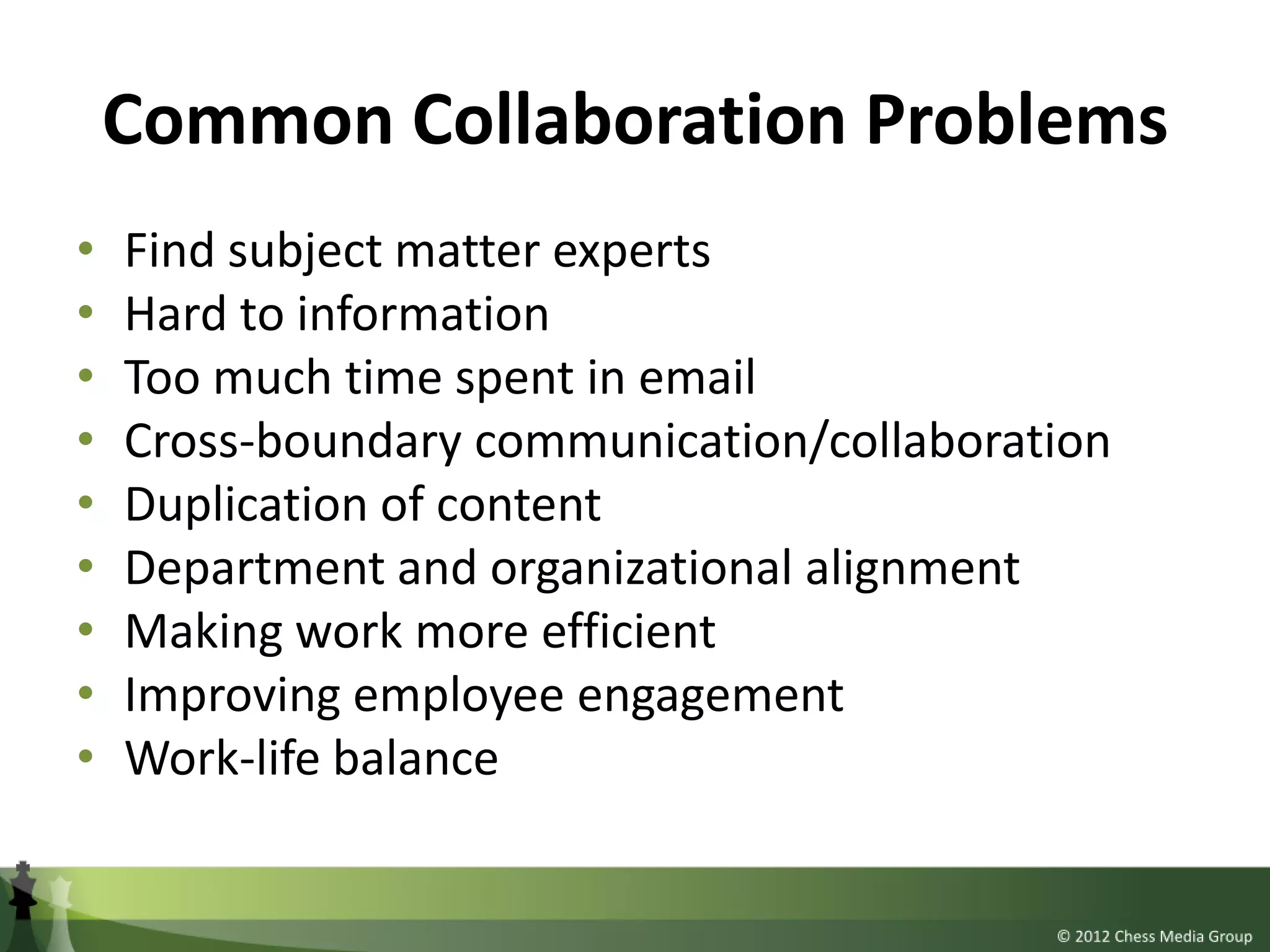
Common Collaboration Problems
•   Find subject matter experts
•   Hard to information
•   Too much time spent in email
•   Cross-boundary communication/collaboration
•   Duplication of content
•   Department and organizational alignment
•   Making work more efficient
•   Improving employee engagement
•   Work-life balance
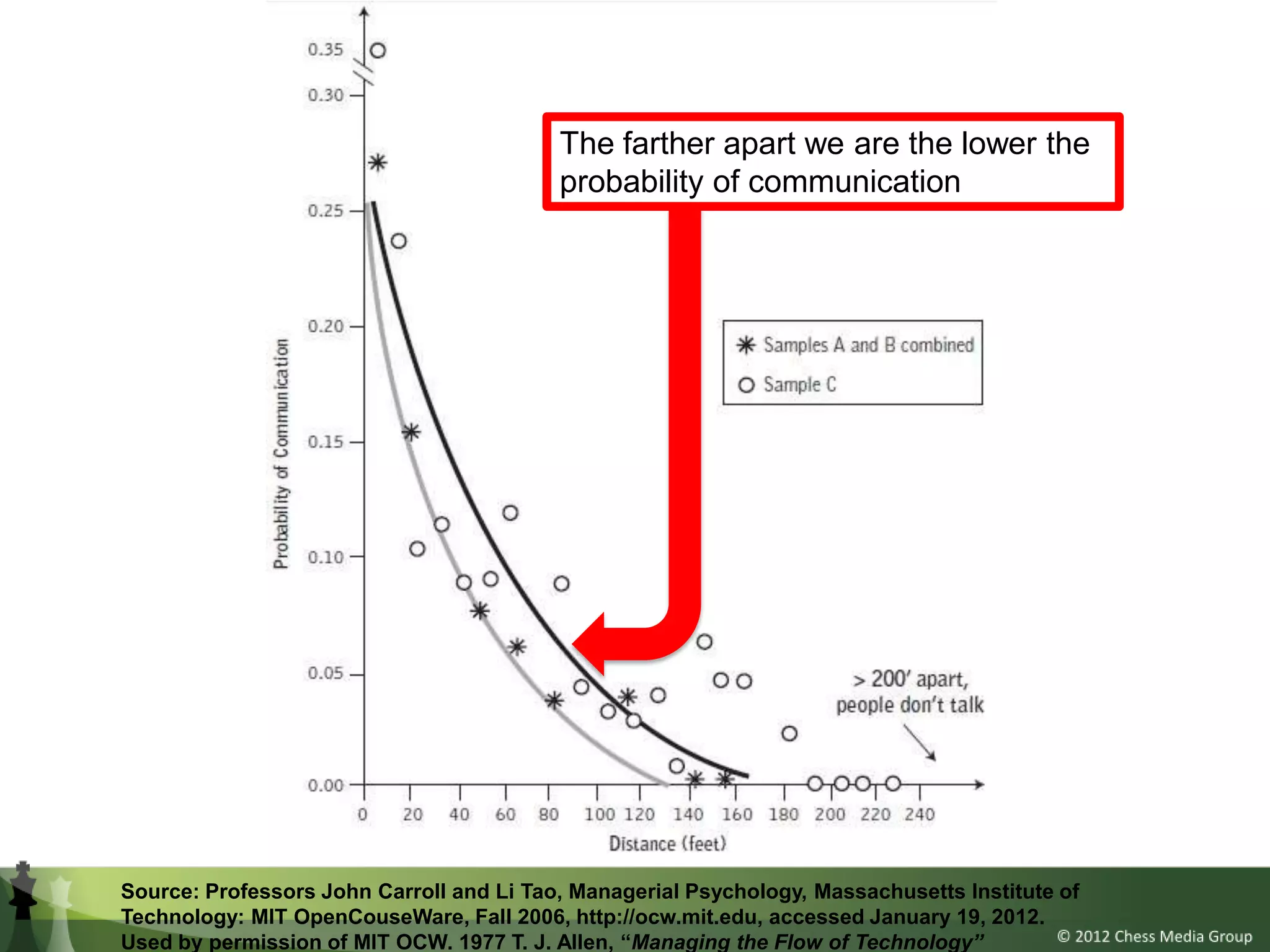
The farther apart we are the lower the
                                          probability of communication


Source: Professors John Carroll and Li Tao, Managerial Psychology, Massachusetts Institute of
Technology: MIT OpenCouseWare, Fall 2006, http://ocw.mit.edu, accessed January 19, 2012.
Used by permission of MIT OCW. 1977 T. J. Allen, “Managing the Flow of Technology”
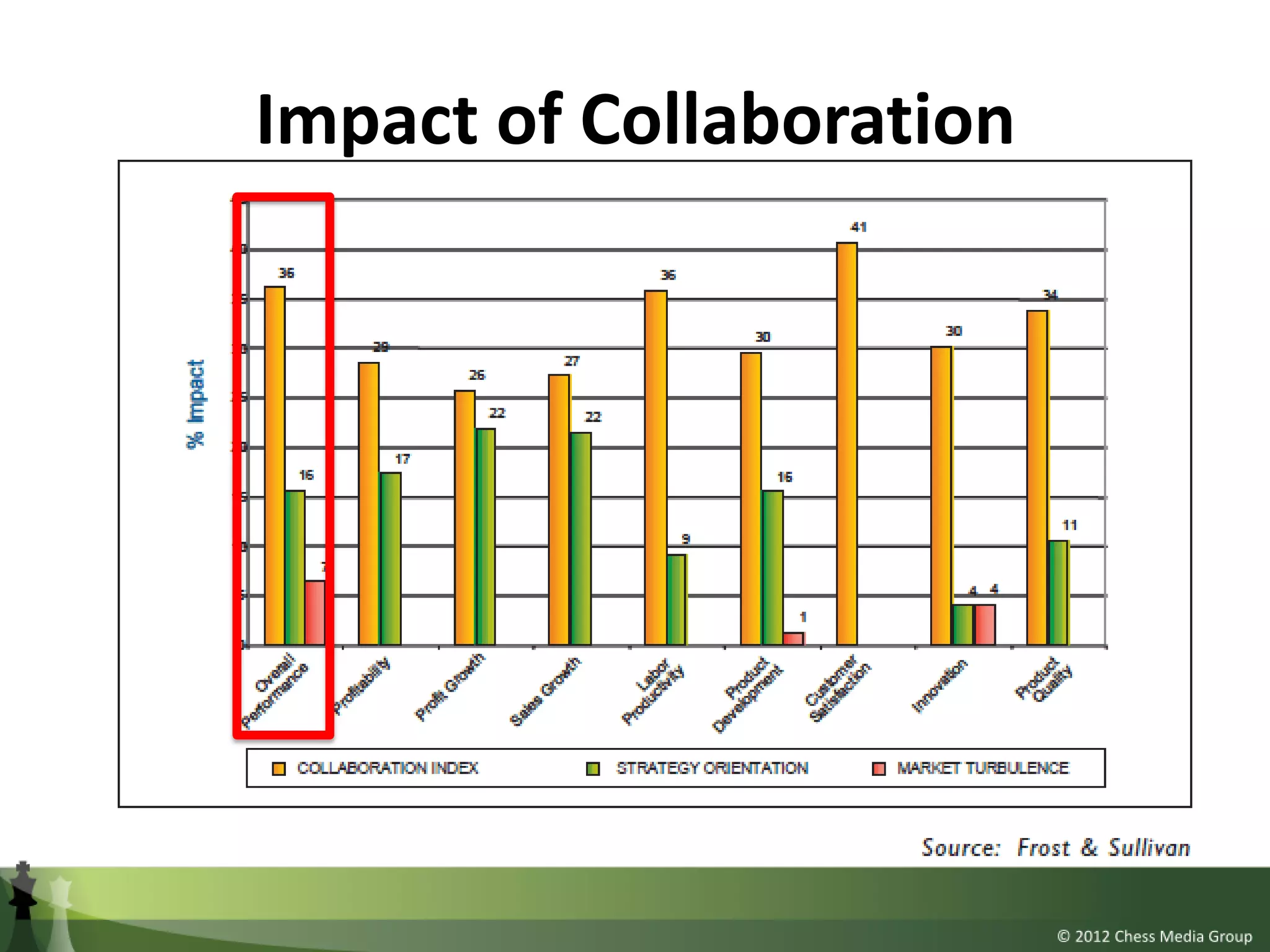
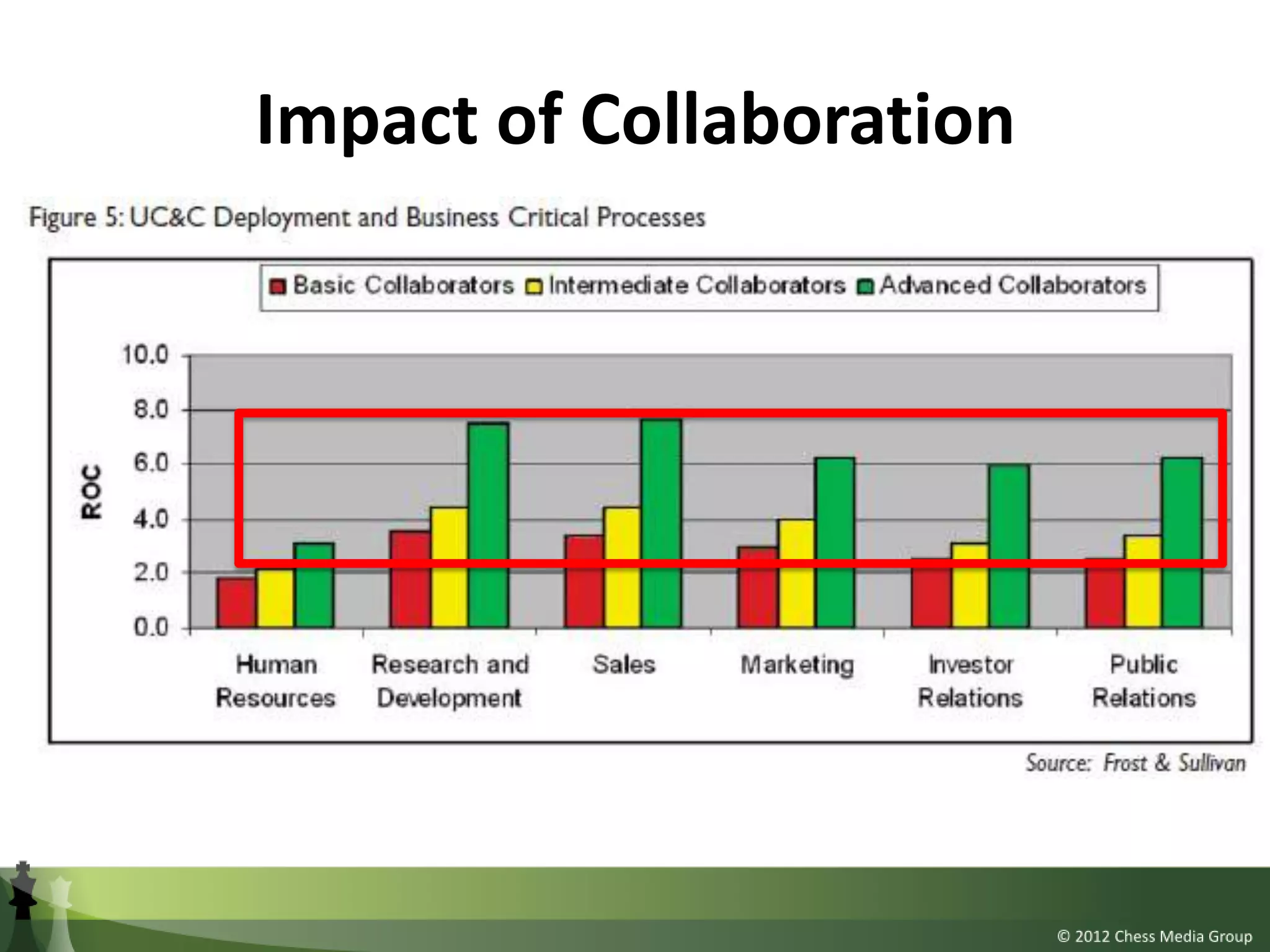
Impact of Collaboration


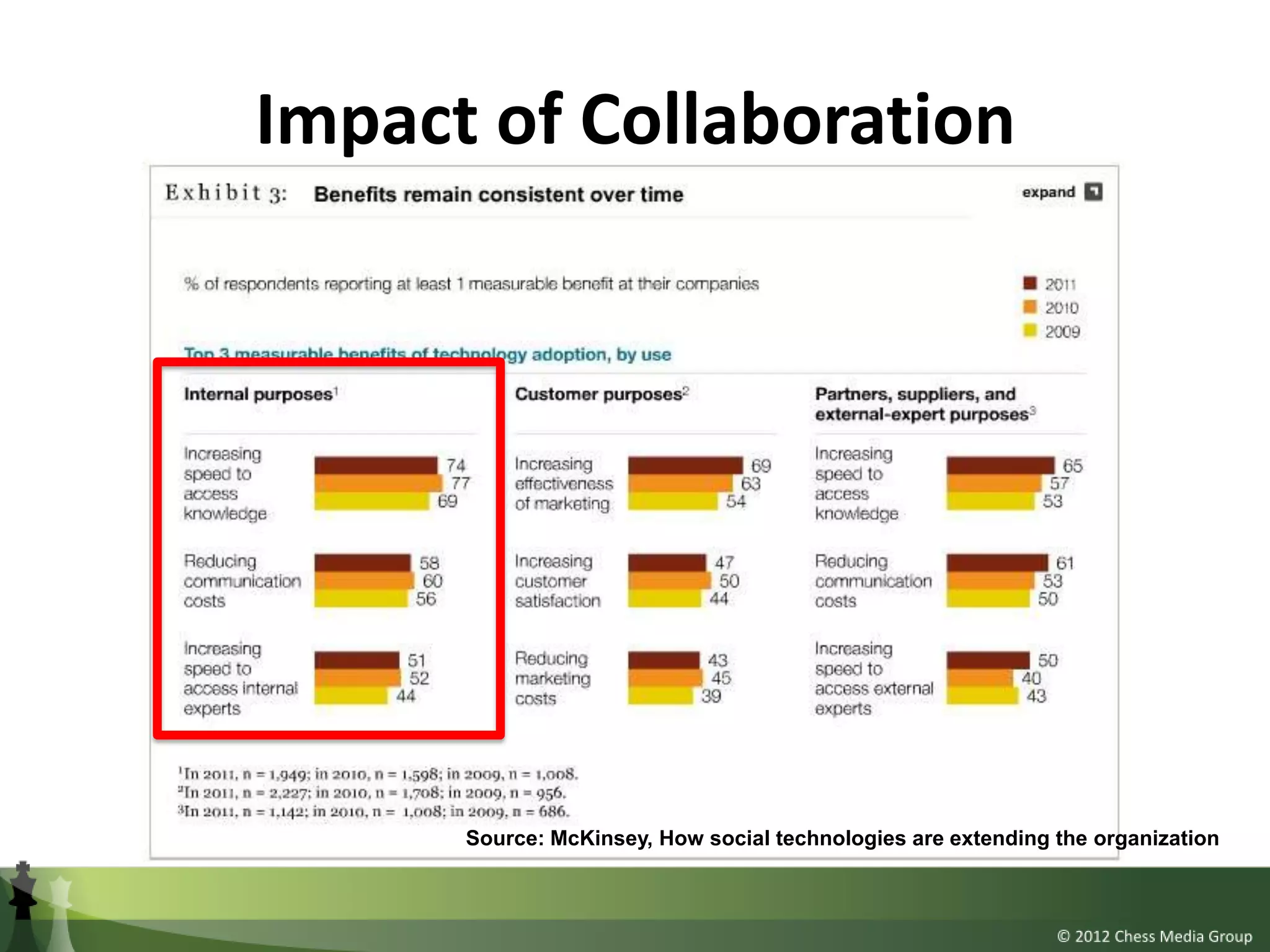
      Source: McKinsey, How social technologies are extending the organization
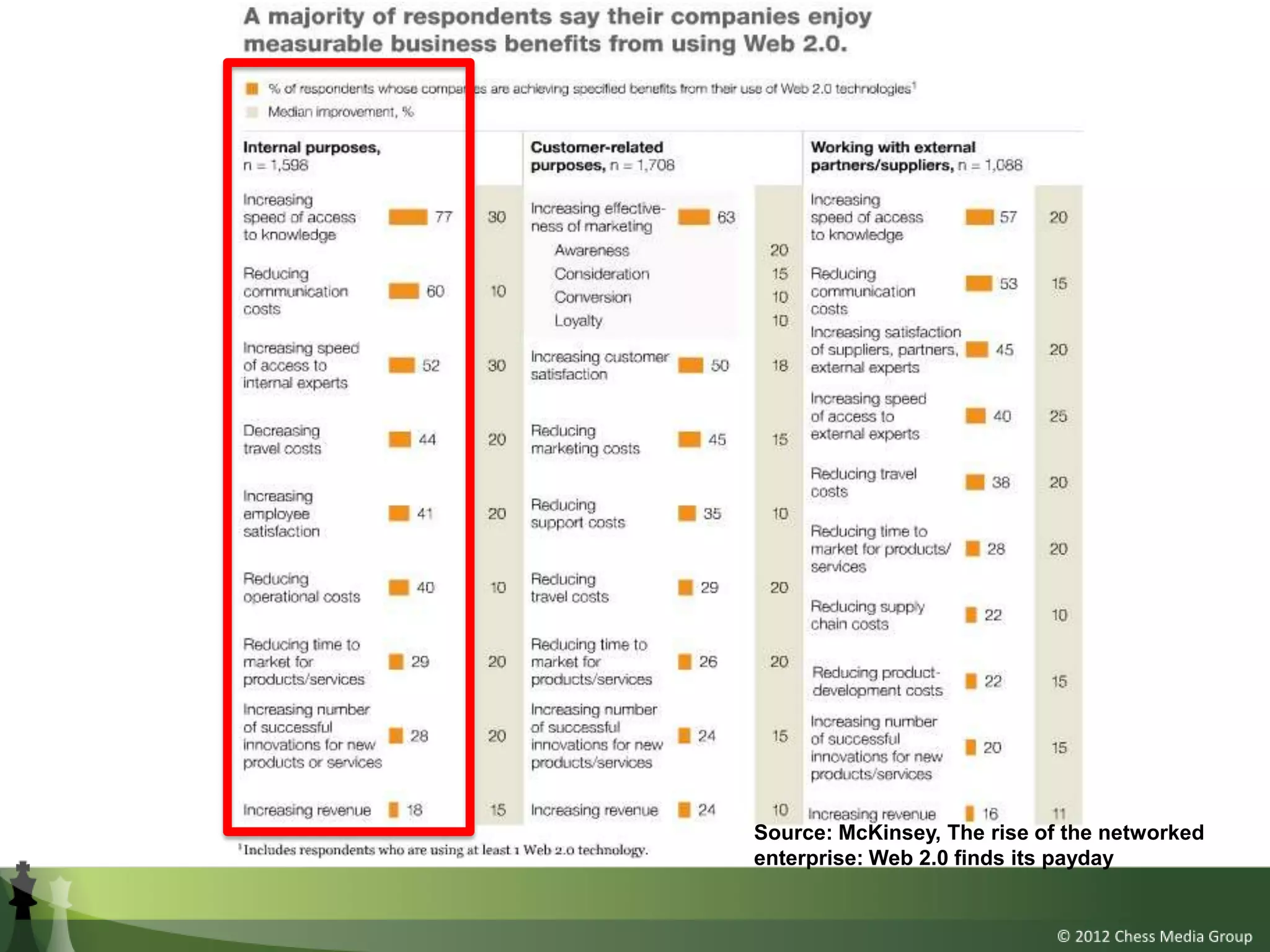
Source: McKinsey, The rise of the networked
enterprise: Web 2.0 finds its payday
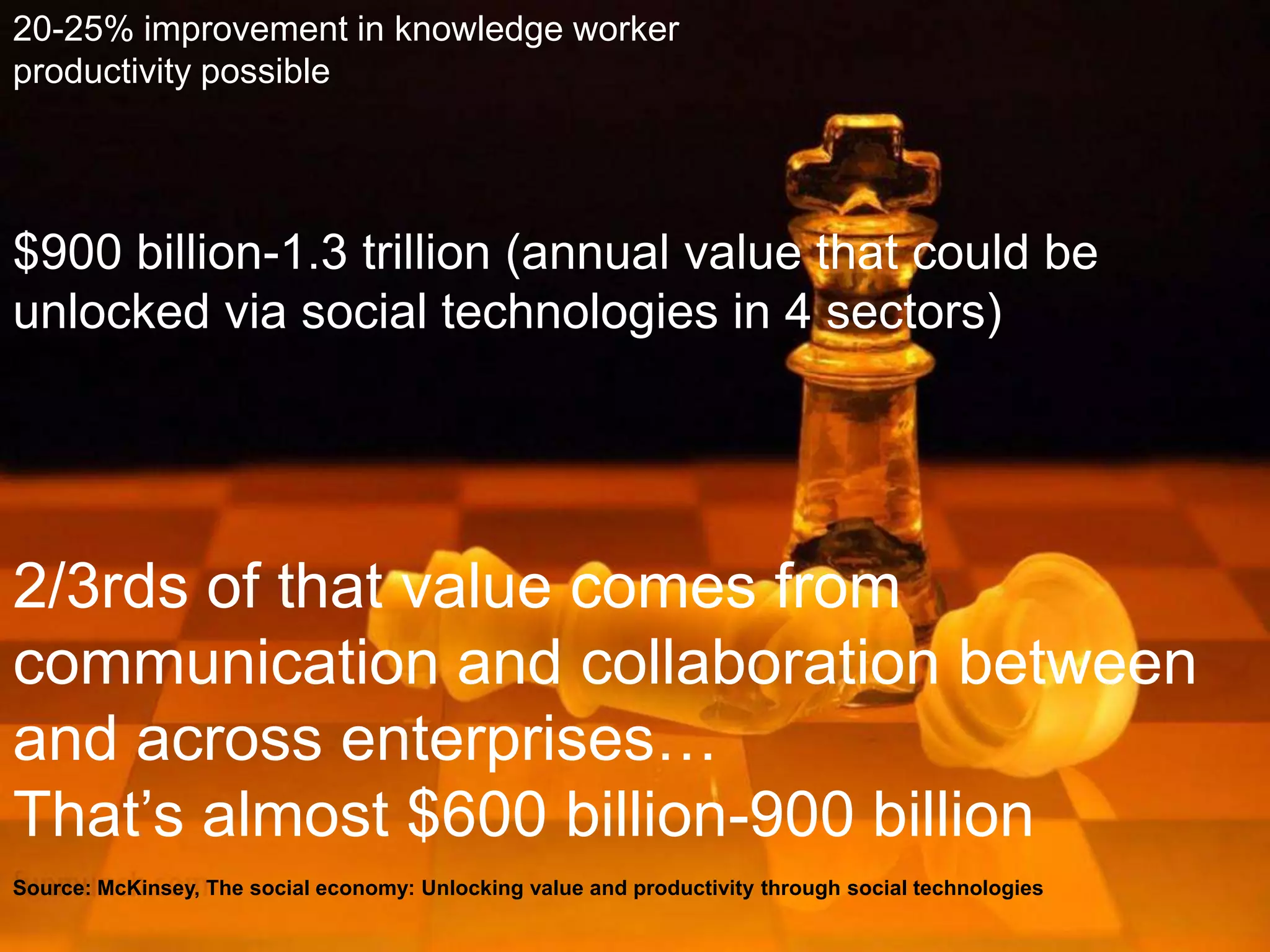
20-25% improvement in knowledge worker
productivity possible


$900 billion-1.3 trillion (annual value that could be
unlocked via social technologies in 4 sectors)


2/3rds of that value comes from
communication and collaboration between
and across enterprises…
That’s almost $600 billion-900 billion
Source: McKinsey, The social economy: Unlocking value and productivity through social technologies
“If only HP knew what HP knows, we would be
three times more productive.”
~Lou Platt, Former CEO, HP
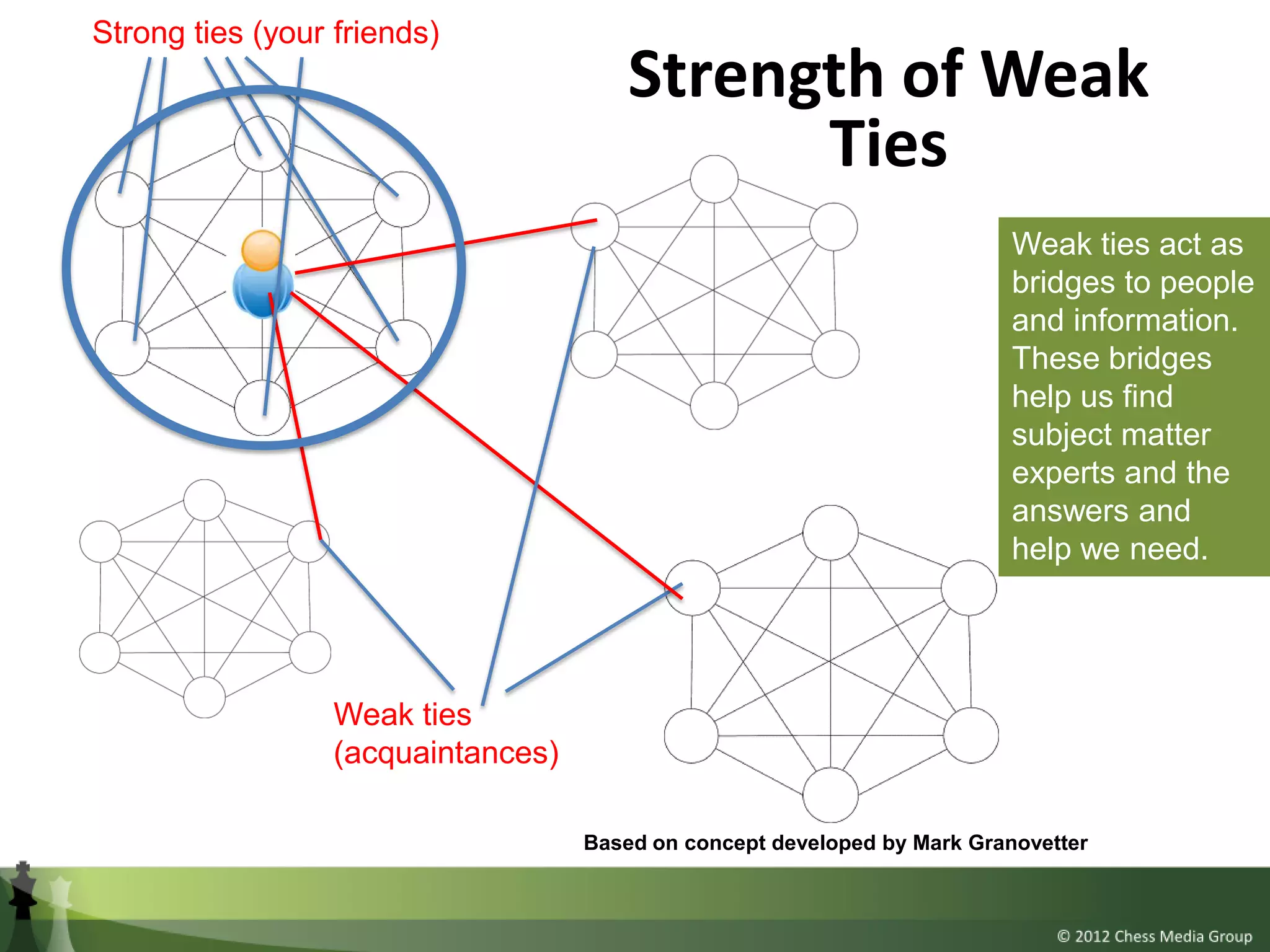
Strong ties (your friends)
                                        Strength of Weak
                                              Ties
                                                                           Weak ties act as
                                                                           bridges to people
                                                                           and information.
                                                                           These bridges
                                                                           help us find
                                                                           subject matter
                                                                           experts and the
                                                                           answers and
                                                                           help we need.


                  Weak ties
                  (acquaintances)

                                    Based on concept developed by Mark Granovetter
From this
To This
1
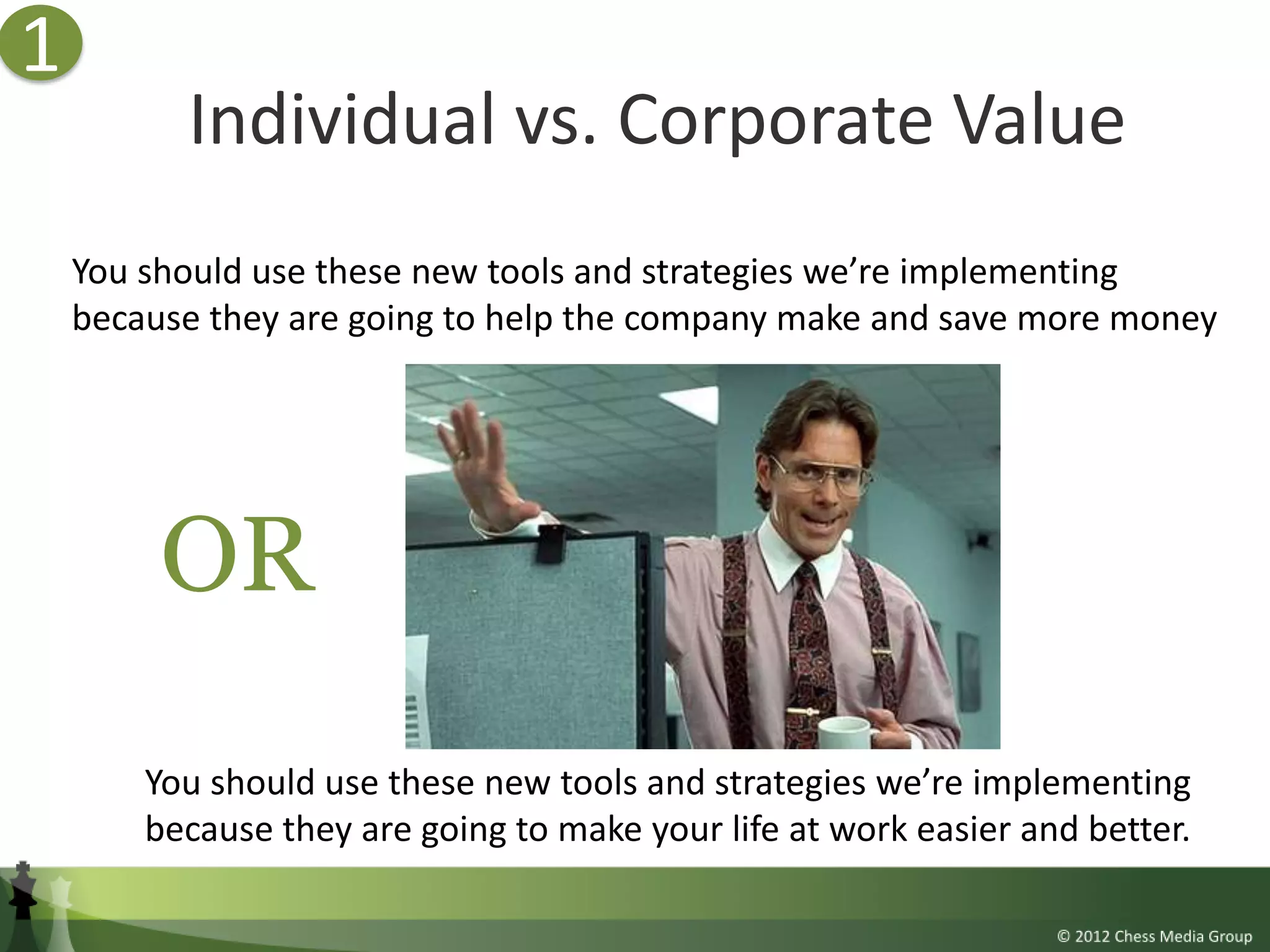
          Individual vs. Corporate Value
    You should use these new tools and strategies we’re implementing
    because they are going to help the company make and save more money


         OR
        You should use these new tools and strategies we’re implementing
        because they are going to make your life at work easier and better.
2
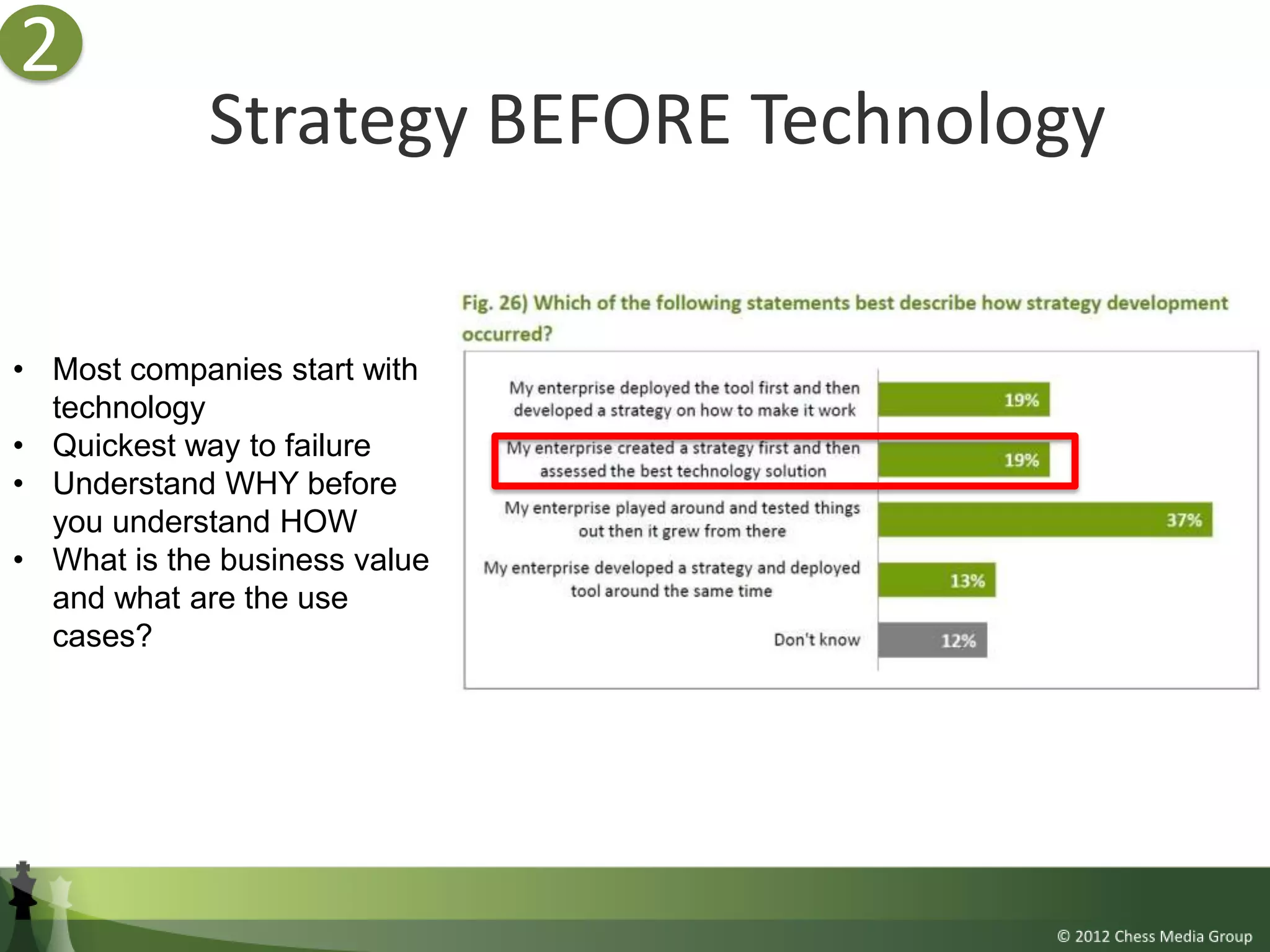
             Strategy BEFORE Technology


• Most companies start with
  technology
• Quickest way to failure
• Understand WHY before
  you understand HOW
• What is the business value
  and what are the use
  cases?
3                Listen to the Voice of the
                         Employee
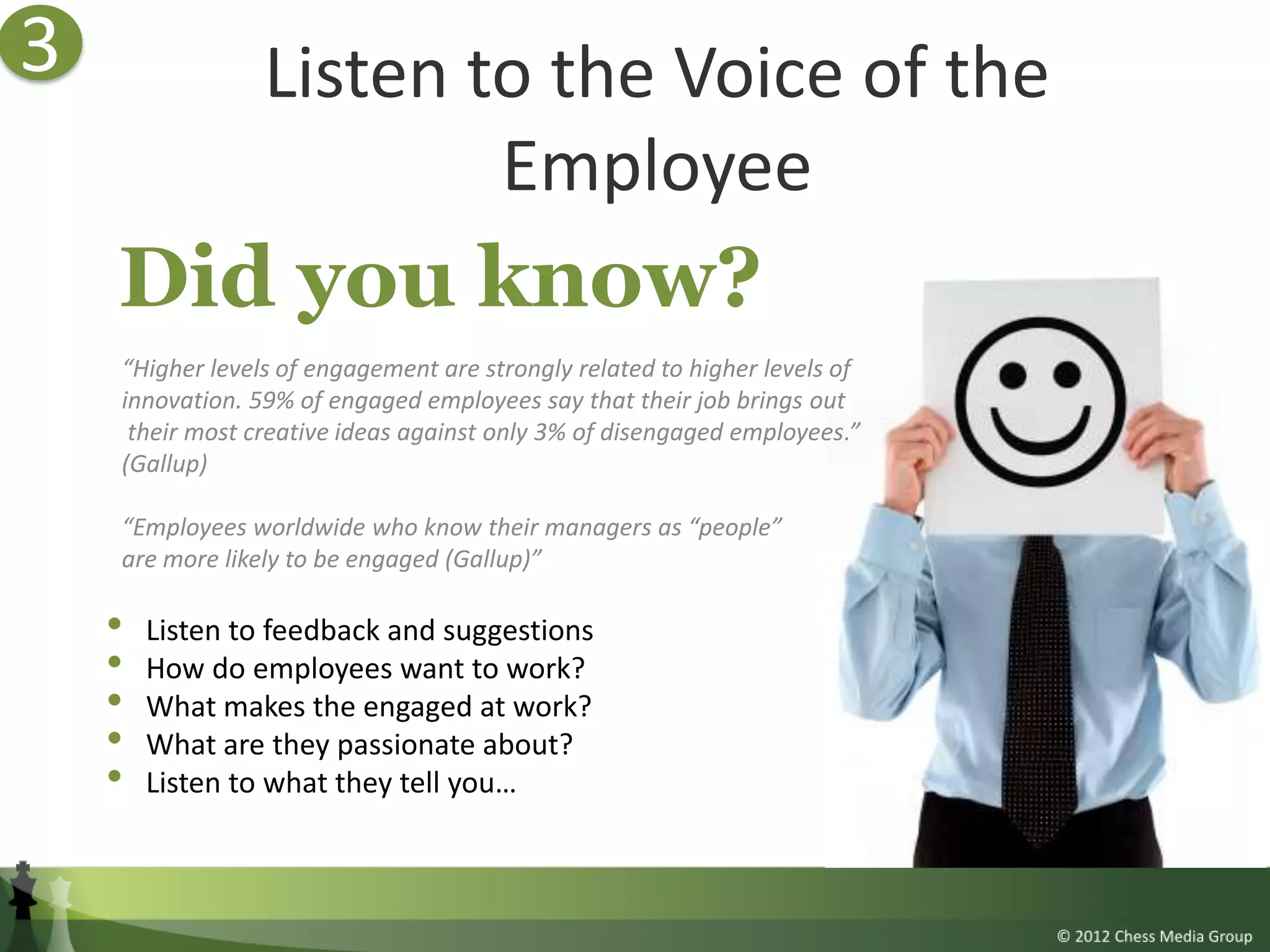
    Did you know?
    “Higher levels of engagement are strongly related to higher levels of
    innovation. 59% of engaged employees say that their job brings out
     their most creative ideas against only 3% of disengaged employees.”
    (Gallup)

    “Employees worldwide who know their managers as “people”
    are more likely to be engaged (Gallup)”

    •   Listen to feedback and suggestions
    •   How do employees want to work?
    •   What makes the engaged at work?
    •   What are they passionate about?
    •   Listen to what they tell you…
4         Learn to Get Out of the Way


    • Avoid the “wear any color because it’s black” mentality
    • Not about policing and enforcing
    • Empower and support but don’t dictate
5                  Lead by Example


    • If leaders aren’t on-board why should employees be?
    • Leaders have tremendous impact on culture and direction
    • According to Andrew McAfee, quickest way to fail
    • Not just about saying you support collaboration, SHOW it
6          Integrate Into Flow of Work


    • Needs to be a part of how employees work
    • Not mean to be “another” place to go to
    • Example: leveraging single sign on to create the “front door” to
      the enterprise
7
     Create a Supportive Environment
    • Think long-term
      – Onboarding of new employees
      – Evaluating existing employees
    • Beyond the tools
      – Education and training
      – Lunch & learns
      – Reverse mentoring
      – Open Q&A sessions
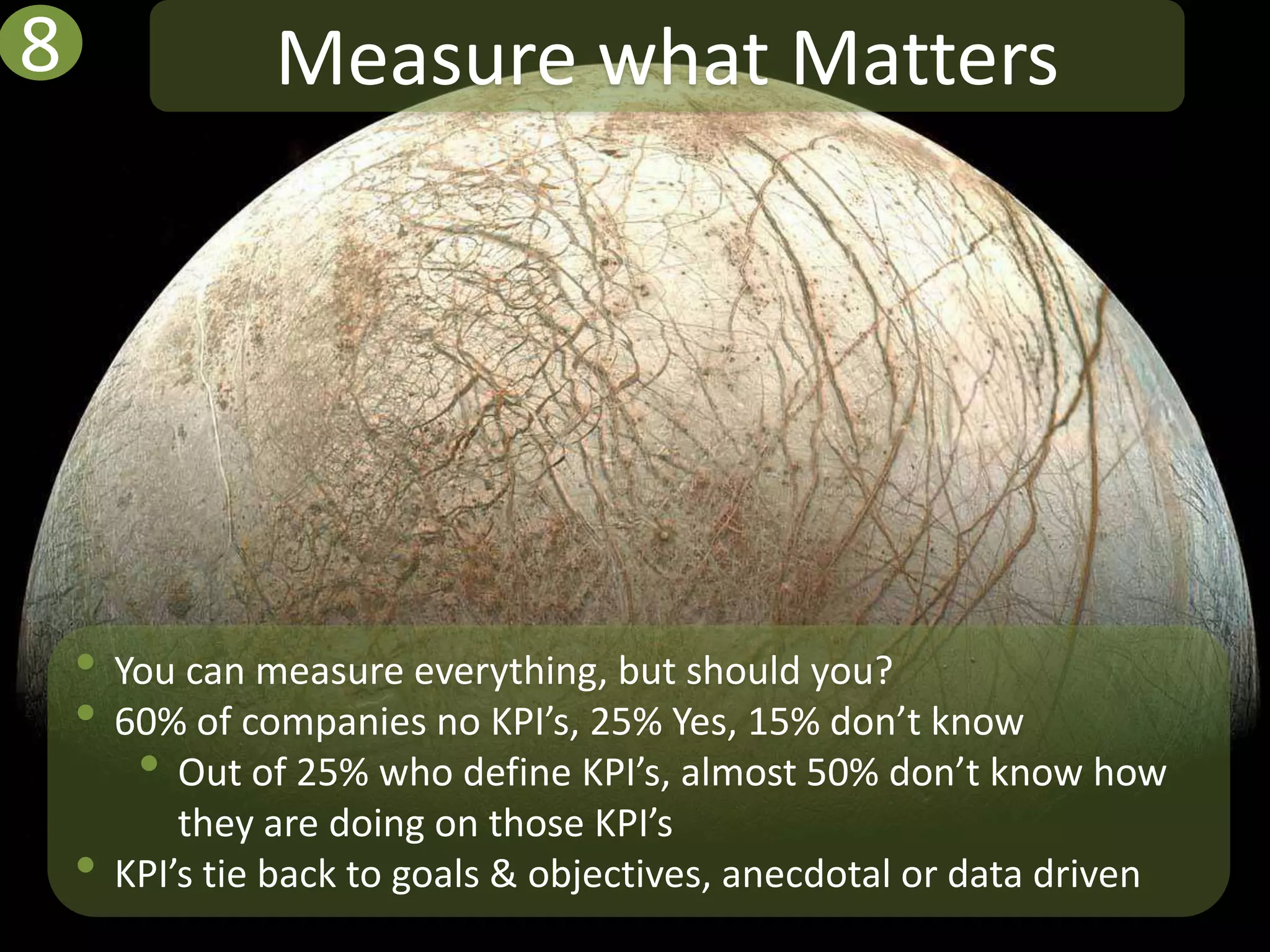
8                Measure what Matters


    • You can measure everything, but should you?
    • 60% of companies no KPI’s, 25% Yes, 15% don’t know
       • Out of 25% who define KPI’s, almost 50% don’t know how
            they are doing on those KPI’s
    •   KPI’s tie back to goals & objectives, anecdotal or data driven
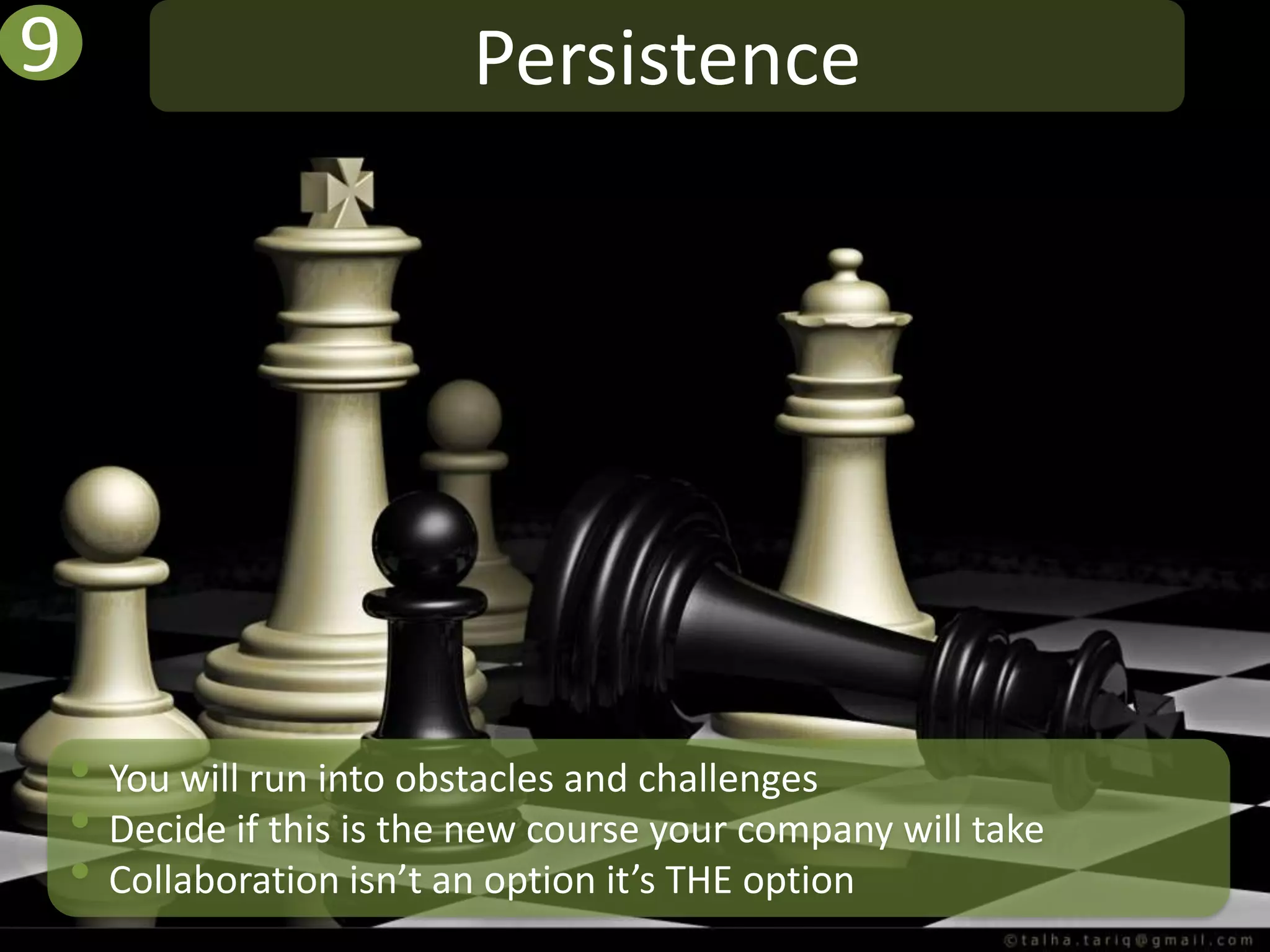
9                          Persistence


    • You will run into obstacles and challenges
    • Decide if this is the new course your company will take
    • Collaboration isn’t an option it’s THE option
10
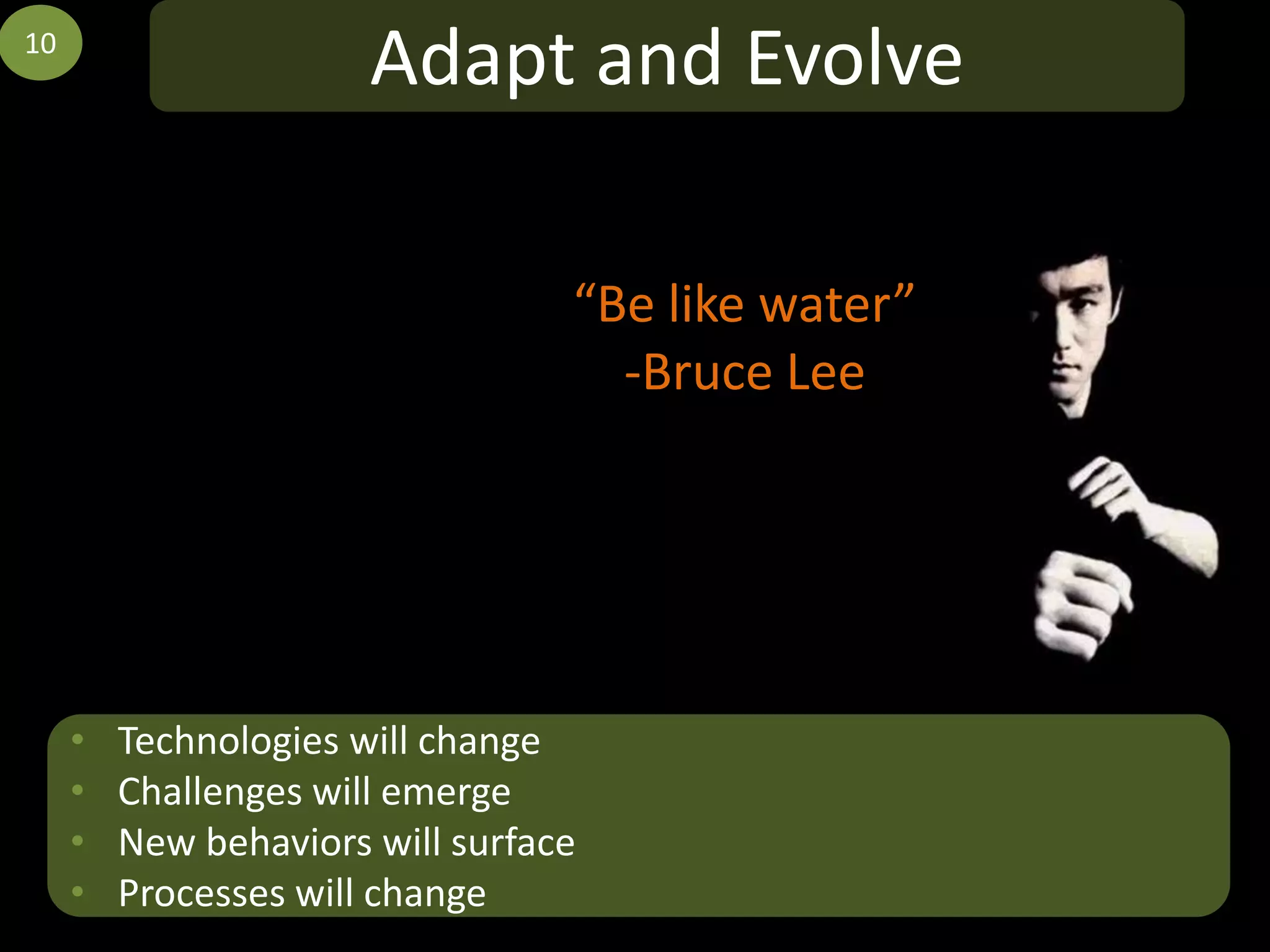
                       Adapt and Evolve

                                  “Be like water”
                                    -Bruce Lee


     •   Technologies will change
     •   Challenges will emerge
     •   New behaviors will surface
     •   Processes will change
11
        Collaboration also Benefits the
                  Customer
     • Ability to respond faster to customers
     • More accurate customer responses
     • Create knowledge/content repository for
       repeating issues
     • Integrate customer feedback into company
       products and services
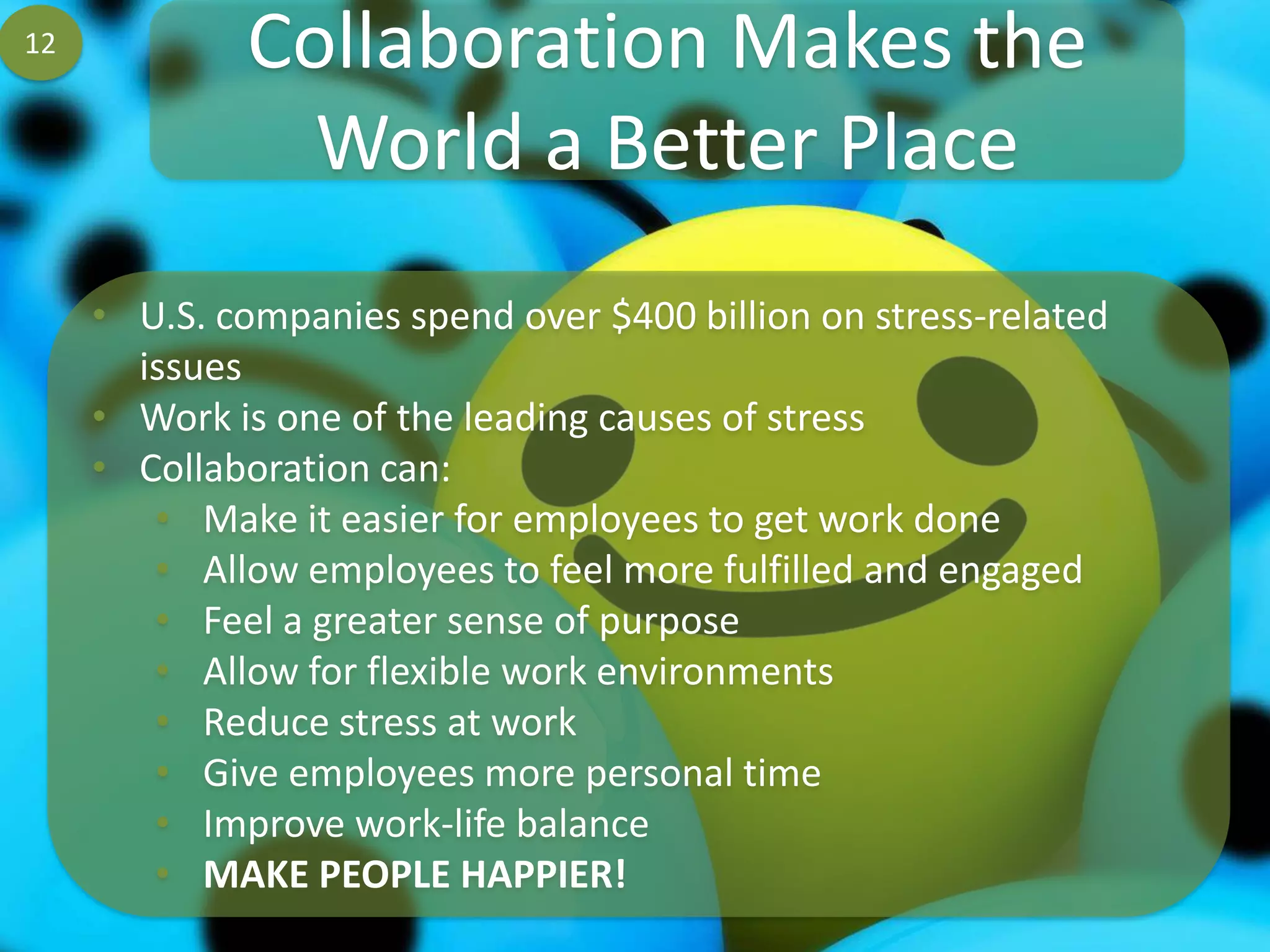
12           Collaboration Makes the
               World a Better Place
     • U.S. companies spend over $400 billion on stress-related
       issues
     • Work is one of the leading causes of stress
     • Collaboration can:
        • Make it easier for employees to get work done
        • Allow employees to feel more fulfilled and engaged
        • Feel a greater sense of purpose
        • Allow for flexible work environments
        • Reduce stress at work
        • Give employees more personal time
        • Improve work-life balance
        • MAKE PEOPLE HAPPIER!
What organizations are seeing
• TELUS- Improved performance seen by over 70% of employees
• Vistaprint- Reduced onboarding time of new employees by 50%
• OCE- Cost savings of over 1 million euros annually
• Penn State University-Improved communication and engagement,
  broke down silos
• U.S Department of State- Ability to support 500k new workers over
  10 years, capture and retain knowledge
• Lowe’s- Recent $1 million revenue generation from shared product
  demo
• FSG- 80 person growing company using collaboration to support
  growth
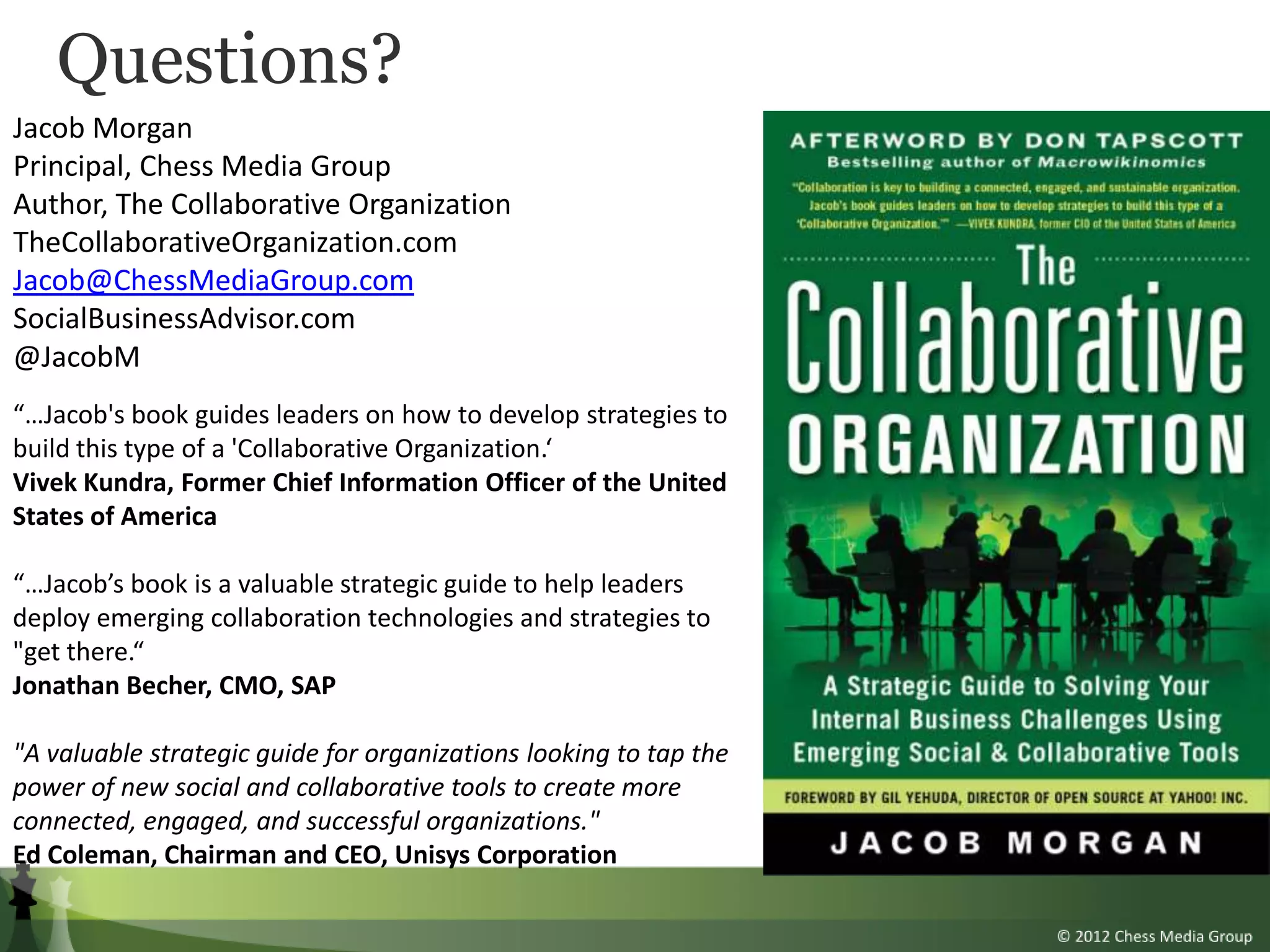
Questions?
Jacob Morgan
Principal, Chess Media Group
Author, The Collaborative Organization
TheCollaborativeOrganization.com
Jacob@ChessMediaGroup.com
SocialBusinessAdvisor.com
@JacobM
“…Jacob's book guides leaders on how to develop strategies to
build this type of a 'Collaborative Organization.‘
Vivek Kundra, Former Chief Information Officer of the United
States of America

“…Jacob’s book is a valuable strategic guide to help leaders
deploy emerging collaboration technologies and strategies to
"get there.“
Jonathan Becher, CMO, SAP

"A valuable strategic guide for organizations looking to tap the
power of new social and collaborative tools to create more
connected, engaged, and successful organizations."
Ed Coleman, Chairman and CEO, Unisys Corporation
Slides, Case Studies, and Strategy
                Resources

ChessMediaGroup.com/Resources
•   Around a dozen in-depth case studies
•   State of Enterprise 2.0 Collaboration Report
•   Unique strategy resources to help you with collaboration efforts
•   Updated Regularly!

12 Principles of Collaboration

  • 1.
    12 Principles ofCollaboration Jacob Morgan
  • 2.
    Slides, Case Studies,and Strategy Resources ChessMediaGroup.com/Resources • Around a dozen in-depth case studies • State of Enterprise 2.0 Collaboration Report • Unique strategy resources to help you with collaboration efforts • Updated Regularly!
  • 3.
    • Principal, ChessMedia Group • Author of Amazon best-selling book “The Collaborative Organization” (McGraw Hill) • Traveler and Chess Lover! • Blog: SocialBusinessAdviser.com • Twitter: @JacobM
  • 4.
    The Collaborative Organization •Published July 2012 (McGraw Hill) • First comprehensive guide to emergent collaboration in the workplace • Includes real-world examples, hard data, and contributions from practitioners, and unique models and frameworks • Amazon best-seller • Endorsed by leaders such as the former CIO of the USA, CMO of Dell, Chair of the MIT Sloan Management Review, CEO of Unisys, CMO of SAP, and dozens of others • SocialBusinessAdvisor.com
  • 5.
    The Ultimate Puzzle Thenumber of possible ways of playing the first four moves for both sides in a game of chess is 318,979,564,000 There are more possible chess moves then there are atoms in the entire universe There are more possible Chess moves then there are seconds that have elapsed since the big bang
  • 6.
    What Is Collaboration? • Collaboration isn’t new, it’s been around for many years • All about two or more people working together to create something or achieve a goal • Technology and culture have changed
  • 7.
    Collaboration Has Evolved • Nobody even • Digital • Scale remembers • With boundaries • Transparency • Not at scale • Digital • Poor depth and • Breadth and depth breadth • No boundaries • Small • Truly collaborative groups/individual • Empowered • Static employees • Email!! • Dynamic • Beyond email
  • 8.
    Easy to find information Join/create Learn and communities grow You control Live a more technology public life YOU Engage with Use multiple others devices Easy to learn Connect and teach with people others
  • 9.
    Your Future Workforce • Cultivate passions • Engage with communities • Find and share information • Learn and grow at will • Always connected • A teacher and a student Are you ready for him?...
  • 10.
    Fueled by theConsumer Web • Thanks to companies such as Facebook, Twitter, Google, Foursquare, Linkedin and others it’s now so easy to: • Find information and people • Connect with information and people • Create information • Share information • Consume information • More comfortable living a public life
  • 11.
    Mind the Gap Consumer web The Enterprise New tools and behaviors Trapped in email Transparency Legacy systems Easy of use The enterprise is Old ways of working Innovation getting left behind Not efficient Easy to find, connect, and is struggling to Command and control share, create, & consume adapt to current Hard to navigate Evolving changes in behavior Not adapting Bold and technology Scared Engaged Disengaged Collaborative Siloed
  • 12.
    Common Collaboration Problems • Find subject matter experts • Hard to information • Too much time spent in email • Cross-boundary communication/collaboration • Duplication of content • Department and organizational alignment • Making work more efficient • Improving employee engagement • Work-life balance
  • 13.
    The farther apartwe are the lower the probability of communication Source: Professors John Carroll and Li Tao, Managerial Psychology, Massachusetts Institute of Technology: MIT OpenCouseWare, Fall 2006, http://ocw.mit.edu, accessed January 19, 2012. Used by permission of MIT OCW. 1977 T. J. Allen, “Managing the Flow of Technology”
  • 14.
  • 15.
  • 16.
    Impact of Collaboration Source: McKinsey, How social technologies are extending the organization
  • 17.
    Source: McKinsey, Therise of the networked enterprise: Web 2.0 finds its payday
  • 18.
    20-25% improvement inknowledge worker productivity possible $900 billion-1.3 trillion (annual value that could be unlocked via social technologies in 4 sectors) 2/3rds of that value comes from communication and collaboration between and across enterprises… That’s almost $600 billion-900 billion Source: McKinsey, The social economy: Unlocking value and productivity through social technologies
  • 19.
    “If only HPknew what HP knows, we would be three times more productive.” ~Lou Platt, Former CEO, HP
  • 20.
    Strong ties (yourfriends) Strength of Weak Ties Weak ties act as bridges to people and information. These bridges help us find subject matter experts and the answers and help we need. Weak ties (acquaintances) Based on concept developed by Mark Granovetter
  • 21.
  • 22.
  • 25.
    1 Individual vs. Corporate Value You should use these new tools and strategies we’re implementing because they are going to help the company make and save more money OR You should use these new tools and strategies we’re implementing because they are going to make your life at work easier and better.
  • 26.
    2 Strategy BEFORE Technology • Most companies start with technology • Quickest way to failure • Understand WHY before you understand HOW • What is the business value and what are the use cases?
  • 27.
    3 Listen to the Voice of the Employee Did you know? “Higher levels of engagement are strongly related to higher levels of innovation. 59% of engaged employees say that their job brings out their most creative ideas against only 3% of disengaged employees.” (Gallup) “Employees worldwide who know their managers as “people” are more likely to be engaged (Gallup)” • Listen to feedback and suggestions • How do employees want to work? • What makes the engaged at work? • What are they passionate about? • Listen to what they tell you…
  • 28.
    4 Learn to Get Out of the Way • Avoid the “wear any color because it’s black” mentality • Not about policing and enforcing • Empower and support but don’t dictate
  • 29.
    5 Lead by Example • If leaders aren’t on-board why should employees be? • Leaders have tremendous impact on culture and direction • According to Andrew McAfee, quickest way to fail • Not just about saying you support collaboration, SHOW it
  • 30.
    6 Integrate Into Flow of Work • Needs to be a part of how employees work • Not mean to be “another” place to go to • Example: leveraging single sign on to create the “front door” to the enterprise
  • 31.
    7 Create a Supportive Environment • Think long-term – Onboarding of new employees – Evaluating existing employees • Beyond the tools – Education and training – Lunch & learns – Reverse mentoring – Open Q&A sessions
  • 32.
    8 Measure what Matters • You can measure everything, but should you? • 60% of companies no KPI’s, 25% Yes, 15% don’t know • Out of 25% who define KPI’s, almost 50% don’t know how they are doing on those KPI’s • KPI’s tie back to goals & objectives, anecdotal or data driven
  • 33.
    9 Persistence • You will run into obstacles and challenges • Decide if this is the new course your company will take • Collaboration isn’t an option it’s THE option
  • 34.
    10 Adapt and Evolve “Be like water” -Bruce Lee • Technologies will change • Challenges will emerge • New behaviors will surface • Processes will change
  • 35.
    11 Collaboration also Benefits the Customer • Ability to respond faster to customers • More accurate customer responses • Create knowledge/content repository for repeating issues • Integrate customer feedback into company products and services
  • 36.
    12 Collaboration Makes the World a Better Place • U.S. companies spend over $400 billion on stress-related issues • Work is one of the leading causes of stress • Collaboration can: • Make it easier for employees to get work done • Allow employees to feel more fulfilled and engaged • Feel a greater sense of purpose • Allow for flexible work environments • Reduce stress at work • Give employees more personal time • Improve work-life balance • MAKE PEOPLE HAPPIER!
  • 37.
    What organizations areseeing • TELUS- Improved performance seen by over 70% of employees • Vistaprint- Reduced onboarding time of new employees by 50% • OCE- Cost savings of over 1 million euros annually • Penn State University-Improved communication and engagement, broke down silos • U.S Department of State- Ability to support 500k new workers over 10 years, capture and retain knowledge • Lowe’s- Recent $1 million revenue generation from shared product demo • FSG- 80 person growing company using collaboration to support growth
  • 38.
    Questions? Jacob Morgan Principal, ChessMedia Group Author, The Collaborative Organization TheCollaborativeOrganization.com Jacob@ChessMediaGroup.com SocialBusinessAdvisor.com @JacobM “…Jacob's book guides leaders on how to develop strategies to build this type of a 'Collaborative Organization.‘ Vivek Kundra, Former Chief Information Officer of the United States of America “…Jacob’s book is a valuable strategic guide to help leaders deploy emerging collaboration technologies and strategies to "get there.“ Jonathan Becher, CMO, SAP "A valuable strategic guide for organizations looking to tap the power of new social and collaborative tools to create more connected, engaged, and successful organizations." Ed Coleman, Chairman and CEO, Unisys Corporation
  • 39.
    Slides, Case Studies,and Strategy Resources ChessMediaGroup.com/Resources • Around a dozen in-depth case studies • State of Enterprise 2.0 Collaboration Report • Unique strategy resources to help you with collaboration efforts • Updated Regularly!