The Next Era in GI Surgery  BioDynamix TM Anastomosis The Colon Ring Clinical Training Team TREATMENT Surgical Procedures
Anastomoses – End-to-End  On the proximal side, the surgeon will insert the anvil and place a purse string suture. On the distal side, he will open the circular device and penetrate the stump through or near the staple line with the trocar. The anvil shaft and center rod are joined, and the anvil is closed against the center rod.
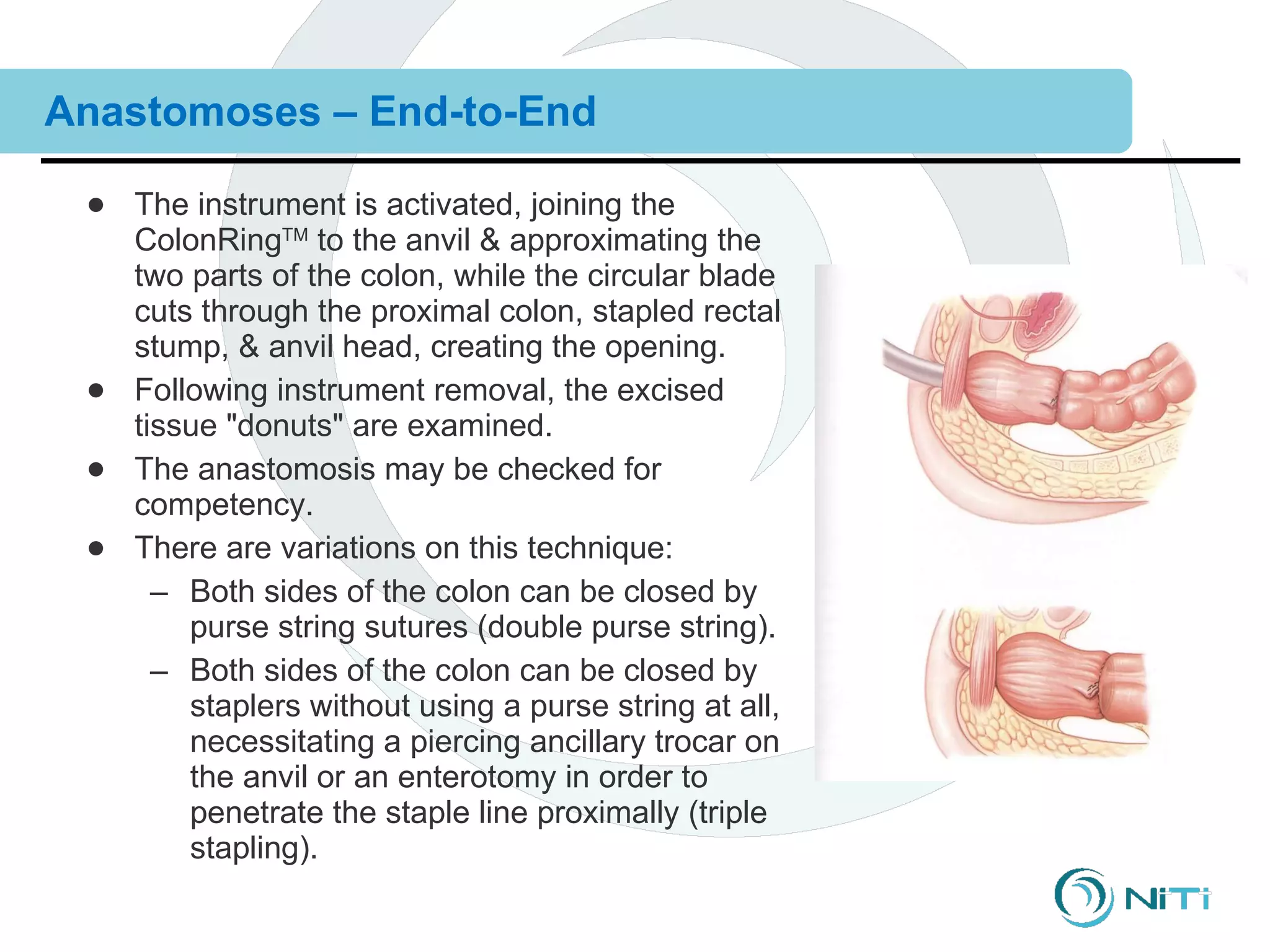
Anastomoses – End-to-End  The instrument is activated, joining the ColonRing TM  to the anvil & approximating the two parts of the colon, while the circular blade cuts through the proximal colon, stapled rectal stump, & anvil head, creating the opening. Following instrument removal, the excised tissue "donuts" are examined. The anastomosis may be checked for competency. There are variations on this technique: Both sides of the colon can be closed by purse string sutures (double purse string). Both sides of the colon can be closed by staplers without using a purse string at all, necessitating a piercing ancillary trocar on the anvil or an enterotomy in order to penetrate the staple line proximally (triple stapling).
Anastomoses –  End-to-Side or Side-to-End or Side-to-Side An anastomosis may also be formed  end-to-side  where the end of the proximal segment is connected to the side of the distal segment. An anastomosis may also be formed  side-to-end  where the side of the proximal segment is connected to the end of the distal segment. An anastomosis may also be formed  side-to-side  where the side of the proximal segment is connected to the side of the distal segment.
Procedures – Not Appropriate Not appropriate for ColonRing TM  use: Small bowel resection w/enteroenterostomy Ring complex may not pass ileocecal valve Ileostomy closure Ring complex may not pass ileocecal valve Transverse or Sigmoid Colostomy  (separate procedure) No anastomosis is performed Hartman procedure No anastomosis is performed
Hartman Procedure In performing a Hartman procedure, the pathologic specimen is resected, and an end sigmoid colostomy is created, leaving a rectal pouch for later closure.
Procedures – Not Appropriate Not appropriate for ColonRing TM  use: Small bowel resection w/enteroenterostomy Ring complex may not pass ileocecal valve Ileostomy closure Ring complex may not pass ileocecal valve Transverse or Sigmoid Colostomy (separate procedure) No anastomosis is performed Hartman procedure No anastomosis is performed Proctocolectomy w/ileoanal anastomosis??? (if hand-sewn) Anastomosis is hand-sewn
Coloanal Anastomosis – Hand-sewn The anastomosis in this case is hand-sewn.
Procedures – Not Appropriate Not appropriate for ColonRing TM  use: Small bowel resection w/enteroenterostomy Ring complex may not pass ileocecal valve Ileostomy closure Ring complex may not pass ileocecal valve Transverse or Sigmoid Colostomy (separate procedure) No anastomosis is performed Hartman procedure No anastomosis is performed Proctocolectomy w/ileoanal anastomosis??? (if hand-sewn) Anastomosis is hand-sewn Abdominoperineal Resection No anastomosis is performed
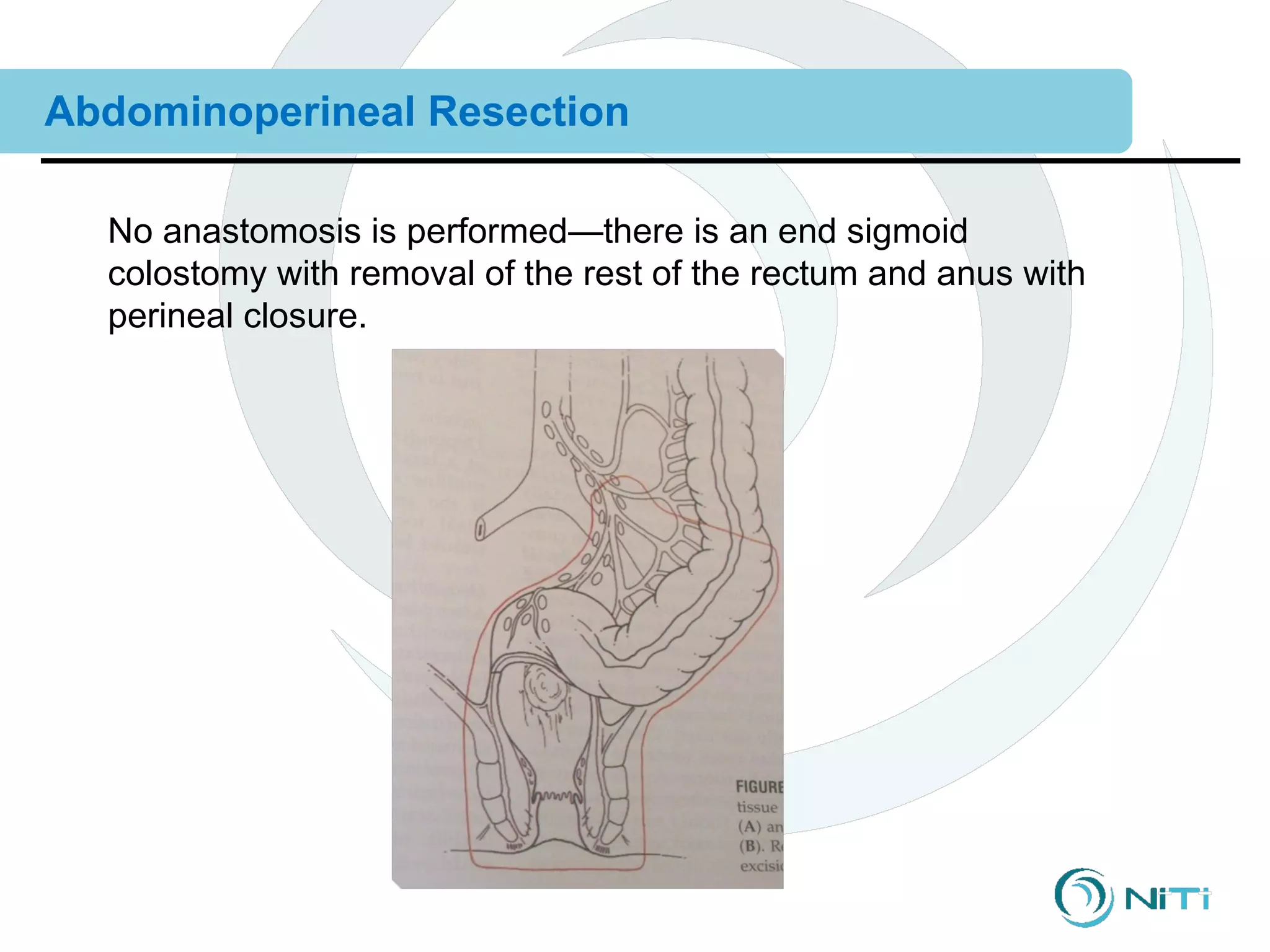
Abdominoperineal Resection No anastomosis is performed—there is an end sigmoid colostomy with removal of the rest of the rectum and anus with perineal closure.
Abdominoperineal Resection (APR)
Procedures—Transanal Insertion (“Routine”) These procedures are performed with a transanal insertion of the ColonRing TM  applier following “routine” protocols: Left colectomy with coloproctostomy
Left Colectomy w/Coloproctostomy .
Procedures—Transanal Insertion (“Routine”) These procedures are performed with a transanal insertion of the ColonRing TM  applier following “routine” protocols: Left colectomy with coloproctostomy Sigmoid resection
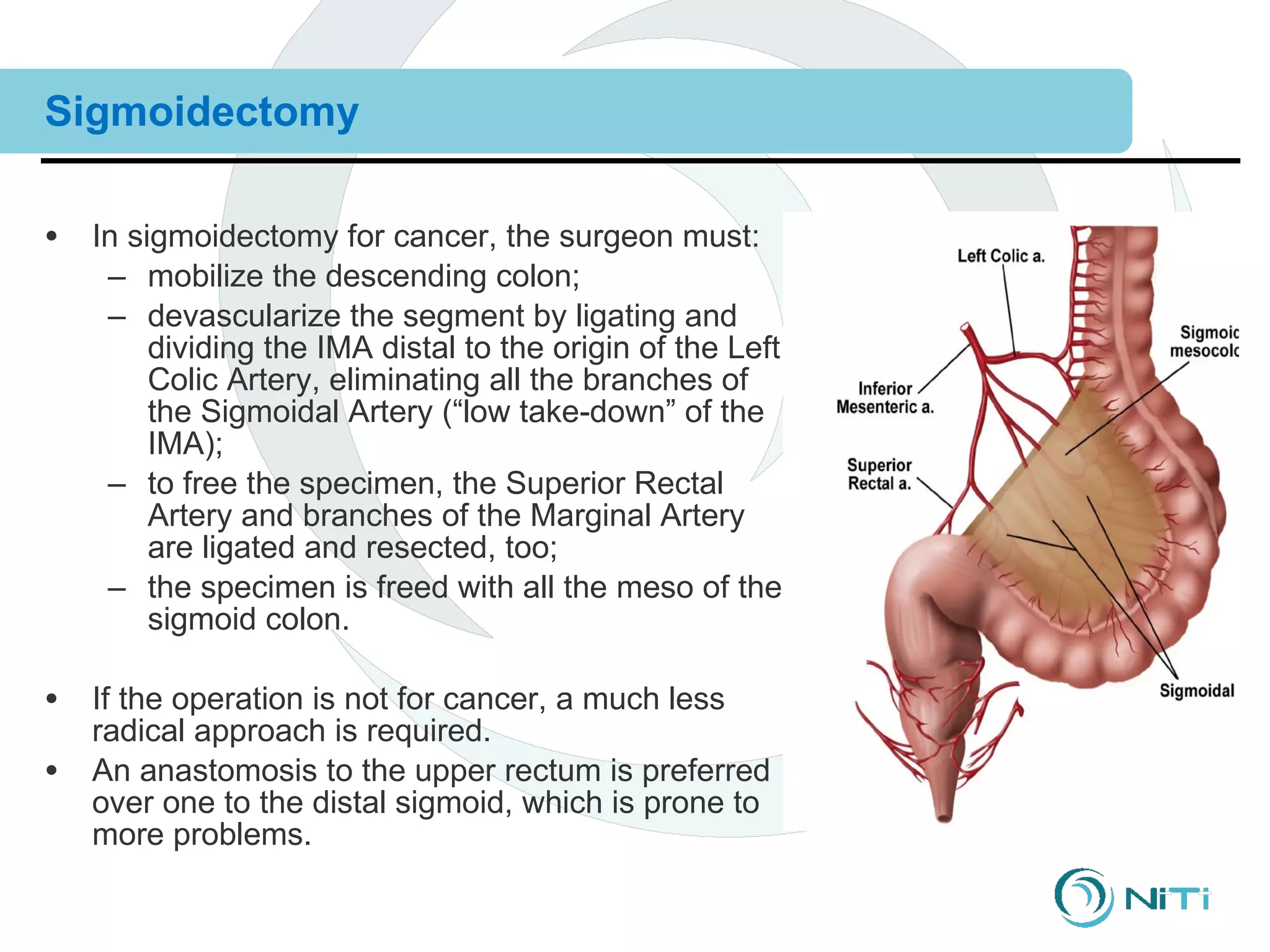
Sigmoidectomy In sigmoidectomy for cancer, the surgeon must: mobilize the descending colon; devascularize the segment by ligating and dividing the IMA distal to the origin of the Left Colic Artery, eliminating all the branches of the Sigmoidal Artery (“low take-down” of the IMA); to free the specimen, the Superior Rectal Artery and branches of the Marginal Artery are ligated and resected, too; the specimen is freed with all the meso of the sigmoid colon. If the operation is not for cancer, a much less radical approach is required. An anastomosis to the upper rectum is preferred over one to the distal sigmoid, which is prone to more problems.
Sigmoidectomy
Procedures—Transanal Insertion (“Routine”) These procedures are performed with a transanal insertion of the ColonRing TM  applier following “routine” protocols: Left colectomy with coloproctostomy Sigmoid resection Anterior resection
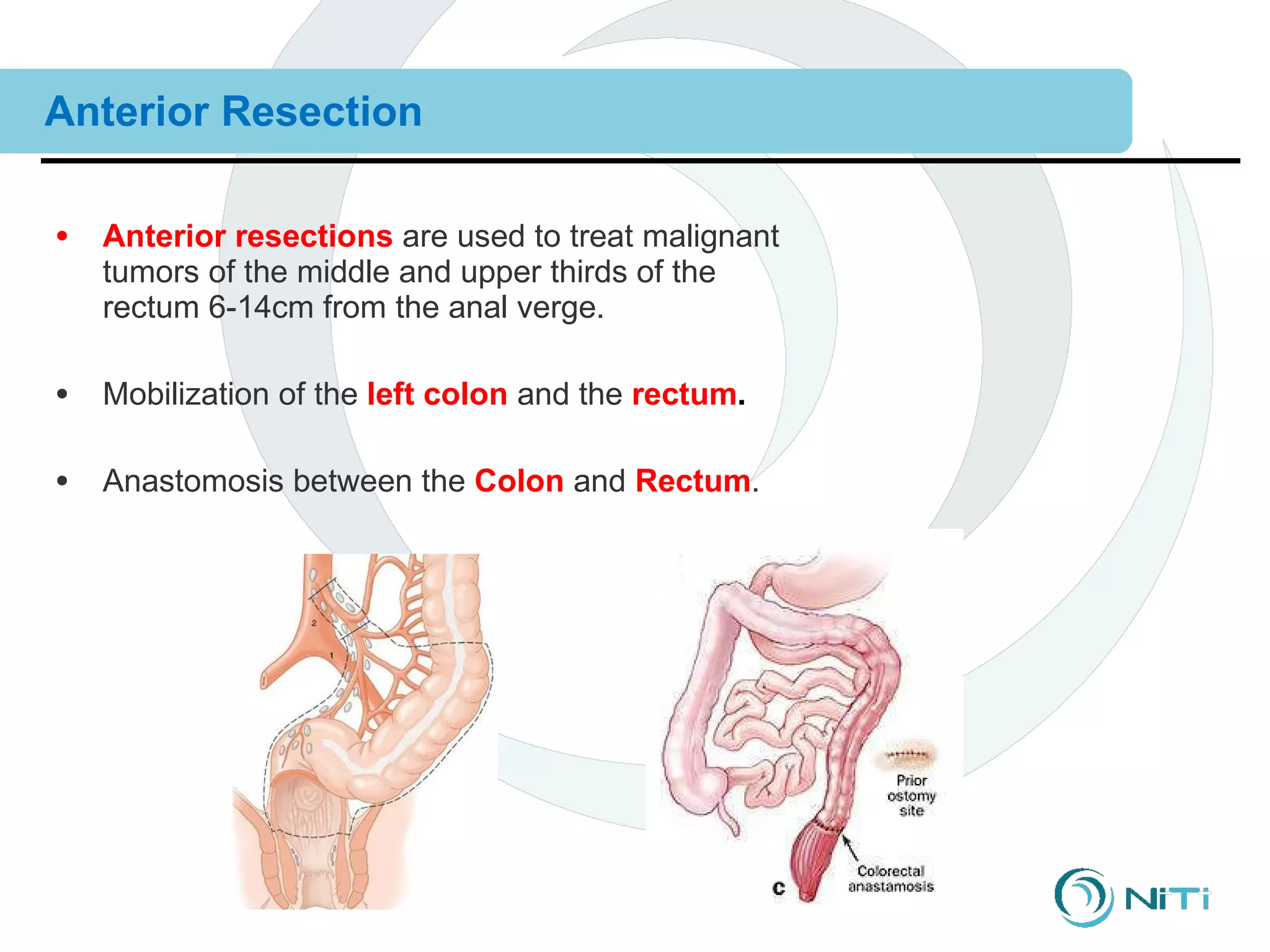
Anterior Resection Anterior resections  are used to treat malignant tumors of the middle and upper thirds of the rectum 6-14cm from the anal verge. Mobilization of the  left colon  and the  rectum . Anastomosis between the  Colon  and  Rectum .
Procedures—Transanal Insertion (“Routine”) These procedures are performed with a transanal insertion of the ColonRing TM  applier following “routine” protocols: Left colectomy with coloproctostomy Sigmoid resection Anterior resection Low anterior resection
Procedures—Low Anterior Resection Many surgeons will not specifically distinguish between Anterior and Low Anterior Resection.  For our purposes, we will consider any anastomosis below 8 cm from the anal verge to be a Low Anterior Resection (anastomosis).
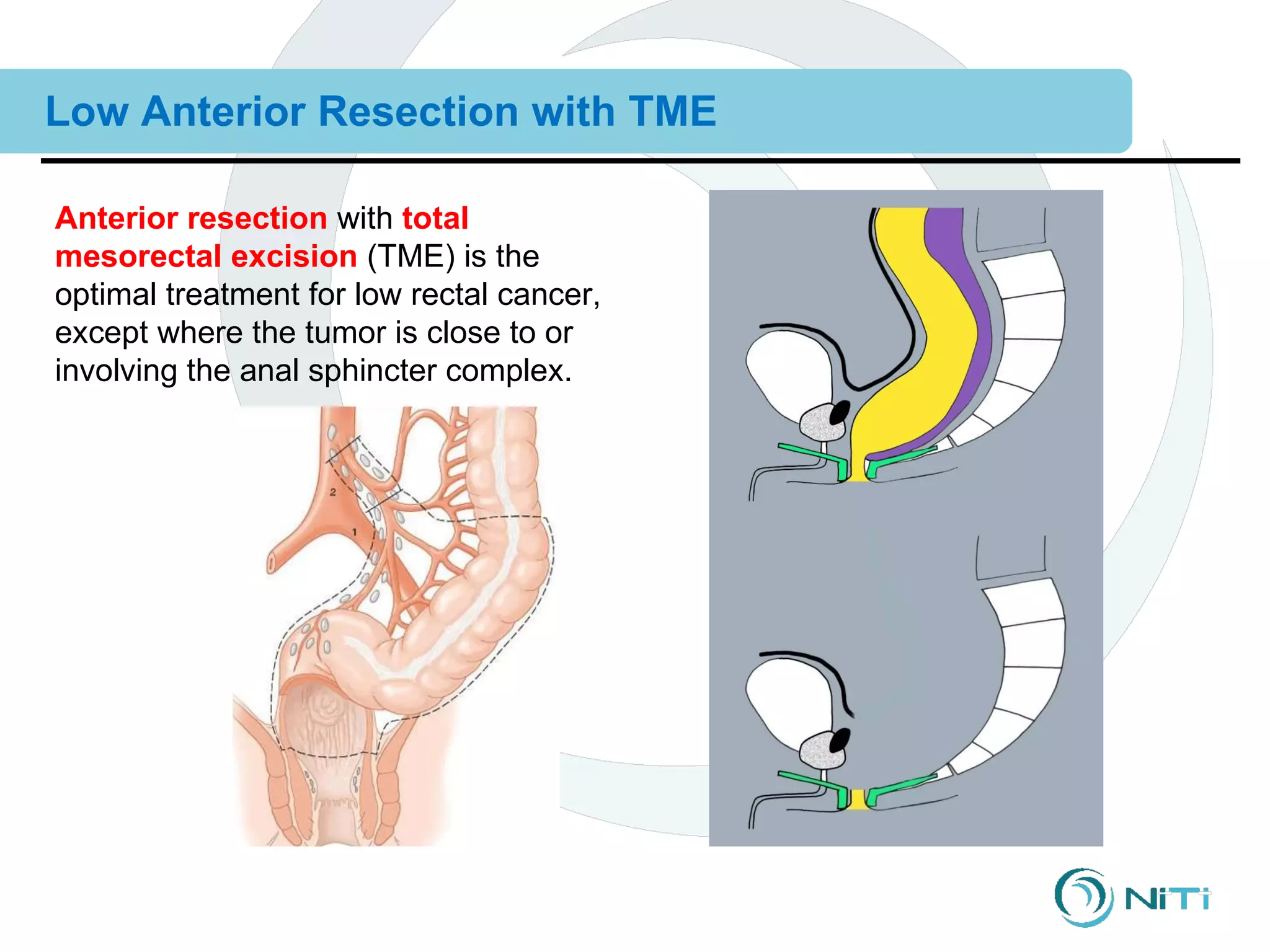
Low Anterior Resection with TME Anterior resection  with  total mesorectal excision  (TME) is the optimal treatment for low rectal cancer, except where the tumor is close to or involving the anal sphincter complex.
Low Anterior Resection with TME Mobilization of the left colon and the rectum is usually required. An anastomosis between the descending colon and the rectum is performed.
Procedures—Transanal Insertion (“Routine”) These procedures are performed with a transanal insertion of the ColonRing TM  applier following “routine” protocols: Left colectomy with coloproctostomy Sigmoid resection Anterior resection Low anterior resection Subtotal colectomy***   (may not be transanal)
Procedures—Transanal Insertion (“Special”) Hartman closure/reversal These procedures, using transanal insertion of the ColonRing TM  applier, require special considerations:
Hartman Reversal/Closure There are several special considerations with this procedure.
Colostomy Closure Colostomy closure (primarily Hartmann reversal)— This procedure may frequently cause more potential problems than expected due to various factors mostly related to the delay between the initial operation and the subsequent closure. Mucous plugs— Fore-shortened segment— “ Strictured” areas— Thick fibrotic tissue— Refer to  Problem Situations  – Module 12b for additional information.
Procedures—Transanal Insertion (“Special”) Hartman closure/reversal Total colectomy w/ileoproctostomy These procedures, using transanal insertion of the ColonRing TM  applier, require special considerations:
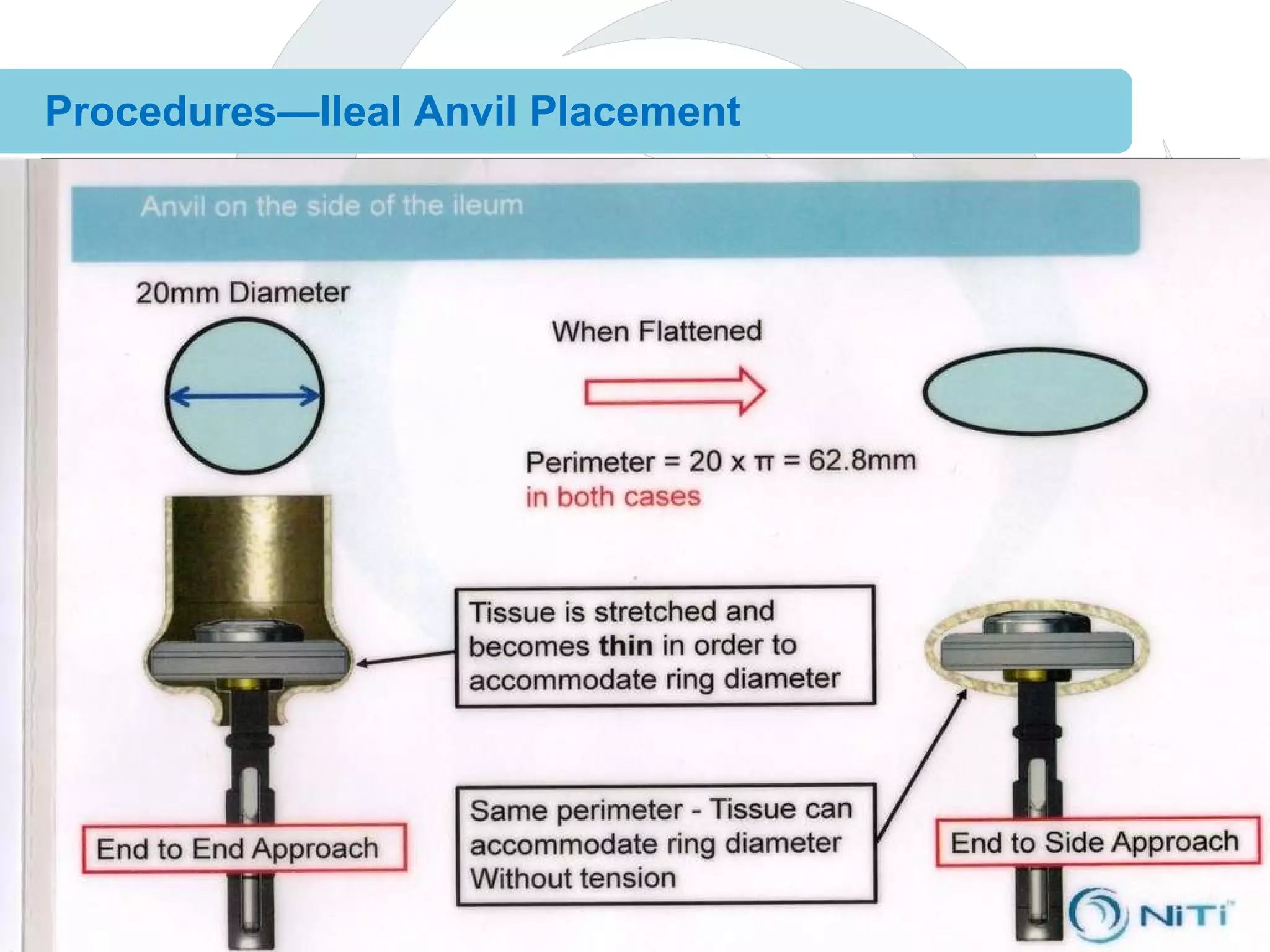
Total Colectomy w/Ileoproctostomy Anvil placement in the small bowel requires special considerations due to the often decreased diameter of the ileum to <27 mm.
Procedures—Ileal Anvil Placement
Total Colectomy w/Ileoproctostomy Anvil placement in the small bowel should be brought out the side of the ileum about 5 cm proximal to the end in order to avoid the potential for radial tension should the diameter of the ileum be <27 mm, either due to normal small lumen or subsequent spasm.
Procedures—Transanal Insertion (“Special”) Hartman closure/reversal Total colectomy w/ileoproctostomy Proctocolectomy w/ileoanal anastomosis*** ( if not hand-sewn—rarely done ) These procedures, using transanal insertion of the ColonRing TM  applier, require special considerations:
Procedures—Transanal Insertion (“Special”) Hartman closure/reversal Total colectomy w/ileoproctostomy Proctocolectomy w/ileoanal anastomosis***(if not hand-sewn) Proctocolectomy w/ileal J-pouch These procedures, using transanal insertion of the ColonRing TM  applier, require special considerations:
Proctocolectomy w/Ileoanal J-Pouch
Procedures—Ileoanal J-Pouch
Procedures—Transanal Insertion (“Special”) Hartman closure/reversal Total colectomy w/ileoproctostomy Proctocolectomy w/ileoanal anastomosis***(if not hand-sewn) Proctocolectomy w/ileal J-pouch Low anterior resection or Proctectomy w/colonic J-pouch These procedures, using transanal insertion of the ColonRing TM  applier, require special considerations:
Low Anterior Resection with TME The operation of low anterior resection with total mesorectal excision (TME) has become the gold standard for the treatment of cancer of the rectum, except where the tumor is adjacent to or involving the anal sphincter complex. There is a low incidence of local recurrence after this procedure, which has now been reported by several independent groups. The procedure has two main drawbacks: Firstly, there is a high risk of anastomotic breakdown (in the range of 5-15%), and many surgeons use a temporary diverting ileostomy to ameliorate the effects of this potential complication. Secondly, it can be associated with a high incidence of urgency and fecal leakage. On the basis of evidence from functional studies and randomized trials, it is becoming standard practice to fashion a short colopouch to improve functional results.
Procedures – Coloanal J-Pouch
Procedures – Coloplasty A longitudinal incision is made along the tenia. The longitudinal incision is closed transversely, enlarging the transverse diameter and creating a small pouch. Longitudinal incision Incision closed transversely Pouch
Protective, Diverting or Loop Ileostomy
Procedures – Non-Transanal Insertion Ileocecectomy Right Hemicolectomy Transverse Colectomy Splenic Flexure Resection Left Hemicolectomy Subtotal colectomy*** (may be transanal) These procedures require special considerations because the applier is not introduced transanal, and a circular anastomotic device is often not routinely used.
Right Hemicolectomy
Right Hemicolectomy   A right hemicolectomy is done for inflammatory conditions, large polyps, and cancers of the cecum and ascending colon. The distal ileum is reconnected to the transverse colon. If the tumor is malignant, it is obligatory to also remove the tissue that contains the blood and lymph vessels that supply or drain the colon.
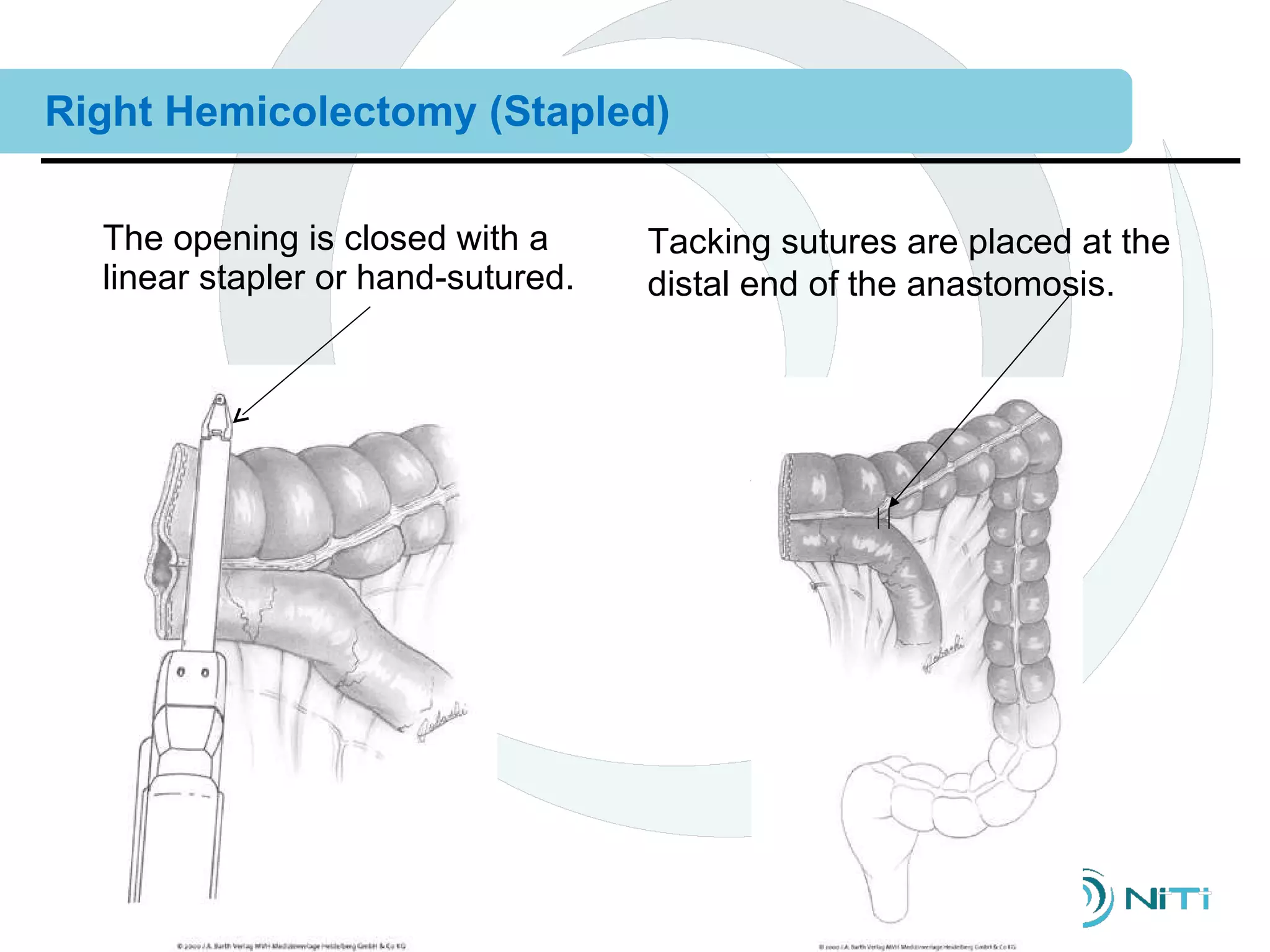
Right Hemicolectomy (Stapled) The two healthy stumps of bowel are joined together with a linear cutter in order to create a new lumen adjacent to right lateral staple line ( functional end-to-end ). Another possibility is to join the stumps in  true side-to-side  position with new lumen a few cms medial to the right lateral staple line.
Right Hemicolectomy (Stapled) The opening is closed with a linear stapler or hand-sutured. Tacking sutures are placed at the distal end of the anastomosis.
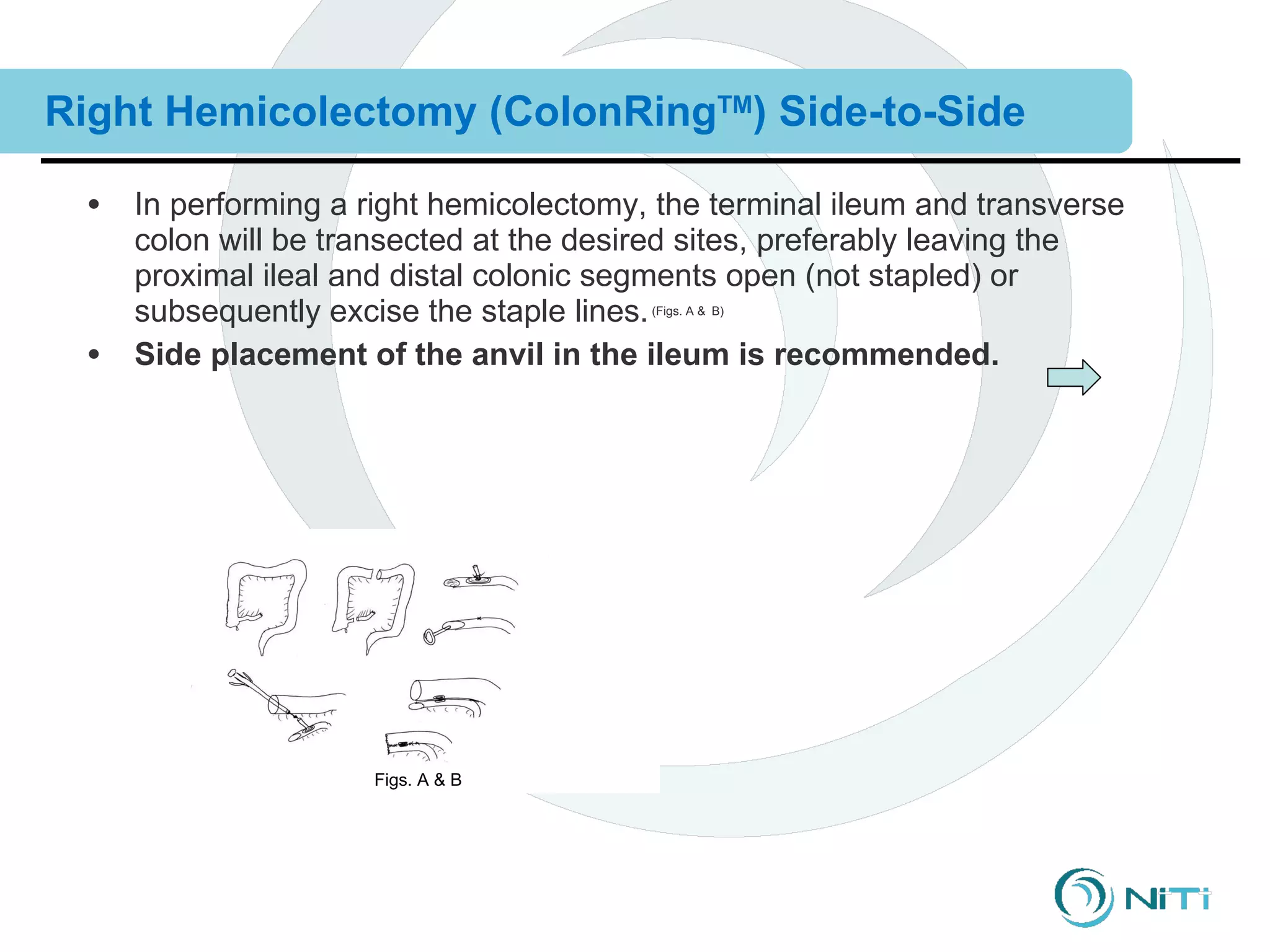
Right Hemicolectomy (ColonRing TM ) Side-to-Side In performing a right hemicolectomy, the terminal ileum and transverse colon will be transected at the desired sites, preferably leaving the proximal ileal and distal colonic segments open (not stapled) or subsequently excise the staple lines.  (Figs. A &   B) Figs. A & B
Right Hemicolectomy (ColonRing TM ) Side-to-Side In performing a right hemicolectomy, the terminal ileum and transverse colon will be transected at the desired sites, preferably leaving the proximal ileal and distal colonic segments open (not stapled) or subsequently excise the staple lines.  (Figs. A &   B) Side placement of the anvil in the ileum is recommended. Figs. A & B
Procedures—Ileal Anvil Placement
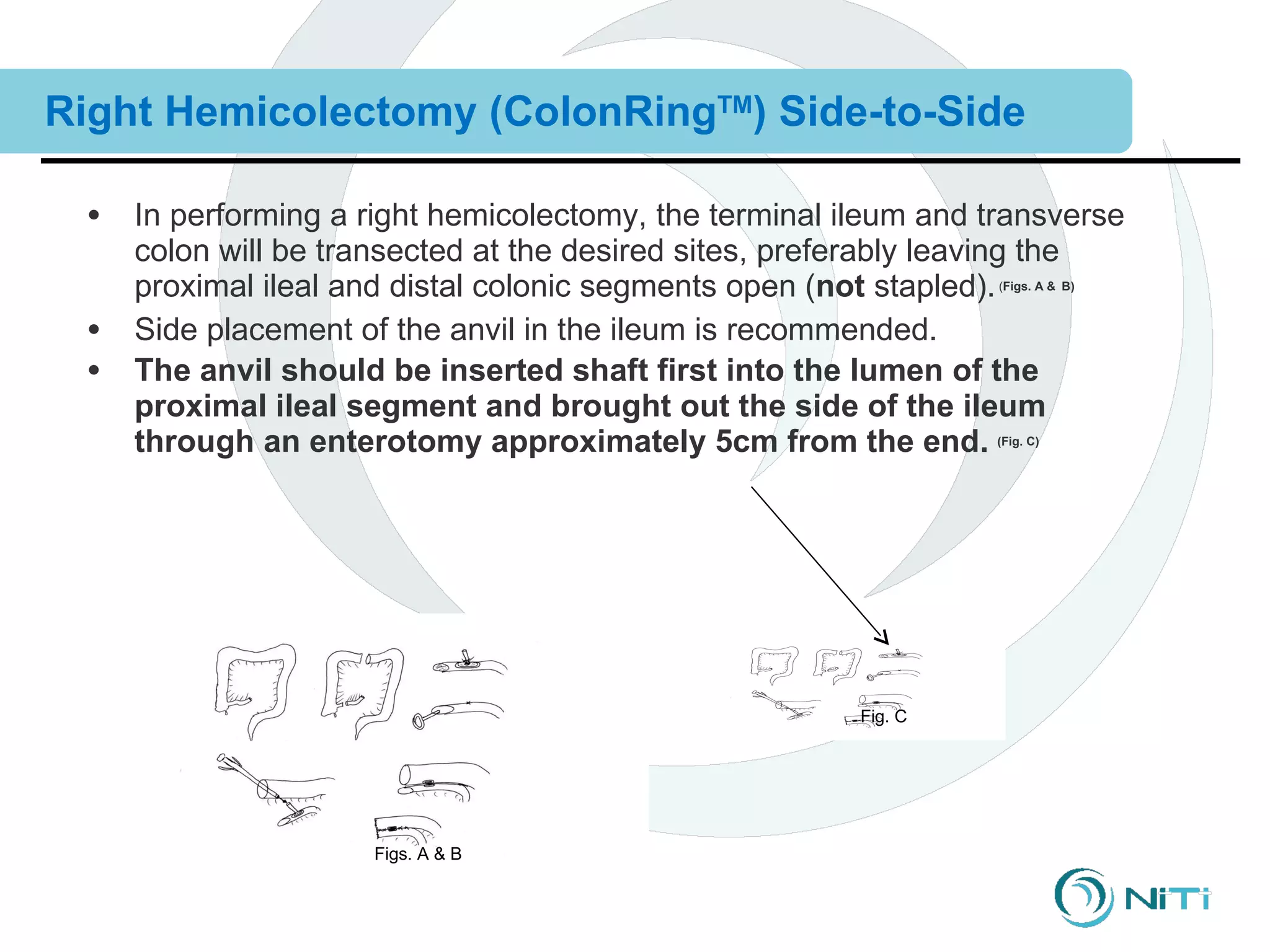
Right Hemicolectomy (ColonRing TM ) Side-to-Side In performing a right hemicolectomy, the terminal ileum and transverse colon will be transected at the desired sites, preferably leaving the proximal ileal and distal colonic segments open ( not  stapled).  ( Figs. A &   B) Side placement of the anvil in the ileum is recommended. The anvil should be inserted shaft first into the lumen of the proximal ileal segment and brought out the side of the ileum through an enterotomy approximately 5cm from the end.  (Fig. C)   Figs. A & B Fig. C
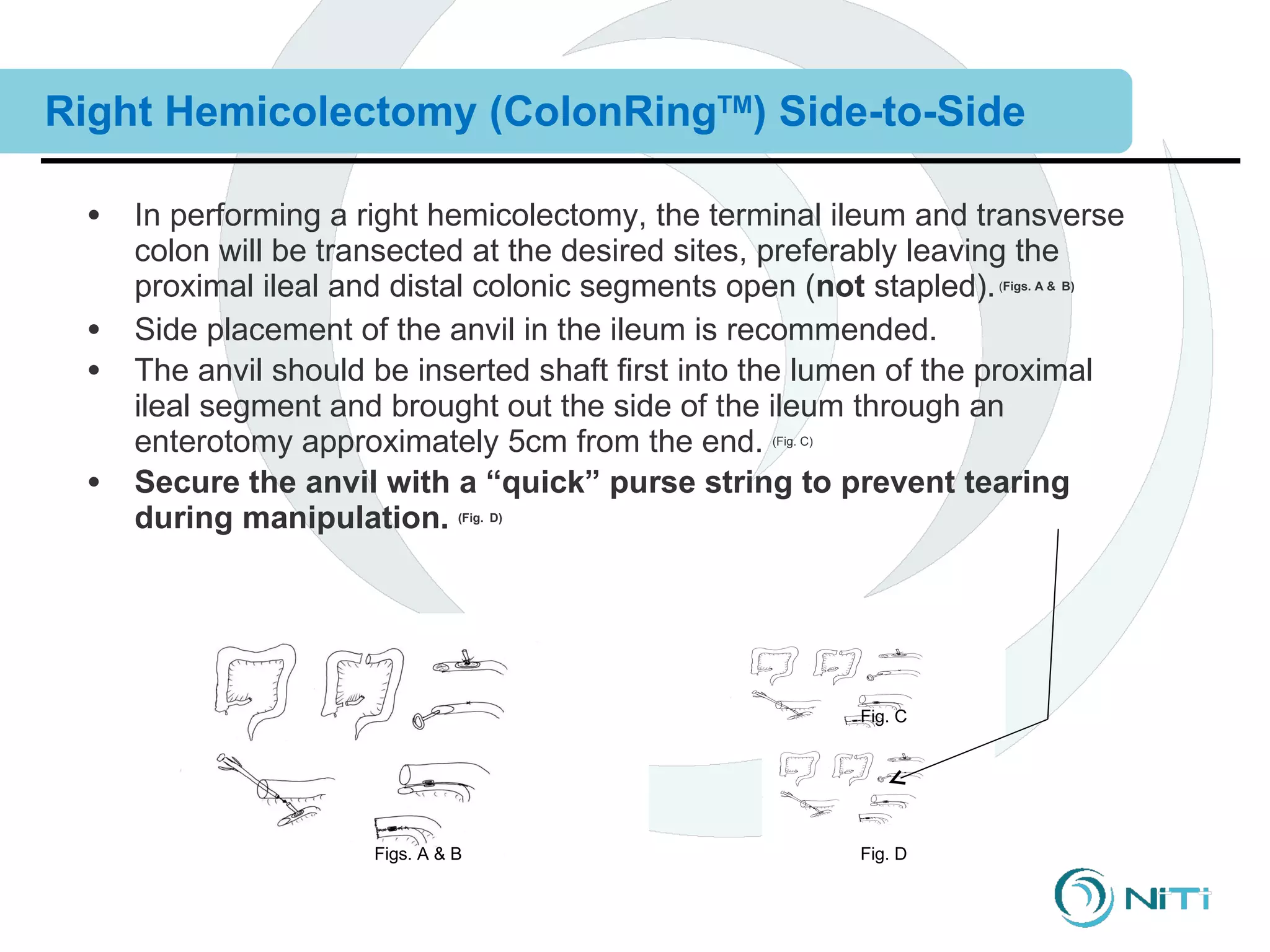
Right Hemicolectomy (ColonRing TM ) Side-to-Side In performing a right hemicolectomy, the terminal ileum and transverse colon will be transected at the desired sites, preferably leaving the proximal ileal and distal colonic segments open ( not  stapled).  ( Figs. A &   B) Side placement of the anvil in the ileum is recommended. The anvil should be inserted shaft first into the lumen of the proximal ileal segment and brought out the side of the ileum through an enterotomy approximately 5cm from the end.  (Fig. C)   Secure the anvil with a “quick” purse string to prevent tearing during manipulation.  (Fig.   D) Figs. A & B Fig. C Fig. D
Right Hemicolectomy (ColonRing TM ) Side-to-Side The ColonRing  TM  applier should be brought through the open distal colonic segment, opening the trocar through the bowel wall approximately 5cm distal to the proximal end.  (Fig.   A) The anvil should then be mated to the trocar, the applier closed in the usual fashion to, and then past, the click; and the cutting trigger and handle depressed to complete the anastomosis.  (Fig.   B) The anastomosis may then be visually inspected through the open lumen, the open ends closed with staples or sutures, and a few “safety” stitches placed on each side of the anastomosis to prevent excess tension from the dependent proximal ileum.  (Fig.   C) Fig. A Fig. B Fig. C
Right Hemicolectomy (ColonRing TM ) Side-to-End Alternatively, for side-to-end approach, the terminal ileum and transverse colon will be transected at the desired sites, preferably leaving the proximal ileal and distal colonic segments open ( not  stapled).  ( Figs. A &   B) The anvil should be inserted shaft first into the lumen of the proximal ileal segment and brought out through the side through an enterotomy approximately 5 cm from the end.  (Fig. C)   Secure the anvil with a “quick” purse string to prevent tearing during manipulation. (Fig.   D)   The ileal end may then be closed by suture or staples. Figs. A & B Fig. C Fig. D
The ColonRing  TM  applier may then be brought retrograde through a distal colonic enterotomy. (Fig.   A)   The trocar will be brought out proximally, either through or adjacent to a stapled end or secured by purse string around the trocar shaft. (Figs.   B&C) The anvil should then be mated to the trocar (side-to-end), the applier closed in the usual fashion to, and then past, the click; and the cutting trigger and handle depressed to complete the anastomosis. (Fig.   D) Appropriate “safety” stitches should be placed on each side of the anastomosis to prevent excess tension from the dependent proximal ileum,   and the enterotomy should be closed. (Fig. E) Right Hemicolectomy (ColonRing TM ) Side-to-End Fig. A Fig. B Fig. C Enterotomy Stapled end Purse string Fig. D Fig. E Ileal end w/side anvil Tacking sutures
Extended Right Hemicolectomy An extended right hemicolectomy is done for cancers of the hepatic flexure or transverse colon. The distal ileum is anastomosed to the descending colon.
Transverse Colectomy The proximal segment is usually anastomosed end-to-end or side-to-side to the distal segment.
High Left Colectomy/Hemicolectomy The proximal segment is usually anastomosed end-to-end or side-to-side to the distal segment.
Segmental and High Left Hemicolectomy Similarly, extended right, segmental, transverse, and high left colectomies may be performed with the ColonRing TM , if desired, following the techniques described previously for right hemicolectomy. Where small bowel is not involved, the anvil may be brought through the end of the desired lumen. If the bowel segment in which the anvil is to be placed is enlarged (perhaps >33-35 mm), it may be appropriate to consider bringing it through the side wall to avoid “bunching” the excess tissue around a purse string. In some cases, it may be more advantageous technically to place the anvil in the distal lumen.
Segmental and High Left Hemicolectomy In those cases in which the anvil is placed in the distal lumen, the anastomosis may be performed either end-to-end or side-to-end. For end-to-end, the applier may be brought either a proximal enterotomy with the trocar being brought out through a stapled or purse stringed end. (Fig. A)   For side-to-end, the applier may be brought retrograde through the end of the proximal segment with the trocar being brought out through the side of the proximal segment at the desired site of anastomosis. (Fig. B) The excess end of the proximal segment may then be resected, leaving a small pouch adjacent to the anastomosis. (Fig. C) Fig. A Fig. B Fig. C Enterotomy closed Anastomosis Segment to be resected Anastomosis Residual pouch Enterotomy

Combined 12 clinical training--surgical procedures

  • 1.
    The Next Erain GI Surgery BioDynamix TM Anastomosis The Colon Ring Clinical Training Team TREATMENT Surgical Procedures
  • 2.
    Anastomoses – End-to-End On the proximal side, the surgeon will insert the anvil and place a purse string suture. On the distal side, he will open the circular device and penetrate the stump through or near the staple line with the trocar. The anvil shaft and center rod are joined, and the anvil is closed against the center rod.
  • 3.
    Anastomoses – End-to-End The instrument is activated, joining the ColonRing TM to the anvil & approximating the two parts of the colon, while the circular blade cuts through the proximal colon, stapled rectal stump, & anvil head, creating the opening. Following instrument removal, the excised tissue &quot;donuts&quot; are examined. The anastomosis may be checked for competency. There are variations on this technique: Both sides of the colon can be closed by purse string sutures (double purse string). Both sides of the colon can be closed by staplers without using a purse string at all, necessitating a piercing ancillary trocar on the anvil or an enterotomy in order to penetrate the staple line proximally (triple stapling).
  • 4.
    Anastomoses – End-to-Side or Side-to-End or Side-to-Side An anastomosis may also be formed end-to-side where the end of the proximal segment is connected to the side of the distal segment. An anastomosis may also be formed side-to-end where the side of the proximal segment is connected to the end of the distal segment. An anastomosis may also be formed side-to-side where the side of the proximal segment is connected to the side of the distal segment.
  • 5.
    Procedures – NotAppropriate Not appropriate for ColonRing TM use: Small bowel resection w/enteroenterostomy Ring complex may not pass ileocecal valve Ileostomy closure Ring complex may not pass ileocecal valve Transverse or Sigmoid Colostomy (separate procedure) No anastomosis is performed Hartman procedure No anastomosis is performed
  • 6.
    Hartman Procedure Inperforming a Hartman procedure, the pathologic specimen is resected, and an end sigmoid colostomy is created, leaving a rectal pouch for later closure.
  • 7.
    Procedures – NotAppropriate Not appropriate for ColonRing TM use: Small bowel resection w/enteroenterostomy Ring complex may not pass ileocecal valve Ileostomy closure Ring complex may not pass ileocecal valve Transverse or Sigmoid Colostomy (separate procedure) No anastomosis is performed Hartman procedure No anastomosis is performed Proctocolectomy w/ileoanal anastomosis??? (if hand-sewn) Anastomosis is hand-sewn
  • 8.
    Coloanal Anastomosis –Hand-sewn The anastomosis in this case is hand-sewn.
  • 9.
    Procedures – NotAppropriate Not appropriate for ColonRing TM use: Small bowel resection w/enteroenterostomy Ring complex may not pass ileocecal valve Ileostomy closure Ring complex may not pass ileocecal valve Transverse or Sigmoid Colostomy (separate procedure) No anastomosis is performed Hartman procedure No anastomosis is performed Proctocolectomy w/ileoanal anastomosis??? (if hand-sewn) Anastomosis is hand-sewn Abdominoperineal Resection No anastomosis is performed
  • 10.
    Abdominoperineal Resection Noanastomosis is performed—there is an end sigmoid colostomy with removal of the rest of the rectum and anus with perineal closure.
  • 11.
  • 12.
    Procedures—Transanal Insertion (“Routine”)These procedures are performed with a transanal insertion of the ColonRing TM applier following “routine” protocols: Left colectomy with coloproctostomy
  • 13.
  • 14.
    Procedures—Transanal Insertion (“Routine”)These procedures are performed with a transanal insertion of the ColonRing TM applier following “routine” protocols: Left colectomy with coloproctostomy Sigmoid resection
  • 15.
    Sigmoidectomy In sigmoidectomyfor cancer, the surgeon must: mobilize the descending colon; devascularize the segment by ligating and dividing the IMA distal to the origin of the Left Colic Artery, eliminating all the branches of the Sigmoidal Artery (“low take-down” of the IMA); to free the specimen, the Superior Rectal Artery and branches of the Marginal Artery are ligated and resected, too; the specimen is freed with all the meso of the sigmoid colon. If the operation is not for cancer, a much less radical approach is required. An anastomosis to the upper rectum is preferred over one to the distal sigmoid, which is prone to more problems.
  • 16.
  • 17.
    Procedures—Transanal Insertion (“Routine”)These procedures are performed with a transanal insertion of the ColonRing TM applier following “routine” protocols: Left colectomy with coloproctostomy Sigmoid resection Anterior resection
  • 18.
    Anterior Resection Anteriorresections are used to treat malignant tumors of the middle and upper thirds of the rectum 6-14cm from the anal verge. Mobilization of the left colon and the rectum . Anastomosis between the Colon and Rectum .
  • 19.
    Procedures—Transanal Insertion (“Routine”)These procedures are performed with a transanal insertion of the ColonRing TM applier following “routine” protocols: Left colectomy with coloproctostomy Sigmoid resection Anterior resection Low anterior resection
  • 20.
    Procedures—Low Anterior ResectionMany surgeons will not specifically distinguish between Anterior and Low Anterior Resection. For our purposes, we will consider any anastomosis below 8 cm from the anal verge to be a Low Anterior Resection (anastomosis).
  • 21.
    Low Anterior Resectionwith TME Anterior resection with total mesorectal excision (TME) is the optimal treatment for low rectal cancer, except where the tumor is close to or involving the anal sphincter complex.
  • 22.
    Low Anterior Resectionwith TME Mobilization of the left colon and the rectum is usually required. An anastomosis between the descending colon and the rectum is performed.
  • 23.
    Procedures—Transanal Insertion (“Routine”)These procedures are performed with a transanal insertion of the ColonRing TM applier following “routine” protocols: Left colectomy with coloproctostomy Sigmoid resection Anterior resection Low anterior resection Subtotal colectomy*** (may not be transanal)
  • 24.
    Procedures—Transanal Insertion (“Special”)Hartman closure/reversal These procedures, using transanal insertion of the ColonRing TM applier, require special considerations:
  • 25.
    Hartman Reversal/Closure Thereare several special considerations with this procedure.
  • 26.
    Colostomy Closure Colostomyclosure (primarily Hartmann reversal)— This procedure may frequently cause more potential problems than expected due to various factors mostly related to the delay between the initial operation and the subsequent closure. Mucous plugs— Fore-shortened segment— “ Strictured” areas— Thick fibrotic tissue— Refer to Problem Situations – Module 12b for additional information.
  • 27.
    Procedures—Transanal Insertion (“Special”)Hartman closure/reversal Total colectomy w/ileoproctostomy These procedures, using transanal insertion of the ColonRing TM applier, require special considerations:
  • 28.
    Total Colectomy w/IleoproctostomyAnvil placement in the small bowel requires special considerations due to the often decreased diameter of the ileum to <27 mm.
  • 29.
  • 30.
    Total Colectomy w/IleoproctostomyAnvil placement in the small bowel should be brought out the side of the ileum about 5 cm proximal to the end in order to avoid the potential for radial tension should the diameter of the ileum be <27 mm, either due to normal small lumen or subsequent spasm.
  • 31.
    Procedures—Transanal Insertion (“Special”)Hartman closure/reversal Total colectomy w/ileoproctostomy Proctocolectomy w/ileoanal anastomosis*** ( if not hand-sewn—rarely done ) These procedures, using transanal insertion of the ColonRing TM applier, require special considerations:
  • 32.
    Procedures—Transanal Insertion (“Special”)Hartman closure/reversal Total colectomy w/ileoproctostomy Proctocolectomy w/ileoanal anastomosis***(if not hand-sewn) Proctocolectomy w/ileal J-pouch These procedures, using transanal insertion of the ColonRing TM applier, require special considerations:
  • 33.
  • 34.
  • 35.
    Procedures—Transanal Insertion (“Special”)Hartman closure/reversal Total colectomy w/ileoproctostomy Proctocolectomy w/ileoanal anastomosis***(if not hand-sewn) Proctocolectomy w/ileal J-pouch Low anterior resection or Proctectomy w/colonic J-pouch These procedures, using transanal insertion of the ColonRing TM applier, require special considerations:
  • 36.
    Low Anterior Resectionwith TME The operation of low anterior resection with total mesorectal excision (TME) has become the gold standard for the treatment of cancer of the rectum, except where the tumor is adjacent to or involving the anal sphincter complex. There is a low incidence of local recurrence after this procedure, which has now been reported by several independent groups. The procedure has two main drawbacks: Firstly, there is a high risk of anastomotic breakdown (in the range of 5-15%), and many surgeons use a temporary diverting ileostomy to ameliorate the effects of this potential complication. Secondly, it can be associated with a high incidence of urgency and fecal leakage. On the basis of evidence from functional studies and randomized trials, it is becoming standard practice to fashion a short colopouch to improve functional results.
  • 37.
  • 38.
    Procedures – ColoplastyA longitudinal incision is made along the tenia. The longitudinal incision is closed transversely, enlarging the transverse diameter and creating a small pouch. Longitudinal incision Incision closed transversely Pouch
  • 39.
  • 40.
    Procedures – Non-TransanalInsertion Ileocecectomy Right Hemicolectomy Transverse Colectomy Splenic Flexure Resection Left Hemicolectomy Subtotal colectomy*** (may be transanal) These procedures require special considerations because the applier is not introduced transanal, and a circular anastomotic device is often not routinely used.
  • 41.
  • 42.
    Right Hemicolectomy A right hemicolectomy is done for inflammatory conditions, large polyps, and cancers of the cecum and ascending colon. The distal ileum is reconnected to the transverse colon. If the tumor is malignant, it is obligatory to also remove the tissue that contains the blood and lymph vessels that supply or drain the colon.
  • 43.
    Right Hemicolectomy (Stapled)The two healthy stumps of bowel are joined together with a linear cutter in order to create a new lumen adjacent to right lateral staple line ( functional end-to-end ). Another possibility is to join the stumps in true side-to-side position with new lumen a few cms medial to the right lateral staple line.
  • 44.
    Right Hemicolectomy (Stapled)The opening is closed with a linear stapler or hand-sutured. Tacking sutures are placed at the distal end of the anastomosis.
  • 45.
    Right Hemicolectomy (ColonRingTM ) Side-to-Side In performing a right hemicolectomy, the terminal ileum and transverse colon will be transected at the desired sites, preferably leaving the proximal ileal and distal colonic segments open (not stapled) or subsequently excise the staple lines. (Figs. A & B) Figs. A & B
  • 46.
    Right Hemicolectomy (ColonRingTM ) Side-to-Side In performing a right hemicolectomy, the terminal ileum and transverse colon will be transected at the desired sites, preferably leaving the proximal ileal and distal colonic segments open (not stapled) or subsequently excise the staple lines. (Figs. A & B) Side placement of the anvil in the ileum is recommended. Figs. A & B
  • 47.
  • 48.
    Right Hemicolectomy (ColonRingTM ) Side-to-Side In performing a right hemicolectomy, the terminal ileum and transverse colon will be transected at the desired sites, preferably leaving the proximal ileal and distal colonic segments open ( not stapled). ( Figs. A & B) Side placement of the anvil in the ileum is recommended. The anvil should be inserted shaft first into the lumen of the proximal ileal segment and brought out the side of the ileum through an enterotomy approximately 5cm from the end. (Fig. C) Figs. A & B Fig. C
  • 49.
    Right Hemicolectomy (ColonRingTM ) Side-to-Side In performing a right hemicolectomy, the terminal ileum and transverse colon will be transected at the desired sites, preferably leaving the proximal ileal and distal colonic segments open ( not stapled). ( Figs. A & B) Side placement of the anvil in the ileum is recommended. The anvil should be inserted shaft first into the lumen of the proximal ileal segment and brought out the side of the ileum through an enterotomy approximately 5cm from the end. (Fig. C) Secure the anvil with a “quick” purse string to prevent tearing during manipulation. (Fig. D) Figs. A & B Fig. C Fig. D
  • 50.
    Right Hemicolectomy (ColonRingTM ) Side-to-Side The ColonRing TM applier should be brought through the open distal colonic segment, opening the trocar through the bowel wall approximately 5cm distal to the proximal end. (Fig. A) The anvil should then be mated to the trocar, the applier closed in the usual fashion to, and then past, the click; and the cutting trigger and handle depressed to complete the anastomosis. (Fig. B) The anastomosis may then be visually inspected through the open lumen, the open ends closed with staples or sutures, and a few “safety” stitches placed on each side of the anastomosis to prevent excess tension from the dependent proximal ileum. (Fig. C) Fig. A Fig. B Fig. C
  • 51.
    Right Hemicolectomy (ColonRingTM ) Side-to-End Alternatively, for side-to-end approach, the terminal ileum and transverse colon will be transected at the desired sites, preferably leaving the proximal ileal and distal colonic segments open ( not stapled). ( Figs. A & B) The anvil should be inserted shaft first into the lumen of the proximal ileal segment and brought out through the side through an enterotomy approximately 5 cm from the end. (Fig. C) Secure the anvil with a “quick” purse string to prevent tearing during manipulation. (Fig. D) The ileal end may then be closed by suture or staples. Figs. A & B Fig. C Fig. D
  • 52.
    The ColonRing TM applier may then be brought retrograde through a distal colonic enterotomy. (Fig. A) The trocar will be brought out proximally, either through or adjacent to a stapled end or secured by purse string around the trocar shaft. (Figs. B&C) The anvil should then be mated to the trocar (side-to-end), the applier closed in the usual fashion to, and then past, the click; and the cutting trigger and handle depressed to complete the anastomosis. (Fig. D) Appropriate “safety” stitches should be placed on each side of the anastomosis to prevent excess tension from the dependent proximal ileum, and the enterotomy should be closed. (Fig. E) Right Hemicolectomy (ColonRing TM ) Side-to-End Fig. A Fig. B Fig. C Enterotomy Stapled end Purse string Fig. D Fig. E Ileal end w/side anvil Tacking sutures
  • 53.
    Extended Right HemicolectomyAn extended right hemicolectomy is done for cancers of the hepatic flexure or transverse colon. The distal ileum is anastomosed to the descending colon.
  • 54.
    Transverse Colectomy Theproximal segment is usually anastomosed end-to-end or side-to-side to the distal segment.
  • 55.
    High Left Colectomy/HemicolectomyThe proximal segment is usually anastomosed end-to-end or side-to-side to the distal segment.
  • 56.
    Segmental and HighLeft Hemicolectomy Similarly, extended right, segmental, transverse, and high left colectomies may be performed with the ColonRing TM , if desired, following the techniques described previously for right hemicolectomy. Where small bowel is not involved, the anvil may be brought through the end of the desired lumen. If the bowel segment in which the anvil is to be placed is enlarged (perhaps >33-35 mm), it may be appropriate to consider bringing it through the side wall to avoid “bunching” the excess tissue around a purse string. In some cases, it may be more advantageous technically to place the anvil in the distal lumen.
  • 57.
    Segmental and HighLeft Hemicolectomy In those cases in which the anvil is placed in the distal lumen, the anastomosis may be performed either end-to-end or side-to-end. For end-to-end, the applier may be brought either a proximal enterotomy with the trocar being brought out through a stapled or purse stringed end. (Fig. A) For side-to-end, the applier may be brought retrograde through the end of the proximal segment with the trocar being brought out through the side of the proximal segment at the desired site of anastomosis. (Fig. B) The excess end of the proximal segment may then be resected, leaving a small pouch adjacent to the anastomosis. (Fig. C) Fig. A Fig. B Fig. C Enterotomy closed Anastomosis Segment to be resected Anastomosis Residual pouch Enterotomy