NLP Business Coaching Series 
The Language of Influence and 
Persuasion Introduction to the 
NLP Milton Model
+ What is persuasive and influential language? 
This is the language used by the top ‘people leaders’ in the world to empower others and helps them 
to develop themselves. 
It is the language that creates the least resistance and most agreement when talking to people. Most 
of all, it is the language that encourages others to make decisions and come up with their own 
solutions! 
To be persuasive and influential others have to recognise, and accept you, as an expert. You have to 
know what you are talking about, and be in a position to help someone resolve something. You do 
this by using language in a way that helps people come up with their own solutions to problems, not 
by giving them the answers! 
Persuasive and influential language encourages individuals to find their own skills and resources 
needed to achieve what ever it is they are required to do. 
This can be as simple as asking a client ‘when’ they are going to make a decision rather then ‘if’ they 
are going to make a decision (implying a decision will be made). 
Or, as complex as, empowering others to believe they are capable of achieving something they are 
not sure they can do yet. (Implying that you believe that person has the ability to achieve this, even 
although they may not believe they can!).
+ What persuasive and influential language is not? 
Persuasive and Influential language is not used to force people to do what you want!! 
Some people want to learn these skills so they can manipulative others into doing things they want 
done. This is not a leadership skill, this is called bullying!! 
People are not stupid; think of a time when someone tried to persuade you to do something you were 
not comfortable with and really didn’t want to do. How did that feel? I am guessing you felt 
uncomfortable and manipulated? 
Buyers remorse is the biggest cause of cancellations, product returns and clients using products and 
services only once. This happens when someone has been persuaded to buy something they did not 
need or want by a ‘pushy’ person. 
They often said yes to buying a product or service just to to get rid of the sales person. This is 
because they had not yet ‘bought into’ to what that product or service could do for them. Although 
they bought something, they will never give that sales person repeat business or recommend them to 
others. 
It is exactly the same situation when leading others. If you are ‘pushy’, bullying and manipulative 
people respond once and resist ‘buying in’ to your future ideas and suggestions.
+ The importance of using persuasive and 
influential language. 
Often in business people get promoted to leadership positions because they are fantastic at the 
specific job they do. They get put in ‘charge’ of a team and are sent off to lead people without any 
training in how to to influence and persuade others. 
Some people are naturally good at influencing and persuading others however, for most people this is 
a leadership skill that they need to learn. 
The importance of using influential and persuasive language is, that it creates a culture where people 
are encouraged to take personal responsibility for their actions and come up with their own solutions 
in the workplace. 
This is achieved by talking to others in ways that help them to think about what they have to do, to 
achieve a desired outcome, rather than telling them directly, what to do. 
Speaking to people in this way can take longer and more require more effort than just telling them 
what to do. 
However, ultimately this saves time and money as your people develop and create a culture of 
personal responsibility and great working relationships between their work colleagues and clients.
+ The way naturally delete, distort and generalise 
information 
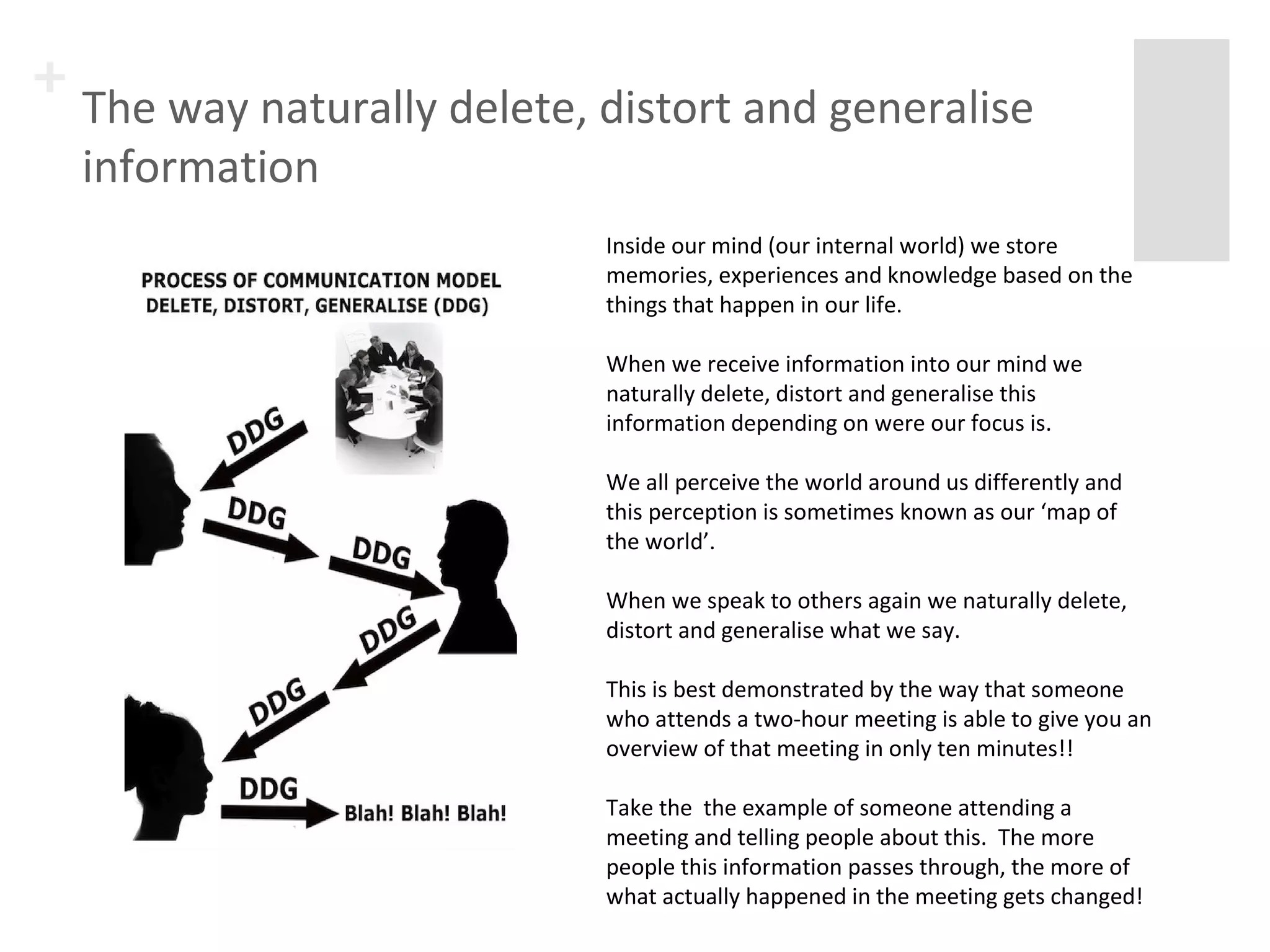
Inside our mind (our internal world) we store 
memories, experiences and knowledge based on the 
things that happen in our life. 
When we receive information into our mind we 
naturally delete, distort and generalise this 
information depending on were our focus is. 
We all perceive the world around us differently and 
this perception is sometimes known as our ‘map of 
the world’. 
When we speak to others again we naturally delete, 
distort and generalise what we say. 
This is best demonstrated by the way that someone 
who attends a two-hour meeting is able to give you an 
overview of that meeting in only ten minutes!! 
Take the the example of someone attending a 
meeting and telling people about this. The more 
people this information passes through, the more of 
what actually happened in the meeting gets changed!
+ The NLP Milton Model – the most powerful 
language tool to influence and persuade others 
The Milton Model was developed by Richard Bandler and John Grinder (the co-founders of Neuro 
Linguistic Programming) from the work they did modeling the language patterns of Milton Erickson. 
Milton Erickson was a hypnotherapist who achieved amazing results with his patients. Bandler and 
Grinder where able to establish (by modeling how Milton Erikson spoke to his patients) that the 
language patterns he used worked so well, because they were intentionally ambiguous. 
Milton worked on the assumption that people already know how to solve their problems. He gave his 
patients deliberate, ambiguous suggestions that encouraged them to access their own resources and 
find their own answers to their problems. 
The Milton Model is a way of using language when speaking to someone where you deliberately 
delete, distort and generalise what you say to someone so that they have to fill in what is missing 
from their “internal world’ 
It is the art of being ambiguously specific!!
+ Milton Model in action - the scenario 
A sales manager has a team member, who usually overachieves their target by 5%. This 
person has just been given their new target for the year. This year their target has been 
increased by 11% instead of the usual 8%. This person is now struggling to imagine achieving 
this new target. 
The information above tells you. 
That there is a sales person 
They usually overachieve their target by 5% 
They have received a new target 
Their annual target is usually increased by 8% 
This year the target has been increased by 3% more than it normally is. 
They are struggling to imagine how they will achieve this new target. 
The elegant use of Milton Model language by leaders to influence and persuade others 
depends on giving people suggestions ONLY from the facts you have.
+ Trying to influence and persuade without using 
Milton Model language 
Often people who lead others think the can persuade people to do something by providing them with 
solutions, based on what works for them. 
For example our sales manager, trying to persuade and influence this person, could say. 
“To get your target, you can start work an hour earlier, at 8 instead of 9 and make 30 calls a day 
instead of 20. That will get you more appointments to get you in front of your customers. The more 
customers you see the more sales you will get. This should help you achieve your 11% increased 
target. 
The problem with talking like this, to someone who is already struggling to even think about achieving 
their target, is that you have only given them a strategy of things to do (normally based on what has 
worked for YOU in the past). These are tasks and things to do in the ‘outside world’ 
You have not addressed how they are thinking about the situation in their own head, what we call 
their “inside world”
+ Influencing and persuading by using Milton 
Model language 
When language is consciously structured to be deliberately ambiguous, vague and free from specifics, 
it becomes much more persuasive. We are constantly being given suggestions from others in the 
advice they give us. 
Using Milton model language is the art of giving people suggestions in such a way that they access 
their own inner resources and come up with their own ways to do something. Simply put - helping 
them to think about how they will do something. 
In this example - our sales manager using the Milton model language style could say: 
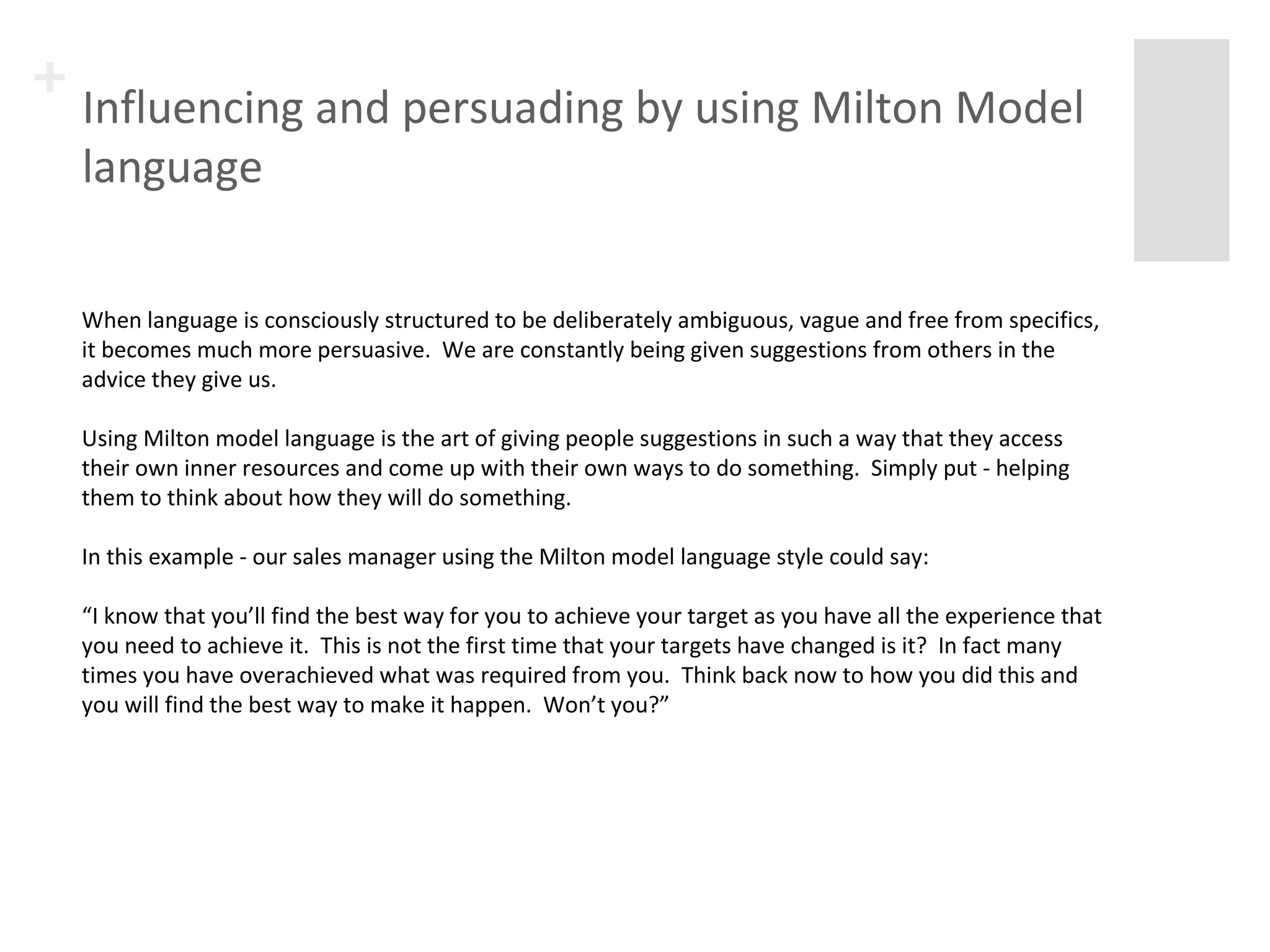
“I know that you’ll find the best way for you to achieve your target as you have all the experience that 
you need to achieve it. This is not the first time that your targets have changed is it? In fact many 
times you have overachieved what was required from you. Think back now to how you did this and 
you will find the best way to make it happen. Won’t you?”
+ Unpicking Milton Model language 
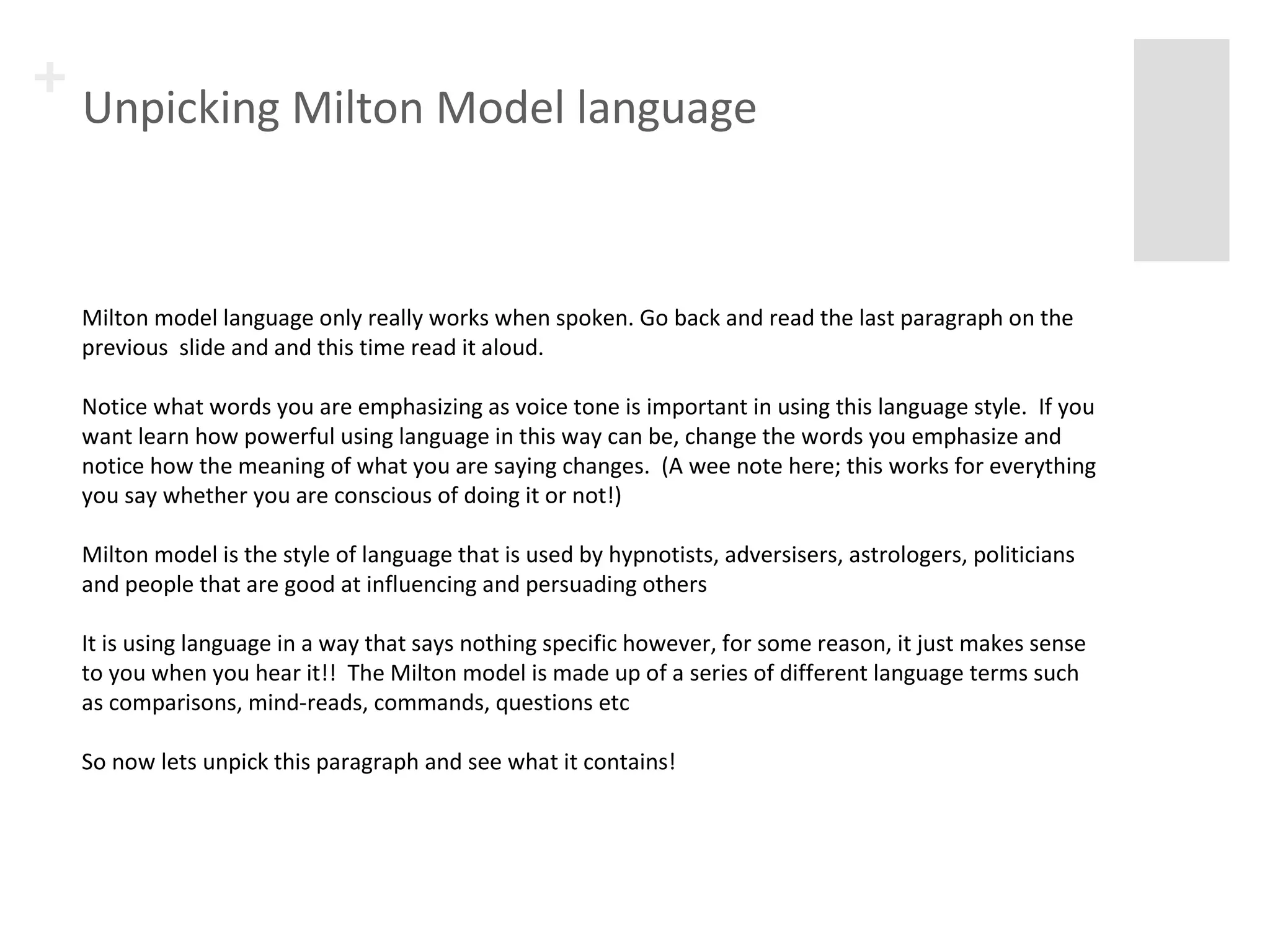
Milton model language only really works when spoken. Go back and read the last paragraph on the 
previous slide and and this time read it aloud. 
Notice what words you are emphasizing as voice tone is important in using this language style. If you 
want learn how powerful using language in this way can be, change the words you emphasize and 
notice how the meaning of what you are saying changes. (A wee note here; this works for everything 
you say whether you are conscious of doing it or not!) 
Milton model is the style of language that is used by hypnotists, adversisers, astrologers, politicians 
and people that are good at influencing and persuading others 
It is using language in a way that says nothing specific however, for some reason, it just makes sense 
to you when you hear it!! The Milton model is made up of a series of different language terms such 
as comparisons, mind-reads, commands, questions etc 
So now lets unpick this paragraph and see what it contains!
+ Mind-read – comparison 
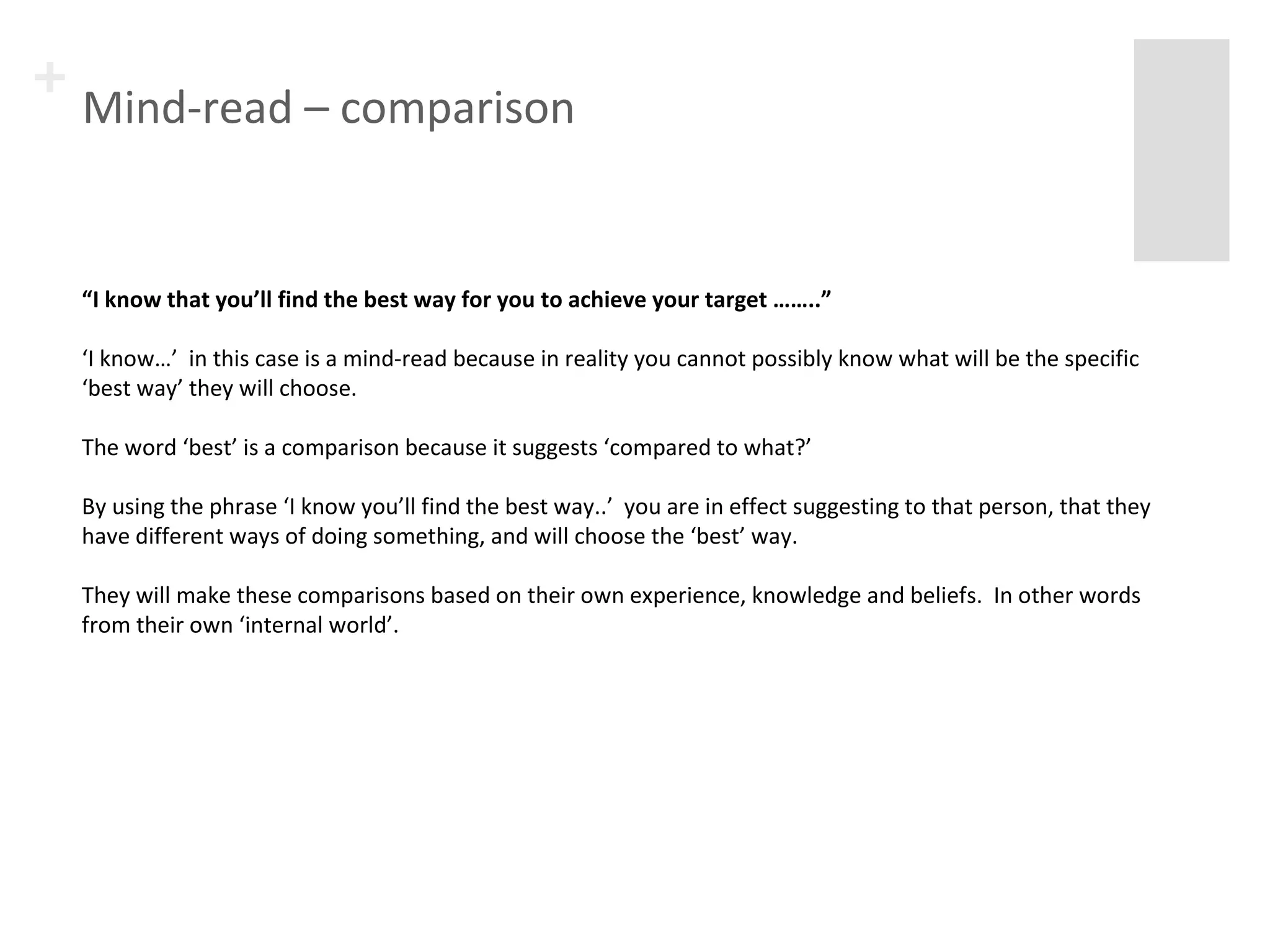
“I know that you’ll find the best way for you to achieve your target ……..” 
‘I know…’ in this case is a mind-read because in reality you cannot possibly know what will be the specific 
‘best way’ they will choose. 
The word ‘best’ is a comparison because it suggests ‘compared to what?’ 
By using the phrase ‘I know you’ll find the best way..’ you are in effect suggesting to that person, that they 
have different ways of doing something, and will choose the ‘best’ way. 
They will make these comparisons based on their own experience, knowledge and beliefs. In other words 
from their own ‘internal world’.
+ Linking word – mind read 
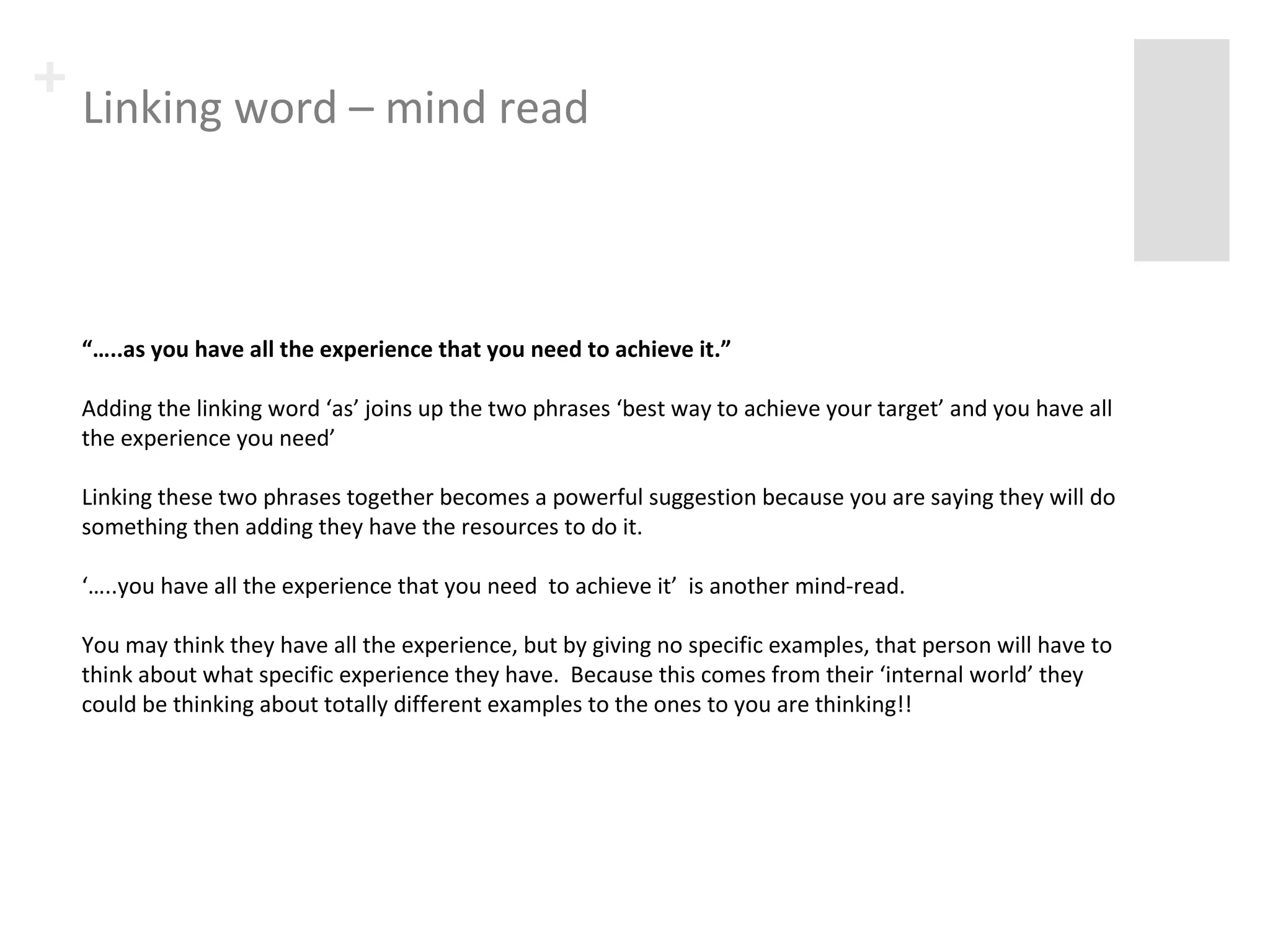
“…..as you have all the experience that you need to achieve it.” 
Adding the linking word ‘as’ joins up the two phrases ‘best way to achieve your target’ and you have all 
the experience you need’ 
Linking these two phrases together becomes a powerful suggestion because you are saying they will do 
something then adding they have the resources to do it. 
‘…..you have all the experience that you need to achieve it’ is another mind-read. 
You may think they have all the experience, but by giving no specific examples, that person will have to 
think about what specific experience they have. Because this comes from their ‘internal world’ they 
could be thinking about totally different examples to the ones to you are thinking!!
+ Presuppositions – the number order - first, 
second, third etc 
“This is not the first time that your targets have changed…..” 
By saying ‘this is not the first time your targets have changed….’ you are presupposing or assuming 
that there have been other times in that past that their targets have changed. 
Although we know this is a fact, by reminding them that ‘this is not the first time’, you are helping 
that person experience, in their ‘inner world’ that they already have the resources to deal with target 
change. 
This helps them move out of the struggle they are having imagining achieving the new target. 
Notice there is no mention of the specific % increase. The moment you speak about exact numbers 
you move from ambiguous language to specific language. 
Milton Model language is all about being ambiguous so that someone has to go into their ‘inner 
world’ to get their own examples of what they have achieved in the past.
+ Tag questions 
“..is it?” is a tag question – this is a short question that you ‘tag on’ to something you have said to 
someone that they will unconsciously agree with. 
When you add a ‘tag’ question, look straight at the person you are speaking with and give a quick 
head nod and notice what happens. 
Often you will see that person nod their head back to you. 
This is an unconscious signal that they are in agreement with what has just been said!
+ Give a fact they recognise as true 
“In fact many times you have overachieved what was required from you.” 
Stating a true fact is a powerful way of boosting someone's confidence because it reminds them of 
the things they have already done. 
In this case they have not only achieved what was required of them once, they have OVER achieved 
this many times. 
A subtle emphasis on how you say ‘many times’ and ‘over’ makes this suggestion even more 
powerful.
+ Command – linking word - comparison – tag 
question 
“Think back now to how you did this, and you will find the best way to make it happen. Won’t 
you?” 
‘Think back now…..’ by adding a downward inflection to your voice as you say the word ‘now’ turns 
this statement into a command to go and search back in their past for something and to do it now. 
‘……to how you did this’. Using the word ‘did’ suggests that they have already done this before in the 
past and only have to remember what it was they did. 
‘and’ is the linking word here that links to the outcome 
‘…you will find the best way..’ is again suggesting they compare the way they could do this and choose 
the best way to make it happen. 
‘….won’t you?’ is finishing off with another tag question.
+ Roundup 
Persuading and Influencing others is a complex and elegant leadership skill. 
I trust that you have found this introduction to the use of the Milton Model useful. 
Using language in a consciously ambiguous way, lets you help people access there own resources. As 
a business leader this encourages others to take personal responsibility for their own actions and 
development. 
Becoming an expert ‘influencer and persuader’ is achieved by life long learning. This means 
continuing to attend training courses, on-line education and master-classes, watching videos and 
reading books 
Have a look at my Enhancing Communication for Business Leaders e-book series on Amazon, and my 
NLP Business Practitioner and Leadership Development training courses. 
Some of the other expert authors on the NLP Milton Model are Dr Richard Bandler, Sue Knight, Matt 
Caulfield and Joseph O’Connor 
Mastering the use of the Milton Model help you influence and persuade just about everyone you 
come in contact with.
+ 
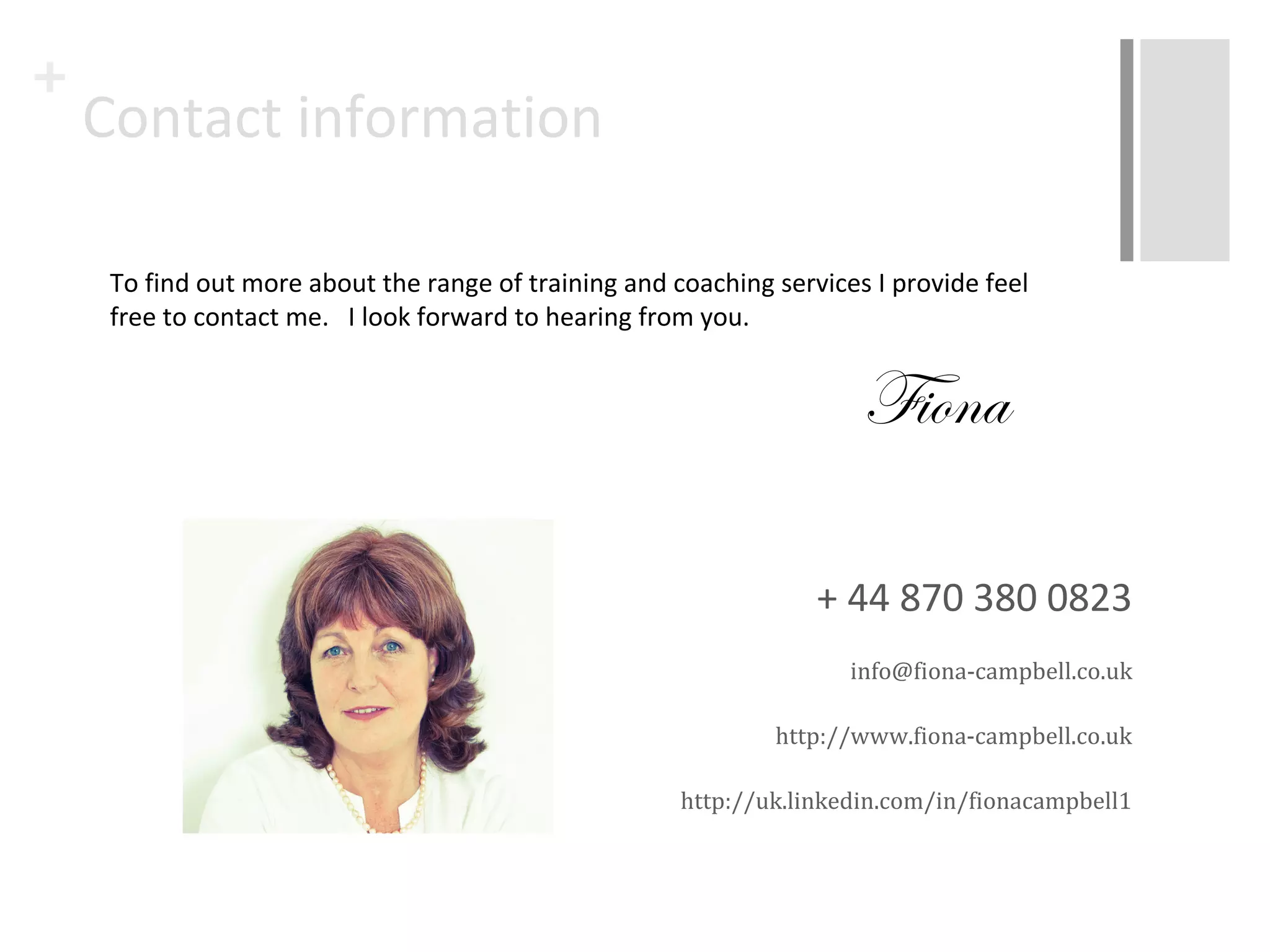
Fiona Campbell is an Executive Coach 
and Licensed NLP Business Coach 
trainer for the Society of NLP. 
To find out how Fiona can help you or 
your business 
Check out her LinkedIn Profile

Language of Influence and Persuasion - introduction to the NLP Milton Model

  • 1.
    NLP Business CoachingSeries The Language of Influence and Persuasion Introduction to the NLP Milton Model
  • 2.
    + What ispersuasive and influential language? This is the language used by the top ‘people leaders’ in the world to empower others and helps them to develop themselves. It is the language that creates the least resistance and most agreement when talking to people. Most of all, it is the language that encourages others to make decisions and come up with their own solutions! To be persuasive and influential others have to recognise, and accept you, as an expert. You have to know what you are talking about, and be in a position to help someone resolve something. You do this by using language in a way that helps people come up with their own solutions to problems, not by giving them the answers! Persuasive and influential language encourages individuals to find their own skills and resources needed to achieve what ever it is they are required to do. This can be as simple as asking a client ‘when’ they are going to make a decision rather then ‘if’ they are going to make a decision (implying a decision will be made). Or, as complex as, empowering others to believe they are capable of achieving something they are not sure they can do yet. (Implying that you believe that person has the ability to achieve this, even although they may not believe they can!).
  • 3.
    + What persuasiveand influential language is not? Persuasive and Influential language is not used to force people to do what you want!! Some people want to learn these skills so they can manipulative others into doing things they want done. This is not a leadership skill, this is called bullying!! People are not stupid; think of a time when someone tried to persuade you to do something you were not comfortable with and really didn’t want to do. How did that feel? I am guessing you felt uncomfortable and manipulated? Buyers remorse is the biggest cause of cancellations, product returns and clients using products and services only once. This happens when someone has been persuaded to buy something they did not need or want by a ‘pushy’ person. They often said yes to buying a product or service just to to get rid of the sales person. This is because they had not yet ‘bought into’ to what that product or service could do for them. Although they bought something, they will never give that sales person repeat business or recommend them to others. It is exactly the same situation when leading others. If you are ‘pushy’, bullying and manipulative people respond once and resist ‘buying in’ to your future ideas and suggestions.
  • 4.
    + The importanceof using persuasive and influential language. Often in business people get promoted to leadership positions because they are fantastic at the specific job they do. They get put in ‘charge’ of a team and are sent off to lead people without any training in how to to influence and persuade others. Some people are naturally good at influencing and persuading others however, for most people this is a leadership skill that they need to learn. The importance of using influential and persuasive language is, that it creates a culture where people are encouraged to take personal responsibility for their actions and come up with their own solutions in the workplace. This is achieved by talking to others in ways that help them to think about what they have to do, to achieve a desired outcome, rather than telling them directly, what to do. Speaking to people in this way can take longer and more require more effort than just telling them what to do. However, ultimately this saves time and money as your people develop and create a culture of personal responsibility and great working relationships between their work colleagues and clients.
  • 5.
    + The waynaturally delete, distort and generalise information Inside our mind (our internal world) we store memories, experiences and knowledge based on the things that happen in our life. When we receive information into our mind we naturally delete, distort and generalise this information depending on were our focus is. We all perceive the world around us differently and this perception is sometimes known as our ‘map of the world’. When we speak to others again we naturally delete, distort and generalise what we say. This is best demonstrated by the way that someone who attends a two-hour meeting is able to give you an overview of that meeting in only ten minutes!! Take the the example of someone attending a meeting and telling people about this. The more people this information passes through, the more of what actually happened in the meeting gets changed!
  • 6.
    + The NLPMilton Model – the most powerful language tool to influence and persuade others The Milton Model was developed by Richard Bandler and John Grinder (the co-founders of Neuro Linguistic Programming) from the work they did modeling the language patterns of Milton Erickson. Milton Erickson was a hypnotherapist who achieved amazing results with his patients. Bandler and Grinder where able to establish (by modeling how Milton Erikson spoke to his patients) that the language patterns he used worked so well, because they were intentionally ambiguous. Milton worked on the assumption that people already know how to solve their problems. He gave his patients deliberate, ambiguous suggestions that encouraged them to access their own resources and find their own answers to their problems. The Milton Model is a way of using language when speaking to someone where you deliberately delete, distort and generalise what you say to someone so that they have to fill in what is missing from their “internal world’ It is the art of being ambiguously specific!!
  • 7.
    + Milton Modelin action - the scenario A sales manager has a team member, who usually overachieves their target by 5%. This person has just been given their new target for the year. This year their target has been increased by 11% instead of the usual 8%. This person is now struggling to imagine achieving this new target. The information above tells you. That there is a sales person They usually overachieve their target by 5% They have received a new target Their annual target is usually increased by 8% This year the target has been increased by 3% more than it normally is. They are struggling to imagine how they will achieve this new target. The elegant use of Milton Model language by leaders to influence and persuade others depends on giving people suggestions ONLY from the facts you have.
  • 8.
    + Trying toinfluence and persuade without using Milton Model language Often people who lead others think the can persuade people to do something by providing them with solutions, based on what works for them. For example our sales manager, trying to persuade and influence this person, could say. “To get your target, you can start work an hour earlier, at 8 instead of 9 and make 30 calls a day instead of 20. That will get you more appointments to get you in front of your customers. The more customers you see the more sales you will get. This should help you achieve your 11% increased target. The problem with talking like this, to someone who is already struggling to even think about achieving their target, is that you have only given them a strategy of things to do (normally based on what has worked for YOU in the past). These are tasks and things to do in the ‘outside world’ You have not addressed how they are thinking about the situation in their own head, what we call their “inside world”
  • 9.
    + Influencing andpersuading by using Milton Model language When language is consciously structured to be deliberately ambiguous, vague and free from specifics, it becomes much more persuasive. We are constantly being given suggestions from others in the advice they give us. Using Milton model language is the art of giving people suggestions in such a way that they access their own inner resources and come up with their own ways to do something. Simply put - helping them to think about how they will do something. In this example - our sales manager using the Milton model language style could say: “I know that you’ll find the best way for you to achieve your target as you have all the experience that you need to achieve it. This is not the first time that your targets have changed is it? In fact many times you have overachieved what was required from you. Think back now to how you did this and you will find the best way to make it happen. Won’t you?”
  • 10.
    + Unpicking MiltonModel language Milton model language only really works when spoken. Go back and read the last paragraph on the previous slide and and this time read it aloud. Notice what words you are emphasizing as voice tone is important in using this language style. If you want learn how powerful using language in this way can be, change the words you emphasize and notice how the meaning of what you are saying changes. (A wee note here; this works for everything you say whether you are conscious of doing it or not!) Milton model is the style of language that is used by hypnotists, adversisers, astrologers, politicians and people that are good at influencing and persuading others It is using language in a way that says nothing specific however, for some reason, it just makes sense to you when you hear it!! The Milton model is made up of a series of different language terms such as comparisons, mind-reads, commands, questions etc So now lets unpick this paragraph and see what it contains!
  • 11.
    + Mind-read –comparison “I know that you’ll find the best way for you to achieve your target ……..” ‘I know…’ in this case is a mind-read because in reality you cannot possibly know what will be the specific ‘best way’ they will choose. The word ‘best’ is a comparison because it suggests ‘compared to what?’ By using the phrase ‘I know you’ll find the best way..’ you are in effect suggesting to that person, that they have different ways of doing something, and will choose the ‘best’ way. They will make these comparisons based on their own experience, knowledge and beliefs. In other words from their own ‘internal world’.
  • 12.
    + Linking word– mind read “…..as you have all the experience that you need to achieve it.” Adding the linking word ‘as’ joins up the two phrases ‘best way to achieve your target’ and you have all the experience you need’ Linking these two phrases together becomes a powerful suggestion because you are saying they will do something then adding they have the resources to do it. ‘…..you have all the experience that you need to achieve it’ is another mind-read. You may think they have all the experience, but by giving no specific examples, that person will have to think about what specific experience they have. Because this comes from their ‘internal world’ they could be thinking about totally different examples to the ones to you are thinking!!
  • 13.
    + Presuppositions –the number order - first, second, third etc “This is not the first time that your targets have changed…..” By saying ‘this is not the first time your targets have changed….’ you are presupposing or assuming that there have been other times in that past that their targets have changed. Although we know this is a fact, by reminding them that ‘this is not the first time’, you are helping that person experience, in their ‘inner world’ that they already have the resources to deal with target change. This helps them move out of the struggle they are having imagining achieving the new target. Notice there is no mention of the specific % increase. The moment you speak about exact numbers you move from ambiguous language to specific language. Milton Model language is all about being ambiguous so that someone has to go into their ‘inner world’ to get their own examples of what they have achieved in the past.
  • 14.
    + Tag questions “..is it?” is a tag question – this is a short question that you ‘tag on’ to something you have said to someone that they will unconsciously agree with. When you add a ‘tag’ question, look straight at the person you are speaking with and give a quick head nod and notice what happens. Often you will see that person nod their head back to you. This is an unconscious signal that they are in agreement with what has just been said!
  • 15.
    + Give afact they recognise as true “In fact many times you have overachieved what was required from you.” Stating a true fact is a powerful way of boosting someone's confidence because it reminds them of the things they have already done. In this case they have not only achieved what was required of them once, they have OVER achieved this many times. A subtle emphasis on how you say ‘many times’ and ‘over’ makes this suggestion even more powerful.
  • 16.
    + Command –linking word - comparison – tag question “Think back now to how you did this, and you will find the best way to make it happen. Won’t you?” ‘Think back now…..’ by adding a downward inflection to your voice as you say the word ‘now’ turns this statement into a command to go and search back in their past for something and to do it now. ‘……to how you did this’. Using the word ‘did’ suggests that they have already done this before in the past and only have to remember what it was they did. ‘and’ is the linking word here that links to the outcome ‘…you will find the best way..’ is again suggesting they compare the way they could do this and choose the best way to make it happen. ‘….won’t you?’ is finishing off with another tag question.
  • 17.
    + Roundup Persuadingand Influencing others is a complex and elegant leadership skill. I trust that you have found this introduction to the use of the Milton Model useful. Using language in a consciously ambiguous way, lets you help people access there own resources. As a business leader this encourages others to take personal responsibility for their own actions and development. Becoming an expert ‘influencer and persuader’ is achieved by life long learning. This means continuing to attend training courses, on-line education and master-classes, watching videos and reading books Have a look at my Enhancing Communication for Business Leaders e-book series on Amazon, and my NLP Business Practitioner and Leadership Development training courses. Some of the other expert authors on the NLP Milton Model are Dr Richard Bandler, Sue Knight, Matt Caulfield and Joseph O’Connor Mastering the use of the Milton Model help you influence and persuade just about everyone you come in contact with.
  • 18.
    + Fiona Campbellis an Executive Coach and Licensed NLP Business Coach trainer for the Society of NLP. To find out how Fiona can help you or your business Check out her LinkedIn Profile