t RIOWISE   CONSULTANT The Trainer :  C.K.Ong B.A Hons (Econs) U.M Certified Neuro Linguistic Programming @ NLP Practitioner Certified Time Line Therapy ™ Practitioner Certified Emotional Freedom Techniques ™(EFT) Practitioner Pembangunan Sumber Manusia Berhad Qualified Corporate Trainer t RIOWISE CONSULTANT COPY RIGHT ©  2008 – CK ONG
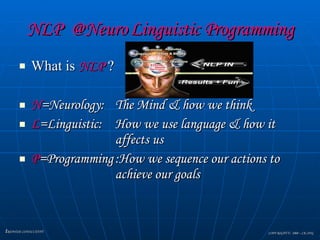
NLP  @Neuro Linguistic Programming What is  NLP  ? N =Neurology: The Mind & how we think L =Linguistic: How we use language & how it  affects us P =Programming :How we sequence our actions to  achieve our goals t RIOWISE CONSULTANT COPY RIGHT ©  2008 – CK ONG
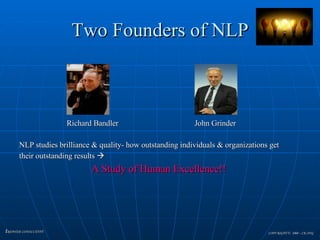
Two Founders of NLP   Richard Bandler     John Grinder NLP studies brilliance & quality- how outstanding individuals & organizations get their outstanding results   A Study of Human Excellence!! t RIOWISE CONSULTANT COPY RIGHT ©  2008 – CK ONG
NLP  @Neuro Linguistic Programming NLP Tools are used internationally in different industries: Therapy, Counseling, Business, Sports, Sales, Communications, Law, Sales, and  Education * NLP is an attitude and a methodology, which leave behind a trail of techniques—  Richard Bandler * NLP is an accelerated learning strategy for the detection and utilization of pattern in the world–  John Grinder t RIOWISE CONSULTANT COPY RIGHT ©  2008 – CK ONG
NLP For Education 1 of the major contributions :   New Concept of Learning Styles Identified Three different Learning Styles: V = Visual   A = Auditory K = Kinesthetic t RIOWISE CONSULTANT COPY RIGHT ©  2008 – CK ONG
Understanding Our Representational Systems Our Representational Systems  =  Our Senses We rely on all our senses to receive information from the outside world :-    We tend to develop one sense more than others ;    We develop a preference for one type of learning style;     Our most developed pathway to the brain ; Our Learning Style t RIOWISE CONSULTANT COPY RIGHT ©  2008 – CK ONG
Understanding Our Representational Systems The Five Main Systems: *  The Visual system: How we create our internal pictures, visualize, daydream,  fantasize & imagine. *  The Auditory system: Auditory thinking is often a mixture of words & other sounds *  The Kinesthetic system: Made up of our internal & external feelings of touch and body  awareness. The Emotions are also included. *  The Olfactory system:   Remembered & created Smells *  The Gustatory system : Remembered & created Tastes t RIOWISE CONSULTANT COPY RIGHT ©  2008 – CK ONG
The Three Main Learning Styles V  @Visual,  A  @Auditory &  K  @Kinesthetic *  V isual learners:  Learn by Seeing *  A uditory Learners:  Learn by Listening   *  K inesthetic Learners:  Connecting what they learn to their      sense of touch or their Feelings t RIOWISE CONSULTANT COPY RIGHT ©  2008 – CK ONG
Learning Style & Representational System Learning Style = The Representational system we prefer to use (the most) when learning and understanding the world @ “ Primary Representational System ”  t RIOWISE CONSULTANT COPY RIGHT ©  2008 – CK ONG
Understand your Learning Style Understand your Learning Style  — Make your Learning Easier, Faster, more Comfortable & More Effective!! Accessing Cues: Clues about Our Learning Style  Our body language = posture, breathing pattern, voice tone, eye movements and language we use. t RIOWISE CONSULTANT COPY RIGHT ©  2008 – CK ONG
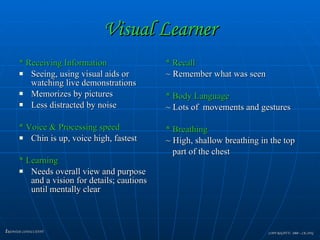
Visual Learner * Receiving Information Seeing, using visual aids or watching live demonstrations Memorizes by pictures Less distracted by noise * Voice & Processing speed Chin is up, voice high, fastest * Learning Needs overall view and purpose  and a vision for details; cautions until mentally clear * Recall ~ Remember what was seen * Body Language ~ Lots of  movements and gestures * Breathing ~ High, shallow breathing in the top part of the chest t RIOWISE CONSULTANT COPY RIGHT ©  2008 – CK ONG
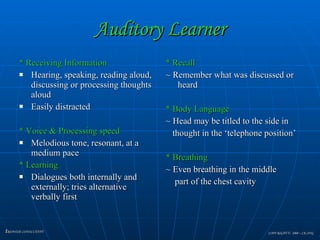
Auditory Learner * Receiving Information Hearing, speaking, reading aloud, discussing or processing thoughts  aloud Easily distracted * Voice & Processing speed Melodious tone, resonant, at a medium pace * Learning Dialogues both internally and externally; tries alternative verbally first * Recall ~ Remember what was discussed or heard * Body Language ~ Head may be titled to the side in thought in the ‘telephone position’ * Breathing ~ Even breathing in the middle part of the chest cavity t RIOWISE CONSULTANT COPY RIGHT ©  2008 – CK ONG
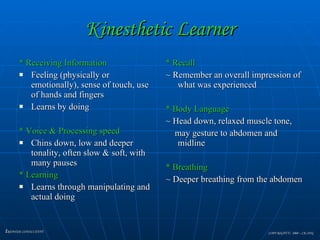
Kinesthetic Learner * Receiving Information Feeling (physically or emotionally), sense of touch, use of hands and fingers Learns by doing * Voice & Processing speed Chins down, low and deeper tonality, often slow & soft, with many pauses * Learning Learns through manipulating and actual doing * Recall ~ Remember an overall impression of what was experienced * Body Language ~ Head down, relaxed muscle tone, may gesture to abdomen and midline * Breathing ~ Deeper breathing from the abdomen t RIOWISE CONSULTANT COPY RIGHT ©  2008 – CK ONG
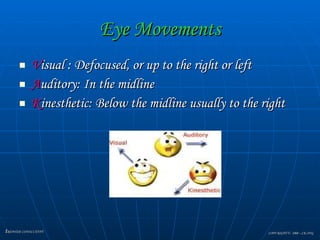
Eye Movements V isual : Defocused, or up to the right or left A uditory: In the midline K inesthetic: Below the midline usually to the right t RIOWISE CONSULTANT COPY RIGHT ©  2008 – CK ONG
Eye Accessing Cues t RIOWISE CONSULTANT COPY RIGHT ©  2008 – CK ONG
Reading your colleagues and students mind with Eye Accessing Cues   Questions A: 1) What colour is your front door? 2) Can you recall your first office and what it looked like? 3) Can you recall exactly how many people were in the previous school meeting?  4) What colour is your favourite office suit?  Question B: 1) What do you think you will look like if you are dancing on stage now? 2) Can you picture yourself in a board meeting in your tennis short? 3) Imagine a purple triangle inside a red square. t RIOWISE CONSULTANT COPY RIGHT ©  2008 – CK ONG
Reading your colleagues and students mind with Eye Accessing Cues * Questions C: 1) What exactly did your secretary tell you that was so interested? 2) Who spoke to you about the meeting/seminar today? 3) Can you hear your favourite piece of music in your mind?  * Question D: 1) When you talk to yourself, where does the sound come from? 2) Can you imagine what your staffs will say when you tell them they will have a day off? 3) What do you say to yourself when things go wrong? t RIOWISE CONSULTANT COPY RIGHT ©  2008 – CK ONG
Reading your colleagues and students mind with Eye Accessing Cues Question E: 1) What does it feel like to be happy? 2) What does it feel like to put on wet socks? 3) What is it like to settle down in a nice hot bath? t RIOWISE CONSULTANT COPY RIGHT ©  2008 – CK ONG
Students At Risk   Any information that enters through senses    “translated” into “ Primary Representational System ”/ our “ Preferred System ”   Accelerated progress Majority of students at risk  =  Kinesthetic Learners Preferred mode (representational system) when learning =Kinesthetic   * Little capacity in the other two systems    having difficulties under education system today( visual learning methods/visual environment)  t RIOWISE CONSULTANT COPY RIGHT ©  2008 – CK ONG
Students At Risk Auditory Learners * Easily distracted by sound (noise),  “  Too Sensitive  ”  or “   Too Demanding  ”  on the tonality of teachers, having difficulties using their preferred system in school. t RIOWISE CONSULTANT COPY RIGHT ©  2008 – CK ONG
Basic Keys to Improving  Learning & Memory for your students Step 1:   Help your students to have a goal or purpose for remembering what they are learning. Step 2:   Consciously decide to put what they learn into long term memory   to set a “program” in their unconscious mind.  Step 3:   To store what they have learned according to their preferred system. Step 4:   Keep a memory active by retrieving it and using it. t RIOWISE CONSULTANT COPY RIGHT ©  2008 – CK ONG
Basic Keys to Improving  Learning & Memory for your students Step  1: Help your students to have a goal or purpose for remembering what they are learning. *It is our intention and desire to learn something that determines what we will remember & what we will forget    Initiate your students to realise & decide “ Why it is important for them to learn!!” Step 2:  Consciously decide to put what they learn into long term memory    to set a “ Program ” in their unconscious mind.  A few things to think about when you are doing your best to commit what you learn to long term memory: 1) Remember that this will be the only time you can learn it 2) Trust that you can pass a test faster 3) Remember that you will have more free time to do other things 4) Remember that you will be able to use the information right away t RIOWISE CONSULTANT COPY RIGHT ©  2008 – CK ONG
Basic Keys to Improving  Learning & Memory for your students Step 3:   To store what they have learned according to their preferred system. Visual Learners  would see what they read & hear as a movie in their minds. Auditory Learners  would hear what they read & hear as the sound track to a movie in their minds, complete with words , music or sound effects. Kinesthetic Learners  would experience or feel the sensations & feelings of the movie in their minds Step 4:   Keep a memory active by retrieving it and using it. Recall or retrieve several times a week ( More Frequent ) t RIOWISE CONSULTANT COPY RIGHT ©  2008 – CK ONG
My Book: For Parents & Teachers

Neuro Linguistic Programming

  • 1.
    t RIOWISE CONSULTANT The Trainer : C.K.Ong B.A Hons (Econs) U.M Certified Neuro Linguistic Programming @ NLP Practitioner Certified Time Line Therapy ™ Practitioner Certified Emotional Freedom Techniques ™(EFT) Practitioner Pembangunan Sumber Manusia Berhad Qualified Corporate Trainer t RIOWISE CONSULTANT COPY RIGHT © 2008 – CK ONG
  • 2.
    NLP @NeuroLinguistic Programming What is NLP ? N =Neurology: The Mind & how we think L =Linguistic: How we use language & how it affects us P =Programming :How we sequence our actions to achieve our goals t RIOWISE CONSULTANT COPY RIGHT © 2008 – CK ONG
  • 3.
    Two Founders ofNLP Richard Bandler John Grinder NLP studies brilliance & quality- how outstanding individuals & organizations get their outstanding results  A Study of Human Excellence!! t RIOWISE CONSULTANT COPY RIGHT © 2008 – CK ONG
  • 4.
    NLP @NeuroLinguistic Programming NLP Tools are used internationally in different industries: Therapy, Counseling, Business, Sports, Sales, Communications, Law, Sales, and Education * NLP is an attitude and a methodology, which leave behind a trail of techniques— Richard Bandler * NLP is an accelerated learning strategy for the detection and utilization of pattern in the world– John Grinder t RIOWISE CONSULTANT COPY RIGHT © 2008 – CK ONG
  • 5.
    NLP For Education1 of the major contributions : New Concept of Learning Styles Identified Three different Learning Styles: V = Visual A = Auditory K = Kinesthetic t RIOWISE CONSULTANT COPY RIGHT © 2008 – CK ONG
  • 6.
    Understanding Our RepresentationalSystems Our Representational Systems = Our Senses We rely on all our senses to receive information from the outside world :-  We tend to develop one sense more than others ;  We develop a preference for one type of learning style;  Our most developed pathway to the brain ; Our Learning Style t RIOWISE CONSULTANT COPY RIGHT © 2008 – CK ONG
  • 7.
    Understanding Our RepresentationalSystems The Five Main Systems: * The Visual system: How we create our internal pictures, visualize, daydream, fantasize & imagine. * The Auditory system: Auditory thinking is often a mixture of words & other sounds * The Kinesthetic system: Made up of our internal & external feelings of touch and body awareness. The Emotions are also included. * The Olfactory system: Remembered & created Smells * The Gustatory system : Remembered & created Tastes t RIOWISE CONSULTANT COPY RIGHT © 2008 – CK ONG
  • 8.
    The Three MainLearning Styles V @Visual, A @Auditory & K @Kinesthetic * V isual learners: Learn by Seeing * A uditory Learners: Learn by Listening * K inesthetic Learners: Connecting what they learn to their sense of touch or their Feelings t RIOWISE CONSULTANT COPY RIGHT © 2008 – CK ONG
  • 9.
    Learning Style &Representational System Learning Style = The Representational system we prefer to use (the most) when learning and understanding the world @ “ Primary Representational System ” t RIOWISE CONSULTANT COPY RIGHT © 2008 – CK ONG
  • 10.
    Understand your LearningStyle Understand your Learning Style — Make your Learning Easier, Faster, more Comfortable & More Effective!! Accessing Cues: Clues about Our Learning Style  Our body language = posture, breathing pattern, voice tone, eye movements and language we use. t RIOWISE CONSULTANT COPY RIGHT © 2008 – CK ONG
  • 11.
    Visual Learner *Receiving Information Seeing, using visual aids or watching live demonstrations Memorizes by pictures Less distracted by noise * Voice & Processing speed Chin is up, voice high, fastest * Learning Needs overall view and purpose and a vision for details; cautions until mentally clear * Recall ~ Remember what was seen * Body Language ~ Lots of movements and gestures * Breathing ~ High, shallow breathing in the top part of the chest t RIOWISE CONSULTANT COPY RIGHT © 2008 – CK ONG
  • 12.
    Auditory Learner *Receiving Information Hearing, speaking, reading aloud, discussing or processing thoughts aloud Easily distracted * Voice & Processing speed Melodious tone, resonant, at a medium pace * Learning Dialogues both internally and externally; tries alternative verbally first * Recall ~ Remember what was discussed or heard * Body Language ~ Head may be titled to the side in thought in the ‘telephone position’ * Breathing ~ Even breathing in the middle part of the chest cavity t RIOWISE CONSULTANT COPY RIGHT © 2008 – CK ONG
  • 13.
    Kinesthetic Learner *Receiving Information Feeling (physically or emotionally), sense of touch, use of hands and fingers Learns by doing * Voice & Processing speed Chins down, low and deeper tonality, often slow & soft, with many pauses * Learning Learns through manipulating and actual doing * Recall ~ Remember an overall impression of what was experienced * Body Language ~ Head down, relaxed muscle tone, may gesture to abdomen and midline * Breathing ~ Deeper breathing from the abdomen t RIOWISE CONSULTANT COPY RIGHT © 2008 – CK ONG
  • 14.
    Eye Movements Visual : Defocused, or up to the right or left A uditory: In the midline K inesthetic: Below the midline usually to the right t RIOWISE CONSULTANT COPY RIGHT © 2008 – CK ONG
  • 15.
    Eye Accessing Cuest RIOWISE CONSULTANT COPY RIGHT © 2008 – CK ONG
  • 16.
    Reading your colleaguesand students mind with Eye Accessing Cues Questions A: 1) What colour is your front door? 2) Can you recall your first office and what it looked like? 3) Can you recall exactly how many people were in the previous school meeting? 4) What colour is your favourite office suit? Question B: 1) What do you think you will look like if you are dancing on stage now? 2) Can you picture yourself in a board meeting in your tennis short? 3) Imagine a purple triangle inside a red square. t RIOWISE CONSULTANT COPY RIGHT © 2008 – CK ONG
  • 17.
    Reading your colleaguesand students mind with Eye Accessing Cues * Questions C: 1) What exactly did your secretary tell you that was so interested? 2) Who spoke to you about the meeting/seminar today? 3) Can you hear your favourite piece of music in your mind? * Question D: 1) When you talk to yourself, where does the sound come from? 2) Can you imagine what your staffs will say when you tell them they will have a day off? 3) What do you say to yourself when things go wrong? t RIOWISE CONSULTANT COPY RIGHT © 2008 – CK ONG
  • 18.
    Reading your colleaguesand students mind with Eye Accessing Cues Question E: 1) What does it feel like to be happy? 2) What does it feel like to put on wet socks? 3) What is it like to settle down in a nice hot bath? t RIOWISE CONSULTANT COPY RIGHT © 2008 – CK ONG
  • 19.
    Students At Risk Any information that enters through senses  “translated” into “ Primary Representational System ”/ our “ Preferred System ”  Accelerated progress Majority of students at risk = Kinesthetic Learners Preferred mode (representational system) when learning =Kinesthetic * Little capacity in the other two systems  having difficulties under education system today( visual learning methods/visual environment) t RIOWISE CONSULTANT COPY RIGHT © 2008 – CK ONG
  • 20.
    Students At RiskAuditory Learners * Easily distracted by sound (noise), “ Too Sensitive ” or “ Too Demanding ” on the tonality of teachers, having difficulties using their preferred system in school. t RIOWISE CONSULTANT COPY RIGHT © 2008 – CK ONG
  • 21.
    Basic Keys toImproving Learning & Memory for your students Step 1: Help your students to have a goal or purpose for remembering what they are learning. Step 2: Consciously decide to put what they learn into long term memory  to set a “program” in their unconscious mind. Step 3: To store what they have learned according to their preferred system. Step 4: Keep a memory active by retrieving it and using it. t RIOWISE CONSULTANT COPY RIGHT © 2008 – CK ONG
  • 22.
    Basic Keys toImproving Learning & Memory for your students Step 1: Help your students to have a goal or purpose for remembering what they are learning. *It is our intention and desire to learn something that determines what we will remember & what we will forget  Initiate your students to realise & decide “ Why it is important for them to learn!!” Step 2: Consciously decide to put what they learn into long term memory  to set a “ Program ” in their unconscious mind. A few things to think about when you are doing your best to commit what you learn to long term memory: 1) Remember that this will be the only time you can learn it 2) Trust that you can pass a test faster 3) Remember that you will have more free time to do other things 4) Remember that you will be able to use the information right away t RIOWISE CONSULTANT COPY RIGHT © 2008 – CK ONG
  • 23.
    Basic Keys toImproving Learning & Memory for your students Step 3: To store what they have learned according to their preferred system. Visual Learners would see what they read & hear as a movie in their minds. Auditory Learners would hear what they read & hear as the sound track to a movie in their minds, complete with words , music or sound effects. Kinesthetic Learners would experience or feel the sensations & feelings of the movie in their minds Step 4: Keep a memory active by retrieving it and using it. Recall or retrieve several times a week ( More Frequent ) t RIOWISE CONSULTANT COPY RIGHT © 2008 – CK ONG
  • 24.
    My Book: ForParents & Teachers