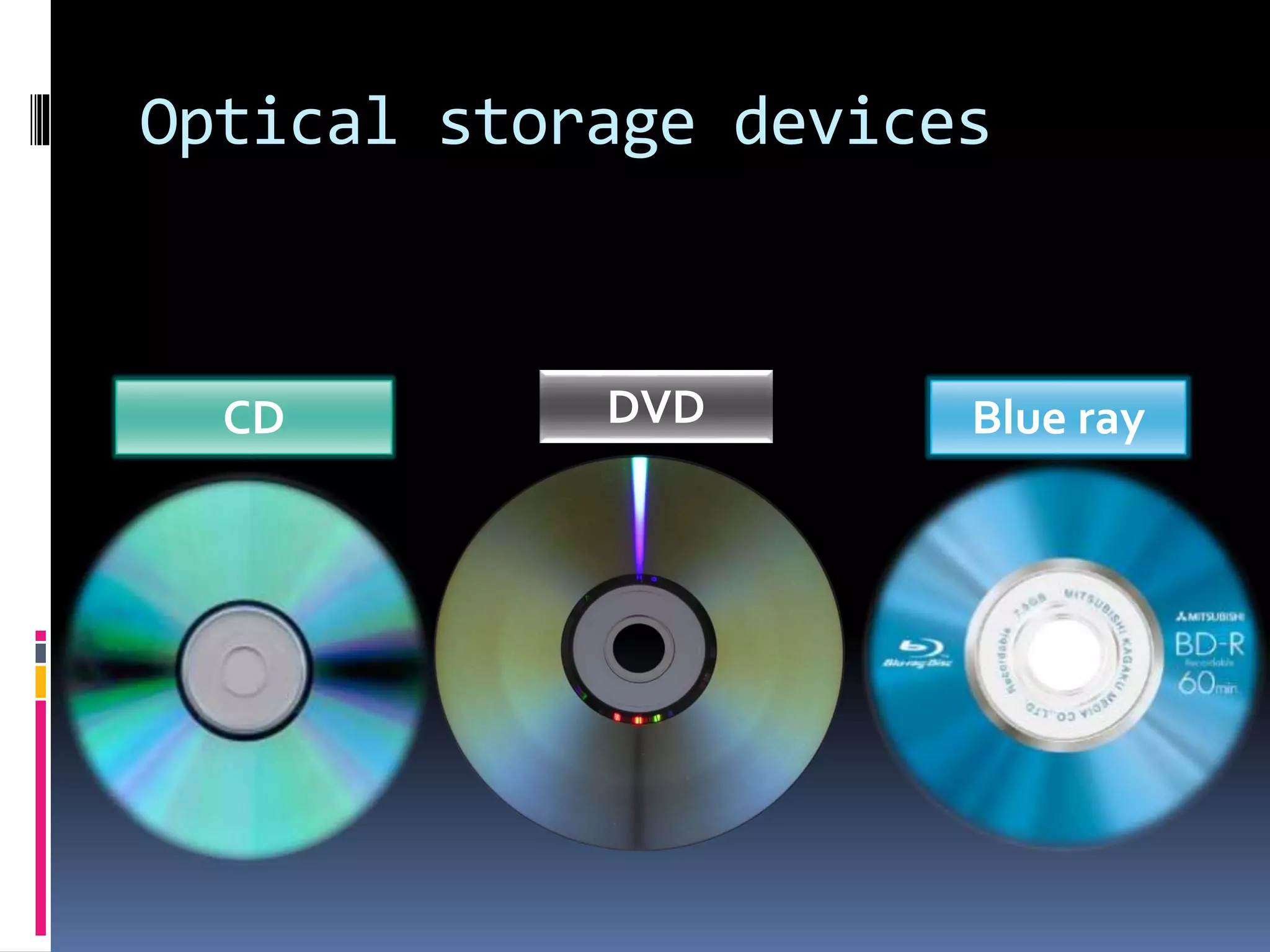
Optical memory uses lasers, storage media, and detectors to store data. Common optical storage devices include CDs, DVDs, and Blu-ray discs. CDs store data in the form of pits and lands on an aluminum layer, which a laser reads by detecting differences in light reflection. DVDs store more data than CDs using closer pit spacing and multiple layers that the laser can read through. Blu-ray discs can store 25 GB per layer or 50 GB with dual layers, replacing DVD technology.
What is aCompact Disc (CD)?
circular discs
4.75 in (12 cm) in diameter
developed by Philips and Sony in 1980
Initially for audio
1985 CD-ROM (Compact Disc Read Only
Memory)
can hold 720 MB(80 min audio)= 500 floppy
disks or 200,000 pages of text.
5.
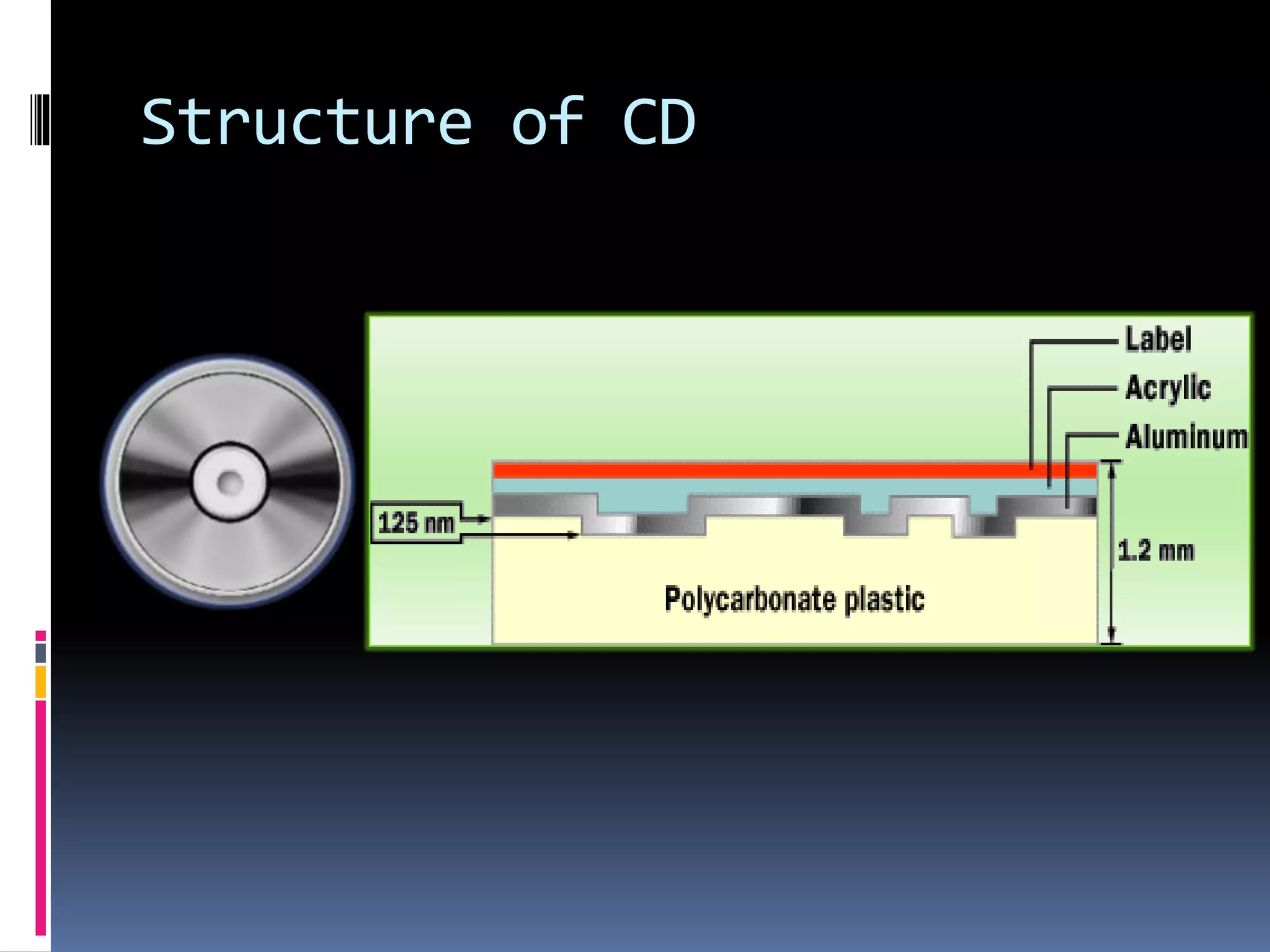
Structure of CD
CD is made of a polycarbonate substance and is
coated with a metallic film , usually an aluminum
alloy .
This aluminum film is the portion of the disc that
the CD-ROM drive reads for information.
The aluminum film is then covered by a plastic
acrylic coating that protects the underlying data.
A label will usually be placed on the top of the
disc and data is read from the bottom of the CD.
HOW DATA ISSTORED ON A
DISC?
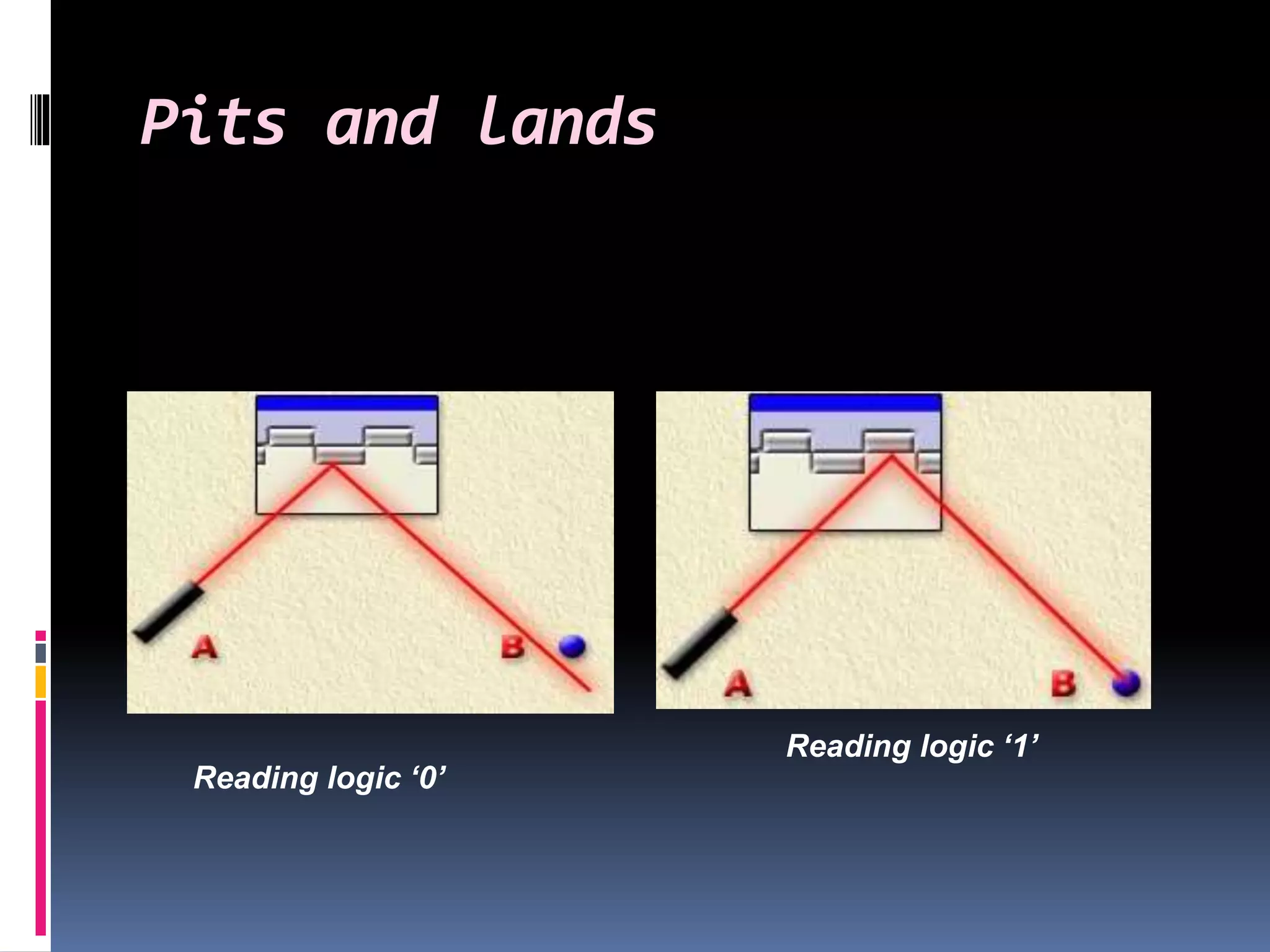
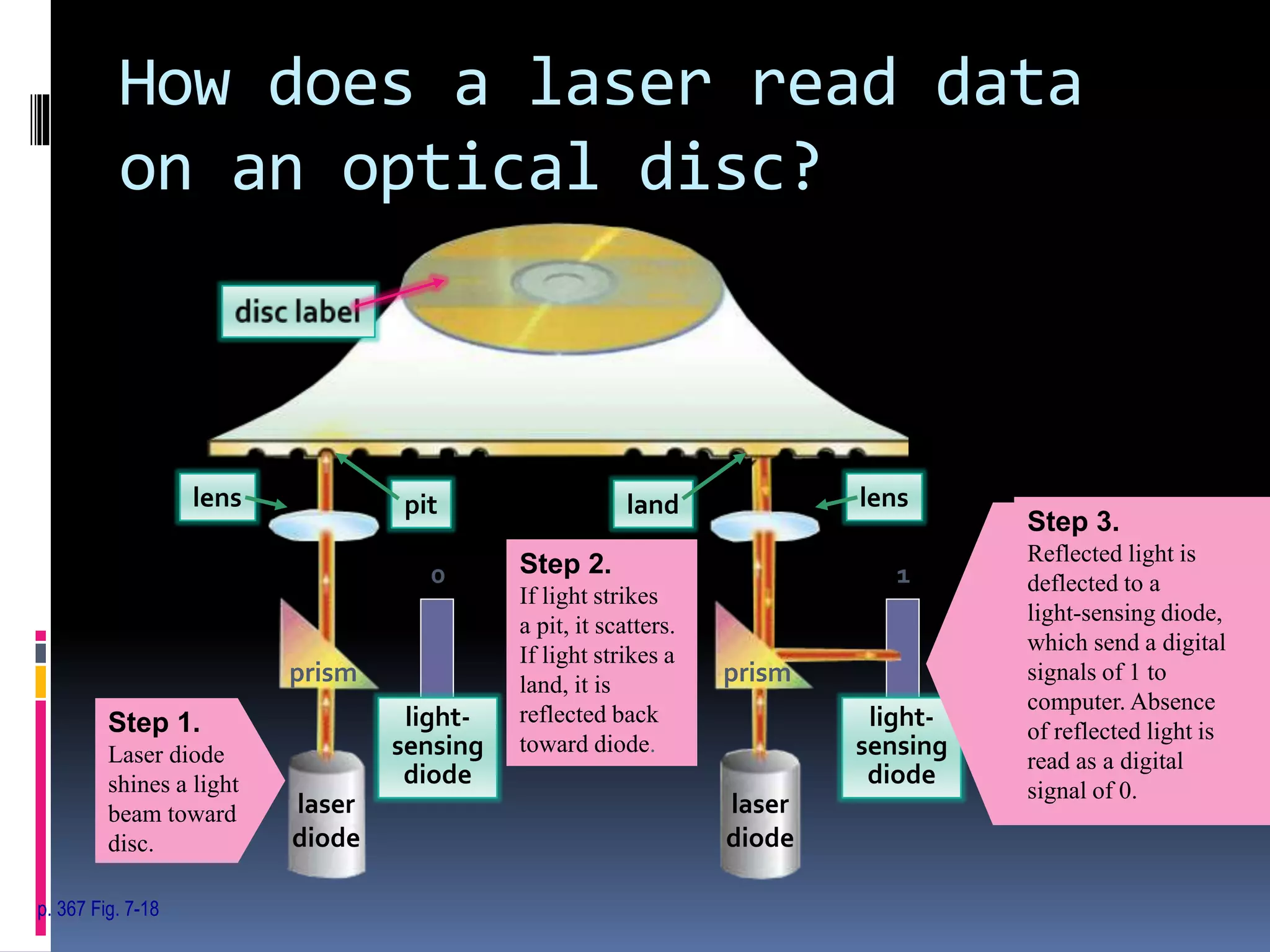
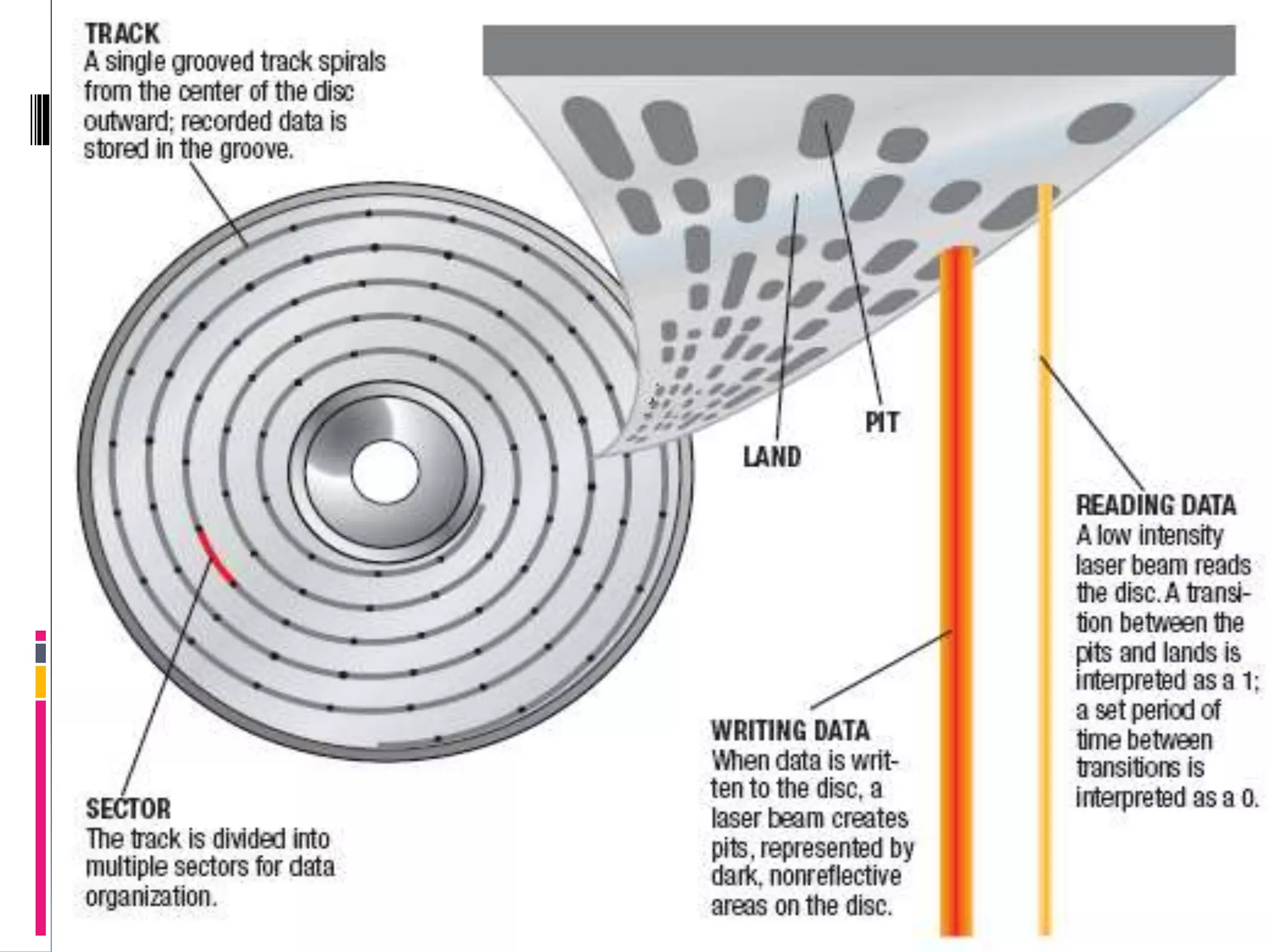
Pits and lands
The CD-ROM holds digital data.
Data is stored in the form of lands and pits.
Lands are flat areas on the metal surface.
Pits are depressions or hollows.
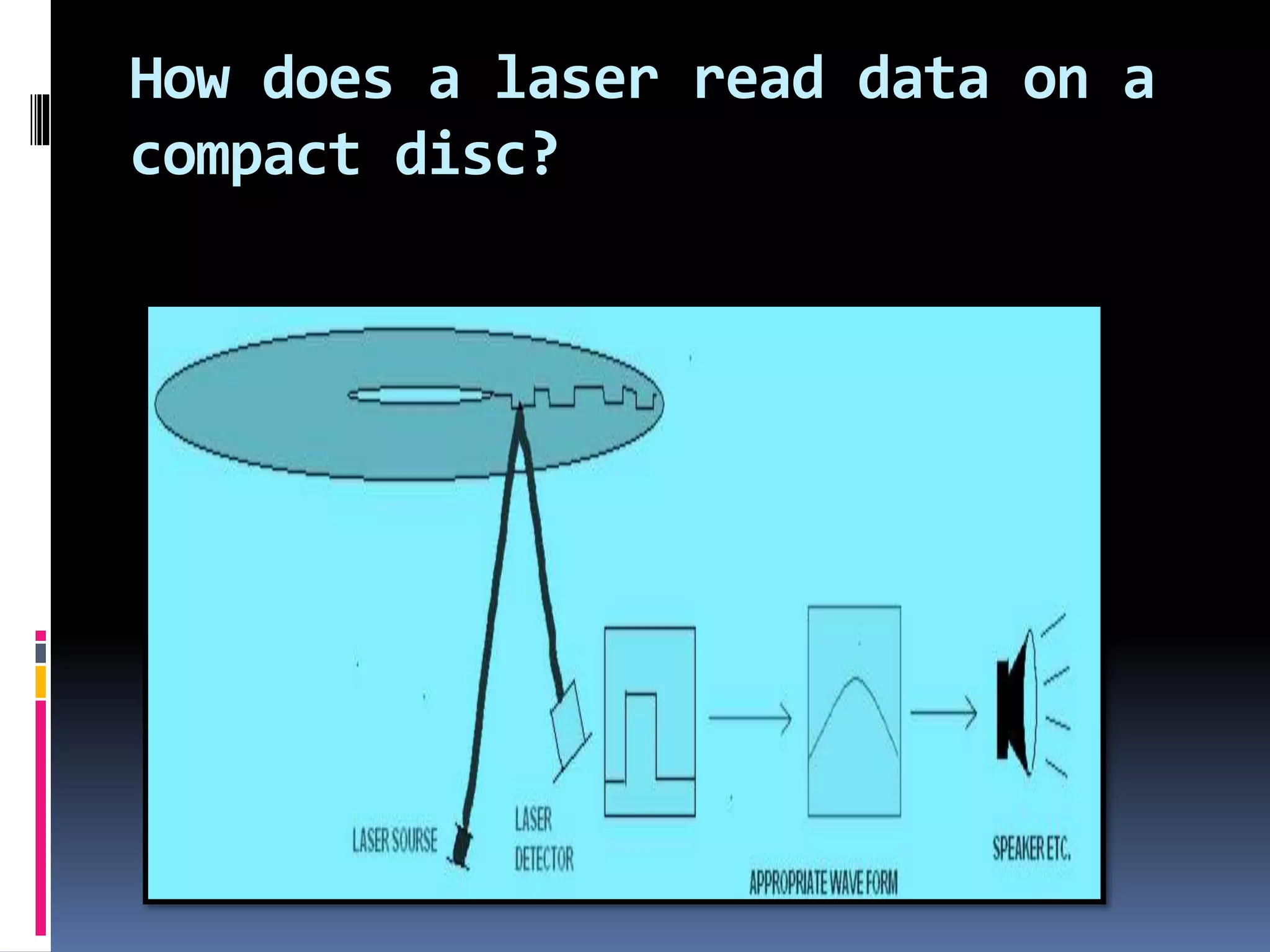
How does alaser read data
on an optical disc?
p. 367 Fig. 7-18
laser
diode
laser
diode
prism prism
light-
sensing
diode
light-
sensing
diode
0 1
lens lenspit land
Step 1.
Laser diode
shines a light
beam toward
disc.
Step 2.
If light strikes
a pit, it scatters.
If light strikes a
land, it is
reflected back
toward diode.
Step 3.
Reflected light is
deflected to a
light-sensing diode,
which send a digital
signals of 1 to
computer. Absence
of reflected light is
read as a digital
signal of 0.
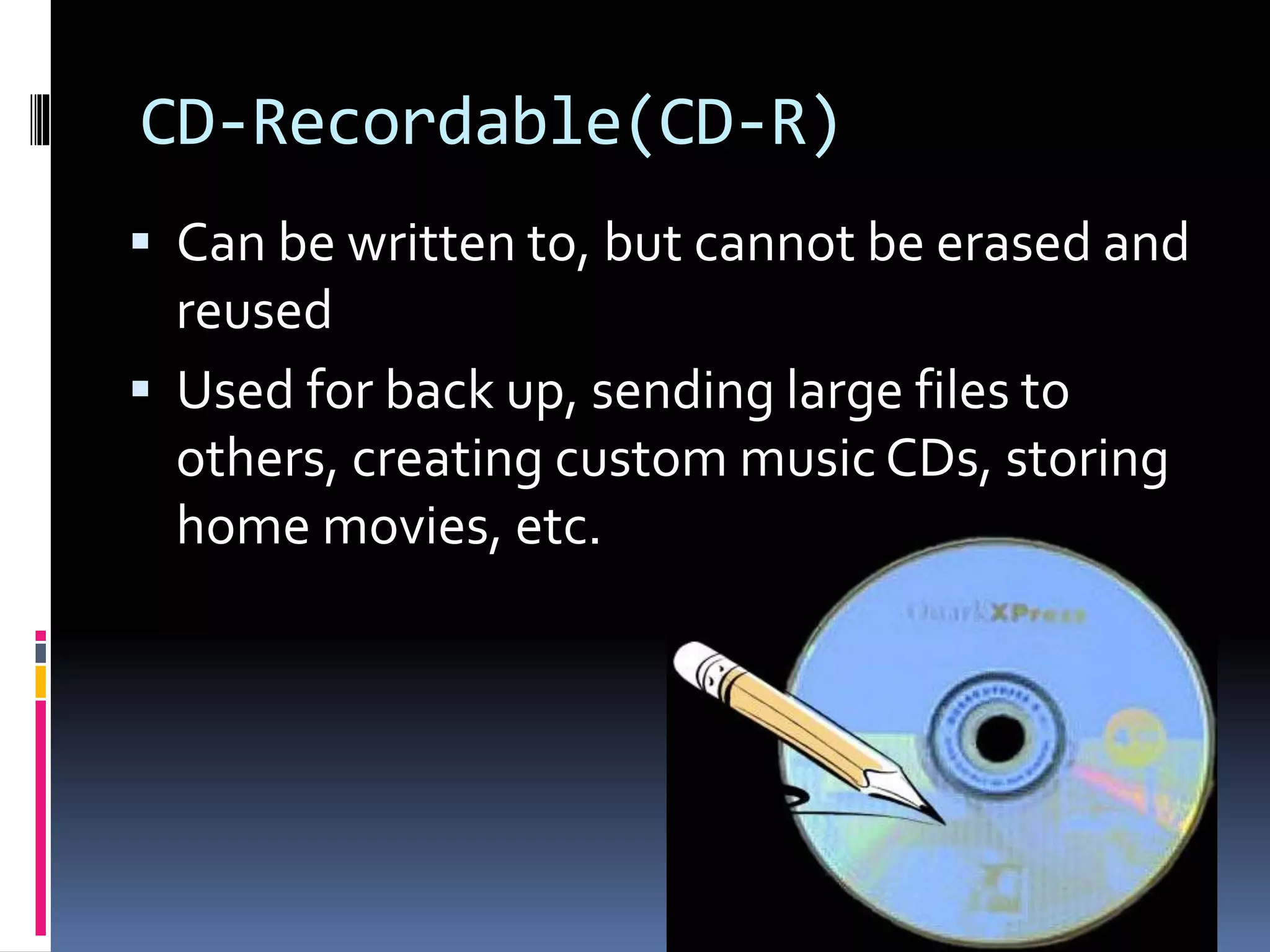
CD-Recordable(CD-R)
Can bewritten to, but cannot be erased and
reused
Used for back up, sending large files to
others, creating custom music CDs, storing
home movies, etc.
14.
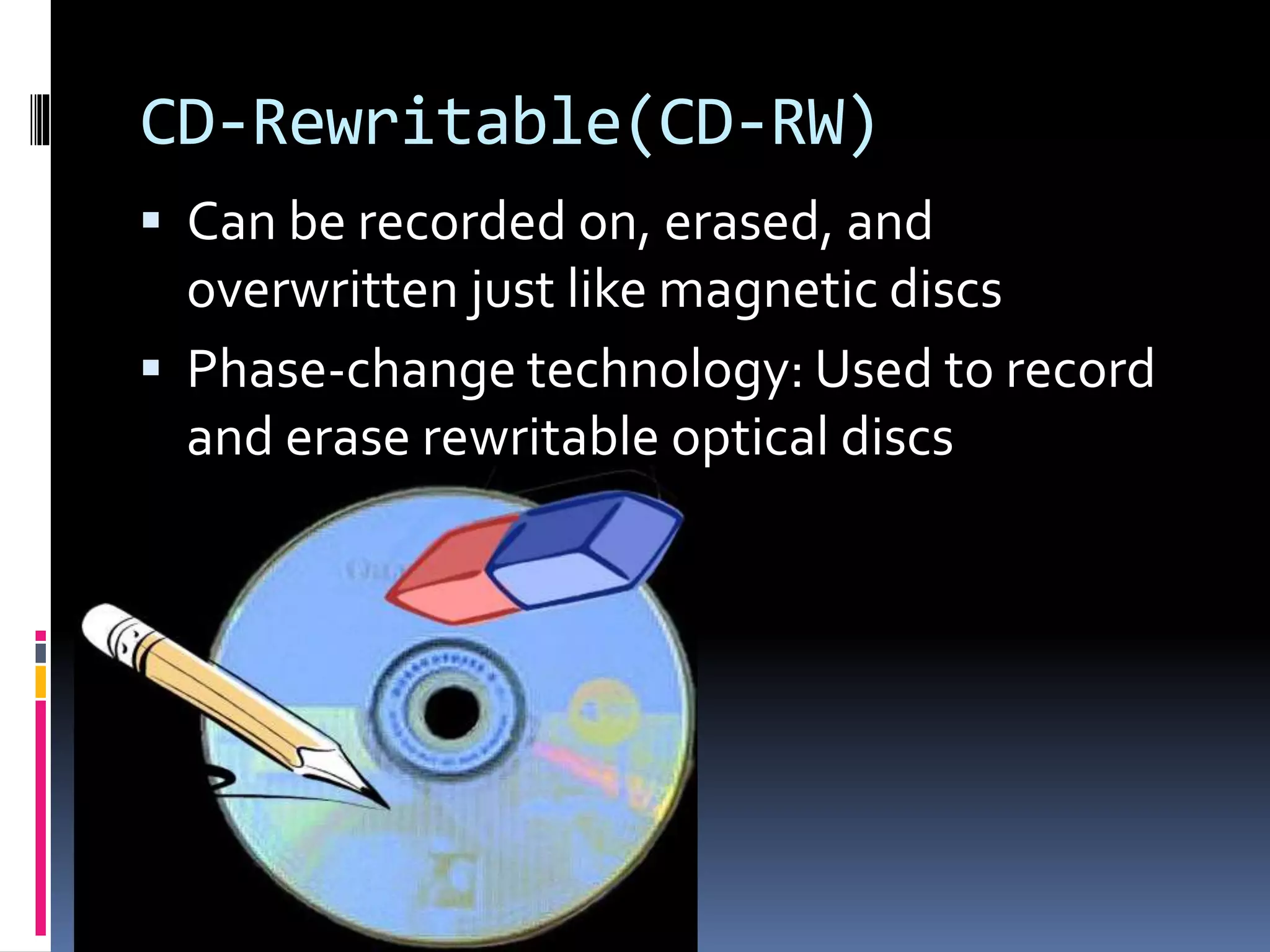
CD-Rewritable(CD-RW)
Can berecorded on, erased, and
overwritten just like magnetic discs
Phase-change technology: Used to record
and erase rewritable optical discs
DVD
DigitalVersatile Disk(Formerly Digital
Video Disk)
More capacity than CDs while having the
same dimensions.
developed by Philips, Sony,Toshiba,
and Panasonic in 1995.
An extremely high capacity compact disc
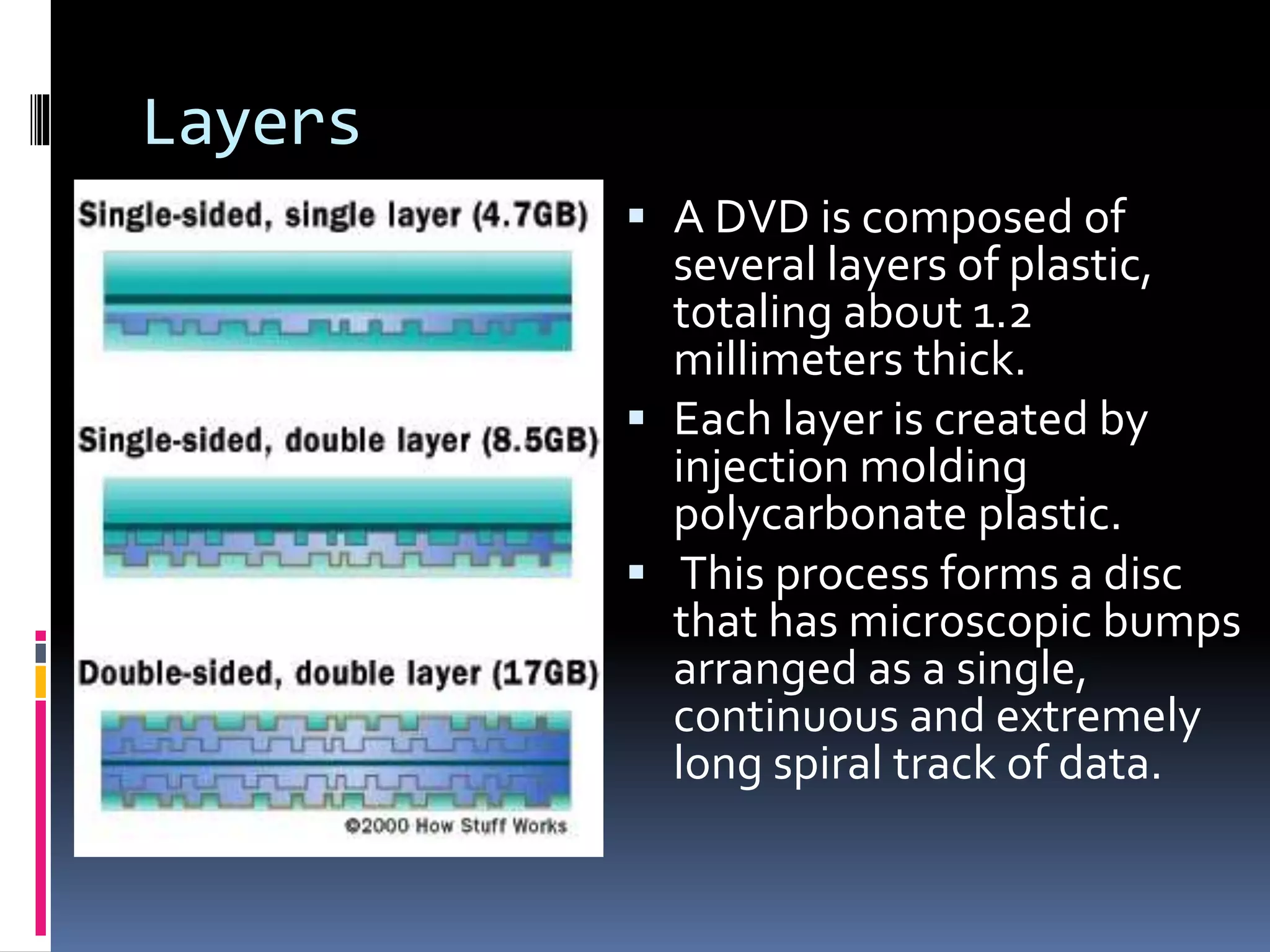
capable of storing from 4.7 GB to 17 GB
18.
How does aDVD-ROM store
data?
Three storage techniques used to store
DVD-ROM data
Pits are packed closer together to make the
disc more dense
Two layers of pits are used, where the lower
layer is semitransparent so the laser can
read through it to the upper layer
Some are double-sided, which means you
can remove the DVD-ROM and turn it over
to read the other side
19.
Layers
A DVDis composed of
several layers of plastic,
totaling about 1.2
millimeters thick.
Each layer is created by
injection molding
polycarbonate plastic.
This process forms a disc
that has microscopic bumps
arranged as a single,
continuous and extremely
long spiral track of data.
20.
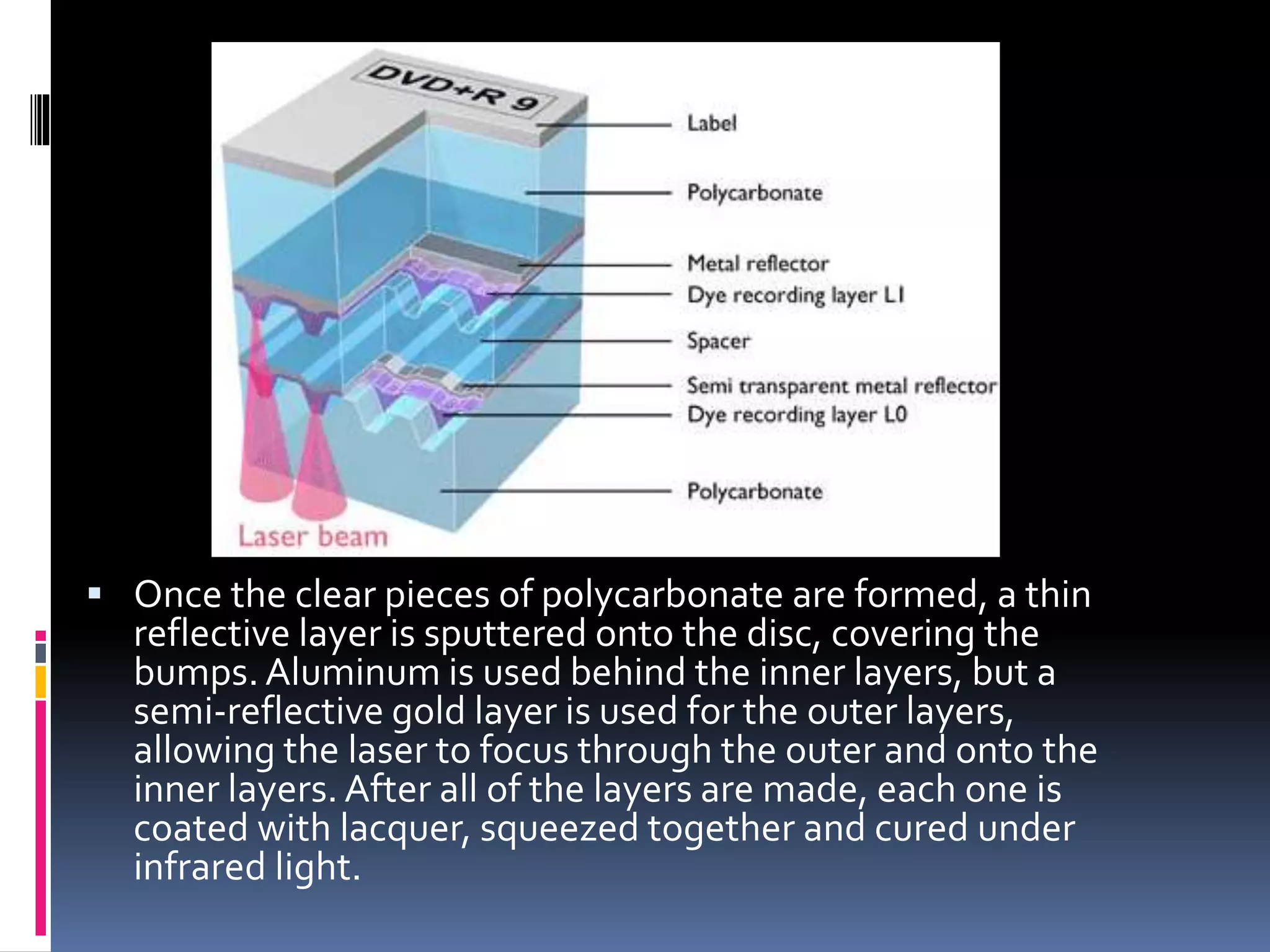
Once theclear pieces of polycarbonate are formed, a thin
reflective layer is sputtered onto the disc, covering the
bumps. Aluminum is used behind the inner layers, but a
semi-reflective gold layer is used for the outer layers,
allowing the laser to focus through the outer and onto the
inner layers. After all of the layers are made, each one is
coated with lacquer, squeezed together and cured under
infrared light.
21.
The datatrack is just 740 nanometers
separate one track from the next (a
nanometer is a billionth of a meter).And the
elongated bumps that make up the track are
each 320 nanometers wide, a minimum of
400 nanometers long and 120 nanometers
high.
22.
Blu-ray disc
Blu-rayDisc (official abbreviation BD) is
an optical disc storage medium designed
to replace the DVD format.
The standard physical medium is a 12 cm
plastic optical disc, the same size as DVDs
and CDs.
Blu-Ray Discs contain 25 GB per layer,
with dual layer discs (50 GB) the norm for
feature-length video discs and additional
layers possible later.