



HACKING (CRIME) 
If we can defeat them sitting at 
home……who needs to fight with tanks 
and guns!!!! 
Presented By 
Farkhanda Kiran.
INTRODUCTION 
The internet is growing rapidly. It has given rise to 
new opportunities in every field we can think of be it 
entertainment, business, sports or education. 
There’re two sides to a coin. Internet also has it’s 
own disadvantages is Cyber crime- illegal activity 
committed on the internet.
DEFINING CYBER CRIME 
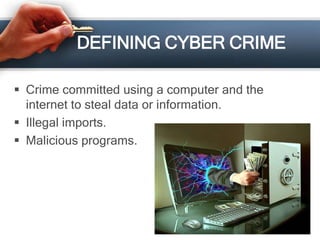
 Crime committed using a computer and the 
internet to steal data or information. 
 Illegal imports. 
 Malicious programs.
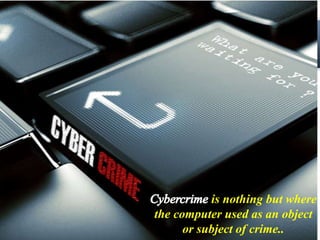
Cyber crime 
is nothing but where 
the computer used as an object 
or subject of crime..
TYPES OF CYBER CRIME 
• Hacking 
• Denial of service attack 
• Virus Dissemination 
• Computer Vandalism 
• Cyber Terrorism 
• Software Piracy
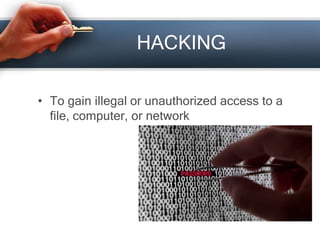
HACKING 
• To gain illegal or unauthorized access to a 
file, computer, or network
HISTORY 
• Phase 1: early 1960s to 1970s 
– It was a positive term introduce by MIT 
– A "hacker" was a creative programmer 
who wrote elegant or clever code 
– A "hack" was an especially clever piece 
of code
HISTORY 
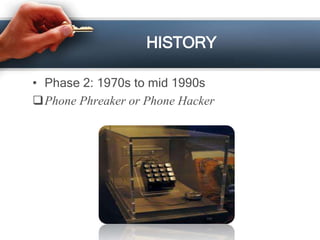
• Phase 2: 1970s to mid 1990s 
Phone Phreaker or Phone Hacker
HISTORY 
• Phase 3: beginning with the mid 1990s 
Phreaks started to migrate to computers 
-Political hacking (Hacktivism) surfaced 
– Denial-of-service (DoS) 
– Large scale theft of personal and 
financial information
Who is a “HACKER” ?
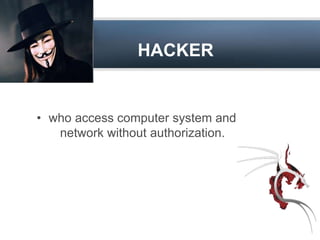
HACKER 
• who access computer system and 
network without authorization.
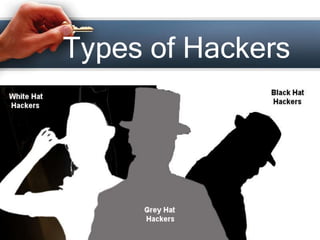
Types of Hackers
1. Black Hat hackers always do illegal work. They 
Work for black money . 
2. Hack into to Bank Websites , credit card 
websites and stole Money from accounts in 
bank websites. 
3. They use their knowledge for illegal purposes.
•White hat hackers are like Ethical Hackers . 
They use their skills for good purposes 
•They work for organizations for stop the 
illegal activities through black hat hackers.
1. Grey Hat hackers have both qualities like 
black hat hackers and white hat hackers . 
2. They use their knowledge for bad 
purposes and good purposes too.
Terminologies 
Hackers 
• Access computer systemornetworkwithoutauthorization 
• Breaks thelaw; cango toprison 
Crackers 
• Break into systems to steal or destroy data 
• U.S.Department of Justice calls both hackers 
Ethical hacker 
• Performs most of the same activities but with owner’s 
permission
Hacktivism
Hacktivism/Political Hacking 
• The act of hacking, or breaking into 
computer system, for a political or socially 
motivated purpose.
The Law: Catching and 
Punishing Hackers: 
• 1986 Congress passed the Computer 
Fraud and Abuse Act (CFAA) 
– Covers government computers, financial and 
medical systems, and activities that involve 
computers in more than one state, including 
computers connected to the Internet 
– The USA Patriot Act expanded the definition of 
loss to include the cost of responding to an 
attack, assessing damage and restoring 
systems
The Law: Catching and 
Punishing Hackers (cont.): 
• A variety of methods for catching 
hackers 
– Law enforcement agents read hacker 
newsletters and participate in chat rooms 
undercover 
– They can often track a handle by looking 
through newsgroup archives 
– Security professionals set up ‘honey pots’ 
which are Web sites that attract hackers, to 
record and study 
– Computer forensics is used to retrieve 
evidence from computers
The Law: Catching and 
Punishing Hackers (cont.): 
• Security 
– Internet started with open access as a means 
of sharing information for research 
– Attitudes about security were slow to catch up 
with the risks 
– Firewalls are used to monitor and filter out 
communication from untrusted sites or that fit a 
profile of suspicious activity 
– Security is often playing catch-up to hackers as 
new vulnerabilities are discovered and 
exploited
The Law: Catching and 
Punishing Hackers (cont.): 
• Responsibility for Security 
– Developers have a responsibility to develop 
with security as a goal 
– Businesses have a responsibility to use 
security tools and monitor their systems to 
prevent attacks from succeeding 
– Home users have a responsibility to ask 
questions and educate themselves on the tools 
to maintain security (personal firewalls, anti-virus 
and anti-spyware)
Conclusion 
• Hacking is a good computing skill that can be used for 
good or bad intention. 
• Hacking does not mean using your computing skills to do 
bad. Society have forgotten the difference between 
crackers and hackers. 
• Learning skills of hacking is only for the greater good.
References 
• http://compnetworking.about.com/od/networksecurityprivacy/f/what-is-hacking. 
htm 
• http://whatishacking.org/ 
• http://whatismyipaddress.com/hacking 
• http://dictionary.reference.com/browse/hacker?s=t 
• http://wiki.answers.com/Q/What_is_the_difference_between_hacking_and_crac 
king 
• http://answers.yahoo.com/question/index?qid=20071206182542AA3JzNy 
• http://www.huffingtonpost.co.uk/eva-blumdumontet/29c3-hacking-politics_ 
b_2512573.html 
• http://answers.yahoo.com/question/index?qid=20110801131429AAFTktO 
• http://www.• http://www.Thank cs.berkeley.edu/~bh/hacker.html 
ehow.com/about_4673738_why-do-You 
people-hack.html 
• http://venturebeat.com/2011/12/28/anonymous-stratfor-hack-10-things-to-know/ 
• http://www.slideshare.net/TerroWhite/ethical-hacking-and-it-security-training 
• http://www.switched.com/2011/02/24/what-to-do-email-account-hacked/
Any **Queries **Ask@Your Own Risk

Hacking

  • 1.
    HACKING (CRIME) Ifwe can defeat them sitting at home……who needs to fight with tanks and guns!!!! Presented By Farkhanda Kiran.
  • 2.
    INTRODUCTION The internetis growing rapidly. It has given rise to new opportunities in every field we can think of be it entertainment, business, sports or education. There’re two sides to a coin. Internet also has it’s own disadvantages is Cyber crime- illegal activity committed on the internet.
  • 3.
    DEFINING CYBER CRIME  Crime committed using a computer and the internet to steal data or information.  Illegal imports.  Malicious programs.
  • 4.
    Cyber crime isnothing but where the computer used as an object or subject of crime..
  • 5.
    TYPES OF CYBERCRIME • Hacking • Denial of service attack • Virus Dissemination • Computer Vandalism • Cyber Terrorism • Software Piracy
  • 7.
    HACKING • Togain illegal or unauthorized access to a file, computer, or network
  • 8.
    HISTORY • Phase1: early 1960s to 1970s – It was a positive term introduce by MIT – A "hacker" was a creative programmer who wrote elegant or clever code – A "hack" was an especially clever piece of code
  • 9.
    HISTORY • Phase2: 1970s to mid 1990s Phone Phreaker or Phone Hacker
  • 10.
    HISTORY • Phase3: beginning with the mid 1990s Phreaks started to migrate to computers -Political hacking (Hacktivism) surfaced – Denial-of-service (DoS) – Large scale theft of personal and financial information
  • 11.
    Who is a“HACKER” ?
  • 12.
    HACKER • whoaccess computer system and network without authorization.
  • 13.
  • 15.
    1. Black Hathackers always do illegal work. They Work for black money . 2. Hack into to Bank Websites , credit card websites and stole Money from accounts in bank websites. 3. They use their knowledge for illegal purposes.
  • 17.
    •White hat hackersare like Ethical Hackers . They use their skills for good purposes •They work for organizations for stop the illegal activities through black hat hackers.
  • 19.
    1. Grey Hathackers have both qualities like black hat hackers and white hat hackers . 2. They use their knowledge for bad purposes and good purposes too.
  • 20.
    Terminologies Hackers •Access computer systemornetworkwithoutauthorization • Breaks thelaw; cango toprison Crackers • Break into systems to steal or destroy data • U.S.Department of Justice calls both hackers Ethical hacker • Performs most of the same activities but with owner’s permission
  • 21.
  • 22.
    Hacktivism/Political Hacking •The act of hacking, or breaking into computer system, for a political or socially motivated purpose.
  • 23.
    The Law: Catchingand Punishing Hackers: • 1986 Congress passed the Computer Fraud and Abuse Act (CFAA) – Covers government computers, financial and medical systems, and activities that involve computers in more than one state, including computers connected to the Internet – The USA Patriot Act expanded the definition of loss to include the cost of responding to an attack, assessing damage and restoring systems
  • 24.
    The Law: Catchingand Punishing Hackers (cont.): • A variety of methods for catching hackers – Law enforcement agents read hacker newsletters and participate in chat rooms undercover – They can often track a handle by looking through newsgroup archives – Security professionals set up ‘honey pots’ which are Web sites that attract hackers, to record and study – Computer forensics is used to retrieve evidence from computers
  • 25.
    The Law: Catchingand Punishing Hackers (cont.): • Security – Internet started with open access as a means of sharing information for research – Attitudes about security were slow to catch up with the risks – Firewalls are used to monitor and filter out communication from untrusted sites or that fit a profile of suspicious activity – Security is often playing catch-up to hackers as new vulnerabilities are discovered and exploited
  • 26.
    The Law: Catchingand Punishing Hackers (cont.): • Responsibility for Security – Developers have a responsibility to develop with security as a goal – Businesses have a responsibility to use security tools and monitor their systems to prevent attacks from succeeding – Home users have a responsibility to ask questions and educate themselves on the tools to maintain security (personal firewalls, anti-virus and anti-spyware)
  • 27.
    Conclusion • Hackingis a good computing skill that can be used for good or bad intention. • Hacking does not mean using your computing skills to do bad. Society have forgotten the difference between crackers and hackers. • Learning skills of hacking is only for the greater good.
  • 28.
    References • http://compnetworking.about.com/od/networksecurityprivacy/f/what-is-hacking. htm • http://whatishacking.org/ • http://whatismyipaddress.com/hacking • http://dictionary.reference.com/browse/hacker?s=t • http://wiki.answers.com/Q/What_is_the_difference_between_hacking_and_crac king • http://answers.yahoo.com/question/index?qid=20071206182542AA3JzNy • http://www.huffingtonpost.co.uk/eva-blumdumontet/29c3-hacking-politics_ b_2512573.html • http://answers.yahoo.com/question/index?qid=20110801131429AAFTktO • http://www.• http://www.Thank cs.berkeley.edu/~bh/hacker.html ehow.com/about_4673738_why-do-You people-hack.html • http://venturebeat.com/2011/12/28/anonymous-stratfor-hack-10-things-to-know/ • http://www.slideshare.net/TerroWhite/ethical-hacking-and-it-security-training • http://www.switched.com/2011/02/24/what-to-do-email-account-hacked/
  • 29.