
BLU-RAY DISC


                                                                      abc
Under the guidance of:            School of Electronics & communication
xyz                                                          engineering
Assistant Professor      Lovely Professional University Phagwara, Punjab-
                                                                  144401
OVERVIEW
•Introduction
•The Name
•Foundation
•Types of BD
•The Technology
•Working of Blu-ray
•Disc Characteristics
•Comparison
•Benifits
•Ongoing Developments
•Conclusion
INTRODUCTION

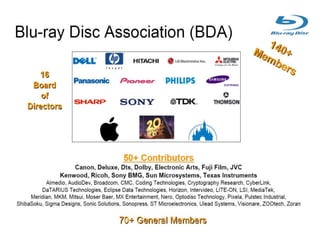
• Blu-ray, also known as Blu-ray Disc (BD), is the name
  of a next-generation optical disc format jointly
  developed by the Blu-ray Disc Association (BDA).

• The format was developed to enable
  recording, rewriting and playback of high-definition
  video (HD), as well as storing large amounts of data.
THE NAME
• The blu-ray name is a combination of “blue”, for the
  color of the laser that is used and “ray” for optical
  ray.

• The “e” in “blue” was purposefully left off, according
  to the manufacturers, because an everyday word
  cannot be a trademark.
FOUNDATION

• The first blue laser was developed in 1996 by Shuji
  Nakamura (Nichia Corporation).
• The first Blu-ray Disc prototypes were unveiled in
  October 2000.
• In 2002, an alliance was formed, called the Blu-ray
  Disc Association.
• Afterwards, it continued to be developed until its
  official release in June 2006.


                         5
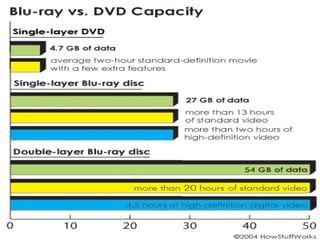
TYPES OF BD
 SINGLE LAYER :
- Can hold data up to 25 GB that means 2 hrs of HD
  video or about 13 hrs of standard video.

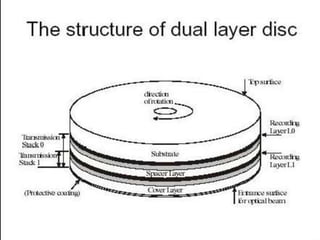
 DOUBLE LAYER :
- Can hold data up to 50 GB that means 4.5 hrs of HD
  video or more than 20 hrs of standard video.
THE TECHNOLOGY
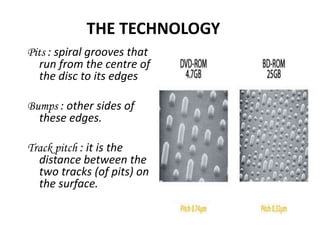
Pits : spiral grooves that
   run from the centre of
   the disc to its edges

Bumps : other sides of
  these edges.

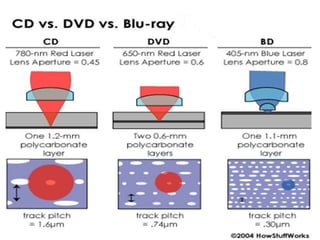
Track pitch : it is the
  distance between the
  two tracks (of pits) on
  the surface.
WORKING OF BLU-RAY

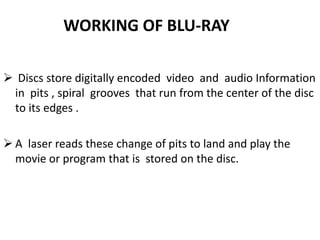
 Discs store digitally encoded video and audio Information
 in pits , spiral grooves that run from the center of the disc
 to its edges .

 A laser reads these change of pits to land and play the
  movie or program that is stored on the disc.
DISC CHARACTERISTICS
• Pit size – 0.15 microns
  ( more than twice as
  small as the pits on
  DVD )
• Track-pitch is : 0.30
  microns
• Laser needed : blue
  laser (405 nm)
• Data transfer rate : 36
  Mbps
DISC CHARACTERISTICS(cont…)
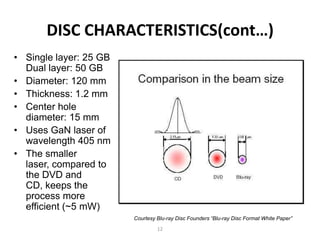
• Single layer: 25 GB
  Dual layer: 50 GB
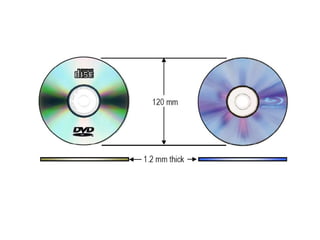
• Diameter: 120 mm
• Thickness: 1.2 mm
• Center hole
  diameter: 15 mm
• Uses GaN laser of
  wavelength 405 nm
• The smaller
  laser, compared to
  the DVD and
  CD, keeps the
  process more
  efficient (~5 mW)
                        Courtesy Blu-ray Disc Founders “Blu-ray Disc Format White Paper”
                                 12
BACKWARD COMPATIBILITY

• A few early Blu-ray Disc players released in 2006 could
  play DVDs but not CDs (the LG BH100, Pioneer BDP-
  HD1, and Sony BDP-S1).
• But all current Blu-ray Disc players are capable of both
  DVD and CD playback.
BENEFITS OF BLU-RAY
• Shorter wavelength than red laser (650nm), which
  makes it possible to focus the laser spot with even
  greater precision.
• Allows data to be packed more tightly and stored in
  less space.
• Possible to fit more data on the disc even though it's
  the same size as CD/DVD.
• With the change of numerical aperture to 0.85 is
  what enables Blu-ray Disc to hold 25GB/50GB.

                                                           .
BLU RAY ‘S DURABILITY ADVANTAGE
 Various hard coating technologies make Blu ray disc
  most durable and family -friendly”
 Hard-coating technology provides resistance to:
      - Finger prints
      - Marks
      - Scratches
      - Dust
 Much more ROBUST than today’s polycarbonate-
  based CD/DVD’s
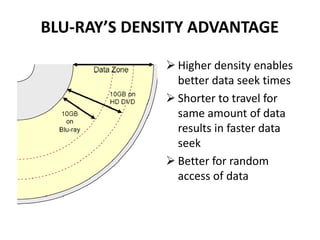
BLU-RAY’S DENSITY ADVANTAGE

               Higher density enables
                better data seek times
               Shorter to travel for
                same amount of data
                results in faster data
                seek
               Better for random
                access of data
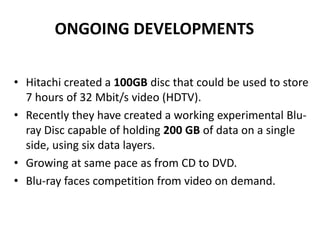
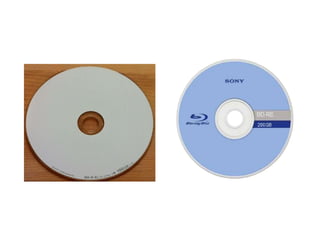
ONGOING DEVELOPMENTS

• Hitachi created a 100GB disc that could be used to store
  7 hours of 32 Mbit/s video (HDTV).
• Recently they have created a working experimental Blu-
  ray Disc capable of holding 200 GB of data on a single
  side, using six data layers.
• Growing at same pace as from CD to DVD.
• Blu-ray faces competition from video on demand.
CONCLUSION

It’s very likely that the technology will be
adopted as the next generation optical disc
format for PC data storage and replace
technologies such as CD, DVD, and HD-DVD etc.
Thank You

Blu ray disc new1

  • 1.
    BLU-RAY DISC abc Under the guidance of: School of Electronics & communication xyz engineering Assistant Professor Lovely Professional University Phagwara, Punjab- 144401
  • 2.
    OVERVIEW •Introduction •The Name •Foundation •Types ofBD •The Technology •Working of Blu-ray •Disc Characteristics •Comparison •Benifits •Ongoing Developments •Conclusion
  • 3.
    INTRODUCTION • Blu-ray, alsoknown as Blu-ray Disc (BD), is the name of a next-generation optical disc format jointly developed by the Blu-ray Disc Association (BDA). • The format was developed to enable recording, rewriting and playback of high-definition video (HD), as well as storing large amounts of data.
  • 4.
    THE NAME • Theblu-ray name is a combination of “blue”, for the color of the laser that is used and “ray” for optical ray. • The “e” in “blue” was purposefully left off, according to the manufacturers, because an everyday word cannot be a trademark.
  • 5.
    FOUNDATION • The firstblue laser was developed in 1996 by Shuji Nakamura (Nichia Corporation). • The first Blu-ray Disc prototypes were unveiled in October 2000. • In 2002, an alliance was formed, called the Blu-ray Disc Association. • Afterwards, it continued to be developed until its official release in June 2006. 5
  • 6.
    TYPES OF BD SINGLE LAYER : - Can hold data up to 25 GB that means 2 hrs of HD video or about 13 hrs of standard video.  DOUBLE LAYER : - Can hold data up to 50 GB that means 4.5 hrs of HD video or more than 20 hrs of standard video.
  • 8.
    THE TECHNOLOGY Pits :spiral grooves that run from the centre of the disc to its edges Bumps : other sides of these edges. Track pitch : it is the distance between the two tracks (of pits) on the surface.
  • 9.
    WORKING OF BLU-RAY Discs store digitally encoded video and audio Information in pits , spiral grooves that run from the center of the disc to its edges .  A laser reads these change of pits to land and play the movie or program that is stored on the disc.
  • 11.
    DISC CHARACTERISTICS • Pitsize – 0.15 microns ( more than twice as small as the pits on DVD ) • Track-pitch is : 0.30 microns • Laser needed : blue laser (405 nm) • Data transfer rate : 36 Mbps
  • 12.
    DISC CHARACTERISTICS(cont…) • Singlelayer: 25 GB Dual layer: 50 GB • Diameter: 120 mm • Thickness: 1.2 mm • Center hole diameter: 15 mm • Uses GaN laser of wavelength 405 nm • The smaller laser, compared to the DVD and CD, keeps the process more efficient (~5 mW) Courtesy Blu-ray Disc Founders “Blu-ray Disc Format White Paper” 12
  • 14.
    BACKWARD COMPATIBILITY • Afew early Blu-ray Disc players released in 2006 could play DVDs but not CDs (the LG BH100, Pioneer BDP- HD1, and Sony BDP-S1). • But all current Blu-ray Disc players are capable of both DVD and CD playback.
  • 16.
    BENEFITS OF BLU-RAY •Shorter wavelength than red laser (650nm), which makes it possible to focus the laser spot with even greater precision. • Allows data to be packed more tightly and stored in less space. • Possible to fit more data on the disc even though it's the same size as CD/DVD. • With the change of numerical aperture to 0.85 is what enables Blu-ray Disc to hold 25GB/50GB. .
  • 17.
    BLU RAY ‘SDURABILITY ADVANTAGE  Various hard coating technologies make Blu ray disc most durable and family -friendly”  Hard-coating technology provides resistance to: - Finger prints - Marks - Scratches - Dust  Much more ROBUST than today’s polycarbonate- based CD/DVD’s
  • 18.
    BLU-RAY’S DENSITY ADVANTAGE  Higher density enables better data seek times  Shorter to travel for same amount of data results in faster data seek  Better for random access of data
  • 20.
    ONGOING DEVELOPMENTS • Hitachicreated a 100GB disc that could be used to store 7 hours of 32 Mbit/s video (HDTV). • Recently they have created a working experimental Blu- ray Disc capable of holding 200 GB of data on a single side, using six data layers. • Growing at same pace as from CD to DVD. • Blu-ray faces competition from video on demand.
  • 24.
    CONCLUSION It’s very likelythat the technology will be adopted as the next generation optical disc format for PC data storage and replace technologies such as CD, DVD, and HD-DVD etc.
  • 26.