Two Patterns of Speciation
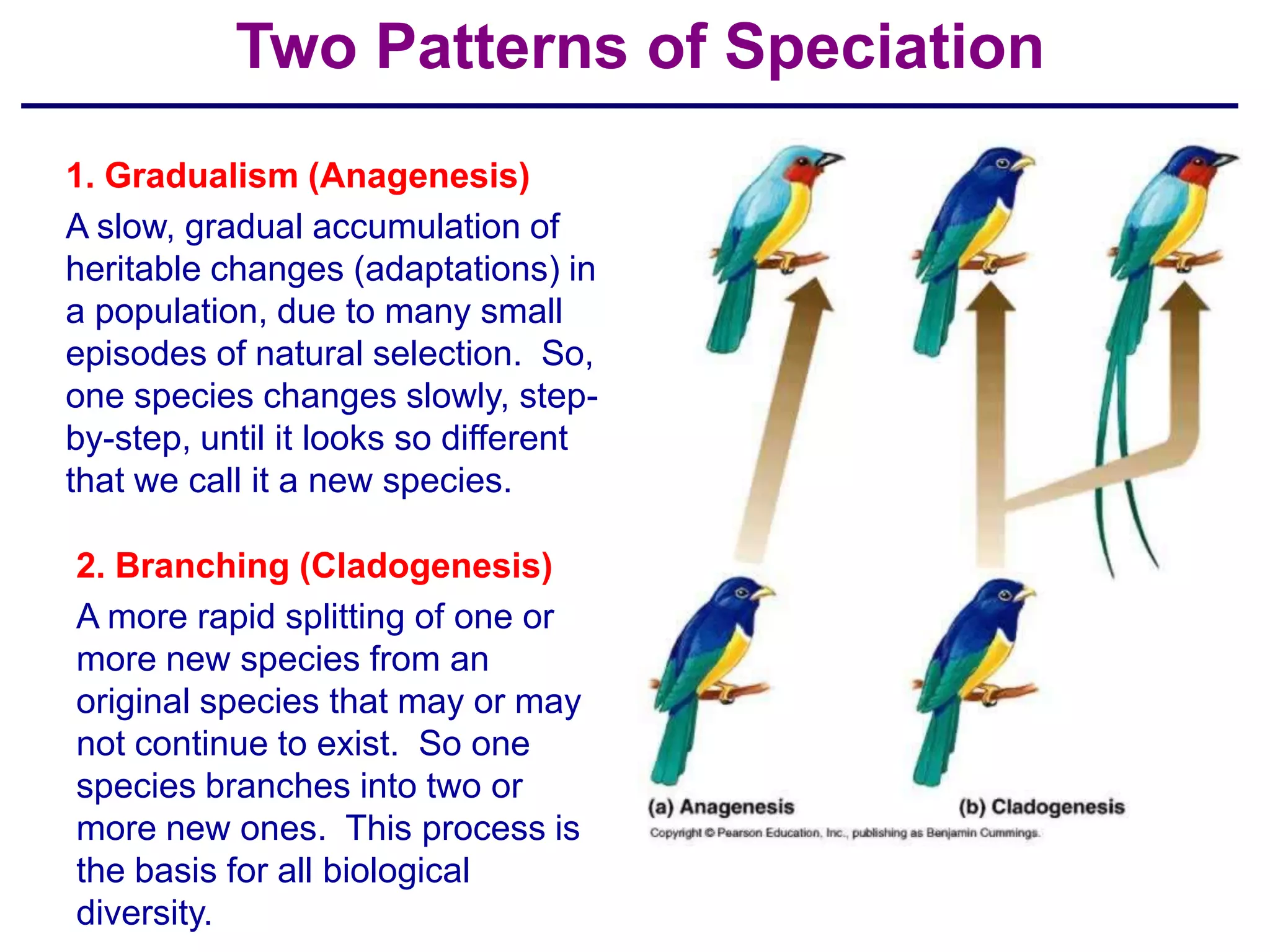
1. Gradualism (Anagenesis)
A slow, gradual accumulation of
heritable changes (adaptations) in
a population, due to many small
episodes of natural selection. So,
one species changes slowly, step-
by-step, until it looks so different
that we call it a new species.

2. Branching (Cladogenesis)
A more rapid splitting of one or
more new species from an
original species that may or may
not continue to exist. So one
species branches into two or
more new ones. This process is
the basis for all biological
diversity.
How does one species evolve into two or more new
             species by branching?

                   By a 2-step process…
1. Geographic isolation - A single population gets divided
   into two (or more) populations.
   The members of the different populations (which are
   now separated from each other) are therefore no longer
   able to interact with each other.
2. Evolution of reproductive barriers - Over time, as they
   adapt to their different environments due to natural
   selection, the two populations evolve one or more
   reproductive barriers, which prevent interbreeding.
Step 1: Geographic Isolation
Gene flow between two populations is
interrupted (or reduced) between two
populations because they are geographically
separated. What causes this to happen?
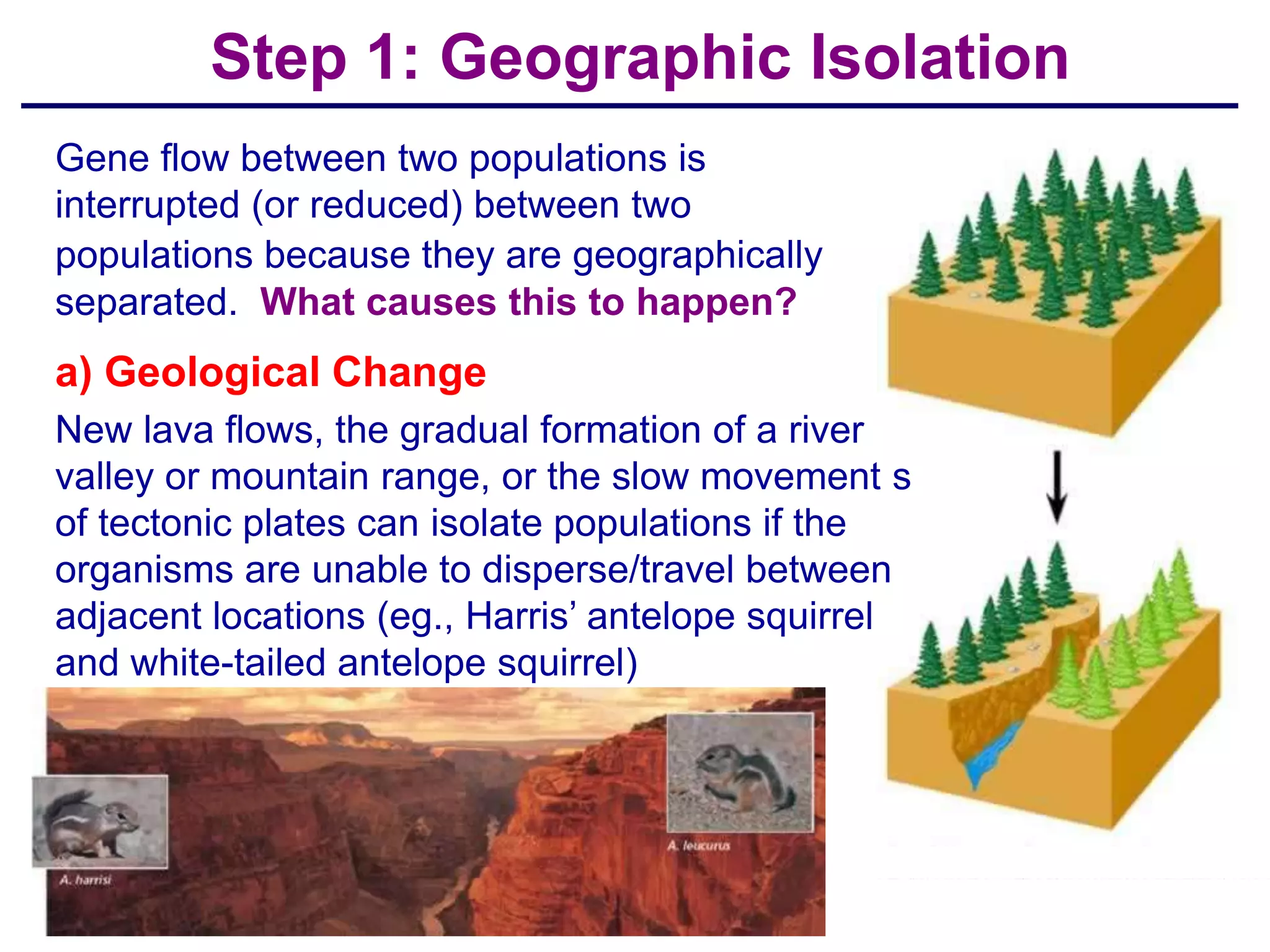
a) Geological Change
New lava flows, the gradual formation of a river
valley or mountain range, or the slow movement s
of tectonic plates can isolate populations if the
organisms are unable to disperse/travel between
adjacent locations (eg., Harris’ antelope squirrel
and white-tailed antelope squirrel)
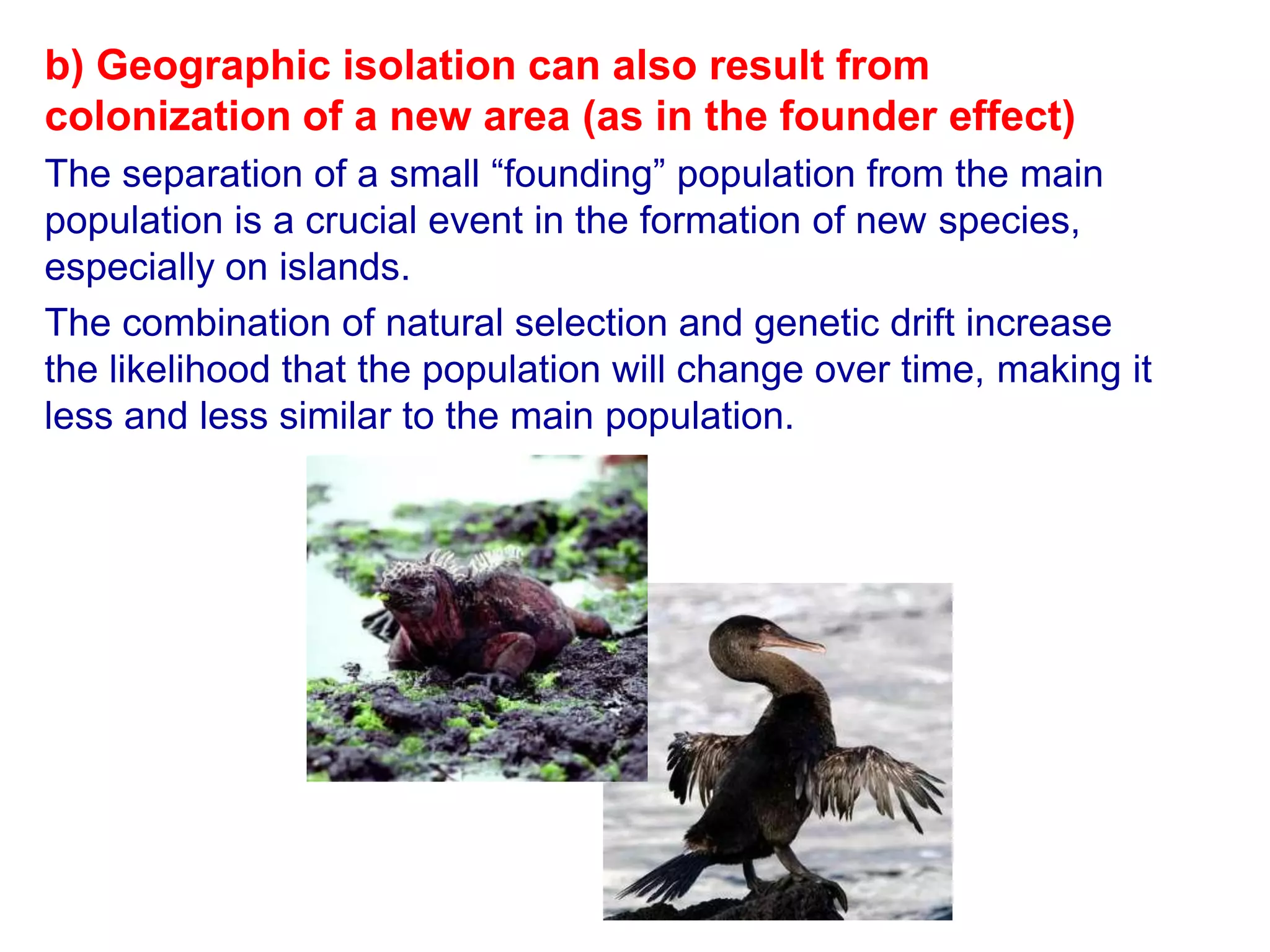
b) Geographic isolation can also result from
colonization of a new area (as in the founder effect)
The separation of a small “founding” population from the main
population is a crucial event in the formation of new species,
especially on islands.
The combination of natural selection and genetic drift increase
the likelihood that the population will change over time, making it
less and less similar to the main population.
Adaptive Radiation: many diversely-adapted species
         evolved from a common ancestor

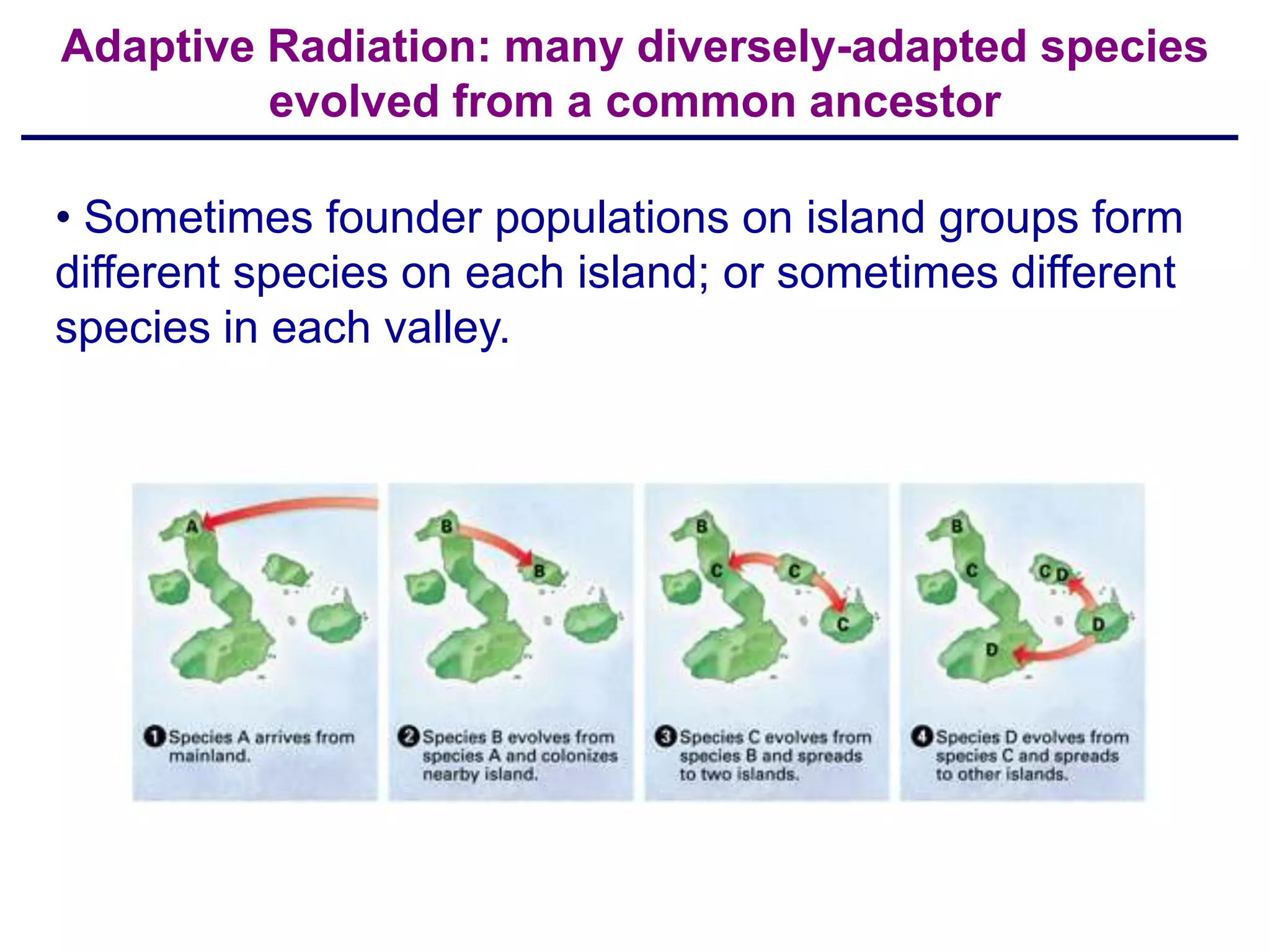
• Sometimes founder populations on island groups form
different species on each island; or sometimes different
species in each valley.
Adaptive Radiation: many diversely-adapted species
         evolved from a common ancestor

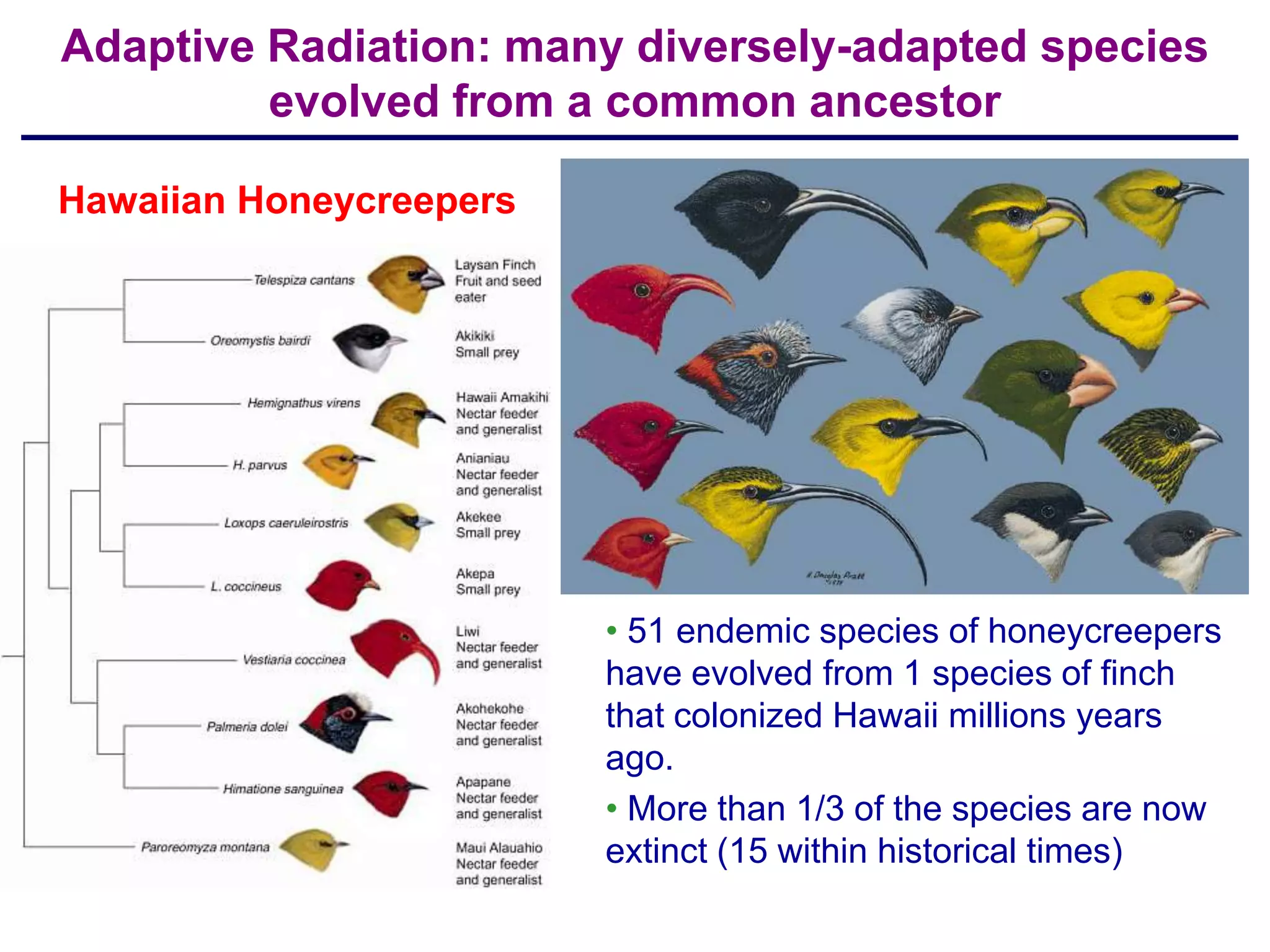
Hawaiian Honeycreepers


                         • 51 endemic species of honeycreepers
                         have evolved from 1 species of finch
                         that colonized Hawaii millions years
                         ago.
                         • More than 1/3 of the species are now
                         extinct (15 within historical times)
Adaptive Radiation: many diversely-adapted species
           evolved from a common ancestor
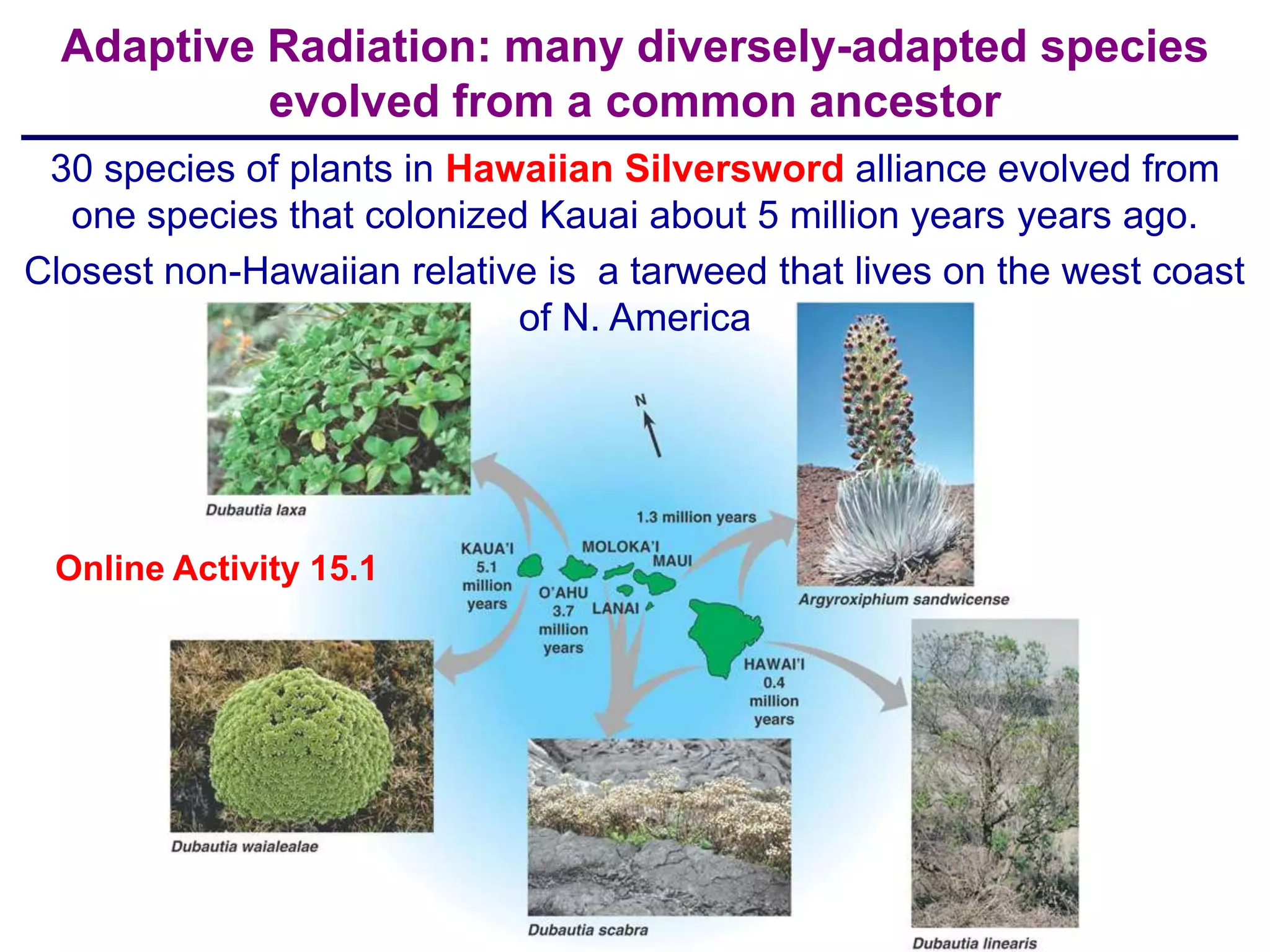
 30 species of plants in Hawaiian Silversword alliance evolved from
   one species that colonized Kauai about 5 million years years ago.
Closest non-Hawaiian relative is a tarweed that lives on the west coast
                             of N. America


 Online Activity 15.1
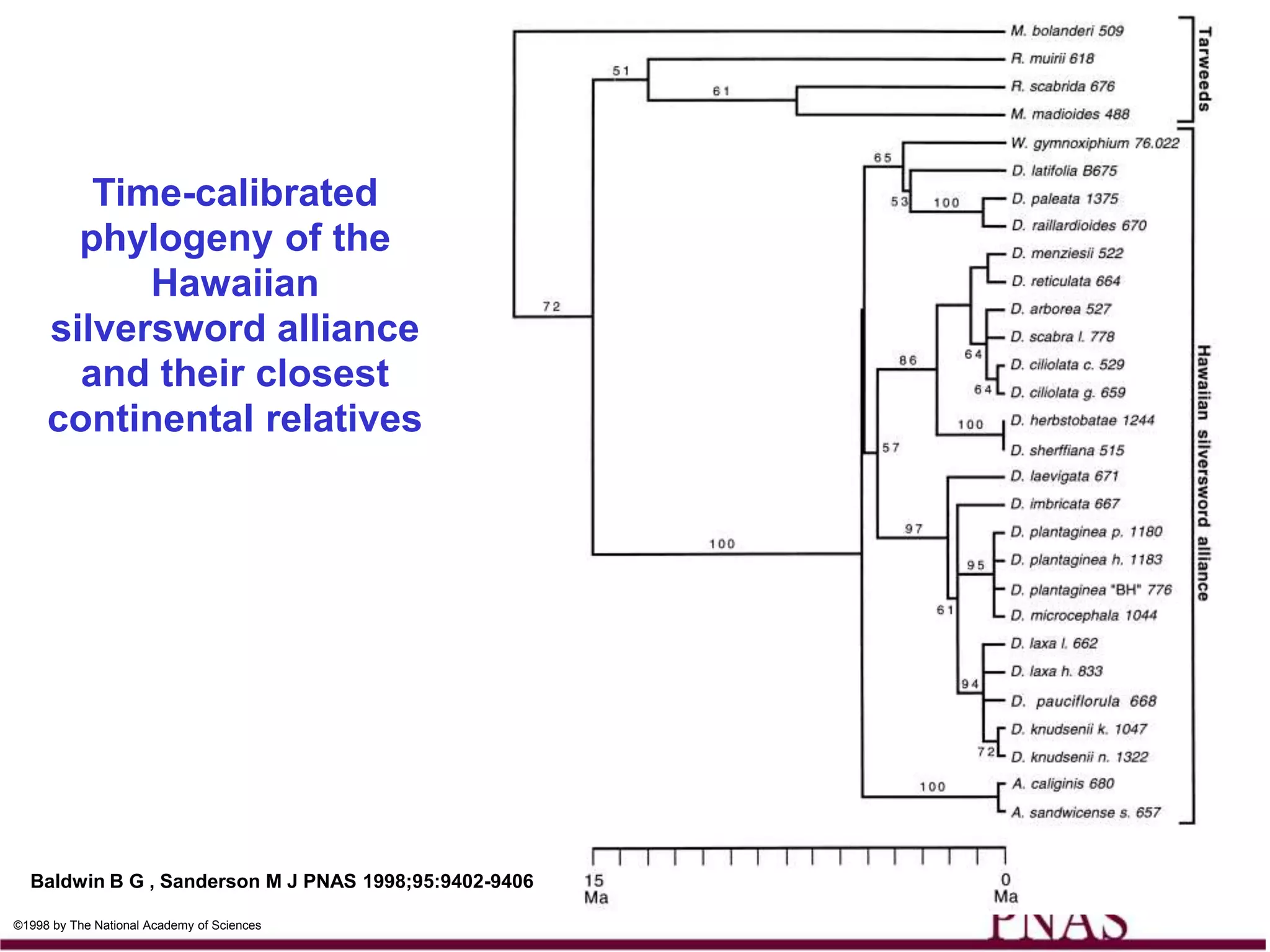
Time-calibrated
       phylogeny of the
           Hawaiian
     silversword alliance
       and their closest
     continental relatives


  Baldwin B G , Sanderson M J PNAS 1998;95:9402-9406

©1998 by The National Academy of Sciences
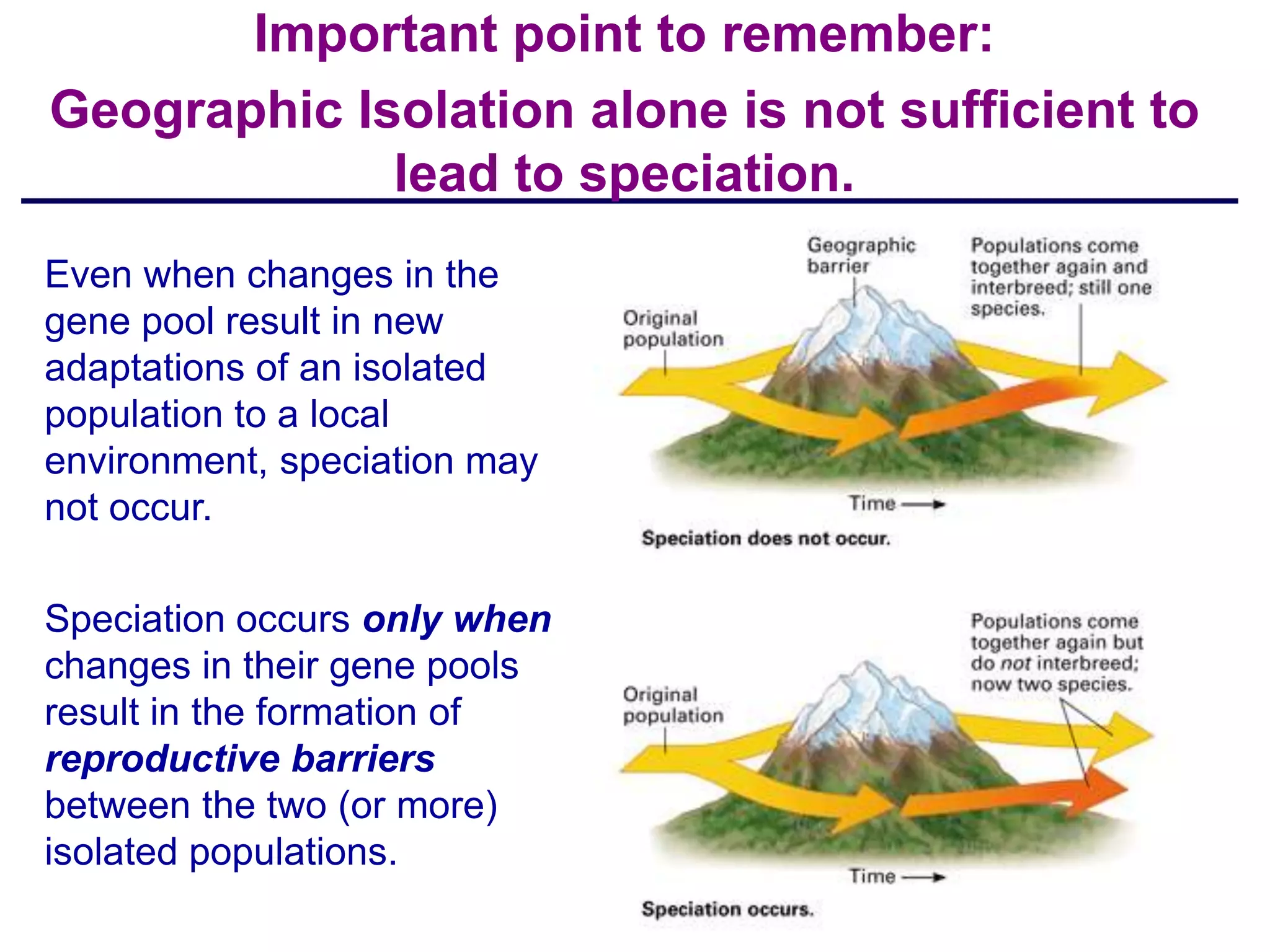
Important point to remember:
Geographic Isolation alone is not sufficient to
             lead to speciation.
Even when changes in the
gene pool result in new
adaptations of an isolated
population to a local
environment, speciation may
not occur.

Speciation occurs only when
changes in their gene pools
result in the formation of
reproductive barriers
between the two (or more)
isolated populations.
Step 2. The formation of reproductive
         barriers between species
• What are reproductive barriers?
  Any morphological, physiological, or behavioral trait
  that prevents different organisms from successfully
  interbreeding (so they cannot produce viable, fertile
  offspring).

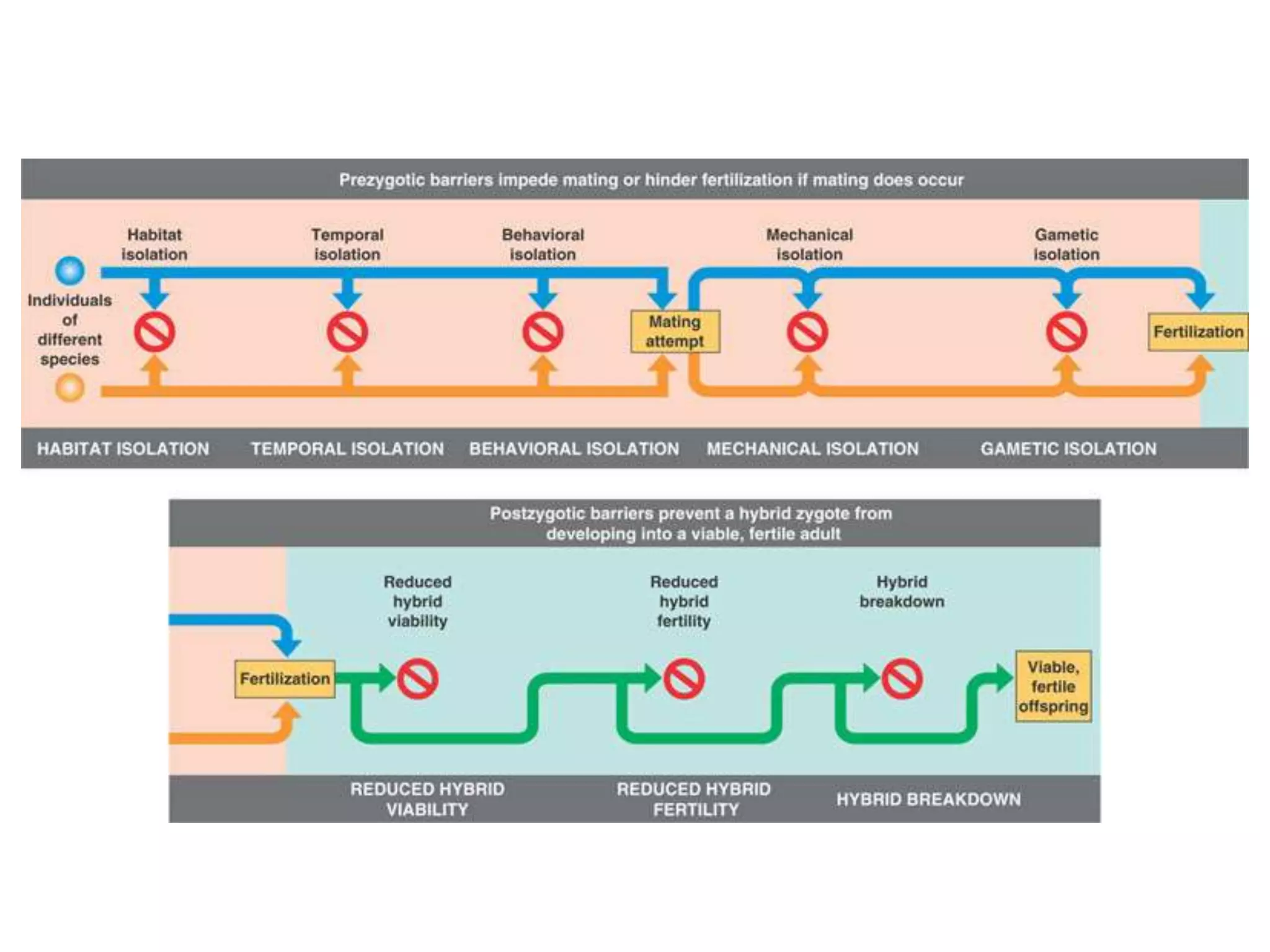
• There are several types, which can be classified as
  either pre-zygotic or post-zygotic barriers
Pre-zygotic Reproductive Barriers


Prevent the formation of a zygote by preventing
mating or fertilization

There are 5 types:
Pre-zygotic Reproductive Barriers
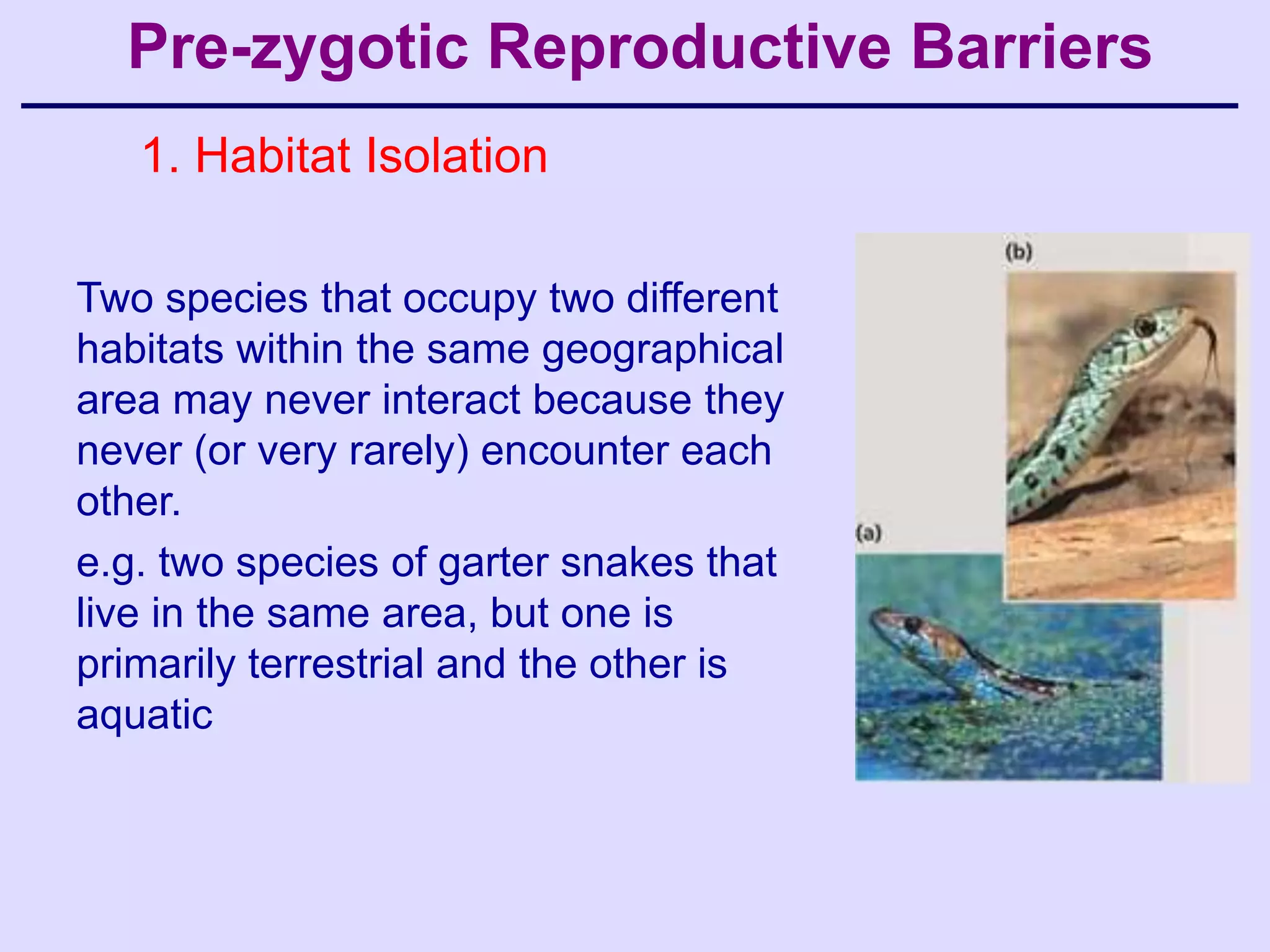
   1. Habitat Isolation

Two species that occupy two different
habitats within the same geographical
area may never interact because they
never (or very rarely) encounter each
other.
e.g. two species of garter snakes that
live in the same area, but one is
primarily terrestrial and the other is
aquatic
Pre-zygotic Reproductive Barriers
• Prevent the formation of a zygote by preventing
  mating or fertilization
   1. Habitat Isolation
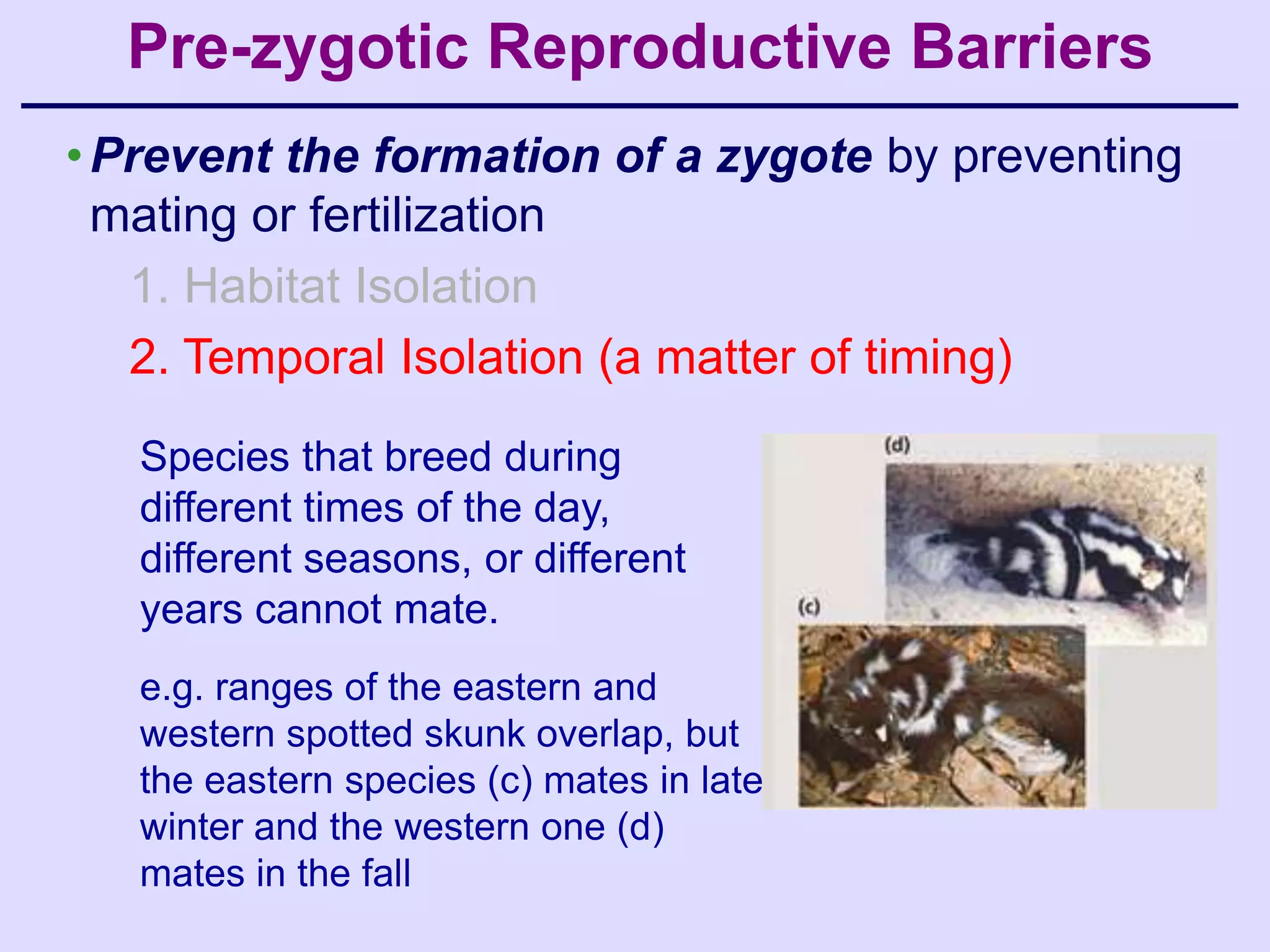
   2. Temporal Isolation (a matter of timing)
   Species that breed during
   different times of the day,
   different seasons, or different
   years cannot mate.
   e.g. ranges of the eastern and
   western spotted skunk overlap, but
   the eastern species (c) mates in late
   winter and the western one (d)
   mates in the fall
Pre-zygotic Barriers
• Prevent the formation of a zygote by preventing
  mating or fertilization
   1. Habitat Isolation
   2. Temporal Isolation
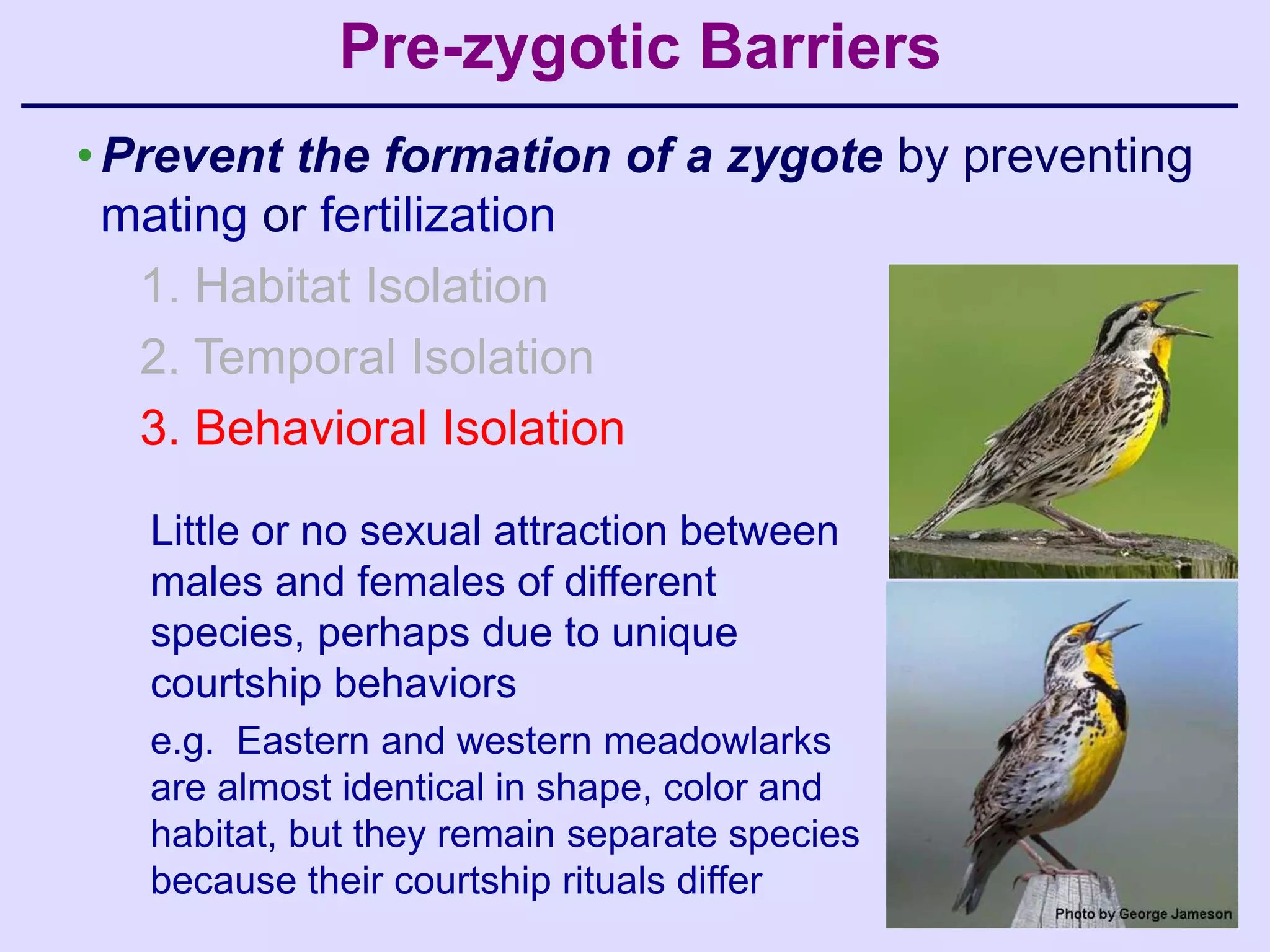
   3. Behavioral Isolation

   Little or no sexual attraction between
   males and females of different
   species, perhaps due to unique
   courtship behaviors
   e.g. Eastern and western meadowlarks
   are almost identical in shape, color and
   habitat, but they remain separate species
   because their courtship rituals differ
Pre-zygotic Barriers
• Prevent the formation of a zygote by preventing
  mating or fertilization
   1. Habitat Isolation
   2. Temporal Isolation
   3. Behavioral Isolation
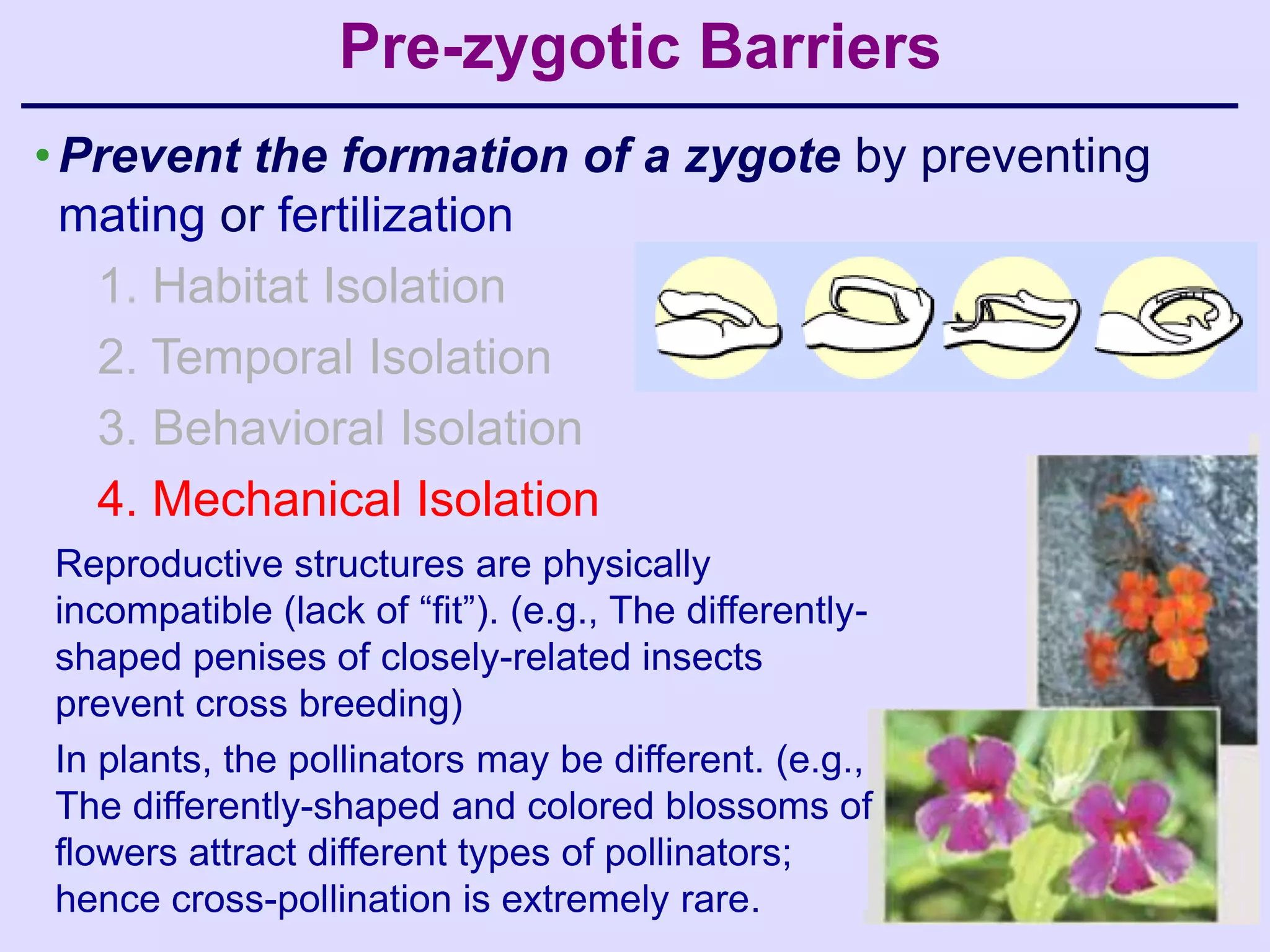
   4. Mechanical Isolation
Reproductive structures are physically
incompatible (lack of “fit”). (e.g., The differently-
shaped penises of closely-related insects
prevent cross breeding)
In plants, the pollinators may be different. (e.g.,
The differently-shaped and colored blossoms of
flowers attract different types of pollinators;
hence cross-pollination is extremely rare.
Pre-zygotic Barriers
• Prevent the formation of a zygote by preventing
  mating or fertilization
   1. Habitat Isolation
   2. Temporal Isolation
   3. Behavioral Isolation
   4. Mechanical Isolation
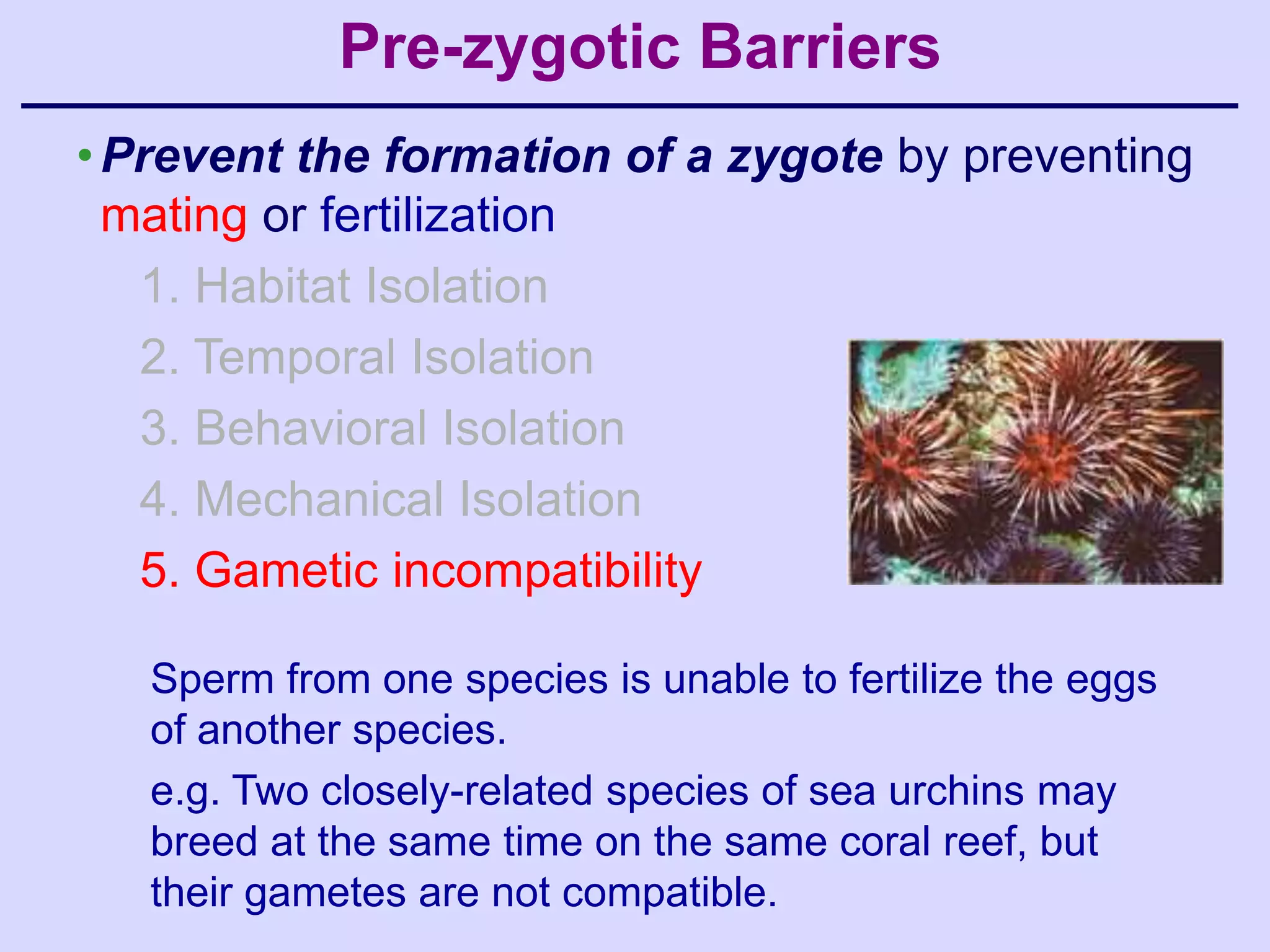
   5. Gametic incompatibility

   Sperm from one species is unable to fertilize the eggs
   of another species.
   e.g. Two closely-related species of sea urchins may
   breed at the same time on the same coral reef, but
   their gametes are not compatible.
Post-zygotic Reproductive Barriers

• Occur after the formation of a zygote by preventing
  the formation of healthy or fertile offspring


• There are 2 types:
Post-zygotic Reproductive Barriers
• Occur after the formation of a zygote by preventing
  the formation of a viable, fertile adult offspring
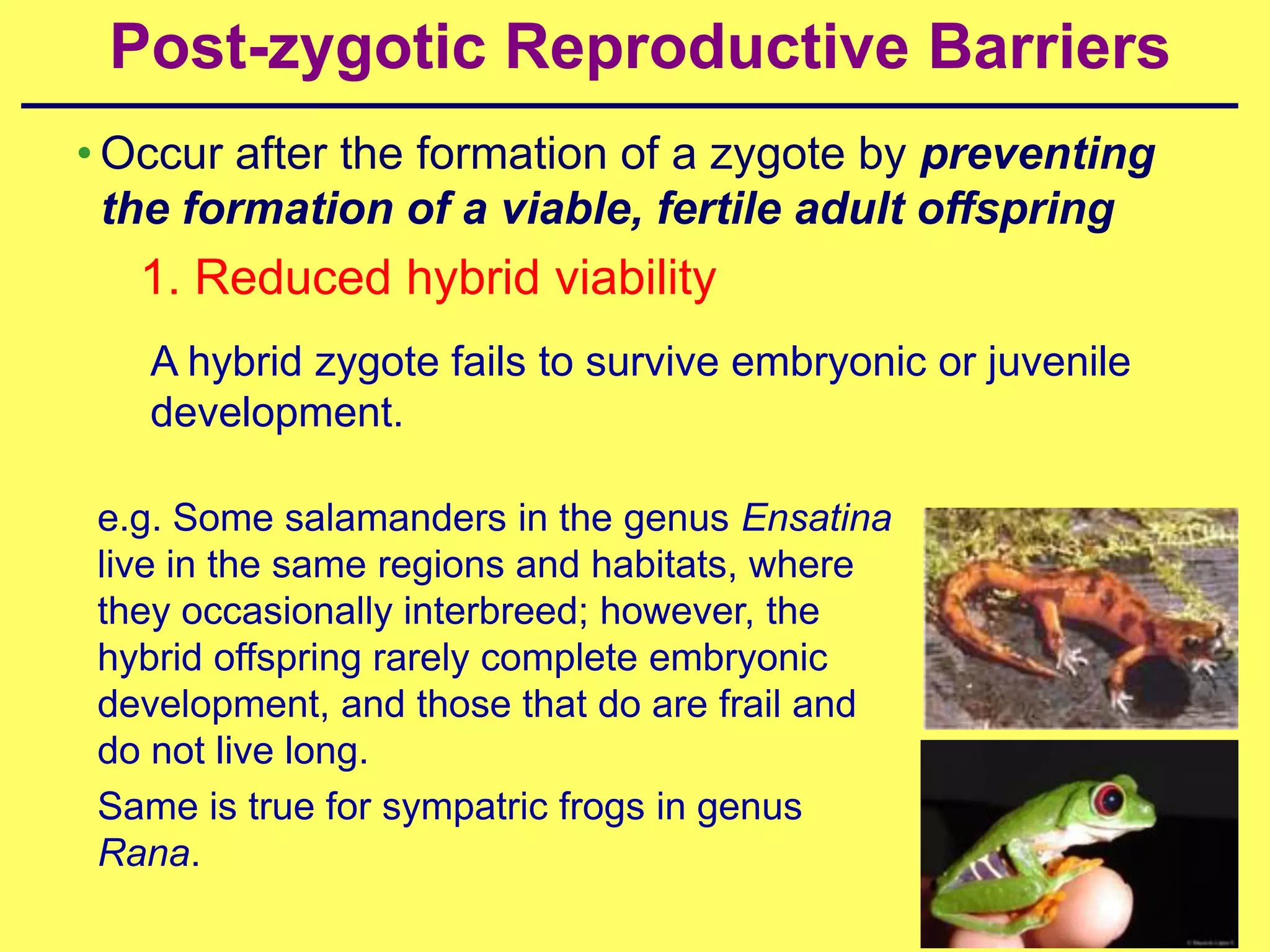
   1. Reduced hybrid viability
   A hybrid zygote fails to survive embryonic or juvenile
   development.

 e.g. Some salamanders in the genus Ensatina
 live in the same regions and habitats, where
 they occasionally interbreed; however, the
 hybrid offspring rarely complete embryonic
 development, and those that do are frail and
 do not live long.
 Same is true for sympatric frogs in genus
 Rana.
Post-zygotic Reproductive Barriers
• Occur after the formation of a zygote by preventing
  the formation of a viable, fertile adult offspring
   1. Reduced hybrid viability
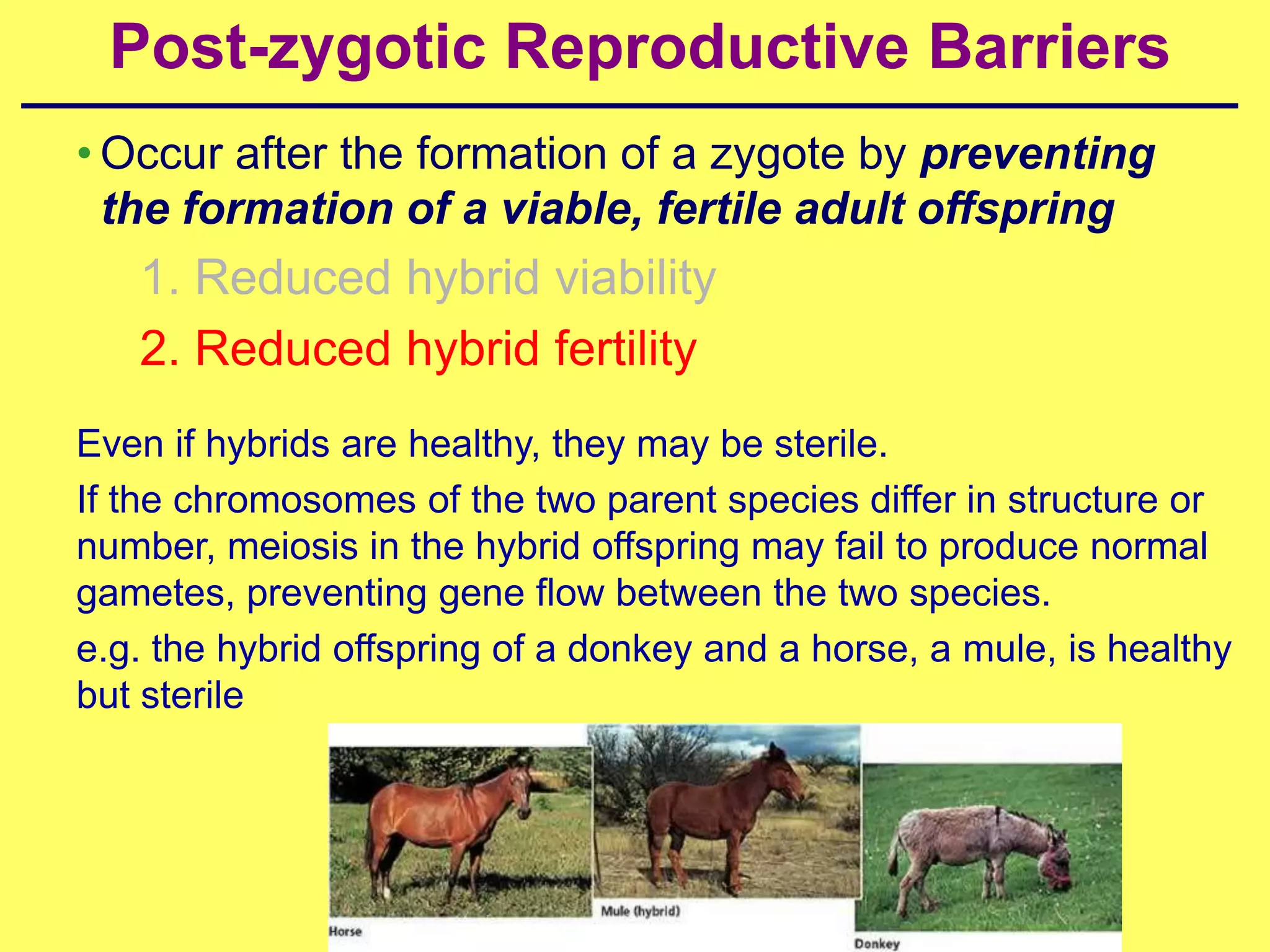
   2. Reduced hybrid fertility
Even if hybrids are healthy, they may be sterile.
If the chromosomes of the two parent species differ in structure or
number, meiosis in the hybrid offspring may fail to produce normal
gametes, preventing gene flow between the two species.
e.g. the hybrid offspring of a donkey and a horse, a mule, is healthy
but sterile
Concept Check
1. Why are donkeys and horses considered different species?

Their offspring (mules) are sterile (not fertile).

2. What is macroevolution?

Major evolutionary changes, often evident in the fossil record,
due to speciation and the evolution of major new adaptations

3. Give an example of a reproductive barrier that may separate
two similar species.

prezygotic: behavioral, habitat, temporal (timing), mechanical,
gametic,
postzygotic; reduced hybrid viability or fertility
Concept Check
4. Describe conditions that could make a new island a likely
place for adaptive radiation.

The island may consist of varied habitats with environmental
conditions that differ from one another and from other
landmasses.

Organisms may adapt to the varied conditions in different
ways, resulting in species diversity.

5. How does that branching model of evolution relate to
Darwin's theory of natural selection?

Suggests that natural selection causes most change as new
species begins. Major change is less common once a species
is established in an area.

Speciation 2013

  • 1.
    Two Patterns ofSpeciation 1. Gradualism (Anagenesis) A slow, gradual accumulation of heritable changes (adaptations) in a population, due to many small episodes of natural selection. So, one species changes slowly, step- by-step, until it looks so different that we call it a new species. 2. Branching (Cladogenesis) A more rapid splitting of one or more new species from an original species that may or may not continue to exist. So one species branches into two or more new ones. This process is the basis for all biological diversity.
  • 2.
    How does onespecies evolve into two or more new species by branching? By a 2-step process… 1. Geographic isolation - A single population gets divided into two (or more) populations. The members of the different populations (which are now separated from each other) are therefore no longer able to interact with each other. 2. Evolution of reproductive barriers - Over time, as they adapt to their different environments due to natural selection, the two populations evolve one or more reproductive barriers, which prevent interbreeding.
  • 3.
    Step 1: GeographicIsolation Gene flow between two populations is interrupted (or reduced) between two populations because they are geographically separated. What causes this to happen? a) Geological Change New lava flows, the gradual formation of a river valley or mountain range, or the slow movement s of tectonic plates can isolate populations if the organisms are unable to disperse/travel between adjacent locations (eg., Harris’ antelope squirrel and white-tailed antelope squirrel)
  • 4.
    b) Geographic isolationcan also result from colonization of a new area (as in the founder effect) The separation of a small “founding” population from the main population is a crucial event in the formation of new species, especially on islands. The combination of natural selection and genetic drift increase the likelihood that the population will change over time, making it less and less similar to the main population.
  • 5.
    Adaptive Radiation: manydiversely-adapted species evolved from a common ancestor • Sometimes founder populations on island groups form different species on each island; or sometimes different species in each valley.
  • 6.
    Adaptive Radiation: manydiversely-adapted species evolved from a common ancestor Hawaiian Honeycreepers • 51 endemic species of honeycreepers have evolved from 1 species of finch that colonized Hawaii millions years ago. • More than 1/3 of the species are now extinct (15 within historical times)
  • 7.
    Adaptive Radiation: manydiversely-adapted species evolved from a common ancestor 30 species of plants in Hawaiian Silversword alliance evolved from one species that colonized Kauai about 5 million years years ago. Closest non-Hawaiian relative is a tarweed that lives on the west coast of N. America Online Activity 15.1
  • 8.
    Time-calibrated phylogeny of the Hawaiian silversword alliance and their closest continental relatives Baldwin B G , Sanderson M J PNAS 1998;95:9402-9406 ©1998 by The National Academy of Sciences
  • 9.
    Important point toremember: Geographic Isolation alone is not sufficient to lead to speciation. Even when changes in the gene pool result in new adaptations of an isolated population to a local environment, speciation may not occur. Speciation occurs only when changes in their gene pools result in the formation of reproductive barriers between the two (or more) isolated populations.
  • 10.
    Step 2. Theformation of reproductive barriers between species • What are reproductive barriers? Any morphological, physiological, or behavioral trait that prevents different organisms from successfully interbreeding (so they cannot produce viable, fertile offspring). • There are several types, which can be classified as either pre-zygotic or post-zygotic barriers
  • 11.
    Pre-zygotic Reproductive Barriers Preventthe formation of a zygote by preventing mating or fertilization There are 5 types:
  • 12.
    Pre-zygotic Reproductive Barriers 1. Habitat Isolation Two species that occupy two different habitats within the same geographical area may never interact because they never (or very rarely) encounter each other. e.g. two species of garter snakes that live in the same area, but one is primarily terrestrial and the other is aquatic
  • 13.
    Pre-zygotic Reproductive Barriers •Prevent the formation of a zygote by preventing mating or fertilization 1. Habitat Isolation 2. Temporal Isolation (a matter of timing) Species that breed during different times of the day, different seasons, or different years cannot mate. e.g. ranges of the eastern and western spotted skunk overlap, but the eastern species (c) mates in late winter and the western one (d) mates in the fall
  • 14.
    Pre-zygotic Barriers • Preventthe formation of a zygote by preventing mating or fertilization 1. Habitat Isolation 2. Temporal Isolation 3. Behavioral Isolation Little or no sexual attraction between males and females of different species, perhaps due to unique courtship behaviors e.g. Eastern and western meadowlarks are almost identical in shape, color and habitat, but they remain separate species because their courtship rituals differ
  • 15.
    Pre-zygotic Barriers • Preventthe formation of a zygote by preventing mating or fertilization 1. Habitat Isolation 2. Temporal Isolation 3. Behavioral Isolation 4. Mechanical Isolation Reproductive structures are physically incompatible (lack of “fit”). (e.g., The differently- shaped penises of closely-related insects prevent cross breeding) In plants, the pollinators may be different. (e.g., The differently-shaped and colored blossoms of flowers attract different types of pollinators; hence cross-pollination is extremely rare.
  • 16.
    Pre-zygotic Barriers • Preventthe formation of a zygote by preventing mating or fertilization 1. Habitat Isolation 2. Temporal Isolation 3. Behavioral Isolation 4. Mechanical Isolation 5. Gametic incompatibility Sperm from one species is unable to fertilize the eggs of another species. e.g. Two closely-related species of sea urchins may breed at the same time on the same coral reef, but their gametes are not compatible.
  • 17.
    Post-zygotic Reproductive Barriers •Occur after the formation of a zygote by preventing the formation of healthy or fertile offspring • There are 2 types:
  • 18.
    Post-zygotic Reproductive Barriers •Occur after the formation of a zygote by preventing the formation of a viable, fertile adult offspring 1. Reduced hybrid viability A hybrid zygote fails to survive embryonic or juvenile development. e.g. Some salamanders in the genus Ensatina live in the same regions and habitats, where they occasionally interbreed; however, the hybrid offspring rarely complete embryonic development, and those that do are frail and do not live long. Same is true for sympatric frogs in genus Rana.
  • 19.
    Post-zygotic Reproductive Barriers •Occur after the formation of a zygote by preventing the formation of a viable, fertile adult offspring 1. Reduced hybrid viability 2. Reduced hybrid fertility Even if hybrids are healthy, they may be sterile. If the chromosomes of the two parent species differ in structure or number, meiosis in the hybrid offspring may fail to produce normal gametes, preventing gene flow between the two species. e.g. the hybrid offspring of a donkey and a horse, a mule, is healthy but sterile
  • 21.
    Concept Check 1. Whyare donkeys and horses considered different species? Their offspring (mules) are sterile (not fertile). 2. What is macroevolution? Major evolutionary changes, often evident in the fossil record, due to speciation and the evolution of major new adaptations 3. Give an example of a reproductive barrier that may separate two similar species. prezygotic: behavioral, habitat, temporal (timing), mechanical, gametic, postzygotic; reduced hybrid viability or fertility
  • 22.
    Concept Check 4. Describeconditions that could make a new island a likely place for adaptive radiation. The island may consist of varied habitats with environmental conditions that differ from one another and from other landmasses. Organisms may adapt to the varied conditions in different ways, resulting in species diversity. 5. How does that branching model of evolution relate to Darwin's theory of natural selection? Suggests that natural selection causes most change as new species begins. Major change is less common once a species is established in an area.