ParallelAccelerator.jl
High Performance Scripting in Julia
Ehsan Totoni
ehsan.totoni@intel.com
Programming Systems Lab, Intel Labs
December 17, 2015
Contributors: Todd Anderson, Raj Barik, Chunling Hu, Lindsey Kuper, Victor Lee, Hai Liu,
Geoff Lowney, Paul Petersen, Hongbo Rong, Tatiana Shpeisman, Youfeng Wu
1
§  Motivation
§  High Performance Scripting(HPS) Project at Intel Labs
§  ParallelAccelerator.jl
§  How It Works
§  Evaluation Results
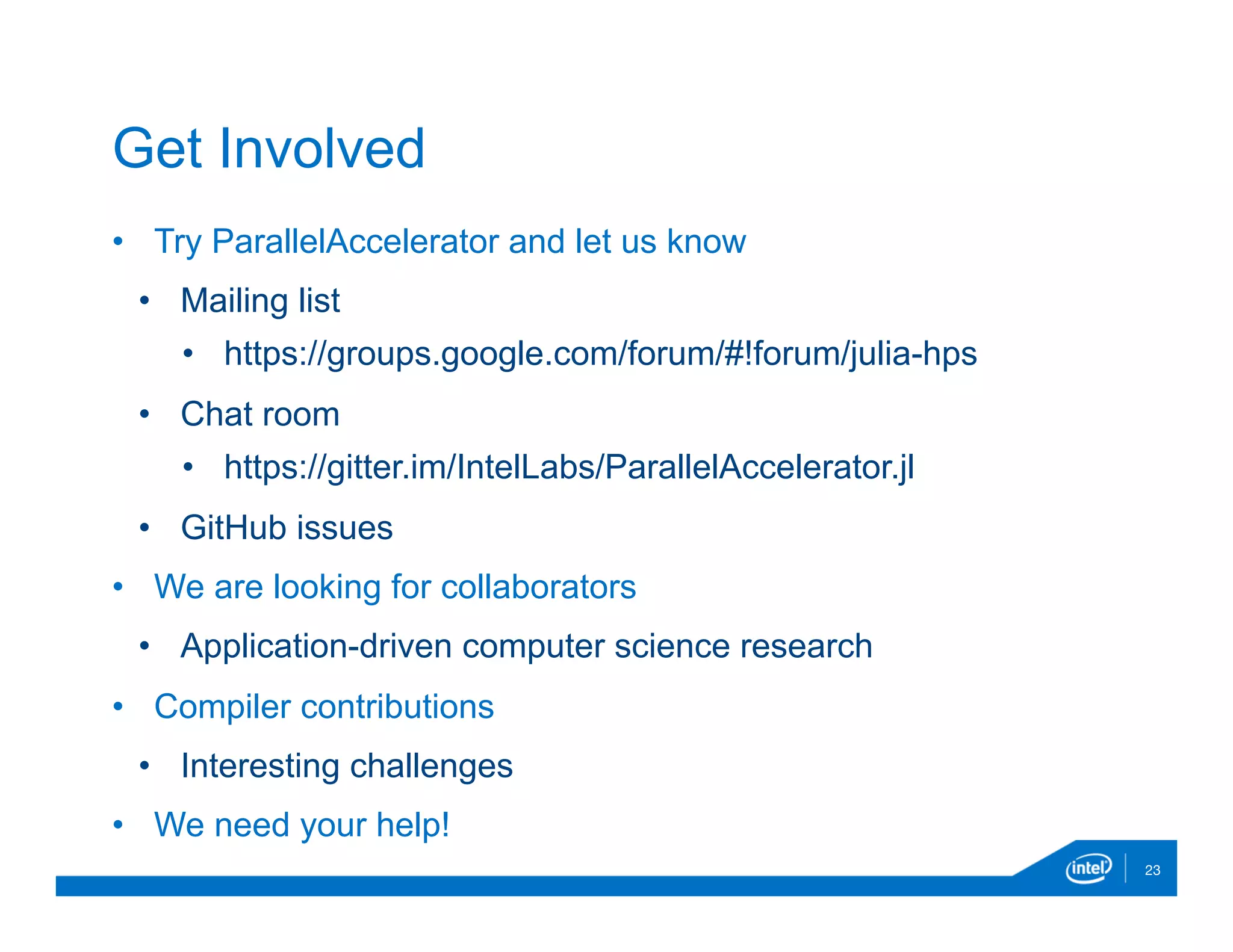
§  Current Limitations
§  Get Involved
§  Future Steps
§  Deep Learning
§  Distributed-Memory HPC Cluster/Cloud
2
Outline
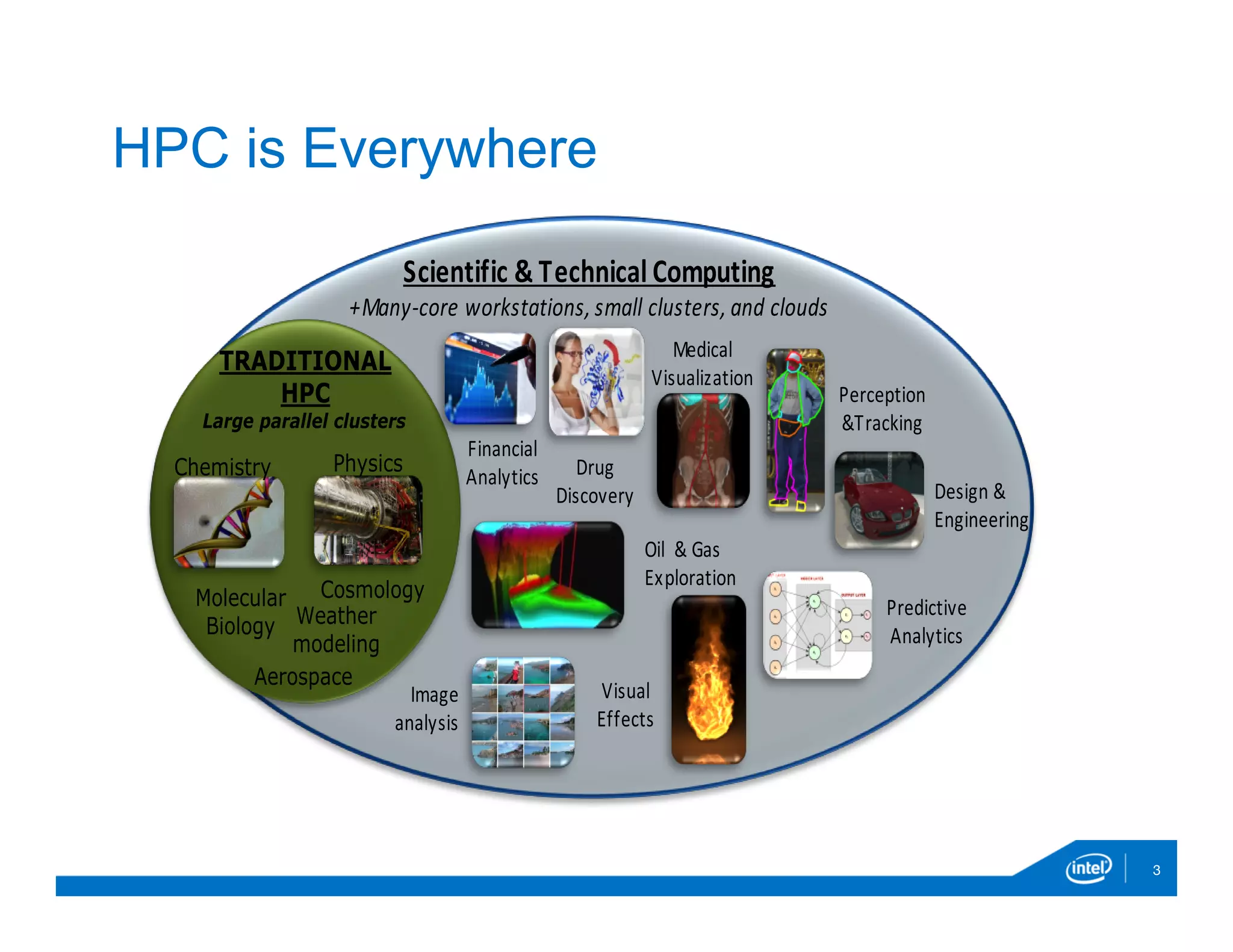
HPC is Everywhere
3
Molecular
Biology
Aerospace
Cosmology
PhysicsChemistry
Weather
modeling
TRADITIONAL
HPC
Medical	
  
Visualization
Financial
Analytics
Visual	
  
Effects
Image
analysis
Perception	
  
&Tracking
Oil	
  	
  &	
  Gas	
  
Exploration
Scientific	
  &	
  Technical	
  Computing
+Many-­‐core	
  workstations,	
  small	
  clusters,	
  and	
  clouds
Design	
  &
Engineering
Predictive
Analytics
Drug
Discovery
Large parallel clusters
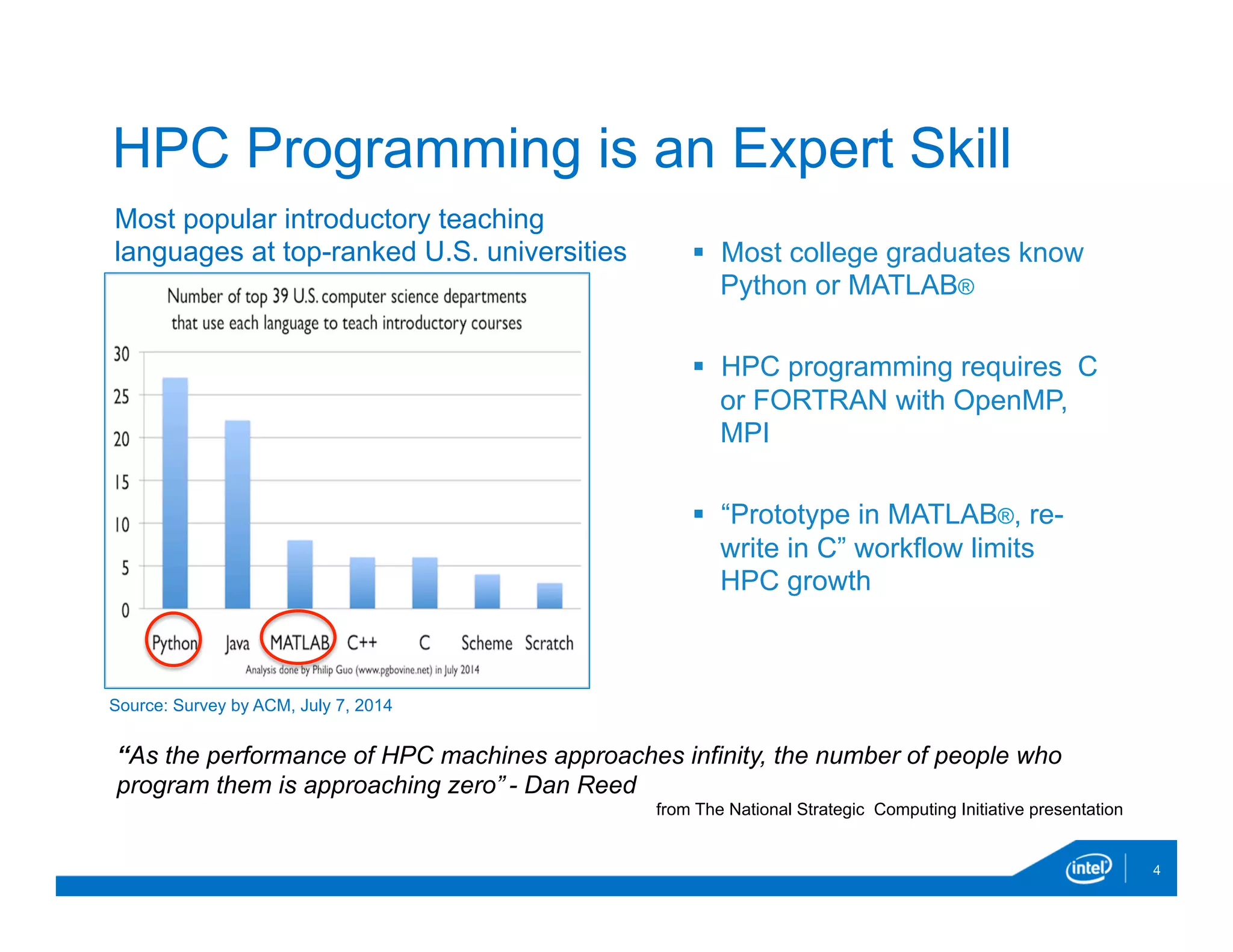
HPC Programming is an Expert Skill
§  Most college graduates know
Python or MATLAB®
§  HPC programming requires C
or FORTRAN with OpenMP,
MPI
§  “Prototype in MATLAB®, re-
write in C” workflow limits
HPC growth
Source: Survey by ACM, July 7, 2014
Most popular introductory teaching
languages at top-ranked U.S. universities
“As the performance of HPC machines approaches infinity, the number of people who
program them is approaching zero” - Dan Reed
from The National Strategic Computing Initiative presentation
4
5
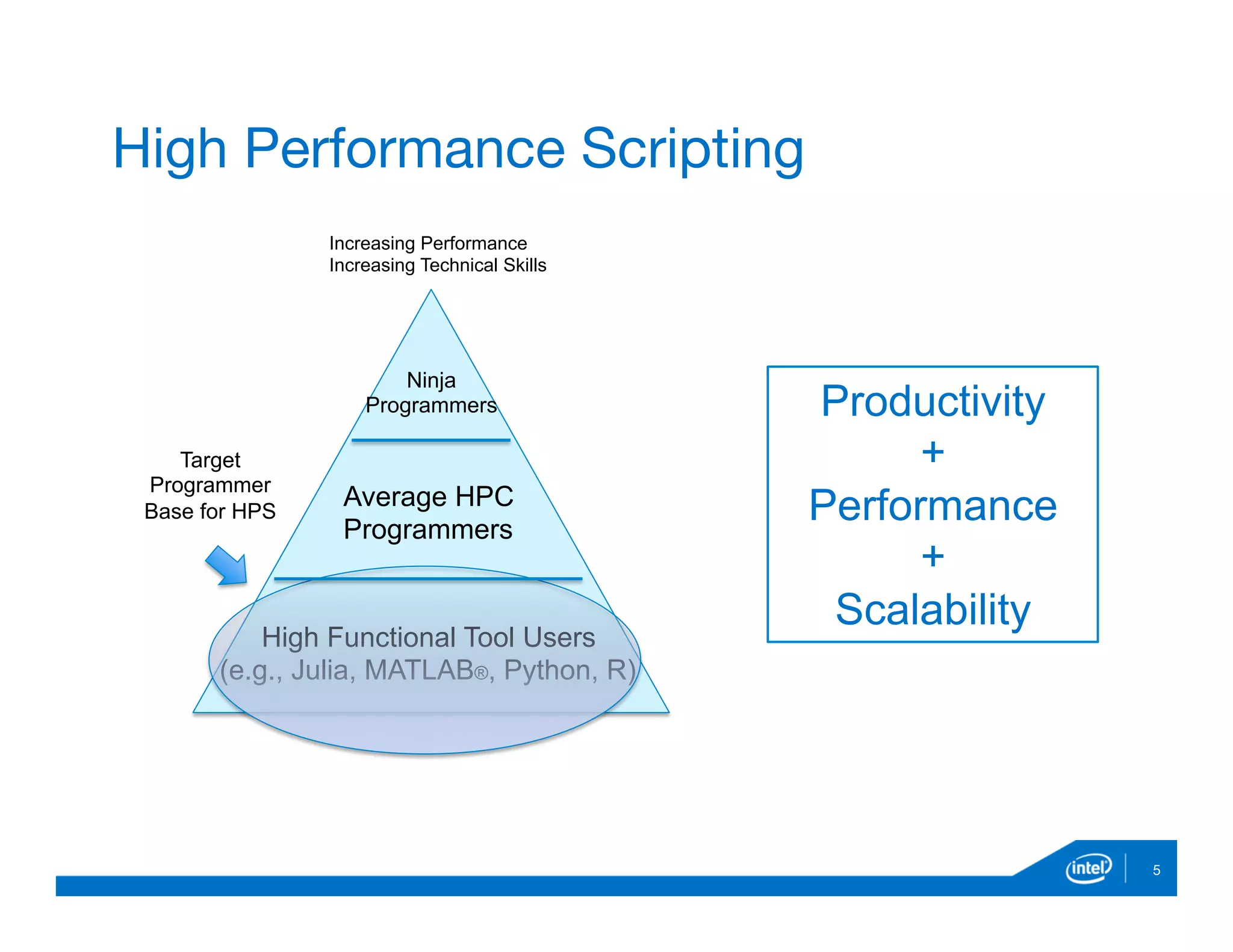
High Performance Scripting
High Functional Tool Users
(e.g., Julia, MATLAB®, Python, R)
Ninja
Programmers
Increasing Performance
Increasing Technical Skills
Target
Programmer
Base for HPS
Average HPC
Programmers
Productivity
+
Performance
+
Scalability
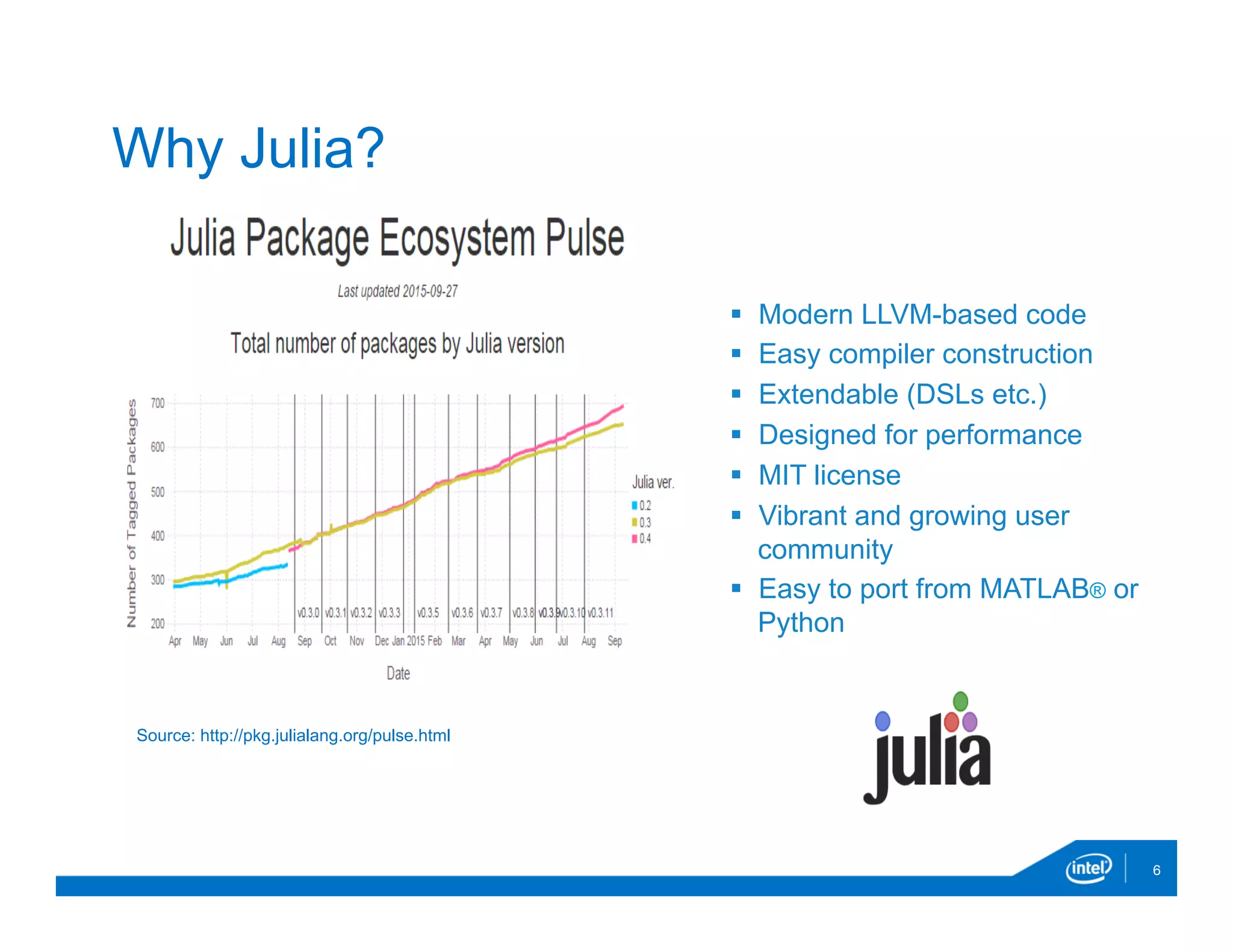
Why Julia?
§  Modern LLVM-based code
§  Easy compiler construction
§  Extendable (DSLs etc.)
§  Designed for performance
§  MIT license
§  Vibrant and growing user
community
§  Easy to port from MATLAB® or
Python
Source: http://pkg.julialang.org/pulse.html
6
•  Implemented as a package:
•  @acc macro to optimize Julia functions
•  Domain-specific Julia-to-C++ compiler written in
Julia
•  Parallel for loops translated to C++ with OpenMP
•  SIMD vectorization flags
•  Please try it out and report bugs!
7
ParallelAccelerator.jl
https://github.com/IntelLabs/ParallelAccelerator.jl
A compiler framework on top of the Julia compiler for high-
performance technical computing
Approach:
§  Identify implicit parallel patterns such as map, reduce,
comprehension, and stencil
§  Translate to data-parallel operations
§  Minimize runtime overheads
§  Eliminate array bounds checks
§  Aggressively fuse data-parallel operations
8
ParallelAccelerator.jl
9
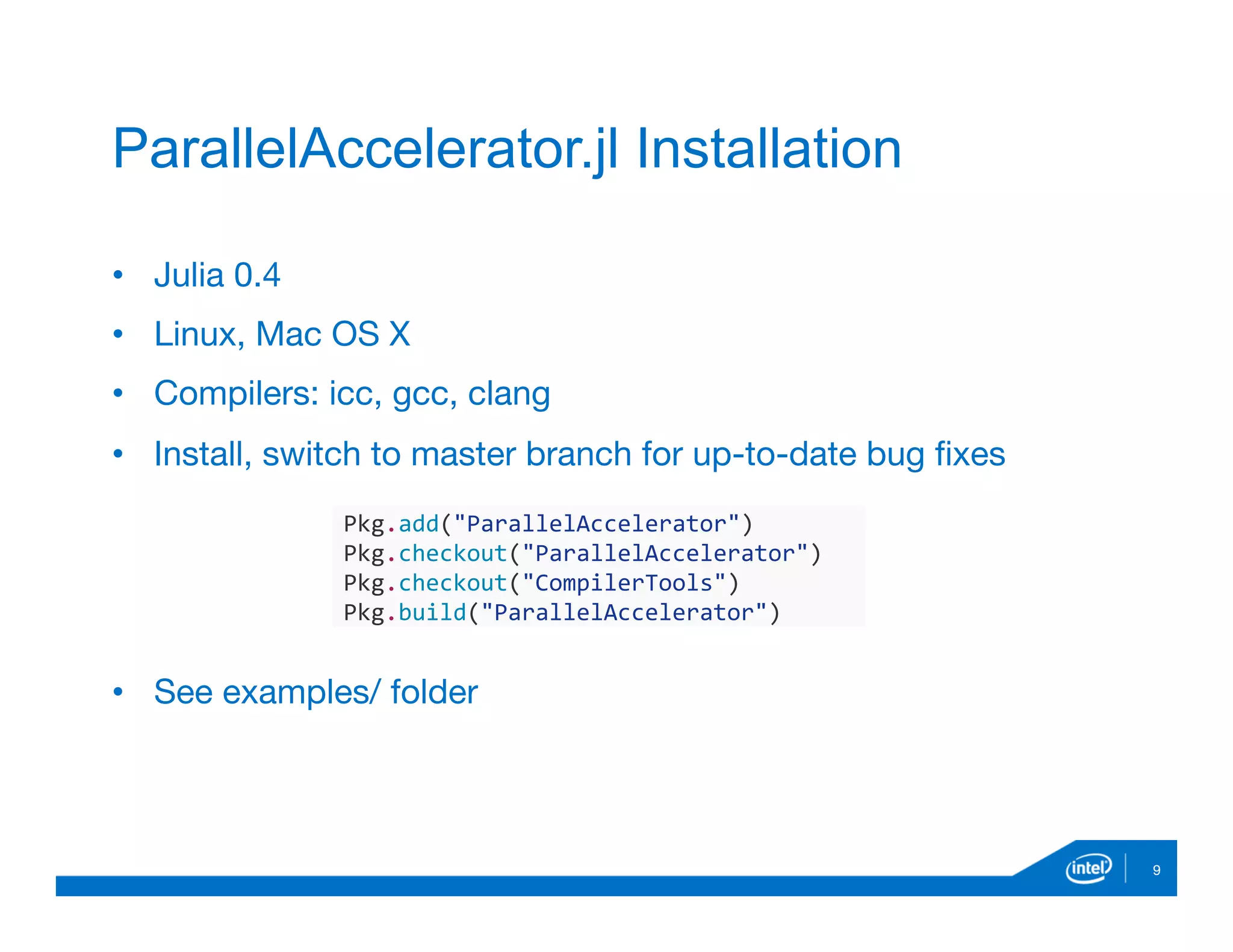
ParallelAccelerator.jl Installation
•  Julia 0.4
•  Linux, Mac OS X
•  Compilers: icc, gcc, clang
•  Install, switch to master branch for up-to-date bug fixes
•  See examples/ folder
Pkg.add("ParallelAccelerator")	
  
Pkg.checkout("ParallelAccelerator")	
  
Pkg.checkout("CompilerTools")	
  
Pkg.build("ParallelAccelerator")
10
ParallelAccelerator.jl Usage
•  Use high-level array operations (MATLAB®-style)
•  Unary functions: -, +, acos, cbrt, cos, cosh, exp10, exp2, exp, lgamma, log10, log, sin, sinh,
sqrt, tan, tanh, abs, copy, erf …
•  Binary functions: -, +, .+, .-, .*, ./, .,.>, .<,.==, .<<, .>>, .^, div, mod, &, |, min, max …
•  Reductions, comprehensions, stencils
•  minimum, maximum, sum, prod, any, all 
•  A = [ f(i) for i in 1:n]
•  runStencil(dst, src, N, :oob_skip) do b, a

b[0,0] = (a[0,-1] + a[0,1] + a[-1,0] + a[1,0]) / 4

return a, b

end
•  Avoid sequential for-loops
•  Hard to analyze by ParallelAccelerator
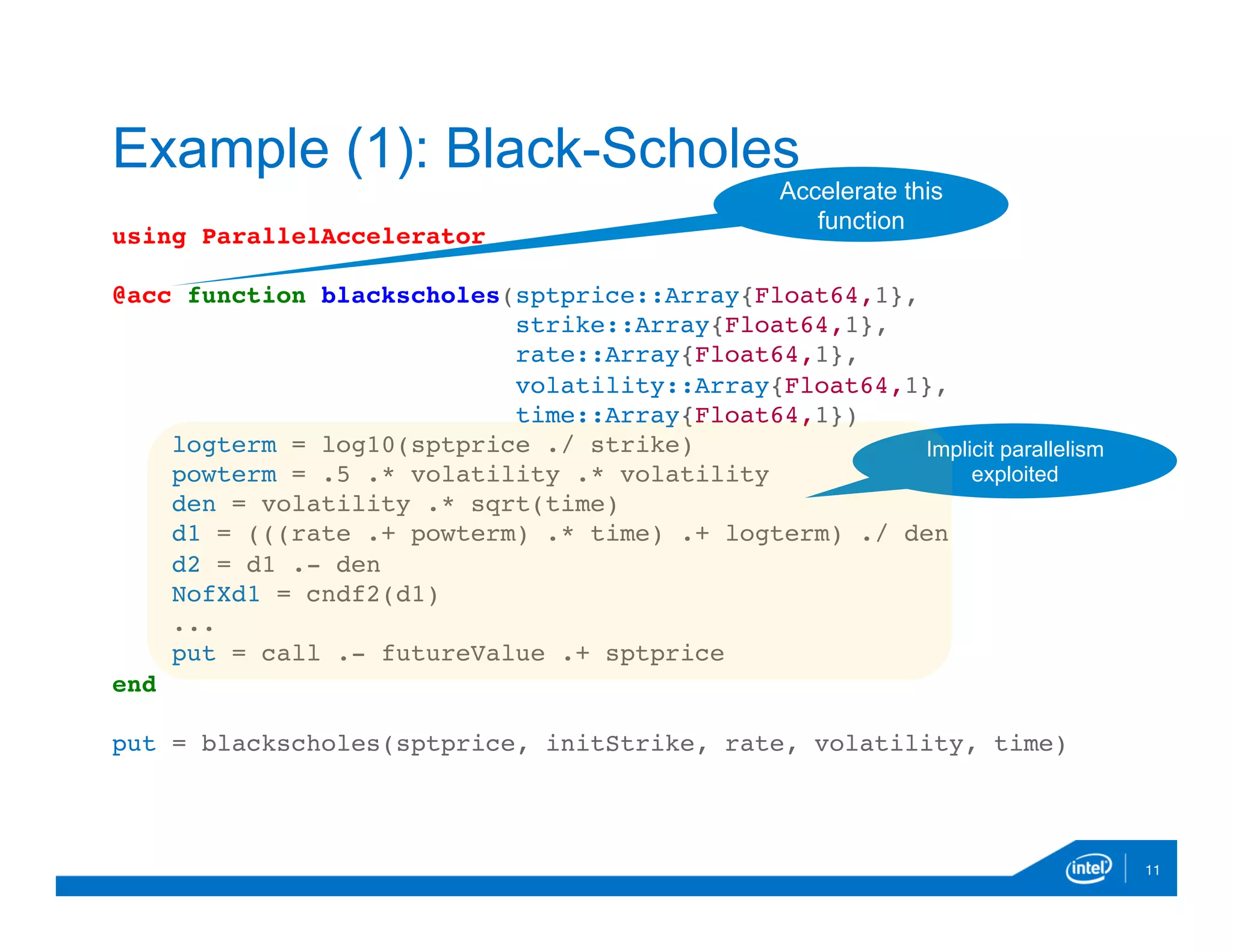
using ParallelAccelerator
@acc function blackscholes(sptprice::Array{Float64,1},
strike::Array{Float64,1},
rate::Array{Float64,1},
volatility::Array{Float64,1},
time::Array{Float64,1})
logterm = log10(sptprice ./ strike)
powterm = .5 .* volatility .* volatility
den = volatility .* sqrt(time)
d1 = (((rate .+ powterm) .* time) .+ logterm) ./ den
d2 = d1 .- den
NofXd1 = cndf2(d1)
...
put = call .- futureValue .+ sptprice
end
put = blackscholes(sptprice, initStrike, rate, volatility, time)
11
Example (1): Black-Scholes
Accelerate this
function
Implicit parallelism
exploited
using ParallelAccelerator
@acc function blur(img::Array{Float32,2}, iterations::Int)
buf = Array(Float32, size(img)...)
runStencil(buf, img, iterations, :oob_skip) do b, a
b[0,0] =
(a[-2,-2] * 0.003 + a[-1,-2] * 0.0133 + a[0,-2] * ...
a[-2,-1] * 0.0133 + a[-1,-1] * 0.0596 + a[0,-1] * ...
a[-2, 0] * 0.0219 + a[-1, 0] * 0.0983 + a[0, 0] * ...
a[-2, 1] * 0.0133 + a[-1, 1] * 0.0596 + a[0, 1] * ...
a[-2, 2] * 0.003 + a[-1, 2] * 0.0133 + a[0, 2] * ...
return a, b
end
return img
end
img = blur(img, iterations)

12
Example (2): Gaussian blur
runStencil
construct
13
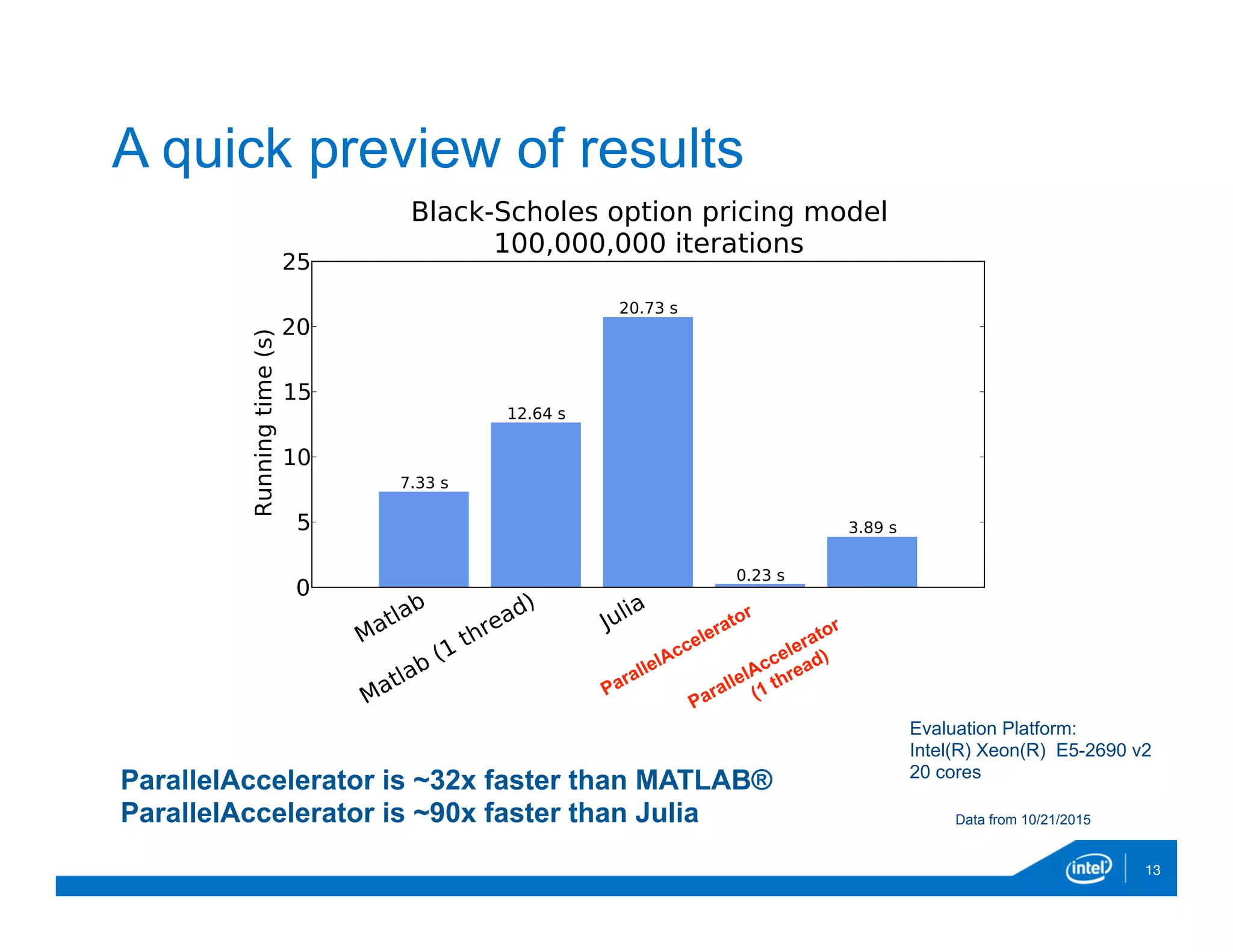
A quick preview of results
Data from 10/21/2015
Evaluation Platform:
Intel(R) Xeon(R) E5-2690 v2
20 cores
ParallelAccelerator is ~32x faster than MATLAB®
ParallelAccelerator is ~90x faster than Julia
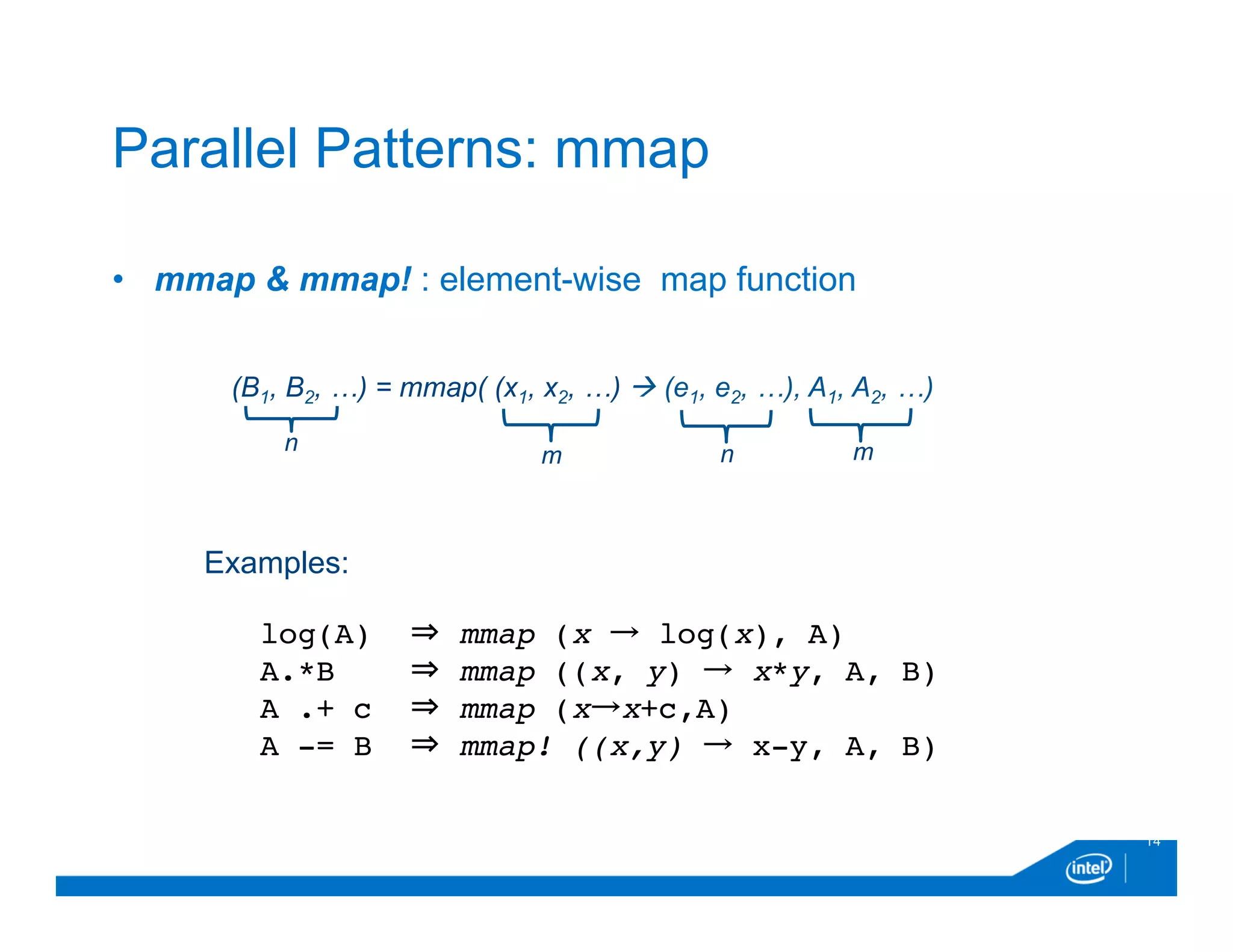
•  mmap & mmap! : element-wise map function
14
Parallel Patterns: mmap
(B1, B2, …) = mmap( (x1, x2, …) à (e1, e2, …), A1, A2, …)
n mm n
Examples:
log(A) ⇒ mmap (x → log(x), A)
A.*B ⇒ mmap ((x, y) → x*y, A, B)
A .+ c ⇒ mmap (x→x+c,A)
A -= B ⇒ mmap! ((x,y) → x-y, A, B)
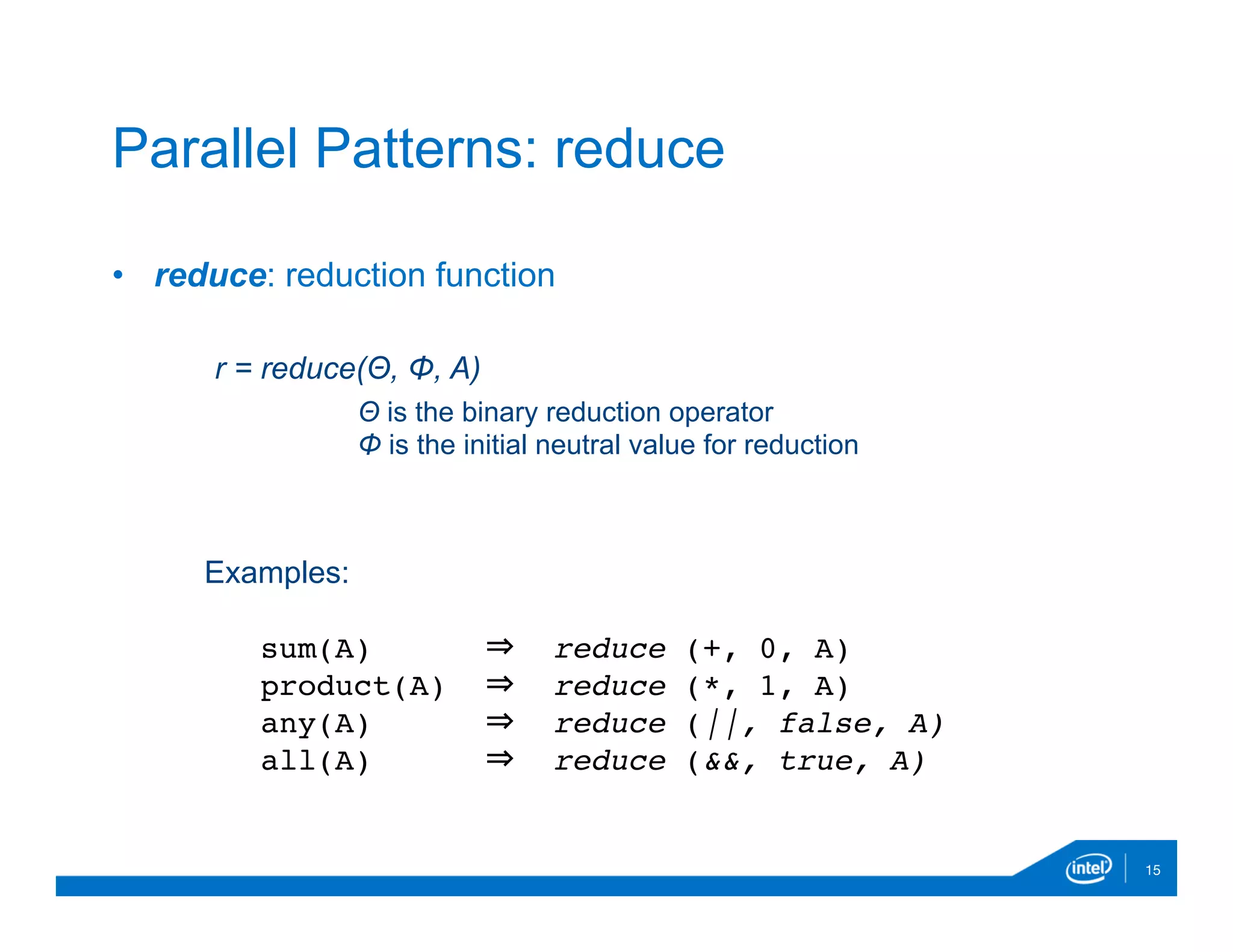
•  reduce: reduction function

15
Parallel Patterns: reduce
r = reduce(Θ, Φ, A)
Θ is the binary reduction operator
Φ is the initial neutral value for reduction
Examples:
sum(A) ⇒ reduce (+, 0, A)
product(A) ⇒ reduce (*, 1, A)
any(A) ⇒ reduce (||, false, A)
all(A) ⇒ reduce (&&, true, A)
•  Comprehension: creates a rank-n array that is the cartesian
product of the range of variables
16
Parallel Patterns: comprehension
A = [ f(x1, x2, …, xn) for x1 in r1, x2 in r2, …, xn in rn]
where, function f is applied over cartesian product
of points (x1, x2, …, xn) in the ranges (r1, r2, …, rn)
Example:
avg(x) = [ 0.25*x[i-1]+0.5*x[i]+0.25*x[i+1] for i in 2:length(x)-1 ]
•  runStencil: user-facing language construct to perform stencil
operation

17
Parallel Patterns: stencil
runStencil((A, B, …) à f(A, B, …), A, B, …, n, s)
m mm
all arrays in function f are relatively indexed,
n is the trip count for iterative stencil
s specifies how stencil borders are handled
Example:
runStencil(b, a, N, :oob_skip) do b, a
b[0,0] =
(a[-1,-1] + a[-1,0] + a[1, 0] + a[1, 1]) / 4)
return a, b
end
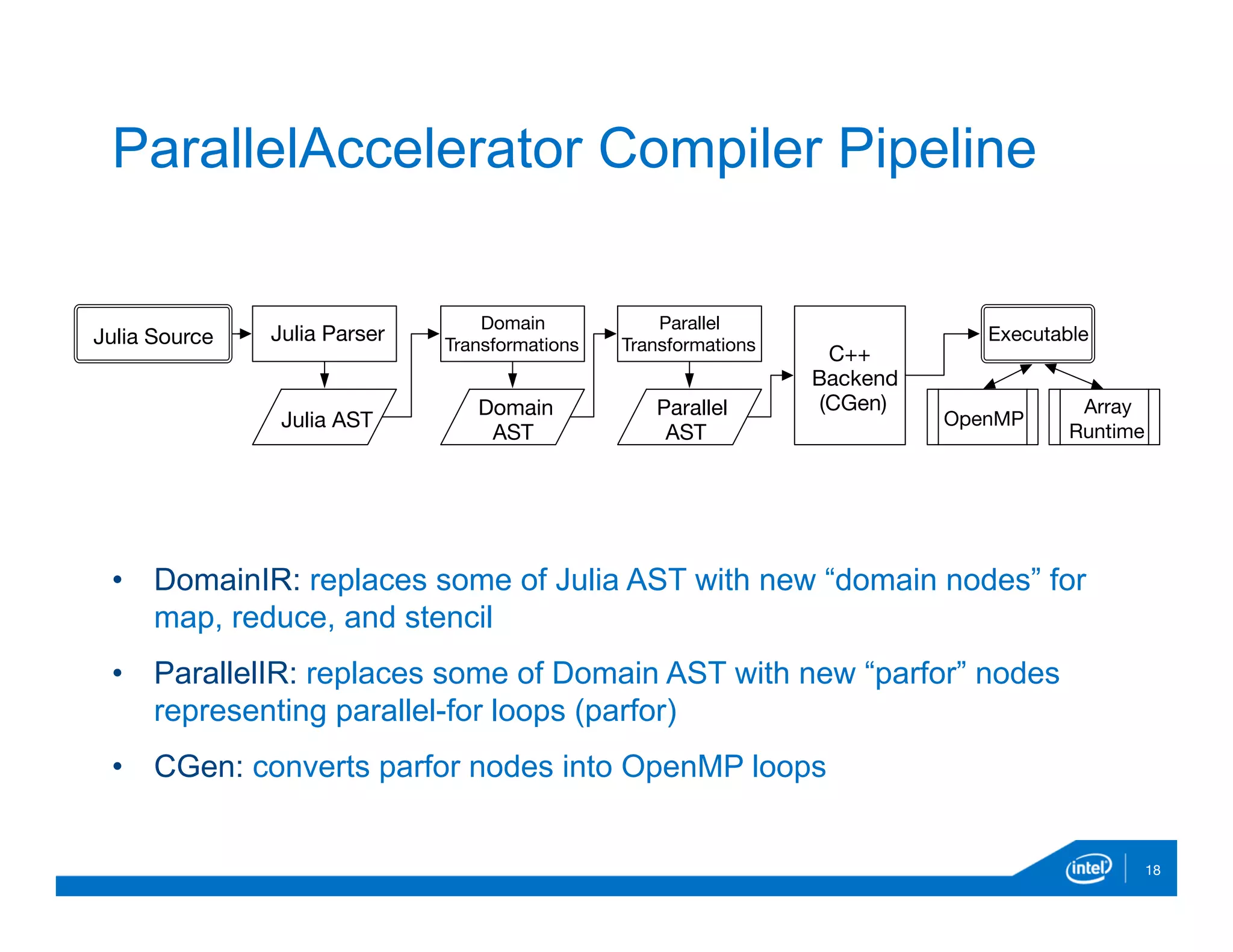
•  DomainIR: replaces some of Julia AST with new “domain nodes” for
map, reduce, and stencil
•  ParallelIR: replaces some of Domain AST with new “parfor” nodes
representing parallel-for loops (parfor)
•  CGen: converts parfor nodes into OpenMP loops
18
ParallelAccelerator Compiler Pipeline
Domain 
Transformations
C++
Backend
(CGen) Array
Runtime
Executable
OpenMP
Domain
AST
Parallel
AST
Julia Parser
Julia AST
Julia Source
Parallel
Transformations
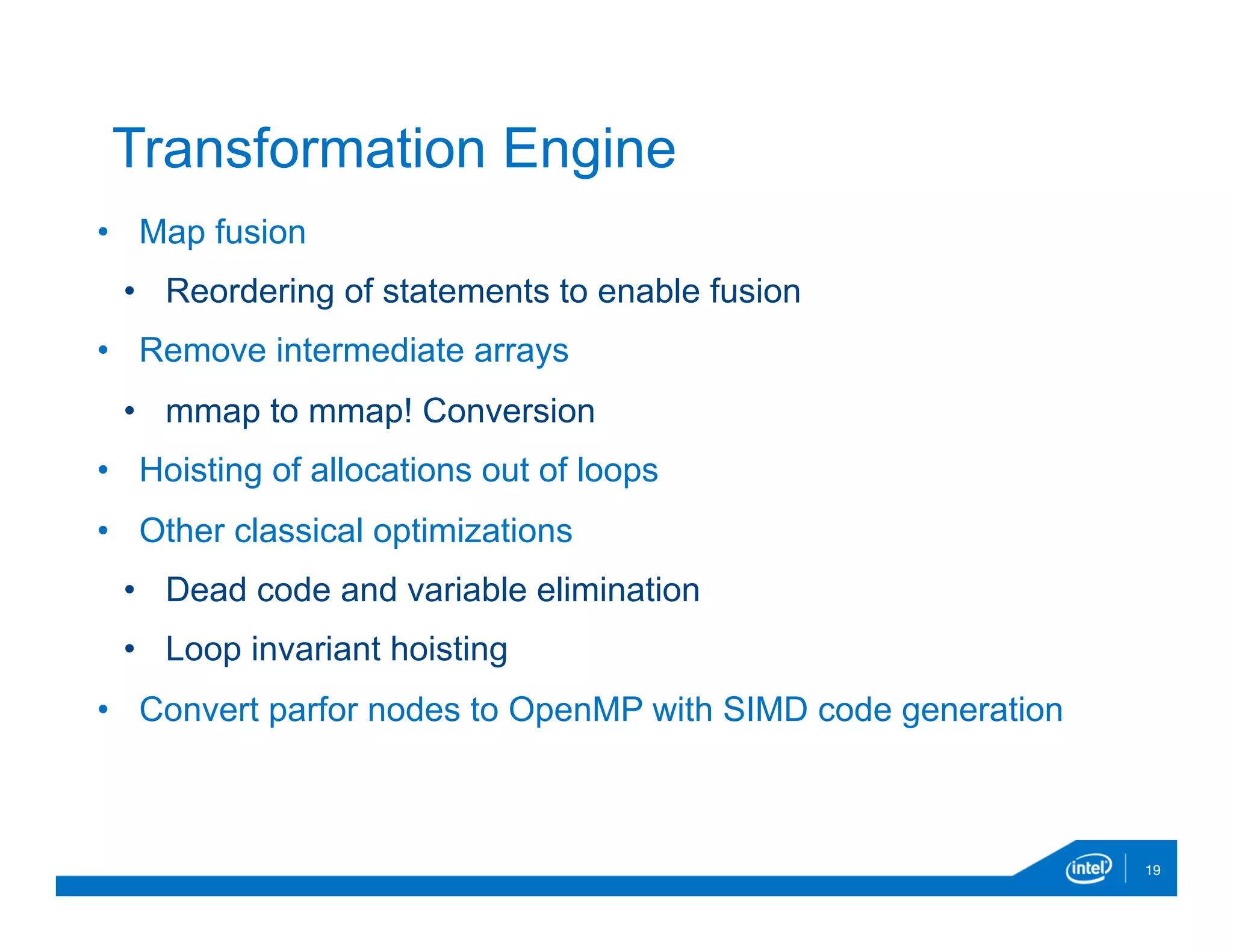
•  Map fusion
•  Reordering of statements to enable fusion
•  Remove intermediate arrays
•  mmap to mmap! Conversion
•  Hoisting of allocations out of loops
•  Other classical optimizations
•  Dead code and variable elimination
•  Loop invariant hoisting
•  Convert parfor nodes to OpenMP with SIMD code generation
19
Transformation Engine
20
ParallelAccelerator vs. Julia
24x
146x
169x
25x
63x
36x
14x
33x
0
20
40
60
80
100
120
140
160
180
SpeedupoverJulia
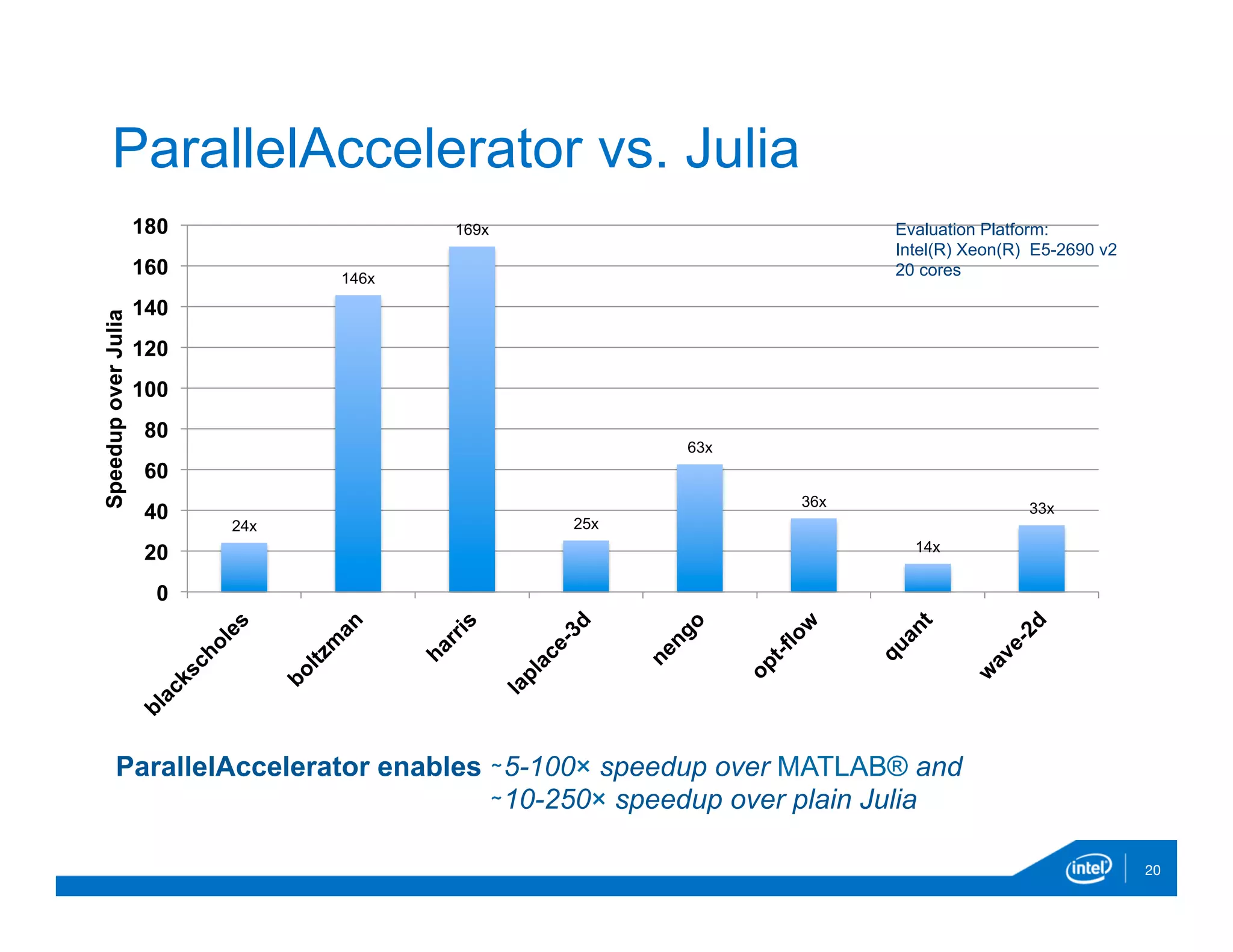
ParallelAccelerator enables ∼5-100× speedup over MATLAB® and
∼10-250× speedup over plain Julia
Evaluation Platform:
Intel(R) Xeon(R) E5-2690 v2
20 cores
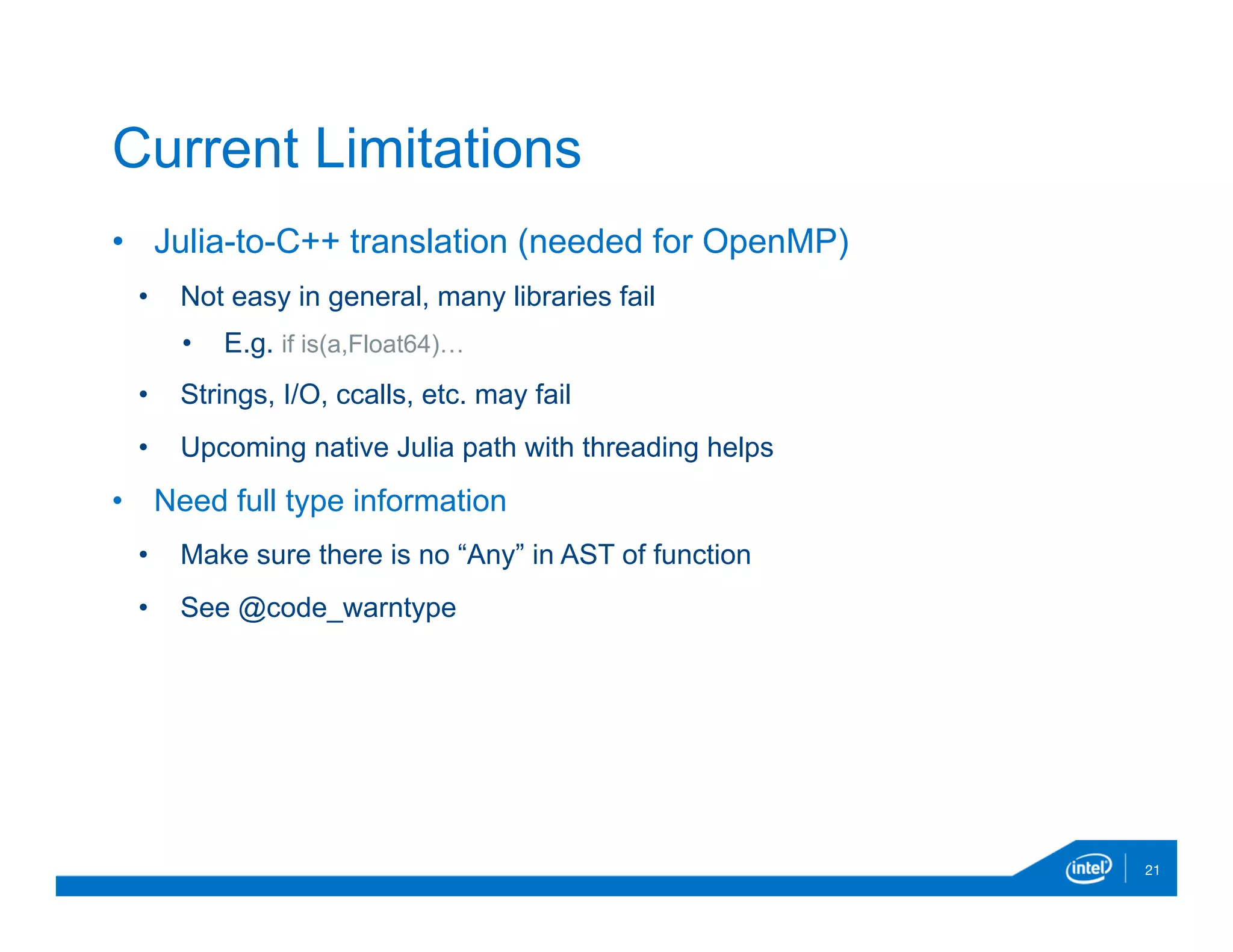
•  Julia-to-C++ translation (needed for OpenMP)
•  Not easy in general, many libraries fail
•  E.g. if is(a,Float64)…
•  Strings, I/O, ccalls, etc. may fail
•  Upcoming native Julia path with threading helps
•  Need full type information
•  Make sure there is no “Any” in AST of function
•  See @code_warntype
21
Current Limitations
•  Not everything parallelizable
•  Limited operators supported
•  Expanding over time
•  ParallelAccelerator’s compilation time
•  Type-inference for our package by Julia compiler
•  First use of package only
•  Use same Julia REPL
•  A solution: see ParallelAccelerator.embed()
•  Julia source needed
•  Compiler bugs…
•  Need more documentation
22
Current Limitations
•  Try ParallelAccelerator and let us know
•  Mailing list
•  https://groups.google.com/forum/#!forum/julia-hps
•  Chat room
•  https://gitter.im/IntelLabs/ParallelAccelerator.jl
•  GitHub issues
•  We are looking for collaborators
•  Application-driven computer science research
•  Compiler contributions
•  Interesting challenges
•  We need your help!
23
Get Involved
•  ParallelAccelerator lets you write code in a
scripting language without sacrificing efficiency
•  Identifies parallel patterns in the code and
compiles to run efficiently on parallel hardware
•  Eliminates many of the usual overheads of high-
level array languages
24
Summary
•  Make it real
•  Extend coverage
•  Improve performance
•  Enable native Julia threading
•  Apply to real world applications
•  Domain-specific features
•  E.g. DSL for Deep Learning
•  Distributed-Memory HPC Cluster/Cloud
25
Next Steps
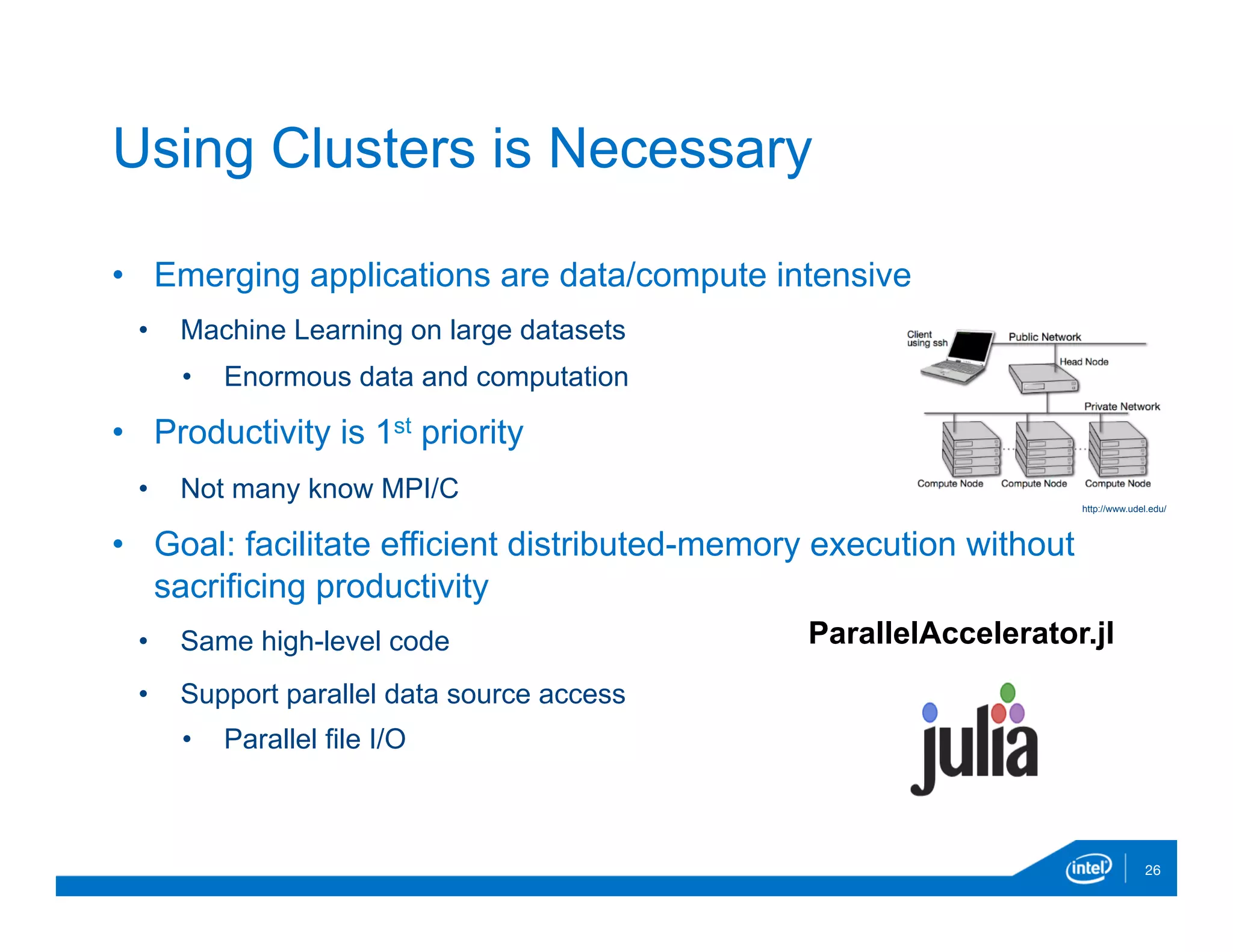
•  Emerging applications are data/compute intensive
•  Machine Learning on large datasets
•  Enormous data and computation
•  Productivity is 1st priority
•  Not many know MPI/C
•  Goal: facilitate efficient distributed-memory execution without
sacrificing productivity
•  Same high-level code
•  Support parallel data source access
•  Parallel file I/O
26
Using Clusters is Necessary
http://www.udel.edu/
ParallelAccelerator.jl
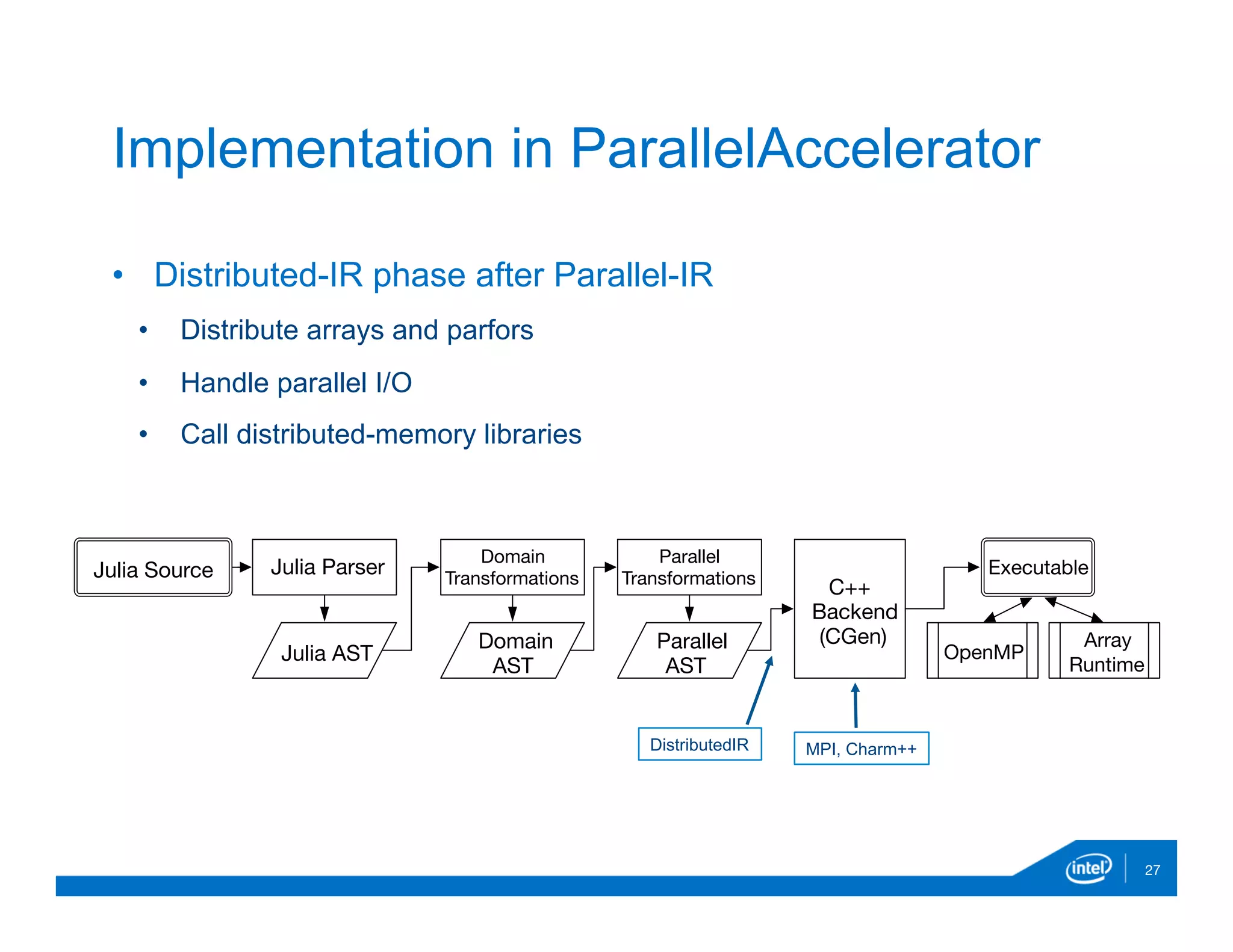
•  Distributed-IR phase after Parallel-IR
•  Distribute arrays and parfors
•  Handle parallel I/O
•  Call distributed-memory libraries
27
Implementation in ParallelAccelerator
Domain 
Transformations
C++
Backend
(CGen) Array
Runtime
Executable
OpenMP
Domain
AST
Parallel
AST
Julia Parser
Julia AST
Julia Source
Parallel
Transformations
DistributedIR MPI, Charm++
@acc function blackscholes(iterations::Int64)
sptprice = [ 42.0 for i=1:iterations]
strike = [ 40.0+(i/iterations) for i=1:iterations]
logterm = log10(sptprice ./ strike)
powterm = .5 .* volatility .* volatility
den = volatility .* sqrt(time)
d1 = (((rate .+ powterm) .* time) .+ logterm) ./ den
d2 = d1 .- den
NofXd1 = cndf2(d1)
...
put = call .- futureValue .+ sptprice
return sum(put)
end
checksum = blackscholes(iterations)
28
Example: Black-Scholes
Parallel
initialization
double blackscholes(int64_t iterations)
{
int mpi_rank , mpi_nprocs;
MPI_Comm_size(MPI_COMM_WORLD,&mpi_nprocs);
MPI_Comm_rank(MPI_COMM_WORLD,&mpi_rank);
int mystart = mpi_rank∗(iterations/mpi_nprocs);
int myend = mpi_rank==mpi_nprocs ? iterations:
(mpi_rank+1)∗(iterations/mpi_nprocs);
double *sptprice = (double*)malloc(
(myend-mystart)*sizeof(double));
…
for(i=mystart ; i<myend ; i++) {
sptprice[i-mystart] = 42.0 ;
strike[i-mystart] = 40.0+(i/iterations);
. . .
loc_put_sum += Put;
}
double all_put_sum ;
MPI_Reduce(&loc_put_sum , &all_put_sum , 1 , MPI_DOUBLE,
MPI_SUM, 0 , MPI_COMM_WORLD);
return all_put_sum;
} 29
Example: Black-Scholes
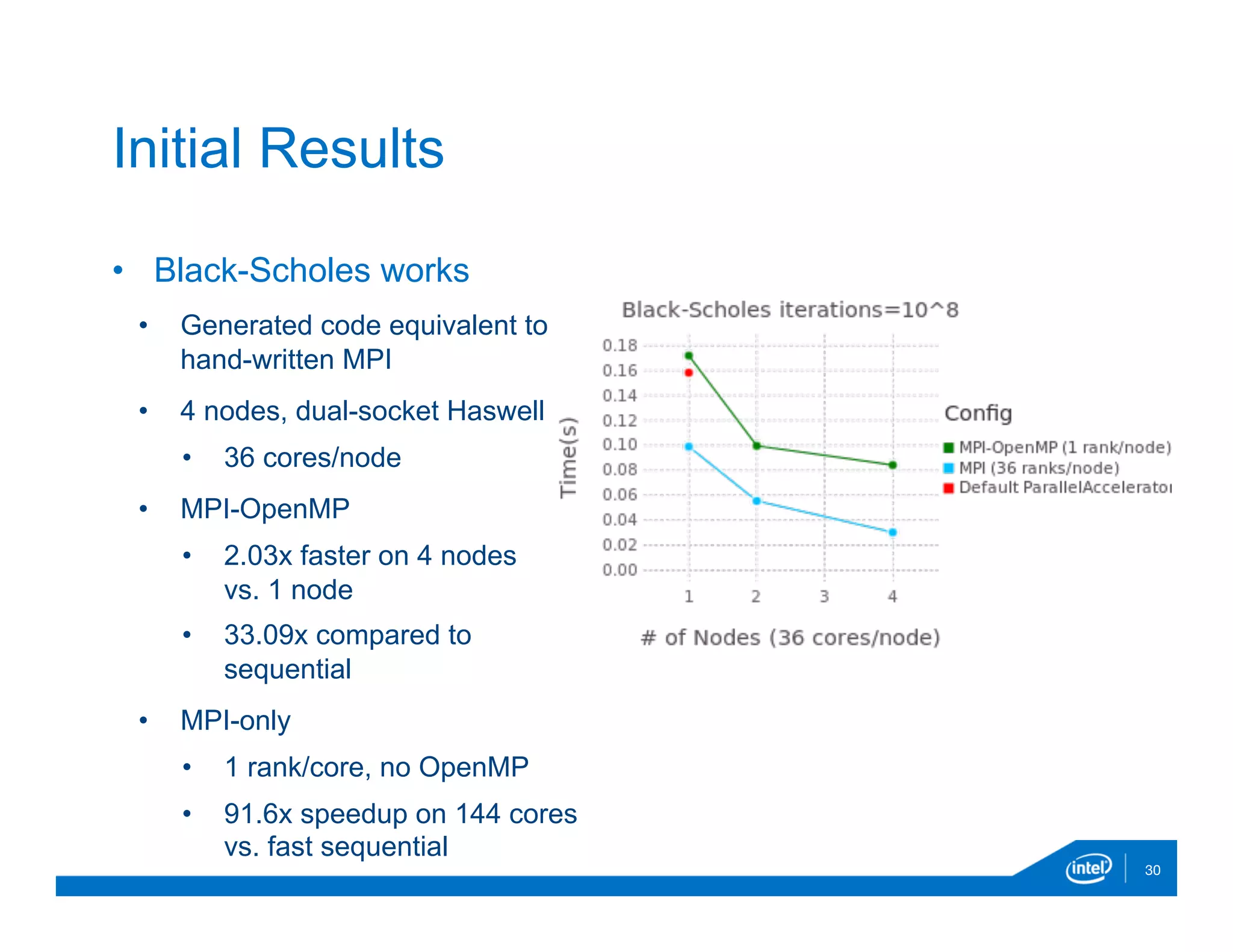
•  Black-Scholes works
•  Generated code equivalent to
hand-written MPI
•  4 nodes, dual-socket Haswell
•  36 cores/node
•  MPI-OpenMP
•  2.03x faster on 4 nodes
vs. 1 node
•  33.09x compared to
sequential
•  MPI-only
•  1 rank/core, no OpenMP
•  91.6x speedup on 144 cores
vs. fast sequential
30
Initial Results
Questions
31

Ehsan parallel accelerator-dec2015

  • 1.
    ParallelAccelerator.jl High Performance Scriptingin Julia Ehsan Totoni ehsan.totoni@intel.com Programming Systems Lab, Intel Labs December 17, 2015 Contributors: Todd Anderson, Raj Barik, Chunling Hu, Lindsey Kuper, Victor Lee, Hai Liu, Geoff Lowney, Paul Petersen, Hongbo Rong, Tatiana Shpeisman, Youfeng Wu 1
  • 2.
    §  Motivation §  HighPerformance Scripting(HPS) Project at Intel Labs §  ParallelAccelerator.jl §  How It Works §  Evaluation Results §  Current Limitations §  Get Involved §  Future Steps §  Deep Learning §  Distributed-Memory HPC Cluster/Cloud 2 Outline
  • 3.
    HPC is Everywhere 3 Molecular Biology Aerospace Cosmology PhysicsChemistry Weather modeling TRADITIONAL HPC Medical   Visualization Financial Analytics Visual   Effects Image analysis Perception   &Tracking Oil    &  Gas   Exploration Scientific  &  Technical  Computing +Many-­‐core  workstations,  small  clusters,  and  clouds Design  & Engineering Predictive Analytics Drug Discovery Large parallel clusters
  • 4.
    HPC Programming isan Expert Skill §  Most college graduates know Python or MATLAB® §  HPC programming requires C or FORTRAN with OpenMP, MPI §  “Prototype in MATLAB®, re- write in C” workflow limits HPC growth Source: Survey by ACM, July 7, 2014 Most popular introductory teaching languages at top-ranked U.S. universities “As the performance of HPC machines approaches infinity, the number of people who program them is approaching zero” - Dan Reed from The National Strategic Computing Initiative presentation 4
  • 5.
    5 High Performance Scripting HighFunctional Tool Users (e.g., Julia, MATLAB®, Python, R) Ninja Programmers Increasing Performance Increasing Technical Skills Target Programmer Base for HPS Average HPC Programmers Productivity + Performance + Scalability
  • 6.
    Why Julia? §  ModernLLVM-based code §  Easy compiler construction §  Extendable (DSLs etc.) §  Designed for performance §  MIT license §  Vibrant and growing user community §  Easy to port from MATLAB® or Python Source: http://pkg.julialang.org/pulse.html 6
  • 7.
    •  Implemented asa package: •  @acc macro to optimize Julia functions •  Domain-specific Julia-to-C++ compiler written in Julia •  Parallel for loops translated to C++ with OpenMP •  SIMD vectorization flags •  Please try it out and report bugs! 7 ParallelAccelerator.jl https://github.com/IntelLabs/ParallelAccelerator.jl
  • 8.
    A compiler frameworkon top of the Julia compiler for high- performance technical computing Approach: §  Identify implicit parallel patterns such as map, reduce, comprehension, and stencil §  Translate to data-parallel operations §  Minimize runtime overheads §  Eliminate array bounds checks §  Aggressively fuse data-parallel operations 8 ParallelAccelerator.jl
  • 9.
    9 ParallelAccelerator.jl Installation •  Julia0.4 •  Linux, Mac OS X •  Compilers: icc, gcc, clang •  Install, switch to master branch for up-to-date bug fixes •  See examples/ folder Pkg.add("ParallelAccelerator")   Pkg.checkout("ParallelAccelerator")   Pkg.checkout("CompilerTools")   Pkg.build("ParallelAccelerator")
  • 10.
    10 ParallelAccelerator.jl Usage •  Usehigh-level array operations (MATLAB®-style) •  Unary functions: -, +, acos, cbrt, cos, cosh, exp10, exp2, exp, lgamma, log10, log, sin, sinh, sqrt, tan, tanh, abs, copy, erf … •  Binary functions: -, +, .+, .-, .*, ./, .,.>, .<,.==, .<<, .>>, .^, div, mod, &, |, min, max … •  Reductions, comprehensions, stencils •  minimum, maximum, sum, prod, any, all •  A = [ f(i) for i in 1:n] •  runStencil(dst, src, N, :oob_skip) do b, a
 b[0,0] = (a[0,-1] + a[0,1] + a[-1,0] + a[1,0]) / 4
 return a, b
 end •  Avoid sequential for-loops •  Hard to analyze by ParallelAccelerator
  • 11.
    using ParallelAccelerator @acc functionblackscholes(sptprice::Array{Float64,1}, strike::Array{Float64,1}, rate::Array{Float64,1}, volatility::Array{Float64,1}, time::Array{Float64,1}) logterm = log10(sptprice ./ strike) powterm = .5 .* volatility .* volatility den = volatility .* sqrt(time) d1 = (((rate .+ powterm) .* time) .+ logterm) ./ den d2 = d1 .- den NofXd1 = cndf2(d1) ... put = call .- futureValue .+ sptprice end put = blackscholes(sptprice, initStrike, rate, volatility, time) 11 Example (1): Black-Scholes Accelerate this function Implicit parallelism exploited
  • 12.
    using ParallelAccelerator @acc functionblur(img::Array{Float32,2}, iterations::Int) buf = Array(Float32, size(img)...) runStencil(buf, img, iterations, :oob_skip) do b, a b[0,0] = (a[-2,-2] * 0.003 + a[-1,-2] * 0.0133 + a[0,-2] * ... a[-2,-1] * 0.0133 + a[-1,-1] * 0.0596 + a[0,-1] * ... a[-2, 0] * 0.0219 + a[-1, 0] * 0.0983 + a[0, 0] * ... a[-2, 1] * 0.0133 + a[-1, 1] * 0.0596 + a[0, 1] * ... a[-2, 2] * 0.003 + a[-1, 2] * 0.0133 + a[0, 2] * ... return a, b end return img end img = blur(img, iterations) 12 Example (2): Gaussian blur runStencil construct
  • 13.
    13 A quick previewof results Data from 10/21/2015 Evaluation Platform: Intel(R) Xeon(R) E5-2690 v2 20 cores ParallelAccelerator is ~32x faster than MATLAB® ParallelAccelerator is ~90x faster than Julia
  • 14.
    •  mmap &mmap! : element-wise map function 14 Parallel Patterns: mmap (B1, B2, …) = mmap( (x1, x2, …) à (e1, e2, …), A1, A2, …) n mm n Examples: log(A) ⇒ mmap (x → log(x), A) A.*B ⇒ mmap ((x, y) → x*y, A, B) A .+ c ⇒ mmap (x→x+c,A) A -= B ⇒ mmap! ((x,y) → x-y, A, B)
  • 15.
    •  reduce: reductionfunction 15 Parallel Patterns: reduce r = reduce(Θ, Φ, A) Θ is the binary reduction operator Φ is the initial neutral value for reduction Examples: sum(A) ⇒ reduce (+, 0, A) product(A) ⇒ reduce (*, 1, A) any(A) ⇒ reduce (||, false, A) all(A) ⇒ reduce (&&, true, A)
  • 16.
    •  Comprehension: createsa rank-n array that is the cartesian product of the range of variables 16 Parallel Patterns: comprehension A = [ f(x1, x2, …, xn) for x1 in r1, x2 in r2, …, xn in rn] where, function f is applied over cartesian product of points (x1, x2, …, xn) in the ranges (r1, r2, …, rn) Example: avg(x) = [ 0.25*x[i-1]+0.5*x[i]+0.25*x[i+1] for i in 2:length(x)-1 ]
  • 17.
    •  runStencil: user-facinglanguage construct to perform stencil operation 17 Parallel Patterns: stencil runStencil((A, B, …) à f(A, B, …), A, B, …, n, s) m mm all arrays in function f are relatively indexed, n is the trip count for iterative stencil s specifies how stencil borders are handled Example: runStencil(b, a, N, :oob_skip) do b, a b[0,0] = (a[-1,-1] + a[-1,0] + a[1, 0] + a[1, 1]) / 4) return a, b end
  • 18.
    •  DomainIR: replacessome of Julia AST with new “domain nodes” for map, reduce, and stencil •  ParallelIR: replaces some of Domain AST with new “parfor” nodes representing parallel-for loops (parfor) •  CGen: converts parfor nodes into OpenMP loops 18 ParallelAccelerator Compiler Pipeline Domain Transformations C++ Backend (CGen) Array Runtime Executable OpenMP Domain AST Parallel AST Julia Parser Julia AST Julia Source Parallel Transformations
  • 19.
    •  Map fusion • Reordering of statements to enable fusion •  Remove intermediate arrays •  mmap to mmap! Conversion •  Hoisting of allocations out of loops •  Other classical optimizations •  Dead code and variable elimination •  Loop invariant hoisting •  Convert parfor nodes to OpenMP with SIMD code generation 19 Transformation Engine
  • 20.
    20 ParallelAccelerator vs. Julia 24x 146x 169x 25x 63x 36x 14x 33x 0 20 40 60 80 100 120 140 160 180 SpeedupoverJulia ParallelAcceleratorenables ∼5-100× speedup over MATLAB® and ∼10-250× speedup over plain Julia Evaluation Platform: Intel(R) Xeon(R) E5-2690 v2 20 cores
  • 21.
    •  Julia-to-C++ translation(needed for OpenMP) •  Not easy in general, many libraries fail •  E.g. if is(a,Float64)… •  Strings, I/O, ccalls, etc. may fail •  Upcoming native Julia path with threading helps •  Need full type information •  Make sure there is no “Any” in AST of function •  See @code_warntype 21 Current Limitations
  • 22.
    •  Not everythingparallelizable •  Limited operators supported •  Expanding over time •  ParallelAccelerator’s compilation time •  Type-inference for our package by Julia compiler •  First use of package only •  Use same Julia REPL •  A solution: see ParallelAccelerator.embed() •  Julia source needed •  Compiler bugs… •  Need more documentation 22 Current Limitations
  • 23.
    •  Try ParallelAcceleratorand let us know •  Mailing list •  https://groups.google.com/forum/#!forum/julia-hps •  Chat room •  https://gitter.im/IntelLabs/ParallelAccelerator.jl •  GitHub issues •  We are looking for collaborators •  Application-driven computer science research •  Compiler contributions •  Interesting challenges •  We need your help! 23 Get Involved
  • 24.
    •  ParallelAccelerator letsyou write code in a scripting language without sacrificing efficiency •  Identifies parallel patterns in the code and compiles to run efficiently on parallel hardware •  Eliminates many of the usual overheads of high- level array languages 24 Summary
  • 25.
    •  Make itreal •  Extend coverage •  Improve performance •  Enable native Julia threading •  Apply to real world applications •  Domain-specific features •  E.g. DSL for Deep Learning •  Distributed-Memory HPC Cluster/Cloud 25 Next Steps
  • 26.
    •  Emerging applicationsare data/compute intensive •  Machine Learning on large datasets •  Enormous data and computation •  Productivity is 1st priority •  Not many know MPI/C •  Goal: facilitate efficient distributed-memory execution without sacrificing productivity •  Same high-level code •  Support parallel data source access •  Parallel file I/O 26 Using Clusters is Necessary http://www.udel.edu/ ParallelAccelerator.jl
  • 27.
    •  Distributed-IR phaseafter Parallel-IR •  Distribute arrays and parfors •  Handle parallel I/O •  Call distributed-memory libraries 27 Implementation in ParallelAccelerator Domain Transformations C++ Backend (CGen) Array Runtime Executable OpenMP Domain AST Parallel AST Julia Parser Julia AST Julia Source Parallel Transformations DistributedIR MPI, Charm++
  • 28.
    @acc function blackscholes(iterations::Int64) sptprice= [ 42.0 for i=1:iterations] strike = [ 40.0+(i/iterations) for i=1:iterations] logterm = log10(sptprice ./ strike) powterm = .5 .* volatility .* volatility den = volatility .* sqrt(time) d1 = (((rate .+ powterm) .* time) .+ logterm) ./ den d2 = d1 .- den NofXd1 = cndf2(d1) ... put = call .- futureValue .+ sptprice return sum(put) end checksum = blackscholes(iterations) 28 Example: Black-Scholes Parallel initialization
  • 29.
    double blackscholes(int64_t iterations) { intmpi_rank , mpi_nprocs; MPI_Comm_size(MPI_COMM_WORLD,&mpi_nprocs); MPI_Comm_rank(MPI_COMM_WORLD,&mpi_rank); int mystart = mpi_rank∗(iterations/mpi_nprocs); int myend = mpi_rank==mpi_nprocs ? iterations: (mpi_rank+1)∗(iterations/mpi_nprocs); double *sptprice = (double*)malloc( (myend-mystart)*sizeof(double)); … for(i=mystart ; i<myend ; i++) { sptprice[i-mystart] = 42.0 ; strike[i-mystart] = 40.0+(i/iterations); . . . loc_put_sum += Put; } double all_put_sum ; MPI_Reduce(&loc_put_sum , &all_put_sum , 1 , MPI_DOUBLE, MPI_SUM, 0 , MPI_COMM_WORLD); return all_put_sum; } 29 Example: Black-Scholes
  • 30.
    •  Black-Scholes works • Generated code equivalent to hand-written MPI •  4 nodes, dual-socket Haswell •  36 cores/node •  MPI-OpenMP •  2.03x faster on 4 nodes vs. 1 node •  33.09x compared to sequential •  MPI-only •  1 rank/core, no OpenMP •  91.6x speedup on 144 cores vs. fast sequential 30 Initial Results
  • 31.