License Except as otherwise noted, the content of this presentation is licensed under the Creative Commons Attribution 2.5 License.
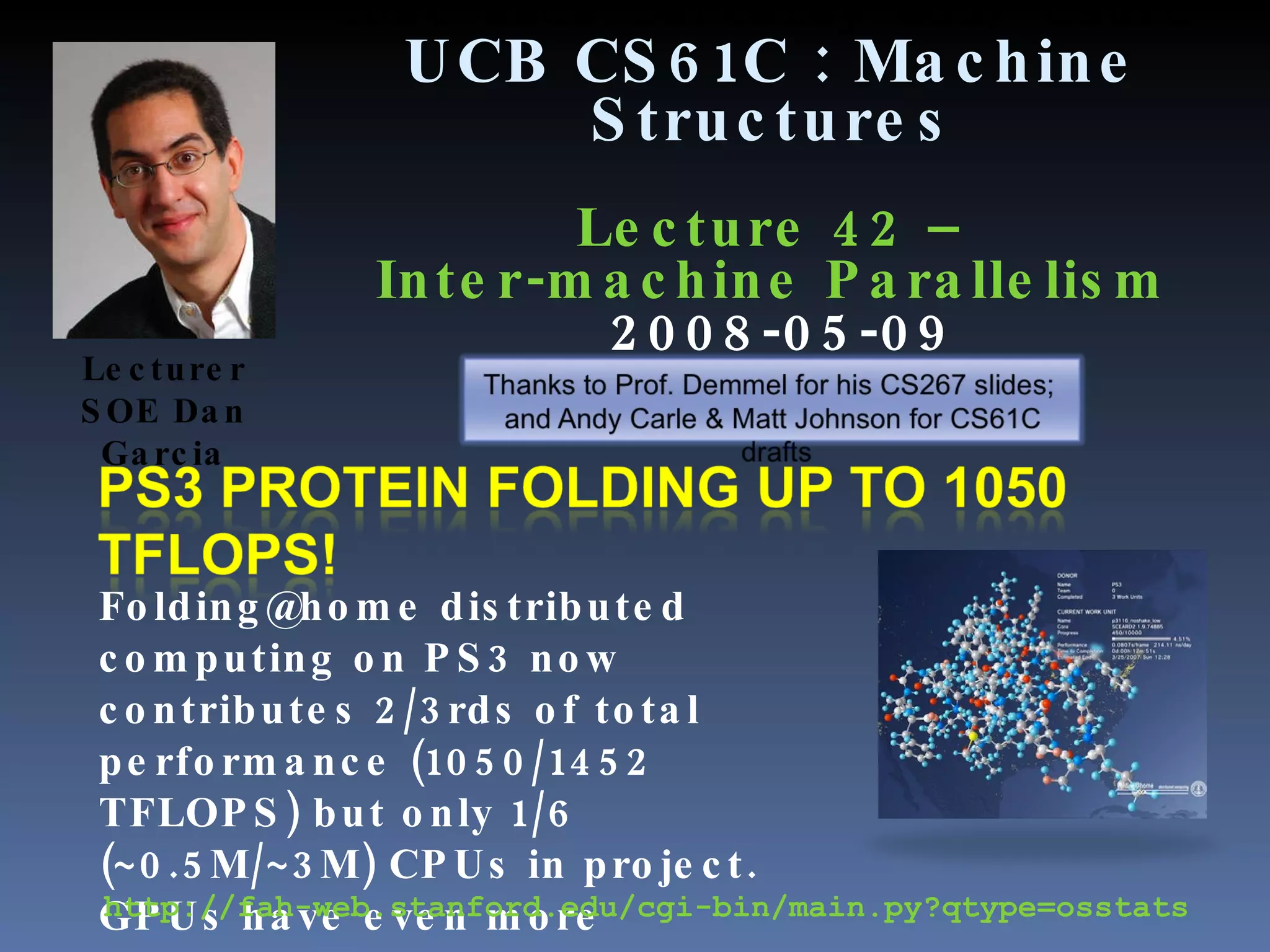
Folding@home distributed computing on PS3 now contributes 2/3rds of total performance (1050/1452 TFLOPS) but only 1/6 (~0.5M/~3M) CPUs in project. GPUs have even more impressive performance. 200W avg for PS3.  inst.eecs.berkeley.edu/~cs61c   UCB CS61C : Machine Structures   Lecture 42 –  Inter-machine Parallelism   2008-05-09 Lecturer SOE Dan Garcia http://fah-web.stanford.edu/cgi-bin/main.py?qtype=osstats
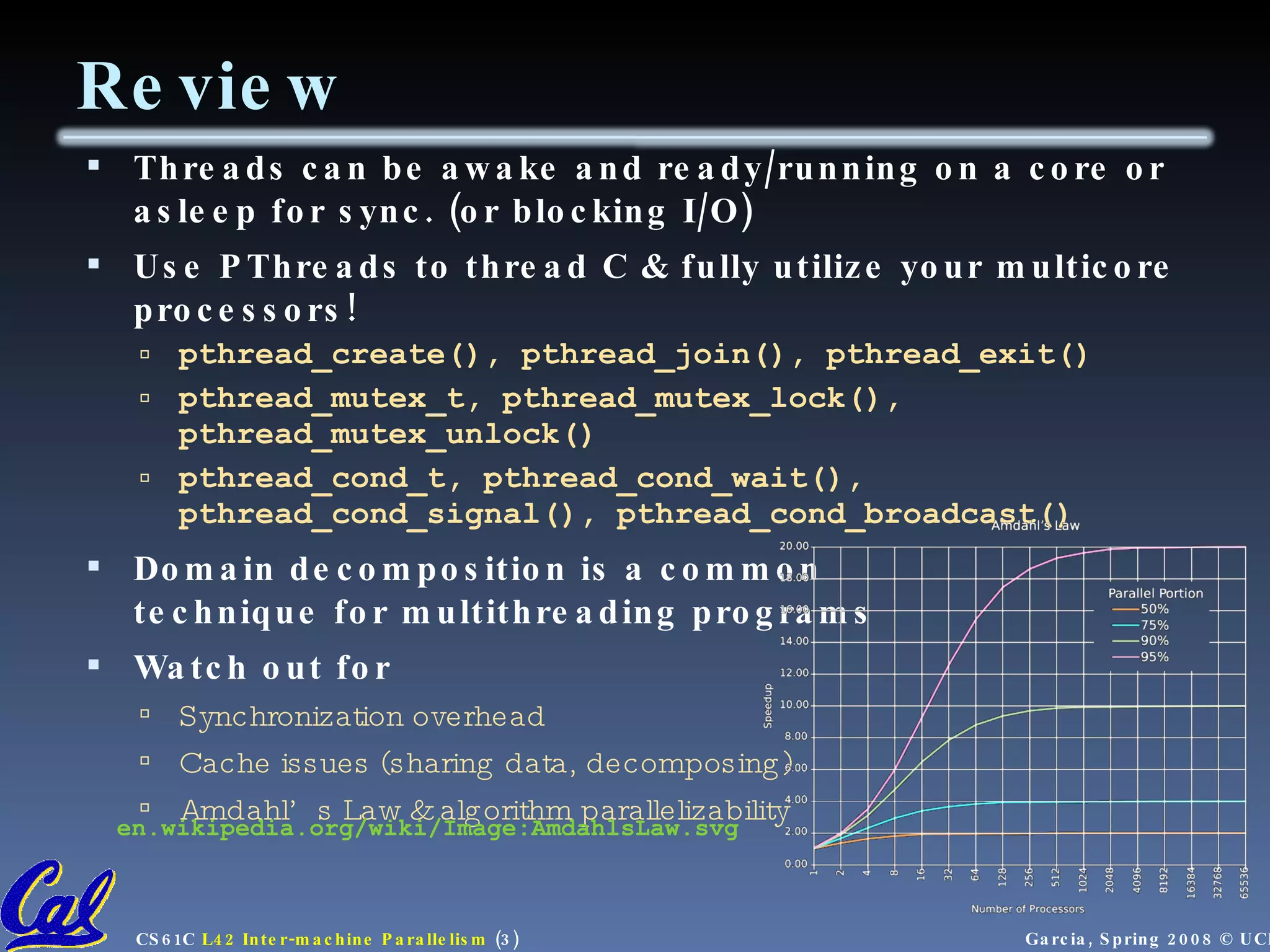
Review Threads can be awake and ready/running on a core or asleep for sync. (or blocking I/O) Use PThreads to thread C & fully utilize your multicore processors! pthread_create(), pthread_join(), pthread_exit() pthread_mutex_t, pthread_mutex_lock(), pthread_mutex_unlock() pthread_cond_t, pthread_cond_wait(), pthread_cond_signal(), pthread_cond_broadcast() Domain decomposition is a common  technique for multithreading programs Watch out for Synchronization overhead Cache issues (sharing data, decomposing) Amdahl’s Law & algorithm parallelizability en.wikipedia.org/wiki/Image:AmdahlsLaw.svg
Today’s Outline Motivation for Inter-machine Parallelism Inter-machine parallelism hardware Supercomputing Distributed computing Grid computing Cluster computing Inter-machine parallelism examples Message Passing Interface (MPI) Google’s MapReduce paradigm Programming Challenges
Big Problems Simulation: the Third Pillar of Science Traditionally perform experiments or build systems Limitations to standard approach: Too difficult – build large wind tunnels Too expensive – build disposable jet Too slow – wait for climate or galactic evolution Too dangerous – weapons, drug design Computational Science: Simulate the phenomenon on computers Based on physical laws and efficient numerical methods
Example Applications Science & Medicine Global climate modeling Biology: genomics; protein folding; drug design; malaria simulations Astrophysical modeling Computational Chemistry, Material Sciences and Nanosciences SETI@Home : Search for Extra-Terrestrial Intelligence Engineering Semiconductor design Earthquake and structural modeling Fluid dynamics (airplane design) Combustion (engine design) Crash simulation Computational Game Theory (e.g., Chess Databases) Business Rendering computer graphic imagery (CGI), ala Pixar and ILM Financial and economic modeling Transaction processing, web services and search engines Defense Nuclear weapons -- test by simulations Cryptography
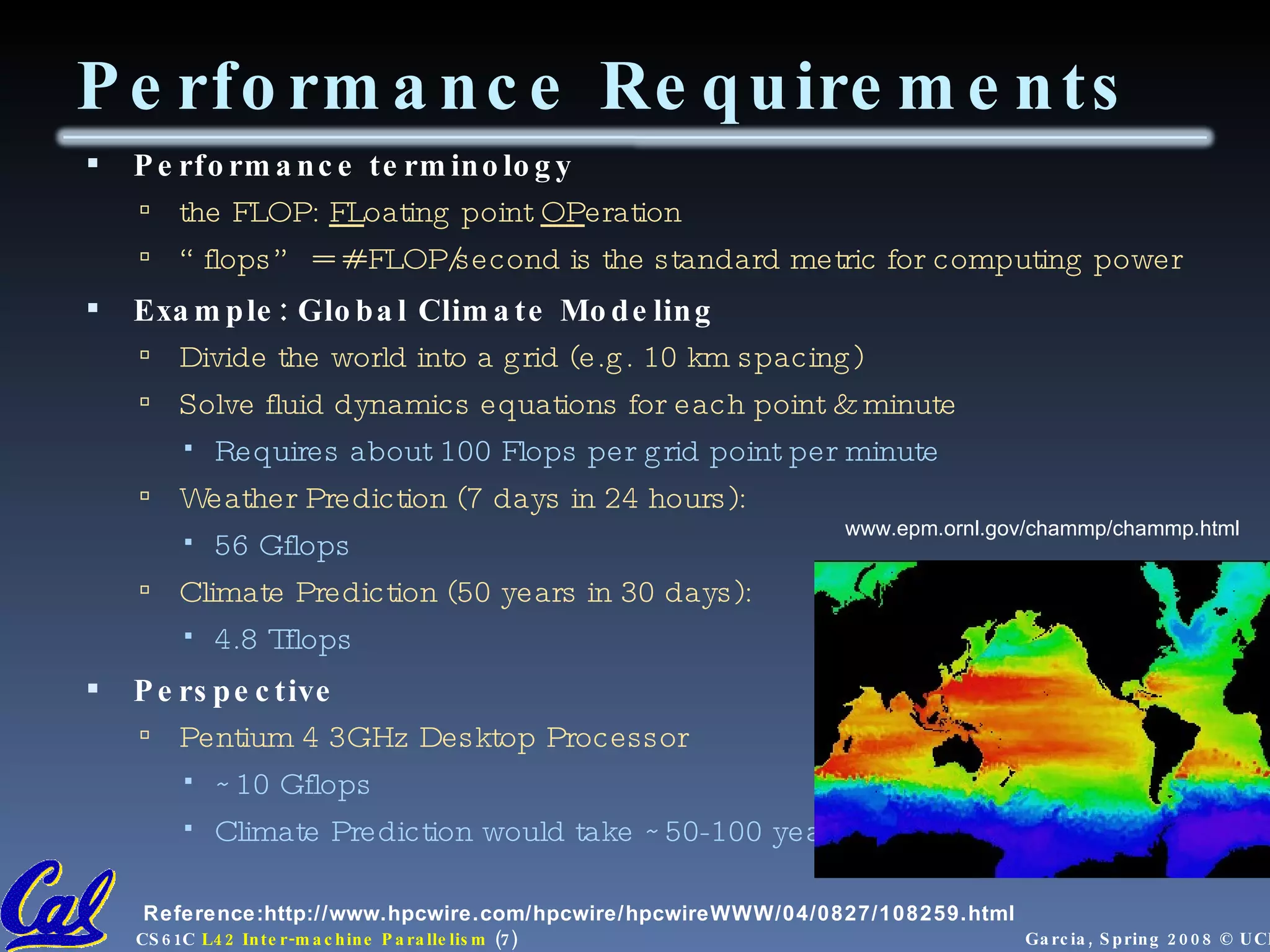
Performance Requirements Performance terminology the FLOP:  FL oating point  OP eration “ flops” = # FLOP/second is the standard metric for computing power Example: Global Climate Modeling Divide the world into a grid (e.g. 10 km spacing) Solve fluid dynamics equations for each point & minute Requires about 100 Flops per grid point per minute Weather Prediction (7 days in 24 hours):  56 Gflops Climate Prediction (50 years in 30 days):  4.8 Tflops Perspective Pentium 4 3GHz Desktop Processor ~10 Gflops Climate Prediction would take ~50-100 years www.epm.ornl.gov/chammp/chammp.html Reference:http://www.hpcwire.com/hpcwire/hpcwireWWW/04/0827/108259.html
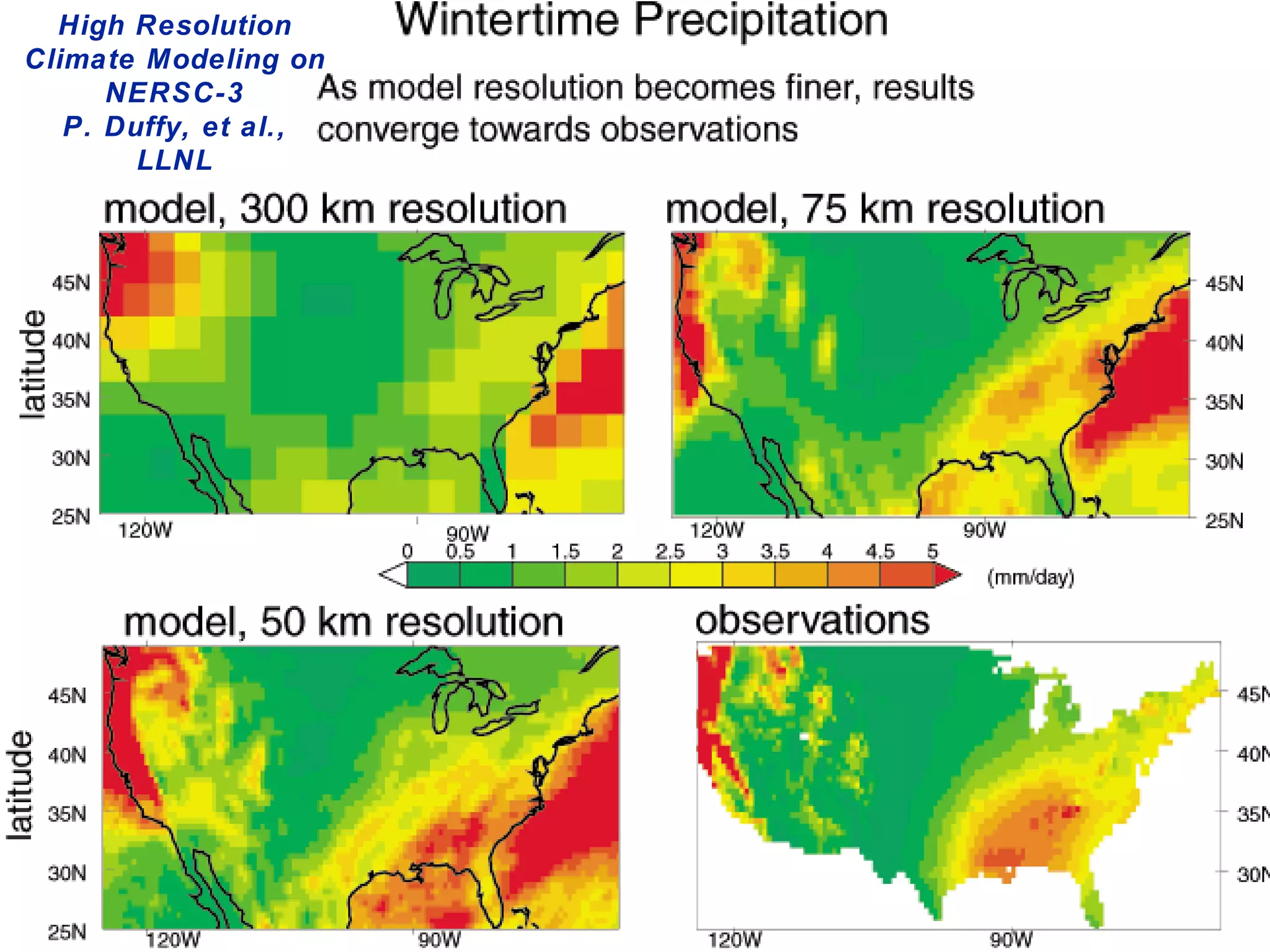
High Resolution Climate Modeling on NERSC-3 P. Duffy, et al., LLNL
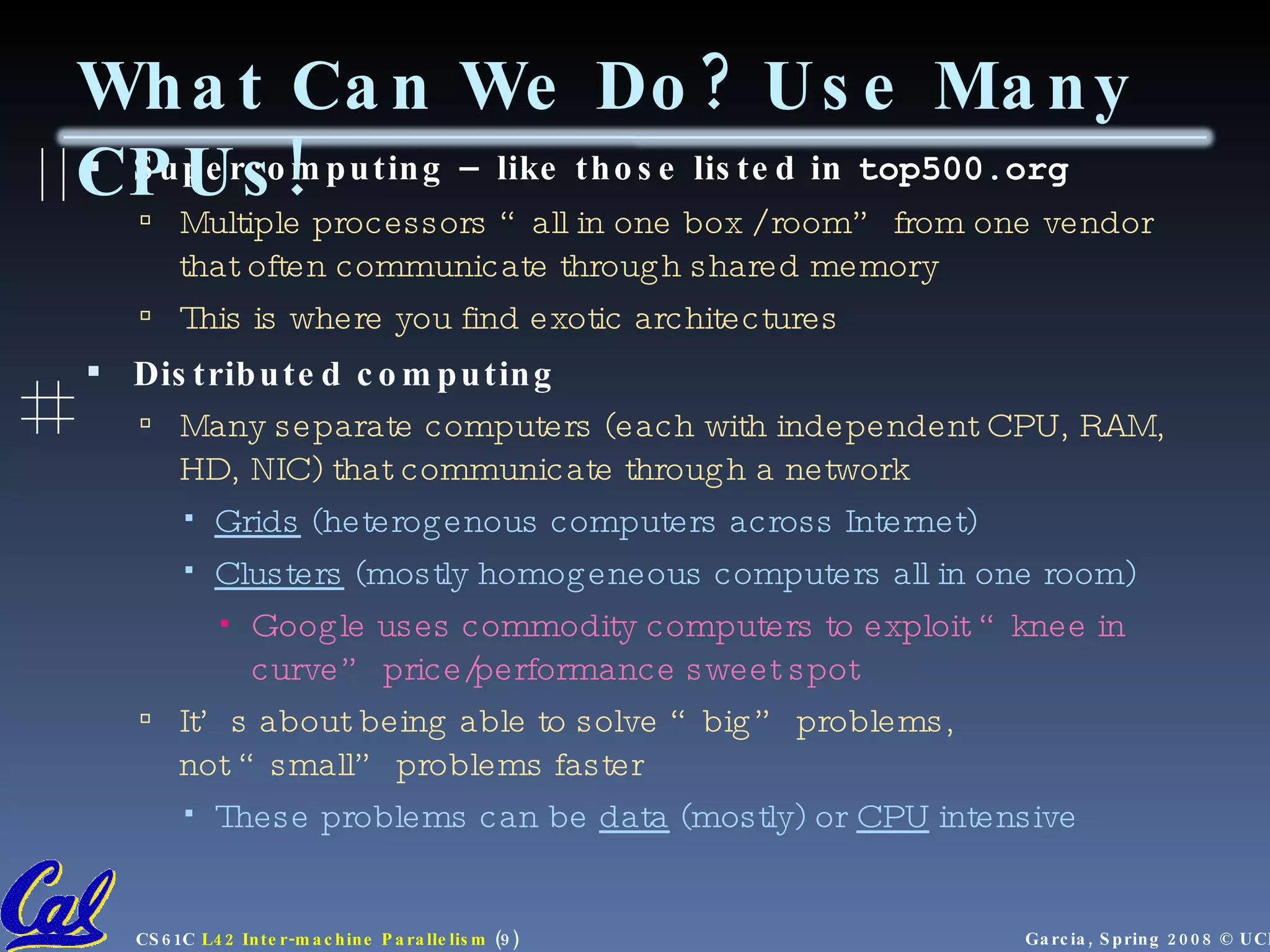
Supercomputing – like those listed in  top500.org Multiple processors “all in one box / room” from one vendor that often communicate through shared memory This is where you find exotic architectures Distributed computing Many separate computers (each with independent CPU, RAM, HD, NIC) that communicate through a network Grids  (heterogenous computers across Internet) Clusters  (mostly homogeneous computers all in one room) Google uses commodity computers to exploit “knee in curve” price/performance sweet spot It’s about being able to solve “big” problems,  not “small” problems faster These problems can be  data  (mostly) or  CPU  intensive  What Can We Do? Use Many CPUs!
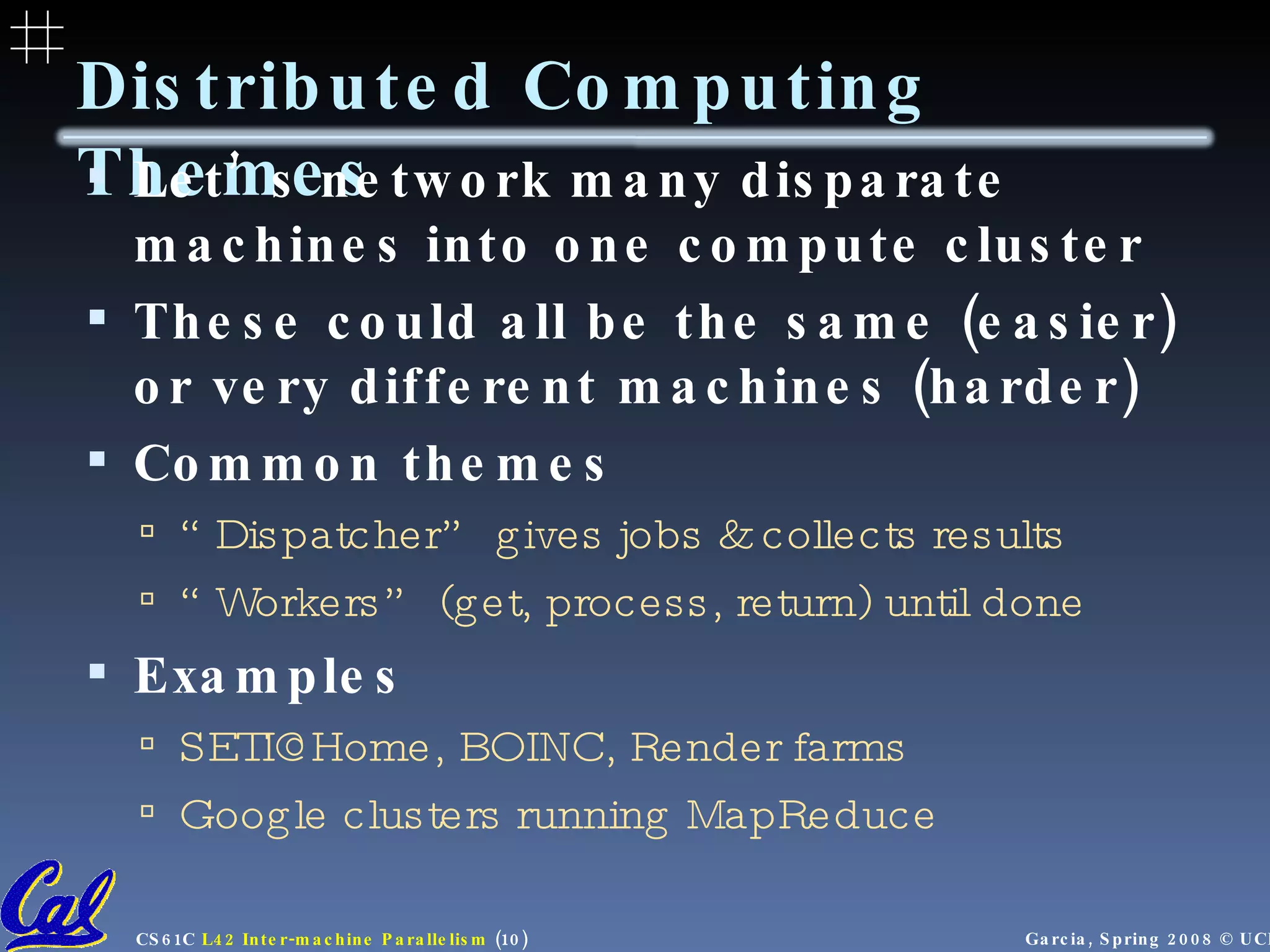
Distributed Computing Themes Let’s network many disparate machines into one compute cluster These could all be the same (easier) or very different machines (harder) Common themes “ Dispatcher” gives jobs & collects results “ Workers” (get, process, return) until done Examples SETI@Home, BOINC, Render farms Google clusters running MapReduce
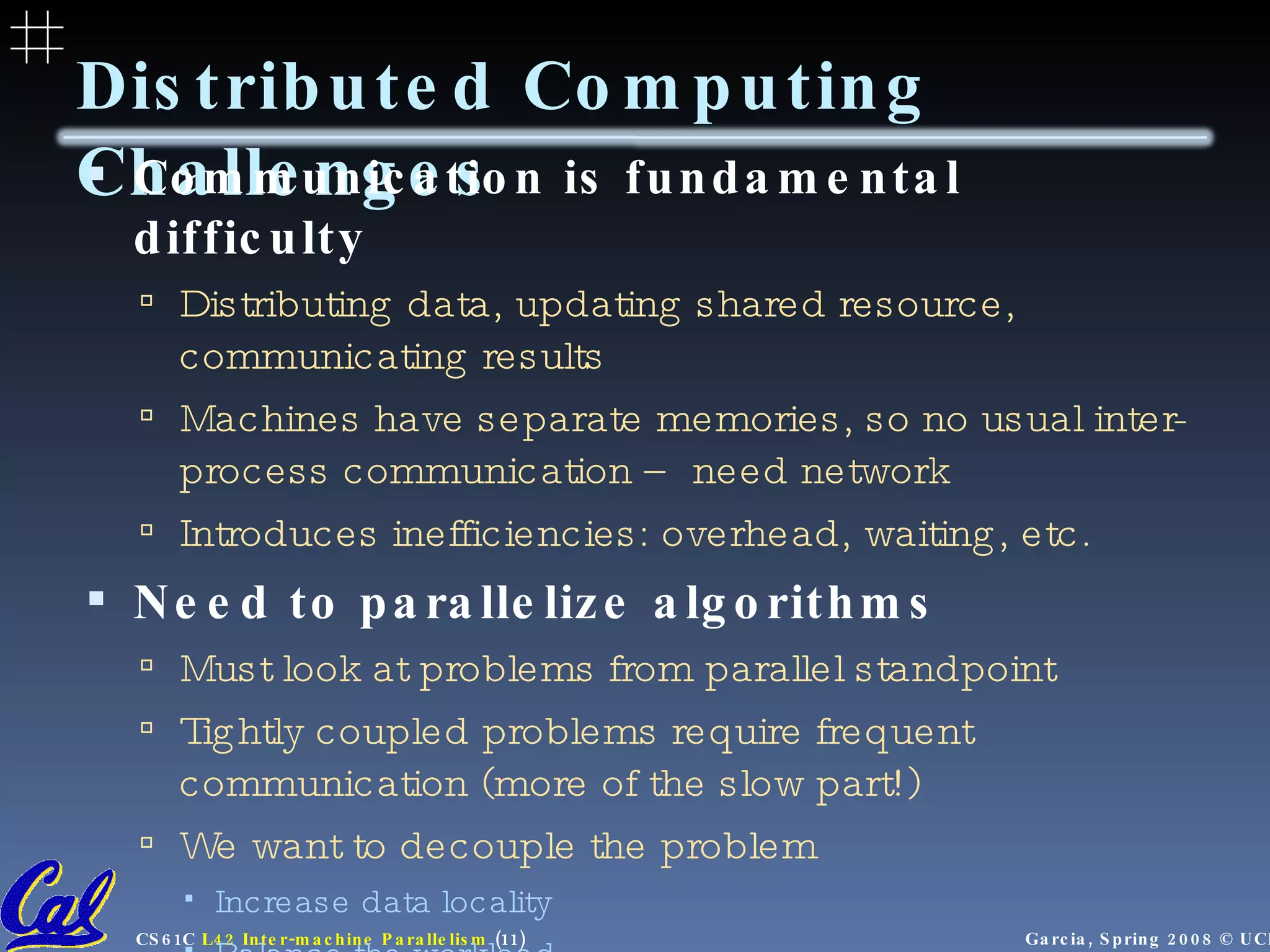
Distributed Computing Challenges Communication is fundamental difficulty Distributing data, updating shared resource, communicating results Machines have separate memories, so no usual inter-process communication – need network Introduces inefficiencies: overhead, waiting, etc. Need to parallelize algorithms Must look at problems from parallel standpoint Tightly coupled problems require frequent communication (more of the slow part!) We want to decouple the problem Increase data locality Balance the workload
Programming Models: What is MPI? Message Passing Interface (MPI) World’s most popular distributed API MPI is “de facto standard” in scientific computing C and FORTRAN, ver. 2 in 1997 What is MPI good for? Abstracts away common network communications Allows lots of control without bookkeeping Freedom and flexibility come with complexity 300 subroutines, but serious programs with fewer than 10  Basics: One executable run on every node Each node process has a rank ID number assigned Call API functions to send messages http://www.mpi-forum.org/ http://forum.stanford.edu/events/2007/plenary/slides/Olukotun.ppt http://www.tbray.org/ongoing/When/200x/2006/05/24/On-Grids
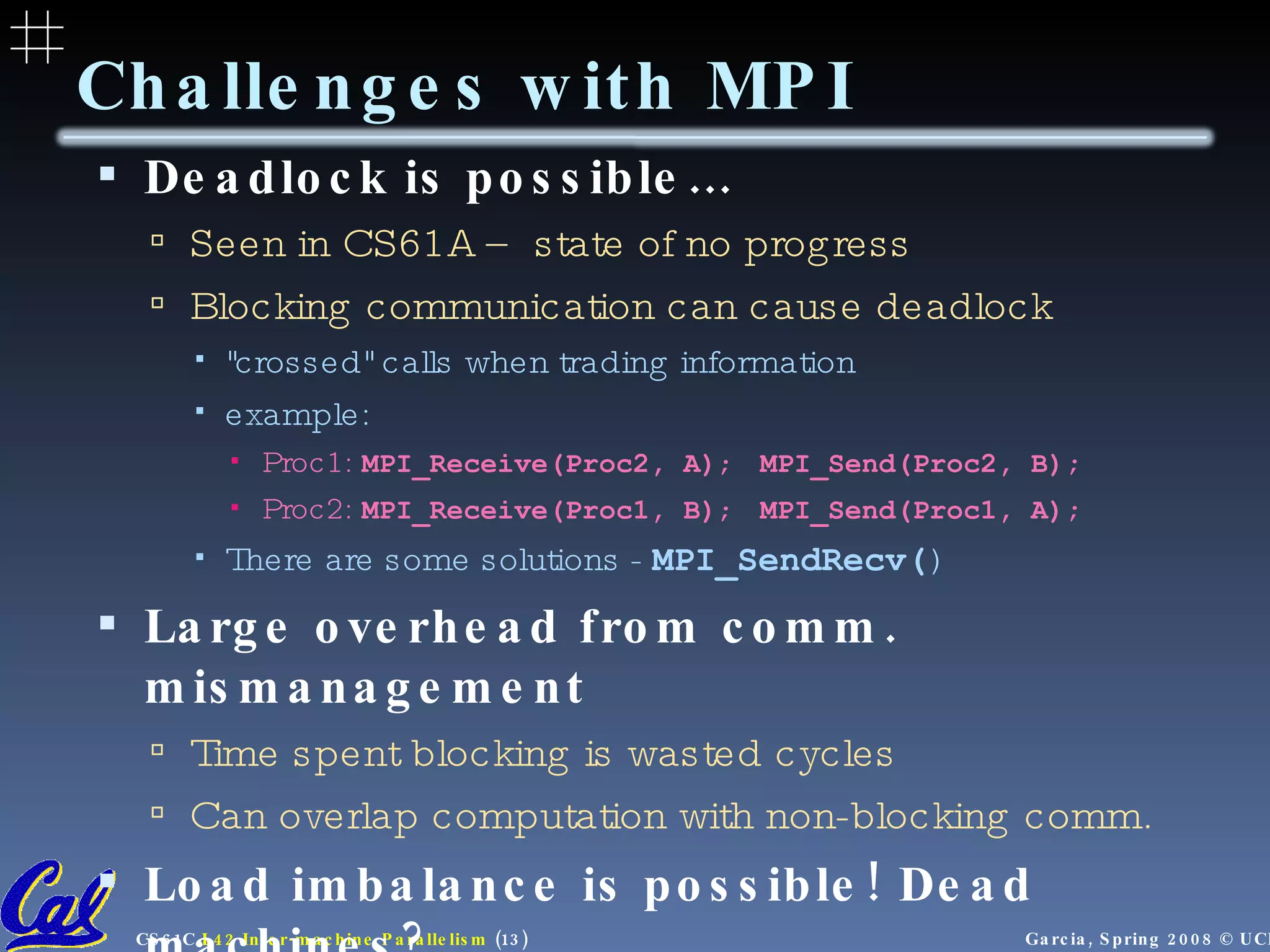
Deadlock is possible… Seen in CS61A – state of no progress Blocking communication can cause deadlock "crossed" calls when trading information  example:  Proc1:  MPI_Receive(Proc2, A) ;  MPI_Send(Proc2, B); Proc2:  MPI_Receive(Proc1, B) ;  MPI_Send(Proc1, A); There are some solutions -  MPI_SendRecv( ) Large overhead from comm. mismanagement Time spent blocking is wasted cycles Can overlap computation with non-blocking comm. Load imbalance is possible! Dead machines? Things are starting to look hard to code! Challenges with MPI
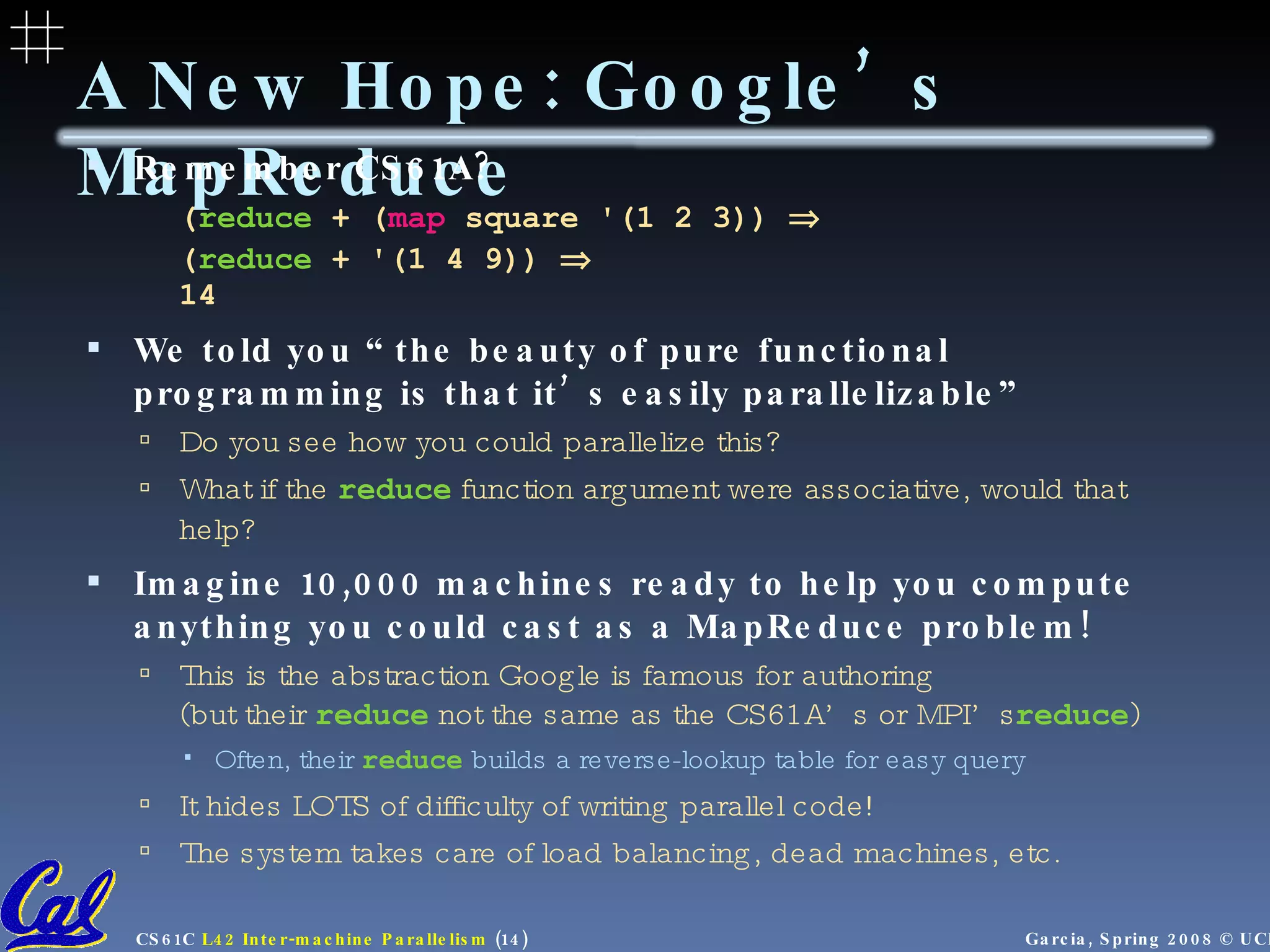
A New Hope: Google’s MapReduce Remember CS61A? ( reduce  + ( map  square '(1 2 3))   ( reduce  + '(1 4 9))     14 We told you “the beauty of pure functional programming is that it’s easily parallelizable” Do you see how you could parallelize this? What if the  reduce  function argument were associative, would that help? Imagine 10,000 machines ready to help you compute anything you could cast as a MapReduce problem! This is the abstraction Google is famous for authoring (but their  reduce  not the same as the CS61A’s or MPI’s  reduce ) Often, their  reduce   builds a reverse-lookup table for easy query It hides LOTS of difficulty of writing parallel code! The system takes care of load balancing, dead machines, etc.
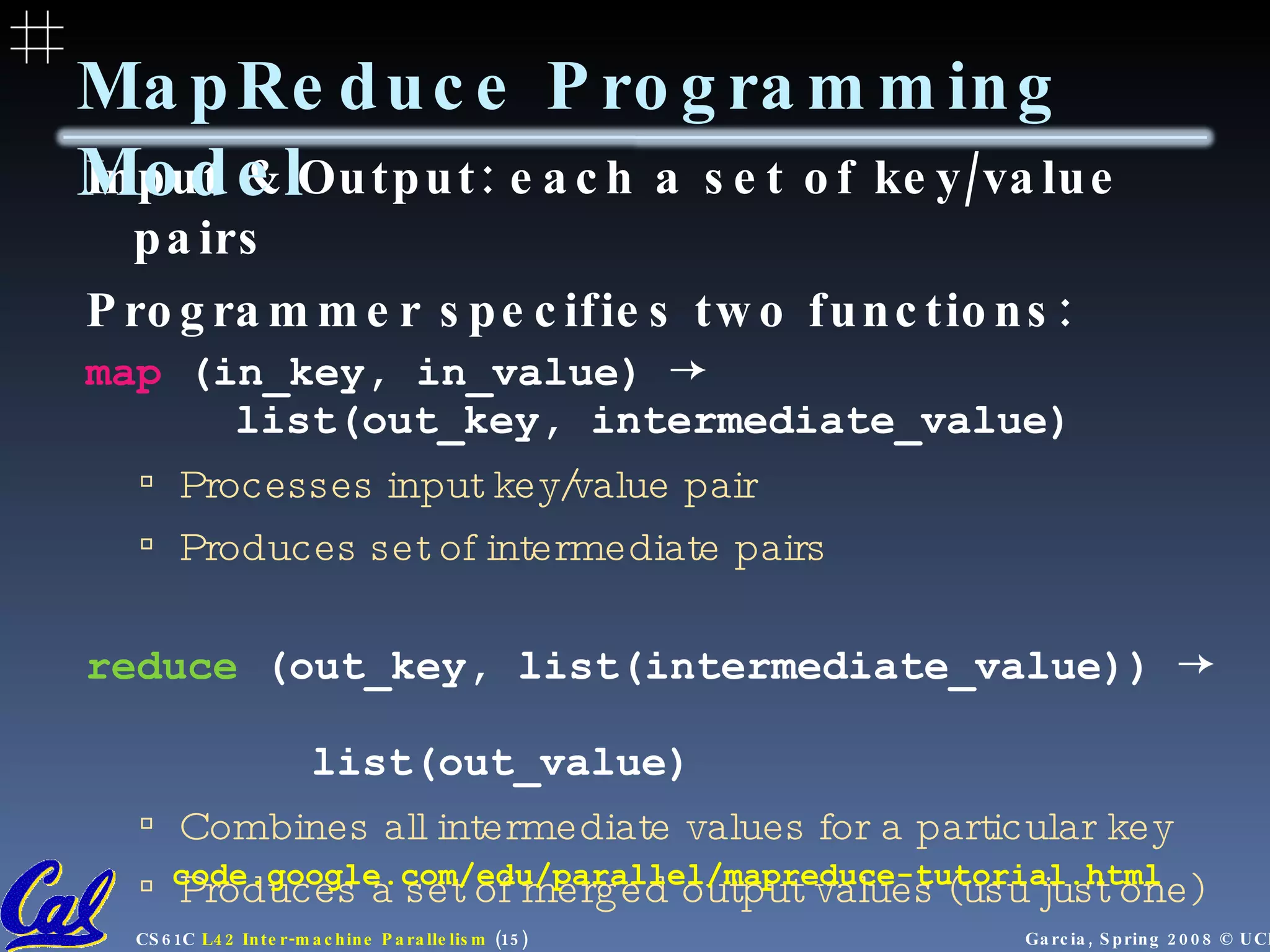
Input & Output: each a set of key/value pairs Programmer specifies two functions: map  (in_key, in_value)       list(out_key, intermediate_value) Processes input key/value pair Produces set of intermediate pairs reduce  (out_key, list(intermediate_value))       list(out_value) Combines all intermediate values for a particular key Produces a set of merged output values (usu just one) MapReduce Programming Model code.google.com/edu/parallel/mapreduce-tutorial.html
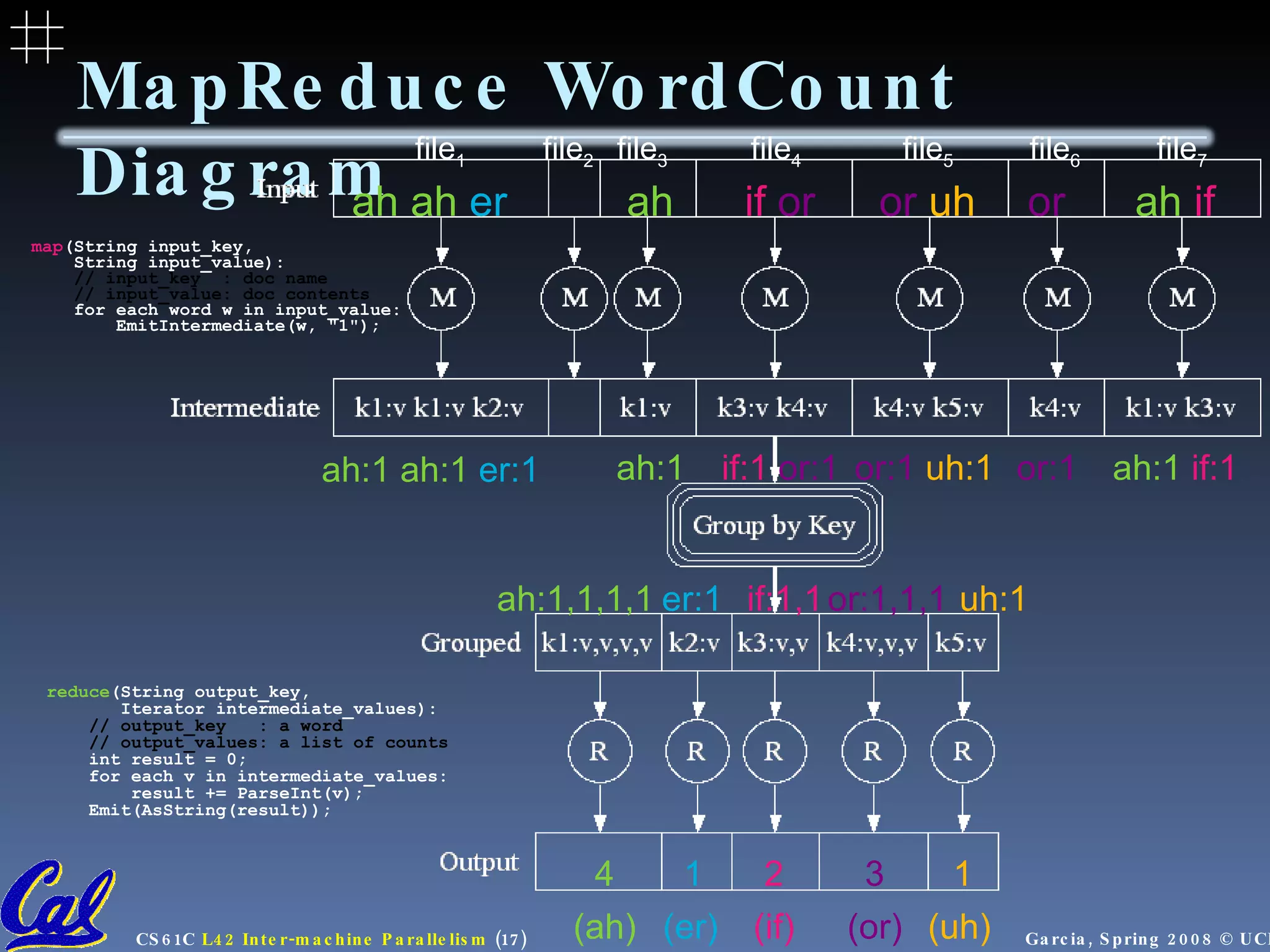
MapReduce WordCount Example “ Mapper” nodes are responsible for the  map  function // “I do I learn”    (“I”,1), (“do”,1), (“I”,1), (“learn”,1)  map (String input_key,   String input_value):     // input_key  : document name (or line of text)    // input_value: document contents     for each word w in input_value:   EmitIntermediate(w, "1"); “ Reducer” nodes are responsible for the  reduce   function // (“I”,[1,1])    (“I”,2)  reduce (String output_key,    Iterator intermediate_values):   // output_key  : a word   // output_values: a list of counts   int result = 0;   for each v in intermediate_values:   result += ParseInt(v);   Emit(AsString(result)); Data on a distributed file system (DFS)
MapReduce WordCount Diagram ah ah  er ah if   or or   uh or ah  if ah:1,1,1,1 ah:1 if:1   or:1 or:1   uh:1 or:1 ah:1  if:1 er:1 if:1,1 or:1,1,1 uh:1 ah:1 ah:1  er:1 4 1 2 3 1 file 1 file 2 file 3 file 4 file 5 file 6 file 7 (ah) (er) (if) (or) (uh) map (String input_key,   String input_value):     // input_key  : doc name    // input_value: doc contents     for each word w in input_value:   EmitIntermediate(w, "1"); reduce (String output_key,    Iterator intermediate_values):   // output_key  : a word   // output_values: a list of counts   int result = 0;   for each v in intermediate_values:   result += ParseInt(v);   Emit(AsString(result));
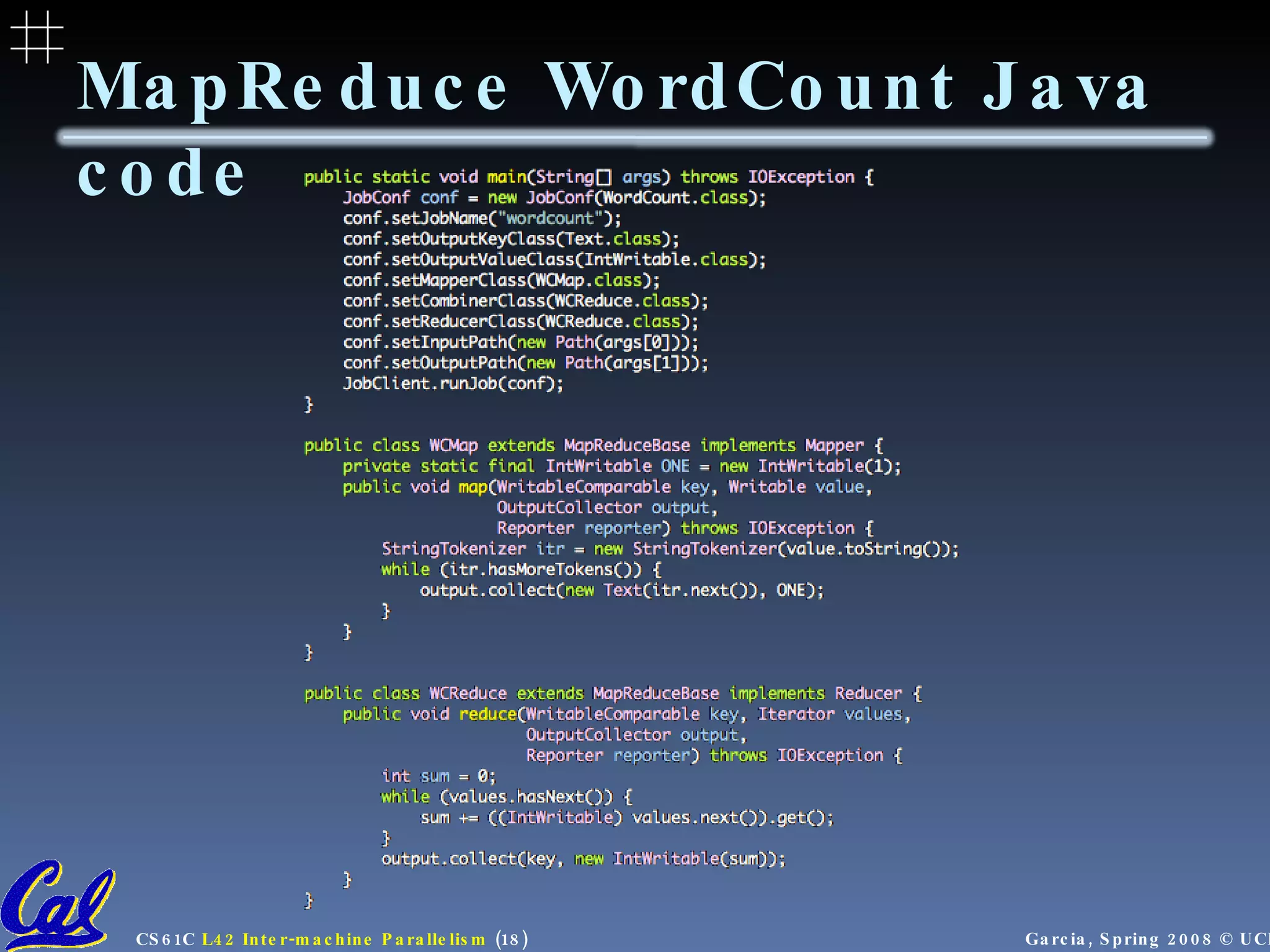
MapReduce WordCount Java code
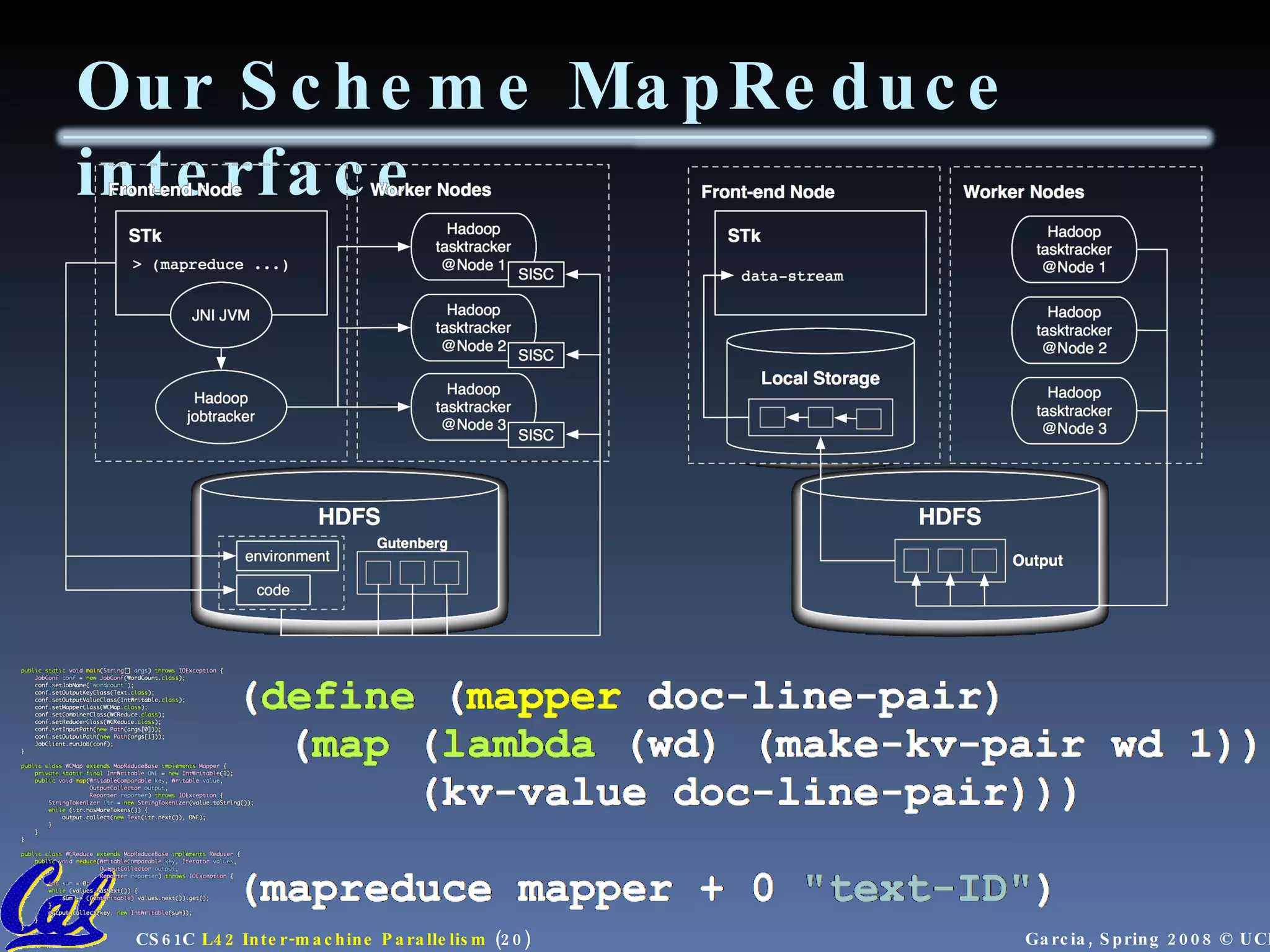
MapReduce in CS61A (and CS3?!) Think that’s too much code? So did we, and we wanted to teach the Map/Reduce programming paradigm in CS61A “ We” = Dan, Brian Harvey and ace undergrads  Matt Johnson, Ramesh Sridharan, Robert Liao, Alex Rasmussen.  Google & Intel gave us the cluster you used in Lab! You live in Scheme, and send the task to the cluster in the basement by invoking the fn  mapreduce . Ans comes back as a stream.  (mapreduce  mapper  reducer  reducer-base input) www.eecs.berkeley.edu/Pubs/TechRpts/2008/EECS-2008-34.html
Our Scheme MapReduce interface
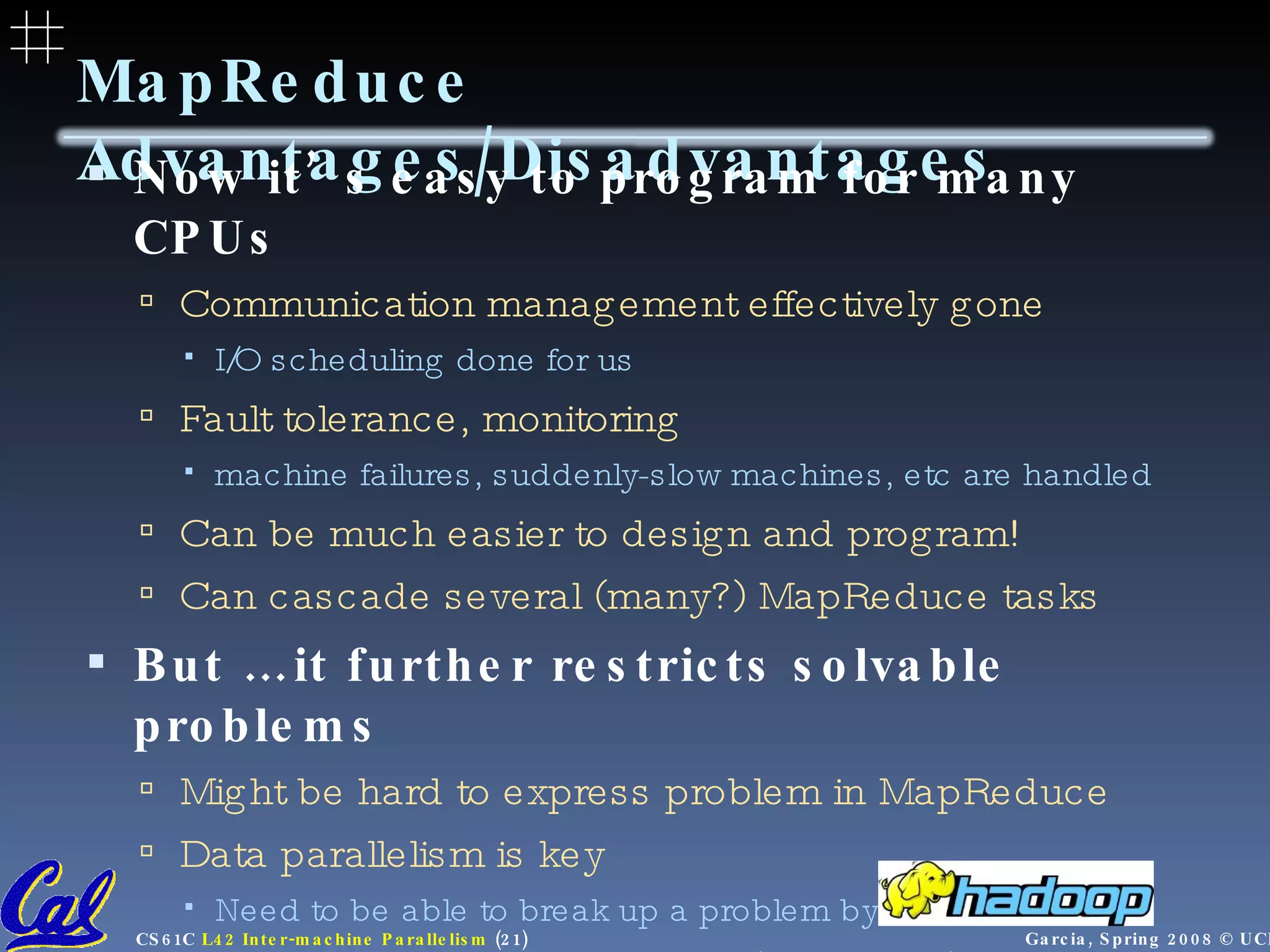
MapReduce Advantages/Disadvantages Now it’s easy to program for many CPUs Communication management effectively gone I/O scheduling done for us Fault tolerance, monitoring machine failures, suddenly-slow machines, etc are handled Can be much easier to design and program! Can cascade several (many?) MapReduce tasks But … it further restricts solvable problems Might be hard to express problem in MapReduce Data parallelism is key Need to be able to break up a problem by data chunks MapReduce is closed-source (to Google)  C++ Hadoop is open-source Java-based rewrite
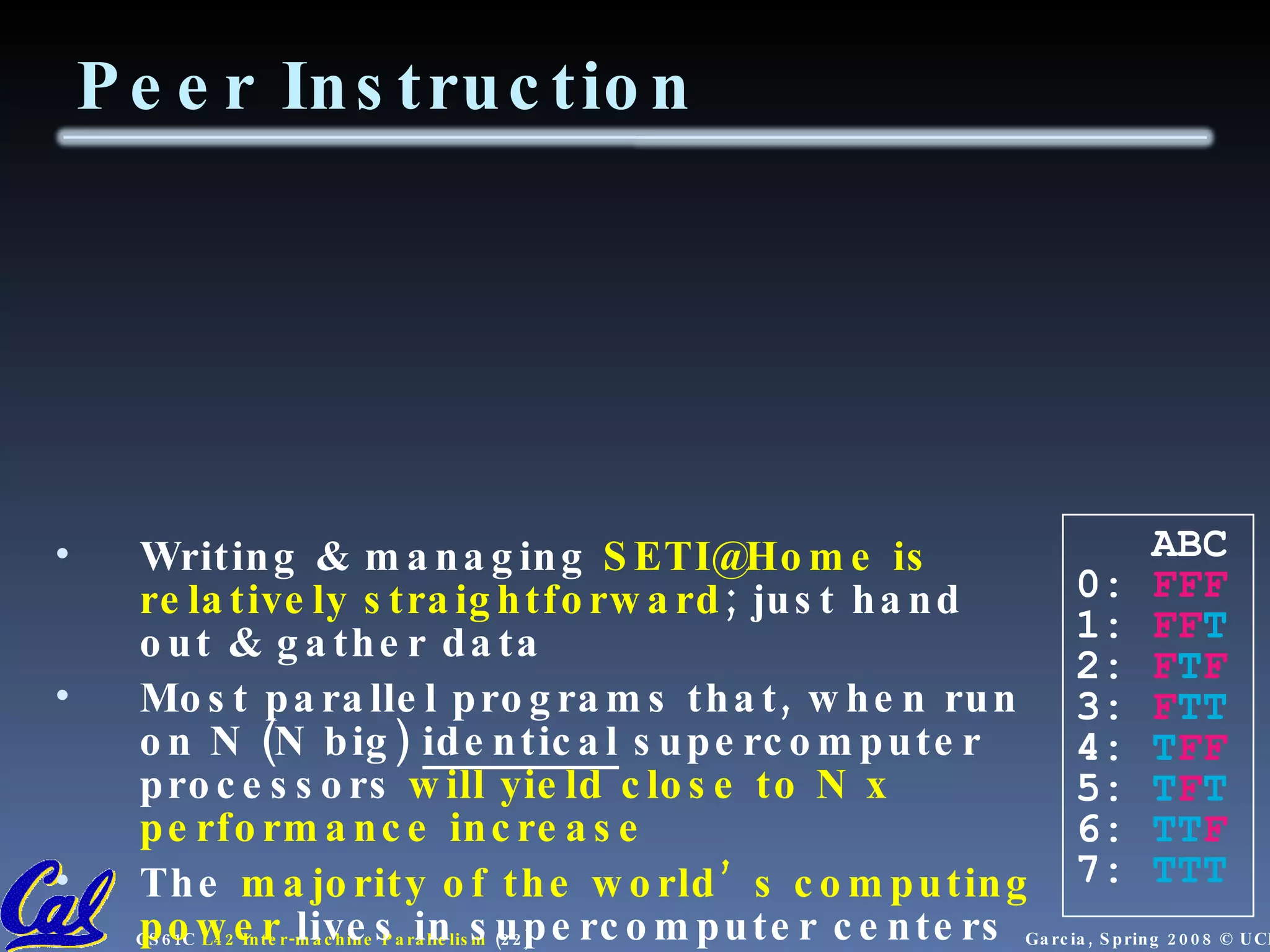
Peer Instruction ABC 0:  FFF 1:  FF T 2:  F T F 3:  F TT 4:  T FF 5:  T F T 6:  TT F 7:  TTT Writing & managing  SETI@Home is relatively straightforward ; just hand out & gather data  Most parallel programs that, when run on N (N big)  identical  supercomputer processors  will yield close to N x performance increase The  majority of the world’s computing power  lives in supercomputer centers
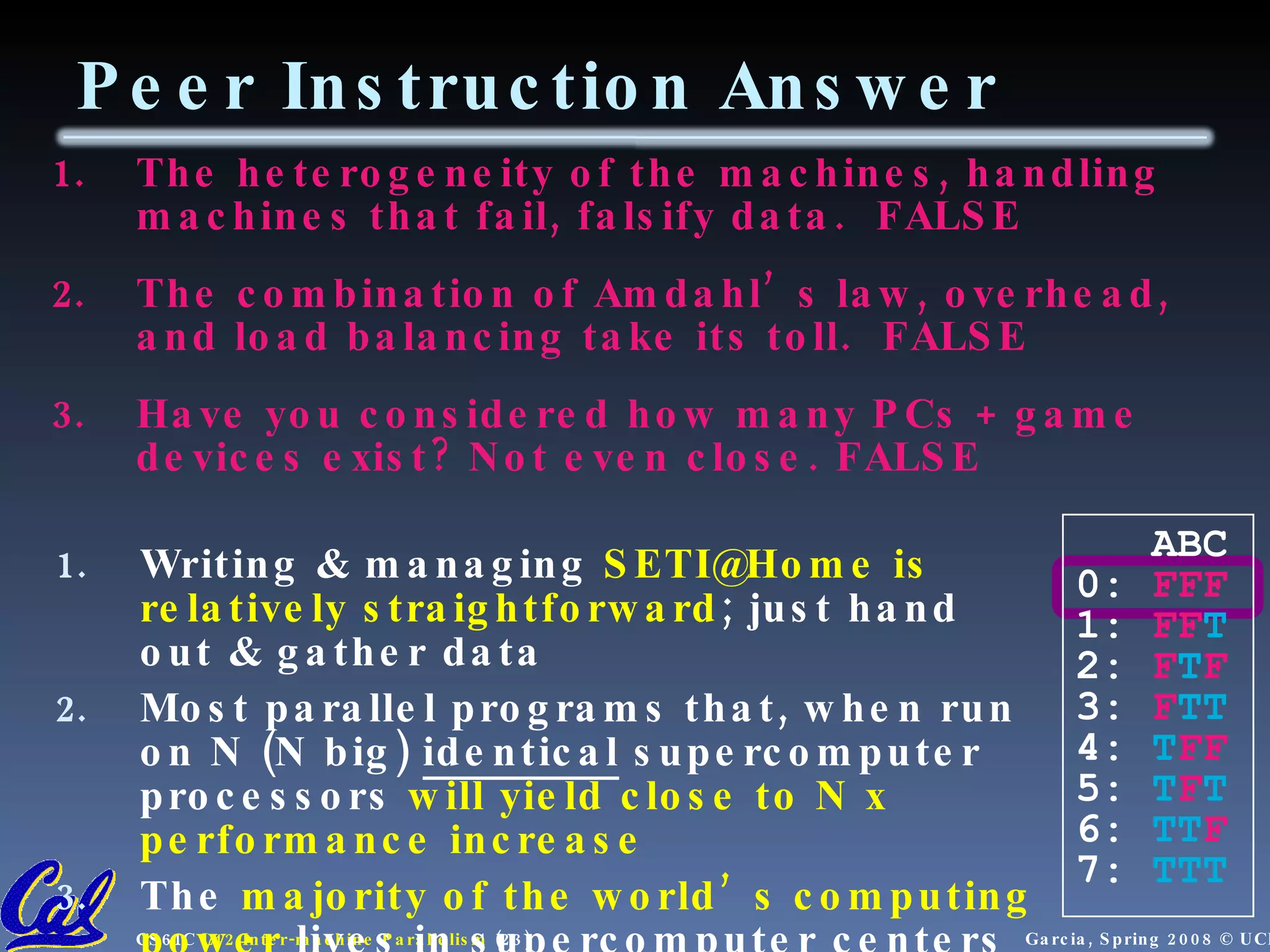
Writing & managing  SETI@Home is relatively straightforward ; just hand out & gather data  Most parallel programs that, when run on N (N big)  identical  supercomputer processors  will yield close to N x performance increase The  majority of the world’s computing power  lives in supercomputer centers Peer Instruction Answer The heterogeneity of the machines, handling machines that fail, falsify data.  FALSE The combination of Amdahl’s law, overhead, and load balancing take its toll.  FALSE Have you considered how many PCs + game devices exist? Not even close. FALSE ABC 0:  FFF 1:  FF T 2:  F T F 3:  F TT 4:  T FF 5:  T F T 6:  TT F 7:  TTT
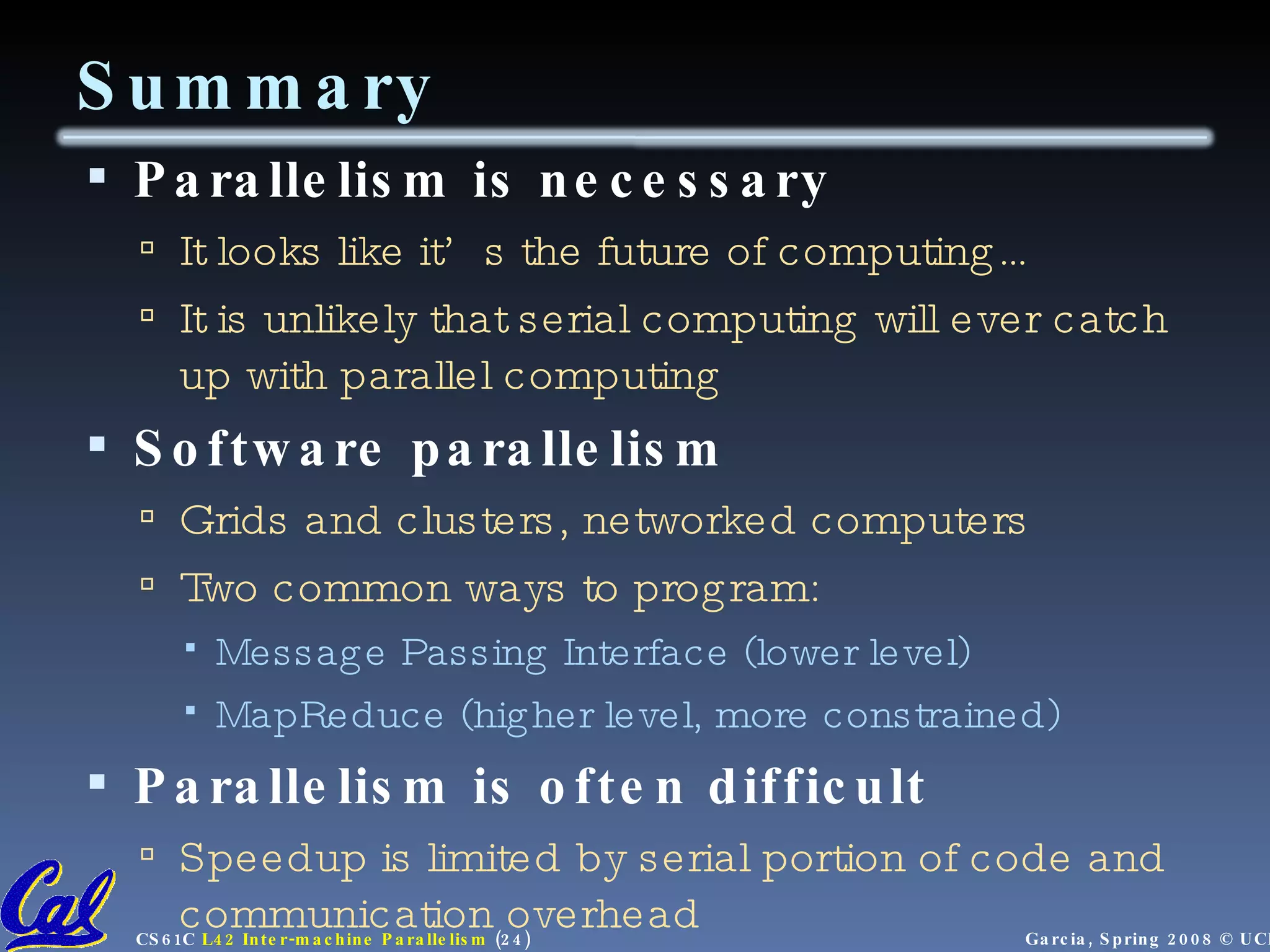
Summary Parallelism is necessary It looks like it’s the future of computing… It is unlikely that serial computing will ever catch up with parallel computing Software parallelism Grids and clusters, networked computers Two common ways to program: Message Passing Interface (lower level) MapReduce (higher level, more constrained) Parallelism is often difficult Speedup is limited by serial portion of code and communication overhead
Bonus slides These are extra slides that used to be included in lecture notes, but have been moved to this, the “bonus” area to serve as a supplement. The slides will appear in the order they would have in the normal presentation Bonus
To Learn More… About MPI… www.mpi-forum.org Parallel Programming in C with MPI and OpenMP by Michael J. Quinn About MapReduce… code.google.com/edu/parallel/mapreduce-tutorial.html labs.google.com/papers/mapreduce.html lucene.apache.org/hadoop/index.html
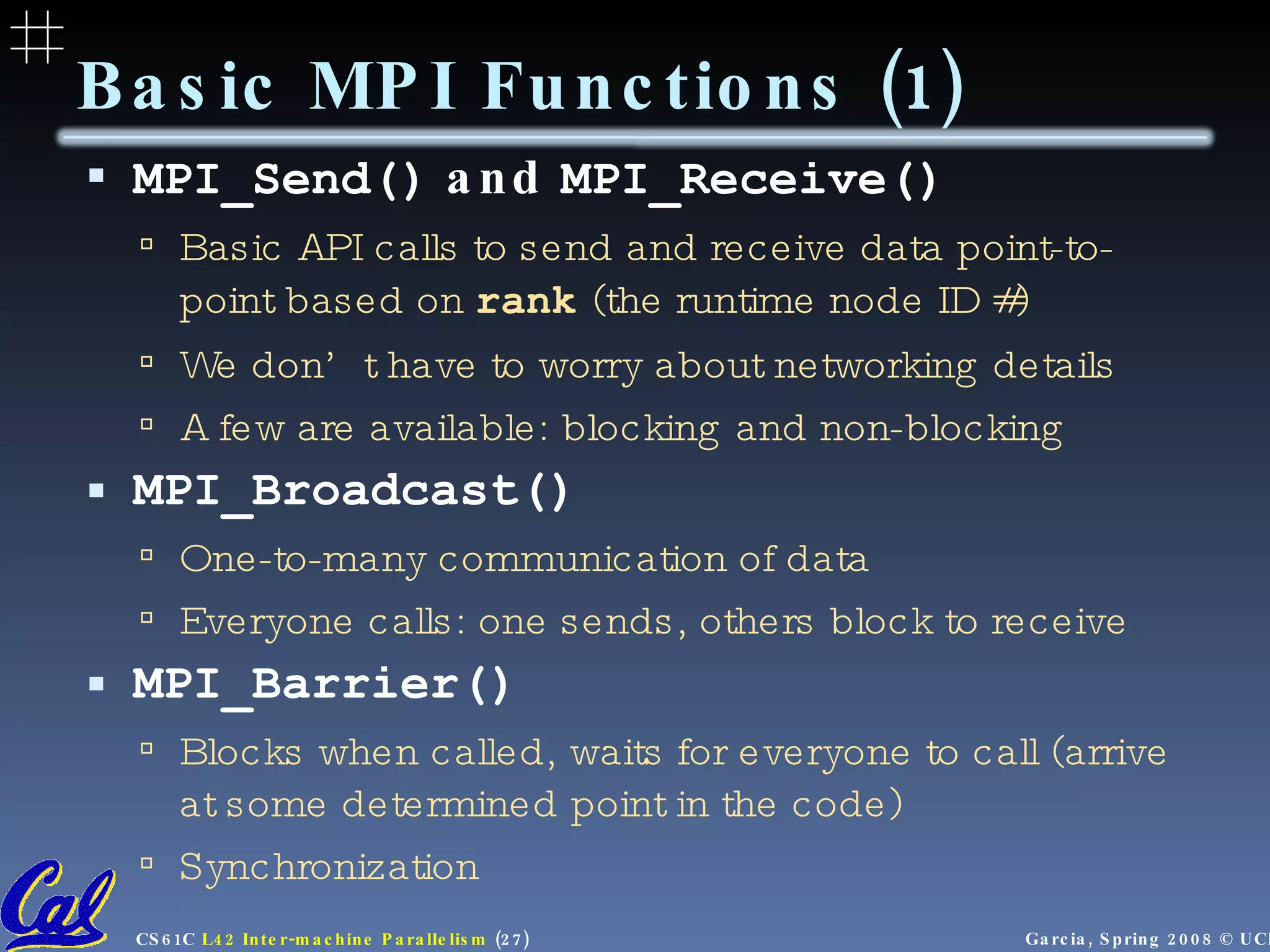
MPI_Send()  and  MPI_Receive() Basic API calls to send and receive data point-to-point based on  rank   (the runtime node ID #) We don’t have to worry about networking details  A few are available: blocking and non-blocking MPI_Broadcast() One-to-many communication of data Everyone calls: one sends, others block to receive MPI_Barrier() Blocks when called, waits for everyone to call (arrive at some determined point in the code) Synchronization Basic MPI Functions (1)
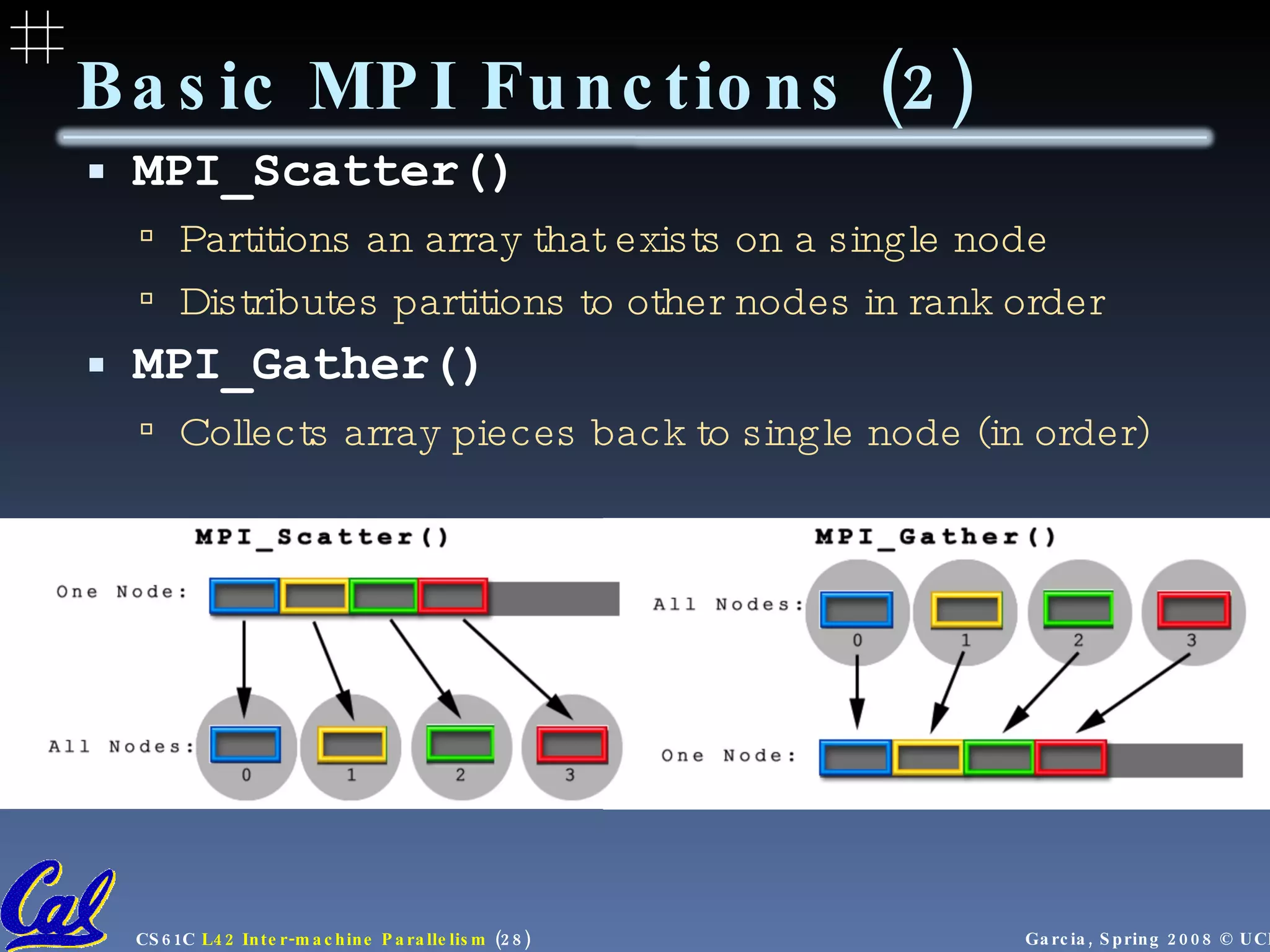
MPI_Scatter() Partitions an array that exists on a single node Distributes partitions to other nodes in rank order MPI_Gather() Collects array pieces back to single node (in order) Basic MPI Functions (2)
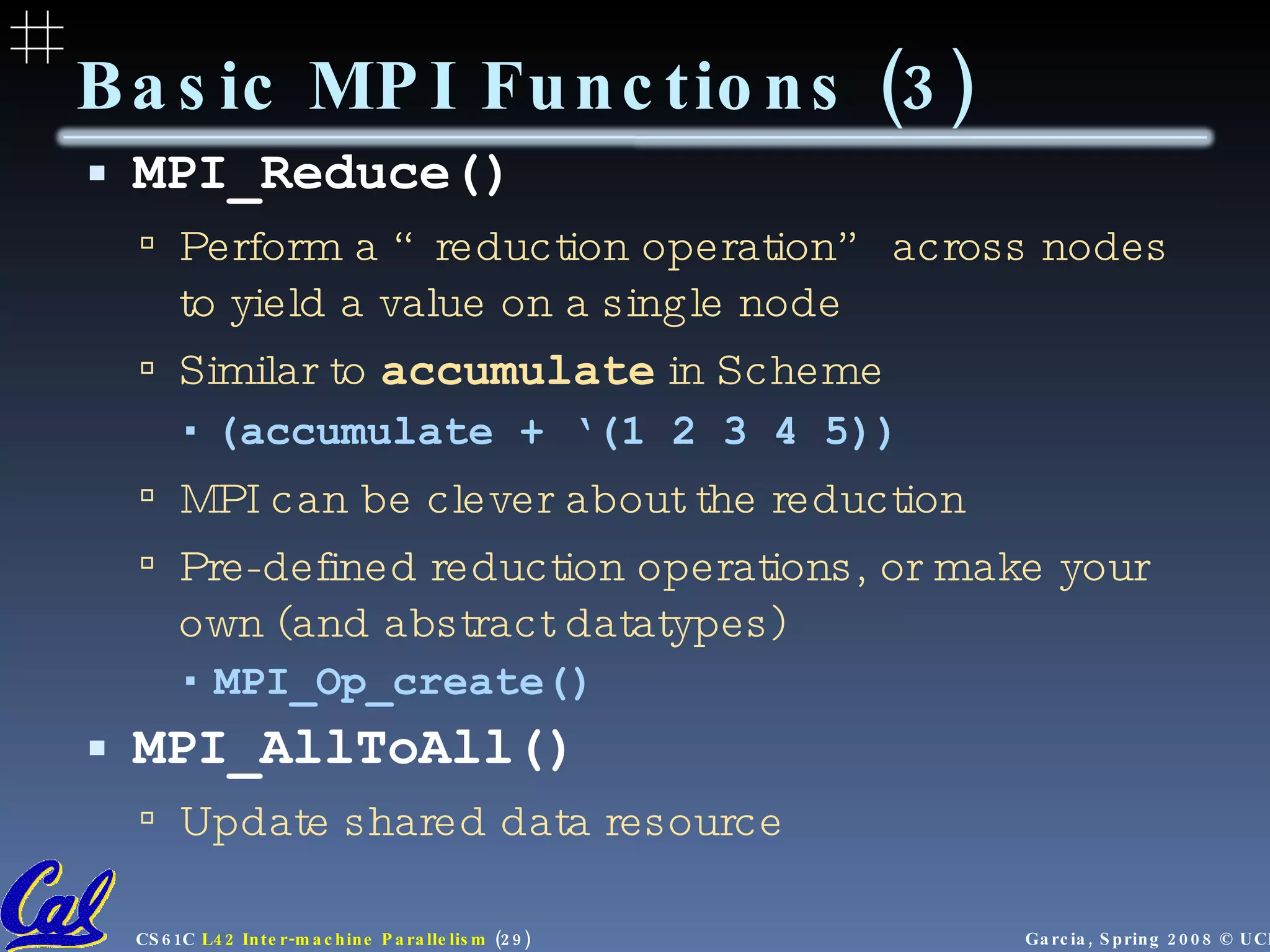
Basic MPI Functions (3) MPI_Reduce() Perform a “reduction operation” across nodes to yield a value on a single node Similar to  accumulate   in Scheme (accumulate + ‘(1 2 3 4 5)) MPI can be clever about the reduction Pre-defined reduction operations, or make your own (and abstract datatypes) MPI_Op_create() MPI_AllToAll() Update shared data resource
Communicators  - set up node groups Startup/Shutdown Functions Set up  rank   and  size ,  pass  argc  and  argv “ Real” code segment main(int argc, char *argv[]){ MPI_Init(&argc, &argv); MPI_Comm_rank( MPI_COMM_WORLD , &rank); MPI_Comm_size( MPI_COMM_WORLD , &size); /* Data distribution */ ... /* Computation & Communication*/ ... /* Result gathering */ ... MPI_Finalize(); } MPI Program Template

Intermachine Parallelism

  • 1.
    License Except asotherwise noted, the content of this presentation is licensed under the Creative Commons Attribution 2.5 License.
  • 2.
    Folding@home distributed computingon PS3 now contributes 2/3rds of total performance (1050/1452 TFLOPS) but only 1/6 (~0.5M/~3M) CPUs in project. GPUs have even more impressive performance. 200W avg for PS3. inst.eecs.berkeley.edu/~cs61c UCB CS61C : Machine Structures Lecture 42 – Inter-machine Parallelism 2008-05-09 Lecturer SOE Dan Garcia http://fah-web.stanford.edu/cgi-bin/main.py?qtype=osstats
  • 3.
    Review Threads canbe awake and ready/running on a core or asleep for sync. (or blocking I/O) Use PThreads to thread C & fully utilize your multicore processors! pthread_create(), pthread_join(), pthread_exit() pthread_mutex_t, pthread_mutex_lock(), pthread_mutex_unlock() pthread_cond_t, pthread_cond_wait(), pthread_cond_signal(), pthread_cond_broadcast() Domain decomposition is a common technique for multithreading programs Watch out for Synchronization overhead Cache issues (sharing data, decomposing) Amdahl’s Law & algorithm parallelizability en.wikipedia.org/wiki/Image:AmdahlsLaw.svg
  • 4.
    Today’s Outline Motivationfor Inter-machine Parallelism Inter-machine parallelism hardware Supercomputing Distributed computing Grid computing Cluster computing Inter-machine parallelism examples Message Passing Interface (MPI) Google’s MapReduce paradigm Programming Challenges
  • 5.
    Big Problems Simulation:the Third Pillar of Science Traditionally perform experiments or build systems Limitations to standard approach: Too difficult – build large wind tunnels Too expensive – build disposable jet Too slow – wait for climate or galactic evolution Too dangerous – weapons, drug design Computational Science: Simulate the phenomenon on computers Based on physical laws and efficient numerical methods
  • 6.
    Example Applications Science& Medicine Global climate modeling Biology: genomics; protein folding; drug design; malaria simulations Astrophysical modeling Computational Chemistry, Material Sciences and Nanosciences SETI@Home : Search for Extra-Terrestrial Intelligence Engineering Semiconductor design Earthquake and structural modeling Fluid dynamics (airplane design) Combustion (engine design) Crash simulation Computational Game Theory (e.g., Chess Databases) Business Rendering computer graphic imagery (CGI), ala Pixar and ILM Financial and economic modeling Transaction processing, web services and search engines Defense Nuclear weapons -- test by simulations Cryptography
  • 7.
    Performance Requirements Performanceterminology the FLOP: FL oating point OP eration “ flops” = # FLOP/second is the standard metric for computing power Example: Global Climate Modeling Divide the world into a grid (e.g. 10 km spacing) Solve fluid dynamics equations for each point & minute Requires about 100 Flops per grid point per minute Weather Prediction (7 days in 24 hours): 56 Gflops Climate Prediction (50 years in 30 days): 4.8 Tflops Perspective Pentium 4 3GHz Desktop Processor ~10 Gflops Climate Prediction would take ~50-100 years www.epm.ornl.gov/chammp/chammp.html Reference:http://www.hpcwire.com/hpcwire/hpcwireWWW/04/0827/108259.html
  • 8.
    High Resolution ClimateModeling on NERSC-3 P. Duffy, et al., LLNL
  • 9.
    Supercomputing – likethose listed in top500.org Multiple processors “all in one box / room” from one vendor that often communicate through shared memory This is where you find exotic architectures Distributed computing Many separate computers (each with independent CPU, RAM, HD, NIC) that communicate through a network Grids (heterogenous computers across Internet) Clusters (mostly homogeneous computers all in one room) Google uses commodity computers to exploit “knee in curve” price/performance sweet spot It’s about being able to solve “big” problems, not “small” problems faster These problems can be data (mostly) or CPU intensive What Can We Do? Use Many CPUs!
  • 10.
    Distributed Computing ThemesLet’s network many disparate machines into one compute cluster These could all be the same (easier) or very different machines (harder) Common themes “ Dispatcher” gives jobs & collects results “ Workers” (get, process, return) until done Examples SETI@Home, BOINC, Render farms Google clusters running MapReduce
  • 11.
    Distributed Computing ChallengesCommunication is fundamental difficulty Distributing data, updating shared resource, communicating results Machines have separate memories, so no usual inter-process communication – need network Introduces inefficiencies: overhead, waiting, etc. Need to parallelize algorithms Must look at problems from parallel standpoint Tightly coupled problems require frequent communication (more of the slow part!) We want to decouple the problem Increase data locality Balance the workload
  • 12.
    Programming Models: Whatis MPI? Message Passing Interface (MPI) World’s most popular distributed API MPI is “de facto standard” in scientific computing C and FORTRAN, ver. 2 in 1997 What is MPI good for? Abstracts away common network communications Allows lots of control without bookkeeping Freedom and flexibility come with complexity 300 subroutines, but serious programs with fewer than 10 Basics: One executable run on every node Each node process has a rank ID number assigned Call API functions to send messages http://www.mpi-forum.org/ http://forum.stanford.edu/events/2007/plenary/slides/Olukotun.ppt http://www.tbray.org/ongoing/When/200x/2006/05/24/On-Grids
  • 13.
    Deadlock is possible…Seen in CS61A – state of no progress Blocking communication can cause deadlock "crossed" calls when trading information example: Proc1: MPI_Receive(Proc2, A) ; MPI_Send(Proc2, B); Proc2: MPI_Receive(Proc1, B) ; MPI_Send(Proc1, A); There are some solutions - MPI_SendRecv( ) Large overhead from comm. mismanagement Time spent blocking is wasted cycles Can overlap computation with non-blocking comm. Load imbalance is possible! Dead machines? Things are starting to look hard to code! Challenges with MPI
  • 14.
    A New Hope:Google’s MapReduce Remember CS61A? ( reduce + ( map square '(1 2 3))  ( reduce + '(1 4 9))  14 We told you “the beauty of pure functional programming is that it’s easily parallelizable” Do you see how you could parallelize this? What if the reduce function argument were associative, would that help? Imagine 10,000 machines ready to help you compute anything you could cast as a MapReduce problem! This is the abstraction Google is famous for authoring (but their reduce not the same as the CS61A’s or MPI’s reduce ) Often, their reduce builds a reverse-lookup table for easy query It hides LOTS of difficulty of writing parallel code! The system takes care of load balancing, dead machines, etc.
  • 15.
    Input & Output:each a set of key/value pairs Programmer specifies two functions: map (in_key, in_value)  list(out_key, intermediate_value) Processes input key/value pair Produces set of intermediate pairs reduce (out_key, list(intermediate_value))  list(out_value) Combines all intermediate values for a particular key Produces a set of merged output values (usu just one) MapReduce Programming Model code.google.com/edu/parallel/mapreduce-tutorial.html
  • 16.
    MapReduce WordCount Example“ Mapper” nodes are responsible for the map function // “I do I learn”  (“I”,1), (“do”,1), (“I”,1), (“learn”,1) map (String input_key, String input_value): // input_key : document name (or line of text) // input_value: document contents for each word w in input_value: EmitIntermediate(w, "1"); “ Reducer” nodes are responsible for the reduce function // (“I”,[1,1])  (“I”,2) reduce (String output_key, Iterator intermediate_values): // output_key : a word // output_values: a list of counts int result = 0; for each v in intermediate_values: result += ParseInt(v); Emit(AsString(result)); Data on a distributed file system (DFS)
  • 17.
    MapReduce WordCount Diagramah ah er ah if or or uh or ah if ah:1,1,1,1 ah:1 if:1 or:1 or:1 uh:1 or:1 ah:1 if:1 er:1 if:1,1 or:1,1,1 uh:1 ah:1 ah:1 er:1 4 1 2 3 1 file 1 file 2 file 3 file 4 file 5 file 6 file 7 (ah) (er) (if) (or) (uh) map (String input_key, String input_value): // input_key : doc name // input_value: doc contents for each word w in input_value: EmitIntermediate(w, "1"); reduce (String output_key, Iterator intermediate_values): // output_key : a word // output_values: a list of counts int result = 0; for each v in intermediate_values: result += ParseInt(v); Emit(AsString(result));
  • 18.
  • 19.
    MapReduce in CS61A(and CS3?!) Think that’s too much code? So did we, and we wanted to teach the Map/Reduce programming paradigm in CS61A “ We” = Dan, Brian Harvey and ace undergrads Matt Johnson, Ramesh Sridharan, Robert Liao, Alex Rasmussen. Google & Intel gave us the cluster you used in Lab! You live in Scheme, and send the task to the cluster in the basement by invoking the fn mapreduce . Ans comes back as a stream. (mapreduce mapper reducer reducer-base input) www.eecs.berkeley.edu/Pubs/TechRpts/2008/EECS-2008-34.html
  • 20.
  • 21.
    MapReduce Advantages/Disadvantages Nowit’s easy to program for many CPUs Communication management effectively gone I/O scheduling done for us Fault tolerance, monitoring machine failures, suddenly-slow machines, etc are handled Can be much easier to design and program! Can cascade several (many?) MapReduce tasks But … it further restricts solvable problems Might be hard to express problem in MapReduce Data parallelism is key Need to be able to break up a problem by data chunks MapReduce is closed-source (to Google) C++ Hadoop is open-source Java-based rewrite
  • 22.
    Peer Instruction ABC0: FFF 1: FF T 2: F T F 3: F TT 4: T FF 5: T F T 6: TT F 7: TTT Writing & managing SETI@Home is relatively straightforward ; just hand out & gather data Most parallel programs that, when run on N (N big) identical supercomputer processors will yield close to N x performance increase The majority of the world’s computing power lives in supercomputer centers
  • 23.
    Writing & managing SETI@Home is relatively straightforward ; just hand out & gather data Most parallel programs that, when run on N (N big) identical supercomputer processors will yield close to N x performance increase The majority of the world’s computing power lives in supercomputer centers Peer Instruction Answer The heterogeneity of the machines, handling machines that fail, falsify data. FALSE The combination of Amdahl’s law, overhead, and load balancing take its toll. FALSE Have you considered how many PCs + game devices exist? Not even close. FALSE ABC 0: FFF 1: FF T 2: F T F 3: F TT 4: T FF 5: T F T 6: TT F 7: TTT
  • 24.
    Summary Parallelism isnecessary It looks like it’s the future of computing… It is unlikely that serial computing will ever catch up with parallel computing Software parallelism Grids and clusters, networked computers Two common ways to program: Message Passing Interface (lower level) MapReduce (higher level, more constrained) Parallelism is often difficult Speedup is limited by serial portion of code and communication overhead
  • 25.
    Bonus slides Theseare extra slides that used to be included in lecture notes, but have been moved to this, the “bonus” area to serve as a supplement. The slides will appear in the order they would have in the normal presentation Bonus
  • 26.
    To Learn More…About MPI… www.mpi-forum.org Parallel Programming in C with MPI and OpenMP by Michael J. Quinn About MapReduce… code.google.com/edu/parallel/mapreduce-tutorial.html labs.google.com/papers/mapreduce.html lucene.apache.org/hadoop/index.html
  • 27.
    MPI_Send() and MPI_Receive() Basic API calls to send and receive data point-to-point based on rank (the runtime node ID #) We don’t have to worry about networking details A few are available: blocking and non-blocking MPI_Broadcast() One-to-many communication of data Everyone calls: one sends, others block to receive MPI_Barrier() Blocks when called, waits for everyone to call (arrive at some determined point in the code) Synchronization Basic MPI Functions (1)
  • 28.
    MPI_Scatter() Partitions anarray that exists on a single node Distributes partitions to other nodes in rank order MPI_Gather() Collects array pieces back to single node (in order) Basic MPI Functions (2)
  • 29.
    Basic MPI Functions(3) MPI_Reduce() Perform a “reduction operation” across nodes to yield a value on a single node Similar to accumulate in Scheme (accumulate + ‘(1 2 3 4 5)) MPI can be clever about the reduction Pre-defined reduction operations, or make your own (and abstract datatypes) MPI_Op_create() MPI_AllToAll() Update shared data resource
  • 30.
    Communicators -set up node groups Startup/Shutdown Functions Set up rank and size , pass argc and argv “ Real” code segment main(int argc, char *argv[]){ MPI_Init(&argc, &argv); MPI_Comm_rank( MPI_COMM_WORLD , &rank); MPI_Comm_size( MPI_COMM_WORLD , &size); /* Data distribution */ ... /* Computation & Communication*/ ... /* Result gathering */ ... MPI_Finalize(); } MPI Program Template