Parallel Programming Paradigms
MPI — Message-Passing Interface
OpenMP — Portable Shared Memory Programming
Parallel Numerical Algorithms
Chapter 2 – Parallel Thinking
Section 2.2 – Parallel Programming
Michael T. Heath and Edgar Solomonik
Department of Computer Science
University of Illinois at Urbana-Champaign
CS 554 / CSE 512
Michael T. Heath and Edgar Solomonik Parallel Numerical Algorithms 1 / 45
Parallel Programming Paradigms
MPI — Message-Passing Interface
OpenMP — Portable Shared Memory Programming
Outline
1 Parallel Programming Paradigms
2 MPI — Message-Passing Interface
MPI Basics
Communication and Communicators
3 OpenMP — Portable Shared Memory Programming
Michael T. Heath and Edgar Solomonik Parallel Numerical Algorithms 2 / 45
Parallel Programming Paradigms
MPI — Message-Passing Interface
OpenMP — Portable Shared Memory Programming
Parallel Programming Paradigms
Functional languages
Parallelizing compilers
Object parallel
Data parallel
Shared memory
Partitioned global address space
Remote memory access
Message passing
Michael T. Heath and Edgar Solomonik Parallel Numerical Algorithms 3 / 45
Parallel Programming Paradigms
MPI — Message-Passing Interface
OpenMP — Portable Shared Memory Programming
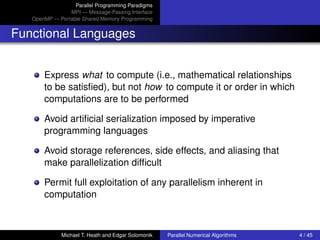
Functional Languages
Express what to compute (i.e., mathematical relationships
to be satisfied), but not how to compute it or order in which
computations are to be performed
Avoid artificial serialization imposed by imperative
programming languages
Avoid storage references, side effects, and aliasing that
make parallelization difficult
Permit full exploitation of any parallelism inherent in
computation
Michael T. Heath and Edgar Solomonik Parallel Numerical Algorithms 4 / 45
Parallel Programming Paradigms
MPI — Message-Passing Interface
OpenMP — Portable Shared Memory Programming
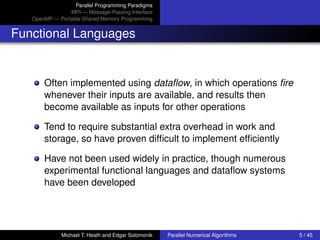
Functional Languages
Often implemented using dataflow, in which operations fire
whenever their inputs are available, and results then
become available as inputs for other operations
Tend to require substantial extra overhead in work and
storage, so have proven difficult to implement efficiently
Have not been used widely in practice, though numerous
experimental functional languages and dataflow systems
have been developed
Michael T. Heath and Edgar Solomonik Parallel Numerical Algorithms 5 / 45
Parallel Programming Paradigms
MPI — Message-Passing Interface
OpenMP — Portable Shared Memory Programming
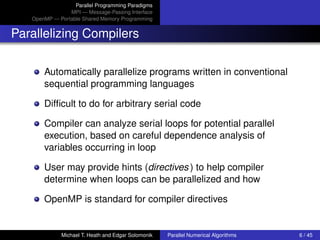
Parallelizing Compilers
Automatically parallelize programs written in conventional
sequential programming languages
Difficult to do for arbitrary serial code
Compiler can analyze serial loops for potential parallel
execution, based on careful dependence analysis of
variables occurring in loop
User may provide hints (directives ) to help compiler
determine when loops can be parallelized and how
OpenMP is standard for compiler directives
Michael T. Heath and Edgar Solomonik Parallel Numerical Algorithms 6 / 45
Parallel Programming Paradigms
MPI — Message-Passing Interface
OpenMP — Portable Shared Memory Programming
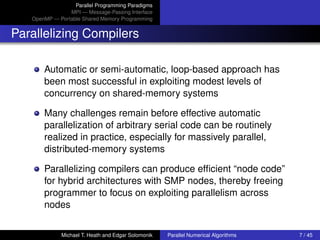
Parallelizing Compilers
Automatic or semi-automatic, loop-based approach has
been most successful in exploiting modest levels of
concurrency on shared-memory systems
Many challenges remain before effective automatic
parallelization of arbitrary serial code can be routinely
realized in practice, especially for massively parallel,
distributed-memory systems
Parallelizing compilers can produce efficient “node code”
for hybrid architectures with SMP nodes, thereby freeing
programmer to focus on exploiting parallelism across
nodes
Michael T. Heath and Edgar Solomonik Parallel Numerical Algorithms 7 / 45
Parallel Programming Paradigms
MPI — Message-Passing Interface
OpenMP — Portable Shared Memory Programming
Object Parallel
Parallelism encapsulated within distributed objects that
bind together data and functions operating on data
Parallel programs built by composing component objects
that communicate via well-defined interfaces and protocols
Implemented using object-oriented programming
languages such as C++ or Java
Examples include Charm++ and Legion
Michael T. Heath and Edgar Solomonik Parallel Numerical Algorithms 8 / 45
Parallel Programming Paradigms
MPI — Message-Passing Interface
OpenMP — Portable Shared Memory Programming
Data Parallel
Simultaneous operations on elements of data arrays,
typified by vector addition
Low-level programming languages, such as Fortran 77 and
C, express array operations element by element in some
specified serial order
Array-based languages, such as APL, Fortran 90, and
MATLAB, treat arrays as higher-level objects and thus
facilitate full exploitation of array parallelism
Michael T. Heath and Edgar Solomonik Parallel Numerical Algorithms 9 / 45
Parallel Programming Paradigms
MPI — Message-Passing Interface
OpenMP — Portable Shared Memory Programming
Data Parallel
Data parallel languages provide facilities for expressing
array operations for parallel execution, and some allow
user to specify data decomposition and mapping to
processors
High Performance Fortran (HPF) is one attempt to
standardize data parallel approach to programming
Though naturally associated with SIMD architectures, data
parallel languages have also been implemented
successfully on general MIMD architectures
Data parallel approach can be effective for highly regular
problems, but tends to be too inflexible to be effective for
irregular or dynamically changing problems
Michael T. Heath and Edgar Solomonik Parallel Numerical Algorithms 10 / 45
Parallel Programming Paradigms
MPI — Message-Passing Interface
OpenMP — Portable Shared Memory Programming
Shared Memory
Classic shared-memory paradigm, originally developed for
multitasking operating systems, focuses on control
parallelism rather than data parallelism
Multiple processes share common address space
accessible to all, though not necessarily with uniform
access time
Because shared data can be changed by more than one
process, access must be protected from corruption,
typically by some mechanism to enforce mutual exclusion
Shared memory supports common pool of tasks from
which processes obtain new work as they complete
previous tasks
Michael T. Heath and Edgar Solomonik Parallel Numerical Algorithms 11 / 45
Parallel Programming Paradigms
MPI — Message-Passing Interface
OpenMP — Portable Shared Memory Programming
Lightweight Threads
Most popular modern implementation of explicit
shared-memory programming, typified by pthreads
(POSIX threads)
Reduce overhead for context-switching by providing
multiple program counters and execution stacks so that
extensive program state information need not be saved and
restored when switching control quickly among threads
Provide detailed, low-level control of shared-memory
systems, but tend to be tedious and error prone
More suitable for implementing underlying systems
software (such as OpenMP and run-time support for
parallelizing compilers) than for user-level applications
Michael T. Heath and Edgar Solomonik Parallel Numerical Algorithms 12 / 45
Parallel Programming Paradigms
MPI — Message-Passing Interface
OpenMP — Portable Shared Memory Programming
Shared Memory
Most naturally and efficiently implemented on true
shared-memory architectures, such as SMPs
Can also be implemented with reasonable efficiency on
NUMA (nonuniform memory access) shared-memory or
even distributed-memory architectures, given sufficient
hardware or software support
With nonuniform access or distributed shared memory,
efficiency usually depends critically on maintaining locality
in referencing data, so design methodology and
programming style often closely resemble techniques for
exploiting locality in distributed-memory systems
Michael T. Heath and Edgar Solomonik Parallel Numerical Algorithms 13 / 45
Parallel Programming Paradigms
MPI — Message-Passing Interface
OpenMP — Portable Shared Memory Programming
Partitioned Global Address Space
Partitioned global address space (PGAS) model provides
global memory address space that is partitioned across
processes, with a portion local to each process
Enables programming semantics of shared memory while
also enabling locality of memory reference that maps well
to distributed memory hardware
Example PGAS programming languages include Chapel,
Co-Array Fortran, Titanium, UPC, X-10
Michael T. Heath and Edgar Solomonik Parallel Numerical Algorithms 14 / 45
Parallel Programming Paradigms
MPI — Message-Passing Interface
OpenMP — Portable Shared Memory Programming
Message Passing
Two-sided, send and receive communication between
processes
Most natural and efficient paradigm for distributed-memory
systems
Can also be implemented efficiently in shared-memory or
almost any other parallel architecture, so it is most portable
paradigm for parallel programming
“Assembly language of parallel computing” because of its
universality and detailed, low-level control of parallelism
Fits well with our design philosophy and offers great
flexibility in exploiting data locality, tolerating latency, and
other performance enhancement techniques
Michael T. Heath and Edgar Solomonik Parallel Numerical Algorithms 15 / 45
Parallel Programming Paradigms
MPI — Message-Passing Interface
OpenMP — Portable Shared Memory Programming
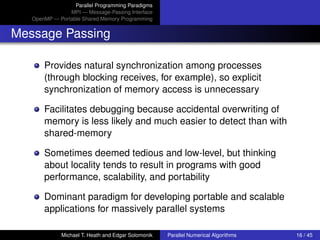
Message Passing
Provides natural synchronization among processes
(through blocking receives, for example), so explicit
synchronization of memory access is unnecessary
Facilitates debugging because accidental overwriting of
memory is less likely and much easier to detect than with
shared-memory
Sometimes deemed tedious and low-level, but thinking
about locality tends to result in programs with good
performance, scalability, and portability
Dominant paradigm for developing portable and scalable
applications for massively parallel systems
Michael T. Heath and Edgar Solomonik Parallel Numerical Algorithms 16 / 45
Parallel Programming Paradigms
MPI — Message-Passing Interface
OpenMP — Portable Shared Memory Programming
MPI Basics
Communication and Communicators
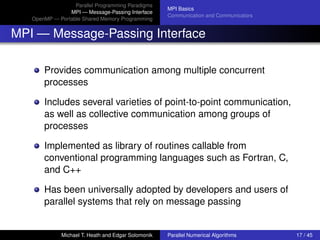
MPI — Message-Passing Interface
Provides communication among multiple concurrent
processes
Includes several varieties of point-to-point communication,
as well as collective communication among groups of
processes
Implemented as library of routines callable from
conventional programming languages such as Fortran, C,
and C++
Has been universally adopted by developers and users of
parallel systems that rely on message passing
Michael T. Heath and Edgar Solomonik Parallel Numerical Algorithms 17 / 45
Parallel Programming Paradigms
MPI — Message-Passing Interface
OpenMP — Portable Shared Memory Programming
MPI Basics
Communication and Communicators
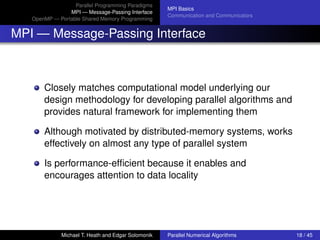
MPI — Message-Passing Interface
Closely matches computational model underlying our
design methodology for developing parallel algorithms and
provides natural framework for implementing them
Although motivated by distributed-memory systems, works
effectively on almost any type of parallel system
Is performance-efficient because it enables and
encourages attention to data locality
Michael T. Heath and Edgar Solomonik Parallel Numerical Algorithms 18 / 45
Parallel Programming Paradigms
MPI — Message-Passing Interface
OpenMP — Portable Shared Memory Programming
MPI Basics
Communication and Communicators
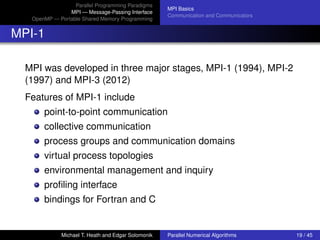
MPI-1
MPI was developed in three major stages, MPI-1 (1994), MPI-2
(1997) and MPI-3 (2012)
Features of MPI-1 include
point-to-point communication
collective communication
process groups and communication domains
virtual process topologies
environmental management and inquiry
profiling interface
bindings for Fortran and C
Michael T. Heath and Edgar Solomonik Parallel Numerical Algorithms 19 / 45
Parallel Programming Paradigms
MPI — Message-Passing Interface
OpenMP — Portable Shared Memory Programming
MPI Basics
Communication and Communicators
MPI-2
Additional features of MPI-2 include:
dynamic process management
input/output
one-sided operations for remote memory access
bindings for C++
Additional features of MPI-3 include:
nonblocking collectives
new one-sided communication operations
Fortran 2008 bindings
Michael T. Heath and Edgar Solomonik Parallel Numerical Algorithms 20 / 45
Parallel Programming Paradigms
MPI — Message-Passing Interface
OpenMP — Portable Shared Memory Programming
MPI Basics
Communication and Communicators
Building and Running MPI Programs
Executable module must first be built by compiling user
program and linking with MPI library
One or more header files, such as mpi.h, may be required
to provide necessary definitions and declarations
MPI is generally used in SPMD mode, so only one
executable must be built, multiple instances of which are
executed concurrently
Most implementations provide command, typically named
mpirun, for spawning MPI processes
MPI-2 specifies mpiexec for portability
User selects number of processes and on which
processors they will run
Michael T. Heath and Edgar Solomonik Parallel Numerical Algorithms 21 / 45
Parallel Programming Paradigms
MPI — Message-Passing Interface
OpenMP — Portable Shared Memory Programming
MPI Basics
Communication and Communicators
Availability of MPI
Custom versions of MPI supplied by vendors of almost all
current parallel computers systems
Freeware versions available for clusters and similar
environments include
MPICH: http://www.mpich.org/
OpenMPI: http://www.open-mpi.org
Both websites provide tutorials on learning and using MPI
MPI standard (MPI-1, -2, -3) available from MPI Forum
http://www.mpi-forum.org
Michael T. Heath and Edgar Solomonik Parallel Numerical Algorithms 22 / 45
Parallel Programming Paradigms
MPI — Message-Passing Interface
OpenMP — Portable Shared Memory Programming
MPI Basics
Communication and Communicators
Communicator (Groups)
A communicator defines a group of MPI processes
Each process is identified by its rank within given group
Rank is integer from zero to one less than size of group
(MPI_PROC_NULL is rank of no process)
Initially, all processes belong to MPI_COMM_WORLD
Additional communicators can be created by user via
MPI_Comm_split
Communicators simplify point-to-point communication on
virtual topologies and enable collectives over any subset of
processors
Michael T. Heath and Edgar Solomonik Parallel Numerical Algorithms 23 / 45
Parallel Programming Paradigms
MPI — Message-Passing Interface
OpenMP — Portable Shared Memory Programming
MPI Basics
Communication and Communicators
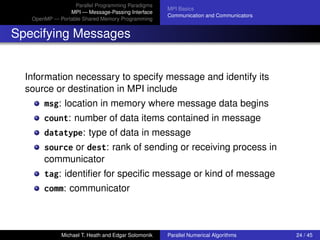
Specifying Messages
Information necessary to specify message and identify its
source or destination in MPI include
msg: location in memory where message data begins
count: number of data items contained in message
datatype: type of data in message
source or dest: rank of sending or receiving process in
communicator
tag: identifier for specific message or kind of message
comm: communicator
Michael T. Heath and Edgar Solomonik Parallel Numerical Algorithms 24 / 45
Parallel Programming Paradigms
MPI — Message-Passing Interface
OpenMP — Portable Shared Memory Programming
MPI Basics
Communication and Communicators
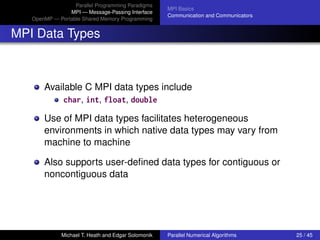
MPI Data Types
Available C MPI data types include
char, int, float, double
Use of MPI data types facilitates heterogeneous
environments in which native data types may vary from
machine to machine
Also supports user-defined data types for contiguous or
noncontiguous data
Michael T. Heath and Edgar Solomonik Parallel Numerical Algorithms 25 / 45
Parallel Programming Paradigms
MPI — Message-Passing Interface
OpenMP — Portable Shared Memory Programming
MPI Basics
Communication and Communicators
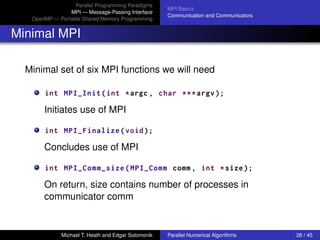
Minimal MPI
Minimal set of six MPI functions we will need
int MPI_Init(int *argc , char ***argv);
Initiates use of MPI
int MPI_Finalize(void);
Concludes use of MPI
int MPI_Comm_size(MPI_Comm comm , int *size);
On return, size contains number of processes in
communicator comm
Michael T. Heath and Edgar Solomonik Parallel Numerical Algorithms 26 / 45
Parallel Programming Paradigms
MPI — Message-Passing Interface
OpenMP — Portable Shared Memory Programming
MPI Basics
Communication and Communicators
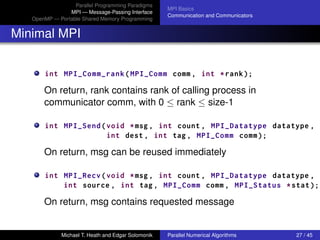
Minimal MPI
int MPI_Comm_rank(MPI_Comm comm , int *rank);
On return, rank contains rank of calling process in
communicator comm, with 0 ≤ rank ≤ size-1
int MPI_Send(void *msg , int count , MPI_Datatype datatype ,
int dest , int tag , MPI_Comm comm);
On return, msg can be reused immediately
int MPI_Recv(void *msg , int count , MPI_Datatype datatype ,
int source , int tag , MPI_Comm comm , MPI_Status *stat);
On return, msg contains requested message
Michael T. Heath and Edgar Solomonik Parallel Numerical Algorithms 27 / 45
Parallel Programming Paradigms
MPI — Message-Passing Interface
OpenMP — Portable Shared Memory Programming
MPI Basics
Communication and Communicators
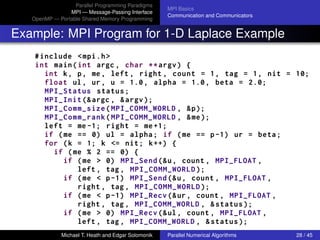
Example: MPI Program for 1-D Laplace Example
#include <mpi.h>
int main(int argc , char **argv) {
int k, p, me, left , right , count = 1, tag = 1, nit = 10;
float ul, ur, u = 1.0, alpha = 1.0, beta = 2.0;
MPI_Status status;
MPI_Init (&argc , &argv);
MPI_Comm_size(MPI_COMM_WORLD , &p);
MPI_Comm_rank(MPI_COMM_WORLD , &me);
left = me -1; right = me+1;
if (me == 0) ul = alpha; if (me == p-1) ur = beta;
for (k = 1; k <= nit; k++) {
if (me % 2 == 0) {
if (me > 0) MPI_Send (&u, count , MPI_FLOAT ,
left , tag , MPI_COMM_WORLD );
if (me < p-1) MPI_Send (&u, count , MPI_FLOAT ,
right , tag , MPI_COMM_WORLD );
if (me < p-1) MPI_Recv (&ur, count , MPI_FLOAT ,
right , tag , MPI_COMM_WORLD , &status );
if (me > 0) MPI_Recv (&ul , count , MPI_FLOAT ,
left , tag , MPI_COMM_WORLD , &status );
Michael T. Heath and Edgar Solomonik Parallel Numerical Algorithms 28 / 45
Parallel Programming Paradigms
MPI — Message-Passing Interface
OpenMP — Portable Shared Memory Programming
MPI Basics
Communication and Communicators
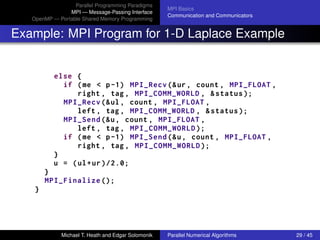
Example: MPI Program for 1-D Laplace Example
else {
if (me < p-1) MPI_Recv (&ur, count , MPI_FLOAT ,
right , tag , MPI_COMM_WORLD , &status );
MPI_Recv (&ul, count , MPI_FLOAT ,
left , tag , MPI_COMM_WORLD , &status );
MPI_Send (&u, count , MPI_FLOAT ,
left , tag , MPI_COMM_WORLD );
if (me < p-1) MPI_Send (&u, count , MPI_FLOAT ,
right , tag , MPI_COMM_WORLD );
}
u = (ul+ur )/2.0;
}
MPI_Finalize ();
}
Michael T. Heath and Edgar Solomonik Parallel Numerical Algorithms 29 / 45
Parallel Programming Paradigms
MPI — Message-Passing Interface
OpenMP — Portable Shared Memory Programming
MPI Basics
Communication and Communicators
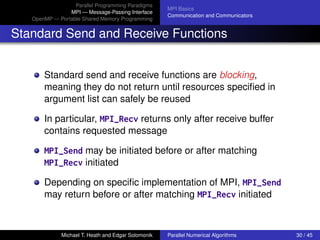
Standard Send and Receive Functions
Standard send and receive functions are blocking,
meaning they do not return until resources specified in
argument list can safely be reused
In particular, MPI_Recv returns only after receive buffer
contains requested message
MPI_Send may be initiated before or after matching
MPI_Recv initiated
Depending on specific implementation of MPI, MPI_Send
may return before or after matching MPI_Recv initiated
Michael T. Heath and Edgar Solomonik Parallel Numerical Algorithms 30 / 45
Parallel Programming Paradigms
MPI — Message-Passing Interface
OpenMP — Portable Shared Memory Programming
MPI Basics
Communication and Communicators
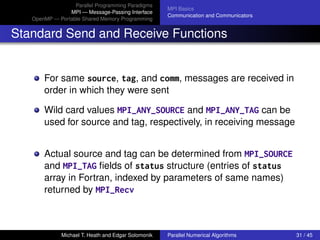
Standard Send and Receive Functions
For same source, tag, and comm, messages are received in
order in which they were sent
Wild card values MPI_ANY_SOURCE and MPI_ANY_TAG can be
used for source and tag, respectively, in receiving message
Actual source and tag can be determined from MPI_SOURCE
and MPI_TAG fields of status structure (entries of status
array in Fortran, indexed by parameters of same names)
returned by MPI_Recv
Michael T. Heath and Edgar Solomonik Parallel Numerical Algorithms 31 / 45
Parallel Programming Paradigms
MPI — Message-Passing Interface
OpenMP — Portable Shared Memory Programming
MPI Basics
Communication and Communicators
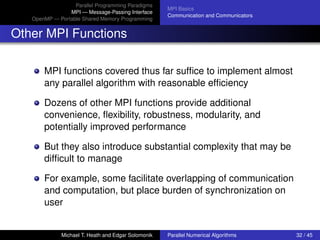
Other MPI Functions
MPI functions covered thus far suffice to implement almost
any parallel algorithm with reasonable efficiency
Dozens of other MPI functions provide additional
convenience, flexibility, robustness, modularity, and
potentially improved performance
But they also introduce substantial complexity that may be
difficult to manage
For example, some facilitate overlapping of communication
and computation, but place burden of synchronization on
user
Michael T. Heath and Edgar Solomonik Parallel Numerical Algorithms 32 / 45
Parallel Programming Paradigms
MPI — Message-Passing Interface
OpenMP — Portable Shared Memory Programming
MPI Basics
Communication and Communicators
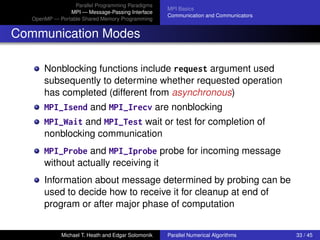
Communication Modes
Nonblocking functions include request argument used
subsequently to determine whether requested operation
has completed (different from asynchronous)
MPI_Isend and MPI_Irecv are nonblocking
MPI_Wait and MPI_Test wait or test for completion of
nonblocking communication
MPI_Probe and MPI_Iprobe probe for incoming message
without actually receiving it
Information about message determined by probing can be
used to decide how to receive it for cleanup at end of
program or after major phase of computation
Michael T. Heath and Edgar Solomonik Parallel Numerical Algorithms 33 / 45
Parallel Programming Paradigms
MPI — Message-Passing Interface
OpenMP — Portable Shared Memory Programming
MPI Basics
Communication and Communicators
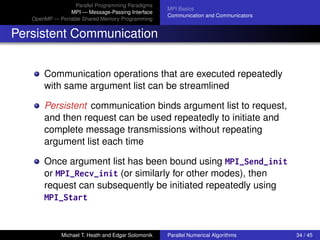
Persistent Communication
Communication operations that are executed repeatedly
with same argument list can be streamlined
Persistent communication binds argument list to request,
and then request can be used repeatedly to initiate and
complete message transmissions without repeating
argument list each time
Once argument list has been bound using MPI_Send_init
or MPI_Recv_init (or similarly for other modes), then
request can subsequently be initiated repeatedly using
MPI_Start
Michael T. Heath and Edgar Solomonik Parallel Numerical Algorithms 34 / 45
Parallel Programming Paradigms
MPI — Message-Passing Interface
OpenMP — Portable Shared Memory Programming
MPI Basics
Communication and Communicators
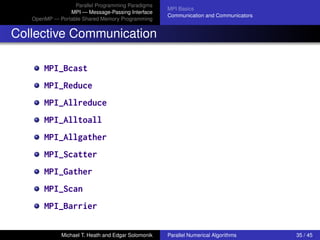
Collective Communication
MPI_Bcast
MPI_Reduce
MPI_Allreduce
MPI_Alltoall
MPI_Allgather
MPI_Scatter
MPI_Gather
MPI_Scan
MPI_Barrier
Michael T. Heath and Edgar Solomonik Parallel Numerical Algorithms 35 / 45
Parallel Programming Paradigms
MPI — Message-Passing Interface
OpenMP — Portable Shared Memory Programming
MPI Basics
Communication and Communicators
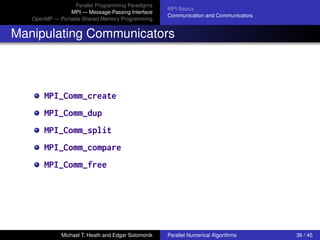
Manipulating Communicators
MPI_Comm_create
MPI_Comm_dup
MPI_Comm_split
MPI_Comm_compare
MPI_Comm_free
Michael T. Heath and Edgar Solomonik Parallel Numerical Algorithms 36 / 45
Parallel Programming Paradigms
MPI — Message-Passing Interface
OpenMP — Portable Shared Memory Programming
MPI Basics
Communication and Communicators
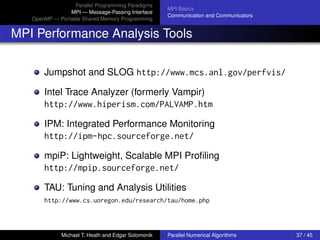
MPI Performance Analysis Tools
Jumpshot and SLOG http://www.mcs.anl.gov/perfvis/
Intel Trace Analyzer (formerly Vampir)
http://www.hiperism.com/PALVAMP.htm
IPM: Integrated Performance Monitoring
http://ipm-hpc.sourceforge.net/
mpiP: Lightweight, Scalable MPI Profiling
http://mpip.sourceforge.net/
TAU: Tuning and Analysis Utilities
http://www.cs.uoregon.edu/research/tau/home.php
Michael T. Heath and Edgar Solomonik Parallel Numerical Algorithms 37 / 45
Parallel Programming Paradigms
MPI — Message-Passing Interface
OpenMP — Portable Shared Memory Programming
OpenMP
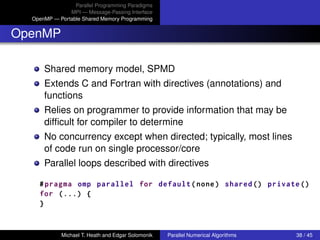
Shared memory model, SPMD
Extends C and Fortran with directives (annotations) and
functions
Relies on programmer to provide information that may be
difficult for compiler to determine
No concurrency except when directed; typically, most lines
of code run on single processor/core
Parallel loops described with directives
#pragma omp parallel for default(none) shared () private ()
for (...) {
}
Michael T. Heath and Edgar Solomonik Parallel Numerical Algorithms 38 / 45
Parallel Programming Paradigms
MPI — Message-Passing Interface
OpenMP — Portable Shared Memory Programming
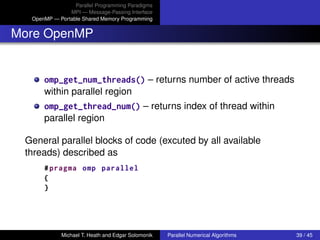
More OpenMP
omp_get_num_threads() – returns number of active threads
within parallel region
omp_get_thread_num() – returns index of thread within
parallel region
General parallel blocks of code (excuted by all available
threads) described as
#pragma omp parallel
{
}
Michael T. Heath and Edgar Solomonik Parallel Numerical Algorithms 39 / 45
Parallel Programming Paradigms
MPI — Message-Passing Interface
OpenMP — Portable Shared Memory Programming
Race Conditions
Example:
sum = 0.0;
#pragma omp parallel for private(i)
for (i=0; i<n; i++) { sum += u[i]; }
Race condition : result of updates to sum depend on which
thread wins race in performing store to memory
OpenMP provides reduction clause for this case:
sum = 0.0;
#pragma omp parallel for reduction (+:sum) private(i)
for (i=0; i<n; i++) { sum += u[i]; }
Not hypothetical example: on one dual-processor system, first
loop computes wrong result roughly half of time
Michael T. Heath and Edgar Solomonik Parallel Numerical Algorithms 40 / 45
Parallel Programming Paradigms
MPI — Message-Passing Interface
OpenMP — Portable Shared Memory Programming
Example: OpenMP Program for 1-D Laplace Example
#include <omp.h>
int main(int argc , char **argv) {
int k, i, nit =10;
float alpha = 1.0, beta = 2.0;
float u0[MAX_U], u1[MAX_U];
float * restrict u0p=u0, * restrict u1p=u1, *tmp;
u0[0] = u1[0] = alpha;
u0[MAX_U -1] = u1[MAX_U -1] = beta;
for (k=0; k<nit; k++) {
#pragma omp parallel for default(none) shared(u1p ,u0p)
private (i)
for (i = 1; i < MAX_U -1; i++) {
u1p[i] = (u0p[i-1]+ u0p[i+1])/2.0;
}
tmp = u1p; u1p = u0p; u0p = tmp; /* swap pointers */
}
}
Michael T. Heath and Edgar Solomonik Parallel Numerical Algorithms 41 / 45
Parallel Programming Paradigms
MPI — Message-Passing Interface
OpenMP — Portable Shared Memory Programming
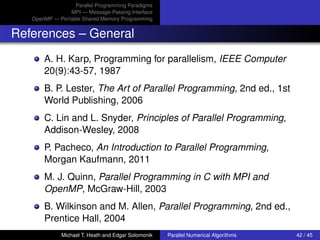
References – General
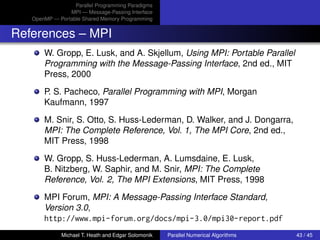
A. H. Karp, Programming for parallelism, IEEE Computer
20(9):43-57, 1987
B. P. Lester, The Art of Parallel Programming, 2nd ed., 1st
World Publishing, 2006
C. Lin and L. Snyder, Principles of Parallel Programming,
Addison-Wesley, 2008
P. Pacheco, An Introduction to Parallel Programming,
Morgan Kaufmann, 2011
M. J. Quinn, Parallel Programming in C with MPI and
OpenMP, McGraw-Hill, 2003
B. Wilkinson and M. Allen, Parallel Programming, 2nd ed.,
Prentice Hall, 2004
Michael T. Heath and Edgar Solomonik Parallel Numerical Algorithms 42 / 45
Parallel Programming Paradigms
MPI — Message-Passing Interface
OpenMP — Portable Shared Memory Programming
References – MPI
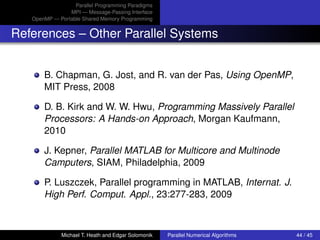
W. Gropp, E. Lusk, and A. Skjellum, Using MPI: Portable Parallel
Programming with the Message-Passing Interface, 2nd ed., MIT
Press, 2000
P. S. Pacheco, Parallel Programming with MPI, Morgan
Kaufmann, 1997
M. Snir, S. Otto, S. Huss-Lederman, D. Walker, and J. Dongarra,
MPI: The Complete Reference, Vol. 1, The MPI Core, 2nd ed.,
MIT Press, 1998
W. Gropp, S. Huss-Lederman, A. Lumsdaine, E. Lusk,
B. Nitzberg, W. Saphir, and M. Snir, MPI: The Complete
Reference, Vol. 2, The MPI Extensions, MIT Press, 1998
MPI Forum, MPI: A Message-Passing Interface Standard,
Version 3.0,
http://www.mpi-forum.org/docs/mpi-3.0/mpi30-report.pdf
Michael T. Heath and Edgar Solomonik Parallel Numerical Algorithms 43 / 45
Parallel Programming Paradigms
MPI — Message-Passing Interface
OpenMP — Portable Shared Memory Programming
References – Other Parallel Systems
B. Chapman, G. Jost, and R. van der Pas, Using OpenMP,
MIT Press, 2008
D. B. Kirk and W. W. Hwu, Programming Massively Parallel
Processors: A Hands-on Approach, Morgan Kaufmann,
2010
J. Kepner, Parallel MATLAB for Multicore and Multinode
Camputers, SIAM, Philadelphia, 2009
P. Luszczek, Parallel programming in MATLAB, Internat. J.
High Perf. Comput. Appl., 23:277-283, 2009
Michael T. Heath and Edgar Solomonik Parallel Numerical Algorithms 44 / 45
Parallel Programming Paradigms
MPI — Message-Passing Interface
OpenMP — Portable Shared Memory Programming
References – Performance Visualization
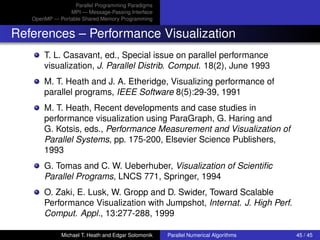
T. L. Casavant, ed., Special issue on parallel performance
visualization, J. Parallel Distrib. Comput. 18(2), June 1993
M. T. Heath and J. A. Etheridge, Visualizing performance of
parallel programs, IEEE Software 8(5):29-39, 1991
M. T. Heath, Recent developments and case studies in
performance visualization using ParaGraph, G. Haring and
G. Kotsis, eds., Performance Measurement and Visualization of
Parallel Systems, pp. 175-200, Elsevier Science Publishers,
1993
G. Tomas and C. W. Ueberhuber, Visualization of Scientific
Parallel Programs, LNCS 771, Springer, 1994
O. Zaki, E. Lusk, W. Gropp and D. Swider, Toward Scalable
Performance Visualization with Jumpshot, Internat. J. High Perf.
Comput. Appl., 13:277-288, 1999
Michael T. Heath and Edgar Solomonik Parallel Numerical Algorithms 45 / 45

Parallel computing High performance computing .pdf

  • 1.
    Parallel Programming Paradigms MPI— Message-Passing Interface OpenMP — Portable Shared Memory Programming Parallel Numerical Algorithms Chapter 2 – Parallel Thinking Section 2.2 – Parallel Programming Michael T. Heath and Edgar Solomonik Department of Computer Science University of Illinois at Urbana-Champaign CS 554 / CSE 512 Michael T. Heath and Edgar Solomonik Parallel Numerical Algorithms 1 / 45
  • 2.
    Parallel Programming Paradigms MPI— Message-Passing Interface OpenMP — Portable Shared Memory Programming Outline 1 Parallel Programming Paradigms 2 MPI — Message-Passing Interface MPI Basics Communication and Communicators 3 OpenMP — Portable Shared Memory Programming Michael T. Heath and Edgar Solomonik Parallel Numerical Algorithms 2 / 45
  • 3.
    Parallel Programming Paradigms MPI— Message-Passing Interface OpenMP — Portable Shared Memory Programming Parallel Programming Paradigms Functional languages Parallelizing compilers Object parallel Data parallel Shared memory Partitioned global address space Remote memory access Message passing Michael T. Heath and Edgar Solomonik Parallel Numerical Algorithms 3 / 45
  • 4.
    Parallel Programming Paradigms MPI— Message-Passing Interface OpenMP — Portable Shared Memory Programming Functional Languages Express what to compute (i.e., mathematical relationships to be satisfied), but not how to compute it or order in which computations are to be performed Avoid artificial serialization imposed by imperative programming languages Avoid storage references, side effects, and aliasing that make parallelization difficult Permit full exploitation of any parallelism inherent in computation Michael T. Heath and Edgar Solomonik Parallel Numerical Algorithms 4 / 45
  • 5.
    Parallel Programming Paradigms MPI— Message-Passing Interface OpenMP — Portable Shared Memory Programming Functional Languages Often implemented using dataflow, in which operations fire whenever their inputs are available, and results then become available as inputs for other operations Tend to require substantial extra overhead in work and storage, so have proven difficult to implement efficiently Have not been used widely in practice, though numerous experimental functional languages and dataflow systems have been developed Michael T. Heath and Edgar Solomonik Parallel Numerical Algorithms 5 / 45
  • 6.
    Parallel Programming Paradigms MPI— Message-Passing Interface OpenMP — Portable Shared Memory Programming Parallelizing Compilers Automatically parallelize programs written in conventional sequential programming languages Difficult to do for arbitrary serial code Compiler can analyze serial loops for potential parallel execution, based on careful dependence analysis of variables occurring in loop User may provide hints (directives ) to help compiler determine when loops can be parallelized and how OpenMP is standard for compiler directives Michael T. Heath and Edgar Solomonik Parallel Numerical Algorithms 6 / 45
  • 7.
    Parallel Programming Paradigms MPI— Message-Passing Interface OpenMP — Portable Shared Memory Programming Parallelizing Compilers Automatic or semi-automatic, loop-based approach has been most successful in exploiting modest levels of concurrency on shared-memory systems Many challenges remain before effective automatic parallelization of arbitrary serial code can be routinely realized in practice, especially for massively parallel, distributed-memory systems Parallelizing compilers can produce efficient “node code” for hybrid architectures with SMP nodes, thereby freeing programmer to focus on exploiting parallelism across nodes Michael T. Heath and Edgar Solomonik Parallel Numerical Algorithms 7 / 45
  • 8.
    Parallel Programming Paradigms MPI— Message-Passing Interface OpenMP — Portable Shared Memory Programming Object Parallel Parallelism encapsulated within distributed objects that bind together data and functions operating on data Parallel programs built by composing component objects that communicate via well-defined interfaces and protocols Implemented using object-oriented programming languages such as C++ or Java Examples include Charm++ and Legion Michael T. Heath and Edgar Solomonik Parallel Numerical Algorithms 8 / 45
  • 9.
    Parallel Programming Paradigms MPI— Message-Passing Interface OpenMP — Portable Shared Memory Programming Data Parallel Simultaneous operations on elements of data arrays, typified by vector addition Low-level programming languages, such as Fortran 77 and C, express array operations element by element in some specified serial order Array-based languages, such as APL, Fortran 90, and MATLAB, treat arrays as higher-level objects and thus facilitate full exploitation of array parallelism Michael T. Heath and Edgar Solomonik Parallel Numerical Algorithms 9 / 45
  • 10.
    Parallel Programming Paradigms MPI— Message-Passing Interface OpenMP — Portable Shared Memory Programming Data Parallel Data parallel languages provide facilities for expressing array operations for parallel execution, and some allow user to specify data decomposition and mapping to processors High Performance Fortran (HPF) is one attempt to standardize data parallel approach to programming Though naturally associated with SIMD architectures, data parallel languages have also been implemented successfully on general MIMD architectures Data parallel approach can be effective for highly regular problems, but tends to be too inflexible to be effective for irregular or dynamically changing problems Michael T. Heath and Edgar Solomonik Parallel Numerical Algorithms 10 / 45
  • 11.
    Parallel Programming Paradigms MPI— Message-Passing Interface OpenMP — Portable Shared Memory Programming Shared Memory Classic shared-memory paradigm, originally developed for multitasking operating systems, focuses on control parallelism rather than data parallelism Multiple processes share common address space accessible to all, though not necessarily with uniform access time Because shared data can be changed by more than one process, access must be protected from corruption, typically by some mechanism to enforce mutual exclusion Shared memory supports common pool of tasks from which processes obtain new work as they complete previous tasks Michael T. Heath and Edgar Solomonik Parallel Numerical Algorithms 11 / 45
  • 12.
    Parallel Programming Paradigms MPI— Message-Passing Interface OpenMP — Portable Shared Memory Programming Lightweight Threads Most popular modern implementation of explicit shared-memory programming, typified by pthreads (POSIX threads) Reduce overhead for context-switching by providing multiple program counters and execution stacks so that extensive program state information need not be saved and restored when switching control quickly among threads Provide detailed, low-level control of shared-memory systems, but tend to be tedious and error prone More suitable for implementing underlying systems software (such as OpenMP and run-time support for parallelizing compilers) than for user-level applications Michael T. Heath and Edgar Solomonik Parallel Numerical Algorithms 12 / 45
  • 13.
    Parallel Programming Paradigms MPI— Message-Passing Interface OpenMP — Portable Shared Memory Programming Shared Memory Most naturally and efficiently implemented on true shared-memory architectures, such as SMPs Can also be implemented with reasonable efficiency on NUMA (nonuniform memory access) shared-memory or even distributed-memory architectures, given sufficient hardware or software support With nonuniform access or distributed shared memory, efficiency usually depends critically on maintaining locality in referencing data, so design methodology and programming style often closely resemble techniques for exploiting locality in distributed-memory systems Michael T. Heath and Edgar Solomonik Parallel Numerical Algorithms 13 / 45
  • 14.
    Parallel Programming Paradigms MPI— Message-Passing Interface OpenMP — Portable Shared Memory Programming Partitioned Global Address Space Partitioned global address space (PGAS) model provides global memory address space that is partitioned across processes, with a portion local to each process Enables programming semantics of shared memory while also enabling locality of memory reference that maps well to distributed memory hardware Example PGAS programming languages include Chapel, Co-Array Fortran, Titanium, UPC, X-10 Michael T. Heath and Edgar Solomonik Parallel Numerical Algorithms 14 / 45
  • 15.
    Parallel Programming Paradigms MPI— Message-Passing Interface OpenMP — Portable Shared Memory Programming Message Passing Two-sided, send and receive communication between processes Most natural and efficient paradigm for distributed-memory systems Can also be implemented efficiently in shared-memory or almost any other parallel architecture, so it is most portable paradigm for parallel programming “Assembly language of parallel computing” because of its universality and detailed, low-level control of parallelism Fits well with our design philosophy and offers great flexibility in exploiting data locality, tolerating latency, and other performance enhancement techniques Michael T. Heath and Edgar Solomonik Parallel Numerical Algorithms 15 / 45
  • 16.
    Parallel Programming Paradigms MPI— Message-Passing Interface OpenMP — Portable Shared Memory Programming Message Passing Provides natural synchronization among processes (through blocking receives, for example), so explicit synchronization of memory access is unnecessary Facilitates debugging because accidental overwriting of memory is less likely and much easier to detect than with shared-memory Sometimes deemed tedious and low-level, but thinking about locality tends to result in programs with good performance, scalability, and portability Dominant paradigm for developing portable and scalable applications for massively parallel systems Michael T. Heath and Edgar Solomonik Parallel Numerical Algorithms 16 / 45
  • 17.
    Parallel Programming Paradigms MPI— Message-Passing Interface OpenMP — Portable Shared Memory Programming MPI Basics Communication and Communicators MPI — Message-Passing Interface Provides communication among multiple concurrent processes Includes several varieties of point-to-point communication, as well as collective communication among groups of processes Implemented as library of routines callable from conventional programming languages such as Fortran, C, and C++ Has been universally adopted by developers and users of parallel systems that rely on message passing Michael T. Heath and Edgar Solomonik Parallel Numerical Algorithms 17 / 45
  • 18.
    Parallel Programming Paradigms MPI— Message-Passing Interface OpenMP — Portable Shared Memory Programming MPI Basics Communication and Communicators MPI — Message-Passing Interface Closely matches computational model underlying our design methodology for developing parallel algorithms and provides natural framework for implementing them Although motivated by distributed-memory systems, works effectively on almost any type of parallel system Is performance-efficient because it enables and encourages attention to data locality Michael T. Heath and Edgar Solomonik Parallel Numerical Algorithms 18 / 45
  • 19.
    Parallel Programming Paradigms MPI— Message-Passing Interface OpenMP — Portable Shared Memory Programming MPI Basics Communication and Communicators MPI-1 MPI was developed in three major stages, MPI-1 (1994), MPI-2 (1997) and MPI-3 (2012) Features of MPI-1 include point-to-point communication collective communication process groups and communication domains virtual process topologies environmental management and inquiry profiling interface bindings for Fortran and C Michael T. Heath and Edgar Solomonik Parallel Numerical Algorithms 19 / 45
  • 20.
    Parallel Programming Paradigms MPI— Message-Passing Interface OpenMP — Portable Shared Memory Programming MPI Basics Communication and Communicators MPI-2 Additional features of MPI-2 include: dynamic process management input/output one-sided operations for remote memory access bindings for C++ Additional features of MPI-3 include: nonblocking collectives new one-sided communication operations Fortran 2008 bindings Michael T. Heath and Edgar Solomonik Parallel Numerical Algorithms 20 / 45
  • 21.
    Parallel Programming Paradigms MPI— Message-Passing Interface OpenMP — Portable Shared Memory Programming MPI Basics Communication and Communicators Building and Running MPI Programs Executable module must first be built by compiling user program and linking with MPI library One or more header files, such as mpi.h, may be required to provide necessary definitions and declarations MPI is generally used in SPMD mode, so only one executable must be built, multiple instances of which are executed concurrently Most implementations provide command, typically named mpirun, for spawning MPI processes MPI-2 specifies mpiexec for portability User selects number of processes and on which processors they will run Michael T. Heath and Edgar Solomonik Parallel Numerical Algorithms 21 / 45
  • 22.
    Parallel Programming Paradigms MPI— Message-Passing Interface OpenMP — Portable Shared Memory Programming MPI Basics Communication and Communicators Availability of MPI Custom versions of MPI supplied by vendors of almost all current parallel computers systems Freeware versions available for clusters and similar environments include MPICH: http://www.mpich.org/ OpenMPI: http://www.open-mpi.org Both websites provide tutorials on learning and using MPI MPI standard (MPI-1, -2, -3) available from MPI Forum http://www.mpi-forum.org Michael T. Heath and Edgar Solomonik Parallel Numerical Algorithms 22 / 45
  • 23.
    Parallel Programming Paradigms MPI— Message-Passing Interface OpenMP — Portable Shared Memory Programming MPI Basics Communication and Communicators Communicator (Groups) A communicator defines a group of MPI processes Each process is identified by its rank within given group Rank is integer from zero to one less than size of group (MPI_PROC_NULL is rank of no process) Initially, all processes belong to MPI_COMM_WORLD Additional communicators can be created by user via MPI_Comm_split Communicators simplify point-to-point communication on virtual topologies and enable collectives over any subset of processors Michael T. Heath and Edgar Solomonik Parallel Numerical Algorithms 23 / 45
  • 24.
    Parallel Programming Paradigms MPI— Message-Passing Interface OpenMP — Portable Shared Memory Programming MPI Basics Communication and Communicators Specifying Messages Information necessary to specify message and identify its source or destination in MPI include msg: location in memory where message data begins count: number of data items contained in message datatype: type of data in message source or dest: rank of sending or receiving process in communicator tag: identifier for specific message or kind of message comm: communicator Michael T. Heath and Edgar Solomonik Parallel Numerical Algorithms 24 / 45
  • 25.
    Parallel Programming Paradigms MPI— Message-Passing Interface OpenMP — Portable Shared Memory Programming MPI Basics Communication and Communicators MPI Data Types Available C MPI data types include char, int, float, double Use of MPI data types facilitates heterogeneous environments in which native data types may vary from machine to machine Also supports user-defined data types for contiguous or noncontiguous data Michael T. Heath and Edgar Solomonik Parallel Numerical Algorithms 25 / 45
  • 26.
    Parallel Programming Paradigms MPI— Message-Passing Interface OpenMP — Portable Shared Memory Programming MPI Basics Communication and Communicators Minimal MPI Minimal set of six MPI functions we will need int MPI_Init(int *argc , char ***argv); Initiates use of MPI int MPI_Finalize(void); Concludes use of MPI int MPI_Comm_size(MPI_Comm comm , int *size); On return, size contains number of processes in communicator comm Michael T. Heath and Edgar Solomonik Parallel Numerical Algorithms 26 / 45
  • 27.
    Parallel Programming Paradigms MPI— Message-Passing Interface OpenMP — Portable Shared Memory Programming MPI Basics Communication and Communicators Minimal MPI int MPI_Comm_rank(MPI_Comm comm , int *rank); On return, rank contains rank of calling process in communicator comm, with 0 ≤ rank ≤ size-1 int MPI_Send(void *msg , int count , MPI_Datatype datatype , int dest , int tag , MPI_Comm comm); On return, msg can be reused immediately int MPI_Recv(void *msg , int count , MPI_Datatype datatype , int source , int tag , MPI_Comm comm , MPI_Status *stat); On return, msg contains requested message Michael T. Heath and Edgar Solomonik Parallel Numerical Algorithms 27 / 45
  • 28.
    Parallel Programming Paradigms MPI— Message-Passing Interface OpenMP — Portable Shared Memory Programming MPI Basics Communication and Communicators Example: MPI Program for 1-D Laplace Example #include <mpi.h> int main(int argc , char **argv) { int k, p, me, left , right , count = 1, tag = 1, nit = 10; float ul, ur, u = 1.0, alpha = 1.0, beta = 2.0; MPI_Status status; MPI_Init (&argc , &argv); MPI_Comm_size(MPI_COMM_WORLD , &p); MPI_Comm_rank(MPI_COMM_WORLD , &me); left = me -1; right = me+1; if (me == 0) ul = alpha; if (me == p-1) ur = beta; for (k = 1; k <= nit; k++) { if (me % 2 == 0) { if (me > 0) MPI_Send (&u, count , MPI_FLOAT , left , tag , MPI_COMM_WORLD ); if (me < p-1) MPI_Send (&u, count , MPI_FLOAT , right , tag , MPI_COMM_WORLD ); if (me < p-1) MPI_Recv (&ur, count , MPI_FLOAT , right , tag , MPI_COMM_WORLD , &status ); if (me > 0) MPI_Recv (&ul , count , MPI_FLOAT , left , tag , MPI_COMM_WORLD , &status ); Michael T. Heath and Edgar Solomonik Parallel Numerical Algorithms 28 / 45
  • 29.
    Parallel Programming Paradigms MPI— Message-Passing Interface OpenMP — Portable Shared Memory Programming MPI Basics Communication and Communicators Example: MPI Program for 1-D Laplace Example else { if (me < p-1) MPI_Recv (&ur, count , MPI_FLOAT , right , tag , MPI_COMM_WORLD , &status ); MPI_Recv (&ul, count , MPI_FLOAT , left , tag , MPI_COMM_WORLD , &status ); MPI_Send (&u, count , MPI_FLOAT , left , tag , MPI_COMM_WORLD ); if (me < p-1) MPI_Send (&u, count , MPI_FLOAT , right , tag , MPI_COMM_WORLD ); } u = (ul+ur )/2.0; } MPI_Finalize (); } Michael T. Heath and Edgar Solomonik Parallel Numerical Algorithms 29 / 45
  • 30.
    Parallel Programming Paradigms MPI— Message-Passing Interface OpenMP — Portable Shared Memory Programming MPI Basics Communication and Communicators Standard Send and Receive Functions Standard send and receive functions are blocking, meaning they do not return until resources specified in argument list can safely be reused In particular, MPI_Recv returns only after receive buffer contains requested message MPI_Send may be initiated before or after matching MPI_Recv initiated Depending on specific implementation of MPI, MPI_Send may return before or after matching MPI_Recv initiated Michael T. Heath and Edgar Solomonik Parallel Numerical Algorithms 30 / 45
  • 31.
    Parallel Programming Paradigms MPI— Message-Passing Interface OpenMP — Portable Shared Memory Programming MPI Basics Communication and Communicators Standard Send and Receive Functions For same source, tag, and comm, messages are received in order in which they were sent Wild card values MPI_ANY_SOURCE and MPI_ANY_TAG can be used for source and tag, respectively, in receiving message Actual source and tag can be determined from MPI_SOURCE and MPI_TAG fields of status structure (entries of status array in Fortran, indexed by parameters of same names) returned by MPI_Recv Michael T. Heath and Edgar Solomonik Parallel Numerical Algorithms 31 / 45
  • 32.
    Parallel Programming Paradigms MPI— Message-Passing Interface OpenMP — Portable Shared Memory Programming MPI Basics Communication and Communicators Other MPI Functions MPI functions covered thus far suffice to implement almost any parallel algorithm with reasonable efficiency Dozens of other MPI functions provide additional convenience, flexibility, robustness, modularity, and potentially improved performance But they also introduce substantial complexity that may be difficult to manage For example, some facilitate overlapping of communication and computation, but place burden of synchronization on user Michael T. Heath and Edgar Solomonik Parallel Numerical Algorithms 32 / 45
  • 33.
    Parallel Programming Paradigms MPI— Message-Passing Interface OpenMP — Portable Shared Memory Programming MPI Basics Communication and Communicators Communication Modes Nonblocking functions include request argument used subsequently to determine whether requested operation has completed (different from asynchronous) MPI_Isend and MPI_Irecv are nonblocking MPI_Wait and MPI_Test wait or test for completion of nonblocking communication MPI_Probe and MPI_Iprobe probe for incoming message without actually receiving it Information about message determined by probing can be used to decide how to receive it for cleanup at end of program or after major phase of computation Michael T. Heath and Edgar Solomonik Parallel Numerical Algorithms 33 / 45
  • 34.
    Parallel Programming Paradigms MPI— Message-Passing Interface OpenMP — Portable Shared Memory Programming MPI Basics Communication and Communicators Persistent Communication Communication operations that are executed repeatedly with same argument list can be streamlined Persistent communication binds argument list to request, and then request can be used repeatedly to initiate and complete message transmissions without repeating argument list each time Once argument list has been bound using MPI_Send_init or MPI_Recv_init (or similarly for other modes), then request can subsequently be initiated repeatedly using MPI_Start Michael T. Heath and Edgar Solomonik Parallel Numerical Algorithms 34 / 45
  • 35.
    Parallel Programming Paradigms MPI— Message-Passing Interface OpenMP — Portable Shared Memory Programming MPI Basics Communication and Communicators Collective Communication MPI_Bcast MPI_Reduce MPI_Allreduce MPI_Alltoall MPI_Allgather MPI_Scatter MPI_Gather MPI_Scan MPI_Barrier Michael T. Heath and Edgar Solomonik Parallel Numerical Algorithms 35 / 45
  • 36.
    Parallel Programming Paradigms MPI— Message-Passing Interface OpenMP — Portable Shared Memory Programming MPI Basics Communication and Communicators Manipulating Communicators MPI_Comm_create MPI_Comm_dup MPI_Comm_split MPI_Comm_compare MPI_Comm_free Michael T. Heath and Edgar Solomonik Parallel Numerical Algorithms 36 / 45
  • 37.
    Parallel Programming Paradigms MPI— Message-Passing Interface OpenMP — Portable Shared Memory Programming MPI Basics Communication and Communicators MPI Performance Analysis Tools Jumpshot and SLOG http://www.mcs.anl.gov/perfvis/ Intel Trace Analyzer (formerly Vampir) http://www.hiperism.com/PALVAMP.htm IPM: Integrated Performance Monitoring http://ipm-hpc.sourceforge.net/ mpiP: Lightweight, Scalable MPI Profiling http://mpip.sourceforge.net/ TAU: Tuning and Analysis Utilities http://www.cs.uoregon.edu/research/tau/home.php Michael T. Heath and Edgar Solomonik Parallel Numerical Algorithms 37 / 45
  • 38.
    Parallel Programming Paradigms MPI— Message-Passing Interface OpenMP — Portable Shared Memory Programming OpenMP Shared memory model, SPMD Extends C and Fortran with directives (annotations) and functions Relies on programmer to provide information that may be difficult for compiler to determine No concurrency except when directed; typically, most lines of code run on single processor/core Parallel loops described with directives #pragma omp parallel for default(none) shared () private () for (...) { } Michael T. Heath and Edgar Solomonik Parallel Numerical Algorithms 38 / 45
  • 39.
    Parallel Programming Paradigms MPI— Message-Passing Interface OpenMP — Portable Shared Memory Programming More OpenMP omp_get_num_threads() – returns number of active threads within parallel region omp_get_thread_num() – returns index of thread within parallel region General parallel blocks of code (excuted by all available threads) described as #pragma omp parallel { } Michael T. Heath and Edgar Solomonik Parallel Numerical Algorithms 39 / 45
  • 40.
    Parallel Programming Paradigms MPI— Message-Passing Interface OpenMP — Portable Shared Memory Programming Race Conditions Example: sum = 0.0; #pragma omp parallel for private(i) for (i=0; i<n; i++) { sum += u[i]; } Race condition : result of updates to sum depend on which thread wins race in performing store to memory OpenMP provides reduction clause for this case: sum = 0.0; #pragma omp parallel for reduction (+:sum) private(i) for (i=0; i<n; i++) { sum += u[i]; } Not hypothetical example: on one dual-processor system, first loop computes wrong result roughly half of time Michael T. Heath and Edgar Solomonik Parallel Numerical Algorithms 40 / 45
  • 41.
    Parallel Programming Paradigms MPI— Message-Passing Interface OpenMP — Portable Shared Memory Programming Example: OpenMP Program for 1-D Laplace Example #include <omp.h> int main(int argc , char **argv) { int k, i, nit =10; float alpha = 1.0, beta = 2.0; float u0[MAX_U], u1[MAX_U]; float * restrict u0p=u0, * restrict u1p=u1, *tmp; u0[0] = u1[0] = alpha; u0[MAX_U -1] = u1[MAX_U -1] = beta; for (k=0; k<nit; k++) { #pragma omp parallel for default(none) shared(u1p ,u0p) private (i) for (i = 1; i < MAX_U -1; i++) { u1p[i] = (u0p[i-1]+ u0p[i+1])/2.0; } tmp = u1p; u1p = u0p; u0p = tmp; /* swap pointers */ } } Michael T. Heath and Edgar Solomonik Parallel Numerical Algorithms 41 / 45
  • 42.
    Parallel Programming Paradigms MPI— Message-Passing Interface OpenMP — Portable Shared Memory Programming References – General A. H. Karp, Programming for parallelism, IEEE Computer 20(9):43-57, 1987 B. P. Lester, The Art of Parallel Programming, 2nd ed., 1st World Publishing, 2006 C. Lin and L. Snyder, Principles of Parallel Programming, Addison-Wesley, 2008 P. Pacheco, An Introduction to Parallel Programming, Morgan Kaufmann, 2011 M. J. Quinn, Parallel Programming in C with MPI and OpenMP, McGraw-Hill, 2003 B. Wilkinson and M. Allen, Parallel Programming, 2nd ed., Prentice Hall, 2004 Michael T. Heath and Edgar Solomonik Parallel Numerical Algorithms 42 / 45
  • 43.
    Parallel Programming Paradigms MPI— Message-Passing Interface OpenMP — Portable Shared Memory Programming References – MPI W. Gropp, E. Lusk, and A. Skjellum, Using MPI: Portable Parallel Programming with the Message-Passing Interface, 2nd ed., MIT Press, 2000 P. S. Pacheco, Parallel Programming with MPI, Morgan Kaufmann, 1997 M. Snir, S. Otto, S. Huss-Lederman, D. Walker, and J. Dongarra, MPI: The Complete Reference, Vol. 1, The MPI Core, 2nd ed., MIT Press, 1998 W. Gropp, S. Huss-Lederman, A. Lumsdaine, E. Lusk, B. Nitzberg, W. Saphir, and M. Snir, MPI: The Complete Reference, Vol. 2, The MPI Extensions, MIT Press, 1998 MPI Forum, MPI: A Message-Passing Interface Standard, Version 3.0, http://www.mpi-forum.org/docs/mpi-3.0/mpi30-report.pdf Michael T. Heath and Edgar Solomonik Parallel Numerical Algorithms 43 / 45
  • 44.
    Parallel Programming Paradigms MPI— Message-Passing Interface OpenMP — Portable Shared Memory Programming References – Other Parallel Systems B. Chapman, G. Jost, and R. van der Pas, Using OpenMP, MIT Press, 2008 D. B. Kirk and W. W. Hwu, Programming Massively Parallel Processors: A Hands-on Approach, Morgan Kaufmann, 2010 J. Kepner, Parallel MATLAB for Multicore and Multinode Camputers, SIAM, Philadelphia, 2009 P. Luszczek, Parallel programming in MATLAB, Internat. J. High Perf. Comput. Appl., 23:277-283, 2009 Michael T. Heath and Edgar Solomonik Parallel Numerical Algorithms 44 / 45
  • 45.
    Parallel Programming Paradigms MPI— Message-Passing Interface OpenMP — Portable Shared Memory Programming References – Performance Visualization T. L. Casavant, ed., Special issue on parallel performance visualization, J. Parallel Distrib. Comput. 18(2), June 1993 M. T. Heath and J. A. Etheridge, Visualizing performance of parallel programs, IEEE Software 8(5):29-39, 1991 M. T. Heath, Recent developments and case studies in performance visualization using ParaGraph, G. Haring and G. Kotsis, eds., Performance Measurement and Visualization of Parallel Systems, pp. 175-200, Elsevier Science Publishers, 1993 G. Tomas and C. W. Ueberhuber, Visualization of Scientific Parallel Programs, LNCS 771, Springer, 1994 O. Zaki, E. Lusk, W. Gropp and D. Swider, Toward Scalable Performance Visualization with Jumpshot, Internat. J. High Perf. Comput. Appl., 13:277-288, 1999 Michael T. Heath and Edgar Solomonik Parallel Numerical Algorithms 45 / 45