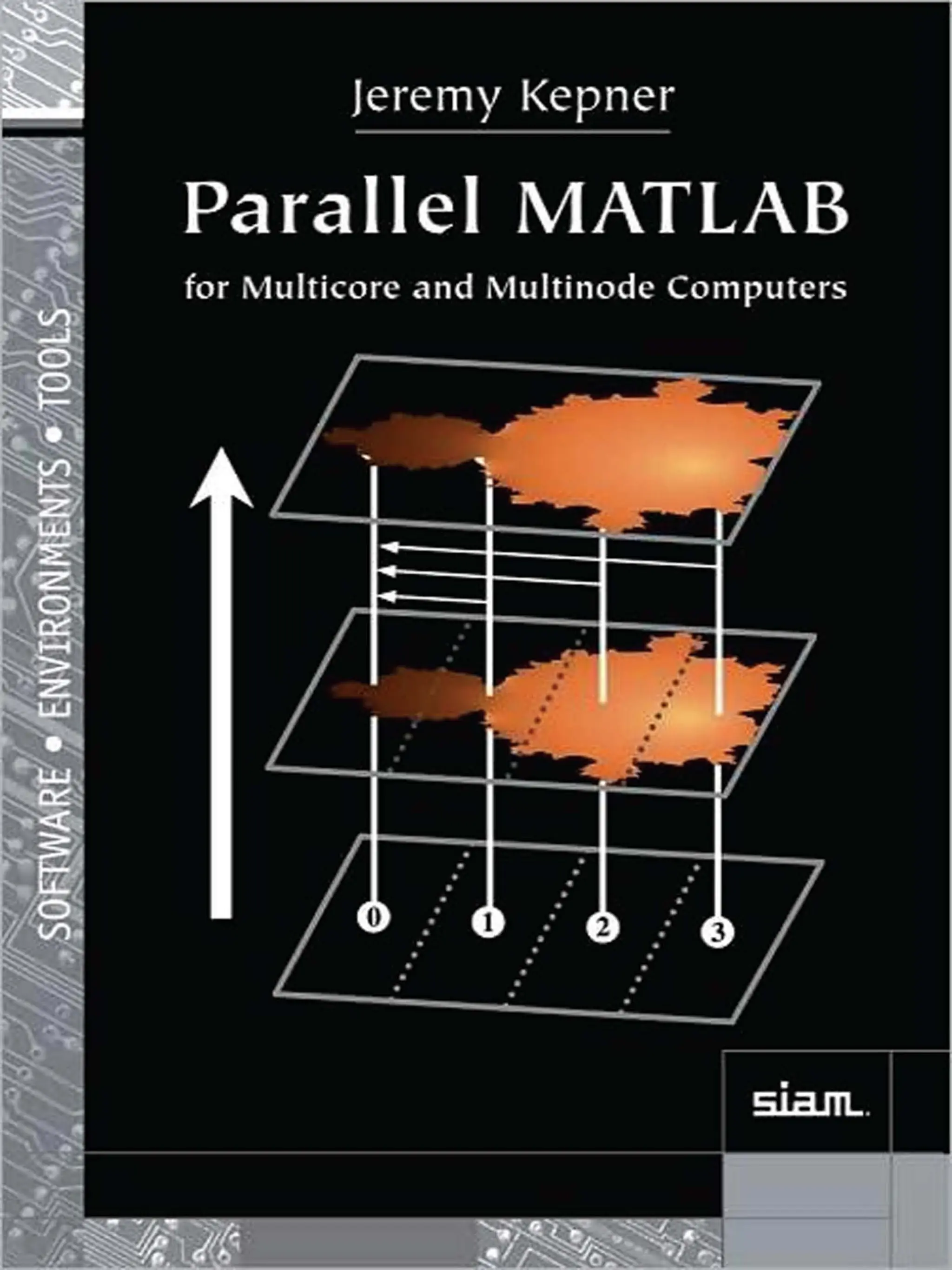
(Ebook) Parallel MATLAB for Multicore and
Multinode Computers by Jeremy Kepner ISBN
9780898716733, 089871673X download
https://ebooknice.com/product/parallel-matlab-for-multicore-and-
multinode-computers-1313902
Explore and download more ebooks at ebooknice.com
We believe these products will be a great fit for you. Click
the link to download now, or visit ebooknice.com
to discover even more!
(Ebook) Parallel Programming: for Multicore and Cluster Systems
by Thomas Rauber, Gudula Rünger ISBN 9783031289231,
9783031289248, 3031289234, 3031289242
https://ebooknice.com/product/parallel-programming-for-multicore-and-
cluster-systems-48456870
(Ebook) Parallel Programming: Techniques and Applications Using
Networked Workstations and Parallel Computers (2nd Edition) by
Barry Wilkinson, Michael Allen ISBN 9780131405639, 0131405632
https://ebooknice.com/product/parallel-programming-techniques-and-
applications-using-networked-workstations-and-parallel-computers-2nd-
edition-2374686
(Ebook) Parallel Programming with Microsoft Visual C++: Design
Patterns for Decomposition and Coordination on Multicore
Architectures (Patterns and Practices) by Colin Campbell, Ade
Miller ISBN 9780735651753, 0735651752
https://ebooknice.com/product/parallel-programming-with-microsoft-visual-c-
design-patterns-for-decomposition-and-coordination-on-multicore-
architectures-patterns-and-practices-2112720
(Ebook) Parallel Computers Architecture and Programming by V.
Rajaraman, C. Siva Ram Murthy ISBN 9788120352629, 8120352629
https://ebooknice.com/product/parallel-computers-architecture-and-
programming-6686298
(Ebook) Parallel Programming with Microsoft .NET: Design
Patterns for Decomposition and Coordination on Multicore
Architectures (Patterns & Practices) by Colin Campbell, Ralph
Johnson, Ade Miller, Stephen Toub ISBN 9780735651593, 0735651590
https://ebooknice.com/product/parallel-programming-with-microsoft-net-
design-patterns-for-decomposition-and-coordination-on-multicore-
architectures-patterns-practices-2488296
(Ebook) MATLAB Parallel Computing Toolbox™ User's Guide by The
MathWorks, Inc.
https://ebooknice.com/product/matlab-parallel-computing-toolboxtm-user-s-
guide-11236254
(Ebook) Using OpenCL: Programming Massively Parallel Computers
by J. Kowalik, T. Puzniakowski ISBN 9781614990291, 1614990298
https://ebooknice.com/product/using-opencl-programming-massively-parallel-
computers-4128552
(Ebook) Biota Grow 2C gather 2C cook by Loucas, Jason; Viles,
James ISBN 9781459699816, 9781743365571, 9781925268492,
1459699815, 1743365578, 1925268497
https://ebooknice.com/product/biota-grow-2c-gather-2c-cook-6661374
(Ebook) Regularized Image Reconstruction in Parallel MRI with
MATLAB by Joseph Suresh Paul, Raji Susan Mathew ISBN
9780815361473, 0815361475
https://ebooknice.com/product/regularized-image-reconstruction-in-parallel-
mri-with-matlab-11110870
Parallel MATLAB
for Multicore and Multinode Computers
The SIAM series on Software, Environments, and Tools focuses on the practical implementation of
computational methods and the high performance aspects of scientific computation by emphasizing
in-demand software, computing environments, and tools for computing. Software technology development
issues such as current status, applications and algorithms, mathematical software, software tools, languages
and compilers, computing environments, and visualization are presented.
Editor-in-Chief
Jack J. Dongarra
University of Tennessee and Oak Ridge National Laboratory
Editorial Board
James W. Demmel, University of California, Berkeley
Dennis Gannon, Indiana University
Eric Grosse, AT&T Bell Laboratories
Jorge J. Moré, Argonne National Laboratory
Software, Environments, and Tools
Jeremy Kepner, Parallel MATLAB for Multicore and Multinode Computers
Michael A. Heroux, Padma Raghavan, and Horst D. Simon, editors, Parallel Processing for Scientific Computing
Gérard Meurant, The Lanczos and Conjugate Gradient Algorithms: From Theory to Finite Precision Computations
Bo Einarsson, editor, Accuracy and Reliability in Scientific Computing
Michael W. Berry and Murray Browne, Understanding Search Engines: Mathematical Modeling and Text
Retrieval, Second Edition
Craig C. Douglas, Gundolf Haase, and Ulrich Langer, A Tutorial on Elliptic PDE Solvers and Their Parallelization
Louis Komzsik, The Lanczos Method: Evolution and Application
Bard Ermentrout, Simulating, Analyzing, and Animating Dynamical Systems: A Guide to XPPAUT for Researchers
and Students
V. A. Barker, L. S. Blackford, J. Dongarra, J. Du Croz, S. Hammarling, M. Marinova, J. Wasniewski, and
P. Yalamov, LAPACK95 Users’ Guide
Stefan Goedecker and Adolfy Hoisie, Performance Optimization of Numerically Intensive Codes
Zhaojun Bai, James Demmel, Jack Dongarra, Axel Ruhe, and Henk van der Vorst, Templates for the Solution
of Algebraic Eigenvalue Problems: A Practical Guide
Lloyd N. Trefethen, Spectral Methods in MATLAB
E. Anderson, Z. Bai, C. Bischof, S. Blackford, J. Demmel, J. Dongarra, J. Du Croz, A. Greenbaum, S. Hammarling,
A. McKenney, and D. Sorensen, LAPACK Users’ Guide, Third Edition
Michael W. Berry and Murray Browne, Understanding Search Engines: Mathematical Modeling and Text Retrieval
Jack J. Dongarra, Iain S. Duff, Danny C. Sorensen, and Henk A. van der Vorst, Numerical Linear Algebra
for High-Performance Computers
R. B. Lehoucq, D. C. Sorensen, and C. Yang, ARPACK Users’ Guide: Solution of Large-Scale Eigenvalue Problems
with Implicitly Restarted Arnoldi Methods
Randolph E. Bank, PLTMG: A Software Package for Solving Elliptic Partial Differential Equations, Users’ Guide 8.0
L. S. Blackford, J. Choi, A. Cleary, E. D’Azevedo, J. Demmel, I. Dhillon, J. Dongarra, S. Hammarling,
G. Henry, A. Petitet, K. Stanley, D. Walker, and R. C. Whaley, ScaLAPACK Users’ Guide
Greg Astfalk, editor, Applications on Advanced Architecture Computers
Roger W. Hockney, The Science of Computer Benchmarking
Françoise Chaitin-Chatelin and Valérie Frayssé, Lectures on Finite Precision Computations
´
Society for Industrial and Applied Mathematics
Philadelphia
Parallel MATLAB
for Multicore and Multinode Computers
Jeremy Kepner
Massachusetts Institute of Technology
Lexington, Massachusetts
is a registered trademark.
Copyright © 2009 by the Society for Industrial and Applied Mathematics (SIAM)
10 9 8 7 6 5 4 3 2 1
All rights reserved. Printed in the United States of America. No part of this book may be reproduced,
stored, or transmitted in any manner without the written permission of the publisher. For information,
write to the Society for Industrial and Applied Mathematics, 3600 Market Street,
6th Floor, Philadelphia, PA 19104-2688 USA.
Trademarked names may be used in this book without the inclusion of a trademark symbol. These
names are used in an editorial context only; no infringement of trademark is intended.
Intel is a registered trademark of Intel Corporation or its subsidiaries in the United States and other
countries.
Java is a trademark of Sun Microsystems, Inc. in the United States and other countries.
Linux is a registered trademark of Linus Torvalds.
MATLAB is a registered trademark of The MathWorks, Inc. For MATLAB product information, please
contact The MathWorks, Inc., 3 Apple Hill Drive, Natick, MA 01760-2098 USA, 508-647-7000,
Fax: 508-647-7001, info@mathworks.com, www.mathworks.com.
Python is a trademark or registered trademark of the Python Software Foundation.
UNIX is a registered trademark of The Open Group in the United States and other countries.
Chapters 5 and 7 are based on work previously published as “pMATLAB Parallel MATLAB Library.”
The final, definitive version of this paper has been published in the International Journal of High
Performance Computing Applications, Special Issue on High Productivity Languages and Models,
J. Kepner and H. Zima, eds., Volume 21, Issue 3, pages 336—359 (August 2007) by SAGE
Publications, Ltd. All rights reserved. © SAGE Publications. The article is available from SAGE Journals
Online at http://hpc.sagepub.com/cgi/content/abstract/21/3/336.
Chapter 6 is based on work previously published as “Performance Metrics and Software Architecture,”
by J. Kepner, T. Meuse, and G. Schrader, in High Performance Embedded Computing Handbook, D. R.
Martinez, R. A. Bond, and M. M. Vai, eds., CRC Press, 2008. © Taylor & Francis Group LLC.
Figure 6.12 is based on Figure 4.4 on page 109 from High Performance Computing: Challenges for
Future Systems by David Kuck (1996). It is used by permission of Oxford University Press. Visit
http://www.oup.com.
This work is sponsored by the Department of the Air Force under Air Force Contract FA8721-05-C-0002.
Opinions, interpretations, conclusions, and recommendations are those of the author and are not
necessarily endorsed by the United States Government.
Library of Congress Cataloging-in-Publication Data
Kepner, Jeremy.
Parallel MATLAB for multicore and multinode computers / Jeremy Kepner.
p. cm. — (Software, environments, and tools ; 21)
Includes index.
ISBN 978-0-898716-73-3
1. Parallel processing (Electronic computers) 2. MATLAB. 3. Multiprocessors. I. Title.
QA76.58.K46 2009
004’.35—dc22
2009013013
For
Jemma
Alix
Clay
Diane
and
Gordon
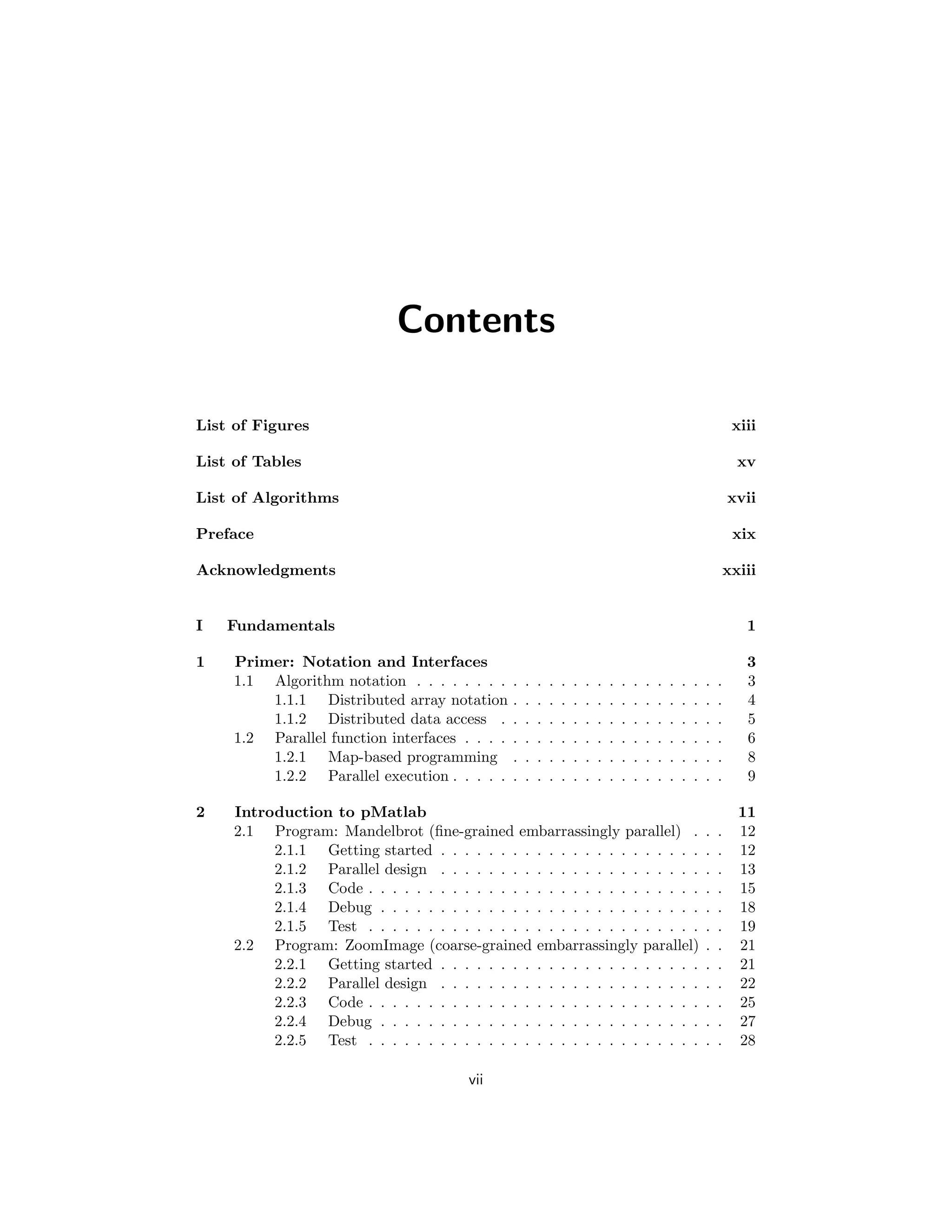
Contents
List of Figures xiii
List of Tables xv
List of Algorithms xvii
Preface xix
Acknowledgments xxiii
I Fundamentals 1
1 Primer: Notation and Interfaces 3
1.1 Algorithm notation . . . . . . . . . . . . . . . . . . . . . . . . . . 3
1.1.1 Distributed array notation . . . . . . . . . . . . . . . . . . 4
1.1.2 Distributed data access . . . . . . . . . . . . . . . . . . . 5
1.2 Parallel function interfaces . . . . . . . . . . . . . . . . . . . . . . 6
1.2.1 Map-based programming . . . . . . . . . . . . . . . . . . 8
1.2.2 Parallel execution . . . . . . . . . . . . . . . . . . . . . . . 9
2 Introduction to pMatlab 11
2.1 Program: Mandelbrot (fine-grained embarrassingly parallel) . . . 12
2.1.1 Getting started . . . . . . . . . . . . . . . . . . . . . . . . 12
2.1.2 Parallel design . . . . . . . . . . . . . . . . . . . . . . . . 13
2.1.3 Code . . . . . . . . . . . . . . . . . . . . . . . . . . . . . . 15
2.1.4 Debug . . . . . . . . . . . . . . . . . . . . . . . . . . . . . 18
2.1.5 Test . . . . . . . . . . . . . . . . . . . . . . . . . . . . . . 19
2.2 Program: ZoomImage (coarse-grained embarrassingly parallel) . . 21
2.2.1 Getting started . . . . . . . . . . . . . . . . . . . . . . . . 21
2.2.2 Parallel design . . . . . . . . . . . . . . . . . . . . . . . . 22
2.2.3 Code . . . . . . . . . . . . . . . . . . . . . . . . . . . . . . 25
2.2.4 Debug . . . . . . . . . . . . . . . . . . . . . . . . . . . . . 27
2.2.5 Test . . . . . . . . . . . . . . . . . . . . . . . . . . . . . . 28
vii
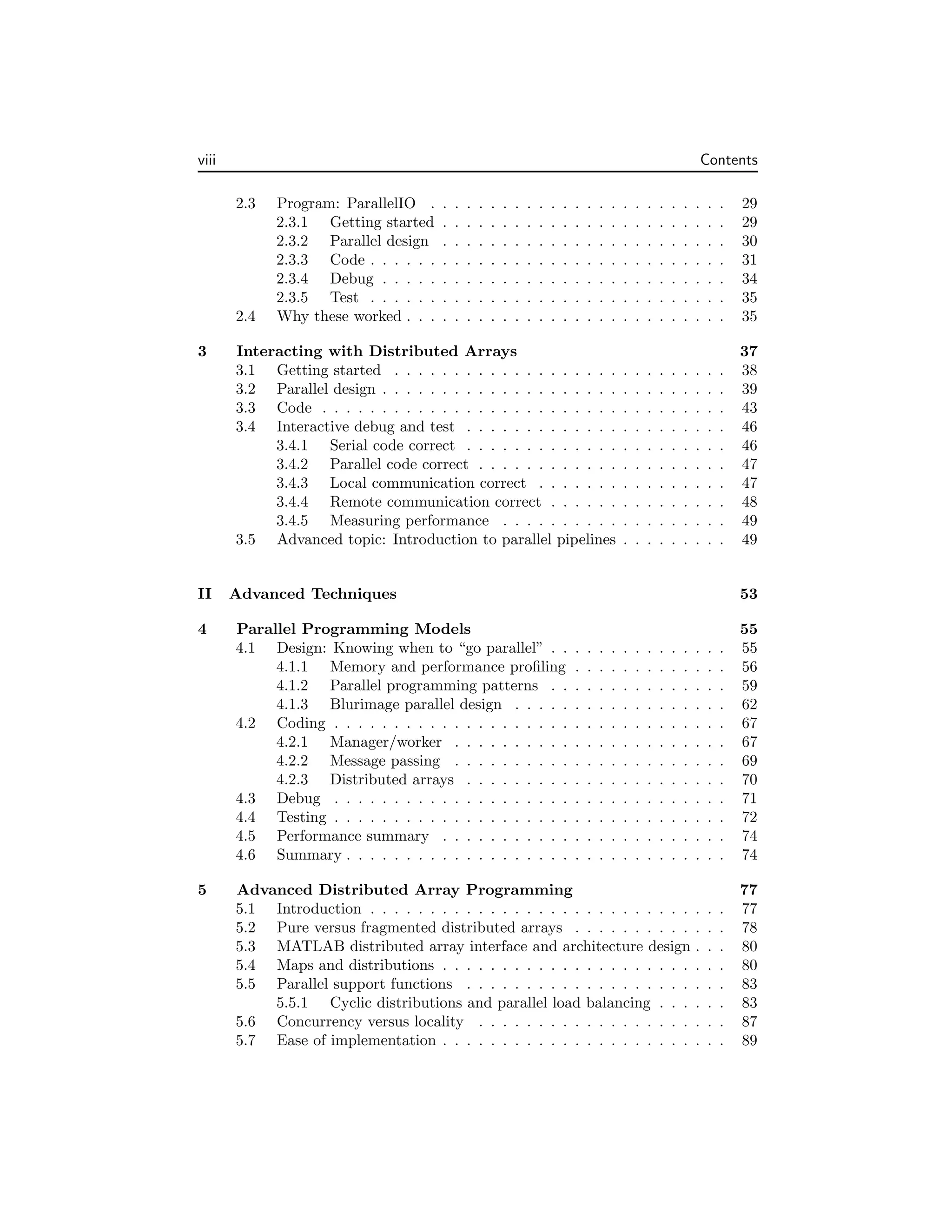
viii Contents
2.3 Program: ParallelIO . . . . . . . . . . . . . . . . . . . . . . . . . 29
2.3.1 Getting started . . . . . . . . . . . . . . . . . . . . . . . . 29
2.3.2 Parallel design . . . . . . . . . . . . . . . . . . . . . . . . 30
2.3.3 Code . . . . . . . . . . . . . . . . . . . . . . . . . . . . . . 31
2.3.4 Debug . . . . . . . . . . . . . . . . . . . . . . . . . . . . . 34
2.3.5 Test . . . . . . . . . . . . . . . . . . . . . . . . . . . . . . 35
2.4 Why these worked . . . . . . . . . . . . . . . . . . . . . . . . . . . 35
3 Interacting with Distributed Arrays 37
3.1 Getting started . . . . . . . . . . . . . . . . . . . . . . . . . . . . 38
3.2 Parallel design . . . . . . . . . . . . . . . . . . . . . . . . . . . . . 39
3.3 Code . . . . . . . . . . . . . . . . . . . . . . . . . . . . . . . . . . 43
3.4 Interactive debug and test . . . . . . . . . . . . . . . . . . . . . . 46
3.4.1 Serial code correct . . . . . . . . . . . . . . . . . . . . . . 46
3.4.2 Parallel code correct . . . . . . . . . . . . . . . . . . . . . 47
3.4.3 Local communication correct . . . . . . . . . . . . . . . . 47
3.4.4 Remote communication correct . . . . . . . . . . . . . . . 48
3.4.5 Measuring performance . . . . . . . . . . . . . . . . . . . 49
3.5 Advanced topic: Introduction to parallel pipelines . . . . . . . . . 49
II Advanced Techniques 53
4 Parallel Programming Models 55
4.1 Design: Knowing when to “go parallel” . . . . . . . . . . . . . . . 55
4.1.1 Memory and performance profiling . . . . . . . . . . . . . 56
4.1.2 Parallel programming patterns . . . . . . . . . . . . . . . 59
4.1.3 Blurimage parallel design . . . . . . . . . . . . . . . . . . 62
4.2 Coding . . . . . . . . . . . . . . . . . . . . . . . . . . . . . . . . . 67
4.2.1 Manager/worker . . . . . . . . . . . . . . . . . . . . . . . 67
4.2.2 Message passing . . . . . . . . . . . . . . . . . . . . . . . 69
4.2.3 Distributed arrays . . . . . . . . . . . . . . . . . . . . . . 70
4.3 Debug . . . . . . . . . . . . . . . . . . . . . . . . . . . . . . . . . 71
4.4 Testing . . . . . . . . . . . . . . . . . . . . . . . . . . . . . . . . . 72
4.5 Performance summary . . . . . . . . . . . . . . . . . . . . . . . . 74
4.6 Summary . . . . . . . . . . . . . . . . . . . . . . . . . . . . . . . . 74
5 Advanced Distributed Array Programming 77
5.1 Introduction . . . . . . . . . . . . . . . . . . . . . . . . . . . . . . 77
5.2 Pure versus fragmented distributed arrays . . . . . . . . . . . . . 78
5.3 MATLAB distributed array interface and architecture design . . . 80
5.4 Maps and distributions . . . . . . . . . . . . . . . . . . . . . . . . 80
5.5 Parallel support functions . . . . . . . . . . . . . . . . . . . . . . 83
5.5.1 Cyclic distributions and parallel load balancing . . . . . . 83
5.6 Concurrency versus locality . . . . . . . . . . . . . . . . . . . . . 87
5.7 Ease of implementation . . . . . . . . . . . . . . . . . . . . . . . . 89
Contents ix
5.8 Implementation specifics . . . . . . . . . . . . . . . . . . . . . . . 90
5.8.1 Program execution . . . . . . . . . . . . . . . . . . . . . . 92
5.9 Array redistribution . . . . . . . . . . . . . . . . . . . . . . . . . . 93
5.10 Message passing layer . . . . . . . . . . . . . . . . . . . . . . . . . 95
5.11 Performance concepts . . . . . . . . . . . . . . . . . . . . . . . . . 98
5.11.1 Performance, performance, performance . . . . . . . . . . 98
5.11.2 Benchmarks . . . . . . . . . . . . . . . . . . . . . . . . . . 99
5.11.3 Minimize overhead . . . . . . . . . . . . . . . . . . . . . . 99
5.11.4 Embarrassingly parallel implies linear speedup . . . . . . 100
5.11.5 Algorithm and mapping are orthogonal . . . . . . . . . . 100
5.11.6 Do no harm . . . . . . . . . . . . . . . . . . . . . . . . . . 100
5.11.7 Watch the SLOC . . . . . . . . . . . . . . . . . . . . . . . 100
5.11.8 No free lunch . . . . . . . . . . . . . . . . . . . . . . . . . 100
5.11.9 Four easy steps . . . . . . . . . . . . . . . . . . . . . . . . 100
5.12 User results . . . . . . . . . . . . . . . . . . . . . . . . . . . . . . 102
6 Performance Metrics and Software Architecture 107
6.1 Introduction . . . . . . . . . . . . . . . . . . . . . . . . . . . . . . 107
6.2 Characterizing a parallel application . . . . . . . . . . . . . . . . 108
6.2.1 Characteristics of the example programs . . . . . . . . . . 108
6.2.2 Serial performance metrics . . . . . . . . . . . . . . . . . . 112
6.2.3 Degrees of parallelism . . . . . . . . . . . . . . . . . . . . 113
6.2.4 Parallel performance metrics (no communication) . . . . . 115
6.2.5 Parallel performance metrics (with communication) . . . 116
6.2.6 Amdahl’s Law . . . . . . . . . . . . . . . . . . . . . . . . 117
6.2.7 Characterizing speedup . . . . . . . . . . . . . . . . . . . 119
6.2.8 Spatial and temporal locality . . . . . . . . . . . . . . . . 121
6.3 Standard parallel computer . . . . . . . . . . . . . . . . . . . . . . 123
6.3.1 Network model . . . . . . . . . . . . . . . . . . . . . . . . 125
6.3.2 Kuck hierarchy . . . . . . . . . . . . . . . . . . . . . . . . 128
6.4 Parallel programming models . . . . . . . . . . . . . . . . . . . . 129
6.5 System metrics . . . . . . . . . . . . . . . . . . . . . . . . . . . . 131
6.5.1 Performance . . . . . . . . . . . . . . . . . . . . . . . . . . 131
6.5.2 Form factor . . . . . . . . . . . . . . . . . . . . . . . . . . 132
6.5.3 Efficiency . . . . . . . . . . . . . . . . . . . . . . . . . . . 133
6.5.4 Software cost . . . . . . . . . . . . . . . . . . . . . . . . . 135
6.5.5 Software productivity . . . . . . . . . . . . . . . . . . . . 137
III Case Studies 141
7 Parallel Application Analysis 143
7.1 Historical overview . . . . . . . . . . . . . . . . . . . . . . . . . . 143
7.2 Characterizing the application space . . . . . . . . . . . . . . . . 145
7.2.1 Physical memory hierarchy . . . . . . . . . . . . . . . . . 146
7.2.2 Spatial/temporal locality . . . . . . . . . . . . . . . . . . 147
7.2.3 Logical memory hierarchy . . . . . . . . . . . . . . . . . . 148
x Contents
7.3 HPC Challenge: Spanning the application space . . . . . . . . . . 148
7.3.1 Stream . . . . . . . . . . . . . . . . . . . . . . . . . . . . . 149
7.3.2 FFT . . . . . . . . . . . . . . . . . . . . . . . . . . . . . . 149
7.3.3 RandomAccess . . . . . . . . . . . . . . . . . . . . . . . . 151
7.3.4 HPL . . . . . . . . . . . . . . . . . . . . . . . . . . . . . . 151
7.4 Intrinsic algorithm performance . . . . . . . . . . . . . . . . . . . 152
7.4.1 Data structures . . . . . . . . . . . . . . . . . . . . . . . . 152
7.4.2 Computational complexity . . . . . . . . . . . . . . . . . . 152
7.4.3 Degrees of parallelism . . . . . . . . . . . . . . . . . . . . 154
7.4.4 Communication complexity . . . . . . . . . . . . . . . . . 155
7.5 Hardware performance . . . . . . . . . . . . . . . . . . . . . . . . 155
7.5.1 Spatial and temporal locality . . . . . . . . . . . . . . . . 156
7.5.2 Performance efficiency . . . . . . . . . . . . . . . . . . . . 156
7.5.3 Estimating performance . . . . . . . . . . . . . . . . . . . 157
7.5.4 Analysis results . . . . . . . . . . . . . . . . . . . . . . . . 159
7.5.5 Performance implications . . . . . . . . . . . . . . . . . . 159
7.6 Software performance . . . . . . . . . . . . . . . . . . . . . . . . . 160
7.6.1 Stream . . . . . . . . . . . . . . . . . . . . . . . . . . . . . 161
7.6.2 RandomAccess . . . . . . . . . . . . . . . . . . . . . . . . 161
7.6.3 FFT . . . . . . . . . . . . . . . . . . . . . . . . . . . . . . 162
7.6.4 HPL . . . . . . . . . . . . . . . . . . . . . . . . . . . . . . 163
7.7 Performance versus effort . . . . . . . . . . . . . . . . . . . . . . . 163
8 Stream 169
8.1 Getting started . . . . . . . . . . . . . . . . . . . . . . . . . . . . 169
8.2 Parallel design . . . . . . . . . . . . . . . . . . . . . . . . . . . . . 171
8.3 Code . . . . . . . . . . . . . . . . . . . . . . . . . . . . . . . . . . 173
8.4 Debug . . . . . . . . . . . . . . . . . . . . . . . . . . . . . . . . . 176
8.5 Test . . . . . . . . . . . . . . . . . . . . . . . . . . . . . . . . . . . 177
9 RandomAccess 181
9.1 Getting started . . . . . . . . . . . . . . . . . . . . . . . . . . . . 182
9.2 Parallel design . . . . . . . . . . . . . . . . . . . . . . . . . . . . . 183
9.2.1 Spray algorithm . . . . . . . . . . . . . . . . . . . . . . . 184
9.2.2 Tree algorithm . . . . . . . . . . . . . . . . . . . . . . . . 187
9.3 Code . . . . . . . . . . . . . . . . . . . . . . . . . . . . . . . . . . 189
9.3.1 Spray code . . . . . . . . . . . . . . . . . . . . . . . . . . 191
9.3.2 Tree code . . . . . . . . . . . . . . . . . . . . . . . . . . . 193
9.3.3 Coding summary . . . . . . . . . . . . . . . . . . . . . . . 194
9.4 Debug . . . . . . . . . . . . . . . . . . . . . . . . . . . . . . . . . 195
9.5 Test . . . . . . . . . . . . . . . . . . . . . . . . . . . . . . . . . . . 197
9.5.1 Multicore performance . . . . . . . . . . . . . . . . . . . . 197
9.5.2 Multinode performance . . . . . . . . . . . . . . . . . . . 198
10 Fast Fourier Transform 201
10.1 Getting started . . . . . . . . . . . . . . . . . . . . . . . . . . . . 202
10.2 Parallel design . . . . . . . . . . . . . . . . . . . . . . . . . . . . . 203
Contents xi
10.3 Code . . . . . . . . . . . . . . . . . . . . . . . . . . . . . . . . . . 206
10.4 Debug . . . . . . . . . . . . . . . . . . . . . . . . . . . . . . . . . 208
10.5 Test . . . . . . . . . . . . . . . . . . . . . . . . . . . . . . . . . . . 209
10.5.1 Multicore performance . . . . . . . . . . . . . . . . . . . . 209
10.5.2 Multinode performance . . . . . . . . . . . . . . . . . . . 211
11 High Performance Linpack 215
11.1 Getting started . . . . . . . . . . . . . . . . . . . . . . . . . . . . 216
11.2 Parallel design . . . . . . . . . . . . . . . . . . . . . . . . . . . . . 217
11.2.1 Parallel LU . . . . . . . . . . . . . . . . . . . . . . . . . . 219
11.2.2 Critical path analysis . . . . . . . . . . . . . . . . . . . . 221
11.3 Code . . . . . . . . . . . . . . . . . . . . . . . . . . . . . . . . . . 224
11.4 Debug . . . . . . . . . . . . . . . . . . . . . . . . . . . . . . . . . 227
11.5 Test . . . . . . . . . . . . . . . . . . . . . . . . . . . . . . . . . . . 229
11.5.1 Multicore performance . . . . . . . . . . . . . . . . . . . . 229
11.5.2 Multinode performance . . . . . . . . . . . . . . . . . . . 230
Appendix Notation for Hierarchical Parallel Multicore
Algorithms 233
A.1 Introduction . . . . . . . . . . . . . . . . . . . . . . . . . . . . . . 233
A.2 Data parallelism . . . . . . . . . . . . . . . . . . . . . . . . . . . . 234
A.2.1 Serial algorithm . . . . . . . . . . . . . . . . . . . . . . . . 234
A.2.2 Parallel algorithm . . . . . . . . . . . . . . . . . . . . . . 235
A.2.3 Block parallel algorithm . . . . . . . . . . . . . . . . . . . 238
A.2.4 Hierarchical parallel algorithm . . . . . . . . . . . . . . . 239
A.2.5 Hierarchical block parallel algorithm . . . . . . . . . . . . 240
A.3 Pipeline parallelism . . . . . . . . . . . . . . . . . . . . . . . . . . 242
A.3.1 Implicit pipeline parallel . . . . . . . . . . . . . . . . . . . 242
A.3.2 Task pipeline parallel . . . . . . . . . . . . . . . . . . . . 243
A.3.3 Fine-grained task pipeline parallel . . . . . . . . . . . . . 246
A.3.4 Generic hierarchical block parallel algorithm . . . . . . . . 247
Index 251
List of Figures
1 Performance versus effort. . . . . . . . . . . . . . . . . . . . . . . . xx
2 Development of parallel MATLAB. . . . . . . . . . . . . . . . . . . xxiv
1.1 Parallel maps. . . . . . . . . . . . . . . . . . . . . . . . . . . . . . 6
1.2 Anatomy of a map. . . . . . . . . . . . . . . . . . . . . . . . . . . 8
1.3 Parallel execution. . . . . . . . . . . . . . . . . . . . . . . . . . . . 10
2.1 Mandelbrot output. . . . . . . . . . . . . . . . . . . . . . . . . . . 13
2.2 Mandelbrot parallel design. . . . . . . . . . . . . . . . . . . . . . . 16
2.3 ZoomImage output. . . . . . . . . . . . . . . . . . . . . . . . . . . 22
2.4 ZoomImage parallel design. . . . . . . . . . . . . . . . . . . . . . . 25
2.5 ParallelIO design. . . . . . . . . . . . . . . . . . . . . . . . . . . . 32
3.1 Beamformer output. . . . . . . . . . . . . . . . . . . . . . . . . . . 38
3.2 Beamformer physics. . . . . . . . . . . . . . . . . . . . . . . . . . . 39
3.3 Beamformer parallel design. . . . . . . . . . . . . . . . . . . . . . . 43
3.4 Beamformer parallel pipeline design. . . . . . . . . . . . . . . . . . 51
4.1 Blurimage output. . . . . . . . . . . . . . . . . . . . . . . . . . . . 56
4.2 Blurimage profiler results. . . . . . . . . . . . . . . . . . . . . . . . 58
4.3 Standard parallel communication patterns. . . . . . . . . . . . . . 61
4.4 Distributed array mappings. . . . . . . . . . . . . . . . . . . . . . 63
4.5 Blurimage parallel designs. . . . . . . . . . . . . . . . . . . . . . . 64
4.6 Four-step debug process. . . . . . . . . . . . . . . . . . . . . . . . 73
5.1 Pure versus fragmented distributed arrays. . . . . . . . . . . . . . 79
5.2 Block-cyclic distributions. . . . . . . . . . . . . . . . . . . . . . . . 82
5.3 Concurrency and locality. . . . . . . . . . . . . . . . . . . . . . . . 88
5.4 Layered library architecture. . . . . . . . . . . . . . . . . . . . . . 92
5.5 Execution framework. . . . . . . . . . . . . . . . . . . . . . . . . . 93
5.6 MatlabMPI file I/O based communication. . . . . . . . . . . . . . 96
5.7 Network speedtest results. . . . . . . . . . . . . . . . . . . . . . . . 97
5.8 MatlabMPI versus MPI. . . . . . . . . . . . . . . . . . . . . . . . . 98
5.9 Array communication overhead. . . . . . . . . . . . . . . . . . . . 99
xiii
xiv List of Figures
6.1 Types of parallelism. . . . . . . . . . . . . . . . . . . . . . . . . . . 114
6.2 Amdahl’s Law. . . . . . . . . . . . . . . . . . . . . . . . . . . . . . 118
6.3 Speedup curves. . . . . . . . . . . . . . . . . . . . . . . . . . . . . 119
6.4 Speedup ranges. . . . . . . . . . . . . . . . . . . . . . . . . . . . . 120
6.5 Weak versus strong scaling. . . . . . . . . . . . . . . . . . . . . . . 121
6.6 Spatial/temporal locality model. . . . . . . . . . . . . . . . . . . . 122
6.7 Spatial/temporal scores of example programs. . . . . . . . . . . . 123
6.8 Parallel architecture and memory hierarchy. . . . . . . . . . . . . . 124
6.9 Network topologies. . . . . . . . . . . . . . . . . . . . . . . . . . . 125
6.10 Network performance. . . . . . . . . . . . . . . . . . . . . . . . . . 127
6.11 Corner turn. . . . . . . . . . . . . . . . . . . . . . . . . . . . . . . 128
6.12 Two-level hierarchy. . . . . . . . . . . . . . . . . . . . . . . . . . . 129
6.13 Example Kuck hierarchies. . . . . . . . . . . . . . . . . . . . . . . 130
6.14 Example computing rack. . . . . . . . . . . . . . . . . . . . . . . . 133
6.15 Speedup versus effort. . . . . . . . . . . . . . . . . . . . . . . . . . 138
6.16 Parallel productivity versus effort. . . . . . . . . . . . . . . . . . . 139
7.1 Supercomputing evolution. . . . . . . . . . . . . . . . . . . . . . . 144
7.2 Memory hierarchy and HPC Challenge. . . . . . . . . . . . . . . . 146
7.3 Spatial versus temporal locality. . . . . . . . . . . . . . . . . . . . 147
7.4 Communication across the hierarchy. . . . . . . . . . . . . . . . . . 148
7.5 Communication patterns of HPC Challenge. . . . . . . . . . . . . 150
7.6 HPC Challenge performance estimates. . . . . . . . . . . . . . . . 160
7.7 Speedup versus relative code size. . . . . . . . . . . . . . . . . . . 166
7.8 HPC Challenge productivity. . . . . . . . . . . . . . . . . . . . . . 167
8.1 Parallel Stream design. . . . . . . . . . . . . . . . . . . . . . . . . 172
8.2 Stream performance versus size. . . . . . . . . . . . . . . . . . . . 179
9.1 RandomAccess spray communication pattern. . . . . . . . . . . . . 186
9.2 RandomAccess tree communication pattern. . . . . . . . . . . . . 189
9.3 Parallel RandomAccess relative performance. . . . . . . . . . . . . 200
10.1 Parallel FFT design. . . . . . . . . . . . . . . . . . . . . . . . . . . 205
10.2 Parallel FFT relative performance. . . . . . . . . . . . . . . . . . . 212
11.1 Parallel LU design. . . . . . . . . . . . . . . . . . . . . . . . . . . . 222
11.2 Parallel LU critical path. . . . . . . . . . . . . . . . . . . . . . . . 223
11.3 Parallel HPL relative performance. . . . . . . . . . . . . . . . . . . 231
A.1 Single processor Kuck diagram. . . . . . . . . . . . . . . . . . . . . 236
A.2 Parallel maps. . . . . . . . . . . . . . . . . . . . . . . . . . . . . . 237
A.3 Parallel processor Kuck diagram. . . . . . . . . . . . . . . . . . . . 238
A.4 Hierarchical parallel processor Kuck diagram. . . . . . . . . . . . . 241
A.5 Two tasks connected by a conduit. . . . . . . . . . . . . . . . . . . 244
A.6 Replicated task connected by an unreplicated task. . . . . . . . . . 246
List of Tables
2.1 Mandelbrot parallel mapping. . . . . . . . . . . . . . . . . . . . . . 15
2.2 Debugging steps. . . . . . . . . . . . . . . . . . . . . . . . . . . . . 19
2.3 Multicore and multinode Mandelbrot performance. . . . . . . . . . 20
2.4 ZoomImage parallel mapping. . . . . . . . . . . . . . . . . . . . . . 24
2.5 Multicore and multinode ZoomImage performance. . . . . . . . . . 28
2.6 Multicore and multinode ParallelIO performance. . . . . . . . . . 36
3.1 Beamformer parallel mapping. . . . . . . . . . . . . . . . . . . . . 43
3.2 Multicore and multinode Beamformer performance. . . . . . . . . 50
3.3 Beamformer parallel pipeline mapping. . . . . . . . . . . . . . . . 50
4.1 Taxonomy of parallel applications. . . . . . . . . . . . . . . . . . . 60
4.2 Multicore and multinode Blurimage performance. . . . . . . . . . 73
5.1 Distributed array design goals. . . . . . . . . . . . . . . . . . . . . 81
5.2 Distributed array parallel support functions. . . . . . . . . . . . . 84
5.3 Distributed array distributions. . . . . . . . . . . . . . . . . . . . . 85
5.4 Mandelbrot load imbalance. . . . . . . . . . . . . . . . . . . . . . . 87
5.5 Implementation levels. . . . . . . . . . . . . . . . . . . . . . . . . . 91
5.6 MPI functions. . . . . . . . . . . . . . . . . . . . . . . . . . . . . . 95
5.7 Selected user application results. . . . . . . . . . . . . . . . . . . . 103
6.1 Parallel algorithm characteristics. . . . . . . . . . . . . . . . . . . 111
6.2 Software implementation efficiency estimates. . . . . . . . . . . . . 135
6.3 Software coding rate estimates. . . . . . . . . . . . . . . . . . . . . 137
6.4 Approximate relative productivity. . . . . . . . . . . . . . . . . . . 139
7.1 HPC Challenge parallel algorithm characteristics. . . . . . . . . . 153
7.2 Memory hierarchy parameters. . . . . . . . . . . . . . . . . . . . . 157
7.3 HPC Challenge implementation results. . . . . . . . . . . . . . . . 164
8.1 Multicore and multinode Stream triadd performance. . . . . . . . 178
9.1 Multicore RandomAccess performance. . . . . . . . . . . . . . . . 197
9.2 Multinode RandomAccess performance. . . . . . . . . . . . . . . . 199
xv
xvi List of Tables
10.1 Multicore FFT performance. . . . . . . . . . . . . . . . . . . . . . 210
10.2 Multinode FFT performance. . . . . . . . . . . . . . . . . . . . . . 211
11.1 Multicore HPL performance. . . . . . . . . . . . . . . . . . . . . . 229
11.2 Multinode HPL performance. . . . . . . . . . . . . . . . . . . . . . 230
List of Algorithms
Algorithm 1.1 Add one serial . . . . . . . . . . . . . . . . . . . . . . . . . 4
Algorithm 1.2 Add one parallel . . . . . . . . . . . . . . . . . . . . . . . 5
Algorithm 2.1 Mandelbrot serial . . . . . . . . . . . . . . . . . . . . . . . 14
Algorithm 2.2 Mandelbrot parallel . . . . . . . . . . . . . . . . . . . . . . 15
Algorithm 2.3 ZoomImage serial . . . . . . . . . . . . . . . . . . . . . . . 23
Algorithm 2.4 ZoomImage parallel . . . . . . . . . . . . . . . . . . . . . . 24
Algorithm 2.5 Serial IO . . . . . . . . . . . . . . . . . . . . . . . . . . . . 30
Algorithm 2.6 ParallelIO . . . . . . . . . . . . . . . . . . . . . . . . . . . 31
Algorithm 3.1 Beamformer serial . . . . . . . . . . . . . . . . . . . . . . 41
Algorithm 3.2 Beamformer parallel . . . . . . . . . . . . . . . . . . . . . 42
Algorithm 3.3 Beamformer pipeline . . . . . . . . . . . . . . . . . . . . . 51
Algorithm 4.1 Blurimage serial . . . . . . . . . . . . . . . . . . . . . . . . 57
Algorithm 4.2 Blurimage manager/worker . . . . . . . . . . . . . . . . . 65
Algorithm 4.3 Blurimage message passing . . . . . . . . . . . . . . . . . 66
Algorithm 4.4 Blurimage distributed array . . . . . . . . . . . . . . . . . 66
Algorithm 5.1 Network speedtest . . . . . . . . . . . . . . . . . . . . . . 96
Algorithm 8.1 Serial Stream . . . . . . . . . . . . . . . . . . . . . . . . . 171
Algorithm 8.2 Parallel Stream . . . . . . . . . . . . . . . . . . . . . . . . 173
Algorithm 9.1 Serial RandomAccess . . . . . . . . . . . . . . . . . . . . . 183
Algorithm 9.2 Parallel RandomAccess spray . . . . . . . . . . . . . . . . 185
Algorithm 9.3 Parallel RandomAccess tree . . . . . . . . . . . . . . . . . 188
Algorithm 10.1 Parallel FFT . . . . . . . . . . . . . . . . . . . . . . . . . 204
Algorithm 11.1 Serial LU . . . . . . . . . . . . . . . . . . . . . . . . . . . 218
Algorithm 11.2 Parallel LU . . . . . . . . . . . . . . . . . . . . . . . . . . 220
Algorithm A.1 Serial 2D filter . . . . . . . . . . . . . . . . . . . . . . . . 235
Algorithm A.2 Parallel 2D filter . . . . . . . . . . . . . . . . . . . . . . . 237
Algorithm A.3 Block parallel 2D filter . . . . . . . . . . . . . . . . . . . . 239
Algorithm A.4 Hierarchical parallel 2D filter . . . . . . . . . . . . . . . . 240
Algorithm A.5 Hierarchical block parallel 2D filter . . . . . . . . . . . . . 242
Algorithm A.6 Implicit pipeline 2D filter . . . . . . . . . . . . . . . . . . 243
Algorithm A.7 Task parallel 2D filter . . . . . . . . . . . . . . . . . . . . 245
Algorithm A.8 Fine-grained task parallel 2D filter . . . . . . . . . . . . . 247
Algorithm A.9 Generic hierarchical block parallel 2D filter . . . . . . . . 248
Algorithm A.10 Hierarchical helper functions . . . . . . . . . . . . . . . . . 249
xvii
Preface
MATLAB R
is currently the dominant language of technical computing with
approximately one million users worldwide, many of whom can benefit from the
increased power offered by widely available multicore processors and multinode
computing clusters. MATLAB is also an ideal environment for learning about par-
allel computing, allowing the user to focus on parallel algorithms instead of the
details of the implementation. The succinctness of MATLAB allows many specific
examples to be presented to illustrate parallel programming concepts.
The subject of this book is parallel programming in MATLAB and is hopefully
the first of many books on this topic, as there are now a wide variety of parallel
MATLAB libraries [Choy 2004] for users to choose from. I am fortunate to have been
involved in the development of two of these libraries [Kepner 2004, Kepner 2003].
The most widely used of these libraries include pMatlab (developed by MIT Lincoln
Laboratory), the Parallel Computing Toolbox (developed by The MathWorks, Inc.),
and StarP (developed at MIT, UCSB, and Interactive Supercomputing, Inc.). All
of these libraries provide direct support for parallel computing using distributed
arrays and other parallel programming models. The specific examples in this book
are written using the freely available pMatlab library. pMatlab has the advantage
of running either standalone or on top of the aforementioned parallel MATLAB
libraries. So all the examples in the book can be run in any of the parallel MATLAB
environments. Fortunately, the concepts illustrated in the book are independent of
the underlying implementation and valid for any particular parallel programming
syntax the user may prefer to use. The software along with installation instructions
can be found at the book website:
http://www.siam.org/KepnerBook
The expressive power of MATLAB allows us to concentrate on the techniques
for creating parallel programs that run well (as opposed to the syntactic mechanics
of writing parallel programs). Our primary focus is on the designing, coding, de-
bugging, and testing techniques required to quickly produce well-performing parallel
programs in a matter of hours instead of weeks or months (see Figure 1). These
techniques have been developed over the years through thousands of one-on-one
interactions with hundreds of parallel MATLAB users.
A general familiarity with MATLAB is assumed (see [Higham  Higham 2005]
and [Moler 2004] for an introduction to MATLAB). The target audience of the book
xix
Random documents with unrelated
content Scribd suggests to you:
Felt his heart with the music thrill!
All forgotten the dreary night,
Hunger, and pillow frosted white.
One by one, as the child-voice sang,
Others joined, till the chorus rang
Deep as a mighty organ tone,
By the bellows of the storm-wind blown.
At midnight the order passed along:—
March! And they marched with their heart of
song!
Needless to say how they fought, that day,
When the sun rose up over far Luray.
And the little singer—the loyal lad
Who gave, unconsciously, all he had
For his country's welfare—let none deny
His sovereign share in the victory!
If not from his song in the dreary night,
Whence came the courage to win the fight?
THE TRUE STORY OF THE MOOSE HEAD.
For a great many years—for as long, indeed, as either Bob or Jack could remember—
there had been over the great fireplace in the office of the Mountain House, as its chief
decorative feature, a huge moose-head, from either side of which rose up majestic
antlers, concerning which Bob had once remarked that they'd make a bully hat-rack.
To this sage remark Bob's father had replied that he thought so too; and he added that
he thought it somewhat of a pity that Bob, when he chose his pets, should choose pug-
dogs and rabbits, that were of no earthly use, instead of an occasional moose, which
might be trained to sit in the hall and allow people to hang their hats on his horns.
Just to think, he said, what a convenience a real live walking hat-rack would be! When
you wanted your hat, all you would have to do would be to whistle, and up the hat-rack
would trot; you'd select the hat you wished to wear, and back would go the moose again
to his accustomed place between the front door and the window.
I'm willing, Bob had answered. You buy me the moose, daddy, and I'll be glad to make
a pet of him.
But it so happened that at the moment his father had something else to think about, and
as a result Bob never got the moose.
Curiously enough, up to this particular summer of which I am writing, it had never
occurred to either of the boys to inquire into the story of this especial moose, who had
been so greatly honored by having his head stuffed and hung up to beautify the office of
the hotel. They had both of them often wondered somewhat as to how it came to lose
the rear portions of its body—that from its shoulders backward—but at such times it had
so happened there had never been anybody about who could be counted upon to
enlighten them on the subject. Now, however, it was different. Sandboys seemed always
at hand, and considering that he had never failed them when they had asked for an
explanation of this, that, or the other thing, they confidently broached the subject to him
one afternoon during the music hour, and, as usual, Sandboys was ready with a true
story for their satisfaction.
Oh, that! he said, when Bob had put the question. Yes, I know all about it; and why
shouldn't I? Didn't my father catch him? I guess!
The boys were not quite sure whether the guess was correct or not, but they deemed it
well to suppose that it was, and Sandboys went on.
Some folks about here will tell you wonderful stories about that moose, he said. Some
will tell you it came from Maine; and some will tell you it came from Canady; and some
will tell you they don't know nothin' at all about it; an' generally it'll be the last ones that
tell the whole truth, though it did come from both Canady an' Maine; and, what's more, if
it hadn't come, I wouldn't ha' been here. Nobody knows that but me, for up to now I
haven't breathed a word about it to a soul, but I don't mind tellin' you boys the whole
truth.
You don't mean to say it got you your position here as a bell-boy, do you? asked Jack.
Yes, I do—that is, it did in a way, as you'll see when I've told you the whole story,
returned Sandboys, and he began:
My father, when he was a boy, used to live up in Canady. I don't recollect the name of
the exact place. He told me its name lots o' times, but it was one o' them French-
Canadian names with an accent to it I never could get the hang of. Names of English
towns, like London or New York, I can always remember without much trouble, because I
can spell 'em and pronounce 'em; but the minute they gets mixed in with a little foreign
language, like French or Eyetalian, I can't spell 'em, pronounce 'em, or remember 'em to
save my life. If anybody'd say to me, 'Remember the name o' that town or die,' I think
that I'd simply have to stop breathin' an' die. I do remember, though, that it was a great
place for salmon and mooses. My daddy used to tell me reg'lar slews of stories about
'em. Why, he told me the salmon was so thick in the river back of his father's barn, that if
you took a bean-shooter and shot anywhere into the river, usin' pebbles instead o' beans,
you couldn't help hittin' a salmon on the head and killin' it—or, rather, knockin' it
unconscious, so's it would flop over and rise to the surface like it was dead, after which
all you had to do was to catch it by the tail, chop its head off as you would a chicken's,
cook it, and have your marketing done for two weeks.
Jiminny! said Bob. It's too bad you can't remember the name of that place. A hotel at
a place like that would be good as a mint.
Oh no—it's all changed now, said Sandboys, sadly. They've put a saw-mill in there
now, and the salmon's mostly all gone. Sometimes they tell me they do catch one or two,
and they're so big they cut 'em up in the saw-mill just like planks, and feed on 'em all
through the winter.
I've heard of planked shad, put in Bob, very anxious indeed to believe in the truth of
Sandboys's statement, and searching in his mind for something in the way of a parallel
which might give it a color of veracity.
Hyops! said Sandboys. Planked shad is very good, but it can't hold a candle to planked
salmon. But, as I was tellin' you, the place was full of moose too. They used to catch 'em
and train 'em to go in harness. I don't believe anybody up there ever thought of buying a
horse or a team of oxen to pull their wagons and plough their fields, moose were so
plenty, and, when you could catch 'em hungry, so easy to tame. They'd hitch 'em to the
plough, for instance, with ropes tied to their horns, and drive 'em around all day, and
when night came they weren't a bit tired. But sometimes daddy said they'd strike a
fearfully wild one, and then there'd be trouble. Pop told me he hitched one up to the
harrow once, and the thing got a wild fit on and started across the field prancin' like a
Rocky Mountain goat. He pulled up all the fences in his way with the harrow's teeth, and
before he stopped he'd gone right through my grandfather's bay-window, into the dinin'-
room, out the back door into the kitchen, takin' all the tables and chiny in the place with
him. Where he went to nobody ever knew, though the harrow was found on top o' one of
the mountains about sixty miles away, three years afterwards. I'd tell you the name of
the mountain, only it had one o' those French-Canadian names too, so of course I can't.
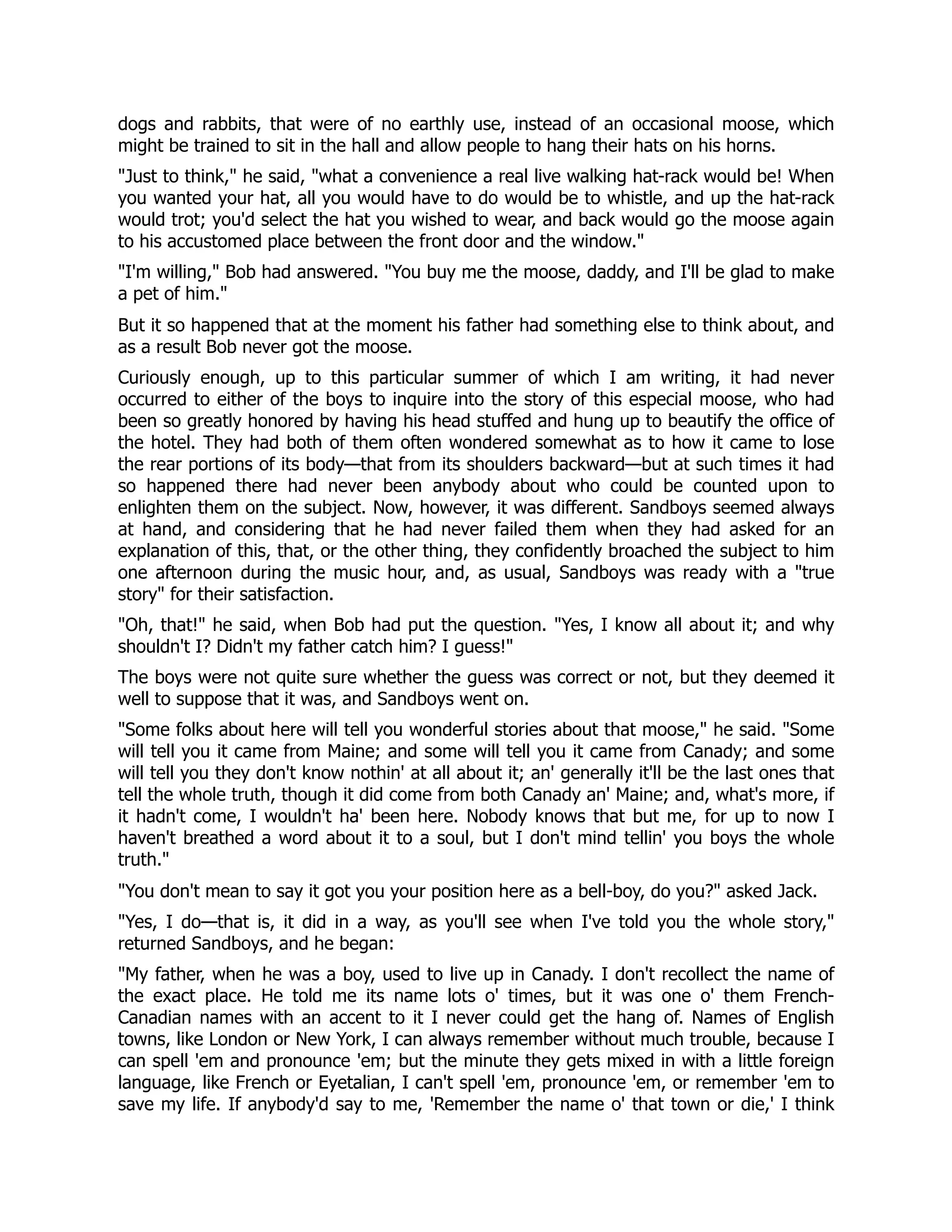
Time went on, and pop got to be a pretty big boy, and on
his thirteenth birthday his father gave him the gun he'd
used in the war—the war of the Revylation, I think it was,
when George Washington was runnin' things. With it he
gave him a powder-flask and some bullets, and I tell you
pop was proud, and crazy to go huntin'. His father wasn't
anxious to let him, though, until he thought pop knew
enough about fire-arms to kill something besides himself,
and he told him no, he couldn't. He must wait awhile. So
pop tried to be good and obey, but that gun was too much
for him. It kept hintin', 'Let's go huntin'—let's go huntin','
and one night pop could not resist it any longer. So after everybody'd gone to bed, he got
up, sneaked down stairs into the parlor, took down the gun from the bricky-brack rack,
and set out for the lonely woods.
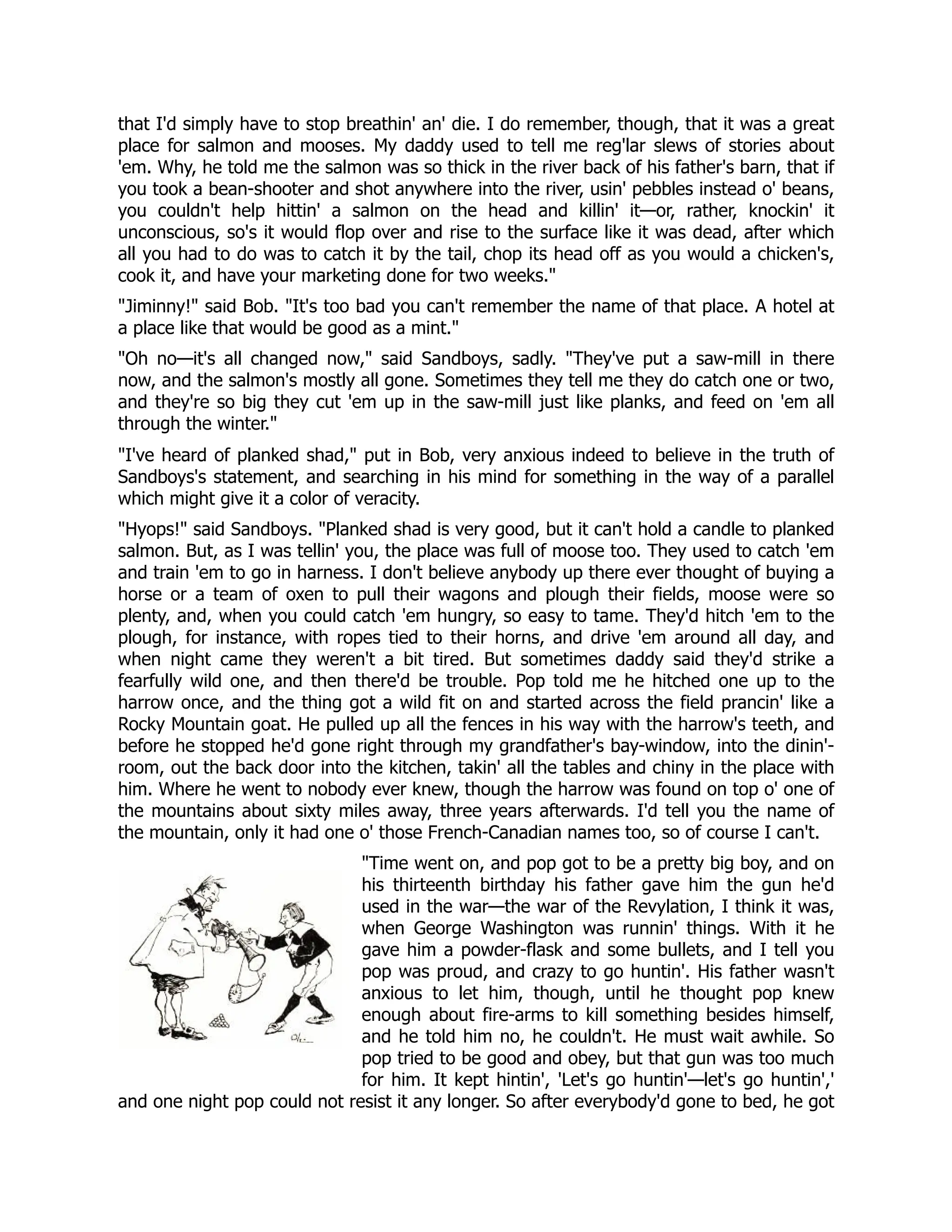
'If I don't kill nothin',' he said to himself, 'I'll get home
before they wake up; and if I do kill somethin', pa will
be so pleased an' proud he'll forgive me.' He little
thought then he was leavin' home forever. He opened
the door softly, an' in half an hour he was off on the
mountain, 'longside of a great big lake. Pretty soon he
heard a sound, and through the darkness he see two
big eyes, flamin' like fire, a-lookin' at where he was. It
was that moose up there as was a-lookin' at him. For a
minute he was scart to death, but he soon recovered,
upped with his gun, an' fired—only he was too excited,
and he didn't do any more than graze the moose's
cheek. You can't see the scar. It's been mended. It was
a tarrable exciting moment, for in a jiffy the moose was
after him, head down. Pop tried to run, but couldn't. He
stumbled, an' just as he stumbled he felt the big
moose's breath hot on the back of his neck. He thought
he was a goner for sure; but he wasn't, as it turned out,
for as he rolled over and the moose tried to butt him to
death, pop grabbed holt of his horns, and the first toss of his head the moose gave
landed pop right between 'em, sittin' down as comfortably fixed as though he was in a
rockin'-chair. If you'll look at the antlers you'll see how there's a place in between 'em
scooped out just right for a small boy to sit in. That's where pop sat, hangin' on to those
two upper prongs, with, his legs dangling down over the moose's cheeks.
Phe-e-e-ew! whispered Bob. He was in a fix, wasn't he? What did the moose do?
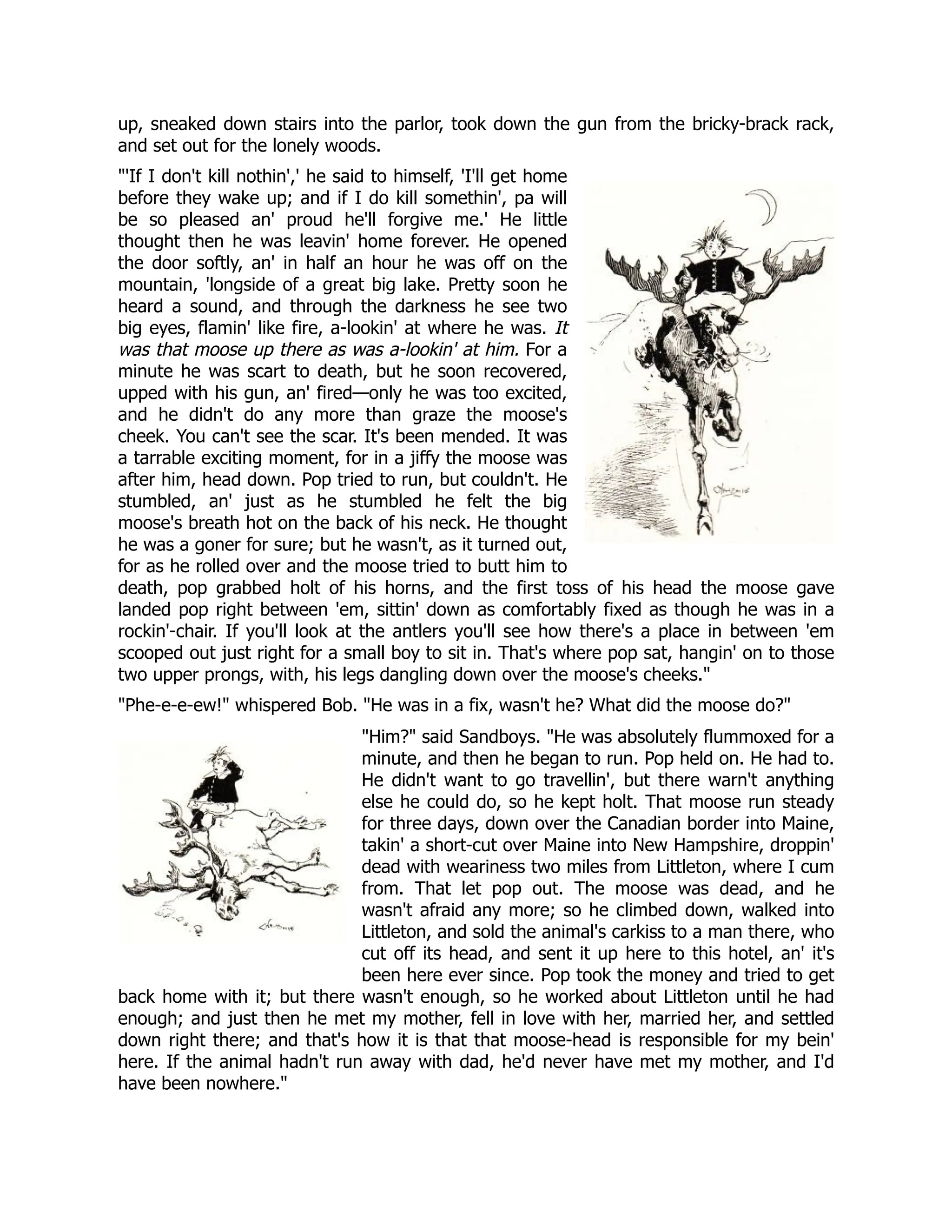
Him? said Sandboys. He was absolutely flummoxed for a
minute, and then he began to run. Pop held on. He had to.
He didn't want to go travellin', but there warn't anything
else he could do, so he kept holt. That moose run steady
for three days, down over the Canadian border into Maine,
takin' a short-cut over Maine into New Hampshire, droppin'
dead with weariness two miles from Littleton, where I cum
from. That let pop out. The moose was dead, and he
wasn't afraid any more; so he climbed down, walked into
Littleton, and sold the animal's carkiss to a man there, who
cut off its head, and sent it up here to this hotel, an' it's
been here ever since. Pop took the money and tried to get
back home with it; but there wasn't enough, so he worked about Littleton until he had
enough; and just then he met my mother, fell in love with her, married her, and settled
down right there; and that's how it is that that moose-head is responsible for my bein'
here. If the animal hadn't run away with dad, he'd never have met my mother, and I'd
have been nowhere.
It's very interesting, said Bob. But I should think he'd have sent word to his father that
he was all right.
Oh, he did, said Sandboys; and a year or two later the whole family came down and
joined him, leavin' Canady and its French names forever.
And here the narrative, which might have been much longer, stopped, for the cross old
lady near the elevator sent word that that talkin' must stop, because while it was goin'
on she couldn't hear what tune it was the trumpeter was blowin'.
THE GAME OF CHOLE.
BY W. G. VAN TASSEL SUTPHEN.
Chole (pronounced shōl) is a capital game for the enthusiastic golfer at this time of year,
when the fields are brown and bare, and the careful green-keeper has closed the regular
golf course for fear of harm to his precious putting greens. It is golf, and yet it is not golf,
the essential difference being that but one ball is used, one player striving to advance it
towards a certain agreed-upon goal, and his opponent as strenuously endeavoring to
thwart him in the attempt. But, on the other hand, it is not hockey or anything
resembling it. Each player has for the time being absolute possession of the ball, and
cannot be interfered with while he is making his stroke. It is an old Belgian game, and
undoubtedly one of the ancestors of our modern golf. As a matter of fact, it is still played
in the Low Countries with rude iron clubs and an egg-shaped ball of birchwood. The
following extract from a historical paper on the beginnings of golf explains very clearly
the purpose and method of the play at chole:
If Tom Morris and Hugh Kircaldy were going to play a match at chole, they would
first fix on an object which was to be hit. A church door at some five miles distance,
cross country, seems to have been a favorite goal. This settled on, match-making
began—a kind of game of brag: I will back myself to hit the thing in five innings,
Tom might say. (We will explain in a moment what an innings meant.) Oh, I'll back
myself to hit it in four, Hugh might answer. Well, I'll say three, then, Tom might
perhaps say, and that might be the finish of the bragging, for Hugh might not feel it
in his power to do it in two, so he must let Tom try. Then Tom would hit off, and
when he came to the ball he would tee it and hit it again, and so a third time. But
when they reached the ball this third time, it would be no longer Tom's turn to hit,
but Hugh's. He would be allowed to tee the ball up and dechole, as it was called—
that is to say, to hit it back again as far as he could. Then Tom would begin again
and have three more shots towards the object; after which Hugh would again have
one shot back. Then if in the course of his third innings of three shots Tom were to
hit the church door, he would win the match; if he failed, he would lose it.
It is evident, from this explanation, that chole gives first-class practice in driving; in fact it
is nothing but a succession of tee shots, and the longest driver ought always to win,
unless he is so over-confident of his powers that he is induced to bid too low for the
honor of being choleur. It may be added that hazards in the lie of the ball are not fairly a
part of the game. Each striker has a right to tee his ball, and he should be allowed to do
so anywhere within two club-lengths of where the ball has dropped. In the case of a lost
ball or a ball in water, the player must go back to the place whence the lost ball was
struck, and play a new one, without penalty. Of course only a driver, or play club, is
carried, and a caddie is not necessary, as the players themselves should be able to keep
track of the ball. In Belgium the game is played with three or more on a side, but in this
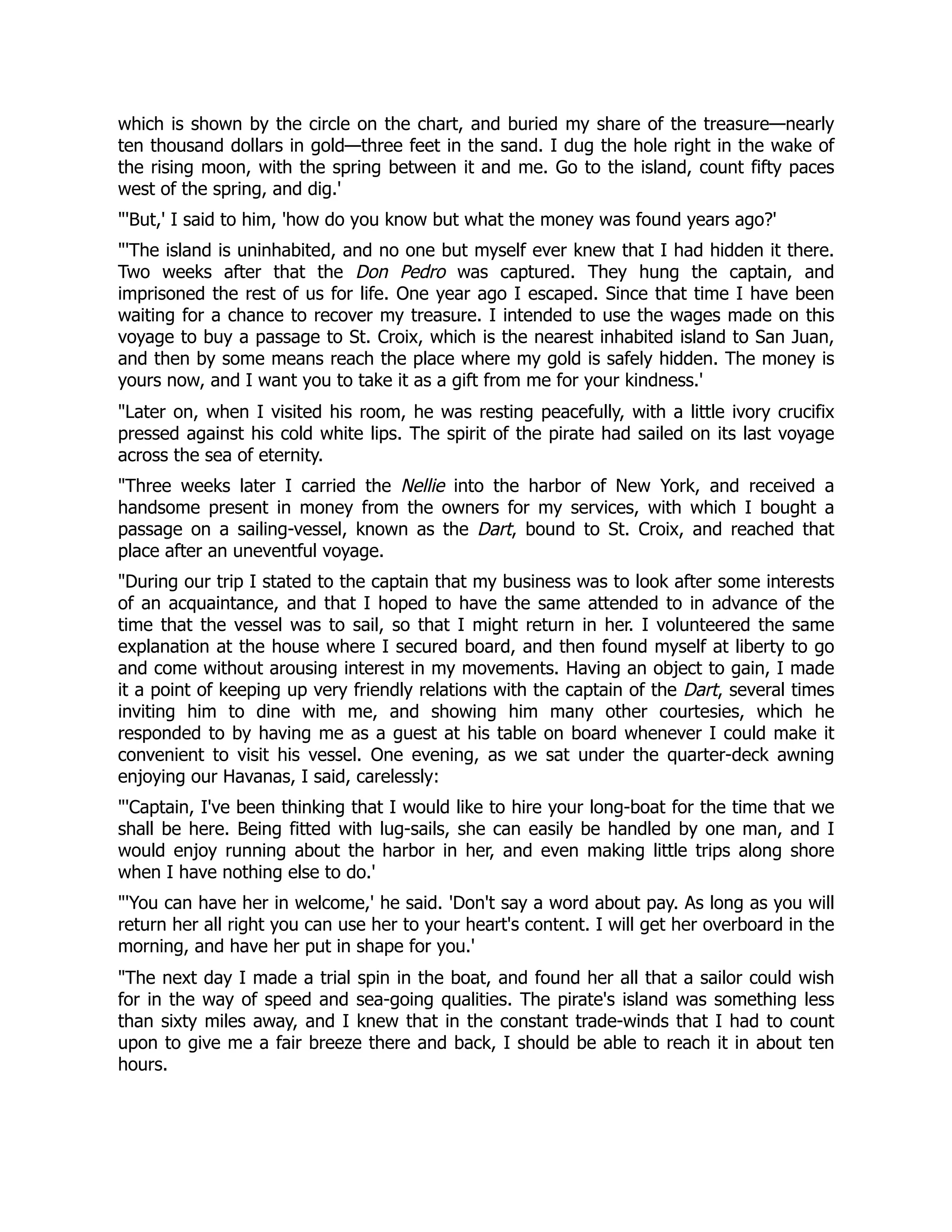
DIAGRAM
OF THE
FIELD.
case the players have to wait too long for their turn to strike, and the interest must be
correspondingly diminished. Here is a better plan for a match game at chole:
The battle-ground should be a field of about 400 yards in length, the
fence at either end serving as the goal over which the ball is to be driven.
The width of the field is of no account, providing that there is a clear
space of at least fifty yards to give a chance for straight and open play. In
practice it might be well to roughly indicate these side-lines by means of
stakes, and if the ball is knocked out of bounds it must be brought back
precisely as in football. Supposing that there are six on a side, the most
skilful player should act as captain, and arm himself with the ordinary
wooden driver. The second man should carry a brassey, the third a cleek,
the fourth a lofter, the fifth a niblick, and the sixth a putter. Or there may
be any other selection among the ordinary clubs used at golf, provided
that each side is armed with virtually the same weapons, and, most
important of all, that every combination must at least include a driver, a
lofter, and a putter. Three is the smallest practicable number for a side,
and the maximum may be put down at six or seven. The object of each
side is to drive the ball over their adversary's goal-line, but the strokes are
taken in turn, and there is nothing resembling the free hitting and
scramble of hockey. The captains toss for the opening stroke, and the
winner tees the ball at the centre of the field, and strikes it with his driver
as far as possible towards the enemy's goal-line. After he has had his
stroke, it is the turn of the other side; and now comes in the essential
point of the game. The return shot must be made by the weakest club on
the opposing side, viz., the putter. The idea is that the players shall all strike in regular
rotation, but the order of the sides is exactly opposite. In other words, one side strikes in
succession with driver, brassey, cleek, lofter, niblick, and putter, their opponents
answering with putter, niblick, lofter, cleek, brassey, and driver. It is evident that if A leads
off their attack will grow weaker as the less powerful clubs come into play, while B, the
defence, will grow stronger in the same proportion. Theoretically, after a full exchange of
shots the ball should be again at the centre of the field from where it started, but of
course, in practice, accidents will happen and shots will be foozled.
The field should be long enough to give the defence a fair chance to rally, and it
therefore should not be less than 400 yards in all. It should not be much longer, as then
it would hardly be possible for ordinary players to ever get near enough for a goal.
Supposing that in actual play the Captain of the Blues drives off and sends the ball 130
yards out of the 200, the putter on the Red side must reply, and he may succeed in
driving the ball back 30 yards. Brassey of the Blues has now a carry of 100 yards to make
to put the ball over the fence and win a goal. If he does it, it is perfect play, and the
Blues are credited with one point. But if he tops his ball or drives short, the niblick man
of the Reds may get it back to, say, the 100-yard point, and the Blues have now a chance
with the cleek to get it over. If this attempt fails, the Red goal should be out of danger for
a while, for their long driving clubs are now coming into play to carry the war into Africa.
But at any stage of the game some one may slip up on a difficult shot, and so the
advantage be gained or lost. The exact size of the field will largely depend upon the
driving ability of the players, and that can only be arrived at by experiment. Theoretically,
the goal should be made on the third or cleek shot—that is, with perfect play on each
side. Of course only the captains have the privilege of teeing the ball; all the other
players must take it as it lies. A ball knocked into a hazard must be played as in match-
play at golf; but if it has not been extricated after each side has taken a shot at it, it may
be lifted and dropped a club-length outside of the hazard at a point agreed upon
between the two captains. A ball in a hazard may not be teed, and this gives a chance for
finesse. For instance, suppose that the ball is perilously near the Red goal, and it is Red
putter's turn to play. With a straight drive he can only get it a few yards back, and Blue
driver, whose turn it is to follow, will be almost certain to get it over. But if Red putter can
play it into a hazard or behind a tree, Blue driver will probably fail to make the goal, and
that will give the Reds another chance. Other variations will occur in the playing of the
game, and may be readily worked out by any boy with a turn for generalship. After each
point the sides change goals, so as to equalize the chances of the hazards, and the side
that has lost the goal drives off. A ball driven through or under the goal-fence does not
count for either side. It must be brought out to a point half-way distant between the
centre of the field and the point where it went over the goal-line, and there teed for the
player whose turn it is to strike. A ball over the side-line is brought inside, as in football,
and dropped a club-length from the line. In the case of a lost ball, the inning begins
again as though no play had been made. A player may not strike the ball back over or
through his own goal-line. If he does so, accidentally or otherwise, the ball is brought out
and teed precisely as in the former case, where the attacking player had failed to put it
fairly over.
The game may be made still more scientific and interesting if a regular field be laid out
with chalk lines, as in football. In this case the goal at each end should be a circular pit
six feet in diameter and six inches deep. The diagram gives the other proportions and the
general arrangement of the field. The vantage-lines indicate the spot where the ball is
to be teed in the case of a failure of a try for goal. There is no restriction upon the
direction in which the ball may be played, except in the case of a player who knocks it
over his own goal-line. The ball is then teed at vantage. Balls out of bounds are placed
on the side-line at the crossing-point. To make a goal, the ball must drop in the pit and
stay there.
It is evident that the interest of the game will depend upon the evenness with which the
players are matched. As a general thing a player should be assigned to the club which he
is most expert in handling, and the players are known by the names of the clubs they
carry. In no case must the rotation of play be altered, and driver always leads off at the
beginning of an inning. It would be possible for two men to play the game, using their
clubs in the prescribed rotation, but the match between sides gives a chance for more
interesting work. If the sides are uneven, one man may, by special agreement, be
allowed to play two clubs.
THE PIRATE'S TREASURE.
BY CAPTAIN HOWARD PATTERSON.
Ralph, said Grandfather Sterling, one hot August morning, looking over the veranda rail
to where the boy was stretched full length upon the lawn, did I ever tell you about the
time that I went hunting for a treasure that had been buried by a pirate on one of the
islands in the West Indies?
The lad came bounding up the steps in delight, for there was no greater treat to him
than one of the old sea-captain's stories concerning the long and adventurous life that he
had led from the time of his first voyage as cabin-boy until his retirement from the sea
about two years before.
No, indeed, Grandpop, and it will be jolly, I'm sure. Please fill up your pipe, so that you
won't have to stop just when you get to the most exciting part. Here's your box of
matches; and now, as you often say, 'let the reel hum.'
Captain Sterling smiled affectionately into the eager face upturned to his, and
commenced his story:
It was when I was second mate of a brig called the Nellie, a good many years ago, that
this yarn really begins. We were homeward bound from Brazil, with a cargo of coffee,
when the yellow fever broke out on board. First the captain sickened and died, then in
order followed our first mate, leaving me in command. Next the oldest member of our
crew was struck down, and to give him a chance for his life, as well as to humor the
wishes of the men, I had him taken out of the dark hot forecastle and brought aft into
one of the spare state-rooms in the cabin. Here I nursed him as well as I could; but
although the fever broke after the third day, it left him so weak that he could not rally,
and his end was hastened on account of his not being able to retain the slightest
nourishment. He seemed to be very grateful for my care. On the afternoon of the fifth
day of his sickness he said to me that he knew his end was near, and that he wished to
show his gratitude while there was yet time. In his chest in the forecastle, he stated that
there was a leather wallet, which I was to get and give to him. I did as he requested. He
took from it a sheet of paper, on which was rudely sketched the outline of an island, with
a compass showing the cardinal points. On the western side of this island there was an
indentation resembling a bay having a very narrow entrance from the sea, and in about
the middle of the sketch there was a small circle, about west of which a cross was
marked.
'Take this,' he said to me, 'and listen to what I say. This is a chart of a little island known
as San Juan, in the Windward West Indies. You will see that I have given its latitude and
longitude. Twenty years ago I was one of the officers of the pirate schooner Don Pedro.
We went on shore at San Juan to divide the contents of the treasure-chest and to
carouse. During the night, when all others were sleeping, I stole away to the spring,
which is shown by the circle on the chart, and buried my share of the treasure—nearly
ten thousand dollars in gold—three feet in the sand. I dug the hole right in the wake of
the rising moon, with the spring between it and me. Go to the island, count fifty paces
west of the spring, and dig.'
'But,' I said to him, 'how do you know but what the money was found years ago?'
'The island is uninhabited, and no one but myself ever knew that I had hidden it there.
Two weeks after that the Don Pedro was captured. They hung the captain, and
imprisoned the rest of us for life. One year ago I escaped. Since that time I have been
waiting for a chance to recover my treasure. I intended to use the wages made on this
voyage to buy a passage to St. Croix, which is the nearest inhabited island to San Juan,
and then by some means reach the place where my gold is safely hidden. The money is
yours now, and I want you to take it as a gift from me for your kindness.'
Later on, when I visited his room, he was resting peacefully, with a little ivory crucifix
pressed against his cold white lips. The spirit of the pirate had sailed on its last voyage
across the sea of eternity.
Three weeks later I carried the Nellie into the harbor of New York, and received a
handsome present in money from the owners for my services, with which I bought a
passage on a sailing-vessel, known as the Dart, bound to St. Croix, and reached that
place after an uneventful voyage.
During our trip I stated to the captain that my business was to look after some interests
of an acquaintance, and that I hoped to have the same attended to in advance of the
time that the vessel was to sail, so that I might return in her. I volunteered the same
explanation at the house where I secured board, and then found myself at liberty to go
and come without arousing interest in my movements. Having an object to gain, I made
it a point of keeping up very friendly relations with the captain of the Dart, several times
inviting him to dine with me, and showing him many other courtesies, which he
responded to by having me as a guest at his table on board whenever I could make it
convenient to visit his vessel. One evening, as we sat under the quarter-deck awning
enjoying our Havanas, I said, carelessly:
'Captain, I've been thinking that I would like to hire your long-boat for the time that we
shall be here. Being fitted with lug-sails, she can easily be handled by one man, and I
would enjoy running about the harbor in her, and even making little trips along shore
when I have nothing else to do.'
'You can have her in welcome,' he said. 'Don't say a word about pay. As long as you will
return her all right you can use her to your heart's content. I will get her overboard in the
morning, and have her put in shape for you.'
The next day I made a trial spin in the boat, and found her all that a sailor could wish
for in the way of speed and sea-going qualities. The pirate's island was something less
than sixty miles away, and I knew that in the constant trade-winds that I had to count
upon to give me a fair breeze there and back, I should be able to reach it in about ten
hours.
During the next two or three days I made several short excursions along the coast,
gradually paving the way for the dash I had in view. At last the day arrived when I
determined to stretch away for the little coral island below the horizon. In the early
morning I left the house, carrying a valise, in which was food sufficient for my anticipated
needs, a large garden trowel, and a boat compass that I had brought from the States.
Folded in the pocket of my coat I carried a chart of the Windward Islands, and with this
equipment I stepped on board, hoisted the two jib-headed sails, and started on my
voyage.
Hour after hour I was swept swiftly onward over the wind-whipped waves, holding the
brave little vessel steadily to her course. It was about four o'clock in the afternoon that I
lifted the island into sight, bearing directly ahead, and an hour later found me sailing
through the narrow inlet that the pirate had laid down on his chart. I ran the boat head
on to the sandy beach, securing her painter to one of several stunted palm-trees that
grew in a bunch close to the water. The island was not much more than a mile in
circumference, and was impoverished in the matter of vegetation, although the cactus-
plant showed here and there, and a few cocoanut-trees with a fringe of sickly scrub
underbrush occupied the centre of this otherwise barren island. I reasoned that the site
of the spring must be found within the little grove; so, providing myself with the trowel
and compass, I made my way toward it.
From the time that I had first become familiar with the pirate's secret up to the hour
when I landed on the island my head had been perfectly cool and my nerves tranquil; but
now, as I approached the spot that I had travelled two thousand miles to find, I grew
dizzy, and my limbs trembled, so that I was obliged to throw myself on the sand to rest
for a few minutes and to force a return of my self-control. Then I arose and stepped
within the circle of the little oasis.
If there had been a spring there twenty years before, it had dried up in the interval,
although a bowl-shaped hollow in the soil possibly showed where the water had once
oozed through the sand.
I asked myself if I had not been too credulous in pinning my faith to a pirate's wild tale.
Had I been chasing a rainbow? Had I spent hard-earned savings and wasted several
months' time on a wild-goose errand? Such thoughts made me sick at heart and half
desperate. I placed my compass on the ground, carefully measured fifty paces due west
of what I was forced to consider the site of the old spring, and fell to digging with my
trowel.
At the depth of about three feet I struck coral; then I commenced a trench running
north and south, and dug away for an hour, meeting with nothing but fine white sand
and the coral foundation. Hope as good as deserted me. Looking at the sun, I saw that it
was almost touching the horizon-line, and knew that in a short time darkness would fall—
for there is no twilight in the tropics. I dropped my trowel, and sat down on the edge of
the hole that had promised so much in the beginning. As I gave loose rein to my bitter
thoughts I savagely kicked the toe of my boot into the sandy wall of the opposite side of
the pit.
Was I dreaming? Had disappointment turned my brain, or had I really heard the clink of
metal? I held my breath, and again drove my boot heavily against the wall.
A piece of the soil fell into the pit, and out of the hole that it left a golden waterfall
poured down with a merry, maddening clink, clink, clink; and there I sat, motionless,
fascinated, while the treasure ran over my feet and literally hid them from sight. Then my
senses partly returned to me, and I dragged my boots out of the gold and jumped and
shouted in a delirium of joy.
It was no myth, after all, for the thousands so secretly hidden away by the pirate looked
upon the light of day for the first time in twenty years, and as I gazed down at the
golden heap I realized that it was mine—all mine!
The sun went down and the deep shadows fell on sea and land as I sat gloating like a
miser over my riches. I slept in the ditch that night, lest during absence my fortune
should be spirited away, and when morning came I stowed the gold in the valise that I
had brought from the boat, then dug into the pocket from which it had flowed, to
discover that it yet contained a few scattered pieces, and the rotten remnants of the
canvas bag in which it had been buried.
I set sail with my precious freight, and late that afternoon I reached St. Croix, where I
pottered about the boat until nightfall; then, under cover of the darkness, I carried the
valise to my room on shore and stowed it in my sea-chest.
Little remains to be told. I returned to New York in the Dart, and used the little fortune
that had come to me to purchase a captain's interest in a fine vessel.
IMPORTANT TRIFLES ON WAR-SHIPS.
BY FRANKLIN MATTHEWS.
II.
Just outside the door of the Captain's cabin, on every ship of the navy, there stands a
sentry. He paces up and down for a distance of about ten feet. On one of the sides of the
cabin is an electric indicator similar to those seen in the large hotels back of the clerk's
desk. The sentry on the ship passes that indicator every time he paces from one end of
his limited beat to the other. He cannot escape hearing its bell when it rings, and his eye
at once sees whence the signal comes that is telegraphed to the Captain in time of
emergency. That indicator is placed there so that, when necessary, there shall be instant
communication with the Captain. Some of the dials tell stories of the utmost importance
to the safety of the ship. They tell these stories automatically.
Let us see how one of the most important of these dials may perhaps save the ship from
destruction. Down in the coal-bunkers there is a little instrument attached to the side of
each compartment that looks like a little thermometer. It is not more than four or five
inches tall. It is simply a thermometer with an electric attachment. A fire has started in a
coal-bunker, as happens sometimes on large steamships, through what is known as
spontaneous combustion. It may smoulder for several days and give no indication of its
existence. At last it breaks into a flame. Some one has felt a hot deck through his shoes
as he has walked along, or perchance has accidentally placed his hand on the iron-work
of the compartment and found it blistering hot. Instantly the fire-alarm is rung, and if the
fire is not too far advanced the ship may be saved. On war-ships, however, no such risk
must be run. In the economy of space on such ships it frequently happens that these
coal-bunkers are placed very near, and sometimes next to, the powder-magazines. A fire
in the coal-bunkers would mean an awful explosion, the loss of the ship and hundreds of
lives.
Here is where that little thermometer plays its heroic part. It is called a thermostat, and it
is so arranged that as the heat increases, the mercury in the bulb slowly rises to what is
known as the danger-point. When the heat reaches that point the mercury sets an
electric current going. At once the bell on the indicator where the sentry outside the
Captain's door stands rings violently. The sentry hurries to it and sees a fire-alarm from a
certain compartment, and he hastily awakes the Captain. The latter presses a button,
perhaps without getting out of bed or up from his chair, and instantly there rings the
general fire-alarm throughout the ship, and every man on board is called to quarters. For
a few seconds it is time of immense confusion and noise. Great gongs are ringing in
various parts of the ship. Men are hurrying half dressed, if it be in the night, here and
there, and there is much shouting in the giving and passing of orders. In a twinkling,
however, order prevails, and through the aid of that little automatic thermometer the ship
and the lives of those on board are saved. This thermostat is an insignificant-looking
affair—a mere trifle in the ship's construction—but see what an important thing it really
is. These instruments are used in many buildings on land, but nowhere are they of such
importance as when placed in coal-bunkers or on the outside walls of magazines in war-
ships.
Another dial on the indicator where the sentry paces also plays an important part in war-
ships. It is called the water-alarm. All modern war-ships have what are known as double
bottoms. They are built to prevent the ship from sinking or from becoming flooded in the
chief compartments of the vessel below the water-line. Sometimes a ship may scrape
along the top of an unknown rock or reef, or may strike some obstruction floating unseen
beneath the waves. No one on board may feel the shock, especially if it is a light one.
The water may rush into one of these double bottoms, and although the ship may be
safe from sinking, the danger in time may be most grave. As the water fills the
compartment which has been broken, a little piece of wood rises with it, and finally, when
it reaches a certain height, it too establishes an electric current, and the alarm rings
outside the cabin door of the Captain. Again the alarm sounds through the ship, and if
possible, the break is mended temporarily, and the pumps set going to clear the
compartment of the water.
A TORPEDO BURSTING AN OUTER COMPARTMENT.
In time of battle, however, this water-alarm may tell a more important story. Perhaps a
torpedo from the enemy has struck the ship, and a gaping wound has been torn not only
in the outside bottom of the ship, but through the inner hull as well. Instantly the news
reaches the Captain through the water-alarm. The Captain simply presses a button, and
at once not only does the general alarm ring, but the siren whistle on the ship is set to
shrieking most horribly. Those siren whistles are seldom heard either in port or at sea.
They begin their noise with a low moan, and run up to an awful shriek, with a thin, ear-
piercing note that is almost unendurable. The siren may be blown by electricity as easily
as an electric door-bell may be rung. When the siren is heard it is a signal throughout the
ship to close all the water-tight doors in the various compartments, and thus confine the
inrushing waters to a limited space. If only one or two compartments are torn open by
the torpedo, the ship may be saved from sinking and a great tragedy of war may be
averted. When the siren howls, however, there is such a scurrying on shipboard as is
never seen at other times. Nearly every compartment has men in it at work. The alarms
and the whistles are their only warning, except, perhaps, the shouts of their companions.
A mighty rush is made to get out of some of these compartments. No time must be lost,
and there can be no waiting for a man to escape. If shut in, he may be drowned. It is a
question of his life or that of the ship and the lives of the rest of the crew, and there is
only one way to answer that question.
These water-alarms are used in many large buildings in connection with the fire-alarm,
but one can see how much more important they are on ships, especially on war-ships,
than on land. They are a most simple contrivance, and, like the thermostat, mere trifles;
but they may turn the tide in a naval battle, and directly or remotely settle the fate of a
nation.
In the early days of steam navigation the Captain of a vessel could speak to the engineer
through a tube and regulate the speed of the ship. When the vessels grew larger, the
signalling was done by means of bells. That method is in common use to-day in many
vessels that ply in harbors, such as river steamboats and tug-boats. As the ocean-liners
increased in size the bell system of signalling became antiquated. The Captain or the
navigator was 300 or 400 feet away from the engineer, and from 20 to 40 feet above the
engine-room. In time of emergency it became necessary to send word to the engineer
exactly what to do in half a dozen different cases. He must stop, back, go slow now with
one engine and now with another, or with both. A long chain was run from a contrivance
on the bridge to the engine-room. When the Captain pressed forward or backward a
handle on a vertical dial, a handle in the engine-room would move on a similar dial, and a
bell would ring to call attention to it, and the engineer knew at once what to do. This
system is in use at the present time on all large passenger-ships and most war-ships in
the world.
Electricity has invaded this field also, and on the newer war-ships of the navy we have
the signalling done by this agent. By the electric-engine telegraph, which Lieutenant Fiske
of our navy has invented, not only does the engineer know at once when to go at full
speed, half-speed, when to stop and back, and all that, but the Captain can tell at an
instant, by looking at a little dial attached to his signalling apparatus, whether his orders
have been understood. The little dial is connected with that part of the signalling
apparatus in the engine-room on the same electric circuit, and thus the Captain knows
exactly what is going on in the engine-room. But the new invention goes farther than
that. It tells the engineer just how many revolutions of the screws a minute the Captain
desires the engines to make. Full speed, for example, in the old way of signalling may
mean anywhere from 80 to 90 or 100 revolutions of the screws. Half-speed may mean
anywhere from 60 to 80 revolutions. The engineer in those cases has to use his own
judgment as to what speed to employ, unless a message is sent especially to him from
the Captain. In the electric device which we are just beginning to use there are certain
notches on the dials, and the Captain can signal exactly the number of revolutions he
desires each engine to make. He not only gets a signal back, but he has a telltale
instrument before his eyes which shows that the engines are making 59, or 73, or
whatever number of turns the Captain wishes them to make.
Now this regulation of the revolutions of the ship's engines has a most important part to
play in warfare. One of the most essential things in naval manœuvring is that ships shall
keep a certain distance from one another. It avoids collisions, and preserves regularity in
fire and in changing positions at critical times. It is as essential as that soldiers shall
present a solid line to the enemy in battle on land. A helter-skelter fleet would be beaten
from the start in a fight. It is most difficult for ships to keep at regular intervals. The
engines of one turn just a little faster than the engines of another, and little by little a
ship creeps up or drops away from its fellows. Sometimes the distances are preserved by
guess-work. Lately a little instrument has been invented by which the Captain can see at
a glance how far he is from the ship ahead of him. It is a modification of the sextant. The
height of a certain object on the ship in front is known. That is the base of a triangle. The
size of the angles at the end of that base are seen at a glance by the observer, and by
the manipulation of a screw or two the Captain of a ship can see on a sliding-scale
whether he is going too slow or too fast. In either case he signals a change or two in the
number of revolutions he wishes the engines to make, and he preserves his required
distance. Accuracy in this matter may win a battle.
So great is the din and confusion on war-ships in time of battle that what are called
visual signals are demanded. This has brought several contrivances into operation that
are new. For example, we have a transmitter of orders. It tells the gunners when and
what guns to load, and with what kind of shot; when to stand ready to fire; when to fire,
and when to cease firing. In the old days, and even in the present days, such orders are
conveyed in speaking-tubes or by telephone on most ships. In the great noise an order
may be mistaken, but with a visual signal in the shape of an indicator, operated by the
mere pressing of a button, orders from the Captain may be conveyed clearly and
instantly.
Another apparently trifling thing in the development of navigation is an electrical
signalling device for indicating the exact angle the Captain wishes the helm set in making
a turn. He presses a button, and the man at the wheel sets the rudder accordingly. A dial
informs the Captain that the rudder is set as required. This is most important, because it
tends to avoid collisions as the war-ships suddenly change their positions in column. We
all remember how serious a collision, even going at slow speed, may be when we recall
how three years ago the Camperdown sunk the Victoria of the English Mediterranean
squadron on a peaceful day off the coast of Africa, in going through some simple
evolutions, and when hundreds of brave sailors, including the Admiral of the fleet himself,
were drowned, as the Victoria went down before the small boats of the other vessels of
the fleet could reach them.
One of the great problems in naval tactics is to secure an effective method of signalling
orders from ship to ship. In the night it is comparatively easy. A string of red and white
alternating electric lights is strung from a yard downwards. An operator sits in front of a
THE ADMIRAL WORKING
SIGNALS AT NIGHT.
little box in which there are a lot of black keys on which
are stamped a certain number of red and white dots. As
he presses these keys, which are arranged in a circle and
look like so many fancy dominoes, the red and white
lights flash out in certain combinations. The operators
see them, and signal back the same light. Each key
pressed down means a certain letter, and it takes little
time to send an order. In the daytime signals must be
sent by flags, or by means of a contrivance with long
arms such as we see on signal-towers on a railroad. As
these arms are jerked into certain positions they tell a
story of their own.
During a battle by day or night all such systems are of
little value because of the smoke. Whistles can be of little
use, because the noise of battle would drown them.
Electrical experts are trying to devise a system of
telegraphing through the water, of course without the use
of wires, but the outlook in that direction is not promising
at present.
Then there are important new devices which we can only
mention. One of them is the sounding apparatus, by which the depth of water can be
taken when going at full speed. The pressure of water on a column of air varies at certain
depths of the ocean. This pressure is marked by the discoloration of a fluid in a tube
through the agency of the salt water. The electric firing of guns is also interesting. A
current of electricity is passed through a filament, such as we see in the incandescent
lamp of a house electric light, and at once the heat sets the gun off as effectively as if a
spark had ignited the powder. Then there is the aerophone, or fog-indicator, which points
out the exact direction of some noise-making object by cutting the sound-wave in two, so
as to send it first in one ear and then the other of the man who operates the invention,
until finally he gets it in equal volume in both ears, and the dial on the machine points
straight to the object which cannot be seen.
All these inventions, which of themselves seem mere trifles, are necessary in these days,
because of the wonderful advance in warfare and the construction of ships. In the old
days the Captain could roar his orders out and make himself heard almost everywhere.
Nowadays a fraction of a second may determine the outcome of a battle. He must be
able to find the distance of his enemy, must fire his guns without aiming them in the old
way, must regulate the speed of his ship to the single turn of a screw, must put his own
helm at a certain angle to a degree. Without electricity he would be helpless in the noise
and confusion. Even with electricity he is hampered, and so we may expect that the
invention of these little devices will go on, until one man in a ship may control that
engine of war as completely as if he were in every vital place in the ship at one and the
same time.
HOW TO USE THE VOICE.
BY FELIX BEAUMONT.
Now, my friends, said Mrs. Martin, as she gathered a knot of young people about her
on the breezy veranda of her pleasant country house, one moonlight evening in
September, we have had picnics, and drives, and walks, and rows upon the lake in the
daytime, and dances almost every night since you have been visiting me, and I believe
that you may be getting sufficiently tired of these sports, as the weather grows cooler, to
wish to change about and settle down to something at once more instructive and more
artistic. You are, all of you, students of music—Ethel reads it very well at sight, Kenneth
plays the 'cello, Patty plays the violin, Beatrice sings charmingly and plays
accompaniments, besides being a general helper and strong inducer of merriment, while
the rest of you have good voices, very pretty taste, and some knowledge of music. So I
am going to organize a musical club, which shall meet here regularly once a week after
you leave me, having finished your visits. And I am going now to attempt to explain to
you so thoroughly the best methods of getting up a 'musical' that other boys and girls
who wish to amuse themselves in the same way may learn from your example. A great
deal of fun may be had from the preliminary practice and rehearsals. I should advise you
to form, in the first place, three quartets: one of mixed voices—that is, you know,
soprano, alto, tenor, and bass—besides one of male voices, first tenor, second tenor, first
bass (or barytone), and second bass. Then a quartet of female voices—two sopranos and
two altos, and this last can sometimes do trios as well as quartets. For all of these
different sets of voices the most beautiful and pleasing music has been made.
Mendelssohn's collection for mixed voices, called 'Open-Air Music,' is intended to be done
without accompaniment, which, as you see, fits it to be sung independently in any place
—in the woods, or on the lake, or while driving. It is as full of inspiration and of the true
sweet Mendelssohnian melody as anything that ever dropped from the pen of that
sociable and amiable composer; the harmonies are delicious, and the words are full of
the poetry of land and sea and love. For male voices there is a large literature; but
perhaps the heaviest mass of writing is found in compositions for women's voices, either
in the form of duets—as, for instance, those of Abt, Mendelssohn, Rubinstein, or Dvorák
—in trios, and in quartets.
In this connection let me tell you, said Mrs. Martin, who now saw that her young
audience was thoroughly attentive and interested, that Schubert has written a most
lovely 'Serenade' for alto solo and women's chorus. For all three kinds of quartet, as I
have said, there is a large choice of music. The old Scotch, English, and Irish songs and
ballads have been arranged to be sung by male, female, or mixed voices, so that 'Robin
Adair,' 'The Bluebells of Scotland,' 'Annie Laurie,' 'Tom Bowling,' 'Hearts of Oak,' 'The Bay
of Biscay,' 'Kathleen Mavourneen,' 'The Last Rose of Summer,' and 'The Harp that once
through Tara's Halls' take on new beauties from their harmonizations. Then there are
humorous things, such as Homer Bartlett's 'The Frogs' Singing-School,' or Caldicott's
'Spider and the Fly,' and all Ingraham's nine 'Nonsense Songs,' set to Lear's words, from
'The Owl and the Pussy-cat' to 'The Duck and the Kangaroo.' Italian folk-songs, too, have
been transformed into harmonized versions, and there are hosts of waltzes so pretty and
inspiriting that you will hardly be able to keep from whirling about while you sing them.
'Cradle Songs' and 'Slumber Songs' may be selected when for variety you need a bit of
reposeful quiet in your programme; and you know enough of Franz Abt's pure, sweet,
pleasing melody to be able to choose judiciously on the occasions when he would be
useful to you.
Of course, added Mrs. Martin, these musical attempts presuppose some knowledge of
sight-reading on the part of you young people; and as nothing is accomplished without
application and effort, you must be willing to take a little trouble in the practice and
perfection of whatever you undertake to perform. Each of you must carry his part home
and study it separately, until you are perfectly familiar with it, then you must rehearse
together until the whole thing goes smoothly. Do any of you understand, said Mrs.
Martin, giving a comprehensive glance along the semicircle of sun-browned smiling faces
in front of her, what you must do to make ensemble singing sound sweetly to the
listener? In the first place, never sing too loud. There is a great temptation for each
member of a chorus or quartet to use all the power of his voice as soon as he feels other
voices pushing against him; but whether in solo or other work, one of the cardinal rules
is to avoid singing as loudly as the vocal chords will permit. One must think continually of
the sound he is producing, must listen carefully to himself, by which method one can
modify and improve the quality of tone to a remarkable degree. Some people
undoubtedly make a much more successful effort than others in managing their voices
before they are cultivated. The best general advice to be given for the help of a novice is,
sing freely and naturally, with relaxed muscles. You should try to open the throat by a
movement which at once forces the tonsils apart and depresses the roots of the tongue,
somewhat as in the commencement of a yawn. Let the column of air which carries the
tone come straight through the middle of the open throat, and focus or strike in the roof
of the mouth just behind and above the upper teeth. Try to enunciate distinctly without
disturbing the continuity of tone emission.
Do you think any of us can do solos, Aunt Martha? asked little Patty, timidly.
Oh yes, indeed, replied Mrs. Martin, drawing Patty close to her. We must have some, of
course; they are so good for making boys and girls conquer shyness and nervousness
and consciousness. At first you should select simple songs of limited range, with
attractive flowing melodies. You will find plenty of just this kind among the works of
Gounod, Abt, Ries, Cowen, Sullivan, Curschman, Kücken, Fesca, Tosti, and Bohm.
Brahms's 'Lullaby' is a charming and easy bit of singing; so is Ries's 'Cradle Song.' Those
by Adalbert Goldschmidt and Gerrit Smith are pretty also. Indeed, slumber songs lend
themselves admirably to early efforts in solo work. Other song writers to whom you may
look for furnishing the best material are Jensen, Eckert, Lachner, Taubert, Bemberg,
Gumbert, Goring-Thomas, Bizet, Lassen, Delibes, Widor, Arditi, Mattei, Godard, Saint-
Saëns, Massenet, and so on, up to the classic heights of Rubinstein, Mendelssohn, Liszt,
Schubert, Schumann, Grieg, and Brahms. Of extreme modern writers who make pleasing
music you can rely on Chaminade, Nevin, Neidlinger, Bartlett, Johns, and Pizzi. Of course
among these names you will not find many opera-composers, for I have only cared to
mention the makers of songs. I will tell you something else, a little foreign to our
immediate subject of ensemble or solo singing, which, however, will, I am sure, afford
you much enjoyment and merriment. There are compositions called in German 'Kinder
Symphonien,' or 'Children's Symphonies.' Dear old Father Haydn made one of the best of
these, and they have been followed by others, by Romberg, Chwatal, Grenzebach, Meyer,
and Schulz. They are played by about ten or twelve persons. There will be a piano score
for either two or four hands, one for violin, and for a number of toy instruments. One of
the instruments is somewhat like a pair of bellows in construction. When it is pressed
together the most illusive sound of 'cuckoo, cuckoo,' comes from it, so natural as almost
to deceive the bird himself if he were listening.
Another instrument is a china mug with a spout like a teapot. The mug must be half
filled with water, and on blowing into the spout a melodious gurgling arises. This is
supposed to be an exact imitation of the ravishing song of the sad poetic nightingale.
Then there is a drum, a trumpet, a triangle, and many other things conducive to noise
and music. Each performer has a separate sheet to read his notes from, and the effort to
count properly, to wait for rests, and to make the right entrances, gives much serious
employment. But when at last everything goes well together the effect is very merry and
pleasing. One of Chwatal's symphonies is called 'The Sleigh-Ride.' The jingling of a set of
small sleigh-bells is a feature in this. I should think, added Mrs. Martin, that some of
these symphonies would be a great addition to your musicals, and give lots of fun. The
trumpeter of the occasion must take pains, however, not to fall into the error of the man
who blew a tremendous blast upon his horn in the middle of a piece of music, producing
a horrid discord. When the leader asked him, angrily, 'What in the world did you play that
dreadful wrong note for?' the man meekly replied, 'Ach Himmel, there was a fly on the
fourth line of the staff, and I played him!' Nor must you, went on Mrs. Martin, smiling at
her reminiscences, copy the negligent daring of a friend of mine who sang in a well-
known German Verein. Things had been going badly, and finally the conductor in despair
cried out, as he stamped his foot and gesticulated wildly, 'Tenors, tenors, you are a
measure behind!' Whereupon my friend called back lustily to him, 'Ach! muss man denn
so genau sein?'—must one then be so very particular? The children laughed heartily at
their dear hostess's jokes, as they tried always to do when it was at all possible.
And now, said tall Ethel, won't you please tell us all about the evening of the musical,
and what we shall wear, and how to write the invitations?
Wear? said Mrs. Martin. Why, of course you would wear your very best evening gowns,
you girls, and of course, to my mind, those who were dressed in white would look the
prettiest. And the boys would wear their Tuxedo suits, or whatever they looked smartest
in. As to the invitations, do not send out so many as to crowd your parlor uncomfortably.
The rule which I have found safe to believe is that one-third of all the people invited will
decline. This gives a hostess the liberty of paying a compliment to many more of her
friends than her house will actually hold. The form of the invitation may be thus:
Mrs. Dudley requests the pleasure of Mr. and Mrs. Allison's company on Thursday
evening, November 12, at half past eight.
Music at nine o'clock.
160 Saint Bernard Street.
Or your mother's ordinary visiting-card will do, if she writes in one corner, 'Music at nine
o'clock.' Invitations should be sent at least a week or ten days beforehand. If it is
possible for you to have a grand-piano, never use a square or an upright one. If you
must use either of the latter kinds, turn it away from the wall, and drape the back of the
upright with some pretty soft drapery, which can be held in place by books, vases, and a
lamp on the top of the piano. All the portières or other curtains that can be taken down
should be removed, and all the rugs and heavy furniture carried out of the room. Music
sounds so much better in a place free from soft thick hangings.
It is good to have programmes, for people enjoy listening to pieces much more if they
know their names. Should expense deter you from having them printed, they may be
nicely written off on a sheet of note-paper. For printed programmes, a card ten inches by
three and a half, folded once in the middle of its length, makes an extremely good form.
Would you like me to give you some idea of the programme, musically and spiritually
considered, as well as from its purely material stand-point? said Mrs. Martin, after a few
moments' silence, for I believe, with that exception, that I have told you all I can. Get
out your note-book, Bertram, and put down what I tell you.
Programme.
1. Mixed Quartet { 'Farewell to the Forest' Mendelssohn
{ 'O, Hush Thee, my Baby' Sullivan
2. Piano Solo, 'Spring' Grieg
3. Female Chorus, { Lullaby Brahms
{ 'My Flaxen-haired Lassie' Koschat
4. Tenor Solo, 'Máppari,' from 'Martha' Flotow
(Or song by Chadwick, 'Du bist wie eine
Blume.')
5. Male Quartet, { 'Verlassen bin ich' ——
{ 'The Owl and the Pussy-cat' Ingraham
6. Violin Solo, 'Simple Aven' Thorne
7. Piano, four
hands,
Ballet Music from Feramors Rubinstein
Programme No. 2.
1. Piano, four hands, 'Hochzeitsmusik' Jensen
2. Female Chorus, 'Rest Thee on this Mossy Pillow'Smart
3. Violoncello Solo, 'Love Scene' Victor Herbert
4. Soprano Song, 'Parting' Rogers
5. Violin Solo, 'Romance' Mrs. Beach
6. Male Quartet, 'It was not So to Be' Nessler-Vognih
And then, said Mrs. Martin, you could finish with the Kinder Symphony as a
merry ending, or add one or two numbers to those I have suggested, and
keep the Kinder Symphony for a separate evening's entertainment. At all
events, I hope you will find that I have inspired and helped you a little, and
that you will carry out the plans I have laid down.
Yes, we will! cried all the young people, in a breath; and Bertram, putting
his note-book in his inside coat pocket, said, dreamily, It's awfully late;
suppose we go in and take the gift of sleep!
OLD-TIME THANKSGIVING.
BY M. L. VAN VORST.
Come, will you help me harness
the bay?
Come, will you help me hitch up
the gray?
Grandfather's lent us the great big
sleigh.
Hip hurrah for Thanksgiving-
time!
Chestnuts and cider and fire's
glow,
Five good miles through the woods
to go,
Clear cold winds and a driving
snow.
Hip hurrah for the bells achime!
Fly by the hedge of the country-
side,
By the gleaming fields and the
farm-lands wide.
Hey for the boys and the girls as
they ride!
Hip hurrah for the gray and the
bay!
Snow-wreaths hang on the fir and
pine,
And the bells are ringing like silver
fine;
Bright cheeks are glowing and
bright eyes shine.
Hip hurrah for the jolly sleigh!
Come, will you go with us, one and
all,
To the games and romps in the
country hall,
Where the rafters ring with our
shout and call?
Hip hurrah for the fun and
cheer!
Months of the holly and mistletoe
We would hold you fast, for we
love you so.
Thanksgiving and Christmas and
sparkling snow
Gladden the days of the dying
year.
THE HANGING OF TEDDY.
Halloween was sure to see a variety of pranks played in Scottsville. It was a
fortunate front fence which had its own gate the next morning. All of which
shows that there were boys in Scottsville.
Well, gates are good enough if you can't do any better, said Teddy, on the
afternoon of a last day in October, but I'm getting tired of them.
What about signs, then? asked Joe.
Signs are all right—genuine signs up on buildings—not these pasteboard
cards saying 'To Rent,' and sewing-machine boards nailed on fences, and such
stuff.
You don't think you could get a big store sign down, do you? asked Fred.
Yes, I do.
Whose?
Oh, a lot of 'em. Mr. Parks's would be an easy one.
But it's up over the door, and runs clear across the front of the building!
protested Joe. And it's fastened up with irons!
Don't care if 'tis. We're good for it, if we only think so. I've been looking at it.
The irons are loose, and there's room to stand on the ledge behind it. It
would be just as easy as nothing to take it down.
What would you do with it? asked Joe.
Well, answered Ted, slowly, it says on it, 'M. Parks. Cheap Cash Grocery.' I
think it would look sort of funny to take it up and put it on the school-house.
The other boys instantly fell in with this idea, though they still doubted their
ability to get the sign down. Then Fred thought of the village's night
watchman, who spent most of his time in the business part of town.
But what about Billy Snyder? he asked.
Oh, my pa says Billy goes to sleep every night at nine o'clock, answered
Teddy, confidently. He says burglars might pull Billy's boots off and he'd
never know it.
Well, if he sleeps all night, he must walk in his sleep, said Joe, who lived
farther down town than the others. I've been awake 'way in the night
sometimes, and heard him tramping round.
But, don't you see, to-night he'll be up town looking out for fellows lugging
off gates, returned Teddy, not to be convinced that there was any danger
from the watchman. Besides, Billy can't run for shucks.
It was accordingly arranged that the boys should meet that night across the
street from Mr. Parks's store at half past ten; and promptly at that hour they
were all on hand. It was a dark night, and the streets were deserted.
It's—it's pretty dark, isn't it, Ted? said Joe, in a loud whisper.
Course, answered Teddy, contemptuously. Want it dark, don't we?
Y—yes. Seen anything of Billy?
Oh, he's all right—way off somewhere. He won't be down here to-night.
They tiptoed cautiously across the street, and looked up at the sign.
Has he been raising it? said Joe, very earnestly.
No, of course not, answered Teddy, impatiently.
Well, it never looked so high to me before, insisted Joe.
Oh, you're scared! returned the brave Ted. Better run home.
I'm not scared. How are you going to get up?
Climb the eaves-spout on the corner. It's easy as nothing, and he started
up.
He went up for five or six feet, but found it harder work than he expected. He
stopped and rested a moment, then struggled on. This he did twice, feeling
his hold weakening all the while. The last time he stopped he looked down. It
seemed a long ways. His hold suddenly grew still weaker, and he slid back and
rolled over on the ground.
Are you hurt, Ted? anxiously inquired the other boys.
Of course not, answered Teddy, impatiently. Came down to rest and put a
little dust on my hands, and he went out into the street and spatted his
palms on the ground.
We ought to had Tom Ketcham along, said Joe, when Teddy came back.
He's a bully climber.
Oh, pshaw! said Ted. If Tom Ketcham can climb any better'n I can I'd like
to know it. Just watch me now; and he started up again.
Thanks to the street dust or to a determination to show Joe that he was as
good a climber as Tommy, he managed to get up this time and wriggle in on
the cornice, which made a sort of ledge behind the sign. He loosened the iron
on that end of the sign, and walked cautiously along, taking a piece of
clothes-line out of his pocket, with which he intended to lower it. Just then
footsteps were heard approaching.
Billy's coming! cried Fred, in a hoarse half-whisper, and he and Joe started
down the street.
Hold on there! called Teddy to the younger boys, in a fierce tone. Get in
the doorway and keep still.
The others obeyed, and Ted himself lay down on the ledge behind the sign
and flattened out as much as possible. It proved to be only a man on his way
home, and he passed without seeing the boys.
Teddy's heart was thumping pretty hard as he thrust his chin over the edge of
the sign and whispered, You fellows down there?
Yes, answered the boys.
Well, what you so scared at? he asked, tauntingly, as a way of keeping up
his own courage. Look out, now, and I'll have this sign down there before
you know it. He rose up and started to hurry along the cornice, but stumbled
over something and went down with a great thump. Fortunately he fell on the
ledge, and the sign kept him from rolling into the street.
What's the matter, Ted? asked the others, excitedly.
Nothing. Don't know. Fell over something. He felt about in the darkness,
and added: Iron thing to put a big flag in. Forgot it was here.
He crawled on to the other end, and readily pulled up the other iron that held
the sign in place. Then he crept back to the middle, looking out for the flag-
staff bracket this time, and tied one end of his clothes-line around the sign.
He took a half turn with the line around the flag-holder, which he stood
astride, lifted up on the sign to release it from the supports on which it rested,
and began to lower it slowly. Get ready, there! he whispered to the other
boys. The sign was heavier than he had expected, and the rope hurt his
hands. But he shut his teeth together and hung on, and slowly paid out the
line. Just then there came the sound of a heavy step up the street. Teddy
tried to let the rope go a little faster, but it suddenly shot through his hands.
The sign struck the stone sidewalk broadside with a report like a gun, and the
end of the rope, which was entangled with his feet, jerked him off the ledge,
and he shot down after the sign. But the flag bracket which had tripped him
up before saved him this time. Its upturned end caught under the back of his
jacket, and stopped him with a jerk, his shoulder-blades against the front of
the ledge, and his legs dangling in the air above the doorway. Between the
crash of the falling sign and the heavy footsteps, which sounded precisely like
the watchman's, the other boys had been too frightened to think, and had
scampered down the street faster than they had ever run before.
Teddy's first thought was to call for help, but he was too frightened to call;
and by the time he had found his voice he had concluded that it would be
best to wait a few minutes, since he was not particularly uncomfortable, and
see if he could not get himself out of the fix he was in without being caught.
The approaching footsteps had ceased, and there was not a sound to be
heard. Billy has stopped and is trying to make out what all the racket is
about, Teddy thought to himself. If I keep still he may not see me in the
dark, after all. His jacket was drawn pretty tightly across his chest, and there
was a good deal of strain on the buttons, but he knew his mother had sewed
them on and that there was not much danger of their giving way. But it was
rather hard to breathe. He wriggled about a little, and tried to get his elbows
up on the cornice in the hope of raising himself, but he couldn't do it. Nothing
more was heard of Billy, and the earth seemed to have swallowed up Joe and
Fred. It seemed to Teddy that he had hung there half an hour, though it
probably wasn't more than three or four minutes, when he ventured to call, in
a subdued voice, Joe!
Is that you, Ted? came from directly beneath him in Tom Ketcham's voice.
Yes, Tom. I'm caught. Help me down, somehow.
Is that you hanging up there?
Yes. I'm caught on the flag-holder.
Yes; we heard it fall. Phil's with me.
Was that you I heard coming? Thought the walk sounded like Billy.
We—we had a gate, and I guess that made us walk pretty heavy.
Just then Joe and Fred crept back, emboldened by the sound of the voices.
The four boys on the sidewalk now held a whispered consultation as to the
best way of getting Teddy down, but they reached no decision. Tom thought
Ted ought to take his knife, cut off his buttons, and drop out of his jacket, but
Teddy objected to this. Joe thought a ladder was the only hope, but Fred was
of the opinion that if they had a long pole he could be got down with that; but
no one knew where either a pole or ladder could be found. Teddy himself
thought that if two of the boys should climb up on the ledge that they could
pull him up, and as Phil shared this view it was decided to try it.
And hurry up, pleaded poor Ted, 'cause I'm getting pretty tired of this, and
can't hardly breathe.
Tom and Phil accordingly started up the leader, and soon wriggled on to the
ledge as Teddy had done. The sign being gone, there was great danger of
their slipping off into the street, and they crept along very cautiously. When
they found themselves over the suspended Ted, they rose up on their feet,
stooped over, and each got a good hold on his collar with one hand. Then
they lifted together with all their strength, but they might as well have lifted
on a thrifty oak-tree for all they accomplished. Ted had settled down so far
that his shoulders were half drawn under the cornice, and though he tried to
wriggle about and help them as they lifted, his wriggling really consisted of
nothing but thrashing his legs about in the air.
We can't do it, Tom, said Phil.
Tom felt around on the front of the building, and replied:
'Fraid we can't. If there was only something for us to hold on to we could lift
a good deal more; but there isn't.
Not a thing. And if we lift another pound we'll pull ourselves into the street
and break our necks. What shall we do?
Don—don't leave me, implored Teddy, with just a suspicion of a whimper in
his voice. Wish I'd never heard of the sign. It's my last sign if I ever get
down.
We'll get you down some way, Ted, answered Tom. Just you keep a stiff
upper lip.
I—I am, returned Teddy. But I can't hang much longer. Feel like I was
going to die, or something.
Just then distant footsteps were heard on the sidewalk.
Ssh! said Phil. Somebody's coming. Get in the doorway, you fellows down
there.
Joe and Fred obeyed, and the footsteps came nearer.
Welcome to our website – the ideal destination for book lovers and
knowledge seekers. With a mission to inspire endlessly, we offer a
vast collection of books, ranging from classic literary works to
specialized publications, self-development books, and children's
literature. Each book is a new journey of discovery, expanding
knowledge and enriching the soul of the reade
Our website is not just a platform for buying books, but a bridge
connecting readers to the timeless values of culture and wisdom. With
an elegant, user-friendly interface and an intelligent search system,
we are committed to providing a quick and convenient shopping
experience. Additionally, our special promotions and home delivery
services ensure that you save time and fully enjoy the joy of reading.
Let us accompany you on the journey of exploring knowledge and
personal growth!
ebooknice.com

(Ebook) Parallel MATLAB for Multicore and Multinode Computers by Jeremy Kepner ISBN 9780898716733, 089871673X

  • 1.
    (Ebook) Parallel MATLABfor Multicore and Multinode Computers by Jeremy Kepner ISBN 9780898716733, 089871673X download https://ebooknice.com/product/parallel-matlab-for-multicore-and- multinode-computers-1313902 Explore and download more ebooks at ebooknice.com

  • 2.
    We believe theseproducts will be a great fit for you. Click the link to download now, or visit ebooknice.com to discover even more! (Ebook) Parallel Programming: for Multicore and Cluster Systems by Thomas Rauber, Gudula Rünger ISBN 9783031289231, 9783031289248, 3031289234, 3031289242 https://ebooknice.com/product/parallel-programming-for-multicore-and- cluster-systems-48456870 (Ebook) Parallel Programming: Techniques and Applications Using Networked Workstations and Parallel Computers (2nd Edition) by Barry Wilkinson, Michael Allen ISBN 9780131405639, 0131405632 https://ebooknice.com/product/parallel-programming-techniques-and- applications-using-networked-workstations-and-parallel-computers-2nd- edition-2374686 (Ebook) Parallel Programming with Microsoft Visual C++: Design Patterns for Decomposition and Coordination on Multicore Architectures (Patterns and Practices) by Colin Campbell, Ade Miller ISBN 9780735651753, 0735651752 https://ebooknice.com/product/parallel-programming-with-microsoft-visual-c- design-patterns-for-decomposition-and-coordination-on-multicore- architectures-patterns-and-practices-2112720 (Ebook) Parallel Computers Architecture and Programming by V. Rajaraman, C. Siva Ram Murthy ISBN 9788120352629, 8120352629 https://ebooknice.com/product/parallel-computers-architecture-and- programming-6686298
  • 3.
    (Ebook) Parallel Programmingwith Microsoft .NET: Design Patterns for Decomposition and Coordination on Multicore Architectures (Patterns & Practices) by Colin Campbell, Ralph Johnson, Ade Miller, Stephen Toub ISBN 9780735651593, 0735651590 https://ebooknice.com/product/parallel-programming-with-microsoft-net- design-patterns-for-decomposition-and-coordination-on-multicore- architectures-patterns-practices-2488296 (Ebook) MATLAB Parallel Computing Toolbox™ User's Guide by The MathWorks, Inc. https://ebooknice.com/product/matlab-parallel-computing-toolboxtm-user-s- guide-11236254 (Ebook) Using OpenCL: Programming Massively Parallel Computers by J. Kowalik, T. Puzniakowski ISBN 9781614990291, 1614990298 https://ebooknice.com/product/using-opencl-programming-massively-parallel- computers-4128552 (Ebook) Biota Grow 2C gather 2C cook by Loucas, Jason; Viles, James ISBN 9781459699816, 9781743365571, 9781925268492, 1459699815, 1743365578, 1925268497 https://ebooknice.com/product/biota-grow-2c-gather-2c-cook-6661374 (Ebook) Regularized Image Reconstruction in Parallel MRI with MATLAB by Joseph Suresh Paul, Raji Susan Mathew ISBN 9780815361473, 0815361475 https://ebooknice.com/product/regularized-image-reconstruction-in-parallel- mri-with-matlab-11110870
  • 6.
    Parallel MATLAB for Multicoreand Multinode Computers
  • 7.
    The SIAM serieson Software, Environments, and Tools focuses on the practical implementation of computational methods and the high performance aspects of scientific computation by emphasizing in-demand software, computing environments, and tools for computing. Software technology development issues such as current status, applications and algorithms, mathematical software, software tools, languages and compilers, computing environments, and visualization are presented. Editor-in-Chief Jack J. Dongarra University of Tennessee and Oak Ridge National Laboratory Editorial Board James W. Demmel, University of California, Berkeley Dennis Gannon, Indiana University Eric Grosse, AT&T Bell Laboratories Jorge J. Moré, Argonne National Laboratory Software, Environments, and Tools Jeremy Kepner, Parallel MATLAB for Multicore and Multinode Computers Michael A. Heroux, Padma Raghavan, and Horst D. Simon, editors, Parallel Processing for Scientific Computing Gérard Meurant, The Lanczos and Conjugate Gradient Algorithms: From Theory to Finite Precision Computations Bo Einarsson, editor, Accuracy and Reliability in Scientific Computing Michael W. Berry and Murray Browne, Understanding Search Engines: Mathematical Modeling and Text Retrieval, Second Edition Craig C. Douglas, Gundolf Haase, and Ulrich Langer, A Tutorial on Elliptic PDE Solvers and Their Parallelization Louis Komzsik, The Lanczos Method: Evolution and Application Bard Ermentrout, Simulating, Analyzing, and Animating Dynamical Systems: A Guide to XPPAUT for Researchers and Students V. A. Barker, L. S. Blackford, J. Dongarra, J. Du Croz, S. Hammarling, M. Marinova, J. Wasniewski, and P. Yalamov, LAPACK95 Users’ Guide Stefan Goedecker and Adolfy Hoisie, Performance Optimization of Numerically Intensive Codes Zhaojun Bai, James Demmel, Jack Dongarra, Axel Ruhe, and Henk van der Vorst, Templates for the Solution of Algebraic Eigenvalue Problems: A Practical Guide Lloyd N. Trefethen, Spectral Methods in MATLAB E. Anderson, Z. Bai, C. Bischof, S. Blackford, J. Demmel, J. Dongarra, J. Du Croz, A. Greenbaum, S. Hammarling, A. McKenney, and D. Sorensen, LAPACK Users’ Guide, Third Edition Michael W. Berry and Murray Browne, Understanding Search Engines: Mathematical Modeling and Text Retrieval Jack J. Dongarra, Iain S. Duff, Danny C. Sorensen, and Henk A. van der Vorst, Numerical Linear Algebra for High-Performance Computers R. B. Lehoucq, D. C. Sorensen, and C. Yang, ARPACK Users’ Guide: Solution of Large-Scale Eigenvalue Problems with Implicitly Restarted Arnoldi Methods Randolph E. Bank, PLTMG: A Software Package for Solving Elliptic Partial Differential Equations, Users’ Guide 8.0 L. S. Blackford, J. Choi, A. Cleary, E. D’Azevedo, J. Demmel, I. Dhillon, J. Dongarra, S. Hammarling, G. Henry, A. Petitet, K. Stanley, D. Walker, and R. C. Whaley, ScaLAPACK Users’ Guide Greg Astfalk, editor, Applications on Advanced Architecture Computers Roger W. Hockney, The Science of Computer Benchmarking Françoise Chaitin-Chatelin and Valérie Frayssé, Lectures on Finite Precision Computations ´
  • 8.
    Society for Industrialand Applied Mathematics Philadelphia Parallel MATLAB for Multicore and Multinode Computers Jeremy Kepner Massachusetts Institute of Technology Lexington, Massachusetts
  • 9.
    is a registeredtrademark. Copyright © 2009 by the Society for Industrial and Applied Mathematics (SIAM) 10 9 8 7 6 5 4 3 2 1 All rights reserved. Printed in the United States of America. No part of this book may be reproduced, stored, or transmitted in any manner without the written permission of the publisher. For information, write to the Society for Industrial and Applied Mathematics, 3600 Market Street, 6th Floor, Philadelphia, PA 19104-2688 USA. Trademarked names may be used in this book without the inclusion of a trademark symbol. These names are used in an editorial context only; no infringement of trademark is intended. Intel is a registered trademark of Intel Corporation or its subsidiaries in the United States and other countries. Java is a trademark of Sun Microsystems, Inc. in the United States and other countries. Linux is a registered trademark of Linus Torvalds. MATLAB is a registered trademark of The MathWorks, Inc. For MATLAB product information, please contact The MathWorks, Inc., 3 Apple Hill Drive, Natick, MA 01760-2098 USA, 508-647-7000, Fax: 508-647-7001, info@mathworks.com, www.mathworks.com. Python is a trademark or registered trademark of the Python Software Foundation. UNIX is a registered trademark of The Open Group in the United States and other countries. Chapters 5 and 7 are based on work previously published as “pMATLAB Parallel MATLAB Library.” The final, definitive version of this paper has been published in the International Journal of High Performance Computing Applications, Special Issue on High Productivity Languages and Models, J. Kepner and H. Zima, eds., Volume 21, Issue 3, pages 336—359 (August 2007) by SAGE Publications, Ltd. All rights reserved. © SAGE Publications. The article is available from SAGE Journals Online at http://hpc.sagepub.com/cgi/content/abstract/21/3/336. Chapter 6 is based on work previously published as “Performance Metrics and Software Architecture,” by J. Kepner, T. Meuse, and G. Schrader, in High Performance Embedded Computing Handbook, D. R. Martinez, R. A. Bond, and M. M. Vai, eds., CRC Press, 2008. © Taylor & Francis Group LLC. Figure 6.12 is based on Figure 4.4 on page 109 from High Performance Computing: Challenges for Future Systems by David Kuck (1996). It is used by permission of Oxford University Press. Visit http://www.oup.com. This work is sponsored by the Department of the Air Force under Air Force Contract FA8721-05-C-0002. Opinions, interpretations, conclusions, and recommendations are those of the author and are not necessarily endorsed by the United States Government. Library of Congress Cataloging-in-Publication Data Kepner, Jeremy. Parallel MATLAB for multicore and multinode computers / Jeremy Kepner. p. cm. — (Software, environments, and tools ; 21) Includes index. ISBN 978-0-898716-73-3 1. Parallel processing (Electronic computers) 2. MATLAB. 3. Multiprocessors. I. Title. QA76.58.K46 2009 004’.35—dc22 2009013013
  • 10.
  • 12.
    Contents List of Figuresxiii List of Tables xv List of Algorithms xvii Preface xix Acknowledgments xxiii I Fundamentals 1 1 Primer: Notation and Interfaces 3 1.1 Algorithm notation . . . . . . . . . . . . . . . . . . . . . . . . . . 3 1.1.1 Distributed array notation . . . . . . . . . . . . . . . . . . 4 1.1.2 Distributed data access . . . . . . . . . . . . . . . . . . . 5 1.2 Parallel function interfaces . . . . . . . . . . . . . . . . . . . . . . 6 1.2.1 Map-based programming . . . . . . . . . . . . . . . . . . 8 1.2.2 Parallel execution . . . . . . . . . . . . . . . . . . . . . . . 9 2 Introduction to pMatlab 11 2.1 Program: Mandelbrot (fine-grained embarrassingly parallel) . . . 12 2.1.1 Getting started . . . . . . . . . . . . . . . . . . . . . . . . 12 2.1.2 Parallel design . . . . . . . . . . . . . . . . . . . . . . . . 13 2.1.3 Code . . . . . . . . . . . . . . . . . . . . . . . . . . . . . . 15 2.1.4 Debug . . . . . . . . . . . . . . . . . . . . . . . . . . . . . 18 2.1.5 Test . . . . . . . . . . . . . . . . . . . . . . . . . . . . . . 19 2.2 Program: ZoomImage (coarse-grained embarrassingly parallel) . . 21 2.2.1 Getting started . . . . . . . . . . . . . . . . . . . . . . . . 21 2.2.2 Parallel design . . . . . . . . . . . . . . . . . . . . . . . . 22 2.2.3 Code . . . . . . . . . . . . . . . . . . . . . . . . . . . . . . 25 2.2.4 Debug . . . . . . . . . . . . . . . . . . . . . . . . . . . . . 27 2.2.5 Test . . . . . . . . . . . . . . . . . . . . . . . . . . . . . . 28 vii
  • 13.
    viii Contents 2.3 Program:ParallelIO . . . . . . . . . . . . . . . . . . . . . . . . . 29 2.3.1 Getting started . . . . . . . . . . . . . . . . . . . . . . . . 29 2.3.2 Parallel design . . . . . . . . . . . . . . . . . . . . . . . . 30 2.3.3 Code . . . . . . . . . . . . . . . . . . . . . . . . . . . . . . 31 2.3.4 Debug . . . . . . . . . . . . . . . . . . . . . . . . . . . . . 34 2.3.5 Test . . . . . . . . . . . . . . . . . . . . . . . . . . . . . . 35 2.4 Why these worked . . . . . . . . . . . . . . . . . . . . . . . . . . . 35 3 Interacting with Distributed Arrays 37 3.1 Getting started . . . . . . . . . . . . . . . . . . . . . . . . . . . . 38 3.2 Parallel design . . . . . . . . . . . . . . . . . . . . . . . . . . . . . 39 3.3 Code . . . . . . . . . . . . . . . . . . . . . . . . . . . . . . . . . . 43 3.4 Interactive debug and test . . . . . . . . . . . . . . . . . . . . . . 46 3.4.1 Serial code correct . . . . . . . . . . . . . . . . . . . . . . 46 3.4.2 Parallel code correct . . . . . . . . . . . . . . . . . . . . . 47 3.4.3 Local communication correct . . . . . . . . . . . . . . . . 47 3.4.4 Remote communication correct . . . . . . . . . . . . . . . 48 3.4.5 Measuring performance . . . . . . . . . . . . . . . . . . . 49 3.5 Advanced topic: Introduction to parallel pipelines . . . . . . . . . 49 II Advanced Techniques 53 4 Parallel Programming Models 55 4.1 Design: Knowing when to “go parallel” . . . . . . . . . . . . . . . 55 4.1.1 Memory and performance profiling . . . . . . . . . . . . . 56 4.1.2 Parallel programming patterns . . . . . . . . . . . . . . . 59 4.1.3 Blurimage parallel design . . . . . . . . . . . . . . . . . . 62 4.2 Coding . . . . . . . . . . . . . . . . . . . . . . . . . . . . . . . . . 67 4.2.1 Manager/worker . . . . . . . . . . . . . . . . . . . . . . . 67 4.2.2 Message passing . . . . . . . . . . . . . . . . . . . . . . . 69 4.2.3 Distributed arrays . . . . . . . . . . . . . . . . . . . . . . 70 4.3 Debug . . . . . . . . . . . . . . . . . . . . . . . . . . . . . . . . . 71 4.4 Testing . . . . . . . . . . . . . . . . . . . . . . . . . . . . . . . . . 72 4.5 Performance summary . . . . . . . . . . . . . . . . . . . . . . . . 74 4.6 Summary . . . . . . . . . . . . . . . . . . . . . . . . . . . . . . . . 74 5 Advanced Distributed Array Programming 77 5.1 Introduction . . . . . . . . . . . . . . . . . . . . . . . . . . . . . . 77 5.2 Pure versus fragmented distributed arrays . . . . . . . . . . . . . 78 5.3 MATLAB distributed array interface and architecture design . . . 80 5.4 Maps and distributions . . . . . . . . . . . . . . . . . . . . . . . . 80 5.5 Parallel support functions . . . . . . . . . . . . . . . . . . . . . . 83 5.5.1 Cyclic distributions and parallel load balancing . . . . . . 83 5.6 Concurrency versus locality . . . . . . . . . . . . . . . . . . . . . 87 5.7 Ease of implementation . . . . . . . . . . . . . . . . . . . . . . . . 89
  • 14.
    Contents ix 5.8 Implementationspecifics . . . . . . . . . . . . . . . . . . . . . . . 90 5.8.1 Program execution . . . . . . . . . . . . . . . . . . . . . . 92 5.9 Array redistribution . . . . . . . . . . . . . . . . . . . . . . . . . . 93 5.10 Message passing layer . . . . . . . . . . . . . . . . . . . . . . . . . 95 5.11 Performance concepts . . . . . . . . . . . . . . . . . . . . . . . . . 98 5.11.1 Performance, performance, performance . . . . . . . . . . 98 5.11.2 Benchmarks . . . . . . . . . . . . . . . . . . . . . . . . . . 99 5.11.3 Minimize overhead . . . . . . . . . . . . . . . . . . . . . . 99 5.11.4 Embarrassingly parallel implies linear speedup . . . . . . 100 5.11.5 Algorithm and mapping are orthogonal . . . . . . . . . . 100 5.11.6 Do no harm . . . . . . . . . . . . . . . . . . . . . . . . . . 100 5.11.7 Watch the SLOC . . . . . . . . . . . . . . . . . . . . . . . 100 5.11.8 No free lunch . . . . . . . . . . . . . . . . . . . . . . . . . 100 5.11.9 Four easy steps . . . . . . . . . . . . . . . . . . . . . . . . 100 5.12 User results . . . . . . . . . . . . . . . . . . . . . . . . . . . . . . 102 6 Performance Metrics and Software Architecture 107 6.1 Introduction . . . . . . . . . . . . . . . . . . . . . . . . . . . . . . 107 6.2 Characterizing a parallel application . . . . . . . . . . . . . . . . 108 6.2.1 Characteristics of the example programs . . . . . . . . . . 108 6.2.2 Serial performance metrics . . . . . . . . . . . . . . . . . . 112 6.2.3 Degrees of parallelism . . . . . . . . . . . . . . . . . . . . 113 6.2.4 Parallel performance metrics (no communication) . . . . . 115 6.2.5 Parallel performance metrics (with communication) . . . 116 6.2.6 Amdahl’s Law . . . . . . . . . . . . . . . . . . . . . . . . 117 6.2.7 Characterizing speedup . . . . . . . . . . . . . . . . . . . 119 6.2.8 Spatial and temporal locality . . . . . . . . . . . . . . . . 121 6.3 Standard parallel computer . . . . . . . . . . . . . . . . . . . . . . 123 6.3.1 Network model . . . . . . . . . . . . . . . . . . . . . . . . 125 6.3.2 Kuck hierarchy . . . . . . . . . . . . . . . . . . . . . . . . 128 6.4 Parallel programming models . . . . . . . . . . . . . . . . . . . . 129 6.5 System metrics . . . . . . . . . . . . . . . . . . . . . . . . . . . . 131 6.5.1 Performance . . . . . . . . . . . . . . . . . . . . . . . . . . 131 6.5.2 Form factor . . . . . . . . . . . . . . . . . . . . . . . . . . 132 6.5.3 Efficiency . . . . . . . . . . . . . . . . . . . . . . . . . . . 133 6.5.4 Software cost . . . . . . . . . . . . . . . . . . . . . . . . . 135 6.5.5 Software productivity . . . . . . . . . . . . . . . . . . . . 137 III Case Studies 141 7 Parallel Application Analysis 143 7.1 Historical overview . . . . . . . . . . . . . . . . . . . . . . . . . . 143 7.2 Characterizing the application space . . . . . . . . . . . . . . . . 145 7.2.1 Physical memory hierarchy . . . . . . . . . . . . . . . . . 146 7.2.2 Spatial/temporal locality . . . . . . . . . . . . . . . . . . 147 7.2.3 Logical memory hierarchy . . . . . . . . . . . . . . . . . . 148
  • 15.
    x Contents 7.3 HPCChallenge: Spanning the application space . . . . . . . . . . 148 7.3.1 Stream . . . . . . . . . . . . . . . . . . . . . . . . . . . . . 149 7.3.2 FFT . . . . . . . . . . . . . . . . . . . . . . . . . . . . . . 149 7.3.3 RandomAccess . . . . . . . . . . . . . . . . . . . . . . . . 151 7.3.4 HPL . . . . . . . . . . . . . . . . . . . . . . . . . . . . . . 151 7.4 Intrinsic algorithm performance . . . . . . . . . . . . . . . . . . . 152 7.4.1 Data structures . . . . . . . . . . . . . . . . . . . . . . . . 152 7.4.2 Computational complexity . . . . . . . . . . . . . . . . . . 152 7.4.3 Degrees of parallelism . . . . . . . . . . . . . . . . . . . . 154 7.4.4 Communication complexity . . . . . . . . . . . . . . . . . 155 7.5 Hardware performance . . . . . . . . . . . . . . . . . . . . . . . . 155 7.5.1 Spatial and temporal locality . . . . . . . . . . . . . . . . 156 7.5.2 Performance efficiency . . . . . . . . . . . . . . . . . . . . 156 7.5.3 Estimating performance . . . . . . . . . . . . . . . . . . . 157 7.5.4 Analysis results . . . . . . . . . . . . . . . . . . . . . . . . 159 7.5.5 Performance implications . . . . . . . . . . . . . . . . . . 159 7.6 Software performance . . . . . . . . . . . . . . . . . . . . . . . . . 160 7.6.1 Stream . . . . . . . . . . . . . . . . . . . . . . . . . . . . . 161 7.6.2 RandomAccess . . . . . . . . . . . . . . . . . . . . . . . . 161 7.6.3 FFT . . . . . . . . . . . . . . . . . . . . . . . . . . . . . . 162 7.6.4 HPL . . . . . . . . . . . . . . . . . . . . . . . . . . . . . . 163 7.7 Performance versus effort . . . . . . . . . . . . . . . . . . . . . . . 163 8 Stream 169 8.1 Getting started . . . . . . . . . . . . . . . . . . . . . . . . . . . . 169 8.2 Parallel design . . . . . . . . . . . . . . . . . . . . . . . . . . . . . 171 8.3 Code . . . . . . . . . . . . . . . . . . . . . . . . . . . . . . . . . . 173 8.4 Debug . . . . . . . . . . . . . . . . . . . . . . . . . . . . . . . . . 176 8.5 Test . . . . . . . . . . . . . . . . . . . . . . . . . . . . . . . . . . . 177 9 RandomAccess 181 9.1 Getting started . . . . . . . . . . . . . . . . . . . . . . . . . . . . 182 9.2 Parallel design . . . . . . . . . . . . . . . . . . . . . . . . . . . . . 183 9.2.1 Spray algorithm . . . . . . . . . . . . . . . . . . . . . . . 184 9.2.2 Tree algorithm . . . . . . . . . . . . . . . . . . . . . . . . 187 9.3 Code . . . . . . . . . . . . . . . . . . . . . . . . . . . . . . . . . . 189 9.3.1 Spray code . . . . . . . . . . . . . . . . . . . . . . . . . . 191 9.3.2 Tree code . . . . . . . . . . . . . . . . . . . . . . . . . . . 193 9.3.3 Coding summary . . . . . . . . . . . . . . . . . . . . . . . 194 9.4 Debug . . . . . . . . . . . . . . . . . . . . . . . . . . . . . . . . . 195 9.5 Test . . . . . . . . . . . . . . . . . . . . . . . . . . . . . . . . . . . 197 9.5.1 Multicore performance . . . . . . . . . . . . . . . . . . . . 197 9.5.2 Multinode performance . . . . . . . . . . . . . . . . . . . 198 10 Fast Fourier Transform 201 10.1 Getting started . . . . . . . . . . . . . . . . . . . . . . . . . . . . 202 10.2 Parallel design . . . . . . . . . . . . . . . . . . . . . . . . . . . . . 203
  • 16.
    Contents xi 10.3 Code. . . . . . . . . . . . . . . . . . . . . . . . . . . . . . . . . . 206 10.4 Debug . . . . . . . . . . . . . . . . . . . . . . . . . . . . . . . . . 208 10.5 Test . . . . . . . . . . . . . . . . . . . . . . . . . . . . . . . . . . . 209 10.5.1 Multicore performance . . . . . . . . . . . . . . . . . . . . 209 10.5.2 Multinode performance . . . . . . . . . . . . . . . . . . . 211 11 High Performance Linpack 215 11.1 Getting started . . . . . . . . . . . . . . . . . . . . . . . . . . . . 216 11.2 Parallel design . . . . . . . . . . . . . . . . . . . . . . . . . . . . . 217 11.2.1 Parallel LU . . . . . . . . . . . . . . . . . . . . . . . . . . 219 11.2.2 Critical path analysis . . . . . . . . . . . . . . . . . . . . 221 11.3 Code . . . . . . . . . . . . . . . . . . . . . . . . . . . . . . . . . . 224 11.4 Debug . . . . . . . . . . . . . . . . . . . . . . . . . . . . . . . . . 227 11.5 Test . . . . . . . . . . . . . . . . . . . . . . . . . . . . . . . . . . . 229 11.5.1 Multicore performance . . . . . . . . . . . . . . . . . . . . 229 11.5.2 Multinode performance . . . . . . . . . . . . . . . . . . . 230 Appendix Notation for Hierarchical Parallel Multicore Algorithms 233 A.1 Introduction . . . . . . . . . . . . . . . . . . . . . . . . . . . . . . 233 A.2 Data parallelism . . . . . . . . . . . . . . . . . . . . . . . . . . . . 234 A.2.1 Serial algorithm . . . . . . . . . . . . . . . . . . . . . . . . 234 A.2.2 Parallel algorithm . . . . . . . . . . . . . . . . . . . . . . 235 A.2.3 Block parallel algorithm . . . . . . . . . . . . . . . . . . . 238 A.2.4 Hierarchical parallel algorithm . . . . . . . . . . . . . . . 239 A.2.5 Hierarchical block parallel algorithm . . . . . . . . . . . . 240 A.3 Pipeline parallelism . . . . . . . . . . . . . . . . . . . . . . . . . . 242 A.3.1 Implicit pipeline parallel . . . . . . . . . . . . . . . . . . . 242 A.3.2 Task pipeline parallel . . . . . . . . . . . . . . . . . . . . 243 A.3.3 Fine-grained task pipeline parallel . . . . . . . . . . . . . 246 A.3.4 Generic hierarchical block parallel algorithm . . . . . . . . 247 Index 251
  • 18.
    List of Figures 1Performance versus effort. . . . . . . . . . . . . . . . . . . . . . . . xx 2 Development of parallel MATLAB. . . . . . . . . . . . . . . . . . . xxiv 1.1 Parallel maps. . . . . . . . . . . . . . . . . . . . . . . . . . . . . . 6 1.2 Anatomy of a map. . . . . . . . . . . . . . . . . . . . . . . . . . . 8 1.3 Parallel execution. . . . . . . . . . . . . . . . . . . . . . . . . . . . 10 2.1 Mandelbrot output. . . . . . . . . . . . . . . . . . . . . . . . . . . 13 2.2 Mandelbrot parallel design. . . . . . . . . . . . . . . . . . . . . . . 16 2.3 ZoomImage output. . . . . . . . . . . . . . . . . . . . . . . . . . . 22 2.4 ZoomImage parallel design. . . . . . . . . . . . . . . . . . . . . . . 25 2.5 ParallelIO design. . . . . . . . . . . . . . . . . . . . . . . . . . . . 32 3.1 Beamformer output. . . . . . . . . . . . . . . . . . . . . . . . . . . 38 3.2 Beamformer physics. . . . . . . . . . . . . . . . . . . . . . . . . . . 39 3.3 Beamformer parallel design. . . . . . . . . . . . . . . . . . . . . . . 43 3.4 Beamformer parallel pipeline design. . . . . . . . . . . . . . . . . . 51 4.1 Blurimage output. . . . . . . . . . . . . . . . . . . . . . . . . . . . 56 4.2 Blurimage profiler results. . . . . . . . . . . . . . . . . . . . . . . . 58 4.3 Standard parallel communication patterns. . . . . . . . . . . . . . 61 4.4 Distributed array mappings. . . . . . . . . . . . . . . . . . . . . . 63 4.5 Blurimage parallel designs. . . . . . . . . . . . . . . . . . . . . . . 64 4.6 Four-step debug process. . . . . . . . . . . . . . . . . . . . . . . . 73 5.1 Pure versus fragmented distributed arrays. . . . . . . . . . . . . . 79 5.2 Block-cyclic distributions. . . . . . . . . . . . . . . . . . . . . . . . 82 5.3 Concurrency and locality. . . . . . . . . . . . . . . . . . . . . . . . 88 5.4 Layered library architecture. . . . . . . . . . . . . . . . . . . . . . 92 5.5 Execution framework. . . . . . . . . . . . . . . . . . . . . . . . . . 93 5.6 MatlabMPI file I/O based communication. . . . . . . . . . . . . . 96 5.7 Network speedtest results. . . . . . . . . . . . . . . . . . . . . . . . 97 5.8 MatlabMPI versus MPI. . . . . . . . . . . . . . . . . . . . . . . . . 98 5.9 Array communication overhead. . . . . . . . . . . . . . . . . . . . 99 xiii
  • 19.
    xiv List ofFigures 6.1 Types of parallelism. . . . . . . . . . . . . . . . . . . . . . . . . . . 114 6.2 Amdahl’s Law. . . . . . . . . . . . . . . . . . . . . . . . . . . . . . 118 6.3 Speedup curves. . . . . . . . . . . . . . . . . . . . . . . . . . . . . 119 6.4 Speedup ranges. . . . . . . . . . . . . . . . . . . . . . . . . . . . . 120 6.5 Weak versus strong scaling. . . . . . . . . . . . . . . . . . . . . . . 121 6.6 Spatial/temporal locality model. . . . . . . . . . . . . . . . . . . . 122 6.7 Spatial/temporal scores of example programs. . . . . . . . . . . . 123 6.8 Parallel architecture and memory hierarchy. . . . . . . . . . . . . . 124 6.9 Network topologies. . . . . . . . . . . . . . . . . . . . . . . . . . . 125 6.10 Network performance. . . . . . . . . . . . . . . . . . . . . . . . . . 127 6.11 Corner turn. . . . . . . . . . . . . . . . . . . . . . . . . . . . . . . 128 6.12 Two-level hierarchy. . . . . . . . . . . . . . . . . . . . . . . . . . . 129 6.13 Example Kuck hierarchies. . . . . . . . . . . . . . . . . . . . . . . 130 6.14 Example computing rack. . . . . . . . . . . . . . . . . . . . . . . . 133 6.15 Speedup versus effort. . . . . . . . . . . . . . . . . . . . . . . . . . 138 6.16 Parallel productivity versus effort. . . . . . . . . . . . . . . . . . . 139 7.1 Supercomputing evolution. . . . . . . . . . . . . . . . . . . . . . . 144 7.2 Memory hierarchy and HPC Challenge. . . . . . . . . . . . . . . . 146 7.3 Spatial versus temporal locality. . . . . . . . . . . . . . . . . . . . 147 7.4 Communication across the hierarchy. . . . . . . . . . . . . . . . . . 148 7.5 Communication patterns of HPC Challenge. . . . . . . . . . . . . 150 7.6 HPC Challenge performance estimates. . . . . . . . . . . . . . . . 160 7.7 Speedup versus relative code size. . . . . . . . . . . . . . . . . . . 166 7.8 HPC Challenge productivity. . . . . . . . . . . . . . . . . . . . . . 167 8.1 Parallel Stream design. . . . . . . . . . . . . . . . . . . . . . . . . 172 8.2 Stream performance versus size. . . . . . . . . . . . . . . . . . . . 179 9.1 RandomAccess spray communication pattern. . . . . . . . . . . . . 186 9.2 RandomAccess tree communication pattern. . . . . . . . . . . . . 189 9.3 Parallel RandomAccess relative performance. . . . . . . . . . . . . 200 10.1 Parallel FFT design. . . . . . . . . . . . . . . . . . . . . . . . . . . 205 10.2 Parallel FFT relative performance. . . . . . . . . . . . . . . . . . . 212 11.1 Parallel LU design. . . . . . . . . . . . . . . . . . . . . . . . . . . . 222 11.2 Parallel LU critical path. . . . . . . . . . . . . . . . . . . . . . . . 223 11.3 Parallel HPL relative performance. . . . . . . . . . . . . . . . . . . 231 A.1 Single processor Kuck diagram. . . . . . . . . . . . . . . . . . . . . 236 A.2 Parallel maps. . . . . . . . . . . . . . . . . . . . . . . . . . . . . . 237 A.3 Parallel processor Kuck diagram. . . . . . . . . . . . . . . . . . . . 238 A.4 Hierarchical parallel processor Kuck diagram. . . . . . . . . . . . . 241 A.5 Two tasks connected by a conduit. . . . . . . . . . . . . . . . . . . 244 A.6 Replicated task connected by an unreplicated task. . . . . . . . . . 246
  • 20.
    List of Tables 2.1Mandelbrot parallel mapping. . . . . . . . . . . . . . . . . . . . . . 15 2.2 Debugging steps. . . . . . . . . . . . . . . . . . . . . . . . . . . . . 19 2.3 Multicore and multinode Mandelbrot performance. . . . . . . . . . 20 2.4 ZoomImage parallel mapping. . . . . . . . . . . . . . . . . . . . . . 24 2.5 Multicore and multinode ZoomImage performance. . . . . . . . . . 28 2.6 Multicore and multinode ParallelIO performance. . . . . . . . . . 36 3.1 Beamformer parallel mapping. . . . . . . . . . . . . . . . . . . . . 43 3.2 Multicore and multinode Beamformer performance. . . . . . . . . 50 3.3 Beamformer parallel pipeline mapping. . . . . . . . . . . . . . . . 50 4.1 Taxonomy of parallel applications. . . . . . . . . . . . . . . . . . . 60 4.2 Multicore and multinode Blurimage performance. . . . . . . . . . 73 5.1 Distributed array design goals. . . . . . . . . . . . . . . . . . . . . 81 5.2 Distributed array parallel support functions. . . . . . . . . . . . . 84 5.3 Distributed array distributions. . . . . . . . . . . . . . . . . . . . . 85 5.4 Mandelbrot load imbalance. . . . . . . . . . . . . . . . . . . . . . . 87 5.5 Implementation levels. . . . . . . . . . . . . . . . . . . . . . . . . . 91 5.6 MPI functions. . . . . . . . . . . . . . . . . . . . . . . . . . . . . . 95 5.7 Selected user application results. . . . . . . . . . . . . . . . . . . . 103 6.1 Parallel algorithm characteristics. . . . . . . . . . . . . . . . . . . 111 6.2 Software implementation efficiency estimates. . . . . . . . . . . . . 135 6.3 Software coding rate estimates. . . . . . . . . . . . . . . . . . . . . 137 6.4 Approximate relative productivity. . . . . . . . . . . . . . . . . . . 139 7.1 HPC Challenge parallel algorithm characteristics. . . . . . . . . . 153 7.2 Memory hierarchy parameters. . . . . . . . . . . . . . . . . . . . . 157 7.3 HPC Challenge implementation results. . . . . . . . . . . . . . . . 164 8.1 Multicore and multinode Stream triadd performance. . . . . . . . 178 9.1 Multicore RandomAccess performance. . . . . . . . . . . . . . . . 197 9.2 Multinode RandomAccess performance. . . . . . . . . . . . . . . . 199 xv
  • 21.
    xvi List ofTables 10.1 Multicore FFT performance. . . . . . . . . . . . . . . . . . . . . . 210 10.2 Multinode FFT performance. . . . . . . . . . . . . . . . . . . . . . 211 11.1 Multicore HPL performance. . . . . . . . . . . . . . . . . . . . . . 229 11.2 Multinode HPL performance. . . . . . . . . . . . . . . . . . . . . . 230
  • 22.
    List of Algorithms Algorithm1.1 Add one serial . . . . . . . . . . . . . . . . . . . . . . . . . 4 Algorithm 1.2 Add one parallel . . . . . . . . . . . . . . . . . . . . . . . 5 Algorithm 2.1 Mandelbrot serial . . . . . . . . . . . . . . . . . . . . . . . 14 Algorithm 2.2 Mandelbrot parallel . . . . . . . . . . . . . . . . . . . . . . 15 Algorithm 2.3 ZoomImage serial . . . . . . . . . . . . . . . . . . . . . . . 23 Algorithm 2.4 ZoomImage parallel . . . . . . . . . . . . . . . . . . . . . . 24 Algorithm 2.5 Serial IO . . . . . . . . . . . . . . . . . . . . . . . . . . . . 30 Algorithm 2.6 ParallelIO . . . . . . . . . . . . . . . . . . . . . . . . . . . 31 Algorithm 3.1 Beamformer serial . . . . . . . . . . . . . . . . . . . . . . 41 Algorithm 3.2 Beamformer parallel . . . . . . . . . . . . . . . . . . . . . 42 Algorithm 3.3 Beamformer pipeline . . . . . . . . . . . . . . . . . . . . . 51 Algorithm 4.1 Blurimage serial . . . . . . . . . . . . . . . . . . . . . . . . 57 Algorithm 4.2 Blurimage manager/worker . . . . . . . . . . . . . . . . . 65 Algorithm 4.3 Blurimage message passing . . . . . . . . . . . . . . . . . 66 Algorithm 4.4 Blurimage distributed array . . . . . . . . . . . . . . . . . 66 Algorithm 5.1 Network speedtest . . . . . . . . . . . . . . . . . . . . . . 96 Algorithm 8.1 Serial Stream . . . . . . . . . . . . . . . . . . . . . . . . . 171 Algorithm 8.2 Parallel Stream . . . . . . . . . . . . . . . . . . . . . . . . 173 Algorithm 9.1 Serial RandomAccess . . . . . . . . . . . . . . . . . . . . . 183 Algorithm 9.2 Parallel RandomAccess spray . . . . . . . . . . . . . . . . 185 Algorithm 9.3 Parallel RandomAccess tree . . . . . . . . . . . . . . . . . 188 Algorithm 10.1 Parallel FFT . . . . . . . . . . . . . . . . . . . . . . . . . 204 Algorithm 11.1 Serial LU . . . . . . . . . . . . . . . . . . . . . . . . . . . 218 Algorithm 11.2 Parallel LU . . . . . . . . . . . . . . . . . . . . . . . . . . 220 Algorithm A.1 Serial 2D filter . . . . . . . . . . . . . . . . . . . . . . . . 235 Algorithm A.2 Parallel 2D filter . . . . . . . . . . . . . . . . . . . . . . . 237 Algorithm A.3 Block parallel 2D filter . . . . . . . . . . . . . . . . . . . . 239 Algorithm A.4 Hierarchical parallel 2D filter . . . . . . . . . . . . . . . . 240 Algorithm A.5 Hierarchical block parallel 2D filter . . . . . . . . . . . . . 242 Algorithm A.6 Implicit pipeline 2D filter . . . . . . . . . . . . . . . . . . 243 Algorithm A.7 Task parallel 2D filter . . . . . . . . . . . . . . . . . . . . 245 Algorithm A.8 Fine-grained task parallel 2D filter . . . . . . . . . . . . . 247 Algorithm A.9 Generic hierarchical block parallel 2D filter . . . . . . . . 248 Algorithm A.10 Hierarchical helper functions . . . . . . . . . . . . . . . . . 249 xvii
  • 24.
    Preface MATLAB R is currentlythe dominant language of technical computing with approximately one million users worldwide, many of whom can benefit from the increased power offered by widely available multicore processors and multinode computing clusters. MATLAB is also an ideal environment for learning about par- allel computing, allowing the user to focus on parallel algorithms instead of the details of the implementation. The succinctness of MATLAB allows many specific examples to be presented to illustrate parallel programming concepts. The subject of this book is parallel programming in MATLAB and is hopefully the first of many books on this topic, as there are now a wide variety of parallel MATLAB libraries [Choy 2004] for users to choose from. I am fortunate to have been involved in the development of two of these libraries [Kepner 2004, Kepner 2003]. The most widely used of these libraries include pMatlab (developed by MIT Lincoln Laboratory), the Parallel Computing Toolbox (developed by The MathWorks, Inc.), and StarP (developed at MIT, UCSB, and Interactive Supercomputing, Inc.). All of these libraries provide direct support for parallel computing using distributed arrays and other parallel programming models. The specific examples in this book are written using the freely available pMatlab library. pMatlab has the advantage of running either standalone or on top of the aforementioned parallel MATLAB libraries. So all the examples in the book can be run in any of the parallel MATLAB environments. Fortunately, the concepts illustrated in the book are independent of the underlying implementation and valid for any particular parallel programming syntax the user may prefer to use. The software along with installation instructions can be found at the book website: http://www.siam.org/KepnerBook The expressive power of MATLAB allows us to concentrate on the techniques for creating parallel programs that run well (as opposed to the syntactic mechanics of writing parallel programs). Our primary focus is on the designing, coding, de- bugging, and testing techniques required to quickly produce well-performing parallel programs in a matter of hours instead of weeks or months (see Figure 1). These techniques have been developed over the years through thousands of one-on-one interactions with hundreds of parallel MATLAB users. A general familiarity with MATLAB is assumed (see [Higham Higham 2005] and [Moler 2004] for an introduction to MATLAB). The target audience of the book xix
  • 25.
    Random documents withunrelated content Scribd suggests to you:
  • 26.
    Felt his heartwith the music thrill! All forgotten the dreary night, Hunger, and pillow frosted white. One by one, as the child-voice sang, Others joined, till the chorus rang Deep as a mighty organ tone, By the bellows of the storm-wind blown. At midnight the order passed along:— March! And they marched with their heart of song! Needless to say how they fought, that day, When the sun rose up over far Luray. And the little singer—the loyal lad Who gave, unconsciously, all he had For his country's welfare—let none deny His sovereign share in the victory! If not from his song in the dreary night, Whence came the courage to win the fight? THE TRUE STORY OF THE MOOSE HEAD. For a great many years—for as long, indeed, as either Bob or Jack could remember— there had been over the great fireplace in the office of the Mountain House, as its chief decorative feature, a huge moose-head, from either side of which rose up majestic antlers, concerning which Bob had once remarked that they'd make a bully hat-rack. To this sage remark Bob's father had replied that he thought so too; and he added that he thought it somewhat of a pity that Bob, when he chose his pets, should choose pug-
  • 27.
    dogs and rabbits,that were of no earthly use, instead of an occasional moose, which might be trained to sit in the hall and allow people to hang their hats on his horns. Just to think, he said, what a convenience a real live walking hat-rack would be! When you wanted your hat, all you would have to do would be to whistle, and up the hat-rack would trot; you'd select the hat you wished to wear, and back would go the moose again to his accustomed place between the front door and the window. I'm willing, Bob had answered. You buy me the moose, daddy, and I'll be glad to make a pet of him. But it so happened that at the moment his father had something else to think about, and as a result Bob never got the moose. Curiously enough, up to this particular summer of which I am writing, it had never occurred to either of the boys to inquire into the story of this especial moose, who had been so greatly honored by having his head stuffed and hung up to beautify the office of the hotel. They had both of them often wondered somewhat as to how it came to lose the rear portions of its body—that from its shoulders backward—but at such times it had so happened there had never been anybody about who could be counted upon to enlighten them on the subject. Now, however, it was different. Sandboys seemed always at hand, and considering that he had never failed them when they had asked for an explanation of this, that, or the other thing, they confidently broached the subject to him one afternoon during the music hour, and, as usual, Sandboys was ready with a true story for their satisfaction. Oh, that! he said, when Bob had put the question. Yes, I know all about it; and why shouldn't I? Didn't my father catch him? I guess! The boys were not quite sure whether the guess was correct or not, but they deemed it well to suppose that it was, and Sandboys went on. Some folks about here will tell you wonderful stories about that moose, he said. Some will tell you it came from Maine; and some will tell you it came from Canady; and some will tell you they don't know nothin' at all about it; an' generally it'll be the last ones that tell the whole truth, though it did come from both Canady an' Maine; and, what's more, if it hadn't come, I wouldn't ha' been here. Nobody knows that but me, for up to now I haven't breathed a word about it to a soul, but I don't mind tellin' you boys the whole truth. You don't mean to say it got you your position here as a bell-boy, do you? asked Jack. Yes, I do—that is, it did in a way, as you'll see when I've told you the whole story, returned Sandboys, and he began: My father, when he was a boy, used to live up in Canady. I don't recollect the name of the exact place. He told me its name lots o' times, but it was one o' them French- Canadian names with an accent to it I never could get the hang of. Names of English towns, like London or New York, I can always remember without much trouble, because I can spell 'em and pronounce 'em; but the minute they gets mixed in with a little foreign language, like French or Eyetalian, I can't spell 'em, pronounce 'em, or remember 'em to save my life. If anybody'd say to me, 'Remember the name o' that town or die,' I think
  • 28.
    that I'd simplyhave to stop breathin' an' die. I do remember, though, that it was a great place for salmon and mooses. My daddy used to tell me reg'lar slews of stories about 'em. Why, he told me the salmon was so thick in the river back of his father's barn, that if you took a bean-shooter and shot anywhere into the river, usin' pebbles instead o' beans, you couldn't help hittin' a salmon on the head and killin' it—or, rather, knockin' it unconscious, so's it would flop over and rise to the surface like it was dead, after which all you had to do was to catch it by the tail, chop its head off as you would a chicken's, cook it, and have your marketing done for two weeks. Jiminny! said Bob. It's too bad you can't remember the name of that place. A hotel at a place like that would be good as a mint. Oh no—it's all changed now, said Sandboys, sadly. They've put a saw-mill in there now, and the salmon's mostly all gone. Sometimes they tell me they do catch one or two, and they're so big they cut 'em up in the saw-mill just like planks, and feed on 'em all through the winter. I've heard of planked shad, put in Bob, very anxious indeed to believe in the truth of Sandboys's statement, and searching in his mind for something in the way of a parallel which might give it a color of veracity. Hyops! said Sandboys. Planked shad is very good, but it can't hold a candle to planked salmon. But, as I was tellin' you, the place was full of moose too. They used to catch 'em and train 'em to go in harness. I don't believe anybody up there ever thought of buying a horse or a team of oxen to pull their wagons and plough their fields, moose were so plenty, and, when you could catch 'em hungry, so easy to tame. They'd hitch 'em to the plough, for instance, with ropes tied to their horns, and drive 'em around all day, and when night came they weren't a bit tired. But sometimes daddy said they'd strike a fearfully wild one, and then there'd be trouble. Pop told me he hitched one up to the harrow once, and the thing got a wild fit on and started across the field prancin' like a Rocky Mountain goat. He pulled up all the fences in his way with the harrow's teeth, and before he stopped he'd gone right through my grandfather's bay-window, into the dinin'- room, out the back door into the kitchen, takin' all the tables and chiny in the place with him. Where he went to nobody ever knew, though the harrow was found on top o' one of the mountains about sixty miles away, three years afterwards. I'd tell you the name of the mountain, only it had one o' those French-Canadian names too, so of course I can't. Time went on, and pop got to be a pretty big boy, and on his thirteenth birthday his father gave him the gun he'd used in the war—the war of the Revylation, I think it was, when George Washington was runnin' things. With it he gave him a powder-flask and some bullets, and I tell you pop was proud, and crazy to go huntin'. His father wasn't anxious to let him, though, until he thought pop knew enough about fire-arms to kill something besides himself, and he told him no, he couldn't. He must wait awhile. So pop tried to be good and obey, but that gun was too much for him. It kept hintin', 'Let's go huntin'—let's go huntin',' and one night pop could not resist it any longer. So after everybody'd gone to bed, he got
  • 29.
    up, sneaked downstairs into the parlor, took down the gun from the bricky-brack rack, and set out for the lonely woods. 'If I don't kill nothin',' he said to himself, 'I'll get home before they wake up; and if I do kill somethin', pa will be so pleased an' proud he'll forgive me.' He little thought then he was leavin' home forever. He opened the door softly, an' in half an hour he was off on the mountain, 'longside of a great big lake. Pretty soon he heard a sound, and through the darkness he see two big eyes, flamin' like fire, a-lookin' at where he was. It was that moose up there as was a-lookin' at him. For a minute he was scart to death, but he soon recovered, upped with his gun, an' fired—only he was too excited, and he didn't do any more than graze the moose's cheek. You can't see the scar. It's been mended. It was a tarrable exciting moment, for in a jiffy the moose was after him, head down. Pop tried to run, but couldn't. He stumbled, an' just as he stumbled he felt the big moose's breath hot on the back of his neck. He thought he was a goner for sure; but he wasn't, as it turned out, for as he rolled over and the moose tried to butt him to death, pop grabbed holt of his horns, and the first toss of his head the moose gave landed pop right between 'em, sittin' down as comfortably fixed as though he was in a rockin'-chair. If you'll look at the antlers you'll see how there's a place in between 'em scooped out just right for a small boy to sit in. That's where pop sat, hangin' on to those two upper prongs, with, his legs dangling down over the moose's cheeks. Phe-e-e-ew! whispered Bob. He was in a fix, wasn't he? What did the moose do? Him? said Sandboys. He was absolutely flummoxed for a minute, and then he began to run. Pop held on. He had to. He didn't want to go travellin', but there warn't anything else he could do, so he kept holt. That moose run steady for three days, down over the Canadian border into Maine, takin' a short-cut over Maine into New Hampshire, droppin' dead with weariness two miles from Littleton, where I cum from. That let pop out. The moose was dead, and he wasn't afraid any more; so he climbed down, walked into Littleton, and sold the animal's carkiss to a man there, who cut off its head, and sent it up here to this hotel, an' it's been here ever since. Pop took the money and tried to get back home with it; but there wasn't enough, so he worked about Littleton until he had enough; and just then he met my mother, fell in love with her, married her, and settled down right there; and that's how it is that that moose-head is responsible for my bein' here. If the animal hadn't run away with dad, he'd never have met my mother, and I'd have been nowhere.
  • 30.
    It's very interesting,said Bob. But I should think he'd have sent word to his father that he was all right. Oh, he did, said Sandboys; and a year or two later the whole family came down and joined him, leavin' Canady and its French names forever. And here the narrative, which might have been much longer, stopped, for the cross old lady near the elevator sent word that that talkin' must stop, because while it was goin' on she couldn't hear what tune it was the trumpeter was blowin'.
  • 31.
    THE GAME OFCHOLE. BY W. G. VAN TASSEL SUTPHEN. Chole (pronounced shōl) is a capital game for the enthusiastic golfer at this time of year, when the fields are brown and bare, and the careful green-keeper has closed the regular golf course for fear of harm to his precious putting greens. It is golf, and yet it is not golf, the essential difference being that but one ball is used, one player striving to advance it towards a certain agreed-upon goal, and his opponent as strenuously endeavoring to thwart him in the attempt. But, on the other hand, it is not hockey or anything resembling it. Each player has for the time being absolute possession of the ball, and cannot be interfered with while he is making his stroke. It is an old Belgian game, and undoubtedly one of the ancestors of our modern golf. As a matter of fact, it is still played in the Low Countries with rude iron clubs and an egg-shaped ball of birchwood. The following extract from a historical paper on the beginnings of golf explains very clearly the purpose and method of the play at chole: If Tom Morris and Hugh Kircaldy were going to play a match at chole, they would first fix on an object which was to be hit. A church door at some five miles distance, cross country, seems to have been a favorite goal. This settled on, match-making began—a kind of game of brag: I will back myself to hit the thing in five innings, Tom might say. (We will explain in a moment what an innings meant.) Oh, I'll back myself to hit it in four, Hugh might answer. Well, I'll say three, then, Tom might perhaps say, and that might be the finish of the bragging, for Hugh might not feel it in his power to do it in two, so he must let Tom try. Then Tom would hit off, and when he came to the ball he would tee it and hit it again, and so a third time. But when they reached the ball this third time, it would be no longer Tom's turn to hit, but Hugh's. He would be allowed to tee the ball up and dechole, as it was called— that is to say, to hit it back again as far as he could. Then Tom would begin again and have three more shots towards the object; after which Hugh would again have one shot back. Then if in the course of his third innings of three shots Tom were to hit the church door, he would win the match; if he failed, he would lose it. It is evident, from this explanation, that chole gives first-class practice in driving; in fact it is nothing but a succession of tee shots, and the longest driver ought always to win, unless he is so over-confident of his powers that he is induced to bid too low for the honor of being choleur. It may be added that hazards in the lie of the ball are not fairly a part of the game. Each striker has a right to tee his ball, and he should be allowed to do so anywhere within two club-lengths of where the ball has dropped. In the case of a lost ball or a ball in water, the player must go back to the place whence the lost ball was struck, and play a new one, without penalty. Of course only a driver, or play club, is carried, and a caddie is not necessary, as the players themselves should be able to keep track of the ball. In Belgium the game is played with three or more on a side, but in this
  • 32.
    DIAGRAM OF THE FIELD. case theplayers have to wait too long for their turn to strike, and the interest must be correspondingly diminished. Here is a better plan for a match game at chole: The battle-ground should be a field of about 400 yards in length, the fence at either end serving as the goal over which the ball is to be driven. The width of the field is of no account, providing that there is a clear space of at least fifty yards to give a chance for straight and open play. In practice it might be well to roughly indicate these side-lines by means of stakes, and if the ball is knocked out of bounds it must be brought back precisely as in football. Supposing that there are six on a side, the most skilful player should act as captain, and arm himself with the ordinary wooden driver. The second man should carry a brassey, the third a cleek, the fourth a lofter, the fifth a niblick, and the sixth a putter. Or there may be any other selection among the ordinary clubs used at golf, provided that each side is armed with virtually the same weapons, and, most important of all, that every combination must at least include a driver, a lofter, and a putter. Three is the smallest practicable number for a side, and the maximum may be put down at six or seven. The object of each side is to drive the ball over their adversary's goal-line, but the strokes are taken in turn, and there is nothing resembling the free hitting and scramble of hockey. The captains toss for the opening stroke, and the winner tees the ball at the centre of the field, and strikes it with his driver as far as possible towards the enemy's goal-line. After he has had his stroke, it is the turn of the other side; and now comes in the essential point of the game. The return shot must be made by the weakest club on the opposing side, viz., the putter. The idea is that the players shall all strike in regular rotation, but the order of the sides is exactly opposite. In other words, one side strikes in succession with driver, brassey, cleek, lofter, niblick, and putter, their opponents answering with putter, niblick, lofter, cleek, brassey, and driver. It is evident that if A leads off their attack will grow weaker as the less powerful clubs come into play, while B, the defence, will grow stronger in the same proportion. Theoretically, after a full exchange of shots the ball should be again at the centre of the field from where it started, but of course, in practice, accidents will happen and shots will be foozled. The field should be long enough to give the defence a fair chance to rally, and it therefore should not be less than 400 yards in all. It should not be much longer, as then it would hardly be possible for ordinary players to ever get near enough for a goal. Supposing that in actual play the Captain of the Blues drives off and sends the ball 130 yards out of the 200, the putter on the Red side must reply, and he may succeed in driving the ball back 30 yards. Brassey of the Blues has now a carry of 100 yards to make to put the ball over the fence and win a goal. If he does it, it is perfect play, and the Blues are credited with one point. But if he tops his ball or drives short, the niblick man of the Reds may get it back to, say, the 100-yard point, and the Blues have now a chance with the cleek to get it over. If this attempt fails, the Red goal should be out of danger for a while, for their long driving clubs are now coming into play to carry the war into Africa. But at any stage of the game some one may slip up on a difficult shot, and so the advantage be gained or lost. The exact size of the field will largely depend upon the
  • 33.
    driving ability ofthe players, and that can only be arrived at by experiment. Theoretically, the goal should be made on the third or cleek shot—that is, with perfect play on each side. Of course only the captains have the privilege of teeing the ball; all the other players must take it as it lies. A ball knocked into a hazard must be played as in match- play at golf; but if it has not been extricated after each side has taken a shot at it, it may be lifted and dropped a club-length outside of the hazard at a point agreed upon between the two captains. A ball in a hazard may not be teed, and this gives a chance for finesse. For instance, suppose that the ball is perilously near the Red goal, and it is Red putter's turn to play. With a straight drive he can only get it a few yards back, and Blue driver, whose turn it is to follow, will be almost certain to get it over. But if Red putter can play it into a hazard or behind a tree, Blue driver will probably fail to make the goal, and that will give the Reds another chance. Other variations will occur in the playing of the game, and may be readily worked out by any boy with a turn for generalship. After each point the sides change goals, so as to equalize the chances of the hazards, and the side that has lost the goal drives off. A ball driven through or under the goal-fence does not count for either side. It must be brought out to a point half-way distant between the centre of the field and the point where it went over the goal-line, and there teed for the player whose turn it is to strike. A ball over the side-line is brought inside, as in football, and dropped a club-length from the line. In the case of a lost ball, the inning begins again as though no play had been made. A player may not strike the ball back over or through his own goal-line. If he does so, accidentally or otherwise, the ball is brought out and teed precisely as in the former case, where the attacking player had failed to put it fairly over. The game may be made still more scientific and interesting if a regular field be laid out with chalk lines, as in football. In this case the goal at each end should be a circular pit six feet in diameter and six inches deep. The diagram gives the other proportions and the general arrangement of the field. The vantage-lines indicate the spot where the ball is to be teed in the case of a failure of a try for goal. There is no restriction upon the direction in which the ball may be played, except in the case of a player who knocks it over his own goal-line. The ball is then teed at vantage. Balls out of bounds are placed on the side-line at the crossing-point. To make a goal, the ball must drop in the pit and stay there. It is evident that the interest of the game will depend upon the evenness with which the players are matched. As a general thing a player should be assigned to the club which he is most expert in handling, and the players are known by the names of the clubs they carry. In no case must the rotation of play be altered, and driver always leads off at the beginning of an inning. It would be possible for two men to play the game, using their clubs in the prescribed rotation, but the match between sides gives a chance for more interesting work. If the sides are uneven, one man may, by special agreement, be allowed to play two clubs.
  • 34.
    THE PIRATE'S TREASURE. BYCAPTAIN HOWARD PATTERSON. Ralph, said Grandfather Sterling, one hot August morning, looking over the veranda rail to where the boy was stretched full length upon the lawn, did I ever tell you about the time that I went hunting for a treasure that had been buried by a pirate on one of the islands in the West Indies? The lad came bounding up the steps in delight, for there was no greater treat to him than one of the old sea-captain's stories concerning the long and adventurous life that he had led from the time of his first voyage as cabin-boy until his retirement from the sea about two years before. No, indeed, Grandpop, and it will be jolly, I'm sure. Please fill up your pipe, so that you won't have to stop just when you get to the most exciting part. Here's your box of matches; and now, as you often say, 'let the reel hum.' Captain Sterling smiled affectionately into the eager face upturned to his, and commenced his story: It was when I was second mate of a brig called the Nellie, a good many years ago, that this yarn really begins. We were homeward bound from Brazil, with a cargo of coffee, when the yellow fever broke out on board. First the captain sickened and died, then in order followed our first mate, leaving me in command. Next the oldest member of our crew was struck down, and to give him a chance for his life, as well as to humor the wishes of the men, I had him taken out of the dark hot forecastle and brought aft into one of the spare state-rooms in the cabin. Here I nursed him as well as I could; but although the fever broke after the third day, it left him so weak that he could not rally, and his end was hastened on account of his not being able to retain the slightest nourishment. He seemed to be very grateful for my care. On the afternoon of the fifth day of his sickness he said to me that he knew his end was near, and that he wished to show his gratitude while there was yet time. In his chest in the forecastle, he stated that there was a leather wallet, which I was to get and give to him. I did as he requested. He took from it a sheet of paper, on which was rudely sketched the outline of an island, with a compass showing the cardinal points. On the western side of this island there was an indentation resembling a bay having a very narrow entrance from the sea, and in about the middle of the sketch there was a small circle, about west of which a cross was marked. 'Take this,' he said to me, 'and listen to what I say. This is a chart of a little island known as San Juan, in the Windward West Indies. You will see that I have given its latitude and longitude. Twenty years ago I was one of the officers of the pirate schooner Don Pedro. We went on shore at San Juan to divide the contents of the treasure-chest and to carouse. During the night, when all others were sleeping, I stole away to the spring,
  • 35.
    which is shownby the circle on the chart, and buried my share of the treasure—nearly ten thousand dollars in gold—three feet in the sand. I dug the hole right in the wake of the rising moon, with the spring between it and me. Go to the island, count fifty paces west of the spring, and dig.' 'But,' I said to him, 'how do you know but what the money was found years ago?' 'The island is uninhabited, and no one but myself ever knew that I had hidden it there. Two weeks after that the Don Pedro was captured. They hung the captain, and imprisoned the rest of us for life. One year ago I escaped. Since that time I have been waiting for a chance to recover my treasure. I intended to use the wages made on this voyage to buy a passage to St. Croix, which is the nearest inhabited island to San Juan, and then by some means reach the place where my gold is safely hidden. The money is yours now, and I want you to take it as a gift from me for your kindness.' Later on, when I visited his room, he was resting peacefully, with a little ivory crucifix pressed against his cold white lips. The spirit of the pirate had sailed on its last voyage across the sea of eternity. Three weeks later I carried the Nellie into the harbor of New York, and received a handsome present in money from the owners for my services, with which I bought a passage on a sailing-vessel, known as the Dart, bound to St. Croix, and reached that place after an uneventful voyage. During our trip I stated to the captain that my business was to look after some interests of an acquaintance, and that I hoped to have the same attended to in advance of the time that the vessel was to sail, so that I might return in her. I volunteered the same explanation at the house where I secured board, and then found myself at liberty to go and come without arousing interest in my movements. Having an object to gain, I made it a point of keeping up very friendly relations with the captain of the Dart, several times inviting him to dine with me, and showing him many other courtesies, which he responded to by having me as a guest at his table on board whenever I could make it convenient to visit his vessel. One evening, as we sat under the quarter-deck awning enjoying our Havanas, I said, carelessly: 'Captain, I've been thinking that I would like to hire your long-boat for the time that we shall be here. Being fitted with lug-sails, she can easily be handled by one man, and I would enjoy running about the harbor in her, and even making little trips along shore when I have nothing else to do.' 'You can have her in welcome,' he said. 'Don't say a word about pay. As long as you will return her all right you can use her to your heart's content. I will get her overboard in the morning, and have her put in shape for you.' The next day I made a trial spin in the boat, and found her all that a sailor could wish for in the way of speed and sea-going qualities. The pirate's island was something less than sixty miles away, and I knew that in the constant trade-winds that I had to count upon to give me a fair breeze there and back, I should be able to reach it in about ten hours.
  • 36.
    During the nexttwo or three days I made several short excursions along the coast, gradually paving the way for the dash I had in view. At last the day arrived when I determined to stretch away for the little coral island below the horizon. In the early morning I left the house, carrying a valise, in which was food sufficient for my anticipated needs, a large garden trowel, and a boat compass that I had brought from the States. Folded in the pocket of my coat I carried a chart of the Windward Islands, and with this equipment I stepped on board, hoisted the two jib-headed sails, and started on my voyage. Hour after hour I was swept swiftly onward over the wind-whipped waves, holding the brave little vessel steadily to her course. It was about four o'clock in the afternoon that I lifted the island into sight, bearing directly ahead, and an hour later found me sailing through the narrow inlet that the pirate had laid down on his chart. I ran the boat head on to the sandy beach, securing her painter to one of several stunted palm-trees that grew in a bunch close to the water. The island was not much more than a mile in circumference, and was impoverished in the matter of vegetation, although the cactus- plant showed here and there, and a few cocoanut-trees with a fringe of sickly scrub underbrush occupied the centre of this otherwise barren island. I reasoned that the site of the spring must be found within the little grove; so, providing myself with the trowel and compass, I made my way toward it. From the time that I had first become familiar with the pirate's secret up to the hour when I landed on the island my head had been perfectly cool and my nerves tranquil; but now, as I approached the spot that I had travelled two thousand miles to find, I grew dizzy, and my limbs trembled, so that I was obliged to throw myself on the sand to rest for a few minutes and to force a return of my self-control. Then I arose and stepped within the circle of the little oasis. If there had been a spring there twenty years before, it had dried up in the interval, although a bowl-shaped hollow in the soil possibly showed where the water had once oozed through the sand. I asked myself if I had not been too credulous in pinning my faith to a pirate's wild tale. Had I been chasing a rainbow? Had I spent hard-earned savings and wasted several months' time on a wild-goose errand? Such thoughts made me sick at heart and half desperate. I placed my compass on the ground, carefully measured fifty paces due west of what I was forced to consider the site of the old spring, and fell to digging with my trowel. At the depth of about three feet I struck coral; then I commenced a trench running north and south, and dug away for an hour, meeting with nothing but fine white sand and the coral foundation. Hope as good as deserted me. Looking at the sun, I saw that it was almost touching the horizon-line, and knew that in a short time darkness would fall— for there is no twilight in the tropics. I dropped my trowel, and sat down on the edge of the hole that had promised so much in the beginning. As I gave loose rein to my bitter thoughts I savagely kicked the toe of my boot into the sandy wall of the opposite side of the pit.
  • 37.
    Was I dreaming?Had disappointment turned my brain, or had I really heard the clink of metal? I held my breath, and again drove my boot heavily against the wall. A piece of the soil fell into the pit, and out of the hole that it left a golden waterfall poured down with a merry, maddening clink, clink, clink; and there I sat, motionless, fascinated, while the treasure ran over my feet and literally hid them from sight. Then my senses partly returned to me, and I dragged my boots out of the gold and jumped and shouted in a delirium of joy. It was no myth, after all, for the thousands so secretly hidden away by the pirate looked upon the light of day for the first time in twenty years, and as I gazed down at the golden heap I realized that it was mine—all mine! The sun went down and the deep shadows fell on sea and land as I sat gloating like a miser over my riches. I slept in the ditch that night, lest during absence my fortune should be spirited away, and when morning came I stowed the gold in the valise that I had brought from the boat, then dug into the pocket from which it had flowed, to discover that it yet contained a few scattered pieces, and the rotten remnants of the canvas bag in which it had been buried. I set sail with my precious freight, and late that afternoon I reached St. Croix, where I pottered about the boat until nightfall; then, under cover of the darkness, I carried the valise to my room on shore and stowed it in my sea-chest. Little remains to be told. I returned to New York in the Dart, and used the little fortune that had come to me to purchase a captain's interest in a fine vessel.
  • 38.
    IMPORTANT TRIFLES ONWAR-SHIPS. BY FRANKLIN MATTHEWS. II. Just outside the door of the Captain's cabin, on every ship of the navy, there stands a sentry. He paces up and down for a distance of about ten feet. On one of the sides of the cabin is an electric indicator similar to those seen in the large hotels back of the clerk's desk. The sentry on the ship passes that indicator every time he paces from one end of his limited beat to the other. He cannot escape hearing its bell when it rings, and his eye at once sees whence the signal comes that is telegraphed to the Captain in time of emergency. That indicator is placed there so that, when necessary, there shall be instant communication with the Captain. Some of the dials tell stories of the utmost importance to the safety of the ship. They tell these stories automatically. Let us see how one of the most important of these dials may perhaps save the ship from destruction. Down in the coal-bunkers there is a little instrument attached to the side of each compartment that looks like a little thermometer. It is not more than four or five inches tall. It is simply a thermometer with an electric attachment. A fire has started in a coal-bunker, as happens sometimes on large steamships, through what is known as spontaneous combustion. It may smoulder for several days and give no indication of its existence. At last it breaks into a flame. Some one has felt a hot deck through his shoes as he has walked along, or perchance has accidentally placed his hand on the iron-work of the compartment and found it blistering hot. Instantly the fire-alarm is rung, and if the fire is not too far advanced the ship may be saved. On war-ships, however, no such risk must be run. In the economy of space on such ships it frequently happens that these coal-bunkers are placed very near, and sometimes next to, the powder-magazines. A fire in the coal-bunkers would mean an awful explosion, the loss of the ship and hundreds of lives. Here is where that little thermometer plays its heroic part. It is called a thermostat, and it is so arranged that as the heat increases, the mercury in the bulb slowly rises to what is known as the danger-point. When the heat reaches that point the mercury sets an electric current going. At once the bell on the indicator where the sentry outside the Captain's door stands rings violently. The sentry hurries to it and sees a fire-alarm from a certain compartment, and he hastily awakes the Captain. The latter presses a button, perhaps without getting out of bed or up from his chair, and instantly there rings the general fire-alarm throughout the ship, and every man on board is called to quarters. For a few seconds it is time of immense confusion and noise. Great gongs are ringing in various parts of the ship. Men are hurrying half dressed, if it be in the night, here and there, and there is much shouting in the giving and passing of orders. In a twinkling, however, order prevails, and through the aid of that little automatic thermometer the ship
  • 39.
    and the livesof those on board are saved. This thermostat is an insignificant-looking affair—a mere trifle in the ship's construction—but see what an important thing it really is. These instruments are used in many buildings on land, but nowhere are they of such importance as when placed in coal-bunkers or on the outside walls of magazines in war- ships. Another dial on the indicator where the sentry paces also plays an important part in war- ships. It is called the water-alarm. All modern war-ships have what are known as double bottoms. They are built to prevent the ship from sinking or from becoming flooded in the chief compartments of the vessel below the water-line. Sometimes a ship may scrape along the top of an unknown rock or reef, or may strike some obstruction floating unseen beneath the waves. No one on board may feel the shock, especially if it is a light one. The water may rush into one of these double bottoms, and although the ship may be safe from sinking, the danger in time may be most grave. As the water fills the compartment which has been broken, a little piece of wood rises with it, and finally, when it reaches a certain height, it too establishes an electric current, and the alarm rings outside the cabin door of the Captain. Again the alarm sounds through the ship, and if possible, the break is mended temporarily, and the pumps set going to clear the compartment of the water. A TORPEDO BURSTING AN OUTER COMPARTMENT. In time of battle, however, this water-alarm may tell a more important story. Perhaps a torpedo from the enemy has struck the ship, and a gaping wound has been torn not only in the outside bottom of the ship, but through the inner hull as well. Instantly the news reaches the Captain through the water-alarm. The Captain simply presses a button, and at once not only does the general alarm ring, but the siren whistle on the ship is set to shrieking most horribly. Those siren whistles are seldom heard either in port or at sea.
  • 40.
    They begin theirnoise with a low moan, and run up to an awful shriek, with a thin, ear- piercing note that is almost unendurable. The siren may be blown by electricity as easily as an electric door-bell may be rung. When the siren is heard it is a signal throughout the ship to close all the water-tight doors in the various compartments, and thus confine the inrushing waters to a limited space. If only one or two compartments are torn open by the torpedo, the ship may be saved from sinking and a great tragedy of war may be averted. When the siren howls, however, there is such a scurrying on shipboard as is never seen at other times. Nearly every compartment has men in it at work. The alarms and the whistles are their only warning, except, perhaps, the shouts of their companions. A mighty rush is made to get out of some of these compartments. No time must be lost, and there can be no waiting for a man to escape. If shut in, he may be drowned. It is a question of his life or that of the ship and the lives of the rest of the crew, and there is only one way to answer that question. These water-alarms are used in many large buildings in connection with the fire-alarm, but one can see how much more important they are on ships, especially on war-ships, than on land. They are a most simple contrivance, and, like the thermostat, mere trifles; but they may turn the tide in a naval battle, and directly or remotely settle the fate of a nation. In the early days of steam navigation the Captain of a vessel could speak to the engineer through a tube and regulate the speed of the ship. When the vessels grew larger, the signalling was done by means of bells. That method is in common use to-day in many vessels that ply in harbors, such as river steamboats and tug-boats. As the ocean-liners increased in size the bell system of signalling became antiquated. The Captain or the navigator was 300 or 400 feet away from the engineer, and from 20 to 40 feet above the engine-room. In time of emergency it became necessary to send word to the engineer exactly what to do in half a dozen different cases. He must stop, back, go slow now with one engine and now with another, or with both. A long chain was run from a contrivance on the bridge to the engine-room. When the Captain pressed forward or backward a handle on a vertical dial, a handle in the engine-room would move on a similar dial, and a bell would ring to call attention to it, and the engineer knew at once what to do. This system is in use at the present time on all large passenger-ships and most war-ships in the world. Electricity has invaded this field also, and on the newer war-ships of the navy we have the signalling done by this agent. By the electric-engine telegraph, which Lieutenant Fiske of our navy has invented, not only does the engineer know at once when to go at full speed, half-speed, when to stop and back, and all that, but the Captain can tell at an instant, by looking at a little dial attached to his signalling apparatus, whether his orders have been understood. The little dial is connected with that part of the signalling apparatus in the engine-room on the same electric circuit, and thus the Captain knows exactly what is going on in the engine-room. But the new invention goes farther than that. It tells the engineer just how many revolutions of the screws a minute the Captain desires the engines to make. Full speed, for example, in the old way of signalling may mean anywhere from 80 to 90 or 100 revolutions of the screws. Half-speed may mean anywhere from 60 to 80 revolutions. The engineer in those cases has to use his own judgment as to what speed to employ, unless a message is sent especially to him from
  • 41.
    the Captain. Inthe electric device which we are just beginning to use there are certain notches on the dials, and the Captain can signal exactly the number of revolutions he desires each engine to make. He not only gets a signal back, but he has a telltale instrument before his eyes which shows that the engines are making 59, or 73, or whatever number of turns the Captain wishes them to make. Now this regulation of the revolutions of the ship's engines has a most important part to play in warfare. One of the most essential things in naval manœuvring is that ships shall keep a certain distance from one another. It avoids collisions, and preserves regularity in fire and in changing positions at critical times. It is as essential as that soldiers shall present a solid line to the enemy in battle on land. A helter-skelter fleet would be beaten from the start in a fight. It is most difficult for ships to keep at regular intervals. The engines of one turn just a little faster than the engines of another, and little by little a ship creeps up or drops away from its fellows. Sometimes the distances are preserved by guess-work. Lately a little instrument has been invented by which the Captain can see at a glance how far he is from the ship ahead of him. It is a modification of the sextant. The height of a certain object on the ship in front is known. That is the base of a triangle. The size of the angles at the end of that base are seen at a glance by the observer, and by the manipulation of a screw or two the Captain of a ship can see on a sliding-scale whether he is going too slow or too fast. In either case he signals a change or two in the number of revolutions he wishes the engines to make, and he preserves his required distance. Accuracy in this matter may win a battle. So great is the din and confusion on war-ships in time of battle that what are called visual signals are demanded. This has brought several contrivances into operation that are new. For example, we have a transmitter of orders. It tells the gunners when and what guns to load, and with what kind of shot; when to stand ready to fire; when to fire, and when to cease firing. In the old days, and even in the present days, such orders are conveyed in speaking-tubes or by telephone on most ships. In the great noise an order may be mistaken, but with a visual signal in the shape of an indicator, operated by the mere pressing of a button, orders from the Captain may be conveyed clearly and instantly. Another apparently trifling thing in the development of navigation is an electrical signalling device for indicating the exact angle the Captain wishes the helm set in making a turn. He presses a button, and the man at the wheel sets the rudder accordingly. A dial informs the Captain that the rudder is set as required. This is most important, because it tends to avoid collisions as the war-ships suddenly change their positions in column. We all remember how serious a collision, even going at slow speed, may be when we recall how three years ago the Camperdown sunk the Victoria of the English Mediterranean squadron on a peaceful day off the coast of Africa, in going through some simple evolutions, and when hundreds of brave sailors, including the Admiral of the fleet himself, were drowned, as the Victoria went down before the small boats of the other vessels of the fleet could reach them. One of the great problems in naval tactics is to secure an effective method of signalling orders from ship to ship. In the night it is comparatively easy. A string of red and white alternating electric lights is strung from a yard downwards. An operator sits in front of a
  • 42.
    THE ADMIRAL WORKING SIGNALSAT NIGHT. little box in which there are a lot of black keys on which are stamped a certain number of red and white dots. As he presses these keys, which are arranged in a circle and look like so many fancy dominoes, the red and white lights flash out in certain combinations. The operators see them, and signal back the same light. Each key pressed down means a certain letter, and it takes little time to send an order. In the daytime signals must be sent by flags, or by means of a contrivance with long arms such as we see on signal-towers on a railroad. As these arms are jerked into certain positions they tell a story of their own. During a battle by day or night all such systems are of little value because of the smoke. Whistles can be of little use, because the noise of battle would drown them. Electrical experts are trying to devise a system of telegraphing through the water, of course without the use of wires, but the outlook in that direction is not promising at present. Then there are important new devices which we can only mention. One of them is the sounding apparatus, by which the depth of water can be taken when going at full speed. The pressure of water on a column of air varies at certain depths of the ocean. This pressure is marked by the discoloration of a fluid in a tube through the agency of the salt water. The electric firing of guns is also interesting. A current of electricity is passed through a filament, such as we see in the incandescent lamp of a house electric light, and at once the heat sets the gun off as effectively as if a spark had ignited the powder. Then there is the aerophone, or fog-indicator, which points out the exact direction of some noise-making object by cutting the sound-wave in two, so as to send it first in one ear and then the other of the man who operates the invention, until finally he gets it in equal volume in both ears, and the dial on the machine points straight to the object which cannot be seen. All these inventions, which of themselves seem mere trifles, are necessary in these days, because of the wonderful advance in warfare and the construction of ships. In the old days the Captain could roar his orders out and make himself heard almost everywhere. Nowadays a fraction of a second may determine the outcome of a battle. He must be able to find the distance of his enemy, must fire his guns without aiming them in the old way, must regulate the speed of his ship to the single turn of a screw, must put his own helm at a certain angle to a degree. Without electricity he would be helpless in the noise and confusion. Even with electricity he is hampered, and so we may expect that the invention of these little devices will go on, until one man in a ship may control that engine of war as completely as if he were in every vital place in the ship at one and the same time.
  • 43.
    HOW TO USETHE VOICE. BY FELIX BEAUMONT. Now, my friends, said Mrs. Martin, as she gathered a knot of young people about her on the breezy veranda of her pleasant country house, one moonlight evening in September, we have had picnics, and drives, and walks, and rows upon the lake in the daytime, and dances almost every night since you have been visiting me, and I believe that you may be getting sufficiently tired of these sports, as the weather grows cooler, to wish to change about and settle down to something at once more instructive and more artistic. You are, all of you, students of music—Ethel reads it very well at sight, Kenneth plays the 'cello, Patty plays the violin, Beatrice sings charmingly and plays accompaniments, besides being a general helper and strong inducer of merriment, while the rest of you have good voices, very pretty taste, and some knowledge of music. So I am going to organize a musical club, which shall meet here regularly once a week after you leave me, having finished your visits. And I am going now to attempt to explain to you so thoroughly the best methods of getting up a 'musical' that other boys and girls who wish to amuse themselves in the same way may learn from your example. A great deal of fun may be had from the preliminary practice and rehearsals. I should advise you to form, in the first place, three quartets: one of mixed voices—that is, you know, soprano, alto, tenor, and bass—besides one of male voices, first tenor, second tenor, first bass (or barytone), and second bass. Then a quartet of female voices—two sopranos and two altos, and this last can sometimes do trios as well as quartets. For all of these different sets of voices the most beautiful and pleasing music has been made. Mendelssohn's collection for mixed voices, called 'Open-Air Music,' is intended to be done without accompaniment, which, as you see, fits it to be sung independently in any place —in the woods, or on the lake, or while driving. It is as full of inspiration and of the true sweet Mendelssohnian melody as anything that ever dropped from the pen of that sociable and amiable composer; the harmonies are delicious, and the words are full of the poetry of land and sea and love. For male voices there is a large literature; but perhaps the heaviest mass of writing is found in compositions for women's voices, either in the form of duets—as, for instance, those of Abt, Mendelssohn, Rubinstein, or Dvorák —in trios, and in quartets. In this connection let me tell you, said Mrs. Martin, who now saw that her young audience was thoroughly attentive and interested, that Schubert has written a most lovely 'Serenade' for alto solo and women's chorus. For all three kinds of quartet, as I have said, there is a large choice of music. The old Scotch, English, and Irish songs and ballads have been arranged to be sung by male, female, or mixed voices, so that 'Robin Adair,' 'The Bluebells of Scotland,' 'Annie Laurie,' 'Tom Bowling,' 'Hearts of Oak,' 'The Bay of Biscay,' 'Kathleen Mavourneen,' 'The Last Rose of Summer,' and 'The Harp that once through Tara's Halls' take on new beauties from their harmonizations. Then there are humorous things, such as Homer Bartlett's 'The Frogs' Singing-School,' or Caldicott's
  • 44.
    'Spider and theFly,' and all Ingraham's nine 'Nonsense Songs,' set to Lear's words, from 'The Owl and the Pussy-cat' to 'The Duck and the Kangaroo.' Italian folk-songs, too, have been transformed into harmonized versions, and there are hosts of waltzes so pretty and inspiriting that you will hardly be able to keep from whirling about while you sing them. 'Cradle Songs' and 'Slumber Songs' may be selected when for variety you need a bit of reposeful quiet in your programme; and you know enough of Franz Abt's pure, sweet, pleasing melody to be able to choose judiciously on the occasions when he would be useful to you. Of course, added Mrs. Martin, these musical attempts presuppose some knowledge of sight-reading on the part of you young people; and as nothing is accomplished without application and effort, you must be willing to take a little trouble in the practice and perfection of whatever you undertake to perform. Each of you must carry his part home and study it separately, until you are perfectly familiar with it, then you must rehearse together until the whole thing goes smoothly. Do any of you understand, said Mrs. Martin, giving a comprehensive glance along the semicircle of sun-browned smiling faces in front of her, what you must do to make ensemble singing sound sweetly to the listener? In the first place, never sing too loud. There is a great temptation for each member of a chorus or quartet to use all the power of his voice as soon as he feels other voices pushing against him; but whether in solo or other work, one of the cardinal rules is to avoid singing as loudly as the vocal chords will permit. One must think continually of the sound he is producing, must listen carefully to himself, by which method one can modify and improve the quality of tone to a remarkable degree. Some people undoubtedly make a much more successful effort than others in managing their voices before they are cultivated. The best general advice to be given for the help of a novice is, sing freely and naturally, with relaxed muscles. You should try to open the throat by a movement which at once forces the tonsils apart and depresses the roots of the tongue, somewhat as in the commencement of a yawn. Let the column of air which carries the tone come straight through the middle of the open throat, and focus or strike in the roof of the mouth just behind and above the upper teeth. Try to enunciate distinctly without disturbing the continuity of tone emission. Do you think any of us can do solos, Aunt Martha? asked little Patty, timidly. Oh yes, indeed, replied Mrs. Martin, drawing Patty close to her. We must have some, of course; they are so good for making boys and girls conquer shyness and nervousness and consciousness. At first you should select simple songs of limited range, with attractive flowing melodies. You will find plenty of just this kind among the works of Gounod, Abt, Ries, Cowen, Sullivan, Curschman, Kücken, Fesca, Tosti, and Bohm. Brahms's 'Lullaby' is a charming and easy bit of singing; so is Ries's 'Cradle Song.' Those by Adalbert Goldschmidt and Gerrit Smith are pretty also. Indeed, slumber songs lend themselves admirably to early efforts in solo work. Other song writers to whom you may look for furnishing the best material are Jensen, Eckert, Lachner, Taubert, Bemberg, Gumbert, Goring-Thomas, Bizet, Lassen, Delibes, Widor, Arditi, Mattei, Godard, Saint- Saëns, Massenet, and so on, up to the classic heights of Rubinstein, Mendelssohn, Liszt, Schubert, Schumann, Grieg, and Brahms. Of extreme modern writers who make pleasing music you can rely on Chaminade, Nevin, Neidlinger, Bartlett, Johns, and Pizzi. Of course among these names you will not find many opera-composers, for I have only cared to
  • 45.
    mention the makersof songs. I will tell you something else, a little foreign to our immediate subject of ensemble or solo singing, which, however, will, I am sure, afford you much enjoyment and merriment. There are compositions called in German 'Kinder Symphonien,' or 'Children's Symphonies.' Dear old Father Haydn made one of the best of these, and they have been followed by others, by Romberg, Chwatal, Grenzebach, Meyer, and Schulz. They are played by about ten or twelve persons. There will be a piano score for either two or four hands, one for violin, and for a number of toy instruments. One of the instruments is somewhat like a pair of bellows in construction. When it is pressed together the most illusive sound of 'cuckoo, cuckoo,' comes from it, so natural as almost to deceive the bird himself if he were listening. Another instrument is a china mug with a spout like a teapot. The mug must be half filled with water, and on blowing into the spout a melodious gurgling arises. This is supposed to be an exact imitation of the ravishing song of the sad poetic nightingale. Then there is a drum, a trumpet, a triangle, and many other things conducive to noise and music. Each performer has a separate sheet to read his notes from, and the effort to count properly, to wait for rests, and to make the right entrances, gives much serious employment. But when at last everything goes well together the effect is very merry and pleasing. One of Chwatal's symphonies is called 'The Sleigh-Ride.' The jingling of a set of small sleigh-bells is a feature in this. I should think, added Mrs. Martin, that some of these symphonies would be a great addition to your musicals, and give lots of fun. The trumpeter of the occasion must take pains, however, not to fall into the error of the man who blew a tremendous blast upon his horn in the middle of a piece of music, producing a horrid discord. When the leader asked him, angrily, 'What in the world did you play that dreadful wrong note for?' the man meekly replied, 'Ach Himmel, there was a fly on the fourth line of the staff, and I played him!' Nor must you, went on Mrs. Martin, smiling at her reminiscences, copy the negligent daring of a friend of mine who sang in a well- known German Verein. Things had been going badly, and finally the conductor in despair cried out, as he stamped his foot and gesticulated wildly, 'Tenors, tenors, you are a measure behind!' Whereupon my friend called back lustily to him, 'Ach! muss man denn so genau sein?'—must one then be so very particular? The children laughed heartily at their dear hostess's jokes, as they tried always to do when it was at all possible. And now, said tall Ethel, won't you please tell us all about the evening of the musical, and what we shall wear, and how to write the invitations? Wear? said Mrs. Martin. Why, of course you would wear your very best evening gowns, you girls, and of course, to my mind, those who were dressed in white would look the prettiest. And the boys would wear their Tuxedo suits, or whatever they looked smartest in. As to the invitations, do not send out so many as to crowd your parlor uncomfortably. The rule which I have found safe to believe is that one-third of all the people invited will decline. This gives a hostess the liberty of paying a compliment to many more of her friends than her house will actually hold. The form of the invitation may be thus: Mrs. Dudley requests the pleasure of Mr. and Mrs. Allison's company on Thursday evening, November 12, at half past eight.
  • 46.
    Music at nineo'clock. 160 Saint Bernard Street. Or your mother's ordinary visiting-card will do, if she writes in one corner, 'Music at nine o'clock.' Invitations should be sent at least a week or ten days beforehand. If it is possible for you to have a grand-piano, never use a square or an upright one. If you must use either of the latter kinds, turn it away from the wall, and drape the back of the upright with some pretty soft drapery, which can be held in place by books, vases, and a lamp on the top of the piano. All the portières or other curtains that can be taken down should be removed, and all the rugs and heavy furniture carried out of the room. Music sounds so much better in a place free from soft thick hangings. It is good to have programmes, for people enjoy listening to pieces much more if they know their names. Should expense deter you from having them printed, they may be nicely written off on a sheet of note-paper. For printed programmes, a card ten inches by three and a half, folded once in the middle of its length, makes an extremely good form. Would you like me to give you some idea of the programme, musically and spiritually considered, as well as from its purely material stand-point? said Mrs. Martin, after a few moments' silence, for I believe, with that exception, that I have told you all I can. Get out your note-book, Bertram, and put down what I tell you. Programme.
  • 47.
    1. Mixed Quartet{ 'Farewell to the Forest' Mendelssohn { 'O, Hush Thee, my Baby' Sullivan 2. Piano Solo, 'Spring' Grieg 3. Female Chorus, { Lullaby Brahms { 'My Flaxen-haired Lassie' Koschat 4. Tenor Solo, 'Máppari,' from 'Martha' Flotow (Or song by Chadwick, 'Du bist wie eine Blume.') 5. Male Quartet, { 'Verlassen bin ich' —— { 'The Owl and the Pussy-cat' Ingraham 6. Violin Solo, 'Simple Aven' Thorne 7. Piano, four hands, Ballet Music from Feramors Rubinstein Programme No. 2. 1. Piano, four hands, 'Hochzeitsmusik' Jensen 2. Female Chorus, 'Rest Thee on this Mossy Pillow'Smart 3. Violoncello Solo, 'Love Scene' Victor Herbert 4. Soprano Song, 'Parting' Rogers 5. Violin Solo, 'Romance' Mrs. Beach 6. Male Quartet, 'It was not So to Be' Nessler-Vognih And then, said Mrs. Martin, you could finish with the Kinder Symphony as a merry ending, or add one or two numbers to those I have suggested, and keep the Kinder Symphony for a separate evening's entertainment. At all events, I hope you will find that I have inspired and helped you a little, and that you will carry out the plans I have laid down. Yes, we will! cried all the young people, in a breath; and Bertram, putting his note-book in his inside coat pocket, said, dreamily, It's awfully late; suppose we go in and take the gift of sleep!
  • 48.
    OLD-TIME THANKSGIVING. BY M.L. VAN VORST. Come, will you help me harness the bay? Come, will you help me hitch up the gray? Grandfather's lent us the great big sleigh. Hip hurrah for Thanksgiving- time! Chestnuts and cider and fire's glow, Five good miles through the woods to go, Clear cold winds and a driving snow. Hip hurrah for the bells achime! Fly by the hedge of the country- side, By the gleaming fields and the farm-lands wide. Hey for the boys and the girls as they ride! Hip hurrah for the gray and the bay! Snow-wreaths hang on the fir and pine, And the bells are ringing like silver fine; Bright cheeks are glowing and bright eyes shine. Hip hurrah for the jolly sleigh! Come, will you go with us, one and
  • 49.
    all, To the gamesand romps in the country hall, Where the rafters ring with our shout and call? Hip hurrah for the fun and cheer! Months of the holly and mistletoe We would hold you fast, for we love you so. Thanksgiving and Christmas and sparkling snow Gladden the days of the dying year.
  • 50.
    THE HANGING OFTEDDY. Halloween was sure to see a variety of pranks played in Scottsville. It was a fortunate front fence which had its own gate the next morning. All of which shows that there were boys in Scottsville. Well, gates are good enough if you can't do any better, said Teddy, on the afternoon of a last day in October, but I'm getting tired of them. What about signs, then? asked Joe. Signs are all right—genuine signs up on buildings—not these pasteboard cards saying 'To Rent,' and sewing-machine boards nailed on fences, and such stuff. You don't think you could get a big store sign down, do you? asked Fred. Yes, I do. Whose? Oh, a lot of 'em. Mr. Parks's would be an easy one. But it's up over the door, and runs clear across the front of the building! protested Joe. And it's fastened up with irons! Don't care if 'tis. We're good for it, if we only think so. I've been looking at it. The irons are loose, and there's room to stand on the ledge behind it. It would be just as easy as nothing to take it down. What would you do with it? asked Joe. Well, answered Ted, slowly, it says on it, 'M. Parks. Cheap Cash Grocery.' I think it would look sort of funny to take it up and put it on the school-house. The other boys instantly fell in with this idea, though they still doubted their ability to get the sign down. Then Fred thought of the village's night watchman, who spent most of his time in the business part of town. But what about Billy Snyder? he asked. Oh, my pa says Billy goes to sleep every night at nine o'clock, answered Teddy, confidently. He says burglars might pull Billy's boots off and he'd never know it.
  • 51.
    Well, if hesleeps all night, he must walk in his sleep, said Joe, who lived farther down town than the others. I've been awake 'way in the night sometimes, and heard him tramping round. But, don't you see, to-night he'll be up town looking out for fellows lugging off gates, returned Teddy, not to be convinced that there was any danger from the watchman. Besides, Billy can't run for shucks. It was accordingly arranged that the boys should meet that night across the street from Mr. Parks's store at half past ten; and promptly at that hour they were all on hand. It was a dark night, and the streets were deserted. It's—it's pretty dark, isn't it, Ted? said Joe, in a loud whisper. Course, answered Teddy, contemptuously. Want it dark, don't we? Y—yes. Seen anything of Billy? Oh, he's all right—way off somewhere. He won't be down here to-night. They tiptoed cautiously across the street, and looked up at the sign. Has he been raising it? said Joe, very earnestly. No, of course not, answered Teddy, impatiently. Well, it never looked so high to me before, insisted Joe. Oh, you're scared! returned the brave Ted. Better run home. I'm not scared. How are you going to get up? Climb the eaves-spout on the corner. It's easy as nothing, and he started up. He went up for five or six feet, but found it harder work than he expected. He stopped and rested a moment, then struggled on. This he did twice, feeling his hold weakening all the while. The last time he stopped he looked down. It seemed a long ways. His hold suddenly grew still weaker, and he slid back and rolled over on the ground. Are you hurt, Ted? anxiously inquired the other boys. Of course not, answered Teddy, impatiently. Came down to rest and put a little dust on my hands, and he went out into the street and spatted his palms on the ground. We ought to had Tom Ketcham along, said Joe, when Teddy came back. He's a bully climber.
  • 52.
    Oh, pshaw! saidTed. If Tom Ketcham can climb any better'n I can I'd like to know it. Just watch me now; and he started up again. Thanks to the street dust or to a determination to show Joe that he was as good a climber as Tommy, he managed to get up this time and wriggle in on the cornice, which made a sort of ledge behind the sign. He loosened the iron on that end of the sign, and walked cautiously along, taking a piece of clothes-line out of his pocket, with which he intended to lower it. Just then footsteps were heard approaching. Billy's coming! cried Fred, in a hoarse half-whisper, and he and Joe started down the street. Hold on there! called Teddy to the younger boys, in a fierce tone. Get in the doorway and keep still. The others obeyed, and Ted himself lay down on the ledge behind the sign and flattened out as much as possible. It proved to be only a man on his way home, and he passed without seeing the boys. Teddy's heart was thumping pretty hard as he thrust his chin over the edge of the sign and whispered, You fellows down there? Yes, answered the boys. Well, what you so scared at? he asked, tauntingly, as a way of keeping up his own courage. Look out, now, and I'll have this sign down there before you know it. He rose up and started to hurry along the cornice, but stumbled over something and went down with a great thump. Fortunately he fell on the ledge, and the sign kept him from rolling into the street. What's the matter, Ted? asked the others, excitedly. Nothing. Don't know. Fell over something. He felt about in the darkness, and added: Iron thing to put a big flag in. Forgot it was here. He crawled on to the other end, and readily pulled up the other iron that held the sign in place. Then he crept back to the middle, looking out for the flag- staff bracket this time, and tied one end of his clothes-line around the sign. He took a half turn with the line around the flag-holder, which he stood astride, lifted up on the sign to release it from the supports on which it rested, and began to lower it slowly. Get ready, there! he whispered to the other boys. The sign was heavier than he had expected, and the rope hurt his hands. But he shut his teeth together and hung on, and slowly paid out the line. Just then there came the sound of a heavy step up the street. Teddy tried to let the rope go a little faster, but it suddenly shot through his hands.
  • 53.
    The sign struckthe stone sidewalk broadside with a report like a gun, and the end of the rope, which was entangled with his feet, jerked him off the ledge, and he shot down after the sign. But the flag bracket which had tripped him up before saved him this time. Its upturned end caught under the back of his jacket, and stopped him with a jerk, his shoulder-blades against the front of the ledge, and his legs dangling in the air above the doorway. Between the crash of the falling sign and the heavy footsteps, which sounded precisely like the watchman's, the other boys had been too frightened to think, and had scampered down the street faster than they had ever run before. Teddy's first thought was to call for help, but he was too frightened to call; and by the time he had found his voice he had concluded that it would be best to wait a few minutes, since he was not particularly uncomfortable, and see if he could not get himself out of the fix he was in without being caught. The approaching footsteps had ceased, and there was not a sound to be heard. Billy has stopped and is trying to make out what all the racket is about, Teddy thought to himself. If I keep still he may not see me in the dark, after all. His jacket was drawn pretty tightly across his chest, and there was a good deal of strain on the buttons, but he knew his mother had sewed them on and that there was not much danger of their giving way. But it was rather hard to breathe. He wriggled about a little, and tried to get his elbows up on the cornice in the hope of raising himself, but he couldn't do it. Nothing more was heard of Billy, and the earth seemed to have swallowed up Joe and Fred. It seemed to Teddy that he had hung there half an hour, though it probably wasn't more than three or four minutes, when he ventured to call, in a subdued voice, Joe! Is that you, Ted? came from directly beneath him in Tom Ketcham's voice. Yes, Tom. I'm caught. Help me down, somehow. Is that you hanging up there? Yes. I'm caught on the flag-holder. Yes; we heard it fall. Phil's with me. Was that you I heard coming? Thought the walk sounded like Billy. We—we had a gate, and I guess that made us walk pretty heavy. Just then Joe and Fred crept back, emboldened by the sound of the voices. The four boys on the sidewalk now held a whispered consultation as to the best way of getting Teddy down, but they reached no decision. Tom thought Ted ought to take his knife, cut off his buttons, and drop out of his jacket, but
  • 54.
    Teddy objected tothis. Joe thought a ladder was the only hope, but Fred was of the opinion that if they had a long pole he could be got down with that; but no one knew where either a pole or ladder could be found. Teddy himself thought that if two of the boys should climb up on the ledge that they could pull him up, and as Phil shared this view it was decided to try it. And hurry up, pleaded poor Ted, 'cause I'm getting pretty tired of this, and can't hardly breathe. Tom and Phil accordingly started up the leader, and soon wriggled on to the ledge as Teddy had done. The sign being gone, there was great danger of their slipping off into the street, and they crept along very cautiously. When they found themselves over the suspended Ted, they rose up on their feet, stooped over, and each got a good hold on his collar with one hand. Then they lifted together with all their strength, but they might as well have lifted on a thrifty oak-tree for all they accomplished. Ted had settled down so far that his shoulders were half drawn under the cornice, and though he tried to wriggle about and help them as they lifted, his wriggling really consisted of nothing but thrashing his legs about in the air. We can't do it, Tom, said Phil. Tom felt around on the front of the building, and replied: 'Fraid we can't. If there was only something for us to hold on to we could lift a good deal more; but there isn't. Not a thing. And if we lift another pound we'll pull ourselves into the street and break our necks. What shall we do? Don—don't leave me, implored Teddy, with just a suspicion of a whimper in his voice. Wish I'd never heard of the sign. It's my last sign if I ever get down. We'll get you down some way, Ted, answered Tom. Just you keep a stiff upper lip. I—I am, returned Teddy. But I can't hang much longer. Feel like I was going to die, or something. Just then distant footsteps were heard on the sidewalk. Ssh! said Phil. Somebody's coming. Get in the doorway, you fellows down there. Joe and Fred obeyed, and the footsteps came nearer.
  • 55.
    Welcome to ourwebsite – the ideal destination for book lovers and knowledge seekers. With a mission to inspire endlessly, we offer a vast collection of books, ranging from classic literary works to specialized publications, self-development books, and children's literature. Each book is a new journey of discovery, expanding knowledge and enriching the soul of the reade Our website is not just a platform for buying books, but a bridge connecting readers to the timeless values of culture and wisdom. With an elegant, user-friendly interface and an intelligent search system, we are committed to providing a quick and convenient shopping experience. Additionally, our special promotions and home delivery services ensure that you save time and fully enjoy the joy of reading. Let us accompany you on the journey of exploring knowledge and personal growth! ebooknice.com