


Regular and Irregular
verbs
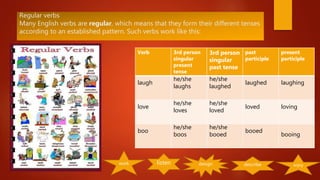
Regular verbs
Many English verbs are regular, which means that they form their different tenses
according to an established pattern. Such verbs work like this:
Verb 3rd person
singular
present
tense
3rd person
singular
past tense
past
participle
present
participle
laugh
he/she
laughs
he/she
laughed
laughed laughing
love
he/she
loves
he/she
loved
loved loving
boo
he/she
boos
he/she
booed
booed
booing
work listen design enjoydescribe
Present tense formation
• In the present simple tense, the basic form of a
regular verb only changes in the 3rd person
singular, as follows:
• Most verbs just add -s to the basic form
(e.g. take/takes, seem/seems, look/looks).
• Verbs that end with a vowel other than e add -
es (e.g. go/goes, veto/vetoes, do/does).
• Verbs that end with -s, -z, -ch, -sh, and -
es
(e.g. kiss/kisses, fizz/fizzes, punch/punches, was
h/washes, mix/mixes).
• If the verb ends in a consonant plus -y, change
the y to an i before adding -
es (e.g. hurry/hurries, clarify/clarifies). But if the
Past tense formation
• Forming the past simple tense of regular verbs
is mostly straightforward, and you use the
form for the first, second, and third persons,
singular and plural:
• If the basic form of the verb ends in a
or a vowel other than e, add the letters -ed to
the end
(e.g. seem/seemed, laugh/laughed, look/looke
.
• For verbs that end in -e, add -
d (e.g. love/loved, recede/receded, hope/hope
.
• If the verb ends in a consonant plus -y, change
the y to an i before adding -
ed (e.g. hurry/hurried, clarify/clarified). But if
verb ends in a vowel plus -y, just add -
ed (e.g. play/played, enjoy/enjoyed).
Forming participles
•To form the past participle of regular verbs, follow
same rules as for the past simple tense above.
•To make the present participle of regular verbs:
•If the basic form of the verb ends in a consonant or
vowel other than e, add the ending -
ing (e.g. laugh/laughing, boo/booing).
•If the verb ends in e, drop the e before adding -
ing (e.g. love/loving, hope/hoping).
•If the basic form ends in y just add -
ing (e.g. hurry/hurrying, clarify/clarifying).
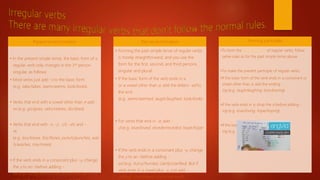
Verb
3rd person singular
present tense
3rd person singular
past tense
past participle present participle
be is was been being
begin begins began begun beginning
bite bites bit bitten biting
break breaks broke broken breaking
buy buys bought bought buying
choose chooses chose chosen choosing
come comes came come coming
dig digs dug dug digging
do does did done doing
drink drinks drank drunk drinking
eat eats ate eaten eating
fall falls fell fallen falling
feel feels felt felt feeling
find finds found found finding
get gets got got getting
go goes went gone going
grow grows grew grown growing
have has had had
having
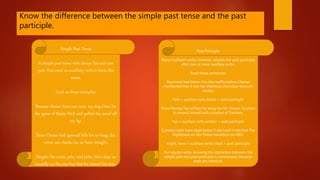
Know the difference between the simple past tense and the past
participle.
Simple Past Tense
A simple past tense verb always has just one
part. You need no auxiliary verb to form this
tense.
Look at these examples:
Because dinner time was near, my dog Oreo bit
the spine of Moby-Dick and pulled the novel off
my lap.
Since Denise had ignored bills for so long, she
wrote out checks for an hour straight.
Despite the noise, jolts, and jerks, Alex slept so
soundly on the city bus that he missed his stop.
Past Participle
Many multipart verbs, however, require the past participle
after one or more auxiliary verbs.
Read these sentences:
Raymond had bitten into the muffin before Charise
mentioned that it was her infamous chocolate-broccoli
variety.
had = auxiliary verb; bitten = past participle
Once Woody has written his essay for Mr. Stover, he plans
to reward himself with a packet of Twinkies.
has = auxiliary verb; written = past participle
Cynthia might have slept better if she hadn't watched The
Nightmare on Elm Street marathon on HBO.
might, have = auxiliary verbs; slept = past participle
For regular verbs, knowing the distinction between the
simple past and past participle is unnecessary because
both are identical.
Conclusion
The distinction between regular verbs and irregular verbs is a very simple one:
Regular Verbs
Those verbs that form their past participle with ‘d’ or ‘ed’ are regular verbs. These verbs
do not undergo substantial changes while changing forms between tenses.
Irregular Verbs
Those verbs that undergo substantial changes when changing forms between tenses are
irregular verbs. The changed forms of these verbs are often unrecognisably different from
the originals.

Regular and irregular verbs

  • 1.
  • 2.
    Regular verbs Many Englishverbs are regular, which means that they form their different tenses according to an established pattern. Such verbs work like this: Verb 3rd person singular present tense 3rd person singular past tense past participle present participle laugh he/she laughs he/she laughed laughed laughing love he/she loves he/she loved loved loving boo he/she boos he/she booed booed booing work listen design enjoydescribe
  • 3.
    Present tense formation •In the present simple tense, the basic form of a regular verb only changes in the 3rd person singular, as follows: • Most verbs just add -s to the basic form (e.g. take/takes, seem/seems, look/looks). • Verbs that end with a vowel other than e add - es (e.g. go/goes, veto/vetoes, do/does). • Verbs that end with -s, -z, -ch, -sh, and - es (e.g. kiss/kisses, fizz/fizzes, punch/punches, was h/washes, mix/mixes). • If the verb ends in a consonant plus -y, change the y to an i before adding - es (e.g. hurry/hurries, clarify/clarifies). But if the Past tense formation • Forming the past simple tense of regular verbs is mostly straightforward, and you use the form for the first, second, and third persons, singular and plural: • If the basic form of the verb ends in a or a vowel other than e, add the letters -ed to the end (e.g. seem/seemed, laugh/laughed, look/looke . • For verbs that end in -e, add - d (e.g. love/loved, recede/receded, hope/hope . • If the verb ends in a consonant plus -y, change the y to an i before adding - ed (e.g. hurry/hurried, clarify/clarified). But if verb ends in a vowel plus -y, just add - ed (e.g. play/played, enjoy/enjoyed). Forming participles •To form the past participle of regular verbs, follow same rules as for the past simple tense above. •To make the present participle of regular verbs: •If the basic form of the verb ends in a consonant or vowel other than e, add the ending - ing (e.g. laugh/laughing, boo/booing). •If the verb ends in e, drop the e before adding - ing (e.g. love/loving, hope/hoping). •If the basic form ends in y just add - ing (e.g. hurry/hurrying, clarify/clarifying).
  • 4.
    Verb 3rd person singular presenttense 3rd person singular past tense past participle present participle be is was been being begin begins began begun beginning bite bites bit bitten biting break breaks broke broken breaking buy buys bought bought buying choose chooses chose chosen choosing come comes came come coming dig digs dug dug digging do does did done doing drink drinks drank drunk drinking eat eats ate eaten eating fall falls fell fallen falling feel feels felt felt feeling find finds found found finding get gets got got getting go goes went gone going grow grows grew grown growing have has had had having
  • 5.
    Know the differencebetween the simple past tense and the past participle. Simple Past Tense A simple past tense verb always has just one part. You need no auxiliary verb to form this tense. Look at these examples: Because dinner time was near, my dog Oreo bit the spine of Moby-Dick and pulled the novel off my lap. Since Denise had ignored bills for so long, she wrote out checks for an hour straight. Despite the noise, jolts, and jerks, Alex slept so soundly on the city bus that he missed his stop. Past Participle Many multipart verbs, however, require the past participle after one or more auxiliary verbs. Read these sentences: Raymond had bitten into the muffin before Charise mentioned that it was her infamous chocolate-broccoli variety. had = auxiliary verb; bitten = past participle Once Woody has written his essay for Mr. Stover, he plans to reward himself with a packet of Twinkies. has = auxiliary verb; written = past participle Cynthia might have slept better if she hadn't watched The Nightmare on Elm Street marathon on HBO. might, have = auxiliary verbs; slept = past participle For regular verbs, knowing the distinction between the simple past and past participle is unnecessary because both are identical.
  • 6.
    Conclusion The distinction betweenregular verbs and irregular verbs is a very simple one: Regular Verbs Those verbs that form their past participle with ‘d’ or ‘ed’ are regular verbs. These verbs do not undergo substantial changes while changing forms between tenses. Irregular Verbs Those verbs that undergo substantial changes when changing forms between tenses are irregular verbs. The changed forms of these verbs are often unrecognisably different from the originals.