Simple Past tense
Learning objective
● To identify the use of Simple Past.
● To use the Simple Past in sentences.
What do you know about Simple Past tense?
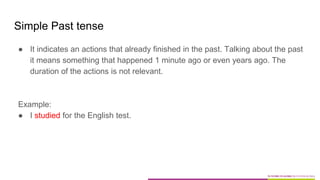
Simple Past tense
● It indicates an actions that already finished in the past. Talking about the past
it means something that happened 1 minute ago or even years ago. The
duration of the actions is not relevant.
Example:
● I studied for the English test.
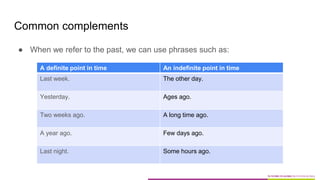
Common complements
● When we refer to the past, we can use phrases such as:
A definite point in time An indefinite point in time
Last week. The other day.
Yesterday. Ages ago.
Two weeks ago. A long time ago.
A year ago. Few days ago.
Last night. Some hours ago.
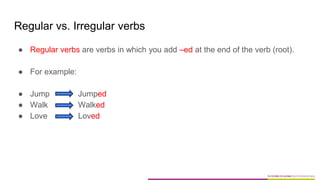
Regular vs. Irregular verbs
● Regular verbs are verbs in which you add –ed at the end of the verb (root).
● For example:
● Jump Jumped
● Walk Walked
● Love Loved
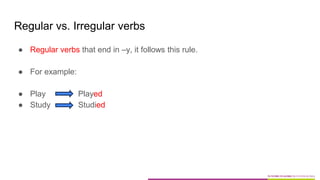
Regular vs. Irregular verbs
● Regular verbs that end in –y, it follows this rule.
● For example:
● Play Played
● Study Studied
Regular vs. Irregular verbs
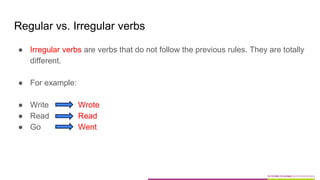
● Irregular verbs are verbs that do not follow the previous rules. They are totally
different.
● For example:
● Write Wrote
● Read Read
● Go Went
List of Irregular verbs
● https://www.gingersoftware.com/content/grammar-rules/verbs/list-of-irregular-
verbs
Formulas
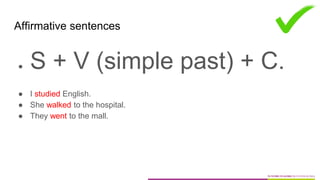
Affirmative sentences
● S + V (simple past) + C.
● I studied English.
● She walked to the hospital.
● They went to the mall.
Negative sentences
● S + did not + V (root) + C.
● I did not study English.
● She did not walk to the hospital.
● They did not go to the mall.
Interrogative sentences
● Did + S + V (root) + C + ?
● Did I study English?
● Did she walk to the hospital?
● Did they go to the mall?
What have we learned?
Simple Past.ppt simple past simple past.

Simple Past.ppt simple past simple past.

  • 2.
  • 3.
    Learning objective ● Toidentify the use of Simple Past. ● To use the Simple Past in sentences.
  • 4.
    What do youknow about Simple Past tense?
  • 5.
    Simple Past tense ●It indicates an actions that already finished in the past. Talking about the past it means something that happened 1 minute ago or even years ago. The duration of the actions is not relevant. Example: ● I studied for the English test.
  • 6.
    Common complements ● Whenwe refer to the past, we can use phrases such as: A definite point in time An indefinite point in time Last week. The other day. Yesterday. Ages ago. Two weeks ago. A long time ago. A year ago. Few days ago. Last night. Some hours ago.
  • 7.
    Regular vs. Irregularverbs ● Regular verbs are verbs in which you add –ed at the end of the verb (root). ● For example: ● Jump Jumped ● Walk Walked ● Love Loved
  • 8.
    Regular vs. Irregularverbs ● Regular verbs that end in –y, it follows this rule. ● For example: ● Play Played ● Study Studied
  • 9.
    Regular vs. Irregularverbs ● Irregular verbs are verbs that do not follow the previous rules. They are totally different. ● For example: ● Write Wrote ● Read Read ● Go Went
  • 10.
    List of Irregularverbs ● https://www.gingersoftware.com/content/grammar-rules/verbs/list-of-irregular- verbs
  • 11.
  • 12.
    Affirmative sentences ● S+ V (simple past) + C. ● I studied English. ● She walked to the hospital. ● They went to the mall.
  • 13.
    Negative sentences ● S+ did not + V (root) + C. ● I did not study English. ● She did not walk to the hospital. ● They did not go to the mall.
  • 14.
    Interrogative sentences ● Did+ S + V (root) + C + ? ● Did I study English? ● Did she walk to the hospital? ● Did they go to the mall?
  • 15.
    What have welearned?