SIMPLE PAST
By: FABRICIO ALVARADO
•Is a form of the verb that
shows the action took place in
the past.
For example: Lisa danced
yesterday.
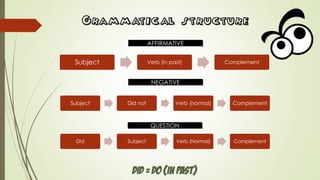
Grammatical structure
Subject Verb (in past) Complement
Subject Did not Verb (normal) Complement
Did Subject Verb (Normal) Complement
NEGATIVE
QUESTION
AFFIRMATIVE
Did = Do (In past)
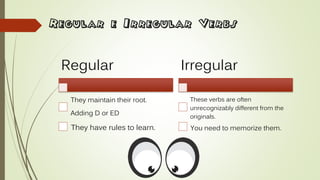
Regular e Irregular Verbs
Regular
They maintain their root.
Adding D or ED
They have rules to learn.
Irregular
These verbs are often
unrecognizably different from the
originals.
You need to memorize them.
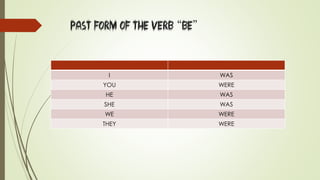
PAST FORM OF THE VERB “BE”
I WAS
YOU WERE
HE WAS
SHE WAS
WE WERE
THEY WERE
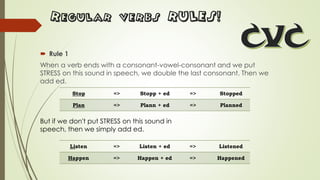
Regular verbs RULES!
 Rule 1
When a verb ends with a consonant-vowel-consonant and we put
STRESS on this sound in speech, we double the last consonant. Then we
add ed.
Stop => Stopp + ed => Stopped
Plan => Plann + ed => Planned
But if we don't put STRESS on this sound in
speech, then we simply add ed.
Listen => Listen + ed => Listened
Happen => Happen + ed => Happened
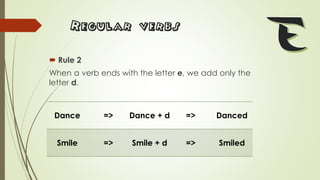
Regular verbs
 Rule 2
When a verb ends with the letter e, we add only the
letter d.
Dance => Dance + d => Danced
Smile => Smile + d => Smiled
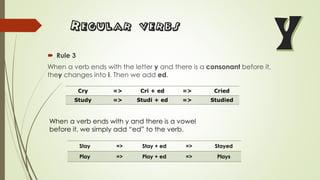
Regular verbs
 Rule 3
When a verb ends with the letter y and there is a consonant before it,
they changes into i. Then we add ed.
Cry => Cri + ed => Cried
Study => Studi + ed => Studied
When a verb ends with y and there is a vowel
before it, we simply add “ed” to the verb.
Stay => Stay + ed => Stayed
Play => Play + ed => Plays
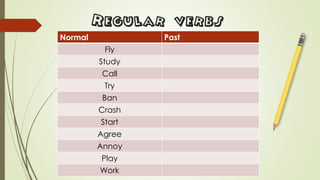
Regular verbs
Normal Past
Fly
Study
Call
Try
Ban
Crash
Start
Agree
Annoy
Play
Work
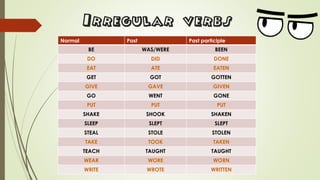
Irregular verbs
Normal Past Past participle
BE WAS/WERE BEEN
DO DID DONE
EAT ATE EATEN
GET GOT GOTTEN
GIVE GAVE GIVEN
GO WENT GONE
PUT PUT PUT
SHAKE SHOOK SHAKEN
SLEEP SLEPT SLEPT
STEAL STOLE STOLEN
TAKE TOOK TAKEN
TEACH TAUGHT TAUGHT
WEAR WORE WORN
WRITE WROTE WRITTEN
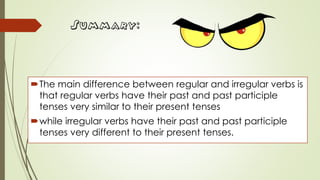
Summary:
The main difference between regular and irregular verbs is
that regular verbs have their past and past participle
tenses very similar to their present tenses
while irregular verbs have their past and past participle
tenses very different to their present tenses.
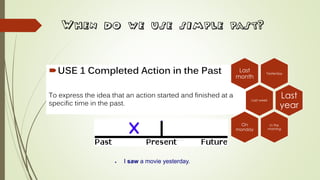
When do we use simple past?
USE 1 Completed Action in the Past
To express the idea that an action started and finished at a
specific time in the past.
 I saw a movie yesterday.
Yesterday
Last
month
Last week
Last
year
In the
morning
On
monday
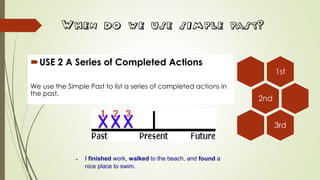
When do we use simple past?
USE 2 A Series of Completed Actions
We use the Simple Past to list a series of completed actions in
the past.
 I finished work, walked to the beach, and found a
nice place to swim.
1st
2nd
3rd
When do we use simple past?
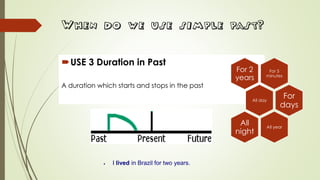
USE 3 Duration in Past
A duration which starts and stops in the past
 I lived in Brazil for two years.
For 5
minutes
For 2
years
All day
For
days
All year
All
night
When do we use simple past?
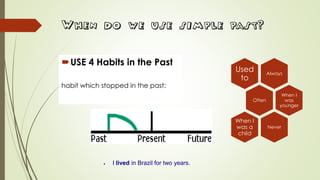
USE 4 Habits in the Past
habit which stopped in the past:
 I lived in Brazil for two years.
Always
Used
to
Often
When I
was
younger
Never
When I
was a
child
When do we use simple past?
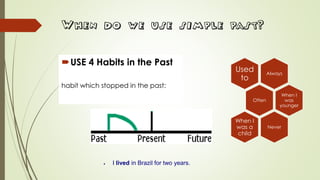
USE 4 Habits in the Past
habit which stopped in the past:
 I lived in Brazil for two years.
Always
Used
to
Often
When I
was
younger
Never
When I
was a
child
THANKS FOR YOUR ATTENTION :D

Simple Past tense (Complete)

  • 1.
    SIMPLE PAST By: FABRICIOALVARADO •Is a form of the verb that shows the action took place in the past. For example: Lisa danced yesterday.
  • 2.
    Grammatical structure Subject Verb(in past) Complement Subject Did not Verb (normal) Complement Did Subject Verb (Normal) Complement NEGATIVE QUESTION AFFIRMATIVE Did = Do (In past)
  • 3.
    Regular e IrregularVerbs Regular They maintain their root. Adding D or ED They have rules to learn. Irregular These verbs are often unrecognizably different from the originals. You need to memorize them.
  • 4.
    PAST FORM OFTHE VERB “BE” I WAS YOU WERE HE WAS SHE WAS WE WERE THEY WERE
  • 5.
    Regular verbs RULES! Rule 1 When a verb ends with a consonant-vowel-consonant and we put STRESS on this sound in speech, we double the last consonant. Then we add ed. Stop => Stopp + ed => Stopped Plan => Plann + ed => Planned But if we don't put STRESS on this sound in speech, then we simply add ed. Listen => Listen + ed => Listened Happen => Happen + ed => Happened
  • 6.
    Regular verbs  Rule2 When a verb ends with the letter e, we add only the letter d. Dance => Dance + d => Danced Smile => Smile + d => Smiled
  • 7.
    Regular verbs  Rule3 When a verb ends with the letter y and there is a consonant before it, they changes into i. Then we add ed. Cry => Cri + ed => Cried Study => Studi + ed => Studied When a verb ends with y and there is a vowel before it, we simply add “ed” to the verb. Stay => Stay + ed => Stayed Play => Play + ed => Plays
  • 8.
  • 9.
    Irregular verbs Normal PastPast participle BE WAS/WERE BEEN DO DID DONE EAT ATE EATEN GET GOT GOTTEN GIVE GAVE GIVEN GO WENT GONE PUT PUT PUT SHAKE SHOOK SHAKEN SLEEP SLEPT SLEPT STEAL STOLE STOLEN TAKE TOOK TAKEN TEACH TAUGHT TAUGHT WEAR WORE WORN WRITE WROTE WRITTEN
  • 10.
    Summary: The main differencebetween regular and irregular verbs is that regular verbs have their past and past participle tenses very similar to their present tenses while irregular verbs have their past and past participle tenses very different to their present tenses.
  • 11.
    When do weuse simple past? USE 1 Completed Action in the Past To express the idea that an action started and finished at a specific time in the past.  I saw a movie yesterday. Yesterday Last month Last week Last year In the morning On monday
  • 12.
    When do weuse simple past? USE 2 A Series of Completed Actions We use the Simple Past to list a series of completed actions in the past.  I finished work, walked to the beach, and found a nice place to swim. 1st 2nd 3rd
  • 13.
    When do weuse simple past? USE 3 Duration in Past A duration which starts and stops in the past  I lived in Brazil for two years. For 5 minutes For 2 years All day For days All year All night
  • 14.
    When do weuse simple past? USE 4 Habits in the Past habit which stopped in the past:  I lived in Brazil for two years. Always Used to Often When I was younger Never When I was a child
  • 15.
    When do weuse simple past? USE 4 Habits in the Past habit which stopped in the past:  I lived in Brazil for two years. Always Used to Often When I was younger Never When I was a child
  • 16.
    THANKS FOR YOURATTENTION :D