PRESENTED BY
     V.Prem Prasad
M.Pharmacy 1stYear(pharmacology)
Gokaraju rangaraju college of pharmacy   1
CONTENTS

   Introduction
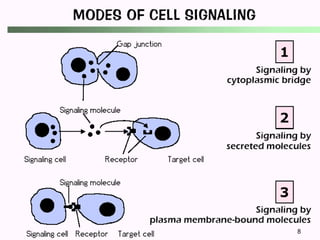
   Modes of cell signaling
   Communication between cells
   Signal transduction
   Ion channels


                                  2
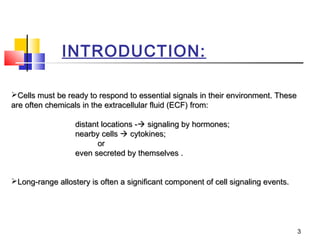
INTRODUCTION:

Cells must be ready to respond to essential signals in their environment. These
are often chemicals in the extracellular fluid (ECF) from:

                  distant locations - signaling by hormones;
                  nearby cells  cytokines;
                         or
                  even secreted by themselves .


Long-range allostery is often a significant component of cell signaling events.


                                                                                   3
CELL SIGNALING


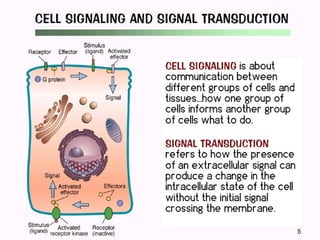
Cell signaling is part of a complex system of communication that governs basic
cellular activities and coordinates cell actions.

The ability of cells to perceive and correctly respond to their microenvironment is the
basis of development, tissue repair, and immunity as well as normal tissue homeostasis


Errors in cellular information processing are responsible for diseases such as cancer,
autoimmunity, and diabetes. By understanding cell signaling, diseases may be treated
effectively and, theoretically, artificial tissues may be created.


                                                                                           4
5
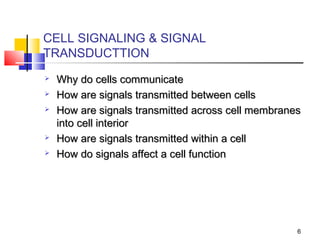
CELL SIGNALING & SIGNAL
TRANSDUCTTION
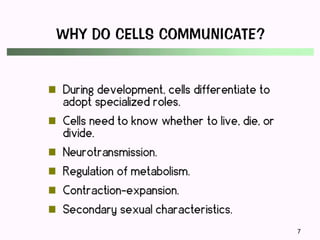
   Why do cells communicate
   How are signals transmitted between cells
   How are signals transmitted across cell membranes
    into cell interior
   How are signals transmitted within a cell
   How do signals affect a cell function


                                                    6
7
8
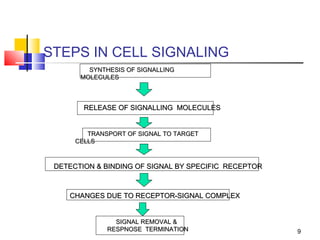
STEPS IN CELL SIGNALING
         SYNTHESIS OF SIGNALLING
       MOLECULES


        RELEASE OF SIGNALLING MOLECULES


         TRANSPORT OF SIGNAL TO TARGET
      CELLS


 DETECTION & BINDING OF SIGNAL BY SPECIFIC RECEPTOR


    CHANGES DUE TO RECEPTOR-SIGNAL COMPLEX


                SIGNAL REMOVAL &
              RESPNOSE TERMINATION                    9
CLASSIFICATION OF INTERCELLULAR
          COMMUNICATION

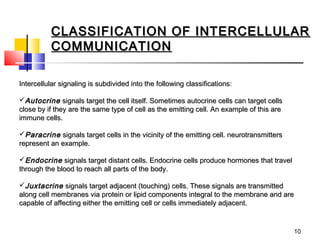
Intercellular signaling is subdivided into the following classifications:

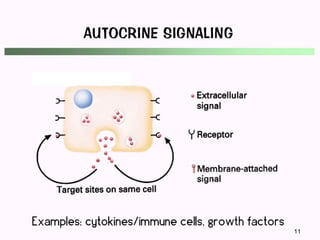
Autocrine signals target the cell itself. Sometimes autocrine cells can target cells
close by if they are the same type of cell as the emitting cell. An example of this are
immune cells.

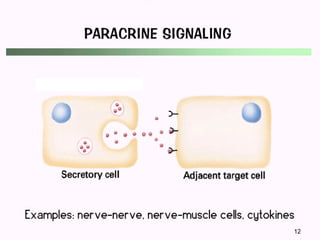
Paracrine signals target cells in the vicinity of the emitting cell. neurotransmitters
represent an example.

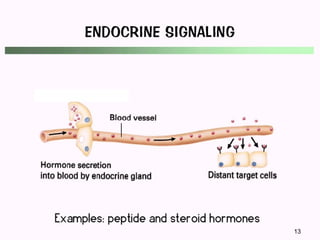
Endocrine signals target distant cells. Endocrine cells produce hormones that travel
through the blood to reach all parts of the body.

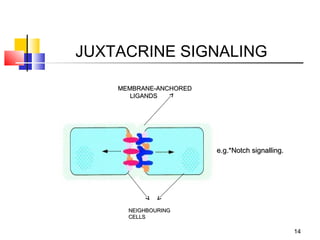
Juxtacrine signals target adjacent (touching) cells. These signals are transmitted
along cell membranes via protein or lipid components integral to the membrane and are
capable of affecting either the emitting cell or cells immediately adjacent.


                                                                                          10
11
12
13
JUXTACRINE SIGNALING

    MEMBRANE-ANCHORED
       LIGANDS


                         e.g.*Notch signalling.


      NEIGHBOURING
      CELLS

                                                  14
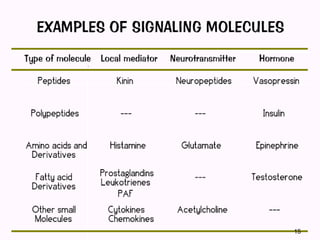
15
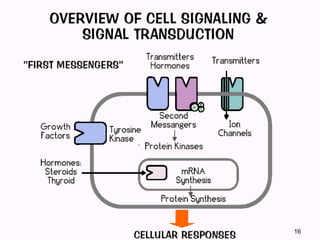
16
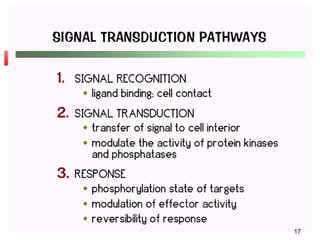
17
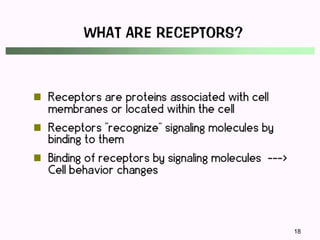
18
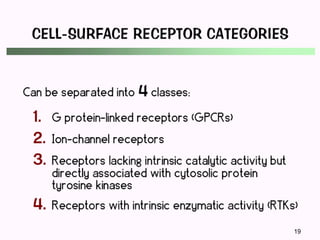
19
20
21
22
23
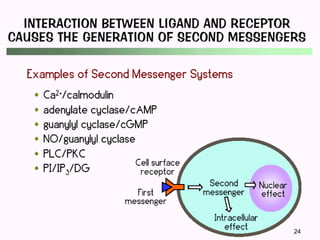
24
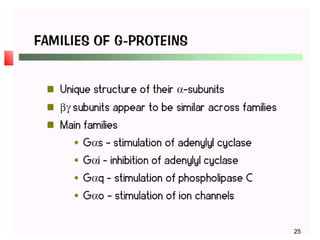
25
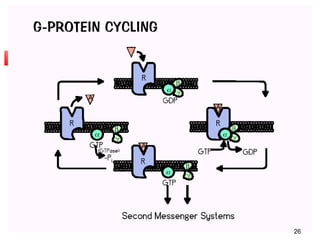
26
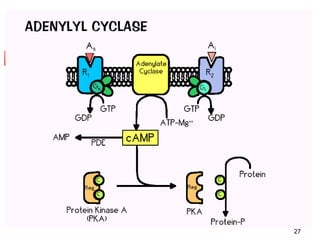
27
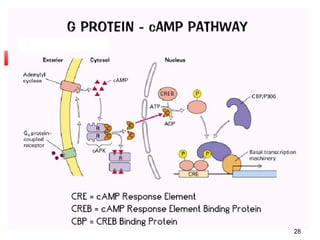
28
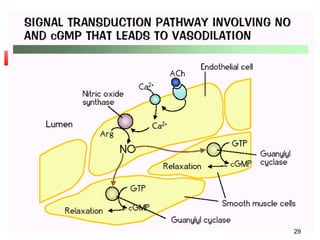
29
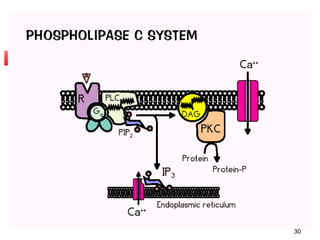
30
Ion Channels


               31
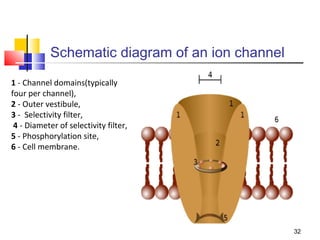
Schematic diagram of an ion channel
1 - Channel domains(typically
four per channel),
2 - Outer vestibule,
3 - Selectivity filter,
 4 - Diameter of selectivity filter,
5 - Phosphorylation site,
6 - Cell membrane.


                                                  32
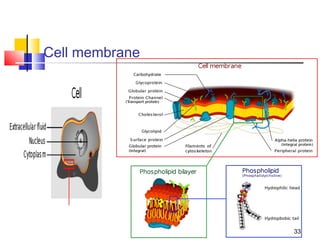
Cell membrane


                33
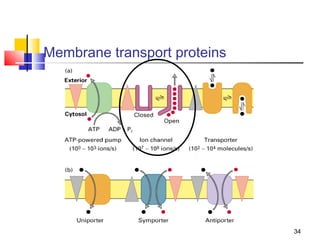
Membrane transport proteins


                              34
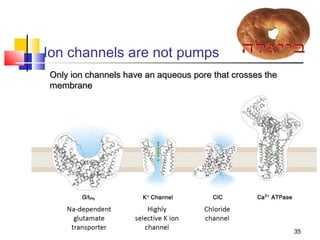
Ion channels are not pumps
Only ion channels have an aqueous pore that crosses the
membrane


                                                          35
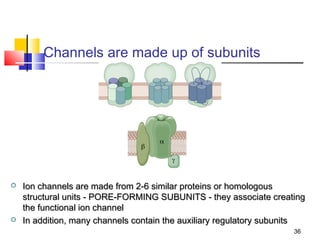
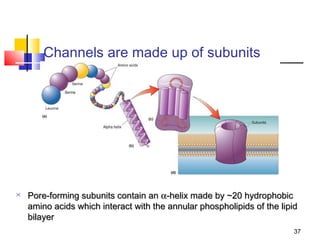
Channels are made up of subunits


   Ion channels are made from 2-6 similar proteins or homologous
    structural units ‐ PORE-FORMING SUBUNITS - they associate creating
    the functional ion channel
   In addition, many channels contain the auxiliary regulatory subunits
                                                                     36
Channels are made up of subunits


   Pore-forming subunits contain an α‐helix made by ~20 hydrophobic
    amino acids which interact with the annular phospholipids of the lipid
    bilayer
                                                                         37
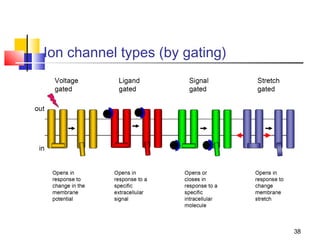
Ion channel types (by gating)


                                38
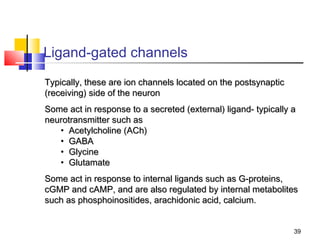
Ligand-gated channels
Typically, these are ion channels located on the postsynaptic
(receiving) side of the neuron
Some act in response to a secreted (external) ligand- typically a
neurotransmitter such as
   • Acetylcholine (ACh)
   • GABA
   • Glycine
   • Glutamate
Some act in response to internal ligands such as G-proteins,
cGMP and cAMP, and are also regulated by internal metabolites
such as phosphoinositides, arachidonic acid, calcium.


                                                                39
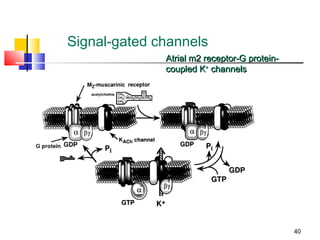
Signal-gated channels
              Atrial m2 receptor-G protein-
              coupled K+ channels


                                              40
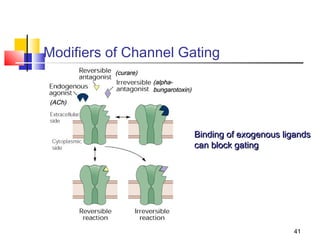
Modifiers of Channel Gating
          (curare)
                     (alpha-
                     bungarotoxin)
(ACh)


                                     Binding of exogenous ligands
                                     can block gating


                                                            41
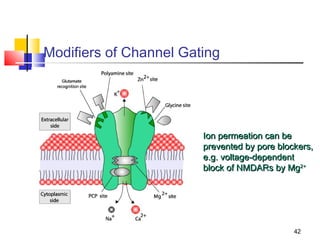
Modifiers of Channel Gating


                        Ion permeation can be
                        prevented by pore blockers,
                        e.g. voltage-dependent
                        block of NMDARs by Mg2+


                                              42
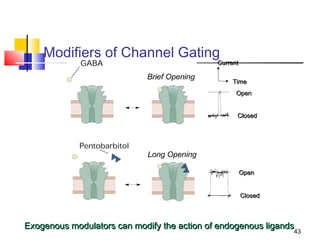
Modifiers of Channel Gating
                                              Current


                                                   Time
                                                    Open


                                                    Closed


                                                        Open


                                                        Closed


Exogenous modulators can modify the action of endogenous ligands
                                                                43
Bu Z, Callaway DJ (2011). "Proteins MOVE! Protein dynamics and long-range allostery
in cell signaling". Advances in Protein Chemistry and Structural Biology . Advances in
Protein Chemistry and Structural Biology 83 : 163–221. 

Rang & Dale's Pharmacology

http://en.wikipedia.org/wiki/Cell_signaling

http://users.rcn.com/jkimball.ma.ultranet/BiologyPages/C/CellSignaling.html

www.authorstream.com/.../shona6685-645587-ppt -cell -signaling

http://www.ncbi.nlm.nih.gov/pmc/articles/PMC151254/

 Congreve M, Marshall F (March 2010). "The impact of GPCR structures on
pharmacology and structure-based drug design". Br. J. Pharmacol. 159  (5): 986–
96.doi:10.1111/j.1476-5381.2009.00476x PMC 2839258 PMID19912230
                                                                                         44
45
46

Cell signaling

  • 1.
    PRESENTED BY V.Prem Prasad M.Pharmacy 1stYear(pharmacology) Gokaraju rangaraju college of pharmacy 1
  • 2.
    CONTENTS  Introduction  Modes of cell signaling  Communication between cells  Signal transduction  Ion channels 2
  • 3.
    INTRODUCTION: Cells must beready to respond to essential signals in their environment. These are often chemicals in the extracellular fluid (ECF) from: distant locations - signaling by hormones; nearby cells  cytokines; or even secreted by themselves . Long-range allostery is often a significant component of cell signaling events. 3
  • 4.
    CELL SIGNALING Cell signalingis part of a complex system of communication that governs basic cellular activities and coordinates cell actions. The ability of cells to perceive and correctly respond to their microenvironment is the basis of development, tissue repair, and immunity as well as normal tissue homeostasis Errors in cellular information processing are responsible for diseases such as cancer, autoimmunity, and diabetes. By understanding cell signaling, diseases may be treated effectively and, theoretically, artificial tissues may be created. 4
  • 5.
  • 6.
    CELL SIGNALING &SIGNAL TRANSDUCTTION  Why do cells communicate  How are signals transmitted between cells  How are signals transmitted across cell membranes into cell interior  How are signals transmitted within a cell  How do signals affect a cell function 6
  • 7.
  • 8.
  • 9.
    STEPS IN CELLSIGNALING SYNTHESIS OF SIGNALLING MOLECULES RELEASE OF SIGNALLING MOLECULES TRANSPORT OF SIGNAL TO TARGET CELLS DETECTION & BINDING OF SIGNAL BY SPECIFIC RECEPTOR CHANGES DUE TO RECEPTOR-SIGNAL COMPLEX SIGNAL REMOVAL & RESPNOSE TERMINATION 9
  • 10.
    CLASSIFICATION OF INTERCELLULAR COMMUNICATION Intercellular signaling is subdivided into the following classifications: Autocrine signals target the cell itself. Sometimes autocrine cells can target cells close by if they are the same type of cell as the emitting cell. An example of this are immune cells. Paracrine signals target cells in the vicinity of the emitting cell. neurotransmitters represent an example. Endocrine signals target distant cells. Endocrine cells produce hormones that travel through the blood to reach all parts of the body. Juxtacrine signals target adjacent (touching) cells. These signals are transmitted along cell membranes via protein or lipid components integral to the membrane and are capable of affecting either the emitting cell or cells immediately adjacent. 10
  • 11.
  • 12.
  • 13.
  • 14.
    JUXTACRINE SIGNALING MEMBRANE-ANCHORED LIGANDS  e.g.*Notch signalling. NEIGHBOURING CELLS 14
  • 15.
  • 16.
  • 17.
  • 18.
  • 19.
  • 20.
  • 21.
  • 22.
  • 23.
  • 24.
  • 25.
  • 26.
  • 27.
  • 28.
  • 29.
  • 30.
  • 31.
  • 32.
    Schematic diagram ofan ion channel 1 - Channel domains(typically four per channel), 2 - Outer vestibule, 3 - Selectivity filter, 4 - Diameter of selectivity filter, 5 - Phosphorylation site, 6 - Cell membrane. 32
  • 33.
  • 34.
  • 35.
    Ion channels arenot pumps Only ion channels have an aqueous pore that crosses the membrane 35
  • 36.
    Channels are madeup of subunits  Ion channels are made from 2-6 similar proteins or homologous structural units ‐ PORE-FORMING SUBUNITS - they associate creating the functional ion channel  In addition, many channels contain the auxiliary regulatory subunits 36
  • 37.
    Channels are madeup of subunits  Pore-forming subunits contain an α‐helix made by ~20 hydrophobic amino acids which interact with the annular phospholipids of the lipid bilayer 37
  • 38.
    Ion channel types(by gating) 38
  • 39.
    Ligand-gated channels Typically, theseare ion channels located on the postsynaptic (receiving) side of the neuron Some act in response to a secreted (external) ligand- typically a neurotransmitter such as • Acetylcholine (ACh) • GABA • Glycine • Glutamate Some act in response to internal ligands such as G-proteins, cGMP and cAMP, and are also regulated by internal metabolites such as phosphoinositides, arachidonic acid, calcium. 39
  • 40.
    Signal-gated channels Atrial m2 receptor-G protein- coupled K+ channels 40
  • 41.
    Modifiers of ChannelGating (curare) (alpha- bungarotoxin) (ACh) Binding of exogenous ligands can block gating 41
  • 42.
    Modifiers of ChannelGating Ion permeation can be prevented by pore blockers, e.g. voltage-dependent block of NMDARs by Mg2+ 42
  • 43.
    Modifiers of ChannelGating Current Time Open Closed Open Closed Exogenous modulators can modify the action of endogenous ligands 43
  • 44.
    Bu Z, CallawayDJ (2011). "Proteins MOVE! Protein dynamics and long-range allostery in cell signaling". Advances in Protein Chemistry and Structural Biology . Advances in Protein Chemistry and Structural Biology 83 : 163–221.  Rang & Dale's Pharmacology http://en.wikipedia.org/wiki/Cell_signaling http://users.rcn.com/jkimball.ma.ultranet/BiologyPages/C/CellSignaling.html www.authorstream.com/.../shona6685-645587-ppt -cell -signaling http://www.ncbi.nlm.nih.gov/pmc/articles/PMC151254/  Congreve M, Marshall F (March 2010). "The impact of GPCR structures on pharmacology and structure-based drug design". Br. J. Pharmacol. 159  (5): 986– 96.doi:10.1111/j.1476-5381.2009.00476x PMC 2839258 PMID19912230 44
  • 45.
  • 46.