

TRAINING,
Process flow chart & SOP’s
By : Vipul Saxena
Infosys has huge facility in Mysore to train 4,000 managers at any given time. It has plans to
expand the capacity to 10,000.
WIPRO Spectramind (BPO outfit of WIPRO based in Delhi) does not want to lose talented youth who want to pursue
higher education. The BPO firm has decided to start SEED (WIPRO Spectramind Educational Enhancement and
Development) where talented youngsters are given help and opportunities to study further.
LG Electronics has made it compulsory for its staff to do two modules a month and each module has a test that has to be
cleared. Every three months a summary of all the tests is made and prizes are doled out to encourage people to learn.
The American Society for Training and Development (ASTD) says new organizations typically deliver 20 -30 percent
of training via technology.
Cisco uses web-based training as an integral tool to make employees more productive because it is available anytime,
anywhere.
GE believes in on-the-job-training approach for training its employees. It trains customer service operators on the job
so that the benefits of listening, thinking and responding occur on the job. Communication and telephone skills are
observed and critiqued.
INTRODUCTION
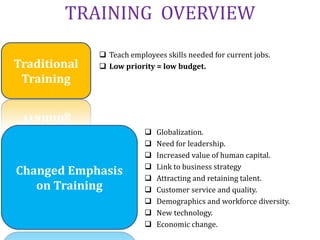
Traditional
Training
Changed Emphasis
on Training
TRAINING OVERVIEW
 Teach employees skills needed for current jobs.
 Low priority = low budget.
 Globalization.
 Need for leadership.
 Increased value of human capital.
 Link to business strategy
 Attracting and retaining talent.
 Customer service and quality.
 Demographics and workforce diversity.
 New technology.
 Economic change.
OBJECTIVES OF TRAINING
 To enhance technical skill and productivity
 To enhance employee growth
 To improve the quality of workforce/Versatile workforce
 To prevent obsolescence of technical skills and competencies
 To improve Health and Safety
 Efficient utilization of resources
 Growth of organization
IMPORTANCE/BENEFITS OF TRAINING
 Improves morale of employees
 Less supervision
 Fewer accidents
 Increased Competency
 Increased productivity
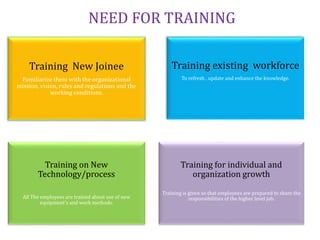
NEED FOR TRAINING
Training New Joinee
Familiarize them with the organizational
mission, vision, rules and regulations and the
working conditions.
Training existing workforce
To refresh , update and enhance the knowledge.
Training on New
Technology/process
All The employees are trained about use of new
equipment's and work methods.
Training for individual and
organization growth
Training is given so that employees are prepared to share the
responsibilities of the higher level job.
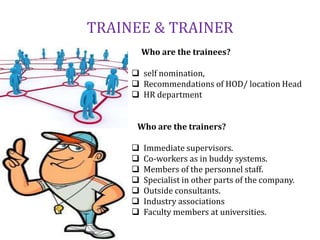
TRAINEE & TRAINER
Who are the trainees?
 self nomination,
 Recommendations of HOD/ location Head
 HR department
Who are the trainers?
 Immediate supervisors.
 Co-workers as in buddy systems.
 Members of the personnel staff.
 Specialist in other parts of the company.
 Outside consultants.
 Industry associations
 Faculty members at universities.
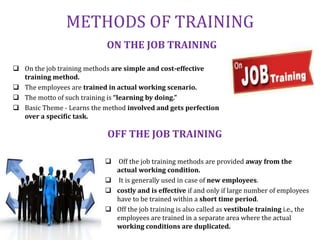
METHODS OF TRAINING
ON THE JOB TRAINING
 On the job training methods are simple and cost-effective
training method.
 The employees are trained in actual working scenario.
 The motto of such training is “learning by doing.”
 Basic Theme - Learns the method involved and gets perfection
over a specific task.
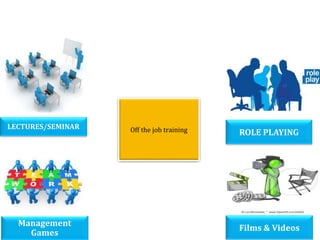
OFF THE JOB TRAINING
 Off the job training methods are provided away from the
actual working condition.
 It is generally used in case of new employees.
 costly and is effective if and only if large number of employees
have to be trained within a short time period.
 Off the job training is also called as vestibule training i.e., the
employees are trained in a separate area where the actual
working conditions are duplicated.
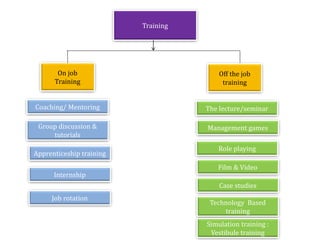
Training
On job
Training
Off the job
training
The lecture/seminar
Technology Based
training
Simulation training :
Vestibule training
Management games
Case studies
Role playing
Job rotation
Coaching/ Mentoring
Apprenticeship training
Internship
Group discussion &
tutorials
Film & Video
LECTURES/SEMINAR
ROLE PLAYING
Management
Games
Films & Videos
Off the job training
 Provide trainees a chance to analyze and discuss real workplace issues.
 They develop analytical and problem-solving skills..
 They can also build a strong sense of teamwork
 All types of issues could be covered
CASE STUDIES
Off job training
TECHNOLOGY-BASED TRAINING
The Methods of learning via technology include:-
 Basic PC-based programs
 Interactive multimedia - using a PC-based CD-ROM
 Interactive video - using a computer in conjunction with a VCR
 Web-based training programs
A trainer also gets more of the learner's involvement than in any other environment and trainees have
the benefit of learning at their own pace.
SIMULATORS -BASED TRAINING
 Simulators are used to imitate real work experiences.
 Duplication of organizational situations in a learning
environment
 A single brief session
 Adapt to the situation and perceptions of various roles
 Trainees participation is full
Off the job training
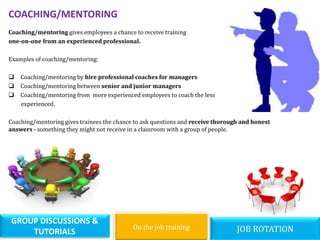
COACHING/MENTORING
Coaching/mentoring gives employees a chance to receive training
one-on-one from an experienced professional.
Examples of coaching/mentoring:
 Coaching/mentoring by hire professional coaches for managers
 Coaching/mentoring between senior and junior managers
 Coaching/mentoring from more experienced employees to coach the less
experienced.
Coaching/mentoring gives trainees the chance to ask questions and receive thorough and honest
answers - something they might not receive in a classroom with a group of people.
GROUP DISCUSSIONS &
TUTORIALS JOB ROTATIONOn the job training
APPRENTICE TRAINING
INTERNSHIP/MANAGEMENT
On the job training
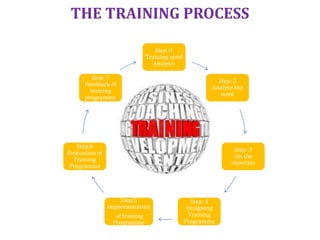
THE TRAINING PROCESS
Step :1
Training need
Analysis
Step: 2
Analyze the
need
Step :3
Set the
objective
Step: 4
Designing
Training
Programme
Step:5
Implementation
of training
Programme
Step:6
Evaluation of
Training
Programme
Step: 7
Feedback of
training
programme
Step:1
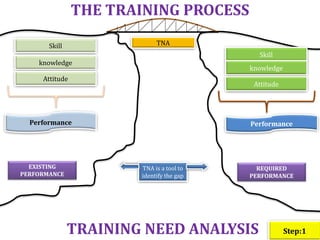
Skill
knowledge
Attitude
Performance
Skill
knowledge
Attitude
Performance
REQUIRED
PERFORMANCE
TNA is a tool to
identify the gap
TNA
EXISTING
PERFORMANCE
TRAINING NEED ANALYSIS
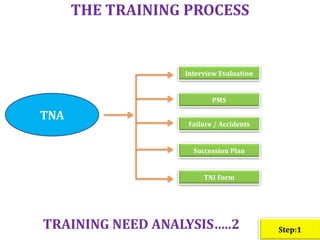
THE TRAINING PROCESS
TRAINING NEED ANALYSIS…..2
TNA
Interview Evaluation
PMS
Failure / Accidents
Succession Plan
TNI Form
Step:1
THE TRAINING PROCESS
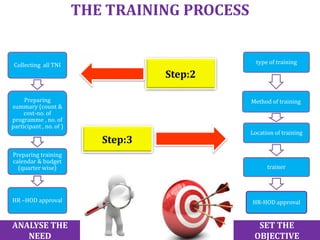
ANALYSE THE
NEED
Collecting all TNI
Preparing
summary (count &
cost-no. of
programme , no. of
participant , no. of )
Preparing training
calendar & budget
(quarter wise)
HR –HOD approval
SET THE
OBJECTIVE
type of training
Method of training
Location of training
trainer
HR-HOD approval
Step:3
Step:2
THE TRAINING PROCESS
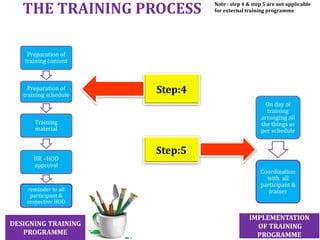
DESIGNING TRAINING
PROGRAMME
Preparation of
training content
Preparation of
training schedule
Training
material
HR –HOD
approval
reminder to all
participant &
respective HOD
IMPLEMENTATION
OF TRAINING
PROGRAMME
On day of
training
arranging all
the things as
per schedule
Coordination
with all
participant &
trainer
Note : step 4 & step 5 are not applicable
for external training programme
Step:5
Step:4
THE TRAINING PROCESS
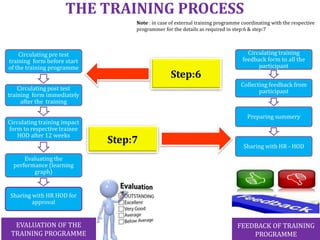
EVALUATION OF THE
TRAINING PROGRAMME
Circulating pre test
training form before start
of the training programme
Circulating post test
training form immediately
after the training
Circulating training impact
form to respective trainee
HOD after 12 weeks
Evaluating the
performance (learning
graph)
Sharing with HR HOD for
approval
FEEDBACK OF TRAINING
PROGRAMME
Circulating training
feedback form to all the
participant
Collecting feedback from
participant
Preparing summery
Sharing with HR - HOD
Note : in case of external training programme coordinating with the respective
programmer for the details as required in step:6 & step:7
Step:7
Step:6
THE TRAINING PROCESS
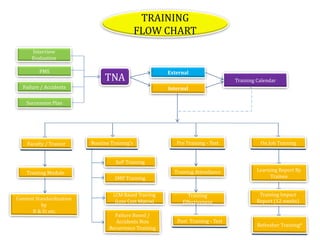
TRAINING
FLOW CHART
PMS
Failure / Accidents
Training Calendar
Interview
Evaluation
Succession Plan
External
Internal
Faculty / Trainer
Training Module
Content Standardization
by
R & D; etc.
Pre Training - Test On Job Training
Training Attendance
Training
Effectiveness
Training Impact
Report (12 weeks)
Post Training - Test
Refresher Training*
TNA
Routine Training’s
SoP Training
Learning Report By
Trainee
Faculty / Trainer Pre Training - Test On Job Training
Training Impact
Report (12 weeks)
Post Training - Test
Refresher Training*
Routine Training’s
SMP Training
Failure Based /
Accidents Non
Recurrence Training
Learning Report By
Trainee
LCM Based Training
(Loss Cost Matrix)
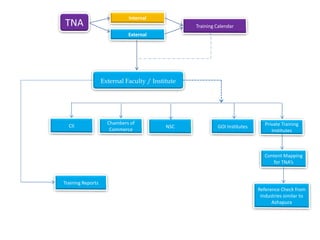
Training Calendar
Internal
External
TNA
External Faculty / Institute
CII
Chambers of
Commerce
NSC GOI Institutes Private Training
Institutes
Content Mapping
for TNA’s
Reference Check from
Industries similar to
Ashapura
Training Reports
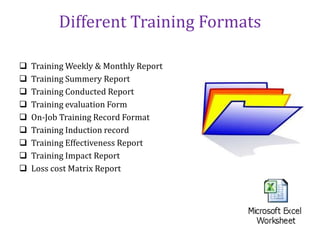
Different Training Formats
 Training Weekly & Monthly Report
 Training Summery Report
 Training Conducted Report
 Training evaluation Form
 On-Job Training Record Format
 Training Induction record
 Training Effectiveness Report
 Training Impact Report
 Loss cost Matrix Report
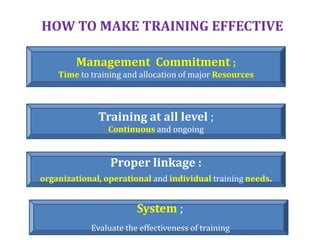
HOW TO MAKE TRAINING EFFECTIVE
Management Commitment ;
Time to training and allocation of major Resources
Training at all level ;
Continuous and ongoing
Proper linkage :
organizational, operational and individual training needs.
System ;
Evaluate the effectiveness of training
Thank you

Training, process flow chart sop's

  • 1.
    TRAINING, Process flow chart& SOP’s By : Vipul Saxena
  • 2.
    Infosys has hugefacility in Mysore to train 4,000 managers at any given time. It has plans to expand the capacity to 10,000. WIPRO Spectramind (BPO outfit of WIPRO based in Delhi) does not want to lose talented youth who want to pursue higher education. The BPO firm has decided to start SEED (WIPRO Spectramind Educational Enhancement and Development) where talented youngsters are given help and opportunities to study further. LG Electronics has made it compulsory for its staff to do two modules a month and each module has a test that has to be cleared. Every three months a summary of all the tests is made and prizes are doled out to encourage people to learn. The American Society for Training and Development (ASTD) says new organizations typically deliver 20 -30 percent of training via technology. Cisco uses web-based training as an integral tool to make employees more productive because it is available anytime, anywhere. GE believes in on-the-job-training approach for training its employees. It trains customer service operators on the job so that the benefits of listening, thinking and responding occur on the job. Communication and telephone skills are observed and critiqued. INTRODUCTION
  • 3.
    Traditional Training Changed Emphasis on Training TRAININGOVERVIEW  Teach employees skills needed for current jobs.  Low priority = low budget.  Globalization.  Need for leadership.  Increased value of human capital.  Link to business strategy  Attracting and retaining talent.  Customer service and quality.  Demographics and workforce diversity.  New technology.  Economic change.
  • 4.
    OBJECTIVES OF TRAINING To enhance technical skill and productivity  To enhance employee growth  To improve the quality of workforce/Versatile workforce  To prevent obsolescence of technical skills and competencies  To improve Health and Safety  Efficient utilization of resources  Growth of organization IMPORTANCE/BENEFITS OF TRAINING  Improves morale of employees  Less supervision  Fewer accidents  Increased Competency  Increased productivity
  • 5.
    NEED FOR TRAINING TrainingNew Joinee Familiarize them with the organizational mission, vision, rules and regulations and the working conditions. Training existing workforce To refresh , update and enhance the knowledge. Training on New Technology/process All The employees are trained about use of new equipment's and work methods. Training for individual and organization growth Training is given so that employees are prepared to share the responsibilities of the higher level job.
  • 6.
    TRAINEE & TRAINER Whoare the trainees?  self nomination,  Recommendations of HOD/ location Head  HR department Who are the trainers?  Immediate supervisors.  Co-workers as in buddy systems.  Members of the personnel staff.  Specialist in other parts of the company.  Outside consultants.  Industry associations  Faculty members at universities.
  • 7.
    METHODS OF TRAINING ONTHE JOB TRAINING  On the job training methods are simple and cost-effective training method.  The employees are trained in actual working scenario.  The motto of such training is “learning by doing.”  Basic Theme - Learns the method involved and gets perfection over a specific task. OFF THE JOB TRAINING  Off the job training methods are provided away from the actual working condition.  It is generally used in case of new employees.  costly and is effective if and only if large number of employees have to be trained within a short time period.  Off the job training is also called as vestibule training i.e., the employees are trained in a separate area where the actual working conditions are duplicated.
  • 8.
    Training On job Training Off thejob training The lecture/seminar Technology Based training Simulation training : Vestibule training Management games Case studies Role playing Job rotation Coaching/ Mentoring Apprenticeship training Internship Group discussion & tutorials Film & Video
  • 9.
  • 10.
     Provide traineesa chance to analyze and discuss real workplace issues.  They develop analytical and problem-solving skills..  They can also build a strong sense of teamwork  All types of issues could be covered CASE STUDIES Off job training
  • 11.
    TECHNOLOGY-BASED TRAINING The Methodsof learning via technology include:-  Basic PC-based programs  Interactive multimedia - using a PC-based CD-ROM  Interactive video - using a computer in conjunction with a VCR  Web-based training programs A trainer also gets more of the learner's involvement than in any other environment and trainees have the benefit of learning at their own pace. SIMULATORS -BASED TRAINING  Simulators are used to imitate real work experiences.  Duplication of organizational situations in a learning environment  A single brief session  Adapt to the situation and perceptions of various roles  Trainees participation is full Off the job training
  • 12.
    COACHING/MENTORING Coaching/mentoring gives employeesa chance to receive training one-on-one from an experienced professional. Examples of coaching/mentoring:  Coaching/mentoring by hire professional coaches for managers  Coaching/mentoring between senior and junior managers  Coaching/mentoring from more experienced employees to coach the less experienced. Coaching/mentoring gives trainees the chance to ask questions and receive thorough and honest answers - something they might not receive in a classroom with a group of people. GROUP DISCUSSIONS & TUTORIALS JOB ROTATIONOn the job training
  • 13.
  • 14.
    THE TRAINING PROCESS Step:1 Training need Analysis Step: 2 Analyze the need Step :3 Set the objective Step: 4 Designing Training Programme Step:5 Implementation of training Programme Step:6 Evaluation of Training Programme Step: 7 Feedback of training programme
  • 15.
    Step:1 Skill knowledge Attitude Performance Skill knowledge Attitude Performance REQUIRED PERFORMANCE TNA is atool to identify the gap TNA EXISTING PERFORMANCE TRAINING NEED ANALYSIS THE TRAINING PROCESS
  • 16.
    TRAINING NEED ANALYSIS…..2 TNA InterviewEvaluation PMS Failure / Accidents Succession Plan TNI Form Step:1 THE TRAINING PROCESS
  • 17.
    ANALYSE THE NEED Collecting allTNI Preparing summary (count & cost-no. of programme , no. of participant , no. of ) Preparing training calendar & budget (quarter wise) HR –HOD approval SET THE OBJECTIVE type of training Method of training Location of training trainer HR-HOD approval Step:3 Step:2 THE TRAINING PROCESS
  • 18.
    DESIGNING TRAINING PROGRAMME Preparation of trainingcontent Preparation of training schedule Training material HR –HOD approval reminder to all participant & respective HOD IMPLEMENTATION OF TRAINING PROGRAMME On day of training arranging all the things as per schedule Coordination with all participant & trainer Note : step 4 & step 5 are not applicable for external training programme Step:5 Step:4 THE TRAINING PROCESS
  • 19.
    EVALUATION OF THE TRAININGPROGRAMME Circulating pre test training form before start of the training programme Circulating post test training form immediately after the training Circulating training impact form to respective trainee HOD after 12 weeks Evaluating the performance (learning graph) Sharing with HR HOD for approval FEEDBACK OF TRAINING PROGRAMME Circulating training feedback form to all the participant Collecting feedback from participant Preparing summery Sharing with HR - HOD Note : in case of external training programme coordinating with the respective programmer for the details as required in step:6 & step:7 Step:7 Step:6 THE TRAINING PROCESS
  • 20.
    TRAINING FLOW CHART PMS Failure /Accidents Training Calendar Interview Evaluation Succession Plan External Internal Faculty / Trainer Training Module Content Standardization by R & D; etc. Pre Training - Test On Job Training Training Attendance Training Effectiveness Training Impact Report (12 weeks) Post Training - Test Refresher Training* TNA Routine Training’s SoP Training Learning Report By Trainee Faculty / Trainer Pre Training - Test On Job Training Training Impact Report (12 weeks) Post Training - Test Refresher Training* Routine Training’s SMP Training Failure Based / Accidents Non Recurrence Training Learning Report By Trainee LCM Based Training (Loss Cost Matrix)
  • 21.
    Training Calendar Internal External TNA External Faculty/ Institute CII Chambers of Commerce NSC GOI Institutes Private Training Institutes Content Mapping for TNA’s Reference Check from Industries similar to Ashapura Training Reports
  • 22.
    Different Training Formats Training Weekly & Monthly Report  Training Summery Report  Training Conducted Report  Training evaluation Form  On-Job Training Record Format  Training Induction record  Training Effectiveness Report  Training Impact Report  Loss cost Matrix Report
  • 23.
    HOW TO MAKETRAINING EFFECTIVE Management Commitment ; Time to training and allocation of major Resources Training at all level ; Continuous and ongoing Proper linkage : organizational, operational and individual training needs. System ; Evaluate the effectiveness of training
  • 24.