MR VIJAY
ASSOCIATE PROF
School of Nursing
P P Savani University
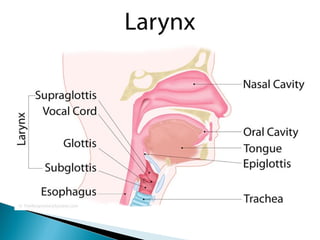
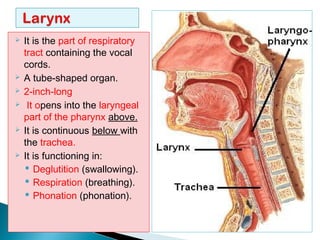
 It is the part of respiratory
tract containing the vocal
cords.
 A tube-shaped organ.
 2-inch-long
 It opens into the laryngeal
part of the pharynx above.
 It is continuous below with
the trachea.
 It is functioning in:
 Deglutition (swallowing).
 Respiration (breathing).
 Phonation (phonation).
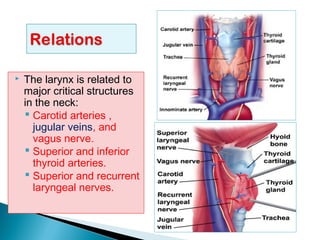
 The larynx is related to
major critical structures
in the neck:
 Carotid arteries ,
jugular veins, and
vagus nerve.
 Superior and inferior
thyroid arteries.
 Superior and recurrent
laryngeal nerves.
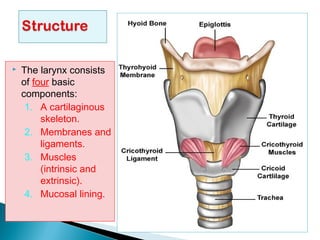
 The larynx consists
of four basic
components:
1. A cartilaginous
skeleton.
2. Membranes and
ligaments.
3. Muscles
(intrinsic and
extrinsic).
4. Mucosal lining.
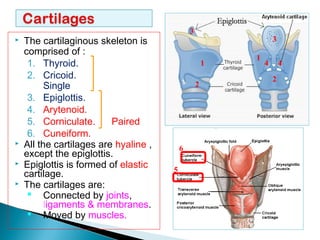
 The cartilaginous skeleton is
comprised of :
1. Thyroid.
2. Cricoid.
Single
3. Epiglottis.
4. Arytenoid.
5. Corniculate. Paired
6. Cuneiform.
 All the cartilages are hyaline ,
except the epiglottis.
 Epiglottis is formed of elastic
cartilage.
 The cartilages are:
 Connected by joints,
ligaments & membranes.
 Moved by muscles.
1
3
2
2
3
1 44
5
6
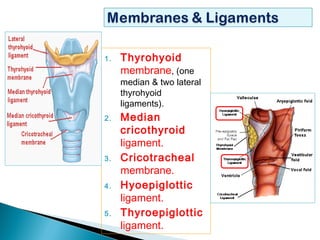
1. Thyrohyoid
membrane, (one
median & two lateral
thyrohyoid
ligaments).
2. Median
cricothyroid
ligament.
3. Cricotracheal
membrane.
4. Hyoepiglottic
ligament.
5. Thyroepiglottic
ligament.
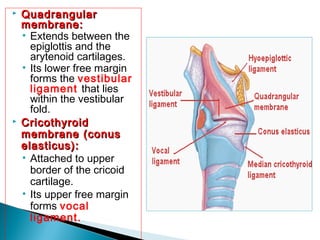
 QuadrangularQuadrangular
membrane:membrane:
• Extends between the
epiglottis and the
arytenoid cartilages.
• Its lower free margin
forms the vestibular
ligament that lies
within the vestibular
fold.
 CricothyroidCricothyroid
membrane (conusmembrane (conus
elasticus):elasticus):
• Attached to upper
border of the cricoid
cartilage.
• Its upper free margin
forms vocal
ligament.
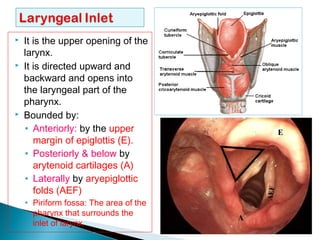
 It is the upper opening of the
larynx.
 It is directed upward and
backward and opens into
the laryngeal part of the
pharynx.
 Bounded by:
• Anteriorly: by the upper
margin of epiglottis (E).
• Posteriorly & below by
arytenoid cartilages (A)
• Laterally by aryepiglottic
folds (AEF)
• Piriform fossa: The area of the
pharynx that surrounds the
inlet of larynx.
E
AEF
A
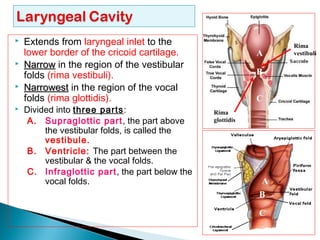
 Extends from laryngeal inlet to the
lower border of the cricoid cartilage.
 NarrowNarrow in the region of the vestibular
folds (rima vestibuli).
 NarrowestNarrowest in the region of the vocal
folds (rima glottidis).
 Divided into three parts:
A. Supraglottic part, the part above
the vestibular folds, is called the
vestibule.
B. Ventricle: The part between the
vestibular & the vocal folds.
C. Infraglottic part, the part below the
vocal folds.
Rima
vestibuli
Rima
glottidis
B
A
C
A
B
C
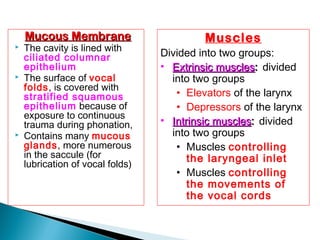
Mucous MembraneMucous Membrane
 The cavity is lined with
ciliated columnar
epithelium
 The surface of vocal
folds, is covered with
stratified squamous
epithelium because of
exposure to continuous
trauma during phonation,
 Contains many mucous
glands, more numerous
in the saccule (for
lubrication of vocal folds)
Muscles
Divided into two groups:
• Extrinsic musclesExtrinsic muscles:: divided
into two groups
• Elevators of the larynx
• Depressors of the larynx
• Intrinsic musclesIntrinsic muscles:: divided
into two groups
• Muscles controlling
the laryngeal inlet
• Muscles controlling
the movements of
the vocal cords
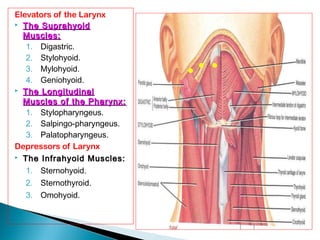
Elevators of the Larynx
 The SuprahyoidThe Suprahyoid
Muscles:Muscles:
1. Digastric.
2. Stylohyoid.
3. Mylohyoid.
4. Geniohyoid.
 The LongitudinalThe Longitudinal
Muscles of the Pharynx:Muscles of the Pharynx:
1. Stylopharyngeus.
2. Salpingo-pharyngeus.
3. Palatopharyngeus.
Depressors of Larynx
 The Infrahyoid Muscles:The Infrahyoid Muscles:
1. Sternohyoid.
2. Sternothyroid.
3. Omohyoid.
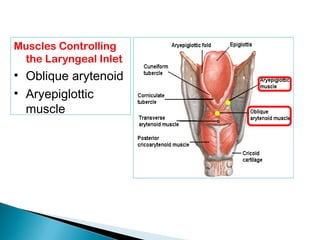
Muscles Controlling
the Laryngeal Inlet
• Oblique arytenoid
• Aryepiglottic
muscle
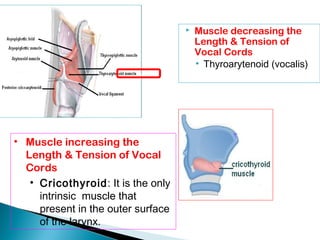
 Muscle decreasing the
Length & Tension of
Vocal Cords
• Thyroarytenoid (vocalis)
• Muscle increasing the
Length & Tension of Vocal
Cords
• Cricothyroid: It is the only
intrinsic muscle that
present in the outer surface
of the larynx.
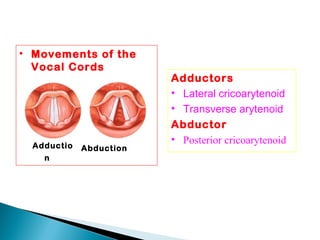
• Movements of the
Vocal Cords
Adductio
n
Abduction
Adductors
• Lateral cricoarytenoid
• Transverse arytenoid
Abductor
• Posterior cricoarytenoid
Blood Supply
 Arteries:
 Upper half: Superior
laryngeal artery, branch of
superior thyroid artery.
 Lower half: Inferior
laryngeal artery, branch of
inferior thyroid artery.
 Veins:
 Accompany the
corresponding arterie.s
 Lymphatics:
 The lymph vessels drain
into the deep cervical
lymph nodes.
Nerve Supply
• Sensory
 Above the vocal cords:
Internal laryngeal nerve,
branch of the superior
laryngeal of vagus.
 Below the vocal cords:
Recurrent laryngeal, of
vagus.
• Motor
 All intrinsic muscles of
the larynx are supplied by
the recurrent laryngeal
except cricothyroid, which
is supplied by the the
external laryngeal of
superior laryngeal of
vagus.
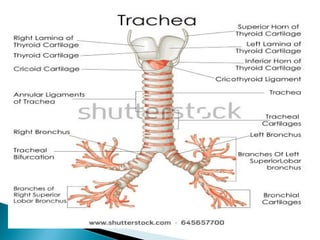
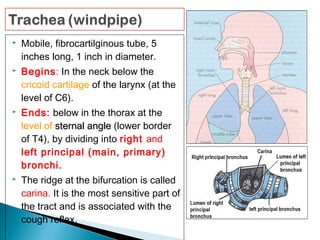
 Mobile, fibrocartilginous tube, 5
inches long, 1 inch in diameter.
 Begins: In the neck below the
cricoid cartilage of the larynx (at the
level of C6).
 Ends: below in the thorax at the
level of sternal anglesternal angle (lower border
of T4), by dividing into right and
left principal (main, primary)
bronchi.
 The ridge at the bifurcation is called
carina. It is the most sensitive part of
the tract and is associated with the
cough reflex.
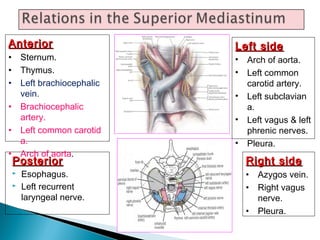
PosteriorPosterior
 Esophagus.
 Left recurrent
laryngeal nerve.
AnteriorAnterior
• Sternum.
• Thymus.
• Left brachiocephalic
vein.
• Brachiocephalic
artery.
• Left common carotid
a.
• Arch of aorta.
Left sideLeft side
• Arch of aorta.
• Left common
carotid artery.
• Left subclavian
a.
• Left vagus & left
phrenic nerves.
• Pleura.
Right sideRight side
• Azygos vein.
• Right vagus
nerve.
• Pleura.
Nerve SupplyNerve Supply
 Branches of vagus and the
recurrent laryngeal nerves.
(from vagus) supply
sensory fibers to the
mucous membrane.
 Branches from the
sympathetic trunks supply
the trachealis muscle and
the blood vessels.
Blood SupplyBlood Supply
• Arteries: Branches from
the inferior thyroid and
bronchial arteries.
• Veins: Drain to inferior
thyroid veins.
Lymphatic DrainageLymphatic Drainage
• Into the pre- &
paratracheal lymph nodes.
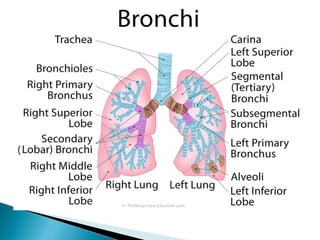
 What are Bronchi
 Bronchi, branching from the trachea, are the
primary passageway for air to get into the lungs [1]
.
It is the plural for bronchus. Each bronchus further
branches into smaller tubes or bronchioles.
 How Many Primary Bronchi are There
 There are two primary (extrapulmonary) bronchi
– the right and left main bronchi that connect
the trachea to the two lungs .
 The bronchi are located in the thoracic
cavity [3]
 along with the trachea and lungs. It
originates from the lower end of the trachea or
windpipe, where it divides or bifurcates (at the
point of carina) into the left and right bronchus .

 Right Main (Primary) Bronchus
 The branch that leads into the right lung is called the right main
or primary bronchus [5]
. Being about 2.5cm long, it is shorter than
the left primary bronchus, but wider in diameter [6]
. It enters the
right lung at around the level where the fifth thoracic vertebra is
located.
 Divisions and Anatomy
 The right primary bronchi branches into three secondary or
lobar bronchi, the superior (upper), middle, and inferior (lower)
lobar bronchi. The right superior secondary bronchus is also
known as the eparterial bronchus because it is the only bronchial
tube originating above the pulmonary artery’s level [34]
. Bronchial
lymph nodes are located at the origin point of each of the lobar
bronchi [35]
.
 The main bronchus first divides into the right superior lobar
bronchus and bronchus intermedius, with the latter then giving
rise to the middle and inferior bronchi [4]
.
 The secondary bronchi then further subdivide into
ten tertiary or segmental bronchi. [7]
.
 These tertiary bronchi then give rise to
the subsegmental bronchi, which then leads to
the smallest branches of a bronchus,
the bronchioles[1]
.
 The azygos vein overarches the right primary
bronchus from behind, at the base of the lung [8]
.
 Left Main (Primary) Bronchus
 The left primary bronchus supplies air to the left
lung [9]
 and is around 5cm in size, twice as long as the
right main bronchus [10]
. It enters the left lung at around
the level of the sixth thoracic vertebra, passes from
beneath the aortic arch, crossing the esophagus,
thoracic duct, and descending aorta from the front [1]
.
 Divisions and Anatomy
 Like the right main bronchus, the left one also divides
into two lobar bronchi, the superior and inferior lobar
bronchi [11]
.
 The lobar bronchi then subdivide into eight tertiary
or segmental bronchi [9, 12]
.
 The tertiary bronchi continue to divide into smaller
tubes to become subsegmental bronchi and
then bronchioles
 Bronchi Function in the Respiratory System
 What Does the Primary Bronchi Do
 The main function of the primary bronchi is to carry
oxygen-rich air reach the lungs during inhalation and
let carbon dioxide-rich air out of the lungs and into the
trachea on its way out during exhalation [17]
. It is the
connection between the rest of the respiratory tract
and the lungs.
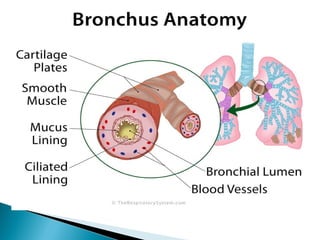
 Its cartilaginous walls help in maintaining its shape
during breathing, preventing it from collapsing, while
the mucus lining, along with cilia keeps any foreign
particles (like dust) from entering the lungs [18]
.
 The smaller tubes of bronchi are assigned to supply
specific regions within the lungs.
 Secondary Bronchi Function
 The three secondary or lobar bronchi of the right lung
act as the passage for air to the superior, middle, and
inferior lobes of the right lung. There are only two
secondary bronchi in the left lung as there are only
two lobes to supply, the superior and inferior lobes [11]
.
 Tertiary Bronchi Function
 These supply air to the bronchopulmonary segments.
There are ten bronchopulmonary segments in the right
lung, so it has ten tertiary bronchi [19]
, while the left lung
has eight tertiary bronchi to serve each of its eight
bronchopulmonary segments.
 Associated Health Conditions
 Bronchitis: Inflammation of the bronchial tube linings,
bronchitis can be either acute or chronic with symptoms
including a cough, shortness of breath, wheezing, and fatigue.
Severe symptoms along with chest pain and high fever may
even indicate pneumonia [36]
. Bronchitis may occur after severe
flu, or due to excessive smoking and certain environmental
factors [21]
. The acute form usually goes away on its own after a
few days, which severe or chronic cases may need medications
and breathing exercises along with a healthy lifestyle [22]
.
 Bronchiectasis: Characterized by chronic dilation of the
bronchi and bronchioles which leads to excessive mucus
discharge, increasing the risks of serious lung infections.
Persistent cough, phlegm discharge, and breathlessness are the
common symptoms of this condition [23]
. Treatment involves
medication, breathing exercises and special devices for getting
rid of the excess mucus and managing the bronchial dilation,
while an infection may require antibiotics [24]
.
 Asthma: A common condition primarily affecting the smaller tubes of bronchi, it
is characterized by breathing difficulty, wheezing, and a tightness in the chest [30]
.
It causes the smooth muscles to contract, narrowing the airways (bronchial
spasms) [31]
, and leading to the symptoms. Treatment and management include
inhalers and medications to open up the airways, as well as avoiding the
triggers, including smoking, eating certain foods, and going near allergenic
animals [32]
.
 Tuberculosis: A bacterial condition that usually affects the lungs, tuberculosis
may also occur in the bronchi and trachea in some cases, leading to fatigue,
fever, cough, and bleeding from the bronchi and trachea [25]
.
 Cancers: Lung cancer and bronchial adenoma are two of the cancer types that
may affect the bronchial tubes. There may be different types depending on
origin and growth of the tumor, including bronchogenic carcinoma (originates in
the bronchi or bronchiole epithelium) [26]
and adenoid cystic carcinoma (arising
from salivary glands in the throat and mouth) [27]
. Diagnosis involves various
medical procedures like a CT scan, MRI, bronchoscopy, and biopsy [28]
. Surgical
repair of the affected bronchus (bronchoplasty) [29]
 may be considered in some
cases.
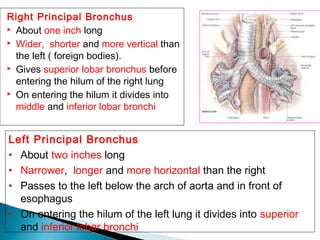
Right Principal Bronchus
 About one inch long
 Wider, shorter and more vertical than
the left ( foreign bodies).
 Gives superior lobar bronchus before
entering the hilum of the right lung
 On entering the hilum it divides into
middle and inferior lobar bronchi
Left Principal Bronchus
• About two inches long
• Narrower, longer and more horizontal than the right
• Passes to the left below the arch of aorta and in front of
esophagus
• On entering the hilum of the left lung it divides into superior
and inferior lobar bronchi
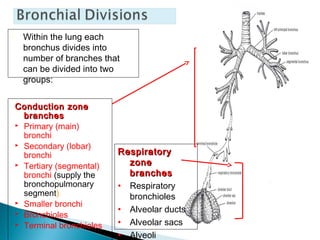
Conduction zoneConduction zone
branchesbranches
 Primary (main)
bronchi
 Secondary (lobar)
bronchi
 Tertiary (segmental)
bronchi (supply the
bronchopulmonary
segment)
 Smaller bronchi
 Bronchioles
 Terminal bronchioles
• Within the lung each
bronchus divides into
number of branches that
can be divided into two
groups:
RespiratoryRespiratory
zonezone
branchesbranches
• Respiratory
bronchioles
• Alveolar ducts
• Alveolar sacs
• Alveoli
Thank You

Larynx, trachea & bronchi

  • 1.
    MR VIJAY ASSOCIATE PROF Schoolof Nursing P P Savani University
  • 3.
     It isthe part of respiratory tract containing the vocal cords.  A tube-shaped organ.  2-inch-long  It opens into the laryngeal part of the pharynx above.  It is continuous below with the trachea.  It is functioning in:  Deglutition (swallowing).  Respiration (breathing).  Phonation (phonation).
  • 4.
     The larynxis related to major critical structures in the neck:  Carotid arteries , jugular veins, and vagus nerve.  Superior and inferior thyroid arteries.  Superior and recurrent laryngeal nerves.
  • 5.
     The larynxconsists of four basic components: 1. A cartilaginous skeleton. 2. Membranes and ligaments. 3. Muscles (intrinsic and extrinsic). 4. Mucosal lining.
  • 6.
     The cartilaginousskeleton is comprised of : 1. Thyroid. 2. Cricoid. Single 3. Epiglottis. 4. Arytenoid. 5. Corniculate. Paired 6. Cuneiform.  All the cartilages are hyaline , except the epiglottis.  Epiglottis is formed of elastic cartilage.  The cartilages are:  Connected by joints, ligaments & membranes.  Moved by muscles. 1 3 2 2 3 1 44 5 6
  • 7.
    1. Thyrohyoid membrane, (one median& two lateral thyrohyoid ligaments). 2. Median cricothyroid ligament. 3. Cricotracheal membrane. 4. Hyoepiglottic ligament. 5. Thyroepiglottic ligament.
  • 8.
     QuadrangularQuadrangular membrane:membrane: • Extendsbetween the epiglottis and the arytenoid cartilages. • Its lower free margin forms the vestibular ligament that lies within the vestibular fold.  CricothyroidCricothyroid membrane (conusmembrane (conus elasticus):elasticus): • Attached to upper border of the cricoid cartilage. • Its upper free margin forms vocal ligament.
  • 9.
     It isthe upper opening of the larynx.  It is directed upward and backward and opens into the laryngeal part of the pharynx.  Bounded by: • Anteriorly: by the upper margin of epiglottis (E). • Posteriorly & below by arytenoid cartilages (A) • Laterally by aryepiglottic folds (AEF) • Piriform fossa: The area of the pharynx that surrounds the inlet of larynx. E AEF A
  • 10.
     Extends fromlaryngeal inlet to the lower border of the cricoid cartilage.  NarrowNarrow in the region of the vestibular folds (rima vestibuli).  NarrowestNarrowest in the region of the vocal folds (rima glottidis).  Divided into three parts: A. Supraglottic part, the part above the vestibular folds, is called the vestibule. B. Ventricle: The part between the vestibular & the vocal folds. C. Infraglottic part, the part below the vocal folds. Rima vestibuli Rima glottidis B A C A B C
  • 11.
    Mucous MembraneMucous Membrane The cavity is lined with ciliated columnar epithelium  The surface of vocal folds, is covered with stratified squamous epithelium because of exposure to continuous trauma during phonation,  Contains many mucous glands, more numerous in the saccule (for lubrication of vocal folds) Muscles Divided into two groups: • Extrinsic musclesExtrinsic muscles:: divided into two groups • Elevators of the larynx • Depressors of the larynx • Intrinsic musclesIntrinsic muscles:: divided into two groups • Muscles controlling the laryngeal inlet • Muscles controlling the movements of the vocal cords
  • 12.
    Elevators of theLarynx  The SuprahyoidThe Suprahyoid Muscles:Muscles: 1. Digastric. 2. Stylohyoid. 3. Mylohyoid. 4. Geniohyoid.  The LongitudinalThe Longitudinal Muscles of the Pharynx:Muscles of the Pharynx: 1. Stylopharyngeus. 2. Salpingo-pharyngeus. 3. Palatopharyngeus. Depressors of Larynx  The Infrahyoid Muscles:The Infrahyoid Muscles: 1. Sternohyoid. 2. Sternothyroid. 3. Omohyoid.
  • 13.
    Muscles Controlling the LaryngealInlet • Oblique arytenoid • Aryepiglottic muscle
  • 14.
     Muscle decreasingthe Length & Tension of Vocal Cords • Thyroarytenoid (vocalis) • Muscle increasing the Length & Tension of Vocal Cords • Cricothyroid: It is the only intrinsic muscle that present in the outer surface of the larynx.
  • 15.
    • Movements ofthe Vocal Cords Adductio n Abduction Adductors • Lateral cricoarytenoid • Transverse arytenoid Abductor • Posterior cricoarytenoid
  • 16.
    Blood Supply  Arteries: Upper half: Superior laryngeal artery, branch of superior thyroid artery.  Lower half: Inferior laryngeal artery, branch of inferior thyroid artery.  Veins:  Accompany the corresponding arterie.s  Lymphatics:  The lymph vessels drain into the deep cervical lymph nodes. Nerve Supply • Sensory  Above the vocal cords: Internal laryngeal nerve, branch of the superior laryngeal of vagus.  Below the vocal cords: Recurrent laryngeal, of vagus. • Motor  All intrinsic muscles of the larynx are supplied by the recurrent laryngeal except cricothyroid, which is supplied by the the external laryngeal of superior laryngeal of vagus.
  • 18.
     Mobile, fibrocartilginoustube, 5 inches long, 1 inch in diameter.  Begins: In the neck below the cricoid cartilage of the larynx (at the level of C6).  Ends: below in the thorax at the level of sternal anglesternal angle (lower border of T4), by dividing into right and left principal (main, primary) bronchi.  The ridge at the bifurcation is called carina. It is the most sensitive part of the tract and is associated with the cough reflex.
  • 19.
    PosteriorPosterior  Esophagus.  Leftrecurrent laryngeal nerve. AnteriorAnterior • Sternum. • Thymus. • Left brachiocephalic vein. • Brachiocephalic artery. • Left common carotid a. • Arch of aorta. Left sideLeft side • Arch of aorta. • Left common carotid artery. • Left subclavian a. • Left vagus & left phrenic nerves. • Pleura. Right sideRight side • Azygos vein. • Right vagus nerve. • Pleura.
  • 20.
    Nerve SupplyNerve Supply Branches of vagus and the recurrent laryngeal nerves. (from vagus) supply sensory fibers to the mucous membrane.  Branches from the sympathetic trunks supply the trachealis muscle and the blood vessels. Blood SupplyBlood Supply • Arteries: Branches from the inferior thyroid and bronchial arteries. • Veins: Drain to inferior thyroid veins. Lymphatic DrainageLymphatic Drainage • Into the pre- & paratracheal lymph nodes.
  • 21.
     What areBronchi  Bronchi, branching from the trachea, are the primary passageway for air to get into the lungs [1] . It is the plural for bronchus. Each bronchus further branches into smaller tubes or bronchioles.  How Many Primary Bronchi are There  There are two primary (extrapulmonary) bronchi – the right and left main bronchi that connect the trachea to the two lungs .
  • 22.
     The bronchiare located in the thoracic cavity [3]  along with the trachea and lungs. It originates from the lower end of the trachea or windpipe, where it divides or bifurcates (at the point of carina) into the left and right bronchus . 
  • 23.
     Right Main(Primary) Bronchus  The branch that leads into the right lung is called the right main or primary bronchus [5] . Being about 2.5cm long, it is shorter than the left primary bronchus, but wider in diameter [6] . It enters the right lung at around the level where the fifth thoracic vertebra is located.  Divisions and Anatomy  The right primary bronchi branches into three secondary or lobar bronchi, the superior (upper), middle, and inferior (lower) lobar bronchi. The right superior secondary bronchus is also known as the eparterial bronchus because it is the only bronchial tube originating above the pulmonary artery’s level [34] . Bronchial lymph nodes are located at the origin point of each of the lobar bronchi [35] .  The main bronchus first divides into the right superior lobar bronchus and bronchus intermedius, with the latter then giving rise to the middle and inferior bronchi [4] .
  • 24.
     The secondarybronchi then further subdivide into ten tertiary or segmental bronchi. [7] .  These tertiary bronchi then give rise to the subsegmental bronchi, which then leads to the smallest branches of a bronchus, the bronchioles[1] .  The azygos vein overarches the right primary bronchus from behind, at the base of the lung [8] .
  • 25.
     Left Main(Primary) Bronchus  The left primary bronchus supplies air to the left lung [9]  and is around 5cm in size, twice as long as the right main bronchus [10] . It enters the left lung at around the level of the sixth thoracic vertebra, passes from beneath the aortic arch, crossing the esophagus, thoracic duct, and descending aorta from the front [1] .  Divisions and Anatomy  Like the right main bronchus, the left one also divides into two lobar bronchi, the superior and inferior lobar bronchi [11] .  The lobar bronchi then subdivide into eight tertiary or segmental bronchi [9, 12] .  The tertiary bronchi continue to divide into smaller tubes to become subsegmental bronchi and then bronchioles
  • 26.
     Bronchi Functionin the Respiratory System  What Does the Primary Bronchi Do  The main function of the primary bronchi is to carry oxygen-rich air reach the lungs during inhalation and let carbon dioxide-rich air out of the lungs and into the trachea on its way out during exhalation [17] . It is the connection between the rest of the respiratory tract and the lungs.  Its cartilaginous walls help in maintaining its shape during breathing, preventing it from collapsing, while the mucus lining, along with cilia keeps any foreign particles (like dust) from entering the lungs [18] .  The smaller tubes of bronchi are assigned to supply specific regions within the lungs.
  • 27.
     Secondary BronchiFunction  The three secondary or lobar bronchi of the right lung act as the passage for air to the superior, middle, and inferior lobes of the right lung. There are only two secondary bronchi in the left lung as there are only two lobes to supply, the superior and inferior lobes [11] .  Tertiary Bronchi Function  These supply air to the bronchopulmonary segments. There are ten bronchopulmonary segments in the right lung, so it has ten tertiary bronchi [19] , while the left lung has eight tertiary bronchi to serve each of its eight bronchopulmonary segments.
  • 28.
     Associated HealthConditions  Bronchitis: Inflammation of the bronchial tube linings, bronchitis can be either acute or chronic with symptoms including a cough, shortness of breath, wheezing, and fatigue. Severe symptoms along with chest pain and high fever may even indicate pneumonia [36] . Bronchitis may occur after severe flu, or due to excessive smoking and certain environmental factors [21] . The acute form usually goes away on its own after a few days, which severe or chronic cases may need medications and breathing exercises along with a healthy lifestyle [22] .  Bronchiectasis: Characterized by chronic dilation of the bronchi and bronchioles which leads to excessive mucus discharge, increasing the risks of serious lung infections. Persistent cough, phlegm discharge, and breathlessness are the common symptoms of this condition [23] . Treatment involves medication, breathing exercises and special devices for getting rid of the excess mucus and managing the bronchial dilation, while an infection may require antibiotics [24] .
  • 29.
     Asthma: A commoncondition primarily affecting the smaller tubes of bronchi, it is characterized by breathing difficulty, wheezing, and a tightness in the chest [30] . It causes the smooth muscles to contract, narrowing the airways (bronchial spasms) [31] , and leading to the symptoms. Treatment and management include inhalers and medications to open up the airways, as well as avoiding the triggers, including smoking, eating certain foods, and going near allergenic animals [32] .  Tuberculosis: A bacterial condition that usually affects the lungs, tuberculosis may also occur in the bronchi and trachea in some cases, leading to fatigue, fever, cough, and bleeding from the bronchi and trachea [25] .  Cancers: Lung cancer and bronchial adenoma are two of the cancer types that may affect the bronchial tubes. There may be different types depending on origin and growth of the tumor, including bronchogenic carcinoma (originates in the bronchi or bronchiole epithelium) [26] and adenoid cystic carcinoma (arising from salivary glands in the throat and mouth) [27] . Diagnosis involves various medical procedures like a CT scan, MRI, bronchoscopy, and biopsy [28] . Surgical repair of the affected bronchus (bronchoplasty) [29]  may be considered in some cases.
  • 31.
    Right Principal Bronchus About one inch long  Wider, shorter and more vertical than the left ( foreign bodies).  Gives superior lobar bronchus before entering the hilum of the right lung  On entering the hilum it divides into middle and inferior lobar bronchi Left Principal Bronchus • About two inches long • Narrower, longer and more horizontal than the right • Passes to the left below the arch of aorta and in front of esophagus • On entering the hilum of the left lung it divides into superior and inferior lobar bronchi
  • 33.
    Conduction zoneConduction zone branchesbranches Primary (main) bronchi  Secondary (lobar) bronchi  Tertiary (segmental) bronchi (supply the bronchopulmonary segment)  Smaller bronchi  Bronchioles  Terminal bronchioles • Within the lung each bronchus divides into number of branches that can be divided into two groups: RespiratoryRespiratory zonezone branchesbranches • Respiratory bronchioles • Alveolar ducts • Alveolar sacs • Alveoli
  • 34.