Reform Bill
Welcome to All
Mr VEERASAMY R
Assistant Professor & Head I/C
Department of English,
Sri Amaraavathi College of Arts and Science,
Velliyanai, Karur.
Contact:
Cell: 99 43 82 98 47, 90 80 30 35 62.
Face book: Veera King’s King
Twitter: @DHANASHREEVEERA
Blogger: rvteachenglish.blogspot.com
First Reform Bill - 1832
Major Reform - Distribution of
Seats – Parliament.
2 MPs – Each country / Town
Due to Agrarian & industrial
Revolutions- people moved –
industrial Towns.
New towns have no
representation.
Voting Rights
Qualification – to Vote
 Free Holders
 Forty Shilling par Annum
No Voting Rights
 Tenant farmers
 lowest People
Economical -Cause
Unemployment
High price of Corn
 Due to Corn Law – 1815
These all due to lack of more
representation in Parliament.
Agitation – Widespread- so Reform-
came.
Prime Minister - Earl Grey (1831)
Introduce Reform Bill in Parliament –
1831
Reading Bill in House of Commons
Sent to House of Lords.
Lords opposed and rejects – Earl
resigned
King – Due of Willington to be Prime
Minister
People opposed – Earl recalled as PM
Once again –reform bill introduced by
Earl
100 lords absented – bill was passed –
7th July-1832
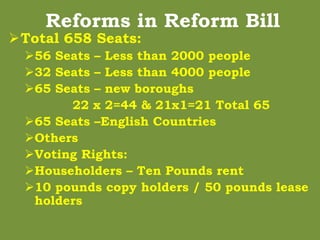
Reforms in Reform Bill
Total 658 Seats:
56 Seats – Less than 2000 people
32 Seats – Less than 4000 people
65 Seats – new boroughs
22 x 2=44 & 21x1=21 Total 65
65 Seats –English Countries
Others
Voting Rights:
Householders – Ten Pounds rent
10 pounds copy holders / 50 pounds lease
holders
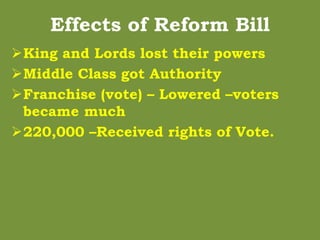
Effects of Reform Bill
King and Lords lost their powers
Middle Class got Authority
Franchise (vote) – Lowered –voters
became much
220,000 –Received rights of Vote.
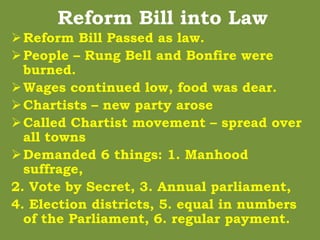
Reform Bill into Law
Reform Bill Passed as law.
People – Rung Bell and Bonfire were
burned.
Wages continued low, food was dear.
Chartists – new party arose
Called Chartist movement – spread over
all towns
Demanded 6 things: 1. Manhood
suffrage,
2. Vote by Secret, 3. Annual parliament,
4. Election districts, 5. equal in numbers
of the Parliament, 6. regular payment.
Second Reform Bill - 1867
 Gladstone introduce –but defeated in
House of Commons itself
Later Benjamin Disraeli - passed the
bill in 1867
Franchise qualifications was lowered.
increased from 540,000 to 790,000
All householders, workman – in towns –
rights to vote
But Agri labors & Miners remained
without voting rights
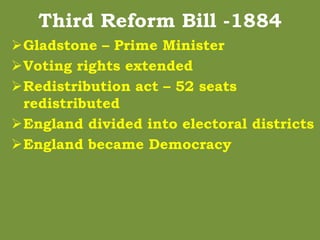
Third Reform Bill -1884
Gladstone – Prime Minister
Voting rights extended
Redistribution act – 52 seats
redistributed
England divided into electoral districts
England became Democracy
Fourth Reform Bill -1918
 Voting rights to all
 Men- 21 age, Women-25 age
 Age difference abolished in 1928
 The equality of woman to man was
acknowledged.

The reform bill

  • 1.
    Reform Bill Welcome toAll Mr VEERASAMY R Assistant Professor & Head I/C Department of English, Sri Amaraavathi College of Arts and Science, Velliyanai, Karur. Contact: Cell: 99 43 82 98 47, 90 80 30 35 62. Face book: Veera King’s King Twitter: @DHANASHREEVEERA Blogger: rvteachenglish.blogspot.com
  • 2.
    First Reform Bill- 1832 Major Reform - Distribution of Seats – Parliament. 2 MPs – Each country / Town Due to Agrarian & industrial Revolutions- people moved – industrial Towns. New towns have no representation.
  • 3.
    Voting Rights Qualification –to Vote  Free Holders  Forty Shilling par Annum No Voting Rights  Tenant farmers  lowest People
  • 4.
    Economical -Cause Unemployment High priceof Corn  Due to Corn Law – 1815 These all due to lack of more representation in Parliament. Agitation – Widespread- so Reform- came.
  • 5.
    Prime Minister -Earl Grey (1831) Introduce Reform Bill in Parliament – 1831 Reading Bill in House of Commons Sent to House of Lords. Lords opposed and rejects – Earl resigned King – Due of Willington to be Prime Minister People opposed – Earl recalled as PM Once again –reform bill introduced by Earl 100 lords absented – bill was passed – 7th July-1832
  • 6.
    Reforms in ReformBill Total 658 Seats: 56 Seats – Less than 2000 people 32 Seats – Less than 4000 people 65 Seats – new boroughs 22 x 2=44 & 21x1=21 Total 65 65 Seats –English Countries Others Voting Rights: Householders – Ten Pounds rent 10 pounds copy holders / 50 pounds lease holders
  • 7.
    Effects of ReformBill King and Lords lost their powers Middle Class got Authority Franchise (vote) – Lowered –voters became much 220,000 –Received rights of Vote.
  • 8.
    Reform Bill intoLaw Reform Bill Passed as law. People – Rung Bell and Bonfire were burned. Wages continued low, food was dear. Chartists – new party arose Called Chartist movement – spread over all towns Demanded 6 things: 1. Manhood suffrage, 2. Vote by Secret, 3. Annual parliament, 4. Election districts, 5. equal in numbers of the Parliament, 6. regular payment.
  • 9.
    Second Reform Bill- 1867  Gladstone introduce –but defeated in House of Commons itself Later Benjamin Disraeli - passed the bill in 1867 Franchise qualifications was lowered. increased from 540,000 to 790,000 All householders, workman – in towns – rights to vote But Agri labors & Miners remained without voting rights
  • 10.
    Third Reform Bill-1884 Gladstone – Prime Minister Voting rights extended Redistribution act – 52 seats redistributed England divided into electoral districts England became Democracy
  • 11.
    Fourth Reform Bill-1918  Voting rights to all  Men- 21 age, Women-25 age  Age difference abolished in 1928  The equality of woman to man was acknowledged.