23. 1 Democratic Reform in Britain
How did political reform gradually expand
suffrage and make the British Parliament
more democratic during the 1800s?
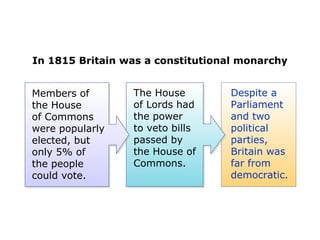
In 1815 Britain was a constitutional monarchy


Members of       The House        Despite a
the House        of Lords had     Parliament
of Commons       the power        and two
were popularly   to veto bills    political
elected, but     passed by        parties,
only 5% of       the House of     Britain was
the people       Commons.         far from
could vote.                       democratic.
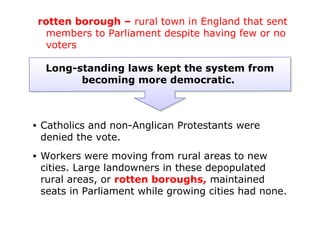
rotten borough – rural town in England that sent
      members to Parliament despite having few or no
      voters

     Long-standing laws kept the system from
           becoming more democratic.


•   Catholics and non-Anglican Protestants were
    denied the vote.
•   Workers were moving from rural areas to new
    cities. Large landowners in these depopulated
    rural areas, or rotten boroughs, maintained
    seats in Parliament while growing cities had none.
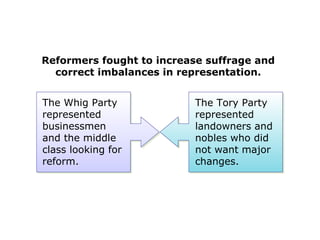
Reformers fought to increase suffrage and
  correct imbalances in representation.


The Whig Party            The Tory Party
represented               represented
businessmen               landowners and
and the middle            nobles who did
class looking for         not want major
reform.                   changes.
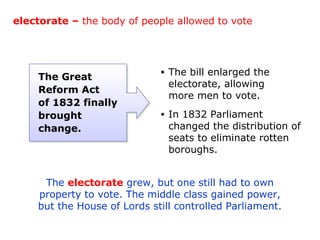
electorate – the body of people allowed to vote


    The Great
                             •   The bill enlarged the
                                 electorate, allowing
    Reform Act
                                 more men to vote.
    of 1832 finally
    brought                  •   In 1832 Parliament
    change.                      changed the distribution of
                                 seats to eliminate rotten
                                 boroughs.


     The electorate grew, but one still had to own
    property to vote. The middle class gained power,
    but the House of Lords still controlled Parliament.
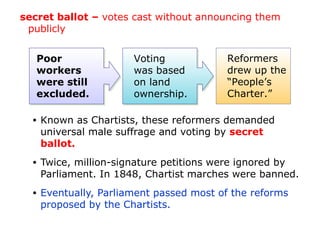
secret ballot – votes cast without announcing them
 publicly


   Poor                 Voting            Reformers
   workers              was based         drew up the
   were still           on land           “People’s
   excluded.            ownership.        Charter.”

  •   Known as Chartists, these reformers demanded
      universal male suffrage and voting by secret
      ballot.
  •   Twice, million-signature petitions were ignored by
      Parliament. In 1848, Chartist marches were banned.
  •   Eventually, Parliament passed most of the reforms
      proposed by the Chartists.
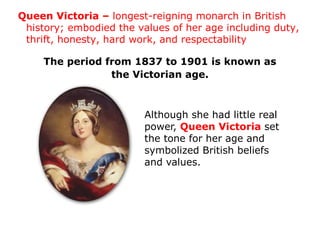
Queen Victoria – longest-reigning monarch in British
 history; embodied the values of her age including duty,
 thrift, honesty, hard work, and respectability

     The period from 1837 to 1901 is known as
                 the Victorian age.


                         Although she had little real
                         power, Queen Victoria set
                         the tone for her age and
                         symbolized British beliefs
                         and values.
The queen embodied a strict code of morals
                 and manners.


•   Victorian values included thrift, honesty, duty,
    hard work, and respectability.
•   The middle class gained new confidence under
    her reign as Britain’s empire grew.
•   Reformers were encouraged as Victoria noted the
    worthiness of the lower classes.
Benjamin Disraeli – leader of the Conservative Party;
 pushed the Reform Bill of 1867 to increase suffrage in
 England
William Gladstone – leader of the Liberal Party;
 worked to extend suffrage to farm workers and most
 other men
                                •   Benjamin Disraeli
  The 1860s were                    reformed the Tories
  the dawn of a new                 into the modern
  age in British                    Conservative Party.
  politics as the old
  parties regrouped             •   William Gladstone
  under new leaders.                led the new Liberal
                                    Party that evolved
                                    from the Whigs.
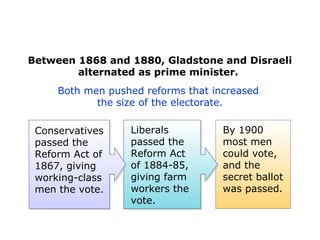
Between 1868 and 1880, Gladstone and Disraeli
        alternated as prime minister.
     Both men pushed reforms that increased
            the size of the electorate.

 Conservatives    Liberals          By 1900
 passed the       passed the        most men
 Reform Act of    Reform Act        could vote,
 1867, giving     of 1884-85,       and the
 working-class    giving farm       secret ballot
 men the vote.    workers the       was passed.
                  vote.
•   After Commons
In the early            threatened to appoint a
1900s the House         flood of new lords, the
of Lords rejected       House of Lords backed
a large number          down.
of acts passed      •   In 1911, most of the
by the House            Lords’ power was
of Commons.             removed. Today the
                        House of Lords is largely
                        ceremonial.
parliamentary democracy – a form of government
 where ministers are chosen by, responsible to, and
 members of an elected legislature or parliament

       Britain had transformed itself from a
    constitutional monarchy to a parliamentary
                    democracy.


•   Government ministers were elected by, responsible
    to, and members of Parliament.
•   The Chartist goals of universal male suffrage
    and a secret ballot were almost completely met.
•   In 1918 women over 30 were also given the vote.
LEQ: How did political reform gradually expand
suffrage and make the British Parliament more
democratic during the 1800s?

  Suffrage was extended to most men;
  representation was made fairer by
  getting rid of rotten boroughs.

23.1 democratic reform in britain

  • 1.
    23. 1 DemocraticReform in Britain
  • 2.
    How did politicalreform gradually expand suffrage and make the British Parliament more democratic during the 1800s?
  • 3.
    In 1815 Britainwas a constitutional monarchy Members of The House Despite a the House of Lords had Parliament of Commons the power and two were popularly to veto bills political elected, but passed by parties, only 5% of the House of Britain was the people Commons. far from could vote. democratic.
  • 4.
    rotten borough –rural town in England that sent members to Parliament despite having few or no voters Long-standing laws kept the system from becoming more democratic. • Catholics and non-Anglican Protestants were denied the vote. • Workers were moving from rural areas to new cities. Large landowners in these depopulated rural areas, or rotten boroughs, maintained seats in Parliament while growing cities had none.
  • 5.
    Reformers fought toincrease suffrage and correct imbalances in representation. The Whig Party The Tory Party represented represented businessmen landowners and and the middle nobles who did class looking for not want major reform. changes.
  • 6.
    electorate – thebody of people allowed to vote The Great • The bill enlarged the electorate, allowing Reform Act more men to vote. of 1832 finally brought • In 1832 Parliament change. changed the distribution of seats to eliminate rotten boroughs. The electorate grew, but one still had to own property to vote. The middle class gained power, but the House of Lords still controlled Parliament.
  • 7.
    secret ballot –votes cast without announcing them publicly Poor Voting Reformers workers was based drew up the were still on land “People’s excluded. ownership. Charter.” • Known as Chartists, these reformers demanded universal male suffrage and voting by secret ballot. • Twice, million-signature petitions were ignored by Parliament. In 1848, Chartist marches were banned. • Eventually, Parliament passed most of the reforms proposed by the Chartists.
  • 8.
    Queen Victoria –longest-reigning monarch in British history; embodied the values of her age including duty, thrift, honesty, hard work, and respectability The period from 1837 to 1901 is known as the Victorian age. Although she had little real power, Queen Victoria set the tone for her age and symbolized British beliefs and values.
  • 9.
    The queen embodieda strict code of morals and manners. • Victorian values included thrift, honesty, duty, hard work, and respectability. • The middle class gained new confidence under her reign as Britain’s empire grew. • Reformers were encouraged as Victoria noted the worthiness of the lower classes.
  • 10.
    Benjamin Disraeli –leader of the Conservative Party; pushed the Reform Bill of 1867 to increase suffrage in England William Gladstone – leader of the Liberal Party; worked to extend suffrage to farm workers and most other men • Benjamin Disraeli The 1860s were reformed the Tories the dawn of a new into the modern age in British Conservative Party. politics as the old parties regrouped • William Gladstone under new leaders. led the new Liberal Party that evolved from the Whigs.
  • 11.
    Between 1868 and1880, Gladstone and Disraeli alternated as prime minister. Both men pushed reforms that increased the size of the electorate. Conservatives Liberals By 1900 passed the passed the most men Reform Act of Reform Act could vote, 1867, giving of 1884-85, and the working-class giving farm secret ballot men the vote. workers the was passed. vote.
  • 12.
    • After Commons In the early threatened to appoint a 1900s the House flood of new lords, the of Lords rejected House of Lords backed a large number down. of acts passed • In 1911, most of the by the House Lords’ power was of Commons. removed. Today the House of Lords is largely ceremonial.
  • 13.
    parliamentary democracy –a form of government where ministers are chosen by, responsible to, and members of an elected legislature or parliament Britain had transformed itself from a constitutional monarchy to a parliamentary democracy. • Government ministers were elected by, responsible to, and members of Parliament. • The Chartist goals of universal male suffrage and a secret ballot were almost completely met. • In 1918 women over 30 were also given the vote.
  • 14.
    LEQ: How didpolitical reform gradually expand suffrage and make the British Parliament more democratic during the 1800s? Suffrage was extended to most men; representation was made fairer by getting rid of rotten boroughs.