Forest Ecosystem
What do you mean by an Ecosystem?
 Eco means environment and System means
interacting, interdependent complex.
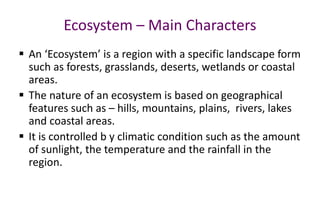
Ecosystem – Main Characters
 An ‘Ecosystem’ is a region with a specific landscape form
such as forests, grasslands, deserts, wetlands or coastal
areas.
 The nature of an ecosystem is based on geographical
features such as – hills, mountains, plains, rivers, lakes
and coastal areas.
 It is controlled b y climatic condition such as the amount
of sunlight, the temperature and the rainfall in the
region.
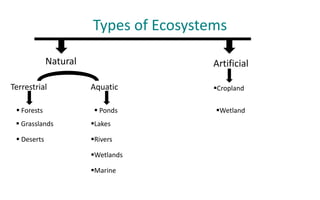
Types of Ecosystems
Natural Artificial
Terrestrial Aquatic
 Forests
 Grasslands
 Deserts
 Ponds
Rivers
Lakes
Wetlands
Marine
Cropland
Wetland
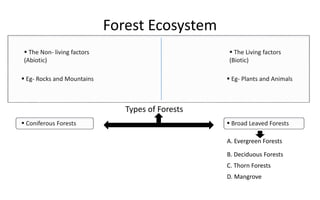
Forest Ecosystem
 The Non- living factors
(Abiotic)
 The Living factors
(Biotic)
 Eg- Rocks and Mountains  Eg- Plants and Animals
Types of Forests
 Coniferous Forests  Broad Leaved Forests
A. Evergreen Forests
B. Deciduous Forests
C. Thorn Forests
D. Mangrove
Coniferous
Forests
 Grow in the
Himalayan mountain
region
 Temperature is low.
 Have tall trees with
needle-like leaves
and downward
sloping branches so
that the snow can
slip off the branches.
 Have cones instead
of seeds and are
called gymnosperms
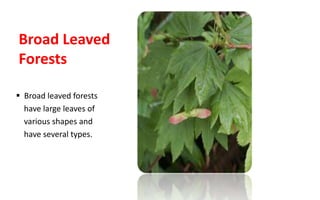
Broad Leaved
Forests
 Broad leaved forests
have large leaves of
various shapes and
have several types.
Evergreen
Forests
 grow in the high rainfall areas of the
Western Ghats, North Eastern and
the Andaman and Nicobar islands.
monsoon lasts for several months.
 Shed a few of their leaves
throughout the year.
 No leafless phase.
Only shade loving trees can grow in
the ground layers as canopy
overlap.
 Forest is rich in orchids and ferns
abounds in animal life and is most
rich in insect life
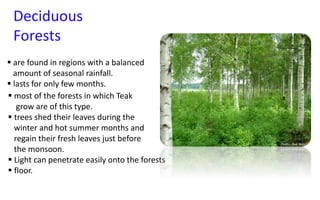
Deciduous
Forests
 are found in regions with a balanced
amount of seasonal rainfall.
 lasts for only few months.
 most of the forests in which Teak
grow are of this type.
 trees shed their leaves during the
winter and hot summer months and
regain their fresh leaves just before
the monsoon.
 Light can penetrate easily onto the forests
 floor.
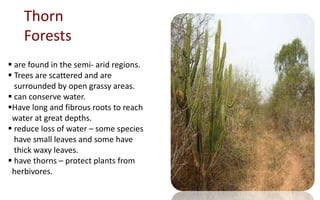
Thorn
Forests
 are found in the semi- arid regions.
 Trees are scattered and are
surrounded by open grassy areas.
 can conserve water.
Have long and fibrous roots to reach
water at great depths.
 reduce loss of water – some species
have small leaves and some have
thick waxy leaves.
 have thorns – protect plants from
herbivores.
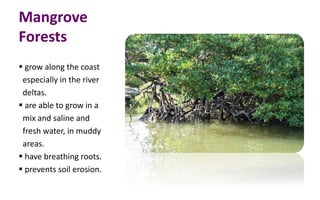
Mangrove
Forests
 grow along the coast
especially in the river
deltas.
 are able to grow in a
mix and saline and
fresh water, in muddy
areas.
 have breathing roots.
 prevents soil erosion.
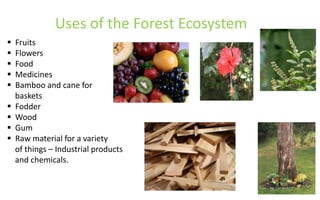
Uses of the Forest Ecosystem
 Fruits
 Flowers
 Food
 Medicines
 Bamboo and cane for
baskets
 Fodder
 Wood
 Gum
 Raw material for a variety
of things – Industrial products
and chemicals.
Services provided by the forest
• Control flow of water
• Watershed protection
• Help increase ground
• Water level
• Prevent soil erosion
• Control temperature
• Absorb co2
• Gene pool
Threats to the forest ecosystem
• Deforestation
• Poaching
• Overexploitation of resources
• Development activities (mining, dams)
• Changing land use patterns
• Fragmentation
• Habitat degradation
Conservation of forest ecosystems
 Use resources carefully
 Alternate source of energy for fuel wood
 Afforestation
 NP and Wildlife Sanctuaries
 Control population
Be a part to keep
the balance of the Forest Ecosystem

Forest Ecosystem

  • 1.
  • 2.
    What do youmean by an Ecosystem?  Eco means environment and System means interacting, interdependent complex.
  • 3.
    Ecosystem – MainCharacters  An ‘Ecosystem’ is a region with a specific landscape form such as forests, grasslands, deserts, wetlands or coastal areas.  The nature of an ecosystem is based on geographical features such as – hills, mountains, plains, rivers, lakes and coastal areas.  It is controlled b y climatic condition such as the amount of sunlight, the temperature and the rainfall in the region.
  • 4.
    Types of Ecosystems NaturalArtificial Terrestrial Aquatic  Forests  Grasslands  Deserts  Ponds Rivers Lakes Wetlands Marine Cropland Wetland
  • 5.
    Forest Ecosystem  TheNon- living factors (Abiotic)  The Living factors (Biotic)  Eg- Rocks and Mountains  Eg- Plants and Animals Types of Forests  Coniferous Forests  Broad Leaved Forests A. Evergreen Forests B. Deciduous Forests C. Thorn Forests D. Mangrove
  • 6.
    Coniferous Forests  Grow inthe Himalayan mountain region  Temperature is low.  Have tall trees with needle-like leaves and downward sloping branches so that the snow can slip off the branches.  Have cones instead of seeds and are called gymnosperms
  • 7.
    Broad Leaved Forests  Broadleaved forests have large leaves of various shapes and have several types.
  • 8.
    Evergreen Forests  grow inthe high rainfall areas of the Western Ghats, North Eastern and the Andaman and Nicobar islands. monsoon lasts for several months.  Shed a few of their leaves throughout the year.  No leafless phase. Only shade loving trees can grow in the ground layers as canopy overlap.  Forest is rich in orchids and ferns abounds in animal life and is most rich in insect life
  • 9.
    Deciduous Forests  are foundin regions with a balanced amount of seasonal rainfall.  lasts for only few months.  most of the forests in which Teak grow are of this type.  trees shed their leaves during the winter and hot summer months and regain their fresh leaves just before the monsoon.  Light can penetrate easily onto the forests  floor.
  • 10.
    Thorn Forests  are foundin the semi- arid regions.  Trees are scattered and are surrounded by open grassy areas.  can conserve water. Have long and fibrous roots to reach water at great depths.  reduce loss of water – some species have small leaves and some have thick waxy leaves.  have thorns – protect plants from herbivores.
  • 11.
    Mangrove Forests  grow alongthe coast especially in the river deltas.  are able to grow in a mix and saline and fresh water, in muddy areas.  have breathing roots.  prevents soil erosion.
  • 12.
    Uses of theForest Ecosystem  Fruits  Flowers  Food  Medicines  Bamboo and cane for baskets  Fodder  Wood  Gum  Raw material for a variety of things – Industrial products and chemicals.
  • 13.
    Services provided bythe forest • Control flow of water • Watershed protection • Help increase ground • Water level • Prevent soil erosion • Control temperature • Absorb co2 • Gene pool
  • 14.
    Threats to theforest ecosystem • Deforestation • Poaching • Overexploitation of resources • Development activities (mining, dams) • Changing land use patterns • Fragmentation • Habitat degradation
  • 15.
    Conservation of forestecosystems  Use resources carefully  Alternate source of energy for fuel wood  Afforestation  NP and Wildlife Sanctuaries  Control population
  • 16.
    Be a partto keep the balance of the Forest Ecosystem