Dr. Umapati Baragi M.D., Ph.D.(Ayu)
Reader,
Department of Basic Principles
BLDEA’s AVS Ayurveda Mahavidyalaya
VIJAYAPUR-586101
Cell no. 9342417398 Email id: umapati.baragi@gmail.com
19-Nov-18 umapati.baragi@gmail.com
2
What is SYNOPSIS?
Synopsis (si-nop-seez) is a Greek word derived
from sýnopsis. syn – together, opsis – seeing.
A synopsis is a brief summary or condensed
statement giving a general view of the subject
selected.
Synonyms:
Condensation, epitome, abstract, abridgment,
summary & protocol.
19-Nov-18 umapati.baragi@gmail.com
3
Who writes a Synopsis?
• An author of a
– Novel
– Play / Drama
– Motion picture
– Research project
19-Nov-18 umapati.baragi@gmail.com
4
Synopsis / Protocol
• A synopsis or a protocol of a research
project is a document submitted to an
authority or an institution for the
purpose of
1. Formal registration to universities for the
award of a degree or doctorate.
2. Ethical clearance
3. Peer review
4. Financial assistance from organizations
like CCRAS, AYUSH, RGUHS etc.
19-Nov-18 umapati.baragi@gmail.com
5
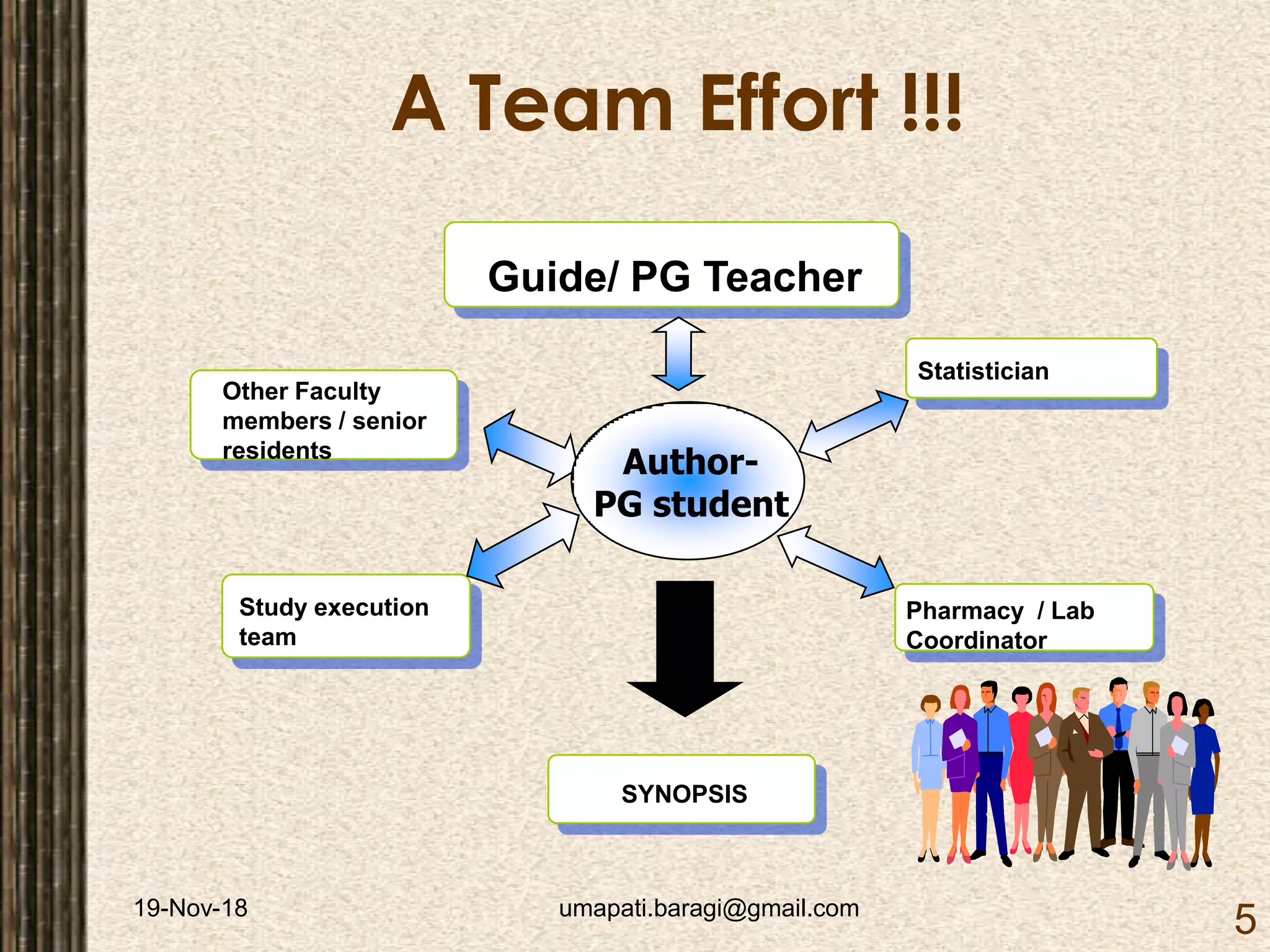
A Team Effort !!!
Study execution
team
Other Faculty
members / senior
residents
Statistician
Pharmacy / Lab
Coordinator
Author-
PG student
Guide/ PG Teacher
SYNOPSIS
19-Nov-18 umapati.baragi@gmail.com
6
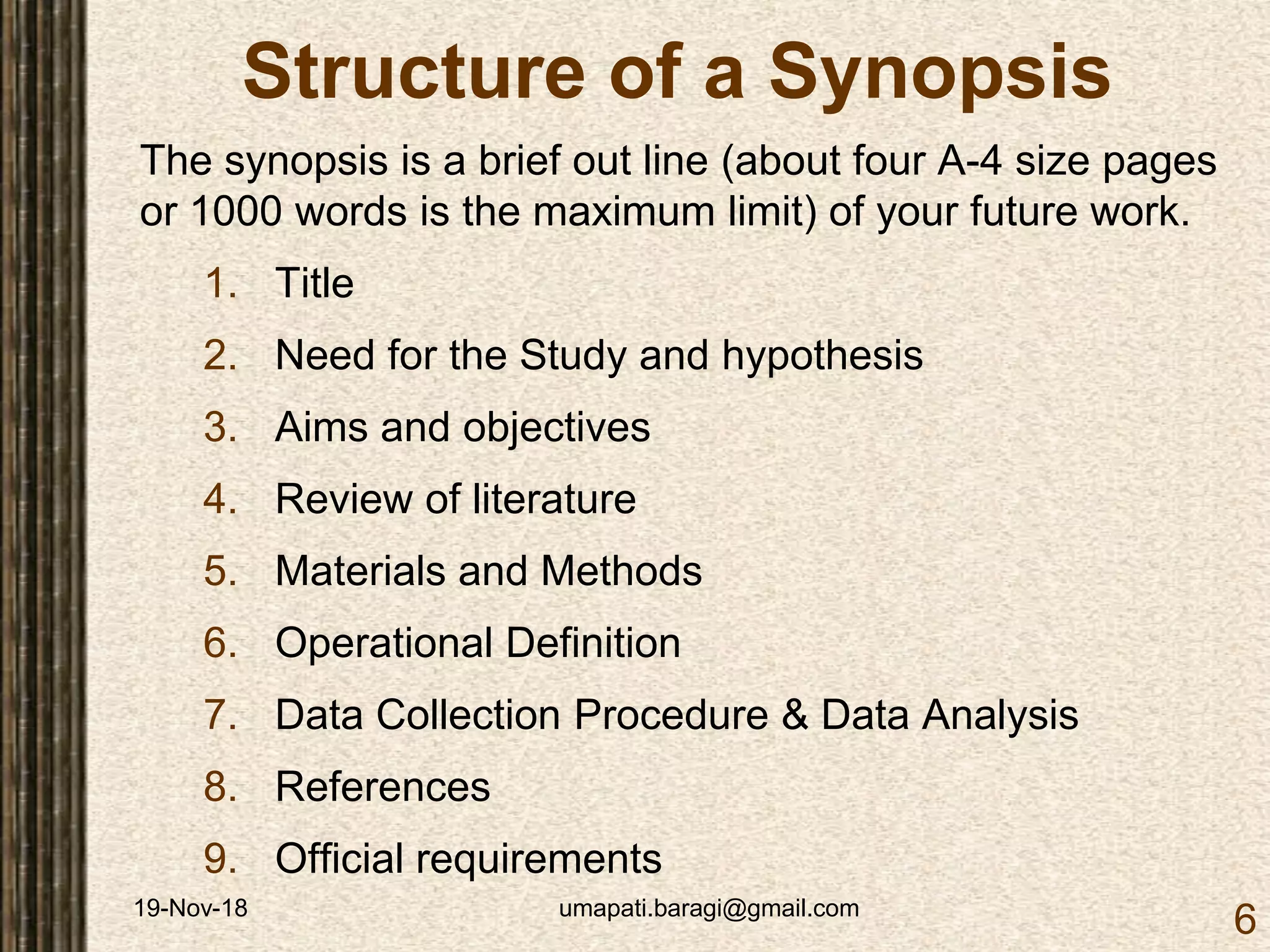
Structure of a Synopsis
The synopsis is a brief out line (about four A-4 size pages
or 1000 words is the maximum limit) of your future work.
1. Title
2. Need for the Study and hypothesis
3. Aims and objectives
4. Review of literature
5. Materials and Methods
6. Operational Definition
7. Data Collection Procedure & Data Analysis
8. References
9. Official requirements
19-Nov-18 umapati.baragi@gmail.com
7
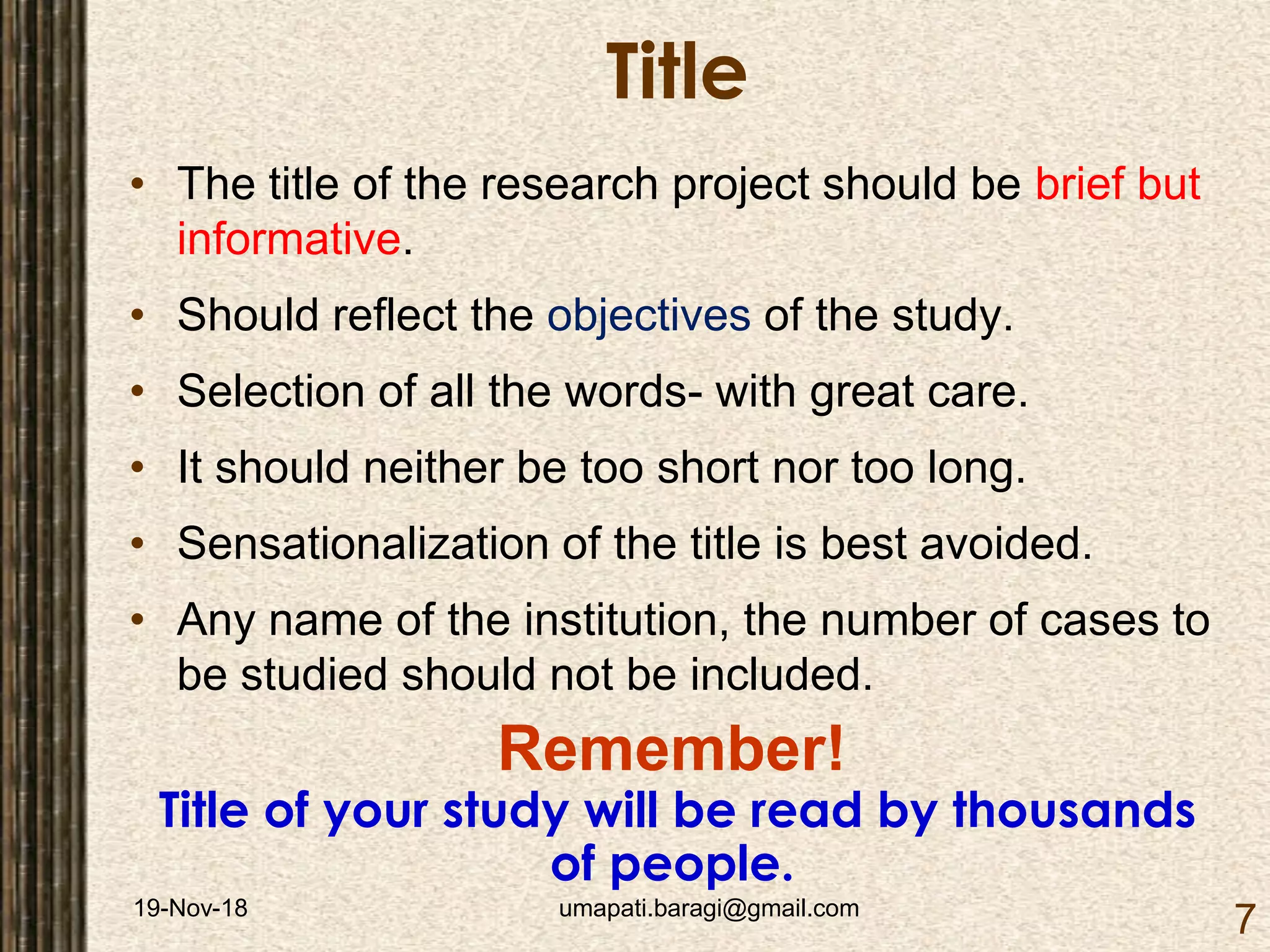
Title
• The title of the research project should be brief but
informative.
• Should reflect the objectives of the study.
• Selection of all the words- with great care.
• It should neither be too short nor too long.
• Sensationalization of the title is best avoided.
• Any name of the institution, the number of cases to
be studied should not be included.
Remember!
Title of your study will be read by thousands
of people.
19-Nov-18 umapati.baragi@gmail.com
8
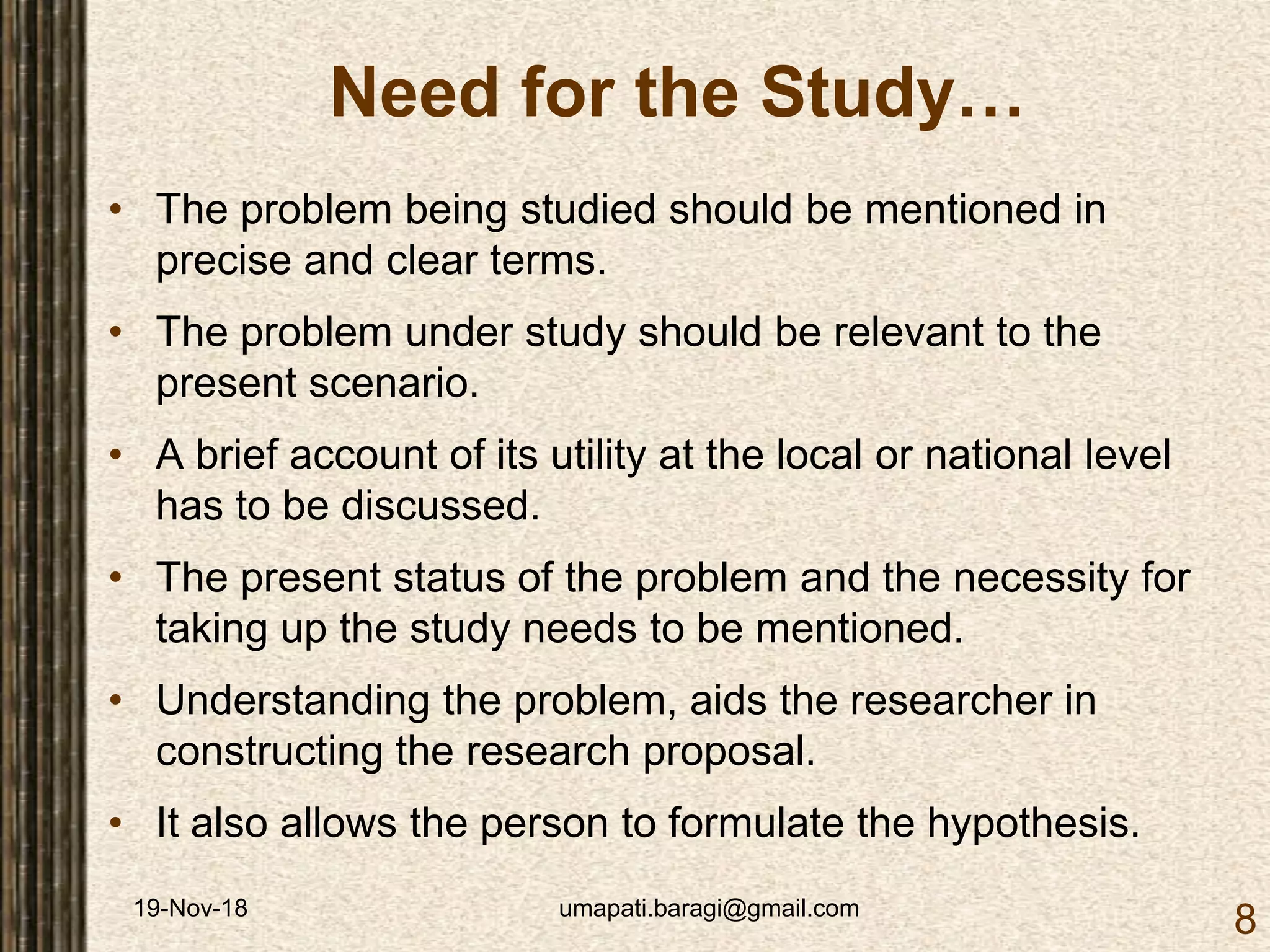
Need for the Study…
• The problem being studied should be mentioned in
precise and clear terms.
• The problem under study should be relevant to the
present scenario.
• A brief account of its utility at the local or national level
has to be discussed.
• The present status of the problem and the necessity for
taking up the study needs to be mentioned.
• Understanding the problem, aids the researcher in
constructing the research proposal.
• It also allows the person to formulate the hypothesis.
19-Nov-18 umapati.baragi@gmail.com
9
Hypothesis…
• Hypothesis is mentioned as a tentative prediction or
explanation of the relationship between two or more
variables.
• Hypothesis should not be a haphazard guess but should
reflect the knowledge, imagination, and experience of
the investigator.
• Hypothesis can be formulated by understanding the
problem, reviewing the literature on it, and considering
other factors.
• A researcher can state the problem and the hypothesis
in about 200 words covering all the aspects described
above.
19-Nov-18 umapati.baragi@gmail.com
10
Aim...
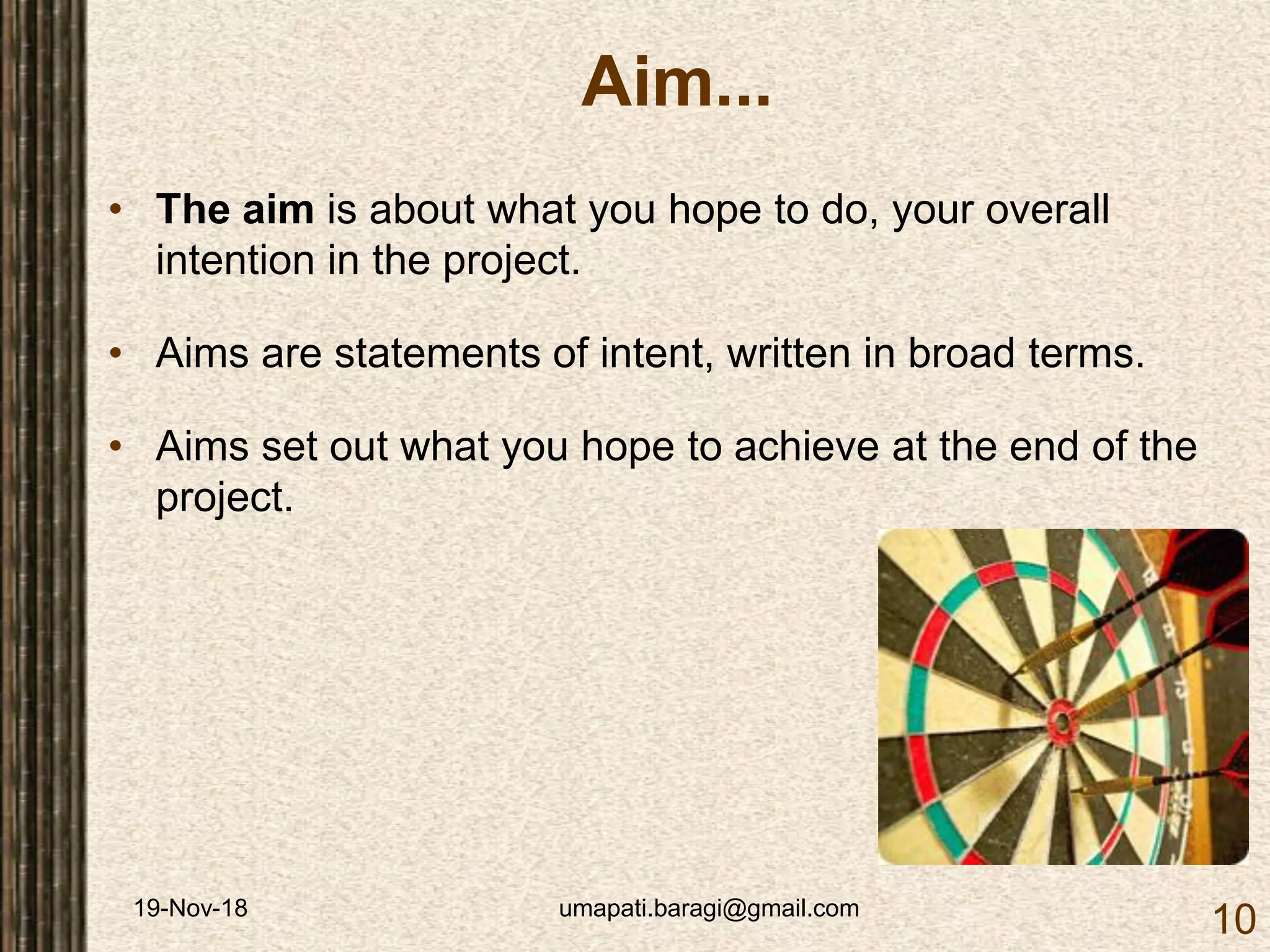
• The aim is about what you hope to do, your overall
intention in the project.
• Aims are statements of intent, written in broad terms.
• Aims set out what you hope to achieve at the end of the
project.
19-Nov-18 umapati.baragi@gmail.com
11
Objectives...
• Objectives are the steps you are going to take to answer
your research questions or
• A specific list of tasks needed to accomplish the goals of
the project.
• The objectives and aims should be only a few (2-3).
• Primary objective and secondary objectives should be
clearly and precisely defined.
• Objectives should not include the word 'know' or
'understand'. They do include active verbs such as
'state', 'explain', 'outline', 'list' or 'describe'.
19-Nov-18 umapati.baragi@gmail.com
12
Objectives...
Objectives should be S.M.A.R.T.:
• Specific – be precise about what you are going to do.
• Measureable –you will know when you have reached
your goal.
• Achievable – Don’t attempt too much. A less ambitious
but completed objective is better than an over-ambitious
one that you cannot possible achieve.
• Realistic – do you have the necessary resources to
achieve the objective? For example: time, money, skills,
etc?
• Time constrained – determine when each stage needs
to be completed. Is there time in your schedule to allow
for unexpected delays?
19-Nov-18 umapati.baragi@gmail.com
13
Review of literature...
• It describes the work done by others either at local or
international level on it or similar subject.
• It helps the researcher to understand the difficulties
faced by others and the corrective steps taken or
modifications made by them.
• Research methodology of the researcher can be
structured and modified after reviewing the literature.
• The review assists in identifying various variables in the
research project and conceptualizes their relationship.
• The reviewer can assess the work put in by the
researcher and also assists in assessing the feasibility of
the study.
19-Nov-18 umapati.baragi@gmail.com
14
Materials and Methods
• The research methodology forms the core of the
research project. The methodology should cover
the following aspects:
– Study design
– Study settings
– Sampling
– Variables
– Controls
– Study methods - examinations or investigations
– Data collection
– Data analysis
– Ethical clearance
•
19-Nov-18 umapati.baragi@gmail.com
15
Study design
• Mention the name of the appropriate study
design.
– Descriptive designs
• Survey study
• Observational study
• Epidemiological description of disease occurrence
– Observational analytical designs
• Prospective study (future)
• Retrospective study (past)
• Follow-up study
– Experimental designs
• Animal studies
• Therapeutic clinical trials – drugs
• Follow-up study
• Study of natural history of a disease
19-Nov-18 umapati.baragi@gmail.com
16
Study settings
• A mention about the research setting should be
made. This includes information about the
1. Setting - Name and place where the
research work is to be conducted
2. Duration of Study - How long will the study
take with dates.
3. Sample size - How many patients will be
included. If there are groups how many per
group?
 Inclusion criteria: On what bases will patients be inducted
in the study.
 Exclusion criteria: On what bases will patients be excluded
from the study.
19-Nov-18 umapati.baragi@gmail.com
17
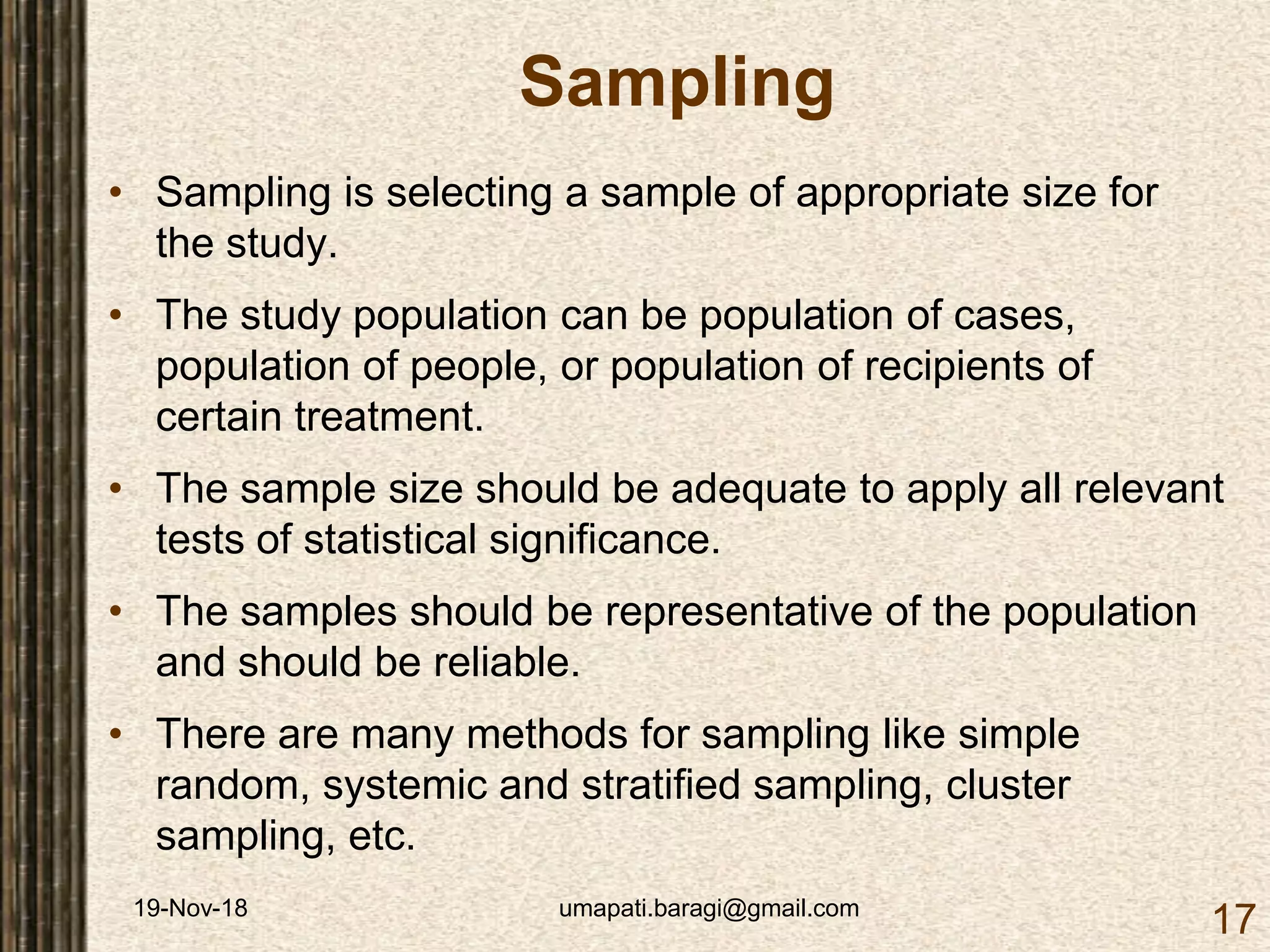
Sampling
• Sampling is selecting a sample of appropriate size for
the study.
• The study population can be population of cases,
population of people, or population of recipients of
certain treatment.
• The sample size should be adequate to apply all relevant
tests of statistical significance.
• The samples should be representative of the population
and should be reliable.
• There are many methods for sampling like simple
random, systemic and stratified sampling, cluster
sampling, etc.
19-Nov-18 umapati.baragi@gmail.com
18
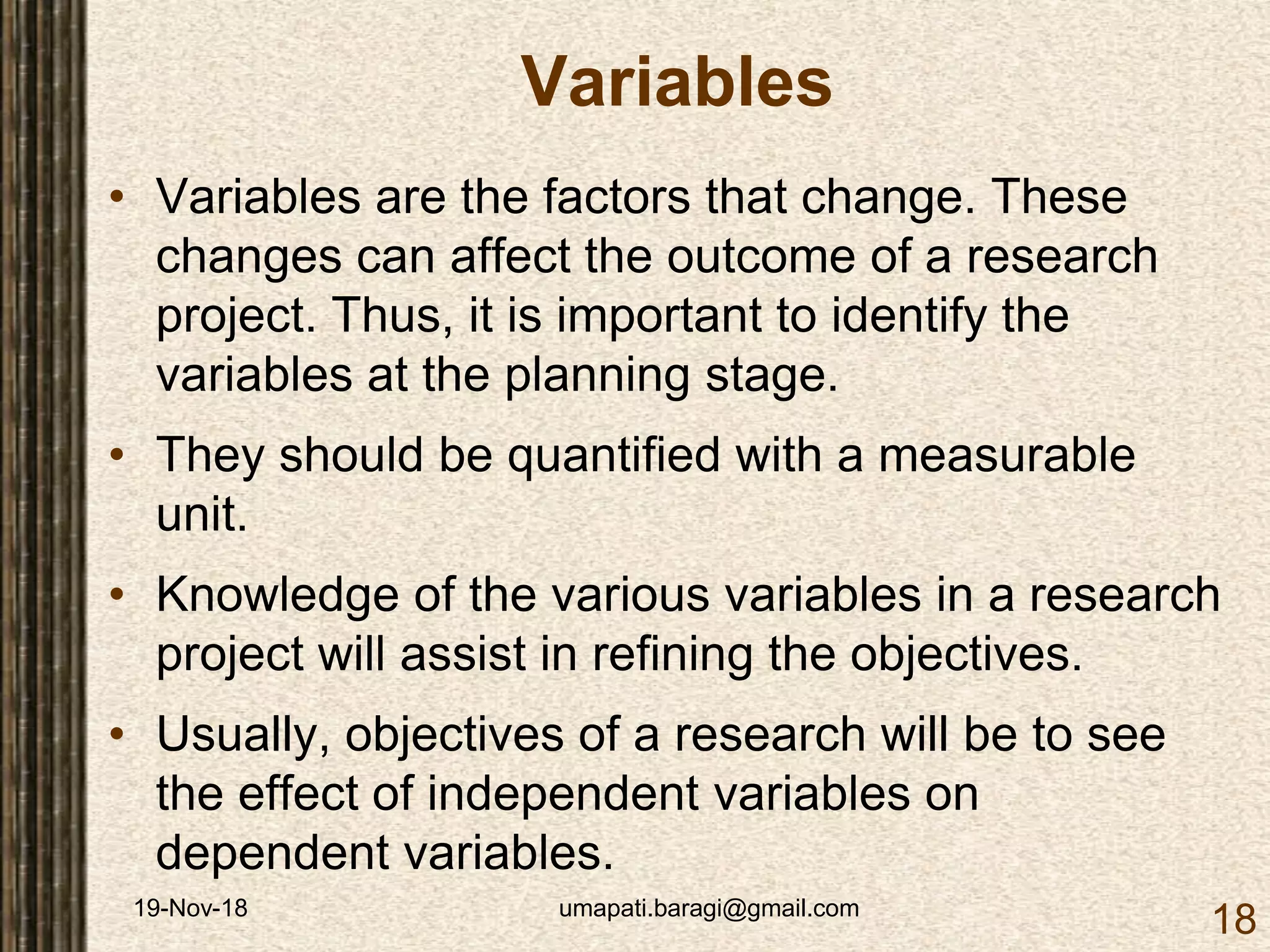
Variables
• Variables are the factors that change. These
changes can affect the outcome of a research
project. Thus, it is important to identify the
variables at the planning stage.
• They should be quantified with a measurable
unit.
• Knowledge of the various variables in a research
project will assist in refining the objectives.
• Usually, objectives of a research will be to see
the effect of independent variables on
dependent variables.
19-Nov-18 umapati.baragi@gmail.com
19
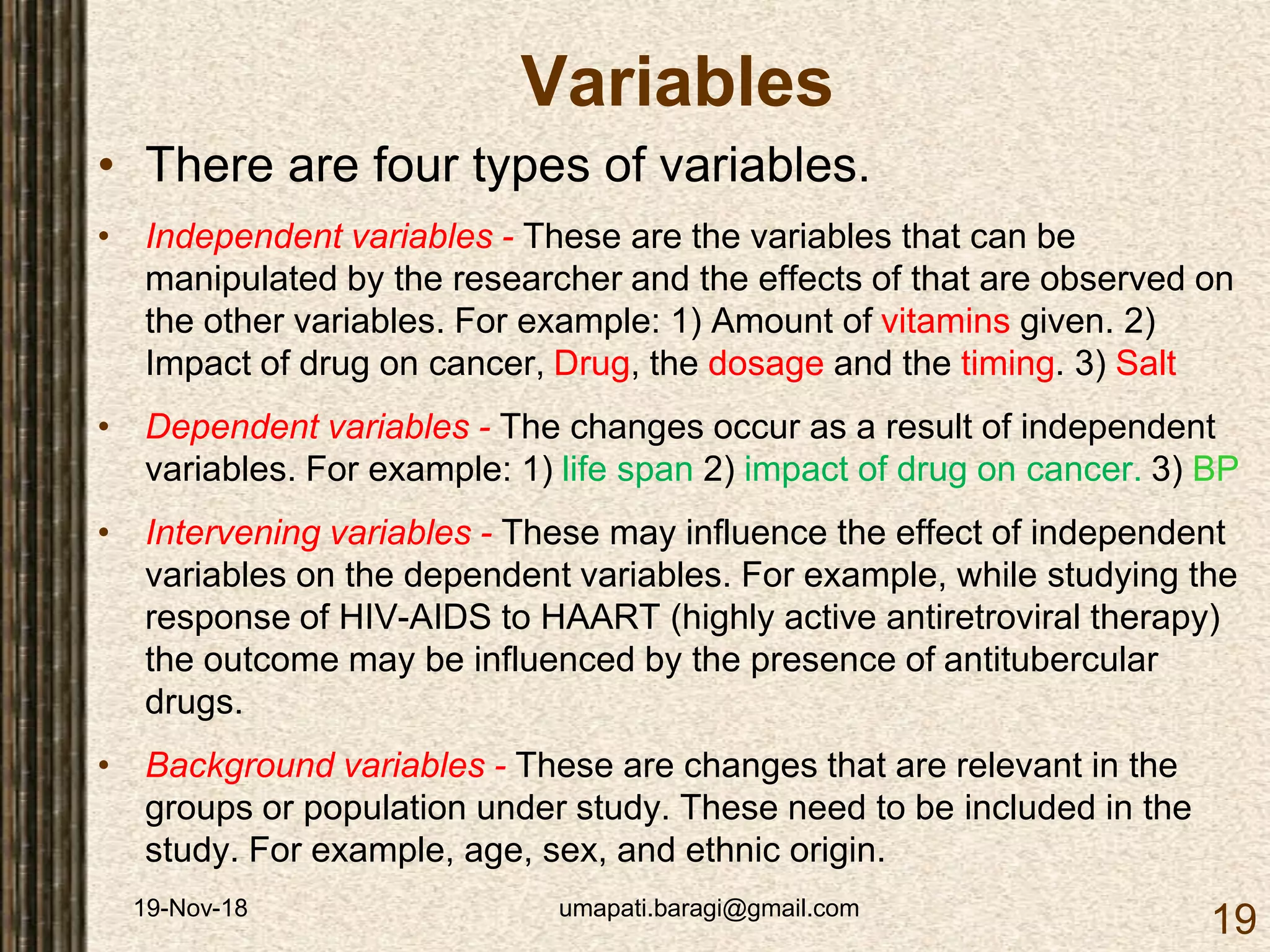
Variables
• There are four types of variables.
• Independent variables - These are the variables that can be
manipulated by the researcher and the effects of that are observed on
the other variables. For example: 1) Amount of vitamins given. 2)
Impact of drug on cancer, Drug, the dosage and the timing. 3) Salt
• Dependent variables - The changes occur as a result of independent
variables. For example: 1) life span 2) impact of drug on cancer. 3) BP
• Intervening variables - These may influence the effect of independent
variables on the dependent variables. For example, while studying the
response of HIV-AIDS to HAART (highly active antiretroviral therapy)
the outcome may be influenced by the presence of antitubercular
drugs.
• Background variables - These are changes that are relevant in the
groups or population under study. These need to be included in the
study. For example, age, sex, and ethnic origin.
19-Nov-18 umapati.baragi@gmail.com
20
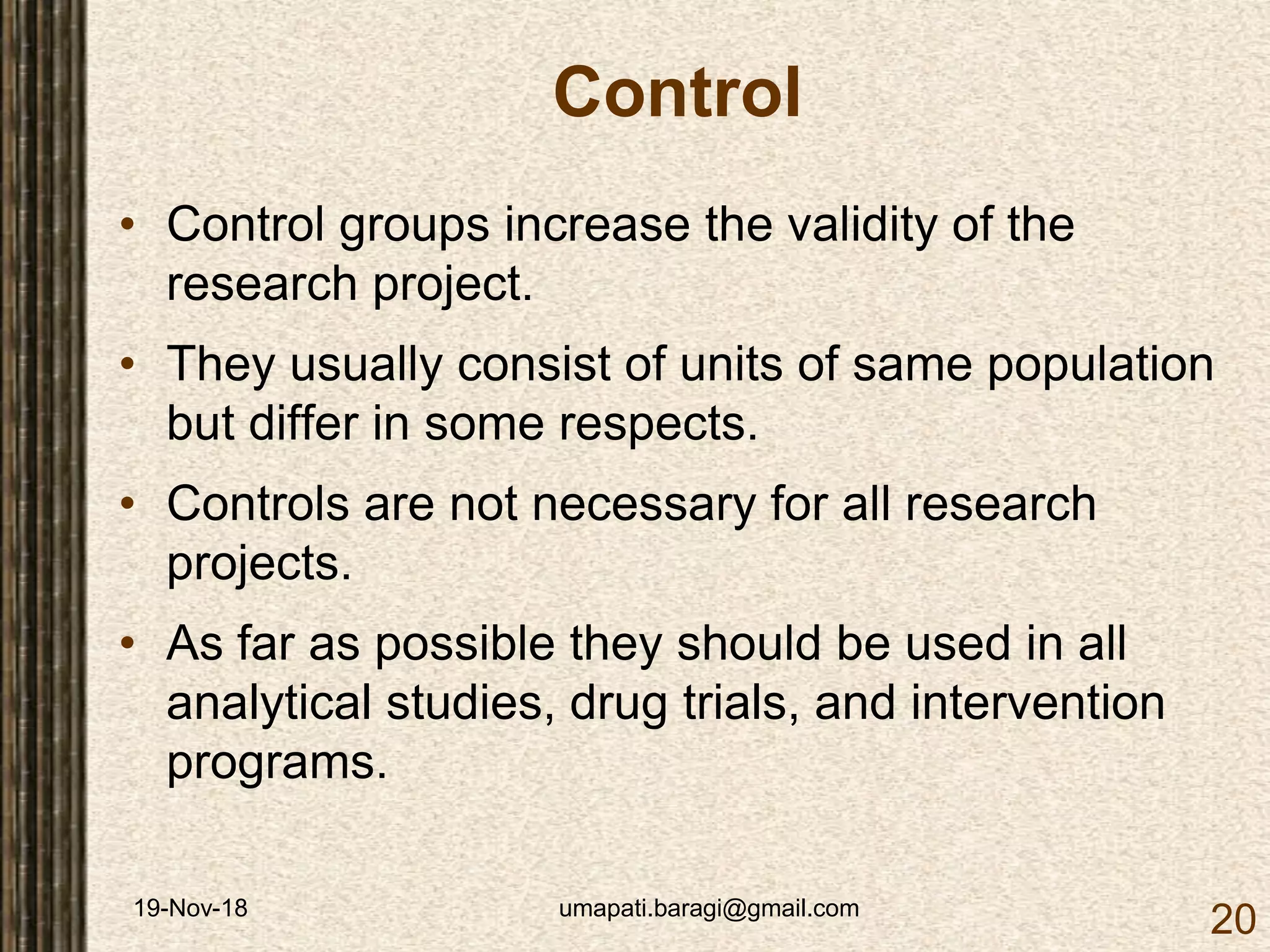
Control
• Control groups increase the validity of the
research project.
• They usually consist of units of same population
but differ in some respects.
• Controls are not necessary for all research
projects.
• As far as possible they should be used in all
analytical studies, drug trials, and intervention
programs.
19-Nov-18 umapati.baragi@gmail.com
21
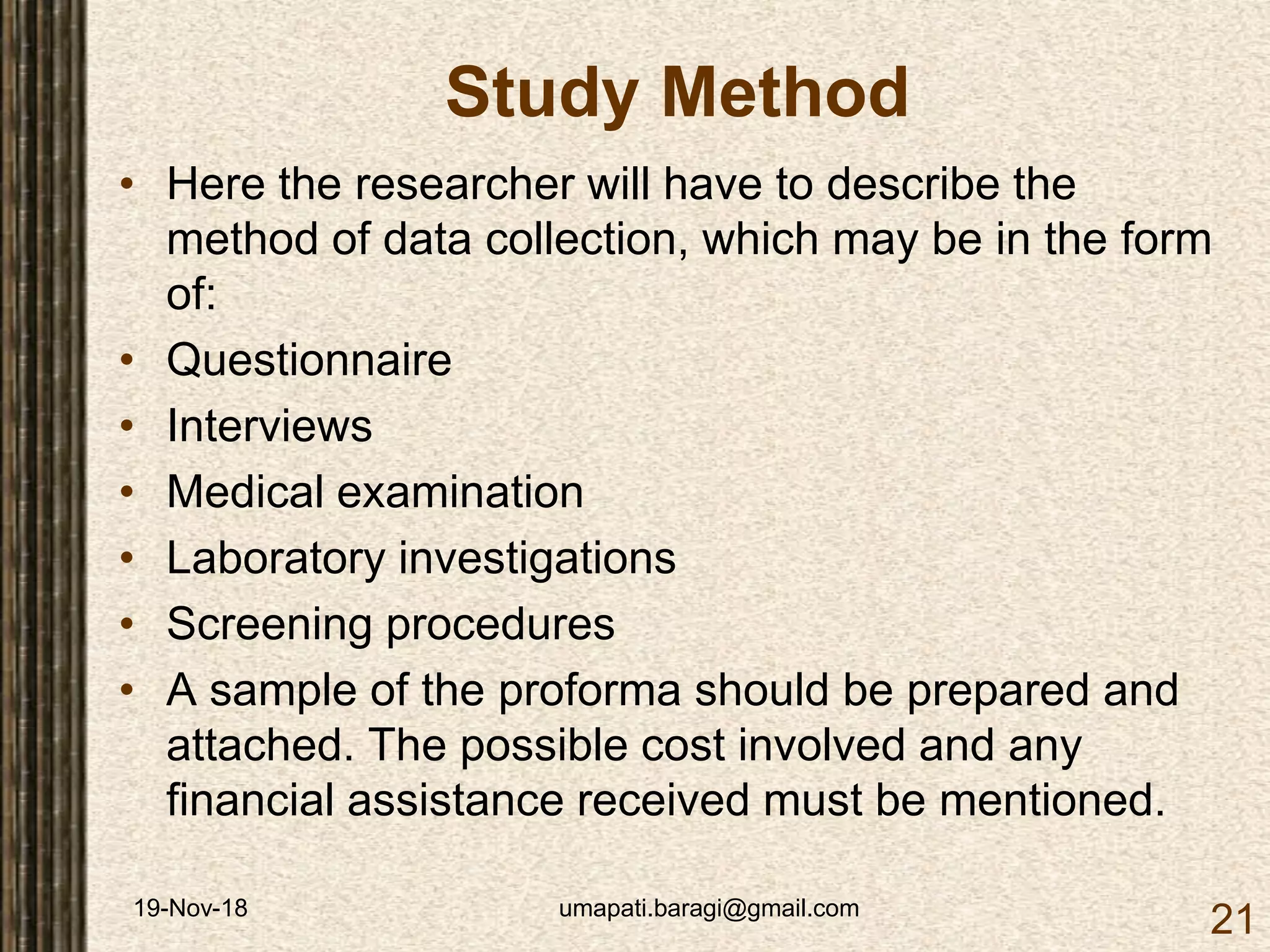
Study Method
• Here the researcher will have to describe the
method of data collection, which may be in the form
of:
• Questionnaire
• Interviews
• Medical examination
• Laboratory investigations
• Screening procedures
• A sample of the proforma should be prepared and
attached. The possible cost involved and any
financial assistance received must be mentioned.
19-Nov-18 umapati.baragi@gmail.com
22
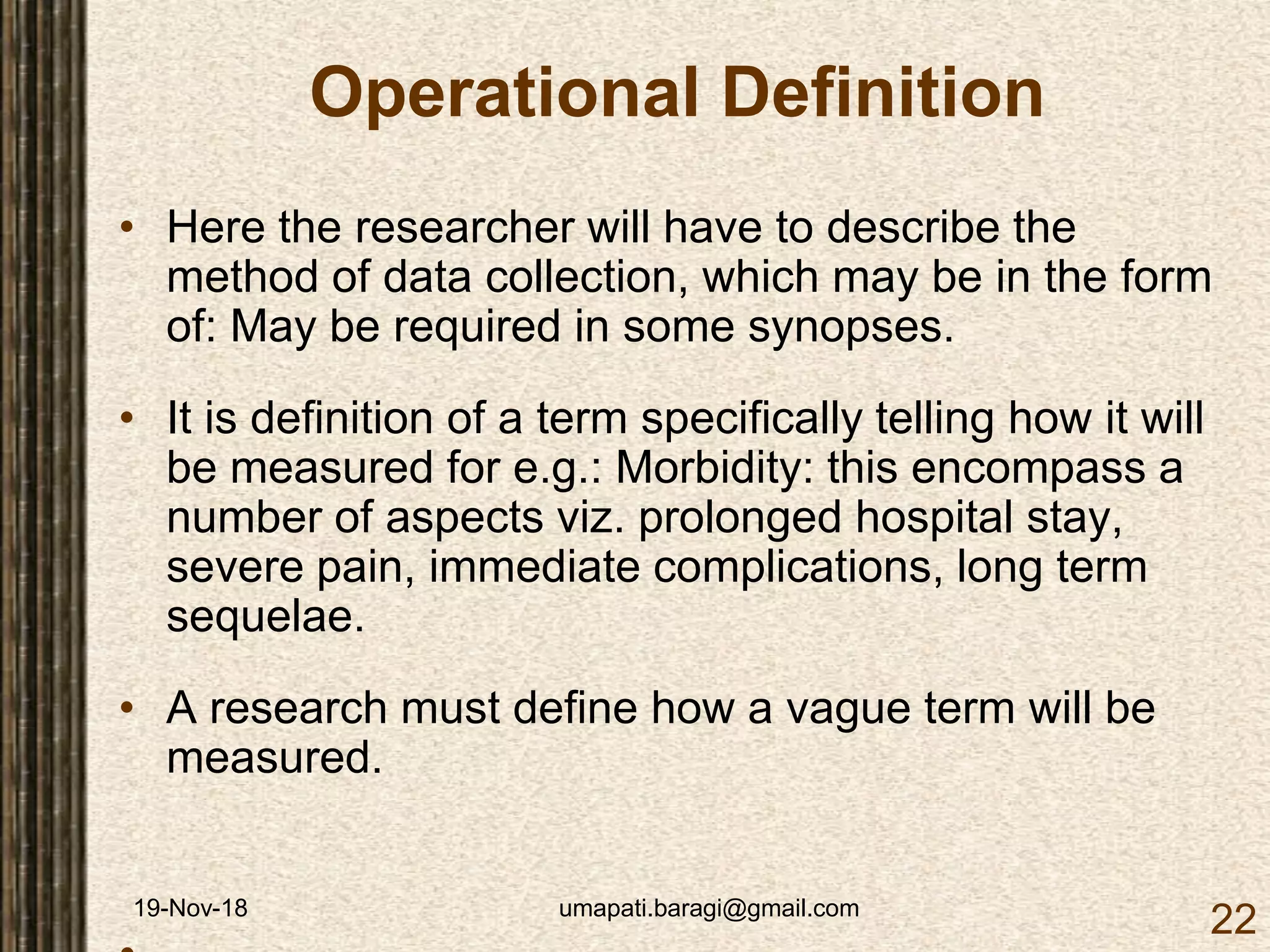
Operational Definition
• Here the researcher will have to describe the
method of data collection, which may be in the form
of: May be required in some synopses.
• It is definition of a term specifically telling how it will
be measured for e.g.: Morbidity: this encompass a
number of aspects viz. prolonged hospital stay,
severe pain, immediate complications, long term
sequelae.
• A research must define how a vague term will be
measured.
19-Nov-18 umapati.baragi@gmail.com
23
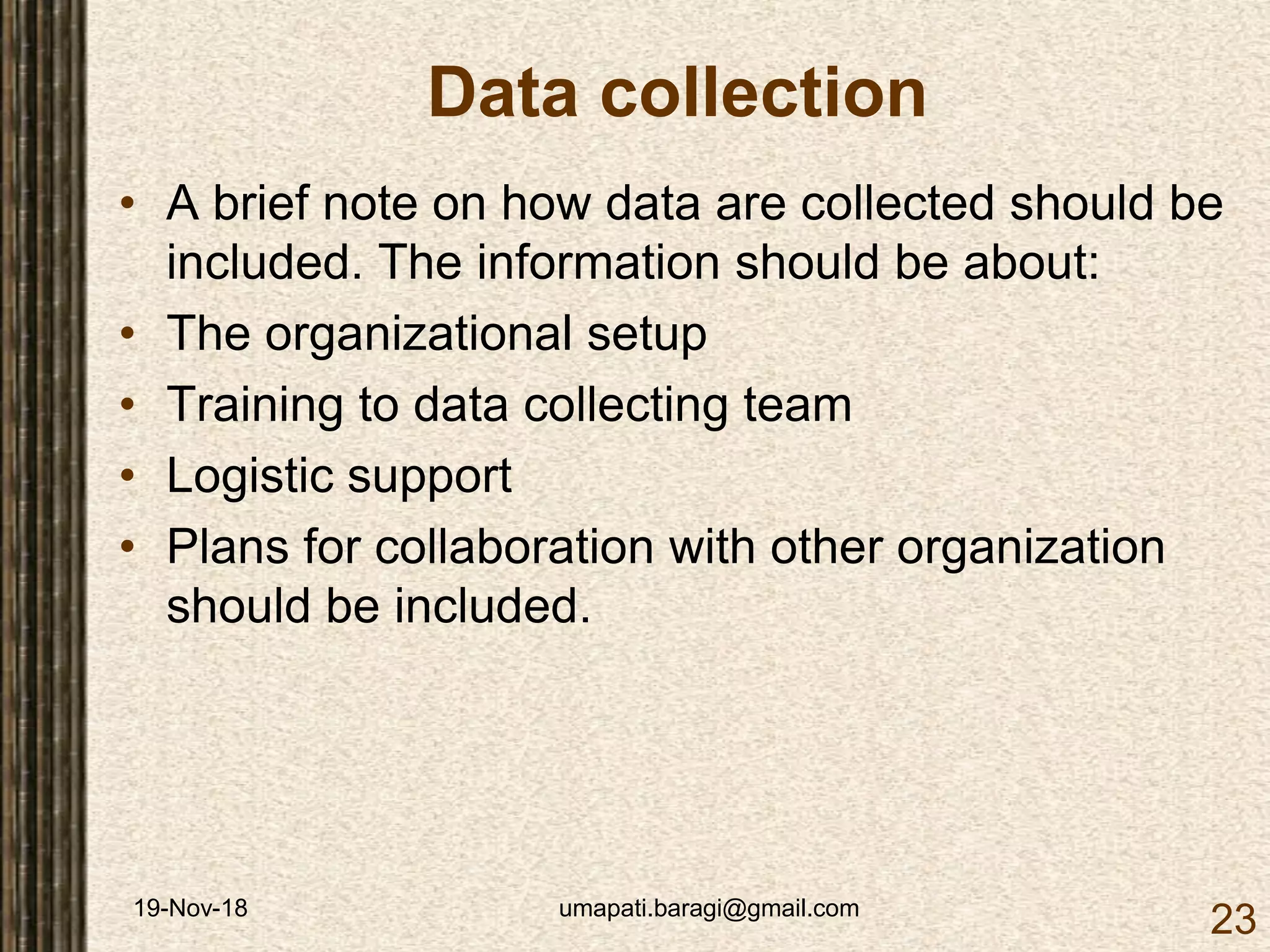
Data collection
• A brief note on how data are collected should be
included. The information should be about:
• The organizational setup
• Training to data collecting team
• Logistic support
• Plans for collaboration with other organization
should be included.
19-Nov-18 umapati.baragi@gmail.com
24
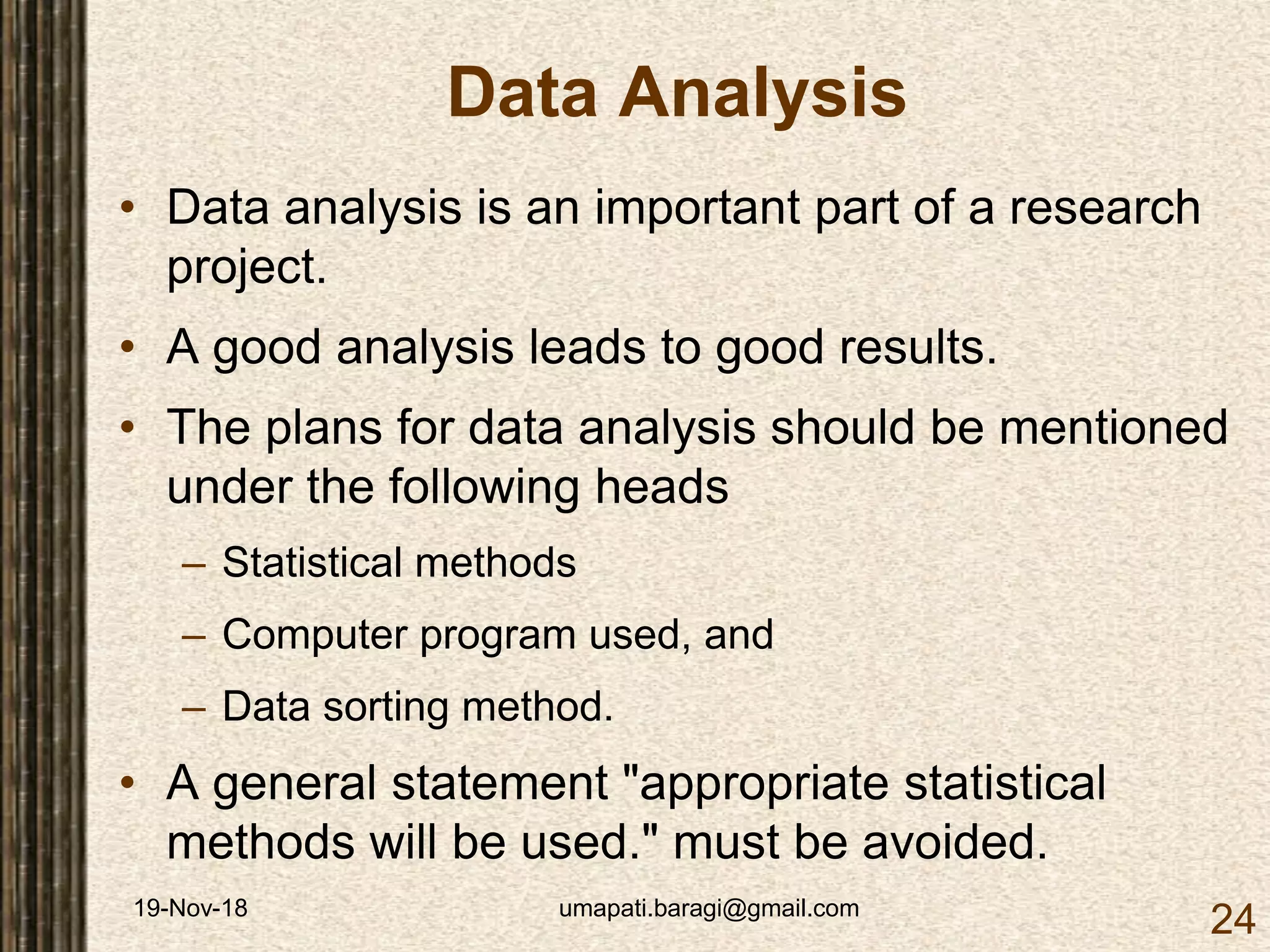
Data Analysis
• Data analysis is an important part of a research
project.
• A good analysis leads to good results.
• The plans for data analysis should be mentioned
under the following heads
– Statistical methods
– Computer program used, and
– Data sorting method.
• A general statement "appropriate statistical
methods will be used." must be avoided.
19-Nov-18 umapati.baragi@gmail.com
25
Ethical Clearance
• Wherever necessary, ethical committee
clearance from the institute should be obtained.
• The certificate must be attached.
• Ethical clearance is required in all human and
animal studies.
19-Nov-18 umapati.baragi@gmail.com
26
References
• All references quoted in review of literature and
anywhere else in the synopsis should be listed
here.
• Vancouver style
• Harvard style
• End note
• Vancouver style is easy to follow and RGUHS
recommend Vancouver style.
• https://www.citethisforme.com/vancouver
19-Nov-18 umapati.baragi@gmail.com
27
Referencing guidelines
19-Nov-18 umapati.baragi@gmail.com
28
Official requirements
• A synopsis is incomplete if it does not contain
the following information:
1. Name of the researcher and designation
2. Name and designation of the guide / co-
guide.
3. Name and designation of head of
department  institution
4. Name of the institution
5. Signatures of all with official seal
19-Nov-18 umapati.baragi@gmail.com
29
Concluding remarks….
• Synopsis writing is an important step in a
research project.
• A good synopsis will give maximum information
in minimum words.
• A well-conceived synopsis will go a long way in
convincing the reviewer about the ability of the
researcher to conduct the project.
• In cases of need for financial assistance, the
request will be considered favorably.
• Thus, all research workers should make efforts
to prepare a well-structured synopsis.

Synopsis - (How to write a effective Synopsis?)

  • 1.
    Dr. Umapati BaragiM.D., Ph.D.(Ayu) Reader, Department of Basic Principles BLDEA’s AVS Ayurveda Mahavidyalaya VIJAYAPUR-586101 Cell no. 9342417398 Email id: umapati.baragi@gmail.com
  • 2.
    19-Nov-18 umapati.baragi@gmail.com 2 What isSYNOPSIS? Synopsis (si-nop-seez) is a Greek word derived from sýnopsis. syn – together, opsis – seeing. A synopsis is a brief summary or condensed statement giving a general view of the subject selected. Synonyms: Condensation, epitome, abstract, abridgment, summary & protocol.
  • 3.
    19-Nov-18 umapati.baragi@gmail.com 3 Who writesa Synopsis? • An author of a – Novel – Play / Drama – Motion picture – Research project
  • 4.
    19-Nov-18 umapati.baragi@gmail.com 4 Synopsis /Protocol • A synopsis or a protocol of a research project is a document submitted to an authority or an institution for the purpose of 1. Formal registration to universities for the award of a degree or doctorate. 2. Ethical clearance 3. Peer review 4. Financial assistance from organizations like CCRAS, AYUSH, RGUHS etc.
  • 5.
    19-Nov-18 umapati.baragi@gmail.com 5 A TeamEffort !!! Study execution team Other Faculty members / senior residents Statistician Pharmacy / Lab Coordinator Author- PG student Guide/ PG Teacher SYNOPSIS
  • 6.
    19-Nov-18 umapati.baragi@gmail.com 6 Structure ofa Synopsis The synopsis is a brief out line (about four A-4 size pages or 1000 words is the maximum limit) of your future work. 1. Title 2. Need for the Study and hypothesis 3. Aims and objectives 4. Review of literature 5. Materials and Methods 6. Operational Definition 7. Data Collection Procedure & Data Analysis 8. References 9. Official requirements
  • 7.
    19-Nov-18 umapati.baragi@gmail.com 7 Title • Thetitle of the research project should be brief but informative. • Should reflect the objectives of the study. • Selection of all the words- with great care. • It should neither be too short nor too long. • Sensationalization of the title is best avoided. • Any name of the institution, the number of cases to be studied should not be included. Remember! Title of your study will be read by thousands of people.
  • 8.
    19-Nov-18 umapati.baragi@gmail.com 8 Need forthe Study… • The problem being studied should be mentioned in precise and clear terms. • The problem under study should be relevant to the present scenario. • A brief account of its utility at the local or national level has to be discussed. • The present status of the problem and the necessity for taking up the study needs to be mentioned. • Understanding the problem, aids the researcher in constructing the research proposal. • It also allows the person to formulate the hypothesis.
  • 9.
    19-Nov-18 umapati.baragi@gmail.com 9 Hypothesis… • Hypothesisis mentioned as a tentative prediction or explanation of the relationship between two or more variables. • Hypothesis should not be a haphazard guess but should reflect the knowledge, imagination, and experience of the investigator. • Hypothesis can be formulated by understanding the problem, reviewing the literature on it, and considering other factors. • A researcher can state the problem and the hypothesis in about 200 words covering all the aspects described above.
  • 10.
    19-Nov-18 umapati.baragi@gmail.com 10 Aim... • Theaim is about what you hope to do, your overall intention in the project. • Aims are statements of intent, written in broad terms. • Aims set out what you hope to achieve at the end of the project.
  • 11.
    19-Nov-18 umapati.baragi@gmail.com 11 Objectives... • Objectivesare the steps you are going to take to answer your research questions or • A specific list of tasks needed to accomplish the goals of the project. • The objectives and aims should be only a few (2-3). • Primary objective and secondary objectives should be clearly and precisely defined. • Objectives should not include the word 'know' or 'understand'. They do include active verbs such as 'state', 'explain', 'outline', 'list' or 'describe'.
  • 12.
    19-Nov-18 umapati.baragi@gmail.com 12 Objectives... Objectives shouldbe S.M.A.R.T.: • Specific – be precise about what you are going to do. • Measureable –you will know when you have reached your goal. • Achievable – Don’t attempt too much. A less ambitious but completed objective is better than an over-ambitious one that you cannot possible achieve. • Realistic – do you have the necessary resources to achieve the objective? For example: time, money, skills, etc? • Time constrained – determine when each stage needs to be completed. Is there time in your schedule to allow for unexpected delays?
  • 13.
    19-Nov-18 umapati.baragi@gmail.com 13 Review ofliterature... • It describes the work done by others either at local or international level on it or similar subject. • It helps the researcher to understand the difficulties faced by others and the corrective steps taken or modifications made by them. • Research methodology of the researcher can be structured and modified after reviewing the literature. • The review assists in identifying various variables in the research project and conceptualizes their relationship. • The reviewer can assess the work put in by the researcher and also assists in assessing the feasibility of the study.
  • 14.
    19-Nov-18 umapati.baragi@gmail.com 14 Materials andMethods • The research methodology forms the core of the research project. The methodology should cover the following aspects: – Study design – Study settings – Sampling – Variables – Controls – Study methods - examinations or investigations – Data collection – Data analysis – Ethical clearance •
  • 15.
    19-Nov-18 umapati.baragi@gmail.com 15 Study design •Mention the name of the appropriate study design. – Descriptive designs • Survey study • Observational study • Epidemiological description of disease occurrence – Observational analytical designs • Prospective study (future) • Retrospective study (past) • Follow-up study – Experimental designs • Animal studies • Therapeutic clinical trials – drugs • Follow-up study • Study of natural history of a disease
  • 16.
    19-Nov-18 umapati.baragi@gmail.com 16 Study settings •A mention about the research setting should be made. This includes information about the 1. Setting - Name and place where the research work is to be conducted 2. Duration of Study - How long will the study take with dates. 3. Sample size - How many patients will be included. If there are groups how many per group?  Inclusion criteria: On what bases will patients be inducted in the study.  Exclusion criteria: On what bases will patients be excluded from the study.
  • 17.
    19-Nov-18 umapati.baragi@gmail.com 17 Sampling • Samplingis selecting a sample of appropriate size for the study. • The study population can be population of cases, population of people, or population of recipients of certain treatment. • The sample size should be adequate to apply all relevant tests of statistical significance. • The samples should be representative of the population and should be reliable. • There are many methods for sampling like simple random, systemic and stratified sampling, cluster sampling, etc.
  • 18.
    19-Nov-18 umapati.baragi@gmail.com 18 Variables • Variablesare the factors that change. These changes can affect the outcome of a research project. Thus, it is important to identify the variables at the planning stage. • They should be quantified with a measurable unit. • Knowledge of the various variables in a research project will assist in refining the objectives. • Usually, objectives of a research will be to see the effect of independent variables on dependent variables.
  • 19.
    19-Nov-18 umapati.baragi@gmail.com 19 Variables • Thereare four types of variables. • Independent variables - These are the variables that can be manipulated by the researcher and the effects of that are observed on the other variables. For example: 1) Amount of vitamins given. 2) Impact of drug on cancer, Drug, the dosage and the timing. 3) Salt • Dependent variables - The changes occur as a result of independent variables. For example: 1) life span 2) impact of drug on cancer. 3) BP • Intervening variables - These may influence the effect of independent variables on the dependent variables. For example, while studying the response of HIV-AIDS to HAART (highly active antiretroviral therapy) the outcome may be influenced by the presence of antitubercular drugs. • Background variables - These are changes that are relevant in the groups or population under study. These need to be included in the study. For example, age, sex, and ethnic origin.
  • 20.
    19-Nov-18 umapati.baragi@gmail.com 20 Control • Controlgroups increase the validity of the research project. • They usually consist of units of same population but differ in some respects. • Controls are not necessary for all research projects. • As far as possible they should be used in all analytical studies, drug trials, and intervention programs.
  • 21.
    19-Nov-18 umapati.baragi@gmail.com 21 Study Method •Here the researcher will have to describe the method of data collection, which may be in the form of: • Questionnaire • Interviews • Medical examination • Laboratory investigations • Screening procedures • A sample of the proforma should be prepared and attached. The possible cost involved and any financial assistance received must be mentioned.
  • 22.
    19-Nov-18 umapati.baragi@gmail.com 22 Operational Definition •Here the researcher will have to describe the method of data collection, which may be in the form of: May be required in some synopses. • It is definition of a term specifically telling how it will be measured for e.g.: Morbidity: this encompass a number of aspects viz. prolonged hospital stay, severe pain, immediate complications, long term sequelae. • A research must define how a vague term will be measured.
  • 23.
    19-Nov-18 umapati.baragi@gmail.com 23 Data collection •A brief note on how data are collected should be included. The information should be about: • The organizational setup • Training to data collecting team • Logistic support • Plans for collaboration with other organization should be included.
  • 24.
    19-Nov-18 umapati.baragi@gmail.com 24 Data Analysis •Data analysis is an important part of a research project. • A good analysis leads to good results. • The plans for data analysis should be mentioned under the following heads – Statistical methods – Computer program used, and – Data sorting method. • A general statement "appropriate statistical methods will be used." must be avoided.
  • 25.
    19-Nov-18 umapati.baragi@gmail.com 25 Ethical Clearance •Wherever necessary, ethical committee clearance from the institute should be obtained. • The certificate must be attached. • Ethical clearance is required in all human and animal studies.
  • 26.
    19-Nov-18 umapati.baragi@gmail.com 26 References • Allreferences quoted in review of literature and anywhere else in the synopsis should be listed here. • Vancouver style • Harvard style • End note • Vancouver style is easy to follow and RGUHS recommend Vancouver style. • https://www.citethisforme.com/vancouver
  • 27.
  • 28.
    19-Nov-18 umapati.baragi@gmail.com 28 Official requirements •A synopsis is incomplete if it does not contain the following information: 1. Name of the researcher and designation 2. Name and designation of the guide / co- guide. 3. Name and designation of head of department institution 4. Name of the institution 5. Signatures of all with official seal
  • 29.
    19-Nov-18 umapati.baragi@gmail.com 29 Concluding remarks…. •Synopsis writing is an important step in a research project. • A good synopsis will give maximum information in minimum words. • A well-conceived synopsis will go a long way in convincing the reviewer about the ability of the researcher to conduct the project. • In cases of need for financial assistance, the request will be considered favorably. • Thus, all research workers should make efforts to prepare a well-structured synopsis.