Ayurvedic Science is based on the fundamental sciences
called ‘Darshana’.
Darshana (Philosophy) :-
The word ‘drs’ that means to see, look, view or The
mirror of knowledge or the source of knowledge.
Seeing means – External things and Inner self (soul)
Darshana’ is concerned with the vision of ‘truth and
reality’.
What is the Srusthi (universe)?
How Srusthi was created?
If it’s a creation, what are its Tatwas (factors /
constituents?
Who is the creator?
What is life?
What is truth?
About death, rebirth and Moksha.
State of body, mind and soul after death.
These all aspects are covered under the Ayurvediya
Darshana Shastra.
The period of the Utpatti of Darshana is under the
controversy, as no solid evidences are found.
The Utpatti of the Vedas (2500 BC or earlier) is not
under controversy.
Vedas existed before the production of the Srusthi, and
are considered as Anadi (having no beginning).
The Bharatiya Sahitya is divided into 5 divisions viz.
Vaidika Yuga
Brahmana Yuga and Aupanishadika Yuga
Sutra Yuga
Kaavya Yuga
Madhya Kaalina Acharya and Gadya Yuga.
The Darshanas had the influence of the Vedas and
Upanishads.
Because some of the words used in them are similar to the
Vedas and Upanishads.
In ancient days all the students were bound to study all the
Darshanas and Shastras which existed during their period as
a part of their General Educational Schedule.
1. Shabda Vidya – Grammer and Literature.
2. Shilpa Vidya – Arts and Crafts.
3. Chikitsa Vidya – Science of Medicine.
4. Hetu Vidya – Philosophy and Logic.
5. Adhyatma Vidya – Spiritual science.
Without knowing the fundamentals of the above sciences,
one cannot get the complete knowledge.
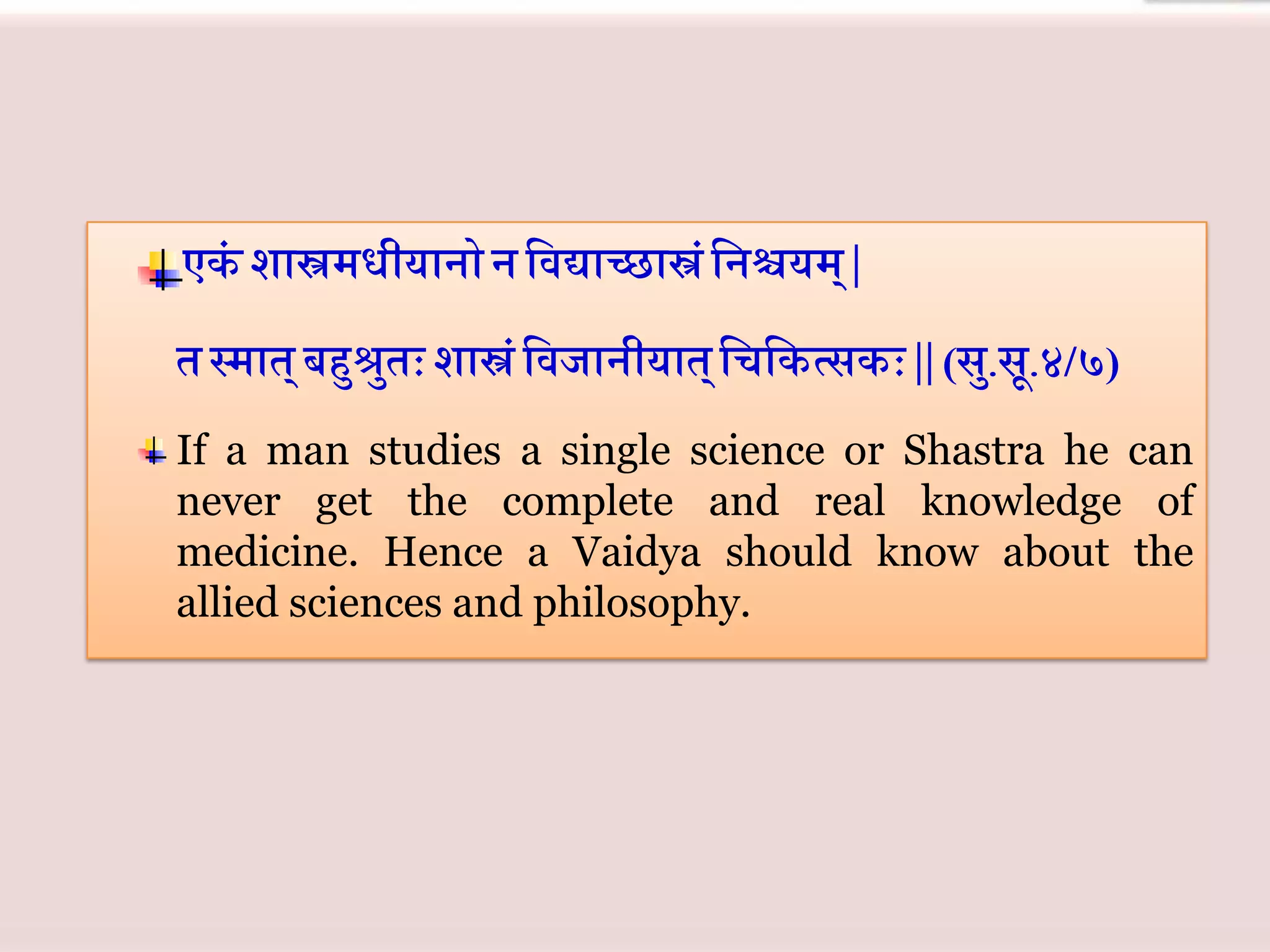
If a man studies a single science or Shastra he can
never get the complete and real knowledge of
medicine. Hence a Vaidya should know about the
allied sciences and philosophy.
The Darshanas are classified into 2 main
categories i.e.
Asthika Darshana
Nasthika Darshana
Asthika Darshana:-
The Darshanas which have a strong belief in the
existence of the Vedas, Atma, Paramatma, Janana,
Marana, Moksha and which believe that the body
and soul are separate, they believe the existence
of Ishwara (God).
Nasthika Darshana:-
The Darshanas which do not have faith in the,
Vedas
Punarjanma
Moksha
Swarga and
The existence of God and believe that there is no
difference between body and soul are called Nasthika
Darshanas.
DARSHANA
Asthika
Vaisheshika Darshana (Kapila)
Nyaya Darshan (Gautama)
Sankhya Darshana (Kapila)
Yoga Darshana (Patanjali)
Purva Mimamsa (Jaimini)
Uttara Mimamsa (Vyasa)
Nasthika
Charvaka Darshana
Bouddha Darshana
Jaina Darshana
umapati.baragi@gmail.com

Philosophical Background of Darshana Shastra

  • 2.
    Ayurvedic Science isbased on the fundamental sciences called ‘Darshana’. Darshana (Philosophy) :- The word ‘drs’ that means to see, look, view or The mirror of knowledge or the source of knowledge. Seeing means – External things and Inner self (soul) Darshana’ is concerned with the vision of ‘truth and reality’.
  • 3.
    What is theSrusthi (universe)? How Srusthi was created? If it’s a creation, what are its Tatwas (factors / constituents? Who is the creator? What is life? What is truth? About death, rebirth and Moksha. State of body, mind and soul after death. These all aspects are covered under the Ayurvediya Darshana Shastra.
  • 4.
    The period ofthe Utpatti of Darshana is under the controversy, as no solid evidences are found. The Utpatti of the Vedas (2500 BC or earlier) is not under controversy. Vedas existed before the production of the Srusthi, and are considered as Anadi (having no beginning). The Bharatiya Sahitya is divided into 5 divisions viz. Vaidika Yuga Brahmana Yuga and Aupanishadika Yuga Sutra Yuga Kaavya Yuga Madhya Kaalina Acharya and Gadya Yuga.
  • 5.
    The Darshanas hadthe influence of the Vedas and Upanishads. Because some of the words used in them are similar to the Vedas and Upanishads. In ancient days all the students were bound to study all the Darshanas and Shastras which existed during their period as a part of their General Educational Schedule. 1. Shabda Vidya – Grammer and Literature. 2. Shilpa Vidya – Arts and Crafts. 3. Chikitsa Vidya – Science of Medicine. 4. Hetu Vidya – Philosophy and Logic. 5. Adhyatma Vidya – Spiritual science. Without knowing the fundamentals of the above sciences, one cannot get the complete knowledge.
  • 6.
    If a manstudies a single science or Shastra he can never get the complete and real knowledge of medicine. Hence a Vaidya should know about the allied sciences and philosophy.
  • 7.
    The Darshanas areclassified into 2 main categories i.e. Asthika Darshana Nasthika Darshana Asthika Darshana:- The Darshanas which have a strong belief in the existence of the Vedas, Atma, Paramatma, Janana, Marana, Moksha and which believe that the body and soul are separate, they believe the existence of Ishwara (God).
  • 8.
    Nasthika Darshana:- The Darshanaswhich do not have faith in the, Vedas Punarjanma Moksha Swarga and The existence of God and believe that there is no difference between body and soul are called Nasthika Darshanas.
  • 9.
    DARSHANA Asthika Vaisheshika Darshana (Kapila) NyayaDarshan (Gautama) Sankhya Darshana (Kapila) Yoga Darshana (Patanjali) Purva Mimamsa (Jaimini) Uttara Mimamsa (Vyasa) Nasthika Charvaka Darshana Bouddha Darshana Jaina Darshana
  • 10.