COMPETITIVE WAR GAMES Compiled by Turgut Ziyal
Why War Games? The immediate goal of a competitive war game is to gain a better understanding of the total competitive arena, and anticipate competitive developments and moves in your industry.  The war game is an effective tool for uncovering hidden weaknesses – your own and those of your competitors. This understanding will help you formulate best-course action options. Competitive war games will also help you shift managerial focus from internal to external, and lay a foundation of an early warning process.
What is the ultimate objective of a War Game?  The immediate goal of a War Game is to anticipate competitive developments and moves in one's industry(ies), and formulate best-course action options. The ultimate long-term objective of a War Game is to shift managerial focus from internal to external.  Additional objectives include: Gain a better understanding of the total competitive arena  Develop reality based market/industry scenarios  Lay the foundation for an early warning process  Develop the ability to think like a competitor among internal "experts"  Raise awareness of participants to the need to consider competitors' moves before committing to a specific strategy, as well as competitors' reactions to your own moves  Air internal blindspots which typically do not get an open hearing
Major Benefits of Competitive War Games Forecasting of future industry-wide scenarios Better proactive strategy Faster reactive strategy
What are the applications of a War Game? A War Game has applications in a number of areas: The Planning Function including: Corporate strategy planning  Business unit's strategy planning  Functional strategy charting (e.g., R&D)  Testing Strategic Initiatives such as: Product introduction  Mergers and acquisitions  Testing Tactical Initiatives:  Marketing campaigns (so called "Competitor Response modeling")  Promotional tactics
What are the components of a War Game? Data Collection and Advance Preparation By Pre-Assigned Teams  Analytical Frameworks  The War Game or "Battle"  Industry Scenarios  Action Recommendations
Data Collection and Advance Preparation By Pre-Assigned Teams  The data include secondary and primary research about competitors and the industry. It is typically assembled by the host company's  analysts or by an outside vendor.  Once collected, the data are then handed to pre-assigned teams representing the competitors and the host company for study prior to the War Game event. The teams must be familiar enough with the data to locate specific data when needed during the course of the War Game. No other preparatory work is required.
Analytical Frameworks  Without a carefully maintained analytical structure, a War Game is a waste of time and resources.  On  “Day One”  of the War Game, participants will learn the frameworks for analyzing the industry, the competitors and for identifying the company's and competitors' blindspots.
The War Game or "Battle" “ Day Two”  of the War Game is devoted to an analytical "battle" between the teams, similar to a chess game. There are two rounds to the battle.  In Round One (the "Descriptive" round ), the teams are asked to predict what competitors plan to do and to analyze potential blindspots.  In Round Two (the "Prescriptive" round),  the teams develop strategy recommendations for the host company, using the information presented in Round One, placing special emphasis on exploiting competitors' blindspots with proactive strategic options or assessments as to what competitors were "most likely to do". Teams are required to support/defend their recommendations and predictions based on the analytical frameworks and intelligence data.
Industry Scenarios At the conclusion of Round Two presentations/defenses, the emphasis shifts to weaving predictions together to form Most Likely and Worst industry-wide scenarios, based on competitors' planned and anticipated moves and the Host's countermoves.
Action Recommendations Following the industry-wide scenarios, participants explore recommendations for actions for the host company.
Who should participate in a War Game?  For a War Game to be successful, the composition of the teams should be carefully selected.  Each team should be headed by a senior executive and include junior and middle managers as well as field personnel.  Team members should represent a diversity of functional expertise unless the War Game is done with one functional area such as R&D.  The choice of team leadership is critical: senior executive leadership will ensure success of the War Game beyond the "event". Ideally, the CEO or business unit President should serve as the ultimate "referee".
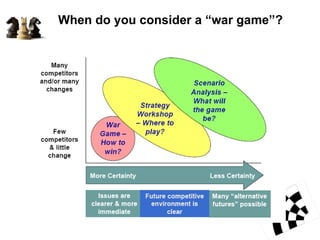
When do you consider a “war game”?
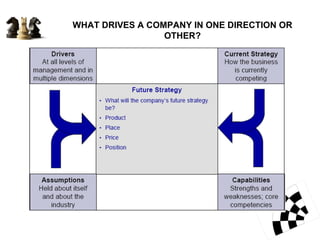
WHAT DRIVES A COMPANY IN ONE DIRECTION OR OTHER?
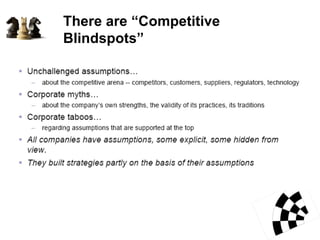
There are “Competitive Blindspots”

Competitive war games

  • 1.
    COMPETITIVE WAR GAMESCompiled by Turgut Ziyal
  • 2.
    Why War Games?The immediate goal of a competitive war game is to gain a better understanding of the total competitive arena, and anticipate competitive developments and moves in your industry. The war game is an effective tool for uncovering hidden weaknesses – your own and those of your competitors. This understanding will help you formulate best-course action options. Competitive war games will also help you shift managerial focus from internal to external, and lay a foundation of an early warning process.
  • 3.
    What is theultimate objective of a War Game? The immediate goal of a War Game is to anticipate competitive developments and moves in one's industry(ies), and formulate best-course action options. The ultimate long-term objective of a War Game is to shift managerial focus from internal to external. Additional objectives include: Gain a better understanding of the total competitive arena Develop reality based market/industry scenarios Lay the foundation for an early warning process Develop the ability to think like a competitor among internal "experts" Raise awareness of participants to the need to consider competitors' moves before committing to a specific strategy, as well as competitors' reactions to your own moves Air internal blindspots which typically do not get an open hearing
  • 4.
    Major Benefits ofCompetitive War Games Forecasting of future industry-wide scenarios Better proactive strategy Faster reactive strategy
  • 5.
    What are theapplications of a War Game? A War Game has applications in a number of areas: The Planning Function including: Corporate strategy planning Business unit's strategy planning Functional strategy charting (e.g., R&D) Testing Strategic Initiatives such as: Product introduction Mergers and acquisitions Testing Tactical Initiatives: Marketing campaigns (so called "Competitor Response modeling") Promotional tactics
  • 6.
    What are thecomponents of a War Game? Data Collection and Advance Preparation By Pre-Assigned Teams Analytical Frameworks The War Game or "Battle" Industry Scenarios Action Recommendations
  • 7.
    Data Collection andAdvance Preparation By Pre-Assigned Teams The data include secondary and primary research about competitors and the industry. It is typically assembled by the host company's analysts or by an outside vendor. Once collected, the data are then handed to pre-assigned teams representing the competitors and the host company for study prior to the War Game event. The teams must be familiar enough with the data to locate specific data when needed during the course of the War Game. No other preparatory work is required.
  • 8.
    Analytical Frameworks Without a carefully maintained analytical structure, a War Game is a waste of time and resources. On “Day One” of the War Game, participants will learn the frameworks for analyzing the industry, the competitors and for identifying the company's and competitors' blindspots.
  • 9.
    The War Gameor "Battle" “ Day Two” of the War Game is devoted to an analytical "battle" between the teams, similar to a chess game. There are two rounds to the battle. In Round One (the "Descriptive" round ), the teams are asked to predict what competitors plan to do and to analyze potential blindspots. In Round Two (the "Prescriptive" round), the teams develop strategy recommendations for the host company, using the information presented in Round One, placing special emphasis on exploiting competitors' blindspots with proactive strategic options or assessments as to what competitors were "most likely to do". Teams are required to support/defend their recommendations and predictions based on the analytical frameworks and intelligence data.
  • 10.
    Industry Scenarios Atthe conclusion of Round Two presentations/defenses, the emphasis shifts to weaving predictions together to form Most Likely and Worst industry-wide scenarios, based on competitors' planned and anticipated moves and the Host's countermoves.
  • 11.
    Action Recommendations Followingthe industry-wide scenarios, participants explore recommendations for actions for the host company.
  • 12.
    Who should participatein a War Game? For a War Game to be successful, the composition of the teams should be carefully selected. Each team should be headed by a senior executive and include junior and middle managers as well as field personnel. Team members should represent a diversity of functional expertise unless the War Game is done with one functional area such as R&D. The choice of team leadership is critical: senior executive leadership will ensure success of the War Game beyond the "event". Ideally, the CEO or business unit President should serve as the ultimate "referee".
  • 13.
    When do youconsider a “war game”?
  • 14.
    WHAT DRIVES ACOMPANY IN ONE DIRECTION OR OTHER?
  • 15.