TPM the Effective
Maintenance
(23/30Apr2016)
For:
Kotak Malaysia (KOM) Sdn Bhd
11-12 Jln Usaha 4, Kawasan
Perindustrian, 75450,
Ayer Keroh, Melaka Darul Azim.
Presented by:
Timothy Wooi
ITS Management Sdn Bhd
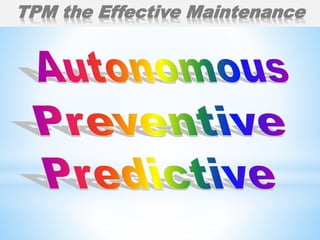
TPM the Effective Maintenance
This is a 2 days course on Total Productive Maintenance
(TPM) that will guide you through to implement
Autonomous Maintenance (AM) on your current
Equipment and to plan the execution of your
Preventive (PM) & Predictive Maintenance (PdM).
2016/4/29 3
TPM defines your Maintenance
schedule and Goals. TPM helps
you plan and develop the
optimal program for your
facility, resulting in increased
efficiencies and cost savings.
TPM the Effective Maintenance
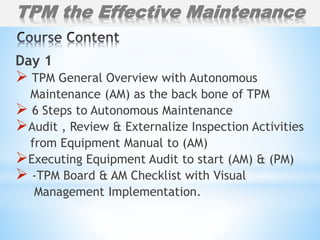
Day 1
 TPM General Overview with Autonomous
Maintenance (AM) as the back bone of TPM
 6 Steps to Autonomous Maintenance
Audit , Review & Externalize Inspection Activities
from Equipment Manual to (AM)
Executing Equipment Audit to start (AM) & (PM)
 -TPM Board & AM Checklist with Visual
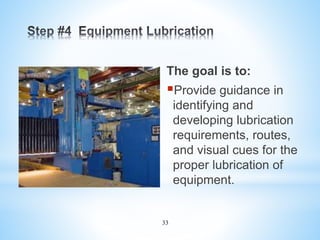
Management Implementation.
TPM the Effective Maintenance
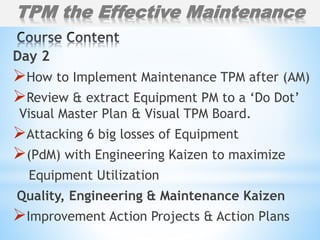
Day 2
How to Implement Maintenance TPM after (AM)
Review & extract Equipment PM to a ‘Do Dot’
Visual Master Plan & Visual TPM Board.
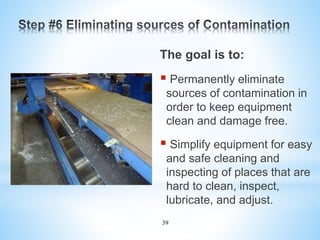
Attacking 6 big losses of Equipment
(PdM) with Engineering Kaizen to maximize
Equipment Utilization
Quality, Engineering & Maintenance Kaizen
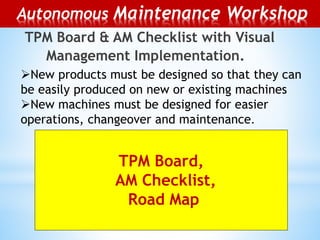
Improvement Action Projects & Action Plans
TPM the Effective Maintenance
TPM is a company-wide team-based effort to
build quality into equipment and to improve
overall equipment effectiveness of Preventive &
Predictive Maintenance.
TPM Overview
It uses Total Quality Control
and Total Employee
Involvement approach, in
maintaining the Equipment
towards a “ready to use
condition” using energy
efficiently.
TPM the Effective Maintenance
2016/4/29 7
TPM combine Production practices in Autonomous
Maintenance (AM) and the Maintenance practices,
both working together as a Team to maintain the
smooth running of a Company’s Equipment towards a
Zero Breakdown.
TPM Maintenance covers;
 Autonomous Maintenance
(AM)
 Preventive Maintenance
(PM)
 Predictive Maintenance
(PdM).
TPM the Effective Maintenance
TPM Overview
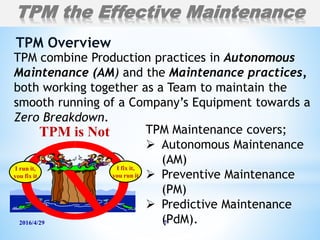
I run it,
you fix it
I fix it,
you run it
TPM is Not
Maintenance Workshop Activities
This Workshop is designed to equip Maintenance
Personal with knowledge of Maintenance TPM after
Autonomous Maintenance to:
 Focus on the Equipment Maintenance using ‘Do Dot’
Visual Master Plan Check sheet.
Ensure timely execution of (PM) with Production and
Management support and…
Execute (PdM) with Engineering support to ensure
Equipment are are always in a ‘ready to use’ condition
‘every time’ towards a ‘Zero Downtime’ as the Goal.
Overview
To enable Participants understand TPM, after
that to Plan, Develop, Implement and oversee
the Maintenance program towards a Zero
downtime by;
Workshop Objective
TPM the Effective Maintenance
 executing Equipment Maintenance timely per
schedule and reduce Company’s resources
efficiently using ‘low cost or no cost’ techniques
as practiced in a Lean and World Class
Environment (WCM).
to Extend life span of Equipment and Tools
preventing damages caused by neglect and to cut
cost of new Equipment reinvestment.
 to improve Productivity and Quality leading to
Increased Profit by eliminating unplanned
breakdowns and costly downtime.
Workshop Objective
TPM the Effective Maintenance
4/29/2016 11
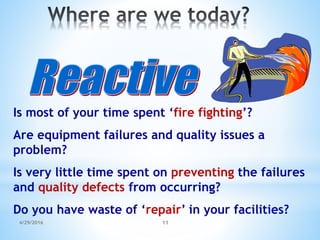
Is most of your time spent ‘fire fighting’?
Are equipment failures and quality issues a
problem?
Is very little time spent on preventing the failures
and quality defects from occurring?
Do you have waste of ‘repair’ in your facilities?
Total- in TPM means ‘total involvement’ from top
management to shop floor personnel. TPM is not
optional, everyone has to participate for it to work.
The biggest reason why TPM failed is that “people
do not have enough time doing it”. Time is either
dedicated to TPM, or spent fire fighting
breakdowns and quality defects. Having time for
breakdowns, we certainly have enough time for
TPM.
Productive- Creates cost saving and also creates
cost avoidance.
TPM the Effective Maintenance
4/29/2016 13
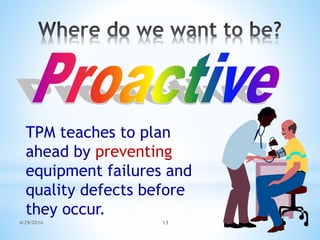
TPM teaches to plan
ahead by preventing
equipment failures and
quality defects before
they occur.
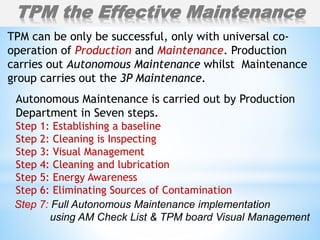
Step 7: Full Autonomous Maintenance implementation
using AM Check List & TPM board Visual Management
TPM can be only be successful, only with universal co-
operation of Production and Maintenance. Production
carries out Autonomous Maintenance whilst Maintenance
group carries out the 3P Maintenance.
TPM the Effective Maintenance
Autonomous Maintenance is carried out by Production
Department in Seven steps.
Step 1: Establishing a baseline
Step 2: Cleaning is Inspecting
Step 3: Visual Management
Step 4: Cleaning and lubrication
Step 5: Energy Awareness
Step 6: Eliminating Sources of Contamination
15
To initiate TPM, the Company and Factory
leadership should promote all seven (6 Workshop
plus 1 Visual Management) of above steps despite
excuses that may come by.
TPM the Effective Maintenance
The company can then gradually eliminate the
losses without adding Cost and new Equipment
reinvestment to establish a more effective
relationship between operators and machines to
maintain it in the best possible condition.
To implement a current Lean Maintenance System,-
Total Productive Maintenance (TPM) by;
understanding different types of Maintenance in TPM.
synergizing Production & Maintenance Staff working
together as a team to Implement TPM for Equipment.
Techniques
Review and externalize Inspection activities to AM.
Establishing a baseline through ‘Clean to Inspect,
Inspect to detect and Detect to Correct.’
 Implement AM Checklist with TPM Board Visual
Management.
Course Content
2016/4/29 17
What does Maintenance
mean to you?
With TPM, the focus of maintenance shifts from
that of repairing, or reacting to failures to that
of maintaining assets and preventing failures
and quality defects in the first place.
TPM the Effective Maintenance
The root word of maintenance is
Maintain,
more often than not maintenance is
looked at as ‘the people that repair
our equipment when it breaks!’.
19
Autonomous Maintenance:
process by which equipment operators accept
and share responsibility (with Maintenance) for
the performance and health of their equipment.
Preventive Maintenance:
routine maintenance to maintain the basic
equipment conditions, replace deteriorating
parts, and maintain equipment in on-spec
condition. It is carried out at predetermined
periods, to ensure equipment reliability.
TPM the Effective Maintenance
20
Predictive Maintenance (condition-based):
corrects equipment deterioration by condition
monitoring and machine diagnosis and helps
detect impending problems before they occur.
Breakdown Maintenance (reactive):
corrects equipment deterioration after the
occurrence of a breakdown.
TPM the Effective Maintenance
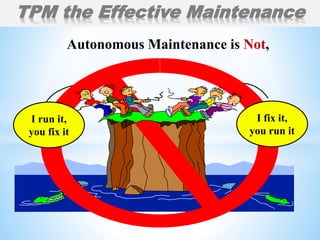
I run it,
you fix it
I fix it,
you run it
Autonomous Maintenance is Not,
TPM the Effective Maintenance
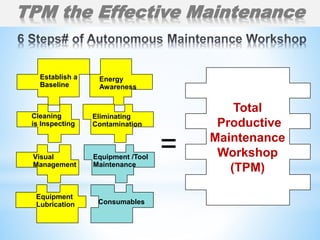
=
Establish a
Baseline
Energy
Awareness
Cleaning
is Inspecting
Eliminating
Contamination
Visual
Management
Equipment /Tool
Maintenance
Equipment
Lubrication Consumables
Total
Productive
Maintenance
Workshop
(TPM)
TPM the Effective Maintenance
23
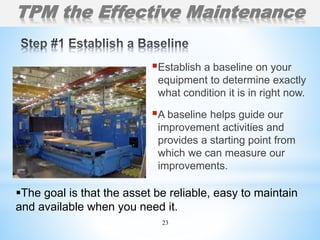
Establish a baseline on your
equipment to determine exactly
what condition it is in right now.
A baseline helps guide our
improvement activities and
provides a starting point from
which we can measure our
improvements.
TPM the Effective Maintenance
The goal is that the asset be reliable, easy to maintain
and available when you need it.
Clean to Inspect, Inspect to Detect &
Detect to Correct
Q: Do you wash your car by hand or in a car
wash?
25
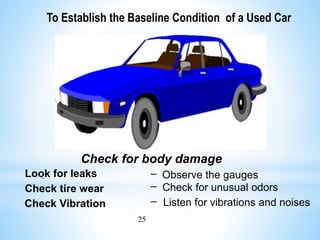
To Establish the Baseline Condition of a Used Car
Check for body damage
–Look for leaks
Check tire wear
–
Observe the gauges–
Listen for vibrations and noises
– Check for unusual odors
Check Vibration
26
Is the equipment
difficult to:
Lubricate
Inspect
Reach
Access
Clean
Remove Covers
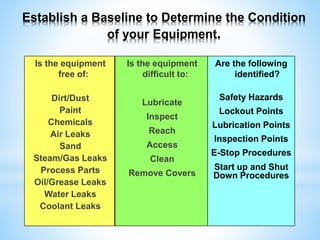
Establish a Baseline to Determine the Condition
of your Equipment.
Is the equipment
free of:
Dirt/Dust
Paint
Chemicals
Air Leaks
Sand
Steam/Gas Leaks
Process Parts
Oil/Grease Leaks
Water Leaks
Coolant Leaks
Are the following
identified?
Safety Hazards
Lockout Points
Lubrication Points
Inspection Points
E-Stop Procedures
Start up and Shut
Down Procedures
27
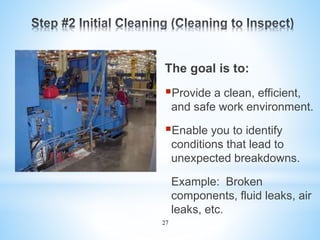
The goal is to:
Provide a clean, efficient,
and safe work environment.
Enable you to identify
conditions that lead to
unexpected breakdowns.
Example: Broken
components, fluid leaks, air
leaks, etc.
28
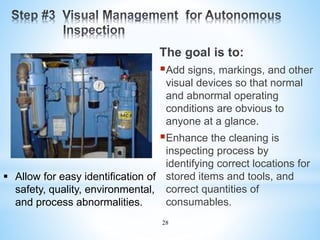
The goal is to:
Add signs, markings, and other
visual devices so that normal
and abnormal operating
conditions are obvious to
anyone at a glance.
Enhance the cleaning is
inspecting process by
identifying correct locations for
stored items and tools, and
correct quantities of
consumables.
 Allow for easy identification of
safety, quality, environmental,
and process abnormalities.
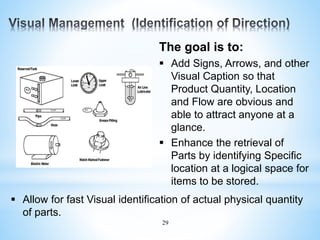
29
The goal is to:
 Add Signs, Arrows, and other
Visual Caption so that
Product Quantity, Location
and Flow are obvious and
able to attract anyone at a
glance.
 Enhance the retrieval of
Parts by identifying Specific
location at a logical space for
items to be stored.
 Allow for fast Visual identification of actual physical quantity
of parts.
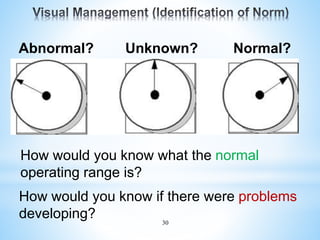
30
Abnormal? Unknown? Normal?
How would you know what the normal
operating range is?
How would you know if there were problems
developing?
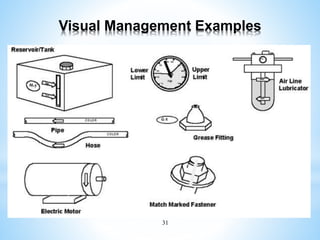
31
Visual Management Examples
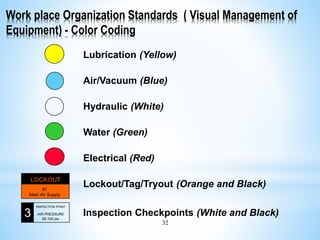
32
Lubrication (Yellow)
Air/Vacuum (Blue)
Hydraulic (White)
Water (Green)
Electrical (Red)
Lockout/Tag/Tryout (Orange and Black)
Inspection Checkpoints (White and Black)3
INSPECTION POINT
AIR PRESSURE
80-100 psi
#1
Main Air Supply
LOCKOUT
Work place Organization Standards ( Visual Management of
Equipment) - Color Coding
33
The goal is to:
Provide guidance in
identifying and
developing lubrication
requirements, routes,
and visual cues for the
proper lubrication of
equipment.
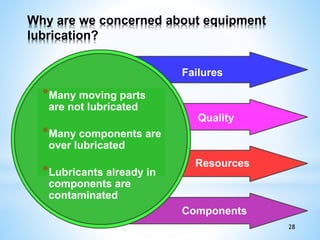
Why are we concerned about equipment
lubrication?
*Many moving parts
are not lubricated
*Many components are
over lubricated
*Lubricants already in
components are
contaminated
Failures
Components
Resources
Quality
28
35
70% of all mechanical
equipment failures are a
result of improper
lubrication.
Too much lubricant is as bad as too little
S
S
S
S
S
Equipment Lubrication
S
S
S
S
S
36
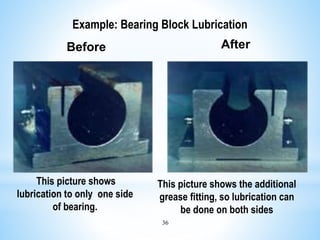
Example: Bearing Block Lubrication
This picture shows
lubrication to only one side
of bearing.
Before After
This picture shows the additional
grease fitting, so lubrication can
be done on both sides
37
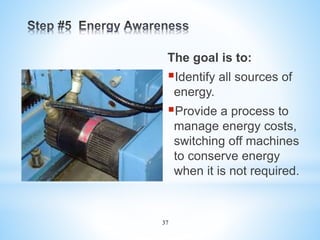
The goal is to:
Identify all sources of
energy.
Provide a process to
manage energy costs,
switching off machines
to conserve energy
when it is not required.
e
38
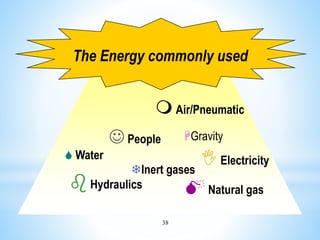
The Energy commonly used
S Water  Electricity
 Natural gas Hydraulics
 People
 Air/Pneumatic
Inert gases
Gravity
39
The goal is to:
 Permanently eliminate
sources of contamination in
order to keep equipment
clean and damage free.
 Simplify equipment for easy
and safe cleaning and
inspecting of places that are
hard to clean, inspect,
lubricate, and adjust.
40
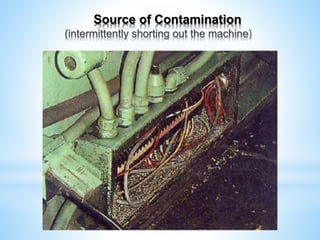
Source of Contamination
41
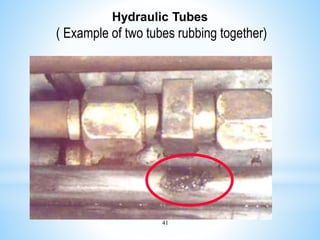
Hydraulic Tubes
( Example of two tubes rubbing together)
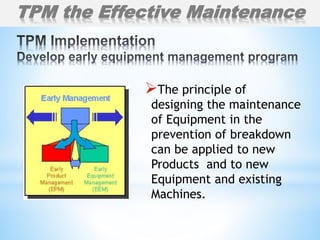
The principle of
designing the maintenance
of Equipment in the
prevention of breakdown
can be applied to new
Products and to new
Equipment and existing
Machines.
TPM the Effective Maintenance
TPM Board & AM Checklist with Visual
Management Implementation.
TPM Board,
AM Checklist,
Road Map
Autonomous Maintenance Workshop
New products must be designed so that they can
be easily produced on new or existing machines
New machines must be designed for easier
operations, changeover and maintenance.
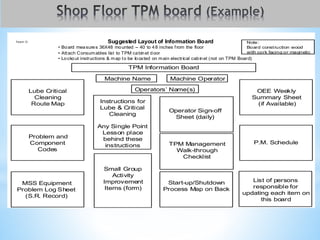
Team D Suggested Layout of I nform ation Board
Suggested Layout of Information Board
• Board measures 36X48 mounted -- 40 to 48 inches from the floor
• Attach Consumables list to TPM cabinet door
• Lockout instructions & map to be located on main electrical cabinet (not on TPM Board)
Lube Critical
Cleaning
Route Map
Problem and
Component
Codes
MSS Equipment
Problem Log Sheet
(S.R. Record)
OEE Weekly
Summary Sheet
(if Available)
P.M. Schedule
List of persons
responsible for
updating each item on
this board
TPM Information Board
Machine OperatorMachine Name
Operators’ Name(s)
Instructions for
Lube & Critical
Cleaning
Any Single Point
Lesson place
behind these
instructions TPM Management
Walk-through
Checklist
Small Group
Activity
Improvement
Items (form)
Start-up/Shutdown
Process Map on Back
Team D Note:
Board construction wood
with cork facing or magnetic
Operator Sign-off
Sheet (daily)
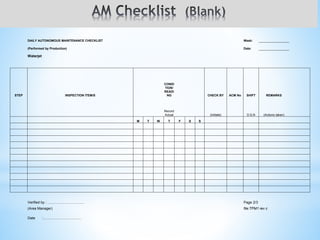
DAILY AUTONOMOUS MAINTENANCE CHECKLIST Week:
(Performed by Production) Date:
Waterjet
STEP INSPECTION ITEM/S
CONDI
TION/
READI
NG CHECK BY ACM No SHIFT REMARKS
Record
Actual (Initiate) D,S,N (Actions taken)
M T W T F S S
Verified by : …………………………. Page 2/3
(Area Manager) file:TPM1 rev c
Date :…………………………..
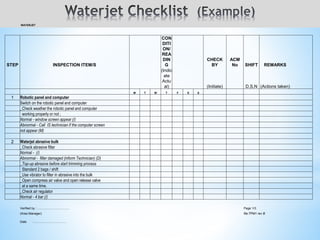
WATERJET
STEP INSPECTION ITEM/S
CON
DITI
ON/
REA
DIN
G
CHECK
BY
ACM
No SHIFT REMARKS
(Indic
ate
Actu
al) (Initiate) D,S,N (Actions taken)
M T W T F S S
1 Robotic panel and computer
Switch on the robotic panel and computer
_Check weather the robotic panel and computer
working properly or not ;
Normal - window screen appear (/)
Abnormal - Call IS technician if the computer screen
not appear (M)
2 Waterjet abrasive bulk
_Check abrasive filter
Normal - (/)
Abnormal - filter damaged (inform Technician) (D)
_Top-up abrasive before start trimming process
Standard 2 bags / shift
_Use vibrator to filter in abrasive into the bulk
_Open compress air valve and open release valve
at a same time.
_Check air regulator
Normal - 4 bar (/)
Verified by : …………………………. Page 1/3
(Area Manager) file:TPM1 rev B
Date :…………………………..
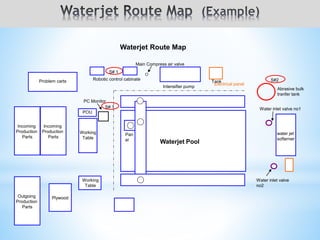
Waterjet Pool
Tank
water jet
softerner
Pan
el
PC Monitor
S# 1
S# 1
POU
Working
Table
S#2
Abrasive bulk
tranfer tank
Electrical panel
Intensifier pump
Robotic control cabinate
Main Compress air valve
Water inlet valve no1
Water inlet valve
no2
Incoming
Production
Parts
Problem carts
Incoming
Production
Parts
Plywood
Working
Table
Outgoing
Production
Parts
Waterjet Route Map
Autonomous Maintenance Workshop
 Audit, Review & Externalize Inspection Activities
from Equipment Manual to Autonomous
Maintenance
 Put in place TPM Board with Inspection Points &
AM Checklist with Visual Management,
supporting PM Implementation.
Identify routine Inspection Activities from
Equipment Manual to develop AM Checklist
for AM Inspection & TPM Board.
Autonomous Maintenance Workshop
Workshop Purpose:
 to ensure Equipment is in operational condition
through routine inspection of parameters before
start of operation.
 to trigger abnormality before damage occur.
 to identify Inspection points with Visual
Management for ease of Inspection using AM
Check List.
Day 2
How to Implement Maintenance TPM after (AM)
Review & extract Equipment PM to a
‘Do Dot’ Visual Master Plan & Visual TPM Board.
Attacking 6 big losses of Equipment
(PdM) with Engineering Kaizen to maximize
Equipment Utilization
Quality, Engineering & Maintenance Kaizen
Improvement Action Projects & Action Plans
TPM the Effective Maintenance

TPM the effective maintenance with Autonomous Maintenance

  • 1.
    TPM the Effective Maintenance (23/30Apr2016) For: KotakMalaysia (KOM) Sdn Bhd 11-12 Jln Usaha 4, Kawasan Perindustrian, 75450, Ayer Keroh, Melaka Darul Azim. Presented by: Timothy Wooi ITS Management Sdn Bhd
  • 2.
    TPM the EffectiveMaintenance
  • 3.
    This is a2 days course on Total Productive Maintenance (TPM) that will guide you through to implement Autonomous Maintenance (AM) on your current Equipment and to plan the execution of your Preventive (PM) & Predictive Maintenance (PdM). 2016/4/29 3 TPM defines your Maintenance schedule and Goals. TPM helps you plan and develop the optimal program for your facility, resulting in increased efficiencies and cost savings. TPM the Effective Maintenance
  • 4.
    Day 1  TPMGeneral Overview with Autonomous Maintenance (AM) as the back bone of TPM  6 Steps to Autonomous Maintenance Audit , Review & Externalize Inspection Activities from Equipment Manual to (AM) Executing Equipment Audit to start (AM) & (PM)  -TPM Board & AM Checklist with Visual Management Implementation. TPM the Effective Maintenance
  • 5.
    Day 2 How toImplement Maintenance TPM after (AM) Review & extract Equipment PM to a ‘Do Dot’ Visual Master Plan & Visual TPM Board. Attacking 6 big losses of Equipment (PdM) with Engineering Kaizen to maximize Equipment Utilization Quality, Engineering & Maintenance Kaizen Improvement Action Projects & Action Plans TPM the Effective Maintenance
  • 6.
    TPM is acompany-wide team-based effort to build quality into equipment and to improve overall equipment effectiveness of Preventive & Predictive Maintenance. TPM Overview It uses Total Quality Control and Total Employee Involvement approach, in maintaining the Equipment towards a “ready to use condition” using energy efficiently. TPM the Effective Maintenance
  • 7.
    2016/4/29 7 TPM combineProduction practices in Autonomous Maintenance (AM) and the Maintenance practices, both working together as a Team to maintain the smooth running of a Company’s Equipment towards a Zero Breakdown. TPM Maintenance covers;  Autonomous Maintenance (AM)  Preventive Maintenance (PM)  Predictive Maintenance (PdM). TPM the Effective Maintenance TPM Overview I run it, you fix it I fix it, you run it TPM is Not
  • 8.
    Maintenance Workshop Activities ThisWorkshop is designed to equip Maintenance Personal with knowledge of Maintenance TPM after Autonomous Maintenance to:  Focus on the Equipment Maintenance using ‘Do Dot’ Visual Master Plan Check sheet. Ensure timely execution of (PM) with Production and Management support and… Execute (PdM) with Engineering support to ensure Equipment are are always in a ‘ready to use’ condition ‘every time’ towards a ‘Zero Downtime’ as the Goal. Overview
  • 9.
    To enable Participantsunderstand TPM, after that to Plan, Develop, Implement and oversee the Maintenance program towards a Zero downtime by; Workshop Objective TPM the Effective Maintenance  executing Equipment Maintenance timely per schedule and reduce Company’s resources efficiently using ‘low cost or no cost’ techniques as practiced in a Lean and World Class Environment (WCM).
  • 10.
    to Extend lifespan of Equipment and Tools preventing damages caused by neglect and to cut cost of new Equipment reinvestment.  to improve Productivity and Quality leading to Increased Profit by eliminating unplanned breakdowns and costly downtime. Workshop Objective TPM the Effective Maintenance
  • 11.
    4/29/2016 11 Is mostof your time spent ‘fire fighting’? Are equipment failures and quality issues a problem? Is very little time spent on preventing the failures and quality defects from occurring? Do you have waste of ‘repair’ in your facilities?
  • 12.
    Total- in TPMmeans ‘total involvement’ from top management to shop floor personnel. TPM is not optional, everyone has to participate for it to work. The biggest reason why TPM failed is that “people do not have enough time doing it”. Time is either dedicated to TPM, or spent fire fighting breakdowns and quality defects. Having time for breakdowns, we certainly have enough time for TPM. Productive- Creates cost saving and also creates cost avoidance. TPM the Effective Maintenance
  • 13.
    4/29/2016 13 TPM teachesto plan ahead by preventing equipment failures and quality defects before they occur.
  • 14.
    Step 7: FullAutonomous Maintenance implementation using AM Check List & TPM board Visual Management TPM can be only be successful, only with universal co- operation of Production and Maintenance. Production carries out Autonomous Maintenance whilst Maintenance group carries out the 3P Maintenance. TPM the Effective Maintenance Autonomous Maintenance is carried out by Production Department in Seven steps. Step 1: Establishing a baseline Step 2: Cleaning is Inspecting Step 3: Visual Management Step 4: Cleaning and lubrication Step 5: Energy Awareness Step 6: Eliminating Sources of Contamination
  • 15.
    15 To initiate TPM,the Company and Factory leadership should promote all seven (6 Workshop plus 1 Visual Management) of above steps despite excuses that may come by. TPM the Effective Maintenance The company can then gradually eliminate the losses without adding Cost and new Equipment reinvestment to establish a more effective relationship between operators and machines to maintain it in the best possible condition.
  • 16.
    To implement acurrent Lean Maintenance System,- Total Productive Maintenance (TPM) by; understanding different types of Maintenance in TPM. synergizing Production & Maintenance Staff working together as a team to Implement TPM for Equipment. Techniques Review and externalize Inspection activities to AM. Establishing a baseline through ‘Clean to Inspect, Inspect to detect and Detect to Correct.’  Implement AM Checklist with TPM Board Visual Management. Course Content
  • 17.
    2016/4/29 17 What doesMaintenance mean to you?
  • 18.
    With TPM, thefocus of maintenance shifts from that of repairing, or reacting to failures to that of maintaining assets and preventing failures and quality defects in the first place. TPM the Effective Maintenance The root word of maintenance is Maintain, more often than not maintenance is looked at as ‘the people that repair our equipment when it breaks!’.
  • 19.
    19 Autonomous Maintenance: process bywhich equipment operators accept and share responsibility (with Maintenance) for the performance and health of their equipment. Preventive Maintenance: routine maintenance to maintain the basic equipment conditions, replace deteriorating parts, and maintain equipment in on-spec condition. It is carried out at predetermined periods, to ensure equipment reliability. TPM the Effective Maintenance
  • 20.
    20 Predictive Maintenance (condition-based): correctsequipment deterioration by condition monitoring and machine diagnosis and helps detect impending problems before they occur. Breakdown Maintenance (reactive): corrects equipment deterioration after the occurrence of a breakdown. TPM the Effective Maintenance
  • 21.
    I run it, youfix it I fix it, you run it Autonomous Maintenance is Not, TPM the Effective Maintenance
  • 22.
    = Establish a Baseline Energy Awareness Cleaning is Inspecting Eliminating Contamination Visual Management Equipment/Tool Maintenance Equipment Lubrication Consumables Total Productive Maintenance Workshop (TPM) TPM the Effective Maintenance
  • 23.
    23 Establish a baselineon your equipment to determine exactly what condition it is in right now. A baseline helps guide our improvement activities and provides a starting point from which we can measure our improvements. TPM the Effective Maintenance The goal is that the asset be reliable, easy to maintain and available when you need it.
  • 24.
    Clean to Inspect,Inspect to Detect & Detect to Correct Q: Do you wash your car by hand or in a car wash?
  • 25.
    25 To Establish theBaseline Condition of a Used Car Check for body damage –Look for leaks Check tire wear – Observe the gauges– Listen for vibrations and noises – Check for unusual odors Check Vibration
  • 26.
    26 Is the equipment difficultto: Lubricate Inspect Reach Access Clean Remove Covers Establish a Baseline to Determine the Condition of your Equipment. Is the equipment free of: Dirt/Dust Paint Chemicals Air Leaks Sand Steam/Gas Leaks Process Parts Oil/Grease Leaks Water Leaks Coolant Leaks Are the following identified? Safety Hazards Lockout Points Lubrication Points Inspection Points E-Stop Procedures Start up and Shut Down Procedures
  • 27.
    27 The goal isto: Provide a clean, efficient, and safe work environment. Enable you to identify conditions that lead to unexpected breakdowns. Example: Broken components, fluid leaks, air leaks, etc.
  • 28.
    28 The goal isto: Add signs, markings, and other visual devices so that normal and abnormal operating conditions are obvious to anyone at a glance. Enhance the cleaning is inspecting process by identifying correct locations for stored items and tools, and correct quantities of consumables.  Allow for easy identification of safety, quality, environmental, and process abnormalities.
  • 29.
    29 The goal isto:  Add Signs, Arrows, and other Visual Caption so that Product Quantity, Location and Flow are obvious and able to attract anyone at a glance.  Enhance the retrieval of Parts by identifying Specific location at a logical space for items to be stored.  Allow for fast Visual identification of actual physical quantity of parts.
  • 30.
    30 Abnormal? Unknown? Normal? Howwould you know what the normal operating range is? How would you know if there were problems developing?
  • 31.
  • 32.
    32 Lubrication (Yellow) Air/Vacuum (Blue) Hydraulic(White) Water (Green) Electrical (Red) Lockout/Tag/Tryout (Orange and Black) Inspection Checkpoints (White and Black)3 INSPECTION POINT AIR PRESSURE 80-100 psi #1 Main Air Supply LOCKOUT Work place Organization Standards ( Visual Management of Equipment) - Color Coding
  • 33.
    33 The goal isto: Provide guidance in identifying and developing lubrication requirements, routes, and visual cues for the proper lubrication of equipment.
  • 34.
    Why are weconcerned about equipment lubrication? *Many moving parts are not lubricated *Many components are over lubricated *Lubricants already in components are contaminated Failures Components Resources Quality 28
  • 35.
    35 70% of allmechanical equipment failures are a result of improper lubrication. Too much lubricant is as bad as too little S S S S S Equipment Lubrication S S S S S
  • 36.
    36 Example: Bearing BlockLubrication This picture shows lubrication to only one side of bearing. Before After This picture shows the additional grease fitting, so lubrication can be done on both sides
  • 37.
    37 The goal isto: Identify all sources of energy. Provide a process to manage energy costs, switching off machines to conserve energy when it is not required. e
  • 38.
    38 The Energy commonlyused S Water  Electricity  Natural gas Hydraulics  People  Air/Pneumatic Inert gases Gravity
  • 39.
    39 The goal isto:  Permanently eliminate sources of contamination in order to keep equipment clean and damage free.  Simplify equipment for easy and safe cleaning and inspecting of places that are hard to clean, inspect, lubricate, and adjust.
  • 40.
  • 41.
    41 Hydraulic Tubes ( Exampleof two tubes rubbing together)
  • 42.
    The principle of designingthe maintenance of Equipment in the prevention of breakdown can be applied to new Products and to new Equipment and existing Machines. TPM the Effective Maintenance
  • 43.
    TPM Board &AM Checklist with Visual Management Implementation. TPM Board, AM Checklist, Road Map Autonomous Maintenance Workshop New products must be designed so that they can be easily produced on new or existing machines New machines must be designed for easier operations, changeover and maintenance.
  • 44.
    Team D SuggestedLayout of I nform ation Board Suggested Layout of Information Board • Board measures 36X48 mounted -- 40 to 48 inches from the floor • Attach Consumables list to TPM cabinet door • Lockout instructions & map to be located on main electrical cabinet (not on TPM Board) Lube Critical Cleaning Route Map Problem and Component Codes MSS Equipment Problem Log Sheet (S.R. Record) OEE Weekly Summary Sheet (if Available) P.M. Schedule List of persons responsible for updating each item on this board TPM Information Board Machine OperatorMachine Name Operators’ Name(s) Instructions for Lube & Critical Cleaning Any Single Point Lesson place behind these instructions TPM Management Walk-through Checklist Small Group Activity Improvement Items (form) Start-up/Shutdown Process Map on Back Team D Note: Board construction wood with cork facing or magnetic Operator Sign-off Sheet (daily)
  • 45.
    DAILY AUTONOMOUS MAINTENANCECHECKLIST Week: (Performed by Production) Date: Waterjet STEP INSPECTION ITEM/S CONDI TION/ READI NG CHECK BY ACM No SHIFT REMARKS Record Actual (Initiate) D,S,N (Actions taken) M T W T F S S Verified by : …………………………. Page 2/3 (Area Manager) file:TPM1 rev c Date :…………………………..
  • 46.
    WATERJET STEP INSPECTION ITEM/S CON DITI ON/ REA DIN G CHECK BY ACM NoSHIFT REMARKS (Indic ate Actu al) (Initiate) D,S,N (Actions taken) M T W T F S S 1 Robotic panel and computer Switch on the robotic panel and computer _Check weather the robotic panel and computer working properly or not ; Normal - window screen appear (/) Abnormal - Call IS technician if the computer screen not appear (M) 2 Waterjet abrasive bulk _Check abrasive filter Normal - (/) Abnormal - filter damaged (inform Technician) (D) _Top-up abrasive before start trimming process Standard 2 bags / shift _Use vibrator to filter in abrasive into the bulk _Open compress air valve and open release valve at a same time. _Check air regulator Normal - 4 bar (/) Verified by : …………………………. Page 1/3 (Area Manager) file:TPM1 rev B Date :…………………………..
  • 47.
    Waterjet Pool Tank water jet softerner Pan el PCMonitor S# 1 S# 1 POU Working Table S#2 Abrasive bulk tranfer tank Electrical panel Intensifier pump Robotic control cabinate Main Compress air valve Water inlet valve no1 Water inlet valve no2 Incoming Production Parts Problem carts Incoming Production Parts Plywood Working Table Outgoing Production Parts Waterjet Route Map
  • 48.
    Autonomous Maintenance Workshop Audit, Review & Externalize Inspection Activities from Equipment Manual to Autonomous Maintenance  Put in place TPM Board with Inspection Points & AM Checklist with Visual Management, supporting PM Implementation. Identify routine Inspection Activities from Equipment Manual to develop AM Checklist for AM Inspection & TPM Board.
  • 49.
    Autonomous Maintenance Workshop WorkshopPurpose:  to ensure Equipment is in operational condition through routine inspection of parameters before start of operation.  to trigger abnormality before damage occur.  to identify Inspection points with Visual Management for ease of Inspection using AM Check List.
  • 50.
    Day 2 How toImplement Maintenance TPM after (AM) Review & extract Equipment PM to a ‘Do Dot’ Visual Master Plan & Visual TPM Board. Attacking 6 big losses of Equipment (PdM) with Engineering Kaizen to maximize Equipment Utilization Quality, Engineering & Maintenance Kaizen Improvement Action Projects & Action Plans TPM the Effective Maintenance