ANTIDEPRESSANTS Tricyclic Antidepressants  Selective Seratonin Reuptake Inhibitors
Definitions Affective disorders   -  mental illnesses characterized by pathological changes in   mood  (not thought – compare with schizophrenia) Unipolar disorders Depression –  pathologically  depressed mood  (life time prevalence up to 17%) Mania  –  excessive elation  and accelerated psychomotoric activity  (rare) Bipolar disorder   (manic-depressive illness) – „cycling mood“ = severe highs (mania, event. hypomania) and lows (major depressive episodes) prevalence 1-5%, life-time illness, stronger genetic background
Depression common mental disorder that presents with depressed mood, loss of interest or pleasure, feelings of guilt or low self-worth, disturbed sleep or appetite, low energy, and poor concentration  (WHO def.)  Major Depressive Episode  Criteria/Core symptoms Five (or more) of the following symptoms  have been present during  the same 2-week  period and represent a change from previous functioning; at least one of the symptoms is either (1)  depressed mood  or (2)  loss of interest or pleasure . depressed mood most of the day … markedly diminished interest or pleasure significant weight loss  /gain insomnia or hypersomnia psychomotor agitation or retardation ,  fatigue or loss of energy feelings of worthlessness or excessive or inappropriate guilt diminished ability to think or concentrate, or indecisiveness recurrent thoughts of death or suicidal ideation without a specific plan   or a suicide attempt  (!)
Neurobiological theory of depression Monoamine (catecholamine) theory (1965)  = the underlying biological or neuroanatomical basis for depression is a  deficiency of central noradrenergic and/or serotonergic transmission in  the  CNS Supported by: pharmacological effect of antidepressants (TCA, MAO I ) In the past ,  medication of hypertension with reserpine induced depression Contradiction : several drugs (e.g.   cocaine) increase the amount of these neurotransmitters in the   CNS but are unable to treat depression the effect of antidepressants on neurotransmitter levels is relatively quick but onset of antidepressant action is significantly delayed „ Receptor theory“  = the problem is  in up-regulation of post-synaptic receptors and alterations in their sensitivity The antidepressant treatment increases the amount of monoamines in CNS and thereby gradually normalize the density/sensitivity of their receptors The precise pathophysiology of depression remains unsolved
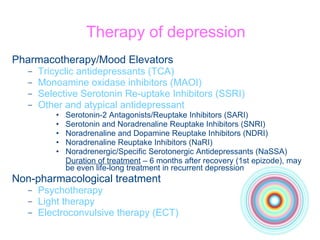
Therapy of depression Pharmacotherapy/Mood Elevators Tricyclic antidepressants (TCA)   Monoamine oxidase inhibitors (MAOI) Selective Serotonin Re-uptake Inhibitors (SSRI) Other and atypical antidepressant Serotonin-2 Antagonists/Reuptake Inhibitors (SARI)  Serotonin and Noradrenaline Reuptake Inhibitors (SNRI) Noradrenaline and Dopamine Reuptake Inhibitors (NDRI) Noradrenaline Reuptake Inhibitors (NaRI) Noradrenergic/Specific Serotonergic Antidepressants (NaSSA) Duration of treatment  – 6 months after recovery (1st epizode), may be even life-long treatment in recurrent depression Non-pharmacological treatment Psychotherapy Light therapy Electroconvulsive therapy (ECT)
 
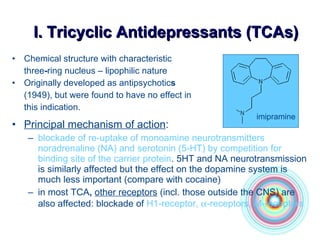
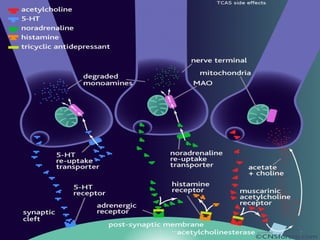
Chemical structure with characteristic three - ring nucleus – lipophilic nature Originally developed as antipsychotic s   (1949), but were found to have no effect in this indication. Principal mechanism of action : blockade of re-uptake of monoamine neurotransmitters   noradrenaline   (NA) and serotonin (5-HT) by competition for binding site of the carrier protein .   5HT and NA neurotransmission is similarly affected but the effect on  the  dopamine system is much less important (compare with cocaine) in most TCA ,   other receptors  (incl. those outside  the  CNS) are also affected: blockade of  H1-receptor,   -receptors, M-receptors I. Tricyclic Antidepressants (TCAs) imipramine
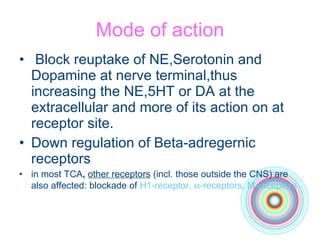
Mode of action Block reuptake of NE,Serotonin and Dopamine at nerve terminal,thus increasing the NE,5HT or DA at the extracellular and more of its action on at receptor site. Down regulation of Beta-adregernic receptors in most TCA ,   other receptors  (incl. those outside  the  CNS) are also affected: blockade of  H1-receptor,   -receptors, M-receptors
 
Pharmacological action CNS-mood elevation in depress patient,can cause ataxia,epilepsy,seizures and coma. CVS-orthostatic hypotension ANS-anticholinergic effects.Most potent anticholinergic action
Classification A.  Tertiary Amines :  Amitriptyline, Butriptyline, Clomipramine, Dosulepin, Doxepin, Imipramine, Lofepramine, Trimipramine B.  Secondary Amines :  Desipramine, Nortriptyline, Protriptyline C.  Others/Dibenzodiazepine derivitive : Dibenzepin
Classification A. NA and 5HT reuptake inhibitors Imipramine,Amitryptaline,Clomipramine B. Predominantly NA reuptake inhibitor Desipramine,Nortriptyline,Amoxapine
Most important TCAs imipramine desimipramine demethylated form, the   active metabolite of imipramine amitriptyline nortriptyline demethylated form, the active metabolite of amitriptyline) Clinical use and efficacy is relatively close within the group the more significant difference is in their adverse effects
INDICATIONS Clinical depression Neuropathic pain-Diabetic neuropathy/Analgesia ADHD  Nocturnal Enuresis (Imipramine) Panic disorder(Imipramine) OCD(Clomipramine) Others like eating disorder,narcolepsy
Agranulocytosis Severe liver damage Glaucoma Prostatic hyperplasia Epilepsy lactation Contraindication
Pharmacokinetics Administered  orally  – rapid absorption, however extensive first pass effect    low and inconsistent BAV Strong  binding to plasma proteins  (90-95% bound). They are also  bound in tissues  +  wide distribution  (high lipophilicity) = large distribution volumes  (ineffectiveness of dialysis in acute intoxications). Biotransformation  – in the liver ( CYP450 , N-demethylation and tricyclic ring hydroxylation) – most of these metabolites are active! CYP450 polymorphisms !  Glucuronidation    inactive metabolites excreted in the urine. Elimination half-lives -  generally LONG  ( T1/2  =10-80h).  Elderly patients – even longer T1/2, risk of accumulation.
Drug interaction Tricyclic interaction includes additive depression of the CNS with other antidepressents include ethanol, barbiturates, benzodiazipines, and opioids. Tricyclic may also cause reversal of the anti-hypertensive action of guanethidine by blocking its transport into sympathetic nerve endings. Less commonly, tricyclics may interfere with the anti-hypertensive actions of methylnorepinephrine( the active metabolite of methyldopa) and clonidine. Tricyclics also share metabolic pathways with phenytoin, hence it may increase concentrations of phenytoin. Tricyclics also potentiate the pressor effects of adrenaline and noradrenaline, so that there is a potantial hazard when a local anaesthetic is used with a pressor amine.
Drug Dose It takes about 2-3 weeks before tricyclic antidepressents has any evident action on depression( although sleep and agitation may respond earlier). Hence, it is useless to give it as per needed only.They must be administred regularly in sufficient doses to achieve the desired effect. After remission of symptoms, it is essential to continue the anti-depressents for 6-12 months in the 1 st  episode and longer duration in subsequent episodes to prevent reccurence of symptoms. A drug, e.g. imipramine is given in sufficient doses(100-300 mg) for 6 weeks, can it be called as ineffective for a particular patient.
When starting the drug start with a low dose and gradually increase it to prevent the side-effects. When stopping the drug, taper the dose over 2-3 weeks period. As if you were to stop it abruptly, it will cause withdrawal symptoms such as: -Nausea -Tremor -Headache -Insomnia
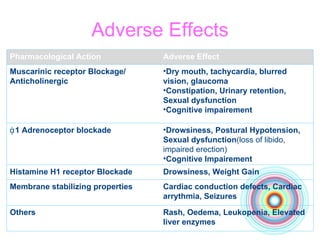
Adverse Effects Pharmacological Action Adverse Effect Muscarinic receptor Blockage/ Anticholinergic Dry mouth, tachycardia, blurred vision, glaucoma Constipation, Urinary retention, Sexual dysfunction Cognitive impairement ᾴ1 Adrenoceptor blockade Drowsiness, Postural Hypotension, Sexual dysfunction (loss of libido, impaired erection) Cognitive Impairement Histamine H1 receptor Blockade Drowsiness, Weight Gain Membrane stabilizing properties Cardiac conduction defects, Cardiac arrythmia, Seizures Others Rash, Oedema, Leukopenia, Elevated liver enzymes
Teratogenic effects Have not been proved but it should be used cautiously in the first trimester of pregnancy.
Toxic Effects CVS : Ventricular fibrillation, Conduction disturbances, Low BP, --- ecg shows prolong PR and QT intervals, depressed ST, flattened T waves. Heartblock occasionally RS : Respiratory depression -> Hypoxia,   Aspiration pneumonia CNS : Agitation, twitching, convulsions, hallucinations, delerium, coma. Parasympathetic dry mouth, dilated pupil, blurred vision, urine retention, pyrexia
Management of toxicity Supportive care Cardiac monitoring---if arrythmia, ICU Plasma level monitoring: Shudn go above 450ng/ml or 300ng/ml if concomitant medical disorder TCA has delayed gastric emptyin, do gastric lavage if several hours after overdose Activated Charcoal 1gm/kg PO/NG
Newer Drugs Lofepramine -Has strong anti-cholinergic side-effect than amitriptyline and is less sedating; however, it may cause anxiety and insomnia.In overdose it is also less toxic than conventional tricyclics. Trazodone -Also has few anti-cholinergic side effects, but has strong sedating properties.
 
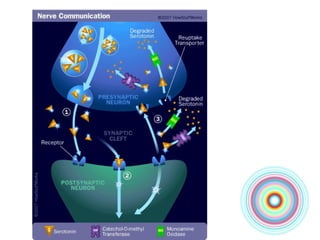
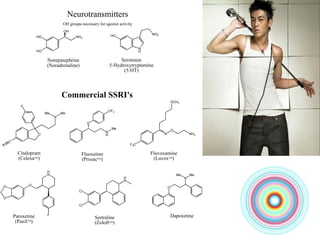
II.  Selective Serotonin Re-uptake Inhibito r s (SSRI) More modern (1 st  drug fluoxetine available in 1988) and safe antidepressants Principal mechanism of action : selective inhibition of 5-HT (sero to nin) reuptake     more extracellular seratonin -> More action on seratonin receptors on post synaptic -> more stimulation Other indications of SSRI -  anxiety disorders :   generalized anxiety, panic disorder, social anxiety disorder, obsessive-compulsive disorder +  bulimia nervosa, gambling
 
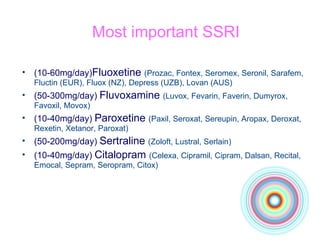
Most important SSRI (10-60mg/day) Fluoxetine   (Prozac, Fontex, Seromex, Seronil, Sarafem, Fluctin (EUR), Fluox (NZ), Depress (UZB), Lovan (AUS) (50-300mg/day)  Fluvoxamine   (Luvox, Fevarin, Faverin, Dumyrox, Favoxil, Movox) (10-40mg/day)  Paroxetine   (Paxil, Seroxat, Sereupin, Aropax, Deroxat, Rexetin, Xetanor, Paroxat) (50-200mg/day)  Sertraline   (Zoloft, Lustral, Serlain) (10-40mg/day)  Citalopram   (Celexa, Cipramil, Cipram, Dalsan, Recital, Emocal, Sepram, Seropram, Citox)
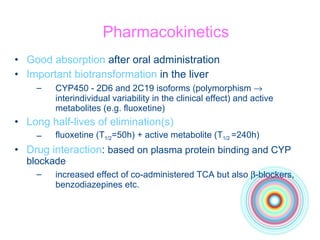
Pharmacokinetics Good absorption  after oral administration Important biotransformation  in the liver CYP450 - 2D6 and 2C19 isoforms (polymorphism    interindividual variability in the clinical effect) and active metabolites (e.g. fluoxetine) Long half-lives of elimination(s) fluoxetine (T 1/2 =50h) + active metabolite (T 1/2  =240h) Drug interaction :  based on plasma protein binding and CYP blockade increased effect of co-administered TCA but also   -blockers, benzodiazepines etc.
 
Adverse effects Relative improvement to other antidepressants  (mostly mild) Less Cardiotoxic compared to TCA Generally, much safer in overdose Lack anticholinergic effects and are not Sedating GIT   – nausea, vomiting, diarrhea Neuropsychiatry  – Headache, Irritability, Restless (Akathisia)-EPS more common in SSRI than TCA, Agitation, Tremor, Insomnia and daytime somnolence, Seizures Mania  Sexual dysfunctions  – Ejaculatory delay, anorgasmia Suicidal Behavior Serotonin syndrome  upon  intoxication  or drug interactions
Serotonin Syndrome SSRIs are contraindicated with concomitant use of MAOIs ( monoamine oxidase inhibitors ). This can lead to increased serotonin levels which could cause a  serotonin syndrome . CF:- NEURO: Myoclonus, Nystagmus, Headache, Tremors, Rigidity, Seizures MENTAL STATE: Irritability, Confusions, Agitations, Hypomania, Coma OTHERS: Hyperpyrexia, sweating, diarrhea, cardiac arrythmia, death
SSRI discontinuation syndrome not as significant as  benzodiazepines little to no abuse potential Withdrawal symptoms: common descriptions include dizziness, electric shock-like sensations, sweating, nausea, insomnia, tremor, confusion, and vertigo
THANK YOU

Antidepressants Tca Ssri

  • 1.
    ANTIDEPRESSANTS Tricyclic Antidepressants Selective Seratonin Reuptake Inhibitors
  • 2.
    Definitions Affective disorders - mental illnesses characterized by pathological changes in mood (not thought – compare with schizophrenia) Unipolar disorders Depression – pathologically depressed mood (life time prevalence up to 17%) Mania – excessive elation and accelerated psychomotoric activity (rare) Bipolar disorder (manic-depressive illness) – „cycling mood“ = severe highs (mania, event. hypomania) and lows (major depressive episodes) prevalence 1-5%, life-time illness, stronger genetic background
  • 3.
    Depression common mentaldisorder that presents with depressed mood, loss of interest or pleasure, feelings of guilt or low self-worth, disturbed sleep or appetite, low energy, and poor concentration (WHO def.) Major Depressive Episode Criteria/Core symptoms Five (or more) of the following symptoms have been present during the same 2-week period and represent a change from previous functioning; at least one of the symptoms is either (1) depressed mood or (2) loss of interest or pleasure . depressed mood most of the day … markedly diminished interest or pleasure significant weight loss /gain insomnia or hypersomnia psychomotor agitation or retardation , fatigue or loss of energy feelings of worthlessness or excessive or inappropriate guilt diminished ability to think or concentrate, or indecisiveness recurrent thoughts of death or suicidal ideation without a specific plan or a suicide attempt (!)
  • 4.
    Neurobiological theory ofdepression Monoamine (catecholamine) theory (1965) = the underlying biological or neuroanatomical basis for depression is a deficiency of central noradrenergic and/or serotonergic transmission in the CNS Supported by: pharmacological effect of antidepressants (TCA, MAO I ) In the past , medication of hypertension with reserpine induced depression Contradiction : several drugs (e.g. cocaine) increase the amount of these neurotransmitters in the CNS but are unable to treat depression the effect of antidepressants on neurotransmitter levels is relatively quick but onset of antidepressant action is significantly delayed „ Receptor theory“ = the problem is in up-regulation of post-synaptic receptors and alterations in their sensitivity The antidepressant treatment increases the amount of monoamines in CNS and thereby gradually normalize the density/sensitivity of their receptors The precise pathophysiology of depression remains unsolved
  • 5.
    Therapy of depressionPharmacotherapy/Mood Elevators Tricyclic antidepressants (TCA) Monoamine oxidase inhibitors (MAOI) Selective Serotonin Re-uptake Inhibitors (SSRI) Other and atypical antidepressant Serotonin-2 Antagonists/Reuptake Inhibitors (SARI) Serotonin and Noradrenaline Reuptake Inhibitors (SNRI) Noradrenaline and Dopamine Reuptake Inhibitors (NDRI) Noradrenaline Reuptake Inhibitors (NaRI) Noradrenergic/Specific Serotonergic Antidepressants (NaSSA) Duration of treatment – 6 months after recovery (1st epizode), may be even life-long treatment in recurrent depression Non-pharmacological treatment Psychotherapy Light therapy Electroconvulsive therapy (ECT)
  • 6.
  • 7.
    Chemical structure withcharacteristic three - ring nucleus – lipophilic nature Originally developed as antipsychotic s (1949), but were found to have no effect in this indication. Principal mechanism of action : blockade of re-uptake of monoamine neurotransmitters noradrenaline (NA) and serotonin (5-HT) by competition for binding site of the carrier protein . 5HT and NA neurotransmission is similarly affected but the effect on the dopamine system is much less important (compare with cocaine) in most TCA , other receptors (incl. those outside the CNS) are also affected: blockade of H1-receptor,  -receptors, M-receptors I. Tricyclic Antidepressants (TCAs) imipramine
  • 8.
    Mode of actionBlock reuptake of NE,Serotonin and Dopamine at nerve terminal,thus increasing the NE,5HT or DA at the extracellular and more of its action on at receptor site. Down regulation of Beta-adregernic receptors in most TCA , other receptors (incl. those outside the CNS) are also affected: blockade of H1-receptor,  -receptors, M-receptors
  • 9.
  • 10.
    Pharmacological action CNS-moodelevation in depress patient,can cause ataxia,epilepsy,seizures and coma. CVS-orthostatic hypotension ANS-anticholinergic effects.Most potent anticholinergic action
  • 11.
    Classification A. Tertiary Amines : Amitriptyline, Butriptyline, Clomipramine, Dosulepin, Doxepin, Imipramine, Lofepramine, Trimipramine B. Secondary Amines : Desipramine, Nortriptyline, Protriptyline C. Others/Dibenzodiazepine derivitive : Dibenzepin
  • 12.
    Classification A. NAand 5HT reuptake inhibitors Imipramine,Amitryptaline,Clomipramine B. Predominantly NA reuptake inhibitor Desipramine,Nortriptyline,Amoxapine
  • 13.
    Most important TCAsimipramine desimipramine demethylated form, the active metabolite of imipramine amitriptyline nortriptyline demethylated form, the active metabolite of amitriptyline) Clinical use and efficacy is relatively close within the group the more significant difference is in their adverse effects
  • 14.
    INDICATIONS Clinical depressionNeuropathic pain-Diabetic neuropathy/Analgesia ADHD Nocturnal Enuresis (Imipramine) Panic disorder(Imipramine) OCD(Clomipramine) Others like eating disorder,narcolepsy
  • 15.
    Agranulocytosis Severe liverdamage Glaucoma Prostatic hyperplasia Epilepsy lactation Contraindication
  • 16.
    Pharmacokinetics Administered orally – rapid absorption, however extensive first pass effect  low and inconsistent BAV Strong binding to plasma proteins (90-95% bound). They are also bound in tissues + wide distribution (high lipophilicity) = large distribution volumes (ineffectiveness of dialysis in acute intoxications). Biotransformation – in the liver ( CYP450 , N-demethylation and tricyclic ring hydroxylation) – most of these metabolites are active! CYP450 polymorphisms ! Glucuronidation  inactive metabolites excreted in the urine. Elimination half-lives - generally LONG ( T1/2 =10-80h). Elderly patients – even longer T1/2, risk of accumulation.
  • 17.
    Drug interaction Tricyclicinteraction includes additive depression of the CNS with other antidepressents include ethanol, barbiturates, benzodiazipines, and opioids. Tricyclic may also cause reversal of the anti-hypertensive action of guanethidine by blocking its transport into sympathetic nerve endings. Less commonly, tricyclics may interfere with the anti-hypertensive actions of methylnorepinephrine( the active metabolite of methyldopa) and clonidine. Tricyclics also share metabolic pathways with phenytoin, hence it may increase concentrations of phenytoin. Tricyclics also potentiate the pressor effects of adrenaline and noradrenaline, so that there is a potantial hazard when a local anaesthetic is used with a pressor amine.
  • 18.
    Drug Dose Ittakes about 2-3 weeks before tricyclic antidepressents has any evident action on depression( although sleep and agitation may respond earlier). Hence, it is useless to give it as per needed only.They must be administred regularly in sufficient doses to achieve the desired effect. After remission of symptoms, it is essential to continue the anti-depressents for 6-12 months in the 1 st episode and longer duration in subsequent episodes to prevent reccurence of symptoms. A drug, e.g. imipramine is given in sufficient doses(100-300 mg) for 6 weeks, can it be called as ineffective for a particular patient.
  • 19.
    When starting thedrug start with a low dose and gradually increase it to prevent the side-effects. When stopping the drug, taper the dose over 2-3 weeks period. As if you were to stop it abruptly, it will cause withdrawal symptoms such as: -Nausea -Tremor -Headache -Insomnia
  • 20.
    Adverse Effects PharmacologicalAction Adverse Effect Muscarinic receptor Blockage/ Anticholinergic Dry mouth, tachycardia, blurred vision, glaucoma Constipation, Urinary retention, Sexual dysfunction Cognitive impairement ᾴ1 Adrenoceptor blockade Drowsiness, Postural Hypotension, Sexual dysfunction (loss of libido, impaired erection) Cognitive Impairement Histamine H1 receptor Blockade Drowsiness, Weight Gain Membrane stabilizing properties Cardiac conduction defects, Cardiac arrythmia, Seizures Others Rash, Oedema, Leukopenia, Elevated liver enzymes
  • 21.
    Teratogenic effects Havenot been proved but it should be used cautiously in the first trimester of pregnancy.
  • 22.
    Toxic Effects CVS: Ventricular fibrillation, Conduction disturbances, Low BP, --- ecg shows prolong PR and QT intervals, depressed ST, flattened T waves. Heartblock occasionally RS : Respiratory depression -> Hypoxia, Aspiration pneumonia CNS : Agitation, twitching, convulsions, hallucinations, delerium, coma. Parasympathetic dry mouth, dilated pupil, blurred vision, urine retention, pyrexia
  • 23.
    Management of toxicitySupportive care Cardiac monitoring---if arrythmia, ICU Plasma level monitoring: Shudn go above 450ng/ml or 300ng/ml if concomitant medical disorder TCA has delayed gastric emptyin, do gastric lavage if several hours after overdose Activated Charcoal 1gm/kg PO/NG
  • 24.
    Newer Drugs Lofepramine-Has strong anti-cholinergic side-effect than amitriptyline and is less sedating; however, it may cause anxiety and insomnia.In overdose it is also less toxic than conventional tricyclics. Trazodone -Also has few anti-cholinergic side effects, but has strong sedating properties.
  • 25.
  • 26.
    II. SelectiveSerotonin Re-uptake Inhibito r s (SSRI) More modern (1 st drug fluoxetine available in 1988) and safe antidepressants Principal mechanism of action : selective inhibition of 5-HT (sero to nin) reuptake  more extracellular seratonin -> More action on seratonin receptors on post synaptic -> more stimulation Other indications of SSRI - anxiety disorders : generalized anxiety, panic disorder, social anxiety disorder, obsessive-compulsive disorder + bulimia nervosa, gambling
  • 27.
  • 28.
    Most important SSRI(10-60mg/day) Fluoxetine (Prozac, Fontex, Seromex, Seronil, Sarafem, Fluctin (EUR), Fluox (NZ), Depress (UZB), Lovan (AUS) (50-300mg/day) Fluvoxamine (Luvox, Fevarin, Faverin, Dumyrox, Favoxil, Movox) (10-40mg/day) Paroxetine (Paxil, Seroxat, Sereupin, Aropax, Deroxat, Rexetin, Xetanor, Paroxat) (50-200mg/day) Sertraline (Zoloft, Lustral, Serlain) (10-40mg/day) Citalopram (Celexa, Cipramil, Cipram, Dalsan, Recital, Emocal, Sepram, Seropram, Citox)
  • 29.
    Pharmacokinetics Good absorption after oral administration Important biotransformation in the liver CYP450 - 2D6 and 2C19 isoforms (polymorphism  interindividual variability in the clinical effect) and active metabolites (e.g. fluoxetine) Long half-lives of elimination(s) fluoxetine (T 1/2 =50h) + active metabolite (T 1/2 =240h) Drug interaction : based on plasma protein binding and CYP blockade increased effect of co-administered TCA but also  -blockers, benzodiazepines etc.
  • 30.
  • 31.
    Adverse effects Relativeimprovement to other antidepressants (mostly mild) Less Cardiotoxic compared to TCA Generally, much safer in overdose Lack anticholinergic effects and are not Sedating GIT – nausea, vomiting, diarrhea Neuropsychiatry – Headache, Irritability, Restless (Akathisia)-EPS more common in SSRI than TCA, Agitation, Tremor, Insomnia and daytime somnolence, Seizures Mania Sexual dysfunctions – Ejaculatory delay, anorgasmia Suicidal Behavior Serotonin syndrome upon intoxication or drug interactions
  • 32.
    Serotonin Syndrome SSRIsare contraindicated with concomitant use of MAOIs ( monoamine oxidase inhibitors ). This can lead to increased serotonin levels which could cause a serotonin syndrome . CF:- NEURO: Myoclonus, Nystagmus, Headache, Tremors, Rigidity, Seizures MENTAL STATE: Irritability, Confusions, Agitations, Hypomania, Coma OTHERS: Hyperpyrexia, sweating, diarrhea, cardiac arrythmia, death
  • 33.
    SSRI discontinuation syndromenot as significant as benzodiazepines little to no abuse potential Withdrawal symptoms: common descriptions include dizziness, electric shock-like sensations, sweating, nausea, insomnia, tremor, confusion, and vertigo
  • 34.