Teaching English to Young Children

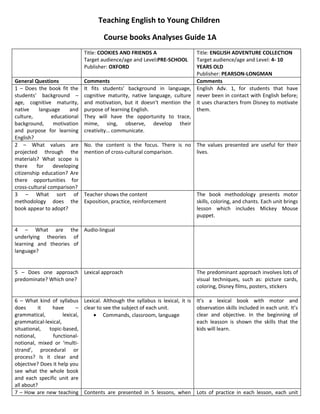
                                      Course books Analyses Guide 1A
                              Title: COOKIES AND FRIENDS A                 Title: ENGLISH ADVENTURE COLLECTION
                              Target audience/age and Level:PRE-SCHOOL     Target audience/age and Level: 4- 10
                              Publisher: OXFORD                            YEARS OLD
                                                                           Publisher: PEARSON-LONGMAN
General Questions             Comments                                     Comments
1 – Does the book fit the     It fits students’ background in language, English Adv. 1, for students that have
students’ background –        cognitive maturity, native language, culture never been in contact with English before;
age, cognitive maturity,      and motivation, but it doesn’t mention the it uses characters from Disney to motivate
native     language    and    purpose of learning English.                 them.
culture,        educational   They will have the opportunity to trace,
background,      motivation   mime, sing, observe, develop their
and purpose for learning      creativity… communicate.
English?
2 – What values are           No. the content is the focus. There is no The values presented are useful for their
projected through the         mention of cross-cultural comparison.     lives.
materials? What scope is
there     for    developing
citizenship education? Are
there opportunities for
cross-cultural comparison?
3 – What sort of              Teacher shows the content                      The book methodology presents motor
methodology does the          Exposition, practice, reinforcement            skills, coloring, and chants. Each unit brings
book appear to adopt?                                                        lesson which includes Mickey Mouse
                                                                             puppet.

4 – What are the Audio-lingual
underlying theories of
learning and theories of
language?


5 – Does one approach Lexical approach                                       The predominant approach involves lots of
predominate? Which one?                                                      visual techniques, such as: picture cards,
                                                                             coloring, Disney films, posters, stickers

6 – What kind of syllabus Lexical. Although the syllabus is lexical, it is   It’s a lexical book with motor and
does      it   have        – clear to see the subject of each unit.          observation skills included in each unit. It’s
grammatical,         lexical,    • Commands, classroom, language             clear and objective. In the beginning of
grammatical-lexical,                                                         each leasson is shown the skills that the
situational,  topic-based,                                                   kids will learn.
notional,       functional-
notional, mixed or ‘multi-
strand’, procedural or
process? Is it clear and
objective? Does it help you
see what the whole book
and each specific unit are
all about?
7 – How are new teaching Contents are presented in 5 lessons, when           Lots of practice in each lesson, each unit
points      graded?      How       the unit changes, there is a new content and words with around five words and repeats
frequently       are      they     the review of the previous one.              some words from previous lessons.
introduced and how much
practice material separates
them?
8 – How is the new                 It’s presented with flashcards, movements, Usually with songs, the new items are
language presented? How            puppets.                                   always related to the previous one.
is the meaning of items
conveyed? Are new items
related to what has been
learned previously?
9 – How much new                                                               Yes, it is appropriate for them.
language is printed in each
unit? Is the rate at which
new material is introduced
appropriate       for    your
pupils?
10 – Is the organization of                                                      It is cyclical. It is a good way for them
the course linear or cyclical?                                                   to memorize what have been taught.
Linear – teaching points are
added one at a time, each
being practiced before
moving on to the next.
Cyclical – a particular
teaching point recurs in a
different context to be
enlarged on throughout the
course. What are the
implications of this to young
learners?
11 – What kind of practice                                                       Listening, puppets, drawings, visual.
activities are there? Is there                                                   Yes, there is a variety of activities.
a variety from controlled to                                                     Yes, for all the questions.
freer practice? Is there a
balance? Is there a balance
between        fluency      and
accuracy?         Are      they
motivating and meaningful?
Do         they         provide
opportunities       for     real
language          use       and
possibilities for interaction?
Is the active participation of
students           encouraged
effectively?
12 – Does the course                                                             The dvd shows a lot of examples.
include any examples of
authentic language and
materials?
13 – Are there any special                                                       There isn’t a special page for it. During
pages for revision, self-                                                        the lessons is made a review with the
testing, self-assessment or                                                      words that were seen before.
reference?
14 – Are opportunities for       The independent work is done when
independent work provided        the kids are coloring.
such as through project
work?
15 – Are learning strategies     Yes
developed in a systematic
and explicit way? Does the
book encourage learners to
develop them and become
independent             and
autonomous learners?
16 – Can young learners          Yes
handle the book easily?
(What is the size of the
book? Is it appropriate for
young learners?)


17 – What are the                Yes very attractive.
illustrations and layout like?
Are they comfortable or
busy? Are they attractive?
Are they useful or only
decorative? Will your pupils
like them?
18 – How is each unit titled?
Will it be clear to your
pupils what they are
expected to learn in the unit
and what they have to do?
19 – Are the topics, tasks, .
activities, techniques varied
so as to provide for
different learner levels,
learning styles, interests,
different intelligences?
20 – Does the book contain
songs, rhymes, and nursery
rhymes, action stories with
drama, hands-on activities,
crafts, play and games
which       enthrall    young
learners?
21 – What components
does the course offer the
teacher and the students:
books, tests, cassettes, CDs,
DVDs, CD-ROMs, videos,
flashcards,           posters,
puppets, stickers, readers,
portfolios,            games,
workbooks, story books,
Internet sites? Are they
useful?
22 – Is the teacher’s guide
easy to follow? Does it
contain interleaved pages
from the pupil’s book? Is
the guidance adequate for
the teacher? Is it useful? Or
does it take the teacher too
long to prepare lessons?
Does it offer methodological
guidance? Does it provide
the teacher with alternative
and           supplementary
exercises?
23 – Can you spot any
notable omissions? Will you
have to supplement the
coursebook in any way?

24 – How are the different
skills treated? Are they
integrated?


25 – How much receptive
language    are students
exposed to?


26 – What kind of listening
activities are there? Listen
and do, listen and repeat,
comprehension questions,
interactive activities?
27 – Are there reading and
writing activities? Are they
suitable for young learners?

28 – Are there speaking
activities?  Are      they
meaningful and fun? Are
they too demanding? What
kind of speaking activities
are there?
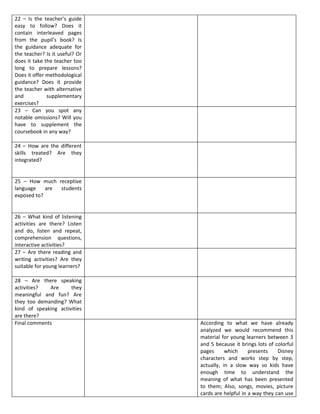
Final comments                  According to what we have already
                                analyzed we would recommend this
                                material for young learners between 3
                                and 5 because it brings lots of colorful
                                pages      which     presents    Disney
                                characters and works step by step,
                                actually, in a slow way so kids have
                                enough time to understand the
                                meaning of what has been presented
                                to them; Also, songs, movies, picture
                                cards are helpful in a way they can use
the listening, visual, speaking.

Course Books Analyses 1a

  • 1.
    Teaching English toYoung Children Course books Analyses Guide 1A Title: COOKIES AND FRIENDS A Title: ENGLISH ADVENTURE COLLECTION Target audience/age and Level:PRE-SCHOOL Target audience/age and Level: 4- 10 Publisher: OXFORD YEARS OLD Publisher: PEARSON-LONGMAN General Questions Comments Comments 1 – Does the book fit the It fits students’ background in language, English Adv. 1, for students that have students’ background – cognitive maturity, native language, culture never been in contact with English before; age, cognitive maturity, and motivation, but it doesn’t mention the it uses characters from Disney to motivate native language and purpose of learning English. them. culture, educational They will have the opportunity to trace, background, motivation mime, sing, observe, develop their and purpose for learning creativity… communicate. English? 2 – What values are No. the content is the focus. There is no The values presented are useful for their projected through the mention of cross-cultural comparison. lives. materials? What scope is there for developing citizenship education? Are there opportunities for cross-cultural comparison? 3 – What sort of Teacher shows the content The book methodology presents motor methodology does the Exposition, practice, reinforcement skills, coloring, and chants. Each unit brings book appear to adopt? lesson which includes Mickey Mouse puppet. 4 – What are the Audio-lingual underlying theories of learning and theories of language? 5 – Does one approach Lexical approach The predominant approach involves lots of predominate? Which one? visual techniques, such as: picture cards, coloring, Disney films, posters, stickers 6 – What kind of syllabus Lexical. Although the syllabus is lexical, it is It’s a lexical book with motor and does it have – clear to see the subject of each unit. observation skills included in each unit. It’s grammatical, lexical, • Commands, classroom, language clear and objective. In the beginning of grammatical-lexical, each leasson is shown the skills that the situational, topic-based, kids will learn. notional, functional- notional, mixed or ‘multi- strand’, procedural or process? Is it clear and objective? Does it help you see what the whole book and each specific unit are all about? 7 – How are new teaching Contents are presented in 5 lessons, when Lots of practice in each lesson, each unit
  • 2.
    points graded? How the unit changes, there is a new content and words with around five words and repeats frequently are they the review of the previous one. some words from previous lessons. introduced and how much practice material separates them? 8 – How is the new It’s presented with flashcards, movements, Usually with songs, the new items are language presented? How puppets. always related to the previous one. is the meaning of items conveyed? Are new items related to what has been learned previously? 9 – How much new Yes, it is appropriate for them. language is printed in each unit? Is the rate at which new material is introduced appropriate for your pupils? 10 – Is the organization of It is cyclical. It is a good way for them the course linear or cyclical? to memorize what have been taught. Linear – teaching points are added one at a time, each being practiced before moving on to the next. Cyclical – a particular teaching point recurs in a different context to be enlarged on throughout the course. What are the implications of this to young learners? 11 – What kind of practice Listening, puppets, drawings, visual. activities are there? Is there Yes, there is a variety of activities. a variety from controlled to Yes, for all the questions. freer practice? Is there a balance? Is there a balance between fluency and accuracy? Are they motivating and meaningful? Do they provide opportunities for real language use and possibilities for interaction? Is the active participation of students encouraged effectively? 12 – Does the course The dvd shows a lot of examples. include any examples of authentic language and materials? 13 – Are there any special There isn’t a special page for it. During pages for revision, self- the lessons is made a review with the testing, self-assessment or words that were seen before. reference?
  • 3.
    14 – Areopportunities for The independent work is done when independent work provided the kids are coloring. such as through project work? 15 – Are learning strategies Yes developed in a systematic and explicit way? Does the book encourage learners to develop them and become independent and autonomous learners? 16 – Can young learners Yes handle the book easily? (What is the size of the book? Is it appropriate for young learners?) 17 – What are the Yes very attractive. illustrations and layout like? Are they comfortable or busy? Are they attractive? Are they useful or only decorative? Will your pupils like them? 18 – How is each unit titled? Will it be clear to your pupils what they are expected to learn in the unit and what they have to do? 19 – Are the topics, tasks, . activities, techniques varied so as to provide for different learner levels, learning styles, interests, different intelligences? 20 – Does the book contain songs, rhymes, and nursery rhymes, action stories with drama, hands-on activities, crafts, play and games which enthrall young learners? 21 – What components does the course offer the teacher and the students: books, tests, cassettes, CDs, DVDs, CD-ROMs, videos, flashcards, posters, puppets, stickers, readers, portfolios, games, workbooks, story books, Internet sites? Are they useful?
  • 4.
    22 – Isthe teacher’s guide easy to follow? Does it contain interleaved pages from the pupil’s book? Is the guidance adequate for the teacher? Is it useful? Or does it take the teacher too long to prepare lessons? Does it offer methodological guidance? Does it provide the teacher with alternative and supplementary exercises? 23 – Can you spot any notable omissions? Will you have to supplement the coursebook in any way? 24 – How are the different skills treated? Are they integrated? 25 – How much receptive language are students exposed to? 26 – What kind of listening activities are there? Listen and do, listen and repeat, comprehension questions, interactive activities? 27 – Are there reading and writing activities? Are they suitable for young learners? 28 – Are there speaking activities? Are they meaningful and fun? Are they too demanding? What kind of speaking activities are there? Final comments According to what we have already analyzed we would recommend this material for young learners between 3 and 5 because it brings lots of colorful pages which presents Disney characters and works step by step, actually, in a slow way so kids have enough time to understand the meaning of what has been presented to them; Also, songs, movies, picture cards are helpful in a way they can use
  • 5.