THE YOUNG
LANGUAGE
LEARNER
CHARACTERISTICS OF THE
YOUNG LANGUAGE LEARNER
There is a big difference
between children of five and
children of ten can do
FIVE TO SEVEN YEAR
OLDS
EIGHT TO TEN YEAR
OLDS
Young children sometimes have difficulty in
knowing what is fact and what is fiction
Children do not always ask
The physical world is dominant at all times
Young children cannot decided for themselves
what to learn
Children are very self-centred and they cannot see
things from someone else´s point of view
They can tell the difference between fact and fiction
They ask questions all the time
They rely on the spoken word as well as the physical world to
convey and understand meaning
They are able to make some decisions about their own learning
They are able to work with others and learn from others
WHAT THIS MEANS FOR OUR TEACHING
Words are not
enough
Play with the
language
Language as
language
Variety in the
classroom
you will need to
have plenty of
objects and
pictures to work
with
Make up
rhymes, sing
songs, tell
stories.
Experiment with
words and
sounds
The spoken
word is often
accompanied by
other clues to
meaning (
facial
expressions,
movement)
You need lots of
variety of
activity, pace,
organisation,
voice to catch
the children´s
attention
WHAT THIS MEANS FOR OUR
TEACHING
Routines
Cooperation not
competition
Grammar Assessment
Use familiar
situations,
activities.
Repeat stories,
rhymes, etc.
Make room for
shared
experiences and
create an
atmosphere of
involvement and
togetherness
The best time to
introduce some
sort of simple
grammar is
when a pupil ask
for an
explanation
(explain in
simple terms)
It is always useful
for the teacher to
make regular
notes about each
child´s progress
and you should be
talking to the
children regularly
about their work
and encouraging
self-assessment
CLASS MANAGEMENT
AND ATMOSPHERE
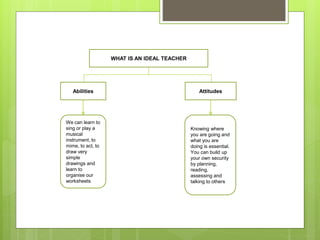
WHAT IS AN IDEAL TEACHER
Abilities Attitudes
We can learn to
sing or play a
musical
instrument, to
mime, to act, to
draw very
simple
drawings and
learn to
organise our
worksheets
Knowing where
you are going and
what you are
doing is essential.
You can build up
your own security
by planning,
reading,
assessing and
talking to others
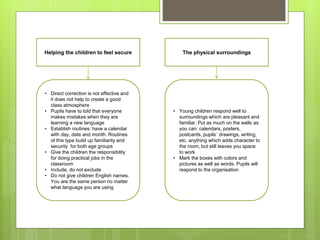
Helping the children to feel secure The physical surroundings
• Direct correction is not effective and
it does not help to create a good
class atmosphere
• Pupils have to told that everyone
makes mistakes when they are
learning a new language
• Establish routines: have a calendar
with day, date and month. Routines
of this type build up familiarity and
security for both age groups
• Give the children the responsibility
for doing practical jobs in the
classroom
• Include, do not exclude
• Do not give children English names.
You are the same person no matter
what language you are using
• Young children respond well to
surroundings which are pleasant and
familiar. Put as much on the walls as
you can: calendars, posters,
postcards, pupils´ drawings, writing,
etc. anything which adds character to
the room, but still leaves you space
to work
• Mark the boxes with colors and
pictures as well as words. Pupils will
respond to the organisation
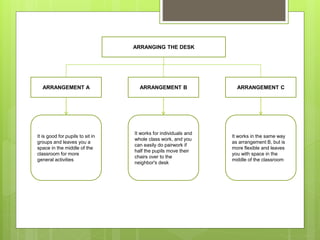
ARRANGING THE DESK
ARRANGEMENT A ARRANGEMENT B ARRANGEMENT C
It is good for pupils to sit in
groups and leaves you a
space in the middle of the
classroom for more
general activities
It works for individuals and
whole class work, and you
can easily do pairwork if
half the pupils move their
chairs over to the
neighbor's desk
It works in the same way
as arrangement B, but is
more flexible and leaves
you with space in the
middle of the classroom
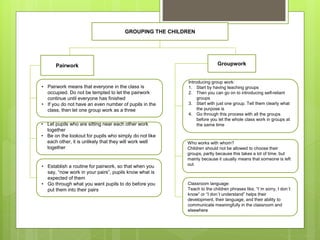
GROUPING THE CHILDREN
Pairwork Groupwork
• Pairwork means that everyone in the class is
occupied. Do not be tempted to let the pairwork
continue until everyone has finished
• If you do not have an even number of pupils in the
class, then let one group work as a three
• Let pupils who are sitting near each other work
together
• Be on the lookout for pupils who simply do not like
each other, it is unlikely that they will work well
together
• Establish a routine for pairwork, so that when you
say, “now work in your pairs”, pupils know what is
expected of them
• Go through what you want pupils to do before you
put them into their pairs
Introducing group work:
1. Start by having teaching groups
2. Then you can go on to introducing self-reliant
groups
3. Start with just one group. Tell them clearly what
the purpose is
4. Go through this process with all the groups
before you let the whole class work in groups at
the same time
Who works with whom?
Children should not be allowed to choose their
groups, partly because this takes a lot of time, but
mainly because it usually means that someone is left
out
Classroom language:
Teach to the children phrases like, “I´m sorry, I don´t
know” or “I don´t understand” helps their
development, their language, and their ability to
communicate meaningfully in the classroom and
elsewhere
THANK YOU!!

The young language learner

  • 1.
  • 2.
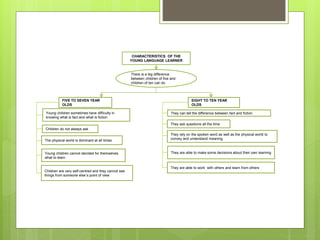
    CHARACTERISTICS OF THE YOUNGLANGUAGE LEARNER There is a big difference between children of five and children of ten can do FIVE TO SEVEN YEAR OLDS EIGHT TO TEN YEAR OLDS Young children sometimes have difficulty in knowing what is fact and what is fiction Children do not always ask The physical world is dominant at all times Young children cannot decided for themselves what to learn Children are very self-centred and they cannot see things from someone else´s point of view They can tell the difference between fact and fiction They ask questions all the time They rely on the spoken word as well as the physical world to convey and understand meaning They are able to make some decisions about their own learning They are able to work with others and learn from others
  • 3.
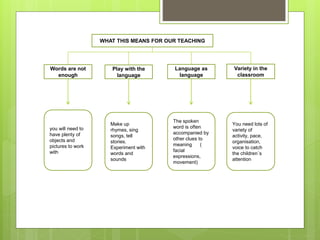
    WHAT THIS MEANSFOR OUR TEACHING Words are not enough Play with the language Language as language Variety in the classroom you will need to have plenty of objects and pictures to work with Make up rhymes, sing songs, tell stories. Experiment with words and sounds The spoken word is often accompanied by other clues to meaning ( facial expressions, movement) You need lots of variety of activity, pace, organisation, voice to catch the children´s attention
  • 4.
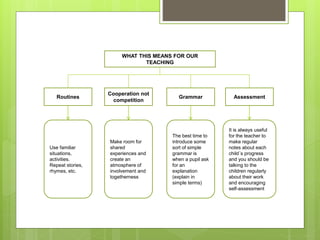
    WHAT THIS MEANSFOR OUR TEACHING Routines Cooperation not competition Grammar Assessment Use familiar situations, activities. Repeat stories, rhymes, etc. Make room for shared experiences and create an atmosphere of involvement and togetherness The best time to introduce some sort of simple grammar is when a pupil ask for an explanation (explain in simple terms) It is always useful for the teacher to make regular notes about each child´s progress and you should be talking to the children regularly about their work and encouraging self-assessment
  • 5.
  • 6.
    WHAT IS ANIDEAL TEACHER Abilities Attitudes We can learn to sing or play a musical instrument, to mime, to act, to draw very simple drawings and learn to organise our worksheets Knowing where you are going and what you are doing is essential. You can build up your own security by planning, reading, assessing and talking to others
  • 7.
    Helping the childrento feel secure The physical surroundings • Direct correction is not effective and it does not help to create a good class atmosphere • Pupils have to told that everyone makes mistakes when they are learning a new language • Establish routines: have a calendar with day, date and month. Routines of this type build up familiarity and security for both age groups • Give the children the responsibility for doing practical jobs in the classroom • Include, do not exclude • Do not give children English names. You are the same person no matter what language you are using • Young children respond well to surroundings which are pleasant and familiar. Put as much on the walls as you can: calendars, posters, postcards, pupils´ drawings, writing, etc. anything which adds character to the room, but still leaves you space to work • Mark the boxes with colors and pictures as well as words. Pupils will respond to the organisation
  • 8.
    ARRANGING THE DESK ARRANGEMENTA ARRANGEMENT B ARRANGEMENT C It is good for pupils to sit in groups and leaves you a space in the middle of the classroom for more general activities It works for individuals and whole class work, and you can easily do pairwork if half the pupils move their chairs over to the neighbor's desk It works in the same way as arrangement B, but is more flexible and leaves you with space in the middle of the classroom
  • 9.
    GROUPING THE CHILDREN PairworkGroupwork • Pairwork means that everyone in the class is occupied. Do not be tempted to let the pairwork continue until everyone has finished • If you do not have an even number of pupils in the class, then let one group work as a three • Let pupils who are sitting near each other work together • Be on the lookout for pupils who simply do not like each other, it is unlikely that they will work well together • Establish a routine for pairwork, so that when you say, “now work in your pairs”, pupils know what is expected of them • Go through what you want pupils to do before you put them into their pairs Introducing group work: 1. Start by having teaching groups 2. Then you can go on to introducing self-reliant groups 3. Start with just one group. Tell them clearly what the purpose is 4. Go through this process with all the groups before you let the whole class work in groups at the same time Who works with whom? Children should not be allowed to choose their groups, partly because this takes a lot of time, but mainly because it usually means that someone is left out Classroom language: Teach to the children phrases like, “I´m sorry, I don´t know” or “I don´t understand” helps their development, their language, and their ability to communicate meaningfully in the classroom and elsewhere
  • 10.