.
Mentorship program
By:
Dr. SWATI SHIKHA
TUTOR
Dept of PSM
Learning Objectives
 What is mentorship
 Need of mentorship program among medicos
 Objectives of this program
 Benefits
 Role of faculty as a mentor
 Proposed guidelines
 Ideal performa of records
2
Definition
3
Mentorship is defined as:
"A process whereby an experienced, highly regarded, empathetic
person (the mentor) guides another (usually younger) individual
(the mentee) in the development and re-examination of their own
ideas, learning, and personal and professional development. The
mentor, who often (but not necessarily) works in the same
organization or field as the mentee, achieves this by listening or
talking in confidence to the mentee."
Introduction
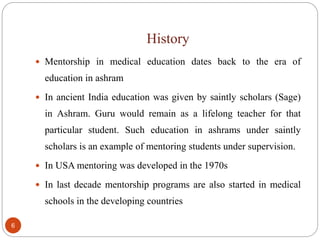
 Mentorship is a relationship in which a more experienced or more
knowledgeable person helps to guide a less experienced or less
knowledgeable person
 Mentoring is a process for the informal transmission of knowledge and
the psychosocial support perceived by the recipient as relevant to work,
career, or professional development; mentoring entails informal
communication, usually face-to-face and during a sustained period of
time, between a person who is perceived to have greater relevant
knowledge, wisdom, or experience (the mentor) and a person who is
perceived to have less"
4
5
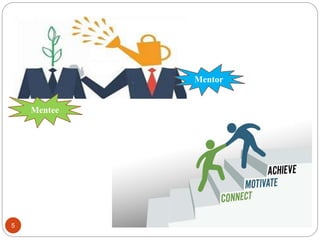
Mentee
Mentor
History
6
 Mentorship in medical education dates back to the era of
education in ashram
 In ancient India education was given by saintly scholars (Sage)
in Ashram. Guru would remain as a lifelong teacher for that
particular student. Such education in ashrams under saintly
scholars is an example of mentoring students under supervision.
 In USA mentoring was developed in the 1970s
 In last decade mentorship programs are also started in medical
schools in the developing countries
Changing Scenario of Mentorship in India
7
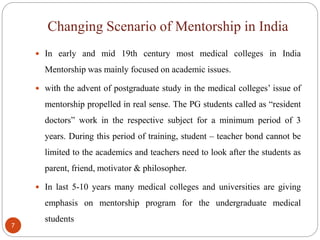
 In early and mid 19th century most medical colleges in India
Mentorship was mainly focused on academic issues.
 with the advent of postgraduate study in the medical colleges’ issue of
mentorship propelled in real sense. The PG students called as “resident
doctors” work in the respective subject for a minimum period of 3
years. During this period of training, student – teacher bond cannot be
limited to the academics and teachers need to look after the students as
parent, friend, motivator & philosopher.
 In last 5-10 years many medical colleges and universities are giving
emphasis on mentorship program for the undergraduate medical
students
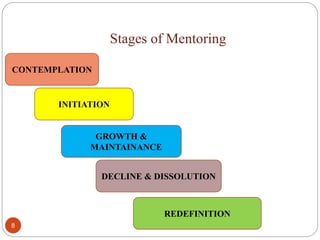
Stages of Mentoring
8
CONTEMPLATION
INITIATION
GROWTH &
MAINTAINANCE
DECLINE & DISSOLUTION
REDEFINITION
Contemplation
9
 During this stage, interested parties learn about the program
and determine whether it is a good fit. They begin to
picture themselves in the role of mentor or mentee and
decide if they want to proceed.
Initiation
10
 The initiation stage involves applying to the mentoring
program, completing screening and training and, finally,
being matched with a mentor or mentee. This first meeting
between mentor and mentee can be exciting and nerve-
wracking.
 Also called as the “courtship” or “fantasy” stage.
Growth & Maintenance
11
 The relationship develops and matures. Mentors and
mentees become more comfortable with each other
and start building a relationship based on trust.
 As the connection grows and trust is built, boundaries may
change. Both the mentor and mentee might be more open to
sharing personal information or talking about topics that are
deeper than what they discussed early in the match.
Decline & Dissolution
12
 A formal mentoring relationship ultimately comes to an end
 The goal in mentoring is for the relationship to last a minimum
amount of time, usually one year. Sometimes matches last
longer, and sometimes they end sooner than desired.
 Premature closure can happen for a variety of reasons, both
internal and external to the match.
 Regardless of when or why closure occurs, it is important for all
parties to work towards a positive and healthy closure.
Redefinition
13
 Redefinition is the final stage of any formal mentoring
relationship. This is the time where the mentor and mentee,
with the support of parents and program staff, determine
what is next for the match. There are a variety of options.
1. Complete closure
2. Continuation of the match
3. Continuing the relationship outside the program
4. Mentor – Mentee rematch
Need for Mentorship Program amongst Medicos:
• Mentorship program in medical school exist to provide support
to students and guidance that contribute to fulfilling undergraduate
medical experience. This program facilitates the students in
academic pursuits and provides them a way to cope up with the
difficulties faced in the new environment.
• Difficulty in coping up in the new environment has led to many
cases of depression among medical students in the past few years
subsequently leading to suicides in severe cases.
14
What is Depression??
Depression is defined as a common mental disorder, characterized
by sadness, loss of interest, or pleasure, feeling of guilt or low self
esteem, disturbed sleep or appetite, feeling of tiredness and poor
concentration.
 Worldwide depression is common with more than 350 million
people affected by it.
 At its worst, it can lead to suicide which kills more than 8 lakh
people every year.
 About 2.6% of Indian population are known to have depression.
 Studies from India indicate that around 40-45% of the medical
students suffer from depression
15
Causes of Depression among Medicos
 Failure to adjust in the new environment
 Academic pressure to excel
 Emotional issues
 Lack of peer group
 Occasional disciplinary issues
 Lack of support and interaction among the senior and
junior medicos
16
Objectives
 To create an environment of mutual trust between faculty and
students
 To encourage interaction among students and dissipate peer
pressure
 To help students to efficiently manage their personal issues and
interpersonal relationships
 To reduce stress and depression among medicos
17
Benefits of this programme:
To the students:
The benefits offered by this program to mentees are related to
their career development
 It enlightens their interest in research and inspires them to
improve their academic performance.
 It further helps them emotionally and reduces their stress by
improving their relationship with the mentors.
 A support system for students
 Empower the students with life skills
18
To the Mentor:
 This program provides a sense of internal satisfaction,
improves their teaching skills, and thus helps in personal
development.
To the Institution:
 The medical school community is also benefitted, as it
improves clinical care, research as well as teaching.
19
20
Role of Faculty as a Mentor:
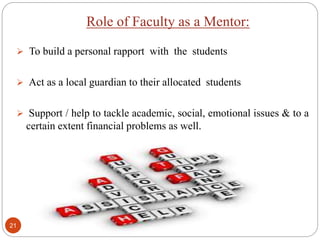
 To build a personal rapport with the students
 Act as a local guardian to their allocated students
 Support / help to tackle academic, social, emotional issues & to a
certain extent financial problems as well.
21
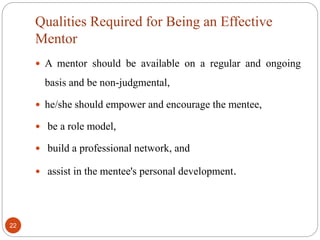
Qualities Required for Being an Effective
Mentor
22
 A mentor should be available on a regular and ongoing
basis and be non-judgmental,
 he/she should empower and encourage the mentee,
 be a role model,
 build a professional network, and
 assist in the mentee's personal development.
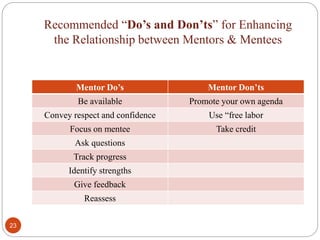
Recommended “Do’s and Don’ts” for Enhancing
the Relationship between Mentors & Mentees
23
Mentor Do’s Mentor Don’ts
Be available Promote your own agenda
Convey respect and confidence Use “free labor
Focus on mentee Take credit
Ask questions
Track progress
Identify strengths
Give feedback
Reassess
Cont…
24
Mentee do’s Mentee don’ts
Be punctual Avoid decisions
Follow through Rely exclusively on mentor
Set agendas Acquiesce
Communicate Overidealize
Accept critique
Convey respect
Accept challenge
Show appreciation
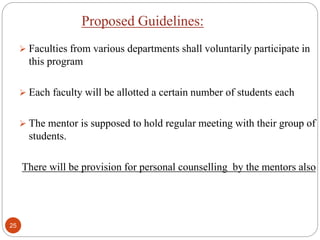
Proposed Guidelines:
 Faculties from various departments shall voluntarily participate in
this program
 Each faculty will be allotted a certain number of students each
 The mentor is supposed to hold regular meeting with their group of
students.
There will be provision for personal counselling by the mentors also
25
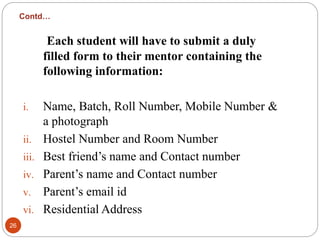
Contd…
Each student will have to submit a duly
filled form to their mentor containing the
following information:
i. Name, Batch, Roll Number, Mobile Number &
a photograph
ii. Hostel Number and Room Number
iii. Best friend’s name and Contact number
iv. Parent’s name and Contact number
v. Parent’s email id
vi. Residential Address
26
The mentor shall keep a record of their students
in terms of :
i. Class attendance.
ii. Academic performance.
iii. Social relationship and any deviant behavior
iv. A monitoring format/checklist will be made to
assess the students in a given time frame
27
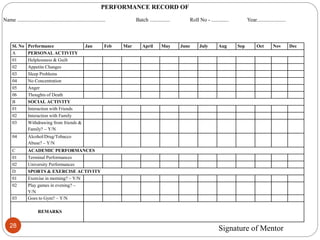
Sl. No Performance Jan Feb Mar April May June July Aug Sep Oct Nov Dec
A PERSONAL ACTIVITY
01 Helplessness & Guilt
02 Appetite Changes
03 Sleep Problems
04 No Concentration
05 Anger
06 Thoughts of Death
B SOCIAL ACTIVITY
01 Interaction with Friends
02 Interaction with Family
03 Withdrawing from friends &
Family? – Y/N
04 Alcohol/Drug/Tobacco
Abuse? – Y/N
C ACADEMIC PERFORMANCES
01 Terminal Performances
02 University Performances
D SPORTS & EXERCISE ACTIVITY
01 Exercise in morning? – Y/N
02 Play games in evening? –
Y/N
03 Goes to Gym? – Y/N
REMARKS
PERFORMANCE RECORD OF
Name .................................................................. Batch ............... Roll No - ............. Year......................
Signature of Mentor28
Guidelines cont..
 Mentors to hold meetings amongst themselves under supervision
of the Head of the institution.
(Parents may be contacted if mentor feels there is a need to do
so.)
 Mentor shall also hold meetings with the Hostel Warden to
discuss issues about a particular student.
 Mentors can create a whatsapp group with students for
convenient communication
 Mentors will keep the performance record of students which
should be kept confidential.
29
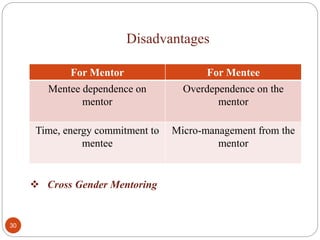
Disadvantages
30
For Mentor For Mentee
Mentee dependence on
mentor
Overdependence on the
mentor
Time, energy commitment to
mentee
Micro-management from the
mentor
 Cross Gender Mentoring
.
 Mentorship is never a judgement
 It is a form of live helpline for the
students
31
32
Thank you
Thank you
33

Mentorship program

  • 1.
    . Mentorship program By: Dr. SWATISHIKHA TUTOR Dept of PSM
  • 2.
    Learning Objectives  Whatis mentorship  Need of mentorship program among medicos  Objectives of this program  Benefits  Role of faculty as a mentor  Proposed guidelines  Ideal performa of records 2
  • 3.
    Definition 3 Mentorship is definedas: "A process whereby an experienced, highly regarded, empathetic person (the mentor) guides another (usually younger) individual (the mentee) in the development and re-examination of their own ideas, learning, and personal and professional development. The mentor, who often (but not necessarily) works in the same organization or field as the mentee, achieves this by listening or talking in confidence to the mentee."
  • 4.
    Introduction  Mentorship isa relationship in which a more experienced or more knowledgeable person helps to guide a less experienced or less knowledgeable person  Mentoring is a process for the informal transmission of knowledge and the psychosocial support perceived by the recipient as relevant to work, career, or professional development; mentoring entails informal communication, usually face-to-face and during a sustained period of time, between a person who is perceived to have greater relevant knowledge, wisdom, or experience (the mentor) and a person who is perceived to have less" 4
  • 5.
  • 6.
    History 6  Mentorship inmedical education dates back to the era of education in ashram  In ancient India education was given by saintly scholars (Sage) in Ashram. Guru would remain as a lifelong teacher for that particular student. Such education in ashrams under saintly scholars is an example of mentoring students under supervision.  In USA mentoring was developed in the 1970s  In last decade mentorship programs are also started in medical schools in the developing countries
  • 7.
    Changing Scenario ofMentorship in India 7  In early and mid 19th century most medical colleges in India Mentorship was mainly focused on academic issues.  with the advent of postgraduate study in the medical colleges’ issue of mentorship propelled in real sense. The PG students called as “resident doctors” work in the respective subject for a minimum period of 3 years. During this period of training, student – teacher bond cannot be limited to the academics and teachers need to look after the students as parent, friend, motivator & philosopher.  In last 5-10 years many medical colleges and universities are giving emphasis on mentorship program for the undergraduate medical students
  • 8.
    Stages of Mentoring 8 CONTEMPLATION INITIATION GROWTH& MAINTAINANCE DECLINE & DISSOLUTION REDEFINITION
  • 9.
    Contemplation 9  During thisstage, interested parties learn about the program and determine whether it is a good fit. They begin to picture themselves in the role of mentor or mentee and decide if they want to proceed.
  • 10.
    Initiation 10  The initiationstage involves applying to the mentoring program, completing screening and training and, finally, being matched with a mentor or mentee. This first meeting between mentor and mentee can be exciting and nerve- wracking.  Also called as the “courtship” or “fantasy” stage.
  • 11.
    Growth & Maintenance 11 The relationship develops and matures. Mentors and mentees become more comfortable with each other and start building a relationship based on trust.  As the connection grows and trust is built, boundaries may change. Both the mentor and mentee might be more open to sharing personal information or talking about topics that are deeper than what they discussed early in the match.
  • 12.
    Decline & Dissolution 12 A formal mentoring relationship ultimately comes to an end  The goal in mentoring is for the relationship to last a minimum amount of time, usually one year. Sometimes matches last longer, and sometimes they end sooner than desired.  Premature closure can happen for a variety of reasons, both internal and external to the match.  Regardless of when or why closure occurs, it is important for all parties to work towards a positive and healthy closure.
  • 13.
    Redefinition 13  Redefinition isthe final stage of any formal mentoring relationship. This is the time where the mentor and mentee, with the support of parents and program staff, determine what is next for the match. There are a variety of options. 1. Complete closure 2. Continuation of the match 3. Continuing the relationship outside the program 4. Mentor – Mentee rematch
  • 14.
    Need for MentorshipProgram amongst Medicos: • Mentorship program in medical school exist to provide support to students and guidance that contribute to fulfilling undergraduate medical experience. This program facilitates the students in academic pursuits and provides them a way to cope up with the difficulties faced in the new environment. • Difficulty in coping up in the new environment has led to many cases of depression among medical students in the past few years subsequently leading to suicides in severe cases. 14
  • 15.
    What is Depression?? Depressionis defined as a common mental disorder, characterized by sadness, loss of interest, or pleasure, feeling of guilt or low self esteem, disturbed sleep or appetite, feeling of tiredness and poor concentration.  Worldwide depression is common with more than 350 million people affected by it.  At its worst, it can lead to suicide which kills more than 8 lakh people every year.  About 2.6% of Indian population are known to have depression.  Studies from India indicate that around 40-45% of the medical students suffer from depression 15
  • 16.
    Causes of Depressionamong Medicos  Failure to adjust in the new environment  Academic pressure to excel  Emotional issues  Lack of peer group  Occasional disciplinary issues  Lack of support and interaction among the senior and junior medicos 16
  • 17.
    Objectives  To createan environment of mutual trust between faculty and students  To encourage interaction among students and dissipate peer pressure  To help students to efficiently manage their personal issues and interpersonal relationships  To reduce stress and depression among medicos 17
  • 18.
    Benefits of thisprogramme: To the students: The benefits offered by this program to mentees are related to their career development  It enlightens their interest in research and inspires them to improve their academic performance.  It further helps them emotionally and reduces their stress by improving their relationship with the mentors.  A support system for students  Empower the students with life skills 18
  • 19.
    To the Mentor: This program provides a sense of internal satisfaction, improves their teaching skills, and thus helps in personal development. To the Institution:  The medical school community is also benefitted, as it improves clinical care, research as well as teaching. 19
  • 20.
  • 21.
    Role of Facultyas a Mentor:  To build a personal rapport with the students  Act as a local guardian to their allocated students  Support / help to tackle academic, social, emotional issues & to a certain extent financial problems as well. 21
  • 22.
    Qualities Required forBeing an Effective Mentor 22  A mentor should be available on a regular and ongoing basis and be non-judgmental,  he/she should empower and encourage the mentee,  be a role model,  build a professional network, and  assist in the mentee's personal development.
  • 23.
    Recommended “Do’s andDon’ts” for Enhancing the Relationship between Mentors & Mentees 23 Mentor Do’s Mentor Don’ts Be available Promote your own agenda Convey respect and confidence Use “free labor Focus on mentee Take credit Ask questions Track progress Identify strengths Give feedback Reassess
  • 24.
    Cont… 24 Mentee do’s Menteedon’ts Be punctual Avoid decisions Follow through Rely exclusively on mentor Set agendas Acquiesce Communicate Overidealize Accept critique Convey respect Accept challenge Show appreciation
  • 25.
    Proposed Guidelines:  Facultiesfrom various departments shall voluntarily participate in this program  Each faculty will be allotted a certain number of students each  The mentor is supposed to hold regular meeting with their group of students. There will be provision for personal counselling by the mentors also 25
  • 26.
    Contd… Each student willhave to submit a duly filled form to their mentor containing the following information: i. Name, Batch, Roll Number, Mobile Number & a photograph ii. Hostel Number and Room Number iii. Best friend’s name and Contact number iv. Parent’s name and Contact number v. Parent’s email id vi. Residential Address 26
  • 27.
    The mentor shallkeep a record of their students in terms of : i. Class attendance. ii. Academic performance. iii. Social relationship and any deviant behavior iv. A monitoring format/checklist will be made to assess the students in a given time frame 27
  • 28.
    Sl. No PerformanceJan Feb Mar April May June July Aug Sep Oct Nov Dec A PERSONAL ACTIVITY 01 Helplessness & Guilt 02 Appetite Changes 03 Sleep Problems 04 No Concentration 05 Anger 06 Thoughts of Death B SOCIAL ACTIVITY 01 Interaction with Friends 02 Interaction with Family 03 Withdrawing from friends & Family? – Y/N 04 Alcohol/Drug/Tobacco Abuse? – Y/N C ACADEMIC PERFORMANCES 01 Terminal Performances 02 University Performances D SPORTS & EXERCISE ACTIVITY 01 Exercise in morning? – Y/N 02 Play games in evening? – Y/N 03 Goes to Gym? – Y/N REMARKS PERFORMANCE RECORD OF Name .................................................................. Batch ............... Roll No - ............. Year...................... Signature of Mentor28
  • 29.
    Guidelines cont..  Mentorsto hold meetings amongst themselves under supervision of the Head of the institution. (Parents may be contacted if mentor feels there is a need to do so.)  Mentor shall also hold meetings with the Hostel Warden to discuss issues about a particular student.  Mentors can create a whatsapp group with students for convenient communication  Mentors will keep the performance record of students which should be kept confidential. 29
  • 30.
    Disadvantages 30 For Mentor ForMentee Mentee dependence on mentor Overdependence on the mentor Time, energy commitment to mentee Micro-management from the mentor  Cross Gender Mentoring
  • 31.
    .  Mentorship isnever a judgement  It is a form of live helpline for the students 31
  • 32.
  • 33.