
The document provides an overview of a branding course. It discusses key concepts in branding like brand identity, image, character, culture, and soul. It also covers personal branding, corporate branding, developing brand identity, and components of an effective branding strategy. The course syllabus outlines topics that will be covered like conducting brand audits, crafting vision statements, evaluating brand visuals and language, enhancing brand touchpoints, and measuring brand performance. The goal of the course is to help students understand how to create, develop, manage and measure brand effectiveness.
Branding Course
B Y
Ad e t a y o T u n d e
The process involved in creating a unique name
and image for a product in the consumer’s mind,
mainly through advertising campaigns with a
consistent theme.
2.
BRANDING
How deeply haveyou thought about your brand?
Is it intentional, or just an afterthought? What
does each component—your logo, your website,
your service, and even your culture—say to
customers? Learn what branding really is, define
and position a brand, how it works, and how you
can build and maintain a more competitive brand,
get a framework for branding, and learn how to
develop and launch a brand and measure its
success. what distinguishes your company from
the rest, and incorporating it into every single
touch point of the business: design, messaging,
marketing and PR, and company vision.
Communicate the brand effectively internally, to
employees, and externally, via social media, PR,
advertising, packaging, and other channels,
explore best practices for researching, developing,
visualizing, and managing your brand, learn about
incorporating your brand and keeping tabs on your
brand as your company grows. measure brand
performance in categories such as authenticity,
relevance, differentiation, consistency, presence,
and understanding.
The course concludes with solid steps for
periodically reviewing the brand and its
effectiveness, especially when there are significant
changes that could impact the brand.
01
3.
COMPONENTS OF BRANDING
Theseare the factors that
constitute and influence an
efficient and successful brands
PERSONAL BRANDING
This is the type of branding that revolves
around an individual or group of
individuals with a common attribute and
disposition.
CORPORATE BRANDING
Corporate branding involves the
development of an identity for a business
or organization.
DEVELOPING AND EXPRESSING BRAND IDENT
This deals with the conception and
presentation of a brand
SYLLABUS
BRANDING
The process involved in creating a unique
name and image for a product in the
consumer’s mind, mainly through advertising
campaigns with a consistent theme.
01
02
03
04
4.
CREATING A BRANDSTRATEGY
For a brand to be successful and
delivers results, there are salient
strategies and tactics involves
CONDUCTING A BRAND AUDIT
Brand auditing is the process of
constructively evaluating a brand
identity to determine it efficiency
against the set goals and time.
CRAFTING VISION STATEMENT & SELLING PO
They selection of words and sentences
structure employed in describing and
presenting a brand’s value is as vital
as the brand itself.
EVALUATING BRAND VISUALS,, & LANGUAGE
Logos, colour, shape and language are
some of the most potent attribute of a
brand.
SYLLABUS
BRANDING
The process involved in creating a unique
name and image for a product in the
consumer’s mind, mainly through advertising
campaigns with a consistent theme.
05
06
07
08
5.
ENHANCING BRAND TOUCHPOINTS
Howto enhance communication and interactionj
between brands and their customers
MEASURING BRAND LOYALTY AND EQUITY
This is the evaluation of customers perception on
brand in terms of loyalty and equity
IDENTIFYING YOUR CORE VALUES AND DRIVE
As a business owner, how do you recognise and
develop your core value and model drivers
LINKING YOUR BUSINESS MODEL TO THE BRA
How do you intergrate a business model with the
business brand strategy?
SYLLABUS
BRANDING
The process involved in creating a unique
name and image for a product in the
consumer’s mind, mainly through advertising
campaigns with a consistent theme.
09
10
11
12
6.
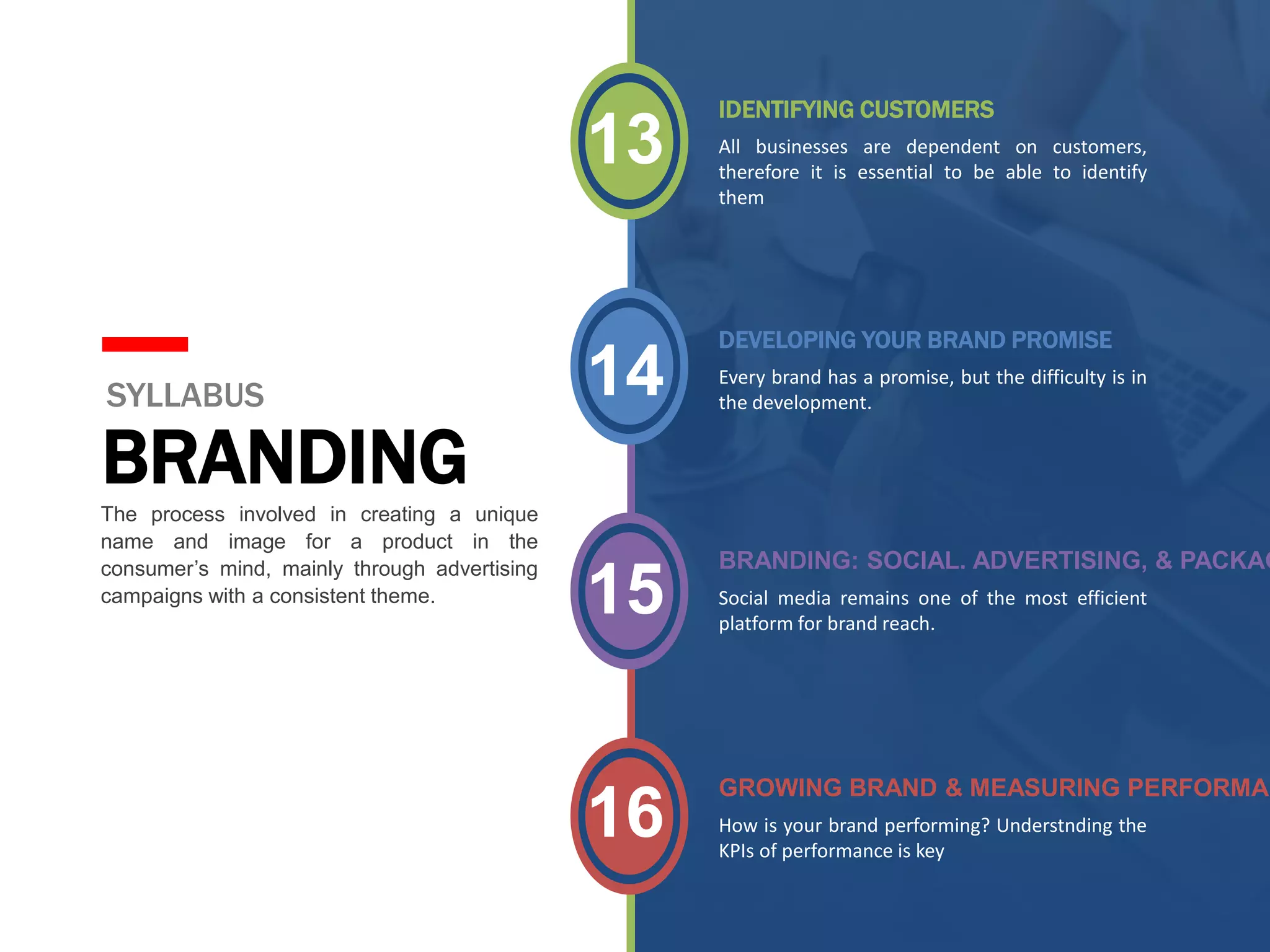
IDENTIFYING CUSTOMERS
All businessesare dependent on customers,
therefore it is essential to be able to identify
them
DEVELOPING YOUR BRAND PROMISE
Every brand has a promise, but the difficulty is in
the development.
BRANDING: SOCIAL. ADVERTISING, & PACKAG
Social media remains one of the most efficient
platform for brand reach.
GROWING BRAND & MEASURING PERFORMAN
How is your brand performing? Understnding the
KPIs of performance is key
SYLLABUS
BRANDING
The process involved in creating a unique
name and image for a product in the
consumer’s mind, mainly through advertising
campaigns with a consistent theme.
13
14
15
16
7.
COMPONENT OF BRANDING
Brandingis not just a logo or trademark. It
incorporates many components that work
together to form the destination brand
concept. Their management is part of the
brand strategy. The value of the brand is
described by the term brand equity. Brand
positioning and leveraging are branding
management approaches. The identity,
image, personality, essence or soul,
character and culture are the brand
components.
8.
BRAND IDENTITY
Is howbrand strategists
want the brand to be
perceived. It is a set of
unique brand associations
that represent what the
brand stands for. These
associations imply a
promise to customers from
organization members.
Brand identity should help
establish a relationship
between the brand and the
customer by generating a
value proposition involving
functional, emotional or
self-expressive benefits.
BRAND IMAGE
Is a key component in the
formation of a clear and
recognizable brand identity
in the market. Brand image
is related to how the brand
is currently perceived by
consumers. In other words
what is the reputation of
the brand in the
marketplace.
BRAND CHARACT
Is related to its internal
constitution, how it is
perceived in terms of
integrity, trustworthiness
and honesty. This is also
related with the promise of
the brand to deliver the
experience associated with
its name.
BRAND CULTURE
Is about the system of values that
surround a brand much like the
cultural aspects of a people or a
country. Brand personality is the set
of human characteristics that are
associated with the brand. It
includes such characteristics as
gender, age, socioeconomic class,
as well as human personality traits
BRAND SOUL
Represents the
emotional elements
and values of the
brand. Essence
should be part of a
long term positioning
that does not change
with every
communication
9.
PERSONAL BRANDING
Creating apersonal brand can be a
daunting, mythical task. And one of the
easiest ways to get lost in the process
is to not know where to start.
Even Oprah Winfrey began by going
through several style iterations on a
small local show before defining her
voice into one of the most influential
personal brands in the world. In both
our look-at-me cultural shift and
evolving job market, it’s both helpful and
necessary to stand out when applying
for a job or starting your own company.
A personal brand is for (almost)
everyone. So here are 10 golden rules
for creating an engaging, unique, and
inviting personal brand.
10.
PERSONAL BRANDING -HAVE FOCUS
“Too many people are unfocused when it comes to press and coverage, trying to be
"everything to everyone." Decide what your key message is and stick to it,” says Cooper
Harris, founder and CEO of Klickly. Her personal brand has undergone a dramatic shift—
from working actress to respected tech entrepreneur and she has handled this shift by only
focusing on one message at a time. Keeping your message focused for your target
demographic will make it that much easier to both create content around your personal
brand and have others define you. In fact, Adam Smiley Poswolsky, millennial workplace
expert and author of The Breakthrough Speaker, takes it one step further when he’s
advising speakers: “Carve a niche, and then carve a niche within your niche. The best
personal brands are very specific.” And Juan Felipe Campos, VP of tech and partner at
Manos Accelerator , goes one step further to focus on communities that he targets with his
large-scale clients. “Keep your message and content consistent to one niche topic to
become memorable within a targeted community.” The narrower and more focused your
brand is, the easier it is for people to remember who you are. And when it comes time to
hire a speaker or a new employee, your narrowed-down brand will be what they remember
11.
PERSONAL BRANDING -TELL A STORY
If your personal brand isn’t telling a story, you’ve already lost half of your potential
audience. Allen Gannett , chief strategy officer at Skyword and author of The Creative
Curve explains it best:” The most effective personal branding strategy these days is to
build a true narrative - single character monologues are boring in Tinseltown, and even
more boring for your personal brand.” No one wants to hear you shout about your brand
into the social media void, so create a story around your brand that your audience can
engage with. Allen regularly meets and chats with his audience in airports around the
world, further developing his warm and friendly personal brand. One of the best ways to
tell that story is through written content or video. For Pelpina Trip, social video strategist,
this is definitely the case. Her own video channel on LinkedIn sees some of the highest
levels of engagement across the platform. “The most personal way to communicate online
is with video. Simply use your smartphone to video message your clients, make a personal
connection with prospective clients and connect with co-workers. After all, you always
have your smartphone on you!”
12.
PERSONAL BRANDING -BE CONSISTENT
Being consistent is very similar to having a narrow focus—it’s much easier to get
recognized for one topic if you consistently create content and brand voice around it.
“Ensure that your personal brand promise stays consistent, both online and offline,”
explains Fyiona Yong , director and millennial leadership coach (ICF ACC). She regularly
works with millennials in a corporate context to help them define their more conservative
work goals. “You have to demonstrate consistency across your communication, gravitas,
and appearance. Don’t underestimate how tiny inconsistencies can derail personal brand
effectiveness.” On the opposite, creative side, CyreneQ , a top storyteller on Snapchat,
suggests “something consistent either visually or personality wise. Something unique that
people can associate with your brand and know it's you. For example, a sidekick mascot or
having a catchphrase you say after every video - something people can fall in love with.”
Her sidekick mascot, Ele, has garnered millions of views per Snap for brand work, allowing
her fun personal brand to represent big box brands like Walmart and DC. So whether
you’recreating a wild, incredibly out-there fun brand or one that’s a bit more on the
conservative, corporate side, consistency is key.
13.
PERSONAL BRANDING -BE GENIUNE
There’s an easy way to have an original personal brand—and that is to be genuine and
authentic. Millennial influencer and head of marketing at Popular Demand, Monica Lin ,
says “People can see right through a disingenuous act.” The more obviously a brand is a
copycat, the more the audience will call out the perpetrator for it. Monica's personal brand
experienced a huge amount of growth after she began engaging with her audience more
meaningfully on Twitter. "Be genuine. It will make it much easier to manage your personal
brand on a daily basis," explained William Harris, Facebook ads expert at Elumynt . Your
personal brand should be an easy daily filter that you create content and reach out to your
audience with. And finally, Justin Wu , founder of CoinState says “Be a master of your
craft, skillset or industry before starting a personal brand. Then your content will help
amplify who you are.” When initially building his personal brand, he garnered a reputation
of being an expert in his field while simultaneously amplifying on social media that same
renown. If you’re deeply skilled in one area, your reputation alone will help you build the
brand you want.
14.
PERSONAL BRANDING -CREATE A POSITIVE
IMPACT.
After you’ve developed your personal brand over a period of time, there are generally
ways to continue to build your brand – hop over others and burn bridges or steadily grow a
community around your brand. Jacob Shwirtz, head of social partnerships at WeWork,
who has worked with many of the top influencers in the world, including makeup
personality, Michelle Phan, gives us this wisdom. Keeping a positive attitude and helping
others will only help healthily grow your brand in the long run.
PERSONAL BRANDING – FOLLOW SUCCESSFUL
EXAMPLE
“People interested in personal branding need to start marketing themselves like the
celebrities and influential people that they look up to every day,“ explains Jason Wong,
CEO of Wonghaus Ventures . His own personal brand has gone viral several times, over
subjects like ice cream in Japan, inflatable pool toys and memes, earning him the title of
the “Meme King.” His success often comes from studying trends and popular individuals
on different social media platforms and then implementing them with a twist. Creatively
dissecting social analytics and establishing the next big trend can be within your grasp too,
if you pay attention across all social media platforms and not simply focus narrowly on one
of them.
15.
PERSONAL BRANDING –LIVE YOUR BRAND
As mentioned before, one of the ways you can make building a personal brand difficult on
yourself is to separate your brand from your personal life. While certainly doable, it’s easier
when initially creating a personal brand to have your actual lifestyle and brand be one and
the same. Tim Salau, community builder and founder of Mentors & Mentees , who works
with college students to help them build brands that will get them hired, believes in this
idea as well. “Your personal brand should follow you everywhere you go. It needs to be an
authentic manifestation of who you are and amplify what you believe.” With this in mind,
your personal brand is not only a reflection of a series of job functions like marketing,
finance or creative but also ideals like giving back, thoughtful leadership or mentorship.
PERSONAL BRANDING – LET OTHERS TELL
YOUR STORY
The best PR is by word of mouth. Creating a personal brand in the public sphere is no
exception to this rule. Aaron Orendorff , editor in chief at Shopify Plus, tells his personal
story through lively videos and the occasional bunny co-host or two and his audience
remembers. They’re able to recall the bright outfits and the animal friends and tie those
pieces of the story to their interpretation of his brand. As he eloquently states: "Personal
branding is the story people tell about you when you're not in the room." Jessie Maltin, co-
host of Maltin On Movies works with her father, renowned film critic Leonard Maltin and
has watched him build his career over the past several decades. “All you have in your life
is your name and the reputation you garner.”
16.
CORPORATE BRANDIN
Corporate Brandingis an act of using
the brand name of the company in the
overall advertising efforts and all the
communication to the stakeholders. It is
the intangible attitude and spirit behind
the company that gives it a
distinguishing identity in the industry and
in the minds of consumers. It is the
much broader concept as compared to
promoting the products and services of
the company.
17.
ADVANTAGE OF CORPORATEBRANDING
It provides a competitive advantage to the company whilst selling its products and
services in the market as the consumers are well aware of the company due to its
strong corporate identity and brand name. It facilitates new product launches and
is well accepted in the market due to the strong corporate legacy created with the
previous or existing line of the products and services offered by the company. It
helps the company to tap and enter new markets and locations on the domestic
and international level as the corporate entity has already created repute for itself
with the corporate branding efforts.
There is an emotional connection with the existing and prospective consumers as
it arises a feeling of brand loyalty in their minds. It makes the marketing and
promotional efforts easier as with the Corporate Branding well in place, the
consumers have the factor of trust towards the product and service offerings by
the company.
There is an increased awareness about the company and its offerings with the
consumers identifying the logo, mascots, color shades, tagline, and other brand
elements having the top-of-the-mind recall about all the expressions
18.
THE FRAMEWORK OFCORPORATE
BRANDING
As mentioned earlier, the facets of Corporate Branding are quite different from the
product branding as the latter strives hard on the selling points and generating
profits for the company whereas the former enlightens the market and the target
audience about the existence of the brand, values, fundamentals, unique selling
proposition, aim and purpose to be in the industry, and very importantly how is it
different from the other brand existing in the market.
IT starts with the management and the
key staff members together understanding
the nature of the brand, business
philosophies, long-term and short-term
objectives, and the target audience along
with the market to promote the brand and
the products and services. The next step
is deciding on the way to position the
brand in the market and in the psychology
of the consumers and that can be arrived
by understanding and finalizing that in
which category does the operations and
product range falls, is it luxury, mid-
segment or affordable and then the brand
NEXT comes in line are the vision and
mission statements of the brand that holds
quite an important place in the framework
of Corporate Branding. Then comes
working on the creative elements such as
logo, tagline, mascot, color palette, and
design templates. Many companies also
hire a brand ambassador such as a
famous sportsperson, movie star, or a
celebrity from any walk of life
complementing the nature of the brand
and its offerings.
ONCE the aforementioned points are in
place, it is the time to execute the
Corporate Branding strategies by
sponsoring and participating in various
events on the corporate level that give the
due visibility of the brand to the target
audience and carving a niche in the
market.
STEP1 STEP 2 STEP 3
19.
The technology giantfamous for
offering gadgets ranging from
mobile phones, tablets, laptops,
computer systems, televisions, and
more is not only renowned in the
USA but has made an impact all
over the globe with the products
that are high on quality, class, and
technology. Its brand logo is quite
creative and catchy and as its
target audience is niche and the
luxury segment, the design
elements are minimalistic in nature
with solid color tones having a
classy finesse. Even its print,
digital, and television
advertisements follow the same
design route with the clear visibility
of the logo.
The products of the company can
be identified even from the far sight
owing to the strong measures
The popular sports brand is quite a
hit number with not only the sports
personalities and celebrities around
the world but also with the common
man as well. Its mission statement
reads, “To bring inspiration and
innovation to every athlete in the
world. “ The co-founder once said
in its speech, “If you have a body,
you are an athlete.” Making it very
clear to the entire world that the
brand is just not confined to the
sportsmen’s but also to everyone
having a zeal for sports and fitness.
Its logo encompasses of a single
right tick with the slogan ‘Just Do It’
is quite sporty and direct in nature
ensuring quick registration and a
strong recall factor. The company
has made a strong corporate base
by sponsoring various sports and
related events.
We all know that sodas are not
very good for our health and vitality
but the beverage major Coca-Cola
is one of the most loved and
profitable brands across the world
since more than hundred years
now. Right from mineral water, fruit
drinks, aerated drinks, energy
drinks to zero-calorie drinks; it has
something or the other in store for
everyone with the cola drink being
the most famous amongst the
target audience. Its slogan is ‘Taste
the Feeling’ as it harps on the fact
that drinking coco cola gives the
feeling of freshness with the
renewed vigor and vitality. It keeps
on hiring celebrities from the
various walks of life as its brand
ambassadors to have an emotional
connection with the target audience
that is majorly young generation
NIKE COCA-COLAAPPLE
20.
BRAND IDENTITY
Branding proMarty Neumeier defines a brand identity as
“the outward expression of a brand, including its
trademark, name, communications, and visual
appearance.” To us, a brand identity is the sum total of
how your brand looks, feels, and speaks to people.
(Sometimes that even includes how it sounds, tastes,
feels, and even smells.) Ultimately, a brand identity is a
way to communicate with the world, differentiate yourself
from your competition, and create a brand experience
that encourages people to engage with you.
Some brands have elevated brand identity to an art (think
Apple , LEGO , or Levi’s ), while others have made it their
entry into the playing field (think Warby Parker or Casper
). These brand stars succeed because they know who
they are and why they exist—and they use every aspect
of their branding to make sure we know it, too. (Brands
with weak identities often struggle because they either
don’t know who they are or struggle to communicate it
well. Not sure if yours is working? Here are 9 signs it’s
not.)
If you want your brand to succeed and thrive in the
future, you need to build a brand identity that accurately
conveys your essence and is flexible enough to evolve
with you. But that doesn’t happen overnight.
21.
HOW TO BUILDA BRAND IDENTITY
To demystify the process for you, we’ve crafted this step-by-step guide to building a brand
identity, focusing specifically on the visual elements of a brand identity. The process can
seem intimidating, but we’ve been through it many times with our creative partners (and
through our own rebranding), so we know firsthand what mistakes to avoid, and how to
make it easier on everyone.
If your brand is in its early stages or preparing to rebrand and not sure where to start,
follow these tips to move through the process seamlessly and build a stronger brand
identity that sets you up for success.
22.
Your brand identityis a tool to help you execute your brand strategy. Your strategy is a
detailed plan that outlines exactly what you’re trying to achieve and how you’re going to
achieve it. Your brand identity, along with your content strategy, helps you communicate
in ways that will let you achieve those goals.
As such, before you dive into your brand identity, it’s important to have a fully fleshed
out strategy. As we walk through our creative process, we’ll cover some brand strategy
elements, but in this post we’ll be mostly focusing on the process of designing your
brand identity. To set yourself up for success, it’s important to complete your strategy
and understand your brand’s core values, brand voice, and brand messaging
architecture (aka your positioning, value prop, tagline , and brand stories), as your
visual design will work in tandem with those elements.
If you don’t have your brand strategy documented (or have never gone through the
exercise), follow our stress-free guide to creating a brand strategy. Once you’ve
documented your brand strategy—and gotten sign-off from leadership—you can focus
on brand identity.
EP1: YOUR BRAND STRATEGY
23.
When designing youridentity, you need to create a comprehensive visual language that
can be applied to everything from your website to your packaging. Depending on your
brand, your needs may be more expansive, but a basic brand identity includes:
• Logo
• Colors
• Typography
• Design System
• Photography
• Illustration
• Iconography
• Data visualization
• Interactive elements
• Video and motion
• Web design
A strong brand identity needs to work for everyone, both your internal team (e.g., brand
ambassadors, content creators) and the people who will interact with it (e.g., customers).
As you embark on the design process, make sure your brand identity is: Distinct: It stands
out among competitors and catches your people’s attention.
Memorable: It makes a visual impact.
Scalable and flexible: It can grow and evolve with the brand.
Cohesive: Each piece complements the brand identity.
Easy to apply: It’s intuitive and clear for designers to use.
If any of these elements are missing, it will be challenging for your brand team to do their
STEP 2: WHAT MAKES IT GREAT
24.
When you begina branding project, you want to approach each phase from a
philosophical and highly critical standpoint—inspect, poke, and prod until you get to the
core of your brand. Only once you have that intimate knowledge can you translate it into a
visual language. That means doing a fair amount of research before diving into design.
Yes, this is hands- down the most laborious stage. But it is crucial to build the foundation
upon which your visual language will stand. Here, your goal is to gather as much
information as you can about who you’re trying to communicate with, who your
competition is, and where your brand currently stands.
STEP 3: DO YOUR RESEARCH
First, Create Personas Your brand
identity is the “face” that interacts
with the entire world. Whatever
you create should accurately
communicate who you are.
Then, Identify Your Competition
Building a brand identity is all
about differentiation: making
your brand visible, relevant,
and unique. However, without a
firm understanding of your
competitive landscape, it’s easy
to blend in. Thus, it’s crucial to
understand not just who your
competition is but how your
brand compares, in perception
Finally, Take a Look at Your
Existing Brand Whether you’re
building your brand identity
entirely from scratch or
updating a stale identity, you
still need a full assessment of:
The current state of your
brand’s identity How that brand
identity might be crafted or
tweaked to align with your
goals going forward
REATE PERSONAS IDENTIFY COMPETITIONEVALUATE YOUR BRAND
25.
IDENTIFYING YOUR COREVALUES
This guide provides detailed step-by-step instructions on how to discover your
personal core values and to use personal values in meaningful ways. Individuals
experience greater fulfillment when they live by their values. And when we don’t honor
our values, our mental, emotional, and physical state suffers. What follows is a self-
coaching tool to help you discover your personal core values. Values are a part of us.
They highlight what we stand for. They can represent our unique, individual essence.
Values guide our behavior, providing us with a personal code of conduct. When we
honor our personal core values consistently, we experience fulfillment. When we don’t,
we are incongruent and are more likely to escape into bad habits and regress into
26.
It’s too easyto presume that we know the answer at the start and to, therefore, never
embark on a creative, personal discovery process. Adopt the mind of a beginner —
someone with no preconceived notions of what is—to give you access to inner truths to
which your conscious mind is yet unaware. Take a deep breath and empty your mind.
Remember that your conscious mind doesn’t have all the answers. Create a space for
new insights and revelations to emerge. Getting in right mental and emotional state is an
essential first step.
STEP 1: START WITH A BEGINNER’S MI
Create Your List of Personal Values Arriving at a concise and short list of personal values
can be a daunting task. You can find lists online with almost 400 values to choose from.
However, I don’t advise using any predetermined lists. Why? Values aren’t selected; we
discover and reveal them . If you start with a list, your conscious mind will test which
values appear “better” than others. That said, if you’re not familiar with working with
values, you can scan a list of values to get a sense of your range of options.
STEP 2: LIST YOUR PERSONAL VALUES
27.
Determine Your TopPersonal Core Values Now comes the hardest part. After completing
step 4, you still may have a sizable list of values. Here are a few questions to help you
whittle your list down:
• What values are essential to your life?
• What values represent your primary way of being ?
• What values are essential to supporting your inner self?
As a unique individual, you possess certain strengths and weaknesses. Your values
matter most to you. How many core values should you end up with? Too few and you
won’t capture all the unique dimensions of your being. Too many and you’ll forget them or
won’t take advantage of them. While the number of core values differs for each person,
the magic range seems to be between 5 and 10. Rank them in the order of importance.
This is often the most challenging part. You may need to do this step in multiple sittings.
After doing one round of ranking put it aside and “sleep on it. ”Revisit your ranking the
next day and see how it sits with you. Then, go through the process again.
STEP 5: DEFINE YOUR TOP CORE VALU
Give Your Personal Values Richer Context Now, creativity comes into play. Highlighting values into
memorable phrases or sentences helps you articulate the meaning behind each value. It gives you
the opportunity to make the value more emotional and memorable. Here are a few tips and
guidelines for crafting your values statements: Use inspiring words and vocabulary.
Our brains are quick to delete or ignore the mundane and commonplace. Mine for words that
evoke and trigger emotional responses. They will be more meaningful and memorable. Play to
your strengths in crafting your values.
STEP 6: PHRASE YOUR PERSONAL VAL
28.
Test the Ecologyof Each Value Once you’ve completed your list of core values, walk away
from them and revisit them the next day after a good night’s sleep. Review your list:
• How do they make you feel?
• Do you feel they are consistent with who you are?
• Are they personal to you?
• Do you see any values that feel inconsistent with your identity (as if they belong to
someone else, like an authority figure or society) and not you?
Check your priority ranking. Do you feel like your values are in the proper order of
importance?
Nothing is final. Make any tweaks and changes as necessary. Are You Living Your
Personal Values?
Now you have a prioritized list of your top 5 to 10 core values, let’s see how well you’re
living them. From a centered position, assess how well you’re honoring each value by
scoring each one on a scale of 1 to 10, where 10 represents optimally living the value.
What’s your level of satisfaction with each value? Record your score for each. You can set
up a table in Excel or an online survey. Date the top of the column. Repeat this exercise
once a month or quarter to assess your progress.
STEP 7: TEST THE ECOLOGY OF EACH
29.
VISION STATEMENT
Many intrepidentrepreneurs have found themselves staring at a blinking cursor on a bare
screen as they struggle to formulate a vision statement for their business. Although we all
know a good one when we hear it – such as Disney's "to make people happy" or Instagram's
"capture and share the world's moments" – creating a well-crafted vision statement can be a
daunting task. However, those willing to do the hard work are rewarded with a vision
statement that encapsulates the core ideals that give their business its shape and direction
and provides a roadmap to where it wants to go.
"A company vision statement reveals, at the highest levels, what an organization most hopes
to be and achieve in the long term," said Katie Trauth Taylor, CEO of the writing consultancy
Untold Content . "It serves a somewhat lofty purpose – to harness all the company's foresight
into one impactful statement."
A vision statement provides a concrete way for stakeholders, especially employees, to
understand the meaning and purpose of your business. Why does this matter? Research
shows that employees who find their company's vision meaningful have engagement levels of
68 percent, which is 19 points above average. More engaged employees are often more
productive, and they are more effective corporate ambassadors in the larger community.
30.
A vision statementshould be concise, no longer than a sentence or a few paragraphs.
Accordingto Falkowski, you want your entire team and organization to be able to quickly
repeat it and, more importantly, understand it. However, a vision statement needs to be
more than a catchy tagline. "[It] can be smart and memorable, but this is for your team
and culture, not for selling a specific product," Falkowski said. You can start by mapping
out the most audacious goals your business hopes to achieve, Taylor suggested.
"Reviewing your long-term goals in a collaborative setting will help you then zoom out on
what your organization and the world will look like if you achieve them. That zoomed-out
view of your success is really the heart of your vision statement.“
STARTING WITH THE BIG QUESTIONS
It's important to start with the big questions – after all, this type of statement establishes
your organization's vision for what impact your business makes on the world," said Taylor.
Honard advises asking questions that reflect the eventual scale and impact your business
will have when constructing a vision statement. These are a few of the questions she uses
in guiding clients to identify their vision statement:
• What ultimate impact do I want my brand to have on my community/industry/world?
• In what way will my brand ultimately interact with customers/clients?
• What will the culture of my business look like, and how will that play out in employees'
lives?
HOW TO WRITE A VISION STATEMENT
31.
DREAM BIG
"Once you'veanswered these questions, you've created a roadmap between your present
and your future," said Honard. Don't be afraid to dream big once you gather all your
information and get down to writing. Don't worry about practicality for now – what initially
looks impossible could be achieved down the road with the right team and technologies.
Work on shaping a vision statement that reflects the specific nature of your business and
its aspirations. There is nothing wrong with a vision statement that is daring, distinct or
even disagreeable. "If a vision statement sets out a generic goal that anyone can agree
with, it is likely to produce mediocre results.
CREATE A VISION BOARD
Those interested in taking their vision one step further can create a brand vision board,
according to Taylor. A vision board includes a company's tagline, a "who we are"
statement, a "what we do" section, a business vision statement, ideal clients overview,
client pain points, content mission statement, advertising, products and SEO keywords.
"In a way, a vision board serves as a one-page business plan that anyone in a company
can reference quickly to remember the key concepts that drive the work," said Taylor.
HOW TO WRITE A VISION STATEMENT
32.
A vision statementshould stretch the imagination while providing guidance and clarity. It
will inform direction and set priorities while challenging employees to grow. But most
importantly, a vision statement must be compelling, not just to the high-level executives of
your company, but to all employees. Based on our expert sources' advice, here's a quick
recap of what to keep in mind when formalizing a vision statement:
• Project five to 10 years in the future.
• Dream big and focus on success.
• Use the present tense. Use clear, concise and jargon-free language.
• Infuse it with passion and make it inspiring.
• Align it with your business values and goals.
• Have a plan to communicate your vision statement to your employees.
• Be prepared to commit time and resources to the vision you establish.
RELEVANT VISION STATEMENT TIPS
33.
Brand strategy isthe process of creating and strengthening your professional services brand.
The process is divided into three phases.
• The first phase is getting your brand model right and aligned with your business objectives.
• Second is developing all the tools you will need to communicate the brand, such as your
logo, tagline and website.
• Finally, there is the phase of strengthening your newly developed or updated brand.
Your brand development strategy is how you go about accomplishing these tasks. To make the
task a bit easier, we’ve broken the brand development strategy into 10 steps.
BRAND STRATEGY
34.
A strong, welldifferentiated brand will make growing your firm much easier. But what type of firm
do you want? Are you planning to grow organically? Your overall business strategy is the context
for your brand development strategy, so that’s the place to start. If you are clear about where you
want to take your firm, your brand will help you get there.
CONSIDER YOUR OVERALL BUSINESS
Who are your target clients? If you say “everybody” you are making a very big mistake.
Our research clearly shows that high growth, high profit firms are focused on having
clearly defined target clients. The narrower the focus, the faster the growth. The more
diverse the target audience, the more diluted your marketing efforts will be. So how do you
know if you have chosen the right target client group? That’s where the next step comes
in.
IDENTIFY YOUR TARGET CLIENTS
35.
Firms that dosystematic research on their target client group grow faster and are more profitable
(see figure below). Further, those that do research more frequently (at least once per quarter)
grow faster still. Research helps you understand your target client’s perspective and priorities,
anticipate their needs and put your message in language that resonates with them. It also tells you
how they view your firm’s strengths and your current brand. As such, it dramatically lowers the
marketing risk associated with brand development.
RESEARCH YOUR TARGET CLIENT GRO
You are now ready to determine your firm’s brand positioning within the professional
services marketplace (also called market positioning). How is your firm different from
others and why should potential clients within your target audience choose towork with
you? A positioning statement is typically three to five sentences in length and captures the
essence of your brand positioning. It must be grounded in reality, as you will have to
deliver on what you promise. It must also be a bit aspirational so you have something to
strive for.
DEVELOP YOUR BRAND POSITIONING
36.
Your next stepis a messaging strategy that translates your brand positioning into
messages to your various target audiences. Your target audiences typically include
potential clients, potential employees, referral sources or other influencers and potential
partnering opportunities, to name a few of the usual suspects. While your core brand
positioning must be the same for all audiences, each audience will be interested in
different aspects of it. The messages to each audience will emphasize the most relevant
points. Each audience will also have specific concerns that must be addressed, and each
will need different types of evidence to support your messages. Your messaging strategy
should address all of these needs. This is an important step in making your brand relevant
to your target audiences.
DEVELOP YOUR MESSAGING STRATEG
For many firms, a name change is not required. But if you are a new firm, are undergoing
a merger or are burdened with a name that no longer suits your positioning, a name
change may be in order. Even if you don’t change your firm name, a new logo and tagline
may make sense to better support your brand positioning. Remember, your name, logo
and tagline are not your brand. They are ways to communicate or symbolize your brand.
You must live it to make it real. And don’t make the mistake of showing the new logo
around internally to get a consensus. The name, logo and tagline are not for you. They are
for your marketplace and should be judged on how well they communicate, not how much
the partners like them.
DEVELOP YOUR NAME, LOGO AND TAG
37.
We could havecalled this step “develop your marketing strategy.” But we didn’t. Instead
we call for a content marketing strategy. Why? Content marketing is particularly well suited
to professional services firms in the Internet age. It does all things traditional marketing
does but it does them more efficiently. It uses valuable educational content to attract,
nurture and qualify prospects. Remember that your brand strength is driven by both
reputation and visibility. Increasing visibility alone, without strengthening your reputation, is
rarely successful. That’s why traditional “awareness-building” advertising or sponsorships
so often yield disappointing results. On the other hand, content marketing increases both
visibility and reputation at the same time. It is also the perfect way to make your brand
relevant to your target audiences. Case closed.
DEVELOP YOUR CONTENT MARKETING
Your website is your single most important brand development tool. It is the place where
all your audiences turn to learn what you do, how you do it and who your clients are.
Prospective clients are not likely to choose your firm solely based on your website. But
they may well rule you out if your site sends the wrong message.
Further, your website will be home to your valuable content. That content will become the
focus of your search engine optimization (SEO) efforts so that your prospects, potential
employees, and referral sources will find you and learn about your firm. Online content is
central to any modern brand development strategy. These days, professional services
websites come in two varieties. The first is a branding site. Such a site tells your story and
conveys who you are, who you serve, and what you do. In short it conveys your brand
message . The other variety does the above and also generates and nurtures potential
DEVELOP YOUR WEBSITE
38.
The next stepin the process is to build out the remainder of your marketing toolkit. This
might include one-page “sales sheets” that describe core services offerings or key
markets served. In addition, there may be a brief “pitch deck” that overviews the firm or
key offerings and an e-brochure about the firm. These are rarely printed pieces anymore.
Increasingly this marketing toolkit also includes videos. Popular video topics include firm
overviews, case studies or “meet the partner” videos. Key services offerings are also very
useful. If prepared appropriately, these tools serve not only a business development
function but also are important for brand development.
BUILD YOUR MARKETING TOOLKIT
This final step in the brand development process may be one of the most important.
Obviously a winning brand development strategy doesn’t do much good if it is never
implemented. You might be surprised at how often that happens. A solid strategy is
developed and started with all the good intentions the firm can muster. Then reality
intervenes. People get busy with client work and brand development tasks get put off…
then forgotten.
That’s why tracking is so important. We strongly recommend tracking both the
implementation of the plan as well as results. Did the strategy get implemented as
planned? What happened with the objective measures, such as search traffic and web
visitors? How many new leads, employee applications and partnering opportunities were
generated? Only by tracking the entire process can you make sure you are drawing the
IMPLEMENT, TRACK, AND ADJUST
39.
The images, logos,photos and designs you use to promote your business make up your visual
brand. You may not realize it, but your visual brand tells the story of your business, including
your company's values, personality and purpose, and it can be one of the best tools you have
of communicating with customers. Poor visual branding, however, can misrepresent and hurt
your business. Not sure how to create a strong, effective visual brand? Follow these seven
do's and don'ts to help your company grow and connect with the right customers.
BRAND VISUALS, COLORS, AND
LANGUAGE
40.
First, let's addressbranding, which is one of the most important issues relating to color
perception and the area where many articles on this subject run into problems. There
have been numerous attempts to classify consumer responses to different individual
colors:
... but the truth of the matter is that color is too dependent on personal experiences to be
universally translated to specific feelings. But there are broader messaging patterns to be
found in color perceptions. For instance, colors play a fairly substantial role in purchases
and branding. In an appropriately titled study called Impact of Color in Marketing,
researchers found that up to 90% of snap judgments made about products can be based
on color alone (depending on the product).
And in regards to the role that color plays in branding, results from studies such as The
Interactive Effects of Colors show that the relationship between brands and color hinges
on the perceived appropriateness of the color being used for the particular brand (in other
words, does the color "fit" what is being sold).
The study Exciting Red and Competent Blue also confirms that purchasing intent is greatly
affected by colors due to the impact they have on how a brand is perceived. This means
that colors influence how consumers view the "personality" of the brand in question (after
all, who would want to buy a Harley Davidson motorcycle if they didn't get the feeling that
Harleys were rugged and cool?).
Additional studies have revealed that our brains prefer recognizable brands , which makes
color incredibly important when creating a brand identity. It has even been suggested in
Color Research & Application that it is of paramount importance for new brands to
specifically target logo colors that ensure differentiation from entrenched competitors (if
COLOURS IN BRANDING
42.
While many brandshave woken up to the need to align the language in their marketing
comms with their broader brand DNA, they often fail to fully integrate that language into
their broader operations. The power of language lies not just in its ability to communicate,
but also in its awesome ability to reflect. In our day to day dealings, we draw implications
and insights not just from what people say, but the manner in which the words are spoken.
Depending on culture, those tonal and attitudinal signals may be overt or implied. Either
way, they telegraph powerful signals stretching from interest or approval to apathy,
sincerity or swagger. Extending that idea to brands, how you converse with customers not
just through marketing but beyond that says a lot more about your brand’s attitudes and
beliefs than many realize. Here’s five places where the opportunities for brand aligned
language are often overlooked.
BRANDING LANGUAGE
43.
1. LEGAL LANGUAGE– why is it that so many brands are chatty and warm until they
start laying down the law? Suddenly their way of talking becomes stiff, archaic, draconian
even. The challenge for the legal team should be to translate the requirements of
legislation, regulation and risk minimization into terms of reference (which is probably how
we should think of terms and conditions from a brand point of view) that align with the
spirit of the brand overall.
There is such an opportunity here for brands to lay out what’s possible, and what’s not, in
ways that customers thank them for.
2. TRANSACTIONAL LANGUAGE – touchpoints are never far from anyone’s mind these
days, yet, once again, the opportunities to extend the brand into business-as-usual
conversations with customers are often overlooked. Too many deal with whatever needs
doing as process-and-approval rather than seeing it as a chance for the brand to behave
in ways that feel powerfully one-to-one. The key to getting these transactions right is
thorough consultation with the frontline people so that the operational needs are met but
the language is brand-aligned across all channels, including voice, automation, online,
and email.
44.
3. PRODUCT/PACKAGING LANGUAGE– packaging is a powerful shopfront; a highly
effective environment in which to talk to consumers as they consider a purchase or after
they have bought. As the competition to be believed heats up, brands need to not just be
true, they also need to sound and look true. Research on food consumers for example
has shown that packaging plays a key role in decision making with 50% of shoppers
saying they sometimes buy food because of how it is presented. Interesting too to look at
the words that most appeal to buyers – fresh, on sale, all natural, organic, locally grown,
low sodium, superfood. Language is a crucial part of a branded shopper experience. What
could you be doing to your packaging to make your brands feel more rewarding and
beneficial? Fluffy stories are no longer enough, nor are vague claims. Consumers want
proof. Succinct. Real. Credible. Eye-catching.
4. TECHNICAL LANGUAGE – most brands are guilty of confusing customers with jargon
and acronyms. But technical language is a fascinating aspect of communication because
it’s nuanced. There’s nothing wrong with using highly technical language for example if
you work within a supply chain where those terms are common references, nor if you are
talking peer-to-peer where the vocabulary is known, indeed expected. And at some level,
especially in business-to-business conversations, customers want the brands they work
with to use language that explains what they do in their sector’s vernacular. Government
agencies want things framed in ways that sound like government. Farmers want to have
rural conversations. Professional investors will expect you to know and use some of the
language of the markets. Used carefully and thoughtfully, technical language will gain you
acceptance and trust because it proves you are no stranger. Now here’s the tough part: in
order for this to work to your brand’s advantage, you need to integrate the technical
language of your customers into your own brand language style, so that you continue to
45.
5. CULTURAL LANGUAGE– if you accept that powerful brands are built from the inside-
out, it absolutely makes sense that you would look to define and integrate brand language
into your culture. As Martin Lindstrom has identified, Disney, Kellogg’s and Gillette are
three brands that have inculcated branded language into every aspect of their business. In
the case of Disney, he says, the brand “welcomes you to its kingdom of fantasy, dreams,
promises, and magic. If you’ve stayed at a Disney resort, taken a Disney cruise, or eaten
in a Disney restaurant, it doesn’t take long to hear “cast members” greeting guests with,
“Have a magical day!” In fact, Lindstrom’s research has shown that 80 percent of people
associate the words “dreams,” “creativity, “fantasy,” “smiles,” “magic,” and “generation”
with the Disney brand. It’s no coincidence then that these words are also embedded deep
in Disney’s culture. Equally, if you want your brand culture to operate around a core,
distinctive idea, doing so begins with making specific and ownable language an intrinsic
part of how you work, relate and report. From back office to frontline and front-of-store, the
brand language you use drives the mindset that your brand competes in. I say “drives”
rather than “reflects” because language, like behavior, is an attitude-setter. Your language
decisions contribute to how you identify as a culture and how consumers identify you as a
brand. If your language is siloed, there’s a good chance that your culture is as well, and
it’s almost certain that your customers will be experiencing very different ‘sides’ of you
along the way. That lack of consistency will impact your brand’s overall effectiveness.
46.
The images, logos,photos and
designs you use to promote your
business make up your visual brand.
You may not realize it, but your
visual brand tells the story of your
business, including your company's
values, personality and purpose, and
it can be one of the best tools you
have of communicating with
customers. Poor visual branding,
however, can misrepresent and hurt
your business. Not sure how to
create a strong, effective visual
brand? Follow these seven do's and
don'ts to help your company grow
and connect with the right
customers.
EXPRESSING
BRAND
IN SOCIAL
CHANNELS
47.
The internet isawash with funny videos, memes and GIFs, so don’t be afraid to get
onboard with the fun. You might think that because you’re a business, your social media
should be more corporate and professional, but that’s not necessarily the case. It’s
becoming increasingly popular for brands to use humour on their social media channels to
entertain and engage their users. And it’s not just a great way to show off the fun side of
your brand. It’s also a savvy business move to help break up your sales-driven promo
posts with other content, so followers don’t get saturated with marketing-heavy messages.
INJECT PERSONALITY
The general public are, quite frankly, a nosey bunch. Everyone wants to know what’s
going on behind closed doors. So let them! It’s quick, easy and cost-effective for you to
give your audience a behind-the- scenes look into your brand. Take for example the
appropriately-named Instagram Stories. With just one swipe, you could open up your
world to your consumers. And the good news is that your followers expect raw, unedited
material so that means you don’t have to spend hours agonising over the quality of the
content. Disney’s behind-the-scenes blog is the perfect example of how to let the user feel
like they are getting an exclusive insider look. You can also metaphorically show users
‘behind-the-scenes’ by microblogging in your Instagram captions – tell them a funny story
about the image, or reveal what you and your team get up to in the office. Subtle insights
like this will increase the authenticity of your brand by showing your audience you’re not
just a stuffy brand. You’re real people, just like them.
SHOW BEHIND THE SCENES
48.
Using the newsto inspire your social posts not only engages your audience and shows
that you’ve got your finger on the pulse of the world, but it’s also a clever way of
expressing your company’s allegiance. Brands are becoming increasingly aware of this
technique and are explicitly using it as a marketing tool – here are some inspiring
examples. Sharing a rainbow-coloured flag during Pride weekend for example, will
express your brand stance and identity, and can get you more coverage thanks to the
trending nature of the topic. Just be sure to only tap into news stories or themes that blend
seamlessly into your brand ethos — the last thing you want is to dilute your brand
message with irrelevant or alienating messages.
KEEP IT CURRENT
The John Lewis Christmas advert is a prime example of how storytelling has become the
new marketing gold dust, with many rival companies trying to replicate this winning
formula year after year. You can learn something from their success and use the lesson
tactfully in your social media strategy to sell your consumer your brand narrative. The key
here is to produce a piece of content that is not obviously marketing-driven, but one that
still concludes with a strong brand message. Don’t be afraid to push the boundaries and
take the premise of content marketing to the extreme by creating a campaign that’s
thought-provoking, engaging and packs a subtle promotional punch.
GET CREATIVE
49.
The hard-working peoplethat make up your company are very important. As well as your
‘meet the team ’ page, your employees should be part of your social media presence.
Introducing your followers to the team that’s behind the brand will make them feel more
involved, giving them a stronger sense of your brand identity. Plus, people like people. On
Instagram, photos showing faces get 38% more likes than those that don’t! And there are
so many different ways you can implement this people power. Use short, snappy video
clips on Instagram to introduce the team, and consider signing off tweets with team names
or initials to personalize the brand. You could even take the plunge with a Facebook Live
or Instagram TV video for a more in-depth Q&A or introduction to the team. LinkedIn
Publisher is another useful tool to harness for team exposure. Get each member of your
team to share their own expertise on there, in the form of an engaging business-focused
article. Not only will they provide insightful advice, but they’ll put a face to your brand and
add to your company story.
TEAM PLAYERS
50.
Something simple likesharing your company journey is a great way to increase brand
loyalty. Right from the first spark of your business idea through to where your brand is
today, your story is dynamic and fascinating. It’s wrong to assume that customers are
familiar with your background and how it all began. With a growing business, it’s likely that
you’ll have a regular stream of new followers so it’s good to post about your brand’s story
every once in a while. This can be done with a cool infographic, or better yet, a short,
snappy video. This will automatically humanise your business and create a stronger bond
with your customers. A story is especially important for DIY online stores , as it shows that
you’re not just a faceless conglomerate: you started from humble beginnings to get where
you are today. A short video is a great way to give boosts your brand’s story by exploring
your history.
BLAST FROM THE PAST
51.
Believe it ornot, building a brand identity isn’t a one-way street. 79% of people agree that
interactive content enhances retention of brand messaging, so utilise your users and
customers to enhance your brand persona. The new question function on Instagram
Stories is ideal for encouraging interaction from potential customers. But you should also
consider getting user generated content on your channels in some way. For example,
getting your customers to tag you in their social posts and then reposting them when they
do. If you’re running a UGC campaign, ensure you use a unique hashtag to follow the
posts. A good example is Buffer’s #BufferCommunity hashtag, through which their
followers tag and share images of their workplaces to be featured on their channel. From
lighthearted GIFs to sharing your company’s history, there are many ways that you can
use the art of storytelling on social media. Incorporate these ideas into your social strategy
to strengthen your brand image and enhance your loyal customer base. Through telling
your brand story in the social sphere, you can draw in and engage more followers, which
in turn means more potential customers.
DON’T FORGET TO INTERACT
52.
Believe it ornot, building a brand identity isn’t a one-way street. 79% of people agree that
interactive content enhances retention of brand messaging, so utilise your users and
customers to enhance your brand persona. The new question function on Instagram
Stories is ideal for encouraging interaction from potential customers. But you should also
consider getting user generated content on your channels in some way. For example,
getting your customers to tag you in their social posts and then reposting them when they
do. If you’re running a UGC campaign, ensure you use a unique hashtag to follow the
posts. A good example is Buffer’s #BufferCommunity hashtag, through which their
followers tag and share images of their workplaces to be featured on their channel. From
lighthearted GIFs to sharing your company’s history, there are many ways that you can
use the art of storytelling on social media. Incorporate these ideas into your social strategy
to strengthen your brand image and enhance your loyal customer base. Through telling
your brand story in the social sphere, you can draw in and engage more followers, which
in turn means more potential customers.
DON’T FORGET TO INTERACT
53.
A brand touchpointis any bit of interaction or
communication made between a brand and its
customers. Touchpoints are normally crafted
and constructed by the brand in order to
engage their customers, giving them the best
brand experience they could possibly have.
Wikipedia explains it like this: “Touchpoints in
marketing communications are the varying
ways that a brand interacts and displays
information to prospective customers and
current customers. Touchpoints allow
customers to have experiences every time they
“touch’ any part of the product, service, brand
or organization, across multiple channels and
various points in time…” All true.
But, to put it simply, brand touchpoints are the
brand’s opportunity to communicate with their
customers on a day-to-day basis; customers
are then able to draw closer to the brand, and,
as a result, continue to use the services
provided. Therefore, every single form of
contact a customer has with your brand needs
ENHANCING
BRAND
TOUCHPOINTS
54.
Brand touchpoints arepractically the make- or-break of your business, so they have to be
well planned and structured in order to wow your customers and keep them coming back
for more.
When used effectively, they can enrich your brand and ignite your marketing strategy,
allowing your business to take flight. Every time a customer comes into contact with your
brand, some kind of impression will be made. This is a killer because the slightest slip up
can have a detrimental effect on your business, leaving a dampener on your brand’s
integrity.
Oh boy.
That’s a pretty heavy weight to have on your shoulders! But rest assured – you are most
likely doing well on the touchpoint front, believe me. You would know it if you weren’t. So
how can you create and deliver the very best brand experience for your customers? How
can you build and sustain killer touchpoints for new and existing clients? Let’s run through
seven steps that will fuel your brand touchpoints and get your customers singing and
dancing about your name.
WHY ARE EFFECTIVE BRAND TOUCHPO
IMPORTANT?
55.
1. IDENTIFY ANDIMPROVE EXISTING TOUCHPOINTS
To begin with, identify all of the existing brand touchpoints
you already have set in place. So far, these are the bad
boys that have thus won the heart of your customers; they
have set out your customer journey and have brought your
business to where it is today. Remember: your brand’s
touchpoints are any form of interaction that your brand has
with its customers. It may be as small as a post on
Instagram to something as big as an advert in a magazine.
No matter the shape or form, all touchpoints need to a)
clearly represent your brand, b) stand out to your
customers, and c) motivate your customers to action. Once
you have identified your brand’s touchpoints, ask yourself
the following: What is my first impression when I come
across each touchpoint?
• Do they fit my brand’s identity?
• Do they stand out from my competitor’s touchpoints?
• Will it attract new customers?
• Will it move my existing customers to act?
Try and focus on streamlining your current touchpoints,
making them thread between one another as a unit rather
than just separate, individual pieces. This will instigate
brand awareness and highlight your position as a
professional business. When customers come across each
touchpoint, they can easily identify you from amongst the
Why is it important?
Even though your current
customer touchpoints are
successful, the game is
changing all the time. New
technology comes into play; the
constant growth of digital media
is outstanding, and so is the
number of people growing with
it! So you need to be aware of
the ever-evolving changes in
technology and what that can
mean for you and your
customers. We are all attuned to
the trends of the digital world,
and our clients even more so.
Therefore, we must make sure
that when the world changes,
we move with it, even going
beyond it, to keep our
customer’s perception of us
fresh and positive.
It may mean updating your
online presence or perhaps
using new ways to reach your
customers. Whatever the
reason, you need to keep
56.
2. DEVELOP NEWBRAND TOUCHPOINTS
After identifying and polishing up your current touchpoints,
you will more than likely find new and exciting ways to build
an array of contact points for your clients. Before you do so,
you need to ask yourself two questions: Where will my
customers be? This goes back to your brand identity and
what you provide for your customers. For example, you
may be a photographer looking for new ways to reach and
engage with your clients – therefore you would need to find
places (either online and offline) where you know your
clients will be. There’s no point trying to reach your
customers by placing your photography add in a cooking
magazine. Instead, you would wisely choose a wedding
magazine with the goal of reaching potential customers.
How can I draw in new clients? Similar to the question
above, you want to think of where your new clients may be.
You may be expanding your business and creating new
areas of service. That in itself will then mean creating new
touchpoints to reach a new clientele. Even if you are not
creating different service packages, you can still brainstorm
new ways to engage with consumers, maybe crafting
touchpoints on social media that maybe don’t get used
often. Remember that as you try to reach out to new
customers, your current clients will also be able to reach
out and engage with you on any new service or platform
you use. They are your most treasured, loyal customers! So
Why is it important?
The way consumers engage
and communicate has evolved
over time, following the trends of
today’s fast-moving technology.
Customers need to be wowed
within the first few seconds; they
need to be actively involved
from the get-go, especially if
they’re online or using a mobile
device. It may mean coming up
with new, creative customer
touchpoints and building a
strong online presence that
moves with the times. Doing so
will give you an edge over your
competitors and help you to
stand out amongst the crowd.
But ultimately, your goal is to
provide the best customer
experience possible for your
new and existing clients.
57.
4. MAKE TOUCHPOINTSUSER-FRIENDLY
One of the best ways to entice and seduce your customers
comes from mapping out how your customers will interact
with you. How are you going to get them to focus on your
brand and stay on the journey with you? Whenever a
consumer/customer comes into contact with you, whether it
be online, on social media, in the newspaper, on the radio
or through their best friend, you want them to have an
enjoyable, hassle-free experience. This way, they are more
likely to stick with you and your products to the very end of
their journey.
You want to make your touchpoints user- friendly and easy
to use. You want to have a simplistic, fast moving, stunning
interface with all of your touchpoints so you can attract and
entice your customers to keep using your services. This
may include a wide array of your touchpoints. Primarily,
your online, techy touchpoints need to be clean, minimal,
and crisp. But it also works the same with any brand
touchpoints you may have offline, such as any products,
samples, demos or surveys you may dispense to your
customers.
What this includes:
Easy to use apps Clear, concise content / how-to articles /
instructions A simple and beautiful website with easy
Why is it important?
If you were to click on a website
of a brand you had high hopes
in, only then to come to a
homepage full of images, block
texts and loud colours, your first
inclination would be to click that
back button as fast as your
fingers will let you. Your
customer journey just came to a
fatal end. That cannot be how
your customers feel about you!
Your image, your design and
brand appearance matters and
should represent who you are
as a brand. You want modest,
fresh and concise touchpoints
that will not only keep your
customers on board but will also
prove your professionalism and
your personal interest in them.
“Design is not just what it looks
like and feels like. Design is how
it works.” – Steve Jobs, Co-
Founder of Apple
58.
5. GET FEEDBACKFROM YOUR CUSTOMERS
Along with learning from the best, it’s time to learn from
yourself as well. That’s right! You can be your very own
teacher! Well… your customers can. It’s time to start getting
feedback from your customers and learn everything you
can about their experience with your brand. This is a great,
practical way to see what you are doing right, and perhaps
point you to areas you could improve on. There is no better
way to actively review your progress and touchpoints than
by involving your customers to do it too. It does sound
pretty scary, but this feedback will fuel your brand and get it
storming ahead of your competitors. You’ll be able to better
understand your clients and craft more touchpoints with
them in mind. Perhaps start by using the bigger touchpoints
you have in order to reach out to customers, and then the
window is wide open for you to invite them to conduct a
survey. Be assertive. Just ask your customers what they
think of you! Get them to tell you where you need to
improve and what you need to continue doing.
In doing so, not only will you be able to improve your
customer’s experience, but you will show them you are
taking a personal interest in them; you’ll prove that you
really care about them. But you’re right. This is no easy
battle. You want to get feedback without coming across as
needy or irritating – and that can be difficult! To get a
breakdown on how to create first-class customer surveys,
Why is it important?
Your customers are the heart
and soul of your brand. What
they say matters, and getting
their views will strengthen your
resolve to work hard to map and
create better experiences for
them.
59.
7. Stay Trueto Your Brand
And breathe. You’ve done it. You’ve swatted up on defining
brand touchpoints and are hopefully a little more confident
in creating the best experiences for your customers. While
you continue to be a bad-ass business owner, keep your
eyes focused on the main reason you started your brand. In
order to effectively create and sustain your customer’s
journey, you need to stay true to our brand.
Never feel that in order to attract and successfully interact
with your customers means that you have to put in all airs
and graces.
Just be yourself.
Your loyal customers are loyal to you because of who you
are as a brand. They see you on the internet, on their
smartphones and in their favourite magazine. They see
you when they hear anything that’s connected to the work
that you do and the services you provide. They are loyal to
you because of your consistency and your unwavering
stability. So even when businesses around you force
themselves to be the best one out their – to come first
place in their field – even if it means loosing or completely
changing parts of their identity, let yourself be found as a
brand strong in its identity and integrity. “Too many
companies want their brands to reflect some idealised,
perfected image of themselves. As a consequence, their
Why is it important?
Your customers have already
made a connection with your
brand, and they like you
because you’re you. Every time
you interact with them using
your brand touchpoints, you are
shaping and reshaping their
impression of you. Dramatically
changing your tact or imitating
other brands to the point of
losing yourself will make you
lose your customers too. So
keep your brand integrity and
stay true to your brand and to
your customers. Focus on
crafting unforgettable
experiences for your customers
by making every touchpoint
count.
60.
A brand auditis a detailed analysis that shows how your brand is currently performing compared
to its stated goals, and then to look at the wider landscape to check how that performance
positions you in the market. The methodology will therefore differ depending on industries and
individual companies. Regardless of the exact criteria you choose to measure, an audit should
allow you to:
One option is to employ a branding agency to conduct a comprehensive audit. They may
examine internal branding: your positioning, voice, brand values, culture, USP, and product.
External branding can also be considered; logo and other brand elements, website, advertising,
SEO, social media, sponsorships, event displays, news and PR and content marketing. They
can also look at company infrastructure, such as customer service, HR policies, and sales
processes.
However, you can chose to audit yourself using data that should be readily available. There are
a wide range of you can measure, but which ones are important will change on a case by case
basis.
BRAND AUDITING
61.
1. CREATE AFRAMEWORK
You should start by looking at your mission and strategic objectives to create a framework. You
want to consider who are your target customers, the marketing plan to reach them, and the
layout of the business landscape you operate in. Some companies will be able to refer to their.
This consists of the overarching plan that includes target customers (geographically, job roles,
sectors, buyer personas etc), product portfolio, distribution channels, partnerships,
competitors, and pricing.
2. QUESTION YOUR CUSTOMERS
It can be easy to rely on web and social numbers alone, but this will not give a complete
picture. You can conduct surveys by telephone, email, on your website or as part of the sales
process. Services like will let you create online questionnaires for free.
A mixture of quantitative and qualitative feedback will provide a more rounded view.
Understanding the customer experience at each touchpoint will be an important part of your
audit. As there is plenty of data available these anecdotal customer stories will help humanize
the audit and provide an idea of how people. They can also help to uncover answers to
questions that cannot be easily told by data, such as rating the customer service experience or
why someone ultimately chose your brand over the competition.
62.
3. REVIEW YOURWEB ANALYTICS
As conduct online research before making a purchase (going up to), the traffic to your website
is an important, if obvious, place to start. Have a look at your web analytics program to
discover how your website is performing.
Monitoring paid and organic channels is standard practice for working out if your SEO or
display adverts are succeeding or need optimizing. You can also look deeper to see if traffic is
coming from the markets you are targeting.
It’s also worth reviewing which channels drive traffic: you want there to be a mix of sources to
mitigate against any sudden drops in one area. An over-reliance on organic search could be
undone by one simple Google update. Obviously, conversions and conversion rates should
always be monitored. A deeper analysis as part of your brand audit will tell you if you are
attracting the right kind of traffic, and which types of content are working best.
4. REVIEW SOCIAL DATA
Social data can help further flesh out the overview of your brand, giving access to audience
data that is unavailable through other channels. The demographic information available
through social media allows you to better understand your audience. You may want to
reposition your messaging if your actual audience differs from your perceived audience.
Social intelligence tools like can be used to gain a deeper understanding of your customers,
examining their to inform marketing. Location-based social data can complement web location
data.
You can find out who is linking to your website, just one way of uncovering influencers.
Sentiment analysis allows you to gain an overview of the wider public opinion around your
brand, or specific campaign or product. A linguistic analysis using categorization of mentions
can inform you of the associations with your brand. Combining this data with an audience
analysis gives you opportunities to reposition or highlight strengths, and answering the needs
63.
5. REVIEW SALESDATA
Of course sales data will be at the forefront of your ongoing monthly reporting, but examining it
in conjunction with the rest of the audit data will help to identify problem areas. The context
provided by an analysis of the entire customer journey can bring out specific areas that are
causing problems, or opportunities to further exploit.
6. LOOK AT YOUR COMPETITORS
No brand exists in isolation. The final part of conducting a brand audit involves looking at your
competitors to understand your place in the market. There is an entire landscape of that will do
a lot of the work for you. SEO and rankings, backlinks, content, adverts, rankings, traffic,
emails and price tracking can all be investigated.
Social data can provide the same data about your competitors as your own brand, as it is not
gated in the same way a lot of other data is. In addition to the methods listed above,
calculating shows how much of the online conversation you are earning, and how that
conversion differs in different markets.
7. TAKE ACTION AND MONITOR RESULTS
A brand audit should highlight areas for action. A detailed plan of findings should be followed
by a series of actionable targets, with a timeline of expected results. After you have taken
action on each area, monitor progress and results. An ongoing process of measurement will
inform if your targets are being reached, but you may wish to repeat the audit process after a
reasonable amount of time.
However you chose to go forward, keep in mind that the landscape will continue to change
and brands need to continually update and innovate to stay relevant and ahead of the
64.
Every entrepreneur shouldbe intensely focused on his or her prospective customers. The ability
to find a customer, sell your product or service to that customer, and satisfy the customer so that
he buys from you again should be the central focus of all entrepreneurial activity. The greater
clarity you have with regard to your ideal customer, the more focused and effective your
marketing efforts will be.
Everyone is in the business of customer satisfaction in some way. The most important activity of
any entrepreneur is to clearly identify the very best customers for your product or service, and
then focus all marketing, advertising and sales efforts on this particular type of customer. Here
are some tips to help you find your business's ideal customers:
DETERMINING YOUR IDEAL
CUSTOMER
65.
1. DEFINE YOURPRODUCT OR SERVICE
from the customer's point of view. What does your product do for your ideal customer? What
problems does your product solve for your customer?
What needs of your customer does your product satisfy? How does your product improve your
customer's life or work?
2. DEFINE THE IDEAL CUSTOMER FOR WHAT
you sell. What is his or her age, education, occupation or business? What is his or her income
or financial situation? What is his or her situation today in life or work?
3. Determine the specific benefits
your customer is seeking in buying your product. Of all the benefits you offer, which are the
most important to your ideal customer? What are the most pressing needs that your product or
service satisfies? Why should your customer buy from you rather than from someone else?
4. DETERMINE THE LOCATION OF YOUR
exact customer. Where is your customer located geographically? Where does your customer
live or work? Where is your customer when he or she buys your product or service?
5. DETERMINE EXACTLY WHEN YOUR IDEAL
customer buys your product or service. What has to happen in the life or work of your
customer for him to buy your product? What time of year, season, month or week does your
customer buy?
66.
6. DETERMINE YOURCUSTOMER'S BUYING STRATEGY.
How does your customer buy your product or service? How has your customer bought similar
products or services in the past? What is your customer's buying strategy? How does your
customer go about making a buying decision for your product?
Imagine placing an ad in the newspaper for your perfect customer. How would you describe
your perfect customer? What prospective customers are the most likely to buy your product or
service immediately? What are the most important qualities that your ideal customer would
have? Your ability to clearly define and determine the very best customer for your product or
service will determine your success in business. How could you find more perfect customers
for your product? How could you create new customers for your product?
Define your unique selling proposition and communicate this key benefit in every customer
contact. Most entrepreneurs aren't clear about their ideal customer. For this reason, they
waste a lot of time and money trying to sell their product to people who aren't good potential
customers.
Your ability to clearly define and focus in on the customers who can most rapidly buy your
product or service will be essential to your business success.
67.
In a worldfilled with Kickstarter’s, start-
ups, and various other “self-made”
mediums – it can be difficult to find
your way ahead of the pack. We live in
a generation of entrepreneurs. Thanks
to the internet, the world is
experiencing a myriad of thriving
independents, who’ve discovered a
way to make a living, solely off of their
ingenuity and hard work. We jealously
applaud their achievement, while we
wonder “how they made it”. In this list,
I’ll provide you with some of the key
things that those successful people
knew and applied to their strategy –
that led them to success. With these
tools, you will be able to grow your
brand and be on that path as well.
GROWING
BRAND
68.
One of themore obvious things that you should be privy to, is the mass amount of free
resources out there. These resources can help you to establish your brand on several
platforms. No matter what your service, skill, product, etc. is – your first and foremost
concern should be to translate that into these mediums. These include (but are not limited
to) – blog sites, podcasting sites, Youtube, and of course any of the social media sites,
(but we’ll get to that later).
All of these are generally free – unless you opt for advanced memberships. By taking
advantage of multiple platforms, you expand your message to a broader audience who
may not have been reachable otherwise. When you translate your message to these free
resources you not only expand your potential clientele but infinitely grow your
opportunities to prove to the consumer why your (insert business here) should be
experienced.
An added bonus to this is that the more landscape you cover, the more legitimate your
business appears. It should go without saying that this method drastically improves your
chances of success by expanding your virtual visibility. Did I mention that it’s free?
UTILIZE FREE RESOURCES
69.
Some would callit being a culture vulture, however, those in tune with their inner
entrepreneur, understand it simply as masterful marketing. Now, by no means am I saying
that you should lie to, or mislead your potential consumer, (click-baiting is a sure way to a
speedy demise), but you should make every reasonable attempt to fit what you’re selling
into what’s selling, (via Search Engine Optimization, tagging, etc.).
For example, if you’re a podcaster whose topics specifically cover finance or business,
you should be researching things and events that can potentially (if loosely) coincide with
those mediums; ergo: new technology, blockbuster movies, popular investments, etc. Your
primary focus should be in making a viable and meaningful connection.
By learning to fit your skill into popular trends you will not only increase your audience but
will be able to provide deeper insight beneath what is commonly known, (or at the very
least provide a supplement to it). Though not everyone will be interested in your take –
you will attract and keep those who are. This will build a following and sure-fire followers,
who will read, discuss, and (most importantly) share your view on the topic at hand.
This tactic works across the board -whether you: cook, clean, entertain, inform, etc.
Though not everything will be relevant – your job is to keep an eye out for what can be.
Just remember to keep it honest and not to pander. It’s up to you to provide a level of
integrity to your brand. Be willing to do the work, or don’t do it at all.
TAKE ADVANTAGE OF TRENDING
70.
We live inthe age of transparency, very dissimilar to the “cloak and dagger” generation
that preceded us. Though secrecy was the creed of the past – with the advent of
technology – we now live in a world where this only leads to distrust and eventual loss of
interest.
Don’t let this discourage you because chances are, you’ve already transcended this social
phenomenon. Scroll down to continue reading article Social media is undeniably one of, (if
not) the most imperative asset that we all have. Facebook, Twitter, Instagram, Snapchat,
etc. If you don’t know what any of these are, I suggest you stop reading now and go on a
Google binge. These outlets not only provide a direct link to your potential consumer but
also provides a way for them to get to you. It is because of this that it is important to sell
yourself.
If you’re funny – be funny. If you’re direct – be direct. If you’re a tomato – be a tomato. The
point here is, to not to put on a facade. Remember, we live in the age of transparency,
because of this the consumer can smell a fraud a mile away. So be yourself. Not everyone
will like you, but those who do will be infinitely grateful and much more likely to return to
and recommend whatever it is that you are providing them. Being you is free, and the only
truly infinite resource at your disposal. Take advantage of it.
SELL YOURSELF (SOCIAL MEDIA)
71.
Bearing the previousin mind, it is also important to be consistent. If you make a promise –
keep it. If you offer something – deliver on it. Never attempt to give more of yourself than
you actually can. Many people enjoy taking on the challenge of pushing themselves
beyond their known limits. Though this trait is admirable in many fields, selling your brand
is not one of them.
The consumer is fickle. This isn’t to say that mistakes don’t happen. However, you should
be adept at limiting them, or avoiding them all together. This isn’t necessarily a “fair’
standard, but with the mass amount of competition out there, it’s the only way the
consumer knows how to separate the worthwhile, from the worthless. Set a standard, stay
there, or raise it. Any other direction will be detrimental to the growth of your brand.
CONSISTENCY
Despite everything I’ve just said, one of the more somber rules to keep in mind is to never
stretch yourself beyond what you can do. If you can’t handle a blog and a podcast, just do
one or the other. If having an Instagram and a Twitter is too intimidating, again, pick one.
The problem that many businesses (especially self-starters) have is their need to over
commit. Though this will expand your exposure, once the quality of your service begins to
wane, this will only hurt your brand. Know your limits, and expand accordingly. If you feel
you’ve hit your productive limit – stop there. It is at this point that you should seriously
consider either monetizing to afford hired help or seeking out volunteers to assist you, so
that you can transition forward smoothly. Remember, quality over quantity. It’s always
better to have a pound of gold than hundred pounds of dirt.
QUALITY OVER QUANTITY
72.
Brand loyalty isdetermined by your returning customers--those who continue to buy your
products rather than switch to your competitors. Brand-loyal customers are willing to go the
extra mile to buy your product, be it higher prices or the literal extra mile. They are also the
most likely to recommend you to their friends and colleagues. To a marketer, loyal
customers bring in most of the revenue through repeated purchases and referrals.
BRAND LOYALTY
73.
How would youmeasure brand loyalty?
Brand loyalty was initially measured by only considering a customer's purchase habits. If a
customer repeatedly purchased products from a particular brand, then the customer was
considered loyal. However, this approach ignored a significant number of additional
factors that contribute to the consumer-brand relationship.
• Involvement and commitment – how dedicated your customers are to your products, as
well as your brand
• Perceived value - the functional, personal, and social impact your products have on
your customers
• Trust - how good your brand's track record is with your customers
• Satisfaction - how well your products are able to meet and exceed customers'
expectations
• Repeated purchase - a measure of whether the above four criteria manifest into
something practical: a pattern of continued purchases from your current customers
FIVE METRICS OF BRAND LOYALTY
74.
Involved customers havea deeper awareness of your products. They have spent more
time using your products and have developed a more detailed relationship with your
brand. Commitment to your brand, then, is a measure of your customers' willingness and
eagerness to maintain that relationship. Higher levels of involvement and commitment
lead to better brand loyalty. Involvement in and commitment to your brand are
characterized by a thorough knowledge of your products. Your questions may be tailored
to their exposure to your brand and their association with brand attributes . "Which product
have you heard of the most among the following?" (involvement) "Would you like periodic
updates on our products?" (commitment)
INVOLVEMENT AND COMMITMENT
Loyalty and trust are closely related to one another. Your customers would not buy your
product repeatedly or, more importantly, recommend it to a friend without trusting your
brand. Trust forms the basis of any long-term relationship with your customers. Any loss of
trust would immediately lead to losses of current revenues and future growth. Gauging
customer trust is a simple matter of asking them both direct and indirect questions, such
as:
"Would you recommend our brand to a friend or colleague?"
"How would you rate our brand's tendency to perform well?"
TRUST
75.
When we thinkof a product's value, we think of it in functional, emotional, and social
terms-- how well a product performs, how well the customers relate to the people behind
the brand, and how the product becomes part of a customer's identity in the social world.
The functional value of a brand is a direct result of its quality and expected performance.
Questions that directly target the specific features of a product can reveal all aspects of a
customer's experience with your product's functionality. For example, if the product being
reviewed were a mobile app for a food delivery company, a functionality survey may
include questions such as:
• "How easy or difficult is it to navigate our app's interface?"
• "How quickly were you able to place orders with your chosen restaurant?"
• "In general, were your orders processed correctly and delivered on time?"
The emotional value of a brand is derived from the human connection a brand establishes
with its customers. This is especially apparent in customer service: buyers are far more
likely to see value in your brand when their concerns are heard and their needs are met
by the people who represent your products. By creating a positive customer-service
experience, a brand demonstrates that it cares about its consumers as people, not just as
a source of revenue. Strengthening this kind of personal, long-term relationship with your
consumers will, in turn, build consumer loyalty to your brand.
The social value of a brand is a measure of the brand's ability to enhance the buyer's
identity in the social context--what does using your product say about your customers?
What kind of a personal statement does your product make for the customer? Brands with
PERCEIVED VALUE
76.
How are yousetting up expectations? How are you meeting those expectations? Once the
expectations are met, what are you doing to exceed them? Customer satisfaction is
simply setting up expectations and exceeding them, delighting your customers in the
process. The more satisfied your customers are, the more loyal they will be to your brand.
Some potential questions to measure your customers' satisfaction include:
• "How would you rate your customer service experience?"
• "How would you rate our product's ease of use?"
• "How well have we met your expectations?"
SATISFACTION
Although it is not the only metric used to measure brand loyalty anymore, tracking
repeated purchases still signals how committed your customers are to your products. If a
customer repeatedly makes purchases from your brand, she is considered a loyal
customer. Measuring repeated purchase can be as simple as asking a question similar to
the following:
"How often have you purchased our product over the last year?"
Using these five key metrics will give you a clearer perspective on your customer loyalty
and a better sense of which areas of your brand need work.
REPEAT PURCHASE
77.
It is believedthat brand strategy, business strategy, business model strategy and
competitive strategy need to be a finely woven tapestry. But to begin to envision this, you
must understand the key components of each of these.
The Key Pieces
Organization/business strategy considers many things – mission, vision and values,
organization culture, product/service portfolio, bundling/ unbundling, market structure,
entry barriers, exit barriers, market segmentation, market focus, proprietary technology,
network effects, economies of scale, accessibility/distribution channels, value proposition,
sources of differentiation, branding, business model/revenue sources, cost structure,
fixed versus variable versus semi-variable costs, vertical and horizontal integration,
strategic partnerships, supply and demand, substitute products, disruptive technologies,
societal trends, cash flow, organization structure, organizational agility, keys for
executional success and sequencing of moves.
INTEGRATING BUSINESS MODEL
WITH BRAND STRATEGY
78.
Business model strategyconsiders how many of these factors come together to create a
profitable business model. Key to this are target customers/customer base, revenue
sources, distribution channels, pricing strategy, cost structure, sources of financing, cash
flow and reinvestment strategies. Competitive strategy focuses on achieving competitive
advantage in the long run, often via one of these three capproaches: cost leadership,
competitive differentiation or customer segment focus.
BUSINESS MODEL
Brand strategy should include target customer definition (including prioritization of need
segments), competitive frame of reference, differentiating benefits, pricing strategy,
distribution strategy and how one will achieve awareness, relevant differentiation,
customer value, brand accessibility and emotional connection to the brand. Brand strategy
can also include the brand archetype and personality, which are highly correlated with the
organization’s culture. As you can see, there are several points of intersection between
these types of strategy.
BRAND STRATEGY
79.
• Mission, visionand values are closely related to brand essence and promise
• Organization culture generally should have some alignment with brand archetype and
personality
• Competitive frame of reference, market structure, market segments and target
customers are fundamentally important to most of these strategies
• Product/service portfolio is the way the brand delivers on its promise
• The value proposition and sources of differentiation are closely related to brand
positioning
• Business and brand strategy should consider accessibility and distribution Business
model strategy, competitive strategy and brand strategy must consider pricing strategy
• Brand extension sometimes requires strategic partnerships
All of these must consider societal trends to be viable in the long run Integration Mandates
So, how does one insure that these strategies dovetail properly? Business strategy and
business model strategy belong in the executive suite perhaps with the help of business
strategy consultants. Competitive strategy links these to brand strategy.
EXAMPLES
80.
• The brandstrategy function should exist at a very high level in the organization.
• Graphic designers, copywriters and ad agency teams should not be crafting high-level
brand strategy. They are too far removed from the work and discipline of business,
business model and competitive strategy formulation.
• Marketing communication strategy and advertising campaign strategy are the
appropriate level of strategy formulation for these functions.
• Another integrating mechanism is the careful consideration of the nesting and
sequencing of the strategic plans. That is, where does the brand plan fit into business
planning?
• Some organizations find that it is useful to use the brand as a way to rally the
organization around its high level strategies. In this way, the brand positioning work
may closely follow the establishment of the organization’s mission, vision and values.
In addition, it is important to have strategic thinkers and people firmly grounded in
marketing research and analytical thought to be a part of the brand management team.
Brand management is a left brain/right brand activity. Strategic thought is as important as
creative capacity.
And sometimes foundational research such as market assessment, attitude and usage
studies and market segmentation studies inform strategy formulation in many of these
Few things that can help with integration.
81.
It’s not uncommon,even for the big and otherwise well-managed brands, to measure too many
metrics of little relevance, and thus not put enough emphasis on the ones that matter. For
example, measuring the engagement level on your social media platforms in likes and shares or
the virality of your videos expressed in YouTube views doesn’t mean much from the business
perspective, unless you are able to determine to what extent (if at all) these metrics can
positively affect your revenue. Measuring brand performance is not about the number of likes or
even the amount of traffic on your website. It’s about understanding the process of how your
consumers, clients, viewers or financial supporters make purchasing decisions in your category
(e.g., cars, soft drinks or streaming services), and in which part of that process you can increase
your chances of being selected as their brand of choice.
MEASURING BRAND
PERFORMANCE
82.
a) What youwant to find out
Do your (potential) customers remember your brand?
b) Key performance indicators (KPIs):
– Top of mind (TOM) brand awareness
– Spontaneous brand awareness
– Prompted brand awareness
c) How can these KPIs be measured?
To measure TOM and spontaneous awareness, you should use unprompted questions.
For example,
“When you think about smartphones (TV channels, charities etc.), which brands come to
your mind?”.
For prompted awareness, you need to present a respondent with a list of brands and ask
which ones he or she has heard of.
The percentage of respondents who mention your brand first (unprompted) gives you your
brand’s TOM awareness (e.g., 20%).
The percentage of people who mention your brand unprompted, but not necessarily first,
is your spontaneous awareness (e.g., 60%).
The percentage of people who recognize your brand on the list is your prompted
awareness (e.g., 80%).
d) Caveats
Even relatively big brands can have very low TOM awareness (0 to single digits).
However, you have a bigger problem if your brand’s prompted awareness is low, which for
a mainstream brand is 60% or less.
STAGE 1: AWARENESS
83.
a) What youwant to find out
Do your (potential) customers know what your brand stands for?
b) KPIs:
– Self-declared knowledge about the brand
– Brand profile
c) How can these KPIs be measured?
Before exploring the profile of your brand, it’s advisable to first ask respondents whether
they know anything about it or have any associations with it. This can be a simple “yes or
no” question. If you don’t ask this beforehand, you will also receive answers about the
profile of your brand from people who know nothing about it (except for the name or logo).
When you eliminate this group, you can ask the remaining respondents how they would
rate your brand (e.g., on a 1-5 scale) on a number of different attributes. Depending on
the category, it should be a mix of rational (e.g., “they have good coverage”, “their
products are widely available”) and emotional descriptors (e.g., “it’s for people like me”,
“it’s friendly”).
d) Caveats
The higher the brand awareness, the stronger the brand is on almost every dimension.
Smaller brands, even with distinct positioning, usually perform worse on all attributes,
including their USP. For mainstream brands, the focus should be on growing the overall
profile over time, which will mean that people have learnt more about the brand
(familiarity).
STAGE 2: FAMILIARITY
84.
a) What youwant to find out
Do your (potential) customers want to buy your brand?
b) KPIs:
– Purchase intent
c) How can these KPIs be measured?
Simply ask whether people would consider purchasing your product or brand.
d) Caveats
In most cases, this metric is positively correlated with sales. However, if this is not the
case (people say they want to buy/sign up to/support etc. your brand, but your financial
numbers do not seem to reflect this intent), a more in-depth analysis is required to explain
the discrepancy. For example, people may want to buy a certain brand, but, then, at a
point of sale, decide to go for something cheaper or are unable to find it due to limited
distribution.
STAGE 1: CONSIDERATION
85.
a) What youwant to find out
Do people buy your brand?
b) KPIs:
– Sales volume
– Sales value
c) How can these KPIs be measured?
How many items have been bought, and of what value.
This is the only metric, which you don’t need to measure with research – it’s your real
data, not people’s declarations.
d) Caveats
It’s crucial to know all factors that may have influenced your sales in a chosen period, and
how much “the brand factor” mattered compared to the other factors (e.g., extended
distribution, new pricing).
If your company can get this one right (easier said than done), you are top brand
management experts and everyone should be learning from you. It’s that rare.
STAGE 1: PURCHASE
86.
a) What youwant to find out
Would your customers recommend your brand to their friends?
b) KPIs:
– Net Promoter Score (NPS)
c) How can these KPIs be measured?
Asking people how likely they are, on a scale from 0 to 10, to recommend your brand to a
friend. Respondents giving your brand 9 or 10 are called promoters, 7-8 are called
passives and 0-6 are called detractors. To calculate the final result, you need to subtract
the percentage of detractors from the percentage of promoters. If you have 10%
distractors, 70% passives and 20% promoters, your NPS is 10 (20-10).
It is also possible to have a negative NPS.
d) Caveats
NPS is particularly important in high-value categories (e.g., cars), in which people tend to
act less impulsively and ask for opinions of others before committing to a purchase.
STAGE 1: ADVOCACY
87.
Brand purpose isemerging as one of the drivers of customer engagement. Increasingly,
people are making decisions based on an emotional connection to a particular brand.
Reinforcing your brand through a circular innovation strategy is one way to build
customer loyalty, but finding the right messaging is key. What are the underlying benefits
to customers which can drive their emotional response and attachment?
DEVELOPING BRAND PROMISES
88.
• Use theBrand Template to create or review your brand promise. This will help you
think about how you engage customers emotionally. What does your brand promise to
do for your customers that differentiates it from anything else out there?
• Next list out what your customers value, e.g. convenience, status, being the first, etc.2
• Then write down your circular opportunity or concept. Ask yourself, based on your
brand promise and your customer’s values, how should this initiative make them feel?
What are emotional qualities that your product brings when they buy or use it? (For
example, do they want to feel empowered, safe, altruistic, inspired, etc.?)
• Next, capture the message that would appeal to your audience for them to feel
invested in this concept. What matters most to them? Your goal is to figure out how to
make your circular initiative feel relevant in a way that relates their values.
• Consider what this circular opportunity or innovation could add back into the brand
promise—what might it refresh, emphasise or add? Also consider how your promise
might play out to other partners or users in the value chain.
STEPS
89.
DEVELOPING BRAND PROMISE
Comp;etethe sentences
• THE ONLY________________________________ WHAT
E.g for Harley Davidson this would be “The only motorcycle manufacturer
• THAT____________________________________ CATEGORY
“that makes big loud motorcycles"
• FOR_____________________________________ WHO (CUSTOMER)
“for macho guys (and “macho wannabes”)”
• IN______________________________________ WHERE (MARKET GEOGRAPHY)
“mostly in the United States”
• IN AN ERA OF ____________________________ WHEN (UNDERLYING TREND
“in an era of decreasing personal freedom”
WORKSHEET