Branding
The process of creating a relationship
between a company's product and emotional
perception of the customer for the purpose of
generating segregation among competition
and building loyalty among customers.
1. Your brand sets you apart.
2. Your brand is ingrained in all your company.
3. Your brand is who you are.
4. Your brand is the connection to your audience.
5. Your brand gives you loyalty.
1. Your brand sets you apart
Jeff Bezos, Amazon
"A brand for a company is like a reputation for a
person. You earn reputation by trying to do hard
things well."
“Burger King sells a product, but McDonald’s sells an
experience…and they sell it very effectively to children. In
doing so, they create an emotional bond with the McDonald’s
brand that is difcult to break, even after you grow up. You,
dear reader, may have broken this bond and moved on from
eating at McDonald’s, but hundreds of millions of others
remain unable to do so. That’s a good business, but what’s
important is that the difference between McDonald’s and
Burger King is fundamentally a difference in basic brand
strategy. And the difference is huge. It impacts the bottom
line. In 2013 the bottom-line difference between these two was
27 billion dollars. That’s a BIG difference.”
“The smell of freshly ground coffee, the friendliness of their
barista that knows them by name and their special order
are irresistible to them. They are the people that keep the
coffee brewing and the profits flowing through Starbucks.
This Starbucks experience is enriched by superior
products and a free wi access.
Starbucks has been brewing up success since they rst
opened their doors in 1971 at their original Seattle location.
Since then, the company has continued this rapid
expansion, and today they have over 17,000 locations.”
Your brand is your
promise to your
customers.
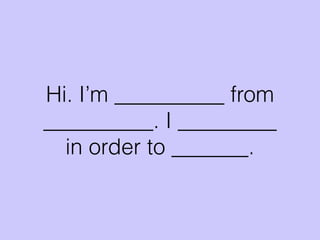
Hi. I’m __________ from
__________. I _________
in order to _______.
Your brand never exists in relation to other brands
but in relation to itself. The raison d'ĂŞtre of your brand
is not to be better than brand A or brand B, that is a
dangerous strategy. What if brands A and B were to
suddenly vanish from the market?
The competition should never dictate the reason
why your brand exists.
How are you different
from your competitors?
What’s your promise?
2. Your brand is ingrained in
all your company.
You must make every aspect of your
company live and breathe the brand.
Marketing is what you do,
Branding is what you are.
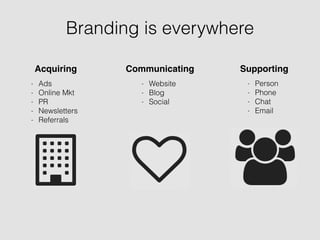
Acquiring Communicating Supporting
Branding is everywhere
- Ads
- Online Mkt
- PR
- Newsletters
- Referrals
- Website
- Blog
- Social
- Person
- Phone
- Chat
- Email
Where do your users
encounter your ?
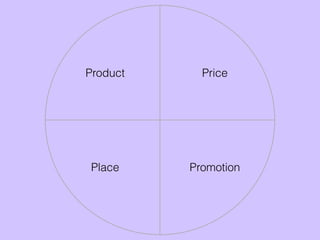
Product Price
Place Promotion
3. Your brand is who you are.
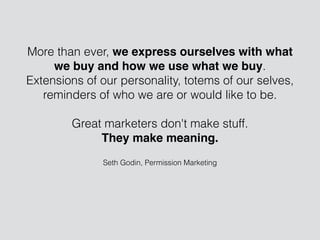
Seth Godin, Permission Marketing
More than ever, we express ourselves with what
we buy and how we use what we buy.
Extensions of our personality, totems of our selves,
reminders of who we are or would like to be.
!
Great marketers don't make stuff.
They make meaning.
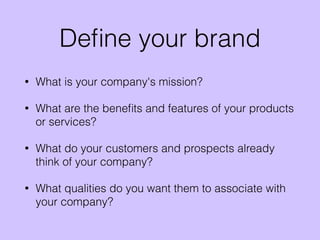
Dene your brand
• What is your company's mission?
• What are the benefits and features of your products
or services?
• What do your customers and prospects already
think of your company?
• What qualities do you want them to associate with
your company?
What Problem does
your product solve?
Getting your prospects to see you
as the only one that provides a
solution to their problem.
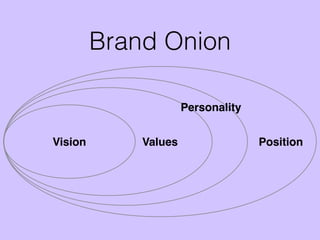
Brand Onion
Position
Personality
ValuesVision
And now…?
1. Get a great logo. Place it everywhere.
2. Write down your brand messaging. What are the key messages you want to communicate about your
brand? Every employee should be aware of your brand attributes.
3. Integrate your brand. Branding extends to every aspect of your business--how you answer your phones,
what you or your salespeople wear on sales calls, your e-mail signature, everything.
4. Create a "voice" for your company that reflects your brand. This voice should be applied to all written
communication and incorporated in the visual imagery of all materials, online and off. Is your brand friendly?
Be conversational. Is it ritzy? Be more formal. You get the gist.
5. Develop a tagline. Write a memorable, meaningful and concise statement that captures the essence of your
brand.
6. Design templates and create brand standards for your marketing materials. Use the same color scheme,
logo placement, look and feel throughout. You don't need to be fancy, just consistent.
7. Be true to your brand. Customers won't return to you--or refer you to someone else--if you don't deliver on
your brand promise.
8. Be consistent. I placed this point last only because it involves all of the above and is the most important tip I
can give you. If you can't do this, your attempts at establishing a brand will fail.
4. Your brand is the
connection to your audience.
Walter Landor, Brand Design Legend
"Products are made in the factory, but brands
are created in the mind."
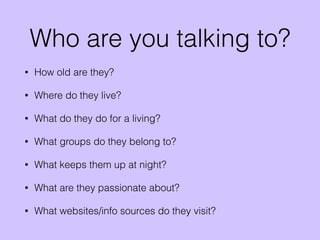
Who are you talking to?
• How old are they?
• Where do they live?
• What do they do for a living?
• What groups do they belong to?
• What keeps them up at night?
• What are they passionate about?
• What websites/info sources do they visit?
Seth Godin, The Purple Cow
“Don’t try to make a product for everybody,
because that is a product for nobody.”
It’s about the customer
How do you make their
lives easier, their jobs
better, their families safer?
Talk to your audience like
you talk to a friend.
5. Your brand gives you
loyalty.
Edwin Artzt
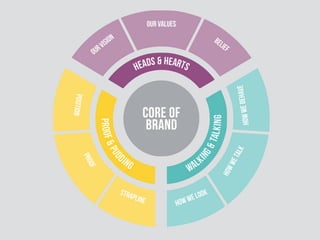
"Brand value is very much like an onion. It has
layers and a core. The core is the user who will
stick with you until the very end."
A brand's value is merely the sum total of
how much extra people will pay, or how
often they choose, the expectations,
memories, stories and relationships of one
brand over the alternatives.
Those who nd a brand relevant are four times more
likely to purchase it than those who don’t.
The added value intrinsic to brand equity frequently
comes in the form of perceived quality or emotional
attachment. For example, Nike associates its
products with star athletes, hoping customers will
transfer their emotional attachment from the athlete to
the product. For Nike, it's not just the shoe's features
that sell the shoe.
What makes your
users come back?
In short, 10 points
1. Focus on what your business achieves for its customers. Your brand is no good to you if it isn't delivering
what customers want.
2. Take ownership of your brand. Pay attention to customers' needs, but you should still control what you
want your brand to mean to them.
3. Be honest. If you don't believe in your brand, no one else will.
4. Keep your brand simple by focusing on a small number of key brand values.
5. Be consistent. Every aspect of your business should make customers feel the same way about you.
6. Be thorough. Look at all your systems to make sure they help to support your brand.
7. Involve employees. Make sure they understand your brand and believe in it.
8. Communicate your brand. Make sure every advertisement, brochure and letter helps reinforce the same
message. If you have a logo, use it everywhere, but make sure the quality is consistent.
9. Meet and exceed what your brand promises. Failing, just once, will damage your brand.
10. Manage your brand. Continually look for opportunities to make improvements. And don't be afraid to
make changes to reflect shifts in the way you do business or new trends in your market.
Index
Intro
Your brand sets you apart (15” presentation + 10”)
Your brand is ingrained in all your company. (10”)
Your brand is who you are. (15”)
Your brand is the connection to your audience. (10” + 10” + 10”)
Your brand gives you loyalty. (10”)