














HOW TO DEVELOP A BRANDING STRATEGY?
How to Brand new products?
A firm has three main choices:
1. Develop new brand elements for the new produc
2. Apply some of its existing brand elements
3. Use a combination of new and existing brand elem
Branding Decisions
ALTERNATIVE BRANDING
STRATEGIES
Three general strategies are popular:
• Individual or separate family brand name
• Corporate umbrella or company brand name
• Sub-brand name
1
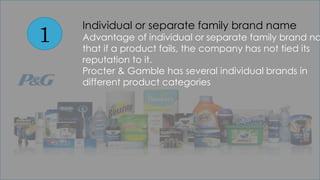
Individual or separate family brand name
Advantage of individual or separate family brand na
that if a product fails, the company has not tied its
reputation to it.
Procter & Gamble has several individual brands in
different product categories
2
Corporate umbrella or company brand name
Development costs are lower with umbrella names
because there is no need to run “name” research or
spend heavily on advertising to create recognition.
Tata, LG, Samsung and many other companies use
corporate brand names as an umbrella brand
3
Sub-brand name
Sub-brands combine two or more of the corporate b
family brand or individual product brand names.
Durable-goods makers such as Honda, Sony and
Hewlett-Packard use sub-brands for their products
HOUSE OF BRANDS & A BRANDED
HOUSE
These two branding strategies represent two ends o
brand relationship continuum
• Use of individual or separate family brand names
been referred to as a house of brands strategy
• Use of an umbrella corporate or company brand
name has been referred to as a branded house
strategy
Brand Portfolios
The brand portfolio is the set of all brands
and brand lines in a particular firm offers
for sale in a particular category or segment.
Brand can play a number of specific roles
as a part of a portfolio:
1
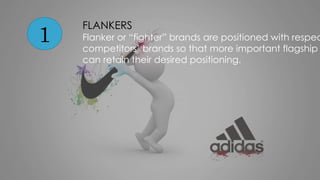
FLANKERS
Flanker or “fighter” brands are positioned with respec
competitors’ brands so that more important flagship
can retain their desired positioning.
2
CASH COWS
Some brands may be kept around despite dwindling
because they manage to maintain their profitability w
virtually no marketing support.
3
LOW-END ENTRY LEVEL
The role of a low-priced brand is to attract
customers to the brand portfolio
Audi A3 – Audi’s low-end model
4
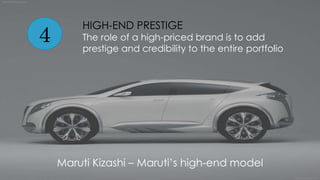
HIGH-END PRESTIGE
The role of a high-priced brand is to add
prestige and credibility to the entire portfolio
Maruti Kizashi – Maruti’s high-end model
HUL has one of the most complex product and brand po
and this illustrates the concept of “house of brands”
Brand Extensions
When a firm uses an established brand to
introduce a new product, the product is
called a brand extension. It has two categories:
1.Line Extension
2.Category Extension
Advantages of brand extensions
1. Improved odds of new-product success
2. Positive feedback effects
Disadvantages of brand extensio
1. Brand dilution
2. Questioning the brand integrity
Presentation created by-
Rohit, NSIT Delhi
During an internship by-
Prof. Sameer Mathur, IIM Lucknow
www.IIMInternship.com

Developing branding strategy

  • 1.
    HOW TO DEVELOPA BRANDING STRATEGY?
  • 2.
    How to Brandnew products?
  • 3.
    A firm hasthree main choices: 1. Develop new brand elements for the new produc 2. Apply some of its existing brand elements 3. Use a combination of new and existing brand elem
  • 4.
  • 5.
    ALTERNATIVE BRANDING STRATEGIES Three generalstrategies are popular: • Individual or separate family brand name • Corporate umbrella or company brand name • Sub-brand name
  • 6.
    1 Individual or separatefamily brand name Advantage of individual or separate family brand na that if a product fails, the company has not tied its reputation to it. Procter & Gamble has several individual brands in different product categories
  • 7.
    2 Corporate umbrella orcompany brand name Development costs are lower with umbrella names because there is no need to run “name” research or spend heavily on advertising to create recognition. Tata, LG, Samsung and many other companies use corporate brand names as an umbrella brand
  • 8.
    3 Sub-brand name Sub-brands combinetwo or more of the corporate b family brand or individual product brand names. Durable-goods makers such as Honda, Sony and Hewlett-Packard use sub-brands for their products
  • 9.
    HOUSE OF BRANDS& A BRANDED HOUSE These two branding strategies represent two ends o brand relationship continuum • Use of individual or separate family brand names been referred to as a house of brands strategy • Use of an umbrella corporate or company brand name has been referred to as a branded house strategy
  • 10.
  • 11.
    The brand portfoliois the set of all brands and brand lines in a particular firm offers for sale in a particular category or segment. Brand can play a number of specific roles as a part of a portfolio:
  • 12.
    1 FLANKERS Flanker or “fighter”brands are positioned with respec competitors’ brands so that more important flagship can retain their desired positioning.
  • 13.
    2 CASH COWS Some brandsmay be kept around despite dwindling because they manage to maintain their profitability w virtually no marketing support.
  • 14.
    3 LOW-END ENTRY LEVEL Therole of a low-priced brand is to attract customers to the brand portfolio Audi A3 – Audi’s low-end model
  • 15.
    4 HIGH-END PRESTIGE The roleof a high-priced brand is to add prestige and credibility to the entire portfolio Maruti Kizashi – Maruti’s high-end model
  • 16.
    HUL has oneof the most complex product and brand po and this illustrates the concept of “house of brands”
  • 17.
  • 18.
    When a firmuses an established brand to introduce a new product, the product is called a brand extension. It has two categories: 1.Line Extension 2.Category Extension
  • 19.
    Advantages of brandextensions 1. Improved odds of new-product success 2. Positive feedback effects
  • 20.
    Disadvantages of brandextensio 1. Brand dilution 2. Questioning the brand integrity
  • 22.
    Presentation created by- Rohit,NSIT Delhi During an internship by- Prof. Sameer Mathur, IIM Lucknow www.IIMInternship.com