Enlargement Most of you should be able to …   Enlarge a shape on a centimetre grid ( Grade E ) Enlarge a shape by a positive integer scale factor about a given centre of enlargement ( Grade D ) Find the “Centre of Enlargement”   Some of you should be able to …   Enlarge a shape by a positive fractional scale factor about a given centre of enlargement ( Grade C ) Vocab
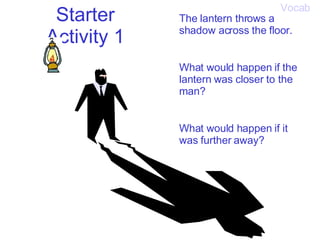
Starter Activity 1 The lantern throws a shadow across the floor. What would happen if the lantern was closer to the man? What would happen if it was further away? Vocab
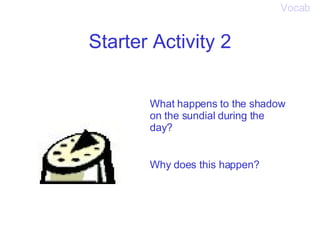
Starter Activity 2 What happens to the shadow on the sundial during the day? Why does this happen? Vocab
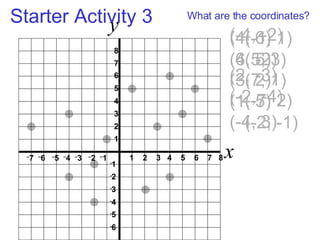
Starter Activity 3 (4, 6) (6, 5) (3, 2) (1, 5) (-4, 3) (-1, 1) (5, 3) (7, 1) (-7, 2) (-2, -1) (-4, -2) (4, -2) (2, -3) (-2, -4) What are the coordinates? y x 1  2  3  4  5  6  7  8 1 2 3 4 5 6 7 8 – 7  – 6  – 5  – 4  – 3  – 2  – 1  - 1 - 2 - 3 - 4 - 5 - 6
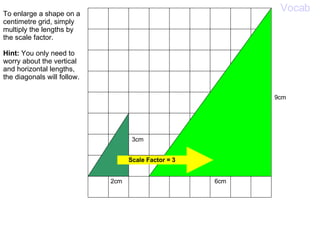
To enlarge a shape on a centimetre grid, simply multiply the lengths by the scale factor.  Hint:  You only need to worry about the vertical and horizontal lengths, the diagonals will follow. 6cm 9cm Vocab 2cm 3cm Scale Factor = 3
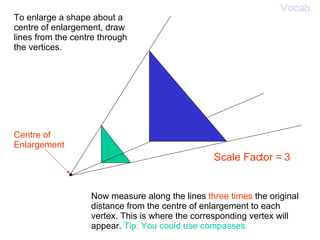
To enlarge a shape about a centre of enlargement, draw lines from the centre through the vertices. Scale Factor = 3 Now measure along the lines  three times  the original distance from the centre of enlargement to each vertex. This is where the corresponding vertex will appear.  Tip: You could use compasses. Vocab Centre of Enlargement
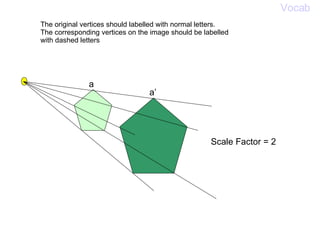
The original vertices should labelled with normal letters. The corresponding vertices on the image should be labelled with dashed letters Vocab a a’ Scale Factor = 2
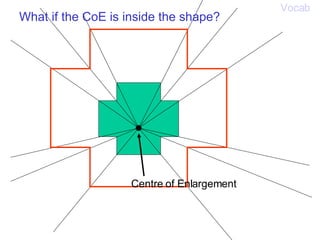
What if the CoE is inside the shape? Vocab Centre of Enlargement
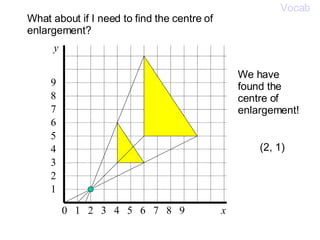
What about if I need to find the centre of enlargement? We have found the centre of enlargement! (2, 1) Vocab 0  1  2  3  4  5  6  7  8  9  x 1 9 8 7 6 5 4 3 2 y
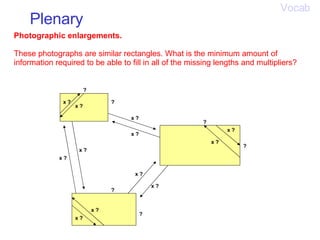
Photographic enlargements. These photographs are similar rectangles. What is the minimum amount of information required to be able to fill in all of the missing lengths and multipliers? Plenary Vocab ? ? ? ? ? ? x ? x ? x ? x ? x ? x ? x ? x ? x ? x ? x ? x ?
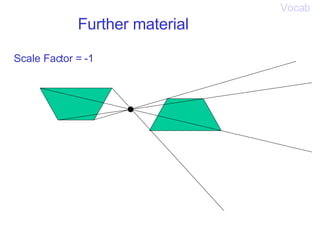
Scale Factor = -1 Further material Vocab
Web Links National Library Emaths  (equivalent ratio Excel file) Vocab
  Transformation  – A change to a shape carried out under a specific rule (or set of rules)   Enlargement  – a  transformation  in which lengths of an  object  are multiplied by the same amount to produce an  image .   Scale Factor  – this is the value of the multiplier used to enlarge an  object . The multiplier for the area of an shape is the ( Scale Factor ) 2 . The multiplier for the volume of an shape is ( Scale Factor ) 3 .   Centre of Enlargement  – This is the point from which the  enlargement  is projected. Lines joining the corresponding  vertices  on the  Image  and  Original  shapes will cross at the  centre of enlargement .   Original (or object)  – the shape that a transformation is carried out on. The shape that you start with. Usually labelled with consecutive letters of the alphabet ABCD etc.   Image  -  when a  transformation  is carried out on an  original  shape, the shape which appears is called the  image . Usually labelled with dashed letters A’B’C’D’ etc, a second image would be labelled with double dashed letters A’’B’’ and so on.   Vertex  ( Pl.  Vertices) – the corner of an object.   Axis  ( Pl . Axes) - for two-dimensional geometry there are two fixed axes, the x-axis and the y-axis. They cross at right angles and allow positions to be defined by  coordinates .   Coordinate  – These give the position of a point by placing it in relation to some other fixed points, usually the numbers on a set of  axes . The x-axis coordinate is given first. For example, (2, 3) means the point which is two along the x-axis and three up the y-axis.   Origin  – the point where the x-axis and y-axis cross. The  coordinate  (0, 0)   Similar  – Shapes are said to be  similar  when they are the same in shape but different in size. One shape is an  enlargement  of the other. Corresponding angles are the same size.   Congruent  – Shapes are said to be  congruent  when they are exactly the same. Corresponding angles are the same size and corresponding lengths are equal.   Ratio  – This is used to compare the sizes of two (or more) quantities. For example, a drink is made by mixing two parts orange juice with five parts water. This relationship of 2 to 5 can be written as the ratio 2:5. Back

Enlargement

  • 1.
    Enlargement Most ofyou should be able to …   Enlarge a shape on a centimetre grid ( Grade E ) Enlarge a shape by a positive integer scale factor about a given centre of enlargement ( Grade D ) Find the “Centre of Enlargement”   Some of you should be able to …   Enlarge a shape by a positive fractional scale factor about a given centre of enlargement ( Grade C ) Vocab
  • 2.
    Starter Activity 1The lantern throws a shadow across the floor. What would happen if the lantern was closer to the man? What would happen if it was further away? Vocab
  • 3.
    Starter Activity 2What happens to the shadow on the sundial during the day? Why does this happen? Vocab
  • 4.
    Starter Activity 3(4, 6) (6, 5) (3, 2) (1, 5) (-4, 3) (-1, 1) (5, 3) (7, 1) (-7, 2) (-2, -1) (-4, -2) (4, -2) (2, -3) (-2, -4) What are the coordinates? y x 1 2 3 4 5 6 7 8 1 2 3 4 5 6 7 8 – 7 – 6 – 5 – 4 – 3 – 2 – 1 - 1 - 2 - 3 - 4 - 5 - 6
  • 5.
    To enlarge ashape on a centimetre grid, simply multiply the lengths by the scale factor. Hint: You only need to worry about the vertical and horizontal lengths, the diagonals will follow. 6cm 9cm Vocab 2cm 3cm Scale Factor = 3
  • 6.
    To enlarge ashape about a centre of enlargement, draw lines from the centre through the vertices. Scale Factor = 3 Now measure along the lines three times the original distance from the centre of enlargement to each vertex. This is where the corresponding vertex will appear. Tip: You could use compasses. Vocab Centre of Enlargement
  • 7.
    The original verticesshould labelled with normal letters. The corresponding vertices on the image should be labelled with dashed letters Vocab a a’ Scale Factor = 2
  • 8.
    What if theCoE is inside the shape? Vocab Centre of Enlargement
  • 9.
    What about ifI need to find the centre of enlargement? We have found the centre of enlargement! (2, 1) Vocab 0 1 2 3 4 5 6 7 8 9 x 1 9 8 7 6 5 4 3 2 y
  • 10.
    Photographic enlargements. Thesephotographs are similar rectangles. What is the minimum amount of information required to be able to fill in all of the missing lengths and multipliers? Plenary Vocab ? ? ? ? ? ? x ? x ? x ? x ? x ? x ? x ? x ? x ? x ? x ? x ?
  • 11.
    Scale Factor =-1 Further material Vocab
  • 12.
    Web Links NationalLibrary Emaths (equivalent ratio Excel file) Vocab
  • 13.
      Transformation – A change to a shape carried out under a specific rule (or set of rules)   Enlargement – a transformation in which lengths of an object are multiplied by the same amount to produce an image .   Scale Factor – this is the value of the multiplier used to enlarge an object . The multiplier for the area of an shape is the ( Scale Factor ) 2 . The multiplier for the volume of an shape is ( Scale Factor ) 3 .   Centre of Enlargement – This is the point from which the enlargement is projected. Lines joining the corresponding vertices on the Image and Original shapes will cross at the centre of enlargement .   Original (or object) – the shape that a transformation is carried out on. The shape that you start with. Usually labelled with consecutive letters of the alphabet ABCD etc.   Image - when a transformation is carried out on an original shape, the shape which appears is called the image . Usually labelled with dashed letters A’B’C’D’ etc, a second image would be labelled with double dashed letters A’’B’’ and so on.   Vertex ( Pl. Vertices) – the corner of an object.   Axis ( Pl . Axes) - for two-dimensional geometry there are two fixed axes, the x-axis and the y-axis. They cross at right angles and allow positions to be defined by coordinates .   Coordinate – These give the position of a point by placing it in relation to some other fixed points, usually the numbers on a set of axes . The x-axis coordinate is given first. For example, (2, 3) means the point which is two along the x-axis and three up the y-axis.   Origin – the point where the x-axis and y-axis cross. The coordinate (0, 0)   Similar – Shapes are said to be similar when they are the same in shape but different in size. One shape is an enlargement of the other. Corresponding angles are the same size.   Congruent – Shapes are said to be congruent when they are exactly the same. Corresponding angles are the same size and corresponding lengths are equal.   Ratio – This is used to compare the sizes of two (or more) quantities. For example, a drink is made by mixing two parts orange juice with five parts water. This relationship of 2 to 5 can be written as the ratio 2:5. Back