Starbucks
Economic Analysis
Presenters
7064134: Rouzet Agaiby
8735220: Nicola Withers
8606328: Beverley Barker
8606323: Stephen Baines
7089620: Odunayo Abidoye
7211689: Folayinka Animasaun
Workshop Date: 3rd September 2012
Historical Starbucks
Starbucks Coffee Company is an international coffee company and coffeehouse chain based in
Seattle, Washington.
The first Starbucks opened in 1971 in Seattle, Washington they purchased green coffee beans
from Peets, then began buying directly from growers.
Largest coffee house company globally, with 19,763 stores in 59 countries, including 12,848 in
the United States, 1,264 in Canada, 973 in Japan, 778 in Great Britain, 621 in China, 441 in South
Korea, 350 in Mexico and 269 in Taiwan.
They entered the instant coffee market in 2009.
According to their 2011 financial report their strategic initiatives are designed to improve their
operating results and drive long-term shareholder value!!
Starbucks Coffee Company
Assumptions
Near rival’s true competition are Kraft and Sara Lee, however, it is choosing to react
to Starbucks as its near rival to position itself alongside the Starbucks brand in the
consumers eyes.
•Therefore, we are assuming CV= 0 from the other competitors,
•Leading to a zero sum game (between Starbucks and the near rival)
The ‘Single Cup Coffee ’ market is part of the ‘Instant Coffee’ market
Instant Coffee - single cup coffee (sachets, capsules and machines)
Game: Definition
Technology
Signals are interpreted to give the player type in a given game
•2007 – 2008 (Previous CEO), Baumol Type
•2008 – Present Day (New CEO), Marris Type
Time and Type
Game Theory is defined by Tn=3
Global Corporation
Geography
Dependent on the Market (TBC)
Near Rival
Type of Key Decision Maker
Baumol Model
•Focus on rapid store expansion
•Focus on sales
•Lack of innovation
Former CEO (<2007)
Marris Model
•Focus on sustainable profitable growth
(signalled from an interview as soon as
Schultz became CEO)
•Increasing Starbucks CAPM per Asset Cost
became the main priority
•Frequent analyst interviews (Positive
Learning Transfer)
Howard Schultz (>2007)
Research: Market Data
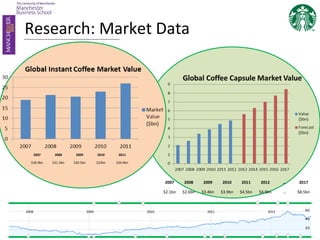
2008 2009 2010 2011 2012
2007 2008 2009 2010 2011
$18.9bn $21.3bn $20.5bn $23bn $26.9bn
2007 2008 2009 2010 2011 2012 … 2017
$2.1bn $2.6bn $3.4bn $3.9bn $4.5bn $4.9bn … $8.5bn
Critical Time Line: 2008 - 2011
Schultz
appointed
as CEO
(Jan 08)
2008 2009 2010 2011 2012
Via®
launched
(Feb 09)
Nestle
attacks
Starbucks
(Nov 09)
Via®
released in
targeted
outlets
(Sep 09)
Starbucks
re-brand
(Jan 11)
Store
closures and
employee
lay-offs
(Jan 09)
Ad
Campaigns
(Feb 09)
Starbucks
announces
China
expansion
(Apr 10)
Via® UK and
Japan
launch
(Apr 10)
Free
samples in
Starbucks
hometown
(Nov 09)
Via® pilots
(Jan 09)
Match of
packaging to
Starbucks Via®
(Jun 09)
Optimised
coffee supply
chain
(Aug 10)
Critical Time Line: 2011 - 2012
2008 2009 2010 2011 2012
Kraft
terminated
(Mar 11)
Green Mountain
contract
(Mar 11)
K-Cup
released
(Nov 11)
Economic
downturn
blamed for
sales slump
(Jul 12)
Nespresso
celebrity TV
Ad
Campaigns
(Apr 12)
Schultz announces
need of market
innovation
(Mar 11)
Schultz suggests
non-GM Single-
Cup
(Feb 12)
Nestle
launches
four new
Nespresso®
machines
(Oct 11)
Nestle IP
court cases
(Feb 12)
VerisimoTM
announcement
(Mar 12)
Capsule price would
be comparable
(Mar 12)
Nestle
announces
doubling of
investment
in China
coffee
market
(Nov 11)
Game starts, 2007-2009
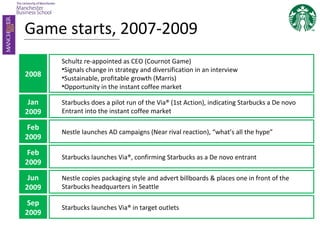
Schultz re-appointed as CEO (Cournot Game)
•Signals change in strategy and diversification in an interview
•Sustainable, profitable growth (Marris)
•Opportunity in the instant coffee market
2008
Starbucks does a pilot run of the Via® (1st Action), indicating Starbucks a De novo
Entrant into the instant coffee market
Jan
2009
Nestle launches AD campaigns (Near rival reaction), “what’s all the hype”
Feb
2009
Starbucks launches Via®, confirming Starbucks as a De novo entrant
Feb
2009
Nestle copies packaging style and advert billboards & places one in front of the
Starbucks headquarters in Seattle
Jun
2009
Starbucks launches Via® in target outlets
Sep
2009
Game continues, 2010-2011
Starbucks announces China expansion
Via® launched in Asia (Japan) and Europe (UK)
April
2010
Nestle optimise coffee supply chain (commitments on coffee farming, production &
consumption) (Cost Leadership)
Aug
2010
Schultz announces need for market innovation
Starbucks terminates contract with Kraft on coffee capsules
Starbucks sets up contract with Green Mountain
Mar
2011
Nestle launches 4 new Nespresso® machines
Oct
2011
Starbucks releases K-cup®
Nestle announces doubling of the scale of its investment in the Chinese coffee market
(Cost Leadership), leading to a Credible Threat to Starbucks
Nov
2011
Nestle attacks Starbucks and hands out free samples in Chicago & Seattle, where Via®
was piloted
Nov
2009
Game continues, 2012
Nestle sue companies for IP infringement
Feb
2012
Starbucks announces introduction of its new coffee machine (VerisimoTM), indicating
a De novo type
Coffee capsule would be comparable (not a price war)
Mar
2012
Schultz suggest non Green Mountain single-cup
Feb
2012
Nestle signals that it will not tolerate imitators to its Nespresso®
Signals increase in capacity with a new Nespresso® factory in Switzerland
May
2012
Nestle starts Nespresso® celebrity TV Advertisement campaigns
Apr
2012
Conclusions
• Starbucks current management is a Marris type
• Starbucks entered a Cournot-Stackelberg game with Nestle
• Starbucks entered as a de novo entrant
• Nestle’s reaction signals a cost leadership type
The Future
• Reinvigorated ‘instant coffee’ consumer interest with Via®
• Building a presence in growth regions such as China, Russia and India with Via®
• Market potential of $8.5bn in the single cup coffee market over the next five
years
• Nestle has a dominance in the overall instant coffee market (51% market share)
• Nespresso® sales have more than doubled in 2011 seeing Nestle take the initial
lead in the capsule market
Questions?

Managerial Economics Starbucks

  • 1.
    Starbucks Economic Analysis Presenters 7064134: RouzetAgaiby 8735220: Nicola Withers 8606328: Beverley Barker 8606323: Stephen Baines 7089620: Odunayo Abidoye 7211689: Folayinka Animasaun Workshop Date: 3rd September 2012
  • 2.
    Historical Starbucks Starbucks CoffeeCompany is an international coffee company and coffeehouse chain based in Seattle, Washington. The first Starbucks opened in 1971 in Seattle, Washington they purchased green coffee beans from Peets, then began buying directly from growers. Largest coffee house company globally, with 19,763 stores in 59 countries, including 12,848 in the United States, 1,264 in Canada, 973 in Japan, 778 in Great Britain, 621 in China, 441 in South Korea, 350 in Mexico and 269 in Taiwan. They entered the instant coffee market in 2009. According to their 2011 financial report their strategic initiatives are designed to improve their operating results and drive long-term shareholder value!! Starbucks Coffee Company
  • 3.
    Assumptions Near rival’s truecompetition are Kraft and Sara Lee, however, it is choosing to react to Starbucks as its near rival to position itself alongside the Starbucks brand in the consumers eyes. •Therefore, we are assuming CV= 0 from the other competitors, •Leading to a zero sum game (between Starbucks and the near rival) The ‘Single Cup Coffee ’ market is part of the ‘Instant Coffee’ market
  • 4.
    Instant Coffee -single cup coffee (sachets, capsules and machines) Game: Definition Technology Signals are interpreted to give the player type in a given game •2007 – 2008 (Previous CEO), Baumol Type •2008 – Present Day (New CEO), Marris Type Time and Type Game Theory is defined by Tn=3 Global Corporation Geography Dependent on the Market (TBC) Near Rival
  • 5.
    Type of KeyDecision Maker Baumol Model •Focus on rapid store expansion •Focus on sales •Lack of innovation Former CEO (<2007) Marris Model •Focus on sustainable profitable growth (signalled from an interview as soon as Schultz became CEO) •Increasing Starbucks CAPM per Asset Cost became the main priority •Frequent analyst interviews (Positive Learning Transfer) Howard Schultz (>2007)
  • 6.
    Research: Market Data 20082009 2010 2011 2012 2007 2008 2009 2010 2011 $18.9bn $21.3bn $20.5bn $23bn $26.9bn 2007 2008 2009 2010 2011 2012 … 2017 $2.1bn $2.6bn $3.4bn $3.9bn $4.5bn $4.9bn … $8.5bn
  • 7.
    Critical Time Line:2008 - 2011 Schultz appointed as CEO (Jan 08) 2008 2009 2010 2011 2012 Via® launched (Feb 09) Nestle attacks Starbucks (Nov 09) Via® released in targeted outlets (Sep 09) Starbucks re-brand (Jan 11) Store closures and employee lay-offs (Jan 09) Ad Campaigns (Feb 09) Starbucks announces China expansion (Apr 10) Via® UK and Japan launch (Apr 10) Free samples in Starbucks hometown (Nov 09) Via® pilots (Jan 09) Match of packaging to Starbucks Via® (Jun 09) Optimised coffee supply chain (Aug 10)
  • 8.
    Critical Time Line:2011 - 2012 2008 2009 2010 2011 2012 Kraft terminated (Mar 11) Green Mountain contract (Mar 11) K-Cup released (Nov 11) Economic downturn blamed for sales slump (Jul 12) Nespresso celebrity TV Ad Campaigns (Apr 12) Schultz announces need of market innovation (Mar 11) Schultz suggests non-GM Single- Cup (Feb 12) Nestle launches four new Nespresso® machines (Oct 11) Nestle IP court cases (Feb 12) VerisimoTM announcement (Mar 12) Capsule price would be comparable (Mar 12) Nestle announces doubling of investment in China coffee market (Nov 11)
  • 9.
    Game starts, 2007-2009 Schultzre-appointed as CEO (Cournot Game) •Signals change in strategy and diversification in an interview •Sustainable, profitable growth (Marris) •Opportunity in the instant coffee market 2008 Starbucks does a pilot run of the Via® (1st Action), indicating Starbucks a De novo Entrant into the instant coffee market Jan 2009 Nestle launches AD campaigns (Near rival reaction), “what’s all the hype” Feb 2009 Starbucks launches Via®, confirming Starbucks as a De novo entrant Feb 2009 Nestle copies packaging style and advert billboards & places one in front of the Starbucks headquarters in Seattle Jun 2009 Starbucks launches Via® in target outlets Sep 2009
  • 10.
    Game continues, 2010-2011 Starbucksannounces China expansion Via® launched in Asia (Japan) and Europe (UK) April 2010 Nestle optimise coffee supply chain (commitments on coffee farming, production & consumption) (Cost Leadership) Aug 2010 Schultz announces need for market innovation Starbucks terminates contract with Kraft on coffee capsules Starbucks sets up contract with Green Mountain Mar 2011 Nestle launches 4 new Nespresso® machines Oct 2011 Starbucks releases K-cup® Nestle announces doubling of the scale of its investment in the Chinese coffee market (Cost Leadership), leading to a Credible Threat to Starbucks Nov 2011 Nestle attacks Starbucks and hands out free samples in Chicago & Seattle, where Via® was piloted Nov 2009
  • 11.
    Game continues, 2012 Nestlesue companies for IP infringement Feb 2012 Starbucks announces introduction of its new coffee machine (VerisimoTM), indicating a De novo type Coffee capsule would be comparable (not a price war) Mar 2012 Schultz suggest non Green Mountain single-cup Feb 2012 Nestle signals that it will not tolerate imitators to its Nespresso® Signals increase in capacity with a new Nespresso® factory in Switzerland May 2012 Nestle starts Nespresso® celebrity TV Advertisement campaigns Apr 2012
  • 12.
    Conclusions • Starbucks currentmanagement is a Marris type • Starbucks entered a Cournot-Stackelberg game with Nestle • Starbucks entered as a de novo entrant • Nestle’s reaction signals a cost leadership type
  • 13.
    The Future • Reinvigorated‘instant coffee’ consumer interest with Via® • Building a presence in growth regions such as China, Russia and India with Via® • Market potential of $8.5bn in the single cup coffee market over the next five years • Nestle has a dominance in the overall instant coffee market (51% market share) • Nespresso® sales have more than doubled in 2011 seeing Nestle take the initial lead in the capsule market
  • 14.

Editor's Notes

  • #6 Baumol – Focus on the Short-term gain Marris – Signals: Share Value Profitability Positive Learning Transfer Trade-off between dividends and R&amp;D R&amp;D seems to be increasing (7 million, 9 million, 15 million (2009-2011) supplemented by PLT Dividends paid seem to be increasing
  • #7 According to the Financial Times the Single-Cup Coffee Market is expected to increase by 33% over the next five years In 2011, Nestle had 37% Single-Cup Coffee Market share
  • #8 Ad Campaign – what’s all the hype Nestle attack starbuck – johnny go lightly description in the press.
  • #10 The Cournot game is non-price specific compared with the Bertrand game Nestle are the dominant incumbent due to them being a key dominant player in the instant coffee market
  • #11 Aug 2010: Clear indication of a Cost Leadership Trade-off is excess capacity versus reserve capacity Because of the nature of the game (Cournot), Nestle seems to be going for reserve capacity Schultz signals penetration into the single cup coffee market When there is a combination between dominant incummbent and cost leadership you expect others to follow Therefore Nestle as a stackelberg in an cournot game expects Starbucks to follow its process
  • #12 Verissimo will be manufactured by an independent German company called Kruger which means that they are not integrating the process in their vertical chain
  • #14 Starbucks joins Tata for India Foray – starbucks signed a sourcing and processing deal with Tata coffee, standalone outlets tata hotels and retail