Group 3
Suraj Bansal (12304)
Ujjwal Chand (12310)
Monika Maheshwari (12319)
Ashish Naulakha (12320)
Smriti Sharma (12329)
Strategic Management
Case Analysis : Starbucks
Date: 7th April 2013
Brief Introduction
2
 Started in 1971in Seattle’s Pike Place Market
 First Company to innovate idea of coffee culture in
America
 Nearly 18000 retail stores in 60 countries
 Products: Coffee, Handcrafted Beverages, Merchandise,
Fresh Food
 Rated as the 11th best place to work in the United States
by Fortune Magazine in 2005
Mission
3
 Mission: To inspire and nurture the human spirit- one
person, one cup and one neighborhood at a time
 Principle:
 Our Coffee
 Our Partners
 Our Customers
 Our Stores
 Our Neighborhood
 Our Shareholders
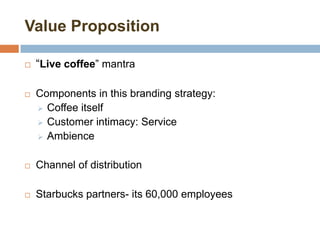
Value Proposition
 “Live coffee” mantra
 Components in this branding strategy:
 Coffee itself
 Customer intimacy: Service
 Ambience
 Channel of distribution
 Starbucks partners- its 60,000 employees
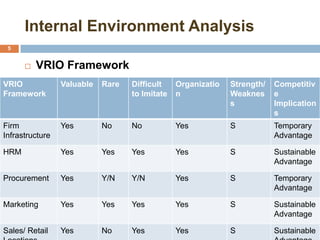
Internal Environment Analysis
5
 VRIO Framework
VRIO
Framework
Valuable Rare Difficult
to Imitate
Organizatio
n
Strength/
Weaknes
s
Competitiv
e
Implication
s
Firm
Infrastructure
Yes No No Yes S Temporary
Advantage
HRM Yes Yes Yes Yes S Sustainable
Advantage
Procurement Yes Y/N Y/N Yes S Temporary
Advantage
Marketing Yes Yes Yes Yes S Sustainable
Advantage
Sales/ Retail Yes No Yes Yes S Sustainable
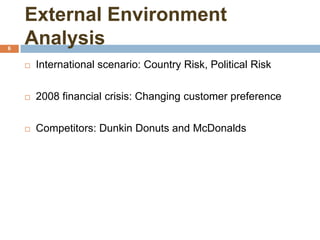
External Environment
Analysis6
 International scenario: Country Risk, Political Risk
 2008 financial crisis: Changing customer preference
 Competitors: Dunkin Donuts and McDonalds
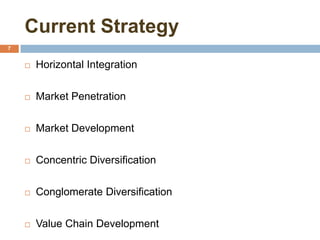
Current Strategy
7
 Horizontal Integration
 Market Penetration
 Market Development
 Concentric Diversification
 Conglomerate Diversification
 Value Chain Development
Future Strategy
8
 Co-branding
 Market penetration with adaptation
 PEST analysis
 Competitive analysis
Thank You
9

Strategic managment on Starbucks

  • 1.
    Group 3 Suraj Bansal(12304) Ujjwal Chand (12310) Monika Maheshwari (12319) Ashish Naulakha (12320) Smriti Sharma (12329) Strategic Management Case Analysis : Starbucks Date: 7th April 2013
  • 2.
    Brief Introduction 2  Startedin 1971in Seattle’s Pike Place Market  First Company to innovate idea of coffee culture in America  Nearly 18000 retail stores in 60 countries  Products: Coffee, Handcrafted Beverages, Merchandise, Fresh Food  Rated as the 11th best place to work in the United States by Fortune Magazine in 2005
  • 3.
    Mission 3  Mission: Toinspire and nurture the human spirit- one person, one cup and one neighborhood at a time  Principle:  Our Coffee  Our Partners  Our Customers  Our Stores  Our Neighborhood  Our Shareholders
  • 4.
    Value Proposition  “Livecoffee” mantra  Components in this branding strategy:  Coffee itself  Customer intimacy: Service  Ambience  Channel of distribution  Starbucks partners- its 60,000 employees
  • 5.
    Internal Environment Analysis 5 VRIO Framework VRIO Framework Valuable Rare Difficult to Imitate Organizatio n Strength/ Weaknes s Competitiv e Implication s Firm Infrastructure Yes No No Yes S Temporary Advantage HRM Yes Yes Yes Yes S Sustainable Advantage Procurement Yes Y/N Y/N Yes S Temporary Advantage Marketing Yes Yes Yes Yes S Sustainable Advantage Sales/ Retail Yes No Yes Yes S Sustainable
  • 6.
    External Environment Analysis6  Internationalscenario: Country Risk, Political Risk  2008 financial crisis: Changing customer preference  Competitors: Dunkin Donuts and McDonalds
  • 7.
    Current Strategy 7  HorizontalIntegration  Market Penetration  Market Development  Concentric Diversification  Conglomerate Diversification  Value Chain Development
  • 8.
    Future Strategy 8  Co-branding Market penetration with adaptation  PEST analysis  Competitive analysis
  • 9.

Editor's Notes

  • #3 http://globalassets.starbucks.com/assets/9a6616b98dc64271ac8c910fbee47884.pdf
  • #4 http://www.starbucks.com/about-us/company-information/mission-statement
  • #5 Employees are called partners are heart of starbucks experienceCutomer Intimacy: Explain Point of contact
  • #6 VRIO frameworkhttp://www.sba.pdx.edu/faculty/daveg/562/Starbucks.pdf
  • #7 International scenario: Country Risk, Political Risk: eg: Israel, AustraliaCompetitionCan they foresee any trouble brewing (2008 crisis)Changing customer preference and behaviorBarista and café coffee day (Local competitors)INT: gloria jeans cafeTrouble brewinghttp://www.sba.pdx.edu/faculty/daveg/562/Starbucks.pdf
  • #8 http://www.sba.pdx.edu/faculty/daveg/562/Starbucks.pdfJoint venture
  • #9 Forward Integration – They should tie up with leading airlines and companies around the globe so that they can penetrate into new and existing markets. This can be a good strategy if they are expanding in countries like India and China.Register: There are lot of fake starbucks opening in China so they can register their company, trademark and logo and also with the help of legal help try to close down fake starbucks coffee.Brand awarenessMarket Penetration: It is easy to get the customers first time to any store but it is difficult to retain the customers. Starbucks needs to understand the local customs and market needs and formulate marketing strategies accordingly. They should get items as per local taste and market/culture. It should not impose/imitate what it does in US the same will work in other countries also. They should go with the adaptation strategy Market development: They should expand geographically around the globe. Recently they have opened a store in Delhi, India. They should come up with more stores around India so that they can give competition to the local market players(Café Coffee Day, Gloria Jeans, Barista). While expanding gloablly they should also take into consideration the price sensitivity of the customers. Demographic analysis – target market (http://www.ukessays.com/essays/marketing/swot-analysis-and-company-overview-of-starbucks-marketing-essay.php)Brand success should be turned into business successExtensive Marketing: CSR activities