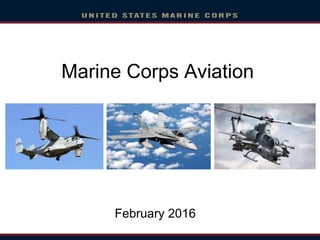
Marine Corps Aviation
February 2016
February 2016
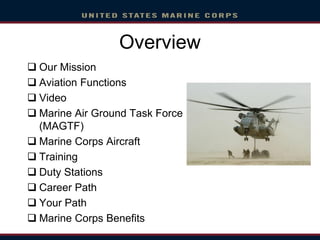
Overview
 Our Mission
 Aviation Functions
 Video
 Marine Air Ground Task Force
(MAGTF)
 Marine Corps Aircraft
 Training
 Duty Stations
 Career Path
 Your Path
 Marine Corps Benefits
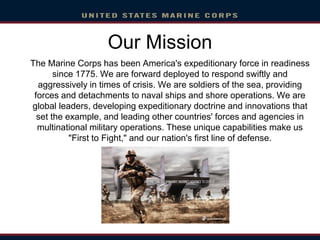
Our Mission
The Marine Corps has been America's expeditionary force in readiness
since 1775. We are forward deployed to respond swiftly and
aggressively in times of crisis. We are soldiers of the sea, providing
forces and detachments to naval ships and shore operations. We are
global leaders, developing expeditionary doctrine and innovations that
set the example, and leading other countries' forces and agencies in
multinational military operations. These unique capabilities make us
"First to Fight," and our nation's first line of defense.
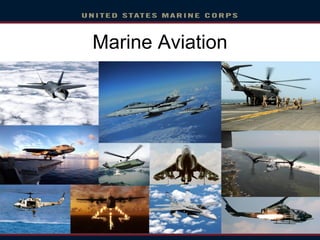
Marine Aviation
Aviation Functions
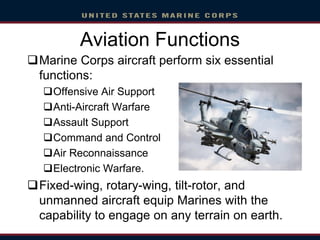
Marine Corps aircraft perform six essential
functions:
Offensive Air Support
Anti-Aircraft Warfare
Assault Support
Command and Control
Air Reconnaissance
Electronic Warfare.
Fixed-wing, rotary-wing, tilt-rotor, and
unmanned aircraft equip Marines with the
capability to engage on any terrain on earth.
Video
The MAGTF
 Marine Air Ground Task
Force (MAGTF)
 Unique fighting force
 Combined Arms
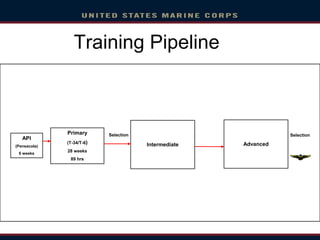
 Fixed Wing and Rotary
Wing aviation
Able to be quickly configured for fighter or attack
missions, the twin-engine, all-weather, day or night
Marine jet can be used for fighter escort, enemy air
defense suppression, reconnaissance, air control and
the calling card of Marine Aviation: close air support.
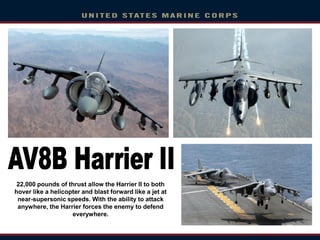
22,000 pounds of thrust allow the Harrier II to both
hover like a helicopter and blast forward like a jet at
near-supersonic speeds. With the ability to attack
anywhere, the Harrier forces the enemy to defend
everywhere.
The Marine Prowler's ability to detect, sort,
classify, jam and destroy air defenses leaves the
enemy with two options: leave the radar on, or
turn it off. Either way, their defenses are reduced
to expensive but useless metal.
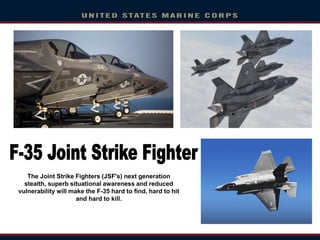
The Joint Strike Fighters (JSF's) next generation
stealth, superb situational awareness and reduced
vulnerability will make the F-35 hard to find, hard to hit
and hard to kill.
The KC-130J Super Hercules is a four-engine
transport aircraft used for aerial refueling,
medical evacuation, combat-assault transport
and battlefield illumination.
No aircraft defines the role of close air support better
than the Marine AH-1Z Viper. Whether it's providing
cover for advancing ground forces or escorting
assault support helicopters enroute to a landing
zone, the AH-1Z is called on when Marines need
firepower from the air.
A case study in Offensive Air Support,
Assault Support, Command and Control and
Aerial Reconnaissance, the UH-1Y Venom
utility helicopter of choice is truly a
microcosm of Marine Aviation.
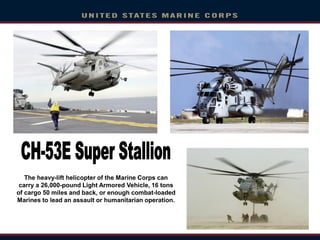
The heavy-lift helicopter of the Marine Corps can
carry a 26,000-pound Light Armored Vehicle, 16 tons
of cargo 50 miles and back, or enough combat-loaded
Marines to lead an assault or humanitarian operation.
With the speed and range of a turboprop, the
maneuverability of a helicopter and the ability to carry
24 Marines twice as fast and five times farther than
previous helicopters, the Osprey greatly enhances the
advantages Marines have over their enemies.
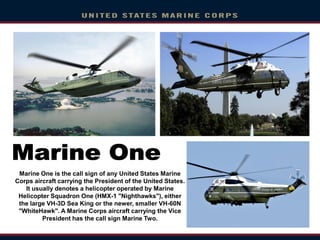
Marine One is the call sign of any United States Marine
Corps aircraft carrying the President of the United States.
It usually denotes a helicopter operated by Marine
Helicopter Squadron One (HMX-1 "Nighthawks"), either
the large VH-3D Sea King or the newer, smaller VH-60N
"WhiteHawk". A Marine Corps aircraft carrying the Vice
President has the call sign Marine Two.
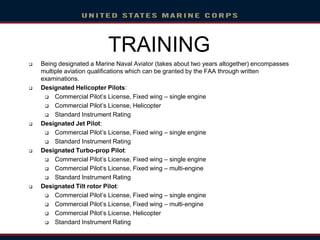
 Being designated a Marine Naval Aviator (takes about two years altogether) encompasses
multiple aviation qualifications which can be granted by the FAA through written
examinations.
 Designated Helicopter Pilots:
 Commercial Pilot’s License, Fixed wing – single engine
 Commercial Pilot’s License, Helicopter
 Standard Instrument Rating
 Designated Jet Pilot:
 Commercial Pilot’s License, Fixed wing – single engine
 Standard Instrument Rating
 Designated Turbo-prop Pilot:
 Commercial Pilot’s License, Fixed wing – single engine
 Commercial Pilot‘s License, Fixed wing – multi-engine
 Standard Instrument Rating
 Designated Tilt rotor Pilot:
 Commercial Pilot’s License, Fixed wing – single engine
 Commercial Pilot’s License, Fixed wing – multi-engine
 Commercial Pilot’s License, Helicopter
 Standard Instrument Rating
TRAINING
 Civilians earning their private pilot’s license typically take between 3 to 12 months, based on their hours to
train, weather, and financial considerations, to complete their training.
 Depending on the quality of flight school a person attends, the financial commitment can be staggering.
 Minimum Requirements # of Hours Costs $
 Dual Hours 30 7,020
 Solo Hours 10 1,950 Ground Instruction
 585 Pre / Post Flight Briefing 10 390 Written Test
 70 Practical Test Aircraft Rental 1.5 293 Check ride Examiner Fee
 350 Flight Physical 65 Books / Basic Equipment 200
 Total 41.4 HOURS $10,923
 These costs, quoted from an online vendor, is consider the average. Additional costs to obtain the same
ratings as a winged Naval Aviator vary but are generally consistent with the following,
 Private Pilot’s License: $15,300
 Standard Instrument Rating: $18,200
 Commercial / Complex: $9500
 Commercial Certification: $9500
 Multi-engine Rating: $5,000
 Helicopter License: $9,000
IT’S ALL FREE!
TRAINING COST
= $66,500
 Hours: 100
 Salary: $2,470/month
Flight pay: $125/month
Basic Allowance for Housing (BAH):
$1095/month (Pensacola, FL)
TOTAL INCOME: $44,280
 Private Pilot’s Certificate -55 +
flights and 20+ ground hours
TOTAL COST = $15,300
1ST YEAR
USMC CIVILIAN
 Instrument Pilot Certification 40+
flights and 20+ ground hours - $18,200
 Commercial Certification 20+ flights
and 23+ ground hours - $19,000
 Multiengine Rating: $5,000
 Helicopter License: $9,000
TOTAL COST: $51,200
 Hours: 215
 Salary: $2570/month
Flight Pay: $125/month
BAH: $1157/month (Pensacola, FL)
TOTAL INCOME: $46,224
2ND YEAR
TOTAL COST
$66,500
TOTAL INCOME
$90,504
AVIATION PIPELINE • IFS/API
• NAS
PENSACOLA, FL
• 7 wks / 6 wks
PRIMARY
NAS CORPUS CHRISTI
CORPUS CHRISTI, TX
6 months
PRIMARY
NAS WHITING FIELD
MILTON, FL
6 months
FLEET REPLACEMENT SQUADRON
ADDITIONAL 6-12 months of training in fleet aircraft
TILT ROTOR
(V-22s)
ADVANCED
CORPUS CHRISTI, TX
5 months
APPROX TTT: 2 year
ROTARY
(HELOS)
ADVANCED
MILTON, FL
7 months
APPROX TTT: 1.5
year
MARITIME
(C-130s)
ADVANCED
COPRPUS CHRISTI, TX
5 months
APPROX TTT: 1.5 years
STRIKE (JETS)
ADVANCED
MERIDIAN, MS
KINGSVILLE, TX
9-12 months
APPROX TTT: 2 years
Aircraft Selection
F/A-18, AV-8,
EA-6
F-35 (2015)
TILT ROTOR
(V-22s)
INTERMEDIATE
MILTON, FL
2.5 months
Aircraft Selection
CH-53E, AH-1W/Z,
UH-1N/Y
Aircraft Selection
KC-130J
Aircraft Selection
MV-22
Based on:
1) Grades
2) Needs of the Marine Corps
3) Personal Preference
Selection breakdown:
Jets: 20 %
C-130’s: 12 %
Helos: 49 %
Tilt Rotor: 19 %
Aviation Platform Pipeline
Selection
Based on:
1) Grades
2) Needs of the Marine
Corps
3) Personal Preference
Selection breakdown for jets:
Hornets: 55 %
Harriers: 34 %
Prowlers: 11 %
JSF: TBD
Aviation Platform Pipeline
Selection
Selection breakdown for helos:
Cobras: 39 %
Hueys: 24 %
CH-53: 37 %
Training Aircraft (SNA)
Primary
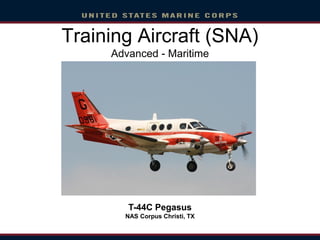
Training Aircraft (SNA)
Advanced - Maritime
T-44C Pegasus
NAS Corpus Christi, TX
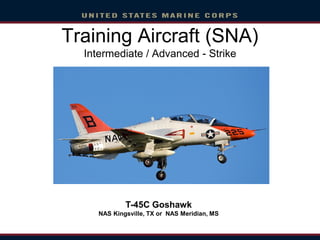
Training Aircraft (SNA)
Intermediate / Advanced - Strike
T-45C Goshawk
NAS Kingsville, TX or NAS Meridian, MS
Training Aircraft (SNA)
Advanced – Helo
TH-57B/C Sea Ranger
NAS Whiting Field
Milton, FL
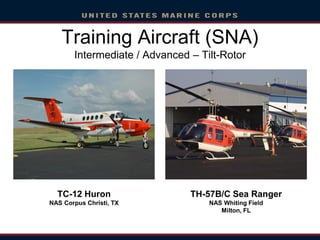
Training Aircraft (SNA)
Intermediate / Advanced – Tilt-Rotor
TC-12 Huron
NAS Corpus Christi, TX
TH-57B/C Sea Ranger
NAS Whiting Field
Milton, FL
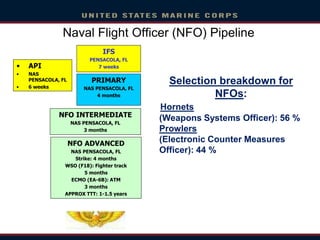
Naval Flight Officer (NFO) Pipeline
• API
• NAS
PENSACOLA, FL
• 6 weeks
PRIMARY
NAS PENSACOLA, FL
4 months
NFO ADVANCED
NAS PENSACOLA, FL
Strike: 4 months
WSO (F18): Fighter track
5 months
ECMO (EA-6B): ATM
3 months
APPROX TTT: 1-1.5 years
NFO INTERMEDIATE
NAS PENSACOLA, FL
3 months
IFS
PENSACOLA, FL
7 weeks
Selection breakdown for
NFOs:
Hornets
(Weapons Systems Officer): 56 %
Prowlers
(Electronic Counter Measures
Officer): 44 %
Training Aircraft (SNFO)
Primary / Intermediate
Training Aircraft (SNFO)
Strike/Fighter/ATM
CHERRY POINT, NC
AV-8B
KC-130J
EA-6B
CH-53E
AH-1W/Z
UH-1N/Y
F-35B/C (20XX)
NEW RIVER, NC
AH-1W
UH-1N/Y
MV-22
CH-53E
BEAUFORT, SC
F/A-18C/D
F-35B/C (2016)
YUMA, AZ
AV-8B
F-35B
CAMP PENDLETON, CA
AH-1W/Z
UH-1Y
MIRAMAR, CA
F/A-18C/D
MV-22
CH-53E
KC-130J
HAWAII
CH-53E
MV-22
AH-1W/Z
UH-1N/Y
OKINAWA JAPAN
AH-1W/Z (UDP)
UH-1N/Y (UDP)
CH-53E
MV-22
KC-130J
Duty Stations
IWAKUNI JAPAN
F/A-18D (Perm)
F/A-18C/D (UDP)
EA-6B (UDP)
AV-8B (UDP)
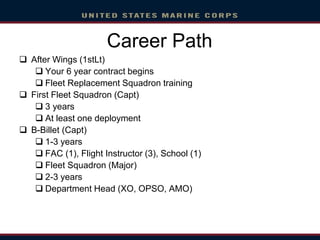
CAREER PATH
Career Path
 After Wings (1stLt)
 Your 6 year contract begins
 Fleet Replacement Squadron training
 First Fleet Squadron (Capt)
 3 years
 At least one deployment
 B-Billet (Capt)
 1-3 years
 FAC (1), Flight Instructor (3), School (1)
 Fleet Squadron (Major)
 2-3 years
 Department Head (XO, OPSO, AMO)
Your Path
 College Freshman
 NROTC or Platoon Leaders Class (PLC) Air program Selection
 PLC 6 weeks Officer Candidate School (OCS) (Challenge/Fitness/Decent Pay)
 Guaranteed Flight School (remain qualified)
 Sophomore Year (Once trained)
 Preparation
 Financial Assistance (Money for school)
 Junior Year
 Financial Assistance
 NROTC 6 weeks Officer Candidate School (OCS) (Challenge/Fitness/Decent Pay)
 Senior Year (Fully Trained)
 Financial Assistance
 Your peers will be going to job fairs
 Graduate and Commission as a 2ndLt
 Report to TBS
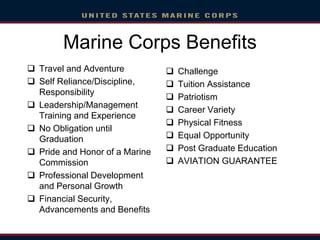
Marine Corps Benefits
 Travel and Adventure
 Self Reliance/Discipline,
Responsibility
 Leadership/Management
Training and Experience
 No Obligation until
Graduation
 Pride and Honor of a Marine
Commission
 Professional Development
and Personal Growth
 Financial Security,
Advancements and Benefits
 Challenge
 Tuition Assistance
 Patriotism
 Career Variety
 Physical Fitness
 Equal Opportunity
 Post Graduate Education
 AVIATION GUARANTEE
QUESTIONS?
Backup Slides
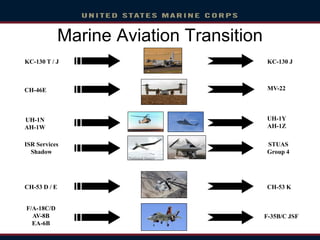
Marine Aviation Transition
Notional Image Notional
Image
KC-130 T / J
MV-22
KC-130 J
CH-46E
UH-1N
AH-1W
ISR Services
Shadow
CH-53 D / E
F/A-18C/D
AV-8B
EA-6B
UH-1Y
AH-1Z
STUAS
Group 4
F-35B/C JSF
CH-53 K
•CH-53K contract awarded April 2006. 1st flight
2014. Initial Operational Capability TBD.
•F-35B (JSF STOVL variant) and F-35C (carrier
variant) replacing F/A-18C/D, AV-8B & EA-6B.
FRS stand-up April 2010. Initial Operational
Capability 2015.
•KC-130J transition continues through 2010. KC-
130J detachments currently supporting OEF.
FRS training moved from Little Rock to Cherry
Point & Miramar.
•VXX replacing VH-3D & VH-60N. Initial Operational
Capability FY2011. Full Operational Capability
FY2019.
Marine Corps Aviation
•MV-22 replacing CH-46E. First operational
deployment Oct 2007.
•UH-1Y replacing “N’s”. FRS training
underway. Initial Operational Capability Aug
2008. First Yankee MEU deployment 2Q 2009.
•AH-1Z replacing “W’s”. FRS training 2Q
FY2009. Initial Operational Capability 2Q
FY2011.
•EA-6B transition to ICAP III. FRS migration from
Whidbey in FY2010. Operational capability thru 2019.
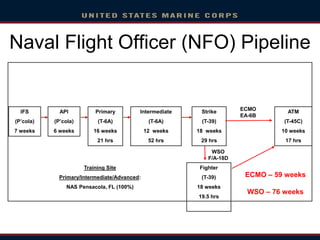
Naval Flight Officer (NFO) Pipeline
API
(P’cola)
6 weeks
Primary
(T-6A)
16 weeks
21 hrs
Fighter
(T-39)
18 weeks
19.5 hrs
Training Site
Primary/Intermediate/Advanced:
NAS Pensacola, FL (100%)
Intermediate
(T-6A)
12 weeks
52 hrs
Strike
(T-39)
18 weeks
29 hrs
ATM
(T-45C)
10 weeks
17 hrs
ECMO
EA-6B
WSO
F/A-18D
ECMO – 59 weeks
WSO – 76 weeks
IFS
(P’cola)
7 weeks
Training Pipeline
API
(Pensacola)
6 weeks
Primary
(T-34/T-6)
28 weeks
89 hrs
Selection
Advanced
Intermediate
Selection
Pilot Pipeline
Strike/Maritime/Rotary
Marine Pilot Flow
API
(Pensacola)
6 weeks
Primary
(T-34C/T-6B)
28 weeks
89 hrs
Jets-Total Syllabus
(T-45C)
52 weeks
156-178 hrs
TOTAL 89 WEEKS
Prop-Advanced
(T-44)
23 weeks
88 hrs
TOTAL 54 WEEKS
Helo-Advanced
(TH-57)
30 weeks
115.6 hrs
TOTAL 59 WEEKS
Strike
Maritime
Helos
IFS
(Pensacola)
7 weeks
Training Sites
Primary:
VT-2/3/6, Whiting Field (55%)
VT-27/28, Corpus Christi (35%)
Advanced:
VT-7/9 Meridian or VT-21/22 Kingsville
VT-31, Corpus Christi
HT-8/18/28 Whiting Field
Pilot Pipeline
Tilt-Rotor
Training Sites
Primary:
VT-2/3/6, Whiting Field (55%)
VT-27/28, Corpus Christi (35%)
Intermediate:
HT-8/18/28 Whiting Field
Advanced:
VT-35, Corpus Christi
API
(Pensacola)
6 weeks
Primary
(T-34C/T-6B)
28 weeks
89 hrs
Selection
Advanced
(TC-12)
23 weeks
60 hrs
TOTAL 65 WEEKS
Intermediate
(TH-57)
10 weeks
60 hrs
IFS
(Pensacola)
7 weeks
Marine Corps Aviation Brief.pdf

Marine Corps Aviation Brief.pdf

  • 1.
  • 2.
    Overview  Our Mission Aviation Functions  Video  Marine Air Ground Task Force (MAGTF)  Marine Corps Aircraft  Training  Duty Stations  Career Path  Your Path  Marine Corps Benefits
  • 3.
    Our Mission The MarineCorps has been America's expeditionary force in readiness since 1775. We are forward deployed to respond swiftly and aggressively in times of crisis. We are soldiers of the sea, providing forces and detachments to naval ships and shore operations. We are global leaders, developing expeditionary doctrine and innovations that set the example, and leading other countries' forces and agencies in multinational military operations. These unique capabilities make us "First to Fight," and our nation's first line of defense.
  • 4.
  • 5.
    Aviation Functions Marine Corpsaircraft perform six essential functions: Offensive Air Support Anti-Aircraft Warfare Assault Support Command and Control Air Reconnaissance Electronic Warfare. Fixed-wing, rotary-wing, tilt-rotor, and unmanned aircraft equip Marines with the capability to engage on any terrain on earth.
  • 6.
  • 7.
    The MAGTF  MarineAir Ground Task Force (MAGTF)  Unique fighting force  Combined Arms  Fixed Wing and Rotary Wing aviation
  • 8.
    Able to bequickly configured for fighter or attack missions, the twin-engine, all-weather, day or night Marine jet can be used for fighter escort, enemy air defense suppression, reconnaissance, air control and the calling card of Marine Aviation: close air support.
  • 9.
    22,000 pounds ofthrust allow the Harrier II to both hover like a helicopter and blast forward like a jet at near-supersonic speeds. With the ability to attack anywhere, the Harrier forces the enemy to defend everywhere.
  • 10.
    The Marine Prowler'sability to detect, sort, classify, jam and destroy air defenses leaves the enemy with two options: leave the radar on, or turn it off. Either way, their defenses are reduced to expensive but useless metal.
  • 11.
    The Joint StrikeFighters (JSF's) next generation stealth, superb situational awareness and reduced vulnerability will make the F-35 hard to find, hard to hit and hard to kill.
  • 12.
    The KC-130J SuperHercules is a four-engine transport aircraft used for aerial refueling, medical evacuation, combat-assault transport and battlefield illumination.
  • 13.
    No aircraft definesthe role of close air support better than the Marine AH-1Z Viper. Whether it's providing cover for advancing ground forces or escorting assault support helicopters enroute to a landing zone, the AH-1Z is called on when Marines need firepower from the air.
  • 14.
    A case studyin Offensive Air Support, Assault Support, Command and Control and Aerial Reconnaissance, the UH-1Y Venom utility helicopter of choice is truly a microcosm of Marine Aviation.
  • 15.
    The heavy-lift helicopterof the Marine Corps can carry a 26,000-pound Light Armored Vehicle, 16 tons of cargo 50 miles and back, or enough combat-loaded Marines to lead an assault or humanitarian operation.
  • 16.
    With the speedand range of a turboprop, the maneuverability of a helicopter and the ability to carry 24 Marines twice as fast and five times farther than previous helicopters, the Osprey greatly enhances the advantages Marines have over their enemies.
  • 17.
    Marine One isthe call sign of any United States Marine Corps aircraft carrying the President of the United States. It usually denotes a helicopter operated by Marine Helicopter Squadron One (HMX-1 "Nighthawks"), either the large VH-3D Sea King or the newer, smaller VH-60N "WhiteHawk". A Marine Corps aircraft carrying the Vice President has the call sign Marine Two.
  • 18.
     Being designateda Marine Naval Aviator (takes about two years altogether) encompasses multiple aviation qualifications which can be granted by the FAA through written examinations.  Designated Helicopter Pilots:  Commercial Pilot’s License, Fixed wing – single engine  Commercial Pilot’s License, Helicopter  Standard Instrument Rating  Designated Jet Pilot:  Commercial Pilot’s License, Fixed wing – single engine  Standard Instrument Rating  Designated Turbo-prop Pilot:  Commercial Pilot’s License, Fixed wing – single engine  Commercial Pilot‘s License, Fixed wing – multi-engine  Standard Instrument Rating  Designated Tilt rotor Pilot:  Commercial Pilot’s License, Fixed wing – single engine  Commercial Pilot’s License, Fixed wing – multi-engine  Commercial Pilot’s License, Helicopter  Standard Instrument Rating TRAINING
  • 19.
     Civilians earningtheir private pilot’s license typically take between 3 to 12 months, based on their hours to train, weather, and financial considerations, to complete their training.  Depending on the quality of flight school a person attends, the financial commitment can be staggering.  Minimum Requirements # of Hours Costs $  Dual Hours 30 7,020  Solo Hours 10 1,950 Ground Instruction  585 Pre / Post Flight Briefing 10 390 Written Test  70 Practical Test Aircraft Rental 1.5 293 Check ride Examiner Fee  350 Flight Physical 65 Books / Basic Equipment 200  Total 41.4 HOURS $10,923  These costs, quoted from an online vendor, is consider the average. Additional costs to obtain the same ratings as a winged Naval Aviator vary but are generally consistent with the following,  Private Pilot’s License: $15,300  Standard Instrument Rating: $18,200  Commercial / Complex: $9500  Commercial Certification: $9500  Multi-engine Rating: $5,000  Helicopter License: $9,000 IT’S ALL FREE! TRAINING COST = $66,500
  • 20.
     Hours: 100 Salary: $2,470/month Flight pay: $125/month Basic Allowance for Housing (BAH): $1095/month (Pensacola, FL) TOTAL INCOME: $44,280  Private Pilot’s Certificate -55 + flights and 20+ ground hours TOTAL COST = $15,300 1ST YEAR USMC CIVILIAN  Instrument Pilot Certification 40+ flights and 20+ ground hours - $18,200  Commercial Certification 20+ flights and 23+ ground hours - $19,000  Multiengine Rating: $5,000  Helicopter License: $9,000 TOTAL COST: $51,200  Hours: 215  Salary: $2570/month Flight Pay: $125/month BAH: $1157/month (Pensacola, FL) TOTAL INCOME: $46,224 2ND YEAR TOTAL COST $66,500 TOTAL INCOME $90,504
  • 21.
    AVIATION PIPELINE •IFS/API • NAS PENSACOLA, FL • 7 wks / 6 wks PRIMARY NAS CORPUS CHRISTI CORPUS CHRISTI, TX 6 months PRIMARY NAS WHITING FIELD MILTON, FL 6 months FLEET REPLACEMENT SQUADRON ADDITIONAL 6-12 months of training in fleet aircraft TILT ROTOR (V-22s) ADVANCED CORPUS CHRISTI, TX 5 months APPROX TTT: 2 year ROTARY (HELOS) ADVANCED MILTON, FL 7 months APPROX TTT: 1.5 year MARITIME (C-130s) ADVANCED COPRPUS CHRISTI, TX 5 months APPROX TTT: 1.5 years STRIKE (JETS) ADVANCED MERIDIAN, MS KINGSVILLE, TX 9-12 months APPROX TTT: 2 years Aircraft Selection F/A-18, AV-8, EA-6 F-35 (2015) TILT ROTOR (V-22s) INTERMEDIATE MILTON, FL 2.5 months Aircraft Selection CH-53E, AH-1W/Z, UH-1N/Y Aircraft Selection KC-130J Aircraft Selection MV-22
  • 22.
    Based on: 1) Grades 2)Needs of the Marine Corps 3) Personal Preference Selection breakdown: Jets: 20 % C-130’s: 12 % Helos: 49 % Tilt Rotor: 19 % Aviation Platform Pipeline Selection
  • 23.
    Based on: 1) Grades 2)Needs of the Marine Corps 3) Personal Preference Selection breakdown for jets: Hornets: 55 % Harriers: 34 % Prowlers: 11 % JSF: TBD Aviation Platform Pipeline Selection Selection breakdown for helos: Cobras: 39 % Hueys: 24 % CH-53: 37 %
  • 24.
  • 25.
    Training Aircraft (SNA) Advanced- Maritime T-44C Pegasus NAS Corpus Christi, TX
  • 26.
    Training Aircraft (SNA) Intermediate/ Advanced - Strike T-45C Goshawk NAS Kingsville, TX or NAS Meridian, MS
  • 27.
    Training Aircraft (SNA) Advanced– Helo TH-57B/C Sea Ranger NAS Whiting Field Milton, FL
  • 28.
    Training Aircraft (SNA) Intermediate/ Advanced – Tilt-Rotor TC-12 Huron NAS Corpus Christi, TX TH-57B/C Sea Ranger NAS Whiting Field Milton, FL
  • 29.
    Naval Flight Officer(NFO) Pipeline • API • NAS PENSACOLA, FL • 6 weeks PRIMARY NAS PENSACOLA, FL 4 months NFO ADVANCED NAS PENSACOLA, FL Strike: 4 months WSO (F18): Fighter track 5 months ECMO (EA-6B): ATM 3 months APPROX TTT: 1-1.5 years NFO INTERMEDIATE NAS PENSACOLA, FL 3 months IFS PENSACOLA, FL 7 weeks Selection breakdown for NFOs: Hornets (Weapons Systems Officer): 56 % Prowlers (Electronic Counter Measures Officer): 44 %
  • 30.
  • 31.
  • 32.
    CHERRY POINT, NC AV-8B KC-130J EA-6B CH-53E AH-1W/Z UH-1N/Y F-35B/C(20XX) NEW RIVER, NC AH-1W UH-1N/Y MV-22 CH-53E BEAUFORT, SC F/A-18C/D F-35B/C (2016) YUMA, AZ AV-8B F-35B CAMP PENDLETON, CA AH-1W/Z UH-1Y MIRAMAR, CA F/A-18C/D MV-22 CH-53E KC-130J HAWAII CH-53E MV-22 AH-1W/Z UH-1N/Y OKINAWA JAPAN AH-1W/Z (UDP) UH-1N/Y (UDP) CH-53E MV-22 KC-130J Duty Stations IWAKUNI JAPAN F/A-18D (Perm) F/A-18C/D (UDP) EA-6B (UDP) AV-8B (UDP)
  • 33.
  • 34.
    Career Path  AfterWings (1stLt)  Your 6 year contract begins  Fleet Replacement Squadron training  First Fleet Squadron (Capt)  3 years  At least one deployment  B-Billet (Capt)  1-3 years  FAC (1), Flight Instructor (3), School (1)  Fleet Squadron (Major)  2-3 years  Department Head (XO, OPSO, AMO)
  • 35.
    Your Path  CollegeFreshman  NROTC or Platoon Leaders Class (PLC) Air program Selection  PLC 6 weeks Officer Candidate School (OCS) (Challenge/Fitness/Decent Pay)  Guaranteed Flight School (remain qualified)  Sophomore Year (Once trained)  Preparation  Financial Assistance (Money for school)  Junior Year  Financial Assistance  NROTC 6 weeks Officer Candidate School (OCS) (Challenge/Fitness/Decent Pay)  Senior Year (Fully Trained)  Financial Assistance  Your peers will be going to job fairs  Graduate and Commission as a 2ndLt  Report to TBS
  • 36.
    Marine Corps Benefits Travel and Adventure  Self Reliance/Discipline, Responsibility  Leadership/Management Training and Experience  No Obligation until Graduation  Pride and Honor of a Marine Commission  Professional Development and Personal Growth  Financial Security, Advancements and Benefits  Challenge  Tuition Assistance  Patriotism  Career Variety  Physical Fitness  Equal Opportunity  Post Graduate Education  AVIATION GUARANTEE
  • 37.
  • 38.
  • 39.
    Marine Aviation Transition NotionalImage Notional Image KC-130 T / J MV-22 KC-130 J CH-46E UH-1N AH-1W ISR Services Shadow CH-53 D / E F/A-18C/D AV-8B EA-6B UH-1Y AH-1Z STUAS Group 4 F-35B/C JSF CH-53 K
  • 40.
    •CH-53K contract awardedApril 2006. 1st flight 2014. Initial Operational Capability TBD. •F-35B (JSF STOVL variant) and F-35C (carrier variant) replacing F/A-18C/D, AV-8B & EA-6B. FRS stand-up April 2010. Initial Operational Capability 2015. •KC-130J transition continues through 2010. KC- 130J detachments currently supporting OEF. FRS training moved from Little Rock to Cherry Point & Miramar. •VXX replacing VH-3D & VH-60N. Initial Operational Capability FY2011. Full Operational Capability FY2019. Marine Corps Aviation
  • 41.
    Marine Corps Aviation •MV-22replacing CH-46E. First operational deployment Oct 2007. •UH-1Y replacing “N’s”. FRS training underway. Initial Operational Capability Aug 2008. First Yankee MEU deployment 2Q 2009. •AH-1Z replacing “W’s”. FRS training 2Q FY2009. Initial Operational Capability 2Q FY2011. •EA-6B transition to ICAP III. FRS migration from Whidbey in FY2010. Operational capability thru 2019.
  • 42.
    Naval Flight Officer(NFO) Pipeline API (P’cola) 6 weeks Primary (T-6A) 16 weeks 21 hrs Fighter (T-39) 18 weeks 19.5 hrs Training Site Primary/Intermediate/Advanced: NAS Pensacola, FL (100%) Intermediate (T-6A) 12 weeks 52 hrs Strike (T-39) 18 weeks 29 hrs ATM (T-45C) 10 weeks 17 hrs ECMO EA-6B WSO F/A-18D ECMO – 59 weeks WSO – 76 weeks IFS (P’cola) 7 weeks
  • 43.
    Training Pipeline API (Pensacola) 6 weeks Primary (T-34/T-6) 28weeks 89 hrs Selection Advanced Intermediate Selection
  • 44.
    Pilot Pipeline Strike/Maritime/Rotary Marine PilotFlow API (Pensacola) 6 weeks Primary (T-34C/T-6B) 28 weeks 89 hrs Jets-Total Syllabus (T-45C) 52 weeks 156-178 hrs TOTAL 89 WEEKS Prop-Advanced (T-44) 23 weeks 88 hrs TOTAL 54 WEEKS Helo-Advanced (TH-57) 30 weeks 115.6 hrs TOTAL 59 WEEKS Strike Maritime Helos IFS (Pensacola) 7 weeks Training Sites Primary: VT-2/3/6, Whiting Field (55%) VT-27/28, Corpus Christi (35%) Advanced: VT-7/9 Meridian or VT-21/22 Kingsville VT-31, Corpus Christi HT-8/18/28 Whiting Field
  • 45.
    Pilot Pipeline Tilt-Rotor Training Sites Primary: VT-2/3/6,Whiting Field (55%) VT-27/28, Corpus Christi (35%) Intermediate: HT-8/18/28 Whiting Field Advanced: VT-35, Corpus Christi API (Pensacola) 6 weeks Primary (T-34C/T-6B) 28 weeks 89 hrs Selection Advanced (TC-12) 23 weeks 60 hrs TOTAL 65 WEEKS Intermediate (TH-57) 10 weeks 60 hrs IFS (Pensacola) 7 weeks