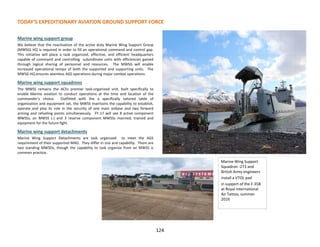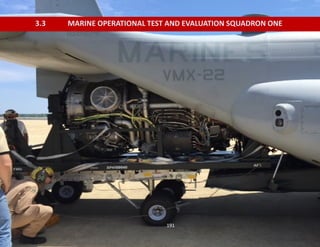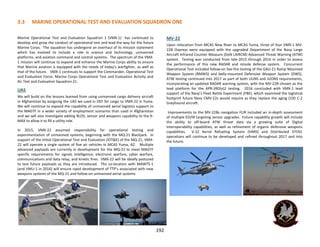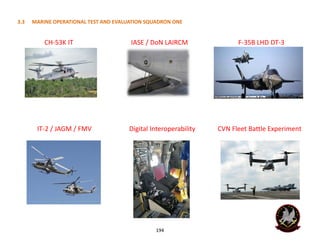
2017 MARINE AVIATION PLAN
MARINE CORPS AVIATION 2017-2027
2
The Marine Corps and Marine Aviation
The Marine Corps is manned, trained, and equipped to be an “expeditionary force
in readiness”, ready and forward deployed, capable of crisis response, entry and
sustained operations, across the range of military operations (ROMO). The Marine
Corps is by design a “middleweight force”, equipped with the requisite organic
capabilities to accomplish its mission, roles, and functions. Marine aviation, as one
of the two combat arms of the Marine Air Ground Task Force (MAGTF), exists “to
conduct air operations, project combat power, and contribute to battlespace
dominance in support of the MAGTF’s mission.” 1
Where We Have Been
As we ended the fiscal year (September 30, 2016), the Marine Corps executed
more than 80 operations (15 from the sea), 130 theater security cooperation (TSC)
events, while participating in more than 150 exercises around the world. From
31st MEU VMM disaster relief operations following the Kumamoto earthquakes in
Japan, to 22 MEU VMA/HMLA strikes in Libya in support of counter-ISIL
operations, Marine aviation has been forward-deployed, ready, and relevant.
Where We Are Going
After fifteen years of emphasizing sustained operations ashore, the Marine Corps
is refocusing on its naval and expeditionary roots and full-spectrum operations
across the ROMO. The Marine aviation portfolio continues to evolve as we
address the challenges and trends of the current and future operational
environment.
Modernization
Over the next five years, as Marine aviation continues with its modernization plan,
the MAGTF’s Aviation Combat Element will enter the heaviest years of aircraft
transition in its history.
Our TACAIR fleet will be in the middle of transition with a robust mix of F-35B, F-
35C, legacy F/A-18A-D, AV-8B and EA-6B platforms. F-35B squadrons will be
operational with both ARG/MEU and forward deployed land-based units, while our
AV-8B and F/A-18 squadrons will receive modernization upgrades to maintain
relevance in close air support, strike, and air defense missions through sundown.
Marine F-35C squadrons will integrate with Navy CVNs in accordance with our
TACAIR integration (TAI) commitments. Marine EA-6B squadrons will remain
ready and forward deployed until their sundown in 2019.
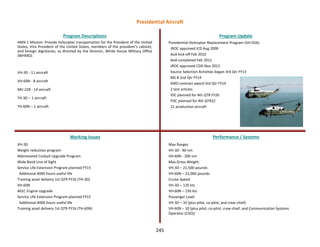
Our rotary wing (RW) and tiltrotor (TR) communities will be closer to complete
transition with AH-1Z, UH-1Y and MV-22B fully operational and deployed across
the MAGTF. Our heavy lift assets (CH-53K) will be over halfway through transition,
anticipating full operational capability by 2029.
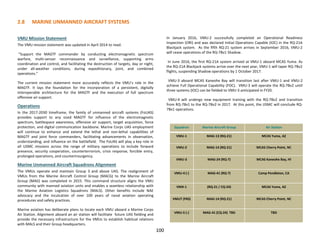
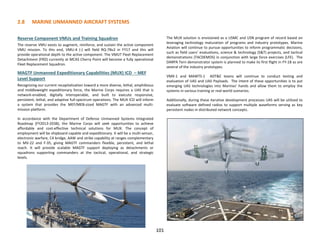
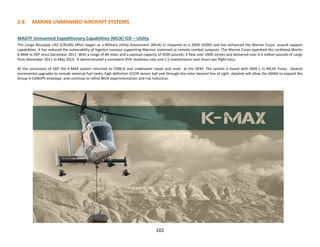
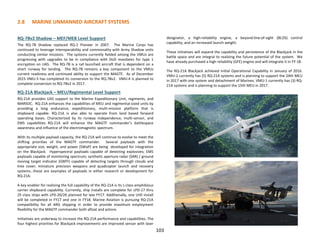
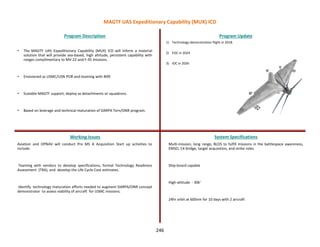
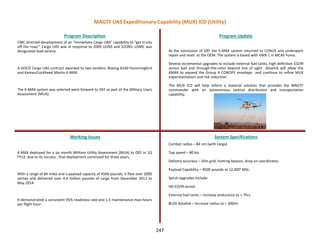
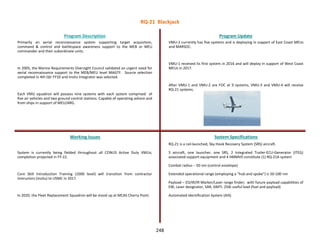
We continue to develop and deploy our fleet of unmanned aircraft systems. The
RQ-21 is being upgraded to provide additional sensor and platform capabilities,
while deploying organically with Marine Expeditionary Units. The Marine Corps’
Group 5 sea-baseable UAS—the Marine Unmanned Expeditionary (MUX)—has
been formally approved by the Joint Requirements Oversight Council and will see
major investment across the FYDP in order to field this capability in the mid-2020s.
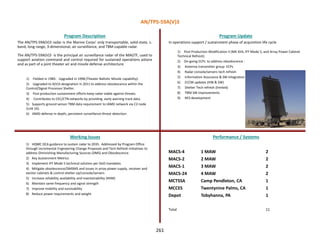
Our expeditionary enablers are modernizing as well. We will introduce G/ATOR
radars, replacing five of the Marine Corps legacy systems and providing a
significant upgrade in capabilities. We will also field the Common Aviation
Command and Control System (CAC2S) to better integrate aviation command and
control functions.
With our materiel modernization, Marine Operational Test and Evaluation
Squadron 1 (VMX-1) is a key enabler in exploring and operationalizing our new
combat capabilities. Now co-located with MAWTS-1, VMX-1 is optimally postured
to conduct experimentation, tactical demonstrations (TACDEMOs), concept
development support, and operational testing in order to rapidly deliver
warfighting capability to the fleet.
1 U.S. Marine Corps, Marine Corps Operations, Marine Corps Doctrine Publication
(MCDP) 1-0 (Washington DC: Headquarters U.S. Marine Corps, 2011), 2-8.
MARINE CORPS AVIATION 2017-2017
3
Readiness
Current readiness, at the squadrons and for Marine aviation as a whole, is below
the level required to support steady-state requirements and provides limited
capability to surge during crisis response and/or major combat operations. The
combination of operational tempo, manpower challenges in critical military
occupational specialties (MOSs), insufficient materiel support, and an aging aircraft
inventory has forced resource tradeoffs and reallocation across the Marine
aviation enterprise. HQMC Aviation has conducted a series of independent
readiness reviews to obtain impartial recommendations to improve Marine Corps
aviation readiness (AV-8B, CH-53, MV-22). Readiness recovery initiatives are being
applied across every platform in Marine aviation, focusing on people, process,
parts and funding.
Given the state of current readiness, coupled with an aging aircraft inventory,
future readiness is an additional challenge that affects Marine aviation. Marine
aviation is prioritizing current readiness initiatives and modernization in an effort
to secure future readiness. Continuing its modernization effort, Marine aviation is
halfway through the full transition of every tactical platform in its inventory. As
older legacy aircraft are replaced by newer, more capable systems, materiel
readiness will increase through planned efficiencies and the anticipated reduction
in unscheduled maintenance.
Training
The training and readiness (T&R) program will remain the cornerstone for Marine
aviation, generating and maintaining combat-capable units in support of
geographic combatant command’s OPLANs and global force management
requirements.2 By executing the T&R program, focusing on “brilliance in the
basics”, Marine Aviation will provide MAGTF commanders with an ACE capable of
executing the six functions of Marine aviation.3
Marine Aviation Weapons and Tactics Squadron One (MAWTS-1) will continue to
be Marine aviation’s premier schoolhouse, conducting the twice-annual Weapons
and Tactics Instructors (WTI) Course. Maintaining a robust WTI course/program
underwrites a competent and relevant ACE by providing standardized advanced
tactical training and certification of unit instructors, enabling units to gain
maximum value and efficiency from the T&R program.
Exercises are another essential line of effort in developing and training a combat-
capable ACE. We must extract every ounce of value from each exercise and
training opportunity; exercises provide venues for experimentation and allow us to
examine and validate current and emerging joint, naval and Marine Corps
concepts.4 Additionally, integrating “collective capabilities" at multi-T/M/S,
MAGTF, naval, joint and/or multi-national exercise venues are invaluable to
exercising higher-level missions and functions and developing warfighting
relationships.
Let’s Move Out
As with our forebears in the interwar years, form follows function in today’s
Marine Corps. As we innovate and drive forward with new aircraft and new
systems, we also think hard about how we will maximize those systems; how we
will integrate with naval, ground, and allied expeditionary forces; and how we will
fight and win. We are leaning forward in the straps, finding ways to better support
the MAGTF, making ourselves ready to be the first to fight. When we do think,
innovate, execute our missions, and put our lives on the line, we will take our
proper place alongside the long line of Marines and sailors who came before us.
Their memory, and our nation, deserves nothing less.
2 U.S. Marine Corps, Marine Aviation Training and Readiness Program, Navy-Marine Corps Instruction
(NAVMC) 3500.14C (Washington DC: Headquarters U.S. Marine Corps, 2011), 1-3.
3 Six Functions of Marine Aviation- Anti-air Warfare, Offensive Air Support, Assault Support, Air
Reconnaissance, Electronic Warfare, Control of Aircraft and Missiles (MCWP 3-2, Aviation Operations)
4 Joint Operational Access Concept (JOAC), Joint Concept for Entry Operations (JCEO), Littoral
Operations in a Contested Environment (LOCE), Naval Operating Concept (NOC), Marine Corps
Operating Concept (MOC), Expeditionary Advanced Base Operations (EABO), Distributed Aviation
Operations (DAO).
Semper Fidelis,
LtGen Jon “Dog” Davis
Deputy Commandant for Aviatian
TABLE OF CONTENTS
Section 1 Marine Corps Operational Landscape
1.1 Marine Corps Operating Concept / Aviation and the MAGTF
1.2 Aviation Combat Readiness
RBA Recovery / Independent Readiness Reviews
Section 2 Expeditionary Aviation Programs and Concepts
2.1 Marine Digital Interoperability
2.2 Marine Air Ground Task Force Electronic Warfare
2.3 Marine Air Command and Control System Plan
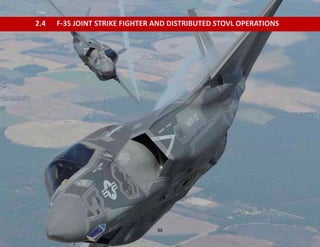
2.4 F-35 Joint Strike Fighter and Distributed STOVL Operations
2.5 Fixed-Wing Aviation
2.6 Tiltrotor Aviation
2.7 Rotary-Wing Aviation
2.8 Marine Unmanned Aircraft Systems
2.9 Marine Aviation Logistics
2.10 Marine Aviation Ground Support
2.11 Tactical Air Control Party
2.12 Science and Technology
2.13 Marine Aviation Training Systems
2.14 Marine Aviation Weapons and Munitions Plan
2.15 Aircraft Survivability Equipment Plan
2.16 Operational Support Airlift
Section 3 Marine Aviation Organization and Enterprise
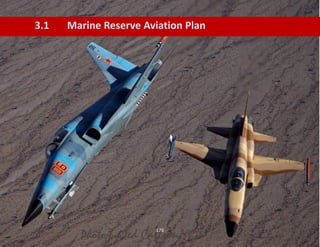
3.1 Marine Reserve Aviation Plan
3.2 Marine Helicopter Squadron One
3.3 Marine Operational Test and Evaluation Squadron One
3.4 Marine Aviation Weapons and Tactics Squadron One
3.5 Naval Aviation Enterprise
3.6 Aviation Training and Readiness Program
3.7 Headquarters Marine Corps Aviation Organizational Charts
3.8 Marine Aviation Manpower
Section 4 Marine Aviation Almanac
4.1 Platform Quick Reference “Quad” Charts
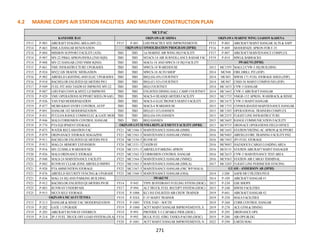
4.2 Marine Corps Air Station Facilities Upgrade / MILCON
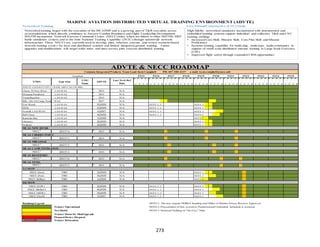
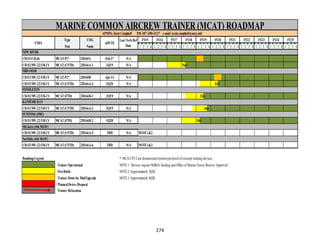
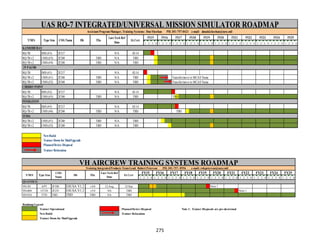
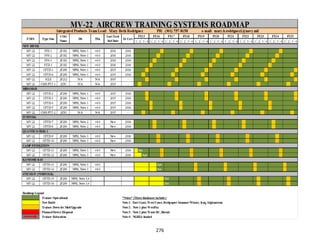
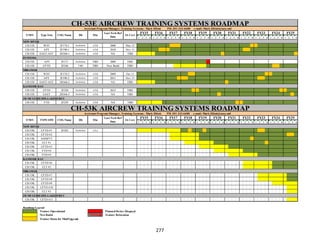
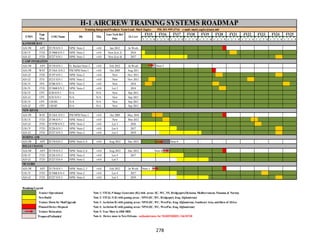
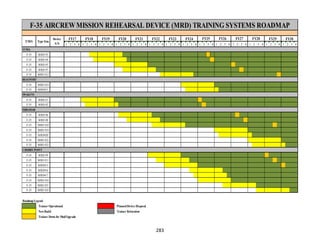
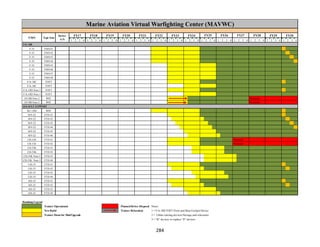
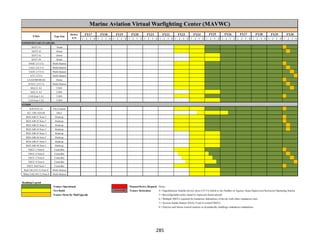
4.3 Aviation Training Systems Roadmap
SECTION ONE
MARINE CORPS OPERATIONS AND READINESS
1.1 Marine Corps Operating Concept
Marine Aviation and the MAGTF
1.2 Aviation Combat Readiness
RBA Recovery
Moving the Needle
Independent Readiness Reviews
6
1.1 MARINE CORPS OPERATING CONCEPT
In September 2016, the Commandant released the Marine Corps’ new
capstone operating concept, the Marine Corps Operating Concept, or MOC.
Recognizing the trends of the future operating environment and the changing
character of war, the Marine Corps developed 21st Century Maneuver Warfare
as its new operating concept to addresses future adversaries, threats and
challenges.
As we design and develop the capabilities and capacities necessary to execute
21st Century Maneuver Warfare, the future force must have the following
characteristics:
1) Naval- Contributes to deterrence, maritime security, sea control and power
projection
2) Expeditionary- Trained and equipped to operate in austere conditions and hostile
environments
3) Agile- Able to navigate the physical and cognitive dimensions of complex
situations and seize the initiative
4) Lethal- Uses combined arms, integrating and leveraging information warfare, to
destroy and defeat our enemies across the five domains (air, land, sea, space, and
cyberspace)
By designing this future force, the Marine Corps will be an integral part of the
naval, joint, and combined force: tailorable, flexible, versatile and capable of
responding to any crisis across the ROMO. As an integrated force, the Marine
Corps recognizes that Marines both contribute and benefit from unique and
complementary capabilities across the ROMO and all five domains.
“The 21st century MAGTF conducts maneuver warfare in the physical and
cognitive dimensions of conflict to generate and exploit psychological,
technological, temporal, and spatial advantages over the adversary. The
21st century MAGTF executes maneuver warfare through a combined arms
approach that embraces information warfare as indispensable for achieving
complementary effects across five domains – air, land, sea, space, and
cyberspace. The 21st century MAGTF avoids linear, sequential, and phased
approaches to operations and blends maneuver warfare and combined arms
to generate the combat power needed for simultaneity of action in its full
range of missions. The 21st century MAGTF operates and fights at sea, from
the sea, and ashore as an integrated part of the naval force and the larger
combined/joint force.”
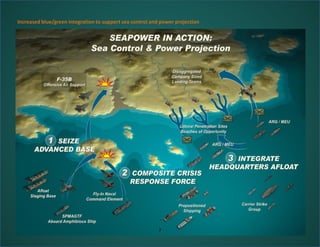
Increased blue/green integration to support sea control and power projection
7
1.1 MARINE AVIATION AND THE MAGTF
8
“The ACE affords the MAGTF the ability to deliver fires, facilitate integrated
command and control, enhance mobility and maneuver, provide force protection,
sustain combat power, and collect intelligence.”
MCWP 3-2, Aviation Operations
Current and Emerging Supporting Concepts
These concepts are nested and aligned with current and emerging joint and naval
concepts: joint operational access concept; joint concept for entry operations;
littoral operations in a contested environment; and expeditionary advanced base
operations.
Distributed Aviation Operations (DAO)
Background- In some regions, the proliferation of long-range, precision
conventional threats, such as advanced SAMS and cruise missiles and armed UAVs,
has contested the use of traditional bases and methods of operations. While
advances have been made to counter such threats, such as interdiction,
interception, and base hardening, the complexity of the problem and sheer
number of threats demands that more must be done. In traditional warfare mass
can be viewed as an asset however, in some scenarios mass, coupled with
predictability, is also a liability.
Concept- The aviation combat element (ACE) of the Marine Air Ground Task Force
(MAGTF) has the ability to conduct distributed aviation operations (DAO) in
support of land and/or naval campaigns. DAO is a task organized MAGTF
operation, employing ACE aircraft in a distributed force posture, independent of
specialized fixed infrastructure. Doctrinally, the ACE conducts these types of
operations from four types of forward operating bases (FOBs): main air base, air
facility, air site, and air point.5 FOBs are classified in relation to their size, location,
and characteristics in the form of airfield services, logistical supportability, and
maintenance capability.6 Benefits for conducting DAO include:
1) Increased operational reach
2) Increased capacity (compliment/supplement sea-based sortie generation)
3) Distributes and reduces overall risk in A2/AD environments
• Threats to traditional/established land-based air bases and sea-based aircraft carriers
• Highly mobile site: occupation/duration determined by threat
4) Economy of force options for major maneuver elements
5) Capitalizes on flexibility and surprise
5 U.S. Marine Corps, Aviation Ground Support, Marine Corps Tactical Publication (MCTP) 3-20B
(Quantico, VA: Marine Corps Combat Development Command, 2016), 3-2.
6 Ibid.
1.1 MARINE AVIATION AND THE MAGTF
Current and Emerging Supporting Concepts (Cont’d)
9
Distributed STOVL Operations (DSO)
Background- Distributed STOVL Operations is a subset of Distributed Aviation
Operations.
Concept
Distributed STOVL Operations maximizes the capabilities of STOVL aircraft and
expands basing options based on reduced runway requirements.7 DSO provides
the same benefits as Distributed Aviation Operations. Increased and
complementary basing options provide commanders with additional options to
leverage the F-35’s access, collection and strike capabilities.
Fifth generation STOVL aircraft launch from a sea base or land base to conduct
multiple missions, with fuel and ordnance resupply conducted at mobile forward
arming and refueling points (M-FARPS) located closer or within the operating area.
Aircraft return to the sea or land base at the conclusion of each flight day.
Complementing and enabling the M-FARPs is the mobile distribution site (MDS)
concept, a vehicle-mobile site located away from the M-FARP, intended to re-arm
and re-fuel the M-FARP while maintaining an element of deception and decoy.
DSO is sustainable using surface connectors, land-based MDSs and host nation
support, enabling readiness and sortie generation for the MAGTF.
The DSO concept/sites are scalable based on the objective, operational
environment and threat. DSO concept/site employment includes four major
types/options:
1) Air-Connected Mobile
2) Light Mobile
3) Medium Mobile
4) Heavy Mobile
While DSO provides another employment option for MAGTF, naval, or joint forces,
it may not be appropriate in every scenario. Employment of forces in a distributed
STOVL fashion requires operational considerations including logistical support,
command and control, and security.
7 U.S. Marine Corps, MAGTF F-35B Distributed Short Take-Off Vertical Landing (STOVL) Operations - DSO
Concept of Operations, (Washington, DC: Headquarters, Marine Corps Department of Aviation, Aviation
Plans and Policies, 1 February 2015).
8 Marine Attack Squadron 542 (VMA-542). Hunter Army Airfield Distributed STOVL Operations After
Action Report. Marine Corps Center For Lessons Learned Report (CDR 15154). Cherry Point, NC, May
2016.
1.1 MARINE AVIATION AND THE MAGTF
Current and Emerging Supporting Concepts (Cont’d)
10
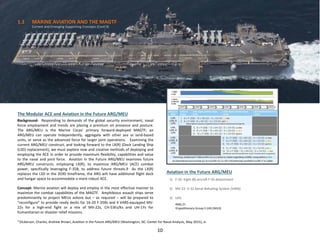
The Modular ACE and Aviation in the Future ARG/MEU
Background- Responding to demands of the global security environment, naval
force employment and trends are placing a premium on presence and posture.
The ARG/MEU is the Marine Corps’ primary forward-deployed MAGTF; an
ARG/MEU can operate independently, aggregate with other sea or land-based
units, or serve as the advanced force for larger joint operations. Examining the
current ARG/MEU construct, and looking forward to the LX(R) (Dock Landing Ship
(LSD) replacement), we must explore new and creative methods of deploying and
employing the ACE in order to provide maximum flexibility, capabilities and value
to the naval and joint force. Aviation in the Future ARG/MEU examines future
ARG/MEU constructs, employing LX(R), to maximize ARG/MEU (ACE) combat
power, specifically leveraging F-35B, to address future threats.9 As the LX(R)
replaces the LSD in the 2030 timeframe, the ARG will have additional flight deck
and hangar space to accommodate a more robust ACE.
Concept- Marine aviation will deploy and employ in the most effective manner to
maximize the combat capabilities of the MAGTF. Amphibious assault ships serve
predominantly to project MEUs ashore but – as required – will be prepared to
“reconfigure” to provide ready decks for 16-20 F-35Bs and 4 VARS-equipped MV-
22s for a high-end fight or a mix of MV-22s, CH-53Es/Ks and UH-1Ys for
humanitarian or disaster relief missions.
Aviation in the Future ARG/MEU
1) F-35- Eight (8) aircraft F-35 detachment
2) MV-22- V-22 Aerial Refueling System (VARS)
3) UAS
•MQ-21
•Expeditionary Group 5 UAS (MUX)
9 Dickerson, Charles, Andrew Brown, Aviation in the Future ARG/MEU (Washington, DC: Center for Naval Analysis, May 2015), vi.
1.1 MARINE AVIATION AND THE MAGTF
Current and Emerging Supporting Concepts (Cont’d)
11
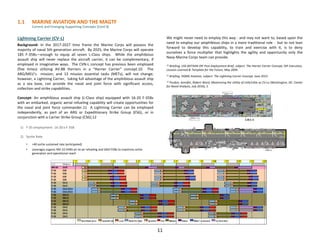
Lightning Carrier (CV-L)
Background- In the 2017-2027 time frame the Marine Corps will possess the
majority of naval 5th generation aircraft. By 2025, the Marine Corps will operate
185 F-35Bs—enough to equip all seven L-Class ships. While the amphibious
assault ship will never replace the aircraft carrier, it can be complementary, if
employed in imaginative ways. The CVN-L concept has previous been employed
(five times) utilizing AV-8B Harriers in a “Harrier Carrier” concept.10 The
ARG/MEU’s mission, and 13 mission essential tasks (METs), will not change;
however, a Lightning Carrier, taking full advantage of the amphibious assault ship
as a sea base, can provide the naval and joint force with significant access,
collection and strike capabilities.
Concept- An amphibious assault ship (L-Class ship) equipped with 16-20 F-35Bs
with an embarked, organic aerial refueling capability will create opportunities for
the naval and joint force commander.11 A Lightning Carrier can be employed
independently, as part of an ARG or Expeditionary Strike Group (ESG), or in
conjunction with a Carrier Strike Group (CSG).12
1) F-35 employment- 16-20 x F-35B
2) Sortie Rate
• +40 sortie sustained rate (anticipated)
• Leverages organic MV-22 VARS air-to-air refueling and DAO FOBs to maximize sortie
generation and operational reach
We might never need to employ this way - and may not want to, based upon the
need to employ our amphibious ships in a more traditional role - but to not lean
forward to develop this capability, to train and exercise with it, is to deny
ourselves a force multiplier that highlights the agility and opportunity only the
Navy-Marine Corps team can provide.
10 Briefing, USS BATAAN OIF Post-Deployment Brief, subject: The Harrier Carrier Concept, OIF Execution,
Lessons Learned & Template for the Future, May 2004.
11 Briefing, HQMC Aviation, subject: The Lightning Carrier Concept, June 2012.
12 Purdon, Jennifer, Robert Ward, Maximizing the Utility of LHA/LHDs as CV-Ls (Washington, DC: Center
for Naval Analysis, July 2016), 3.
12
1.1 MARINE AVIATION AND THE MAGTF
The Marine Corps provides unique capabilities to the naval and joint force and we are
manned, trained, equipped and funded appropriately.
MAGTF Digital Interoperability (Command and Control) - Digital interoperability is the seamless
integration of Marines, systems and exchange of data, across all domains and networks
throughout the MAGTF, naval, joint, and coalition forces in order to rapidly share accurate
information, provide greater situational awareness, accelerate kill-chains, and enhance
survivability. We continue to pursue integration and data exchange throughout the various
arenas; situational awareness, aircraft survivability, intelligence, surveillance, and
reconnaissance (ISR), fire support, and logistics. (CAC2S, G/ATOR, CTN)
MAGTF EW (Electronic Warfare, Fires) - MAGTF EW transitions the Marine Corps from a focus
on the low-density/high-demand EA-6B, to a distributed, platform-agnostic strategy - where
every platform contributes/ functions as a sensor, shooter and sharer - to include EW. Under
MAGTF EW the Marine Corps is integrating multiple aviation platforms (unmanned, fixed wing,
tiltrotor, and rotary wing assets); payloads; and ground-based EW nodes to provide
commanders with an organic and persistent EW capability. Airborne electronic attack (AEA)
capabilities post-EA-6B sundown will be provided by EW payloads such as the Intrepid Tiger II
EW pod, UAS EW payloads, and the EW capabilities inherent to F-35.
TACAIR (Access, Intelligence, Fires) - Fifth-generation aircraft combines low observability with
unprecedented targeting systems and expanded weapons capabilities, and will provide MAGTF
ground commanders with a fighter, attack and electronic warfare platform unlike any other.
Combining the on-board capabilities of the F-35B with the flexible basing options it provides will
create difficultly for enemy planners; further enhance MAGTF commanders' fires capabilities;
and enhance the fleet commander’s ability to provide sea control to the joint force commander.
Assault Support (Maneuver) - With the speed and range of the MV-22B and the CH-53K,
combined with the KC-130J, the MAGTF will have the ability to move Marines and equipment
further, faster and with higher situational awareness than ever before. MAGTF and joint force
commanders will take advantage of the speed and expanded flight ranges that our AH-1Z, UH-
1Y, MV-22 and CH-53K provide, in order to give battle – or not – at the times and places of their
choosing.
Expeditionary Aviation Enablers (Maneuver, Sustainment) - The expeditionary nature of
Marine Aviation, coupled with the operational demand to disaggregate, re-aggregate and/or
conduct distributed operations, requires the niche aviation capabilities inherent in our MWSS
and MALS. Our expeditionary aviation enablers, with their ability to provide modular and task-
organized units/capabilities , facilitate and sustain aviation readiness and generate combat
power.
1.2 AVIATION COMBAT READINESS
13
To be the nation’s force in readiness, the Marine Corps depends upon its aviation
arm. Marine Corps aviation must be trained, manned and equipped to provide
that “A in MAGTF” - to support operations plans and joint and ground force
commanders to give battle at the time and place of their choosing. This endstate
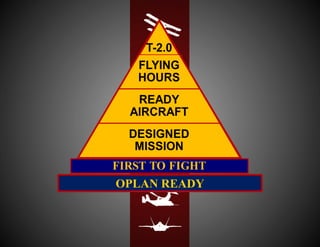
demands a 2.0 standard: a squadron equipped with up aircraft and with aircrew
trained to fly them in any clime and place.
1) We need to increase the amount of time our aviators spend in the air.
2) Our Marine aviators need more “looks at the ball” which equates to more flight time
and more time in the simulator.
The Core Competency Resource Model (CCRM) developed for each T/M/S
calculates the number of hours each pilot/WSO/ECMO (or crew) must fly, based
on the T&R manual, for a squadron to achieve the standards mandated for a
Training Level of 2.0.
T-2.0: Squadron ≥ 70% METS trained
Our legacy gear will be ready until we are done with it. Improving the material
readiness of our legacy gear—the key component to current readiness—is no easy
task, but we must do it.
1) T-Rating is derived from all squadrons’ reported T-Levels.
2) It is one of the primary assessment metrics for the naval aviation enterprise (NAE) to
determine whether squadrons have the resources to generate readiness.
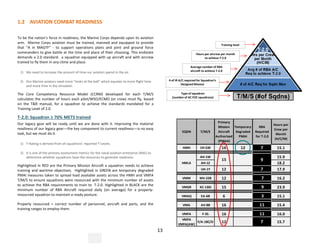
Highlighted in RED are the Primary Mission Aircraft a squadron needs to achieve
training and wartime objectives. Highlighted in GREEN are temporary degraded
PMAI measures taken to spread load available assets across the HMH and VMFA
T/M/S to ensure squadrons were resourced with the minimum number of assets
to achieve the RBA requirements to train to T-2.0. Highlighted in BLACK are the
minimum number of RBA Aircraft required daily (on average) for a properly-
resourced squadron to maintain a ready posture.
Properly resourced = correct number of personnel, aircraft and parts, and the
training ranges to employ them.
Hours per aircrew per month
to achieve T-2.0
Average number of RBA
aircraft to achieve T-2.0
Type of squadron
(number of AC FOC squadrons)
Training level
# of IR A/C required for Squadron’s
Designed Mission
SQDN T/M/S
Primary
Mission
Aircraft
Authorized
(PMAA)
Temporary
Degraded
PMAI
RBA
Required
for T-2.0
Hours per
Crew per
Month
(H/C/M)
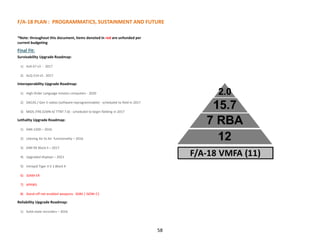
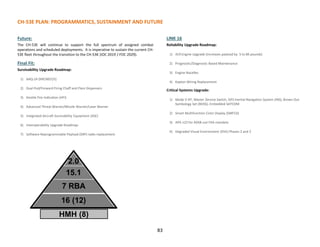
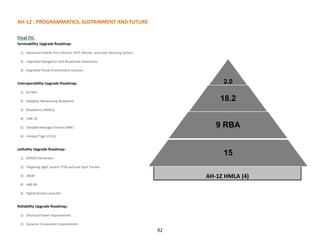
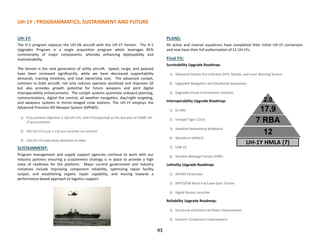
HMH CH-53E 16 12 7 15.1
AH-1W 15.9
AH-1Z 18.2
UH-1Y 12 7 17.9
VMM MV-22B 12  7 16.2
VMGR KC-130J 15  9 23.9
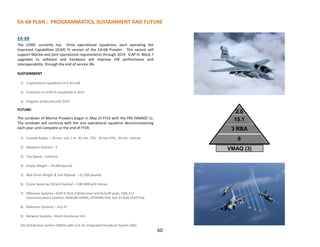
VMAQ EA-6B 6  3 15.1
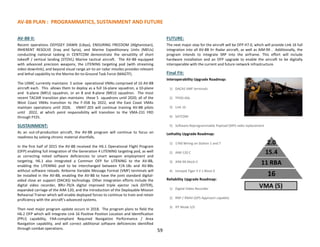
VMA AV-8B 16 11 15.4
VMFA F-35 16 11 16.0
15.7
HMLA
15 9
VMFA
VMFA(AW)
F/A-18C/D 12 10 7
1.2 RBA RECOVERY
14
RBA RECOVERY PLAN
After over a decade and a half of near surge operations for Marine Aviation,
combined with budget cuts, the Corps is currently 159 aircraft short to meet a T-
2.0 training goal and we are 45% short of the “up” aircraft we need to meet our
Title 10 responsibilities. To increase the number of Ready Basic Aircraft and build
the comprehensive strategies to recover our readiness to meet flight line
entitlement (FLE) warfighting requirements, we began a series of independent
readiness reviews (IRRs) to identify both the issues and the resources necessary to
turn this around. We have a POA&M to achieve our required readiness by type,
model and series.
INDEPENDENT READINESS REVIEWS
The Marine Corps conducted the first readiness review of AV-8B Harriers in 2014,
and followed with CH-53E Super Stallion in 2015 and MV-22B Osprey in 2016. H-1
IRR is in process this year. These reviews are intensive and dispassionate, and give
us an in-depth look at the issues and concerns in each community.
WHAT IMPROVEMENTS ARE BEING IMPLEMENTED
Future Readiness: The real key to reducing risk in capacity and recovering
readiness is in transition. Due to our aging fleet, we have to focus on both current
readiness while simultaneously recapitalize TACAIR with the F-35 B/C, completing
the H-1 transition, and soon initiate the transition to the CH-53K.
Current Readiness: Four main components surfaced within each IRR (with
different combinations in each Type/Model/Series): People, Parts, Process, and
Funding. The Marine Corps is tackling these components head-on and our
numbers are starting to trend up, with a full recovery planned for 2019 (as long as
we keep these initiatives funded and stay on track with recapitalization).
People: Ensuring the right people with the right training, leadership and skill sets
are in positions of authority and responsibility.
1) The Advanced Aviation Management Training (AAMT) Course and the Advanced
Maintenance Officer (AMO)Course initiatives are addressing this by providing skilled
leadership at the deck plates.
2) Promotions will be based on demonstrated skills, knowledge, and qualifications.
3) Additional MOSs to track qualified maintenance personnel.
4) The Marine Corps intends to employ targeted bonuses and proficiency pay to keep
our most qualified people.
Parts: From our newest fifth generation F-35B to our oldest legacy platforms, our
mission requires that we adequately fund our spare parts inventory. This detailed
focus on supply chain means parts at the right time and in the right places to fulfill
our readiness requirements. NMCS is debilitating and is our #1 casual factor for
low readiness in Marine Corps aviation.
Process: Remove barriers to readiness recovery in our in-service repairs and
depot backlogs (increasing throughput), and supply posture in our hangar decks
and maintenance departments.
We learned in the course of our DoN F/A-18 readiness recovery strategy and
three independent readiness reviews that no one solution fits all
type/model/series aircraft. We are beginning an aggressive, tailored, funded and
tracked roadmap to recover the readiness we need. We will hold our aviation
general and flag officers accountable for executing that recovery process –
beginning with the DCA.
Funding: Ensuring proper, sustained funding for legacy aircraft, flight hours and
spare parts, and for procurement of future aircraft and systems.
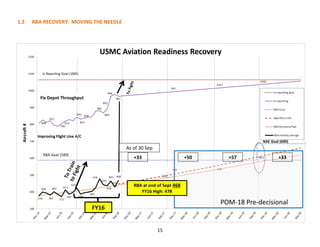
RBA at end of Sept 468
FY16 High: 478
+33 +50 +57 +33
As of 30 Sep
POM-18 Pre-decisional
NAE Goal (690)
506
613
FY16
1.2 RBA RECOVERY: MOVING THE NEEDLE
15
1.2 INDEPENDENT READINESS REVIEWS
16
HARRIER INDEPENDENT READINESS REVIEW (HIRR)
The Harrier Independent Readiness Review (HIRR) identified a cost-effective
strategy through the remainder of the Harrier platform's service life to produce a
daily 11 Ready Basic Aircraft average per squadron equivalent, and 15.4 flight
hours per pilot per month, in order to produce the required T-rating of 2.0.
The HIRR focused on three key areas, which were tied to aircraft
reporting status:
1) Out of reporting aircraft.
2) Manpower deficiencies and/or inefficiencies.
3) Supply.
HIRR output was tailored to two key areas for action:
1) Maintenance and material, which included RBA degraders, depot maintenance
timeline management, and supply system transition from Boeing to NAVSUP.
2) Manpower, which included both contract maintenance and USMC manpower.
Since the HIRR, we have:
1) Established 55 RBA in operational squadrons as the single driven fleet goal for
readiness.
2) Identified key degraders, and ensured that the supply chains for these parts are re-
energized.
3) Conducted executive-level engagement with all DOD agencies that have a supporting
relationship with the AV-8B program.
4) Conducted executive-level engagement with key vendors and OEMs, ensuring that
5) known deficiencies are being addressed.
6) Conducted a holistic analysis of the supply forecasting model for both the F402
engine and the air vehicle as a whole, resulting in improvements in the logistics
system.
7) Ensured that funding levels for Program Related Logistics and Program Related
Engineering are kept at acceptable levels.
8) Analyzed maintenance training
To date, we have seen an increase in readiness across the fleet; however, the
increase is lagging the HIRR forecast. HQMC Aviation, in concert with the TMS
lead (the MAG-14 commanding officer), is actively engaged at the executive level
with OEMs, vendors, and all DOD commands that have a supporting relationship
with the AV-8B program, in an effort to continue to increase readiness to meet our
readiness requirements. While readiness is lagging the forecast there has been a
marked improvement which has allowed us to more adequately meet out
readiness goals.
1.2 INDEPENDENT READINESS REVIEWS
17
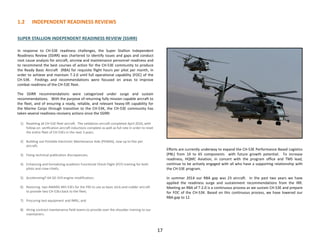
SUPER STALLION INDEPENDENT READINESS REVIEW (SSIRR)
In response to CH-53E readiness challenges, the Super Stallion Independent
Readiness Review (SSIRR) was chartered to identify issues and gaps and conduct
root cause analysis for aircraft, aircrew and maintenance personnel readiness and
to recommend the best courses of action for the CH-53E community to produce
the Ready Basic Aircraft (RBA) for requisite flight hours per pilot per month, in
order to achieve and maintain T-2.0 until full operational capability (FOC) of the
CH-53K. Findings and recommendations were focused on areas to improve
combat readiness of the CH-53E fleet.
The SSIRR recommendations were categorized under surge and sustain
recommendations. With the purpose of returning fully mission capable aircraft to
the fleet, and of ensuring a ready, reliable, and relevant heavy-lift capability for
the Marine Corps through transition to the CH-53K, the CH-53E community has
taken several readiness recovery actions since the SSIRR:
1) Resetting all CH-53E fleet aircraft. The validation aircraft completed April 2016, with
follow-on verification aircraft inductions complete as well as full rate in order to reset
the entire fleet of CH-53Es in the next 3 years.
2) Building out Portable Electronic Maintenance Aids (PEMAS), now up to five per
aircraft;
3) Fixing technical publication discrepancies;
4) Enhancing and formalizing academic Functional Check Flight (FCF) training for both
pilots and crew chiefs;
5) AcceleratingT-64-GE-419 engine modification;
6) Restoring two AMARG MH-53Es for the FRS to use as basic stick-and-rudder aircraft
to provide two CH-53Es back to the fleet;
7) Procuring test equipment and IMRL; and
8) Hiring contract maintenance field teams to provide over the shoulder training to our
maintainers.
Efforts are currently underway to expand the CH-53E Performance Based Logistics
(PBL) from 10 to 65 components with future growth potential. To increase
readiness, HQMC Aviation, in concert with the program office and TMS lead,
continue to be actively engaged with all who have a supporting relationship with
the CH-53E program.
In summer 2014 our RBA gap was 23 aircraft. In the past two years we have
applied the readiness surge and sustainment recommendations from the IRR.
Meeting an RBA of T-2.0 is a continuous process as we sustain CH-53E and prepare
for FOC of the CH-53K. Based on this continuous process, we have lowered our
RBA gap to 12.
1.2 INDEPENDENT READINESS REVIEWS
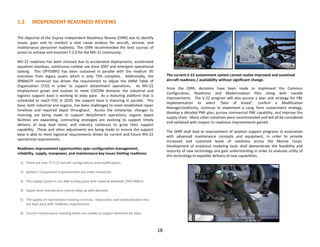
The objective of the Osprey Independent Readiness Review (OIRR) was to identify
issues, gaps and to conduct a root cause analysis for aircraft, aircrew, and
maintenance personnel readiness. The OIRR recommended the best courses of
action to achieve and maintain T-2.0 for the MV-22 community.
MV-22 readiness has been stressed due to accelerated deployments, accelerated
squadron standups, continuous combat use since 2007 and emergent operational
tasking. This OPTEMPO has been sustained in parallel with the medium lift
transition from legacy assets which is only 75% complete. Additionally, the
SPMAGTF construct has driven the requirement to adjust the VMM Table of
Organization (T/O) in order to support detachment operations. As MV-22
employment grows and evolves to meet COCOM demand, the industrial and
logistics support base is working to keep pace. As a maturing platform that is
scheduled to reach FOC in 2020, the support base is maturing in parallel. This
base, both industrial and organic, has been challenged to meet established repair
timelines and required depot throughput. Across the enterprise, changes to
manning are being made to support detachment operations, organic depot
facilities are expanding, contracting strategies are evolving to support timely
delivery of long lead items, and industry continues to grow their support
capability. These and other adjustments are being made to ensure the support
base is able to meet logistical requirements driven by current and future MV-22
operational requirements.
Readiness improvement opportunities span configuration management,
reliability, supply, manpower, and maintenance key issues limiting readiness:
1) There are over 77 V-22 aircraft configurations and modifications
2) System / Component improvements are under-resourced
3) The supply system is not able to keep pace with material demands (34% NMCS)
4) Depot-level maintenance cannot keep up with demand
5) The quality of maintenance training curricula, maturation, and standardization has
not kept pace with readiness requirements
6) Current maintenance manning levels are unable to support demands for labor
The current V-22 sustainment system cannot realize improved and sustained
aircraft readiness / availability without significant change.
Since the OIRR, decisions have been made to implement the Common
Configuration, Readiness and Modernization Plan along with nacelle
improvements. The V-22 program will also pursue a plan and strategy for PBL
Implementation to select “best of breed”, confirm a Modification
Manager/authority, continue to implement a Long Term sustainment strategy,
develop a detailed PMI plan, pursue commercial PMI capability, and improve the
supply chain. Many other initiatives were recommended and will all be considered
and validated with respect to readiness improvements gained.
The OIRR shall lead to improvement of aviation support programs in association
with advanced maintenance concepts and equipment, in order to provide
increased and sustained levels of readiness across the Marine Corps.
Development of analytical modeling tools shall demonstrate the feasibility and
maturity of new technology and gain understanding in order to evaluate utility of
this technology to expedite delivery of new capabilities.
18
OPLAN READY
20
SECTION TWO
EXPEDITIONARY AVIATION PROGRAMS AND CONCEPTS
2.1 Marine Digital Interoperability
2.2 Marine Electronic Warfare
2.3 Marine Aviation Command and Control System
2.4 F-35 Joint Strike Fighter and Distributed STOVL Operations
2.5 Fixed-Wing Aviation
2.6 Tiltrotor Aviation
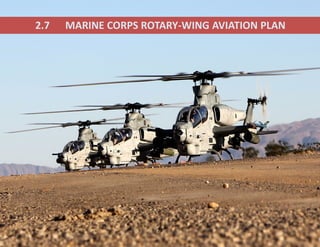
2.7 Rotary-Wing Aviation
2.8 Marine Unmanned Aircraft Systems
2.9 Marine Aviation Logistics
2.10 Marine Aviation Ground Support
2.11 Tactical Air Control Party
2.12 Science & Technology
2.13 Marine Aviation Training Systems
2.14 Marine Aviation Weapons and Munitions
2.15 Marine Aircraft Survivability Equipment
2.16 Marine Operational Support Aircraft
MEU Construct
2.1 MAGTF DIGITAL INTEROPERABILITY
21
MAGTF Digital Interoperability (DI)
Digital interoperability is the seamless integration of systems and exchange of
data, across all domains and networks throughout the MAGTF, naval, joint, and
coalition forces, to include communication in degraded or denied environments,
to rapidly share accurate information, provide greater situational awareness,
accelerate the kill chain, and enhance survivability.
The interoperability goal is to provide the required information to the right
participants at the right time, in order to ensure mission success, while improving
efficiency and effectiveness. This approach provides the additional advantage of
responsible spectrum use, which becomes increasingly important as spectrum
demands increase, as technology advances, and our MAGTFs continually operate
in more distributed and disaggregated manners. We continue to pursue
integration and data exchange throughout the various arenas: situational
awareness; aircraft survivability; intelligence, surveillance, and reconnaissance
(ISR); fire support; and logistics.
Vison – In order to validate our concepts, Marine aviation has adopted an
“integration through innovation and experimentation” disruptive innovation
approach to enhance the MAGTF. This approach attempts to couple existing and
emerging technologies and integrate them into mission threads to assess their
operational viability inside of large scale MAGTF exercises i.e., MAWTS-1 Weapons
and Tactics Instructor course, IOC Talon Reach exercises, MCWL MIX’s, and VMX
early integration opportunities. The inclusion of emerging technologies within
mission threads offers several benefits, which include the refinement of existing
requirements and validation of the concepts leading to formal requirements
generation.
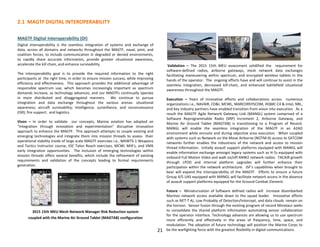
2015 15th MEU Mesh Network Manager Risk Reduction system
coupled with the Marine Air Ground Tablet (MAGTAB) configuration
Validation – The 2015 15th MEU assessment solidified the requirement for
software-defined radios, airborne gateways, mesh network data exchanges
facilitating maneuvering within spectrum, and encrypted wireless tablets in the
hands of the operator. The ongoing efforts have and will continue to assist in the
seamless integration, decreased kill-chain, and enhanced battlefield situational
awareness throughout the MAGTF.
Execution – Years of innovative efforts and collaborations across numerous
organizations i.e., NAVAIR, CD&I, MCWL, MARCORSYSCOM, HQMC C4 & Intel, NRL,
and key industry partners have enabled transition from vision into execution. As a
result the MAGTF Agile Network Gateway Link (MANGL) system comprised of a
Software Reprogrammable Radio (SRP) Increment 2, Airborne Gateway, and
Marine Air Ground Tablet (MAGTAB) is transitioning to a Program of Record.
MANGL will enable the seamless integration of the MAGTF in an A2AD
environment while enroute and during objective area execution. When coupled
with systems such as Network on the Move Airborne (NOTM-A) access to SATCOM
networks further enables the robustness of the network and access to mission
thread information. Initially assault support platforms equipped with MANGL will
enable information exchange amongst legacy systems such as H-1s equipped with
onboard Full Motion Video and walk on/off ANW2 network radios. TACAIR growth
through LPOD and internal platform upgrades will further enhance their
participation within the network architecture. JSF’s capabilities when brought to
bear will expand the interoperability of the MAGTF. Efforts to ensure a future
Group 4/5 UAS equipped with MANGL will facilitate network access in the absence
of assault support platforms equipped for the Ground Combat Element.
Future – Miniaturization of Software defined radios will increase disembarked
Marines network access available down to the squad leader. Innovative efforts
such as NET-T AJ, Low Probably of Detection/Intercept, and data clouds remain on
the horizon. Sensor fusion through the existing program of record Minotaur seeks
to consolidate the shared platform information automating sensor collaboration
for the operator interface. Technology advances are allowing us to use spectrum
more efficiently and effectively in the areas of frequency, time, space, and
modulation. The adoption of future technology will position the Marine Corps to
be the warfighting force with the greatest flexibility in digital communications.
22
TTNT
Link-16
COMMON DATA
LINK (CDL)
ANW2
SATCOM/HPW
VMF
BCDL
AV-8B
RadBn
FMV
LHD/ LX
(R)
Enemy
Rein
Enemy
LPD
LSD
Gateway
Aircraft
117G
117G
117G
117G
117G
117G
Gateway
Aircraft
LPOD
Joint CAS
Aircraft
IT-II
117G
117G/SIR
2.5
Assault
Force
w/ JFO
SIR 2.5
117G/SIR
2.5
R&S
H-60
FMV
Enemy
117G
117G
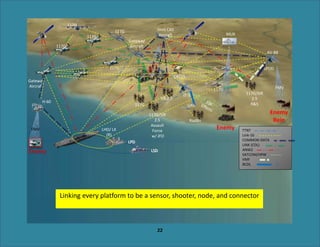
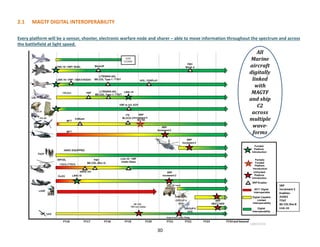
Linking every platform to be a sensor, shooter, node, and connector
CAC2S
MUX
UAS
2.1 MAGTF DIGITAL INTEROPERABILITY
23
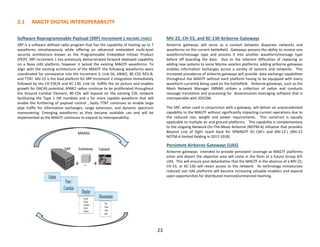
Software Reprogrammable Payload (SRP) Increment 2 AN/ARC-254(C)
SRP is a software defined radio program that has the capability of hosting up to 7
waveforms simultaneously while offering an advanced embedded multi-level
security architecture known as the Programmable Embedded Infosec Product
(PEIP). SRP Increment 1 has previously demonstrated forward deployed capability
on a Navy UAS platform, however it lacked the existing MAGTF waveforms. To
align with the existing architecture of the MAGTF the following waveforms were
coordinated for conveyance into the Increment 2; Link-16, ANW2, BE-CDL REV-B,
and TTNT. MV-22 is the lead platform for SRP Increment 2 integration immediately
followed by the CH-53E/K and KC-130. Link-16 fulfills the air picture and enables
growth for DACAS potential, ANW2 radios continue to be proliferated throughout
the Ground Combat Element, BE-CDL will expand on the existing CDL network
facilitating the Type 1 ISR mandate and a far more capable waveform that will
enable the furthering of payload control , lastly TTNT continues to enable large
pipe traffic for information exchanges, range extension, and dynamic spectrum
maneuvering. Emerging waveforms as they become available can and will be
implemented as the MAGTF continues to expand its interoperability.
MV-22, CH-53, and KC-130 Airborne Gateways
Airborne gateways will serve as a conduit between disparate networks and
waveforms on the current battlefield. Gateways possess the ability to receive one
waveform/message type and process it into another waveform/message type
before off boarding the data. Due to the inherent difficulties of replacing or
adding new systems to some Marine aviation platforms, adding airborne gateways
enables information exchanges across a variety of systems and networks. This
increased prevalence of airborne gateways will provide data exchange capabilities
throughout the MAGTF without each platform having to be equipped with every
waveform currently being used on the battlefield. Airborne gateways, such as the
Mesh Network Manager (MNM) utilizes a collection of radios and conducts
message translation and processing for dissemination leveraging software that is
interoperable with SOCOM.
The SRP, when used in conjunction with a gateway, will deliver an unprecedented
capability to the MAGTF without significantly impacting current operations due to
the reduced size, weight and power requirements. This construct is equally
applicable to multiple air and ground platforms. This capability is complementary
to the ongoing Network-On-The-Move Airborne (NOTM-A) initiative that provides
Beyond Line of Sight reach back for SPMAGTF KC-130’s and MV-22’s (MV-22
NOTM-A limited fielding in 2017-1018).
Persistent Airborne Gateways (UAS)
Airborne gateways intended to provide persistent coverage as MAGTF platforms
enter and depart the objective area will come in the form of a future Group 4/5
UAS. This will ensure post debarkation that the MAGTF in the absence of a MV-22,
CH-53, or KC-130 will retain access to the network. As technology miniaturizes
reduced size UAS platforms will become increasing valuable enablers and expand
upon opportunities for distributed manned/unmanned teaming.
SRP TablettGateway
MANGL
24
2.1 MAGTF DIGITAL INTEROPERABILITY
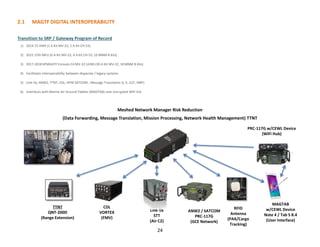
Transition to SRP / Gateway Program of Record
1) 2014-15 VMX (1 A Kit MV-22, 1 A Kit CH-53)
2) 2015 15th MEU (6 A Kit MV-22, 4 A Kit CH-53, 10 MNM B Kits)
3) 2017-2018 SPMAGTF Enroute C4 MV-22 UUNS (30 A Kit MV-22, 18 MNM B Kits)
4) Facilitates interoperability between disparate / legacy systems
5) Link-16, ANW2, TTNT, CDL, HPW SATCOM , Message Translation (J, K, CoT, VMF)
6) Interfaces with Marine Air Ground Tablets (MAGTAB) over encrypted WiFi link
Meshed Network Manager Risk Reduction
(Data Forwarding, Message Translation, Mission Processing, Network Health Management) TTNT
TTNT
QNT-200D
(Range Extension)
CDL
VORTEX
(FMV)
Link-16
STT
(Air C2)
ANW2 / SATCOM
PRC-117G
(GCE Network)
MAGTAB
w/CEWL Device
Note 4 / Tab S 8.4
(User Interface)
PRC-117G w/CEWL Device
(WiFi Hub)
RFID
Antenna
(PAX/Cargo
Tracking)
25
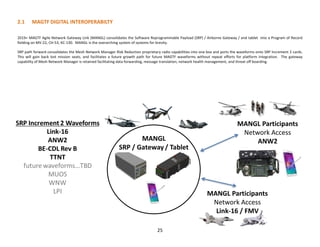
2019+ MAGTF Agile Network Gateway Link (MANGL) consolidates the Software Reprogrammable Payload (SRP) / Airborne Gateway / and tablet into a Program of Record
fielding on MV-22, CH-53, KC-130. MANGL is the overarching system of systems for brevity.
SRP path forward consolidates the Mesh Network Manager Risk Reduction proprietary radio capabilities into one box and ports the waveforms onto SRP Increment 2 cards.
This will gain back lost mission seats, and facilitates a future growth path for future MAGTF waveforms without repeat efforts for platform integration. The gateway
capability of Mesh Network Manager is retained facilitating data forwarding, message translation, network health management, and threat off boarding.
2.1 MAGTF DIGITAL INTEROPERABILTY
MANGL Participants
Network Access
ANW2
MANGL Participants
Network Access
Link-16 / FMV
26
2.1 MAGTF DIGITAL INTEROPERABILITY
Tablets
Android tablets continue to be the most effective way to deliver secure
consolidated information to aircrew and embarked Marines. New aviation
platforms come with highly integrated and complex operating systems that
require years of development and testing prior to fielding. While necessary,
this process is typically both time-consuming and costly. In many cases,
incorporation of a federated tablet offers the aircrew or embarked Marines
with new and relevant information while awaiting modification to the aircraft
operating systems.
This method of integration also allows for rapid modification to a particular
application without significant regression testing to determine the impact on
the aircrafts systems. Industry and general aviation have been successfully
employing this model for years. Wireless Android tablets integrated with
airborne gateway capabilities will enable our ground forces participation
enroute with aircrew collaborative planning and objective area real time
updates.
Marine Air Ground Tablets (MAGTABs)
The MAGTAB was sourced on the 2015 15th MEU, SPMAGTF, TACDEMO’s, and
Talon Reach as a scalable capability for information consolidation and display
for the aircrew operator as well as embarked Marines. While awaiting a fully
networked and classified Electronic Kneeboards (EKB) under the PMA-281
Program of Record which is intended to be interoperable with the Marine
Corps Common Handheld in work under MARCORSYSCOM the MAGTAB and
Encrypted WiFi Links will continue limited fielding facilitating scalable
integration into systems such as Airborne Gateways. The MAGTAB and
Encrypted WiFi Link is covered with an Authority to Operate (ATO) that
capitalizes on the KNOX security container capability afforded by the Android
operating system. Applications such as RFID, ExChecks, Timeline, and Kinetic
Integrated Lightweight Software Individual Tactical Combat Handheld
(KILSWITCH) are some of the mission related applications that have continued
to be enablers.
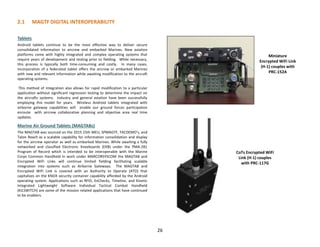
Miniature
Encrypted WiFi Link
(H-1) couples with
PRC-152A
CoTs Encrypted WiFi
Link (H-1) couples
with PRC-117G
27
2.1 MAGTF DIGITAL INTEROPERABILITY
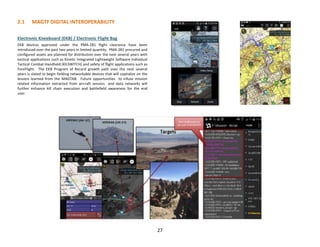
Electronic Kneeboard (EKB) / Electronic Flight Bag
EKB devices approved under the PMA-281 flight clearance have been
introduced over the past two years in limited quantity. PMA-281 procured and
configured assets are planned for distribution over the next several years with
tactical applications such as Kinetic Integrated Lightweight Software Individual
Tactical Combat Handheld (KILSWITCH) and safety of flight applications such as
ForeFlight. The EKB Program of Record growth path over the next several
years is slated to begin fielding networkable devices that will capitalize on the
lessons learned from the MAGTAB. Future opportunities to infuse mission
related information extracted from aircraft sensors and data networks will
further enhance kill chain execution and battlefield awareness for the end
user.
28
2.1 MAGTF DIGITAL INTEROPERABILITY
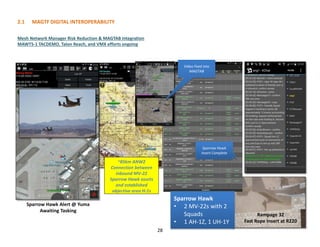
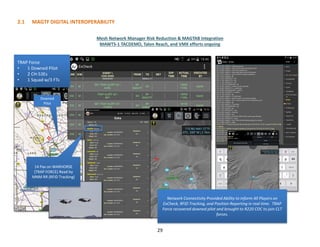
Mesh Network Manager Risk Reduction & MAGTAB Integration
MAWTS-1 TACDEMO, Talon Reach, and VMX efforts ongoing
Sparrow Hawk
Insert Complete
~85km ANW2
Connection between
inbound MV-22
Sparrow Hawk assets
and established
objective area H-1s
Sparrow Hawk Alert @ Yuma
Awaiting Tasking
Sparrow Hawk
Insert Complete
Video Feed into
MAGTAB
Sparrow Hawk
• 2 MV-22s with 2
Squads
• 1 AH-1Z, 1 UH-1Y
Rampage 32
Fast Rope Insert at R220
29
2.1 MAGTF DIGITAL INTEROPERABILITY
Mesh Network Manager Risk Reduction & MAGTAB Integration
MAWTS-1 TACDEMO, Talon Reach, and VMX efforts ongoing
14 Pax on WARHORSE
(TRAP FORCE) Read by
MNM RR (RFID Tracking)
Downed
Pilot
TRAP Force
• 1 Downed Pilot
• 2 CH-53Es
• 1 Squad w/3 FTs
Network Connectivity Provided Ability to Inform All Players on
ExCheck, RFID Tracking, and Position Reporting in real time. TRAP
Force recovered downed pilot and brought to R220 COC to join CLT
forces.
30
2.1 MAGTF DIGITAL INTEROPERABILITY
Every platform will be a sensor, shooter, electronic warfare node and sharer – able to move information throughout the spectrum and across
the battlefield at light speed.
2.2 MAGTF ELECTRONIC WARFARE
31
MAGTF EW MISSION:
Support the MAGTF commander by conducting electronic warfare, day or night,
under all weather conditions during expeditionary, joint, or combined operations.
Increase combat survivability of ground forces, assault support and strike aircraft
and weapons by denying, degrading, and disrupting the enemy’s ability to target
and engage our forces.
FUTURE INITIATIVES:
The Marine Corps is continuing to build an organic and distributed electronic
warfare system of systems known as MAGTF EW. MAGTF EW transitions the
Marine Corps from a focus on the low-density/high-demand EA-6B, to a
distributed, platform-agnostic strategy – where every platform contributes/
functions as a sensor, shooter and sharer – to include EW. Under MAGTF EW the
Marine Corps is leveraging emerging technologies and integrating multiple
aviation platforms (unmanned, fixed wing, tiltrotor, and rotary wing assets);
payloads; ground-based EW nodes; and cyber capabilities to provide commanders
with an organic and persistent EW capability – for every MAGTF – large and small.
Airborne electronic attack (AEA) capabilities post-EA-6B sundown will be provided
by EW payloads such as the Intrepid Tiger II EW pod, UAS EW payloads, and the
EW capabilities inherent to F-35.
This integration of manned and unmanned airborne and ground EW capabilities
will provide the MAGTF commander with greater flexibility and control of the
electromagnetic spectrum – and in many cases giving that MAGTF commander a
capability where previously they had none. MAGTF EW assets will be modular,
scalable, and networked, utilizing an open architecture that is rapidly adaptable
and remotely re-programmable at the tactical level to support future Marine
Corps warfighting requirements.
32
2.2 MAGTF ELECTRONIC WARFARE
UAS are a planned critical component of the MAGTF EW concept. As such, the
requirement for developing and maintaining Aviation specific EW expertise
that is historically resident within the VMAQ community will over time become
resident in the VMU community. The VMU community will begin to grow EW
expertise “from the ground up” as capabilities are developed and procured. A
payload for the MQ-21 is funded beginning in FY18; this will lay the foundation
for further expansion as the Marine Corps moves towards a Group 4/5 UAS
capability.
MAGTF EW AEA CAPABILITIES:
Intrepid Tiger II (IT-II): Precision EW pod providing organic distributed and net-
centric AEA capability.
EOC of IT-II pod in OEF conducted in 2012
Approved Acquisition Objective (AAO): 136 total pods
1) Deployed on AV-8B and F/A-18A++/C/D aircraft, KC-130J in development
2) Deployed on UH-1Y (EOC FY16), AH-1Z (Future)
3) Additional future IT-II platforms: MV-22B, CH-53K
4) Radar AEA variant of IT-II in development (Block X)
UAS Payloads:
1) EW Payload for RQ-21 in development, production in FY20-21
2) Proposed EW Payload for MUX in mid 2020s
F-35: Expansion of inherent JSF EW capabilities and target sets
2.3 MARINE AIR COMMAND AND CONTROL SYSTEM (MACCS) PLAN
33
2.3 MARINE AIR COMMAND AND CONTROL SYSTEM (MACCS) PLAN
Marine Air Command and Control System Overview
Command and control is the means by which a commander recognizes what needs
to be done and sees to it that appropriate actions are taken. It includes collecting
and analyzing information, resource management, planning, communicating
instructions, monitoring results, making decisions, supervising execution and
making assessments. The Marine Air Command and Control System (MACCS)
serves as the catalyst to the timely employment of Marine aviation assets,
effective combined arms, and enabling MAGTF freedom of action throughout the
battle space. The MACCS structure embodies the Marine Corps belief that:
No activities in war are more important than command and control. Through command and control,
the commander recognizes what needs to be done and sees to it that appropriate actions are taken…it
provides purpose and direction to the varied activities of a military unit. If done well, command and
control add to the strength of a force.
-Marine Corps Doctrinal Publication 1-0, 2011
The MACCS provides the aviation combat element (ACE) commander with the
agencies and assets necessary to exercise aviation command and control (AC2)
and air defense in support of the MAGTF, naval, and joint operations. These
agencies provide the ACE commander with the ability to execute the six functions
of Marine aviation.
The MACCS is greater than the sum of its parts, a cohesive system made up of units from
throughout the Marine Air Control Group (MACG). The MAGTF’s structure, and our
training, allows Marines to enjoy decentralized control of both ground and air forces
providing greater flexibility and efficiency on the battlefield. Our philosophy is unique,
resulting in closely integrated aviation and ground fires, reconnaissance, and other
operations into an overall scheme of maneuver allowing for successful mission
accomplishment. This seamless integration is accomplished and provided by the MACCS
and only exists when all of the MACCS agencies are on the battlefield and expertly
coordinating with their joint counterparts interpreting, integrating, and coordinating the
MAGTF battle plan into the joint battle.
Aviation command and control affords the MAGTF commander the most lethal and
responsive form of fire support available on the battlefield. Logistics occurs more rapidly
and targets are identified and destroyed well before friendly ground forces come in contact
with them. Efficient AC2 enhances safety of flight, giving the aviator an opportunity to assist
when needed or direct where required, ultimately working collectively to accomplish the
mission and satisfy the MAGTF commander’s intent. An example of efficient AC2 are
Operations IRAQI FREEDOM and ENDURING FREEDOM, where the MACCS functioned as a
system. Greater efficiency and flexibility were realized, resulting in swift action from
Marine aviation. Dynamic re-tasking of missions quickly supported rapid changes in
battlefield events. Aircraft were diverted to trouble spots as needed within minutes.
Further, ground-based fire support was requested, air cleared, and missions fired near
simultaneously.
Since 2001, our current systems and organization construct have proven successful during
combat operations. Looking into the future, the Marine Corps is rebalancing to support
increasingly dispersed operations by smaller, task-organized forces over ever-greater
distances. The fielding of CAC2S, and TPS-80 combined with CTN will allow the MACCS to
employ additional C2 nodes over a greater geographical area. The MACCS must examine
its organizational and training pillars to maximize capacity to support an increasingly
distributed MAGTF.
The MACG commander must be able to employ task-organized AC2 nodes capable of
providing task-organized MACCS capabilities supporting military operations. These agencies
will be highly expeditionary and capable of seamless expansion based on evolving
situations. There will also be a focused effort to support forces afloat. We will re-engage
with the Navy and recommend where integration of command arrangements and control
functions may provide a more cooperative and integrated blue/green solution for the AC2
of MAGTF assets afloat.
The MACCS is greater than the sum of its parts, a cohesive system made up of units from
throughout the Marine Air Control Group (MACG). The MAGTF’s structure, and our
training, allows Marines to enjoy decentralized control of both ground and air forces
providing greater flexibility and efficiency on the battlefield. Our philosophy is unique,
resulting in closely integrated aviation and ground fires, reconnaissance, and other
operations into an overall scheme of maneuver allowing for successful mission
accomplishment. This seamless integration is accomplished and provided by the MACCS
and only exists when all of the MACCS agencies are on the battlefield and expertly
coordinating with their joint counterparts interpreting, integrating, and coordinating the
MAGTF battle plan into the joint battle.
34
2.3 MARINE AIR COMMAND AND CONTROL SYSTEM (MACCS) PLAN
35
The future MACCS will be expeditionary; able to operate in a distributed manner;
capable of fusing and integrating MAGTF AC2, sensor and weapons data across the
joint force to provide shared situational awareness and increase the decision space
for the MAGTF commander. Because of the unique position as the integrator
between the ACE and GCE, the MACCS must ensure the ability to bridge divergent
communication efforts within the MAGTF and joint force by providing beyond line-
of-sight (BLOS) tactical data links (TDLs), data forwarding, radio relay, tactical
gateways, and ground-based air defense (GBAD) capable of engaging low RCS
targets. This vision will be realized with the fielding of CAC2S phase II, TPS-80,
CTN and future GBAD weapons systems:
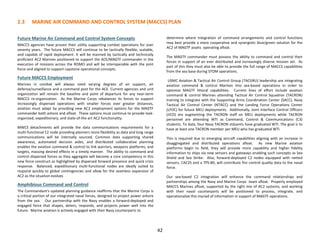
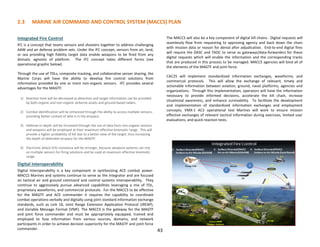
Common Aviation Command and Control System (CAC2S) – will fuse weapons and
sensor data into a single integrated display, and serve as the integrator and
gateway of waveforms between the ACE and GCE. This will be a tool for the MEF
commander to see and shape his battlespace.
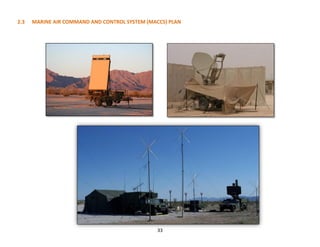
AN/TPS-80 Ground/Air Task Oriented Radar (G/ATOR) is a 3-D, medium range
radar that gives the MAGTF commander unparalleled detection within their AO
while also providing fire control quality data supporting Integrated Fire Control
(IFC) concepts.
Composite Tracking Network (CTN) – is a land-based version of the US Navy's
(USN) Cooperative Engagement Capability (CEC) which is a fused radar network
providing shared sensor quality data between the Marine Corps & Navy.
Directed Energy (DE) – Directed Energy (DE) – provides game changing capabilities
versus the low observable/low radar cross section (LO/LRCS) threat when
integrated with CAC2S, TPS-80, and CTN. DE provides a low shot cost, deep
magazine, precision accuracy, speed of light engagement solution for knocking
down hostile UAS IEDs as well as hostile ISR UASs supporting indirect fires
threatening both our Marines in the field and our high value aircraft on the ramp.
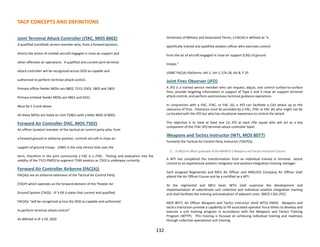
The most critical resource in the MACCS is the individual Marine. As we transition
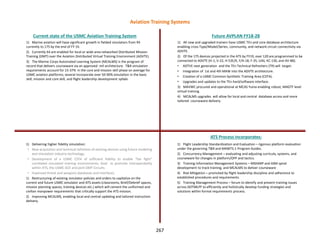
to a common set of equipment, new operational concepts, and operations in
complex battle spaces, we must transition to a training paradigm that provides
baseline knowledge for all AC2 operators to excel. The goal for MACCS operators
is to become air command and control experts who will assist the commanders
and decision makers in receiving and interpreting operational information and
translating this information into effective direction and control for the platforms
operated by Marine aviation.
The primary missions for our tactical agencies will remain intact throughout our
MACCS modernization. As new common sets of equipment are fielded, the ability
to employ future hybrid options becomes relevant. For example, the clearance
requirements for extended range munitions have made knowledge of the ground
situation and MAGTF fires critical for all MACCS agencies. The proliferation and
persistent presence of UAS and civilian aircraft through the AO have highlighted
the fact that all MACCS agencies need an air picture. Integration with special
operations forces and the increased capabilities of new MAGTF platforms, such as
the F-35 and MV-22, will enable hybrid employment options for the MACCS as we
modernize and align our equipment and personnel.
Marine Air Traffic Control (MATC), normally focused upon airspace requirements
in and around the airfield, has become more involved in the clearance of fires and
the safe integration of new platforms and UAS into operational airspace. Recent
history has also shown the need for the ACE to protect HVAs. This mission
requires the close coordination and digital integration of MATC and the Low
Altitude Air Defense (LAAD) Battalion.
2.3 MARINE AIR COMMAND AND CONTROL SYSTEM (MACCS) PLAN
Tactical Air Command Center
The TACC provides the MAGTF with the ability to plan and execute an air tasking
order (ATO) in direct support of the MAGTF, integrate with the joint force, and
seamlessly absorb the support of coalition forces through its flexible design. The
TACC will provide the functional interface for employment of MAGTF aviation in
joint and multinational operations.
Tactical Air Operations Center
The TAOC distributes the air picture to the MAGTF and joint commands while
controlling deep air support, aerial refueling and anti-air-warfare (AAW)
operations and routing itinerant aircraft. Newly fielded systems have transformed
the TAOC into a highly mobile AC2 agency. With the completed fielding of the
CTN, the TAOC will share date with the Navy’s Cooperative Engagement Capability
(CEC) network where it will exchange high fidelity radar track data. The combined
capabilities of CAC2S, CTN and the future TPS-80 have put the TAOC at the
forefront of force protection for the MAGTF.
Direct Air Support Center
The DASC is the critical link between the ACE and GCE within the MACCS. During
OEF/OIF operations, the DASC has continued to conduct its core mission of
processing immediate requests for air support and has also expanded its ability to
control ever increasing and complex volumes of airspace. With the fielding of
CAC2S Phase I, the DASC now has a standard set of equipment for a near real-time
air picture used to enhance situational awareness and increase safety of flight in
the assigned airspace.
Marine Air Traffic Control
MATC detachments provide all-weather air traffic control services to friendly
aircraft operating in support of the MAGTF or within their assigned airspace. The
continued development of the highly expeditionary ATNAVICS has ensured MATC’s
ability to meet mission requirements across the range of military operations
(ROMO) with increasing interoperability and functionality as an AC2 node within
the MACCS, until fielding of future systems.
Meteorological and Oceanographic
The Meteorological and Oceanographic (METOC) section, resident in the Marine
Air Control Squadron, is tasked-organized to provide direct support to the ACE. It
is equipped to support a variety of MAGTF deployments and operations. With the
fielding of the Meteorological Mobile Facility (Replacement) Next Generation
[METMF(R) NEXGEN], the METOC section has become a highly maneuverable
capability that provides environmental products and mission impact assessments
to the MAGTF commander and is currently being employed in support of
SPMAGTF CC-CR. Additionally, METOC Support Teams (MST), sourced from either
the MACS or the intelligence battalion, will utilize the stand-alone Naval Integrated
Tactical Environment Subsystem Variant (IV) (NITES IV) to provide expeditionary
METOC support to forward operating bases (FOBs), Marine Expeditionary Units
and Special Purpose MAGTFs.
Low Altitude Air Defense Battalion
Low Altitude Air Defense Battalion – The LAAD Bn’s capability to provide air and
ground defense of airbases and MAGTF HVAs in an evolving battlespace is a critical
tool for the ACE commander to meet force protection and AAW responsibilities.
LAAD Bns have successfully conducted ground defense of FOBs and security force
(SECFOR) tasks during OEF/OIF for over a thirteen year period. The SECFOR tasks
included internal and external security along with tactical recovery of aircraft and
personnel (TRAP), and training of Indigenous and coalition forces in
counterinsurgency operations. In the future, the LAAD Bn will leverage defense
innovation and technologies to provide three dimensional SECFOR capabilities to
defeat an adversary’s threat to destroy MAGTF HVAs.
Marine Wing Communication Squadron
MWCSs will continue to be in demand for data pathways between ACE, MAGTF,
and joint/coalition elements. The MWCS incorporates numerous systems ranging
from single-channel radio to systems with an emphasis on interoperability and
BLOS communications for a broad spectrum of information services. These
services include video, multimedia, data, and imagery which enable the ACE with a
reliable communications architecture.
36
37
2.3 MARINE AIR COMMAND AND CONTROL SYSTEM (MACCS) PLAN
Aviation Command and Control Family of Systems
As we look to the future, the strategy to modernize the MACCS is synchronized with the arrival of our new, key platforms. The speed, range, and operational flexibility of the
MV-22, and the firepower and electromagnetic spectrum dominance of the F-35B are new capabilities the MACCS, via its own advances, must fully exploit for the MAGTF
commander. The AC2 family of systems (FoS) provides key material enablers that are on track to field to the operating forces and to modernize the ACE. The AC2 FoS is a set
of related, scalable, and modular systems, which the MACCS can arrange or interconnect in various configurations to provide different capabilities. The mix of systems can be
tailored to provide desired capabilities, dependent on the situation or mission assigned. The AC2 FoS includes the CAC2S, CTN, TPS-80 G/ATOR, and TPS-59 long-range radar.
Command and Control Systems
Common Aviation Command and Control System
CAC2S is the foundational command and control system of the future AC2 FoS. Increment 1 of CAC2S replaces equipment used by the TACC, TAOC, and DASC. Increment 1 is
being developed and fielded in two phases:
1) Phase 1 replaced equipment in the DASC and is employed in conjunction with the Mobile TAOM in the TAOC. The TACC received improved communications capability from Phase 1 by
upgrading the AN/MRQ-12v4 to the MRQ-13. CAC2S Phase 1 has completed fielding twenty systems.
2) Phase 2 completes the development and fielding of Increment 1 by including sensor integration and data fusion. Data fusion is accomplished through combining real-time sensor data
(TPS-59, TPS-80, external sensors via a sensor network) correlating tactical data links (TDLs) and associating non-real time track data (TBMCS, AFATDS, IOS) in order to develop and display
an integrated tactical picture. The result is an integrated situational display that can be manipulated by an operator to effectively command and control air operations. Phase 2 will also
translate GCE waveforms (K-Series messages) into ACE (Link 16) waveforms. CAC2S’s ability to translate these messages will increase situational awareness and information exchange
throughout the MAGTF. CAC2S phase 2 fields common software and hardware to the TACC, TAOC, and DASC providing a modular and scalable capability across the MACCS.
The size and capability of these agencies will vary based on mission requirements. The future concept of employment for CAC2S is to create operational facilities capable of
performing any AC2 function within the MACCS. The CAC2S Phase 2 Aviation Command and Control System (AC2S) will integrate the signal data element (UGS-4B) of CTN as
its sensor interface and utilize the CTN antenna trailer to link into the network.
Composite Tracking Network
CTN is a land-based version of the USN's Cooperative Engagement Capability (CEC), which is a radar network that exchanges fire quality radar data between the Marine Corps
& Navy. CTN/CEC is the primary network that will enable future Integrated Fire Control (IFC) capabilities that will provide multiple engagement solutions for MAGTF & Navy
weapons systems. Specifically, CTN will extend USN Sea Shield/Sea Strike concepts inland by providing fire quality data to Aegis beyond its fire control radar. This accurate
high rate data can provide the Navy with an opportunity to expand Aegis engagement solutions that protect the sea-base and sustain combat forces ashore. CTN will be
employed with organic MACCS air defense radars ensuring a fused radar picture within the operational environment. Current Authorized Acquisition Objective (AAO) of ten
systems has completed fielding.
38
2.3 MARINE AIR COMMAND AND CONTROL SYSTEM (MACCS) PLAN
Theater Battle Management Core System
TBMCS is a Joint Chiefs of Staff- mandated air war planning tool for the generation, dissemination and execution of air tasking orders and airspace coordination. TBMCS is the
primary system utilized for airspace command and control, assault support processing and execution, and provides the ACE commander the ability to support the Joint Force
Air Component Commander (JFACC). In the future, TBMCS is programmed to be replaced by the Command and Control Air Operations Suite - Command and Control
Information Services (C2AOS-C2IS). This program is intended to develop, field, and sustain modular net-centric command and control applications and web-enabled
information that will allow operators to plan and execute joint air operations.
2.3 MARINE AIR COMMAND AND CONTROL SYSTEM (MACCS) PLAN
39
SENSORS
AN/TPS-80 Ground/Air Task Oriented Radar
TPS-80 is a highly expeditionary, medium range multi-role radar able to detect
smaller radar cross section targets, such as cruise missiles, rockets, artillery, and
mortars (CRAM), UAS, and aircraft. TPS-80’s expeditionary multi-role capabilities
represent the next generation in ground radar technology and will provide greater
accuracy, detection, target classification, and performance against new and
evolving threats and enemy countermeasures. TPS-80 is being developed and
fielded to cover both aviation and ground missions and will replace three in-
service legacy systems. Each TPS-80 block consists of common hardware with
different software applications that can be adjusted to pace the threat for
decades.
TPS-80 Block I Air Surveillance Radar will provide the MACCS with a real-time
display of all medium range air activity. Its ability to detect LO/LRCS targets will
provide early warning and enhance force protection. TPS-80 Block I track data will
interface with CAC2S and augment other sensor data to create a single composite
track within the CTN/CEC network, improving opportunities for engagement of
airborne threats. In the littoral combat zone, it will enhance force protection for
USN Sea Shield/Sea Strike concepts by providing target cueing and early warning
through the CTN/CEC network. Fielding will begin for TPS-80 Block 1 in FY18 with
all seventeen systems fielded by FY24.
TPS-80 Block II replaces the GCE’s AN/TPQ-46 and will provide counter battery
target acquisition and detection for CRAM. TPS-80 Block II, known as the Ground
Weapons Locator Radar (GWLR), will be capable of 90 or 360 degrees of coverage
while extending range and increasing accuracy when compared to currently
fielded counter battery/fire finder radars.
TPS-80 Block IV Expeditionary Airport Surveillance Radar (EASR) is the ASR
replacement for ATNAVICS. This radar will provide a common ASR radar within the
MACCS and bring MATC fully into the MAGTF digital interoperable network. This
will provide the MAGTF commander the interoperability required to support a
Base Defense Zone (BDZ) with longer range surveillance, increased TDL
integration, weapons cueing, IFC, and MATC integration within the National
Airspace System (NAS) and International Civil Aviation Organization (ICAO) ATC
Systems.
AN/TPS-59 Long Range Radar
The improved TPS-59v3 radar provides the MAGTF and joint force with an
expeditionary long range radar capable of ballistic missile detection. Currently the
only MAGTF sensor that contributes composite track data to CTN/CEC networks
and integrates with CAC2S. TPS-59 provides the MAGTF with the ability to control
its airspace and conduct IAMD operations.
Marine Air Traffic Control Systems
The MATC equipment portfolio is a system of systems (SoS) that supports
expeditionary MATC from liaisons to the MATC Mobile Team (MMT) up through
multiple main airbases (MAB) in sustained operations. This SoS includes MATC
command, control, and communications (C3); towers; navigational aids (NAVAIDS);
and air traffic control (ATC) radars.
MATC Towers
The AN/TSQ-120C expeditionary ATC tower will be modernized into an
expeditionary tower system (ETS) that is lighter, more mobile, and scalable, with
the AN/TSQ-216 Remote Site Landing Tower (RSLT), to meet the range of military
operations, and maximizes use of existing infrastructure. The mobilization of the
TSQ-120C down shelter, combined with Tower Remoting Kits, provides the MATC
Detachment with the flexibility and mobility necessary to maximize the use of
available resources.
MATC Navigational Aids
The Legacy AN/TRN-44 TACAN is being replaced by the AN/TRN-47 v(2) Airfield
Mobile TACAN (AMTAC), a trailer-mounted system that maintains current
capability while reducing size, weight, logistical requirements and setup time. The
AMTAC will provide navigational assistance and non-precision approach capability
in a GPS denied environment. While the AN/TRN-47 remains a viable mobile
TACAN for static operations, future developments will see a one man initial entry
Navigational Aid, designed to provide initial terminal guidance during the early
phases of a campaign, or while establishing short duration landing sites or points.
40
2.3 MARINE AIR COMMAND AND CONTROL SYSTEM (MACCS) PLAN
AN/TPN-31A Air Traffic Navigation, Integration, and Coordination System
ATNAVICS is the fielded Airport Surveillance Radar (ASR) and Precision Approach Radar (PAR) for the MATC detachments. ATNAVICS will bridge expeditionary MATC to the
TPS-80 Block IV. As a bridging system, all modernization efforts in ATNAVICS are focused on MATC mission essential tasks (METs) including radar range extension to 60
nautical miles and fielding of the AN/TYQ-164 ATNAVICS Data Link System (ADLS) to support two-way TDL information exchange.
MATC Future Systems
The future MATC detachment will have CAC2S combined with TPS-80 Block IV. This will provide the MAGTF with state-of-the-art capability to launch and recover aircraft,
while contributing to the integrated air defense system by providing accurate track data to future GBAD weapons systems. Additional capabilities will be gained in providing
access to data communications down to the smallest of MATC capabilities. This will provide those elements the necessary interconnectivity for information exchange to the
most remote points and sites.
Precision Approach Landing Capability Roadmap
Future precision approach capabilities will be GPS based. The Joint Precision Approach Landing System (JPALS) program was initially going to produce this system, but was
dramatically scaled back to shipboard systems only. For the Marine Corps, this will provide a precision capability on all LHA and LHD amphibious ships to support the F-35B,
and on all carriers to support the F-35C. Marine aviation will leverage maturing GPS technology to bring a self-contained precision approach landing capability (PALC) to
MATC that is worldwide deployable.
METMF(R) NEXGEN
The METOC sensing equipment is the Meteorological Mobile Facility (Replacement) Next Generation [METMF(R) NEXGEN]. The METMF(R) NEXGEN is a mobile, fully
integrated, FORCENet compliant, tactical meteorological support system which delivers relevant, timely METOC products and mission impact assessments to the MAGTF and
joint force as required. The NEXGEN is a comprehensive environmental sensor capable of employing a Doppler weather radar, receiving weather satellite imagery, launching
weather balloons to receive upper-air data and predicting expeditionary airfield local weather.
When employed as a standalone sensor and production capability, the METMF(R) NEXGEN’s organic NOWCAST program downloads the Navy Global Environmental Model,
current alphanumeric and area of responsibility upper-air data to produce an initialized weather depiction. When both NIPR and SIPR are available, the METMF(R) NEXGEN
operates as a reach-back system, utilizing both national and international weather information which allows the MAGTF commander the ability to exploit environmental
information in support of combat and combat support operations.
Weapons
No existing system has demonstrated an inherent robust end to end capability against the LO/LRCS and LSS air threat-but a combination of several capabilities could reduce
the threat by neutralizing or destroying hostile UASs and CMs before and after launch. Marine Corps air defense is in the initial phases of defeating these threats by
transitioning to an improved Integrated Air and Missile Defense (IAMD) family of system while continuing to provide integrated, low-altitude, Ground Based Air Defense
(GBAD) and ground security of MAGTF HVAs.
41
2.3 MARINE AIR COMMAND AND CONTROL SYSTEM (MACCS) PLAN
The GBAD Initial Capabilities Document (ICD) was signed by the Assistant Commandant of the Marine Corps (ACMC) and identifies gaps and the required capabilities of the
Stinger Missile replacement system. The GBAD ICD identifies the primary threat to the MAGTF as the LO/LRCS UAS. The secondary threats are: Fixed Wing (F/W), Rotary
Wing (R/W), and CM.
The UAS and CM threat has outpaced the current program of record, the Stinger missile. In order to fill this capability gap and reverse current air defense kinetic strategy, the
Marine Corps intends to invest in non-kinetic (Directed Energy) and improved kinetic (missiles and guns) technologies that create a cost-exchange ratio that favors the
MAGTF and increases counter UAS and CM capabilities. The overall GBAD strategy to close all capability gaps will be accomplished in three phases:
1) Phase I: Field a roll-on, roll-off capability to detect, track, and exploit and/or destroy Group 1 UASs for MEUs, SPMAGTFs, and dismounted operations.
2) Phase II: Field non-kinetic/kinetic capabilities vs CMs, UASs, manned FW/RW aircraft in static defense of HVA such as main air bases and Division–level COCs.
3) Phase III: Field non-kinetic capabilities vs UAS, and manned FW/RW aircraft OTM in defense of maneuver force.
The LAAD Gunner will also transition from using the human eye to detect, identify, and engage targets to engagements that occur beyond visual range (BVR) to defeat the
asymmetric air and ground threats using organic/non-organic fire control quality data to protect HVAs. This data provides the LAAD Gunner with the situational awareness to
monitor and understand the air/ground battle space and evaluate friendly, enemy and neutrals that are in range of the future GBAD Weapon System. This requires the
ability to share, exchange, and correlate fused information and sensor data across multiple agencies to facilitate real time coordination, collaboration, and decision making;
therefore, we must leverage current investments in sensors and C2:
1) Sensor investment: TPS-80 G/ATOR provides the MAGTF with the increased ability to accurately detect smaller radar cross section air threats when compared to legacy systems.
2) C2 investment: Common Aviation Command and Control System (CAC2S) and Composite Tracking Network (CTN) provide integration into netted and distributed fire control architecture.
2.3 MARINE AIR COMMAND AND CONTROL SYSTEM (MACCS) PLAN
42
Future Marine Air Command and Control System Concepts
MACCS agencies have proven their utility supporting combat operations for over
seventy years. The future MACCS will continue to be tactically flexible, scalable,
and capable of rapid deployment. It will be manned by tactically and technically
proficient AC2 Marines positioned to support the ACE/MAGTF commander in the
execution of missions across the ROMO and will be interoperable with the joint
force and aligned to support capstone operational concepts.
Future MACCS Employment
Marines in combat will always need varying degrees of air support, air
defense/surveillance and a command post for the ACE. Current agencies and unit
organization will remain the baseline and point of departure for any near-term
MACCS re-organization. As the Marine Corps rebalances its forces to support
increasingly dispersed operations with smaller forces over greater distances,
aviation must adapt by providing new AC2 employment options for the MAGTF
commander both ashore and afloat. These options must continue to provide task-
organized, expeditionary, and state-of-the-art AC2 functionality.
MWCS detachments will provide the data communications requirements for a
multi-functional C2 node providing planners more flexibility as data and long range
communications will be internally sourced. Common data supporting shared
awareness, automated decision aides, and distributed collaborative planning
enables the aviation command & control to link warriors, weapons platforms, and
targets, massing desired effects in a timely manner. The ability to command and
control dispersed forces as they aggregate will become a core competency in this
new force construct as highlighted by dispersed forward presence and quick crisis
response. Balanced, expeditionary multi-functional nodes are ideally suited to
respond quickly to global contingencies and allow for the seamless expansion of
AC2 as the situation evolves
Amphibious Command and Control
The Commandant's updated planning guidance reaffirms that the Marine Corps is
a critical portion of our integrated naval forces, designed to project power ashore
from the sea. Our partnership with the Navy enables a forward-deployed and
engaged force that shapes, deters, responds, and projects power well into the
future. Marine aviation is actively engaged with their Navy counterparts to
determine where integration of command arrangements and control functions
may best provide a more cooperative and synergistic blue/green solution for the
AC2 of MAGTF assets operating afloat.
The MAGTF commander must possess the ability to command and control their
forces in support of an ever distributed and increasingly diverse mission set. As
part of this they must also be able to provide the full range of MACCS capabilities
from the sea base during STOM operations.
USMC Aviation & Tactical Air Control Group (TACGRU) leadership are integrating
aviation command & control Marines into sea-based operations in order to
optimize MAGTF littoral capabilities. Current lines of effort include aviation
command & control Marines attending Tactical Air Control Squadron (TACRON)
training to integrate with the Supporting Arms Coordination Center (SACC), Navy
Tactical Air Control Center (NTACC) and the Landing Force Operations Center
(LFOC) for future MEU deployments. Additionally, Joint Interface Control Officers
(JICO) are augmenting the TACRON staff on MEU deployments while TACRON
personnel are attending WTI as Command, Control & Communications (C3)
students. To date, four Navy TACRON stduents have graduated WTI. The goal is to
have at least one TACRON member per MEU who has graduated WTI.
This is required due to emerging aircraft capabilities aligning with an increase in
disaggregated and distributed operations afloat. As new Marine aviation
platforms begin to field, they will provide more capability and higher fidelity
information to ships via new sensors and gateways enabling such concepts as Sea
Shield and Sea Strike. Also, forward-deployed C2 nodes equipped with netted
sensors, CAC2S and a TPS-80, will contribute fire control quality data to the naval
force.
Our sea-based C2 integration will enhance the command relationships and
partnerships among the Navy and Marine Corps team afloat. Properly employed
MACCS Marines afloat, supported by the right mix of AC2 systems, and working
with their naval counterparts will be positioned to process, integrate, and
operationalize this myriad of information in support of MAGTF operations.
2.3 MARINE AIR COMMAND AND CONTROL SYSTEM (MACCS) PLAN
43
Integrated Fire Control
IFC is a concept that teams sensors and shooters together to address challenging
AAW and air defense problem sets. Under the IFC concept, sensors from air, land,
or sea providing high fidelity target data enable weapons to be fired from any
domain, agnostic of platform. The IFC concept takes different forms (see
operational graphic below):
Through the use of TDLs, composite tracking, and collaborative sensor sharing, the
Marine Corps will have the ability to develop fire control solutions from
information provided by one or more non-organic sensors. IFC provides several
advantages for the MAGTF:
1) Reaction time will be decreased as detection and target information can be provided
by both organic and non-organic airborne assets and ground-based radars.
2) Combat identification will be enhanced through the ability to access multiple sensors,
providing better context of who is in the airspace.
3) Defense-in-depth will be increased through the use of data from non-organic sensors
and weapons will be employed at their maximum effective kinematic range. This will
provide a higher probability of kill due to a better view of the target, thus increasing
the depth of defended airspace for the MAGTF.
4) Electronic attack (EA) resistance will be stronger, because weapons systems can rely
on multiple sensors for firing solutions and be used at maximum effective kinematic
range.
Digital Interoperability
Digital interoperability is a key component in synthesizing ACE combat power.
MACCS Marines and systems continue to serve as the integrator and are focused
on tactical air and ground command and control systems interoperability. They
continue to aggressively pursue advanced capabilities leveraging a mix of TDL,
proprietary waveforms, and commercial protocols. For the MACCS to be effective
for the MAGTF and ACE commander it requires the capability to coordinate
combat operations verbally and digitally using joint standard information exchange
standards, such as Link 16, Joint Range Extension Application Protocol (JREAP),
and Variable Message Format (VMF). The MACCS is the gateway for the MAGTF
and joint force commander and must be appropriately equipped, trained and
employed to fuse information from various sources, domains, and network
participants in order to achieve decision superiority for the MAGTF and joint force
commander.
The MACCS will also be a key component of digital kill chains. Digital requests will
seamlessly flow from requesting to approving agency and back down the chain
with mission data or reason for denial after adjudication. End-to-end digital fires
will require the DASC and TAOC to serve as gateways/data-forwarders for these
digital requests which will enable the information and the corresponding tracks
that are produced in this process to be managed. MACCS agencies will bind all of
the elements of the MAGTF and joint force.
CAC2S will implement standardized information exchanges, waveforms, and
commercial protocols. This will allow the exchange of relevant, timely and
actionable information between aviation, ground, naval platforms, agencies and
organizations. Through this implementation, operators will have the information
necessary to provide informed decisions, accelerate the kill chain, increase
situational awareness, and enhance survivability. To facilitate the development
and implementation of standardized information exchanges and employment
concepts, VMX-1 AC2 operational test Marines will work to ensure mission
effective exchanges of relevant tactical information during exercises, limited user
evaluations, and quick reaction tests.
2.3 MARINE AIR COMMAND AND CONTROL SYSTEM (MACCS) PLAN
VMX-1 Operational Test and Evaluation and Tactics, Techniques,
and Procedures Development
In July 2013, DCA established a consolidated Marine Aviation Operational Test &
Evaluation Center at MCAS Yuma to provide a single source multi-platform USMC
aviation operational test center that can optimize the development of ACE tactics,
techniques, and procedures (TTPs). The VMX-1 AC2 Department was established
as part of that effort. In concert with APX, MAWTS-1, MCSC, MCOTEA and the
operating forces, the VMX-1 AC2 department will assist in the conduct of
operational test and evaluation (OT&E) to ensure mission integration and
effectiveness of aviation platforms with MACCS equipment and other aviation
technologies across the force. The coordinated efforts of VMX-1 and MAWTS-1
define and refine employment concepts and TTP development that drives
system/platform evaluation and digital interoperability throughout the aviation
community.
Marine Air Command and Control System Training
Historically, the MACCS has trained in narrow specialties that develop specialized
Marines to operate and maintain unique systems developed to carry out specific
MACCS functions. As technology changes and more responsibility is levied on
MACCS Marines by commanders, there is a demand that we modernize our
training approach. The desire is to produce entry level Marines that can exploit
the full capabilities of their AC2 system and execute process driven information
exchanges.
Once in the operating forces, Marines will become experts in planning and
controlling MAGTF airspace, integrating organic Marine and joint fires, employing
TDL and radio communications, and employing MACCS agencies, and will be
trained to operate in a joint and coalition environment. This expertise comes with
a cost and requires a new emphasis on distributed learning capability, live-virtual-
constructive (LVC) environments, and standards-based assessments.
A common set of equipment and new MACCS employment options will also drive
us to look at the feasibility of a common controller in the DASC and TAOC.
Currently, controllers in the DASC are officers and a majority of controllers in the
TAOC are enlisted operators. Enlisted MACCS Marines will retain agency-specific
skill sets early in their careers and then transition to becoming common aircraft
controllers and finally to become MACCS specialists later in their careers. To do
this we will need to greatly enhance our simulation capabilities and usage in the
operating forces and in the supporting establishment.
The first step in this process was the creation of the Air Control Training Squadron
(ACTS) at Marine Corps Communications Electronic School (MCCES) at MCAGCC
Twentynine Palms, California. ACTS has successfully combined three of the four
MACCS entry-level schoolhouses. The next steps will be to redesign enlisted and
officer training to address these new training paradigms.
Officers
We envision our entry-level training paradigm creating MACCS officers who
understand all facets of MACCS employment, not just that of their primary MOS.
In addition to learning their primary MOSs in air defense, air support, GBAD or
MATC, all MACCS officers will receive instruction in civil/military airspace, fires
integration, digital interoperability, planning and employment of the MACCS
agencies, and instruction in joint and coalition operations. This shifts the emphasis
of company-grade officers away from initial controller qualifications and re-focuses
them as agency directors and planners. This creates a more well-rounded AC2
officer much earlier in their careers, and better prepares them to perform duties
in the TACC as well as their primary agency. This early exposure would also
enhance an officer’s knowledge baseline as they approach their duties as
department heads. Most importantly it will empower our MACCS officers to
operate independently in a distributed operations environment.
44
2.3 MARINE AIR COMMAND AND CONTROL SYSTEM (MACCS) PLAN
Enlisted
Early in their careers our enlisted Marines will hone their skills as operators in the
specific agency for which they were initially trained. CAC2S provides the
opportunity to be trained as common aircraft controller or a data link coordinator
to work in the DASC, TAOC, or potentially, a future MEU based light, mobile Air C2
element . A move toward creating a more efficient operator will baseline skills
across the MACCS and provide a larger pool of capability that gives greater
professional continuity for an extremely perishable skillset. The ideal skillset we
will build is:
1) the ability to positively and procedurally control aircraft;
2) an intimate knowledge of TDL, AC2 software applications, and communications
equipment; and
3) expertise in MAGTF command and control and fires integration.
The career progression for a Marine in the DASC or TAOC will logically flow from
operator (Private - Corporal), to controller (Sergeant – Gunnery Sergeant), to
enlisted subject matter expert (Master Sergeant – Master Gunnery Sergeant).
This progression aligns and better defines the career paths of our TAOC and DASC
Marines. It also creates a better operator for the TACC because of their exposure
to different aspects of the MACCS prior to working in the wing commander’s
command post which is an extension of the MEF commander’s. Our enlisted
Marines are the technical and tactical bedrock of our community and we need to
ensure that we are making the best training available to them through all phases
of their careers.
Maintenance Training
Just as the lines between the agencies have been blurred with the introduction of
new equipment, so have the maintenance concepts for the equipment. As
technology has advanced, troubleshooting has shifted from the traditional
component-level to the lowest replaceable unit. Additionally, almost every piece
of modernized equipment is software- and network-driven. The complexity of
modernized equipment forces maintainers to take an active role in the setup,
configuration, operation, and maintenance of this equipment.
Maintenance officers, as restricted officers, will be crucial to transitioning to new
equipment and training by providing the subject matter expertise allowing
operators to successfully employ their weapons system. The enlisted maintainer
of the future will have to be agile enough to adapt to the potential for rapid
changes in capabilities and system implementation amongst this AC2 FoS, and will
be required to be as competent in basic data link implementation as operators.
The synchronization between the roles of the operators, maintainers, and tactical
users will continue to allow the MACCS to be successful in all future missions.
45
46
2.4 F-35 JOINT STRIKE FIGHTER AND DISTRIBUTED STOVL OPERATIONS
47
F-35 DESCRIPTION
The F-35 is the next generation strike weapons system designed to meet an
advanced threat, while improving lethality, survivability, and supportability. It will
be the cornerstone of a multi-mission joint force possessing improved mission
flexibility and unprecedented effectiveness to engage and destroy both air and
ground threats.
The F-35 was developed using a complete analysis of legacy aircraft shortfalls,
emerging threats, and consideration of future operating locations. This approach
led to an aircraft design that incorporates advanced stealth characteristics and a
powerful sensor suite that provides superior awareness to the pilot and ensures
increased survivability and lethality in all environments.
The F-35 has an autonomous capability to strike a broad range of moving or fixed
targets, either day or night and in adverse weather conditions. These targets
include air and ground threats, as well as enemy surface units at sea and anti-ship
or land attack cruise missiles. The F-35 can complete the entire kill chain without
reliance on external sources by using fused information from its onboard systems
and/or other F-35s. This capability allows shortened engagement times, less
exposure to threats, and retains the element of surprise.
Together these elements allow the pilot to control the tactical environment using
proactive tactics. The F-35 provides sensor data to Marine Air-Ground Task Force
command and control agencies to enable intelligence collection and targeting
across the force.
Transition Plan
The F-35B and F-35C will replace F/A-18, AV-8B and EA-6B. The Marine Corps will
procure a total of 353 F-35Bs and 67 F-35Cs in the following squadron bed down:
1) 9 Squadrons x 16 F-35B
2) 5 Squadrons x 10 F-35B
3) 4 Squadrons x 10 F-35C
4) 2 Squadrons x 10 F-35B reserve
5) 2 Squadrons x 25 F-35B FRS
The Marine Corps declared F-35B initial operational capability in July of 2015, five
months ahead of the December threshold date. At IOC, the squadron underwent
an operational readiness inspection proving that it met the requirements with ten
aircraft in the Block 2B configuration. The squadron demonstrated the capability
to execute CAS, limited offensive and defensive counter-air, air interdiction, air
support escort, armed reconnaissance, and limited suppression of enemy air
defenses.
The aircraft is currently tracking to reach its full program-of-record operational
capability (Block 3F) in Q4 of CY 2017. The full transition from legacy to F-35 will
complete with the transition of the second reserve squadron in 2031.
2.4 F-35B AND F-35C LIGHTNING II
F-35 VMFA
2.0
16
11 RBA
16
F-35 VMFA (-)
2.0
16
7 RBA
10
16- plane F-35B squadron 10- plane F-35B squadron
2.4 F-35B AND 35C LIGHTNING
48
USMC F-35C INITIAL OPERATIONAL CAPABILITY (Expeditionary
Operations):
The F-35C IOC is defined as:
1) One squadron with a threshold of 6 F-35C and an objective of 10 F-35C aircraft with
required spares, support equipment, tools, technical publications, and a functional
Autonomic Logistic Information System (ALIS V2) including enabling peripherals.
2) Squadron manned with trained and certified personnel capable of conducting
autonomous operations.
3) Aircraft in a Block 3iP6.21 software configuration or better with the requisite
performance envelope, mission systems, sensors, and weapon clearances.
4) Home base supporting infrastructure and facilities ready and capable of supporting
and sustaining operations.
5) Qualifications and certifications for deploying the F-35C to austere expeditionary sites
and conducting landings using M-31 Expeditionary Arresting Gear.
6) Ability to execute close air support, offensive and defensive counter air, air
interdiction, assault support escort, armed reconnaissance, and suppression of enemy
air defense missions in concert with Marine Air Ground Task Force resources and
capabilities within the performance envelope, mission systems, sensors, and weapon
clearances provided by the Block 3iP6.21 fleet release or better.
7) Naval aviation enterprise (NAE), Joint Program Office (JPO) and contractor
procedures, processes, and infrastructure capable of sustaining operations of the IOC
squadron.
FY17 TACAIR LEGACY TO JSF TRANSITION PLAN
49
F-35 BASING PLAN
IWAKUNI
1 x 16 AC SQDN
(16 aircraft)
MIRAMAR
4 x 10 AC SQDN
1 x 16 AC SQDN
1 X 10 RC SQDN
(66 aircraft)
YUMA
3 x 16 AC SQDN
1 x 10 AC SQDN
1 x 6 OT&E
(64 aircraft)
EGLIN
1 x 10 F-35C
FRS DET
(10 aircraft)
BEAUFORT
2 x 25 FRS SQDN
2 x 10 AC SQDN
(70 aircraft)
CHERRY POINT
4 x 16 AC SQDN
2 x 10 AC SQDN
1 x 10 RC SQDN
(94 aircraft)
SecNav Basing Record of Decision
Dec 2010
Based on two USMC JSF Environmental Impact Studies
All hangars sized for 16-aircraft operations
50
DISTRIBUTED AVIATION OPERATIONS
51
Strategic Context
Potential adversaries are equipped with advanced anti-access / area denial
(A2/AD) long-range precision strike capabilities that threaten traditional US power
projection through fixed infrastructure and naval strike groups. The MAGTF is
challenged with developing asymmetric operating concepts which counter an
enemy A2/AD strategy, thereby allowing access for the joint force.
Distributed Aviation Operations
The future ACE will have the ability to operate effectively in the absence of
traditional fixed infrastructure and supply lines for short periods of time. There
are several drivers for Distributed Aviation Operations (DAO), including:
1) to respond to a threat
2) to capitalize on surprise and flexibility, and
3) to overcome the challenge of distance.
The proliferation of long-range, precision conventional threats, such as cruise
missiles and armed UAVs, has contested the use of traditional bases and methods
of operations. While advances have been made to counter such threats, such as
interdiction, interception, and base hardening, the complexity of the problem and
the sheer number of threats means that more needs to be done; while in
traditional warfare mass can be seen as an asset, in this case mass, coupled with
predictability, is also a liability.
DAO will also allow the MAGTF to extend its operational reach and enable
maneuver at longer ranges. The use of aviation-delivered ground refueling and
support will allow the ACE to support the MAGTF and operate at distances and in
areas beyond the immediate coastline, extend the reach and maneuver capability
several hundred miles beyond the shore, and do so for greater periods of time.
Scalable, pre-planned force packages that balance the need for logistics,
maintenance, and ordnance with the ability to maintain a light footprint and ability
to move on short notice will be key to operating from austere bases. These force
packages can be tailored and used for any aircraft in the Marine Corps inventory,
and will be enabled by dedicated support from the aviation ground support and
command, control and communication communities.
DAO Characteristics
Can be executed with sea-based or land-based logistics and land sites; shared
logistics assets (whether from ships or main bases) support numerous dispersed
M-FARPs through mobile distribution sites.
Austere M-FARPs enable deployment at time of crisis rather than requiring years
of infrastructure preparation.
DAO can rely on a passive defense if not operating in the vicinity of a main base or
from a damaged main base airfield. M-FARPs are only active for a limited period of
time to operate inside of an enemy’s targeting cycle (24-72 hrs). Deception and
decoys further increased efficacy.
Scalable in size, DAO can range from MEU-sized F-35B divisions supported by KC-
130Js/MV-22s/CH-53s to MEB-sized multiple squadron packages. The specific
footprint ashore is scenario based for designated M-FARPs.
The concept has been the subject of a feasibility study and wargame-informed
CONOPS development process. It has been shown to be logistically feasible, using
organic MEU/MEB air and surface connectors along with maritime prepositioning
ship squadron (MPSRON) and combat logistics force (CLF) ships. Additionally, we
have the opportunity to employ to and from allied STOVL carriers such as the 34
jet capable Queen Elizabeth or Prince of Wales, the Garibaldi, and an assortment
of amphibious carriers.
Scheduled aircraft maintenance will be conducted on sea base (LHA, LHD or a
coalition carrier, such as the UK's Queen Elizabeth II) or at main base away from
threat. DAO provides high sortie generation through fuel and ordnance reload
inside of the threat WEZ.
52
2.5 MARINE FIXED-WING AVIATION PLAN
* Operational commitments, contingency plans, and service life expenditure rates may change T/M/S turnover sequence
TO TAL SQ UADRO NS FY17 FY18 FY19 FY20 FY21 FY22 FY23 FY24 FY25 FY26 FY27
8 7 6 6 6 6 6 4 3 3 3
4 4 4 3 3 3 3 2 1 1 1
5 5 5 5 4 3 1 1 1 0 0
3 2 1 0 0 0 0 0 0 0 0
2 3 3 4 5 5 7 8 9 10 10
0 0 1 1 1 2 2 3 4 4 4
1 1 1 1 1 1 1 1 1 1 1
1 1 1 1 1 1 1 0 0 0 0
1 1 1 1 2 2 2 2 2 2 2
1 1 1 1 1 1 1 1 1 1 1
PAI PLAN FY17 FY18 FY19 FY20 FY21 FY22 FY23 FY24 FY25 FY26 FY27
AC/RC PMAA
96 84 72 72 72 72 72 48 36 36 36
48 48 48 36 36 36 36 24 12 12 12
80 80 80 80 64 48 16 16 16 0 0
29 38 54 73 82 89 108 122 137 156 174
0 0 5 10 10 15 20 30 39 40 40
18 18 12 6 0 0 0 0 0 0 0
12 12 12 12 12 12 12 12 12 12 12
TO TAL AC/RC TACTICAL 283 280 283 289 276 272 264 252 252 256 274
FRS/FRD PTAA
18 18 18 21 21 20 18 16 16 14 14
4 4 4 0 0 0 0 0 0 0 0
19 19 19 20 20 19 16 14 14 12 12
13 13 13 13 10 0 0 0 0 0 0
13 13 13 10 10 4 4 4 4 0 0
0 0 0 0 0 0 0 0 0 0 0
20 20 25 25 41 41 44 46 50 50 50
8 10 5 5 5 5 5 5 5 5 10
TO TAL FRS/FRD PTAA 95 97 97 94 107 89 87 85 89 81 86
TO TAL PAA 378 377 380 383 383 361 351 337 341 337 360
FA-18A+/C
FA-18 FRS/FRD
F-5N/F
FA-18A/C
AV-8B FRS/FRD
F-35B FRS
F-5N/F
FA-18D
AV-8B
F-35B
FA-18A+/C
FA-18D
AV-8B
EA-6B
F-35B
F-35C
F-35C
EA-6B
F-35C
EA-6B
F-35B
FA-18B
FA-18D
AV-8B
TAV-8B
54
2.5 MARINE FIXED-WING AVIATION PLAN
55
MISSIONS
MARINE FIGHTER/ATTACK SQUADRON (VMFA);MARINE ATTACK SQUADRON
(VMA):
Support the MAGTF commander by destroying surface targets and enemy aircraft
and escort friendly aircraft, day or night, under all weather conditions during
expeditionary, joint or combined operations.
MARINE ALL-WEATHER FIGHTER/ATTACK SQUADRON (VMFA-AW);
Support the MAGTF commander by providing supporting arms coordination,
conducting multi-sensor imagery, and destroying surface targets and enemy
aircraft day or night, under all weather conditions during expeditionary, joint or
combined operations.
MARINE FIGHTER/ATTACK TRAINING SQUADRON (VMFAT):
Conduct combat capable fighter/attack training for selected aircrews in the Joint
Strike Fighter F-35B aircraft and the legacy F/A-18 aircraft, and provide technical
training for aviation maintenance personnel.
MARINE ATTACK TRAINING SQUADRON (VMAT):
Conduct combat capable attack training for selected aircrews in the AV-8B and
provide technical training for aviation maintenance personnel.
MARINE REFUELING TRANSPORT SQUADRON (VMGR):
Support the MAGTF commander by providing aerial refueling, assault support,
conducting intelligence, surveillance, reconnaissance, target acquisition, indirect
and direct fires adjustment, battlefield damage assessment and destroying surface
targets day or night under all weather conditions during expeditionary, joint, or
combined operations.
MARINE TACTICAL ELECTRONIC WARFARE SQUADRON (VMAQ):
Support the MAGTF commander by conducting airborne electronic warfare, day or
night, under all weather conditions during expeditionary, joint, or combined
operations.
MARINE UNMANNED AERIAL VEHICLE SQUADRON (VMU):
Support the MAGTF commander by conducting electromagnetic spectrum
warfare, multi-sensor reconnaissance and surveillance, supporting arms
coordination and control, and destroying targets, day or night, under all-weather
conditions, during expeditionary, joint, and combined operations.
MARINE UNMANNED AERIAL VEHICLE TRAINING SQUADRON (VMUT):
Conduct core skill Introduction training for VMU aircrews in accordance with the
T&R syllabus.
MARINE FIGHTER TRAINING SQUADRON (VMFT):
Provide fixed-wing adversary support to Marine aviation and ground units to
enhance Marine Corps combat readiness with a focus on increasing Marine
aviation’s core capability in air-to-air combat.
MARINE TRANSPORT SQUADRON (VMR):
Support the MAGTF commander by providing time sensitive air transport of high
priority passengers and cargo between and within a theater of war, day or night,
under all weather conditions, during expeditionary, joint or combined operations.
TACAIR 2030 ROADMAP
The updated FY17 TACAIR transition meets current global commitments, optimizes
deployment to dwell, and assists Hornet inventory recovery in order to maximize
available Marine Corps combat power and TACAIR readiness.
F/A-18s remain the primary bridging platform to F-35B/C with a planned sunset of
2030. Hornets will consolidate on the west coast by 2027 with the exception of
maintaining VMFA (AW)-242 assigned to the western Pacific at MCAS Iwakuni until
the scheduled F-35B transition in 2028.
AV-8B Harriers consolidate on the east coast by the end of 2022 and continue to
support east coast MEUs and squadron(-) deployments through scheduled
sundown in early 2026.
*The Marine Corps and US Navy have synchronized a ten- year operational
deployment plan across all L class carrier, CVN aircraft carrier, and land based
TACAIR assets.
The TACAIR transition will remain flexible with regards to VMA/VMFA transition
order based on F-35 program progress and legacy readiness. In 2017 1stMAW will
have VMFA-121 and VMFA(AW)-242 assigned as forward-deployed forces at MCAS
Iwakuni. This is critical to meeting current deployed requirements, recovering
TACAIR readiness, and achieving a deployment to dwell of 1 to 2 for the TACAIR
community.
1) By the end of FY17, VMFA-121 will fill both the 31st MEU and forward deployed land-
based requirements as a 16-aircraft F-35B squadron.
2) VMFA-122 will transition from F/A-18 to F-35B and relocate to MAG-13 in FY18.
3) West coast MEUs are sourced solely with F-35B by end of FY19.
4) In FY19 VMFA-314 will be the first Marine Corps squadron to transition to the F-35C.
5) 31st MEU will be sourced with F-35B beginning late FY17.
*VMAT-203 shuts down FY21; VMA-231 FRD mission through FY25
*VMFAT-101 shuts down FY23, VMFA-323 FRD mission through FY29
56
F/A-18 PLAN : PROGRAMMATICS, SUSTAINMENT AND FUTURE
57
F/A-18A-D:
The F/A-18A-D community continues combat operations for the fifteenth straight
year as Hornets support OPERATION INHERENT RESOLVE from both land-based
SPMAGTF-CR and the aircraft carrier.
The USMC fleet currently has eleven active squadrons and one reserve squadron.
In recent years there has been an aircraft inventory shortage due to In Service
Repairs (ISR) and depot maintenance backlog. HQMC has reset the force by
temporarily reducing squadron flight line entitlement (FLE) to 10 aircraft to
preserve future combat readiness while meeting today’s current operational
requirements. As inventory continues to recover we will return to a community
FLE of 12 with deploying squadrons beginning in 3rd quarter of FY17. VMFAT-101
will shut down in FY23, with VMFA-323 assuming the FRD mission through FY29
SUSTAINMENT:
The F/A-18 Service Life Management Program (SLMP) consists of the Center
Barrel Replacement Plus (CBR+) and High Flight Hour (HFH) inspection programs.
The CBR+ has extended the service life of 210 Lot 17 and below aircraft and the
HFH inspection has extended the life of more than 160 DoN F/A-18A-D aircraft
beyond 8000 hours.
In parallel to HFH and CBR+ maintenance, the Service Life Extension Program
(SLEP) incorporates a combination of inspections, repairs and a number of
Engineering Change Proposals to extend additional F/A-18 A/C/D to 10,000 Flight
Hours. In FY15 the first Marine Hornet was authorized to 10,000 hours.
FUTURE:
In FY15 the USMC F/A-18 program, PMA-265, and industry began integration of
the Advanced Capabilities Mission Computer (ACMC) for the F/A-18C/D that will
run High Order Language (HOL) based on FA-18E/F Super Hornet Operational
Flight Program software. The ACMC and upgraded displays will posture Marine
F/A-18s as a fully digital interoperable platform to support the MAGTF and ensure
tactical relevance as a lethal, interoperable, and survivable TACAIR aircraft.
TACAIR Integration (TAI): Currently the Marine Corps has two TAI squadrons
allocated to USN CVWs. The Navy and Marine Corps will increase TAI levels to
three, and eventually four, with the F-35C. The Marine Corps is committed to TAI
and the F-35C program with IOC of the F-35C expected in August 2018. VMFA-314
will transition in FY19 and execute the first USMC F-35C deployment in FY21 with
CVW-11.
58
F/A-18 PLAN : PROGRAMMATICS, SUSTAINMENT AND FUTURE
*Note: throughout this document, items denoted in red are unfunded per
current budgeting
Final Fit:
Survivability Upgrade Roadmap:
1) ALR-67 v3 - 2017
2) ALQ-214 v5 - 2017
Interoperability Upgrade Roadmap:
1) High Order Language mission computers - 2020
2) DACAS / Gen 5 radios (software reprogrammable) - scheduled to field in 2017
3) MIDS JTRS (CMN-4/ TTNT 7.0) - scheduled to begin fielding in 2017
Lethality Upgrade Roadmap:
1) AIM-120D – 2016
2) Litening Air to Air functionality – 2016
3) AIM-9X Block II – 2017
4) Upgraded displays – 2021
5) Intrepid Tiger II V 1 Block X
6) JDAM-ER
7) APKWS
8) Stand-off net-enabled weapons: SDBII / JSOW-C1
Reliability Upgrade Roadmap:
1) Solid-state recorders – 2016
AV-8B PLAN : PROGRAMMATICS, SUSTAINMENT AND FUTURE
59
AV-8B II:
Recent operations ODYSSEY DAWN (Libya), ENDURING FREEDOM (Afghanistan),
INHERENT RESOLVE (Iraq and Syria), and Marine Expeditionary Units (MEUs)
conducting national tasking in CENTCOM demonstrate the versatility of short
takeoff / vertical landing (STOVL) Marine tactical aircraft. The AV-8B equipped
with advanced precision weapons, the LITENING targeting pod (with streaming
video downlink), and beyond visual range air-to-air radar missiles provides relevant
and lethal capability to the Marine Air-to-Ground Task Force (MAGTF).
The USMC currently maintains 5 active operational VMAs comprised of 16 AV-8B
aircraft each. This allows them to deploy as a full 16-plane squadron, a 10-plane
and 6-plane (MEU) squadron, or an 8 and 8-plane (MEU) squadron. The most
recent TACAIR transition plan maintains these 5 squadrons until 2020; all of the
West Coast VMAs transition to the F-35B by 2022, and the East Coast VMAs
maintain operations until 2026. VMAT-203 will continue training AV-8B pilots
until 2022, at which point responsibility will transition to the VMA-231 FRD
through FY25.
SUSTAINMENT:
As an out-of-production aircraft, the AV-8B program will continue to focus on
readiness by solving chronic material shortfalls.
In the first half of 2015 the AV-8B received the H6.1 Operational Flight Program
(OFP) enabling full integration of the Generation 4 LITENING targeting pod, as well
as correcting noted software deficiencies to smart weapon employment and
targeting. H6.1 also integrated a Common OFP for LITENING to the AV-8B,
enabling the LITENING pod to be interchanged between F/A-18s and AV-8Bs
without software reloads. Airborne Variable Message Format (VMF) terminals will
be installed in the AV-8B, enabling the AV-8B to have the joint standard digital-
aided close air support (DACAS) technology. Other integration efforts include the
digital video recorder, BRU-70/A digital improved triple ejector rack (DITER),
expanded carriage of the AIM-120, and the introduction of the Deployable Mission
Rehearsal Trainer which will enable deployed forces to continue to train and retain
proficiency with the aircraft’s advanced systems.
Then next major program update occurs In 2018. The program plans to field the
H6.2 OFP which will integrate Link 16 Positive Position Location and Identification
(PPLI) capability, FAA-compliant Required Navigation Performance / Area
Navigation capability, and will correct additional software deficiencies identified
through combat operations.
FUTURE:
The next major step for the aircraft will be OFP H7.0, which will provide Link 16 full
integration into all AV-8B II+ Radar aircraft, as well as AIM-9X . Additionally, the
program intends to integrate SRP into the airframe. This effort will include
hardware installation and an OFP upgrade to enable the aircraft to be digitally
interoperable with the current and future network infrastructure.
Final Fit:
Interoperability Upgrade Roadmap:
1) DACAS VMF terminals
2) TPOD ADL
3) Link 16
4) SATCOM
5) Software Reprogrammable Payload (SRP) radio replacement
Lethality Upgrade Roadmap:
1) 1760 Wiring on Station 1 and 7
2) AIM-120 C
3) AIM-9X block II
4) Intrepid Tiger II V 1 Block X
Reliability Upgrade Roadmap:
1) Digital Video Recorder
2) RNP / RNAV (GPS Approach capable)
3) IFF Mode 5/S
EA-6B PLAN : PROGRAMMATICS, SUSTAINMENT AND FUTURE
60
EA-6B
The USMC currently has three operational squadrons, each operating the
Improved Capabilities (ICAP) III version of the EA-6B Prowler. This variant will
support Marine and joint operational requirements through 2019. ICAP III Block 7
upgrades to software and hardware will improve EW performance and
interoperability through the end of service life.
SUSTAINMENT
1) 3 operational squadrons of 6 aircraft
2) Transition to ICAP III completed in 2012
3) Program of Record until 2019
FUTURE:
The sundown of Marine Prowlers began in May of FY16 with the FRS (VMAQT-1).
The sundown will continue with the one operational squadron decommissioning
each year until complete at the end of FY19.
1) Combat Radius – 30 min. out; 1 hr. 45 min. TOS - 30 min RTB; 20 min. reserve
2) Weapons Stations - 5
3) Top Speed – Subsonic
4) Empty Weight – 34,000 pounds
5) Max Gross Weight & Use Payload – 61,500 pounds
6) Cruise Speed w/ Attack Payload – 0.86 IMN with Stores
7) Offensive Systems –ICAP III ALQ-218 Receiver and ALQ-99 pods; USQ-113
Communications Jammer; AGM-88 HARM; LITENING Pod; ALE-43 Bulk Chaff Pod
8) Defensive Systems – ALE-47
9) Network Systems - Multi-functional Info
10) Distribution System (MIDS) with Link 16; Integrated Broadcast System (IBS)
EA-6B ROADMAP: SUNDOWN PLAN
61
F-5 PLAN : PROGRAMMATICS, SUSTAINMENT AND FUTURE
F-5E/F, N:
The F-5 fleet consistently meets readiness goals while supporting as many MAGTF
adversary commitments as possible based on limited structure. USMC adversary
requirements have grown significantly over the past thirteen years of combat
operations. Today, the adversary capacity gap is growing, with VMFAT-501 (F-35B
FRS) requiring more than 1,500 per year and MAWTS-1 requiring more than 420
annually from VMFT-401. Some of the additional requirements that have
increased adversary demands are:
1) FY10 MAWTS-1 reconstitutes Marine Division Tactics Course for the F/A-18 fleet
2) FY13 AV-8B training and readiness manual increases focus on additional air defense
capabilities
3) FY15 Continued transition of legacy TACAIR to F-35
4) TBD VMFAT-502 (2nd F-35 FRS) stand-up at MCAS Beaufort
F-5 SERVICE LIFE MANAGEMENT
The F-5 fleet is funded for life limited components of upper cockpit longerons,
wings, horizontal stabilator pairs, and vertical stabilators that will enable the F-5 to
achieve its 8000 hour life. This extends the Department of the Navy’s 44 F-5
airframes to 2025 and at least 12 aircraft to approximately 2028 in support of
fleet training.
CAPABILITY
The current configuration of the F-5 meets all MAGTF requirements except for F-
35 and F/A-18.
Upgrades to provide improved beyond visual range situational awareness, as well
as passive weapon systems are being studied. Advanced electronic attack
capabilities will continue to be fielded.
ACCESSIBILITY
Further desired expansion of the F-5 program, to potentially include a permanent
footprint at MCAS Beaufort in FY18, and conceptual plans for adversary elements
at MCASs Miramar, Yuma, and Cherry Point are being explored. Efficiently co-
locating adversary support with the operational forces generates the most
readiness for our operational forces at the least cost. Composite training
squadrons beneath 4th MAW will also leverage on extensive TACAIR experience
and contribute to enhanced Reserve integration across aviation.
F-5 PROGRAM CAPACITY, CAPABILITY AND ACCESIBILITY
Current USMC inventory is 12 F-5s assigned to VMFT-401 at MCAS Yuma. Based
on the low cost per flight hour and ease of maintenance of the F-5, plans to
expand the adversary capacity and capability while improving accessibility are
being sought.
FUTURE
Procurement of numerous F-5s with significant service life remaining would allow
the USMC to meet, with organic assets, most requirements for adversary training.
The first phase of expanded adversary capacity will be to establish a detachment
on the East Coast in support of VMFAT-501 at MCAS Beaufort, S.C. for F-35 pilot
production requirements.
62
KC-130J HERCULES
63
KC-130J DESCRIPTION:
The KC-130J is a new production aircraft that supports the Marine Air-Ground Task
Force commander by providing air-to-air refueling, aviation delivered ground
refueling, and assault support airlift, day or night in all weather conditions during
expeditionary, joint, or combined operations.
The KC-130J carries up to 92 ground troops or 64 paratroops plus equipment. It
can be configured as a medical evacuation platform capable of carrying 74 litter
patients plus attendants.
The KC-130J is capable of operating from austere airfields in forward operating
areas and can provide mission support in emergency evacuation of personnel and
key equipment, advanced party reconnaissance, tactical recovery of aircraft and
personnel, and special warfare operations.
Transition Plan:
The transition is complete for the active component and is underway for the
reserve component. This AVPLAN provides the roadmap for completion of the
transition, presents known operational commitments, and highlights future
improvements:
1) Enhanced aircraft survivability equipment beginning in FY16.
2) Enhanced Harvest HAWK systems beginning in FY18.
3) Enhanced enlisted aircrew training devices deliver in FY17-FY19
4) VMGR-234 projected to reach full operational capability (FOC) in FY24 with 12 Primary
Mission Aircraft.
5) VMGR-452 will begin transition to the KC-130J in FY19 and reach FOC in FY26.
6) Planned EW / digital interoperability capabilities.
7) Backup aircraft procurement deferred until Reserve Component reaches FOC.
As the KC-130J evolves through its block upgrade program, the incorporation of
digital interoperability via Link 16 will enhance MAGTF command and control
agencies’ intelligence collection and targeting capability across the force.
KC-130T (Reserve only):
USMCR KC-130T squadrons began their transition to the KC-130J in FY14. KC-130T
aircraft will be divested incrementally as KC-130J aircraft are delivered to 4th
MAW VMGR squadrons.
Divested KC-130T aircraft will be sold via foreign military sales in order to offset
the cost of procuring KC-130J replacement aircraft.
KC-130 J AND T PLAN : PROGRAMMATICS, SUSTAINMENT, AND FUTURE
KC-130J
HARVEST HAWK: The USMC fielded a bolt-on/bolt-off ISR/weapon mission kit
for use on existing KC-130J aircraft. A total of 10 aircraft are modified to
employ the Harvest HAWK kits with 5 modified aircraft in 2d MAW and 5
modified aircraft in 3d MAW. The Marine Corps intends to outfit all KC-130J
aircraft with the Harvest HAWK system.
This mission kit enables the KC-130J aircraft into a platform capable of
performing persistent targeting ISR and delivering precision fires using Hellfire
or SOPGM family munitions such as the Griffin. This mission kit is a
complementary capability taking advantage of the aircraft's endurance and/or
range.
First deployed in October 2010, Harvest HAWK missions resulted in success in
theater. With the Harvest HAWK ISR / Weapon Mission kit installed, the KC-
130J provides the MAGTF commander with a platform capable of extended
endurance multi-sensor imagery reconnaissance and on-call close air support
in low threat scenarios.
Throughout 2017, the mission kit will continue installation and testing of
sensor and fire control system upgrades to address system obsolescence and
eliminate deficiencies, while sustaining relevancy through transition from P2A
Hellfire to the P4 Hellfire, and eventually JAGM. The VMGR Fleet utilization of
the new modifications to the Harvest HAWK aircraft are anticipated in FY18.
64
KC-130 J AND T PLAN : PROGRAMMATICS, SUSTAINMENT, AND FUTURE
65
KC-130J
Active component VMGR squadrons completed the transition to KC-130J in 2009
and have consistently met readiness and operational commitments. Since IOC in
2005, USMC KC-130Js have provided air-to-air refueling, aviation delivered ground
refueling, battlefield illumination, and aerial delivery and air-landed transportation
of cargo and personnel in support of our troops engaged in ground combat in
multiple theaters of operation.
RESERVE COMPONENT KC-130J TRANSITION
In March 2014 the reserve component began the transition to the KC-130J with
IOC for VMGR-234 declared in August 2015. FOC for VMGR-234 is projected to
occur in 2024. VMGR-452 will begin transition to KC-130J in FY19 and reach FOC
in FY26.
KC-130J BLOCK UPGRADE PROGRAM
The USMC participates in a joint users group with the USAF and seven
international partner nations, to reduce costs associated with the development
and fielding of updated baseline configurations resulting from emerging
requirements and diminishing manufacturing sources. These new configurations
include system and safety improvements and satisfy known CNS/ATM mandates.
Block 7.0/8.1 is the new baseline for all DoD and international C-130J users, which
includes Link 16, Mode 5 IFF, GPS approach capability, ADS-B (out), RNP/RNAV,
and includes a new flight management system.
KC-130T
Legacy KC-130T aircraft will continue operation in 4th MAW until VMGR-452
reaches KC-130J IOC planned for FY20. Efforts are currently underway to replace
the hydraulic propeller valve housing with an Electronic Propeller Control System
and the analog engine instruments with an electronic Engine Instrument Display
System. The TACAN and RADAR systems are also being replaced due to
obsolescence.
Additionally, Diminishing Manufacturing Sources and Material Shortages (DMSMS)
as well as CNS/ATM mandates will need to be addressed in order to sustain and
maintain relevance through 2020. KC-130T Tactical Systems Operators and Flight
Engineers will continue to be required until KC-130J IOC at VMGR-452 in FY20.
Final Fit:
Survivability Upgrade Roadmap:
1) AAQ-24B(V)25 DoN LAIRCM/ATW –
2) Fleet retrofit beginning in FY16.
Lethality Upgrade Roadmap:
1) Intrepid Tiger II V 1 : FY18, pending UNS approval
Interoperability Upgrade Roadmap:
1) Dual Vortex – 2016 (TKI/Test) – Harvest HAWK retrofit beginning in 2016.
2) Block 7.0/8.1 with Link 16 - Fleet retrofit beginning in FY18.
3) Software Reprogrammable Payload (SRP) radio replacement – FY20
4) Common EO/IR Sensor – FY23
Harvest HAWK Lethality Upgrade Roadmap:
1) Hellfire P+/P4 – 2018
2) TSS to MX-20 transition – 2018
3) Fire Control Station to Mission Operator Pallet transition – 2018
4) JAGM – 2020
NOTES:
1) TOTAL OVERALL AIRCRAFT AUTHORIZED (TOAA) PROGRAM OF RECORD IS 79 KC-130J AIRCRAFT. MARINE CORPS WILL BE COMPLETE 2030
2) PMAI FOR EACH ACTIVE COMPONENT VMGR SQUADRON IS 15 AIRCRAFT AND PMAI FOR EACH RESERVE COMPONENT VMGR SQUADRON IS 12 AIRCRAFT.
3) KC-130J BAI AIRCRAFT DELIVERIES BEGIN FY26 (POST RC FOC DELIVERY COMPLETION).
4) KC-130T RETIREMENT SCHEDULE IS A PROJECTION AND REQUIRES CONTINUED ADJUSTMENT UNTIL THE RESERVE KC-130J TRANSITION IS COMPLETED.
VX KC-130J PDAI
FY22 FY24 FY27
0
FY26
45
0
69 71
21
0
FY25
0
FY19
0
KC-130J/T TOAI PLAN
14 9 5 0 0 0
FY18FY17
26
6567
0
FY20 FY21 FY23
68
0 0
67 69
RC KC-130J BAI 0 0
25 21
14
RC KC-130J PMAI
RC KC-130T TAI
7
KC-130J SHORTFALL
54
0
AC KC-130J PMAI 45 45
67 64 61 63 73KC-130J/T TOAI
24
0 0
19
0 0
23
6
71
0
24
3
45
73
8 12 13 15
AC KC-130J BAI 0 0 0 0
45 45
61AC/RC KC-130J TOAI 58 5953
45 45 45 4545
0
0
17
0
63 65 67
1
10 8
0
16 14 1220
1 1 1 1 1
18
1 1 1 1 1 1
66
MARINE AERIAL REFUELER / TRANSPORT (VMGR) PLAN
KEY
J = KC-130J TRANSITION BEGINS
V = KC-130J IOC (5) KJs
NOTES:
1) VMGR SOURCING IS UPDATED DURING QUARTERLY FORCE SYNCH CONFERENCES.
2) THE ABOVE DEPICTED REQUIREMENT RESULTS IN LESS THAN A 1:2 DEPLOYMENT TO DWELL.
3) VMGR SQUADRONS ARE STRUCTURED TO SUPPORT A CORE ELEMENT AND TWO (3) PLANE DETACHMENTS EACH.
4) DETACHMENT SIZE IS SCALABLE TO MEET THE ASSIGNED MAGTF MISSION.
5) MEU PTP SUPPORT REMAINS A REQUIREMENT, BUT NOT SOURCED WITH DEDICATED DETACHMENT UNTIL FUTURE FORCE SOURCING RELIEF IS REALIZED.
CURRENT FORCE:
3 AC SQDN X 15 KC-130J 3 AC SQDN X 15 KC-130J
1 RC SQDN X 6 KC-130J 2 RC SQDN X 12 KC-130J
1 RC SQDN X 12 KC-130T
1 2 3 4 1 2 3 4 1 2 3 4 1 2 3 4 1 2 3 4 1 2 3 4 1 2 3 4 1 2 3 4 1 2 3 4 1 2 3 4 1 2 3 4
UNIT/LOCATION PMAI
VMGR-352 15 KC-130J
VMGR-152 15 KC-130J
VMGR-252 15 KC-130J
VMGR-234 12 KC-130J (FY24)
VMGR-452 12 KC-130J (FY26) J V
FY22FY17 FY21 FY23
FORCE GOAL:
FY19 FY20FY18
III MEF GENERAL SUPPORT
I/II/III MEF GENERAL SUPPORT
EAST COAST MEU PTP
FY27FY26FY24 FY25
RFF SUPPORT
I MEF GENERAL SUPPORT
MAG-11/MIRAMAR, CA
RFF SUPPORT
WEST COAST MEU PTP
MAG-12/IWAKUNI, JA
RFF SUPPORT
WESTPAC MEU
MRF-D/MRF-G/TSC
MAG-14/CHERRY POINT, NC
RFF SUPPORT
II MEF GENERAL SUPPORT
MAG-41/FORT WORTH, TX
MAG-49/NEWBURGH, NY
67
MARINE AERIAL REFUELER / TRANSPORT (VMGR) PLAN
AC/RC
0 2 4 6
2017
2018
2019
2020
2021
2022
2023
2024
2025
2026
2027
1
1
1
1
1
1
1
1
1
1
1
1
1
1
1
1
1
1
1
1
1
1
1
1
1
1
1
1
1
1
1
1
1
1
1
1
1
1
1
1
1
1
1
1
1
1
1
1
1
1
1
1
1
1
1
MCAS Cherry Point
MCAS Miramar
MCAS Iwakuni
NAS JRB Ft Worth
Stewart ANGB
3/2
3/2
3/2
3/2
3/2
3/2
3/2
3/2
3/2
3/2
3/2
FY
68
MARINE AERIAL REFUELER / TRANSPORT SQUADRON GEO-LOCATION
69
2.6 MARINE CORPS TILTROTOR AVIATION PLAN
2.6 MARINE MEDIUM TILTROTOR(VMM) PLAN
70
MV-22 DESCRIPTION:
The MV-22 Osprey is the world’s first production tiltrotor aircraft and the medium
lift assault support platform for the Marine Corps. It blends the vertical flight
capabilities of helicopters with the speed, range, altitude, and endurance of fixed-
wing transport aircraft. Since the first deployment in 2007, the MV-22B’s
revolutionary capability has been a cornerstone of the Marine Air-Ground Task
Force.
Due to the increasing demand for the Osprey, a detachment capability is being
built into the VMMs. Staffing began in 2014 for detachment capability in two East
Coast squadrons. Sixteen additional squadrons will receive the increased staffing
in FY17. The 17th and 18th VMMs will stand-up with a detachment capability.
Efforts are underway to adjust the spares, tools, and support equipment to match
the unit requirements of the detachment capability.
Current inventory of MV-22’s consist of over 70 different hardware configurations
and 7 different software configurations. These different configurations account
for more maintenance man hours and reduced RBA aircraft. A new plan targeting
2019 to start is the Common Configuration Readiness and Modernization (CCRAM)
Plan. This concept would first bring the entire fleet to a single common
configuration and then start improvements leveraging technologies from joint
multi-role (JMR), future vertical lift (FVL), and other emerging technology
initiatives. These will provide a capability leap to ensure relevance and improved
readiness at a lower cost for decades, will improve reliability and decrease direct
maintenance man-hours per flight hour.
Transition Plan:
The MV-22B has replaced the CH-46E and CH-53D. The Marine Corps will procure
a total of 360 MV-22B’s in the following squadron beddown:
1) 18 active squadrons x 12 MV-22B
2) 2 reserve squadrons x 12 MV-22B
3) 1 fleet replacement squadron x 20 MV-22B
The Marine Corps is 75% complete with the medium lift transition. There are
fourteen FOC squadrons in the active fleet. The units in Okinawa are complete
with the transition, leaving the West Coast, Hawaii, East Coast, and the reserve
component to complete. Two active component squadrons are scheduled to
relocate from Southern California to Hawaii in FY17 and FY18.
The transition of the two reserve squadrons began in the third quarter of FY13.
VMM-764 relocated from Edwards Air Force Base to MCAS Miramar in 2013 and
attained initial operational capable (IOC) in June 2014. The unit reached FOC in
the third quarter of FY16.
In the beginning of FY17, VMM-268 will relocate to Kaneohe Bay. They will be
followed by VMM-363, beginning in the first quarter of FY18. A 17th active
component squadron, VMM-362, will stand-up beginning in FY18 in Miramar, CA.
In FY19, VMM-212 will stand -up in Jacksonville, NC to complete the active
component transition.
71
2.6 MARINE MEDIUM TILTROTOR(VMM) PLAN
MISSIONS
MARINE MEDIUM TILTROTOR SQUADRON (VMM):
Support the MAGTF commander by providing assault support transport of combat troops, supplies and equipment, day or night under all weather conditions during
expeditionary, joint or combined operations.
MARINE MEDIUM TILTROTOR TRAINING SQUADRON (VMMT)
Conduct combat capable assault support tiltrotor training for selected aircrew in the MV-22B and provide technical training for aviation maintenance personnel.
1) Additional future MV-22 mission sets will include aerial refueling of fixed wing, tiltrotor, and rotary wing; command and control; and intelligence, surveillance, and reconnaissance (ISR).
The VMM, through Link 16 and Software Reprogrammable Payload, will be digitally linked to the MAGTF, enhancing interoperability of ground and air forces during long range operations.
MV-22B PLAN : PROGRAMMATICS, SUSTAINMENT AND FUTURE
MV-22
Since the first deployment in 2007, the MV-22’s revolutionary capability has been
a cornerstone of the Marine Air-Ground Task Force. MV-22s provided essential
medium lift assault support to ground forces in multiple theaters of operation.
MV-22 readiness has been stressed due to accelerated deployments, accelerated
squadron standups, continuous combat use since 2007 and emergent operational
tasking. This OPTEMPO has been sustained in parallel with the medium lift
transition from legacy assets which is only 75% complete. Additionally, the Special
Purpose MAGTF construct has driven the requirement to adjust the VMM T/O in
order to support detachment operations. As MV-22 employment grows and
evolves to meet CCDR demand, the industrial and logistics support base is working
to keep pace.
The MV-22 is a maturing platform that is scheduled to reach FOC in 2020; the
support base is maturing in parallel. This base, both industrial and organic, has
been challenged to meet established repair timelines and required depot
throughput. Across the enterprise, changes to manning are being made to support
detachment operations, organic depot facilities are expanding, contracting
strategies are evolving to support timely delivery of long lead items, and industry
continues to grow their support capability. These and other adjustments are being
made to ensure the support base is able to meet logistical requirements driven by
current and future MV-22 operational requirements.
SUSTAINMENT:
TIME ON WING IMPROVEMENTS
Readiness initiatives remain a focus of the MV-22 program in order to increase
mission capable rates and decrease operating cost. Improvements have been
achieved through team execution of a comprehensive plan which includes
implementation of R&M improvements, maintenance concept changes, repair
capability standup, and contract strategy changes.
FUTURE:
ASSAULT SUPPORT INTEGRATION
In the years ahead, the Osprey will remain the nation’s crisis response platform of
choice in support of the “new normal.” Due to the increasing demand for the
Osprey, a detachment capability is being built into the VMMs. Staffing began in
2014 for detachment capability in two East Coast squadrons. An additional sixteen
squadrons will receive the increased staffing in FY17. The 17th and 18th VMMs will
stand-up with a detachment capability. Efforts are underway to adjust the spares,
tools, and support equipment to match the unit requirements of the detachment
capability.
72
73
MV-22B PLAN : PROGRAMMATICS, SUSTAINMENT AND FUTURE
Final Fit:
Survivability Upgrade Roadmap:
1) UUNS DON LAIRCM – 2016 (SPMAGTF)
2) JUONS DON LAIRCM – 2017 (MEU)
3) Intrepid Tiger II V1 Block X (2019-21)
Interoperability Upgrade Roadmap:
1) Iridium SATCOM in FY16 to provide Beyond Line Of Sight (BLOS) C2 capabilities.
2) C-4 UUNS – 2018 (SPMAGTF) Iridium, Link-16, ANW2, TTNT, CDL, and Ku
3) FY19 – MAGTF Agile Network Gateway Link (MANGL) consolidates the Software
Reprogrammable Payload (SRP) / Airborne Gateway / and tablet into a Program of
Record fielding on MV-22, CH-53, KC-130. MANGL is the overarching system of
systems including waveforms such as ANW2, Link-16, BE-CDL, and TTNT.
4) Radio frequency identification (RFID) of cargo and personnel to be fielded with SRP
Lethality Upgrade Roadmap:
1) V-22 Aerial Refueling System (VARS)
2) Traffic Collision and Avoidance System (TCAS)
3) TFLIR; Advanced Targeting Sensor (ATS) with EO/IR optics, Laser Target Designator
and Ranging (LTD-R), IR Marker, and Video Data Link (VDL)
4) Enhanced Weapon System; Medium range immediate suppression
Reliability Upgrade Roadmap:
1) Open Architecture / Modular Avionics
2) Nacelle Wiring / Blade Nickle Cap/ Electrical System)
3) Swashplate Actuator (SPA) / Infrared Suppressor (IRS)
VMM (15)
2.0
16.2
7 RBA
12
2.6 MARINE MEDIUM TILTROTOR (VMM) PLAN
74
MV-22 Aircraft Test and Evaluation Updates
DEVELOPMENTAL TEST (DT): Ongoing DT efforts include:
1) Fleet sustainment – Vehicle Management System (VMS) and JVX Application System
Software (JASS) software drops
2) Nacelle sails for increased range
3) Envelope expansion for shipboard operations
4) High altitude operations and defensive maneuvering
5) Strategic tanker envelope expansion
OPERATIONAL TEST AND EVALUATION (OT&E): Ongoing OT efforts
include:
1) Support of integrated test for aircraft and mission planning software development
2) Operational assessments of flare effectiveness and Blue Force Tracker (BFT) Phase IV
3) Defensive weapon system envelope expansion
4) Digital interoperability
5) Integrated Aircraft Survivability Equipment
6) Future Capabilities
Strategic Air-to-Air Refueling (AAR)
The V-22 and KC-130 are a formidable tandem for the MAGTF commander. The
addition of joint and coalition strategic tankers will increase the flexibility of the
combatant commander to utilize the V-22. In 2014, a flight clearance was
completed for the V-22 to conduct air-to-air refueling from the Air Force KC-10.
Further testing and flight clearances are planned for the KC-46. OMEGA-707 test
was completed in July 2016 and a flight clearance is expected by FY17.
V-22 Aerial Refueling System (VARS)
Planned to have the initial capability in mid FY18 being able to refuel fixed wing,
tiltrotor and rotary wing aircraft. Fielding of the full capable system will be in
FY19. This system will be able to refuel all MAGTF aerial refuel capable aircraft
with approximately 10,000 pounds per VARS-equipped V-22.
Enhanced Weapon System
Enhanced weapon systems is in early development to increase all-axis, stand-off,
and precision capabilities.
Integrated Aircraft Survivability Equipment (IASE)
An IASE urgent universal needs statement (UUNS) was approved in FY14. Delivery
of the first 24 sets will be in FY16. Upgrading the remaining fleet will begin in
FY17.
2.6 MARINE MEDIUM TILTROTOR (VMM) PLAN
The next MV-22
The V-22 has proven its worth by transforming rotorcraft operations across the globe. The operational reach and versatility of this remarkable platform has created tactical
and strategic options where there previously were none. Building on this success is key to ensure the platform’s relevance and capability for the future force.
Initial planning has begun to map the next upgrade to the MV-22B, which will achieve a single configuration by the mid 2020s. This concept will take the reliability upgrades
in the current Block C and integrate them into fielded Block B aircraft. It will also be the initial step in the CCRAM Plan that will drive a capability leap to ensure relevance and
improved readiness at a lower cost for decades. New capabilities, such as open architecture, will allow the V-22 to remain lethal on the evolving modern battlefield.
Additionally, the modernization of the aircraft will increase its readiness and cost efficiency. The procurement of a new sensor, that can off-board IASE and DI gathered
threat information to friendly attack platforms, will reduce the steps in the kill chain.
Upgrades will take advantage of maturing technologies as well as incorporate improvements realized since the platform’s introduction to the fleet. The single configuration
aircraft will increase operational effectiveness, reliability and maintainability. It will also sustain the downward trend in operating costs while increasing readiness, which are
hallmarks of the platform's overall performance to date.
75
FY22 FY23 FY24 FY25 FY26 FY27
16 17 18 18 18 18 18 18 18 18 18
2 2 2 2 2 2
FY17 FY18 FY19 FY20 FY21 FY22 FY23 FY24 FY25 FY26 FY27
216 216 228 240 240 240 240 240 240 240 240
2 0 0 0 0 0 0 0 0 0 0
18 20 20 20 20 20 20 20 20 20 20
12 12 12 12 12 12
8 8 8 8 8 8
BAI/PIPE
37 37 37 37 37 37 37 37 37 37 37
360 360 360 360 360 360 360 360 360 360 360
12 12
FY17 FY18 FY19
2
12 MV-22B
MV-22B
MV-22B BLOCK A
12 MV-22B 22
FY20 FY21
TOTAL SQUADRONS / PRIMARY MISSION AIRCRAFT AUTHORIZED (PMAA) - REQUIREMENT
Active Component
Reserve Component
PROGRAM OF RECORD
22
MV-22B 8
MV-22B
12
MV-22B BLOCK B
PDAI / POAI
FRS PTAI
PRIMARY AIRCRAFT INVENTORY (PAI) PLAN - INVENTORY
AC/RC PMAI
HMX-1 PMAI
MV-22B 12 12
8 8 88
GENERAL NOTES:
1) TOTAL PROCUREMENT OBJECTIVE IS 360 MV-22B. A REQUIREMENTS-BASED ANALYSIS IS UNDERWAY TO INCREASE THE PROGRAM OF RECORD TO 380 WITH THE INTRODUCTION OF
VMM-362 and VMM-212 IN FY18 AND FY19.
2) FLEET SQUADRONS WILL CONTAIN A MIX OF BLOCK B AND BLOCK C. THE MIX WILL MOVE FROM 8 BLOCK B AND 4 BLOCK C TO A 6 AND 6 MIX.
3) VMMT-204 WILL CONTAIN BLOCK A AND BLOCK B AIRCRAFT UNTIL FY18.
2.6 MARINE MEDIUM TILTROTOR (VMM) PLAN
76
18 AC SQDN X 12 MV-22B
2 RC SQDN X 12 MV-22B
FRS x 20 MV-22B
HMX-1 x 12 MV-22B
UNIT/LOCATION PMAI 1 2 3 4 1 2 3 4 1 2 3 4 1 2 3 4 1 2 3 4 1 2 3 4 1 2 3 4 1 2 3 4 1 2 3 4 1 2 3 4 1 2 3 4
MAG-16
VMM-161 12 MV-22B
VMM-163 12 MV-22B
VMM-165 12 MV-22B
VMM-166 12 MV-22B
VMM-268 (1) 12 MV-22B MOVE TO MAG-24
VMM-363 (2) 12 MV-22B MOVE TO MAG-24
VMM-362 (3) 12 MV-22B M V
MAG-24
VMM-268 12 MV-22B
VMM-363 12 MV-22B
MAG-26
VMMT-204 20 MV-22B
VMM-162 12 MV-22B
VMM-261 12 MV-22B
VMM-263 12 MV-22B
VMM-264 12 MV-22B
VMM-266 12 MV-22B
VMM-365 12 MV-22B
VMM-212 (4) 12 MV-22B M V
MAG-36
VMM-262 12 MV-22B
VMM-265 12 MV-22B
MAG-39
VMM-164 (5) 12 MV-22B V
VMM-364 (6) 12 MV-22B V
MAG-41
VMM-764 (7) 12 MV-22B
MAG-49
VMM-774 (8) 12 MV-22B V
WHMO
HMX-1 12 MV-22B
SIMULATOR
A B
A B
3 1
HANGAR
FY26
3 1
A B
A B
6 2
3
6 2 4 6
B
HANGAR
A
A B A
AA B A
VTOL PAD MODERNIZATION
SQUADRON WAREHOUSE
B A B A B A B A B
LHD PAD MODERNIZATION
CONVERT LHA DECK TO CONCRETE
LHD PAD AND LZ IMPROVEMENTS
V-22/H-1 WAREHOUSE
FY17 FY18 FY19
CORROSION CONTROL FACILITY
AIRFIELD TAXIWAY
LHD PAD
1 1 1 15
A B A B AMAGTF Tasking
B B B
MILCON
A B A B
MILCON
MILCON
MILCON
MILCON
MAG-24 ARMORY EXPANSION
4
31ST MEU
A B
MILCON
MILCON
MILCON
MILCON
MILCON
MILCON
MILCON
MILCON
East Coast MEU
MILCON
FY25
MAGTF Tasking
West Coast MEU
A A A
FY20 FY21 FY22 FY23 FY24
3 3 3 3
B
5 5
B
15 5 1
B B B
53
ABA
6 2
BA A A A
B A B A B A
4
MAGTF Tasking A B A B A B
6 2 4 6 22
A BB A BB
6 2 4 4
A B
SOCAL MEU 3 1 5 3 1 5 1 55 3 1 5 33 1 5 3 1
A B
A B
3 1
FY27
3 1
A B
A B
6 2
2.6 MARINE MEDIUM TILTROTOR(VMM) PLAN
77
NOTES:
1) VMM-268 FOC Q1 FY16. RELOCATE TO MAG-24 DURING Q1 FY17.
2) VMM-363 RELOCATE TO MAG-24 DURING Q1 FY18.
3) VMM-362 WILL BEGIN STAND UP IN FY18 IN MIRAMAR.
4) VMM-212 WILL BEGIN STAND UP IN FY19 IN NEW RIVER.
5) VMM-164 IOC Q2 FY16. FOC Q3 FY17.
6) VMM-364 FOC Q1 FY17.
7) VMM-764 FOC Q2 FY16.
8) HMM-774 TRANSITION WILL BE CONDUCTED AT NS NORFOLK. IOC Q3 FY16. FOC Q4 FY18
KEY
M = TRANSITION BEGINS
V = TRANSITION COMPLETE
77
2.6 MARINE MEDIUM TILTROTOR(VMM) GEO-LOCATION
0 5 10 15 20
2017
2018
2019
2020
2021
2022
2023
2024
2025
2026
2027
6
6
7
7
7
7
7
7
7
7
7
2
2
2
2
2
2
2
2
2
2
2
2
2
2
2
2
2
2
2
2
2
2
5
6
6
6
6
6
6
6
6
6
6
2
2
2
2
2
2
2
2
2
2
2
1
1
1
1
1
1
1
1
1
1
1
MCAS New River
MCAS Camp
Pendleton
MCAS Kaneohe Bay
MCAS Miramar
MCAS Futenma
NS Norfolk
AC/RC
18/2
**Basing plans are subject to change**
FY
16/2
18/2
18/2
18/2
18/2
18/2
18/2
17/2
16/2
18/2
78
79
2.7 MARINE CORPS ROTARY-WING AVIATION PLAN
80
2.7 MARINE CORPS ROTARY-WING AVIATION PLAN
Missions
MARINE HEAVY HELICOPTER SQUADRON (HMH):
Support the MAGTF commander by providing assault support transport of
heavy equipment, combat troops, and supplies, day or night under all weather
conditions during expeditionary, joint or combined operations. Conduct
intelligence, surveillance and reconnaissance missions and MAGTF electronic
warfare missions.
MARINE HEAVY HELICOPTER TRAINING SQUADRON (HMHT):
Conduct combat capable assault support heavy lift helicopter training for
selected aircrews in the CH-53E aircraft and provide technical training for
aviation maintenance personnel.
MARINE LIGHT ATTACK HELICOPTER SQUADRON (HMLA):
Support the MAGTF commander by providing offensive air support, utility
support, armed escort and airborne supporting arms coordination, day or night
under all weather conditions during expeditionary, joint or combined
operations. Conduct intelligence, surveillance and reconnaissance missions and
MAGTF electronic warfare missions.
MARINE LIGHT ATTACK HELICOPTER TRAINING SQUADRON (HMLAT) Conduct
combat capable attack training for selected aircrews in the UH-1Y, AH-1W and
AH-1Z aircraft, and provide technical training for aviation maintenance
personnel.
MARINE HEAVY HELICOPTER (HMH) PLAN
81
CH-53K King Stallion:
DEVELOPMENTAL TEST:
1st Qtr FY14 to 2nd Qtr FY18
OPERATIONAL TEST/OPEVAL:
OT-B1 testing in support of Milestone C Decision begins 1st Qtr FY17. Integrated
Operational Test and Evaluation (IOT&E ) commences in FY19 in support of Initial
Operational Capability (IOC) / Full Rate Production (FRP).
INITIAL OPERATIONAL CAPABILITY:
Scheduled for 2019.
IOC shall be achieved when the first squadron receives four CH-53K aircraft with
required personnel suitably trained and certified, required primary and support
equipment and technical publications, to include initial spares with interim repair
support and initial training in place, ready to deploy in accordance with USMC
standards.
CH-53K programmatic IOC is currently on track for end of 2019. IOC will be
achieved when the first operational squadron (HMH-366) receives four CH-53K
aircraft with required personnel suitably trained and certified, required primary
support equipment and technical publications, to include spares with interim
repair support and initial training in place, ready to deploy in accordance with
USMC standards.
Currently the CH-53K has four Engineering Developmental Models (EDMs)
conducting Developmental Test (DT) in West Palm Beach, FL. The CH-53K T&R
conference was conducted during the summer of 2016 ensuring VMX-1 can
evaluate the T&R while conducting operational test ensuring an effective and
comprehensive training plan for conversion and initial accession pilots and
aircrew.
Operational Test (OT) B1 with all Marine aircrew beginning fall of 2016 will wrap
up in December 16 executing the envelope of 120kts, 30deg angle of bank/1.5g,
27,000lb external hover out of ground effect, and 12,000lb external lift 110nm
drop off and return in preparation for a Milestone C decision 2QFY17 to approve
Low Rate Initial Production (LRIP). These 4 EDM test assets will move to Pax River,
MD summer of 2017 to continue DT. Four System Demonstration Test Articles
(SDTAs) will deliver in FY17 in order to support operational test (OT).
Tech Evaluation is scheduled to complete in January 2019 with Initial Operational
Test and Evaluation (IOT&E) complete by August of 2019 in support of IOC.
CH-53E PLAN: PROGRAMMATICS, SUSTAINMENT AND FUTURE
CH-53E SUPER STALLION:
The CH-53E entered service in 1981 and is the only heavy lift helicopter in the DoD
rotorcraft inventory. Current force construct is eight active component HMHs and
one reserve component HMH(-). The Super Stallion fleet has enabled heavy lift
assault support operations in OEF, OIF, HOA, and is forward deployed in support of
MEUs, UDP Okinawa, MRF-Darwin and SPMAGTFs. The past 14 years of combat
operations and various humanitarian crises have validated the relevance of vertical
heavy lift by both MAGTF and joint force commanders alike.
The current CH-53E inventory is 146 aircraft. Replacement production capacity
does not exist nor are there CH-53Es available in war storage. Low aircraft
inventory is accentuated by pipeline aircraft (aircraft receiving modifications,
depot level repairs, and standard depot-level maintenance), obsolescence issues
and a supply posture associated with an aging airframe. The result is a lack of
physical assets ready for tasking on the flight line. Due to this shortfall a
squadron’s Primary Aircraft Inventory (PAI) is 12 aircraft. Transition to the CH-53K
will enable re-distribution of CH-53E aircraft, allowing squadrons to return to 16
aircraft.
CH-53E SUSTAINMENT:
CH-53E Readiness Recovery Effort is a continuous process addressing
recommendations from the Super Stallion Independent Readiness Review (SSIRR)
conducted in order to assist the CH-53E community to achieve and maintain T-2.0
until Full Operational Capability (FOC) of the CH-53K in 2029. The recovery plan is
expected to be a three year process extending through FY19.
The reset of all 146 aircraft is the main effort. Reset specification consists of all
Maintenance Requirement Cards (MRC) including phase cycle and calendar/special
inspections improving serviceability and material condition of the aircraft. Upon
completion, a full FCF will be conducted by the squadron to ensure the aircraft is
returned Full Mission Capable (FMC) with zero outstanding Awaiting Maintenance
Discrepancies (AWM). At any given time, 16 aircraft will be in reset. By 2020 all
146 CH-53Es will be reset.
Other readiness recovery efforts include procurement of the correct amount of
Individual Material Readiness List (IMRL) and Support Equipment (SE), Functional
Check Flight (FCF) training for pilots and crew chiefs, procure 5 Portable Electronic
Maintenance Aids (PEMAs) per aircraft, fix all Technical Publication Discrepancy
Reports (TPDRs), AMARG MH-53E reconstitution for stick and rudder aircraft at
HMHT-302, Contract Maintenance Field Teams, and fully fund Program Related
Logistics (PRL).
In the realm of Performance Based Logistics (PBL), the CH-53E currently has 10
components on contract. By summer of 2017 it is expected to have another 65
components with efforts to pursue additional components in the near future.
82
CH-53E PLAN: PROGRAMMATICS, SUSTAINMENT AND FUTURE
83
Future:
The CH-53E will continue to support the full spectrum of assigned combat
operations and scheduled deployments. It is imperative to sustain the current CH-
53E fleet throughout the transition to the CH-53K (IOC 2019 / FOC 2029).
Final Fit:
Survivability Upgrade Roadmap:
1) AAQ-24 DIRCM(V25)
2) Dual Pod/Forward Firing Chaff and Flare Dispensers
3) Hostile Fire Indication (HFI)
4) Advanced Threat Warner/Missile Warner/Laser Warner
5) Integrated Aircraft Survivability Equipment (ASE)
6) Interoperability Upgrade Roadmap:
7) Software Reprogrammable Payload (SRP) radio replacement
LINK 16
Reliability Upgrade Roadmap:
1) 419 Engine Upgrade (increases payload by 5 to 8K pounds)
2) Prognostic/Diagnostic Based Maintenance
3) Engine Nacelles
4) Kapton Wiring Replacement
Critical Systems Upgrade:
1) Mode V IFF, Master Zeroize Switch, GPS Inertial Navigation System (INS), Brown Out
Symbology Set (BOSS), Embedded SATCOM
2) Smart Multifunction Color Display (SMFCD)
3) APX-123 for ADSB-out FAA mandate
4) Degraded Visual Environment (DVE) Phases 2 and 3
MARINE HEAVY HELICOPTER (HMH) PLAN CH-53K
CH-53K KING STALLION DESCRIPTION:
On 27 October 2015, the CH-53K King Stallion flew for the first time and
developmental flight test continues with 4 Engineering Developmental Model
(EDM) aircraft. OT-B1 testing is being conducted in order to support a Milestone C
decision in 2nd QTR FY 17.
The CH-53K is a critical airborne connector which will enable ship to objective
maneuver and seabasing . The CH-53K will be capable of carrying a 36,000lb load
but has a Threshold Key Performance Parameter (KPP) to externally transport
27,000lbs 110 NM under high/hot conditions, loiter for 30 minutes and return.
This provides nearly three times the capability of the CH-53E under similar
environmental conditions. Major system improvements of this new build
helicopter include: fly-by-wire flight controls; a composite airframe housing more
capable and fuel efficient engines and a split torque main gearbox to enable
increased gross weight; advanced fourth-generation composite main rotor blades;
modern interoperable glass cockpit; internal cargo handling systems compatible
with USAF 463L pallets; triple hook external cargo system; and fourth- generation
aircraft survivability equipment. Additionally, the CH-53K will be supported by the
fleet common operating environment (FCOE) which will facilitate condition based
maintenance.
The CH-53K helicopter provides JTF and MAGTF commanders with a vertical heavy
lift capability to project, sustain and reconstitute combat forces. The CH-53K
operates at distances, airspeeds, and gross weights sufficient to support the full
range of military operations, expeditionary maneuver warfare, operational
maneuver from the sea and seabasing concepts. The aircraft affordably optimizes
performance, survivability, maintainability and supportability in a “best value”
solution to provide an effective heavy lift assault support platform.
Unique in aviation build and test history, the CH-53K program has a dedicated
Ground Test Vehicle (GTV) on which to test dynamic components, airframe
fatigue, systems and flight surfaces and controls. A separate, static test article,
used to measure strain and critical loads under several thousand load conditions ,
allows a rigorous testing program in a safe environment, and data from these two
systems are implemented into the program far more quickly than if this were a
flying aircraft. The GTV, by discovering issues inherent in any helicopter test
program, bought down risk and made flight test safer and more efficient.
The program entered Development Test 1st QTR FY 14 with the successful light off
of the ground test vehicle. The first of four Engineering Demonstration Models
(EDM) were delivered in the first quarter of FY 14. EDM 1’s first flight was
conducted on 27 Oct 15 with follow on EDMs 2-4 conducting their first flights
supporting developmental test.
The first external was conducted with a 12,000lb load on 19 Apr 2016, followed by
a 20,000lb load on 27 May 16, and a 27,000lb load 17 June 16.
Following the Advance Procurement Acquisition Decision Memorandum (ADM)
approval by Mr. Kendall, the long lead item contract was awarded in Apr 2016,
approving the purchase of the long lead items for the first Low Rate Initial
Production (LRIP) Lot of (2) CH-53Ks in FY17. In FY16 the first Marine
Developmental test pilot and Operational test pilot flew the CH-53K marking a
major milestone in the program with Integrated Test. System Demonstration Test
Articles (SDTAs) 1-4 are in assembly, with follow on contracts pending for SDTAs 5
and 6.
84
85
MARINE HEAVY HELICOPTER (HMH) PLAN CH-53K
Transition Plan:
The Marine Corps will procure a total of 200 airframes, fielding eight active component squadrons, one fleet replacement squadron, two HMH(-) reserve component
squadrons, and developmental / operational test squadrons.
The CH-53 transition begins in earnest in FY-19, when HMH-366 and HMHT- 302 enter transition. HMH-366 will be the first tactical squadron to deploy a detachment of CH-
53K King Stallions. Transition timelines are as follows:
1) 2nd MAW FY 19-25
2) 1st MAW FY 25-26
3) 3rd MAW FY 26-30
4) 4th MAW FY 29-31.
In FY 23, 4th MAW will restructure its single HMH into two separate HMH(-)s with the reactivation of HMH-769 at MCAS Miramar. CH-53K FOC will be achieved in
2029 with the transition of the last active component squadron. Backup aircraft inventory / attrition reserve deliveries will complete in FY31 when the program of
record reaches 200 aircraft.
86
MARINE HEAVY HELICOPTER (HMH) PLAN
GENERAL NOTES:
1) FOUR CH-53K ENGINEERING DEMONSTRATION MODELS (EDM) , NONPRODUCTION AIRCRAFT, WILL BE UTILIZED FOR DEVELOPMENTAL TEST AND RETAINED AT HX-21. IN FY19 (2) EDMs
WILL BE REMOVED FROM HX-21 TO BE CONVERTED TO PRACTICAL JOB TRAINERS (PJTs) FOR UTILIZATION AT CNATT NEW RIVER FOR INITIAL ACCESSION TRAINING. EDM AIRCRAFT DO
NOT COUNT AGAINST THE PROGRAM OF RECORD.
2) PROGRAM OF RECORD IS 200 CH-53K.
3) TWO AMARG MH-53Es CONVERTED TO HMHT-302 FAMILIARIZATION FLIGHT TRAINERS WITH EST DELIVERY IN FY17
FY17 FY18 FY19 FY20 FY21 FY22 FY23 FY24 FY25 FY26 FY27
8 8 7 7 7 7 6 5 4 3 2
0 0 1 1 1 1 2 3 4 5 6
1 1 1 1 1 1 2 2 2 2 2
0 0 0 0 0 0 0 0 0 0 0
FY17 FY18 FY19 FY20 FY21 FY22 FY23 FY24 FY25 FY26 FY27
104 104 104 104 104 104 108 96 80 64 48
0 0 4 4 5 14 28 43 55 74 96
10 10 10 10 10 10 8 8 6 4 0
2 2 2 2 2 2 0 0 0 0 0
0 0 0 2 6 7 8 8 10 12 14
12 12 12 14 18 19 16 16 16 16 14
2 2 2 2 2 2 2 0 0 0 0
8 8 4 4 4 4 4 4 3 3 3
HX-21 CH-53K 4 4 2 2 2 2 2 2 1 1 1
VMX-22 CH-53K 4 4 2 2 2 2 2 2 2 2 2
10 10 6 6 6 6 6 4 3 3 3
31 31 31 31 31 31 29 23 19 19 19
0 0 0 0 0 0 0 0 0 0 0
TOTAL BAI 31 31 31 31 31 31 29 23 19 19 19
157 157 153 155 159 160 159 139 118 102 84
AC/RC PRIMARY MISSION AIRCRAFT INVENTORY (PMAI)
FRS PRIMARY TRAINING AIRCRAFT INVENTORY (PTAI)
PRIMARY DEVELOPMENTAL/TEST AIRCRAFT INVENTORY (PDAI)
BACKUP AIRCRAFT INVENTORY (BAI)/PIPELINE
Active Component
16 CH-53E
16 CH-53K
Reserve Component
TOTAL SQUADRONS / PRIMARY MISSION AIRCRAFT AUTHORIZED (PMAA) - REQUIREMENT
8 CH-53E
8 CH-53K
CH-53E
CH-53K
CH-53E
CH-53K
CH-53E
CH-53K
TOTAL PTAI
PRIMARY AIRCRAFT INVENTORY (PAI) PLAN - INVENTORY
TOTAL PAI
TOTAL PDAI
MH-53E
CH-53E
CH-53K
CURRENT FORCE: FORCE GOAL:
8 AC SQDN X 12 CH-53E (1) 8 AC SQDN X 16 CH-53K
1 RC SQDN X 6 CH-53E (2) 2 RC SQDN(-) X 8 CH-53K
1 FRS SQDN X 12 CH-53E (10 CH-53E / 2MH-53E) (3) 1 FRS SQDN X 21 CH-53K
1 2 3 4 1 2 3 4 1 2 3 4 1 2 3 4 1 2 3 4 1 2 3 4 1 2 3 4 1 2 3 4 1 2 3 4 1 2 3 4 1 2 3 4
UNIT/LOCATION PAI
HMH-361 12 CH-53E K
HMH-462 12 CH-53E K
HMH-465 12 CH-53E K
HMH-466 12 CH-53E
HMH-463 12 CH-53E K V
HMHT-302 (3) 12 CH-53E K
2 MH-53E (4)
HMH-366 12 CH-53E K V
HMH-461 12 CH-53E K V
HMH-464 12 CH-53E K V
HMH-769 (-) (5) 8 CH-53E
HMH-772 (-) 6 CH-53E
2 MH-53E
2 4
B
FY26
1
MAG-49
8 CH-53E
V=TRANSITION COMPLETE
5
A
MAG-41
A
MILCON 53K TRAINER FACILITY
A=ACTIVATE
K=ENTERS CH-53K TRANSITION
MILCON
MILCON 53K MAINT TRAINING
6 2 4
MAGTF Tasking
6 2 2 46 2 4 6 2 4East Coast MEU 6 2 4 4 6
MILCON MAG-24 ARMORY EXPANSION
MILCON HANGAR 102 MODERIZATION
MAG-29
MILCON MALS MAINT EX
B A B A
MAG-24
16 CH-53E
BB A31st MEU A BB A B A
5
B A AB A
3 1 5 3 1 5 3 11 5 3 1 5 3 1 5West Coast MEU 3
16 CH-53E
16 CH-53E
16 CH-53E
16 CH-53E
MAG-16
FY25FY19 FY20 FY21 FY22 FY23 FY24FY17 FY18 FY27
1 5
A B
6 2
MARINE HEAVY HELICOPTER (HMH) PLAN
87
NOTES:
1) SQUADRONS ARE TEMPORARILY RESOURCED TO A PRIMARY AIRCRAFT INVENTORY (PAI) OF 12
A/C PER SQUADRON DUE TO INVENTORY SHORTFALLS WHICH DO NOT SUPPORT PRIMARY
AIRCRAFT AUTHORIZATION OF 16 A/C. ONCE CH-53K TRANSITION BEGINS, CH-53E AIRCRAFT
WILL BE CAPITALIZED FROM TRANSITIONING SQUADRONS TO FACILITATE THE RETURN TO 16 A/C
SQUADRONS.
2) PAI OF 6 A/C PER SQUADRON UNTIL TOTAL INVENTORY SUPPORTS 8 A/C SQUADRON
FACILITATED BY CH-53K TRANSITIONING SQUADRONS.
3) HMHT-302 WILL BECOME A DUAL T/M/S (CH-53E/CH-53K) THROUGHOUT THE DURATION OF THE
CH-53K TRANSITION.
4) TWO AMARG MH-53Es ADDED TO INVENTORY IN FY15 FOR HMHT-302 FAMILIARIZATION
AIRCRAFT CONVERSION, EST DELIVERY DATE OF FY17
5) SQUADRON (-) ACTIVATES, LOCATION MCAS MIRAMAR FY23
88
MARINE HEAVY LIFT SQUADRON GEO-LOCATION
MARINE LIGHT ATTACK HELICOPTER (HMLA) PLAN
This AVPLAN represents a shift for the HMLA community in several key areas:
The end of the NATO mission in Afghanistan defines a transition point in the USMC’s reset to the Pacific, and the return of HMLAs to the Unit Deployment Program (UDP).
The USMC Pacific reset plan is a crossroads that represents both an operational shift and a pivotal point within the AH-1Z conversion. This period of transition is an
opportunity to align the resourcing and operational employment of the H-1 community based on mass and mutual support. The 2017 AVPLAN maximizes mutual support
within the HMLA community by changing the sequence and pace of the H-1 transition.
In order to mitigate fires risk within the MAGTF, an additional reserve component HMLA, HMLA-775(-), will be re-activated in Q1 FY17. The sequence of AH-1Z conversion is
now 3D MAW, 1st MAW, 2D MAW, then 4th MAW. The conversion of 1st MAW ahead of 2d MAW accelerates TMS mutual support by aligning 1st MAW and 3d MAW to the
AH-1Z, while 2d MAW and 4th MAW remain aligned to the AH-1W. This allows the last active component AH-1W squadron to be collocated with robust HMLA support
structure, thereby eliminating the challenges created by isolating the last AH-1W squadron on Hawaii.
Once each active component MAG fields to 15 AH-1Z aircraft per squadron, the AH-1Z conversion begins in the next MAG. The reserve component will begin AH-1Z
conversion when the active component is complete. The result of these changes is an acceleration of T/M/S alignment within MARFORPAC and increased mutual support for
all HMLAs, while mitigating the delay of the 2D MAW AH-1Z conversion.
Employment of these new aircraft systems will include updated missile technology. The JAGM program will implement a three-step incremental approach. The first
increment will provide a dual-mode semi-active laser (SAL) and millimeter wave (MMW) seeker. The MMW guidance can be activated while the weapon is still on the
aircraft, giving the operator a fire-and-forget missile. The second increment will increase the maximum range to twelve kilometers and add an imaging infrared (IIR) mode to
the seeker providing improved lethality, flexibility in modes of fire, advanced countermeasures capability, and additional capability in an obscured battlefield. The third
increment will expand the missile envelope to sixteen kilometers. Marine Corps integration on the AH-1Z began in FY15 with an expected IOC in FY19.
The H-1 program plans to execute a block upgrade that will encompass readiness and configuration management approach to integrate these airframes into the larger
digitally interoperable MAGTF electronic warfare concept. H-1 program is leveraging earlier success of other programs and conducting an Independent Readiness Review.
This effort will be complete in Q3FY17.
89
AH-1W HMLA (3)
AH-1W : PROGRAMMATICS, SUSTAINMENT AND FUTURE
90
AH-1W:
The AH-1W SuperCobra is a combat-proven force multiplier for the MAGTF. The
SuperCobra provides close air support, strike coordination and reconnaissance,
armed reconnaissance, escort, forward air controller airborne, and air interdiction.
AH-1Ws are outfitted with the Night Targeting System Upgrade (NTSU), a third-
generation targeting FLIR with laser designator / rangefinder and color TV camera.
Ninety AH-1Ws have been outfitted with the Tactical Video Data Link (TVDL)
system, enabling aircrews to send and receive sensor video in C, L, and S bands in
support of reconnaissance and close air support missions.
The AH-1W employs the Advanced Precision Kill Weapon System (APKWS) laser-
guided rocket system. The 20mm linkless feed system is compatible with both the
legacy and upgrade platform recently deployed, showcasing a marked increase in
gun reliability.
SUSTAINMENT:
Program management and supply support agencies continue to work with our
industry partners ensuring a sustainment strategy in place to provide a high state
of readiness for the platform. Major current government and industry initiatives
include improving component reliability and optimizing the production of spare
and repair components.
Final Fit:
Interoperability Upgrade Roadmap:
1) Tactical Video Data Link
Lethality Upgrade Roadmap:
1) Advanced Precision Kill Weapon System
Reliability Upgrade Roadmap:
1) Night Targeting System Upgrade
2) Helmet Display and Tracker System
3) Linkless Feed System
2.0
15.9
9 RBA
15
AH-1Z : PROGRAMMATICS, SUSTAINMENT AND FUTURE
91
AH-1Z:
The H-1 program replaces the AH-1W aircraft with the AH-1Z Viper. The H-1
Upgrades Program is a single acquisition program which leverages 85%
commonality of major components, whereby enhancing deployability and
maintainability.
The Viper is the next generation of attack aircraft. Speed, range, and payload have
been increased significantly, while decreasing maintenance workloads, training
timelines, and total ownership cost. The advanced cockpit, common to both
aircraft, not only reduces operator workload and improves SA but also provides
growth potential for future weapons and joint digital interoperability
enhancements. The cockpit systems assimilate onboard planning,
communications, digital fire control, all weather navigation, day/night targeting,
and weapons systems in mirror-imaged crew stations.
1) The procurement objective is 189 AH-1Zs; 152 are build new aircraft (ZBN).
2) Three of the eight active component HMLAs have completed their Z conversion and
are currently building inventory towards their full authorization of 15 aircraft.
3) 120 AH-1Zs (Lots 1-13) are currently on contract.
4) 54 AH-1Zs have been delivered to date.
SUSTAINMENT:
Program management and supply support agencies continue to work with our
industry partners ensuring a sustainment strategy is in place to provide a high
state of readiness for the platform. Major current government and industry
initiatives include improving component reliability, optimizing repair facility
output, and establishing organic repair capability, and moving towards a
performance-based approach to logistics support.
PLANS:
The details of unit conversion timelines will adjust with real time production
delivery schedule updates. These forecast dates reflect the current delivery
schedule.
3d MAW:
1) AH-1Z conversion complete in July 2017
2d MAW:
1) AH-1Z conversion begins 2018, complete by 2019
1st MAW:
1) HMLA 367 AH-1Z conversion begins in 2017, complete by 2018
2) UDP / 31st MEU conversion in 2016
92
AH-1Z : PROGRAMMATICS, SUSTAINMENT AND FUTURE
Final Fit:
Survivability Upgrade Roadmap:
1) Advanced Hostile Fire Indicator (HFI), Missile, and Laser Warning System
2) Upgraded Navigation and Situational Awareness
3) Degraded Visual Environment solution
Interoperability Upgrade Roadmap:
1) DI FMV
2) Adaptive Networking Wideband
3) Waveform (ANW2)
4) LINK 16
5) Variable Message Format (VMF)
6) Intrepid Tiger 2 (V3)
Lethality Upgrade Roadmap:
1) APKWS Penetrator
2) Targeting Sight System (TSS) w/Laser Spot Tracker
3) JAGM
4) AIM-9X
5) Digital Rocket Launcher
Reliability Upgrade Roadmap:
1) Electrical Power Improvement
2) Dynamic Component Improvement
AH-1Z HMLA (4)
2.0
18.2
9 RBA
15
UH-1Y : PROGRAMMATICS, SUSTAINMENT AND FUTURE
93
UH-1Y:
The H-1 program replaces the UH-1N aircraft with the UH-1Y Venom. The H-1
Upgrades Program is a single acquisition program which leverages 85%
commonality of major components, whereby enhancing deployability and
maintainability.
The Venom is the next generation of utility aircraft. Speed, range, and payload
have been increased significantly, while we have decreased supportability
demands, training timelines, and total ownership cost. The advanced cockpit,
common to both aircraft, not only reduces operator workload and improves SA
but also provides growth potential for future weapons and joint digital
interoperability enhancements. The cockpit systems assimilate onboard planning,
communications, digital fire control, all weather navigation, day/night targeting,
and weapons systems in mirror-imaged crew stations. The UH-1Y employs the
Advanced Precision Kill Weapon System (APKWS).
1) Procurement objective is 160 UH-1Ys, with FY16 planned as the last year of USMC UH-
1Y procurement.
2) 160 UH-1Ys (Lots 1-13) are currently on contract.
3) 136 UH-1Ys have been delivered to date.
SUSTAINMENT:
Program management and supply support agencies continue to work with our
industry partners ensuring a sustainment strategy is in place to provide a high
state of readiness for the platform. Major current government and industry
initiatives include improving component reliability, optimizing repair facility
output, and establishing organic repair capability, and moving towards a
performance-based approach to logistics support.
PLANS:
All active and reserve squadrons have completed their initial UH-1Y conversion
and now have their full authorization of 12 UH-1Ys.
Final Fit:
Survivability Upgrade Roadmap:
1) Advanced Hostile Fire Indicator (HFI), Missile, and Laser Warning System
2) Upgraded Navigation and Situational Awareness
3) Degraded Visual Environment solutions
Interoperability Upgrade Roadmap:
1) DI FMV
2) Intrepid Tiger 2 (V3)
3) Adaptive Networking Wideband
4) Waveform (ANW2)
5) LINK 16
6) Variable Message Format (VMF)
Lethality Upgrade Roadmap:
1) APKWS Penetrator
2) BRITESTAR Block II w/Laser Spot Tracker
3) Digital Rocket Launcher
Reliability Upgrade Roadmap:
1) Structural and Electrical Power Improvement
2) Dynamic Component Improvement
UH-1Y HMLA (7)
2.0
17.9
7 RBA
12
93
FY21 FY23 FY24 FY25 FY26
0 0 0 0 0
7 7 7 7 7
0 0 0 0 0
2 2 2 2 2
FY21 FY23 FY24 FY25 FY26
0 0 0 0 0
64 78 103 130 135 135 135 135 135
108 108 108 108 108
135 135 135 135 135
108 108 108 108 108
0 0 0 0 0
14 15 15 15 15 15 15 15 15
13 13 13 13 13
15 15 15 15 15
13 13 13 13 13
0 0 0 0 0
5 5 5 5 5 5 5 5 5
4 4 4 4 4
8 8 8 5 5 5 5 5 5
4 4 4 4 4 4 4 4 4
BAI/PIPE
10 7 5 1 0 0 0 0 0
0 0 0 0 25 34 34 34 34
0 29 30 31 31 31 31 31 31
TOTAL AH BAI 10 7 5 1 25 34 34 34 34
TOTAL UH BAI 0 29 30 31 31 31 31 31 31
17 16 18 0 0 0 0 0 0
13 13 15 14 15 15 15 15 15
12 12 12 12 12 12 12 12 12
AH PAI 162 149 162 156 155 155 155 155 155
108
TOTAL AH PMAI
10AH-1W
FY17 FY18 FY19
Reserve Component
15 AH-1Z / 12 UH-1Y
15 AH-1Z / 12 UH-1Y
2 2
0
FY17 FY18
Active Component
18 AH-1W / 12 UH-1Y 2 1 0 0
4 4
AH-1W
108
136
0
AH-1W
AH-1Z
TOTAL UH PMAI
130
TOTAL UH PTAI
108
FY20
TOTAL SQUADRONS / PRIMARY MISSION AIRCRAFT AUTHORIZED (PMAI) - REQUIREMENT
TOTAL AH PTAI
FY19
PDAI
FY20
6
108
0 0
0
AH-1Z
AH-1Z
TOTAL UH PDAI
TOTAL AH PDAI
UH-1Y
18 AH-1W / 12 UH-1Y
139
108
PMAI PER HMLA (W)
AH-1Z
FRS PTAI
PRIMARY AIRCRAFT INVENTORY (PAI) PLAN - INVENTORY
AC/RC PMAI
126
UH-1Y 108 108
13
PMAI PER HMLA (Y)
PMAI PER HMLA (Z)
3 3 3
44UH-1Y
AH-1W
UH-1Y
7
108
3666 48
0
2
13
1313 13
15
7
2
0
24 15 15
13 13 13
5 6
0
94
MARINE LIGHT ATTACK HELICOPTER (HMLA) PLAN
GENERAL NOTES:
1) TOTAL PROCUREMENT OBJECTIVE IS 160 UH-1Y AND 189 AH-1Z, FOR A TOTAL OF 349 H-1
AIRCRAFT.
2) THE PMAA CHANGE FROM 18 AH-1W / 9 UH-1Y TO 15 AH-1Z / 12 UH-1Y WILL BE COINCIDENT
WITH THE DIVESTITURE OF THE LAST AH-1W DURING A SQUADRON’S AH-1Z CONVERSION.
3) PMAI WILL ADJUST WITH REAL TIME PRODUCTION DELIVERY SCHEDULE UPDATES. TIMELINES
DEPICTED ABOVE REFLECT THE CURRENT DELIVERY SCHEDULE.
CURRENT FORCE:
5 AC SQDN X 15 AH-1W/12 UH-1Y
3 AC SQDN X 15AH-1Z/12 UH-1Y
1 RC SQDN X 15 AH-1W/12 UH-1Y
1 RC SQDN (-) X 11 AH-1W/9 UH-1Y
1 FRS X 15 AH-1W/ 10 AH-1Z/13 UH-1Y
1 2 3 4 1 2 3 4 1 2 3 4 1 2 3 4 1 2 3 4 1 2 3 4 1 2 3 4 1 2 3 4 1 2 3 4 5 6 7 8
HMLA-367 15 AH-1/12 UH-1 Z V
P-863 Hangar 101
HMLA-167 15 AH-1/12 UH-1 Z V
HMLA-269 15 AH-1/12 UH-1 Z V
HMLA-467 15 AH-1/12 UH-1
P-674 Paint Barn
HMLAT-303 15 AH-1Z/12 UH-1Y
HMLA-169 15 AH-1Z/12 UH-1Y
HMLA-267 15 AH-1Z/12 UH-1Y
HMLA-369 15 AH-1Z/12 UH-1Y
HMLA-469 15 AH-1Z/12 UH-1Y V
P-120 Hangar Expansion
P-134 Simulator Re-location
HMLA-773 15 AH-1/12 UH-1 Z V
MAG-41
HMLA-775 11 AH-1/9 UH-1 W/Y V Z V
MILCON
MILCON
1
24 2
3 5 3 1 15 53
FY17 FY22
West Coast MEU
FY19FY18
MAGTF Tasking
4
FY20
MILCON
2
FY24FY23FY21
4 6
MAG-24
MILCON
East Coast MEU
11 5 3 1 5
MAG-29
6 2
3
66 424 6642
MAG-49
MAG-39
3 1
31st MEU
MAGTF Tasking
5 3
FY25 FY26
6 2
HMLA-467 Deactivation
Y = YANKEE TRANSITION BEGINS
Z = ZULU TRANSITION BEGINS
X = TRANSITION TO USCG BEGINS
V = TRANSITION COMPLETE
95
MARINE LIGHT ATTACK HELICOPTER (HMLA) PLAN
NOTES:
1) HMLA-775 BASED AT CAMP PENDLETON.
2) MRF-D REQUIRMENTS FILLED BY HMLA-367 STARTED IN FY-15 WITH GUAM DETS SOURCED
WITHIN MFP SCHEDULED TO BEGIN FY22.
3) THE DETAILS OF UNIT CONVERSION TIMELINES WILL ADJUST WITH REAL TIME PRODUCTION
DELIVERY SCHEDULE UPDATES. TIMELINES DEPICTED ABOVE REFLECT THE CURRENT
PRODUCTION-DELIVERY SCHEDULE.
96
MARINE LIGHT ATTACK SQUADRON GEO-LOCATION
**Basing plans are subject to change and further environmental analysis**
0 1 2 3 4 5 6 7 8 9
2017
2018
2019
2020
2021
2022
2023
2024
2025
2026
2
2
2
2
2
2
2
2
2
2
4
4
4
4
4
4
4
4
4
4
1
1
1
1
1
1
1
1
1
1
1
1
1
1
1
1
1
1
1
1
1
1
1
1
1
1
1
1
1
1
MCAS New River
MCAS CamPen
MCAS Kaneohe Bay
HMLA-773 (NOLA/JB
McGuire)
HMLA-775 (-) (CPEN)
7/2
7/2
7/2
7/2
7/2
7/2
7/2
AC/RC
7/2
7/2
7/2
FY
HMLAs
CURRENT FORCE: FORCE GOAL: NNo USMC Assets, Contract
1 2 3 4 1 2 3 4 1 2 3 1 2 3 4 1 2 3 4 1 2 3 4 1 2 3 4 1 2 3 4 1 2 3 4
UNIT/LOCATION POAA
MCAS YUMA 4 HH-1N
CONTRACT
C = PLANNED CONTRACTUAL COVERAGE
0 0 00
4 00 0
C
00
0
0
0HH-1N
0
FY25
FY23FY17 FY25FY20 FY21
0 0
FY18 FY19
FY20FY19
FY24FY22
FY21
0
FY22
SAR PAI PLAN
FY23
TOTAL USMC SAR PAI
SAR POAI
FY18 FY24FY17
4
97
MARINE SEARCH AND RESCUE (SAR) PLAN
Marine aviation completes its divestiture of organic SAR capability at MCAS Yuma.
1) The Search and Rescue Unit (SRU) in Yuma will cease operations in FY17.
2) The retirement of the HH-1N in FY-17 marks the completion of a SAR divestiture action the USMC and USN began in 1996.
3) Upon sundown of the HH-1N in MCAS Yuma, the Marine Corps will transition to contract SAR services.
2.8 MARINE UNMANNED AIRCRAFT SYSTEMS
99
2.8 MARINE UNMANNED AIRCRAFT SYSTEMS
VMU Mission Statement
The VMU mission statement was updated in April 2014 to read:
“Support the MAGTF commander by conducting electromagnetic spectrum
warfare, multi-sensor reconnaissance and surveillance, supporting arms
coordination and control, and facilitating the destruction of targets, day or night,
under all-weather conditions, during expeditionary, joint, and combined
operations.”
The current mission statement more accurately reflects the VMU’s role in the
MAGTF. It lays the foundation for the incorporation of a persistent, digitally
interoperable architecture for the MAGTF and the execution of full spectrum
offensive air support.
Operations
In the 2017-2030 timeframe, the family of unmanned aircraft systems (FoUAS)
provides support to any sized MAGTF for influence of the electromagnetic
spectrum, battlespace awareness, offensive air support, target acquisition, force
protection, and digital communication backbone. Marine Corps UAS employment
will continue to enhance and extend the lethal and non-lethal capabilities of
MAGTF and joint force commanders, facilitating advancements in observation,
understanding, and influence on the battlefield. The FoUAS will play a key role in
all USMC missions across the range of military operations to include forward
presence, security cooperation, counterterrorism, crisis response, forcible entry,
prolonged operations, and counterinsurgency.
Marine Unmanned Aircraft Squadrons Alignment
The VMUs operate and maintain Group 3 and above UAS. The realignment of
VMUs from the Marine Aircraft Control Group (MACG) to the Marine Aircraft
Group (MAG) was completed in 2015. This command structure aligns the VMU
community with manned aviation units and enables a seamless relationship with
the Marine Aviation Logistics Squadrons (MALS). Other benefits include NAE
advocacy and the inculcation of over 100 years of naval aviation operating
procedures and safety practices.
Marine aviation has deliberate plans to locate each VMU aboard a Marine Corps
Air Station. Alignment aboard an air station will facilitate future UAS fielding and
provide the necessary infrastructure for the VMUs to establish habitual relations
with MALS and their Group headquarters.
In January 2016, VMU-2 successfully completed an Operational Readiness
Inspection (ORI) and was declared Initial Operations Capable (IOC) in the RQ-21A
Blackjack system. As the fifth RQ-21 system arrives in September 2016, VMU-2
will cease operations of the RQ-7Bv1 Shadow.
In June 2016, the first RQ-21A system arrived at VMU-1 aboard MCAS Yuma. As
the RQ-21A Blackjack systems arrive over the next year, VMU-1 will taper RQ-7Bv2
flights, suspending Shadow operations by 1 October 2017.
VMU-3 aboard MCAS Kaneohe Bay will transition last after VMU-1 and VMU-2
achieve Full Operational Capability (FOC). VMU-3 will operate the RQ-7Bv2 until
three systems (IOC) can be fielded to VMU-3 anticipated in FY20.
VMU-4 will undergo new equipment training with the RQ-7Bv2 and transition
from RQ-7Bv1 to the RQ-7Bv2 in 2017. At this point, the USMC will conclude RQ-
7Bv1 operations.
Squadron Marine Aircraft Group Air Station
VMU-1 MAG-13 (RQ-21) MCAS Yuma, AZ
VMU-2 MAG-14 (RQ-21) MCAS Cherry Point, NC
VMU-3 MAG-24 (RQ-7) MCAS Kaneohe Bay, HI
VMU-4 (-) MAG-41 (RQ-7) Camp Pendleton, CA
VMX-1 (RQ-21 / CQ-24) MCAS Yuma, AZ
VMUT (FRS) MAG-14 (RQ-21) MCAS Cherry Point, NC
VMU-5 (-) MAG-41 (CQ-24) TBD TBD
100
2.8 MARINE UNMANNED AIRCRAFT SYSTEMS
Reserve Component VMUs and Training Squadron
The reserve VMU exists to augment, reinforce, and sustain the active component
VMU mission. To this end, VMU-4 (-) will field RQ-7Bv2 in FY17 and this will
provide operational depth to the active component. The VMUT Fleet Replacement
Detachment (FRD) currently at MCAS Cherry Point will become a fully operational
Fleet Replacement Squadron.
MAGTF Unmanned Expeditionary Capabilities (MUX) ICD – MEF
Level Support
Recognizing our current recapitalization toward a more diverse, lethal, amphibious
and middleweight expeditionary force, the Marine Corps requires a UAS that is
network-enabled, digitally interoperable, and built to execute responsive,
persistent, lethal, and adaptive full-spectrum operations. The MUX ICD will inform
a system that provides the MEF/MEB-sized MAGTF with an advanced multi-
mission platform.
In accordance with the Department of Defense Unmanned Systems Integrated
Roadmap (FY2013-2038), the Marine Corps will seek opportunities to achieve
affordable and cost-effective technical solutions for MUX. The concept of
employment will be shipboard capable and expeditionary. It will be a multi-sensor,
electronic warfare, C4 bridge, AAW and strike capability at ranges complementary
to MV-22 and F-35, giving MAGTF commanders flexible, persistent, and lethal
reach. It will provide scalable MAGTF support deploying as detachments or
squadrons supporting commanders at the tactical, operational, and strategic
levels.
The MUX solution is envisioned as a USMC and USN program of record based on
leveraging technology maturation of programs and industry prototypes. Marine
Aviation will continue to pursue opportunities to inform programmatic decisions,
such as field users’ evaluations, science & technology (S&T) projects, and tactical
demonstrations (TACDEMOS) in conjunction with large force exercises (LFE). The
DARPA Tern demonstrator system is planned to make its first flight in FY-18 as are
several of the industry prototypes.
VMX-1 and MAWTS-1 ADT&E teams will continue to conduct testing and
evaluation of UAS and UAS Payloads. The intent of these opportunities is to put
emerging UAS technologies into Marines’ hands and allow them to employ the
systems in various training or real-world scenarios.
Additionally, during these iterative development processes UAS will be utilized to
evaluate software defined radios to support multiple waveforms serving as key
persistent nodes in distributed network concepts.
101
2.8 MARINE UNMANNED AIRCRAFT SYSTEMS
MAGTF Unmanned Expeditionary Capabilities (MUX) ICD – Utility
The Cargo Resupply UAS (CRUAS) effort began as a Military Utility Assessment (MUA) in response to a 2009 JUONS and has enhanced the Marine Corps’ assault support
capabilities. It has reduced the vulnerability of logistics convoys supporting Marines stationed at remote combat outposts. The Marine Corps operated the Lockheed Martin
K-MAX in OEF since December 2011. With a range of 84 miles and a payload capacity of 4500 pounds, it flew over 2000 sorties and delivered over 4.4 million pounds of cargo
from December 2011 to May 2014. It demonstrated a consistent 95% readiness rate and 1.5 maintenance man-hours per flight hour.
At the conclusion of OEF the K-MAX system returned to CONUS and underwent repair and reset at the OEM. The system is based with VMX-1 in MCAS Yuma. Several
incremental upgrades to include external fuel tanks, high definition EO/IR sensor ball and through-the-rotor beyond line of sight datalink will allow the KMAX to expand the
Group 4 CONOPS envelope and continue to refine MUX experimentation and risk reduction.
102
2.8 MARINE UNMANNED AIRCRAFT SYSTEMS
RQ-7Bv2 Shadow – MEF/MEB Level Support
The RQ-7B Shadow replaced RQ-2 Pioneer in 2007. The Marine Corps has
continued to leverage interoperability and commonality with Army Shadow units
conducting similar missions. The systems currently fielded among the VMUs are
progressing with upgrades to be in compliance with DoD mandates for type 1
encryption on UAS. The RQ-7B is a rail launched aircraft that is dependent on a
short runway for landing. The RQ-7B remains a key component to the VMUs
current readiness and continued ability to support the MAGTF. As of December
2015 VMU-3 has completed its conversion to the RQ-7Bv2. VMU-4 is planned to
complete conversion to RQ-7Bv2 in 2017.
RQ-21A Blackjack – MEU/Regimental Level Support
RQ-21A provides UAS support to the Marine Expeditionary Unit, regiments, and
MARSOC. RQ-21A enhances the capabilities of MEU and regimental-sized units by
providing a long endurance, expeditionary, multi-mission platform that is
shipboard capable. RQ-21A is also able to operate from land based forward
operating bases. Characterized by its runway independence, multi-sensor, and
EMS capabilities RQ-21A will enhance the MAGTF commander’s battlespace
awareness and influence of the electromagnetic spectrum.
With its multiple payload capacity, the RQ-21A will continue to evolve to meet the
shifting priorities of the MAGTF commander. Several payloads with the
appropriate size, weight, and power (SWaP) are being developed for integration
on the Blackjack. Hyperspectral payloads capable of detecting explosives; EMS
payloads capable of monitoring spectrum; synthetic aperture radar (SAR) / ground
moving target indicator (GMTI) capable of detecting targets through clouds and
tree cover; miniature precision weapons and quadcopter launch and recovery
systems…these are examples of payloads in either research or development for
RQ-21A.
A key enabler for realizing the full capability of the RQ-21A is its L-class amphibious
carrier shipboard capability. Currently, ship installs are complete for LPD-17 thru
25 class ships with LPD-20/26 planned for late FY17. Additionally, one LHD install
will be completed in FY17 and one in FY18. Marine Aviation is pursuing RQ-21A
compatibility for all ARG shipping in order to provide maximum employment
flexibility for the MAGTF commander both afloat and ashore.
Initiatives are underway to increase the RQ-21A performance and capabilities. The
four highest priorities for Blackjack improvements are improved sensor with laser
designator, a high-reliability engine, a beyond-line-of-sight (BLOS) control
capability, and an increased launch weight.
These initiatives will expand the capability and persistence of the Blackjack in the
battle space and are integral to realizing the future potential of the system. We
have already purchased a high reliability (GFE) engine and will integrate it in FY-18.
The RQ-21A Blackjack achieved Initial Operational Capability in January of 2016.
VMU-2 currently has (5) RQ-21A systems and is planning to support the 24th MEU
in 2017 with one system and detachment of Marines. VMU-1 currently has (3) RQ-
21A systems and is planning to support the 15th MEU in 2017.
103
2.8 MARINE UNMANNED AIRCRAFT SYSTEMS
UAS Payloads & Capabilities
Acquisition paths for payloads will be defined by three (3) phases and each marked
by a decision gate. Phase I establishes the preliminary integration design concept
and conduct of technology demonstration with validation of a Technology
Readiness Level (TRL) 5/6. Phase II establishes full payload-to-UAS integration and
achievement of TRL 7 or higher constitute the decision gate for Phase III. Phase III
is program of record transition, which supports a production decision based on the
exit criteria from Phase II.
For SIGINT (Spectral Bat):
In FY17 we will be deploying our second series of SIGINT/ES payloads to the MEU
as a Field User Evaluation (FUE). In FY17 we move into a Phase 4 SIGINT effort and
will make the POR transition which will create an EW capability for the VMU.
For RADAR (Split Aces):
In FY17 we will be continuing field user evaluation on the first series of AESA
RADAR payloads for RQ-21. Venues for FUEs will be aboard deployed MEUs to
formulate CONOPS and TPP development as well as refined hardware and
software designs. Additionally, in FY17 we will move into a version 2 RADAR effort
that increases RADAR payload capability and include key enablers such as inflight
selectable communications.
Others:
In FY17, we begin work on a Wide Area Persistence Surveillance capability. These
are POM-18 efforts for the USMC but are currently being supported but Office of
Naval Research (ONR) and Defense Advanced Research Projects Agency (DARPA).
Tactical ISR Processing, Exploitation, and Dissemination System
(TIPS) Block 3
A key enabler for realizing the full capability of the regimental to MEF level family
of UAS is TIPS Block 3. Currently in development, TIPS Block 3 will fuse information
collected from the unmanned aircraft with information from other off board data
systems. It will allow the UAS pilot to control the aircraft while fusing , displaying ,
and disseminating common operational picture data starting with Link 16,
Simplified Electronic Warfare System Interface (SEWSI), Raptor-X, full-motion
video, and other software applications. The ability to display friendly, enemy
units, aircraft, targets, and signals of interest to various disadvantaged users from
the squad to MEF level will be an instrumental definition of this system. All of the
above listed kill-chain, digitally interoperable, and battle space awareness
applications are critical to the MAGTF commander’s ability to influence the EMS,
integrate fires, maneuver, and shorten kill chains. TIPS Block 3 will be the
interface for the fusion.
Additionally, TIPS Block 3 will significantly augment the ability of the VMU to
efficiently execute the task, collect, process, exploit, and disseminate (TCPED)
cycle. As the number and capability of airborne sensors on the battlefield
increases, so will the amount of data that is collected. TIPS Block 3 will act as a
digitally interoperable hub for the collection, cataloguing and storage of full
motion video, multi-intelligence sensor data, topological data, and target
information.
TIPS Block 3 will be able to measure the available bandwidth and determine the
optimal means to disseminate intelligence products. Future iterations of TIPS Block
3 will use advanced algorithms to analyze the vast amount of data as it is collected
and autonomously cue operators to defined areas of interest. TIPS Block 3
completes the full capability of the digitally interoperable VMU. Incorporating TIPS
Block 3 into a program of record is an imperative for the UAS community.
Headquarters Marine Corps Aviation is working with PMA-263, PMA-234, and
C2CEWID for this requirement.
104
2.8 MARINE UNMANNED AIRCRAFT SYSTEMS
105
Small Unit Remote Scouting System (SURSS) Family of Small UAS
(FoSUAS) – Battalion/Company/Platoon Level of Support
To out-think, out-maneuver and outpace the enemy, effective leadership and
decision-making at the lowest level requires decision-speed and decision-space. To
build speed and space before the pivot point, small unit leaders need the most
current and accurate battlespace information at their disposal.
The aim of USMC SURSS FoSUAS is to equip the squad/platoon/company/battalion
level operating force maneuver units with a capable, responsive, and organic
airborne battle space awareness and kinetic capability.
SURSS are man portable, all-environment, ruggedized, low-cost, and simple to
operate. Ideally, SURSS shall be able to operate across the full spectrum of
conflict, in every environment and in the same conditions as the front line
operating forces that they support. Technology solutions that support a single-
operator, multi-mission, and multi-intelligence capable platform shall be pursued
whenever practicable. Additionally, Marine Aviation will pursue a VTOL, nano-
VTOL and Lethal Miniature Aerial Munition System (LMAMS) capability. An open
architecture common SURSS controller is envisioned for the entire small
unmanned sensor portfolio; which may interface with target location, designation
and hand-off systems (TLDHS) to reduce the combat load of the infantryman while
facilitating responsive fires and MAGTF command and control. The current SURSS
FoSUAS is made up of three UAS platforms: RQ-11B Raven, RQ-12A Wasp, and RQ-
20A Puma. Headquarters Marine Corps Aviation, working with FMID, FAA, Marine
Corps Installations, MARSOC, and PMA-263, will continue to streamline and
identify policy, training, and innovation necessary to address these burgeoning
future SURSSs requirements.
RQ-11B Raven
Raven have a mini-gimbaled payload, can be manually operated or programmed
for autonomous operation, and use an enhanced digital data link. With a
wingspan of 4.5 feet and a weight of 4.7 pounds, the hand-launched Raven
provides aerial observation, day or night, at line-of-sight ranges up to 10
kilometers. It is equipped with color electro-optical; black and white low light; and
infrared (IR) payloads, and provides small units with day/night full motion video
and laser illuminator capability via a laptop-based ground control station (GCS).
The rechargeable batteries in the Raven provide an endurance of up to 90
minutes.
RQ-12A Wasp
The micro sized Wasp is a ruggedized, lightweight, portable UAS ideal for platoon
and squad operations. Its small size and quiet battery-driven propulsion system
makes Wasp nearly undetectable. The system is fully waterproofed, has a high
tolerance to wind, and is well suited for amphibious operations. The Wasp was
designed for front-line day/night reconnaissance and surveillance with a weight of
2.75 pounds, wingspan of 3.3 feet, and up to 50 minutes endurance. Wasp uses
the same advanced technology found in the RQ-11B, is controllable through a
common GCS, and video may be viewed from RVT devices.
RQ-20A Puma
The Puma is the largest platform in the FoSUAS and is capable of integrating
supplemental payloads such as communications/data relay and SIGINT devices.
Puma also uses a DDL communications link and carries an electro-optical (EO)
camera, infrared (IR) camera and laser illuminator on a lightweight mechanical
gimbaled payload. The system is hand-launched, launchable from a vehicle while
on the move, and has an optional tactical launcher for reducing launch mishaps
with heavier payloads. The Puma GCS is also compatible with the Raven and Wasp
GCS. The system is fully waterproof, capable of recovery on land or water
(supplemental payload dependent). It weighs 13.5 pounds with an 9.2 foot
wingspan and has an endurance of over 3.5 hours.
VTOL and Nano-VTOL SUAS
Future SURSS procurement strategy will move towards a more modular approach
with an eye towards cost reduction and more rapid capability introduction.
Development of a common ground control station (GCS) will eliminate the need to
procure a GCS with every system, and allow one GCS to control multiple types of
SURSSs. By moving towards standardized interfaces, the rapid technology
development cycle for payloads can be capitalized upon without requiring more
costly replacements of the entire system.
VTOL and nano-VTOL SURSSs will complement the capabilities of the current
family of SUAS in areas where vertical obstructions or confined operations create
unique challenges. Lethal Miniaturized Aerial Munitions Systems will provide an
unprecedented organic precision low-yield precision strike and defensive fires
capability that can be widely distributed to front line, forward deployed, and
isolated/independent units. VTOL quadcopters also offer exceptional promise as
expeditionary launch and recovery systems for Group 3 UAS.
105
2.8 MARINE UNMANNED AIRCRAFT SYSTEMS
UAS Training
The VMU community, Headquarters Marine Corps Aviation, and PMA-263 are
currently in the process of standing up a Fleet Replacement Detachment (FRD) for
RQ-21.
RQ-21A aircrew and maintainers require an MOS producing curriculum and
school-house. Mobile Training Teams (MTT’s) have been the interim solution for
RQ-21A training. As RQ-21A fielding progresses, MAG-14, as the T/M/S lead, will
manage the Blackjack 1000-level T&R curriculum development and training. This
1000-level training will migrate from contractor provided Mobile Training Teams
(MTTs) to the VMUT FRD. PMA-263 and CNATT will support MAG-14 with
curriculum development and training execution.
The current simulator program of record for RQ-21A are not funded to a level
commensurate with a high fidelity simulation based syllabus. A robust, networked,
high fidelity simulation solution is required for RQ-21A curricula in order to realize
Marine Aviation’s vision for the VMU FRD. To this end UAS simulators and training
systems will be included in the Aviation Training Systems (ATS) plan.
The VMU FRD will evolve to a squadron (FRS) unit manned with instructors and
staff from across the VMU community. It will ensure the 1000 level training of the
VMUs is efficiently and effectively accomplished.
Training and Logistics Support Activity (TALSA)
Training and Logistics Support Activities(TALSAs) to support SURSSs has been
established at Camp Pendleton, CA and Camp Lejeune, NC. TALSAs reduce training
costs by 70% and are responsive to operating forces’ dynamic SURSS training
requirements. TALSAs were also established to reduce operations and
maintenance costs for fielded systems by providing a consolidated activity to
manage each MEF’s requirements. SURSS training and logistics support is an
enduring USMC capability and requires transition from OCO to base funding. This
initiative maintains Mobile Training Teams (MTT) funding for units not co-located
with TALSAs.
As the role of SURSSs expands, TALSAs will increase training throughput to meet
MAGTF demands by integrating military personnel with the current contractor
staff. Forward Air Controllers (FACs) and Joint Terminal Attack Controllers (JTACs)
will attend training as SURSSs capabilities increase. TALSAs will support the
MAWTS-1 Air Officer Course in order to ensure Air Officers are aware of the latest
capabilities and emerging trends with SURSSs.
FUTURE PLANS
Experimentation and Innovation
Led by MAWTS-1 and VMX-1, and in close coordination with MCTOG, MCLOG,
MCWL, MARSOC, national laboratories, and industry, Aviation will continue tactical
demonstrations to validate innovative uses for existing and emerging UAS
technologies. The lessons learned from this experimentation will inform
programmatic and employment decisions across Marine Aviation’s FoUAS.
106
2.8 MARINE UNMANNED AIRCRAFT SYSTEMS
Joint Research and Collaboration
Programs such as the DARPA TERN, DARPA Aerial Reconfigurable Embedded
System (ARES), and ONR Autonomous Aerial Cargo Utility System (AACUS) will
inform future UAS capability decisions. Technologies developed in these, and
other, research programs will be critically evaluated to assess feasibility for
transfer to existing or future programs of record. The Marine Corps is working
closely with the Navy on MUX, with TERN as a potential solution, and is a co-
sponsor of the ARES effort with the Army.
Key Technology Development.
Aviation will pursue the following key technology areas:
Digital Interoperability.
Because of their persistence, unmanned systems are perfectly suited to serve as
airborne data network relays and gateways. Emerging technologies, such as SRP,
will be integrated onto unmanned platforms at the earliest opportunity.
Electronic Warfare (EW).
UAS are a component of the MAGTF EW concept. Coupling new UAS employment
concepts with emerging payloads provides the Marine Corps the ability to
influence the EM Spectrum--providing additional critical advantages in the battle
space. UAS provide the MAGTF commander with a persistent lethal and flexible
capability.
National Airspace (NAS) Integration.
The Marine Corps has taken a key role in ground based sense and avoid (GBSAA)
systems for UAS. It operated the first certified GBSAA system at MCAS Cherry
Point. In conjunction with DoD, NASA, and the FAA, the VMU community will
continue to develop standards and procedures for UAS integration in the NAS as
well as field similar systems to the rest of the MCASs that have VMU squadrons.
107
2.8 MARINE UNMANNED AIRCRAFT SYSTEMS
108
UAS SUSTAINMENT
Naval Aviation Enterprise (NAE) Inclusion
The RQ-7 is in the NAE briefing cycle, while the RQ-21A is being incorporated into
the NAE and moving forward towards full NAE incorporation. RQ-21A will be fully
integrated in the NAE no later than FY2017.
Current projects include:
Naval Aviation Maintenance Program (NAMP):
In an effort to bring UAS into compliance with Naval Aviation Maintenance
Program (NAMP), a 2014 comprehensive NAMP review was completed by HQMC
Aviation and NAVAIR. This was done in order to determine which aspects of the
NAMP require modification, deviation, or change so that UAS can be in compliance
with established Commander, Naval Air Forces (CNAF) policy
(COMNAVAIRFORINST 4790.2B). Out of this review came several recommended
updates to the NAMP. The recommended updates have been processed by
Commander, Naval Air Forces (CNAF) and will be reflected in the next NAMP
update CY2016.
Common Maintenance Reporting System for UAS:
Since the fielding of UAS to the Marine Corps, UAS have not been able to utilize
Naval Aviation Logistics Command Management Information System (NALCOMIS)
Optimized Organizational Maintenance Activity (OOMA). The Marine Corps in this
community has established MCC for maintainer proficiency and tracking.
With the fielding of RQ-21A, a way forward has been established to move UAS
onto NALCOMIS OOMA for NAMP compliance readiness reporting and tracking. As
RQ-21A is fielded to the VMUs, it will allow NAVAIR, working with HQMC Aviation
and SPAWAR, to baseline RQ-21A into NALCOMIS OOMA. The goal is to baseline
RQ-21A into NALCOMIS OOMA for all VMUs by FY-17.
UAS Equipment Optimization
HQMC Aviation and the MARFORs conducted a comprehensive review of all
ground equipment used for UAS operations. The review identified excess ground
gear for a proposed Table of Equipment (T/E) allowance reduction. Moreover,
certain RQ-21A Program Procured Equipment (PPE) items will not be fielded or
fielded at a reduced quantity based upon the results of a thorough analysis of
required equipment sets to support UAS operations. Finally, as the VMUs are
aligned under the MAG, the Marine Wing Support Squadrons (MWSS) and Marine
Aviation Logistics Squadrons (MALS) will provide an increased level of aviation
ground support to the UAS squadrons that is commensurate to the level of
support provided to fixed and rotary wing squadrons. MWSS and MALS aviation
support to the UAS squadrons will be an critical enabling factor in the squadrons’
ability to conduct expeditionary operations.
2.8 FAMILY OF UNMANNED AIRCRAFT SYSTEMS (FOUAS) ROADMAP
109
SURSS FIXED WING FIELD PLAN
Organization RQ-12 Wasp RQ-11 Raven RQ-20 Puma
FY17
FY18
FY19
FY20
FY21
FY17
FY18
FY19
FY20
FY21
FY17
FY18
FY19
FY20
FY21
I MEF 30 30 30 30 30 48 44 44 44 44 13 20 23 23 23
II MEF 24 24 24 24 24 42 38 38 38 38 13 20 20 22 22
III MEF 8 8 8 8 8 18 14 14 14 14 2 14 14 14 14
MARFORRES 24 24 24 24 24 32 30 30 30 30 0 5 10 14 14
MARSOC 50 50 50 50 50 0 0 0 0 0 22 22 22 22 22
Support Est. 5 5 5 5 5 20 18 18 18 18 2 6 6 6 6
DMFA 2 2 2 2 2 4 4
TOTALS 143 143 143 143 143 160 144 144 144 144 52 87 95 105 105
110
SURSS VTOL FIELD PLAN
Organization Nano UAS VTOL UAS
FY17
FY18
FY19
FY20
FY21
FY17
FY18
FY19
FY20
FY21
MARSOC 58 58 58 58 58 22 22 22 22 22
2X MEU 12 12 12 12 12 2 2 2 2 2
2Y MEU 12 12 12 12 12 2 2 2 2 2
2Z MEU 12 12 12 12 2 2 2 2
1X MEU 12 12 12 12 12 2 2 2 2 2
1Y MEU 12 12 12 12 12 2 2 2 2 2
1Z MEU 12 12 12 12 2 2 2 2
31 MEU 12 12 12 12 2 2 2 2
SPMAGTF (4) 48 48 48 48 48 8 8 8 8 8
I MEF 42 84 84 14
II MEF 24 48 48 8
III MEF 24 4
Support Est 12 24 24 24 24 2 4 4 6 6
TOTALS 166 214 280 346 370 40 48 48 50 76
111
2.9 MARINE AVIATION LOGISTICS PLAN
112
2.9 MARINE AVIATION LOGISTICS PLAN
113
The aviation logistics (AVLOG) community will continue to develop and lead
operational and strategic level initiatives to improve and sustain Marine aviation
material readiness. Initiatives will modernize existing and time-tested AVLOG
safety, training, and support strategies, as well as capitalize on emerging
capabilities and technologies offered by today’s commercial and military industrial
base. Collectively, these efforts will enhance the ACE by improving the readiness
(e.g. safety, effectiveness, reliability and availability) of Marine Corps aircraft, as
well as improve the required depth and capacity of associated weapon systems,
personnel and equipment. ASL leadership will pursue these objectives along three
primary Lines of Effort (LOEs):
LOE 1: Deliberately target AVLOG professional development
ASL and the AVLOG community are aggressively pursuing and implementing
manpower and training related changes that will transform the professional
development of our AVLOG community. These initiatives include:
1) Strategically assign officers and enlisted Marines to key billets
2) Facilitate the orderly escalation of experience and development milestones
3) Renew focus reviewing and improving MOS manuals and roadmaps
4) Pre-requisite professional qualifications for promotion to Sergeant and Staff Sergeant
5) Implement industry “exchanges” for selected enlisted maintenance Marines
6) Increase AVLOG influence and representation in contracting officer billets
7) Facilitate and foster increased participation in fleet prioritization processes
8) Capitalize on and improve the newly established T&R program
9) Increase Defense Acquisition Workforce Improvement Act (DAWIA)
compliance/overmatch
10) Optimally align DAWIA certifications with key fleet and external support billets
Re-write, improve and standardize existing follow-on training curriculums:
1) Basic organizational structure & key processes
2) Practical application of skills & key processes (basic, intermediate and advanced)
3) Concepts & tools commensurate with squadron level responsibilities
4) Introduction to operational, strategic and joint level concepts
5) Certification and standardization protocols
Non-Traditional Training Opportunities
ASL serves as the lead for MAGTF Logistics Integration for the Deputy
Commandant for Aviation. 2016 saw an increase in the exploration of additive
manufacturing techniques, such as 3D printing, as well as other non-standard
processes. In summer 2016 Marine Aviation sent its first Marine to 3D scanning
and printing training for assets usually reserved for science & technology experts
at NAVAIR. Marine Aviation, along with Marine Corps ground logistics leadership,
continue to explore training opportunities outside of the Marine Corps and Navy
to better leverage the creativity and problem-solving ability of our junior Marines.
Avionics Officer and Avionics Chief Course
ASL, in conjunction with TECOM and CNATT, will create a curriculum and formal
course for newly promoted Avionics Officers and Avionics Chiefs at the Master
Sergeant Rank that addresses proficiency levels required by Commands from the
subject matter expert to include Aircraft Survivability Equipment, Electronic
Countermeasures Equipment, Electronic Keying Material, Laser System Safety,
Digital Interoperability, and 5th Generation Avionics systems.
114
2.9 MARINE AVIATION LOGISTICS PLAN
Advanced Wire Repair Training
Declining material condition across every T/M/S is impacting all wiring types and severely affecting current readiness. There is inadequate training and familiarity within the
maintenance community. Lack of familiarity regarding the importance of wiring systems and apparent lack of focus on funding priorities for wiring at the system level are all
contributing factors needing resolution to affect current readiness.
1) Establish funding in order to maintain the Advanced Wiring Just in Time Training currently taught at CNATT New River and expand training to CNATT Camp Pendleton.
2) Implement a 4790 addition to include Electronic Wiring Interconnect System (EWIS) as a formal program.
3) Continue maximum fleet participation in biannual Joint Services Wire Action Group (JSWAG) and Joint Fiber Optic Working Group (JFOWG) events.
Advanced Aviation Management Training (AAMT) Course
The AAMT course is being developed in conjunction with TECOM and will provide instruction to maintenance Staff Non-Commissioned Officers on how to develop long term
maintenance, manpower, and materiel planning to improve aviation readiness. Focusing on four critical areas: Maintenance Management, Manpower Management,
Training Management, and Advanced Skills Management (ASM).
The challenge for the aviation maintenance manager is to ensure that the maintenance department is to provide safe, mission-capable aircraft to satisfy all mission
requirements. The key to the manager's success is to consistently make the right decisions that will result in successful mission accomplishment. The focus is developing skills
to understanding aviation management and the complexities of operating an effective maintenance department.
Advanced Maintenance Officers Course (AMOC)
The advanced maintenance officers course for 6002/6004/75XX, is currently in development which will compliment and build upon the highly successful WTI program at
MAWTS-1. This course will be taught by MAWTS-1 in conjunction with each WTI class , beginning in class 2-17.
2.9 MARINE AVIATION LOGISTICS PLAN
115
LOE 2: Increase the depth, capacity and reach of our operations
sustainment capability
Marine aviation logistics is critical to the success of the ACE. Accordingly, AVLOG
capabilities will be shaped and refined in order to meet today’s and tomorrow’s
Marine Corps aviation (and overall MAGTF) readiness requirements. Specific
initiatives aimed at increasing the depth, capacity and reach of our operations
sustainment capability include:
Maintenance
1) Aligning maintenance and operations planning process
2) Accurately quantify the training levels across a squadron’s maintenance department
3) Identifying and sustaining requisite maintenance core capabilities
4) Building, standardizing and sustaining a highly capable, mission-ready maintenance
workforce
5) Ensuring adequate infrastructure to execute assigned maintenance workload
6) Complete IMP/IMC/PMI events on the flight line as near to the squadrons as possible
Avionics
1) Sustain dedicated sea based capability for rapid movement and employment of USMC
aviation I-Level maintenance facilities, supply support and personnel to sustain fixed
and rotary wing aircraft operations by extending the hull life of the two dedicated
Aviation Logistics Support Ships (T-AVB) 10 years beyond 2019 and 2020, or until a
suitable replacement is in place to ensure a capability gap does not exist.
2) Ensure similar TAVB-like capabilities are fully exploited to meet USMC AVLOG
requirements.
3) Provide interjection during ESC level decisions on right sizing manpower, training and
support equipment to sustain the flight-line.
4) Implement I-Level and O-Level cross training.
5) Endorse configuration control, tracking and distribution of pool stock weapons
systems and support equipment.
6) Explore opportunities to increase avionics repair capability for all TMS aircraft.
7) Champion distributed laydown ISO rebalance to the Pacific.
8) Explore regionalization of Mobile Facilities for expeditionary use from centralized
locations focusing on maintainability and readiness as well as speed of deployment.
2.9 MARINE AVIATION LOGISTICS PLAN
116
Ordnance
The rapidly changing operational environment, combined with increased
operational tempo, poses challenges for the ordnance community that are
magnified by the pace of technology, end strength reductions and fiscal
limitations. Creative responses are required to meet these challenges. To that
end, we will aggressively pursue:
1) TMS Cross Training and strategic pairing of ordnance officers and chiefs
2) Modernize Class V(A) support packages: MCAPP, MPSRON and MCPP-N
3) Maximize efficient use of O&M,N; eliminate funding redundancies
4) Communicate valid and clearly defined requirements to resource sponsors
5) Advocate for automated IT solutions and additive manufacturing solutions
6) Advocate for modern logistics solutions (e.g. additive Manufacturing)
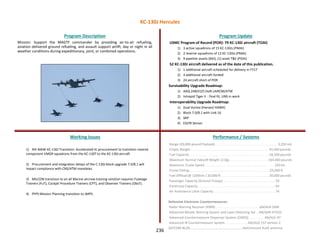
7) Implement CAD/PAD Fleet Returns process at all Marine Corps Air Stations.
8) Reduce Aviation Armament System (AAS) maintenance (Level III preservation, right-
sizing the MAGs)
9) Improve upon expeditionary and CONUS explosives safety posture
10) Review, improve and modernize formal schools course curriculum
Supply
1) We are attacking our current unacceptable NMCS rate, and the root causes for it.
2) Continue the roll-out of the Mission Essential Sub-System Matrix Strategy
3) Support and assist DLA/FRC in the effort to improve accuracy of bills of material
4) Support NAVSUP and FRC effort to improve depot component repair performance
5) CWO-2 embedded at DLA to monitor fleet demand for consumables on long-term
contracts and ensure vendors receive accurate demand forecasts.
6) Implement MALSP Mod allowancing to H-1, AV8-B, and C-130 in FY17
ALIMS
1) CNA Study to effectively scope responsibilities and manning requirements for I-Level
and O-Level aviation information systems
2) Align and synchronize efforts to Marine Corps Enterprise Network Unification
Campaign Plan
3) Constant communication of aviation information systems requirements to MITSCs,
MCNOSC, C4, OPFOR G6 and Navy IT department
4) Sustaining cybersecurity certifications for ALIMS personnel and improve information
assurance for aviation information systems
5) Reformat current MCO 2020.1, ALIMS SOP, to NAVMC and align to CNAF inspection
policies
MAGTF Logistics Integration
1) Continue to synchronize the efforts of the cargo UAS proponents in both Aviation and
DC, I & L.
2) Identify emerging technologies for use by maintainers closer to the flight line.
3) Initiate efforts to identify and leverage corollaries between aviation logistics and
ground logistics to enable increased unity of effort within the MAGTF.
2.9 MARINE AVIATION LOGISTICS PLAN
117
LOE 3: Modernize AVLOG support strategies and expand
operational capability
Today’s dynamic global environment demands flexible and scalable capabilities.
Increased operational tempo, split and disaggregated operations and constrained
resources mandate the modernization of written doctrine and its associated
enablers:
Maintenance
1) Achieve an optimally trained, skilled, and ready workforce
2) Improve aircraft readiness, safety, reliability, and availability posture
3) Close the gap between required readiness and associated costs
4) Enhance deployed capacity & capability
5) Maintain minimal logistics footprint
6) Enhance deployed capacity & capability by exploring emerging technologies such as
3D printing and metal coating processes
7) Maintain minimal logistics footprint by utilizing MAGTF Distribution Liaison Teams
8) Power by the Hour and Contract Maintenance Support concepts
9) Organizational, Intermediate, and Depot Level processes
10) Accuracy and consistency of maintenance planning processes
11) Standardize scheduled maintenance stand-downs
12) Consolidate maintenance resources (personnel, equipment, facilities)
13) Eliminate non-productive time of assigned maintenance personnel
Supply
The focused efforts to improve the supply chain that supports Marine Aviation
have netted some important improvements. The FY16 AVPLAN spelled out the
intent to improve the way we organize spare parts at the tactical level to better
support detachments and deployments. MARADMIN 175/16 announced the
implementation of MALSP Modernization allowancing methodology, which will
help to optimize use of material resources at the tactical level and better support
distributed operations. The implementation of MALSP Mod is a significant
milestone for Marine aviation.
Another success is the addition of nine AVLOG Marines to DLA Aviation in
Richmond, including an aviation logistics Colonel. Management of demand signals
and consumable materials will be a critical part of readiness recovery. Accordingly,
the Marines assigned to DLA Richmond have been re-organized into a single cell to
better focus on providing support directly to Marine Aviation.
Although these recent successes are significant, there are many other challenges
that will require concerted effort and coordination across the various commands,
supporting agencies, and stake-holders to overcome. The supply chain that
supports Marine aviation is fragmented, antiquated, and not optimized to enable
the required state of readiness in our current fleet. This fact is clearly evidenced
by the low rate of Ready Basic Aircraft (RBA) and unsatisfactory high Non Mission
Capable Supply (NMCS) rates across nearly every T/M/S the Marine Corps
currently operates.
Each of the Independent Readiness Reviews conducted to date (AV-8B, CH-53E,
and V-22) identified systematic shortfalls in the sustainment organizations,
processes, and resources of the supply chain that supports Marine Aviation.
Accordingly, the focus of effort in FY17 and beyond will be on continuing to
aggressively attack these daunting challenges.
The strategy to reduce the NMCS challenge will be focused on the areas of
consumables, repairable, and manpower.
2.9 MARINE AVIATION LOGISTICS PLAN
118
Consumables:
1) HQMC continue teaming with DLA, NAVSUP, and NAVAIR to pursue the MESM
inventory strategy.
2) Consumable forecasting is an issue that was identified in by all three IRR’s. Lack of
consumable material accounts for greater than 80% of non-mission capable supply
(NMCS) demands. To address this issue HQMC will assist in developing local MALS
stocking procedures to include an enterprise-wide approach to managing consumable
demand data. A CW0-3 has been assigned to DLA-Richmond to assist with the effort,
and multiple software tools and allowancing parameters are being evaluated to
ensure the correct items and quantities are stocked “plane side” at each MALS and
included in pack-ups to support detachments and deployments.
Repairables:
1) HQMC will continue the MALSP Moderation effort by implementing AV8-B, H-1
W/Y/Z, and C-130 during FY17.
2) HQMC will champion the effort with DLA, NAVSUP, and NAVAIR to pursue
Performance Based Logistics opportunities wherever it makes sense in order to
recapture government/industry accountabilities.
Manpower:
1) HQMC is supporting the Center for Naval Aviation Technical Training (CNATT) effort
to relocate the Marine Corps Aviation Supply Officer Basic Qualification Course from
its current location at NAS Newport RI, to NAS Whiting Field, FL, to be co-located with
the Aviation Maintenance Officer and Aviation Ordnance courses. The long-term
benefits and synergy created by a single center for Marine Aviation-Ground officer
training will be significant.
2) HQMC, in conjunction with the Navy and Fleet, will continue to improve the Training
and Readiness Manual that governs the professional development of our Aviation
Supply Marines.
119
2.9 MARINE AVIATION LOGISTICS PLAN
Avionics
Aviation Logistics Support Ship T-AVB
1) Explore alternative exercises for real world training that represents present day and future engagements.
2) Continue to explore Logistics Integration opportunities for MAGTF logistics support, to include integration with Combat Logistics Regiments at the Marine Logistics Group.
3) Coordinate Ship-to-Ship and Ship-to-Shore concepts of employment
4) Certify and modify for MV-22 operations aboard both T-AVBs.
5) Validate future MAGTF requirements and increase support beyond ground and aviation logistics requirements.
6) Improve upon MAGTF DI and CYBER/EW through the fielding, training and utilization of the ALQ-231 Intrepid Tiger II Pod
Align the Mobile Facilities Table of Allowance to meet the needs of changing IMRL inventories and supply pack ups for contingency operations to support the requirements of
the MALSP modernization concept. Implement a phased approach to right size the Mobile Facilities inventory and reduce the logistic foot print in support of deployed forces
while ensuring our capabilities meet our unique task.
Ordnance
We are working diligently to strengthen our relationships with service partners, resource sponsors, fleet subject matter experts and other common stakeholders in order to
develop and implement modern, safe and low cost logistics initiatives. These initiatives are intended to serve as the catalysts to drive immediate training and combat
capability force multipliers for the operational community. Specifically, we are seeking to deliver improved depth and capacity in an environment of limited resources and to
provide additional capability options to commanders.
1) Ship board and shore based aircraft hot-loading
2) Fixed-wing integration of the Advanced Precision Kill Weapon System
3) Common Weapons Support Equipment (CWSE) enhancements for Distributed Short Take-Off/Vertical Landing (STOVL) Operations.
4) Flight clearances for improved and additional payload combinations
2.9 MARINE AVIATION LOGISTICS PLAN
120
Collectively these efforts will assist operational commanders with reducing aircraft
turnaround times and increase sortie generation. Additional benefits include, but
are not limited to the following:
1) Reduces footprint required at Forward Arming & Refueling Points (FARPs)
2) Reduces mechanical problems at FARPs and FOBs
3) Reduces aircraft flight hours when transiting to and from target areas
Improves weapon flexibility, lethality and precision options
Aviation Logistics Information Management Systems (ALIMS)
1) Provide uninterrupted levels of Aviation Information Systems support for Marine
Aviation
2) Effectively manage transition to next generation of aviation information systems
equipment and personnel
3) Mitigation of Aviation Information Systems transitional shortfalls
4) Manageable incorporation of new aviation information systems
MAGTF Logistics Integration (MLI)
Future operating concepts and fiscal constraints are driving the need to
modernize and increase the efficiency of MAGTF Logistics. In the past, the ground
and aviation communities embarked on separate modernization efforts, such as
Global Combat Support System-Marine Corps and Marine Aviation Logistics
Support Program II. Separately, each effort did not necessarily aim for integration
of the logistics function into MAGTF future operating concepts. Reviewing current
practices and aligning future initiatives towards the integration of internal MAGTF
logistics will minimize disparate and overlapping processes. MLI is a critical
component for future success of our naval expeditionary forces.
MLI focuses on logistics standardization and optimization across the MAGTF, with
specific concentration on convergent practices associated with expeditionary
(afloat and/or ashore) operations. When addressing processes, technologies and
people, MLI will focus on maintaining the correct balance between combat
effectiveness and logistics chain management efficiency, with an ultimate goal of
increasing MAGTF readiness.
On 12 September 2014, the Deputy Commandant for Aviation (DCA) and Deputy
Commandant for Installations and Logistics (DC I&L) signed a charter that reaffirms
the Marine Corps commitment to MLI and re-charters the MLI Group. The MLI
Group addresses and prioritizes MAGTF logistics initiatives with a focus on
leveraging and applying proven best practices to current logistics improvement
initiatives. The MLI Group is empowered to develop specific solutions and
approaches to logistics challenges and make recommendations to the DCA and DC
I&L. To this end, the MLI Group is guided by four principles:
Partnership: Develop an integrated, enterprise approach to MAGTF readiness that
encompasses the entire logistics chain.
Transformation: MAGTF logistics transformation harnesses the power of
standardization and integration to develop a logistics enterprise that is focused on
warfighter support.
Balance: Ensuring the right balance between effectiveness and efficiency,
reducing cost while improving logistics responsiveness and flexibility internal &
external to the MAGTF.
Change/ Risk Management: Through effective management of both change and
risk, we will challenge the status quo in the areas of science and technology, policy
and doctrine, business practices and processes, and training and education.
2.9 MARINE AVIATION LOGISTICS PLAN
121
Summary
These three lines of effort will serve to focus the efforts of the AVLOG community
in FY16 and beyond. The actions and initiatives will enhance readiness through
improved institutional alignment, synchronization efforts, continued development
of our AVLOG Marines, and a relentless focus on sustainment of our aviation
platforms.
The AVLOG community remains focused on strategic and operational objectives
that must be accomplished to transform Marine aviation logistics so that we better
support ACE operations across the ROMO. ASL continually strives to train AVLOG
Marines to be the best in the world at deploying expeditionary AVLOG capabilities
that deliver and sustain aircraft readiness. Maintaining current capabilities, smartly
planning for the sundown of existing platforms and introducing replacement
aircraft are all areas that must be addressed. Keeping Marine aviation ever
present in the skies above our Marines on the ground is our single purpose, and all
that we do is a means to that end.
2.10 MARINE AVIATION GROUND SUPPORT PLAN
122
TODAY’S EXPEDITIONARY AVIATION GROUND SUPPORT FORCE
123
The Marine Wing Support Squadron (MWSS) serves as our maneuverable carriers
ashore and provides the functional support necessary to enable Marine aviation
operations in an expeditionary environment. These capabilities are also relevant
to the joint force commander, where forward basing and the rapid build-up and
sustainment of aviation combat power are essential. The ability to maneuver the
ACE ashore is critical to the Expeditionary Advanced Base concept set forth in the
Marine Corps Operating Concept.
Proven Past Performance; presently responsive; poised for the
future
Fulfilling their legislated role as the nation’s “force in readiness,” Marines are
frequently called upon to rapidly respond to an emerging crisis or strategic
surprise. Even when engaged in “sustained operations ashore,” as experienced in
operations in Afghanistan and Iraq (OEF/OIF), the Marine Corps must retain its
capabilities as an agile expeditionary force. An expeditionary force is
characterized by speed and versatility, often in austere conditions; it must be fully
capable of engaging across the ROMO. Whether as a supporting component
within a joint force or as a supported joint force, the MAGTF will execute
operations and campaigns that range from humanitarian operations and crisis
response, to limited contingency operations through major combat operation
(MCO).
Marine Wing Support Squadrons are meeting and exceeding expectations across
the globe. From Special Purpose MAGTF Crisis Response missions in Central
Command and Africa Command, to supporting Marine rotational forces – Darwin
and Australia. The Marines in Marine Wing Support Squadrons and detachments
are in every clime and place performing the functions of AGS and enabling Marine
Aviation to complete its assigned mission.
Planning for the future of Aviation Ground Support continues with modernization
of equipment, acquisition of new programs, updating training standards and
reassessing of core Mission Essential Tasks. Whether it be the reactivation of the
Marine Wing Support Groups’ HQ element, upgrading training opportunities,
establishment of alternative MOSs for AGS Weapons and Tactics Instructors, or the
research and development of enhanced equipment and tactics, techniques, and
procedures (TTPs) that will enable the MAGTF to maneuver within the littorals to
support power projection operations; the aviation ground support units will be
ready.
Airfield Support Functions
1) Expeditionary Airfield Services (EAF)
2) Expeditionary Rescue and Firefighting
(EFR)
3) Aircraft and Ground Refueling
4) Explosive Ordnance Disposal
Air Base Support Functions
1) Essential Engineer Services
2) Internal Airfield Communications
3) Routine/Emergency Sick Call
4) Air Base Commandant
5) Motor Transport
6) Field Messing
7) Airfield Security Operations
Anti-Air
Warfare
Assault
Support
Electronic
Warfare
Control of
Aircraft
and Missiles
Aerial
Reconnaissance
Offensive
Air Support
Aviation
Ground
Support
Enabling MAGTF Maneuver, Power Projection, Agility, Depth, and Readiness
TODAY’S EXPEDITIONARY AVIATION GROUND SUPPORT FORCE
124
Marine wing support group
We believe that the reactivation of the active duty Marine Wing Support Group
(MWSG) HQ is required In order to fill an operational command and control gap.
This initiative will place a task organized, effective, and efficient headquarters
capable of command and controlling subordinate units with efficiencies gained
through logical sharing of personnel and resources. The MWSG will enable
increased operational tempo of both the supported and supporting units. The
MWSG HQ ensures seamless AGS operations during major combat operations.
Marine wing support squadrons
The MWSS remains the ACEs premier task-organized unit, built specifically to
enable Marine aviation to conduct operations at the time and location of the
commander’s choice. Outfitted with the a specifically tailored table of
organization and equipment set, the MWSS maintains the capability to establish,
operate and play its role in the security of one main airbase and two forward
arming and refueling points simultaneously. FY 17 will see 8 active component
MWSSs, an MWSS (-) and 3 reserve component MWSSs manned, trained and
equipment for the future fight.
Marine wing support detachments
Marine Wing Support Detachments are task organized to meet the AGS
requirement of their supported MAG. They differ in size and capability. There are
two standing MWSDs, though the capability to task organize from an MWSS is
common practice.
Marine Wing Support
Squadron -273 and
British Army engineers
install a VTOL pad
in support of the F-35B
at Royal International
Air Tattoo, summer
2016
AVIATION GROUND SUPPORT THROUGH 2025
The first step toward the future
The AGS community is actively updating doctrine to meet the rapidly changing
future operational environment. The capstone to the effort is the MCWP 3-21.1,
Aviation Ground Support, which is near completion and should be published in
2017. In addition, to accurately reflect the capabilities of an MWSS, the Mission
Essential Task List and the MWSS Training and Readiness Manual are being
updated.
Remaining responsive and relevant as an aviation combat
multiplier
In close coordination with MAWTS-1 and the AGS executive steering committee,
the AGS community continues to align AGS TTPs with existing and emergent
Marine aviation platforms such as the F-35, MV-22, MQ-21, and CH-53K.
Currently there are several significant efforts underway :
1) Enabling the concept of distributed operations. By continually testing and working
with T/M/S leads, HQMC and MAWTS-1 continue to refine the required support for
this distributed operation template.
2) Development of a new concept of employment for Airfield Damage Repair (ADR)
which will increase repair cycle times and improve the quality of repairs-in order to
ensure faster sortie generation. With the development of this new concept comes an
upgrade to the current ADR kit. The new ADR kit will be augmented by a mobile
mixer, upgraded tools, new Foreign Object Debris cover, and rapid setting crater fill
material.
3) Creation of the AGS WTI MOS (7077). This MOS will allow HQMC Aviation to track
and then properly align Marines with the skillsets and knowledge required to plan
and employ AGS units. This initiative will align the AGS Marines with students from
MCLOG, MCTOG and others from MAWTS-1.
4) Refinement of the AGS input and participation as a training unit at service level
exercises including WTI and ITX is imperative and an ongoing effort. An OAG
appointed OPT is leading this effort.
5) Integration of an AGS training cell at MAGTF-Training Command/Tactical Training and
Exercise Control Group will occur in 2016. Four AGS Coyotes will be put in place to
train and evaluate AGS units.
6) Initial Capabilities Documents for EFR and EAF have been completed that will lead to
Capabilities Description Documents (CDD) development, based from community CBAs
, that will potentially lead to material programs used to alleviate gaps within the EFR
and EAF MOSs.
7) DOTmLPF-P Change Requests continue in the EFR and EAF MOSs to ensure
capabilities (doctrine, training, manpower, etc.) are in place to support the MAGTF
when conducting interrelated military activities involving combat, security,
engagement, and relief/reconstruction activities in a distributed operations
environment.
8) Significant progress in the testing of a lightweight matting solution continues. This
effort will enable the ACE to project power and gain access to the littorals in support
of the MAGTF.
125
AVIATION GROUND SUPPORT MATERIEL INITIATIVES
126
P-19R (P-19A replacement) (Fielding FY17-FY20)
This initiative replaces the A/S32P-19A Aircraft Crash and Structure Fire Fighting
Truck, known as the P-19A. The P-19A was introduced in 1984 with a service life of
12 years and has undergone two depot level rebuilds.
1) The P-19A is the Marine Corps’ only major aircraft fire fighting vehicle utilized at
Marine Corps Air Stations and Forward Operating Bases for immediate response to
aircraft emergencies (primary) and structural fires (secondary).
2) The new vehicle is compliant with current National Fire Protection Association (NFPA)
standards for aircraft rescue and fire fighting vehicles, resulting in a vehicle optimized
for operator and crew safety.
3) Equipment updates and enhancements will significantly enhance the ability of ARFF
Marines to fulfill their secondary mission by providing more effective base camp
structural firefighting support.
4) The level of drivetrain and power-pack commonality (up to 75%) with current USMC
tactical vehicles (MTVR and LVSR) will result in more efficient supply and maintenance
supportability. Commercial Off The Shelf (COTS) fire fighting components will
increase parts availability and sustainability. The addition of an Integral Auxiliary
Power Unit (APU) will greatly reduce engine idle time during standby, resulting in
increased fuel efficiency and engine longevity. The off road capability will ensure
operations in austere locations-such as those supporting distributed short take-off,
vertical land (STOVL) operations (DSO)-will be supported.
EAF Sustainment Lighting System (SLS) (FY19-FY20)
Current EAF hard-wire lighting system utilizes 1960-era technology, is
maintenance intensive, and consistently encounters logistical challenges due to
parts obsolescence.
1) SLS will fill a capability gap by providing mandatory runway lighting required for
Category I, precision Instrument Flight Rules (IFR) approaches. This will serve to
effectively integrate Air Traffic Control (ATC) and EAF capabilities to provide a safer
operational environment in degraded or reduced visibility landing environments.
2) All available modern energy efficiency technology (Improved batteries, solar
capability) will be leveraged to increase performance and sustainability. In addition,
the new lighting system will be lighter, easily adaptable to various airfield
configurations, and heat-resistant to support MV-22 and F-35 operations.
AVIATION GROUND SUPPORT MATERIEL INITIATIVES
127
MV-22 Capable light-weight matting
This initiative will develop and field, to the MWSS Expeditionary Airfield Platoon, a
light-weight matting solution that will withstand the heat signature produced by
the MV-22 aircraft. There are possible COTS solutions available that are currently
undergoing testing at Engineer Research and Development Center (ERDC) as part
of an Expeditionary Airfield (EAF) Congressional plus-up. A gap was identified in
the EAF 2014 Capabilities Based Assessment (CBA) for MV-22 capable light-weight
matting, subsequently, an EAF Initial Capabilities Document (ICD) has been staffed
and a light-weight matting Capabilities Description Document (CDD) is slated to
kick-off in late June 2016.
Replacement lightweight mat will is being tested to meet the following Key
Performance Parameters (KPP) and Key System Attributes (KSA):
1) The system shall support the operations of both aircraft and ground support vehicles
2) The matting shall withstand the heat/flux duration of MV-22 air and ground
operations with degradation of structural integrity
3) The system should require minimum ground preparation, minimum CBR of four
4) EAF Marines should be able to install the matting at a rate of 600 square feet per
man-hour using a four man crew
5) The matting system must contain a non-skid surface and mate with AM-2 medium
duty matting system
6) Matts shall be recoverable and suitable for reuse after being subject to a conditional
inspection, cleaned, and repackaged
7) The matt shall be able to withstand exposure to all POLs without degradation to
performance or structure
128
AVIATION GROUND SUPPORT MATERIEL INITIATIVES
Airfield Damage Repair
The Marine Corps requires an Airfield Damage Repair (ADR) Kit capable of
creating useable landing surfaces by new construction or repair of existing
surfaces. This mission has been repeatedly tested during recent operations in
Afghanistan and Iraq. The ADR Kit must take advantage of modern
developments in construction equipment and materials, must be easily
deployable, flexible enough to work in all geographic locations and
environments, and provide the capability to quickly repair craters and spalls of
all sizes. The required capability for one ADR Kit is to provide the tools and
materials to repair six 10-foot diameter craters, in a concrete surface, and/or
fifteen 10-foot diameter craters, in an asphalt surface, in less than 92 minutes
plus (+) a two hour curing period. One ADR Kit must also contain the materials
to repair 45 spalls in a concrete surface.
Concept of Employment
With the ever-changing face of future expeditionary operations, there will be
an increasingly significant reliance on the air component of the MAGTF. An
airfield damage repair capability that takes advantage of modern
developments in construction equipment and materials is key to any
expeditious preparation and/or rehabilitation of existing airfields. With the
current technology and updated engineering methods that have improved in
the past 15 years, the Marine Wing Support Squadrons (MWSS) and Engineer
Support Battalions (ESB) will possess and maintain a core capability that will
enable the Marine Corps to take advantage of existing airfields despite
damage.
Attributes
Based on requirements, the ADR Kit should contain all the tools and
equipment necessary to provide expedient repairs using established repair
techniques covered by an upgraded Foreign Object Debris (FOD) cover or more
durable temporary repairs using flowable fill and rapid setting cementitious
products. Key upgrades include:
1) Improved lightweight and scalable FOD cover system
2) Upgraded tracked skid steered/loader with concrete cutting saw and additional
attachments
3) Self-contained volumetric mixer
AERIAL PORT DAMAGE REPAIR
129
The USMC recently participated in a Joint Services Capabilities Based Assessment
on Aerial Port Damage Repair (APDR). As a result, the Marine Corps is pursuing
updated DOTMLPF-C solutions. These solutions include the modernization of the
current B0039 Airfield Damage Repair kit and an update to the tactics, techniques
and procedures for conducting airfield damage repair.
Aerial Port Damage Repair
Aerial Port Damage Repair (APDR) comprises the activities required to fix, restore,
replace, or rebuild damaged or disabled infrastructure or equipment at an air
operating location (landing zone, airfield, aerial port, or air base) in order to meet
the commander’s requirements. APDR activities can occur across the range of
military operations and during any phase of a campaign. These activities can occur
at locations that span degrees of development from austere landing zones, to
established air bases. APDR activities can provide four operational effects:
1) Contribute to countering anti access and area denial effects;
2) Ensure inter- and intra- theater logistics, and combat power for the commander;
3) Repair damage caused by natural disaster or catastrophic failure; and
4) Support the economic development of a region
5) APDR actions decompose to three primary tasks: Planning, Execution, and
Maintenance of repairs.
Planning
Planning for damage repair begins before damage occurs with the development of
contingency plans that can be adapted to specific situations. When damage
occurs, engineer forces contribute to crisis action planning by including APDR
considerations in plans. Planning extends through the execution and maintenance
phases as engineering forces respond to changing conditions and complete
repairs.
Execution
Execution of APDR requires the seamless integration of forces and means
conducting combat, general, and geospatial Engineering missions, as well as other
activities supporting Engineering work. A technical reconnaissance of damage
provides the detailed information necessary to execute repair operations. Initial
repair priorities include mitigating hazards on, and repairs to the minimum aircraft
operating surfaces. Once initial repair work on the operating surfaces is complete,
the priority of effort shifts to other facilities, utilities, and ancillary systems at an
air operating location.
Maintenance
Maintenance of repairs begins as soon as the first repair is completed, and extends
until responsibility for the repairs is transferred to an appropriate authority.
Repairs must be maintained in an acceptable condition in order to ensure
continued operations. Repairs can be either periodic, such as repairing surfaces
after a set number of passes, or emergent, such as a pipe that bursts after an
initial repair was conducted. The APDR mission is completed with the transfer of
responsibility and property to a designated authority.
AERIAL PORT DAMAGE REPAIR
130
The thirteen APDR areas of interest are listed to the right. These areas of interest
represent the gaps identified by the Joint Capabilities Based Assessment Team
(CBAT). Without accepted Joint standards to measure task performance,
distinguishing among gaps, redundancies and shortfalls could not be
accomplished. That is one reason why the lack of accepted joint standards
became a key finding. Joint standards are required to effectively pursue or develop
joint solutions.
Areas of interest provide the joint engineering community and the AF civil
engineer community with the opportunity to develop integrated solutions
portfolios. By aggregating problems into defined groups, the community can seek
the biggest “bang-for-buck” solutions for APDR problems, can identify forms of
solutions across DOTmLPF-P, and supports the downstream integration of related
Capabilities Based Assessments.
The next steps in the Joint Capabilities Integration Development System (JCIDS)
process are the development of formal JCIDS documents such as DOTMLPF-P
Change Recommendations (DCR) and Initial Capabilities Documents (ICD). The
DOTMLPF-P mapping provides an initial indication of which problems might
require a materiel or non-materiel solution, and therefore help to scope
subsequent JCIDS documents.
CONCEPT OF EMPLOYMENT FOR USMC
With the ever-changing face of future expeditionary operations, there will be an
increasingly significant reliance on the air component of the MAGTF. An airfield
damage repair capability that takes advantage of modern developments in
construction equipment and materials is key to any expeditious preparation
and/or rehabilitation of existing airfields. With the current technology and
updated engineering methods that have improved in the past 15 years, the Marine
Wing Support Squadrons (MWSS) and Engineer Support Battalions (ESB) will
possess and maintain a core capability that will enable the Marine Corps to take
advantage of existing airfields despite damage.
Based on identified future requirements, the upgrade ADR Kit will contain all the
tools and equipment necessary to provide expedient repairs using established
repair techniques covered by an upgraded Foreign Object Debris (FOD) cover or
more durable temporary repairs using flowable fill and rapid setting cementitious
products.
PRIORITIZED AREAS OF INTEREST
1) Mitigate Explosive Threats
2) Engineering and Technical Recon & Assessment
3) Expedient Air Operating Location Repair
4) “Deployability” of Engineering Assets
5) Configuration and Prepositioning of Materiel
6) Joint Standards for Air Operating Location Repair
7) (tie) – Geospatial Enterprise
8) (tie) – Capability Visibility
9) Command and Control
10) Reachback (Institutional and Technical Support)
11) Planning
12) Targeting and Assessing Engineering Effects
13) Joint Engineer Development
TACP SUPPORT, TRAINING, AND READINESS
The demand for Joint Terminal Attack Controllers (JTAC); Forward Air Controllers
(FACs); Forward Air Controllers (Airborne) (FAC(A)s) properly integrated with Joint
Fires Observers (JFOs) has increased dramatically over the past decade in support
of USMC and joint force operations, and their collective fire support capabilities
are projected to be a major component of future force design. As specially
qualified and certified service members and aviators who, from a forward position
or airborne, direct the action of combat aircraft engaged in close air support and
offensive air operations, act as an extension of the TACP, and perform
autonomous terminal guidance operations (TGO), the low density, high demand
teams are sought after to support the ground fire support plan and have proven
absolutely critical to mission accomplishment. Initial certification and refresher
training for JTACs, FACs, and JFOs occurs through the period of instruction
provided by instructors employed at Expeditionary Warfare Training Group Pacific
and Atlantic (EWTGPAC/LANT) . The Training and Readiness (T&R) training
continuum is facilitated in the fleet by air officers and SNCOs at the artillery
regiments, ANGLICO, and divisions, ideally who have been designated Weapons
and Tactics Instructors (8077 MOS) after completing the course at MAWTS-1
(formerly referred to as TACP(I)).
JTAC / FAC PRODUCTION AND SUSTAINMENT
Currently there exists a validated requirement for 354 JTACs and 272 FACs for a
total of 626 ground-based controllers. This need translates to a requirement to
produce 216 JTACs annually (equal to roughly maximum capacity for EWTGPAC
and LANT when fully supported with all required external assets). Air support
requirements for certification and qualification has grown and will continue to be
more challenging. Initiatives have been and are in work to mitigate this situation;
however, demand for JTACs and FACs continues to grow with expectations that
the total requirement will increase again. Studies about post-OEF JTAC
requirements in support of future force employment and design are on-going;
contract close air support (CCAS) providers exist to help offset some of the fleet air
training requirements. Commercial Air Services who currently provide CAS to the
Marine Corps at times provide up to 50% of the total FW certification
requirements. The USMC Terminal Attack Controller Trainer (TAC-T) program is
funded and will work to augment fleet air support with contractor-owned, USMC
attack pilot flown aircraft for terminal attack controller training. In addition to the
fleet air that will directly support collective PTP, surrogate CAS contracted service
support, coupled with increased investment in and budget emphasis on high
fidelity, linked simulation will yield overall proficiency and combat readiness.
The TACP and JFO curricula must strive to collectively incorporate unmanned
aviation platforms to increase proficiency with persistent/simultaneous ISR, CAS,
and EW for the MAGTF and joint force.
FUTURE
The USMC TACP, fire support and aviation communities will work together to
coordinate and align individual and collective live training opportunities and
augment live execution with real-world synergistic simulation. TACP equipment kit
continues to be refined and will be driven by innovation tailored to the needs of
the warfighter. In addition to the TAC-T and simulation efforts that will advance
fire support integration proficiency, serious consideration and steps must be taken
to properly align and consolidate the various programs, policies, manning and
training efforts for the JTAC-JFO Team. A roadmap that will help define how the
USMC will man, train, and equip terminal attack control teams is located at the
end of the TACP section and submitted for consideration.
Future Capabilities and Interoperability (JTAC Kit)
COTS tablets + GOTS software
DPSS Project Office located at NAWCWD China Lake
1) 100% government-owned, government civilian software team
2) Creators of PSS-SOF applications and software
KILSWITCH/APASS = Android App for Precision Fires Image Map Engine
1) Users: SOCOM (NSW), MARSOC, HMX-1, DOS, FBI, AZ firefighters, USMC
2) ~5000 tablets fielded since 2012, in widespread use throughout all MAGTFs
3) Application is NGA validated
4) Same algorithms and engines employed in NGA certified PSS-SOF and APASS
applications.
5) KILSWITCH capabilities will increase even further with the next generation Target
Handoff System version 2 (THSv2), which will integrate KILSWITCH with MAFIA in a
Marine Fires Application, fielding in early 2017.
2.11 TACTICAL AIR CONTROL PARTY PLAN
131
TACP CONCEPTS AND DEFINITIONS
Joint Terminal Attack Controller (JTAC, MOS 8002)
A qualified (certified) service member who, from a forward position,
directs the action of combat aircraft engaged in close air support and
other offensive air operations. A qualified and current joint terminal
attack controller will be recognized across DOD as capable and
authorized to perform terminal attack control.
Primary officer feeder MOSs are 0802, 7315, 0302, 1802 and 1803
Primary enlisted feeder MOSs are 0861 and 0321.
Must be E-5 and above.
All these MOSs are listed on Unit TO&Es with a billet MOS of 8002.
Forward Air Controller (FAC, MOS 7502)
An officer (aviator) member of the tactical air control party who, from
a forward ground or airborne position, controls aircraft in close air
support of ground troops. USMC is the only service that uses the
term, therefore in the joint community a FAC is a JTAC. Testing and evaluation into the
validity of the 7315 PMOS to augment 75XX aviators as 7502 is underway currently.
Forward Air Controller Airborne (FAC(A))
FAC(A)s are an airborne extension of the Tactical Air Control Party
(TACP) which operates as the forward element of the Theater Air-
Ground System (TAGS). JP 3-09.3 states that current and qualified
FAC(A)s “will be recognized across the DOD as capable and authorized
to perform terminal attack control”.
As defined in JP 1-02, DOD
Dictionary of Military and Associated Terms, a FAC(A) is defined as “a
specifically trained and qualified aviation officer who exercises control
from the air of aircraft engaged in close air support (CAS) of ground
troops.”
USMC FAC(A) Platforms: AH-1, UH-1, F/A-18, AV-8, F-35
Joint Fires Observer (JFO)
A JFO is a trained service member who can request, adjust, and control surface-to-surface
fires, provide targeting information in support of Type 2 and 3 close air support terminal
attack control, and perform autonomous terminal guidance operations.
In conjunction with a FAC, JTAC, or FAC (A), a JFO can facilitate a CAS attack up to the
clearance of fires. Clearance must be provided by a FAC, JTAC or FAC (A) who might not be
co-located with the JFO but who has situational awareness to control the attack.
The objective is to have at least one (1) JFO at each rifle squad who will act as a key
component of the JTAC-JFO terminal attack controller team.
Weapons and Tactics Instructor (WTI, MOS 8077)
Formerly the Tactical Air Control Party Instructor (TACP(I)).
1) A SNCO or officer graduate of the MAWTS-1 Weapons and Tactics Instructor Course.
A WTI has completed the transformation from an individual trained in terminal attack
control to an experienced aviation integrator and aviation integration training manager.
Each assigned Regimental and MEU Air Officer and ANGLICO Company Air Officer shall
attend the Air Officer Course and be a certified as a WTI.
At the regimental and MEU level, WTIs shall supervise the development and
implementation of subordinate unit collective and individual aviation integration training
and shall facilitate the training and evaluation of adjacent units. (MCO 1301.25C)
MOS 8077, Air Officer Weapons and Tactics Instructor (AirO WTI)) EMOS. Weapons and
tactics instructors provide a capability to fill associated operator force billets to develop and
execute a unit training program in accordance with the Weapons and Tactics Training
Program (WTTP). This training is focused on achieving individual training and readiness
through collective operational unit training.
132
133
TACP MANNING PROGRESSION
GCE TACP T&R LIVE CONTROL REQUIREMENTS ACE FAC(A) T&R LIVE CONTROL REQUIREMENTS
134
TACTICAL AIR CONTROL PARTY STRUCTURE (182K)
135
TACTICAL AIR CONTROL PARTY FAMILY OF SYSTEMS
136
Target Handoff System (THS)
THS is in the process of refreshing hardware and software to enable an increase in
capability with the SLATE (Smaller Lighter Ancillary TLDHS Equipment) kit and
Strikelink software version 1.2, with the goal of providing a better user interface.
This capability will be replaced in 2017 by THSv2, which incorporates the Marine
Fires Application, a combination of KILSWITCH and the Army’s MAFIA application.
THS has also assumed responsibility for the hand-held video downlink requirement
and began fielding this capability in FY 2013 with the Soldier ISR Receiver (SIR)
versions 2.0 and 2.5.
Common Laser Range Finder (CLRF)/Vector 21
The Common Laser Rangefinder - Integrated Capability (CLRF-IC) will combine the
components of the current CLRF in to a smaller lighter device. Fielding for the
CLRF-IC began in 2016.
Portable Laser Designator Rangefinder (PLDR)
The PLDR replaced the interim laser designator, the Ground Laser Target
Designator II. The PLDR provides a laser designation capability out to 5000m at a
reduced weight than previous lesser equipment. Redistribution of PLDRs and GLTD
IIs is continuous to ensure units have a laser designation capability until
production can increase to expected rates.
In October 2011, The Joint Terminal Attack Controller Lightweight Target
Designator (JTAC-LTD) was fielded in response to an UUNS. 150 systems have
been fielded.
Situational Awareness and Night Vision
AN/PVS-17/14
The AN/PVS-17 provides extended range night vision capability. AN/PVS-14 is
issued as a component of the Vector 21.
Thermal Laser Spot Imager (TLSI)
The Kollsman TLSI with Enhanced Targeting Sight provides the capability to see the
laser spot generated by the FAC/JTAC’s laser designator or a self-lasing aircraft as
well as providing thermal imaging capability.
Fielding is complete.
Thermal Imager
The Kollsman Long Range Thermal Imager provides the FAC/JTAC a long range
target location capability for both day and night operations. Fielding to the
operating forces is complete.
Video Scout (VS)
Video Scout continues to be the standard for COC video downlink operations. The
Remote Video Viewing Terminal (RVVT) is undergoing a requirements re-write
that will affect the procurement of a COC video receiver capable of allowing
multiple users to subscribe to multiple video signals received on a local network.
The intent is to maintain a technical family of systems approach for the non-static
operator (THS operators) and static operators (COC operators). The Man Portable
Video Downlink Receiver, SIR 2.5, started fielding in June 2016 with a total AAO of
384 systems.
TOTAL OF 384 SIR 2.5
-JULY 2016: I MEF x 97
1st RAIDER BN x 6
-SEP 2016: III MEF x 46
-II MEF TBD (SEP 2016)
136
TACTICAL AIR CONTROL PARTY FAMILY OF SYSTEMS
1) The Marine Corps continues to evaluate systems and to equip TACPs to this end state. Increased PRC-117G and SIR 2.5 AAOs will help ensure systems critical link in the digitally
interoperable MAGTF are fielded to the lowest levels for training and execution;
2) All systems should seek to integrate with joint and airborne systems such as SRP to enable full end-user interface and capability.
137
TACP and Tablets
Android tablets enable situational awareness and Digitally Aided Close Air Support
(DACAS), with applications like Kinetic Integrated Lightweight Software Individual
Tactical Combat Handheld (KILSWITCH)/Android Precision Assault Strike Suite
(APASS) [pictured]. KILSWITCH/APASS is a model example of rapid innovation in
support of our warfighting requirements.
Digital and sensor situational awareness (SA) for GCE embarked
aboard Assault Support
These are screen captures of the tablet-based SA applications available to troops
embarked aboard a KC-130J during the SPARROWHAWK insertion conducted at a
recent TALON REACH DI demo – along with PLI data shared via ANW2, sensor SA is
provided to the end user on a common operating interface and display – capability
currently deployed ISO SPMAGTFs and MEUs.
“We believe that implicit communication—to communicate through mutual understanding, is a faster,
more effective way to communicate…We develop this ability through familiarity and trust, which are
based on a shared philosophy and shared experience.” – MCDP 1
DIGITALLY AIDED CLOSE AIR SUPPORT
138
TACTICAL AIR CONTROL PARTY INITIATIVES
139
Near Term: Group 1 Small UAS Training
FACs and JTACs will complete group 1 small UAS training either:
1) Prior to attending TACP school or
2) During 2100 level training once assigned to unit
Training is conducted by the UAS TALSAs located aboard Camp Pendleton and
Camp Lejeune
Marine Terminal Attack Controller and JFO Action Plan/Roadmap
The Action Plan/ Roadmap depicted to the right is required to help consolidate
efforts to create and foster properly manned, trained, and equipped JTAC-JFO
teams in support of MAGTF and joint force operations.
By examining the problem and endstate desired in support of future force design
and CMC strategic service guidance, the action plan indicates actions, efforts, and
policies that can be mapped to specific HQMC and fleet agents. It will help to
provide action items to various entities and ensure the force maximizes synergy
with programming, training, and tactical execution. The endstate is properly
trained and equipped JTAC-JFO teams that are capable of holistically integrating
digitally interoperable fire support, ISR, and EW.
Far Term: UAS Expertise to the TACP
7315 (UAS Officer) infusion into the TACP:
Analysis ongoing to determine best way to gain and maintain UAS expertise at the
tactical edge
1) As added member of TACP (requires structure change)
2) 7315s are eligible for 8002 (JTAC) MOS and associated B-billet assignments;
manpower analysis ongoing
MAWTS-1 AIR OFFICER CERTIFICATION
140
2.12 MARINE AVIATION SCIENCE AND TECHNOLOGY PLAN
AVIATION SCIENCE AND TECHNOLOGY STRATEGIC GUIDANCE
Introduction
The Marine aviation combat element must leverage S&T to transform into a
digitally-interoperable expeditionary force which continues to dominate the air,
sea, space, land, and cyberspace domains in support of MAGTF operations.
Operating through the electromagnetic spectrum, the ACE must conduct effective
missions for anti-air warfare, offensive air and assault support, air reconnaissance,
control of aircraft and missiles, electronic /cyber warfare. Leveraging S&T, Marine
aviation seeks to identify, influence, and rapidly insert capability into new and
legacy airborne systems by upgrading or replacing existing systems at minimum
cost. Highlighted Marine aviation S&T focus areas that require continuous S&T
investments are electronic warfare (EW); cyber operations; command and control
(C2); communication and networks; unmanned aircraft systems (UAS); weapons;
and rotorcraft and fixed wing technologies.
Aviation S&T Strategic Guidance
Expanding DoD capability is accomplished by integrating platforms and systems
and promoting interoperability to deliver increased lethal or non-lethal effects
across the battlefield. By incorporating integration and interoperability tenets,
DoD systems with long acquisition development cycles, point-to-point solutions,
proprietary, and platform centric solutions will be minimized or eliminated. The
results provide increase warfighting effectiveness and produce open architecture,
common standards which enable more effective tactical systems.
Aviation S&T Sponsors
Marine aviation S&T strategic guidance describes how Marine Corps aviation must
rely on scientific research to meet their current, emerging, and future needs. The
Marine Corps Combat Development Command (MCCDC) and Chief of Naval
Operations Air Warfare facilitate the programming, budgeting, and resources for
Marine aviation programs. The Office of Naval Research (ONR), Naval Aviation
Enterprise (NAE) and MCDDC advocate for the S&T funding and solutions for the
Marine Corps aviation S&T programs. The Department of Army, Department of Air
Force, Office of the Secretary of Defense (OSD) and Defense Advanced Research
Projects Agency (DARPA), Federally Funded Research and Development Centers
(FFRDCs), National Security Agency (NSA), and Central Intelligence Agency also
provide significant S&T support for the future of Marine aviation.
Airborne Electronic Warfare
The Marine Corps is continuing to build an organic and distributed electronic
warfare system of systems known as MAGTF EW. MAGTF EW transitions the
Marine Corps from a focus on the low-density/high-demand EA-6B, to a
distributed, platform-agnostic strategy – where every platform contributes/
functions as a sensor, shooter and sharer – to include EW.
Under MAGTF EW the Marine Corps is leveraging emerging technologies and
integrating multiple aviation platforms (unmanned, fixed wing, tiltrotor, and rotary
wing assets), payloads, ground-based EW nodes, and cyber capabilities to provide
commanders with an organic and persistent EW capability – for every MAGTF –
large and small.
Airborne electronic attack (AEA) capabilities post-EA-6B sundown will be provided
by EW payloads such as the Intrepid Tiger II EW pod, UAS EW payloads, and the
EW capabilities inherent to F-35. This integration of manned and unmanned
airborne and ground EW capabilities will provide the MAGTF commander with
greater flexibility and control of the electromagnetic spectrum – and in many
cases giving that MAGTF commander a capability where previously they had none.
MAGTF EW assets will be modular, scalable, and networked, utilizing an open
architecture that is rapidly adaptable and remotely re-programmable at the
tactical level to support future Marine Corps warfighting requirements.
142
AVIATION SCIENCE AND TECHNOLOGY STRATEGIC GUIDANCE
Cyber Operations
Marine Corps aviation will operate jointly with allied, coalition, and homeland
security forces using information networks, each of which has varying security
requirements. USMC fixed, rotary and UAS systems will be employed as
information systems conducting intelligence, surveillance, and reconnaissance
(ISR), cyber and EW operations over the EM spectrum. The ACE must continue to
develop cyber strategy to protect and defend USMC airborne assets against
kinetic and non- kinetic threats. The Marine aviation cyber S&T focus areas are:
1) Cyber Security: Develop technologies that facilitate rapid and secure information
storage and sharing (down to the platform level) across multi-level security in joint
and coalition operations during intermittent/limited connectivity, and in restricted
and hostile environments.
2) Full Spectrum Cyber Operations: Develop situational awareness and visualization
tools to understand the extent and status of cyberspace across the air, surface, and
land domains in order to plan and execute cyber operations.
3) Cyber Intrusion: Develop technologies to protect information infrastructure from
malware and other cyber threats by developing algorithms and techniques to detect,
deter, or defeat the threats.
4) Cyber Defense: Develop technologies to holistically assure information through
proactive defensive measures that are not limited to conventional areas such as
multi-level security, real-time automated information guards and response, cross
domain solutions, inter-domain authentication, encryption, intrusion detection,
prevention, and response
Command and Control (C2)
The ACE will assimilate large volumes of information from airborne and ground tactical
sensors distributed across air, land, sea, space, and cyber domains. The Common Aviation
Command and Control System (CAC2S) is a major initiative for aviation command and
control. CAC2S lays the foundation for an open architecture platform to fuse and visualize
airborne, ground, logistics, and intelligence data. The ACE command and control
capability must evolve to provide the MAGTF commander with the ability to make timely
decisions, maintain situational awareness, coordinate and disseminate information to the
joint and collation forces. Utilizing reliable tactical communication links, volumes of data
will be transported and shared to provide an integrated seamless joint C2 system. The
Marine aviation C2 S&T focus areas are:.
1) Data fusion: Develop technologies to fuse real, near, and non-real time data from
airborne and ground sensors, and intelligence systems to provide operators with
visualization tools for full situational awareness.
2) Information Flow: Develop technologies to converge service networks to allow
information to flow seamlessly and data exchange across classified and unclassified
networks and for joint and coalition operations to enable net-centric military
operations.
3) Secure Information: Develop technologies to provide push/pull data across
bidirectional intra-, cross-, and inter-domain authentication, encryption, and
information assurance/integrity services.
143
AVIATION SCIENCE AND TECHNOLOGY STRATEGIC GUIDANCE
144
Communication and Networks
Airborne communication networks provide the backbone to reliably exchange
relevant information to/from airborne, ground, ship, and ground platforms.
Marine aviation requires communication networks to connect all Marine fixed,
rotary, and UAS platforms with joint defense and coalition forces.
Software Reprogrammable Payload (SRP) is a single common payload module that
is flexible and reconfigurable to support simultaneous missions making maximum
use of available bandwidth and ensuring interoperability within joint standards
and protocols providing commonality across platforms. Equipped with SRP,
airborne platforms act as communication relays for over horizon missions, and
interpret, translate and relay heterogeneous waveforms to platforms distributed
throughout the battlefield. Marine aviators in the cockpit or on the ground will
operate mobile devices and smartphones over 4G or xG wireless protocols to
provide up-to-date situational awareness using advanced visualization aids.
The communications networks S&T focus areas are:
1) Software reprogrammable/cognitive payload:
• Develop an open architecture software programmable platform that supports
multiple and emerging advanced tactical datalinks;
• Develop cognitive technologies that enable payloads to sense the environment,
select, and optimize waveforms to accomplish mission effectiveness based on
predefined operational objectives.
2) Advanced Datalinks: Develop high frequency (HF), millimeter-wave, or laser
communication networks to maintain over-the-horizon, air-to-air, and air-to-ground
in a SATCOM limited or denied environment.
3) Bandwidth Compression: Develop compression or spread spectrum techniques to
automatically transport large data files over limited bandwidths or over continuous or
unused spectrum.
4) Survivable Networks: Develop mobile tactical wireless networks which dynamically
self-heal, self-organize in contested, multi-level security, degraded communications
and jamming environments.
Unmanned Systems
Marine aviation has successfully deployed and leveraged unmanned air systems
(UASs) in combat operations. The demand for dedicated UAS systems will
continue to increase. The air vehicle platform and its associated payload directly
determine the effectiveness of the UAS system during mission engagements.
Group 1 - small UASs, Pumas, Wasp, and RQ-11 Raven – have excelled at providing
ISR and communications relay but are limited in carrying larger and heavier
payloads.
Employing larger UASs, such as the Group 3 RQ-21A, allows larger and heavier
payloads with increased capability but still limited in providing effective electronic
warfare and SIGNIT capability at long distances.
The Marine Corps intends to have its Group 4/5 UAS and unmanned cargo systems
carry larger payloads with increase multifunction capability such as EW, cyber,
radar, communications, kinetic and non-kinetic payloads and logistics support.
The Marine Corps intends to field a sea-basing Group 5 UAS.
The Marine aviation unmanned systems S&T focus areas are driving toward
manned/unmanned teaming:
1) Platforms: Develop platform and energy technologies to enable UAS platforms to
operate in all-weather environments, high altitudes, and long endurance operations
from ship to maneuver.
2) Payloads: Develop modular, standards, and open architecture technologies to
enable interchangeable UAS payloads such as electro-optical/infrared, electronic
warfare, cyber, signals intelligence, synthetic aperture radar, communication relays,
and laser designators.
3) Autonomy: Develop techniques to provide capabilities to reduce manning
requirements, increase the level of autonomous decisions, reasoning, and learning in
uncertain operational environments to successfully conduct complex mission tasks.
4) Communications: Develop secure communication datalinks to semi or fully control
UAS over-the-horizon and line-of-sight with robust encrypted protocols. Develop
common control station using iPad technology.
144
Directed Energy Weapons
The Marine Corps is actively pursuing directed energy weapons (DEW) to provide
force protection against ballistic and cruise missile defense; defense against
manned and unmanned aircraft; counter-sensor applications; counter-rockets,
artillery, and mortar (C-RAM); counter-man portable air defense systems (C-
MANPADS); and non-lethal defense. DEW enables speed of light engagement to
the targets, provides an extremely lower cost per shot compared to bullets and
missiles cost per shot, and provides continuous magazine capacity to defeat
hostile UAS, missiles, or mortars. The Marine Corps and the Office of Naval
Research are currently investing in a Ground Based Air Defense Capability (GBAD)
DEW as a counter-unmanned air systems (C-UAS) role. Mounted on a tactical
vehicle, the DEW is envisioned to utilize a combination of guns and missiles,
command and control (C2), and radar cueing. Marine aviation is interested in
pursuing airborne DEW capability for F35 fixed, V-22, CH53 rotary wing aircraft
and unmanned air systems. The Marine aviation DEW S&T focus areas are:
1) Power Generation and Energy Storage: Develop power generation and energy
storage systems to increase the wall-plug efficiency and reduce wasted heat and
improve thermal efficiency.
2) Laser Systems: Develop solid-state lasers, fiber laser systems to increase power
output by investigation dielectric materials, components, and power combining
techniques while reducing the laser system volume, power consumption, and weight
for medium to small aircraft.
3) EM Systems: Develop technologies to investigate EMP and high-power radio
frequency (HPRF) technologies payloads for missile or unmanned air systems. for
both offensive and defensive lethal and non-lethal effects.
4) Integration: Develop interfaces and techniques to integrate laser systems with
existing air platforms, develop automated techniques to coordinate and integrate
with kinetic and non- kinetic weapon systems.
Degraded Visual Environment
The Marine Corps is actively pursuing technology to mitigate risk in DVE. There
are three critical aspects to reducing mishaps in DVE: hover stability,
symbology/cueing and sensors. The ultimate technological solution would provide
a stable geo-located hover capability, intuitive cueing to drift and obstacles, and
sensors which can detecting and display obstacles (wires), terrain slope, or other
hazards on approach, landing, takeoff and en route phases of flight. The intent is a
capability that supports multi-ship simultaneous flight operations in obscured
conditions (sand, dust, snow, fog, smoke, rain, flat light, night) in a GPS-denied
environment.
It will also provide a takeoff, en route, approach and landing capability throughout
all operational flight envelopes to include EMCON shipboard operations. The final
goal is to significantly reduce pilot and aircrew workload to operate safely in DVE
and transform adverse weather conditions into a tactical advantage on the
battlefield. Marine aviation continues the evolution from “owning the night” to
“owning the weather” in order to support ground operations 24/7/365.
The Marine aviation DVE S&T focus areas are:
1) Advanced Sensors: Develop compact light weight millimeter-wave and terahertz
radar, and 3D flash or scanning LIDAR sensor technologies that leverage
advancements in semiconductor devices and optics.
2) Flight controls: Develop advanced techniques that automatically eliminate drift and
provide hover stabilization. Develop advanced algorithms that fuse sensor data with
stored terrain data to provide a clear operational vision for landing on unpredictable
terrain.
3) Situational Awareness: Develop visualization tools that provided the crew with clear
and accurate symbology and visual aid for situation awareness for all types of
brownout conditions.
AVIATION SCIENCE AND TECHNOLOGY STRATEGIC GUIDANCE
145
1) Tiltrotor/Tiltprop: Develop advanced technologies for rotors/props as components of
assault support propulsion as well as tactical UAS. As rotorcraft/helicopters
requirements grow in terms of hover load and harsh environments (heat/dust/high
altitude), as well as top-end speed (i.e., MV-22 escort), advanced rotor performance
enhancement (dynamic blade shaping) will garner performance as well as efficiency
(fuel/load savings).
2) Heavy Lift: Develop rotorcraft capability enhancements to sustain performance and
improve high altitude operations. Develop lift technologies to provide lift well beyond
this ambient pressure/temperature for all potential deployment locations. Develop
technology that can increase vertical lift and increase operational radius.
3) Variable-speed air refueling drogue: Develop technologies that enable refueling
drogues to refuel fast tactical aircraft as well as slower rotorcraft.
4) Platform Protection & Weapons: Develop technology supporting a family of low
collateral damage/low energetic weapons. Existing methods of obtaining low
collateral damage munitions include reducing the amount of explosive filler of
existing weapons. Develop technologies to improve accuracy thereby reducing the
risk of collateral damage when an appropriate lethality warhead and fuse are applied.
Develop technologies that ensure weapon fusing and weapon yield is selectable from
within the cockpit.
5) Composite materials: Develop technologies for health monitoring of composite
structures enabling condition based maintenance and predictive failure of composite
structures on aircraft in order to reduce time in depot-level maintenance facilities as
well as reducing NDI inspections. The increased use of composite structures requires
an enhanced capability to rapidly make repairs to these structures in all
environmental conditions (heat, cold, sand, humid, etc.) Marine aviation is
committed to high reliability in supply and parts, and to longer-life components.
6) Lightweight De-ice/Anti-ice capability for aircraft: Develop technologies to provide a
lightweight all de-ice/anti-ice capability for both rotor blades and fuselage that
reduces both weight and electrical power requirements. Current de-ice/anti-ice
capabilities are heavy due to power requirements for heating and wiring.
7) Manned/Unmanned Teaming : Create aviation options for commanders to use
manned, unmanned, or a combination of the two.
8) Artificial Intelligent (AI) Systems: Develop AI technologies to enable optimally piloted
aircraft providing commanders flexibility to fully man, partially man, or unman to use
an aircraft as a UAS to best suit mission requirements. AI technologies could also
provide intelligent cockpit systems increasing pilot effectiveness and enhancing
Manned Unmanned Teaming.
AVIATION SCIENCE AND TECHNOLOGY STRATEGIC GUIDANCE
Aircraft Enablers
Marine aviation is also interested in pursing additional S&T initiatives for fixed, rotary, and UAS platforms.
146
2.13 MARINE AVIATION TRAINING SYSTEM (ATS) PLAN
147
USMC SIMULATOR LAYDOWN
148
149
AVIATION TRAINING SYSTEM (ATS) PLAN
150
Aviation Training System (ATS) Plan
A combination of challenging operational environments, decreasing training
resources and budgets, and a lower deployment to dwell ratio, requires Marine
aviation to focus its training more effectively and efficiently to achieve and sustain
the highest levels of combat readiness. The USMC Aviation Training System (ATS)
integrates Marine aviation training processes and structures into a single,
integrated training system; links training costs with readiness; and spans all Marine
aviation communities. A properly integrated training system requires evolving
institutionalized processes that support our missions and provide on-time delivery
of tactically relevant training. With training and readiness (T&R) as its foundation,
ATS provides the MAGTF commander with core and mission skill proficient combat
ready units. Integrated ATS processes, governed by policy and supported by
appropriate resources, provide the catalyst for incremental training system
improvements. ATS integrates and coordinates policy, manpower, equipment, and
fiscal requirements of post initial accession training for Marine aviation officers
and enlisted personnel as well as initial accession aircrew training (Core Skill
Introduction) for aviation units that conduct T/M/S specific aviation training (e.g.
Fleet Replacement Squadron (FRS) or Fleet Replacement Detachments (FRD)). ATS
processes and procedures shall be applicable to all current and future Marine
aviation training programs to include naval or joint-level programs in which the
USMC participates. ATS is outlined in the governing policy MCO 3710.6B NAVMC
3500.14C. The ATS Systems Approach to Training (SAT) model is depicted in the
following figure:
ATS Focus
ATS integrates processes and programs for training that institutionalize
“operational excellence” across Marine aviation. “Operational excellence”
involves increased combat readiness and preservation of personnel and assets –
risk mitigation through reduction in mishap causal factors from supervisory,
procedural, and human error. T&R manuals are source documents for
implementing ATS. ATS is intended to:
1) Provide operational commanders with a current, responsive and relevant training
system for aircrew, aircraft maintenance, aviation ground support and C2 personnel.
2) Develop a holistic training system across every Marine aviation community
throughout the training continuum that supports aircrew (pilot/NFO/enlisted),
operators and maintainers.
3) Help proliferate standardization within the Marine aviation communities.
4) Develop concurrency management processes to ensure the training system
(curriculum, courseware and training devices) remains relevant.
5) Address training and safety issues through SAT derived curricula and improved use of
Risk Management (RM) and Crew Resource Management (CRM) principles.
6) Utilize Marine Aviation Training System Sites (MATSS) to facilitate the ATS program.
ATS Processes
ATS is process intensive and includes the following:
Flight/Combat Leadership Standardization and Evaluation: process of training
toward and achieving certifications, qualifications and designations consolidated
and standardized, under the MAW ATS structure in accordance with platform and
community T&R Manuals and the MAWTS-1 governing Program Guides. It is
applicable to both flight leadership and non-aircrew certifications, qualifications,
designations, contract instructor (CI) certifications, Naval Air Training and
Operating Procedures Standardization (NATOPS) Instrument training and
evaluation, as well as recurring generic training such as Instrument Ground School
(IGS), Crew Resource Management (CRM), Risk Management (RM), and basic Navy
Occupational Safety and Health (NAVOSH) or Naval Aviation Maintenance Program
(NAMP) training.
Concurrency Management (CCM): process whereby a change in tactics,
aircraft/operational systems configuration, publications or procedures is evaluated
to identify the impact of the change on T&R requirements. The T/M/S Simulator
Essential Equipment Support Matrix (EESM) is an MCO 3500.14 mandated
requirement that helps identify, track, and report simulator shortfalls. Once
highlighted, appropriate and timely changes are made to curricula, courseware,
and devices to ensure alignment with operational systems and doctrine.
RESOURCESRESOURCES
RISK
MITIGATION
 ORM
 CRM
 RRM
STAN
&EVAL
TRNG
MGMNT
 Cert/Desig/Qual
− FLSE
− Cmbt Ldr
− NATOPS / Inst
 TSC
 CCM
 MTT
 Trng Req’ts
− TMP / ATS IG
− TTF / OAG
 Trng Info
(Web-based)
− TMS
− LMS
LEARNINGLEARNING
ENVIRONMENTENVIRONMENT
- Instructor-led
- Computer Aided
Instruction (CAI)
- Self-paced
- Computer Based
Training (CBT)
- Web-accessed
- Publications
LIVELIVE
TRAININGTRAINING
ENVIRONMENTENVIRONMENT
- Aircraft
- Vehicles
- Operational Equipment
- Ranges
VIRTUALVIRTUAL
TRAININGTRAINING
ENVIRONMENTENVIRONMENT
- Part Task Trainers
- Full Flight Simulator
- Distributed Mission
Operations (DMO)
CONSTRUCTIVECONSTRUCTIVE
TRAININGTRAINING
ENVIRONMENTENVIRONMENT
- Scenario-based
Training
- Mission Task Trainer
MAW ATS / MATSS
HQMC/SUPPORT
ESTABLISHMENT
ACQUISITIONS
GOVERNINGGOVERNING
DOCTRINE, POLICIES & DIRECTIVESDOCTRINE, POLICIES & DIRECTIVES
TRAINING & READINESS PROGRAMTRAINING & READINESS PROGRAM
(SAT DERIVED CURRICULUM)
RESOURCESRESOURCES
RISK
MITIGATION
 ORM
 CRM
 RRM
STAN
&EVAL
TRNG
MGMNT
 Cert/Desig/Qual
− FLSE
− Cmbt Ldr
− NATOPS / Inst
 TSC
 CCM
 MTT
 Trng Req’ts
− TMP / ATS IG
− TTF / OAG
 Trng Info
(Web-based)
− TMS
− LMS
LEARNINGLEARNING
ENVIRONMENTENVIRONMENT
- Instructor-led
- Computer Aided
Instruction (CAI)
- Self-paced
- Computer Based
Training (CBT)
- Web-accessed
- Publications
LIVELIVE
TRAININGTRAINING
ENVIRONMENTENVIRONMENT
- Aircraft
- Vehicles
- Operational Equipment
- Ranges
VIRTUALVIRTUAL
TRAININGTRAINING
ENVIRONMENTENVIRONMENT
- Part Task Trainers
- Full Flight Simulator
- Distributed Mission
Operations (DMO)
CONSTRUCTIVECONSTRUCTIVE
TRAININGTRAINING
ENVIRONMENTENVIRONMENT
- Scenario-based
Training
- Mission Task Trainer
MAW ATS / MATSS
HQMC/SUPPORT
ESTABLISHMENT
ACQUISITIONS
GOVERNINGGOVERNING
DOCTRINE, POLICIES & DIRECTIVESDOCTRINE, POLICIES & DIRECTIVES
TRAINING & READINESS PROGRAMTRAINING & READINESS PROGRAM
(SAT DERIVED CURRICULUM)
AVIATION TRAINING SYSTEM (ATS) PLAN
Training Information Management Systems:
process that integrates the employment of multiple information systems under a
training information architecture. Resources that support the management and
integration of training information are Training Management Systems
(TMS), Learning Management Systems (LMS), and the ATS SharePoint
maintained by Aviation Standards Branch (ASB) at TECOM.
https://www.intranet.tecom.usmc.mil/hq/branches/atb1/ATS/default.aspx .
The TMS tracks T&R progression and helps commanders ensure that training is
conducted in accordance with appropriate orders and regulations; currency and
qualification requirements are met; and RM principles are properly applied. The
TMS for aircraft maintenance training is the Advanced Skills Management (ASM).
Marine Sierra-Hotel Aviation Readiness Program (MSHARP) is the authorized
aviation training management system to be used to track all training governed by
aviation T&R manuals. The only exception is F-35B, which utilizes the Autonomic
Logistics Information System (ALIS). An LMS functions as an electronic repository
of specific courseware and technical manuals. The LMS for Marine aviation is the
Marine Corps Aviation Learning Management System (MCALMS). The ATS website
serves as a CAC enabled portal for access to other resources and training
information management systems such as the LMS.
1) Risk Mitigation: process that includes risk assessment, risk decision making, and
implementation of effective risk controls. Emphasis placed on risk mitigation and
aviation fundamentals during all aspects of training is required in developing and
fostering a climate that promotes flight discipline and adherence to established
procedures and requirements. Such a climate leads to operational excellence and
mitigation of mishap causal factors. Training devices allow the control of specific
elements in scenarios that enhance the exercise of risk management abilities. Risk
mitigation is a by-product of professionalism and safe practices, and must be stressed
in all aviation training.
2) Training Management Process (TMP): provides an effective forum for the operating
forces to identify training issues across the DOTMLPF spectrum as the impetus for
requirements generation and training improvement. The TMP helps determine
common solutions to aviation training issues, eliminating redundant, “stovepipe”,
solutions which are wasteful and inefficient. The TMP is focused on the needs of the
warfighter through platform and community training management teams (TMT) and
supported by Headquarters U.S. Marine Corp, Deputy Commandant for Aviation,
Naval Air Systems Command , and industry.
ATS/MATSS MISSIONS:
ATS Mission: Provide resources, processes and policies that deliver a standardized,
responsive, cost effective and integrated training system focused on tactically
relevant training in order to provide combat ready aviation capabilities to the
MAGTF and joint commander.
MATSS: The primary focus of each MAW’s ATS is the Marine Aviation Training
System Site (MATSS). It directly supports execution of ATS functions for the fleet.
While ATS as a whole is process intensive, the MATSS is resource and product
intensive. ATS resources available at the MATSS include simulators and training
devices, web-based training and learning management systems, academic
courseware, electronic classrooms, and the military, civilian and contractor
manpower to support, analyze, and provide input to improve training system
performance. MATSS contribute the following to the ATS process: 1) simulator and
academic resource usage optimization; 2) flight leadership standardization and
evaluation (FLSE) support; and 3) aircraft platform and community training
management team (TMT) issue advocacy. The MATSS construct has migrated
across Marine aviation in the active and reserve components at thirteen sites. ATS
products are continually analyzed for ways to improve Marine aviation unit
readiness and technically refreshed appropriately to meet the demand for changes
in the aviation training continuum with advancing technology. With increased ATS
awareness, the ability to leverage common solutions, coordinate and pool critical
resources, and support combat leadership development across the various
platforms and communities has improved exponentially. The result is two-fold:
significant cost savings and cost avoidance by using a robust SAT process by
freeing funds for other requirements, and an enhanced training capability that
substantively increases reportable combat readiness across Marine aviation and
the MAGTF.
Training Future / Summary
For Marine aviation, ATS is risk mitigation that presents a game-changing
opportunity. The USMC ATS MATSS shall be staffed with high quality uniformed
FLSEs, Weapons and Tactics Instructors, and strike fighter tactics Instructors, as
well as GS and contractor civilian support (device operators, fielded training
system support personnel, contract instructors in support of all FRS and FRD
activities) to ensure the functions of ATS are carried out with success and overall
combat readiness is improved across the MAGTF.
151
MARINE CORPS AVIATION SIMULATOR MASTER PLAN (MCSAMP)
MCASMP Requirements
All new simulators function as a system of tactically relevant networked trainers.
All new simulator procurements shall be compatible with this Simulator Master
Plan at a minimum. The following are standing requirements:
1) CONUS bases: one section of networked simulators
2) OCONUS & reserve bases: minimum of one simulator
3) Marine Corps Common Visual Data Base (MCCVDb) via Navy Portable Source Initiative
(NPSI) and in the future be able to run a USMC Common Synthetic Training (CSTA)
4) Tactical Environment (TEn), one per flight device : threat, emitters, emissions,
weapon flyouts, USMC and joint air/ground interoperability
5) Common hardware approach across all T/M/S and community simulators to ensure a
high fidelity, cross domain, platform and community distributed mission networked
training capability is possible with other MAGTF and joint entities.
6) Developed IAW current and/or draft T&R, Maneuver Description Guides (MDG), and
NATOPS manuals
The MCASMP is intended to reduce overall procurement and sustainment training
costs by procuring training devices and training media (courseware and curricula)
with common hardware and software systems. The idea is to avoid the cost of
developing new or platform unique type-systems; to pursue only the most
promising developmental and mature technologies for training; and mitigate
operational risks.
The Marine Aviation simulator strategy outlines an increased reliance on
simulation to augment flight training and provide improved readiness. The
foundation for simulator key performance parameters will be based on the ability
of the training device to provide and support a multi-ship capability for similar and
dissimilar platforms, the integration of aircrew training, and the ability for aviation
systems to be networked with other aviation, ground, and future C2 systems to
support MAGTF level integrated training. At the micro-level, the ability of CONUS
and OCONUS systems to satisfy capacity, capability, and networking requirements
will be essential for achieving the end state of enhanced pilot and aircrew
simulator training (Reference Figure 1.0).
Fully integrated implementation of the MCASMP will foster a tipping point for
Marine aviation, whereby the aviation community accepts the full capacity and
capability of networked, high fidelity training systems as the “norm”. Its use is
DEMANDED as part of complex, persistent, and scalable pre-deployment mission
rehearsal training always by every unit in the fleet.
152
MARINE AVIATION DISTRIBUTED VIRTUAL TRAINING ENVIRONMENT (ADVTE)
Aviation Distributed Virtual Training Environment (ADVTE) is a Marine
aviation-specific network
1) ADVTE is an encrypted, closed-loop, persistent, simulation network under
USMC administrative and operational control .
2) Enables interoperability between multiple USMC Aviation Training Devices
to facilitate distributed mission training.
3) Provides capability to link and train virtually with other services, Joint
Training and Experimentation Network (JTEn), Joint Strike Fighter (JSF),
and MAGTF GCE Trainers/Equipment
4) ADVTE Wide Area Network simulation data packet traffic moves across
Marine Corps Network Operations and Security Command’s (MCNOSC)
Marine Corps Intranet (MCI) circuits and connects the base ATS training
locations.
Designated MCNOSC controlled network = Persistent Wide Area Network (WAN) circuits
that all ADVTE data traffic (visual/audio) travels acrossBase
Demarcation Point (DEMARK) = Provides the bridge node to move off station
NODE* = Secondary/Tertiary connection points (nodes) used as required to bridge to
DEMARK
A future initiative for ADVTE is to connect and interface with the Joint Information Operations Range.
Network Exercise Control Center (NECC) is the training system connectivity “Hub”
1) Provides instructor/operator and observer stations and Tactical Environment (TEn)
functionality
2) Provides 2D/3D visualization from any geographic location or tactical environment
entity.
3) Provides simulated tactical radios with the ability to communicate on multiple nets,
point to point VTC Capability.
4) Digitally capture data streams from selectable audio and video channels to support
joint brief/de-brief requirements.
5) Integrates with existing Deployable Virtual Training Environment (DVTE) capability.
Tactical Environment (TEn) is a non-proprietary software application that models a
variety of threat systems, sensors, emissions, and weapons.
1) USMC “owned” TEn provides doctrinally relevant, physics-based, real-time modeling
and threat correlation.
2) TEn is an HLA (High Level Architecture) compliant networking gateway with
Federation Object Model (FOM) compatibility with both JFCOM and NASMP FOMs.
3) Provides simulators with the capability to link to same site or offsite systems through
the NECC.
4) TEn Version 4.0 is currently available and operational; Ten v5.0 is in the installation
process.. It will be the new baseline required for ADVTE connectivity (Designed to be
backwards compatible with v4.0 to support transition).
fSimulator 2
Additional
Simulators
TEn
TEn
Network
Exercise
Control
Center
N
O
D
E
*
D
E
M
A
R
K
ADVTE
HDN
Simulator 1
TEn
(Typical MCAS) SITE 1
Simulator 2
Additional
Simulators
TEn
TEn
Simulator 1
TEn
Network
Exercise
Control
Center
N
O
D
E
*
D
E
M
A
R
K
SITE 2
NODE* * As Needed
153
MARINE CORPS COMMON SYNTHETIC TRAINING AREA
Concept of the Common Database
The concept of the Marine Corps Common Visual Database originated from the
Marine Corps Aviation Simulator Master Plan (MCASMP) policy, which required all
newly acquired Marine Corps Aviation Training System simulators to function
together as a system of tactically relevant networked trainers, when linked. The
first common databases was initially developed for and installed in a series of five
Weapon Systems Trainers (WSTs) delivered to the USMC under the MCASMP
procurement in the mid-90’s. The term common database identified the collective
East Coast and West Coast United States visual databases installed in those same
five WSTs. Under the MCASMP program, these five trainers were produced by the
same contractor and, consequently, included a common visual system solution
which included a common image generator (IG), display system, and run-time
visual databases. The databases installed in each WST were exact copies of each
other and were rendered and displayed by image generators and projectors of the
exact same make and model. As a result, the training scenes presented to the
trainees across these five training systems were correlated to each other. That
was the origin of the common visual database concept.
The common visual database provides ATS simulators with commonality with
respect to the following visual/sensor database content and features:
1) Geographic region
2) Terrain surface (terrain mesh and elevation)
3) Imagery (two dimensional surface features)
4) Fixed 3D features (buildings, vertical obstructions, etc.).
5) Landing Zones (LZs, CALs, etc.)
6) Terrain flight (TERF) routes
7) Moving models, ground and aviation
8) Material attribution (not derived from NPSI)
Currently, the MCCVDb is comprised of a set of catalogued stand-alone
individual databases corresponding to the following geographic regions:
1) Eastern United States
2) Western United States
3) Western Pacific (Westpac)
4) Afghanistan
5) Iraq and the Gulf
6) Horn of Africa (HOA)
7) Southeast Asia (4 Quadrants)
8) Hawaii (under development)
9) Other regions (small DBs)
154
MARINE CORPS COMMON SYNTHETIC TRAINING AREA
155
A common synthetic training area will enable robust, realistic,
virtual MAGTF training
Visual database fidelity and content correlation remain key issues to optimize to
ensure optimal scene accuracy and interoperability across networked simulators.
The introduction of non-aviation training systems into distributed missions
operations and networked training increases the complexity to ensuring aviation
simulators can be successfully network with simulators designed to train ground
forces thereby creating a seamless, virtual, tactically relevant MAGTF training
environment and form a robust LVC training construct capable of supporting high
value integrated virtual MAGTF training.
Moving forward:
1) Improvements to the current common visual databases, culminating in one common
synthetic training area, consisting of new geographic regions, and updated source
files, in order to support MAGTF virtual training.
2) This Common Synthetic Training Area will evolve in terms of geographic regions
available and improved fidelity and content - specifically with regard to imagery
resolution and available database features.
The Goal:
To further develop a single source, common visual database, a USMC Common
Synthetic Training Area (CSTA), that will be woven together from existing and
future identified source code which is run time corrected for ATS Networked
Devices and of sufficient fidelity to enable “fair fight” correlated simulated training
environments. This environment will not only be used in the USMC ATS but across
the MAGTF and joint services solutions to promote interoperability within ATS, the
USMC GCE and Joint Distributed Mission Training (DMT) Circuits. Efforts by HQMC
AVN Weapons Requirements Branch, MARCORSYSCOM, NAVAIRSYSCOM, and
TECOM will continue to develop an acceptable CSTA solution with the GCE as well
as with the joint and multi-national partners. Distributed mission training
environments incorporating common arenas will yield a limitless enhanced
combat readiness training experience. Initial developmental focus will be in the
southwestern United States with synthetic augmented operational environments
embedded to represent non-native other terrain and environments with
maximum fidelity.
MARINE AVIATION VIRTUAL WARFIGHTING CENTER (MAVWC)
The MAVWC construct will bridge the gaps between live and synthetic training for
groups as small as detachments to as large as a Marine Expeditionary Force Air
Combat Element. It will support individual and unit collaborative training and
mission rehearsal based upon existing aircraft/community T&R manuals . It will
leverage existing mandated academics, theoretical application, and weapon
systems employment. This will be accomplished by leveraging technology to link
or network simulators/training devices together in a classified training
environment for the accomplishment of prescribed T&R requirements. The
MAVWC will be Marine Aviation’s large-scale warfighting center that has the
capacity to train numerous units simultaneously using detailed scenario-based
missions to achieve the highest possible level of collaborative training and
operational integration. It will provide for maneuver space in training and mission
rehearsal for Marine Aviation combat units. It will allow for networked similar and
dissimilar simulators/training devices, both co-located and geographically
separated, in order to support Marine Corps T&R event training/mission rehearsal,
ultimately achieving exponentially increased combat readiness.
1) Provides a foundation for the integration and interoperability of aviation and ground
simulation to achieve true Marine Air Ground Task Force (MAGTF) Live Virtual and
Constructive (LVC) training per the United States Marine Corps Commandant’s FRAGO
01-2016.
2) Tactics, test, and fleet units will be able to develop new or improve TTPs in which to
counter existing or developing threats.
3) System Integration Laboratory (SIL) capabilities co-located with simulators/training
devices can assist in the development and testing of future aircraft and weapon
system integration and interoperability.
4) Increase current and future readiness at the MAGTF level by increasing repetitions
and sets in the most challenging and dynamic environments.
The MAVWC will create a Virtual Warfighting Center on par with the Air Force
(Nellis AFB) and the Navy (NAS Fallon). The capability to conduct large-scale
(various units) aviation training events to facilitate integrated training will allow
the Fleet Marine Force to become more collaborative in T&R training, thereby
improving their combat readiness proficiency. It will allow for increased risk taking
using aggressive risk management to execute the mission safely, emphasize higher
order cognitive processes in complex full spectrum operations, and enable rapid
decision-making and effective Command and Control (C2). This will ultimately
allow a commander to evaluate a units performance in following commander’s
intent, mission accomplishment, and the determination of mission critical success
factors. Realistic training tools, models, and simulations enable the capability to
practice the collaborative planning, decision-making, and execution processes and
procedures. MAVWC training will provide high quality realistic, MAGTF level
training that is essential to ensure future Marine forces are adequately trained to
conduct the six functions of aviation and maintain the highest level of combat
readiness.
156
Every platform a shooter
2.14 MARINE AVIATION WEAPONS AND MUNITIONS PLAN
157
Marine aviation continues to develop and procure weapon systems that will
increase lethality and survivability for the warfighter. Our focus of effort is to pace
enhancements to the USMC weapons portfolio with platform advances by
leveraging technology in order to achieve precision, discrimination, lower weight,
increased kills per sortie, and commonality wherever appropriate.
Rockets:
The Advanced Precision Kill Weapon System II (APKWS II) combined with the
Mk152 warhead in its all-up-round configuration has been designated AGR-19A.
New Initiative
APKWS II integrated with the M282 Multi-Purpose Penetrator (MPP) warhead is a
low-cost PGM capable of defeating light-armored vehicles and hardened
structures. The M282 MPP warhead is a 2.75-inch 13.7 pound penetrating and
incendiary warhead delivering penetration (40” reinforced concrete or 1” of steel),
blast (over 1500 fragments), and incendiary effects (2000˚F due to zirconium).
APKWS II’s nearly 90% hit rate, coupled with the M282 MPP warhead will provide
a lower yield and lower cost choice for attacking targets otherwise serviced by
Hellfire missiles or guided bombs, and provide more stowed-kills per sortie.
HQMC anticipates M282 integration on H-1s with IOC in Summer FY17.
Future Requirement
Marine aviation will continue to leverage APKWS II success by developing APKWS II
for TACAIR. The AV-8B was the first TACAIR platform to integrate APKWS II in April
2016 using a Rapid Development Capability during Operation INHERENT RESOLVE.
The F/A-18 will also be gaining APKWS II, complementing GBU-12 and Laser
Maverick with a lower collateral damage weapon providing more kills per sortie.
Missiles:
New Initiatives
To address TACAIR’s operational need for additional forward-firing missiles, more
than 500 legacy AGM-65F Infrared (IR) Mavericks are being converted into
modernized AGM-65E2 Laser Mavericks. These conversions will nearly double the
current inventory of Laser Mavericks. The AGM-65E2 seeker provides F/A-18 and
AV-8B with increased self-designation capability, greater chance of laser spot re-
acquisition if lost due to obscurants, and a more accurate laser spot scan than the
AGM-65E seeker.
M282 MPP Warhead
2.14 MARINE AVIATION WEAPONS AND MUNITIONS PLAN
158
GAU-21 on MV-22
High Performance
Airframe
Multi-effects
warhead
Flexible Link 16
and UHF data link
Deployable
wings and fins
BRU-61/A and Universal Armament
Interface (UAI) compatible
Dimensions:
Seeker: 7” diameter
with dome cover
Fuselage: Tapers to
6” diameter
Weight : 200 pound
Length: 69.53”
Wingspan: 66” with
5° Anhedral wings
Multi-Mode
Seeker
SMALL DIAMETER BOMB II
The AIM-9X Block II Sidewinder adds a lock-on-after-launch capability with data
link, allowing it to be launched and then guided to a target for 360 degree
engagements. The Block II+ variant will meet future requirements.
The AIM-120 Advanced Medium Range Air-to-Air Missile (AMRAAM) allows TACAIR
platforms the ability for a single aircraft to engage multiple targets simultaneously
through the use of its own active RADAR for terminal guidance. The AIM-120D
variant will provide further refinements through the inclusion of an internal GPS,
an enhanced data link, improved software, and improved range and speed.
Advanced Anti-Radiation Guided Missile – Extended Range (AARGM-ER) will
incorporate a new rocket motor onto AARGM in order to improve range and
survivability. AARGM-ER is fully-funded for F/A-18E/F and IOC is expected in FY23,
with F-35B/C objective platforms.
The Joint Air-Ground Missile (JAGM) program is fully funded and recently passed
the Milestone B Defense Acquisition Board. JAGM incorporates a dual-mode semi-
active laser (SAL) and millimeter wave (MMW) seeker with a multi-mode fuze
(height of burst, delay, and point detonate). The shaped-charge warhead has
blast-frag capabilities that increases lethality. Survivability will be improved in
JAGM by an increased launch
acceptability region and countermeasure resistance versus HELLFIRE. The MMW
guidance can be activated while still on the aircraft giving the operator a fire-and-
forget capability. JAGM will replace all variants of HELLFIRE and will be capable of
destroying armor, maritime craft, bunkers, and buildings, with an expected IOC on
AH-1Z in FY19.
Bombs:
New Initiatives
The AGM-154 Joint Stand-Off Weapon (JSOW) C-1 is a net-enabled weapon that
provides a Moving Maritime Target (MMT) capability with stand-off. JSOW C-1 will
IOC on F-35C in FY23.
The GBU-53 Small Diameter Bomb II (SDB II) is a 250-pound class, precision-
guided, all-weather munition, eight of which the F-35B and C will carry internally.
SDB II is a gliding, stand-off, direct-attack weapon suitable against fixed and
moving targets in day, night, and adverse weather. It is network-enabled, utilizes
a tri-mode seeker with SAL, MMW, and Imaging Infra-Red (IIR), and will IOC on the
F-35B in FY21.
Guns:
New Initiative
The GAU-21 Common Defensive Weapon System (CDWS) improves reliability,
lethality, and rate of fire. GAU-21 CDWS prototype procurement begins in FY15
for MV-22 and FY16 for CH-53K.
Future requirement
HQMC, in conjunction with NAVAIR, is researching improved 20mm and 25mm
ammunition for air-to-ground delivery. Potential capabilities include improved
point detonation, increased armor penetration, and incendiary effects.
Future Weapon Requirements:
Investment in weapons requirements for the future must leverage modular classes
of weapons in order to support operations ranging from crisis response to major
combat operations. Weapons modularity will permit the flexibility required to
support the combatant commander's distributed forces with tactical flexibility.
JAGM JAGM fuzed for Height
of Burst
2.14 MARINE AVIATION WEAPONS AND MUNITIONS PLAN
159
2.14 MARINE AVIATION WEAPONS AND MUNITIONS PLAN
160
Weapon Modularity
1) Increased kills per sortie
2) Economies of scale
3) Maximize ship’s fill space
4) Low cost
5) Counter measure resistant
6) Open architecture / Reprogrammable
7) Common launchers / racks / LAUs
Seekers
GPS/INS
Semi-active
laser
Millimeter
wave
Imaging
infrared
Anti-radiation
homing
Payload
Blast/Frag
Shaped charge
Thermobaric
Non-kinetic:
• Electro-magnetic pulse
• Electronic warfare
• Cyber
Fuzing
Height of burst
Instantaneous
Delay
Motors
Mission-
tailorable
Datalink
optional
Fuzing
Dynamic
re-targeting
Cooperative
engagement
Synchronized
attack
161
2.15 AIRCRAFT SURVIVABILITY EQUIPMENT PLAN
162
The Marine Corps aviation vision for ASE is to equip all USMC aircraft with integrated
aircraft survivability equipment (IASE) systems . IASE uses modular, open system
architectures that are optimized to ensure survivability across the platform’s full range of
operations, providing threat engagement information and situational awareness across the
digital battlespace.
Current baseline mission sensor capabilities equip Marine Corps fixed-wing, tiltrotor and
rotary-wing aircraft with a variety of situational awareness (SA) and countermeasure
capabilities in the radio frequency (RF) and electro-optic (EO)/infrared (IR) spectrums.
Many of these capabilities are aircraft platform-specific solutions that support each
platform’s required operational threat environments and contribute into platform tactics,
techniques and procedure (TTPs) for susceptibility reduction.
HQMC aviation collaborates with numerous DoD and service-specific entities, including
MAWTS, NAVAIR, PMA272, Joint Electronics Advanced Technology (JEAT), service aviation
training commands (NSAWC), Joint Aircraft Survivability Program Office (JASPO), all service
laboratories (DARPA, NRL, ONR, AFRL and ARL), and other services’ science and technology
development organizations to achieve desired goals
ASE Concept and Capabilities
Achieve susceptibility reduction through radio frequency (RF) confusion, prevent self-
identification, create deceptive targets, detect radar signals, threat signatures, threat lasers,
identify hostile radar detectors and detect ballistic events (such as guided missiles,
unguided rockets and unguided ballistic fires, i.e. hostile fire).
Address aircraft survivability equipment (ASE) for electronic support (ES), electronic attack
(EA) and advanced electro-optic/infrared (EO/IR) sensing that enable platforms to
successfully conduct operations in a battlefield.
Employ training tactics and procedures (TTPs) and countermeasures against threats using
directed RF and IR jamming, chaff dispensing, flares, decoys or other obscurants that
prevent hostile weapons system effectiveness.
MARINE AVIATION ASSAULT SUPPORT ASE PLAN
163
The AAR-47 Missile Warning System (MWS) is an electronic warfare system
designed to protect aircraft against IR guided missile threats, laser-guided / laser-
aided threats and unguided munitions. Upon detection of the threat, the system
will provide as audio and visual sector warning to the pilot. For IR missile threats,
the system automatically initiates countermeasures by sending a command signal
to the Countermeasure Dispensing Set. The AAR-47 is currently deployed on MV-
22B, AH-1W/Z, UH-1Y, and CH-53E aircraft
The AAQ-24 Department of Navy (DoN) Large Aircraft Infra-Red Countermeasure
(DAIRCM) system is an advanced Missile Warning System (MWS), Laser Warning,
and Hostile Fire Indicator “front end” and directed energy, Guardian Pointer
Tracker (GPT) IRCM “back end”, to be fielded on the CH-53E/K, KC-130J, and MV-
22 aircraft. The Advanced Threat Warner (ATW) upgrade will provide aircrew with
improved situational awareness using advanced two color IR MWS sensors to
detect IR guided missiles (e.g. MANPADS), hostile fire (AAA, small arms/RPGs), and
Band A/B lasers and hand-off threat information to IRCM (GPT, flares.) The
current size and weight of the GPT and Central Processor excludes AAQ-24 as a
suitable IRCM solution for smaller aircraft (H-60/H-1).
The ALE-47 Countermeasure Dispensing Set (CMDS) receives threat data from the
aircraft’s survivability sensors (MWS or RWR), and then selects the appropriate
response to the threat in terms of expendables to be employed (Chaff and/or
Flares), dispersal sequence and pattern, and when to dispense the selected
expendables
The Distributed Aperture IRCM (DAIRCM) is a light weight MWS and integrated
IRCM being developed by NRL under an FY04 ONR FNC with additional risk
reduction funding from PMA-272. This system has been OSD approved in
response to JUUONS SO-0010 and is a viable path forward as a Program of Record
for the H-1 community offering significant savings in size, weight and power
(SWaP) as well as cost avoidance.
The APR-39 Radar Warning Receiver (RWR) series provides aircraft with a Radar
Signal Detecting Set (RSDS) designed for use on USMC, USN, and USA assault
support aircraft in order to provide onboard situational awareness and warning of
radar threats. The system also provides control and display of the AAR-47 Missile
Warning System and Chaff dispense commands to the ALE-47 Countermeasure
Dispensing System (CMDS). The APR-39D(V)2 will correct major deficiencies and
obsolescence in the current version. The APR-39 System acts as EW Bus
Controller and is one of the pillars to fusing threat data and information for Digital
Interoperability applicability.
Technology Transition Agreements (TTA’s)
Helicopter Active RPG Protection (HARP): Will seek to develop an expendable
countermeasure that would offer a hard kill system to defeat unguided munitions
such as RPGs. This system will require the development of not only the
expendable but also the guidance system required to drive the expendable
countermeasure to intercept the threat
Multi-Spectral Electro-Optical/Infrared Seeker Defeat (MSSD): Will seek to
develop techniques, components, and technologies to improve the ability to
defeat advanced multi-spectral EO/IR MANPADS by (1) better understanding the
advanced MANPAD threat posed to rotor-craft and the current countermeasure
capabilities that are employed and (2) developing advanced flares/obscurants and
laser sources to better defeat advanced MANPADs
MARINE ASSAULT SUPPORT ASE ROADMAP
164
MARINE AVIATION STRIKE ASE PLAN
165
The AN/ALR-67 countermeasures warning and control system is the standard
threat warning system for tactical aircraft and was specifically designed for the
F/A-18 and AV-8B aircraft. The system detects, identifies and displays radars and
radar-guided weapon systems in the C to J frequency range (about 0.5 to 20 GHz).
The system also coordinates its operation with onboard fire control radars,
datalinks, jammers, missile detection systems and anti-radiation missiles. The
AN/ALR-67(V)3 is an upgrade to the ALR-67(V)2 system referred to as the
Advanced Special Received (ASR) set. The receiver electronics unit has been
upgraded to a fully channelized digital architecture with dual 32-bit processors, yet
with an overall reduction in system size and weight. The Azimuth Display Indicator
(ADI) is a 3 in (76.2 mm) diameter CRT or LCD cockpit display, carried over from
the AN/ALR-67(V)2, used to show intercepted threats.
The ALQ-214 Integrated Defense Electronic Countermeasure (IDECM) will provide
internal self-protection for the F/A-18 C/D by establishing a common on-board
jammer solution to counter modern SAM and Air-to-Air RF Threats. Block V IOC is
slated for FY17. The Software Improvement Program (SWIP) is scheduled for IOC
in FY18, and will provide for additional DRFM techniques to degrade a threat’s
ability to engage while also improving interoperability, timeline challenges, and
the ability to engage multiple threats simultaneously. The ALQ-165 Air Self-
Protection Jammer (ASPJ) will be replaced by the ALQ-214(V)3 providing a baseline
ASE suite of ALR-67(V)3, ALQ-214(V)3, and ALE-47.
The ALE-47 Countermeasure Dispensing Set (CMDS) receives threat data from the
aircraft’s survivability sensors (MWS or RWR), and then selects the appropriate
response to the threat in terms of expendables to be employed (Chaff and/or
Flares), dispersal sequence and pattern, and when to dispense the selected
expendables.
Intrepid Tiger II (IT-II) is a Precision Electronic Warfare (EW) pod providing organic
distributed and net-centric Airborne Electronic Attack (AEA) capability. Early
Operational Capability (EOC) of IT-II pod in Operation Enduring Freedom (OEF) was
conducted in 2012. The Approved Acquisition Objective (AAO) for USMC is 136
total pods. IT-II(V)1 deployed on AV-8B and F/A-18A++/C/D aircraft in 2012, KC-
130J capability is currently in development. IT-II(V)3 is currently deployed on UH-
1Y (EOC FY16), with AH-1Z capability in the future. Additional future IT-II
platforms include the MV-22B and CH-53K. Radar AEA variant of IT-II is currently
in development (Block X).
Future Naval Capability (FNC)
FNC programs will address expanded frequency threats through GAP analysis and
provide solution sets comprised, but not limited to ALQ-214, and advanced IR/RF
expendables in addition to smart dispense technology.
MARINE FIXED-WING ASE ROADMAP
166
INTEGRATED AIRCRAFT SURVIVABILITY EQUIPMENT
167
Integrated Aircraft Survivability Equipment (iASE) will provide the capability to
cooperatively use information derived from on-board and off-board systems or
networks to enhance aircraft protection, combat survivability, and mission
effectiveness by providing situational awareness of flight and mission
environments to warfighters and the supporting network systems, thus enabling
the most survivable and effective single or multi-system response available.
DESIRED CAPABILITY
1) LOCATE THREATS: ACCURATELY DISPLAY/REPORT THREATS TO HOST AIRCRAFT
2) CLASSIFY/ID THREATS: SHARE THREATS WITH GRD FORCES,
AIRCRAFT, COMMANDERS
3) AVOID ENGAGEMENT: PREVENT TRACK OR LOCK-ON
4) EMBEDDED TRAINING: LOCATE OBSTACLES OR OTHER AIRCRAFT
1
3
6
Cooperative threat
engagement
COMMONDATALINK/CLOUD
ACCURATELY
DISPLAY/REPORT TO
OTHER A/C AND GROUND
Threat location off-boarded
to network
Multi-ship geo-location/
Threat correlation
4
ACCURATELY DISPLAY/REPORT
IMPROVE CM RESPONSE
Correlated threat data informs
CMsystem enabling effective
response
FSCC BATTLE
MANAGEMENT
2
CLASSIFY AND ID THREAT
Multi-spectral sensor
detection correlated to
solve ambiguity
LOCATE THREAT
EW Detection
Single Ship –
Informed by Off-
Board Information
5
7
ALLOW HOST A/C TO
OPERATE IN DVE
Enhanced DVE Capability
8 Embedded Training
2.16 MARINE OPERATIONAL SUPPORT AIRLIFT
168
OVERVIEW:
The USMC operational support airlift (OSA) fleet supports the time-sensitive air
transport of high priority passengers and cargo to, within, and between theaters of
war. Current fleet consists of 12 UC-12F/M/W, 12 UC-35C/D, 2 C-9B and 1 C-20G.
These aircraft are distributed throughout USMC bases and stations and are
actively supporting forward deployed Marine Air Ground Task Forces.
COMMUNITY IMPROVEMENTS:
USMC is invested in making the OSA fleet readily deployable throughout the
world. Aviation Survivability Equipment has been integrated onto UC-12W, UC-
35D and C-20G aircraft to allow operations in low-threat environments. 3rd flare
dispenser for the UC-12W has been incorporated. This allows forward-firing
kinematic flares, enhancing aircraft survivability. Testing and integration of night
vision compatible flight station and external lighting for the UC-12W, along with an
integrated satellite phone capability, enhancing forward deployed capability and
dynamic tasking through beyond-line-of-sight communications is funded for 4 of 8
aircraft. Funding needs to be identified for the remaining 4 aircraft.
TRANSITION PLAN:
The UC-12W transition has four legacy UC-12F/M aircraft required for
recapitalization. This transition, along with continued use of low-density, high-
demand UC-35C/D aircraft will posture the Marine Corps to support the forward
deployed MAGTFs with air mobility. The Marine Corps will divest of the obsolete
and expensive-to-operate C-9B aircraft no later than FY25.
1) UC-35C/D & C-20G do not have an established service life limit, and USMC will
continue to operate until sustainment costs become prohibitive
FUTURE:
The shift in national strategy and emerging operating concepts such as the
expanded use of Special Purpose Marine Air Ground Task Forces, disaggregated
Marine Expeditionary Units and distributed operations continues to increase
demand for air mobility. To satisfy this need, the Deputy Commandant for
Aviation (DCA) will expand the use of Operational Support Airlift assets outside of
the continental United States. DCA intent is to provide advocacy, oversight and
standards for aviation-specific issues for OSA operations, aircraft and aircrew
through the MAW CGs and in close coordination with the Deputy Commandant for
Installations and Logistics.
OPERATIONAL SUPPORT AIRLIFT PLAN: PROGRAMMATICS, SUSTAINMENT AND FUTURE
169
CURRENT USMC OSA LAYDOWN
170
PROPOSED FUTURE USMC OSA LAYDOWN
171
MARINE OPERATIONAL SUPPORT AIRLIFT (OSA) PLAN
172
12 UC-35C/D
12 UC-12F/M/W
1 C-20G
2 C-9B
UNIT/LOCATION PAI 1 2 3 4 1 2 3 4 1 2 3 4 1 2 3 4 1 2 3 4 1 2 3 4 1 2 3 4 1 2 3 4 1 2 3 4 1 2 3 4 1 2 3 4 PAI UNIT/LOCATION
MCAS CHERRY PT MCAS CHERRY PT
VMR-1 2 x C-9B T
2 x UC-35D 2 x UC-35D VMR-1
4 x UC-12F T D
T 3 x UC-12W
MCAS NEW RIVER
H&HS NEW RIVER 2 x UC-12F T
MCAS BEAUFORT
H&HS BEAUFORT 2 x UC-12M T
MCAS MIRAMAR MCAS MIRAMAR
H&HS MIRAMAR 2 x UC-35D 2 x UC-35D H&HS MIRAMAR
2 x UC-12M T D
2 x UC-12W T
T 3 x UC-12W
MCAS YUMA
H&HS YUMA 2 x UC-12F T
MCAF K-BAY MCAF K-BAY
H&HS K-BAY 1 x C-20G 1 x C-20G H&HS K-BAY
MCAS FUTENMA MCAS FUTENMA
H&HS FUTENMA 3 x UC-35D 3 x UC-35D H&HS FUTENMA
1 x UC-12W T
MCAS IWAKUNI MCAS IWAKUNI
H&HS IWAKUNI 2 x UC-12W T H&HS IWAKUNI
T 3 x UC-12W
JRB FORTWORTH JRB FORTWORTH
2 x C-9B T D
T 2xC-40A
NAF ANDREWS NAF ANDREWS
VMR-5 3 x UC-35D 3 x UC-35D VMR-5
NAS JRB NO NAS JRB NO
VMR-4 2 x UC-35C 2 x UC-35C VMR-4
2 x UC-12W T
T 3 x UC-12W
D = Divestiture
T = Transition
CURRENTFORCE: FORCEGOAL:
FY22FY17 FY18
12 UC-12W
1 C-20 Replacement Aircraft
2 C-40A
FY20 FY21FY19 FY27FY23
12 UC-35 Extended Range Replacement Aircraft
FY24 FY25 FY26
MARINE OPERATIONAL SUPPORT AIRLIFT (OSA) PLAN
173
MARINE OSA TRANSITION
174
175
SECTION THREE TOTAL FORCE, TRAINING, TEST, ACADEMICS, MANPOWER
3.1 MARINE RESERVE AVIATION PLAN
3.2 MARINE HELICOPTER SQUADRON ONE
3.3 MARINE OPERATIONAL TEST AND EVALUATION SQUADRON ONE
3.4 MARINE AVIATION WEAPONS AND TACTICS SQUADRON ONE
3.5 NAVAL AVIATION ENTERPRISE
3.6 MARINE AVIATION TRAINING AND READINESS PROGRAM
3.7 MARINE CORPS AVIATION ORGANIZATIONAL CHARTS
3.8 MARINE AVIATION MANPOWER
176
3.1 Marine Reserve Aviation Plan
RESERVE INTEGRATION AND THE TOTAL FORCE
AUGMENT, REINFORCE AND SUSTAIN THE ACTIVE COMPONENT
The 4th Marine Aircraft Wing’s (4th MAW) mission is to augment, reinforce, and
sustain the active component as an operational aircraft wing under a total force
construct. In order to maintain the total force, reserve aviation must be postured
to meet combatant commander (CCDR) requirements on an immediate, sustained
and enduring basis. As the draw-down, sequestration and resulting fiscal austerity
continues, reserve aviation units must be fully prepared for the current fight,
creating options and decision space for the Commandant and national leaders.
4th MAW will remain postured as an operational aircraft wing, prepared to “fight
today’s fight with today’s forces” as an integrated member of America’s
expeditionary force in readiness.
4th MAW Priorities
In addition to its role as a force provider for aviation operations around the globe,
4th MAW units remain engaged in providing support along predefined lines of
operation to include:
1. THE CURRENT FIGHT: 4th MAW continues to integrate and deploy aviation
forces in support of the current fight to meet our national security objectives. 4th
MAW will aggressively man, train, and equip units for expeditious deployment and
sustained combat operations as directed by the Commandant of the Marine Corps.
Current operations include sustained VMR UC-35D and UC-12W deployments in
support of SPMAGTF-CR-CENTCOM and SPMAGTF-CR-AFRICOM; 4th MAW’s
Aviation Command and Control Team (AC2T) individual augments in support of the
CENTCOM Combined Air Operations Center (CAOC), VMGR operations across the
globe, HMH in support of SPMAGTF-SOUTHCOM, and VMM in support of
SPMAGTF-CR-AFRICOM.
2. UNIT DEPLOYMENT PROGRAM: 4th MAW will support the Unit Deployment
Program by providing OPTEMPO relief for the active component as required.
3. THEATER SECURITY COOPERATION: 4th MAW remains postured to provide
forces to meet CCDR demand for forces in support of our allies and partner nations
around the globe.
4. PRE-DEPLOYMENT TRAINING: 4th MAW will continue to support training for
units preparing for deployment. Examples include recurring support for the
Integrated Training Exercises (ITX) aboard MCAGCC Twentynine Palms and
MARSOC’s Exercise Raven.
5. OPLANS/CONPLANS: 4th MAW remains postured to support OPLAN/CONPLAN
exercises and contingency operations. Examples include participation in Exercises
Ulchi Freedom Guardian, Key Resolve, RIMPAC, Valient Shield, and Cold Response.
6. STAFF AUGMENTATION: 4th MAW remains postured to provide highly-
qualified individual staff officers to augment and reinforce JTF, MARFOR, MEF,
MEB, and MEU command elements in support of the current fight.
7. SHOCK ABSORBER: 4th MAW conducts daily distributed operations and
serves as the “shock absorber” for the active MAWs by providing regular frag
support for all three MEFs, MARSOC, and TECOM.
“We will employ a total force approach to meet the Marine Corps’ force
generation requirements. We will pursue policies and operational practices to
better develop and access the skill, knowledge, and expertise of Marines in the
Reserve component.”
-Marine Corps Vision and Strategy 2025
177
AVPLAN RESERVE INTEGRATED STRATEGY (AVRIS)
178
ALIGNING AND SYNCHRONIZING THE TOTAL FORCE
The success of the Marine Corps’ total force construct is based on enduring and
habitual relationships, standardized TTPs and common platforms. By ensuring
the reserve and active components share common aircraft, equipment and TTPs;
the Marine Corps truly fosters an interoperable total force approach. Maintaining
commonality is fundamental to recruiting, sustaining and employing this essential
capability.
Programmed transitions include:
1) F/A-18 and AV-8B : The Marine Corps is reviewing options for reserve component
F/A-18 and AV-8B units aboard MCAS Miramar and MCAS Cherry Point. These units
will be a buffer for operational requirements through the F-35 transition.
F-35B:
The proposed transition of VMFA-112 and VMFA-134 to the JSF remains a critical
part of the TACAIR roadmap and 4th MAW’s ability to augment, reinforce, and
sustain the active component. Additionally, 4th MAW is pursuing a stand-up of a
VMFAT-501 SAU in support of F-35 FRS flight operations and student production in
FY17.
KC-130J:
The accelerated transition to the KC-130J remains a reserve aviation priority for
HQMC. VMGR-234 received their sixth aircraft during the 4th Quarter of FY2016.
VMGR-452 is projected to receive it’s first KJ in FY19 and achieve IOC in FY20. The
KC-130T continues to deploy and support the active component with minimal loss
of core METS.
UH-1Y/AH-1Z:
Reserve transition to the AH-1Z remains programmed for FY2020. HMLA-773(-)
consolidation from three sites to two sites was completed the 4th quarter of
FY2016. In addition, HMLA-775 (-) will reactivate aboard MCAS Camp Pendleton
during the 1st Quarter of FY2017, adding strategic depth to reserve aviation and
preserving HMLA operational capacity in support of the total force.
MV-22B:
VMM-764 achieved FOC in April 2016, a milestone for the squadron as they
prepare to deploy in support of SPMAGTF(CR/AF). In addition, VMM-774 received
it’s initial complement of MV-22B and received their Safe for Flight certification in
March 2016. VMM-774 is working towards a projected FOC in 4QFY18 aboard NS
Norfolk, where it remains best positioned to sustain reserve recruiting
requirements and support East Coast forces.
RQ-21A:
VMU-4 (-) will transition to the RQ-21A in FY2021 to provide operational depth for
this high demand / low density asset. In the long-term, VMU-5 (-) is planned to
activate in FY2023 to provide additional flexibility and depth to the VMU
community.
F-5F/N:
With VMFT-401 scheduled to fly the F-5F/N into the foreseeable future, several
upgrades are planned to maintain the currency and relevancy of this platform.
Establishment of an East Coast based VMFT-401 Detachment at MCAS Beaufort is
under analysis IOT support to the JSF training requirements at VMFAT-501.
OSA:
4th MAW continues to play a pivotal role in the OSA community. With the
flexibility and experience base existent within 4th MAW, VMR-1 will re-locate to
NAS JRB Ft Worth and re-flag as a 4th MAW unit in FY17. The aging C-9 fleet will
reach its service life in the 2025 timeframe and will eventually be replaced with C-
40s. Realigning the remaining CONUS-based OSA assets under 4th MAW remains
under analysis based on availability of additional structure.
G/ATOR:
To maintain interoperable command and control systems with the active
component and update outdated capabilities, 4th MAW will transition to the TPS-
80 G/ATOR beginning in FY2019.
CH-53K:
At the start of the CH-53K transition in FY2019, HMH-772 (-) will return to its full
T/E of CH-53E aircraft, followed by the reactivation of HMH-769 (-) aboard MCAS
Miramar in FY2023. Both squadrons will eventually transition to the CH-53K
beginning in FY2029.
Aviation Training Systems (ATS):
4th MAW continues to aggressively pursue procurement of flight training devices
as part of ongoing and programmed transitions to next generation aircraft.
Funding for the majority of these systems has been provided through annual
National Guard and Reserve Equipment Appropriations.
178
AVRIS OVERVIEW
179
MARINE COMPOSITE TRAINING SQUADRON CONCEPT
180
MARINE COMPOSITE TRAINING SQUADRON CONCEPT
USMC fixed wing adversary and fleet Tactical Air Control Party (TACP) and Forward
Air Controller (Airborne) (FAC(A)) training requirements will persist, and likely
grow. Headquarters Marine Corps Aviation is examining alternatives and solutions
for these high demand/low density adversary and CAS training platforms.
The Marine Corps composite training squadron concept could address those
needs. This squadron, likely in 4th MAW, would provide low cost, regionally
distributed adversary and light attack-capable fixed-wing airframes to support
fleet aviation and TACP/FAC(A) production, while improving readiness across the
MAGTF.
Compositing two different aircraft regionally will support crucial local training
requirements:
1) The F-5 (or similar aircraft) will support fixed-wing adversary support for fixed- and
rotary-wing squadrons, as well as for LAAD and command and control training.
2) The turboprop aircraft and/or unmanned platform will augment close air support
training for TACP and FAC(A)
SQUADRON COMPOSITION AND SUSTAINMENT
The USMC F-5 current fleet has a service life plan that extends the current
platforms to 2025 (see F-5 Plan). Research is ongoing to examine low-cost turbo
propeller aircraft alternatives to employ alongside the F-5. Marine aviation is
examining options to purchase and/or lease contractor-owned and -maintained
airframes that could be operated by USMC aviators from the composite training
squadron and local flying units.
CAPACITY AND ACCESIBILITY
Current USMC inventory is 12 F-5s assigned to VMFT-401 at MCAS Yuma that
execute detachments to away sites for training support.
Marine aviation is researching the requisite manning and logistics to expand
adversary and TACP/FAC(A) capacity and capability while improving accessibility by
possibly placing permanent resources at MCAS Beaufort, MCAS Cherry Point, and
MCAS Miramar.
CAPABILITY
The current configuration and future upgrades to the F-5 do not meet all MAGTF
requirements for F-35 and F/A-18, but these aircraft can effectively service many
fixed wing, rotary wing DACM, GBAD, and C2 training needs (see F-5 Plan).
Additionally, an ordnance-employing light attack turbo prop airframe with variable
communication and sensor suites would help support all air and ground terminal
attack control training requirements.
FUTURE
Procurement of additional F-5s with significant service life remaining along with
leasing or procuring a light ordnance capable turbo prop could allow the USMC to
meet, with a combination of organic assets and contracted solutions, most of the
requirements for adversary training and appropriately augment close air support
for TACP and FAC(A) training.
* The turboprop aircraft shown here represents a possible option and does not indicate the solution.
MARINE COMPOSITE TRAINING SQUADRON CONCEPT
181
4TH MAW ORGANIZATIONAL CHART
182
4TH MAW FLYING SQUADRON AND GROUP LAYDOWN
183
4TH MAW AGS, MACCS, AND MALS LAYDOWN
184
F-5 PLAN : PROGRAMMATICS, SUSTAINMENT AND FUTURE
185
F-5E/F, N:
The F-5 fleet consistently meets readiness goals while supporting as many MAGTF
adversary commitments as possible based on limited structure. USMC adversary
requirements have grown significantly over the past thirteen years of combat
operations. Today, the adversary capacity gap is growing, with VMFAT-501 (F-35B
FRS) requiring more than 1,500 per year and MAWTS-1 requiring more than 420
annually from VMFT-401. Some of the additional requirements that have
increased adversary demands are:
FY10 MAWTS-1 reconstitutes Marine Division Tactics Course for the F/A-18 fleet
FY13 AV-8B training and readiness manual increases focus on additional air defense capabilities
FY15 Continued transition of legacy TACAIR to F-35
TBD VMFAT-502 (2nd F-35 FRS) stand-up at MCAS Beaufort
F-5 SERVICE LIFE MANAGEMENT
The F-5 fleet is funded for life limited components of upper cockpit longerons,
wings, horizontal stabilator pairs, and vertical stabilators that will enable the F-5 to
achieve its 8000 hour life. This extends the Department of the Navy’s 44 F-5
airframes to 2025 and at least 12 aircraft to approximately 2028 in support of
fleet training.
CAPABILITY
The current configuration of the F-5 meets all MAGTF requirements except for F-
35 and F/A-18.
Upgrades to provide improved beyond visual range situational awareness, as well
as passive weapon systems are being studied. Advanced electronic attack
capabilities will continue to be fielded.
ACCESSIBILITY
Further desired expansion of the F-5 program, to potentially include a permanent
footprint at MCAS Beaufort in FY18, and conceptual plans for adversary elements
at MCASs Miramar, Yuma, and Cherry Point are being explored. Efficiently co-
locating adversary support with the operational forces generates the most
readiness for our operational forces at the least cost. Composite training
squadrons beneath 4th MAW will also leverage on extensive TACAIR experience
and contribute to enhanced Reserve integration across aviation.
F-5 PROGRAM CAPACITY, CAPABILITY AND ACCESIBILITY
Current USMC inventory is 12 F-5s assigned to VMFT-401 at MCAS Yuma. Based
on the low cost per flight hour and ease of maintenance of the F-5, plans to
expand the adversary capacity and capability while improving accessibility are
being sought.
FUTURE
Procurement of numerous F-5s with significant service life remaining would allow
the USMC to meet, with organic assets, most requirements for adversary training.
The first phase of expanded adversary capacity will be to establish a detachment
on the East Coast in support of VMFAT-501 at MCAS Beaufort, S.C. for F-35 pilot
production requirements.
186
3.2 MARINE HELICOPTER SQUADRON ONE
Marine Helicopter Squadron One (HMX-1) was established 1 December 1947 as an
experimental unit tasked with testing and evaluating military helicopters when
rotary wing flight was still in its infancy. Founded to test tactics, techniques,
procedures, and equipment, HMX-1 has since then become synonymous with
helicopter transport of the President of the United States. HMX-1’s missions
include the worldwide transportation for the President of the United States,
transportation within the National Capital Region of the Vice President of the
United States, members of the President’s cabinet, and visiting heads of state.
Additionally HMX-1 provides support for the Commanding General, Marine Corps
Combat Development Command and continues to conduct operational test and
evaluation for rotary wing presidential lift aircraft.
Marine aviation has been a force in transition for the past ten plus years and, like
the rest of the fleet, HMX-1 has been part of this evolving force. Historically HMX-
1 has been a four T/M/S squadron flying the VH-3D, VH-60N, CH-53E, and CH-46E
aircraft. However, beginning in FY11 HMX-1 began the preparatory work to both
aid the Fleet Marine Force in their transition efforts and also posture themselves
for their own success. The first step was divesting of their heavy lift aircraft and
transitioning to an all CH-46E support element. Executed in less than nine months
this move provided much needed CH-53E assets to the fleet while posturing the
squadron for their own MV-22B transition. In FY13 HMX-1 began the one year
transition from CH-46E to the MV-22B. This was completed during the 4th Qtr
FY14 providing HMX-1 with 12 MV-22B aircraft for presidential support.
The final component of the HMX-1 transformation is the Presidential Helicopter
Replacement Program (VXX). The VXX will replace both the VH-3D and VH-60N
aircraft. The VXX program entered the JCIDS process in FY09 with the JROC
approved Initial Capabilities Document (ICD). Since that time the program has
completed the Analysis of Alternatives (AoA) phase and has a JROC approved
Capability Development Document (CDD). Source selection efforts began during
3rd Qtr FY13 and the program achieved MS B during 2nd Qtr FY14. Shortly
thereafter, the Sikorsky S-92 was selected and designated the VH-92A. The
introduction of the VH-92A into HMX-1 operational missions will begin in 2020
with steady deliveries through 2023, coupled with commensurate retirement of
In-Service assets.
In addition to these aircraft transitions HMX-1 will be updating their training
systems to reflect the Marine aviation Training vision. As part of this update the
squadron replaced its aging VH-60N Aircraft Procedures Trainer (APT) with a VH-
60N Containerized Flight Training Device (CFTD) and in support of the MV-22B
transition HMX-1 added two MV-22B CFTDs to their training system. The addition
of these CFTDs has incorporated an expanded and more detailed visual database,
upgraded graphics presentation, and more representative flight models to better
replicate the characteristics of the actual aircraft they represent. To further
reduce flight time on the VH aircraft the squadron received two training aircraft
during FY16, one UH-3D and one UH-60N.
187
MARINE HELICOPTER SQUADRON ONE: PROGRAMMATICS, SUSTAINMENT AND FUTURE
188
VH-3D/VH-60N
The VH-3D/VH-60N have consistently and reliably supported the office of the
President of the United States for decades. Deployed worldwide at a moment’s
notice, these aircraft provide a vital service ensuring the safe and timely travel of
each president, his family, and Cabinet officials.
SUSTAINMENT
VH-3D/VH-60N SERVICE LIFE EXTENSION PROGRAM (SLEP):
The VH-3D/VH-60N will undergo a Service Life Extension Program (SLEP) beginning
in FY15 which will extend the service life by 4,000 flight hours (each airframe).
This SLEP is part of the necessary sustainment plan to maintain these aircraft until
their planned replacement beginning in FY20.
In addition to the SLEP both aircraft will also receive planned upgrades and
sustainment modifications in order to ensure mission effectiveness during this
transition period. Some of these programs include weight reduction efforts,
communications upgrades, and upgrading the VH-60N to the 401C engine to
improve high altitude performance.
FUTURE
PRESIDENTIAL HELICOPTER REPLACEMENT PROGRAM (VXX):
The VXX will replace both the VH-3D and VH-60N aircraft. The VXX program
entered the JCIDS process in FY09 with the JROC approved Initial Capabilities
Document (ICD). Since that time the program has completed the Analysis of
Alternatives (AoA) phase and has a JROC approved Capability Development
Document (CDD). Source selection efforts began during 3rd Qtr FY13 and the
program achieved MS B during 2nd Qtr FY14. Shortly thereafter, the Sikorsky S-92
was selected and designated the VH-92A. The introduction of the VH-92A into
HMX-1 operational missions will begin in 2020 with steady deliveries through
2023, coupled with commensurate retirement of In-Service assets
UPGRADE ROADMAP
VH-3D
1) Weight reduction program
2) Abbreviated Cockpit Upgrade Program
3) 1st install FY16
4) Wide Band Line of Sight
5) Service Life Extension Program (FY15)
6) Training asset development (UH-3D)
7) Delivered 1st Qtr FY16
VH-60N
1) 401C engine upgrade
2) In-progress upgrade
3) Planned completion 1st Qtr FY16
4) Service Life Extension Program (FY15)
5) Training asset development (UH-60N)
6) Delivered 1st Qtr FY16
FUTURE INITIATIVES
1) Presidential Helicopter Replacement Program (VH-92A)
2) Planned IOC 4th Qtr FY20
3) Planned FOC 4th Qtr FY22
MARINE HELICOPTER SQUADRON ONE (HMX-1) PLAN
189
GENERAL NOTES:
1) HMX-1 is located at MCAF Quantico, VA.
2) The 13th and 14th MV-22B aircraft are part of the overall USMC MV-22B community
BAI and are depicted here for operational planning considerations.
TAI – Total Aircraft Inventory
1) Aircraft assigned to operating forces for mission, training, test, or maintenance
functions
2) Inclusive of mission, back-up, attrition, training, and depot aircraft
CURRENT FORCE:
1 2 3 4 1 2 3 4 1 2 3 4 1 2 3 4 1 2 3 4 1 2 3 4 1 2 3 4 1 2 3 4 1 2 3 4 1 2 3 4 1 2 3 4
UNIT/LOCATION TAI
HMX-1 QUANTICO 11 x VH-3D H X
8 x VH-60N H X
21 x VH-92A H X
1 x UH-60N D
1 x UH-3D D
14 x MV-22B
1UH-60N
1
1
H = VH AIRCRAFT TRANSITION BEGINS
X = VH AIRCRAFT TRANSITION COMPLETE
UH-3D
0
1
1
FY24
0
0 4
0
1
1
1 1 1
1 1 0
0
0
6
213
0
8
21
8 6
15
FY16
VH-3D X 11
VH-60N X 8
MV-22B X 12
UH-3D X 1
FORCE GOAL: VH-92A x 21
UH-60N X 1
MV-22B X 14
FY17 FY21FY20 FY23FY19 FY24
FY26
8 8 8 0
FY16
FY25 FY26
FY19 FY25FY21 FY22 FY23
0 0 0
8
8 21
35
14 14
35 35 35
14 14
0
0 0
0
1
11
21
0
5
0
FY20
FY18
11 8
FY18
FY22
D = UH-60N DIVESTING
D = UH-3D DIVESTING
FY17
14
35
14 14
VH-92A 0 0
11 11
MV-22B 14
38
AIRCRAFTTYPE/TAI
VH-60N
VH-3D
14 14 14
36 38 4135 35TOTAL HMX-1 TAI
**Basing plans are subject to change and further environmental analysis**
MARINE HELICOPTER SQUADRON ONE (HMX-1) PLAN
190
3.3 MARINE OPERATIONAL TEST AND EVALUATION SQUADRON ONE
191
3.3 MARINE OPERATIONAL TEST AND EVALUATION SQUADRON ONE
192
Marine Operational Test and Evaluation Squadron 1 (VMX-1) has continued to
develop and grow the conduct of operational test and lead the way for the future
Marine Corps. The squadron has undergone an overhaul of its mission statement
which has evolved to include a role in science and technology, unmanned
platforms, and aviation command and control systems. The spectrum of the VMX-
1 mission will continue to expand and enhance the Marine Corps ability to ensure
that Marine aviation is equipped with the needs of today’s warfighter, as well as
that of the future. VMX-1 continues to support the Commander, Operational Test
and Evaluation Force, Marine Corps Operational Test and Evaluation Activity and
Air Test and Evaluation Squadron 21.
UAS
We will build on the lessons learned from using unmanned cargo delivery aircraft
in Afghanistan by assigning the UAS we used in OEF for cargo to VMX-22 in Yuma.
We will continue to expand the capability of unmanned aerial logistics support to
the MAGTF in a wider variety of employment scenarios than used in Afghanistan
and we will also investigate adding BLOS, sensor and weapons capability to the K-
MAX to allow it to fill a utility role.
In 2015, VMX-22 assumed responsibility for operational testing and
experimentation of unmanned systems, beginning with the MQ-21 Blackjack. In
support of the Initial Operational Test and Evaluation (IOT&E) of the MQ-21, VMX-
22 will operate a single system of five air vehicles in MCAS Yuma, AZ. Multiple
advanced payloads are currently in development for the MQ-21 to meet MAGTF
specific requirements for signals intelligence, electronic warfare, cyber warfare,
communications and data relay, and kinetic fires. VMX-22 will be ideally postured
to test future payloads as they are introduced. The co-location with MAWTS-1
(and VMU-1 in 2016) will ensure rapid development of TTP’s associated with new
weapons systems of the MQ-21 and follow-on unmanned aerial systems
MV-22
Upon relocation from MCAS New River to MCAS Yuma, three of four VMX-1 MV-
22B Ospreys were equipped with the upgraded Department of the Navy Large
Aircraft Infrared Counter Measure (DoN LAIRCM) Advanced Threat Warning (ATW)
system. Testing was conducted from late-2015 through 2016 in order to assess
the performance of this new RADAR and missile defense system. Concurrent
Operational Test included follow-on live-fire testing of the GAU-21 Ramp Mounted
Weapon System (RMWS) and belly-mounted Defensive Weapon System (DWS).
ATW testing continued into 2017 as part of both UUNS and JUONS requirements,
incorporating an updated RADAR warning system, with the MV-22B chosen as the
lead platform for the APR-39D(v)2 testing. 2016 concluded with VMX-1 lead
support of the Navy’s Fleet Battle Experiment (FBE), which examined the logistical
footprint future Navy CMV-22s would require as they replace the aging COD C-2
Greyhound aircraft.
Improvements to the MV-22Bs navigation FLIR included an in-depth assessment
of multiple EO/IR targeting sensor upgrades. Future capability growth will include
the ability to off-board ATW threat data via a growing suite of Digital
Interoperability capabilities, as well as refinement of organic defensive weapons
capabilities. V-22 Aerial Refueling System (VARS) and Distributed STOVL
operations will continue to be developed and refined throughout 2017 and into
the future.
3.3 MARINE OPERATIONAL TEST AND EVALUATION SQUADRON ONE
193
Marine Air Command and Control Systems
The VMX-1 C3 Department is charged with ensuring future aviation command and
control (C2) systems are operationally suitable and interoperable, and that those
systems meet warfighter requirements across the spectrum of military operations.
To accomplish this, the C3 Department contributes to operational test and
evaluation (OT&E) of aviation C2 systems through support to Marine Corps
Operational Test and Evaluation Activity (MCOTEA), and conducts concept and TTP
development through integration with MAWTS-1 C3 Department and in
coordination with the supporting establishment and operating forces. The C3
Department’s primary focus in 2016 was providing support to MCOTEA’s Common
Aviation Command and Control System (CAC2S) Phase 2 integrated and
operational test events. C3 also provided OT&E planning support to MCOTEA for
G/ATOR Block 1, and Command and Control Air Operations Suite – Command and
Control Information Services (C2AOS-C2IS) developmental test (DT) assistance. In
addition to test support, C3 supported concept and TTP development on Counter-
Small UAS projects, Integrated Fire Control (IFC) events and exercises, as well as
development and refinement of the Tactical Air Control Element (TACE) concept, a
potential future replacement for the Marine Air Control Group MEU Detachment.
The Department’s activity in FY17 will retain primary emphasis on OT&E and DT
assistance, as well as TACE concept refinement and demonstration. FY17
Department Focus Areas outside of test support are USMC/naval Integration
ashore and afloat, Counter-UAS, MAGTF Digital Interoperability, and MACCS role in
IFC.
CH-53
CH-53: VMX-1's CH-53E/K Detachment is stationed at MCAS New River with two
CH-53E aircraft and supports various operational and developmental test efforts.
Additionally, the CH-53 Division supports the validation and certification of
external and internal cargo. VMX-1 will support the development of the CH-53K
by participation in integrated testing at Sikorsky's West Palm Beach, FL facility and
will assist in the training and standup of our first CH-53K fleet squadron in MCAS
New River. Once the CH-53K fleet introduction is complete, the VMX-1 CH-53E/K
Detachment will join the VMX-1 main body in Yuma with two CH-53E and two CH-
53K aircraft.
H-1
Two AH-1Z, two UH-1Y, and one AH-1W reside at VMX-1 as operational testing
aircraft. In 2016, VMX-1 conducted a Quick Reaction Assessment of the Intrepid
Tiger II (V)3 pod in support of the Rapid Deployment Capability on the UH-1Y. The
Light/Attack division also worked with NASA and NRL to collect acoustic
propagation data for the H-1 Upgrades aircraft. Future tests include software
upgrades, an improved APKWS warhead with penetration capability, and the Joint
Service Aircrew Mask.
F-35B
VMX-1 Det Edwards continues testing on four F-35B Lightning II aircraft. The Det
participated in Operation Steel Knight which assisted in TTP development for
VMFA-121 and the future of F-35 employment. As part of the Joint Strike Fighter
Operational Test Team (JOTT) at Edwards AFB, the detachment continues to train
and receive aircraft modifications required for IOT&E of the F-35B that is
scheduled to begin in 2017. The detachment will grow to six aircraft through the
IOT&E of the F-35B.
Following the completion of IOT&E, the F-35Bs will transition from Edwards AFB to
MCAS Yuma to join the VMX-1 aviation combat element. The detachment also
supports initial tactics development and new software and weapon systems
capabilities are introduced, and concept of employment for amphibious and
expeditionary operations
CH-53K IT F-35B LHD DT-3
IT-2 / JAGM / FMV CVN Fleet Battle ExperimentDigital Interoperability
IASE / DoN LAIRCM
3.3 MARINE OPERATIONAL TEST AND EVALUATION SQUADRON ONE
194
195
3.4 MARINE AVIATION WEAPONS AND TACTICS SQUADRON ONE
196
MAWTS-1
The origin of MAWTS-1 may be traced to the aftermath of World War II when
Marine pilots were first assigned to Navy Composite Squadrons (VCs). These
squadrons, operating from shore bases and carriers, were assigned the special
weapons delivery mission. Special Weapons Training Units (SWTUs) were formed
to provide necessary training to the attack squadrons. In response to their
growing mission, the size of the SWTUs was increased, and they were
redesignated as Marine Air Weapons Training Units, MAWTULant at Cherry Point,
North Carolina, and MAWTUPac at El Toro, California.
In 1975, a study group was formed at Headquarters Marine Corps to determine
requirements for the enhancement and standardization of aviation training. A
series of recommendations, labeled as numbered projects, were made to the head
of Marine aviation and to CMC in early 1976. Project 19 recommended
establishment of the Weapons and Tactics Training Program (WTTP) for all of
Marine aviation.
The cornerstone of the WTTP was the development of a graduate-level Weapons
and Tactics Instructor (WTI) Course and the placement of WTI graduates in training
billets in every tactical unit in Marine Corps aviation. Consolidated WTI Courses
were subsequently conducted at Marine Corps Air Station, Yuma, Arizona, by a
combined MAWTU staff in May 1977 and February 1978. Due to the
overwhelming success of the consolidated WTI Courses, the Commandant of the
Marine Corps commissioned Marine Aviation Weapons and Tactics Squadron One
at Marine Corps Air Station, Yuma, Arizona, on 1 June 1978.
MAWTS-1’s mission is to provide standardized graduate-level advanced tactical
training for Marine aviation and assists in the development and employment of
aviation weapons and tactics. Advanced tactical training is accomplished through
two Weapons and Tactics Instructor (WTI) Courses and two Marine Division Leader
Tactics Courses each year, as well as home station fleet support throughout the
year.
MAWTS-1 provides assistance to Headquarters Marine Corps, industry, and the
Systems Commands in the development and employment of aviation weapons and
tactics through the Aviation Development, Tactics and Evaluation (ADT&E)
department. ADT&E’s enduring mission to develop weapon systems
requirements, create concepts of operation, manage Marine aviation doctrine,
and conduct tactical demonstrations (TACDEMOs) of advanced emerging concepts
keeps Marine aviation engaged at the forefront of combat tactics.
Among these is the convergence of cyber and electronic warfare. MAWTS-1 is
currently pursuing new and innovative techniques in the application of both
kinetic and non-kinetic combined arms in support of MAGTF objectives. The WTI
course integrates the Cyber Electronic Warfare Coordination Cell (CEWCC) to plan
and execute non-kinetic fires supporting major evolutions throughout the WTI
course.
Centers of Excellence
MAWTS-1 is partnering with the Marine Corps Tactics and Operations Group
(MCTOG) and the Marine Corps Logistics Operations Group (MCLOG) to create a
MAGTF Weapons School environment, responsible for the development of
individual advanced tactical training, as well as exercise design supporting the
MAGTF Training Program. This construct creates both an individual and collective
training environment supported by a MEB-level operational scenario, allowing our
Marines to train in an O PLAN-informed environment and perform with acumen
across the spectrum of conflict.
Additionally, the combined arms integration of the WTI course and Talon exercise
(TALONEX) continues to provide exceptional infantry battalion live fire training as
part of the MAGTF Training Program.
3.4 MARINE AVIATION WEAPONS AND TACTICS SQUADRON ONE
197
Weapons and Tactics Instructor (WTI) Course
MAWTS-1’s semi-annual training venue, the Weapons and Tactics Instructor
Course, is the Marine Corps’ only service- level exercise that provides students and
supporting units the full spectrum of combat operations - - from small unit inserts
to noncombatant evacuation operations (NEOs) to infantry battalion heliborne lifts
into the heart of a sophisticated enemy’s battlespace to the highest-threat strike
and air-to-air combat profiles. Exposing Marine, joint and partner nation
prospective WTIs to the unique array of capabilities our MAGTF possesses is the
hallmark of this training program.
Aside from a rigorous academic curriculum, students participate in numerous
graduate level exercises that integrate all six functions of Marine aviation. These
evolutions, such as anti-air warfare, air base ground defense, assault support
tactics, offensive air support, and ground based air defense culminate in a series of
final exercises that integrate joint, conventional and special operations forces.
WTI continues to serve as the best live and simulated training venue for the
Marine Air Control Group and the largest training exercise for which employs a
Marine Air Command and Control System (MACCS). The MACG deploys with more
than 900 personnel and over 90 million dollars' worth of equipment.
WTI continues to serve as the best live and simulated training venue for the
Marine Air Control Group and the largest training exercise for which employs a
Marine Air Command and Control System (MACCS). The MACG deploys with more
than 900 personnel and over 90 million dollars' worth of equipment.
3.4 MARINE AVIATION WEAPONS AND TACTICS SQUADRON ONE
198
CONCEPT EXPERIMENTATION
As the Marine Corps pursues new concepts, MAWTS-1 continues to define and
standardize the training the ACE requires to support future MAGTF operations.
The strategic environment compels the Marine Corps to operate in an increasingly
distributed fashion. In order to respond rapidly to dispersed global threats, we are
moving toward a model wherein infantry units deploy as battalions and employ as
companies. We are beginning to think of units as small as the company landing
team (CLT) as separate maneuver elements. Marine aviation is central to
dispersed and effective maneuver elements and enables such rapid response now.
With aviation weapons systems like the KC-130J, F-35B, MV-22, and MQ-21, the
MAGTF will be equipped to quickly respond to crisis across the range of military
operations.
MAWTS-1 facilitates experimentation and collaboration across multiple venues
with different agencies. The movement of VMX-1 to MCAS Yuma has presented a
tremendous opportunity for synergistic planning and execution of TACDEMOS for
Marine Aviation innovation and experimentation advancement. MAWTS-1
continues to advance Digital Interoperability initiatives, advance counter-UAS
TTPs, and assists VMX-1 with UAS efforts such as the MQ-8C Firescout and K-Max.
The coordination of VMX-1 and MAWTS-1 will ultimately improve operational test,
link OT with MAWTS-1 IP aviation subject matter expertise, and improve TTP
development and innovation efforts across the Marine Corps.
As part of honing our collective skills when embarking for long range crisis
response, MAWTS-1 continues to partner with The Basic School during each WTI
course to execute long range missions in support of the Infantry Officers Course
through the Talon Reach exercises. These events are also supported by MCTOG
and MCLOG. These missions capitalize on the unique capabilities of Marine
aviation’s range and speed to deliver more effective, lethal, and survivable long-
range operations as well as advance innovation and out-of-the box thinking.
During the WTI course the MV-22, CH-53E and KC-130J communities further
explore our range of capabilities within this arena while conducting a humanitarian
assistance and embassy reinforcement missions between Yuma and Las Cruces,
New Mexico – nearly 500 miles. The ADT&E department takes advantage of the
evolutions to demonstrate multiple airborne and ground networks connected with
commercial level encryption (Black Core Network).
Black Core establishes and interconnects Link 16, TTNT, Net-T, CDL, and ANW2
networks through use of Mesh Network Manager (MNM) gateways installed on
the MV-22 and CH-53. This connectivity provides troop commanders enhanced
situational awareness via Wi-Fi networked tablets, expanded C3, limited gateway
functionality and mesh network range extension to the CEWCC and TACC.
Additionally, this venue provides a practical application to conduct radio
frequency identification (RFID) operations in order to track Marines and logistical
support, and then disseminate the data across the tactical networks.
3.4 MARINE AVIATION WEAPONS AND TACTICS SQUADRON ONE
199
C3
MAWTS-1 continues to spearhead innovating concepts to increase our lethality via
the command, control, and communications (C3) department. With the
employment of the Advanced Simulation Combat Operations Trainer (ASCOT),
MAWTS-1 increases the scope and depth of knowledge of our command and
control Marines in the live / virtual / constructive (LVC) environment.
Additionally, during previous WTI courses, a composite detachment of DASC and
TAOC Marines combined to perform a proof-of-concept for future MACCS agency
employment. In 2017, we will continue to experiment with aviation command
and control nodes capable of supporting both air support and air defense from a
common set of equipment. MAWTS-1 C3 and VMX-22 are partnering to collect
data and lessons learned in support of HQMC Aviation’s future MACCS roadmap.
The G/ATOR is an expeditionary radar able to detect and track low-
observable/low-radar cross-section targets such as guided rockets, artillery,
mortars, and missiles; this system also provides a new level of protection to
ground forces. MAWTS-1’s C3 Department is deeply involved in implementing
CAC2S as a ground-based gateway, fusing real-, near-real, and non-real-time data
derived from the F–35, RQ–21, G/ATOR, and other inputs into an integrated
tactical picture providing the ground combat element new levels of situational
awareness and advanced decision support tools.
The new systems of the Marine air command and control system allow the MAGTF
commander to “see” and exploit opportunities with speed and precision.
Cyber Electronic Warfare
The WTI Course now features a fully-staffed Cyberspace / Electronic Warfare
Coordination Center (CEWCC) during the execution phase, with key support from
the MACGs, Marine Corps Information Operations Center (MCIOC), Marine Corps
Forces Cyberspace Command (MARFORCYBER), Marine Corps Forces Special
Operations Command (MARSOC), and Radio Battalion. Integrating curricula from
C3, GCD, AOD, UAS and Prowler Divisions, as well as some new Spectrum-unique
academics, the WTI course now validates the efficacy and relevance of the
curriculum for our target communities: 7588 Prowler ECMOs, 7315/7314 UAS EW
specialists, 06xx and 26xx Cyberspace and EW (offensive and defensive) experts,
8834 / 0550 Information Operations experts, and 8866 MAGTF Space Officers.
PWTIs are now being exposed to the planning, coordination and C2 of various
aspects of cyberspace, electronic warfare, information operations, spectrum
management and MAGTF space operations. CEWCC vignettes are deeply
integrated in every aspect of WTI execution, and execution on the Joint
Information Operations / Cyberspace Range (JIOR) enables combined live kinetic
and non-kinetic operations over a realistic network-in-depth, in support of live
operating forces and across the full spectrum of the OPLAN-aligned WTI scenario.
Trusted Handheld Tablets
MAWTS-1 continues to issue Trusted Handheld (TH2) tablets to the students
during the academic phase of WTI courses. The tablets augment the student’s
ability to study the courseware, take examinations, and operate as a publications
repository. Marine Air Ground Tablets (MAGTAB) are issued for the flight phase to
enable planning and execution of flight evolutions leveraging digital applications in
place of many traditional paper products. The MAGTABs are information
assurance (IA) compliant and were provided by APW-74’s Digital Interoperability
initiative. They are authorized to operate on a secure wireless network. The
tablet demonstrations pave the way for future expansion of tablet computing
across the Marine Corps and helps advance the Electronic Kneeboard initiative for
PMA-281.
Defense of the Expeditionary Airfield
WTI continues to incorporate air base ground defense operations through the
defense of the expeditionary airfield (DEAF) 1 & 2 evolutions. The focus of training
is on integration of live aircraft into the ground defense plan while conducting
simulated CAS using unqualified controllers. Another key objective is to
demonstrate the ability of defense forces to separate friendly forces from enemy
once the enemy is inside the perimeter. MCLOG has been involved providing
guest instructors who demonstrate the intricacies of how to run a combat
operations center. A portion of the AGS department academic instruction is
completed at MCLOG’s classrooms in Twentynine Palms, CA by the staff members
of MCLOG. This instruction continues to strengthen the collaborative efforts
between these institutions.
Distributed Operations
The Assault Support and Aviation Ground Support departments continue to refine
the procedures for the conduct of distributed operations missions with STOVAL
aircraft at Laguna Army Airfield. MV-22B aircraft conduct ADGR and weapons
reload for the AV-8B , increasing the number of sorties sent to the objective area
executing offensive air support. This falls in line with the F-35B’s desired capability
to fight in anti-access/area denial (A2/AD) environments. With the F-35B, our
MEUs and MEBs will have a fifth-generation low observable strike and sensor
platform providing a unique and critical role in joint forcible entry operations
Distributed operations are also well-rehearsed during separate evolutions
involving reactive forward arming and refueling points (FARPs) supporting AH-1
and UH-1 aircraft sorties. These rapidly deployable FARPS relocate on call based
on the enemy situation and mission requirements providing fuel and ordnance to
Marine attack and utility helicopters.
3.4 MARINE AVIATION WEAPONS AND TACTICS SQUADRON ONE
200
201
3.4 MARINE AVIATION WEAPONS AND TACTICS SQUADRON ONE
Air Officer WTI
Air Officer WTI started as a five week embedded course based on OIF 1 after-
actions to train forward air controllers (FACs) to be better Air Officers for fleet
units. It has since grown to a full seven-week, MOS- producing course
intended for MEU and regimental air officers. The primary focus is integrating
aviation capabilities within the ground combat element. Additionally the
course trains each graduate to be a JTAC evaluator and program manager,
empowered to develop a cadre of professional terminal controllers and
aviation integrators.
During the WTI exercise each prospective instructor has the opportunity to
control close air support in day and night conditions in urban and rural
environments, integrated with indirect fires and maneuver. In addition to the
live controls, the course includes a robust simulation phase integrating
multiple controllers using the distributed virtual training environment (DVTE)
and supporting arms virtual trainer (SAVT) into complex CAS scenarios. At the
conclusion of WTI, each graduate is certified as a WTI and receives the 8077
MOS.
3.4 MARINE AVIATION WEAPONS AND TACTICS SQUADRON ONE
202
Tactical Risk Management
Since 2005, MAWTS-1 has been striving to reshape the thinking of tactical leaders
in Marine aviation. They have made risk management an inherent part of the way
we train, operate, and fight. A program called Tactical Risk Management (TRM)
was started in 2004 as a result of a spike in aviation mishaps. An analysis of the
causal factors for these mishaps indicated that the spike was not due to enemy
action, despite the significant combat operations that the Marine Corps was
involved in at the time. Mistakes or errors in judgement were the main causes of
Marine aviation mishaps - indicating the need to examine and develop tactics to
counter these "blue threats."
MAWTS-1 restructured the curriculum during their semi-annual Weapons and
Tactics Instructor (WTI) course to include instructing students how to balance the
blue threat and the red threat during mission planning and execution. Ultimately,
WTI graduates return to their squadrons and foster a culture of excellence in risk
management and tactical execution across the fleet.
Tactical Risk Management is a two-day lecture series conducted during every WTI
course. The course builds on the fundamentals of ORM by presenting the students
with various safety topics through the lens of mission effectiveness. TRM teaches
the students that a tactically sound plan is an inherently safe plan. The principles
taught during TRM are risk management, ethics, leadership, human performance,
aerodynamics, managing red and blue threats, and professionalism in their trade.
WTI students understand their role in managing risk is necessary to enhance
mission effectiveness by preventing injury to personnel and damage to critical
assets.
TRM principles are reinforced throughout the execution phase. MAWTS-1
requires students come up with a mitigation strategy and brief the red and blue
threat (risk to mission/risk to force) during every confirmation brief. During
mission planning the WTI students are asked if their plan is tactically sound and
executable with the assets that have been allocated to the mission. If not, then
they fine tune their plan until the red and blue threats are mitigated appropriately.
Risk management is inherent to the mission planning conducted during WTI.
The curriculum is constantly transforming as the blue threats change on the
battlefield. The next set of changes to the TRM curriculum will be based on an
analysis of the DoD Human Factors Analysis and Classification System (HFACS)
codes most frequently identified in aviation mishaps. Some of the most prevalent
blue threats include complacency, communicating critical information, making
adequate real-time risk assessments, and following published procedures. The
course will bring in new relevant guest speakers presenting both a civilian and
military perspective for managing high risk activities. WTI 2-16 incorporated a
sports psychologist to help WTI students learn how to operate at their peak
potential, and brought in an expert from Delta Airlines to give a different
perspective on crew coordination and operational risk management. During WTI
1-17 physiologists and nutrition experts will teach specially tailored classes on
mental and physical preparedness.
MAWTS-1 will also include several mentorship sessions with their students where
they will talk about identifying hazards and preventing mishaps in a small group
setting. Guest speakers that have experienced Marine Corps mishaps will speak to
the students about lessons learned from their experience. The students will also
review the most recent mishaps and the causal factors that were identified
through investigation.
Marine Corps aircraft are national assets; their preservation is essential to
continued success on the battlefields of tomorrow. Reshaping the thinking of
future tactical leaders will transform the culture of aviation to include an
appreciation for the development and execution of blue threat tactics - ultimately
enhancing tactical excellence fleet wide while preserving assets.
203
3.4 MARINE AVIATION WEAPONS AND TACTICS SQUADRON ONE
F-35 Integration
During WTI 1-14, the initial F-35B sorties were flown in support of the course.
In every course since, the staff has continued to integrate additional F-35
participation, incorporating antiair warfare, deep air support, close air support,
electronic warfare, and assault support escort missions. With the July 2015
IOC declaration of VMFA-121, MAWTS-1 was positioned to take the next step
towards a complete F-35 student syllabus. The WTI 2-16 Course graduated the
first three F-35B students with support from MAG-13, specifically VMFA-121,
and VMX-1. The first WTI class with F-35B students was a tremendous success
and will pave the way for future courses as they evolve to incorporate the
capabilities of the Marine Corps’ newest TACAIR platform.
Summary
While there are many “new and different” aspects of the WTI course, the
central core persists as world class and unique. MAWTS-1 remains the
weapons school of the Marine Corps, dedicated to meeting the needs of the
operating forces. We continue to focus on relevance and responsiveness, with
a bias towards innovation and tactical excellence. Ultimately, the goal is to
continue to produce graduates who are well prepared to fight and win our
nation's battles.
Naval Aviation Enterprise & Current Readiness Mission
Advance and sustain naval aviation warfighting capabilities and readiness at best
possible cost...today and in the future.
The mission of the naval aviation enterprise is unchanged: to keep naval aviation a
warfighting force. It brings to bear the right capabilities, capacity, and wholeness
for fighting and winning. Advancing and sustaining these core functions at an
affordable cost is smart, prudent, and responsible.
Naval aviation with an enterprise approach ensures a team effort dedicated to
working together and committed to open information sharing and process
improvement across naval aviation stakeholder organizations. This way of doing
business must be ingrained throughout naval aviation. It significantly and
measurably improves our ability to deliver warfighting readiness more efficiently.
It leads to a better understanding of our operational costs and readiness degraders
from the deckplate to the flag and general officer level. It facilitates better
informed resource decisions for the overall good of the entire naval aviation
enterprise.
Within the NAE, it is our mission to intelligently optimize those resources to meet
today’s and tomorrow’s threats.
Marine aviation commanders and leaders – in concert with the naval aviation
enterprise – will plan, execute, and manage the current readiness (CR) process in
order to maximize equipment and personnel readiness. The focus must be on
optimizing material resource allocations and expenditures while minimizing
logistics downtime and delays. Leaders will conduct CR operations to align Marine
aviation with enabling organizations. The purpose of this alignment is to
predictably and effectively achieve required levels of readiness to produce core
competent aviation units (squadrons / detachments) for warfighting missions
Goals
The goal of Marine aviation is to attain and maintain combat readiness to support
expeditionary maneuver warfare while at the same time preserving and
conserving Marines and equipment. Embedded within this combat readiness goal
is the ability to plan for crises and/or contingency operations, and the capacity to
deploy rapidly, effectively, and efficiently on short notice. The specific goals are
as follows:
1) Increase aircraft readiness
• Increase aircraft availability
• Increase in-reporting (IR) rates / Decrease out-of-reporting (OOR) rates
• Increase depot throughput
2) Reduce workload on Marines
3) Understand and manage costs and schedule
4) Extend service life for legacy aircraft / achieve programmed service life for new
platforms
5) Improve health of organizational and intermediate level maintenance departments
6) Increase sortie generation and combat power
7) Increase reliability of aircraft, components, and logistics process
3.5 NAVAL AVIATION ENTERPRISE
204
NAVAL AVIATION ENTERPRISE / CURRENT READINESS IMPROVEMENT PROGRAM
205
The Goal - A Core Competent Unit
The most direct measurable output of the CR process is the production of
readiness: T-2.0. The design of CR, therefore, is to support mission essential task
(MET)-based output standards that are consistent with a core competent unit
(squadron or detachment).
Key Performance Indicators (KPIs)
To create consistent and integrated performance-based measurements,
type/model/series (TMS) teams have determined which processes should be
measured, what metrics would be used for the analysis, and which of those
metrics are to be considered key performance indicators (KPIs).
-Pilot Training: T-Rating shows the TMS pilot training readiness based on unit
inputs to the Defense Readiness Reporting System – Marine Corps (DRRS-MC).
TMSs are funded to a T-Rating of 2.0
-Trained Maintenance Manpower: Maintainer core competency (MCC), the
maintenance department’s technical ability to maintain aircraft, is central to
producing Ready for Tasking (RFT) aircraft. MCC includes, at a minimum,
qualifications and licensing , collateral duty inspector (CDI), collateral duty quality
assurance representative (CDQAR), aircraft sign off, and so forth to conduct the
assigned number of maintenance shifts.
-Ready for Tasking (RFT): A main goal of the CR cross-functional team (CFT) is
being able to provide the appropriate amount of RFT resources to support a
squadron’s current mission.
-Aircraft Life Management: Proper management of aircraft utilization ensures
airframes attain the expected service life, including managing airframe usage
within an acceptable range of life-limiting parameters (flight hours, fatigue, etc.).
-Flight Hour Cost-Per-Hour: The goal of the NAE is to produce the required
readiness and RFT aircraft while efficiently managing cost. In order to meet this
goal, TMS teams must be aware and critical of the rate at which, and how, fiscal
resources are expended.
The Future of the NAE
In order to reach these goals , the following stakeholder actions will be critical to
the success of naval aviation:
1) Improve readiness of each TMS to service targets
2) Reduce Cost Per Flight Hour (CPFH) by the percentage assigned for each TMS while
meeting readiness requirements
3) Develop methodology for managing fully burdened operating and support (O&S)
costs
4) Apply O&S cost reduction initiative across all TMS platforms
5) Implement the Integrated Logistics Support Management System (ILSMS) tool across
all TMS Program Offices
6) Expand Commander, Fleet Readiness Center (COMFRC) Aviation Rapid Action Team
(ARAT) process to all TMS Teams
7) Streamline depot business operations
8) Program executive office (PEO)/program manager (PM) address future O&S costs in
new acquisitions
9) Modify TMS briefs
• Shorten the briefs to focus on exactly what flag/general officers need to know/can
impact/desire as needed
• Provide mid-cycle reviews every four months after the Air Board
• Provide focus on both key readiness degraders and cost initiatives/progress
10) Increase PM engagement in submission of affordability initiatives Future Readiness
(FR) CFT
206
MARINE AVIATION TYPE/ MODEL/ SERIES LEADS
Core Competency
Resource Model (CCRM)
•Flight Hours
(minimum mandatory)
•Ordnance
•Ranges
•Targets
•Aggressors
•Other external support
Defense Readiness
Reporting System –
Marine Corps (DRRS-MC)
•M-SHARP: CMTR and ACC
Reports
•Collective Training
•Core/Mission Skill
Proficiency
•MET Output Standards
•Combat Leadership
•MCC
Core Competency Model
•Mission Statement
•Core METL
•Output Standards
•Unit Training Events
•Core/Mission Skills
•Combat Leadership
•Core Model Minimum
Requirements (CMMR)
Unit Readiness Training ResourcesAviation T&R Program
MARFOR
Requirements
(Core METs)
Joint Task Force
Requirements
(Named Operations)
Scalable Operational
Force Requirements
Core Competent Unit
Combatant Commanders
Requirements
3.6 MARINE AVIATION TRAINING AND READINESS PROGRAM
207
Marine aviation must be prepared to respond to operational tasking around the
world. Its effectiveness is directly related to unit sortie generation capability, the
ability to command and control aviation assets, and our ability to train mission
skill-proficient crews and combat leaders in a standardized manner to meet
Mission Essential Task List output standards.
Aviation Training and Readiness Program
The Marine aviation training and readiness (T&R) program aligns with Department
of Defense (DoD) and joint requirements by prescribing training standards
required to develop core competent units that can fulfill operational requirements
of combatant commanders. The T&R program implements a comprehensive,
capabilities-based training system providing mission skill-proficient crews and
combat flight leaders to MAGTF and combatant commanders. The T&R program
has been updated to identify training resource requirements and assist in HQMC
planning and budgeting. The Marine aviation T&R program structure, unit
readiness reporting methods, and training resources requirements’ contribution to
force readiness is depicted below.
T&R Program Manual
NAVMC 3500.14D, Aviation Training and Readiness (T&R) Program Manual,
outlines the standards, regulations and policies regarding the training of Marine
Corps aircrew; command and control; airfield emergency and operations services;
and meteorological and oceanographic personnel.
The foundation of every Marine aviation community T&R is the Commandant of
the Marine Corps-approved Core Competency Model. The Core Competency
Model establishes the basic structure around which each T&R program is created
and links the following:
1) Mission statement
2) Mission Essential Task List (METL)
3) Core Model Minimum Requirement (CMMR)
4) Unit Core Capability (MET Output Standards)
5) Core/Mission Skill Proficiency (CSP/MSP), Crew CMMR, and combat leadership (CL)
requirements
Mission Essential Task List
Each aviation community has a unique Mission Essential Task List (METL) which
captures the capabilities for which a unit was designed. The METL is composed of
Mission Essential Tasks (METs) derived and validated from the Marine Corps Task
List. Each unit-specific MET is defined as either Core (primary capability) or Core
Plus (on demand or theater specific capability) and forms the basis for community
T&R development.
Mission Skills
T&R Program Manual establishes a framework whereby training is composed of
essential events that act as enablers for advanced skills and events known as
“mission skills.” Mission skills are linked to METs. Aircrew who are trained to
standard in MET-specific mission skills enable a unit to execute that MET.
MET to Core/Mission/Core Plus Skill Matrix
The MET to Core/Mission/Core Plus Skill Matrix ensures that skills are linked to
METs, thus laying a firm foundation for both training program structure and
accurate readiness reporting. This matrix is produced in each T&R manual and
represents the training required to satisfy MET training and readiness
requirements. It is in the mission skills-to-MET correlation where a commander
can best gauge the readiness of his unit to accomplish a specific MET.
Sortie-Based Training Program
The Marine Aviation Sortie-Based Training Program (SBTP) enables squadron
commanders to develop their unit’s TEEP and train mission skill-proficient aircrew
and combat leaders to their T/M/S T&R Core Model Minimum Requirement
(CMMR) to maintain a T-2 level of readiness. A T-2 level of readiness allows a unit
to fully execute its Mission Essential Task output standards in support of a Marine
Air-Ground Task Force or joint force commander.
An annual SBTP forecast is developed at the squadron level, then reviewed and
approved through the MAG/MAW/MCI/MARFOR/DCA chain of command. Unit
SBTP forecasts shall be submitted by each respective MARFOR NLT 1 September to
HQMC Aviation Plans and Policies each year for the following fiscal year (FY) or as
specified by the SBTP Message.
HQMC Aviation Plans and Policy (APP) consolidates the MARFOR-approved inputs
into a single Marine aviation SBTP by T/M/S.
Monthly Unit SBTP Execution Submission: the monthly unit SBTP execution report
provides Marine aviation organizations at all levels the required data to track unit
SBTPs and FHP execution.
Core METL to Core / Mission Skill
Matrix (KC-130J Example)
MET to Core/Mission/Core Plus
Skill MatrixM-SHARP SBTP Forecast/Execution Reports
3.6 MARINE AVIATION TRAINING AND READINESS PROGRAM
208
209
3.6 MARINE AVIATION TRAINING AND READINESS PROGRAM
Marine Corps Sierra-Hotel Aviation Readiness Program
(MSHARP)
M-SHARP provides Marine Aviation with user-friendly scheduling, event
tracking and objective operational risk management capabilities. M-SHARP is
the USMC authoritative data source for a multitude of Marine Aviation training
and readiness management, flight hour execution, and resource utilization
data points, and utilizes data warehousing to archive historical data for
enhanced trend analysis across a variety of aviation specific and related areas
of interest.
Marine aviation has made great advances in M-SHARP schedule automation,
providing commanders with scheduling risk management tools to identify and
advise on delinquent or unqualified aircrew without the requisite skills,
proficiency, or supervision.
The next step on Marine Aviation’s automated training management roadmap
enhances usability and efficiency through modernization of user interfaces and
system architecture, as well as continued implementation of information
assurance security and controls. TECOM (Aviation Standards Branch) is
responsible for the programmatic management of M-SHARP.
Squadrons’ utilization and data accuracy levels are reported monthly and are
critical to the validation and verification process. System Accuracy Status Level
1 data ensures squadrons’ utilization of M-SHARP is proper and the data is
valid.
Defense Readiness Reporting System – Marine Corps (DRRS-MC)
DRRS-MC captures the present state of a unit’s personnel, equipment,
resources and METL ability (training). It is a resourcing, force sourcing, and
readiness tool that feeds DRRS-Strategic. Marine aviation can assess DRRS-MC
METL ability though the development of highly objective T&R standards and
the use of MSHARP. M-SHARP provides various tools to assess a near real-time
picture of a unit’s aircrew readiness and provides the commander a ready-
reference to better inform the DRRS-MC assessment.
FLYING HOUR PROGRAM (FHP) AND CORE COMPETENCY RESOURCE MODEL (CCRM)
210
Marine Corps flying hour program management is detailed in MCO 3125.1B.
The term “flying hour program” refers to the allocation and obligation of funds
from the Operation and Maintenance, Navy (OMN) and Operation and
Maintenance, Navy Reserve (OMNR) accounts appropriated to the Marine Corps
for the operation and maintenance of Marine Corps aircraft.
Marine Corps flight operations management is composed of two elements: the
Sortie Based Training Program (SBTP) and the FHP. The SBTP is the commander’s
execution tool while the FHP, which provides policy, guidance, and responsibilities
for the execution of the Marine Corps flight hours, is the HQMC’s budgeting tool.
It is important to stress that the SBTP is the foundation for all that we do, while
the FHP is a measuring tool used by OPNAV to allocate resources. All commanders
shall use all available resources to ensure their commands are trained per the
current editions of the appropriate type/model/series T&R manuals. Key sections
of the FHP order include:
1) Marine Corps Flying Hour Programs
2) Marine Corps Unit CCRM Guidelines
3) Marine Corps Sortie Based Training Program
4) Marine Corps FHP Reporting
Marine Corps Flying Hour Programs
Schedule A: Tactical Aircraft (TACAIR) FHP
Deployable active component (AC) fixed-wing, rotary-wing and tiltrotor squadrons.
Activated reserve component (RC) squadrons will also be funded from the gaining
MARFOR TACAIR FHP.
Schedule B: Fleet Air Training (FAT) FHP
All Marine Corps fleet replacement squadrons (FRS).
Schedule C: Fleet Air Support (FAS) FHP
Deployable and non-deployable AC operational support aircraft (OSA), SAR,
HMX-1, VMX-1, and VMFT-401 aircraft.
Schedule D: Reserve FHP
Deployable and non-deployable RC FW/RW/TR squadrons and OSA aircraft
Core Competency Resource Model (CCRM)
CG, Training and Education Command (TECOM) Aviation Standards Branch (ASB) is
the custodian of the CCRM for each T/M/S. The CCRM directly links the FHP, T&R
syllabi, and the readiness reporting system (DRRS-MC) in order to generate annual
flying hour and sortie requirements (including training, support, or operational
sorties) for T-2.0 readiness level. The Deputy Commandant for Aviation uses CCRM
data as the primary guide/validation tool when providing annual TACAIR FHP
inputs to the USN OP-20 budgeting document.
Marine Corps SBTP Guidance
In recent years the Marine Corps FHP experienced a negative trend in SBTP
baseline flight hour execution. The divergence between the annual CCRM
modeled training requirement and the execution of SBTP flight hours is typically
due to aircraft availability, increased mission and T&R requirements. This has
resulted in an unfavorable optic in a pressurized budget environment potentially
placing funding for the T-2.0 flight hour requirement.
In order to promote accurate and executable SBTPs that successfully achieve
readiness goals that mirror the CCRM requirements, HQMC Aviation Plans, Policy,
& Budget branch released the ‘FY16 Marine Corps Aviation SBTP’ guidance
message (261129ZMay15). This message defines the CCRM and SBTP, describes
the utility of the Operational Forecasting tool to assist in the development of a
unit’s SBTP, and outlines those data points and variables that shall be factored into
an accurate and executable SBTP.
T/M/S Hours
AV-8B 17,565
MV-22B 38,816
F-35B 9,226
CH-53E 24,633
KC-130J 18,963
AH-1W 10,560
AH-1Z 13,996
UH-1Y 18,124
F/A-18A/C/D 35,200
EA-6B 4,341
TOTAL 191,424
Schedule FY 17 FY 18 FY 19 FY 20 FY 21 FY22
Fleet aircraft (TACAIR)
Hours 173,439 176,340 177,750 175,245 172,684 TBD
Fleet Replacement
Squadron (FRS) Aircraft
Hours 29,933 27,242 27,170 27,668 27,459 TBD
Fleet Air Support Aircraft
Hours 28,207 25,924 27,608 28,431 22,808 TBD
Reserve aircraft Hours 26,301 26,349 27,046 28,111 26,868 TBD
USMC FHP TOTAL
BUDGETED HOURS 257,880 255,855 259,574 259,455 249,819 TBD
*Schedule A
Source: PB-17 Requirement
v3888
Source: PB-17 Control v3871 for FY17-21; POM-18 budgeted hours are pending
211
MARINE CORPS FLYING HOUR PROGRAM
Presidential Budget (PB) FY17
Fleet Aircraft FHP Requirement by T/M/S
MARINE CORPS AVIATION INVENTORY
T/M/S
CURRENT
INVENTORY
AVERAGE
AGE
AH-1W 109 25.25
AH-1Z 47 3.86
AV-8B 112 20.02
C-20G 1 21.87
C-9B 2 33.62
CH-53E 146 27.92
EA-6B 18 28.98
F-35B 43 2.56
F-5F 1 37.83
F-5N 11 35.22
FA-18A 52 29.82
FA-18B 7 31.48
FA-18C 122 23.99
FA-18D 92 22.60
HH-1N 4 43.77
KC-130J 48 9.18
KC-130T 14 26.15
MV-22B 250 5.23
RQ-21A 6 2.16
RQ-7B 47 6.25
T-34C 3 38.00
TAV-8B 16 26.78
UC-12F 4 29.47
UC-12M 3 28.36
UC-12W 6 5.55
UC-35C 2 16.50
UC-35D 10 11.90
UH-1Y 128 3.80
UH-3D 1 48.25
UH-60N 1 33.58
VH-3D 11 40.68
VH-60N 8 27.90
212
3.7 MARINE CORPS AVIATION ORGANIZATIONAL CHARTS
213
AVIATION-UNIQUE ORGANIZATIONAL CHARTS
214
AVIATION-UNIQUE ORGANIZATIONAL CHARTS
215
CURRENT MARINE CORPS INSTALLATIONS EAST ORGANIZATIONAL CHART
216
FUTURE MARINE CORPS INSTALLATIONS EAST ORGANIZATIONAL CHART
217
218
CURRENT MARINE CORPS INSTALLATIONS WEST ORGANIZATIONAL CHART
* Air station commanding officers have advocacy relationship with wing commander and staff for prioritization and planning for aviation issues.
MC INSTALLATIONS COMMAND
HQMC I&L
MC INSTALLATIONS WEST
MCB CAMP PENDLETON
MCAS
MIRAMAR
(NKX)
MCAS
CAMP PENDLETON
(NFG)
MCAS YUMA
(NYL)
H&HS (2)H&HS H&HS (1)
MCB
CAMP PENDLETON
MCLB
BARSTOW, CA
2 x UC-12
3 x HH-1N
1 x UC-12
2 x UC-35
219
FUTURE MARINE CORPS INSTALLATIONS WEST ORGANIZATIONAL CHART
NOTE:
1) UPON DIVESTURE OF SAR, MCAS YUMA OSA ASSETS WILL CONSOLIDATE AT MCAS MIRAMAR.
* Air station commanding officers have advocacy relationship with wing commander and staff for prioritization and planning for aviation issues.
MC INSTALLATIONS COMMAND
HQMC I&L
MC INSTALLATIONS WEST
MCB CAMP PENDLETON
MCAS
MIRAMAR
(NKX)
MCAS
CAMP PENDLETON
(NFG)
MCAS YUMA
(NYL)
H&HS (1)H&HS H&HS (1)
MCB
CAMP PENDLETON
MCLB
BARSTOW, CA
3 x UC-12
2 x UC-35
220
CURRENT MARINE CORPS INSTALLATIONS PACIFIC ORGANIZATIONAL CHART
NOTES:
1) H&HS MCAS FUTENMA OPERATES 1 X UC-12W EQUIPPED WITH EXTENDED RANGE TANKS.
2) H&HS MCAS IWAKUNI OPERATES 1 X UC-12W NOT EQUIPPED WITH EXTENDED RANGE TANKS AND 1 X UC-12W EQUIPPED WITH EXTENDED RANGE TANKS.
* Air station commanding officers have advocacy relationship with wing commander and staff for prioritization and planning for aviation issues.
MC INSTALLATIONS COMMAND
HQMC I&L
MCAS FUTENMA
(ROTM)
MCAS IWAKUNI
(RJOI)
H&HS (2)
MC INSTALLATIONS PACIFIC
MCB CAMP BUTLER
H&HS (1)
1 x UC-12
3 x UC-35
2 x UC-12
MCB
CAMP BUTLER
MCB
HAWAII
CAMP MUJUK CAMP FUJI
MCAS
KANEOHE BAY
(PHNG)
1 x C-20G
221
MARFORPAC/1st MAW ORGANIZATIONAL CHART
NOTES:
1) UDP SQUADRON SOURCED FROM 2d/3d MAW.
2) UDP SQUADRON SOURCED THROUGH GFMP (USMC/USN SQUADRON).
3) UDP SQUADRON (-) ISO 31ST MEU
4) UDP SQUADRON TYPICALLY SOURCED FROM 3d MAW.
5) 31ST MEU DETACHMENT SOURCED BY1stMAW/3dMAW.
MARFORPAC
CAMP SMITH
III MEF
CAMP COURTNEY
1st MAW
CAMP FOSTER MWHS-1
MACG-18
FUTENMA
(ROTM)
MWSS-171
MWSS-172
MAG-12
IWAKUNI
(RJOI)
MTACS-18
MACS-4
ATC DET B (RJOI)
ATC DET A
MASS-2
MWCS-18
MALS-12
VMFA(AW)/VMFA (1)
VMFA(AW)/VMFA (1)
VMAQ/VAQ (2)
VMA (-) (3)
TAOC DET
MAG-24
MCAF K-BAY
(PHNG)
MALS-24 (-)
HMH-463
MAG-36
FUTENMA
(ROTM)
MALS-36
HMH (-) (4) (5)
HMLA (-) (4) (5)
VMFA(AW)-242
VMM-265
HMLA-367
VMGR-152
VMU 3
MWSD-24
VMM-262
222
MARFORCOM/2d MAW ORGANIZATIONAL CHART
NOTES:
1) MWSS-273 BECOMES MWSD-31 IN FY-17.
2) HMLA-467 DISESTABLISHES IN FY16.
3) VMAQ SQUADRON SUNDOWN PLAN: VMAQ-4 in FY17; VMAQ-3 in FY18; VMAQ-2 in FY19
COMMARFORCOM
NORFOLK
II MEF
CAMP LEJEUNE
2d MAW
CHERRY POINT
MWHS-2
MAG-31
BEAUFORT
(NBC)
MAG-26
NEW RIVER
(NCA)
MACG-28
CHERRY POINT
(NKT)
MAG-29
NEW RIVER
(NCA)
MAG-14
CHERRY POINT
(NKT)
MALS-14
VMAQ-2 (3)
VMAQ-3 (3)
VMAQ-4 (3)
VMA-223
VMA-231
VMA-542
VMAT-203
VMGR-252
MALS-29
VMM-261
VMM-264
VMM-266
HMH-464
HMLA-167
VMMT-204
MALS-26
VMM-162
VMM-263
VMM-365
HMH-461
HMLA-269
HMHT-302
MALS-31
VMFA-115
VMFA-122
VMFA-251
VMFA-312
VMFA(AW)-224
VMFA(AW)-533
MTACS-28
MACS-2
ATC DET (NCA)
ATC DET (NBC)
ATC DET (NJM)
MASS-1
MWCS-28
2d LAAD BN
VMU-2
HMH-366
HMLA-467 (2)
MWSS-271
MWSS-272
MWSS-273 (1)
MWSS-274
TAOC DET
EWC DET (NBC)
223
MARFORPAC/3d MAW ORGANIZATIONAL CHART
NOTES:
1) MWSS-374 BECOMES MWSS-374 (-) IN FY17
MARFORPAC
CAMP SMITH
I MEF
CAMP PENDLETON
3d MAW
MIRAMAR MWHS-3
MAG-13
YUMA
(NYL)
MAG-16
MIRAMAR
(NKX)
MAG-39
PENDLETON
(NFG)
MAG-11
MIRAMAR
(NKX)
MALS-11
VMFA-232
VMFA-314
VMFA-323
VMFA(AW)-225
VMGR-352
VMFAT-101
MALS-13
VMFA-211
VMA-214
VMA-311
MWSS-371
MWSS-372
MWSS-373
MWSS-374(1)
MALS-16
VMM-363
HMH-462
HMH-465
HMH-466
MALS-39
HMLA-169
HMLA-267
HMLAT-303
HMLA-369
HMLA-469
MACG-38
MIRAMAR
(NKX)
MTACS-38
MACS-1 (NYL)
ATC DET A (NFG)
ATC DET B (NKX)
MASS-3 (NFG)
MWCS-38
3d LAAD BN (NFG)
TAOC DET (NYL)
EWC DET (NKX)
ATC DET C (NYL)
VMU-1
VMM-161
VMM-165
VMM-166
VMM-163
VMM-268
VMM-364
VMM-164
HMH-361
VMFA-121
4TH MAW ORGANIZATIONAL CHART
NOTES:
1) VMR-1 RELOCATES AND REALIGNS
UNDER 4TH MAW IN FY17
2) HMLA-775 (-)/MALS-41 DET B
REACTIVATE ABOARD MCAS
CAMP PENDLETON IN FY17
3) HMH-769 (-) REACTIVATES
ABOARD MCAS MIRAMAR IN FY23
4) VMU-5 ACTIVATES AT TBD
LOCATION IN FY23
5) VMFA-134 (F/A-18) ACTIVATES
ABOARD MCAS MIRAMAR IN FY
TBD
6) VMFAT-501 SAU SPT PLANNED
START FY17
7) MALS DET ADMIN UICS
ESTABLISHED FY17
8) VMA-XXX (AV-8B) ACTIVATES
ABOARD MCAS CHERRY POINT IN
FY TBD
ADW – Joint Base Andrews, MD BKF – Buckley AFB, CO CEF – Westover ARB, MA CP – MCB Camp Pendleton, CA DM – Dam Neck/Oceana, VA JST – Johnstown, PA
MTC – Selfridge ANGB, MI MSP – Minneapolis, MN NBG – NAS JRB New Orleans, LA NFG – MCAS Camp Pendleton, CA NFW – NAS JRB Fort Worth, TX NGU – NS Norfolk, VA
NKX – MCAS Miramar, CA NLC – NAS Lemoore, CA NPA – NAS Pensacola, FL NSGL – NS Great Lakes, IL NYL – MCAS Yuma, AZ SWF – Stewart ANGB, NY
WPA – Wyoming, PA WRI – Joint Base McGuire-Dix-Lakehurst, NJ
224
225
3.8 MARINE AVIATION MANPOWER
Marine Aviation Manpower Plans
The focus of aviation manpower is to improve current and future readiness
through active management of structure and associated aviation policy. Aviation
Marines continue to stay highly engaged at home and abroad. Operational tempo,
legacy aircraft reset, and fleet upgrades continue to present challenges to
managing manpower.
In particular, Company Grade manpower shortfalls due to draw-down force
shaping measures and delays in pilot production further taxed aviation readiness
recovery. HQMC Aviation is working with M&RA and Training Command on top-
down solutions. Additionally, bottom-up approaches are being utilized with
surveys and Operational Advisory Groups that provide feedback and input from
the fleet on where HQMC Aviation devotes its advocacy efforts toward.
End Strength
The Marine Corps’ end-strength has solidified at 182,000 active duty Marines.
Meanwhile, aviation’s current operational needs, continued transitions, and future
force requirements were factored into the Force Optimization Review Group’s
(FORG) strategy that supports our current end-strength level. With no anticipated
growth in end-strength, aviation structure will need to be managed with the
understanding that any increase in structure is at the expense of another
community. Any structure changes must result in a net zero change to USMC
manpower.
Aviation Structure
In FY15, 40,687 active duty Marines had primary military occupational specialties
(PMOS) that were aviation and aviation support-related. Over 22,000 pieces of the
Marine Corps structure are used within our fleet aviation units. Management of
this structure is aimed at optimization in order to support the attainment of
readiness that ensures success for our operational units while also meeting the
needs for transitioning platforms and training institutions.
MOS Initiative
The Deputy Commandant for Aviation has instituted an initiative that will assign
additional MOSs (AMOS) to aviation designations and qualifications that
contribute to the enhancement of combat readiness. As our enlisted and Marine
officers attain flight leadership, instructor and maintenance inspector ratings,
MOSs will be assigned to them to ensure their assignments to the correct units,
and in order to have a metric of the health of aviation.
Historically, aviation readiness has been inextricably linked to qualifications and
designation of our personnel. The MOS Initiative intends to improve our readiness
through the creation of metrics that prevent inefficient manning and staffing while
also creating opportunities for directed retention incentives of our Marines who
have attained advanced qualifications.
Force of the Future
Optimizing structure is only a portion of the equation. We demand much from our
Marines and we will continue to do so as our Marines begin to operate and
maintain our transitioning platforms with more complex technologies. As we look
at how to better train, man and equip our units to succeed operationally, we are
seeking ways to improve the training institutions that provide aviation Marines
with the proper training to work on our evolving equipment while also reducing
timeline inadequacies that reduce our Marines impact on operational units.
With the ever increasing resource demand to train and equipment our Marines, it
is absolutely imperative that we continue to recruit, train, educate and RETAIN our
most qualified Marines.
3.8 MARINE AVIATION MANPOWER
226
MANPOWER CHANGES WITH A TRANSITIONING FORCE
227
HQMC Aviation Manpower and Support (ASM), Total Force Structure Division (TFSD)
and Manpower and Reserve Affairs (M&RA) continue to manage finite resources to
meet the expanding requirements associated with our transition plans and the
operational requirements of our force.
The Deputy Commandant for Aviation advocated for first- tour aviators to spend a
dedicate period of years in their fleet squadrons before those aviators become eligible
for PCS orders. The goal is to maximize the return on investment while also allowing for
their professional growth and maturity in their primary MOS.
The TACAIR community has felt the greatest shortfalls in manpower. Solutions are in
place to mitigate these current gaps. Through improved maintenance and resources in
our training commands, the target for improved “normal” pilot production is FY18.
F-35 Transition
Manpower requirements have been programmed to support all squadron transitions
from legacy TACAIR T/M/S’s (F/A-18A/C/D, EA-6B and AV-8B) to F-35 and the
activation of FRS squadrons through the end of the transition. The first F-35B FRS
(VMFAT-501, which is transitioning to become an O-6 command) is located at MCAS
Beaufort, while F-35B/C maintenance training is located at the Joint Integrated Training
Center (JITC), Eglin AFB. F-35C FRS training is conducted at VFA-101 at Eglin AFB. VMX-
22 has assumed the mission of F-35B OT&E.
Transition manpower plans are designed to support manpower requirements for the
introduction of F-35 squadrons while maintaining legacy TMS capability. Aviation will
continue to convene F-35 transition selection boards to harvest
fleet experience to meet squadron staffing requirements. The FY16
Transition/Conversion board selected nine aviators from all TACAIR T/M/S’s. This year
we will select our first two pure F-35 aviators from flight school.
F/A-18A/C/D FRS Training
VMFAT-101 serves as the Marine Corps’ sole F/A-18 aircrew producer for CAT I
aviators with the divesture of VFA-106’s legacy production in FY18.
VFA-106 will maintain a small cadre of Marine instructor pilots to support CAT Other
refresher training for aviators returning to the fleet. VMFAT-101 student production
will decrease beginning in FY22.
EA-6B Sundown and EW Way Ahead
Sundown of the EA-6B commenced in FY16 with VMAQT-1. Each subsequent year a
Prowler squadron will stand down until completion in FY19. The management and
redistribution of the VMAQ structure and its personnel will be closely monitored to
ensure operational readiness is maintained while also responsibly managing the career
paths of those that stay in the community through its final sundown. This will be
accomplished through the continued use of the Transition/Conversion board process
and re-designation process of MMOA-3 to fill gaps in manpower.
MAGTF EW is the Marine Corps’ comprehensive plan to address post-EA-6B Prowler
EW requirements. MAGTF EW will be an integration of manned and unmanned EW
capabilities. These capabilities fill operational requirements and also provide the
retention of the EW corporate knowledge that is currently held within the VMAQ
community.
KC-130J Conversion
With the active component fully transitioned to the J model KC-130, the reserve
component will continue transitioning to the KC-130J through its procurement life
cycle. Additionally, as KC-130 pilots continue their training as Fire Control Officers
(FCO) in the Harvest HAWK variant of the armed KC-130J, their capability will expand
while minimizing the manpower impact on the squadrons and on Marine aviation.
MANPOWER INITIATIVES WITH A TRANSITIONING FORCE
228
MV-22 Transition
Active-duty Marine Aircraft Wings’ HMM-to-VMM transitions are complete and
the transitional focus is now on the reserve squadrons. The move of two 3d MAW
VMM squadrons to Hawaii is continuing. This move will provide a greater
distribution of the MV-22 manpower structure across the globe, to better position
and capitalize on Osprey capabilities while also improving deployment-to-dwell
ratios.
The detachment capabilities of the MV-22 community continues to expand and
further highlights efforts to allow commanders to match the appropriate force
against our operational requirements in order to optimize our manpower
resources. As the community progresses to fill its ranks and to meet the growth of
an additional squadron on both east and west coast, deployment to dwell ratio is
expected to increase which will allow our personnel and equipment more time to
rest, refit, train and inevitably increase operational readiness.
The annual transition/conversion board process for fixed and rotary-wing pilots
from outside the MV-22 community for transition to the MV-22 platform is under
review as the MOS-producing capability of the FRS becomes saturated. B-billets for
officers and enlisted will continue to be staffed by MMOA and MMEA as
community health improves. As the VMM community continues to mature,
manpower requirements will continue to be evaluated and improved as required.
UH-1Y/AH-1Z Conversion
The conversion to the UH-1Y is complete in both active and reserve components of
Marine aviation. The AH-1Z conversion is still underway with the sequence
remaining 3d MAW, 1st MAW, 2d MAW, and then 4th MAW. As of the summer of
2015, 3d MAW has 42 UH-1Y aircraft and 34 AH-1Z aircraft. 2d MAW has 26 UH-1Y
aircraft, and will begin converting to the AH-1Z in the third quarter of FY18. HMLA-
469 is next to convert to the AH-1Z aircraft in FY16, followed by HMLA-367.
The change in Primary Mission Aircraft Authorization (PMAA) mix of HMLA
squadrons to 15 AH-1Z and 12 UH-1Y has created an opportunity for growth in UH-
1Y pilot production. Transition/conversion boards will continue to provide
opportunities to fill available UH-1Y positions.
HMLA-467 is scheduled for deactivation at the end of FY16 while HMLA-775 will be
reactivated as the second reserve HMLA in FY17. The AH-1W production ends at
HMLAT-303 in Q1 of FY19. The AH-1W pilot population will continue to be closely
monitored to ensure appropriate career progression opportunities are available
and communicated as its sundown nears.
CH-53K Transition
The CH-53K transition is scheduled for 2d MAW, 1st MAW, 3d MAW and then 4th
MAW. Due to a shallow procurement ramp, the first squadron transition will take
four years. Once HMH-366 has completed its transition, squadron transitions will
take 18 months with two squadrons transitioning at a time.
The CH-53K is scheduled to achieve IOC in FY19. In order to ensure a successful
IOC, a large contingent of pilots and maintainers who participated in the initial
operational test of the CH-53K at VMX-22 will transition to HMH-366, the first
operational CH-53K squadron.
In order to capitalize on lessons learned from previous transitions and minimize
reliance on contract maintenance, a maintenance training support detachment
was established in West Palm Beach, Florida. Upon completion of the maintenance
detachment assignment, these Sikorsky engineer-trained Marines will be assigned
throughout the CH-53K fleet to pass on their expertise.
UAS Transition
The Marine Unmanned Aerial Vehicle Squadron (VMU) tables of organization
are structured and manned to support the RQ-7 Shadow, MQ-21 Blackjack,
and now the Training and Logistics Support Activity (TALSA) for the Small
Unmanned Aircraft Systems (SUAS). Previously staffed by contractor support
personnel, the TALSA will now be manned and led by VMU-trained Marines in
order to continue the training, maintenance and development of SUAS
throughout the Marine Corps.
A Fleet Replacement Detachment and eventually squadron for the Blackjack is
standing up at MCAS Cherry Point. The VMU FRD/S is intended to provide an
MOS - producing school for the Blackjack as the Marine Corps proliferates its
inventory with these new systems.
In FY16, VMU-1 completes its relocation from MCAGCC Twenty-nine Palms, CA
to MCAS Yuma, AZ. This move will provide more support to VMU-1 through its
physical location adjacent to its parent MAG, MAWTS-1, VMX-22 and the
Yuma Training Range Complex.
Marine Aviation Training Support Groups
Marine aviation will reduce time to train and increase the capabilities of our
Marines entering into fleet aviation. We are concerned about staffing
shortfalls in our Marine Aviation Training Support Groups (MATSG). We know
Marine aviation MOS production’s linkage to fleet readiness; efforts are
underway to improve instructor staffing.
Additionally, efforts are underway to implement tiltrotor training
modifications that reduce time to train by up to ten weeks while also reducing
resource requirements. Also underway is a review of the introductory flight
syllabus (IFS). The goal is to ensure IFS maximizes its value to our future
student naval aviators and student naval flight officers.
The last initiative under review is to reduce overall time to train for rotary wing
aviators while also increasing the rotary wing hours to the syllabus. This effort
falls in line with the overall goal of getting our Marines into fleet aviation
faster, while ensuring that the standards are upheld or improved. The Deputy
Commandant for Aviation will continue to work closely with our Navy brethren
to ensure our Marines’ time and training is optimized.
MANPOWER INITIATIVES WITH A TRANSITIONING FORCE
229
Personnel Exchange Program (PEP)
The Marine Corps shares aviation exchange billets with our sister services, allies, and partners. In addition to these billets, the Marine Corps continues to expand exchange
programs to share tactical experience and operational employment concepts for a new generation of aircraft, unmanned aircraft systems, and C2 technology. Applicants for
PEP billets are thoroughly screened to ensure they are the most competitive and qualified individuals to represent their service and country. Tables 4-2 depicts current
USMC aviation exchanges. More information can be found on the HQMC Aviation website.
http://www.aviation.marines.mil/Branches/ManpowerandSupport/PersonnelExchange.aspx
Current Aviation Exchanges
Country/Service USMC Billets with Foreign Nation or Inter-Service
Foreign Nation or Inter-service Billet with
USMC
Australia
ARH Tiger (Aus Army) AH-1 (MAG-39)
F/A-18 (RAAF) F/A-18 (MAG-31)
F/A-18 Maintenance Officer (RAAF) F-35 Maintenance Officer (VMFAT-501)
Air Traffic Control (RAAF) Air Traffic Control (MACG-38)
Canada
CC-130 (CAF) KC-130J (VMGR-252)
F/A-18 (CAF) F/A-18 (MAG-31)
Finland F/A-18 (FINAF) F/A-18 (VMFAT-101)
Spain AV-8B (SPN) AV-8B (MAG-13)
United Kingdom
C-130 (RAF) - A400 IN 2019 KC-130J (VMGR-352)
Mk3/4 (RN) MV-22 (MAG-26)
Mk7 (RM) AH-1 (MAG-39)
Air Defense Control (RAF) Air Defense Control (MAWTS-1)
Typhoon F2 (RAF) F/A-18 (VMFAT-101)
JSF Staff Exchange (RAF Air Cmd) JSF Staff Exchange (HQMC AVN)
Chinook (RAF) CH-53 (HMHT-302)
UAS (RN) UAS (VMU-2)
United States
Air Force
MC-130 (Cannon AFB) KC-130J (VMGR-252)
EC-130 EWO (Davis-Monthan AFB) EA-6B ECMO (MAG-14)
F-35 (Nellis AFB) F-35 (VMX-1, Fill in 2017)
F-35 (16 WPS, Nellis AFB) F-35 (MAWTS-1)
JTAC (AGOS/JFCC) (Nellis AFB) JTAC (EWTGPAC)
HH-60G (Davis-Monthan AFB) UH-1Y (MAG-39)
Air Traffic Control (Eglin AFB) Air Traffic Control (MACG-38)
Air Defense Control (Hill AFB) Air Defense Control (MACG-38)
F-16 (Shaw AFB) F-5 (VMFT-401)
F-16 (Luke AFB) F/A-18 (MAG-31)
CV-22 (Eglin AFB) MV-22 (MAWTS-1)
CV-22 (Cannon AFB) MV-22 (Fill in 2019)
United States Army AH-6 (160TH) AH-1 (MAWTS-1)
United States Navy F/A-18 (NSAWC, NAS Fallon) F/A-18 (MAWTS-1)
TABLE 4-2
PERSONNEL EXCHANGE PROGRAM
230
SECTION FOUR MARINE AVIATION ALMANAC
4.1 Platform Quick Reference “Quad” Charts
4.2 Marine Corps Air Station Facilities / MILCON
4.3 Aviation Training Systems Roadmap
231
232
The F-35 brings strategic agility, operational flexibility and tactical supremacy to
the MAGTF and represents the centerpiece of Marine aviation transformation.
The F-35B unites 5th generation stealth, precision weapons and multi-spectral
sensors with the expeditionary responsiveness of a Short Take-off and Vertical
Landing (STOVL) fighter-attack platform. The F-35C provides additional flexibility
and persistence operating from conventional aircraft carriers.
The F-35 in 2016:
52 aircraft delivered into Marine Corps service
Three USMC F-35 squadrons in place
VMFA-121 Permanent Change of Station to Japan underway
First F-35B shipboard deployments on track for 2018
Program Description Program Update
Working Issues Performance / Systems
Transition Task Force (TTF) and Cross Functional Teams (CFT)
CFT 1: Test and Training
CFT 2: Organization and Manpower
CFT 3A: Maintenance/Logistics
CFT 3B: Installations/Facilities/Environmental
CFT 4: Requirements
CFT 5: Autonomic Logistics Information System (ALIS) integration
F-35B has flown more than 15,900 sorties and over 22,500 flight hours
F-35B completed successful ship test trials in 2011, 2013, 2015, 2016
VMFAT-501
Combined US/UK training squadron
First 2 CAT I students in training February 2016
VMFA-121
First IOC squadron in F-35 Program
PCS to Japan in January 2017
VMFA-211
VMA-211 transitioned 30 June, MCAS Yuma
VMX-1
F-35 Operational Test Det Edwards
Combat radius:
F-35B = 450 nm; F-35C = 600 nm
Internal fuel:
F-35B = 14,000 pounds; F-35C = 20,000
pounds
Ordnance load-out:
F-35B = 15,000 pounds; F-35C = 18,000
pounds
Internal carriage:
F-35B 2 x 1,000 pound class + 2 x AIM-
120 AMRAAM
F-35C 2 x 2,000 pound class + 2 x AIM-
120 AMRAAM
Max gross weight:
F-35B = 61,500 pounds; F-35C = 70,400
Cruise speed w/ attack payload:
.94M / Top speed: 1.6M
Offensive systems:
APG-81 radar, Electro Optical Targeting
System (EOTS)
Defensive systems:
advanced Electronic Warfare / Electronic
Protection (EP/EW), electro-optical
Distributed Aperture System (DAS)
Network systems:
Link 16, VMF, Multi-function Advanced
Data Link (MADL)
Low observable, 360° integrated fused
sensor information
Current software load is 2B / 3i:
initial combat capability
Aircraft will be full combat capable in
August 2017.
F-35 B/C Lightning II
233
VMFA Mission: Support the MAGTF commander by destroying surface targets and
enemy aircraft, and escorting friendly aircraft, day or night under all weather
conditions during expeditionary, joint, or combined operations.
F/A-18
Active: 11 Squadrons
FRS: 1 Squadron
Reserve: 1 Squadron
Enduring Missions Both Coasts
TAI: 2 squadrons
UDP: 2 rotational squadrons + 1 assigned squadron
SPMAGTF-CR-CC: 1 rotational squadron commitment shared with AV-8B
Contingency Operations
VMFA(AW)-533 - SPMAGTF-CR-CC
Program Description Program Update
Working Issues Performance / Systems
F/A-18 Inventory managed to support JSF transition
Structural Life Management Program Goals (minimum)
SLEP Phase B complete
6,000 hrs 10,000 hrs
2000 Traps 2700 (1500 B/D)
8,300 landings 14,500 (20,000 B/D)
.78 FLE 1.0 FLE (via 350 CBR+)
Mission System Goals to meet AVPLAN Requirements
HOL Mission Computer and upgraded displays
G4 LITENING
Digital CAS Interoperability – Gen 5 radio with 29C
EW Suite - ALR-67(v3) and ALQ-214
JHMCS - Complete
LINK 16 - Complete
AIM-120D and AIM-9X Block II
F/A-18A+/C/D Inventory Issues
SLAP Phase II, SLEP Phase A and B
complete
Phase C (ECP Kit installs began in
FY2014)
ECP-583 / 1153 (A++, C+)
A++ complete
C+: 30 aircraft FY16 to FY19 (AFC-638 23
a/c from AMARG)
APG-73 RUG II Expand 4/5 (F/A-
18D)
All-weather enhanced target resolution
capability
Litening Targeting Pod
Generation IV, A/A MSI integration
Electronic Warfare
ALR-67v3 ( 96 DoN ) 86 USMC)
ALQ-214 ( 96 DoN ) (56 USMC)
Intrepid Tiger II V 1 Block X
Weapons
APKWS
Net Enabled Weapons study
AIM-9X Block II
AIM-120D
Combat radius:
500+ nm (900+ km)
Seating capacity/crew options:
Model F/A-18A++/C: one-seat (pilot-
only)
Model F/A-18D: two-seats (pilot/WSO)
Dimensions:
length 56 ft (17.1 m), wing span 40 ft
(12.3 m), height 15.3 ft (4.7 m)
Propulsion:
two F404-GE-402 engines, each with
18,000 pounds of thrust
Top speed:
Mach 1.8 (Cruise 0.78M – 0.85M)
Aircraft gross weight:
24,000-25,000 pounds (13,700 pounds
external weapons and fuel payload)
Armament: Air – Air
AIM-9, AIM-120, AIM-7, 20mm Gun
Armament: Air – Ground
20mm Gun, Rockets, GP bombs, Laser
Guided, GPS weapons, Dual Mode
Sensors:
APG-65/73 RADAR,
Litening FLIR, Advanced Tactical Air
Reconnaissance System (ATARS on F/A-
18D only)
Electronic Warfare:
ALE-39 / 47, ALQ-126B / 165 / 214,
ALR-67v(2) / v(3)
F/A-18A-D Hornet
234
VMA Mission: Support the MAGTF commander by destroying surface targets and
escorting friendly aircraft, day or night under all weather conditions during
expeditionary, joint, or combined operations.
AV-8B:
1) Active: 5 Squadrons/80 Aircraft
2) FRS: 1 Squadron/30 Aircraft
3) Test: 4 Aircraft
4) Total: 128 Aircraft
Enduring Missions
1) MEU: 12 Aircraft deployed / 12 in work ups
2) UDP: 8 Aircraft deployed ISO 31st MEU
3) SPMAGTF-CENT: 10 aircraft (biennial rotation with F/A-18)
Program Description Program Update
Working Issues Performance / Systems
Airframe/Engine Sustainment
1) Close Ready Basic Aircraft (RBA) gap
2) Readiness Management Program/Engineering support
Reduce Ready for Tasking (RFT) gap
1) Capitalize on the success of RBA gap reduction initiatives
Sustain Engine Readiness Goal
1) Material availability/sustained production
Post-production support to address obsolescence mitigation
Warfighter relevance upgrades to meet operational requirement
Funded Tactical Relevance upgrades
H6.2 OFP Upgrade Initial Operating Capability in FY18
1) Initial Link 16 capability
2) RNP/RNAV (GPS approach)
3) Mission Planning update
H7.0 OFP Upgrade Initial operating Capability in FY20
1) Full Link 16 capability
2) Weapons modernization
Tactical Data Link Efforts
Link 16 PPLI capability to be fielded with H6.2
Link 16 Fighter-to fighter capability with H7.0
Advanced Tactical data link to be fielded in Litening with H7.0
Digital Video Recorder – funded drop-in replacement
Digital Improved Triple Ejector Rack (DITER)
Airborne VMF Terminal (AVT) procurement and installs
CNS/ATM Efforts
RNP/RNAV capability in H6.2
IFF Mode 5/S capability in H7.0
Stores Modernization Efforts
APKWS II employment envelope expansion
AIM-9X in 7.0
Intrepid Tiger II V 1 Block X development
Combat Radius: ~300nm (500nm w/tanks)
Weapons Stations: 7
Empty Weight: 14,912 pounds
Max Gross Weight: 32,000 pounds
Propulsion: Rolls Royce F402-RR-408 turbo fan providing 23,400 pounds of thrust
Top Speed: 585 KCAS/1.0 IMN
Armament: 500/1000-pound GPS/Laser/General Purpose Bombs, CBU-99/100,
CBU-78, MK-77, 2.75/5.0 inch rockets, APKWS, AGM-65E, AIM-120B, AIM-9M,
GAU-12
Sensors: APG-65 RADAR, AN/AAQ-28 LITENING Pod Gen 4, NavFLIR, Dual-mode
tracker
Electronic Warfare: ALE-47 ECM, ALR-67 RWR, ALQ-164 DECM Pod
Network Systems: Automatic Target Handoff System/VMF, LITENING C-band
video downlink, Intrepid Tiger II
AV-8B Harrier
235
MAGTF EW Mission: Support the MAGTF commander by conducting airborne
electronic warfare, day or night, under all weather conditions during
expeditionary, joint, or combined operations. Increase combat survivability of
ground forces, assault support and strike aircraft & weapons by denying,
degrading, disrupting the enemy’s ability to target and engage our forces.
EA-6B
1) 3 operational squadrons of 6 aircraft
2) Program of record into 2019
MAGTF EW
Intrepid Tiger II (ALQ-231)
1) AV-8B, F/A-18, H-1 series aircraft
2) EW pods for counter-comms and IW RF target sets
3) Technology and capacity to field radar EA variant of Intrepid Tiger II
4) MV-22B, KC-130J, CH-53K in development
EW Payloads
1) 28 EW Payload for MQ-21
Program Descriptions Program Update
Performance / Systems
EA-6B
1) Fully funded ICAP III Block 7 upgrades
ALQ-231 Intrepid Tiger II
1) Continued development of H-1 variant
2) Continued development of radar EA variant
EW Payloads
1) Proposed EW Payload for MUX in development
F-35B
1) Continued expansion of JSF EW capabilities and target sets
EA-6B
1) Combat Radius – 30 min. out; 1 hr. 45 min. TOS - 30 min RTB; 20 min. reserve
2) Weapons Stations - 5
3) Top Speed – Subsonic
4) Empty Weight – 34,000 pounds
5) Max Gross Weight & Use Payload – 61,500 pounds
6) Cruise Speed w/ Attack Payload – 0.86 IMN with Stores
7) Offensive Systems –ICAP III ALQ-218 Receiver and ALQ-99 pods; USQ-113
Communications Jammer; AGM-88 HARM; LITENING Pod; ALE-43 Bulk Chaff Pod
8) Defensive Systems – ALE-47
9) Network Systems - Multi-functional Info Distribution System (MIDS) with
Link 16; Integrated Broadcast System (IBS)
EA-6B Prowler and MAGTF EW
236
Mission: Support the MAGTF commander by providing air-to-air refueling,
aviation delivered ground refueling, and assault support airlift, day or night in all
weather conditions during expeditionary, joint, or combined operations.
Program Description Program Update
Working Issues Performance / Systems
1) 4th MAW KC-130J Transition: Accelerated KJ procurement to transition reserve
component VMGR squadrons from the KC-130T to the KC-130J aircraft
2) Procurement and integration delays of the C-130J block upgrade 7.0/8.1 will
impact compliance with CNS/ATM mandates.
3) MILCON transition to an all Marine aircrew training solution requires Fuselage
Trainers (FuT), Cockpit Procedure Trainers (CPT), and Observer Trainers (ObsT).
4) PFPS Mission Planning transition to JMPS.
USMC Program of Record (POR): 79 KC-130J aircraft (TOAI)
1) 3 active squadrons of 15 KC-130Js (PMAI)
2) 2 reserve squadrons of 12 KC-130Js (PMAI)
3) 9 pipeline assets (BAI), (1) asset T&E (PDAI)
52 KC-130J aircraft delivered as of the date of this publication.
1) 1 additional aircraft scheduled for delivery in FY17
2) 4 additional aircraft funded
3) 24 aircraft short of POR
Survivability Upgrade Roadmap:
1) AAQ-24B(V)25 DoN LAIRCM/ATW
2) Intrepid Tiger II : final fit, UNS in work
Interoperability Upgrade Roadmap:
1) Dual Vortex (Harvest HAWK)
2) Block 7.0/8.1 with Link 16
3) SRP
4) EO/IR Sensor
Range (20,000-pound Payload) . . . . . . . . . . . . . . . . . . . . . . . . . . . . . . . . . . . . 3,250 nm
Empty Weight . . . . . . . . . . . . . . . . . . . . . . . . . . . . . . . . . . . . . . . . . . . . . 91,000 pounds
Fuel Capacity . . . . . . . . . . . . . . . . . . . . . . . . . . . . . . . . . . . . . . . . . . . . . .58,500 pounds
Maximum Normal Takeoff Weight (2.0g). . . . . . . . . . . . . . . . . . . . . . . 164,000 pounds
Maximum Cruise Speed . . . . . . . . . . . . . . . . . . . . . . . . . . . . . . . . . . . . . . . . 320 kts
Cruise Ceiling . . . . . . . . . . . . . . . . . . . . . . . . . . . . . . . . . . . . . . . . . . . . . . .25,000 ft
Fuel Offload @ 1200nm / 20,000 ft . . . . . . . . . . . . . . . . . . . . . . . . . . . . 30,000 pounds
Passenger Capacity (Ground Troops) . . . . . . . . . . . . . . . . . . . . . . . . . . . . . . 92
Paratroop Capacity . . . . . . . . . . . . . . . . . . . . . . . . . . . . . . . . . . . . . . . . . . . . . 64
Air Ambulance Litter Capacity . . . . . . . . . . . . . . . . . . . . . . . . . . . . . . . . . . . . 74
Defensive Electronic Countermeasures:
Radar Warning Receiver (RWR) . . . . . . . . . . . . . . . . . . . . . . . . . .AN/ALR-56M
Advanced Missile Warning System and Laser Detecting Set .. AN/AAR-47(V)2
Advanced Countermeasure Dispenser System (CMDS) . . . . . . . . . AN/ALE-47
Advanced IR Countermeasure System . . . . . . . . . . . . . AN/ALQ-157 version 2
SATCOM BLOS………………………………………………………Hatchmount KuSS antenna
KC-130J Hercules
Status: The capability first deployed in support of OEF in October, 2010 and has
experienced overwhelming success in theater. Feedback from supported units is
outstanding.
Ten aircraft have been modified with A-kits to accept the Harvest HAWK mission
D-kit and six mission D-kits have been delivered to the Fleet. MROC Decision
Memorandum 19-2012 stated the baseline Harvest HAWK requirement is for
continuous support to OEF with one mission kit, satisfied through six full (A+D)
kits; three kits at 2nd MAW and three kits at 3rd MAW, and that global sourcing
of Harvest HAWK assets will be required to support Westpac contingencies.
Harvest HAWK capability is postured to support each CONUS-based MEF as
directed.
237
Mission: Support the MAGTF commander by conducting intelligence, surveillance,
reconnaissance, target acquisition, indirect and direct fires adjustment, battlefield
damage assessment and destroying surface targets day or night, under all
weather conditions, during expeditionary, joint, or combined operations.
Description: The USMC has fielded a bolt-on/bolt-off ISR/weapon mission kit for
use on existing KC-130J aircraft. This mission kit is designed to rapidly re-
configure a KC-130J aircraft with the appropriate modifications (A-kit) into a
platform capable of performing persistent Multi-sensor Imagery Reconnaissance
(MIR) and Close Air Support (CAS).
The Harvest HAWK mission kit enables the aircraft to deliver precision fires using
Hellfire, as well as Griffin and Viper Strike, Stand Off Precision Guided Munitions
(SOPGM). The Harvest HAWK mission kit is designed as a complementary
capability that takes advantage of the aircraft’s extended range and endurance.
Program Description Program Update
Working Issues Performance / Systems
Future upgrades (FY17 and beyond):
1) Relocate wing-mounted sensor to aircraft chin
2) Regain additional 18k pound fuel capacity.
3) Upgrade Mission Operators Pallet
4) Hellfire P+ compatibility.
5) Full Motion Video (FMV)/Common Tactical Data Link.
6) Digitally Aided CAS.
7) JAGM
Combat Radius . . . . . . . . . . . . . 300 nm
On-station time at radius. . . . . . . 8+hrs
Maximum Speed . . . . . . . . . . . . 250 kts
Operational Ceiling . . . . . . . . .25,000 ft
Systems:
Sensor . . . . . . . . . . . . . . . . . . AN/AAQ-30 Target Sight System (TSS) FLIR/Camera, 3rd Gen
Mid Wave FLIR with Color Camera optimizes D/R/I ranges, Laser Range Finder and
Designator
Fire Control . . . . . . . . . . . . . . Lockheed Martin Littoral Combat Ship Fire Control Station
(FCS), SOCOM Battle Management System (BMS)
Weapons: (2 Air to Ground Weapons Stations)
(4) wing-mounted AGM-114 Hellfire
(2) shot pressurized SOPGM launcher integrated into right hand paratroop door
Interoperability:
AN/ARC-210 HAVEQUICK/ SINCGARS Radio,
UHF frequency hopping system, SATCOM, Rover IV Down Link
KC-130J Harvest HAWK
NOTE: KC-130Ts will continue to operate in
4th MAW until the reserve KC-130J transition
timeline can be defined
238
Mission: Support the MAGTF commander by providing air-to-air refueling,
aviation delivered ground refueling, and assault support airlift, day or night in all
weather conditions during expeditionary, joint, or combined operations.
Program Description Program Update
Working Issues Performance / Systems
KC-130T Parts Obsolescence/Readiness Extension: Due to KC-130J procurement
delays, the USMC is investing in upgrades as a bridge to KC-130J transition.
Electronic Propeller Control System
Engine Indicator Display System
Weather RADAR
GPS
TACAN
Tactical Systems Operator End of Mission: POA&M to manage sundown of
existing inventory of Warrant Officer and Enlisted Tactical Systems Operators.
KC-130J Transition: 4th MAW KC-130Ts will be sold via FMS or retired as KC-130Js
are delivered. VMGR-234 (Fort Worth, TX) has transitioned to the KC-130J as of
August 2015, followed by VMGR-452 (Newburgh, NY).
Projected IOC (5 KC-130Js):
1) VMGR-452 – FY20
Projected FOC: (12 KC-130Js):
1) VMGR-234 – FY24
2) VMGR-452 – FY26
Range (20,000-pound Payload) . . . . . . . . . . . . . . . . . . . . . . . . . . . . . . . . . 3,000 nm
Empty Weight . . . . . . . . . . . . . . . . . . . . . . . . . . . . . . . . . . . . . . . . . . . 87,000 pounds
Fuel Capacity . . . . . . . . . . . . . . . . . . . . . . . . . . . . . . . . . . . . . . . . . . . 58,500 pounds
Maximum Normal Takeoff Weight (2.0g) . . . . . . . . . . . . . . . . . . . . . . 155,000 pounds
Maximum Cruise Speed . . . . . . . . . . . . . . . . . . . . . . . . . . . . . . . . . . . . . 300 kts
Cruise Ceiling . . . . . . . . . . . . . . . . . . . . . . . . . . . . . . . . . . . . . . . . . . . . 25,000 ft
Fuel Offload @ 1200nm / 20,000 ft . . . . . . . . . . . . . . . . . . . . . . . . . . . 30,000 pounds
Passenger Capacity (Ground Troops) . . . . . . . . . . . . . . . . . . . . . . . . . . . . . 92
Paratroop Capacity . . . . . . . . . . . . . . . . . . . . . . . . . . . . . . . . . . . . . . . . . . . . 64
Air Ambulance Litter Capacity . . . . . . . . . . . . . . . . . . . . . . . . . . . . . . . . . . . . 74
Defensive Electronic Countermeasures:
Radar Warning Receiver (RWR) . . . . . . . . . . . . . . . . . . . . . . . . AN/APR-39A(V)2
Advanced Missile Warning System and Laser Detecting Set . . AN/AAR-47(V)2
Advanced Countermeasure Dispenser System (CMDS) . . . . . . . . . AN/ALE-47
Advanced IR Countermeasure System . . . . . . . . . . . . . . . . . . AN/ALQ-157A(V)1
KC-130T Hercules
OP DAMAYAN
239
The V-22 is the world’s first production tiltrotor aircraft. Unlike any aircraft before
it, the V-22 successfully blends the vertical flight capabilities of helicopters with
the speed, range, altitude and endurance of fixed-wing transports.
The incredible effectiveness and survivability of this versatile aircraft have been
demonstrated time and again, from land-based operations in Iraq, Afghanistan
and Special Purpose MAGTFs to sea-based operations in Haiti and Libya.
The future of expeditionary operations and crisis response will leverage the speed
and flexibility of the V-22. Marine Air-Ground Task Force commanders will have
an expanded area of influence due to the enhanced capabilities of the
cornerstone of the aviation combat element, the MV-22.
Program Description Program Update
Working Issues Performance / Systems
1) Detachment capability for all VMMs (Manpower, Equipment, Training)
2) Facilities, readiness and sustainability for the growing fleet
3) Aircraft Survivability Equipment upgrades
4) Software Reprogrammable Payload (SRP) with Link 16
5) Adding mission kits to support expanded mission sets (Aerial Refueling,
enhanced defensive weapons)
6) Extended range (Aft Sponson, Additional receivers KC-10/KC-46)
Survivability Upgrade Roadmap:
UUNS DON LAIRCM – 2016 (SPMAGTF)
JUONS DON LAIRCM – 2017 (MEU)
Intrepid Tiger II V 1 Block X FY19-21
Interoperability Upgrade
Roadmap:
Iridium SATCOM in FY16 to provide
Beyond Line Of Sight (BLOS) C2
capabilities.
C-4 UUNS – 2018 (SPMAGTF) Iridium,
Link-16, ANW2, TTNT, CDL, and Ku
Software Reprogrammable Payload
(SRP) with a gateway functionality will
be available in FY20 and will incorporate
voice, data, still photos, and video
Airborne gateway functionality for
multiple waveforms, initially including
Link 16, ANW2, TTNT, and BE-CDL
Radio frequency identification (RFID) of
cargo and personnel to be fielded with
SRP
Lethality Upgrade Roadmap:
V-22 Aerial Refueling System (VARS)
Traffic Collision and Avoidance System
(TCAS)
TFLIR; Advanced Targeting Sensor (ATS)
with EO/IR optics, Laser Target
Designator and Ranging (LTD-R), IR
Marker, and Video Data Link (VDL)
Enhanced Weapon System; Medium
range immediate suppression
Reliability Upgrade Roadmap:
Open Architecture / Modular Avionics
Nacelle Wiring / Blade Nickle Cap/
Electrical System)
Swashplate Actuator(SPA) / Infrared
Suppressor (IRS)
Combat Radius: 325nm
Empty Weight : 35,000 pounds
Max Gross Weight: 52,600 pounds VTOL / 57,000 pounds STO
Payload: Internal / External - 24 passengers / 12 litters / 12,500 pounds
Top Speed: 280 KCAS
Cruise Speed: 266 KCAS
Defensive Systems: AAR-47 B(V)2, APR-39 C(V)2, ALE-47, M240D 7.62 / GAU-16 Ramp
Gun, GAU-17 IDWS
MV-22B Osprey
240
The H-1 program replaces the UH-1N and AH-1W aircraft with the AH-1Z “Viper”
and the UH-1Y “Venom”. The H-1 Upgrades Program is a single acquisition
program which leverages 85% commonality of major components, enhancing
deployability and maintainability.
The Venom is the next generation of utility aircraft. Speed, range, and payload
have been increased significantly, while decreasing supportability demands,
training timelines, and total ownership cost. The advanced cockpit is common to
both aircraft, reduces operator workload, improves SA, and provides growth
potential for future weapons and joint digital interoperability enhancements.
The cockpit systems assimilate onboard planning, communications, digital fire
control, all weather navigation, day/night targeting, and weapons systems in
mirror-imaged crew stations.
Procurement objective is 160 UH-1Ys, with FY16 planned as the last year of USMC
UH-1Y procurement.
Program Description Program Update
Working Issues Performance / Systems
160 UH-1Ys (Lots 1-13) on contract
1) 136 aircraft delivered to date
2) All active and reserve component HMLAs have complete conversion and have
their full authorization of 12 UH-1Ys.
3) Full Motion Video (FMV)
4) Fleet Installations to commence 3rd Qtr. 2016
5) Advanced Precision Kill Weapon System (APKWS)
6) The UH-1Y employs the Advanced Precision Kill Weapon System (APKWS)
1) Interoperability Upgrade Roadmap: Blue Force Tracking, Software
Reprogrammable Payload (SRP) with LINK 16, FMV – 2016
2) Relevancy Enhancements: Structural / power upgrades – 2021
3) Reliability Upgrade Roadmap:– 2021
4) Lethality Upgrade Roadmap: APKWS, Advanced Missile Warning System, DRL
Digital Rocket Pod, Brite Star w/Laser Spot Tracker
5) Intrepid Tiger II V 3
6) Future Upgrades:
7) Integrated Aircraft Survivability Equipment (ASE)
8) Degraded Visual Environment solutions
9) Advanced Threat, Missile, and Laser Warning System
Combat Radius*: 119 nm
Weapons Stations: Two
Empty Weight: 11,700 pounds
Max Gross Weight: 18,500 pounds
Use Payload (HOGE): 5,930 pounds
Cruise Speed: 139 kts
Offensive Systems:
2.75-inch rockets,fixed forward or crew served 7.62mm/GAU-17A gun and or crew served
M240D/GAU-16/GAU-21 machine guns
Defensive Systems:
AAR-47, ALE-47, and APR-39
* (Mission radius with eight combat loaded troops, 5 minute mid-mission HOGE, 10
minutes on station, and 20 minute fuel reserve)
UH-1Y Venom
241
The AH-1W “Super Cobra” is a combat proven force multiplier for the MAGTF.
The Super Cobra provides close air support, strike coordination and
reconnaissance, armed reconnaissance, escort, forward air controller airborne,
and air interdiction.
The Marine Corps has flown the AH-1W since 1986, with the last AH-1W delivery
occurring in 1998. The AH-1W will be replaced by the AH-1Z as part of the H-1
Upgrades Program combined with the UH-1Y.
Although the AH-1Z achieved Initial Operational Capability in 2011, the AH-1W
will remain in service until 2021.
Program Description Program Update
Working Issues Performance / Systems
The AH-1W will remain relevant through the end of its service life through the
incorporation of the systems below:
Helmet Display and Tracker System (HDTS)
1) Full Rate production approved Jul 2012
2) Fleet installs continue through 2015
Night Targeting System Upgrade
1) GFE Reliability kits
Advanced Precision Kill Weapon System (APKWS) laser guided rocket system
1) AH-1Ws are outfitted with the Night Targeting System Upgrade (NTSU), a 3rd
Generation Targeting FLIR with Laser Designator / Rangefinder and color TV camera,
which has made significant contributions to the quality of offensive air support
provided during Operation Enduring Freedom.
2) 90 AH-1Ws have been outfitted with the Tactical Video Data Link (TVDL) system,
enabling aircrews to send and receive sensor Full Motion Video (FMV) in C, L, and S
Bands in support of reconnaissance and close air support missions.
3) The AH-1W employs the Advanced Precision Kill Weapon System (APKWS) laser
guided rocket system which achieved Initial Operational Capability (IOC) in Mar
2012.
4) The 20mm Linkless Feed System recently deployed to contingency operations
has increased gun reliability.
5) Systems forward fit to AH-1Z
1) Combat Radius*: 58 nm
2) Weapons Stations: Four
3) Empty Weight: 10,750 pounds
4) Max Gross Weight: 14,750 pounds
5) Useful Payload (HOGE): 3,986 pounds
6) Cruise Speed : 131 kts
7) Offensive Systems: 20mm cannon, 2.75 rockets (to include APKWS), TOW,
HELLFIRE with multiple warhead configurations and AIM-9 Sidewinder
8) Defensive Systems: AAR-47, ALE-47 Dual Dispenser Pods, ALQ-144, and APR-39
9) * (Combat radius includes 30 minutes time on station and a 20 min fuel reserve)
AH-1W Super Cobra
242
The H-1 program replaces the UH-1N and AH-1W aircraft with the AH-1Z “Viper”
and the UH-1Y “Venom”. The H-1 Upgrades Program is a single Acquisition
Program which leverages 85% commonality of major components, thereby
enhancing deployability and maintainability.
The Viper is the next generation of attack aircraft. Speed, range, and payload
have been increased significantly, while decreasing supportability demands,
training timelines, and total ownership cost. The advanced cockpit is common to
both aircraft, reduces operator workload, improves SA, and provides growth
potential for future weapons and joint digital interoperability enhancements.
The cockpit systems assimilate onboard planning, communications, digital fire
control, all weather navigation, day/night targeting, and weapons systems in
mirror-imaged crew stations.
The procurement objective is 189 AH-1Zs; 152 are build new aircraft (ZBN).
Program Description Program Update
Working Issues Performance / Systems
120 AH-1Zs (Lots 1-13) are currently on contract.
1) 54 AH-1Zs have been delivered to date.
2) Advanced Precision Kill Weapon System (APKWS)
3) APKWS Initial Operational Capability (IOC) scheduled 1st Qtr. 2016
4) Laser guided rocket system:
5) Full Motion Video (FMV)
6) Fleet installations to commence 3rd Qtr. 2016
7) The AH-1Z achieved Full Rate Production (FRP) on 28 Nov 2010 and Initial
Operational Capability on 24 Feb 2011.
8) First deployment of the AH-1Z occurred in the Fall of 2011 as part of the 11th
MEU. It was also the first “all upgrades” detachment in which the AH-1Z and UH-1Y
deployed alongside one another, showcasing the advantages of 85% commonality.
9) Three of the eight active component HMLAs have completed their Z conversion,
and are currently building inventory towards their full authorization of 15 aircraft
10) Reserve component HMLAs will begin their Z conversion in FY19.
Interoperability Upgrade Roadmap: Blue Force Tracking, Software
Reprogrammable Adaptive Networking Wideband Waveform (ANW2) with LINK
16
1) DI FMV – 2016
2) Relevancy Enhancements: Power Upgrade – 2021
3) Reliability Upgrade Roadmap:– 2021
4) Lethality Upgrade Roadmap: APKWS, JAGM Advanced Missile Warning System,
Digital Rocket Pod, TSS w/Laser Spot Tracker
5) Future Upgrades:
6) Integrated Aircraft Survivability Equipment (ASE)
7) Degraded Visual Environment solutions
8) Advanced Threat, Missile, and Laser Warning System
9) Enhanced EW capability
1) Combat Radius*: 139 nm
2) Weapons Stations: Six
3) Empty Weight: 11,700 pounds
4) Max Gross Weight : 18,500 pounds
5) Useful Payload (HOGE): 5,764 pounds
6) Cruise Speed: 139 kts
7) Offensive Systems: 20mm cannon, 2.75 rockets, HELLFIRE with multiple warhead
configurations and AIM-9 Sidewinder
8) Defensive Systems: AAR-47 B(V)2, ALE-47, and APR-39
9) * (Combat radius includes (8) HELLFIRE, (14) 2.75” rockets, (650) 20mm, 120
chaff and flare, 30 minutes time on station and 20 minute fuel reserve)
AH-1Z Viper
243
The CH-53E is a heavy lift helicopter designed to transport heavy equipment and supplies
during the ship-to-shore movement of an amphibious assault and during subsequent
operations ashore.
The aircraft is capable of transporting 32,000 pounds externally at a cruise speed of 100
KIAS to a range of 50 NM, hover for 5 minutes, and return. The CH-53E was derived from
an engineering change proposal to the twin-engine CH-53D. Improvements include the
addition of a third engine to give the aircraft the ability to lift the majority of the Fleet
Marine Force's equipment, a dual point cargo hook system, improved main rotor blades,
and composite tail rotor blades. A dual digital automatic flight control system and engine
anti-ice system give the aircraft an all-weather capability.
The helicopter seats 32 passengers in its normal configuration and has provisions to carry
55 passengers with centerline seats installed. With the dual point hook systems, it can
carry external loads at increased airspeeds due to the stability achieved with the dual point
system.
We will be flying the CH-53E until replaced by the CH-53K. CH-53E readiness recovery
continues to be a focus of the community until the CH-53K transition is complete in 2029.
Program Description Program Update
Working Issues Performance / Systems
CH-53E Readiness Recovery Effort is a continuous process addressing recommendations from
the Super Stallion Independent Readiness Review (SSIRR) conducted in order to assist the CH-
53E community to achieve and maintain T-2.0 until Full Operational Capability (FOC) of the CH-
53K in 2029. The recovery plan is expected to be a three year process extending through FY19.
Critical Survivability Upgrade (CSU): DIRCM threat message to CDNU, Smart Dispensing,
Forward Firing Buckets, SMFCD, Day/Night HUD symbology for DVE, EGI data on 1553 Data bus,
AAR-47 Hostile Fire Indication.
Hot Day Performance Upgrade: Upgrading GE T64-416A to GE T64-419
Fleet Common Operational Environment (FCOE) continues to make progress and has done
recent work with the TRDCs, vibration analysis, and engines. This is a place where data comes in
from multiple entities, gets processed and analyzed. The FCOE enables fleet relevant outcomes
by arriving at faster/safe solutions and assists with correct technical and business decisions,
based on root cause analysis, driving operational success while reducing total ownership cost.
The release of a new dashboard will provide single point of data displaying the current health of
the fleet using data collected from: DLA-supply status, NAVSUP-supply status, fleet retail sites,
AMSRR / hi-pri report, depot data, open work orders, and open requisitions. The dashboard
will reflect current status of fleet, with data viewing (down to the BuNo) of fleet to the
wing/group and squadron.
Interoperability Upgrade Roadmap:
Software Reprogrammable Payload (SRP) with LINK 16
Reliability Upgrade Roadmap:
Integrated Mechanical Diagnostics System, 419 Engine Upgrade (increases
payload by 5000 to 8000 pounds), Prognostic/Diagnostic Based Maintenance
Engine Nacelles, Kapton Wiring Replacement
Avionics Upgrade Roadmap:
Critical Systems Upgrade: Mode V IFF, Master Zeroize Switch, GPS Inertial
Navigation System (INS), Brown Out Symbology Set (BOSS), Embedded SATCOM,
Smart Multifunction Color Display (SMFCD), Day Heads-up Display (HUD),
Degraded Visual Environment (DVE) Phases 2 and 3
Future Upgrades:
Integrated Aircraft Survivability Equipment (ASE), Degraded Visual Environment
solutions Advanced Threat Warner Missile Warner/Laser Warning
1) Max range 540 nm; max endurance: 4 hours (unrefueled) / indefinite (HAAR)
2) Empty Weight: 37,500 pounds
3) Max Weight on Wheels: 69,750 pounds
4) Max Gross Weight with External load: 73,500 pounds
5) Internal Load: 32 troops or 24 litter patients or 7 40”x48” Warehouse pallets
6) External Load: Hook rated to 36,000 pounds
7) Flight Controls: Mechanical
8) External Hook system: Single-point or Dual-point hook system
9) Max Speed: 150 kts
10) Armament: 2 XM-218 or 2 GAU-21 .50 caliber machine guns, 1 Ramp-mount
GAU-21 .50 caliber machine gun
11) ASE: DIRCM, AAR-47(v)2, ALE-47, Dual Dispensing Pods, APR-39
12) Network Systems: FBCB2 Blue Force Tracker
CH-53E Super Stallion
244
The CH-53K new build helicopter is the only marinized helicopter that can lift
100% of the Marine Corps equipment designed for vertical lift from amphibious
shipping to inland objectives under high altitude and hot atmospheric conditions.
The aircraft will be capable of externally transporting 27,000 pounds to a range of
110 NM in support of the baseline MEB and is the only heavy lift helicopter
currently being developed within DoD.
CH-53K system and capability improvements include : the T408-GE-400 7500 SHP
engine, 88,000 pounds max gross weight airborne, low maintenance drive train
and rotorhead, 4th generation composite rotor blades, CAAS cockpit, triple hook
capability, integrated cargo pallet locking system, and the first DoD heavy-lift
rotorcraft aircraft compatible with the Air Mobility Command (AMC) 463L pallet.
The CH-53K is designed to reduce logistics shipboard footprint, reduce operating
costs per aircraft, reduce direct maintenance man hours per flight hours, and
significantly reduce threat vulnerable area compared to the CH-53E.
Program Description Program Update
Working Issues Performance / Systems
Sikorsky and PMA-261 in concert with Fleet Subject Matter Experts (SMEs) and
HQMC Aviation currently staffing courseware development to support Training &
Readiness Manuals
Lessons learned from CH-53E Fleet Common Operating Environment (FCOE) to
support CH-53K Integrated Vehicle Health Monitoring System, leveraging
predictive Condition Based Maintenance
CH-53 Transition Task Force meets biannually to provide a proactive mechanism
for operational forces, both Active and Reserve, to act in concert with the
Program Office and acquisition agencies in the formulation and implementation
of each pillar of the DOTMLPF (Doctrine, Organization, Training, Material,
Leadership, Personnel and Facilities)
On the horizon: Capability Production Document (CPD) is currently in joint staffing
for Milestone “C”, scheduled for FY17
1) Acquisition Procurement Baseline (APB) approved Apr 2013, Program of Record
(POR) 200 aircraft
2) Entered DT Dec 2013
3) Ground Test Vehicle (GTV) Bare Head Light Off and bladed turn in 2014.
4) Engineering Demonstration Model (EDM) 1 flew for the first time 27 Oct 2015
and EDM 3 flew for the first time 22 Jan 2016.
5) First external was conducted on 19 Apr 2016 with a 12,000lb load.
6) 20,000lb load and 27,000lb load externals conducted on 27 May 16 and 17 June
16.
7) System Demonstration Test Articles (SDTAs) 1-4 in assembly, and SDTA 5 and 6
on contract
8) Milestone C (LRIP authorization) scheduled for FY 2017
9) Initial Operational Capability (IOC) scheduled for 2019
10) Full Operational Capability (FOC) scheduled for 2029
1) Max range 454 nm; Endurance: 4 hours (unrefueled) / indefinite (HAAR)
2) Empty Weight: 43,750 pounds
3) Max Weight on Wheels: 74,000 pounds
4) Max Gross Weight with External load: 88,000 pounds
5) Internal Load: 30 troops or 24 litter patients, or 12 x 40”x48” Warehouse Pallets,
2 x 463L Pallets (Full) or 5 x 463L Pallets (Half)
6) External Load: Hook rated to 36,000 pounds
7) Flight Controls: Fly-by-Wire
8) External Hook system: Triple hook system (ability to independently lift and
release three separate external loads)
9) Max Speed: 170 kts
10) Armament: 3 GAU-21 .50 caliber machine guns
11) ASE: Directional IR Countermeasures (DIRCM), APR-39(C)V2, ALE-47
12) Network Systems: Link 16, VMF, SATCOM
CH-53K King Stallion
245
HMX-1 Mission: Provide helicopter transportation for the President of the United
States, Vice President of the United States, members of the president’s cabinet,
and foreign dignitaries, as directed by the Director, White House Military Office
(WHMO).
VH-3D - 11 aircraft
VH-60N - 8 aircraft
MV-22B - 14 aircraft
TH-3D – 1 aircraft
TH-60N – 1 aircraft
Program Descriptions Program Update
Working Issues Performance / Systems
VH-3D
Weight reduction program
Abbreviated Cockpit Upgrade Program
Wide Band Line of Sight
Service Life Extension Program planned FY15
Additional 4000 hours useful life
Training asset delivery 1st QTR FY16 (TH-3D)
VH-60N
401C Engine Upgrade
Service Life Extension Program planned FY15
Additional 4000 hours useful life
Training asset delivery 1st QTR FY16 (TH-60N)
Presidential Helicopter Replacement Program (VH-92A)
JROC approved ICD Aug 2009
AoA kick-off Feb 2010
AoA completed Feb 2012
JROC approved CDD Nov 2012
Source Selection Activities began 3rd Qtr FY13
MS B 2nd Qtr FY14
EMD contract award 3rd Qtr FY14
2 test articles
IOC planned for 4th QTR FY20
FOC planned for 4th QTR22
21 production aircraft
Max Ranges
VH-3D - 90 nm
VH-60N - 200 nm
Max Gross Weight:
VH-3D – 21,500 pounds
VH-60N – 22,000 pounds
Cruise Speed:
VH-3D – 120 kts
VH-60N – 150 kts
Passenger Load:
VH-3D – 10 (plus pilot, co-pilot, and crew chief)
VH-60N – 10 (plus pilot, co-pilot, crew chief, and Communication Systems
Operator (CSO))
Presidential Aircraft
• The MAGTF UAS Expeditionary Capability (MUX) ICD will inform a material
solution that will provide sea-based, high altitude, persistent capability with
ranges complimentary to MV-22 and F-35 missions.
• Envisioned as USMC/USN POR and teaming with N99
• Scalable MAGTF support; deploy as detachments or squadrons.
• Based on leverage and technical maturation of DARPA Tern/ONR program.
Program Description Program Update
Working Issues System Specifications
Aviation and OPNAV will conduct Pre MS A Acquisition Start up activities to
include:
Teaming with vendors to develop specifications, formal Technology Readiness
Assessment (TRA), and develop the Life Cycle Cost estimates.
Identify technology maturation efforts needed to augment DARPA/ONR concept
demonstrator to assess viability of aircraft for USMC missions.
1) Technology demonstration flight in 2018.
2) EOC in 2024
3) IOC in 2026
Multi-mission, long range, BLOS to fulfill missions in the battlespace awareness,
EMSO, C4 bridge, target acquisition, and strike roles.
Ship-board capable
High-altitude - 30k’
24hr orbit at 600nm for 10 days with 2 aircraft
MAGTF UAS Expeditionary Capability (MUX) ICD
246
CMC directed development of an “Immediate Cargo UAS” capability to “get trucks
off the road.” Cargo UAS was in response to 2009 UUNS and JUONS: USMC was
designated lead service.
A GOCO Cargo UAS contract awarded to two vendors: Boeing A160 Hummingbird
and Kaman/Lockheed Martin K-MAX.
The K-MAX system was selected went forward to OEF as part of the Military Users
Assessment (MUA).
Program Description Program Update
Working Issues System Specifications
K-MAX deployed for a six month Military Utility Assessment (MUA) to OEF in 1Q
FY12; due to its success , that deployment continued for three years.
With a range of 84 miles and a payload capacity of 4500 pounds, it flew over 2000
sorties and delivered over 4.4 million pounds of cargo from December 2011 to
May 2014.
It demonstrated a consistent 95% readiness rate and 1.5 maintenance man-hours
per flight hour.
At the conclusion of OEF the K-MAX system returned to CONUS and underwent
repair and reset at the OEM. The system is based with VMX-1 in MCAS Yuma.
Several incremental upgrades to include external fuel tanks, high definition EO/IR
sensor ball and through-the-rotor beyond line of sight datalink will allow the
KMAX to expand the Group 4 CONOPS envelope and continue to refine MUX
experimentation and risk reduction.
The MUX ICD will help inform a material solution that provides the MAGTF
commander with an autonomous tactical distribution and transportation
capability.
Combat radius – 84 nm (with cargo)
Top speed – 80 kts
Delivery accuracy – 10m grid, homing beacon, drop on coordinates.
Payload Capability – 4500 pounds at 12,000’ MSL.
Spiral Upgrades include:
HD EO/IR sensor
External fuel tanks – increase endurance to > 7hrs
BLOS datalink – increase radius to > 300mi
MAGTF UAS Expeditionary Capability (MUX) ICD (Utility)
247
Primarily an aerial reconnaissance system supporting target acquisition,
command & control and battlespace awareness support to the MEB or MEU
commander and their subordinate units.
In 2005, the Marine Requirements Oversight Council validated an urgent need for
aerial reconnaissance support to the MEB/MEU level MAGTF. Source selection
completed in 4th Qtr FY10 and Insitu Integrator was selected.
Each VMU squadron will possess nine systems with each system comprised of
five air vehicles and two ground control stations. Capable of operating ashore and
from ships in support of MEU/ARG.
Program Description Program Update
Working Issues System Specifications
System is currently being fielded throughout all CONUS Active Duty VMUs;
completion projected in FY-22.
Core Skill Introduction Training (1000 level) will transition from contractor
instructors (Insitu) to USMC in 2017.
In 2020, the Fleet Replacement Squadron will be stood up at MCAS Cherry Point.
VMU-2 currently has five systems and is deploying in support of East Coast MEUs
and MARSOC.
VMU-1 received its first system in 2016 and will deploy in support of West Coast
MEUs in 2017.
After VMU-1 and VMU-2 are FOC at 9 systems, VMU-3 and VMU-4 will receive
RQ-21 systems.
RQ-21 is a rail-launched, Sky Hook Recovery System (SRS) aircraft.
5 aircraft, one launcher, one SRS, 2 Integrated Trailer-ECU-Generator (ITEG)
associated support equipment and 4 HMMVS constitute (1) RQ-21A system
Combat radius – 50 nm (control envelope)
Extended operational range (employing a “hub and spoke”) is 50-100 nm
Payload – EO/IR/IR Marker/Laser range finder; with future payload capabilities of
EW, Laser designator, SAR, GMTI. 25lb useful load (fuel and payload)
Automated Identification System (AIS)
RQ-21 Blackjack
248
1) Primarily an aerial reconnaissance system supporting target acquisition and
designation, command & control and ISR support to the MEF commander and his
subordinate units.
2) Marine Corps procurement began in 2007 through an existing Army UAS
program, the Chairman of the Joint Requirements Oversight Council (JROC) signed
the Mission Need Statement (MNS) for this capability in 1990. In 2007, Marine
Requirements Oversight Council (MROC) adopted JROC documents and authorized
procurement to replace RQ-2 Pioneer UAS.
3) VMU – 1 and VMU -3 squadron possesses three RQ-7B systems with each system
comprised four air vehicles and two ground control stations. VMUs are organized to
provide up to three detachments of 50 Marines each providing up to 12 hours of
daily support or deploy as an intact squadron to provide continuous 24 hour daily
support.
Program Description Program Update
Working Issues System Specifications
1) TCDL (Tactical Common Data Link) initiative provides mandated Type 1 encrypted
data link for C2 and FMV downlinks.
2) TCDL has been fully fielded to VMU-1 and VMU-3; further fielding and training
continues through FY-18 for VMU-4.
1) V2 Shadow - Tactical Common Datalink (TCDL)
• NSA Type 1 encrypted primary datalink
• STANAG message compliance
2) As the RQ-21A is introduced, the RQ-7B will be phased out. This transition began
in July 2016 with VMU-2 ceasing RQ-7B operations.
3) VMU-1 will transition in FY17 to an all RQ-21A Squadron.
4) VMU-3 and VMU-4 will operate the RQ-7B until 2020.
5) VMU-3 will actively deploy the RQ-7Bv2 Shadow in the Pacific
1) Combat radius – 67nm
2) Max Gross weight – 467 pounds
3) Payload – POP 300D, EO/IR/IR marker/laser designator
4) Rail launched / Runway and arresting gear recovered.
RQ-7Bv2 Shadow
249
RQ-11B Raven
RQ-12A Wasp IVRQ-20A Puma
The Small Unit Remote Scouting System includes the RQ-12A Wasp, RQ-11B
Raven, and RQ-20A Puma as the foundational tier of the USMC UAS Family of
Systems.
Organic to select regiments and battalions from the GCE, LCE, and ACE, these
hand-launched systems are typically employed at the company level and below to
provide day/night RSTA for small units across the range of military operations.
Wasp (2.2 pounds) and Raven (4.2 pounds) are man-portable while Puma (13
pounds) is typically employed from vehicles or static positions due to its size.
Each system includes a laptop-based ground control station and a number of
Wasp, Raven, and/or Puma unmanned aircraft.
Program Description Program Update
Working Issues System Specifications
1) Program office is continually working to fund and complete procurement to AAO.
2) Efforts to increase RDT&E funding to develop new payloads and improve
capabilities are essential in satisfying the demand signal for SURSS.
1) RQ-11 Raven fully fielded to AAO requirement
2) RQ-12 Wasp procured to AAO requirement , fielding in progress
3) Developing additional payloads for EW, Laser Designator and Communications
relay
4) Developing common ground station
RQ-11B
Battery Powered
5-10 km range
44 kts Vmax
60-90 min endurance
150 – 1000 ft AGL
10,000 ft MSL
Gimbaled EO/IR, laser
pointer
RQ-12A
Battery Powered
2.5-5 km range
45 kts Vmax
50+min endurance
500 ft AGL
10,000 ft MSL
Gimbaled EO/IR ,
laser pointer
RQ-20A
Battery Powered
10-20 km range
40 kts Vmax
120min endurance
500 ft AGL
10,500 ft MSL
Gimbaled EO/IR, laser
pointer, EW payload
RQ-11B, RQ-12A, RQ-20A (SURSS)
250
SkyRanger (VTOL)
Mk-2 Gen 3 Instant Eye (Nano)
1) Both products are COTS, selected based on market research of available
potential solutions
2) Very small, lightweight, organic ISR asset capable of operation in confined areas
where vertical launch and recovery is necessary. Capable of operations in a wide
range of environmental conditions.
3) User: MARSOC
Program Description Program Update
Working Issues System Specifications
1) No funding identified for further procurement and sustainment
2) Awaiting clarification of requirements for MAGTF units
1) Received final MROC approval (DM 03-2015) for MARSOC U-UNS
2) Fielded to MARSOC units Jan 2014
3) Incremental approach phased with MARSOC orbits (deployments)
4) Future procurements based on results of field user evaluations
SkyRanger
1) Battery Powered
2) 5 km range
3) 35 kts Vmax
4) 50 min endurance
5) 15,000 ft MSL
6) 1,500 ft AGL
7) Gimbaled EO/IR
InstantEye
1) Battery Powered
2) 2 km range
3) 30 kts Vmax
4) 30 min endurance
5) 12,000 ft MSL
6) 1,500 ft AGL
7) 1 axis Gimbaled EO/IR
VTOL/Nano VTOL
251
252
1) Operational Support Airlift (OSA) supports the MAGTF
2) commander by providing time sensitive air transport of high
3) priority passengers and cargo between and within theaters of
4) war, day and night, under all weather conditions, during
5) expeditionary, joint or combined operations
6) The Marine Corps currently operates 27 OSA aircraft*:
• 1 x C-20G
• 2 x C-9B
• 12 x UC-12F/M/W
• 12 x UC-35C/D
7) * (2) aircraft remain forward deployed ISO SPMAGTF requirements
CURRENT FUTURE
FY17 UPDATES FY17 UPDATES
1) UC-12W Transition:
• Aircraft #7 delivers in fall of 2016.
1) UC-12W Upgrades:
• 3rd ASE Dispenser
 All aircraft funded (2 complete)
• Extended Range (ER) Tanks
 Increases range from 1500 – 2400 NM
 (4) aircraft currently equipped
 Remaining aircraft are funded for completion by 4QFY16
• NVIS Compatibility (Interior and Exterior)
 (2) aircraft funded for completion 2QFY16
• Satellite Phone
 All aircraft are funded
 (2) installs complete
1) MROC endorsed OSA Master Plan recapitalizes OSA:
• 1 x C-20RA
• 2 x C-40A
• 12 x UC-12W
• 12 UC-35RA
2) Consolidation of CONUS OSA aircraft and personnel:
• Enduring SPMAGTF requirements cannot be sustained under
• current construct
• Plan consolidates active component CONUS based OSA assets aboard MCAS
Cherry Point and MCAS Miramar
• Reduction of 3 sites
3) Creates a sustainable, deployable construct
4) Active/Reserve component construct under analysis
1) UC-35D ASE
• (8) of (10) aircraft currently equipped
• Remaining 2 aircraft are funded for completion by 4QFY16
2) C-9B Divestiture
• To be complete no later than 2025
3) OSA assets cannot operate from Futenma Replacement Facility
4) WESTPAC relocation alternatives currently under review
OSA
253
Mission: Provide time sensitive air transport of high priority passengers and
cargo between and within a theater of war.
Description:
1) Boeing / McDonnell Douglass C-9B
2) Capable of transporting 90 passengers
3) 20,000 lbs of cargo
4) Operational range of 1,740 nautical miles
5) Average Age: 33
Program Description Program Update
Working Issues Performance / Systems
1) Sustaining C9B until divestiture
2) FAA SFAR 88 Fuel Tank compliance is complete
3) UNS-1FW funded, projected completion in 1st QTR 16
4) TCAS 7.1 funded, projected completion in 1st QTR 16
5) CNS-ATM
• MANDATE: Automatic Dependent Surveillance- Broadcast out to DO 260B
standard by 2020.
• Requires APN-5 funding in FY-17/18
USMC intent is to divest of the (2) C-9B’s and replace them with (2) C-40A’s
1) Mandate: Based on the current 510 month airframe life our A/C reach life limits:
2) 161529 March 2025
3) 161530 April 2025
4) DOTMLPF conducted on 12Apr2016 to pursue moving VMR-1 (Flag) and (2) C-
9B’s to NAS JRB Fort Worth and place them under 4th MAW
1) Range: 1,740 NM with 20,000 lbs
2,500 NM with 5,000 lbs
1) Crew: 5 to 8
2) Length: 119 ft 3 in
3) Wingspan: 93 ft 5 in
4) Height: 27 ft 6 in
5) Max takeoff weight: 110,000 lb
6) Empty weight: 59,700 lb
7) Powerplant: 2× P&W JT8D-9 turbofan
8) Max Speed: M.84/340 KIAS
9) Cruise Speed: M.78/485 KTAS
C-9B
254
Mission: Provide time sensitive air transport of high priority passengers and
cargo (limited cargo capability) between and within a theater of war.
Description:
1) UC-35C/D twin engine turbofan
2) Capable of transporting 7 passengers or 1,500 lbs of cargo
3) Operational range of 700 nautical miles
4) Cost: $9M (new cost)
5) Acquired: FY98-06
Program Description Program Update
Working Issues Performance / Systems
1) Acquisition of “Super Mid-Size” class aircraft
2) Fleet submission of Universal Needs Statement for improved range and payload
3) Install ASE “A-Kits” in remaining UC-35D assets
• (8) aircraft complete
4) CNS-ATM compliance
• MANDATE: Block III Avionics modification includes Future Air Navigation Systems
1/A and Automatic Dependent Surveillance –Broadcast out to DO 260B standard.
Prototype certification completed 1st QTR 16
• Remaining aircraft will be completed in FY16
• Requires APN-5 funding in FY16
USMC intent is to replace current (12) UC-35C/D aircraft with (12) “Super Mid-
Size” class transport with improved range and payload capabilities.
1) Range: 1,300 NM Max Range
700 NM with 7 Passengers
1) Crew: 2
2) Length: 48 ft 11 in
3) Wingspan: 52 ft 2 in
4) Height: 15 ft 0 in
5) Max takeoff weight: 16,300 lb for C/ 16,830 for D
6) Empty weight: 9,395 lb for C / 10,642 for D
7) Powerplant: 2× P&WC JT15-D turbofans
8) Cruise Speed: M.755/420 KTAS
UC-35C/D Citation
255
Mission: Provide time sensitive air transport of high priority passengers and cargo
between and within a theater of war.
Description:
1) Beechcraft UC12F/M (King Air 200)
2) Twin engine turbo-prop
3) Capable of transporting 7 passengers
4) 1,500 lbs of cargo
5) Operational range of 700 nautical miles
6) Cost: $6M
7) Average Age: 24 Yrs
Program Description Program Update
Working Issues Performance / Systems
1) Funding of 4 X USMC UC-12W aircraft to replace legacy UC-12F/M
2) Sustaining UC-12F/M readiness until UC-12W acquisition complete
3) CNS-ATM compliance
• Mandate Automatic Dependent Surveillance- Broadcast Out to DO 260B standard
by 2020.
• Funding Requires APN-5 funding in FY-17/18
4) No install of Aircraft Survivability Equipment for legacy UC-12F/M planned
• - Negative impact to payload
HQMC intent is to replace all UC-12F/M with UC-12W Huron aircraft.
1) Range: 1,200 NM Max Range
700 NM with 7 Passengers
1) Crew: 2
2) Length: 43 feet 10 inches
3) Wingspan: 54 ft 6 in
4) Height: 15ft 0 in
5) Max takeoff weight: 12,500 lb
6) Empty weight: 7,755lb
7) Powerplant: 2× P&WC PT6A-41/42 turbo-prop
8) Max Speed: 294 KIAS
UC-12F/M Huron
256
Mission: Provide time sensitive air transport of high priority passengers and cargo
between and within a theater of war.
Description:
1) Capable of transporting 8 passengers
2) 2,500 lbs of cargo
3) Operational range of 1,500 nautical miles
4) ASE installed
5) CNS/ATM compliant
6) RVSM compliant
7) Cargo door
8) Cost: $15.1M
Program Description Program Update
Working Issues Performance / Systems
1) Funding of 4 x UC-12W aircraft to replace legacy UC-12F/M
2) Retrofit Extended Range Tanks for remaining (2) Block I aircraft
3) Prototype of 3rd dispenser forward firing - kinematic flares has been certified
• Complete remaining (5) Block I aircraft
• Aircraft 7 will be delivered with 3rd dispenser installed
4) Investigating potential requirements for GPS Anti-Jam technology
5) CNS-ATM compliance
• Mandate Automatic Dependent Surveillance- Broadcast out to DO 260B standard
by 2020.
• Funding Requires APN-5 funding in FY-17/18
Marine aviation intent is to replace all UC-12F/M with UC-12W Huron aircraft.
1) Range: 2,100 NM Max Range
1,500 NM with 8 Passengers
1) Crew: 2
2) Length: 46 feet 8 inches
3) Wingspan: 57 ft 11 in
4) Height: 14ft 4 in
5) Max takeoff weight: 16,500 lb
6) Empty weight: 10,200lb
7) Powerplant: 2× P&WC PT6A-60A turbo-prop
8) Max Speed: 300 KIAS
UC-12W Huron
CAC2S Increment I provides the command and control system to process, display,
and distribute air and ground data from sensors, other C2 nodes, and aircraft for
the ACE commander to effectively command, control, direct and coordinate air
operations in support of the MAGTF and joint force.
1) CAC2S is an ACAT IAC MAIS program providing aviation command centers, air
defense and air support operation centers
2) Key Performance Parameters: Net Ready and Data Fusion
3) Common hardware, software, equipment, and facilities
4) Modular and scalable
5) Interoperable with MACCS organic sensors and weapons systems; fosters joint
interoperability
Program Description Program Update
Working Issues Performance / Systems
CAC2S Increment I is separated into two phases. Phase 1, currently fielded,
focused on core aviation C2 capabilities. Phase 2, under development, will achieve
the full CPD requirements of the TACC, TAOC and DASC.
1) Phase 1:
• Combines non and near real-time data to provide a combined air/ground
Common Tactical Picture, communications, and operations facility.
2) Phase 2:
• Fuses real-time, near, and non real-time data
• Provides data fusion and sensor integration to TACC/TAOC/DASC
• Provides common HW/SW to TACC/TAOC/ DASC
1) Phase 1
• All (20) Phase 1 systems have been fielded to the MASS, MACS, MTACS and Air
Control Training Squadron (ACTS).
2) Phase 2
• Contract awarded to General Dynamics for 3 year development effort: IOC FY17 /
FOC FY20
• AAO (50) Aviation Command and Control Systems (AC2S)
• (75) Communication Subsystems (CS)
3) Phase 2: MS-C completed Q2FY15
4) Phase 2: IOT&E Q3FY16
1) Increment I replaces equipment within:
• TACC (176 seats)
• TAOC (17 seats)
• DASC (17seats)
2) Operational Impact
• Provide connectivity between ACE and GCE networks
• Integrated air and ground picture providing critical battlespace awareness to the
MAGTF
• Sensor network provides real time composite air picture
• Increases echeloning options between MACCS units
• Agencies not tethered to sensors
CAC2S
257
The AN/TPN-31A(V)7 is a fully autonomous Airport Surveillance Radar and
Precision Approach Radar air traffic control system. When combined with the
AN/TSQ-263 Tactical Terminal Control System, it allows the Marine Air Traffic
Control Detachment to provide the full range of radar services.
1) 2004 Army ORD adopted: ASPARCS over cost and delayed.
2) 2007 System identified as complementary to legacy MATCALS.
3) Bridging system until G/ATOR and CAC2S.
4) Replaced legacy MATCALS with fielding of extended range of version 7
5) Rapidly deployable, HMMWV based system transportable with organic USMC
assets.
AN/TPN-31A (V) 7 Program Description Program Update
AN/TRN-47(V)2 Program Description Program Update
1) The AN/TRN-47(V)2 Airfield Mobile TACAN (AMTAC) is a highly mobile, rapidly
deployable navigational aid, capable of providing navigational assistance in a GPS
denied environment. Provides range and bearing information for navigational
assistance and forms the basis of non-precision approaches in supported airfields.
2) Replaces AN/TRN-44, ISO-container based TACAN
3) Entire system on one trailer
4) Power supplied by fielded generators
5) Increased deployability with no loss in capability
In Operations Support/Sustainment Phase of Acquisition Life Cycle
1) Total systems: 15
• IOC – FY07
• FOC – FY13
2) ECP
• Range Extension - In fielding. Increases primary radar range from 25NM and
10,000 feet to 60 NM and 60,000 feet.
• ATNAVICS Tactical Data Link – Receive only to begin fielding in FY16. Planned
two-way system in development.
• Mode 5 – Developed jointly with Army lead. Installation to commence in FY16.
Currently in testing as an ECP to the AN/TRN-47 portable TACAN
1) ECP Part 1 to be complete in FY16
2) ECP Part 2 to commence in 3rd Quarter FY16
3) Initial fielding planned for FY17
Marine Air Traffic Control
258
The Composite Tracking Network (CTN) system will distribute composite tracking
data to Command and Control (C2) and weapon systems participating in a
Cooperative Engagement Capability (CEC) network. The system will significantly
contribute to real-time situational awareness and high fidelity track data.
1) ACAT III designation in Nov 01
2) MDA: Program Executive Office, Land Systems-1 Feb 12
3) USMC led with US Navy and US Army cooperation
4) AAO: 10 systems
Program Description Program Update
Working Issues Performance / Systems
1) Money put back into the CTN POM to support CAB-E array antenna
development, procurement and fielding in 2017 through 2019 will ensure continued
connectivity with Navy CEC.
2) The NIFC-CA Flag Steering Committee (FSC) was briefed on CTN/TPS-80
operational concepts. The NIFC-CA FSC is exploring how to best include CTN & TPS-
80 into NIFC-CA concepts.
3) TPS-80, CTN & CAC2S need ECPs to ensure the correct message sets are
communicated throughout all three systems IOT use TPS-80 as a target provider for
Navy & Marine Corps IFC kill chains. These ECPs are expected to be low cost and low
risk. Industry & PEO LS currently establishing time/cost estimates for these ECPs.
1) MS C Decision (Oct 08)
2) FOC: FY 16
3) Fielded to MACS-1,2,4, 24, MCTSSA and MCCES
4) AAO revised from 25 to 10 (Jan 24th, 2014)
5) CAB-E Array replacing the CSSA antenna
1) System supports WTI & CAC2S/GATOR testing – Can establish CTN/CEC network
between E-2C, TPS-59 and TPS-80
2) Fielding : 10 systems – Currently FOC
3) CTN will have two-way data transmission once CAC2S phase II is fielded
CTN
259
LAAD is the Marine Corps' only persistent air defense capability defending the
MAGTF against low altitude UAS, cruise missiles and rotary/fixed-wing (RW/FW)
aircraft. Marine aviation requires a replacement weapon system for the current
Program of Record, the Stinger missile, to mitigate the capability gap versus low
observable/low radar cross-section threats (UASs/cruise missiles). To fill this gap,
Marine aviation intends to integrate kinetic (missile/gun system) and non-kinetic
(directed energy) weapons to provide continuous, low altitude air defense of High
Value Asset (HVA) Aircraft, Combat Operation Centers (MEF COC, ACE TACC,
Division COC’s) and maneuvering units.
Program Description Program Update
Working Issues Performance / Systems
1) Aviation is pursuing incremental approach since there’s no one size fits all
solution.
2) The Ground Based Aerial Defense – Transformation (GBAD-T) program only
includes funding to maintain the Stinger missile system.
3) S&T, R&D, and PMC investment is needed to continue developing long-term
kinetic/non-kinetic GBAD solution to defeat the full spectrum of UAS, FW/RW, and
Cruise Missile threats.
4) Current ONR 30kW HEL initiative is entering its final year of funding (ends 01 Oct
17) and requires a Technology Transition Agreement signed by ONR, PEO LS and
FPID. Lack of TTA puts this effort and field demonstrations in jeopardy.
5) AOA will be completed in August and will help determine technical maturity of
potential solutions in the 2020 timeframe.
The Marine Corps is investing in the modernization of current weapon systems
and LAAD equipment by:
1) Fielding the remaining AMANPADS Inc 1 to provide a common tactical picture
(CTP) that enables timely cueing for LAAD Firing Teams and enhances aircraft
identification and target acquisition to engage hostile air threats against the MAGTF.
AMANPADS Inc I is a C2 bridge for CAC2S and the Composite Tracking Network.
2) Completing a joint Service Life Extension Program (SLEP) for Stinger Block I
Missiles. The SLEP extends the shelf life to 2028 and serves as a bridge until another
kinetic MDD capability is determined.
3) Transitioning the on-going High Energy Laser (HEL) weapon system Office of
Naval Research (ONR) Science and Technology (S&T) initiative to a Program of
Record with a planned Initial Operational Capability (IOC) of the future GBAD
Weapons System in FY28.
4) Developing, sourcing, and fielding a Mode 5 IFF capability by 2020 to conform to
DoD directed fielding requirements.
1) GBAD HEL performance includes a HEL cueing source, C2 system, and a GBAD
HEL Weapon System.
2) GBAD HEL weapon consists of a solid state ruggedized, expeditionary HEL
mounted on a light tactical vehicle with a power source capable of supporting HEL
target engagement rates during a joint engagement sequence (JES).
3) The GBAD HEL concept demonstrator will be developed and provided to the
transition sponsor to advise the formal acquisition of the GBAD Program of Record.
LAAD
260
The AN/TPS-59A(V)3 radar is the Marine Corps’ only transportable, solid-state, L-
band, long range, 3-dimensional, air surveillance, and TBM-capable radar.
The AN/TPS-59A(V)3 is the principal air surveillance radar of the MAGTF, used to
support aviation command and control required for sustained operations ashore
and as part of a joint theater air and missile defense architecture.
1) Fielded in 1985: Upgraded in 1998 (Theater Ballistic Missile capability).
2) Upgraded to A(V)3 designation in 2011 to address obsolescence within the
Control/Signal Processor Shelter.
3) Post production sustainment efforts keep radar viable against threats.
4) Contributes to CEC/CTN networks by providing early warning track data.
5) Supports ground sensor TBM data requirement to IAMD network via C2 node
(Link 16).
6) IAMD defense in depth, persistent surveillance-threat detection.
Program Description Program Update
Working Issues Performance / Systems
1) HQMC DCA guidance to sustain radar to 2035. Addressed by Program Office
through incremental Engineering Change Proposals and Tech Refresh Initiatives to
address Diminishing Manufacturing Sources (DMS) and Obsolescence.
2) Key Sustainment Metrics:
3) Implement IFF Mode 5 technical solution per DoD mandates
4) Mitigate obsolescence/DMSMS and issues in array power supply, receiver and
exciter cabinets & control shelter op/console/servers
5) Increase reliability availability and maintainability (RAM)
6) Maintain same frequency and signal strength
7) Improve mobility and survivability
8) Reduce power requirements and weight
In operations support / sustainment phase of acquisition life cycle
1) Post Production Modification II (MK XIIA, IFF Mode 5, and Array Power Cabinet
Technical Refresh)
2) On-going ECPs to address obsolescence :
3) Antenna transmitter group ECPs
4) Radar console/servers tech refresh
5) Information Assurance & SW Integration
6) ECCM updates (HW & SW)
7) Shelter Tech refresh (limited)
8) TBM SW improvements
9) RES development
MACS-4 1 MAW 2
MACS-2 2 MAW 2
MACS-1 3 MAW 2
MACS-24 4 MAW 2
MCTSSA Camp Pendleton, CA 1
MCCES Twentynine Palms, CA 1
Depot Tobyhanna, PA 1
Total 11
AN/TPS-59A(V)3
261
The Meteorological Mobile Facility (Replacement) Next Generation [MetMF(R)
NEXGEN] is a mobile, fully integrated, FORCENet compliant USMC tactical
meteorological support system. The system delivers relevant, timely METOC
products and mission impact assessments via Common Operating Picture to the
MAGTF and joint force.
1) CPD Approved Acquisition Objective (AAO): 15 modified to 14 per (CMC/APX-
1, OPNAV N2/N6E) Joint Letter of 17 May 2013
• 11 of 14 systems delivered to the ATC Dets including MARFORRES.
• Funding shortfall for (3) systems remains = ~$12M-$14M
• A new competitive contract must be awarded upon funding
2) MACG-48, MACS-24, Det A (MARFORRES) NEXGEN Delivered Q3FY16.
3) NEXGEN supported deployments/exercises
• Weapons & Tactics Instructor (WTI) Course, Large Scale Exercises (LSE),
Contingency Operations (Afghanistan), SPMAGTF-CR-CC.
• Continues to provide METOC support to aviation operations around the world.
• Currently deployed ISO SPMAGTF-CR-CC
Program Update Top 2 Identified Issues
1) Funding Issues
• ~$7.5M OM/N required to sustain the NEXGEN program - FYDP
• ~$4M.4 OP/N for tech refresh …maintain system baseline
• ~$12-$14M OP/N …procure (3) NEXGENS organic to the INTEL BNs
2) Viper Generator issue
• OEM Generator may be unsupportable based upon possible vendor bankruptcy
& unavailability of replacement parts.
• The ISEA (SSC-PAC) requires ~$.5M funding to conduct AoA
3) Software/Hardware issues
• HQMC mandated Windows 10 migration NLT 31 Jan 2017. Effort previously
unplanned/unfunded - quoted at ~$227K by Prime contractor.
• System remains susceptible to
• dirty power, FY17 plan in place
• to provide power
• transformer/leveler.
METMF(R) NEXGEN
Location Contract Delivery Date Smiths Delivery Date Govt Acceptance Date SOVT / Training MILCON Complete?
MCAS Futenma, Okinawa - MACG-18 Det A 11/20/2012 11/20/2012 11/30/2012 8/1/2013 No
MCAS Miramar, CA - MACG-38 Det B 11/30/2012 11/30/2012 12/21/2012 12/1/2012 No
SSC PAC – ISEA 12/31/2012 12/12/2012 1/24/2013 N/A Yes
MCAF Boque Field, NC - MACG-28 Det C 4/30/2013 4/26/2013 6/14/2013 6/1/2013 No
NAS Pensacola, FL 6/13/2013 5/21/2013 5/30/2013 5/21/2013 Yes
MCAS New River, NC - MACG-28 Det B 5/31/2013 5/29/2013 6/14/2013 6/1/2013 No
MCAS Yuma, AZ - MACG-38 Det C 6/28/2013 7/1/2013 7/20/2013 7/1/2013 No
MCAS Iwakuni, Japan - MACG-18 Det B 7/23/2013 7/15/2013 7/25/2013 8/1/2013 Yes
MCAS Camp Pendleton, CA - MACG-38 Det A 7/07/2014 7/07/2014 8/1/2014 10/1/2014 N/A
MCAS Beaufort, SC - MACG-28 Det A 7/31/2014 7/31/2014 9/22/2014 2/16/2015 N/A
NAS JRB Fort Worth Tx, MACG-48 Det A 9/25/2015 1/15/2016 2/11/2016 2/26/2016 Partially
1st Intelligence BN, Camp Pendleton CA
2nd Intelligence BN, Camp Lejeune, NC
3rd Intelligence BN, Camp Hanson, Okinawa
262
Unfunded Requirement
APPN
FY1
3 FY14 FY15 FY16 FY17 FY18 FY19 FY13-19
RDTEN $6.5 $.9 $1.6 $0 $0 $0 $0 $9.0
PMC $0 $16.9 $11.0 $30.1 $33.1 $16.0 $16.3 $123.4
OMMC $0 $.6 $1.1 $1.2 $1,5 $1,5 $1.6 $7.5
OTHER $0 $0 $0 $.949 $.966 $.984 $1.0 $3,9
TOTAL $6.5 $18.4 $13.7 $32.2 $35.5 $18.5 $18.9 $143.8
This initiative replaces the A/S32P-19A Aircraft Crash and Structure Fire Fighting
Truck, TAMCN D1064, known as the P-19A. The P-19A, introduced into service in
1984, with a service life of 12 years, has undergone depot level rebuild two times.
1) The P-19A is the Marine Corps’ only major aircraft fire fighting vehicle, utilized at
Marine Corps Air Stations and Forward Operating Bases for immediate response to
aircraft emergencies (primary) and structural fires (secondary).
2) At 30 years of service, the P-19A faces parts obsolescence, frame fatiguing, and
possesses 1984-era mechanical and fire fighting technology.
3) The P-19R is compliant with current National Fire Protection Association (NFPA)
standards for aircraft rescue and fire fighting vehicles, resulting in a vehicle
optimized for crew/operator safety and fire fighting effectiveness.
4) The P-19R drivetrain and power-pack maintains up to is 75% commonality with
current USMC tactical vehicles (MTVR and LVSR), resulting in greater logistical and
maintenance supportability. COTS fire fighting components (Pierce Mfg.) will
increase parts availability and sustainability.
Program Description Program Update
Working Issues Performance / Systems
1) P-19A Replacement initial operational capability (IOC) is planned for Fiscal Year
(FY) 2017. IOC is achieved when one MAW has received a complete issue of P-19A
Replacements, the assigned mechanics and crews have received initial training at the
Operator/Crew, Field and Sustainment levels and sufficient repair parts are in place
to support operations.
2) P-19A Replacement full operational capability (FOC) is desired by FY 2020 to
meet the Approved Acquisition Objective (AAO) of 164.
3) MARCORSYSCOM and I&L proceeding with the SLEP of MWSS and MCAS P-19As
to extend service life .
1) Training Curriculum Overview March 2015.
2) Milestone “C” achieved on 31 March 2015.
3) Field User Evaluation planned for November 2015.
Chart reflects current funding profile as of 4 Feb 2014
1) 4-man crew
2) 1,000 gallon water tank, 130 gallon foam concentrate tank
3) Approximately 75% parts commonality between P-19R, LVSR, and MTVR
4) Proven MTVR Transmission and chassis powered by LVSR engine
5) EPA approved chemical firefighting agent (minimum of 500 pounds)
6) National Fire Protection Association Standard 414 compliant
7) JP-8 capable with range of 150 miles @ 55 mph
8) 0 to 50 mph in 25 seconds or less
9) Alternate Power Unit (APU) to reduce engine idle time
10) Capability to draft water from a static supply source (structural panel-equipped)
P-19A Replacement (P-19R)
263
TY$M FY13 FY14 FY15 FY16 FY17 FY18 FY14-18
OPN -- -- -- -- 0.0 0.0
POM 14 Req -- -- -- -- 23.1 23.1
Delta -- -- -- -- -23.1 -23.1
TY$M FY13 FY14 FY15 FY16 FY17 FY18 FY14-18
RDTEN 3.1 7.6 20.3 15.0 11.0 0.0 59.2
POM 14 Req 5.2 9.3 18.2 19.5 10.1 67.6
Delta 2.4 11.2 -3.2 -8.5 -10.1 -8.2
TY$M FY13 FY14 FY15 FY16 FY17 FY18 FY14-18
Total Delta 2.4 11.2 -3.2 -8.5 -33.2 -31.3
Current EAF hard-wire lighting system utilizes 1960-era technology, is
maintenance intensive, and consistently encounters logistical challenges due to
parts obsolescence.
1) The EAF SLS will make use of all available modern energy efficiency technology
(Improved batteries, solar capability, etc.).
2) SLS will be lighter, easily adaptable to various airfield configurations, and heat-
resistant IOT support MV-22 and F-35B operations.
3) EAF SLS will fill existing capability gap by providing the visual cues required for
CAT I, precision IFR approaches. Effectively “marrying” MACG and EAF capabilities to
provide a safer operational environment for our aviators.
Program Description Program Update
Working Issues
1) Milestone “B” achieved on 5 December 2014
2) Milestone “C” slated for 15 February 2019
3) Initial operational capability (IOC ) is expected on 11 December 2019
4) Full operational capability (FOC) is expected on 13 August 2020
EAF Sustainment Lighting System (SLS)
264
265
This initiative will develop and field, to the MWSS Expeditionary Airfield Platoon, a
light-weight matting solution that will withstand the heat signature produced by
the MV-22 aircraft.
Initiative Description Initiative Update
Initiative Requirements
There are possible COTS solutions available that are currently undergoing testing
at Engineer Research and Development Center (ERDC) as part of an Expeditionary
Airfield (EAF) Congressional plus-up. A gap was identified in the EAF 2014
Capabilities Based Assessment (CBA) for MV-22 capable light-weight matting,
subsequently, an EAF Initial Capabilities Document (ICD) has been staffed and a
light-weight matting Capabilities Description Document (CDD) is slated to kick-off
in late June 2016.
1) The system shall support the operations of both aircraft and ground support
vehicles
2) The matting shall withstand the heat/flux duration of MV-22 air and ground
operations with degradation of structural integrity
3) The system should require minimum ground preparation, minimum CBR of four
4) EAF Marines should be able to install the matting at a rate of 600 square feet
per man-hour using a four man crew
5) The matting system must contain a non-skid surface and mate with AM-2
medium duty matting system
6) Matts shall be recoverable and suitable for reuse after being subject to a
conditional inspection, cleaned, and repackaged
7) The matt shall be able to withstand exposure to all POLs without degradation to
performance or structure
Light-weight Matting (MV-22 Cap)
266
Marine Wing Support Squadron (MWSS) engineers supporting Marine Corps Task
(MCT) 6.3.3 Restore Mission Essential Operations/Communications have a critical
requirement to upgrade their current ADR capability to support semi-permanent
(concrete) repair of 12-24 small (< 10’) craters within 6 hours using organic
means. These repairs will provide a Minimum Operating Strip (MOS) of 50’ x
5000’ on an airfield that has experienced an attack, which will allow for the launch
and recovery of United States Marine Corps (USMC) KC-130 and fighter aircraft.
The required capability for one ADR Kit is to provide the tools and materials to
repair six 10-foot diameter craters, in a concrete surface, and/or fifteen 10-foot
diameter craters, in an asphalt surface, in less than 92 minutes plus (+) a two hour
curing period. One ADR Kit must also contain the materials to repair 45 spalls in a
concrete surface.
Program Description Program Update
Working Issues Performance Systems
1) The total program cost is anticipated to be approximately $34,000,000. Current
funding for this program consist of: $11.5M [FY17 -Family of Construction Equipment
(FCE)], $5M (FY18 - FCE), and $5M (FY19 - FCE), totaling $21.5M. Based upon the
established AAO, this program will not be fully funded. Because of this, it has been
designated to fund the following units (by priority): Marine Corps Engineer School,
Marine Wing Support Squadrons, Engineer Support Battalions
1) Statement of Need Change request has been submitted to CD&I
2) ADR kit allocations have been identified
3) Volumetric mixer is being tested by ERDC.
1) Self-Contained Volumetric cementitious material mixing capability capable of
hydrating, mixing and placing cementitious flowable fill and rapid setting crater
capping materials.
2) Material to enable small crater repair including a cementitious flowable fill.
3) A rapid setting crater capping material.
4) Lightweight and scaleable FOD cover.
5) FOD cover anchoring system tools.
6) Rubber tracked skid-steered/loader capable of powering the existing ADR Kit
attachments, equipped with steel road wheels and a high flow hydraulic system
capable of powering a wheel saw attachment able to cut reinforced concrete to a
depth of 22 inches.
7) Drum type Concrete mixing attachment for skid steer that will allow the mixing,
transport and dumping of concrete where required.
8) Moil Points and rubber tracks for excavator.
Airfield Damage Repair
1) Delivering higher fidelity simulation:
• New acquisition and technical refreshes of existing devices using future modeling
and simulation industry technology.
• Development of a USMC CSTA of sufficient fidelity to enable “fair fight”
correlated simulated training environments; Goal to promote interoperability
within ATS, the USMC GCE and joint DMT Circuits.
• Improved threat and weapons databases and interfaces.
1) Restructuring of existing simulator policies and orders to capitalize on the
current and future USMC simulator and ATS assets (classrooms, Brief/Debrief spaces,
mission planning spaces, training devices etc.) which will cement the uniformed and
civilian manpower requirements that critically support the ATS mission.
2) Improving MCALMS, enabling local and central updating and tailored instruction
delivery.
267
1) Marine aviation will have significant growth in fielded simulators from 94
currently to 175 by the end of FY 19.
2) Currently 64 are enabled for local or wide area networked Distributed Mission
Training (DMT) over the Aviation Distributed Virtual Training Environment (ADVTE).
3) The Marine Corps Automated Learning System (MCALMS) is the program of
record that delivers courseware via an approved .mil architecture. T&R simulation
requirements account for 15-37% in the core and mission skill phase on average for
USMC aviation platforms; several incorporate over 50-90% simulation in the basic
skill, mission and core skill, and flight leadership development syllabi.
Current state of the USMC Aviation Training System Future AVPLAN FY18-28
ATS Process incorporates:
1) All new and upgraded trainers have USMC TEn and core database architecture
enabling cross Type/Model/Series, community, and network circuit connectivity via
ADVTE.
2) Of the 175 devices projected in the ATS by FY19, over 120 are programmed to be
connected to ADVTE (H-1, V-22, H-53E/K, F/A-18, F-35, UAS, KC-130, and AV-8B).
• ADTVE next generation and the TEn Technical Refreshers (TR) will target:
• Integration of 1st and 4th MAW into the ADVTE architecture.
• Creation of a USMC Common Synthetic Training Area (CSTA).
• Upgrades and updates to the TEn hard/software interface.
3) MAVWC procured and operational at MCAS Yuma enabling robust, MAGTF level
virtual training.
4) MCALMS upgrades will allow for local and central database access and more
tailored courseware delivery.
1) Flight Leadership Standardization and Evaluation – rigorous platform evaluation
under the governing T&R and MAWTS-1 Program Guides.
2) Concurrency Management – evaluating and adjusting curricula, systems, and
courseware for changes in platform/OFP and tactics.
3) Training Information Management Systems – MSHARP and ASM spiral
development to track training, and MCALMS to deliver courseware
4) Risk Mitigation – promoted by flight leadership discipline and adherence to
established procedures and requirements.
5) Training Management Process – forum to identify and present training issues
across DOTMLPF to efficiently and holistically develop funding strategies and
solutions within formal requirements process.
Aviation Training Systems
Aviation military construction (MILCON) projects are essential to achieving the
Commandant’s vision for Marine Corps aviation. MILCON projects enable IOC
fielding for introducing new weapon systems, such as the CH-53K, RQ-21A, and F-
35B to the operational forces and training commands. MILCON designs will focus
on flexibility of use to allow new weapon systems, squadron relocations, and re-
designations to serve MAGTF requirements as they evolve over time. Marine
Corps aviation’s new weapon systems have a much greater range and more robust
capabilities than legacy platforms. As a result, the use of air station facilities,
ranges, and air space may differ to accommodate these enhanced capabilities.
The MILCON, DPRI, and host nation projects listed in the following tables
represent projects required for the realization of the current AVPLAN, air safety or
required to address some deficiencies. The project tables represent a snapshot in
time, are subject to change and include pure AVPLAN and regular air station
projects.
Marine Corps air stations and air facilities must remain viable in the future. Where
possible, existing physical assets will be used as a bridge to the full funding and
construction of MILCON programs. The introduction of F-35B and other weapon
systems will require additional MILCON resources to ensure programmatic and
operational risk to both Marine Corps aviation and the Marine Corps as a whole
are mitigated. Consequently, Marine aviation has planned MILCON projects which
validate the commitment to establish a JSF capability within the MEFs as per the
TACAIR Transition Plan. Some risk can be accepted in order to move forward with
the modernization of the force, but the resources must eventually be found to
recapitalize air stations.
4.2 MARINE CORPS AIR STATION FACILITIES AND MILITARY CONSTRUCTION PLAN
268
269
4.2 MARINE CORPS AIR STATION FACILITIES AND MILITARY CONSTRUCTION PLAN
FY14 P-1406 ATC TX/RX RELOCATION FY22 P-234 F-35 MAINTENANCE TRAINING FACILITY FY19 P-456 REPAIR RUNWAY5/23 CAMP DAVIS SOUTH
FY16 P-647 ATFP GATE FY22 P-205 VERTICAL LANDING PAD IMPROVEMENTS
FY22 P-207 GROUND SUPPORTEQUIPMENTSHOP FY13 P-459 RECYCLE/HAZWASTE FACILITY
FY13 P-163 MASS-1 COMPLEX FY22 P-209 ENGINE MAINTENANCE FACILITY FY14 P-465 AIRCRAFTHANGAR - VMFA
FY16 P-193 WATER SYSTEMS UPGRADES & IMPROVEME FY22 P-226 MALS 14 MAINTHANGAR / MAG14 HQs FY14 P-473 TOWNSEND BOMBING RANGE ACQ - PH 1
FY16 P-194 UAS FACILITIES EXPANSION FY22 P-562 POSTOFFICE FY14 AM00037 LAUREL BAYELEM/MIDDLE SCHOOL
FY16 P-229 KC-130 FUSELAGE TRAINER FY22 P-142 FIRE STATIONS FY15 DLA1606 JETFUEL STORAGE & PIPELINE REPLACE
FY16 P-222 AIRFIELD SECURITYUPGRADES FY24 P-200 F-35 HANGAR (2 MODULES) FY16 P-474 TOWNSEND BOMBING RANGE ACQ - PH 2
FY17 P-224 CENTRAL HEATING PLANTCONV FY27 P-201 F-35 HANGAR (1 MODULE) RESERVE FY17 P-464 AIRCRAFTHANGAR - VMFAT
FY17 P-233 LHD TOWER - BOGUE FY19 P-457 CRYOGENICS FACILITY
FY19 P-235 FLIGHTLINE UTILITIES UPGRADE, PH I FY14 P-726 REGIONAL COMM STATION FY19 P-476 REGIONAL COMMUNICATIONS CENTER
FY19 P-199 F-35 HANGAR (2 MODULES) FY14 P-676 CH-53K MAINTENANCE TRAINING FY19 P-484 F-35 MAINTENANCE TRAINING FACILITY
FY19 P-658 INDOOR FITNESS FACILITY FY14 P-674 CORROSION CONTROL HANGAR FY19 P-458 LAUREL BAYFIRE STATION
FY19 P-134 PHYSICAL SECURITY- SLOCUM ROAD FY16 P-729 OPERATIONAL TRAINER FACILITY FY19 P-487 CLIMATE CONTROLLED WAREHOUSE
FY19 P-080 ATLANTIC FIELD SECURITY FY16 P-686 ATC FACILITYADDITION FY20 P-471 MAG-31 HEADQUARTERS
FY19 P-129 MACS-2 OPERATIONS & MAINTENANCE FY19 P-690 STATION ARMORY FY20 P-482 MACS-2 VEHICLE STORAGE & MAINTFAC
FY19 P-196 RIFLE RANGE OPERATIONS BUILDING FY19 P-675 REGIONAL STORMWATER BMP FY20 P-485 F-35 OPERATIONAL SUPPORTFACILITY
FY20 P-130 MWSS MOTOR TRANSPORT& COMM SHOP FY19 P-728 C-12 A/C MAINTHANGAR FY21 P-475 AIRCRAFTHANGAR - VMFAT
FY20 P-173 MWCS DETACHMENTFACILITIY FY19 P-389 GROUP HEAD QUARTERS MAG-29 FY21 P-488 WAREHOUSE
FY20 P-143 PHYSICAL SECURITYGRADES - MAINGATE FY19 P-709 ORDNANCE STORAGE FY21 P-481 MRAP STORAGE AND MAINTFACILITY
FY20 P-223 POTABLE WATER WELLS FY19 P-706 SQUADRON WAREHOUSE FY21 P-483 RUNWAYOVERRUNS
FY20 P-227 CONSTRUCTTARGETBERMS ATBT-11 FY19 P-724 LIBRARYAND EDUCATION CENTER FY22 P-477 JETFUEL SYSTEM CAPACITYEXPANSION
FY20 P-232 CALABERM FY19 P-713 THEATER FY22 P-480 UPGRADE COMM INFRASTRUCTURE
FY20 P-204 TRAINING AND SIMULATOR FACILITY FY19 P-366 CH-53K BRIDGE CRANE UPGRADES FY22 P-462 F-35B ASSAULTSTRIP
FY20 P-167 ORDNANCE MAGAZINES FY19 P-378 CH-53K REPLACE AS3905 FY22 P-479 EXPEDITIONARYCONSTR COMPLEX
FY20 P-210 MCALF BOGUE AIRFIELD IMPROVEMENTS FY19 P-635 OSPREYSUPPORTCENTER FY22 P-478 STATION MAINTENANCE COMPLEX
FY20 P-228 ATC TOWER &AIRFIELD OPS FY19 P-721 MALS ADDITION FY23 P-489 WAREHOUSE
FY21 P-149 GUIDED MISSILE INTEGRATION FACILITY FY20 P-712 DOUGLASS GATE SECURITYUPGRADE FY23 P-486 ORDNANCE CONTROL BUNKERS
FY21 P-197 F-35 HANGAR (2 MODULES) FY21 P-386 REPLACE AS4108
FY21 P-162 SECURITYOFFICE FY22 P-660 REPLACE AS515
FY21 P-202 SUPPORTEQUIPMENTSTORAGE FY23 P666 REPLACE AS518
FY21 P-203 AVIATION ARNAMENTSHOP FY24 P672 REPLACE AS4106
FY21 P-239 FLIGHTLINE UTILITIES UPGRADE, PH II
MCI EAST
QUANTICO AIR FACILITY
CHERRYPOINT
CHERRYPOINT, CONT.
BEAUFORT
NEWRIVER
LEJEUNE
270
4.2 MARINE CORPS AIR STATION FACILITIES AND MILITARY CONSTRUCTION PLAN
FY13 P-378 SECURITYOPERATIONS FACILITY FY21 P-570 AIRCRAFTMAINTHANGAR (F-35) FY17 P-249 F-35 COMM BLDG & INFRAUPGRADE
FY15 P-617 MALS-13 FACILITIES UPGRADES (F-35) FY22 P-600 MAINTBUILTIN TESTPADS (F-35) FY17 P-203 F-35 AIRCRAFTPARKING APRON
FY16 P-602 MAWTS-1 CALAMAINTCOMPLEX PH I FY22 P-572 COMPOSITE REPAIR FACILITY(F-35) FY18 P-198 F-35 AIRCRAFTMAINTHANGAR A
FY17 P-612 VMX-22 MAINTHANGAR (MV-22/CH-53K) FY22 P-587 TAXIWAYUPGRADES FY19 P-238 F-35 AIRFIELD SECURITY
FY18 P-539 ENLISTED DINING FACILITY FY22 P-598 CONSOLIDATED CHILLER FACILITY FY19 P-256 MALS HANGAR COMPLEX
FY19 P-538 BEQ (F-35) FY22 P-616 LOX/N2 FACILITY FY19 P-250 CHILD DEVELOPMENTCENTER
FY19 P-596 HANGAR 95 REN & ADD (VMX -- F-35) FY22 P-605 UAS HANGAR (GROUP 4/5) FY19 P-166 LEGAL SERVICES CENTER
FY19 P-620 AME STORAGE ADDITION, HANGAR 80 FY22 P-553 POSTOFFICE FY19 P-197 INDOOR FITNESS FACILITY
FY19 P-621 AME STORAGE ADDITION, HANGAR 78 FY23 P-585 RUNWAYUPGRADES (F-35) FY19 P-210 F-35 SIMULATOR FACILITY
FY19 P-623 MOUTCOLLECTIVE TRAINING FACILITY FY24 P-576 ALF PH II (F-35) FY19 P-222 F-35 VERTICAL LANDING PADS
FY19 P-364 FITNESS/WATER SURVIVAL TRAINING FAC FY25 P-532 SECURE ACCESS CONTROL FACILITY FY19 P-205 PLESS AVE ROAD EXTENSION
FY19 P-619 F-35 MAINTENANCE TRAINING FACILITY FY27 P-580 FLIGHTLINE PARKING STRUCTURE (F-35) FY19 P-225 AIRFIELD TAXIWAY
FY19 P-504 CONSOLIDATED STATION ARMORY FY20 P-244 MATCU OPERATIONS BUILDING
FY19 P-501 FIRE STATION FY16 P-1607MR CONSTRUCTSIMULATOR ROOMS IN B-23194 FY21 P-193 BACHELORS ENLISTED QUARTERS
FY19 P-421 STUDENTQUARTERS BOQ FY16 P-132 ORDNANCE BUILD UP FACILITY FY21 P-204 VEHICULAR BRIDGE
FY19 P-606 UAS AVIATION LOGISTICS SUPPORTCOMPLFY19 P-120 DOUBLE HANGAR EXPANSION FY22 P-254 CENTRAL ENGINE REPAIR FAC (CERF)
FY19 P-604 GROUP 3 UAS OPERATIONS FAC FY19 P-137 AVN CORROSION CONTROL FAC FY23 P-258 HANGAR 3 MOD AND ADDITION
FY19 P-568 CLC-16 COMPOUND FY19 P-134 MULTI-PLATFORM AVIATION SIM FAC FY23 P-190 TACTICAL COMM OPS & TRAINING FAC
FY19 P-579 AVIATION MAINTENANCE STORAGE FAC FY21 P-140 ARM AND DEARM TAXIWAY FY23 P-191 TACTICAL AIR CONTROL EQUIP FAC
FY19 P-536 MAG/MALS/STATION OPS FACILITY(F-35) FY21 P-135 AVIATION PRESERVATION WAREHOUSE FY23 P-194 ARMORYADDITION
FY19 P-551 AIRCRAFTMAINTHANGAR (F-35) FY21 P-139 AIRCRAFTRESCUE & FIRE FIGHTING STA FY24 P-216 RUNWAY24R PHASE 1
FY20 P-538 BEQ (F-35) FY22 P-138 MARINE AVIATION VMU-4 FACILITIES FY25 P-201 F-35 AIRCRAFTMAINTHANGAR B
FY20 P-640 AIRFIELD DUSTABATEMENT FY22 P-141 AIRCRAFTMAINTENANCE HANGAR 4&5 FY25 P-234 RUNWAY24R PHASE 2
FY20 P-531 TAC AIR COMMAND CENTER FY20 PEN121 CONVERTSIM LHADECK TO CONCRETE FY27 P-202 F-35 AIRCRAFTMAINTHANGAR C
FY20 P-446 CONSOLIDATED ORDNANCE DISPOSAL FY20 PEN1056 LHD PAD MODERNIZATION
FY20 P-589 VL PAD FY20 PEN1057 VTOL PAD MODERNIZATION FY18 P-077 MFR SIMULATOR FACILITY-- NAS FW
FY20 P-419 LIFELONG LEARNING CENTER FY20 PEN1058 HOLF RUNWAYLIGHTING IMPROVEMENTS FY18 P-650 APRON, TAXIWAY& SUPPORT-- JBDIX
FY20 P-450 RELIGIOUS EDUCATION CENTER ADD
FY20 P-493 RUNWAY3R/21L EXTENSION FY13 P-181 HANGAR 5 MODIFICATION
FY20 P-503 TRANSIENTQUARTERS FY14 P-308 POL PIPELINE
FY20 P-542 MWSS-371 RELOCATION FY14 P-906 ENERGYSECURITYAND MICROGRID
FY20 P-591 WATER TREATMENTFACILITY FY16 P-242 DEHUMIDIFICATION AVN ARMAMENT
FY21 P-614 AIRFIELD LIGHTING AND POWER FY16 P-200 ENLISTED AIRCREW TRAINING SYSTEMS
MFR MILCON -- VARIOUS LOCATIONS
MCI WEST
YUMA
MCAS PENDLETON & MCB PENDLETON (AIR SUPPORT)
YUMA, CONT.
MIRAMAR
MIRAMAR, CONT.
271
4.2 MARINE CORPS AIR STATION FACILITIES AND MILITARY CONSTRUCTION PLAN
FY13 P-905 AIRCRAFTSTAGING AREA(MV-22) FY15 P-801 LHD PRACTICE SITE IMPROVEMENTS FY15 P-803 AIRCRAFTMAINTHANGAR ALTS & SAPF
FY14 P-863 HMLAHANGAR RENOVATION FY16 P-809 MODERNIZE APRON FOR F-35
FY14 P-884 MISSION SUPPORTFACILITY(ATS) TBD TBD 1st MARINE AIR WING HQ FACILITY FY17 P-807 AIRCRAFTMAINTENANCE COMPLEX
FY14 P-907 MV-22 PRKG APRON/INFRA(2ND SQD) TBD TBD MTACS-18 AIR SURVEILLANCE RADAR FAC FY19 P-810 MWLK BARRACKS
FY14 P-908 MV-22 HANGAR (2ND VMM SQND) TBD TBD MACG-18 AND MWCS-18 HQ FACILITY
FY15 P-861 VMU INFRASTRUCTURE UPGRADES TBD TBD MWCS-18 WAREHOUSE 2013 MC159T MAG12/CVW-5 HQ BUILDING
FY15 P-924 MV22 EIS TRAFFIC MITIGATION TBD TBD MWCS-18 AUTO SHOP 2014 MC948 FIRE DRILL PIT(JFIP)
FY16 P-902 AIRFIELD LIGHTING AND ELEC UPGRADES TBD TBD BEQ (E6-E9) COURTNEY 2014 MC403 MWSS 171 FUEL STORAGE SHED (JFIP)
FY16 P-910 BACHELOR ENLISTED QUARTERS PH I TBD TBD BEQ (E1-E5) COURTNEY 2014 MC407 CSSD-36 MAINTCOMPOUND (JFIP)
FY17 P-949 FUEL PITAND TAXIWAYIMPROVE MV-22 TBD TBD BEQ COURTNEY 2014 MC165T CVW-5 HANGAR
FY18 P-887 LHD PAD CONV& MV22 LZ IMPROVE TBD TBD ENLISTED DINING HALL CAMP COURTNEY 2014 MC166T CVW-5 AIRCRAFTHANGAR
FY19 P-929 VMU OPERATIONS SUPPORTSHED (WAAF) TBD TBD MACS-4 HEADQUARTERS FACILITY 2015 MC173T VMGR-152 APRON, WASHRACK & RINSE
FY19 P-936 VAN PAD MODERNIZATION TBD TBD MACS-4 ELECTRONICS MAINTFACILITY 2015 MC167T CVW-5 MAINTHANGAR
FY19 P-877 MCBH KBAYENTRYCONTROL AT/FP TBD TBD MACS-4 WAREHOUSE 2015 MC175T CONSOLIDATED MAINTENANCE HANGAR
FY19 P-891 HANGAR 102 MODERNIZATION TBD TBD BEQ (E1-E5) HANSEN 2015 MC158T OPERATIONAL TRAINERS COMPLEX
FY19 P-931 PUULOARANGE COMM/ELEC & GATE MODE TBD TBD BEQ (E6-E9) HANSEN 2015 MC255T FLIGHTLINE INFRASTRUCTURE
FY19 P-946 MALS CORROSION CONTROL HANGAR TBD TBD BEQ HANSEN 2015 MC360T RANGE COMMUNICATION FACILITY
FY19 P-774 PTAEQUIPMENTSTORAGE 2015 MC975T ORDNACE OPERATIONS FIELD OFFICE
FY19 P-875 WATER RECLAMATION FAC FY21 MC1566-T MAINTENANCE HANGAR (HMH) 2016 MC164T STATION/VISTING AC APRON & SUPPORT
FY19 P-879 ORDNANACE STORAGE MAGAZINE FY21 MC1563-T MAINTENANCE HANGAR (VMM1) 2016 MC948T AIRFIELD FIRE TRAINING FACILITYPH2
FY19 P-911 BACHELOR ENLISTED QUARTERS PH II FY24 MC1530-T RUNWAY 2016 MC194T JP5 FUEL STORAGE
FY19 P-913 MAG-24 ARMORYEXPANSION FY24 MC1531-T TAXIWAY 2016 MC908T HAZADOUS CARGO LOADING AREA
FY20 P-916 MV-22/HMLAWAREHOUSE FY24 MC1551-T AIRFIELD PARKING APRON 2016 MC0135 STATION AIRCRAFTMAINTHANAGER
FY20 P-926 MALS ORDNANCE STORAGE FY25 MC1562-T CORROSION CONTROL HANGAR 2016 MC263T CVW-5 MAINTENANCE TESTAREA
FY20 P-948 MALS-24 MAINTENANCE FACILITY FY25 MC1564-T MAINTENANCE HANGAR (VMM2) 2016 MC936T STATION AIR CARGO TERMINAL
FY21 P-882 RUNWAYCLEAR ZONE AIRFIELD IMPRV FY25 MC1565-T MAINTENANCE HANGAR (HMLA) 2017 MC320T FLIGHTLINE PERIMETER FENCING
FY21 P-928 PTAAMMUNITION STORAGE FY25 MC1567-T MAINTENANCE HANGAR (FRC WP/MALS)
FY21 P-876 AIRFIELD SECURITYFENCING & UPGRADE FY25 MC1568-T MAINTENANCE HANGAR (OSA) 2014 J-200 AAFB NR UTILITIES PH II
FY21 P-836 MAG-24 HQ AND PARKING BUILDING 2014 P-109 AIRCRAFTHANGAR #1
FY21 P-912 BACHELOR ENLISTED QUARTERS PH III FY14 P-945 TYPE III HYDRANTFUELING STYEM (DESC) 2015 P-230 GSE SHOPS
FY25 P-883 RUNWAYUNDERPASS FY17 P-994 ALTTRUCK FUEL RECEIPTSYSTEM (DESC) 2015 P-240 MWSS FACILITIES
FY25 P-915 MCCS SELF STORAGE FY18 P-1006 KC130J ENLISTED AIR CREW TRAINER 2019 P-601 AIRCRAFTHANGAR #2
FY19 P-XXX F-35 MAINTTRAINER 2019 P-250 MALS FACILITIES
FY15 P-213 HANGAR & RINSE FAC MODERNIZATION FY19 P-1005 VTOL PAD – SOUTH 2019 P-260 CORR CONTROL HANGAR
FY19 P-202 GATE 1 UPGRADE FY19 P-1000 ACFTMAINTHANGAR IMPROVEMENTS, S. 2019 P-270 ACE GYM & DINING
FY19 P-205 AIRCRAFTRUNWAYOVERRUN FY19 P-993 PROVIDE T-5 CAPABLE PIER (DESC) 2019 P-295 ORDNANCE OPS
FY19 P-214 JP-5 FUEL TRUCK OFF-LOAD SYSTEM (DLA) FY18 P-992 BULK FUEL STRG TANKS-PACOM (DESC) 2019 P-280 AIR OPS BLDG
FY20 P-1001 ACFTMAINTHANGAR IMPROVEMENTS, N. 2022 P-290 EARTH MAG
GUAM - ANDERSON AB (DPRI)
IWAKUNI (DPRI)
MCI PAC
KANEOHE BAY OKINAWAIE SHIMA
OKINAWACONSOLIDATION PROGRAM (DPRI)
OKINAWAFUTENMAREPLACEMENTFACILITY(DPRI)
IWAKUNI
OKINAWAMCAS FUTENMA
OKINAWAMARINE WING LIAISON KADENA
272
4.3 AVIATION TRAINING SYSTEMS ROADMAP
273
Networked Training Live/Virtual/Constructive (LVC) Goals
ADVTE & NECC ROADMAP
Common Integrated Products Team Lead: Kent Campbell PH: 407 380-4237 e-mail: kent.compbell@navy.mil
Location FY15 FY16 FY17 FY18 FY19 FY20 FY21 FY22 FY23 FY24 FY25
T/M/S Type Sim
COG
Name
ADVTE
Last Tech Ref
Date 1 2 3 4 1 2 3 4 1 2 3 4 1 2 3 4 1 2 3 4 1 2 3 4 1 2 3 4 1 2 3 4 1 2 3 4 1 2 3 4 1 2 3 4
ADVT E CONNECT IVIT Y (WIDE AREA NET WORK)
Cherry Pt/New River LAN/WAN 2013 N/A
Miramar/Pendleton LAN/WAN 2013 N/A
Yuma/Beaufort LAN/WAN 2013 N/A
BSC, MCAS Camp Pendl WAN 2017 N/A
Fort Worth LAN/WAN 2Q2020 N/A NOT E 1, 2 NOT E 3
MDL LAN/WAN 2Q2020 N/A NOT E 1, 2 NOT E 3
Norfolk LAN/WAN LAN/WAN 1Q2021 N/A NOT E 1, 2 NOT E 3
Bell Chase LAN/WAN 4Q2020 N/A NOT E 1, 2 NOT E 3
Kaneohe Bay LAN/WAN 1Q2020 N/A NOT E 3
Okinawa LAN/WAN 2Q2020 N/A NOT E 3
Iwakuni LAN/WAN 2Q2020 N/A NOT E 3
NECC1
2H157-4 2013 N/A
NECC2
2H157-1 2013 N/A
NECC2
2H157-2 2013 N/A
NECC1
2H157-3 2013 N/A
NECC3
2H157-6 2013 N/A
NECC3
2H157-5 2013 N/A
NECC (Iwa) TBD 2Q2020 N/A NOT E 3
NECC (Fut) TBD 3Q2020 N/A NOT E 3
NECC (KBay) TBD 1Q2020 N/A NOT E 3
NECC (FtW) TBD 2Q2020 N/A NOT E 1, 2 NOT E 3
NECC (BelleC) TBD 4Q2020 N/A NOT E 1, 2 NOT E 3
NECC (MDL) TBD 3Q2020 N/A NOT E 1, 2 NOT E 3
NECC (Norf) TBD 1Q2021 N/A NOT E 1, 2 NOT E 3
Roadmap Legend NOTE 1: Devices require NGREA funding and Office of Marine Forces Reserve Approval
Trainer Operational NOTE 2: Procurement of this system is Predecisional/Unfunded. Schedule is notional
New Build NOTE 3: Notional Fielding or "Go-Live" Date
Trainer Down for Mod/Upgrade
Planned Device Disposal
Trainer Relocation
MARINE AVIATION DISTRIBUTED VIRTUAL TRAINING ENVIRONMENT (ADVTE)
MCAS BEAUFORT
MCAS YUMA
1st MAW
4th MAW
MCAS NEW RIVER
MCAS CHERRY POINT
MCAS MIRAMAR
MCAS CAMP PENDLETON
Networked training began with the execution of the MCASMP and is a growing part of T&R execution across
several plaforms which directly contibutes to Aircrew Combat Readiness and Flight Leadership Development.
MATSS incorporate Network Exercise Command Center (NECC) hubs, which are linked to other MATSS, MEF
battle simulation centers, and to the Joint National Training Capability (JNTC) through nationwide network
infrastructure. These NECCs are currently used to develop, plan, rehearse, execute , and review scenario‐based
network training event s for local and distributed aviation and limited integrated ground training. Future
upgrades and modifications will target wider intra- and inter-service joint exercise distributed training.
High‐fidelity networked simulators incorporated with instrumented and
embedded training systems support individual and collective T&R and LVC
training yielding:
• Increased Core Skill, Mission Skill, Core Plus Skill and Mission
Proficiency.
• Systems training capability for multi-ship, multi-type, multi-community in
support of small scale distributed mission training to Large Scale Exercises
(LSE).
• Improved flight safety through expanded CRM opportunities.
274
MARINE COMMON AIRCREW TRAINER (MCAT) ROADMAP
APMTS:KentCampbell PH:407-380-4237 e-mail:kent.campbell@navy.mil
Type COG FY15 FY16 FY17 FY18 FY19 FY20 FY21 FY22 FY23 FY24 FY25
Sim Name 1 2 3 4 1 2 3 4 1 2 3 4 1 2 3 4 1 2 3 4 1 2 3 4 1 2 3 4 1 2 3 4 1 2 3 4 1 2 3 4 1 2 3 4
NEW RIVER
CH-53/CH-46 MCAT-P1* 2H160A Feb-17 N/A
CH-53/MV-22/UH-1Y MCAT(CFTD) 2H166A-1 1Q19 N/A Nov
MIRAMAR
CH-53/MV-22/UH-1Y MCAT-P2* 2H160B Apr-14 N/A
CH-53/MV-22/UH-1Y MCAT(CFTD) 2H166A-3 2Q20 N/A Feb
PENDLETON
CH-53/MV-22/UH-1Y MCAT(FTD) 2H166B-1 2Q19 N/A Feb
KANEOHEBAY
CH-53/MV-22/UH-1Y MCAT(CFTD) 2H166A-2 3Q19 N/A Jun
FUTENMA(FRF)
CH-53/MV-22/UH-1Y MCAT(FTD) 2H166B-2 1Q20 N/A Oct
McGuire (4thMAW)
CH-53/MV-22/UH-1Y MCAT(CFTD) 2H166A-5 TBD N/A NOTE1&2
Norlfolk (4thMAW)
CH-53/MV-22/UH-1Y MCAT(CFTD) 2H166A-6 TBD N/A NOTE1&3
RoadmapLegend *:MCAT-P1/2are demonstrator/prototype/proofofconcept training devices
Trainer Operational NOTE1: Devices require NGREA funding and Office ofMarine Forces Reserve Approval
NewBuild
Trainer Downfor Mod/Upgrade
PlannedDevice Disposal
Trainer Relocation
NOTE3:Approximately 4Q20
NOTE2:Approximately 3Q20
T/M/S ADVTE
LastTechRef
Date
275
UAS RQ-7 INTEGRATED/UNIVERSAL MISSION SIMULATOR ROADMAP
Assistant ProgramManager, Training Systems: Don Sheehan PH: 301-757-0421 e-mail: donald.sheehan@navy.mil
FY15 FY16 FY17 FY18 FY19 FY20 FY21 FY22 FY23 FY24 FY25
1 2 3 4 1 2 3 4 1 2 3 4 1 2 3 4 1 2 3 4 1 2 3 4 1 2 3 4 1 2 3 4 1 2 3 4 1 2 3 4 1 2 3 4
RQ-7B IMS (#3) 2F217 N/A 02-14
RQ-7Bv2 UMS (#3) 2F240 TBD N/A TBD
RQ-7Bv2 UMS (#4) 2F240 TBD N/A TBD
29 PALMS
RQ-7B IMS (#1) 2F217 N/A 02-14
RQ-7Bv2 UMS (#1) 2F240 TBD N/A TBD Transfer/move to MCAS Yuma
RQ-7Bv2 UMS (#2) 2F240 TBD N/A TBD Transfer/move to MCAS Yuma
RQ-7B IMS (#2) 2F217 N/A 02-14
RQ-7Bv2 UMS (#5) 2F240 TBD N/A TBD TBD
RQ-7B IMS (#5) 2F217 N/A 02-14
RQ-7Bv2 UMS (#6) 2F240 TBD N/A TBD TBD
RQ-7Bv2 UMS (#1) 2F240 TBD N/A TBD
RQ-7Bv2 UMS (#2) 2F240 TBD N/A TBD
NewBuild
Trainer Down for Mod/Upgrade
PlannedDevice Disposal
Trainer Relocation
KANEOHEBAY
PENDLETON
YUMA
CHERRYPOINT
IA CertT/M/S Type Sim COGName Db TEn
Last Tech Ref
Date
VH AIRCREW TRAINING SYSTEMS ROADMAP
FY15 FY16 FY17 FY18 FY19 FY20 FY21 FY22 FY23 FY24 FY25
1 2 3 4 1 2 3 4 1 2 3 4 1 2 3 4 1 2 3 4 1 2 3 4 1 2 3 4 1 2 3 4 1 2 3 4 1 2 3 4 1 2 3 4
QUANTICO
VH-3D APT 2F180 ESUSA V1.2 v4.0 12-Aug 12-Sep Note 1
VH-60N CFTD 2F233 ESUSA V1.2 v5.0 NA TBD Note 1
VH-92A FTD TBD TBD TBD NA TBD
RoadmapLegend
Trainer Operational PlannedDevice Disposal Note 1: Trainer Disposals are pre-decisional
NewBuild Trainer Relocation
Trainer Down for Mod/Upgrade
Training IntegratedProducts Team Lead: Robert Peterson PH: 301-757- 8956 e-mail: rob.peterson@navy.mil
IA Cert
Last Tech Ref
Date
T/M/S Type Sim
COG
Name
Db TEn
276
277
CH-53E AIRCREW TRAINING SYSTEMS ROADMAP
FY15 FY16 FY17 FY18 FY19 FY20 FY21 FY22 FY23 FY24 FY25
1 2 3 4 1 2 3 4 1 2 3 4 1 2 3 4 1 2 3 4 1 2 3 4 1 2 3 4 1 2 3 4 1 2 3 4 1 2 3 4 1 2 3 4
NEW RIVER
CH-53E WST 2F174-1 Aechelon v5.0 2008 Mar 12
CH-53E APT 2F190-1 Aechelon v5.0 2010 Nov 11
CH-53E EAET/AET 2H164-1 Aechelon v5.0 NA TBD
FUTENMA
CH-53E APT 2F171 Aechelon TBD 2009 TBD
CH-53E CFTD 2F246 TBD TBD New Build TBD
MIRAMAR
CH-53E WST 2F174-2 Aechelon v5.0 2009 Oct 11
CH-53E APT 2F190-2 Aechelon v5.0 2011 Nov 11
CH-53E EAET/AET 2H164-2 Aechelon v5.0 NA TBD
KANEOHEBAY
CH-53E CFTD 2F220 Aechelon v5.0 2012 TBD
CH-53E EAET 2H164-3 Aechelon v5.0 NA TBD
JB MCGUIRE-DIX-LAKEHURST
CH-53E FTD 2F239 Aechelon v5.0 NA TBD
CH-53K AIRCREW TRAINING SYSTEMS ROADMAP
FY15 FY16 FY17 FY18 FY19 FY20 FY21 FY22 FY23 FY24 FY25
1 2 3 4 1 2 3 4 1 2 3 4 1 2 3 4 1 2 3 4 1 2 3 4 1 2 3 4 1 2 3 4 1 2 3 4 1 2 3 4 1 2 3 4
NEW RIVER
CH-53K CFTD #1 2F243 Aechelon v5.x
CH-53K CFTD #2
CH-53K AMSPTT
CH-53K CLT #1
CH-53K CFTD #3
CH-53K FTD #4
CH-53K FTD #5
KANEOHEBAY
CH-53K CFTD #6
CH-53K CLT #2
MIRAMAR
CH-53K CFTD #7
CH-53K CFTD #8
CH-53K CFTD #9
CH-53K CFTD #10
CH-53K CLT #3
JB MCGUIRE-DIX-LAKEHURST
CH-53K CFTD #11
RoadmapLegend
Trainer Operational PlannedDevice Disposal
NewBuild Trainer Relocation
Trainer Down for Mod/Upgrade
IA Cert
Assistant Program Manager, Training Systems: Mark Elliott PH: 301-342-6688 e-mail: Mark.Elliott@navy.mil
T/M/S Type Sim COG Name Db TEn
Last Tech Ref
Date
IA Cert
Assistant Program Manager, Training Systems: Mark Elliott PH: 301 342-6688 e-mail: Mark.Elliott@navy.mil
T/M/S TYPESIM COG Name Db TEn
Last Tech Ref
Date
278
H-1 AIRCREW TRAINING SYSTEMS ROADMAP
Training IntegratedProducts Team Lead: Mark Eagles PH: 301-995-3716 e-mail: mark.eagles@navy.mil
FY15 FY16 FY17 FY18 FY19 FY20 FY21 FY22 FY23 FY24 FY25
1 2 3 4 1 2 3 4 1 2 3 4 1 2 3 4 1 2 3 4 1 2 3 4 1 2 3 4 1 2 3 4 1 2 3 4 1 2 3 4 1 2 3 4
AH-1W APT 2F170 S/N 3 NPSI Note-2 v4.0 Jan 2012 In Work
UH-1Y FTD 2F196B S/N 3 NPSI Note-2 v4.0 New (Lot 3) 2014
AH-1Z FTD 2F227 S/N 1 NPSI Note-2 v4.0 New (Lot 4) 2017
AH-1W APT 2F170 S/N 1 Ft. Rucker Note-3 v4.0 Feb 2012 In Work Note 5
AH-1W WST 2F136A S/N 2 PSI/NPSI Note-1 v4.0 Oct 2005 Aug 2011
AH-1Z FTD 2F197 S/N 1 NPSI Note-2 v4.0 New Nov 2011
AH-1Z FFS 2F215 S/N 1 NPSI Note-2 v4.0 New Nov 2011
UH-1Y FFS 2F206 S/N 1 NPSI Note-2 v4.0 New 2014
UH-1Y FTD 2F196B S/N 2 NPSI Note-2 v4.0 Lot 3 2014
UH-1Y CPT 2C84 S/N 1 N/A N/A New Sep 2011
AH-1Z CPT 2C83 S/N 1 N/A N/A New Sep 2011
UH-1Y CPT 11H184 N/A N/A New Sep 2011
AH-1Z CPT 11H185 N/A N/A New Sep 2011
AH-1W WST 2F136A S/N 1 PSI/NPSI Note-1 v4.0 Oct 2005 May 2010
UH-1Y FTD 2F196 S/N 1 NPSI Note-2 v4.0 New Mar 2012
AH-1Z FTD 2F197B S/N 2 NPSI Note-2 v4.0 Lot 3 2016
UH-1Y FTD 2F226 S/N 1 NPSI Note-2 v4.0 Lot 4 2017
AH-1Z FTD 2F227 S/N 2 NPSI Note-2 v4.0 Lot 5 2019
AH-1W APT 2F170 S/N 2 NPSI Note-2, 6 v4.0 Aug 2012 Dec 2012 Note 6
UH-1Y FTD 2F226 S/N 2 NPSI Note-2 v4.0 Lot 4 2017
AH-1Z FTD 2F227 S/N 4 NPSI Note-2 v4.0 Lot 5
AH-1W APT 2F170 S/N 1 NPSI Note-2, 5 v4.0 Feb 2012 In Work Note 5
UH-1Y FTD 2F196B S/N 4 NPSI Note-2 v4.0 Lot 4 2017
AH-1Z FTD 2F227 S/N 3 NPSI Note-2 v4.0 Lot 5 2019
RoadmapLegend
Trainer Operational Note 1: VITAL-9 Image Generator (IG) with areas: EC, WC, NY, Bridgeport,Okinawa, Mediterranean. Panama, & Norway
NewBuild Note 2: VITAL-X IGwith gamng areas : NPSI(EC, WC, Bridgeport, Iraq, Afghanistan)
Trainer Down for Mod/Upgrade Note 3: Aechelon IGwith gaming areas: NPSI(EC, WC, WestPac, Iraq, Afghanistan, Southeast Asia, andHorn of Africa
PlannedDevice Disposal Note 4: Aechelon IGwith gaming areas: NPSI(EC, WC, WestPac, Iraq, Afghanistan)
Trainer Relocation Note 5: Trnr Move to JRB MDL
Proposed/Unfunded Note 6: Device move to NewOrleans - unfundedmove for MARFORRES, O&M/NR
IA Cert
Last Tech Ref
Date
T/M/S
Type
Sim
COGName Db TEn
MCGUIRE
KANEOHEBAY
CAMP PENDLETON
NEW RIVER
ROBINS AFB
BELLECHASSE
279
KC-130 AIRCREW TRAINING SYSTEMS ROADMAP
FY15 FY16 FY17 FY18 FY19 FY20 FY21 FY22 FY23 FY24 FY25
1 2 3 4 1 2 3 4 1 2 3 4 1 2 3 4 1 2 3 4 1 2 3 4 1 2 3 4 1 2 3 4 1 2 3 4 1 2 3 4 1 2 3 4
KC-130J WST 2F199-1 NPSI Note-1 v6.0 MAY14 Note 5 Note 6
KC-130J HH PTT+ 2A85-1 Afghanistan N/A
KC-130J CPT 2C87 Note-7 N/A
KC-130J FuT 2A88 Note-2,4,7 N/A
KC-130J OBST TBD Note-2,7 N/A
KC-130J WST 2F199-2 NPSI Note-1 v6.0 DEC 15 Note 6 Note 5 Note 6
KC-130J HH PTT+ 2A85-2 Afghanistan N/A
KC-130J CPT 2C87 Note-7,8 N/A
KC-130J FuT 2A88 Note-2,4,7 N/A
KC-130J OBST TBD Note-2, 7, 8 N/A
KC-130J WST 2F199-3 NPSI Note-1,3 v6.0 DEC 17 Note 3 Note 5,6 Note 6
KC-130J CPT 2C87 N/A N/A
KC-130J FuT 2A88 Note-2,4,7 N/A
KC-130J OBST TBD Note-2,7 N/A
C-130T OFT (USN) 2F107-1 NPSI Note-1 v2.4 DEC 14 Note 6
C-130T CPT (USN) 2F107A NPSI Note-1 N/A
KC-130T APT 2F176 NPSI Note-1 v2.1 SEP 12 Note 6
KC-130J WST 2F199-4 NPSI Note-1 v6.0 Note 9 Note 6
KC-130J CPT 2C87 Note-7,8 N/A
KC-130J FuT 2A88 Note-2,4,7 N/A
KC-130J OBST TBD Note-7,8 TBD
KC-130J WST 2F199-5 NPSI, Note 1,4 TBD
KC-130J CPT 2C87 Note-7,8 N/A
KC-130J FuT 2A88 Note-2,4,7 N/A
KC-130J OBST TBD Note-2,7 TBD
C-130T OFT (USN) 2F152 NPSI Note-1,10 N/A Note 10 Note 6
RoadmapLegend *Notes* (These databases include:)
Trainer Operational 1 - East & West Coasts, Bridgeport, Afghanistan andIraq
NewBuild 2 -This Trainer can perform in Standalone or connectedto WST for full CRMTraining
Trainer Down for Mod/Upgrade 3 - Move from Okinawa to Iwakuni
PlannedDevice Disposal 4 - NewBuilding neededfor this Trainer
Trainer Relocation 5 - LAIRCMUpgrade in WST
6 - Technology Refresh
7 - This Trainer will go into FuT building
8 - This Trainer will be in temploction until FuT building is complete
9 - Ready For Training Oct 2017
10 - Move from MDL to Ft Worth, perform Tech Refresh andupgrade with AOUSuite
Assistant Program Manager, Training Systems: MGySgt E.J. Hammerquist PH: 301-757-8742 e-mail: eric.hammerquist@navy.mil
IA CertT/M/S Type Sim COGName Db TEn
Last Tech Ref
Date
MDL (KC-130T)
CHERRYPOINT
MIRAMAR
FUTENMA/IWAKUNI
FT WORTH (KC-130T/KC-130J)
STEWART ANGB (KC-130T/KC-130J)
280
281
USMC F/A-18 C-D AIRCREW TRAINING SYSTEMS ROADMAP
Assistant ProgramManager, Training Systems: TimMcDonald PH: 301-757-7333 e-mail: timothy.mcdonald@navy.mil
FY15 FY16 FY17 FY18 FY19 FY20 FY21 FY22 FY23 FY24 FY25
1 2 3 4 1 2 3 4 1 2 3 4 1 2 3 4 1 2 3 4 1 2 3 4 1 2 3 4 1 2 3 4 1 2 3 4 1 2 3 4 1 2 3 4
F/A-18C TOFT #16 2F193A NASMP v1.4 Note 1
F/A-18D TOFT #37 2F193B NASMP v1.4 Note 1
F/A-18C TOFT #25 2F193A NASMP v1.4 NAS Lemoore Note 1
F/A-18D TOFT #30 2F193B NASMP v1.4
F/A-18D TOFT #31 2F193B NASMP v1.4
F/A-18C TOFT #32 2F193A NASMP v1.4
F/A-18C TOFT #33 2F193A NASMP v1.4
F/A-18C TOFT #35 2F193A NASMP v1.4
F/A-18C TOFT #38 2F193A NASMP v1.4
F/A-18C TOFT #28 2F193A NASMP v1.4 Note 2
F/A-18D TOFT #34 2F193B NASMP v1.4
F/A-18D TOFT #36 2F193B NASMP v1.4
F/A-18C TOFT #40 2F193A NASMP v1.4
F/A-18C TOFT #43 2F193A NASMP v1.4
F/A-18C TOFT #XX XXXXX NASMP v1.4 Note 3
RoadmapLegend
Trainer Operational Note 1: NewFacility Schedule in flux, driving timing of move. Effort is fundedandwill occur ICW Technology Refresh
NewBuild Note 2: SAN DISKHardware upgrades will be installedat Beufort, Miramar andIwakuni in late FY16-early FY17
Upgrades Note 3: Trainer move andMILCON funds needto be identified
PlannedDevice Disposal
Move/Relocation
IWAKUNI
MIRAMAR
BEAUFORT
FTWORTH
Last Tech
Ref Date
IA CertT/M/S Type Sim
COG
Name
Db TEn
282
283
F-35 AIRCREWMISSION REHEARSAL DEVICE (MRD) TRAINING SYSTEMS ROADMAP
FY17 FY18 FY19 FY20 FY21 FY22 FY23 FY24 FY29 FY30
1 2 3 4 1 2 3 4 1 2 3 4 1 2 3 4 1 2 3 4 1 2 3 4 1 2 3 4 1 2 3 4 1 2 3 4 1 2 3 4 1 2 3 4 1 2 3 4 1 2 3 4 1 2 3 4
F-35 MRD #3
F-35 MRD #4
F-35 MRD #5
F-35 MRD #7
F-35 MRD #12
F-35 MRD #14
F-35 MRD#15
F-35 MRD #1
F-35 MRD #2
F-35 MRD #6
F-35 MRD #8
F-35 MRD #10
F-35 MRD #19
F-35 MRD#20
F-35 MRD #22
F-35 MRD #23
F-35 MRD #9
F-35 MRD #11
F-35 MRD#13
F-35 MRD#16
F-35 MRD#17
F-35 MRD #18
F-35 MRD #21
F-35 MRD #24
RoadmapLegend
Trainer Operational PlannedDevice Disposal
NewBuild Trainer Relocation
Trainer Down for Mod/Upgrade
FY28
T/M/S Type Sim
Device
S/N
FY25 FY26 FY27
CHERRY POINT
MIRAMAR
IWAKUNI
BEAUFORT
YUMA
Marine Aviation Virtual Warfighting Center (MAVWC)
FY17 FY18 FY19 FY20 FY21 FY22 FY23 FY24 FY29 FY30
1 2 3 4 1 2 3 4 1 2 3 4 1 2 3 4 1 2 3 4 1 2 3 4 1 2 3 4 1 2 3 4 1 2 3 4 1 2 3 4 1 2 3 4 1 2 3 4 1 2 3 4 1 2 3 4
F-35 FMS #1
F-35 FMS #2
F-35 FMS #3
F-35 FMS #4
F-35 FMS #5
F-35 FMS #6
F-35 FMS #7
F-35 FMS #8
F/A-18C TOFT
F/A-18C TOFT
F/A-18D Note 1 TOFT
F/A-18D Note 1 TOFT
AV-8B Note 2 WST Notional
KC-130J WST
MV-22 FTD #1
MV-22 FTD #2
MV-22 FTD #3
MV-22 FTD #4
MV-22 FTD #5
MV-22 FTD #6
CH-53E FTD #1 Notional
CH-53E FTD #2 Notional
CH-53K FTD #1
CH-53K FTD #2
CH-53K Note 3 FTD #3
CH-53K Note 3 FTD #4
UH-1Y FTD #1
UH-1Y FTD #2
UH-1Y FTD #3
UH-1Y FTD #4
AH-1Z FTD #1
AH-1Z FTD #2
AH-1Z FTD #3
AH-1Z FTD #4
RoadmapLegend
Trainer Operational PlannedDevice Disposal Notes
NewBuild Trainer Relocation 1 = F/A-18D TOFT Front and Rear Cockpit Device
Trainer Down for Mod/Upgrade 2 = Utilize existing devices/Storage and relocation
3 = "K" devices to replace "E" devices
FY28
T/M/S Type Sim
Device
S/N
FY25 FY26 FY27
TACAIR
ASSAULT SUPPORT
284
Marine Aviation Virtual Warfighting Center (MAVWC)
FY17 FY18 FY19 FY20 FY21 FY22 FY23 FY24 FY29 FY30
1 2 3 4 1 2 3 4 1 2 3 4 1 2 3 4 1 2 3 4 1 2 3 4 1 2 3 4 1 2 3 4 1 2 3 4 1 2 3 4 1 2 3 4 1 2 3 4 1 2 3 4 1 2 3 4
SAVT #1 Dome
SAVT #2 Dome
SAVT #3 Dome
SAVT #4 Dome
DASC (11/1/1) Multi-Station
TACC (21/1/1) Multi-Station
TAOC (17/1/1) Multi-Station
ATC (7/2/1) Multi-Station
LAAD/SHORAD Dome
JFACC (15/1/1) Multi-Station
MQ-21 A2 UMS
MQ-21 A2 UMS
UAS Gen-5 A1 UMS
UAS Gen-5 A2 UMS
H/H FCO A1 Fire Control
KC-130J AD/AR ObsT
RED AIR #1 Note 5 Desktop
RED AIR #2 Note 5 Desktop
RED AIR #3 Note 5 Desktop
RED AIR #4 Note 5 Desktop
RED AIR #5 Note 5 Desktop
RED AIR #6 Note 5 Desktop
RED AIR #7 Note 5 Desktop
RED AIR #8 Note 5 Desktop
NECC-1 Note 6 Controller
NECC-2 Note 6 Controller
NECC-3 Note 6 Controller
NECC-4 Note 6 Controller
NECC SAS Note 7 Controller
Red Cell (10/1/1) Note 8 Multi-Station
White Cell (10/1/1) Note 8 Multi-Station
RoadmapLegend
Trainer Operational PlannedDevice Disposal Notes
NewBuild Trainer Relocation 4 = Expeditionary Enabler device show (15/1/1) which is the Number of Agency Seats/Supervisor/Instructor Operating Station
Trainer Down for Mod/Upgrade 5 = Reconfigurable entity model to represent threat aircraft
6 = Multiple NECCs required for numerous federations of device with other simulators/sites
7 = SystemAdmin Station (SAS). Used to control NECCs.
8 = Exercise and threat control stations to dynamically challenge simulators/simulations
FY28
T/M/S Type Sim
Device
S/N
FY25 FY26 FY27
OTHER
EXPEDITIONARY ENABLERS
285
Marine Aviation Plan 2017 link

2017 U.S. Marine Corps Aviation Plan

  • 1.
  • 2.
    MARINE CORPS AVIATION2017-2027 2 The Marine Corps and Marine Aviation The Marine Corps is manned, trained, and equipped to be an “expeditionary force in readiness”, ready and forward deployed, capable of crisis response, entry and sustained operations, across the range of military operations (ROMO). The Marine Corps is by design a “middleweight force”, equipped with the requisite organic capabilities to accomplish its mission, roles, and functions. Marine aviation, as one of the two combat arms of the Marine Air Ground Task Force (MAGTF), exists “to conduct air operations, project combat power, and contribute to battlespace dominance in support of the MAGTF’s mission.” 1 Where We Have Been As we ended the fiscal year (September 30, 2016), the Marine Corps executed more than 80 operations (15 from the sea), 130 theater security cooperation (TSC) events, while participating in more than 150 exercises around the world. From 31st MEU VMM disaster relief operations following the Kumamoto earthquakes in Japan, to 22 MEU VMA/HMLA strikes in Libya in support of counter-ISIL operations, Marine aviation has been forward-deployed, ready, and relevant. Where We Are Going After fifteen years of emphasizing sustained operations ashore, the Marine Corps is refocusing on its naval and expeditionary roots and full-spectrum operations across the ROMO. The Marine aviation portfolio continues to evolve as we address the challenges and trends of the current and future operational environment. Modernization Over the next five years, as Marine aviation continues with its modernization plan, the MAGTF’s Aviation Combat Element will enter the heaviest years of aircraft transition in its history. Our TACAIR fleet will be in the middle of transition with a robust mix of F-35B, F- 35C, legacy F/A-18A-D, AV-8B and EA-6B platforms. F-35B squadrons will be operational with both ARG/MEU and forward deployed land-based units, while our AV-8B and F/A-18 squadrons will receive modernization upgrades to maintain relevance in close air support, strike, and air defense missions through sundown. Marine F-35C squadrons will integrate with Navy CVNs in accordance with our TACAIR integration (TAI) commitments. Marine EA-6B squadrons will remain ready and forward deployed until their sundown in 2019. Our rotary wing (RW) and tiltrotor (TR) communities will be closer to complete transition with AH-1Z, UH-1Y and MV-22B fully operational and deployed across the MAGTF. Our heavy lift assets (CH-53K) will be over halfway through transition, anticipating full operational capability by 2029. We continue to develop and deploy our fleet of unmanned aircraft systems. The RQ-21 is being upgraded to provide additional sensor and platform capabilities, while deploying organically with Marine Expeditionary Units. The Marine Corps’ Group 5 sea-baseable UAS—the Marine Unmanned Expeditionary (MUX)—has been formally approved by the Joint Requirements Oversight Council and will see major investment across the FYDP in order to field this capability in the mid-2020s. Our expeditionary enablers are modernizing as well. We will introduce G/ATOR radars, replacing five of the Marine Corps legacy systems and providing a significant upgrade in capabilities. We will also field the Common Aviation Command and Control System (CAC2S) to better integrate aviation command and control functions. With our materiel modernization, Marine Operational Test and Evaluation Squadron 1 (VMX-1) is a key enabler in exploring and operationalizing our new combat capabilities. Now co-located with MAWTS-1, VMX-1 is optimally postured to conduct experimentation, tactical demonstrations (TACDEMOs), concept development support, and operational testing in order to rapidly deliver warfighting capability to the fleet. 1 U.S. Marine Corps, Marine Corps Operations, Marine Corps Doctrine Publication (MCDP) 1-0 (Washington DC: Headquarters U.S. Marine Corps, 2011), 2-8.
  • 3.
    MARINE CORPS AVIATION2017-2017 3 Readiness Current readiness, at the squadrons and for Marine aviation as a whole, is below the level required to support steady-state requirements and provides limited capability to surge during crisis response and/or major combat operations. The combination of operational tempo, manpower challenges in critical military occupational specialties (MOSs), insufficient materiel support, and an aging aircraft inventory has forced resource tradeoffs and reallocation across the Marine aviation enterprise. HQMC Aviation has conducted a series of independent readiness reviews to obtain impartial recommendations to improve Marine Corps aviation readiness (AV-8B, CH-53, MV-22). Readiness recovery initiatives are being applied across every platform in Marine aviation, focusing on people, process, parts and funding. Given the state of current readiness, coupled with an aging aircraft inventory, future readiness is an additional challenge that affects Marine aviation. Marine aviation is prioritizing current readiness initiatives and modernization in an effort to secure future readiness. Continuing its modernization effort, Marine aviation is halfway through the full transition of every tactical platform in its inventory. As older legacy aircraft are replaced by newer, more capable systems, materiel readiness will increase through planned efficiencies and the anticipated reduction in unscheduled maintenance. Training The training and readiness (T&R) program will remain the cornerstone for Marine aviation, generating and maintaining combat-capable units in support of geographic combatant command’s OPLANs and global force management requirements.2 By executing the T&R program, focusing on “brilliance in the basics”, Marine Aviation will provide MAGTF commanders with an ACE capable of executing the six functions of Marine aviation.3 Marine Aviation Weapons and Tactics Squadron One (MAWTS-1) will continue to be Marine aviation’s premier schoolhouse, conducting the twice-annual Weapons and Tactics Instructors (WTI) Course. Maintaining a robust WTI course/program underwrites a competent and relevant ACE by providing standardized advanced tactical training and certification of unit instructors, enabling units to gain maximum value and efficiency from the T&R program. Exercises are another essential line of effort in developing and training a combat- capable ACE. We must extract every ounce of value from each exercise and training opportunity; exercises provide venues for experimentation and allow us to examine and validate current and emerging joint, naval and Marine Corps concepts.4 Additionally, integrating “collective capabilities" at multi-T/M/S, MAGTF, naval, joint and/or multi-national exercise venues are invaluable to exercising higher-level missions and functions and developing warfighting relationships. Let’s Move Out As with our forebears in the interwar years, form follows function in today’s Marine Corps. As we innovate and drive forward with new aircraft and new systems, we also think hard about how we will maximize those systems; how we will integrate with naval, ground, and allied expeditionary forces; and how we will fight and win. We are leaning forward in the straps, finding ways to better support the MAGTF, making ourselves ready to be the first to fight. When we do think, innovate, execute our missions, and put our lives on the line, we will take our proper place alongside the long line of Marines and sailors who came before us. Their memory, and our nation, deserves nothing less. 2 U.S. Marine Corps, Marine Aviation Training and Readiness Program, Navy-Marine Corps Instruction (NAVMC) 3500.14C (Washington DC: Headquarters U.S. Marine Corps, 2011), 1-3. 3 Six Functions of Marine Aviation- Anti-air Warfare, Offensive Air Support, Assault Support, Air Reconnaissance, Electronic Warfare, Control of Aircraft and Missiles (MCWP 3-2, Aviation Operations) 4 Joint Operational Access Concept (JOAC), Joint Concept for Entry Operations (JCEO), Littoral Operations in a Contested Environment (LOCE), Naval Operating Concept (NOC), Marine Corps Operating Concept (MOC), Expeditionary Advanced Base Operations (EABO), Distributed Aviation Operations (DAO). Semper Fidelis, LtGen Jon “Dog” Davis Deputy Commandant for Aviatian
  • 4.
    TABLE OF CONTENTS Section1 Marine Corps Operational Landscape 1.1 Marine Corps Operating Concept / Aviation and the MAGTF 1.2 Aviation Combat Readiness RBA Recovery / Independent Readiness Reviews Section 2 Expeditionary Aviation Programs and Concepts 2.1 Marine Digital Interoperability 2.2 Marine Air Ground Task Force Electronic Warfare 2.3 Marine Air Command and Control System Plan 2.4 F-35 Joint Strike Fighter and Distributed STOVL Operations 2.5 Fixed-Wing Aviation 2.6 Tiltrotor Aviation 2.7 Rotary-Wing Aviation 2.8 Marine Unmanned Aircraft Systems 2.9 Marine Aviation Logistics 2.10 Marine Aviation Ground Support 2.11 Tactical Air Control Party 2.12 Science and Technology 2.13 Marine Aviation Training Systems 2.14 Marine Aviation Weapons and Munitions Plan 2.15 Aircraft Survivability Equipment Plan 2.16 Operational Support Airlift Section 3 Marine Aviation Organization and Enterprise 3.1 Marine Reserve Aviation Plan 3.2 Marine Helicopter Squadron One 3.3 Marine Operational Test and Evaluation Squadron One 3.4 Marine Aviation Weapons and Tactics Squadron One 3.5 Naval Aviation Enterprise 3.6 Aviation Training and Readiness Program 3.7 Headquarters Marine Corps Aviation Organizational Charts 3.8 Marine Aviation Manpower Section 4 Marine Aviation Almanac 4.1 Platform Quick Reference “Quad” Charts 4.2 Marine Corps Air Station Facilities Upgrade / MILCON 4.3 Aviation Training Systems Roadmap
  • 5.
    SECTION ONE MARINE CORPSOPERATIONS AND READINESS 1.1 Marine Corps Operating Concept Marine Aviation and the MAGTF 1.2 Aviation Combat Readiness RBA Recovery Moving the Needle Independent Readiness Reviews
  • 6.
    6 1.1 MARINE CORPSOPERATING CONCEPT In September 2016, the Commandant released the Marine Corps’ new capstone operating concept, the Marine Corps Operating Concept, or MOC. Recognizing the trends of the future operating environment and the changing character of war, the Marine Corps developed 21st Century Maneuver Warfare as its new operating concept to addresses future adversaries, threats and challenges. As we design and develop the capabilities and capacities necessary to execute 21st Century Maneuver Warfare, the future force must have the following characteristics: 1) Naval- Contributes to deterrence, maritime security, sea control and power projection 2) Expeditionary- Trained and equipped to operate in austere conditions and hostile environments 3) Agile- Able to navigate the physical and cognitive dimensions of complex situations and seize the initiative 4) Lethal- Uses combined arms, integrating and leveraging information warfare, to destroy and defeat our enemies across the five domains (air, land, sea, space, and cyberspace) By designing this future force, the Marine Corps will be an integral part of the naval, joint, and combined force: tailorable, flexible, versatile and capable of responding to any crisis across the ROMO. As an integrated force, the Marine Corps recognizes that Marines both contribute and benefit from unique and complementary capabilities across the ROMO and all five domains. “The 21st century MAGTF conducts maneuver warfare in the physical and cognitive dimensions of conflict to generate and exploit psychological, technological, temporal, and spatial advantages over the adversary. The 21st century MAGTF executes maneuver warfare through a combined arms approach that embraces information warfare as indispensable for achieving complementary effects across five domains – air, land, sea, space, and cyberspace. The 21st century MAGTF avoids linear, sequential, and phased approaches to operations and blends maneuver warfare and combined arms to generate the combat power needed for simultaneity of action in its full range of missions. The 21st century MAGTF operates and fights at sea, from the sea, and ashore as an integrated part of the naval force and the larger combined/joint force.”
  • 7.
    Increased blue/green integrationto support sea control and power projection 7
  • 8.
    1.1 MARINE AVIATIONAND THE MAGTF 8 “The ACE affords the MAGTF the ability to deliver fires, facilitate integrated command and control, enhance mobility and maneuver, provide force protection, sustain combat power, and collect intelligence.” MCWP 3-2, Aviation Operations Current and Emerging Supporting Concepts These concepts are nested and aligned with current and emerging joint and naval concepts: joint operational access concept; joint concept for entry operations; littoral operations in a contested environment; and expeditionary advanced base operations. Distributed Aviation Operations (DAO) Background- In some regions, the proliferation of long-range, precision conventional threats, such as advanced SAMS and cruise missiles and armed UAVs, has contested the use of traditional bases and methods of operations. While advances have been made to counter such threats, such as interdiction, interception, and base hardening, the complexity of the problem and sheer number of threats demands that more must be done. In traditional warfare mass can be viewed as an asset however, in some scenarios mass, coupled with predictability, is also a liability. Concept- The aviation combat element (ACE) of the Marine Air Ground Task Force (MAGTF) has the ability to conduct distributed aviation operations (DAO) in support of land and/or naval campaigns. DAO is a task organized MAGTF operation, employing ACE aircraft in a distributed force posture, independent of specialized fixed infrastructure. Doctrinally, the ACE conducts these types of operations from four types of forward operating bases (FOBs): main air base, air facility, air site, and air point.5 FOBs are classified in relation to their size, location, and characteristics in the form of airfield services, logistical supportability, and maintenance capability.6 Benefits for conducting DAO include: 1) Increased operational reach 2) Increased capacity (compliment/supplement sea-based sortie generation) 3) Distributes and reduces overall risk in A2/AD environments • Threats to traditional/established land-based air bases and sea-based aircraft carriers • Highly mobile site: occupation/duration determined by threat 4) Economy of force options for major maneuver elements 5) Capitalizes on flexibility and surprise 5 U.S. Marine Corps, Aviation Ground Support, Marine Corps Tactical Publication (MCTP) 3-20B (Quantico, VA: Marine Corps Combat Development Command, 2016), 3-2. 6 Ibid.
  • 9.
    1.1 MARINE AVIATIONAND THE MAGTF Current and Emerging Supporting Concepts (Cont’d) 9 Distributed STOVL Operations (DSO) Background- Distributed STOVL Operations is a subset of Distributed Aviation Operations. Concept Distributed STOVL Operations maximizes the capabilities of STOVL aircraft and expands basing options based on reduced runway requirements.7 DSO provides the same benefits as Distributed Aviation Operations. Increased and complementary basing options provide commanders with additional options to leverage the F-35’s access, collection and strike capabilities. Fifth generation STOVL aircraft launch from a sea base or land base to conduct multiple missions, with fuel and ordnance resupply conducted at mobile forward arming and refueling points (M-FARPS) located closer or within the operating area. Aircraft return to the sea or land base at the conclusion of each flight day. Complementing and enabling the M-FARPs is the mobile distribution site (MDS) concept, a vehicle-mobile site located away from the M-FARP, intended to re-arm and re-fuel the M-FARP while maintaining an element of deception and decoy. DSO is sustainable using surface connectors, land-based MDSs and host nation support, enabling readiness and sortie generation for the MAGTF. The DSO concept/sites are scalable based on the objective, operational environment and threat. DSO concept/site employment includes four major types/options: 1) Air-Connected Mobile 2) Light Mobile 3) Medium Mobile 4) Heavy Mobile While DSO provides another employment option for MAGTF, naval, or joint forces, it may not be appropriate in every scenario. Employment of forces in a distributed STOVL fashion requires operational considerations including logistical support, command and control, and security. 7 U.S. Marine Corps, MAGTF F-35B Distributed Short Take-Off Vertical Landing (STOVL) Operations - DSO Concept of Operations, (Washington, DC: Headquarters, Marine Corps Department of Aviation, Aviation Plans and Policies, 1 February 2015). 8 Marine Attack Squadron 542 (VMA-542). Hunter Army Airfield Distributed STOVL Operations After Action Report. Marine Corps Center For Lessons Learned Report (CDR 15154). Cherry Point, NC, May 2016.
  • 10.
    1.1 MARINE AVIATIONAND THE MAGTF Current and Emerging Supporting Concepts (Cont’d) 10 The Modular ACE and Aviation in the Future ARG/MEU Background- Responding to demands of the global security environment, naval force employment and trends are placing a premium on presence and posture. The ARG/MEU is the Marine Corps’ primary forward-deployed MAGTF; an ARG/MEU can operate independently, aggregate with other sea or land-based units, or serve as the advanced force for larger joint operations. Examining the current ARG/MEU construct, and looking forward to the LX(R) (Dock Landing Ship (LSD) replacement), we must explore new and creative methods of deploying and employing the ACE in order to provide maximum flexibility, capabilities and value to the naval and joint force. Aviation in the Future ARG/MEU examines future ARG/MEU constructs, employing LX(R), to maximize ARG/MEU (ACE) combat power, specifically leveraging F-35B, to address future threats.9 As the LX(R) replaces the LSD in the 2030 timeframe, the ARG will have additional flight deck and hangar space to accommodate a more robust ACE. Concept- Marine aviation will deploy and employ in the most effective manner to maximize the combat capabilities of the MAGTF. Amphibious assault ships serve predominantly to project MEUs ashore but – as required – will be prepared to “reconfigure” to provide ready decks for 16-20 F-35Bs and 4 VARS-equipped MV- 22s for a high-end fight or a mix of MV-22s, CH-53Es/Ks and UH-1Ys for humanitarian or disaster relief missions. Aviation in the Future ARG/MEU 1) F-35- Eight (8) aircraft F-35 detachment 2) MV-22- V-22 Aerial Refueling System (VARS) 3) UAS •MQ-21 •Expeditionary Group 5 UAS (MUX) 9 Dickerson, Charles, Andrew Brown, Aviation in the Future ARG/MEU (Washington, DC: Center for Naval Analysis, May 2015), vi.
  • 11.
    1.1 MARINE AVIATIONAND THE MAGTF Current and Emerging Supporting Concepts (Cont’d) 11 Lightning Carrier (CV-L) Background- In the 2017-2027 time frame the Marine Corps will possess the majority of naval 5th generation aircraft. By 2025, the Marine Corps will operate 185 F-35Bs—enough to equip all seven L-Class ships. While the amphibious assault ship will never replace the aircraft carrier, it can be complementary, if employed in imaginative ways. The CVN-L concept has previous been employed (five times) utilizing AV-8B Harriers in a “Harrier Carrier” concept.10 The ARG/MEU’s mission, and 13 mission essential tasks (METs), will not change; however, a Lightning Carrier, taking full advantage of the amphibious assault ship as a sea base, can provide the naval and joint force with significant access, collection and strike capabilities. Concept- An amphibious assault ship (L-Class ship) equipped with 16-20 F-35Bs with an embarked, organic aerial refueling capability will create opportunities for the naval and joint force commander.11 A Lightning Carrier can be employed independently, as part of an ARG or Expeditionary Strike Group (ESG), or in conjunction with a Carrier Strike Group (CSG).12 1) F-35 employment- 16-20 x F-35B 2) Sortie Rate • +40 sortie sustained rate (anticipated) • Leverages organic MV-22 VARS air-to-air refueling and DAO FOBs to maximize sortie generation and operational reach We might never need to employ this way - and may not want to, based upon the need to employ our amphibious ships in a more traditional role - but to not lean forward to develop this capability, to train and exercise with it, is to deny ourselves a force multiplier that highlights the agility and opportunity only the Navy-Marine Corps team can provide. 10 Briefing, USS BATAAN OIF Post-Deployment Brief, subject: The Harrier Carrier Concept, OIF Execution, Lessons Learned & Template for the Future, May 2004. 11 Briefing, HQMC Aviation, subject: The Lightning Carrier Concept, June 2012. 12 Purdon, Jennifer, Robert Ward, Maximizing the Utility of LHA/LHDs as CV-Ls (Washington, DC: Center for Naval Analysis, July 2016), 3.
  • 12.
    12 1.1 MARINE AVIATIONAND THE MAGTF The Marine Corps provides unique capabilities to the naval and joint force and we are manned, trained, equipped and funded appropriately. MAGTF Digital Interoperability (Command and Control) - Digital interoperability is the seamless integration of Marines, systems and exchange of data, across all domains and networks throughout the MAGTF, naval, joint, and coalition forces in order to rapidly share accurate information, provide greater situational awareness, accelerate kill-chains, and enhance survivability. We continue to pursue integration and data exchange throughout the various arenas; situational awareness, aircraft survivability, intelligence, surveillance, and reconnaissance (ISR), fire support, and logistics. (CAC2S, G/ATOR, CTN) MAGTF EW (Electronic Warfare, Fires) - MAGTF EW transitions the Marine Corps from a focus on the low-density/high-demand EA-6B, to a distributed, platform-agnostic strategy - where every platform contributes/ functions as a sensor, shooter and sharer - to include EW. Under MAGTF EW the Marine Corps is integrating multiple aviation platforms (unmanned, fixed wing, tiltrotor, and rotary wing assets); payloads; and ground-based EW nodes to provide commanders with an organic and persistent EW capability. Airborne electronic attack (AEA) capabilities post-EA-6B sundown will be provided by EW payloads such as the Intrepid Tiger II EW pod, UAS EW payloads, and the EW capabilities inherent to F-35. TACAIR (Access, Intelligence, Fires) - Fifth-generation aircraft combines low observability with unprecedented targeting systems and expanded weapons capabilities, and will provide MAGTF ground commanders with a fighter, attack and electronic warfare platform unlike any other. Combining the on-board capabilities of the F-35B with the flexible basing options it provides will create difficultly for enemy planners; further enhance MAGTF commanders' fires capabilities; and enhance the fleet commander’s ability to provide sea control to the joint force commander. Assault Support (Maneuver) - With the speed and range of the MV-22B and the CH-53K, combined with the KC-130J, the MAGTF will have the ability to move Marines and equipment further, faster and with higher situational awareness than ever before. MAGTF and joint force commanders will take advantage of the speed and expanded flight ranges that our AH-1Z, UH- 1Y, MV-22 and CH-53K provide, in order to give battle – or not – at the times and places of their choosing. Expeditionary Aviation Enablers (Maneuver, Sustainment) - The expeditionary nature of Marine Aviation, coupled with the operational demand to disaggregate, re-aggregate and/or conduct distributed operations, requires the niche aviation capabilities inherent in our MWSS and MALS. Our expeditionary aviation enablers, with their ability to provide modular and task- organized units/capabilities , facilitate and sustain aviation readiness and generate combat power.
  • 13.
    1.2 AVIATION COMBATREADINESS 13 To be the nation’s force in readiness, the Marine Corps depends upon its aviation arm. Marine Corps aviation must be trained, manned and equipped to provide that “A in MAGTF” - to support operations plans and joint and ground force commanders to give battle at the time and place of their choosing. This endstate demands a 2.0 standard: a squadron equipped with up aircraft and with aircrew trained to fly them in any clime and place. 1) We need to increase the amount of time our aviators spend in the air. 2) Our Marine aviators need more “looks at the ball” which equates to more flight time and more time in the simulator. The Core Competency Resource Model (CCRM) developed for each T/M/S calculates the number of hours each pilot/WSO/ECMO (or crew) must fly, based on the T&R manual, for a squadron to achieve the standards mandated for a Training Level of 2.0. T-2.0: Squadron ≥ 70% METS trained Our legacy gear will be ready until we are done with it. Improving the material readiness of our legacy gear—the key component to current readiness—is no easy task, but we must do it. 1) T-Rating is derived from all squadrons’ reported T-Levels. 2) It is one of the primary assessment metrics for the naval aviation enterprise (NAE) to determine whether squadrons have the resources to generate readiness. Highlighted in RED are the Primary Mission Aircraft a squadron needs to achieve training and wartime objectives. Highlighted in GREEN are temporary degraded PMAI measures taken to spread load available assets across the HMH and VMFA T/M/S to ensure squadrons were resourced with the minimum number of assets to achieve the RBA requirements to train to T-2.0. Highlighted in BLACK are the minimum number of RBA Aircraft required daily (on average) for a properly- resourced squadron to maintain a ready posture. Properly resourced = correct number of personnel, aircraft and parts, and the training ranges to employ them. Hours per aircrew per month to achieve T-2.0 Average number of RBA aircraft to achieve T-2.0 Type of squadron (number of AC FOC squadrons) Training level # of IR A/C required for Squadron’s Designed Mission SQDN T/M/S Primary Mission Aircraft Authorized (PMAA) Temporary Degraded PMAI RBA Required for T-2.0 Hours per Crew per Month (H/C/M) HMH CH-53E 16 12 7 15.1 AH-1W 15.9 AH-1Z 18.2 UH-1Y 12 7 17.9 VMM MV-22B 12  7 16.2 VMGR KC-130J 15  9 23.9 VMAQ EA-6B 6  3 15.1 VMA AV-8B 16 11 15.4 VMFA F-35 16 11 16.0 15.7 HMLA 15 9 VMFA VMFA(AW) F/A-18C/D 12 10 7
  • 14.
    1.2 RBA RECOVERY 14 RBARECOVERY PLAN After over a decade and a half of near surge operations for Marine Aviation, combined with budget cuts, the Corps is currently 159 aircraft short to meet a T- 2.0 training goal and we are 45% short of the “up” aircraft we need to meet our Title 10 responsibilities. To increase the number of Ready Basic Aircraft and build the comprehensive strategies to recover our readiness to meet flight line entitlement (FLE) warfighting requirements, we began a series of independent readiness reviews (IRRs) to identify both the issues and the resources necessary to turn this around. We have a POA&M to achieve our required readiness by type, model and series. INDEPENDENT READINESS REVIEWS The Marine Corps conducted the first readiness review of AV-8B Harriers in 2014, and followed with CH-53E Super Stallion in 2015 and MV-22B Osprey in 2016. H-1 IRR is in process this year. These reviews are intensive and dispassionate, and give us an in-depth look at the issues and concerns in each community. WHAT IMPROVEMENTS ARE BEING IMPLEMENTED Future Readiness: The real key to reducing risk in capacity and recovering readiness is in transition. Due to our aging fleet, we have to focus on both current readiness while simultaneously recapitalize TACAIR with the F-35 B/C, completing the H-1 transition, and soon initiate the transition to the CH-53K. Current Readiness: Four main components surfaced within each IRR (with different combinations in each Type/Model/Series): People, Parts, Process, and Funding. The Marine Corps is tackling these components head-on and our numbers are starting to trend up, with a full recovery planned for 2019 (as long as we keep these initiatives funded and stay on track with recapitalization). People: Ensuring the right people with the right training, leadership and skill sets are in positions of authority and responsibility. 1) The Advanced Aviation Management Training (AAMT) Course and the Advanced Maintenance Officer (AMO)Course initiatives are addressing this by providing skilled leadership at the deck plates. 2) Promotions will be based on demonstrated skills, knowledge, and qualifications. 3) Additional MOSs to track qualified maintenance personnel. 4) The Marine Corps intends to employ targeted bonuses and proficiency pay to keep our most qualified people. Parts: From our newest fifth generation F-35B to our oldest legacy platforms, our mission requires that we adequately fund our spare parts inventory. This detailed focus on supply chain means parts at the right time and in the right places to fulfill our readiness requirements. NMCS is debilitating and is our #1 casual factor for low readiness in Marine Corps aviation. Process: Remove barriers to readiness recovery in our in-service repairs and depot backlogs (increasing throughput), and supply posture in our hangar decks and maintenance departments. We learned in the course of our DoN F/A-18 readiness recovery strategy and three independent readiness reviews that no one solution fits all type/model/series aircraft. We are beginning an aggressive, tailored, funded and tracked roadmap to recover the readiness we need. We will hold our aviation general and flag officers accountable for executing that recovery process – beginning with the DCA. Funding: Ensuring proper, sustained funding for legacy aircraft, flight hours and spare parts, and for procurement of future aircraft and systems.
  • 15.
    RBA at endof Sept 468 FY16 High: 478 +33 +50 +57 +33 As of 30 Sep POM-18 Pre-decisional NAE Goal (690) 506 613 FY16 1.2 RBA RECOVERY: MOVING THE NEEDLE 15
  • 16.
    1.2 INDEPENDENT READINESSREVIEWS 16 HARRIER INDEPENDENT READINESS REVIEW (HIRR) The Harrier Independent Readiness Review (HIRR) identified a cost-effective strategy through the remainder of the Harrier platform's service life to produce a daily 11 Ready Basic Aircraft average per squadron equivalent, and 15.4 flight hours per pilot per month, in order to produce the required T-rating of 2.0. The HIRR focused on three key areas, which were tied to aircraft reporting status: 1) Out of reporting aircraft. 2) Manpower deficiencies and/or inefficiencies. 3) Supply. HIRR output was tailored to two key areas for action: 1) Maintenance and material, which included RBA degraders, depot maintenance timeline management, and supply system transition from Boeing to NAVSUP. 2) Manpower, which included both contract maintenance and USMC manpower. Since the HIRR, we have: 1) Established 55 RBA in operational squadrons as the single driven fleet goal for readiness. 2) Identified key degraders, and ensured that the supply chains for these parts are re- energized. 3) Conducted executive-level engagement with all DOD agencies that have a supporting relationship with the AV-8B program. 4) Conducted executive-level engagement with key vendors and OEMs, ensuring that 5) known deficiencies are being addressed. 6) Conducted a holistic analysis of the supply forecasting model for both the F402 engine and the air vehicle as a whole, resulting in improvements in the logistics system. 7) Ensured that funding levels for Program Related Logistics and Program Related Engineering are kept at acceptable levels. 8) Analyzed maintenance training To date, we have seen an increase in readiness across the fleet; however, the increase is lagging the HIRR forecast. HQMC Aviation, in concert with the TMS lead (the MAG-14 commanding officer), is actively engaged at the executive level with OEMs, vendors, and all DOD commands that have a supporting relationship with the AV-8B program, in an effort to continue to increase readiness to meet our readiness requirements. While readiness is lagging the forecast there has been a marked improvement which has allowed us to more adequately meet out readiness goals.
  • 17.
    1.2 INDEPENDENT READINESSREVIEWS 17 SUPER STALLION INDEPENDENT READINESS REVIEW (SSIRR) In response to CH-53E readiness challenges, the Super Stallion Independent Readiness Review (SSIRR) was chartered to identify issues and gaps and conduct root cause analysis for aircraft, aircrew and maintenance personnel readiness and to recommend the best courses of action for the CH-53E community to produce the Ready Basic Aircraft (RBA) for requisite flight hours per pilot per month, in order to achieve and maintain T-2.0 until full operational capability (FOC) of the CH-53K. Findings and recommendations were focused on areas to improve combat readiness of the CH-53E fleet. The SSIRR recommendations were categorized under surge and sustain recommendations. With the purpose of returning fully mission capable aircraft to the fleet, and of ensuring a ready, reliable, and relevant heavy-lift capability for the Marine Corps through transition to the CH-53K, the CH-53E community has taken several readiness recovery actions since the SSIRR: 1) Resetting all CH-53E fleet aircraft. The validation aircraft completed April 2016, with follow-on verification aircraft inductions complete as well as full rate in order to reset the entire fleet of CH-53Es in the next 3 years. 2) Building out Portable Electronic Maintenance Aids (PEMAS), now up to five per aircraft; 3) Fixing technical publication discrepancies; 4) Enhancing and formalizing academic Functional Check Flight (FCF) training for both pilots and crew chiefs; 5) AcceleratingT-64-GE-419 engine modification; 6) Restoring two AMARG MH-53Es for the FRS to use as basic stick-and-rudder aircraft to provide two CH-53Es back to the fleet; 7) Procuring test equipment and IMRL; and 8) Hiring contract maintenance field teams to provide over the shoulder training to our maintainers. Efforts are currently underway to expand the CH-53E Performance Based Logistics (PBL) from 10 to 65 components with future growth potential. To increase readiness, HQMC Aviation, in concert with the program office and TMS lead, continue to be actively engaged with all who have a supporting relationship with the CH-53E program. In summer 2014 our RBA gap was 23 aircraft. In the past two years we have applied the readiness surge and sustainment recommendations from the IRR. Meeting an RBA of T-2.0 is a continuous process as we sustain CH-53E and prepare for FOC of the CH-53K. Based on this continuous process, we have lowered our RBA gap to 12.
  • 18.
    1.2 INDEPENDENT READINESSREVIEWS The objective of the Osprey Independent Readiness Review (OIRR) was to identify issues, gaps and to conduct a root cause analysis for aircraft, aircrew, and maintenance personnel readiness. The OIRR recommended the best courses of action to achieve and maintain T-2.0 for the MV-22 community. MV-22 readiness has been stressed due to accelerated deployments, accelerated squadron standups, continuous combat use since 2007 and emergent operational tasking. This OPTEMPO has been sustained in parallel with the medium lift transition from legacy assets which is only 75% complete. Additionally, the SPMAGTF construct has driven the requirement to adjust the VMM Table of Organization (T/O) in order to support detachment operations. As MV-22 employment grows and evolves to meet COCOM demand, the industrial and logistics support base is working to keep pace. As a maturing platform that is scheduled to reach FOC in 2020, the support base is maturing in parallel. This base, both industrial and organic, has been challenged to meet established repair timelines and required depot throughput. Across the enterprise, changes to manning are being made to support detachment operations, organic depot facilities are expanding, contracting strategies are evolving to support timely delivery of long lead items, and industry continues to grow their support capability. These and other adjustments are being made to ensure the support base is able to meet logistical requirements driven by current and future MV-22 operational requirements. Readiness improvement opportunities span configuration management, reliability, supply, manpower, and maintenance key issues limiting readiness: 1) There are over 77 V-22 aircraft configurations and modifications 2) System / Component improvements are under-resourced 3) The supply system is not able to keep pace with material demands (34% NMCS) 4) Depot-level maintenance cannot keep up with demand 5) The quality of maintenance training curricula, maturation, and standardization has not kept pace with readiness requirements 6) Current maintenance manning levels are unable to support demands for labor The current V-22 sustainment system cannot realize improved and sustained aircraft readiness / availability without significant change. Since the OIRR, decisions have been made to implement the Common Configuration, Readiness and Modernization Plan along with nacelle improvements. The V-22 program will also pursue a plan and strategy for PBL Implementation to select “best of breed”, confirm a Modification Manager/authority, continue to implement a Long Term sustainment strategy, develop a detailed PMI plan, pursue commercial PMI capability, and improve the supply chain. Many other initiatives were recommended and will all be considered and validated with respect to readiness improvements gained. The OIRR shall lead to improvement of aviation support programs in association with advanced maintenance concepts and equipment, in order to provide increased and sustained levels of readiness across the Marine Corps. Development of analytical modeling tools shall demonstrate the feasibility and maturity of new technology and gain understanding in order to evaluate utility of this technology to expedite delivery of new capabilities. 18
  • 19.
  • 20.
    20 SECTION TWO EXPEDITIONARY AVIATIONPROGRAMS AND CONCEPTS 2.1 Marine Digital Interoperability 2.2 Marine Electronic Warfare 2.3 Marine Aviation Command and Control System 2.4 F-35 Joint Strike Fighter and Distributed STOVL Operations 2.5 Fixed-Wing Aviation 2.6 Tiltrotor Aviation 2.7 Rotary-Wing Aviation 2.8 Marine Unmanned Aircraft Systems 2.9 Marine Aviation Logistics 2.10 Marine Aviation Ground Support 2.11 Tactical Air Control Party 2.12 Science & Technology 2.13 Marine Aviation Training Systems 2.14 Marine Aviation Weapons and Munitions 2.15 Marine Aircraft Survivability Equipment 2.16 Marine Operational Support Aircraft
  • 21.
    MEU Construct 2.1 MAGTFDIGITAL INTEROPERABILITY 21 MAGTF Digital Interoperability (DI) Digital interoperability is the seamless integration of systems and exchange of data, across all domains and networks throughout the MAGTF, naval, joint, and coalition forces, to include communication in degraded or denied environments, to rapidly share accurate information, provide greater situational awareness, accelerate the kill chain, and enhance survivability. The interoperability goal is to provide the required information to the right participants at the right time, in order to ensure mission success, while improving efficiency and effectiveness. This approach provides the additional advantage of responsible spectrum use, which becomes increasingly important as spectrum demands increase, as technology advances, and our MAGTFs continually operate in more distributed and disaggregated manners. We continue to pursue integration and data exchange throughout the various arenas: situational awareness; aircraft survivability; intelligence, surveillance, and reconnaissance (ISR); fire support; and logistics. Vison – In order to validate our concepts, Marine aviation has adopted an “integration through innovation and experimentation” disruptive innovation approach to enhance the MAGTF. This approach attempts to couple existing and emerging technologies and integrate them into mission threads to assess their operational viability inside of large scale MAGTF exercises i.e., MAWTS-1 Weapons and Tactics Instructor course, IOC Talon Reach exercises, MCWL MIX’s, and VMX early integration opportunities. The inclusion of emerging technologies within mission threads offers several benefits, which include the refinement of existing requirements and validation of the concepts leading to formal requirements generation. 2015 15th MEU Mesh Network Manager Risk Reduction system coupled with the Marine Air Ground Tablet (MAGTAB) configuration Validation – The 2015 15th MEU assessment solidified the requirement for software-defined radios, airborne gateways, mesh network data exchanges facilitating maneuvering within spectrum, and encrypted wireless tablets in the hands of the operator. The ongoing efforts have and will continue to assist in the seamless integration, decreased kill-chain, and enhanced battlefield situational awareness throughout the MAGTF. Execution – Years of innovative efforts and collaborations across numerous organizations i.e., NAVAIR, CD&I, MCWL, MARCORSYSCOM, HQMC C4 & Intel, NRL, and key industry partners have enabled transition from vision into execution. As a result the MAGTF Agile Network Gateway Link (MANGL) system comprised of a Software Reprogrammable Radio (SRP) Increment 2, Airborne Gateway, and Marine Air Ground Tablet (MAGTAB) is transitioning to a Program of Record. MANGL will enable the seamless integration of the MAGTF in an A2AD environment while enroute and during objective area execution. When coupled with systems such as Network on the Move Airborne (NOTM-A) access to SATCOM networks further enables the robustness of the network and access to mission thread information. Initially assault support platforms equipped with MANGL will enable information exchange amongst legacy systems such as H-1s equipped with onboard Full Motion Video and walk on/off ANW2 network radios. TACAIR growth through LPOD and internal platform upgrades will further enhance their participation within the network architecture. JSF’s capabilities when brought to bear will expand the interoperability of the MAGTF. Efforts to ensure a future Group 4/5 UAS equipped with MANGL will facilitate network access in the absence of assault support platforms equipped for the Ground Combat Element. Future – Miniaturization of Software defined radios will increase disembarked Marines network access available down to the squad leader. Innovative efforts such as NET-T AJ, Low Probably of Detection/Intercept, and data clouds remain on the horizon. Sensor fusion through the existing program of record Minotaur seeks to consolidate the shared platform information automating sensor collaboration for the operator interface. Technology advances are allowing us to use spectrum more efficiently and effectively in the areas of frequency, time, space, and modulation. The adoption of future technology will position the Marine Corps to be the warfighting force with the greatest flexibility in digital communications.
  • 22.
    22 TTNT Link-16 COMMON DATA LINK (CDL) ANW2 SATCOM/HPW VMF BCDL AV-8B RadBn FMV LHD/LX (R) Enemy Rein Enemy LPD LSD Gateway Aircraft 117G 117G 117G 117G 117G 117G Gateway Aircraft LPOD Joint CAS Aircraft IT-II 117G 117G/SIR 2.5 Assault Force w/ JFO SIR 2.5 117G/SIR 2.5 R&S H-60 FMV Enemy 117G 117G Linking every platform to be a sensor, shooter, node, and connector CAC2S MUX UAS
  • 23.
    2.1 MAGTF DIGITALINTEROPERABILITY 23 Software Reprogrammable Payload (SRP) Increment 2 AN/ARC-254(C) SRP is a software defined radio program that has the capability of hosting up to 7 waveforms simultaneously while offering an advanced embedded multi-level security architecture known as the Programmable Embedded Infosec Product (PEIP). SRP Increment 1 has previously demonstrated forward deployed capability on a Navy UAS platform, however it lacked the existing MAGTF waveforms. To align with the existing architecture of the MAGTF the following waveforms were coordinated for conveyance into the Increment 2; Link-16, ANW2, BE-CDL REV-B, and TTNT. MV-22 is the lead platform for SRP Increment 2 integration immediately followed by the CH-53E/K and KC-130. Link-16 fulfills the air picture and enables growth for DACAS potential, ANW2 radios continue to be proliferated throughout the Ground Combat Element, BE-CDL will expand on the existing CDL network facilitating the Type 1 ISR mandate and a far more capable waveform that will enable the furthering of payload control , lastly TTNT continues to enable large pipe traffic for information exchanges, range extension, and dynamic spectrum maneuvering. Emerging waveforms as they become available can and will be implemented as the MAGTF continues to expand its interoperability. MV-22, CH-53, and KC-130 Airborne Gateways Airborne gateways will serve as a conduit between disparate networks and waveforms on the current battlefield. Gateways possess the ability to receive one waveform/message type and process it into another waveform/message type before off boarding the data. Due to the inherent difficulties of replacing or adding new systems to some Marine aviation platforms, adding airborne gateways enables information exchanges across a variety of systems and networks. This increased prevalence of airborne gateways will provide data exchange capabilities throughout the MAGTF without each platform having to be equipped with every waveform currently being used on the battlefield. Airborne gateways, such as the Mesh Network Manager (MNM) utilizes a collection of radios and conducts message translation and processing for dissemination leveraging software that is interoperable with SOCOM. The SRP, when used in conjunction with a gateway, will deliver an unprecedented capability to the MAGTF without significantly impacting current operations due to the reduced size, weight and power requirements. This construct is equally applicable to multiple air and ground platforms. This capability is complementary to the ongoing Network-On-The-Move Airborne (NOTM-A) initiative that provides Beyond Line of Sight reach back for SPMAGTF KC-130’s and MV-22’s (MV-22 NOTM-A limited fielding in 2017-1018). Persistent Airborne Gateways (UAS) Airborne gateways intended to provide persistent coverage as MAGTF platforms enter and depart the objective area will come in the form of a future Group 4/5 UAS. This will ensure post debarkation that the MAGTF in the absence of a MV-22, CH-53, or KC-130 will retain access to the network. As technology miniaturizes reduced size UAS platforms will become increasing valuable enablers and expand upon opportunities for distributed manned/unmanned teaming. SRP TablettGateway MANGL
  • 24.
    24 2.1 MAGTF DIGITALINTEROPERABILITY Transition to SRP / Gateway Program of Record 1) 2014-15 VMX (1 A Kit MV-22, 1 A Kit CH-53) 2) 2015 15th MEU (6 A Kit MV-22, 4 A Kit CH-53, 10 MNM B Kits) 3) 2017-2018 SPMAGTF Enroute C4 MV-22 UUNS (30 A Kit MV-22, 18 MNM B Kits) 4) Facilitates interoperability between disparate / legacy systems 5) Link-16, ANW2, TTNT, CDL, HPW SATCOM , Message Translation (J, K, CoT, VMF) 6) Interfaces with Marine Air Ground Tablets (MAGTAB) over encrypted WiFi link Meshed Network Manager Risk Reduction (Data Forwarding, Message Translation, Mission Processing, Network Health Management) TTNT TTNT QNT-200D (Range Extension) CDL VORTEX (FMV) Link-16 STT (Air C2) ANW2 / SATCOM PRC-117G (GCE Network) MAGTAB w/CEWL Device Note 4 / Tab S 8.4 (User Interface) PRC-117G w/CEWL Device (WiFi Hub) RFID Antenna (PAX/Cargo Tracking)
  • 25.
    25 2019+ MAGTF AgileNetwork Gateway Link (MANGL) consolidates the Software Reprogrammable Payload (SRP) / Airborne Gateway / and tablet into a Program of Record fielding on MV-22, CH-53, KC-130. MANGL is the overarching system of systems for brevity. SRP path forward consolidates the Mesh Network Manager Risk Reduction proprietary radio capabilities into one box and ports the waveforms onto SRP Increment 2 cards. This will gain back lost mission seats, and facilitates a future growth path for future MAGTF waveforms without repeat efforts for platform integration. The gateway capability of Mesh Network Manager is retained facilitating data forwarding, message translation, network health management, and threat off boarding. 2.1 MAGTF DIGITAL INTEROPERABILTY MANGL Participants Network Access ANW2 MANGL Participants Network Access Link-16 / FMV
  • 26.
    26 2.1 MAGTF DIGITALINTEROPERABILITY Tablets Android tablets continue to be the most effective way to deliver secure consolidated information to aircrew and embarked Marines. New aviation platforms come with highly integrated and complex operating systems that require years of development and testing prior to fielding. While necessary, this process is typically both time-consuming and costly. In many cases, incorporation of a federated tablet offers the aircrew or embarked Marines with new and relevant information while awaiting modification to the aircraft operating systems. This method of integration also allows for rapid modification to a particular application without significant regression testing to determine the impact on the aircrafts systems. Industry and general aviation have been successfully employing this model for years. Wireless Android tablets integrated with airborne gateway capabilities will enable our ground forces participation enroute with aircrew collaborative planning and objective area real time updates. Marine Air Ground Tablets (MAGTABs) The MAGTAB was sourced on the 2015 15th MEU, SPMAGTF, TACDEMO’s, and Talon Reach as a scalable capability for information consolidation and display for the aircrew operator as well as embarked Marines. While awaiting a fully networked and classified Electronic Kneeboards (EKB) under the PMA-281 Program of Record which is intended to be interoperable with the Marine Corps Common Handheld in work under MARCORSYSCOM the MAGTAB and Encrypted WiFi Links will continue limited fielding facilitating scalable integration into systems such as Airborne Gateways. The MAGTAB and Encrypted WiFi Link is covered with an Authority to Operate (ATO) that capitalizes on the KNOX security container capability afforded by the Android operating system. Applications such as RFID, ExChecks, Timeline, and Kinetic Integrated Lightweight Software Individual Tactical Combat Handheld (KILSWITCH) are some of the mission related applications that have continued to be enablers. Miniature Encrypted WiFi Link (H-1) couples with PRC-152A CoTs Encrypted WiFi Link (H-1) couples with PRC-117G
  • 27.
    27 2.1 MAGTF DIGITALINTEROPERABILITY Electronic Kneeboard (EKB) / Electronic Flight Bag EKB devices approved under the PMA-281 flight clearance have been introduced over the past two years in limited quantity. PMA-281 procured and configured assets are planned for distribution over the next several years with tactical applications such as Kinetic Integrated Lightweight Software Individual Tactical Combat Handheld (KILSWITCH) and safety of flight applications such as ForeFlight. The EKB Program of Record growth path over the next several years is slated to begin fielding networkable devices that will capitalize on the lessons learned from the MAGTAB. Future opportunities to infuse mission related information extracted from aircraft sensors and data networks will further enhance kill chain execution and battlefield awareness for the end user.
  • 28.
    28 2.1 MAGTF DIGITALINTEROPERABILITY Mesh Network Manager Risk Reduction & MAGTAB Integration MAWTS-1 TACDEMO, Talon Reach, and VMX efforts ongoing Sparrow Hawk Insert Complete ~85km ANW2 Connection between inbound MV-22 Sparrow Hawk assets and established objective area H-1s Sparrow Hawk Alert @ Yuma Awaiting Tasking Sparrow Hawk Insert Complete Video Feed into MAGTAB Sparrow Hawk • 2 MV-22s with 2 Squads • 1 AH-1Z, 1 UH-1Y Rampage 32 Fast Rope Insert at R220
  • 29.
    29 2.1 MAGTF DIGITALINTEROPERABILITY Mesh Network Manager Risk Reduction & MAGTAB Integration MAWTS-1 TACDEMO, Talon Reach, and VMX efforts ongoing 14 Pax on WARHORSE (TRAP FORCE) Read by MNM RR (RFID Tracking) Downed Pilot TRAP Force • 1 Downed Pilot • 2 CH-53Es • 1 Squad w/3 FTs Network Connectivity Provided Ability to Inform All Players on ExCheck, RFID Tracking, and Position Reporting in real time. TRAP Force recovered downed pilot and brought to R220 COC to join CLT forces.
  • 30.
    30 2.1 MAGTF DIGITALINTEROPERABILITY Every platform will be a sensor, shooter, electronic warfare node and sharer – able to move information throughout the spectrum and across the battlefield at light speed.
  • 31.
    2.2 MAGTF ELECTRONICWARFARE 31 MAGTF EW MISSION: Support the MAGTF commander by conducting electronic warfare, day or night, under all weather conditions during expeditionary, joint, or combined operations. Increase combat survivability of ground forces, assault support and strike aircraft and weapons by denying, degrading, and disrupting the enemy’s ability to target and engage our forces. FUTURE INITIATIVES: The Marine Corps is continuing to build an organic and distributed electronic warfare system of systems known as MAGTF EW. MAGTF EW transitions the Marine Corps from a focus on the low-density/high-demand EA-6B, to a distributed, platform-agnostic strategy – where every platform contributes/ functions as a sensor, shooter and sharer – to include EW. Under MAGTF EW the Marine Corps is leveraging emerging technologies and integrating multiple aviation platforms (unmanned, fixed wing, tiltrotor, and rotary wing assets); payloads; ground-based EW nodes; and cyber capabilities to provide commanders with an organic and persistent EW capability – for every MAGTF – large and small. Airborne electronic attack (AEA) capabilities post-EA-6B sundown will be provided by EW payloads such as the Intrepid Tiger II EW pod, UAS EW payloads, and the EW capabilities inherent to F-35. This integration of manned and unmanned airborne and ground EW capabilities will provide the MAGTF commander with greater flexibility and control of the electromagnetic spectrum – and in many cases giving that MAGTF commander a capability where previously they had none. MAGTF EW assets will be modular, scalable, and networked, utilizing an open architecture that is rapidly adaptable and remotely re-programmable at the tactical level to support future Marine Corps warfighting requirements.
  • 32.
    32 2.2 MAGTF ELECTRONICWARFARE UAS are a planned critical component of the MAGTF EW concept. As such, the requirement for developing and maintaining Aviation specific EW expertise that is historically resident within the VMAQ community will over time become resident in the VMU community. The VMU community will begin to grow EW expertise “from the ground up” as capabilities are developed and procured. A payload for the MQ-21 is funded beginning in FY18; this will lay the foundation for further expansion as the Marine Corps moves towards a Group 4/5 UAS capability. MAGTF EW AEA CAPABILITIES: Intrepid Tiger II (IT-II): Precision EW pod providing organic distributed and net- centric AEA capability. EOC of IT-II pod in OEF conducted in 2012 Approved Acquisition Objective (AAO): 136 total pods 1) Deployed on AV-8B and F/A-18A++/C/D aircraft, KC-130J in development 2) Deployed on UH-1Y (EOC FY16), AH-1Z (Future) 3) Additional future IT-II platforms: MV-22B, CH-53K 4) Radar AEA variant of IT-II in development (Block X) UAS Payloads: 1) EW Payload for RQ-21 in development, production in FY20-21 2) Proposed EW Payload for MUX in mid 2020s F-35: Expansion of inherent JSF EW capabilities and target sets
  • 33.
    2.3 MARINE AIRCOMMAND AND CONTROL SYSTEM (MACCS) PLAN 33
  • 34.
    2.3 MARINE AIRCOMMAND AND CONTROL SYSTEM (MACCS) PLAN Marine Air Command and Control System Overview Command and control is the means by which a commander recognizes what needs to be done and sees to it that appropriate actions are taken. It includes collecting and analyzing information, resource management, planning, communicating instructions, monitoring results, making decisions, supervising execution and making assessments. The Marine Air Command and Control System (MACCS) serves as the catalyst to the timely employment of Marine aviation assets, effective combined arms, and enabling MAGTF freedom of action throughout the battle space. The MACCS structure embodies the Marine Corps belief that: No activities in war are more important than command and control. Through command and control, the commander recognizes what needs to be done and sees to it that appropriate actions are taken…it provides purpose and direction to the varied activities of a military unit. If done well, command and control add to the strength of a force. -Marine Corps Doctrinal Publication 1-0, 2011 The MACCS provides the aviation combat element (ACE) commander with the agencies and assets necessary to exercise aviation command and control (AC2) and air defense in support of the MAGTF, naval, and joint operations. These agencies provide the ACE commander with the ability to execute the six functions of Marine aviation. The MACCS is greater than the sum of its parts, a cohesive system made up of units from throughout the Marine Air Control Group (MACG). The MAGTF’s structure, and our training, allows Marines to enjoy decentralized control of both ground and air forces providing greater flexibility and efficiency on the battlefield. Our philosophy is unique, resulting in closely integrated aviation and ground fires, reconnaissance, and other operations into an overall scheme of maneuver allowing for successful mission accomplishment. This seamless integration is accomplished and provided by the MACCS and only exists when all of the MACCS agencies are on the battlefield and expertly coordinating with their joint counterparts interpreting, integrating, and coordinating the MAGTF battle plan into the joint battle. Aviation command and control affords the MAGTF commander the most lethal and responsive form of fire support available on the battlefield. Logistics occurs more rapidly and targets are identified and destroyed well before friendly ground forces come in contact with them. Efficient AC2 enhances safety of flight, giving the aviator an opportunity to assist when needed or direct where required, ultimately working collectively to accomplish the mission and satisfy the MAGTF commander’s intent. An example of efficient AC2 are Operations IRAQI FREEDOM and ENDURING FREEDOM, where the MACCS functioned as a system. Greater efficiency and flexibility were realized, resulting in swift action from Marine aviation. Dynamic re-tasking of missions quickly supported rapid changes in battlefield events. Aircraft were diverted to trouble spots as needed within minutes. Further, ground-based fire support was requested, air cleared, and missions fired near simultaneously. Since 2001, our current systems and organization construct have proven successful during combat operations. Looking into the future, the Marine Corps is rebalancing to support increasingly dispersed operations by smaller, task-organized forces over ever-greater distances. The fielding of CAC2S, and TPS-80 combined with CTN will allow the MACCS to employ additional C2 nodes over a greater geographical area. The MACCS must examine its organizational and training pillars to maximize capacity to support an increasingly distributed MAGTF. The MACG commander must be able to employ task-organized AC2 nodes capable of providing task-organized MACCS capabilities supporting military operations. These agencies will be highly expeditionary and capable of seamless expansion based on evolving situations. There will also be a focused effort to support forces afloat. We will re-engage with the Navy and recommend where integration of command arrangements and control functions may provide a more cooperative and integrated blue/green solution for the AC2 of MAGTF assets afloat. The MACCS is greater than the sum of its parts, a cohesive system made up of units from throughout the Marine Air Control Group (MACG). The MAGTF’s structure, and our training, allows Marines to enjoy decentralized control of both ground and air forces providing greater flexibility and efficiency on the battlefield. Our philosophy is unique, resulting in closely integrated aviation and ground fires, reconnaissance, and other operations into an overall scheme of maneuver allowing for successful mission accomplishment. This seamless integration is accomplished and provided by the MACCS and only exists when all of the MACCS agencies are on the battlefield and expertly coordinating with their joint counterparts interpreting, integrating, and coordinating the MAGTF battle plan into the joint battle. 34
  • 35.
    2.3 MARINE AIRCOMMAND AND CONTROL SYSTEM (MACCS) PLAN 35 The future MACCS will be expeditionary; able to operate in a distributed manner; capable of fusing and integrating MAGTF AC2, sensor and weapons data across the joint force to provide shared situational awareness and increase the decision space for the MAGTF commander. Because of the unique position as the integrator between the ACE and GCE, the MACCS must ensure the ability to bridge divergent communication efforts within the MAGTF and joint force by providing beyond line- of-sight (BLOS) tactical data links (TDLs), data forwarding, radio relay, tactical gateways, and ground-based air defense (GBAD) capable of engaging low RCS targets. This vision will be realized with the fielding of CAC2S phase II, TPS-80, CTN and future GBAD weapons systems: Common Aviation Command and Control System (CAC2S) – will fuse weapons and sensor data into a single integrated display, and serve as the integrator and gateway of waveforms between the ACE and GCE. This will be a tool for the MEF commander to see and shape his battlespace. AN/TPS-80 Ground/Air Task Oriented Radar (G/ATOR) is a 3-D, medium range radar that gives the MAGTF commander unparalleled detection within their AO while also providing fire control quality data supporting Integrated Fire Control (IFC) concepts. Composite Tracking Network (CTN) – is a land-based version of the US Navy's (USN) Cooperative Engagement Capability (CEC) which is a fused radar network providing shared sensor quality data between the Marine Corps & Navy. Directed Energy (DE) – Directed Energy (DE) – provides game changing capabilities versus the low observable/low radar cross section (LO/LRCS) threat when integrated with CAC2S, TPS-80, and CTN. DE provides a low shot cost, deep magazine, precision accuracy, speed of light engagement solution for knocking down hostile UAS IEDs as well as hostile ISR UASs supporting indirect fires threatening both our Marines in the field and our high value aircraft on the ramp. The most critical resource in the MACCS is the individual Marine. As we transition to a common set of equipment, new operational concepts, and operations in complex battle spaces, we must transition to a training paradigm that provides baseline knowledge for all AC2 operators to excel. The goal for MACCS operators is to become air command and control experts who will assist the commanders and decision makers in receiving and interpreting operational information and translating this information into effective direction and control for the platforms operated by Marine aviation. The primary missions for our tactical agencies will remain intact throughout our MACCS modernization. As new common sets of equipment are fielded, the ability to employ future hybrid options becomes relevant. For example, the clearance requirements for extended range munitions have made knowledge of the ground situation and MAGTF fires critical for all MACCS agencies. The proliferation and persistent presence of UAS and civilian aircraft through the AO have highlighted the fact that all MACCS agencies need an air picture. Integration with special operations forces and the increased capabilities of new MAGTF platforms, such as the F-35 and MV-22, will enable hybrid employment options for the MACCS as we modernize and align our equipment and personnel. Marine Air Traffic Control (MATC), normally focused upon airspace requirements in and around the airfield, has become more involved in the clearance of fires and the safe integration of new platforms and UAS into operational airspace. Recent history has also shown the need for the ACE to protect HVAs. This mission requires the close coordination and digital integration of MATC and the Low Altitude Air Defense (LAAD) Battalion.
  • 36.
    2.3 MARINE AIRCOMMAND AND CONTROL SYSTEM (MACCS) PLAN Tactical Air Command Center The TACC provides the MAGTF with the ability to plan and execute an air tasking order (ATO) in direct support of the MAGTF, integrate with the joint force, and seamlessly absorb the support of coalition forces through its flexible design. The TACC will provide the functional interface for employment of MAGTF aviation in joint and multinational operations. Tactical Air Operations Center The TAOC distributes the air picture to the MAGTF and joint commands while controlling deep air support, aerial refueling and anti-air-warfare (AAW) operations and routing itinerant aircraft. Newly fielded systems have transformed the TAOC into a highly mobile AC2 agency. With the completed fielding of the CTN, the TAOC will share date with the Navy’s Cooperative Engagement Capability (CEC) network where it will exchange high fidelity radar track data. The combined capabilities of CAC2S, CTN and the future TPS-80 have put the TAOC at the forefront of force protection for the MAGTF. Direct Air Support Center The DASC is the critical link between the ACE and GCE within the MACCS. During OEF/OIF operations, the DASC has continued to conduct its core mission of processing immediate requests for air support and has also expanded its ability to control ever increasing and complex volumes of airspace. With the fielding of CAC2S Phase I, the DASC now has a standard set of equipment for a near real-time air picture used to enhance situational awareness and increase safety of flight in the assigned airspace. Marine Air Traffic Control MATC detachments provide all-weather air traffic control services to friendly aircraft operating in support of the MAGTF or within their assigned airspace. The continued development of the highly expeditionary ATNAVICS has ensured MATC’s ability to meet mission requirements across the range of military operations (ROMO) with increasing interoperability and functionality as an AC2 node within the MACCS, until fielding of future systems. Meteorological and Oceanographic The Meteorological and Oceanographic (METOC) section, resident in the Marine Air Control Squadron, is tasked-organized to provide direct support to the ACE. It is equipped to support a variety of MAGTF deployments and operations. With the fielding of the Meteorological Mobile Facility (Replacement) Next Generation [METMF(R) NEXGEN], the METOC section has become a highly maneuverable capability that provides environmental products and mission impact assessments to the MAGTF commander and is currently being employed in support of SPMAGTF CC-CR. Additionally, METOC Support Teams (MST), sourced from either the MACS or the intelligence battalion, will utilize the stand-alone Naval Integrated Tactical Environment Subsystem Variant (IV) (NITES IV) to provide expeditionary METOC support to forward operating bases (FOBs), Marine Expeditionary Units and Special Purpose MAGTFs. Low Altitude Air Defense Battalion Low Altitude Air Defense Battalion – The LAAD Bn’s capability to provide air and ground defense of airbases and MAGTF HVAs in an evolving battlespace is a critical tool for the ACE commander to meet force protection and AAW responsibilities. LAAD Bns have successfully conducted ground defense of FOBs and security force (SECFOR) tasks during OEF/OIF for over a thirteen year period. The SECFOR tasks included internal and external security along with tactical recovery of aircraft and personnel (TRAP), and training of Indigenous and coalition forces in counterinsurgency operations. In the future, the LAAD Bn will leverage defense innovation and technologies to provide three dimensional SECFOR capabilities to defeat an adversary’s threat to destroy MAGTF HVAs. Marine Wing Communication Squadron MWCSs will continue to be in demand for data pathways between ACE, MAGTF, and joint/coalition elements. The MWCS incorporates numerous systems ranging from single-channel radio to systems with an emphasis on interoperability and BLOS communications for a broad spectrum of information services. These services include video, multimedia, data, and imagery which enable the ACE with a reliable communications architecture. 36
  • 37.
    37 2.3 MARINE AIRCOMMAND AND CONTROL SYSTEM (MACCS) PLAN Aviation Command and Control Family of Systems As we look to the future, the strategy to modernize the MACCS is synchronized with the arrival of our new, key platforms. The speed, range, and operational flexibility of the MV-22, and the firepower and electromagnetic spectrum dominance of the F-35B are new capabilities the MACCS, via its own advances, must fully exploit for the MAGTF commander. The AC2 family of systems (FoS) provides key material enablers that are on track to field to the operating forces and to modernize the ACE. The AC2 FoS is a set of related, scalable, and modular systems, which the MACCS can arrange or interconnect in various configurations to provide different capabilities. The mix of systems can be tailored to provide desired capabilities, dependent on the situation or mission assigned. The AC2 FoS includes the CAC2S, CTN, TPS-80 G/ATOR, and TPS-59 long-range radar. Command and Control Systems Common Aviation Command and Control System CAC2S is the foundational command and control system of the future AC2 FoS. Increment 1 of CAC2S replaces equipment used by the TACC, TAOC, and DASC. Increment 1 is being developed and fielded in two phases: 1) Phase 1 replaced equipment in the DASC and is employed in conjunction with the Mobile TAOM in the TAOC. The TACC received improved communications capability from Phase 1 by upgrading the AN/MRQ-12v4 to the MRQ-13. CAC2S Phase 1 has completed fielding twenty systems. 2) Phase 2 completes the development and fielding of Increment 1 by including sensor integration and data fusion. Data fusion is accomplished through combining real-time sensor data (TPS-59, TPS-80, external sensors via a sensor network) correlating tactical data links (TDLs) and associating non-real time track data (TBMCS, AFATDS, IOS) in order to develop and display an integrated tactical picture. The result is an integrated situational display that can be manipulated by an operator to effectively command and control air operations. Phase 2 will also translate GCE waveforms (K-Series messages) into ACE (Link 16) waveforms. CAC2S’s ability to translate these messages will increase situational awareness and information exchange throughout the MAGTF. CAC2S phase 2 fields common software and hardware to the TACC, TAOC, and DASC providing a modular and scalable capability across the MACCS. The size and capability of these agencies will vary based on mission requirements. The future concept of employment for CAC2S is to create operational facilities capable of performing any AC2 function within the MACCS. The CAC2S Phase 2 Aviation Command and Control System (AC2S) will integrate the signal data element (UGS-4B) of CTN as its sensor interface and utilize the CTN antenna trailer to link into the network. Composite Tracking Network CTN is a land-based version of the USN's Cooperative Engagement Capability (CEC), which is a radar network that exchanges fire quality radar data between the Marine Corps & Navy. CTN/CEC is the primary network that will enable future Integrated Fire Control (IFC) capabilities that will provide multiple engagement solutions for MAGTF & Navy weapons systems. Specifically, CTN will extend USN Sea Shield/Sea Strike concepts inland by providing fire quality data to Aegis beyond its fire control radar. This accurate high rate data can provide the Navy with an opportunity to expand Aegis engagement solutions that protect the sea-base and sustain combat forces ashore. CTN will be employed with organic MACCS air defense radars ensuring a fused radar picture within the operational environment. Current Authorized Acquisition Objective (AAO) of ten systems has completed fielding.
  • 38.
    38 2.3 MARINE AIRCOMMAND AND CONTROL SYSTEM (MACCS) PLAN Theater Battle Management Core System TBMCS is a Joint Chiefs of Staff- mandated air war planning tool for the generation, dissemination and execution of air tasking orders and airspace coordination. TBMCS is the primary system utilized for airspace command and control, assault support processing and execution, and provides the ACE commander the ability to support the Joint Force Air Component Commander (JFACC). In the future, TBMCS is programmed to be replaced by the Command and Control Air Operations Suite - Command and Control Information Services (C2AOS-C2IS). This program is intended to develop, field, and sustain modular net-centric command and control applications and web-enabled information that will allow operators to plan and execute joint air operations.
  • 39.
    2.3 MARINE AIRCOMMAND AND CONTROL SYSTEM (MACCS) PLAN 39 SENSORS AN/TPS-80 Ground/Air Task Oriented Radar TPS-80 is a highly expeditionary, medium range multi-role radar able to detect smaller radar cross section targets, such as cruise missiles, rockets, artillery, and mortars (CRAM), UAS, and aircraft. TPS-80’s expeditionary multi-role capabilities represent the next generation in ground radar technology and will provide greater accuracy, detection, target classification, and performance against new and evolving threats and enemy countermeasures. TPS-80 is being developed and fielded to cover both aviation and ground missions and will replace three in- service legacy systems. Each TPS-80 block consists of common hardware with different software applications that can be adjusted to pace the threat for decades. TPS-80 Block I Air Surveillance Radar will provide the MACCS with a real-time display of all medium range air activity. Its ability to detect LO/LRCS targets will provide early warning and enhance force protection. TPS-80 Block I track data will interface with CAC2S and augment other sensor data to create a single composite track within the CTN/CEC network, improving opportunities for engagement of airborne threats. In the littoral combat zone, it will enhance force protection for USN Sea Shield/Sea Strike concepts by providing target cueing and early warning through the CTN/CEC network. Fielding will begin for TPS-80 Block 1 in FY18 with all seventeen systems fielded by FY24. TPS-80 Block II replaces the GCE’s AN/TPQ-46 and will provide counter battery target acquisition and detection for CRAM. TPS-80 Block II, known as the Ground Weapons Locator Radar (GWLR), will be capable of 90 or 360 degrees of coverage while extending range and increasing accuracy when compared to currently fielded counter battery/fire finder radars. TPS-80 Block IV Expeditionary Airport Surveillance Radar (EASR) is the ASR replacement for ATNAVICS. This radar will provide a common ASR radar within the MACCS and bring MATC fully into the MAGTF digital interoperable network. This will provide the MAGTF commander the interoperability required to support a Base Defense Zone (BDZ) with longer range surveillance, increased TDL integration, weapons cueing, IFC, and MATC integration within the National Airspace System (NAS) and International Civil Aviation Organization (ICAO) ATC Systems. AN/TPS-59 Long Range Radar The improved TPS-59v3 radar provides the MAGTF and joint force with an expeditionary long range radar capable of ballistic missile detection. Currently the only MAGTF sensor that contributes composite track data to CTN/CEC networks and integrates with CAC2S. TPS-59 provides the MAGTF with the ability to control its airspace and conduct IAMD operations. Marine Air Traffic Control Systems The MATC equipment portfolio is a system of systems (SoS) that supports expeditionary MATC from liaisons to the MATC Mobile Team (MMT) up through multiple main airbases (MAB) in sustained operations. This SoS includes MATC command, control, and communications (C3); towers; navigational aids (NAVAIDS); and air traffic control (ATC) radars. MATC Towers The AN/TSQ-120C expeditionary ATC tower will be modernized into an expeditionary tower system (ETS) that is lighter, more mobile, and scalable, with the AN/TSQ-216 Remote Site Landing Tower (RSLT), to meet the range of military operations, and maximizes use of existing infrastructure. The mobilization of the TSQ-120C down shelter, combined with Tower Remoting Kits, provides the MATC Detachment with the flexibility and mobility necessary to maximize the use of available resources. MATC Navigational Aids The Legacy AN/TRN-44 TACAN is being replaced by the AN/TRN-47 v(2) Airfield Mobile TACAN (AMTAC), a trailer-mounted system that maintains current capability while reducing size, weight, logistical requirements and setup time. The AMTAC will provide navigational assistance and non-precision approach capability in a GPS denied environment. While the AN/TRN-47 remains a viable mobile TACAN for static operations, future developments will see a one man initial entry Navigational Aid, designed to provide initial terminal guidance during the early phases of a campaign, or while establishing short duration landing sites or points.
  • 40.
    40 2.3 MARINE AIRCOMMAND AND CONTROL SYSTEM (MACCS) PLAN AN/TPN-31A Air Traffic Navigation, Integration, and Coordination System ATNAVICS is the fielded Airport Surveillance Radar (ASR) and Precision Approach Radar (PAR) for the MATC detachments. ATNAVICS will bridge expeditionary MATC to the TPS-80 Block IV. As a bridging system, all modernization efforts in ATNAVICS are focused on MATC mission essential tasks (METs) including radar range extension to 60 nautical miles and fielding of the AN/TYQ-164 ATNAVICS Data Link System (ADLS) to support two-way TDL information exchange. MATC Future Systems The future MATC detachment will have CAC2S combined with TPS-80 Block IV. This will provide the MAGTF with state-of-the-art capability to launch and recover aircraft, while contributing to the integrated air defense system by providing accurate track data to future GBAD weapons systems. Additional capabilities will be gained in providing access to data communications down to the smallest of MATC capabilities. This will provide those elements the necessary interconnectivity for information exchange to the most remote points and sites. Precision Approach Landing Capability Roadmap Future precision approach capabilities will be GPS based. The Joint Precision Approach Landing System (JPALS) program was initially going to produce this system, but was dramatically scaled back to shipboard systems only. For the Marine Corps, this will provide a precision capability on all LHA and LHD amphibious ships to support the F-35B, and on all carriers to support the F-35C. Marine aviation will leverage maturing GPS technology to bring a self-contained precision approach landing capability (PALC) to MATC that is worldwide deployable. METMF(R) NEXGEN The METOC sensing equipment is the Meteorological Mobile Facility (Replacement) Next Generation [METMF(R) NEXGEN]. The METMF(R) NEXGEN is a mobile, fully integrated, FORCENet compliant, tactical meteorological support system which delivers relevant, timely METOC products and mission impact assessments to the MAGTF and joint force as required. The NEXGEN is a comprehensive environmental sensor capable of employing a Doppler weather radar, receiving weather satellite imagery, launching weather balloons to receive upper-air data and predicting expeditionary airfield local weather. When employed as a standalone sensor and production capability, the METMF(R) NEXGEN’s organic NOWCAST program downloads the Navy Global Environmental Model, current alphanumeric and area of responsibility upper-air data to produce an initialized weather depiction. When both NIPR and SIPR are available, the METMF(R) NEXGEN operates as a reach-back system, utilizing both national and international weather information which allows the MAGTF commander the ability to exploit environmental information in support of combat and combat support operations. Weapons No existing system has demonstrated an inherent robust end to end capability against the LO/LRCS and LSS air threat-but a combination of several capabilities could reduce the threat by neutralizing or destroying hostile UASs and CMs before and after launch. Marine Corps air defense is in the initial phases of defeating these threats by transitioning to an improved Integrated Air and Missile Defense (IAMD) family of system while continuing to provide integrated, low-altitude, Ground Based Air Defense (GBAD) and ground security of MAGTF HVAs.
  • 41.
    41 2.3 MARINE AIRCOMMAND AND CONTROL SYSTEM (MACCS) PLAN The GBAD Initial Capabilities Document (ICD) was signed by the Assistant Commandant of the Marine Corps (ACMC) and identifies gaps and the required capabilities of the Stinger Missile replacement system. The GBAD ICD identifies the primary threat to the MAGTF as the LO/LRCS UAS. The secondary threats are: Fixed Wing (F/W), Rotary Wing (R/W), and CM. The UAS and CM threat has outpaced the current program of record, the Stinger missile. In order to fill this capability gap and reverse current air defense kinetic strategy, the Marine Corps intends to invest in non-kinetic (Directed Energy) and improved kinetic (missiles and guns) technologies that create a cost-exchange ratio that favors the MAGTF and increases counter UAS and CM capabilities. The overall GBAD strategy to close all capability gaps will be accomplished in three phases: 1) Phase I: Field a roll-on, roll-off capability to detect, track, and exploit and/or destroy Group 1 UASs for MEUs, SPMAGTFs, and dismounted operations. 2) Phase II: Field non-kinetic/kinetic capabilities vs CMs, UASs, manned FW/RW aircraft in static defense of HVA such as main air bases and Division–level COCs. 3) Phase III: Field non-kinetic capabilities vs UAS, and manned FW/RW aircraft OTM in defense of maneuver force. The LAAD Gunner will also transition from using the human eye to detect, identify, and engage targets to engagements that occur beyond visual range (BVR) to defeat the asymmetric air and ground threats using organic/non-organic fire control quality data to protect HVAs. This data provides the LAAD Gunner with the situational awareness to monitor and understand the air/ground battle space and evaluate friendly, enemy and neutrals that are in range of the future GBAD Weapon System. This requires the ability to share, exchange, and correlate fused information and sensor data across multiple agencies to facilitate real time coordination, collaboration, and decision making; therefore, we must leverage current investments in sensors and C2: 1) Sensor investment: TPS-80 G/ATOR provides the MAGTF with the increased ability to accurately detect smaller radar cross section air threats when compared to legacy systems. 2) C2 investment: Common Aviation Command and Control System (CAC2S) and Composite Tracking Network (CTN) provide integration into netted and distributed fire control architecture.
  • 42.
    2.3 MARINE AIRCOMMAND AND CONTROL SYSTEM (MACCS) PLAN 42 Future Marine Air Command and Control System Concepts MACCS agencies have proven their utility supporting combat operations for over seventy years. The future MACCS will continue to be tactically flexible, scalable, and capable of rapid deployment. It will be manned by tactically and technically proficient AC2 Marines positioned to support the ACE/MAGTF commander in the execution of missions across the ROMO and will be interoperable with the joint force and aligned to support capstone operational concepts. Future MACCS Employment Marines in combat will always need varying degrees of air support, air defense/surveillance and a command post for the ACE. Current agencies and unit organization will remain the baseline and point of departure for any near-term MACCS re-organization. As the Marine Corps rebalances its forces to support increasingly dispersed operations with smaller forces over greater distances, aviation must adapt by providing new AC2 employment options for the MAGTF commander both ashore and afloat. These options must continue to provide task- organized, expeditionary, and state-of-the-art AC2 functionality. MWCS detachments will provide the data communications requirements for a multi-functional C2 node providing planners more flexibility as data and long range communications will be internally sourced. Common data supporting shared awareness, automated decision aides, and distributed collaborative planning enables the aviation command & control to link warriors, weapons platforms, and targets, massing desired effects in a timely manner. The ability to command and control dispersed forces as they aggregate will become a core competency in this new force construct as highlighted by dispersed forward presence and quick crisis response. Balanced, expeditionary multi-functional nodes are ideally suited to respond quickly to global contingencies and allow for the seamless expansion of AC2 as the situation evolves Amphibious Command and Control The Commandant's updated planning guidance reaffirms that the Marine Corps is a critical portion of our integrated naval forces, designed to project power ashore from the sea. Our partnership with the Navy enables a forward-deployed and engaged force that shapes, deters, responds, and projects power well into the future. Marine aviation is actively engaged with their Navy counterparts to determine where integration of command arrangements and control functions may best provide a more cooperative and synergistic blue/green solution for the AC2 of MAGTF assets operating afloat. The MAGTF commander must possess the ability to command and control their forces in support of an ever distributed and increasingly diverse mission set. As part of this they must also be able to provide the full range of MACCS capabilities from the sea base during STOM operations. USMC Aviation & Tactical Air Control Group (TACGRU) leadership are integrating aviation command & control Marines into sea-based operations in order to optimize MAGTF littoral capabilities. Current lines of effort include aviation command & control Marines attending Tactical Air Control Squadron (TACRON) training to integrate with the Supporting Arms Coordination Center (SACC), Navy Tactical Air Control Center (NTACC) and the Landing Force Operations Center (LFOC) for future MEU deployments. Additionally, Joint Interface Control Officers (JICO) are augmenting the TACRON staff on MEU deployments while TACRON personnel are attending WTI as Command, Control & Communications (C3) students. To date, four Navy TACRON stduents have graduated WTI. The goal is to have at least one TACRON member per MEU who has graduated WTI. This is required due to emerging aircraft capabilities aligning with an increase in disaggregated and distributed operations afloat. As new Marine aviation platforms begin to field, they will provide more capability and higher fidelity information to ships via new sensors and gateways enabling such concepts as Sea Shield and Sea Strike. Also, forward-deployed C2 nodes equipped with netted sensors, CAC2S and a TPS-80, will contribute fire control quality data to the naval force. Our sea-based C2 integration will enhance the command relationships and partnerships among the Navy and Marine Corps team afloat. Properly employed MACCS Marines afloat, supported by the right mix of AC2 systems, and working with their naval counterparts will be positioned to process, integrate, and operationalize this myriad of information in support of MAGTF operations.
  • 43.
    2.3 MARINE AIRCOMMAND AND CONTROL SYSTEM (MACCS) PLAN 43 Integrated Fire Control IFC is a concept that teams sensors and shooters together to address challenging AAW and air defense problem sets. Under the IFC concept, sensors from air, land, or sea providing high fidelity target data enable weapons to be fired from any domain, agnostic of platform. The IFC concept takes different forms (see operational graphic below): Through the use of TDLs, composite tracking, and collaborative sensor sharing, the Marine Corps will have the ability to develop fire control solutions from information provided by one or more non-organic sensors. IFC provides several advantages for the MAGTF: 1) Reaction time will be decreased as detection and target information can be provided by both organic and non-organic airborne assets and ground-based radars. 2) Combat identification will be enhanced through the ability to access multiple sensors, providing better context of who is in the airspace. 3) Defense-in-depth will be increased through the use of data from non-organic sensors and weapons will be employed at their maximum effective kinematic range. This will provide a higher probability of kill due to a better view of the target, thus increasing the depth of defended airspace for the MAGTF. 4) Electronic attack (EA) resistance will be stronger, because weapons systems can rely on multiple sensors for firing solutions and be used at maximum effective kinematic range. Digital Interoperability Digital interoperability is a key component in synthesizing ACE combat power. MACCS Marines and systems continue to serve as the integrator and are focused on tactical air and ground command and control systems interoperability. They continue to aggressively pursue advanced capabilities leveraging a mix of TDL, proprietary waveforms, and commercial protocols. For the MACCS to be effective for the MAGTF and ACE commander it requires the capability to coordinate combat operations verbally and digitally using joint standard information exchange standards, such as Link 16, Joint Range Extension Application Protocol (JREAP), and Variable Message Format (VMF). The MACCS is the gateway for the MAGTF and joint force commander and must be appropriately equipped, trained and employed to fuse information from various sources, domains, and network participants in order to achieve decision superiority for the MAGTF and joint force commander. The MACCS will also be a key component of digital kill chains. Digital requests will seamlessly flow from requesting to approving agency and back down the chain with mission data or reason for denial after adjudication. End-to-end digital fires will require the DASC and TAOC to serve as gateways/data-forwarders for these digital requests which will enable the information and the corresponding tracks that are produced in this process to be managed. MACCS agencies will bind all of the elements of the MAGTF and joint force. CAC2S will implement standardized information exchanges, waveforms, and commercial protocols. This will allow the exchange of relevant, timely and actionable information between aviation, ground, naval platforms, agencies and organizations. Through this implementation, operators will have the information necessary to provide informed decisions, accelerate the kill chain, increase situational awareness, and enhance survivability. To facilitate the development and implementation of standardized information exchanges and employment concepts, VMX-1 AC2 operational test Marines will work to ensure mission effective exchanges of relevant tactical information during exercises, limited user evaluations, and quick reaction tests.
  • 44.
    2.3 MARINE AIRCOMMAND AND CONTROL SYSTEM (MACCS) PLAN VMX-1 Operational Test and Evaluation and Tactics, Techniques, and Procedures Development In July 2013, DCA established a consolidated Marine Aviation Operational Test & Evaluation Center at MCAS Yuma to provide a single source multi-platform USMC aviation operational test center that can optimize the development of ACE tactics, techniques, and procedures (TTPs). The VMX-1 AC2 Department was established as part of that effort. In concert with APX, MAWTS-1, MCSC, MCOTEA and the operating forces, the VMX-1 AC2 department will assist in the conduct of operational test and evaluation (OT&E) to ensure mission integration and effectiveness of aviation platforms with MACCS equipment and other aviation technologies across the force. The coordinated efforts of VMX-1 and MAWTS-1 define and refine employment concepts and TTP development that drives system/platform evaluation and digital interoperability throughout the aviation community. Marine Air Command and Control System Training Historically, the MACCS has trained in narrow specialties that develop specialized Marines to operate and maintain unique systems developed to carry out specific MACCS functions. As technology changes and more responsibility is levied on MACCS Marines by commanders, there is a demand that we modernize our training approach. The desire is to produce entry level Marines that can exploit the full capabilities of their AC2 system and execute process driven information exchanges. Once in the operating forces, Marines will become experts in planning and controlling MAGTF airspace, integrating organic Marine and joint fires, employing TDL and radio communications, and employing MACCS agencies, and will be trained to operate in a joint and coalition environment. This expertise comes with a cost and requires a new emphasis on distributed learning capability, live-virtual- constructive (LVC) environments, and standards-based assessments. A common set of equipment and new MACCS employment options will also drive us to look at the feasibility of a common controller in the DASC and TAOC. Currently, controllers in the DASC are officers and a majority of controllers in the TAOC are enlisted operators. Enlisted MACCS Marines will retain agency-specific skill sets early in their careers and then transition to becoming common aircraft controllers and finally to become MACCS specialists later in their careers. To do this we will need to greatly enhance our simulation capabilities and usage in the operating forces and in the supporting establishment. The first step in this process was the creation of the Air Control Training Squadron (ACTS) at Marine Corps Communications Electronic School (MCCES) at MCAGCC Twentynine Palms, California. ACTS has successfully combined three of the four MACCS entry-level schoolhouses. The next steps will be to redesign enlisted and officer training to address these new training paradigms. Officers We envision our entry-level training paradigm creating MACCS officers who understand all facets of MACCS employment, not just that of their primary MOS. In addition to learning their primary MOSs in air defense, air support, GBAD or MATC, all MACCS officers will receive instruction in civil/military airspace, fires integration, digital interoperability, planning and employment of the MACCS agencies, and instruction in joint and coalition operations. This shifts the emphasis of company-grade officers away from initial controller qualifications and re-focuses them as agency directors and planners. This creates a more well-rounded AC2 officer much earlier in their careers, and better prepares them to perform duties in the TACC as well as their primary agency. This early exposure would also enhance an officer’s knowledge baseline as they approach their duties as department heads. Most importantly it will empower our MACCS officers to operate independently in a distributed operations environment. 44
  • 45.
    2.3 MARINE AIRCOMMAND AND CONTROL SYSTEM (MACCS) PLAN Enlisted Early in their careers our enlisted Marines will hone their skills as operators in the specific agency for which they were initially trained. CAC2S provides the opportunity to be trained as common aircraft controller or a data link coordinator to work in the DASC, TAOC, or potentially, a future MEU based light, mobile Air C2 element . A move toward creating a more efficient operator will baseline skills across the MACCS and provide a larger pool of capability that gives greater professional continuity for an extremely perishable skillset. The ideal skillset we will build is: 1) the ability to positively and procedurally control aircraft; 2) an intimate knowledge of TDL, AC2 software applications, and communications equipment; and 3) expertise in MAGTF command and control and fires integration. The career progression for a Marine in the DASC or TAOC will logically flow from operator (Private - Corporal), to controller (Sergeant – Gunnery Sergeant), to enlisted subject matter expert (Master Sergeant – Master Gunnery Sergeant). This progression aligns and better defines the career paths of our TAOC and DASC Marines. It also creates a better operator for the TACC because of their exposure to different aspects of the MACCS prior to working in the wing commander’s command post which is an extension of the MEF commander’s. Our enlisted Marines are the technical and tactical bedrock of our community and we need to ensure that we are making the best training available to them through all phases of their careers. Maintenance Training Just as the lines between the agencies have been blurred with the introduction of new equipment, so have the maintenance concepts for the equipment. As technology has advanced, troubleshooting has shifted from the traditional component-level to the lowest replaceable unit. Additionally, almost every piece of modernized equipment is software- and network-driven. The complexity of modernized equipment forces maintainers to take an active role in the setup, configuration, operation, and maintenance of this equipment. Maintenance officers, as restricted officers, will be crucial to transitioning to new equipment and training by providing the subject matter expertise allowing operators to successfully employ their weapons system. The enlisted maintainer of the future will have to be agile enough to adapt to the potential for rapid changes in capabilities and system implementation amongst this AC2 FoS, and will be required to be as competent in basic data link implementation as operators. The synchronization between the roles of the operators, maintainers, and tactical users will continue to allow the MACCS to be successful in all future missions. 45
  • 46.
    46 2.4 F-35 JOINTSTRIKE FIGHTER AND DISTRIBUTED STOVL OPERATIONS
  • 47.
    47 F-35 DESCRIPTION The F-35is the next generation strike weapons system designed to meet an advanced threat, while improving lethality, survivability, and supportability. It will be the cornerstone of a multi-mission joint force possessing improved mission flexibility and unprecedented effectiveness to engage and destroy both air and ground threats. The F-35 was developed using a complete analysis of legacy aircraft shortfalls, emerging threats, and consideration of future operating locations. This approach led to an aircraft design that incorporates advanced stealth characteristics and a powerful sensor suite that provides superior awareness to the pilot and ensures increased survivability and lethality in all environments. The F-35 has an autonomous capability to strike a broad range of moving or fixed targets, either day or night and in adverse weather conditions. These targets include air and ground threats, as well as enemy surface units at sea and anti-ship or land attack cruise missiles. The F-35 can complete the entire kill chain without reliance on external sources by using fused information from its onboard systems and/or other F-35s. This capability allows shortened engagement times, less exposure to threats, and retains the element of surprise. Together these elements allow the pilot to control the tactical environment using proactive tactics. The F-35 provides sensor data to Marine Air-Ground Task Force command and control agencies to enable intelligence collection and targeting across the force. Transition Plan The F-35B and F-35C will replace F/A-18, AV-8B and EA-6B. The Marine Corps will procure a total of 353 F-35Bs and 67 F-35Cs in the following squadron bed down: 1) 9 Squadrons x 16 F-35B 2) 5 Squadrons x 10 F-35B 3) 4 Squadrons x 10 F-35C 4) 2 Squadrons x 10 F-35B reserve 5) 2 Squadrons x 25 F-35B FRS The Marine Corps declared F-35B initial operational capability in July of 2015, five months ahead of the December threshold date. At IOC, the squadron underwent an operational readiness inspection proving that it met the requirements with ten aircraft in the Block 2B configuration. The squadron demonstrated the capability to execute CAS, limited offensive and defensive counter-air, air interdiction, air support escort, armed reconnaissance, and limited suppression of enemy air defenses. The aircraft is currently tracking to reach its full program-of-record operational capability (Block 3F) in Q4 of CY 2017. The full transition from legacy to F-35 will complete with the transition of the second reserve squadron in 2031. 2.4 F-35B AND F-35C LIGHTNING II F-35 VMFA 2.0 16 11 RBA 16 F-35 VMFA (-) 2.0 16 7 RBA 10 16- plane F-35B squadron 10- plane F-35B squadron
  • 48.
    2.4 F-35B AND35C LIGHTNING 48 USMC F-35C INITIAL OPERATIONAL CAPABILITY (Expeditionary Operations): The F-35C IOC is defined as: 1) One squadron with a threshold of 6 F-35C and an objective of 10 F-35C aircraft with required spares, support equipment, tools, technical publications, and a functional Autonomic Logistic Information System (ALIS V2) including enabling peripherals. 2) Squadron manned with trained and certified personnel capable of conducting autonomous operations. 3) Aircraft in a Block 3iP6.21 software configuration or better with the requisite performance envelope, mission systems, sensors, and weapon clearances. 4) Home base supporting infrastructure and facilities ready and capable of supporting and sustaining operations. 5) Qualifications and certifications for deploying the F-35C to austere expeditionary sites and conducting landings using M-31 Expeditionary Arresting Gear. 6) Ability to execute close air support, offensive and defensive counter air, air interdiction, assault support escort, armed reconnaissance, and suppression of enemy air defense missions in concert with Marine Air Ground Task Force resources and capabilities within the performance envelope, mission systems, sensors, and weapon clearances provided by the Block 3iP6.21 fleet release or better. 7) Naval aviation enterprise (NAE), Joint Program Office (JPO) and contractor procedures, processes, and infrastructure capable of sustaining operations of the IOC squadron.
  • 49.
    FY17 TACAIR LEGACYTO JSF TRANSITION PLAN 49
  • 50.
    F-35 BASING PLAN IWAKUNI 1x 16 AC SQDN (16 aircraft) MIRAMAR 4 x 10 AC SQDN 1 x 16 AC SQDN 1 X 10 RC SQDN (66 aircraft) YUMA 3 x 16 AC SQDN 1 x 10 AC SQDN 1 x 6 OT&E (64 aircraft) EGLIN 1 x 10 F-35C FRS DET (10 aircraft) BEAUFORT 2 x 25 FRS SQDN 2 x 10 AC SQDN (70 aircraft) CHERRY POINT 4 x 16 AC SQDN 2 x 10 AC SQDN 1 x 10 RC SQDN (94 aircraft) SecNav Basing Record of Decision Dec 2010 Based on two USMC JSF Environmental Impact Studies All hangars sized for 16-aircraft operations 50
  • 51.
    DISTRIBUTED AVIATION OPERATIONS 51 StrategicContext Potential adversaries are equipped with advanced anti-access / area denial (A2/AD) long-range precision strike capabilities that threaten traditional US power projection through fixed infrastructure and naval strike groups. The MAGTF is challenged with developing asymmetric operating concepts which counter an enemy A2/AD strategy, thereby allowing access for the joint force. Distributed Aviation Operations The future ACE will have the ability to operate effectively in the absence of traditional fixed infrastructure and supply lines for short periods of time. There are several drivers for Distributed Aviation Operations (DAO), including: 1) to respond to a threat 2) to capitalize on surprise and flexibility, and 3) to overcome the challenge of distance. The proliferation of long-range, precision conventional threats, such as cruise missiles and armed UAVs, has contested the use of traditional bases and methods of operations. While advances have been made to counter such threats, such as interdiction, interception, and base hardening, the complexity of the problem and the sheer number of threats means that more needs to be done; while in traditional warfare mass can be seen as an asset, in this case mass, coupled with predictability, is also a liability. DAO will also allow the MAGTF to extend its operational reach and enable maneuver at longer ranges. The use of aviation-delivered ground refueling and support will allow the ACE to support the MAGTF and operate at distances and in areas beyond the immediate coastline, extend the reach and maneuver capability several hundred miles beyond the shore, and do so for greater periods of time. Scalable, pre-planned force packages that balance the need for logistics, maintenance, and ordnance with the ability to maintain a light footprint and ability to move on short notice will be key to operating from austere bases. These force packages can be tailored and used for any aircraft in the Marine Corps inventory, and will be enabled by dedicated support from the aviation ground support and command, control and communication communities. DAO Characteristics Can be executed with sea-based or land-based logistics and land sites; shared logistics assets (whether from ships or main bases) support numerous dispersed M-FARPs through mobile distribution sites. Austere M-FARPs enable deployment at time of crisis rather than requiring years of infrastructure preparation. DAO can rely on a passive defense if not operating in the vicinity of a main base or from a damaged main base airfield. M-FARPs are only active for a limited period of time to operate inside of an enemy’s targeting cycle (24-72 hrs). Deception and decoys further increased efficacy. Scalable in size, DAO can range from MEU-sized F-35B divisions supported by KC- 130Js/MV-22s/CH-53s to MEB-sized multiple squadron packages. The specific footprint ashore is scenario based for designated M-FARPs. The concept has been the subject of a feasibility study and wargame-informed CONOPS development process. It has been shown to be logistically feasible, using organic MEU/MEB air and surface connectors along with maritime prepositioning ship squadron (MPSRON) and combat logistics force (CLF) ships. Additionally, we have the opportunity to employ to and from allied STOVL carriers such as the 34 jet capable Queen Elizabeth or Prince of Wales, the Garibaldi, and an assortment of amphibious carriers. Scheduled aircraft maintenance will be conducted on sea base (LHA, LHD or a coalition carrier, such as the UK's Queen Elizabeth II) or at main base away from threat. DAO provides high sortie generation through fuel and ordnance reload inside of the threat WEZ.
  • 52.
  • 53.
    2.5 MARINE FIXED-WINGAVIATION PLAN
  • 54.
    2.5 MARINE FIXED-WINGAVIATION PLAN * Operational commitments, contingency plans, and service life expenditure rates may change T/M/S turnover sequence TO TAL SQ UADRO NS FY17 FY18 FY19 FY20 FY21 FY22 FY23 FY24 FY25 FY26 FY27 8 7 6 6 6 6 6 4 3 3 3 4 4 4 3 3 3 3 2 1 1 1 5 5 5 5 4 3 1 1 1 0 0 3 2 1 0 0 0 0 0 0 0 0 2 3 3 4 5 5 7 8 9 10 10 0 0 1 1 1 2 2 3 4 4 4 1 1 1 1 1 1 1 1 1 1 1 1 1 1 1 1 1 1 0 0 0 0 1 1 1 1 2 2 2 2 2 2 2 1 1 1 1 1 1 1 1 1 1 1 PAI PLAN FY17 FY18 FY19 FY20 FY21 FY22 FY23 FY24 FY25 FY26 FY27 AC/RC PMAA 96 84 72 72 72 72 72 48 36 36 36 48 48 48 36 36 36 36 24 12 12 12 80 80 80 80 64 48 16 16 16 0 0 29 38 54 73 82 89 108 122 137 156 174 0 0 5 10 10 15 20 30 39 40 40 18 18 12 6 0 0 0 0 0 0 0 12 12 12 12 12 12 12 12 12 12 12 TO TAL AC/RC TACTICAL 283 280 283 289 276 272 264 252 252 256 274 FRS/FRD PTAA 18 18 18 21 21 20 18 16 16 14 14 4 4 4 0 0 0 0 0 0 0 0 19 19 19 20 20 19 16 14 14 12 12 13 13 13 13 10 0 0 0 0 0 0 13 13 13 10 10 4 4 4 4 0 0 0 0 0 0 0 0 0 0 0 0 0 20 20 25 25 41 41 44 46 50 50 50 8 10 5 5 5 5 5 5 5 5 10 TO TAL FRS/FRD PTAA 95 97 97 94 107 89 87 85 89 81 86 TO TAL PAA 378 377 380 383 383 361 351 337 341 337 360 FA-18A+/C FA-18 FRS/FRD F-5N/F FA-18A/C AV-8B FRS/FRD F-35B FRS F-5N/F FA-18D AV-8B F-35B FA-18A+/C FA-18D AV-8B EA-6B F-35B F-35C F-35C EA-6B F-35C EA-6B F-35B FA-18B FA-18D AV-8B TAV-8B 54
  • 55.
    2.5 MARINE FIXED-WINGAVIATION PLAN 55 MISSIONS MARINE FIGHTER/ATTACK SQUADRON (VMFA);MARINE ATTACK SQUADRON (VMA): Support the MAGTF commander by destroying surface targets and enemy aircraft and escort friendly aircraft, day or night, under all weather conditions during expeditionary, joint or combined operations. MARINE ALL-WEATHER FIGHTER/ATTACK SQUADRON (VMFA-AW); Support the MAGTF commander by providing supporting arms coordination, conducting multi-sensor imagery, and destroying surface targets and enemy aircraft day or night, under all weather conditions during expeditionary, joint or combined operations. MARINE FIGHTER/ATTACK TRAINING SQUADRON (VMFAT): Conduct combat capable fighter/attack training for selected aircrews in the Joint Strike Fighter F-35B aircraft and the legacy F/A-18 aircraft, and provide technical training for aviation maintenance personnel. MARINE ATTACK TRAINING SQUADRON (VMAT): Conduct combat capable attack training for selected aircrews in the AV-8B and provide technical training for aviation maintenance personnel. MARINE REFUELING TRANSPORT SQUADRON (VMGR): Support the MAGTF commander by providing aerial refueling, assault support, conducting intelligence, surveillance, reconnaissance, target acquisition, indirect and direct fires adjustment, battlefield damage assessment and destroying surface targets day or night under all weather conditions during expeditionary, joint, or combined operations. MARINE TACTICAL ELECTRONIC WARFARE SQUADRON (VMAQ): Support the MAGTF commander by conducting airborne electronic warfare, day or night, under all weather conditions during expeditionary, joint, or combined operations. MARINE UNMANNED AERIAL VEHICLE SQUADRON (VMU): Support the MAGTF commander by conducting electromagnetic spectrum warfare, multi-sensor reconnaissance and surveillance, supporting arms coordination and control, and destroying targets, day or night, under all-weather conditions, during expeditionary, joint, and combined operations. MARINE UNMANNED AERIAL VEHICLE TRAINING SQUADRON (VMUT): Conduct core skill Introduction training for VMU aircrews in accordance with the T&R syllabus. MARINE FIGHTER TRAINING SQUADRON (VMFT): Provide fixed-wing adversary support to Marine aviation and ground units to enhance Marine Corps combat readiness with a focus on increasing Marine aviation’s core capability in air-to-air combat. MARINE TRANSPORT SQUADRON (VMR): Support the MAGTF commander by providing time sensitive air transport of high priority passengers and cargo between and within a theater of war, day or night, under all weather conditions, during expeditionary, joint or combined operations.
  • 56.
    TACAIR 2030 ROADMAP Theupdated FY17 TACAIR transition meets current global commitments, optimizes deployment to dwell, and assists Hornet inventory recovery in order to maximize available Marine Corps combat power and TACAIR readiness. F/A-18s remain the primary bridging platform to F-35B/C with a planned sunset of 2030. Hornets will consolidate on the west coast by 2027 with the exception of maintaining VMFA (AW)-242 assigned to the western Pacific at MCAS Iwakuni until the scheduled F-35B transition in 2028. AV-8B Harriers consolidate on the east coast by the end of 2022 and continue to support east coast MEUs and squadron(-) deployments through scheduled sundown in early 2026. *The Marine Corps and US Navy have synchronized a ten- year operational deployment plan across all L class carrier, CVN aircraft carrier, and land based TACAIR assets. The TACAIR transition will remain flexible with regards to VMA/VMFA transition order based on F-35 program progress and legacy readiness. In 2017 1stMAW will have VMFA-121 and VMFA(AW)-242 assigned as forward-deployed forces at MCAS Iwakuni. This is critical to meeting current deployed requirements, recovering TACAIR readiness, and achieving a deployment to dwell of 1 to 2 for the TACAIR community. 1) By the end of FY17, VMFA-121 will fill both the 31st MEU and forward deployed land- based requirements as a 16-aircraft F-35B squadron. 2) VMFA-122 will transition from F/A-18 to F-35B and relocate to MAG-13 in FY18. 3) West coast MEUs are sourced solely with F-35B by end of FY19. 4) In FY19 VMFA-314 will be the first Marine Corps squadron to transition to the F-35C. 5) 31st MEU will be sourced with F-35B beginning late FY17. *VMAT-203 shuts down FY21; VMA-231 FRD mission through FY25 *VMFAT-101 shuts down FY23, VMFA-323 FRD mission through FY29 56
  • 57.
    F/A-18 PLAN :PROGRAMMATICS, SUSTAINMENT AND FUTURE 57 F/A-18A-D: The F/A-18A-D community continues combat operations for the fifteenth straight year as Hornets support OPERATION INHERENT RESOLVE from both land-based SPMAGTF-CR and the aircraft carrier. The USMC fleet currently has eleven active squadrons and one reserve squadron. In recent years there has been an aircraft inventory shortage due to In Service Repairs (ISR) and depot maintenance backlog. HQMC has reset the force by temporarily reducing squadron flight line entitlement (FLE) to 10 aircraft to preserve future combat readiness while meeting today’s current operational requirements. As inventory continues to recover we will return to a community FLE of 12 with deploying squadrons beginning in 3rd quarter of FY17. VMFAT-101 will shut down in FY23, with VMFA-323 assuming the FRD mission through FY29 SUSTAINMENT: The F/A-18 Service Life Management Program (SLMP) consists of the Center Barrel Replacement Plus (CBR+) and High Flight Hour (HFH) inspection programs. The CBR+ has extended the service life of 210 Lot 17 and below aircraft and the HFH inspection has extended the life of more than 160 DoN F/A-18A-D aircraft beyond 8000 hours. In parallel to HFH and CBR+ maintenance, the Service Life Extension Program (SLEP) incorporates a combination of inspections, repairs and a number of Engineering Change Proposals to extend additional F/A-18 A/C/D to 10,000 Flight Hours. In FY15 the first Marine Hornet was authorized to 10,000 hours. FUTURE: In FY15 the USMC F/A-18 program, PMA-265, and industry began integration of the Advanced Capabilities Mission Computer (ACMC) for the F/A-18C/D that will run High Order Language (HOL) based on FA-18E/F Super Hornet Operational Flight Program software. The ACMC and upgraded displays will posture Marine F/A-18s as a fully digital interoperable platform to support the MAGTF and ensure tactical relevance as a lethal, interoperable, and survivable TACAIR aircraft. TACAIR Integration (TAI): Currently the Marine Corps has two TAI squadrons allocated to USN CVWs. The Navy and Marine Corps will increase TAI levels to three, and eventually four, with the F-35C. The Marine Corps is committed to TAI and the F-35C program with IOC of the F-35C expected in August 2018. VMFA-314 will transition in FY19 and execute the first USMC F-35C deployment in FY21 with CVW-11.
  • 58.
    58 F/A-18 PLAN :PROGRAMMATICS, SUSTAINMENT AND FUTURE *Note: throughout this document, items denoted in red are unfunded per current budgeting Final Fit: Survivability Upgrade Roadmap: 1) ALR-67 v3 - 2017 2) ALQ-214 v5 - 2017 Interoperability Upgrade Roadmap: 1) High Order Language mission computers - 2020 2) DACAS / Gen 5 radios (software reprogrammable) - scheduled to field in 2017 3) MIDS JTRS (CMN-4/ TTNT 7.0) - scheduled to begin fielding in 2017 Lethality Upgrade Roadmap: 1) AIM-120D – 2016 2) Litening Air to Air functionality – 2016 3) AIM-9X Block II – 2017 4) Upgraded displays – 2021 5) Intrepid Tiger II V 1 Block X 6) JDAM-ER 7) APKWS 8) Stand-off net-enabled weapons: SDBII / JSOW-C1 Reliability Upgrade Roadmap: 1) Solid-state recorders – 2016
  • 59.
    AV-8B PLAN :PROGRAMMATICS, SUSTAINMENT AND FUTURE 59 AV-8B II: Recent operations ODYSSEY DAWN (Libya), ENDURING FREEDOM (Afghanistan), INHERENT RESOLVE (Iraq and Syria), and Marine Expeditionary Units (MEUs) conducting national tasking in CENTCOM demonstrate the versatility of short takeoff / vertical landing (STOVL) Marine tactical aircraft. The AV-8B equipped with advanced precision weapons, the LITENING targeting pod (with streaming video downlink), and beyond visual range air-to-air radar missiles provides relevant and lethal capability to the Marine Air-to-Ground Task Force (MAGTF). The USMC currently maintains 5 active operational VMAs comprised of 16 AV-8B aircraft each. This allows them to deploy as a full 16-plane squadron, a 10-plane and 6-plane (MEU) squadron, or an 8 and 8-plane (MEU) squadron. The most recent TACAIR transition plan maintains these 5 squadrons until 2020; all of the West Coast VMAs transition to the F-35B by 2022, and the East Coast VMAs maintain operations until 2026. VMAT-203 will continue training AV-8B pilots until 2022, at which point responsibility will transition to the VMA-231 FRD through FY25. SUSTAINMENT: As an out-of-production aircraft, the AV-8B program will continue to focus on readiness by solving chronic material shortfalls. In the first half of 2015 the AV-8B received the H6.1 Operational Flight Program (OFP) enabling full integration of the Generation 4 LITENING targeting pod, as well as correcting noted software deficiencies to smart weapon employment and targeting. H6.1 also integrated a Common OFP for LITENING to the AV-8B, enabling the LITENING pod to be interchanged between F/A-18s and AV-8Bs without software reloads. Airborne Variable Message Format (VMF) terminals will be installed in the AV-8B, enabling the AV-8B to have the joint standard digital- aided close air support (DACAS) technology. Other integration efforts include the digital video recorder, BRU-70/A digital improved triple ejector rack (DITER), expanded carriage of the AIM-120, and the introduction of the Deployable Mission Rehearsal Trainer which will enable deployed forces to continue to train and retain proficiency with the aircraft’s advanced systems. Then next major program update occurs In 2018. The program plans to field the H6.2 OFP which will integrate Link 16 Positive Position Location and Identification (PPLI) capability, FAA-compliant Required Navigation Performance / Area Navigation capability, and will correct additional software deficiencies identified through combat operations. FUTURE: The next major step for the aircraft will be OFP H7.0, which will provide Link 16 full integration into all AV-8B II+ Radar aircraft, as well as AIM-9X . Additionally, the program intends to integrate SRP into the airframe. This effort will include hardware installation and an OFP upgrade to enable the aircraft to be digitally interoperable with the current and future network infrastructure. Final Fit: Interoperability Upgrade Roadmap: 1) DACAS VMF terminals 2) TPOD ADL 3) Link 16 4) SATCOM 5) Software Reprogrammable Payload (SRP) radio replacement Lethality Upgrade Roadmap: 1) 1760 Wiring on Station 1 and 7 2) AIM-120 C 3) AIM-9X block II 4) Intrepid Tiger II V 1 Block X Reliability Upgrade Roadmap: 1) Digital Video Recorder 2) RNP / RNAV (GPS Approach capable) 3) IFF Mode 5/S
  • 60.
    EA-6B PLAN :PROGRAMMATICS, SUSTAINMENT AND FUTURE 60 EA-6B The USMC currently has three operational squadrons, each operating the Improved Capabilities (ICAP) III version of the EA-6B Prowler. This variant will support Marine and joint operational requirements through 2019. ICAP III Block 7 upgrades to software and hardware will improve EW performance and interoperability through the end of service life. SUSTAINMENT 1) 3 operational squadrons of 6 aircraft 2) Transition to ICAP III completed in 2012 3) Program of Record until 2019 FUTURE: The sundown of Marine Prowlers began in May of FY16 with the FRS (VMAQT-1). The sundown will continue with the one operational squadron decommissioning each year until complete at the end of FY19. 1) Combat Radius – 30 min. out; 1 hr. 45 min. TOS - 30 min RTB; 20 min. reserve 2) Weapons Stations - 5 3) Top Speed – Subsonic 4) Empty Weight – 34,000 pounds 5) Max Gross Weight & Use Payload – 61,500 pounds 6) Cruise Speed w/ Attack Payload – 0.86 IMN with Stores 7) Offensive Systems –ICAP III ALQ-218 Receiver and ALQ-99 pods; USQ-113 Communications Jammer; AGM-88 HARM; LITENING Pod; ALE-43 Bulk Chaff Pod 8) Defensive Systems – ALE-47 9) Network Systems - Multi-functional Info 10) Distribution System (MIDS) with Link 16; Integrated Broadcast System (IBS)
  • 61.
  • 62.
    F-5 PLAN :PROGRAMMATICS, SUSTAINMENT AND FUTURE F-5E/F, N: The F-5 fleet consistently meets readiness goals while supporting as many MAGTF adversary commitments as possible based on limited structure. USMC adversary requirements have grown significantly over the past thirteen years of combat operations. Today, the adversary capacity gap is growing, with VMFAT-501 (F-35B FRS) requiring more than 1,500 per year and MAWTS-1 requiring more than 420 annually from VMFT-401. Some of the additional requirements that have increased adversary demands are: 1) FY10 MAWTS-1 reconstitutes Marine Division Tactics Course for the F/A-18 fleet 2) FY13 AV-8B training and readiness manual increases focus on additional air defense capabilities 3) FY15 Continued transition of legacy TACAIR to F-35 4) TBD VMFAT-502 (2nd F-35 FRS) stand-up at MCAS Beaufort F-5 SERVICE LIFE MANAGEMENT The F-5 fleet is funded for life limited components of upper cockpit longerons, wings, horizontal stabilator pairs, and vertical stabilators that will enable the F-5 to achieve its 8000 hour life. This extends the Department of the Navy’s 44 F-5 airframes to 2025 and at least 12 aircraft to approximately 2028 in support of fleet training. CAPABILITY The current configuration of the F-5 meets all MAGTF requirements except for F- 35 and F/A-18. Upgrades to provide improved beyond visual range situational awareness, as well as passive weapon systems are being studied. Advanced electronic attack capabilities will continue to be fielded. ACCESSIBILITY Further desired expansion of the F-5 program, to potentially include a permanent footprint at MCAS Beaufort in FY18, and conceptual plans for adversary elements at MCASs Miramar, Yuma, and Cherry Point are being explored. Efficiently co- locating adversary support with the operational forces generates the most readiness for our operational forces at the least cost. Composite training squadrons beneath 4th MAW will also leverage on extensive TACAIR experience and contribute to enhanced Reserve integration across aviation. F-5 PROGRAM CAPACITY, CAPABILITY AND ACCESIBILITY Current USMC inventory is 12 F-5s assigned to VMFT-401 at MCAS Yuma. Based on the low cost per flight hour and ease of maintenance of the F-5, plans to expand the adversary capacity and capability while improving accessibility are being sought. FUTURE Procurement of numerous F-5s with significant service life remaining would allow the USMC to meet, with organic assets, most requirements for adversary training. The first phase of expanded adversary capacity will be to establish a detachment on the East Coast in support of VMFAT-501 at MCAS Beaufort, S.C. for F-35 pilot production requirements. 62
  • 63.
    KC-130J HERCULES 63 KC-130J DESCRIPTION: TheKC-130J is a new production aircraft that supports the Marine Air-Ground Task Force commander by providing air-to-air refueling, aviation delivered ground refueling, and assault support airlift, day or night in all weather conditions during expeditionary, joint, or combined operations. The KC-130J carries up to 92 ground troops or 64 paratroops plus equipment. It can be configured as a medical evacuation platform capable of carrying 74 litter patients plus attendants. The KC-130J is capable of operating from austere airfields in forward operating areas and can provide mission support in emergency evacuation of personnel and key equipment, advanced party reconnaissance, tactical recovery of aircraft and personnel, and special warfare operations. Transition Plan: The transition is complete for the active component and is underway for the reserve component. This AVPLAN provides the roadmap for completion of the transition, presents known operational commitments, and highlights future improvements: 1) Enhanced aircraft survivability equipment beginning in FY16. 2) Enhanced Harvest HAWK systems beginning in FY18. 3) Enhanced enlisted aircrew training devices deliver in FY17-FY19 4) VMGR-234 projected to reach full operational capability (FOC) in FY24 with 12 Primary Mission Aircraft. 5) VMGR-452 will begin transition to the KC-130J in FY19 and reach FOC in FY26. 6) Planned EW / digital interoperability capabilities. 7) Backup aircraft procurement deferred until Reserve Component reaches FOC. As the KC-130J evolves through its block upgrade program, the incorporation of digital interoperability via Link 16 will enhance MAGTF command and control agencies’ intelligence collection and targeting capability across the force. KC-130T (Reserve only): USMCR KC-130T squadrons began their transition to the KC-130J in FY14. KC-130T aircraft will be divested incrementally as KC-130J aircraft are delivered to 4th MAW VMGR squadrons. Divested KC-130T aircraft will be sold via foreign military sales in order to offset the cost of procuring KC-130J replacement aircraft.
  • 64.
    KC-130 J ANDT PLAN : PROGRAMMATICS, SUSTAINMENT, AND FUTURE KC-130J HARVEST HAWK: The USMC fielded a bolt-on/bolt-off ISR/weapon mission kit for use on existing KC-130J aircraft. A total of 10 aircraft are modified to employ the Harvest HAWK kits with 5 modified aircraft in 2d MAW and 5 modified aircraft in 3d MAW. The Marine Corps intends to outfit all KC-130J aircraft with the Harvest HAWK system. This mission kit enables the KC-130J aircraft into a platform capable of performing persistent targeting ISR and delivering precision fires using Hellfire or SOPGM family munitions such as the Griffin. This mission kit is a complementary capability taking advantage of the aircraft's endurance and/or range. First deployed in October 2010, Harvest HAWK missions resulted in success in theater. With the Harvest HAWK ISR / Weapon Mission kit installed, the KC- 130J provides the MAGTF commander with a platform capable of extended endurance multi-sensor imagery reconnaissance and on-call close air support in low threat scenarios. Throughout 2017, the mission kit will continue installation and testing of sensor and fire control system upgrades to address system obsolescence and eliminate deficiencies, while sustaining relevancy through transition from P2A Hellfire to the P4 Hellfire, and eventually JAGM. The VMGR Fleet utilization of the new modifications to the Harvest HAWK aircraft are anticipated in FY18. 64
  • 65.
    KC-130 J ANDT PLAN : PROGRAMMATICS, SUSTAINMENT, AND FUTURE 65 KC-130J Active component VMGR squadrons completed the transition to KC-130J in 2009 and have consistently met readiness and operational commitments. Since IOC in 2005, USMC KC-130Js have provided air-to-air refueling, aviation delivered ground refueling, battlefield illumination, and aerial delivery and air-landed transportation of cargo and personnel in support of our troops engaged in ground combat in multiple theaters of operation. RESERVE COMPONENT KC-130J TRANSITION In March 2014 the reserve component began the transition to the KC-130J with IOC for VMGR-234 declared in August 2015. FOC for VMGR-234 is projected to occur in 2024. VMGR-452 will begin transition to KC-130J in FY19 and reach FOC in FY26. KC-130J BLOCK UPGRADE PROGRAM The USMC participates in a joint users group with the USAF and seven international partner nations, to reduce costs associated with the development and fielding of updated baseline configurations resulting from emerging requirements and diminishing manufacturing sources. These new configurations include system and safety improvements and satisfy known CNS/ATM mandates. Block 7.0/8.1 is the new baseline for all DoD and international C-130J users, which includes Link 16, Mode 5 IFF, GPS approach capability, ADS-B (out), RNP/RNAV, and includes a new flight management system. KC-130T Legacy KC-130T aircraft will continue operation in 4th MAW until VMGR-452 reaches KC-130J IOC planned for FY20. Efforts are currently underway to replace the hydraulic propeller valve housing with an Electronic Propeller Control System and the analog engine instruments with an electronic Engine Instrument Display System. The TACAN and RADAR systems are also being replaced due to obsolescence. Additionally, Diminishing Manufacturing Sources and Material Shortages (DMSMS) as well as CNS/ATM mandates will need to be addressed in order to sustain and maintain relevance through 2020. KC-130T Tactical Systems Operators and Flight Engineers will continue to be required until KC-130J IOC at VMGR-452 in FY20. Final Fit: Survivability Upgrade Roadmap: 1) AAQ-24B(V)25 DoN LAIRCM/ATW – 2) Fleet retrofit beginning in FY16. Lethality Upgrade Roadmap: 1) Intrepid Tiger II V 1 : FY18, pending UNS approval Interoperability Upgrade Roadmap: 1) Dual Vortex – 2016 (TKI/Test) – Harvest HAWK retrofit beginning in 2016. 2) Block 7.0/8.1 with Link 16 - Fleet retrofit beginning in FY18. 3) Software Reprogrammable Payload (SRP) radio replacement – FY20 4) Common EO/IR Sensor – FY23 Harvest HAWK Lethality Upgrade Roadmap: 1) Hellfire P+/P4 – 2018 2) TSS to MX-20 transition – 2018 3) Fire Control Station to Mission Operator Pallet transition – 2018 4) JAGM – 2020
  • 66.
    NOTES: 1) TOTAL OVERALLAIRCRAFT AUTHORIZED (TOAA) PROGRAM OF RECORD IS 79 KC-130J AIRCRAFT. MARINE CORPS WILL BE COMPLETE 2030 2) PMAI FOR EACH ACTIVE COMPONENT VMGR SQUADRON IS 15 AIRCRAFT AND PMAI FOR EACH RESERVE COMPONENT VMGR SQUADRON IS 12 AIRCRAFT. 3) KC-130J BAI AIRCRAFT DELIVERIES BEGIN FY26 (POST RC FOC DELIVERY COMPLETION). 4) KC-130T RETIREMENT SCHEDULE IS A PROJECTION AND REQUIRES CONTINUED ADJUSTMENT UNTIL THE RESERVE KC-130J TRANSITION IS COMPLETED. VX KC-130J PDAI FY22 FY24 FY27 0 FY26 45 0 69 71 21 0 FY25 0 FY19 0 KC-130J/T TOAI PLAN 14 9 5 0 0 0 FY18FY17 26 6567 0 FY20 FY21 FY23 68 0 0 67 69 RC KC-130J BAI 0 0 25 21 14 RC KC-130J PMAI RC KC-130T TAI 7 KC-130J SHORTFALL 54 0 AC KC-130J PMAI 45 45 67 64 61 63 73KC-130J/T TOAI 24 0 0 19 0 0 23 6 71 0 24 3 45 73 8 12 13 15 AC KC-130J BAI 0 0 0 0 45 45 61AC/RC KC-130J TOAI 58 5953 45 45 45 4545 0 0 17 0 63 65 67 1 10 8 0 16 14 1220 1 1 1 1 1 18 1 1 1 1 1 1 66 MARINE AERIAL REFUELER / TRANSPORT (VMGR) PLAN
  • 67.
    KEY J = KC-130JTRANSITION BEGINS V = KC-130J IOC (5) KJs NOTES: 1) VMGR SOURCING IS UPDATED DURING QUARTERLY FORCE SYNCH CONFERENCES. 2) THE ABOVE DEPICTED REQUIREMENT RESULTS IN LESS THAN A 1:2 DEPLOYMENT TO DWELL. 3) VMGR SQUADRONS ARE STRUCTURED TO SUPPORT A CORE ELEMENT AND TWO (3) PLANE DETACHMENTS EACH. 4) DETACHMENT SIZE IS SCALABLE TO MEET THE ASSIGNED MAGTF MISSION. 5) MEU PTP SUPPORT REMAINS A REQUIREMENT, BUT NOT SOURCED WITH DEDICATED DETACHMENT UNTIL FUTURE FORCE SOURCING RELIEF IS REALIZED. CURRENT FORCE: 3 AC SQDN X 15 KC-130J 3 AC SQDN X 15 KC-130J 1 RC SQDN X 6 KC-130J 2 RC SQDN X 12 KC-130J 1 RC SQDN X 12 KC-130T 1 2 3 4 1 2 3 4 1 2 3 4 1 2 3 4 1 2 3 4 1 2 3 4 1 2 3 4 1 2 3 4 1 2 3 4 1 2 3 4 1 2 3 4 UNIT/LOCATION PMAI VMGR-352 15 KC-130J VMGR-152 15 KC-130J VMGR-252 15 KC-130J VMGR-234 12 KC-130J (FY24) VMGR-452 12 KC-130J (FY26) J V FY22FY17 FY21 FY23 FORCE GOAL: FY19 FY20FY18 III MEF GENERAL SUPPORT I/II/III MEF GENERAL SUPPORT I/II/III MEF GENERAL SUPPORT EAST COAST MEU PTP FY27FY26FY24 FY25 RFF SUPPORT I MEF GENERAL SUPPORT MAG-11/MIRAMAR, CA RFF SUPPORT WEST COAST MEU PTP MAG-12/IWAKUNI, JA RFF SUPPORT WESTPAC MEU MRF-D/MRF-G/TSC MAG-14/CHERRY POINT, NC RFF SUPPORT II MEF GENERAL SUPPORT MAG-41/FORT WORTH, TX MAG-49/NEWBURGH, NY 67 MARINE AERIAL REFUELER / TRANSPORT (VMGR) PLAN
  • 68.
    AC/RC 0 2 46 2017 2018 2019 2020 2021 2022 2023 2024 2025 2026 2027 1 1 1 1 1 1 1 1 1 1 1 1 1 1 1 1 1 1 1 1 1 1 1 1 1 1 1 1 1 1 1 1 1 1 1 1 1 1 1 1 1 1 1 1 1 1 1 1 1 1 1 1 1 1 1 MCAS Cherry Point MCAS Miramar MCAS Iwakuni NAS JRB Ft Worth Stewart ANGB 3/2 3/2 3/2 3/2 3/2 3/2 3/2 3/2 3/2 3/2 3/2 FY 68 MARINE AERIAL REFUELER / TRANSPORT SQUADRON GEO-LOCATION
  • 69.
    69 2.6 MARINE CORPSTILTROTOR AVIATION PLAN
  • 70.
    2.6 MARINE MEDIUMTILTROTOR(VMM) PLAN 70 MV-22 DESCRIPTION: The MV-22 Osprey is the world’s first production tiltrotor aircraft and the medium lift assault support platform for the Marine Corps. It blends the vertical flight capabilities of helicopters with the speed, range, altitude, and endurance of fixed- wing transport aircraft. Since the first deployment in 2007, the MV-22B’s revolutionary capability has been a cornerstone of the Marine Air-Ground Task Force. Due to the increasing demand for the Osprey, a detachment capability is being built into the VMMs. Staffing began in 2014 for detachment capability in two East Coast squadrons. Sixteen additional squadrons will receive the increased staffing in FY17. The 17th and 18th VMMs will stand-up with a detachment capability. Efforts are underway to adjust the spares, tools, and support equipment to match the unit requirements of the detachment capability. Current inventory of MV-22’s consist of over 70 different hardware configurations and 7 different software configurations. These different configurations account for more maintenance man hours and reduced RBA aircraft. A new plan targeting 2019 to start is the Common Configuration Readiness and Modernization (CCRAM) Plan. This concept would first bring the entire fleet to a single common configuration and then start improvements leveraging technologies from joint multi-role (JMR), future vertical lift (FVL), and other emerging technology initiatives. These will provide a capability leap to ensure relevance and improved readiness at a lower cost for decades, will improve reliability and decrease direct maintenance man-hours per flight hour. Transition Plan: The MV-22B has replaced the CH-46E and CH-53D. The Marine Corps will procure a total of 360 MV-22B’s in the following squadron beddown: 1) 18 active squadrons x 12 MV-22B 2) 2 reserve squadrons x 12 MV-22B 3) 1 fleet replacement squadron x 20 MV-22B The Marine Corps is 75% complete with the medium lift transition. There are fourteen FOC squadrons in the active fleet. The units in Okinawa are complete with the transition, leaving the West Coast, Hawaii, East Coast, and the reserve component to complete. Two active component squadrons are scheduled to relocate from Southern California to Hawaii in FY17 and FY18. The transition of the two reserve squadrons began in the third quarter of FY13. VMM-764 relocated from Edwards Air Force Base to MCAS Miramar in 2013 and attained initial operational capable (IOC) in June 2014. The unit reached FOC in the third quarter of FY16. In the beginning of FY17, VMM-268 will relocate to Kaneohe Bay. They will be followed by VMM-363, beginning in the first quarter of FY18. A 17th active component squadron, VMM-362, will stand-up beginning in FY18 in Miramar, CA. In FY19, VMM-212 will stand -up in Jacksonville, NC to complete the active component transition.
  • 71.
    71 2.6 MARINE MEDIUMTILTROTOR(VMM) PLAN MISSIONS MARINE MEDIUM TILTROTOR SQUADRON (VMM): Support the MAGTF commander by providing assault support transport of combat troops, supplies and equipment, day or night under all weather conditions during expeditionary, joint or combined operations. MARINE MEDIUM TILTROTOR TRAINING SQUADRON (VMMT) Conduct combat capable assault support tiltrotor training for selected aircrew in the MV-22B and provide technical training for aviation maintenance personnel. 1) Additional future MV-22 mission sets will include aerial refueling of fixed wing, tiltrotor, and rotary wing; command and control; and intelligence, surveillance, and reconnaissance (ISR). The VMM, through Link 16 and Software Reprogrammable Payload, will be digitally linked to the MAGTF, enhancing interoperability of ground and air forces during long range operations.
  • 72.
    MV-22B PLAN :PROGRAMMATICS, SUSTAINMENT AND FUTURE MV-22 Since the first deployment in 2007, the MV-22’s revolutionary capability has been a cornerstone of the Marine Air-Ground Task Force. MV-22s provided essential medium lift assault support to ground forces in multiple theaters of operation. MV-22 readiness has been stressed due to accelerated deployments, accelerated squadron standups, continuous combat use since 2007 and emergent operational tasking. This OPTEMPO has been sustained in parallel with the medium lift transition from legacy assets which is only 75% complete. Additionally, the Special Purpose MAGTF construct has driven the requirement to adjust the VMM T/O in order to support detachment operations. As MV-22 employment grows and evolves to meet CCDR demand, the industrial and logistics support base is working to keep pace. The MV-22 is a maturing platform that is scheduled to reach FOC in 2020; the support base is maturing in parallel. This base, both industrial and organic, has been challenged to meet established repair timelines and required depot throughput. Across the enterprise, changes to manning are being made to support detachment operations, organic depot facilities are expanding, contracting strategies are evolving to support timely delivery of long lead items, and industry continues to grow their support capability. These and other adjustments are being made to ensure the support base is able to meet logistical requirements driven by current and future MV-22 operational requirements. SUSTAINMENT: TIME ON WING IMPROVEMENTS Readiness initiatives remain a focus of the MV-22 program in order to increase mission capable rates and decrease operating cost. Improvements have been achieved through team execution of a comprehensive plan which includes implementation of R&M improvements, maintenance concept changes, repair capability standup, and contract strategy changes. FUTURE: ASSAULT SUPPORT INTEGRATION In the years ahead, the Osprey will remain the nation’s crisis response platform of choice in support of the “new normal.” Due to the increasing demand for the Osprey, a detachment capability is being built into the VMMs. Staffing began in 2014 for detachment capability in two East Coast squadrons. An additional sixteen squadrons will receive the increased staffing in FY17. The 17th and 18th VMMs will stand-up with a detachment capability. Efforts are underway to adjust the spares, tools, and support equipment to match the unit requirements of the detachment capability. 72
  • 73.
    73 MV-22B PLAN :PROGRAMMATICS, SUSTAINMENT AND FUTURE Final Fit: Survivability Upgrade Roadmap: 1) UUNS DON LAIRCM – 2016 (SPMAGTF) 2) JUONS DON LAIRCM – 2017 (MEU) 3) Intrepid Tiger II V1 Block X (2019-21) Interoperability Upgrade Roadmap: 1) Iridium SATCOM in FY16 to provide Beyond Line Of Sight (BLOS) C2 capabilities. 2) C-4 UUNS – 2018 (SPMAGTF) Iridium, Link-16, ANW2, TTNT, CDL, and Ku 3) FY19 – MAGTF Agile Network Gateway Link (MANGL) consolidates the Software Reprogrammable Payload (SRP) / Airborne Gateway / and tablet into a Program of Record fielding on MV-22, CH-53, KC-130. MANGL is the overarching system of systems including waveforms such as ANW2, Link-16, BE-CDL, and TTNT. 4) Radio frequency identification (RFID) of cargo and personnel to be fielded with SRP Lethality Upgrade Roadmap: 1) V-22 Aerial Refueling System (VARS) 2) Traffic Collision and Avoidance System (TCAS) 3) TFLIR; Advanced Targeting Sensor (ATS) with EO/IR optics, Laser Target Designator and Ranging (LTD-R), IR Marker, and Video Data Link (VDL) 4) Enhanced Weapon System; Medium range immediate suppression Reliability Upgrade Roadmap: 1) Open Architecture / Modular Avionics 2) Nacelle Wiring / Blade Nickle Cap/ Electrical System) 3) Swashplate Actuator (SPA) / Infrared Suppressor (IRS) VMM (15) 2.0 16.2 7 RBA 12
  • 74.
    2.6 MARINE MEDIUMTILTROTOR (VMM) PLAN 74 MV-22 Aircraft Test and Evaluation Updates DEVELOPMENTAL TEST (DT): Ongoing DT efforts include: 1) Fleet sustainment – Vehicle Management System (VMS) and JVX Application System Software (JASS) software drops 2) Nacelle sails for increased range 3) Envelope expansion for shipboard operations 4) High altitude operations and defensive maneuvering 5) Strategic tanker envelope expansion OPERATIONAL TEST AND EVALUATION (OT&E): Ongoing OT efforts include: 1) Support of integrated test for aircraft and mission planning software development 2) Operational assessments of flare effectiveness and Blue Force Tracker (BFT) Phase IV 3) Defensive weapon system envelope expansion 4) Digital interoperability 5) Integrated Aircraft Survivability Equipment 6) Future Capabilities Strategic Air-to-Air Refueling (AAR) The V-22 and KC-130 are a formidable tandem for the MAGTF commander. The addition of joint and coalition strategic tankers will increase the flexibility of the combatant commander to utilize the V-22. In 2014, a flight clearance was completed for the V-22 to conduct air-to-air refueling from the Air Force KC-10. Further testing and flight clearances are planned for the KC-46. OMEGA-707 test was completed in July 2016 and a flight clearance is expected by FY17. V-22 Aerial Refueling System (VARS) Planned to have the initial capability in mid FY18 being able to refuel fixed wing, tiltrotor and rotary wing aircraft. Fielding of the full capable system will be in FY19. This system will be able to refuel all MAGTF aerial refuel capable aircraft with approximately 10,000 pounds per VARS-equipped V-22. Enhanced Weapon System Enhanced weapon systems is in early development to increase all-axis, stand-off, and precision capabilities. Integrated Aircraft Survivability Equipment (IASE) An IASE urgent universal needs statement (UUNS) was approved in FY14. Delivery of the first 24 sets will be in FY16. Upgrading the remaining fleet will begin in FY17.
  • 75.
    2.6 MARINE MEDIUMTILTROTOR (VMM) PLAN The next MV-22 The V-22 has proven its worth by transforming rotorcraft operations across the globe. The operational reach and versatility of this remarkable platform has created tactical and strategic options where there previously were none. Building on this success is key to ensure the platform’s relevance and capability for the future force. Initial planning has begun to map the next upgrade to the MV-22B, which will achieve a single configuration by the mid 2020s. This concept will take the reliability upgrades in the current Block C and integrate them into fielded Block B aircraft. It will also be the initial step in the CCRAM Plan that will drive a capability leap to ensure relevance and improved readiness at a lower cost for decades. New capabilities, such as open architecture, will allow the V-22 to remain lethal on the evolving modern battlefield. Additionally, the modernization of the aircraft will increase its readiness and cost efficiency. The procurement of a new sensor, that can off-board IASE and DI gathered threat information to friendly attack platforms, will reduce the steps in the kill chain. Upgrades will take advantage of maturing technologies as well as incorporate improvements realized since the platform’s introduction to the fleet. The single configuration aircraft will increase operational effectiveness, reliability and maintainability. It will also sustain the downward trend in operating costs while increasing readiness, which are hallmarks of the platform's overall performance to date. 75
  • 76.
    FY22 FY23 FY24FY25 FY26 FY27 16 17 18 18 18 18 18 18 18 18 18 2 2 2 2 2 2 FY17 FY18 FY19 FY20 FY21 FY22 FY23 FY24 FY25 FY26 FY27 216 216 228 240 240 240 240 240 240 240 240 2 0 0 0 0 0 0 0 0 0 0 18 20 20 20 20 20 20 20 20 20 20 12 12 12 12 12 12 8 8 8 8 8 8 BAI/PIPE 37 37 37 37 37 37 37 37 37 37 37 360 360 360 360 360 360 360 360 360 360 360 12 12 FY17 FY18 FY19 2 12 MV-22B MV-22B MV-22B BLOCK A 12 MV-22B 22 FY20 FY21 TOTAL SQUADRONS / PRIMARY MISSION AIRCRAFT AUTHORIZED (PMAA) - REQUIREMENT Active Component Reserve Component PROGRAM OF RECORD 22 MV-22B 8 MV-22B 12 MV-22B BLOCK B PDAI / POAI FRS PTAI PRIMARY AIRCRAFT INVENTORY (PAI) PLAN - INVENTORY AC/RC PMAI HMX-1 PMAI MV-22B 12 12 8 8 88 GENERAL NOTES: 1) TOTAL PROCUREMENT OBJECTIVE IS 360 MV-22B. A REQUIREMENTS-BASED ANALYSIS IS UNDERWAY TO INCREASE THE PROGRAM OF RECORD TO 380 WITH THE INTRODUCTION OF VMM-362 and VMM-212 IN FY18 AND FY19. 2) FLEET SQUADRONS WILL CONTAIN A MIX OF BLOCK B AND BLOCK C. THE MIX WILL MOVE FROM 8 BLOCK B AND 4 BLOCK C TO A 6 AND 6 MIX. 3) VMMT-204 WILL CONTAIN BLOCK A AND BLOCK B AIRCRAFT UNTIL FY18. 2.6 MARINE MEDIUM TILTROTOR (VMM) PLAN 76
  • 77.
    18 AC SQDNX 12 MV-22B 2 RC SQDN X 12 MV-22B FRS x 20 MV-22B HMX-1 x 12 MV-22B UNIT/LOCATION PMAI 1 2 3 4 1 2 3 4 1 2 3 4 1 2 3 4 1 2 3 4 1 2 3 4 1 2 3 4 1 2 3 4 1 2 3 4 1 2 3 4 1 2 3 4 MAG-16 VMM-161 12 MV-22B VMM-163 12 MV-22B VMM-165 12 MV-22B VMM-166 12 MV-22B VMM-268 (1) 12 MV-22B MOVE TO MAG-24 VMM-363 (2) 12 MV-22B MOVE TO MAG-24 VMM-362 (3) 12 MV-22B M V MAG-24 VMM-268 12 MV-22B VMM-363 12 MV-22B MAG-26 VMMT-204 20 MV-22B VMM-162 12 MV-22B VMM-261 12 MV-22B VMM-263 12 MV-22B VMM-264 12 MV-22B VMM-266 12 MV-22B VMM-365 12 MV-22B VMM-212 (4) 12 MV-22B M V MAG-36 VMM-262 12 MV-22B VMM-265 12 MV-22B MAG-39 VMM-164 (5) 12 MV-22B V VMM-364 (6) 12 MV-22B V MAG-41 VMM-764 (7) 12 MV-22B MAG-49 VMM-774 (8) 12 MV-22B V WHMO HMX-1 12 MV-22B SIMULATOR A B A B 3 1 HANGAR FY26 3 1 A B A B 6 2 3 6 2 4 6 B HANGAR A A B A AA B A VTOL PAD MODERNIZATION SQUADRON WAREHOUSE B A B A B A B A B LHD PAD MODERNIZATION CONVERT LHA DECK TO CONCRETE LHD PAD AND LZ IMPROVEMENTS V-22/H-1 WAREHOUSE FY17 FY18 FY19 CORROSION CONTROL FACILITY AIRFIELD TAXIWAY LHD PAD 1 1 1 15 A B A B AMAGTF Tasking B B B MILCON A B A B MILCON MILCON MILCON MILCON MAG-24 ARMORY EXPANSION 4 31ST MEU A B MILCON MILCON MILCON MILCON MILCON MILCON MILCON MILCON East Coast MEU MILCON FY25 MAGTF Tasking West Coast MEU A A A FY20 FY21 FY22 FY23 FY24 3 3 3 3 B 5 5 B 15 5 1 B B B 53 ABA 6 2 BA A A A B A B A B A 4 MAGTF Tasking A B A B A B 6 2 4 6 22 A BB A BB 6 2 4 4 A B SOCAL MEU 3 1 5 3 1 5 1 55 3 1 5 33 1 5 3 1 A B A B 3 1 FY27 3 1 A B A B 6 2 2.6 MARINE MEDIUM TILTROTOR(VMM) PLAN 77 NOTES: 1) VMM-268 FOC Q1 FY16. RELOCATE TO MAG-24 DURING Q1 FY17. 2) VMM-363 RELOCATE TO MAG-24 DURING Q1 FY18. 3) VMM-362 WILL BEGIN STAND UP IN FY18 IN MIRAMAR. 4) VMM-212 WILL BEGIN STAND UP IN FY19 IN NEW RIVER. 5) VMM-164 IOC Q2 FY16. FOC Q3 FY17. 6) VMM-364 FOC Q1 FY17. 7) VMM-764 FOC Q2 FY16. 8) HMM-774 TRANSITION WILL BE CONDUCTED AT NS NORFOLK. IOC Q3 FY16. FOC Q4 FY18 KEY M = TRANSITION BEGINS V = TRANSITION COMPLETE 77
  • 78.
    2.6 MARINE MEDIUMTILTROTOR(VMM) GEO-LOCATION 0 5 10 15 20 2017 2018 2019 2020 2021 2022 2023 2024 2025 2026 2027 6 6 7 7 7 7 7 7 7 7 7 2 2 2 2 2 2 2 2 2 2 2 2 2 2 2 2 2 2 2 2 2 2 5 6 6 6 6 6 6 6 6 6 6 2 2 2 2 2 2 2 2 2 2 2 1 1 1 1 1 1 1 1 1 1 1 MCAS New River MCAS Camp Pendleton MCAS Kaneohe Bay MCAS Miramar MCAS Futenma NS Norfolk AC/RC 18/2 **Basing plans are subject to change** FY 16/2 18/2 18/2 18/2 18/2 18/2 18/2 17/2 16/2 18/2 78
  • 79.
    79 2.7 MARINE CORPSROTARY-WING AVIATION PLAN
  • 80.
    80 2.7 MARINE CORPSROTARY-WING AVIATION PLAN Missions MARINE HEAVY HELICOPTER SQUADRON (HMH): Support the MAGTF commander by providing assault support transport of heavy equipment, combat troops, and supplies, day or night under all weather conditions during expeditionary, joint or combined operations. Conduct intelligence, surveillance and reconnaissance missions and MAGTF electronic warfare missions. MARINE HEAVY HELICOPTER TRAINING SQUADRON (HMHT): Conduct combat capable assault support heavy lift helicopter training for selected aircrews in the CH-53E aircraft and provide technical training for aviation maintenance personnel. MARINE LIGHT ATTACK HELICOPTER SQUADRON (HMLA): Support the MAGTF commander by providing offensive air support, utility support, armed escort and airborne supporting arms coordination, day or night under all weather conditions during expeditionary, joint or combined operations. Conduct intelligence, surveillance and reconnaissance missions and MAGTF electronic warfare missions. MARINE LIGHT ATTACK HELICOPTER TRAINING SQUADRON (HMLAT) Conduct combat capable attack training for selected aircrews in the UH-1Y, AH-1W and AH-1Z aircraft, and provide technical training for aviation maintenance personnel.
  • 81.
    MARINE HEAVY HELICOPTER(HMH) PLAN 81 CH-53K King Stallion: DEVELOPMENTAL TEST: 1st Qtr FY14 to 2nd Qtr FY18 OPERATIONAL TEST/OPEVAL: OT-B1 testing in support of Milestone C Decision begins 1st Qtr FY17. Integrated Operational Test and Evaluation (IOT&E ) commences in FY19 in support of Initial Operational Capability (IOC) / Full Rate Production (FRP). INITIAL OPERATIONAL CAPABILITY: Scheduled for 2019. IOC shall be achieved when the first squadron receives four CH-53K aircraft with required personnel suitably trained and certified, required primary and support equipment and technical publications, to include initial spares with interim repair support and initial training in place, ready to deploy in accordance with USMC standards. CH-53K programmatic IOC is currently on track for end of 2019. IOC will be achieved when the first operational squadron (HMH-366) receives four CH-53K aircraft with required personnel suitably trained and certified, required primary support equipment and technical publications, to include spares with interim repair support and initial training in place, ready to deploy in accordance with USMC standards. Currently the CH-53K has four Engineering Developmental Models (EDMs) conducting Developmental Test (DT) in West Palm Beach, FL. The CH-53K T&R conference was conducted during the summer of 2016 ensuring VMX-1 can evaluate the T&R while conducting operational test ensuring an effective and comprehensive training plan for conversion and initial accession pilots and aircrew. Operational Test (OT) B1 with all Marine aircrew beginning fall of 2016 will wrap up in December 16 executing the envelope of 120kts, 30deg angle of bank/1.5g, 27,000lb external hover out of ground effect, and 12,000lb external lift 110nm drop off and return in preparation for a Milestone C decision 2QFY17 to approve Low Rate Initial Production (LRIP). These 4 EDM test assets will move to Pax River, MD summer of 2017 to continue DT. Four System Demonstration Test Articles (SDTAs) will deliver in FY17 in order to support operational test (OT). Tech Evaluation is scheduled to complete in January 2019 with Initial Operational Test and Evaluation (IOT&E) complete by August of 2019 in support of IOC.
  • 82.
    CH-53E PLAN: PROGRAMMATICS,SUSTAINMENT AND FUTURE CH-53E SUPER STALLION: The CH-53E entered service in 1981 and is the only heavy lift helicopter in the DoD rotorcraft inventory. Current force construct is eight active component HMHs and one reserve component HMH(-). The Super Stallion fleet has enabled heavy lift assault support operations in OEF, OIF, HOA, and is forward deployed in support of MEUs, UDP Okinawa, MRF-Darwin and SPMAGTFs. The past 14 years of combat operations and various humanitarian crises have validated the relevance of vertical heavy lift by both MAGTF and joint force commanders alike. The current CH-53E inventory is 146 aircraft. Replacement production capacity does not exist nor are there CH-53Es available in war storage. Low aircraft inventory is accentuated by pipeline aircraft (aircraft receiving modifications, depot level repairs, and standard depot-level maintenance), obsolescence issues and a supply posture associated with an aging airframe. The result is a lack of physical assets ready for tasking on the flight line. Due to this shortfall a squadron’s Primary Aircraft Inventory (PAI) is 12 aircraft. Transition to the CH-53K will enable re-distribution of CH-53E aircraft, allowing squadrons to return to 16 aircraft. CH-53E SUSTAINMENT: CH-53E Readiness Recovery Effort is a continuous process addressing recommendations from the Super Stallion Independent Readiness Review (SSIRR) conducted in order to assist the CH-53E community to achieve and maintain T-2.0 until Full Operational Capability (FOC) of the CH-53K in 2029. The recovery plan is expected to be a three year process extending through FY19. The reset of all 146 aircraft is the main effort. Reset specification consists of all Maintenance Requirement Cards (MRC) including phase cycle and calendar/special inspections improving serviceability and material condition of the aircraft. Upon completion, a full FCF will be conducted by the squadron to ensure the aircraft is returned Full Mission Capable (FMC) with zero outstanding Awaiting Maintenance Discrepancies (AWM). At any given time, 16 aircraft will be in reset. By 2020 all 146 CH-53Es will be reset. Other readiness recovery efforts include procurement of the correct amount of Individual Material Readiness List (IMRL) and Support Equipment (SE), Functional Check Flight (FCF) training for pilots and crew chiefs, procure 5 Portable Electronic Maintenance Aids (PEMAs) per aircraft, fix all Technical Publication Discrepancy Reports (TPDRs), AMARG MH-53E reconstitution for stick and rudder aircraft at HMHT-302, Contract Maintenance Field Teams, and fully fund Program Related Logistics (PRL). In the realm of Performance Based Logistics (PBL), the CH-53E currently has 10 components on contract. By summer of 2017 it is expected to have another 65 components with efforts to pursue additional components in the near future. 82
  • 83.
    CH-53E PLAN: PROGRAMMATICS,SUSTAINMENT AND FUTURE 83 Future: The CH-53E will continue to support the full spectrum of assigned combat operations and scheduled deployments. It is imperative to sustain the current CH- 53E fleet throughout the transition to the CH-53K (IOC 2019 / FOC 2029). Final Fit: Survivability Upgrade Roadmap: 1) AAQ-24 DIRCM(V25) 2) Dual Pod/Forward Firing Chaff and Flare Dispensers 3) Hostile Fire Indication (HFI) 4) Advanced Threat Warner/Missile Warner/Laser Warner 5) Integrated Aircraft Survivability Equipment (ASE) 6) Interoperability Upgrade Roadmap: 7) Software Reprogrammable Payload (SRP) radio replacement LINK 16 Reliability Upgrade Roadmap: 1) 419 Engine Upgrade (increases payload by 5 to 8K pounds) 2) Prognostic/Diagnostic Based Maintenance 3) Engine Nacelles 4) Kapton Wiring Replacement Critical Systems Upgrade: 1) Mode V IFF, Master Zeroize Switch, GPS Inertial Navigation System (INS), Brown Out Symbology Set (BOSS), Embedded SATCOM 2) Smart Multifunction Color Display (SMFCD) 3) APX-123 for ADSB-out FAA mandate 4) Degraded Visual Environment (DVE) Phases 2 and 3
  • 84.
    MARINE HEAVY HELICOPTER(HMH) PLAN CH-53K CH-53K KING STALLION DESCRIPTION: On 27 October 2015, the CH-53K King Stallion flew for the first time and developmental flight test continues with 4 Engineering Developmental Model (EDM) aircraft. OT-B1 testing is being conducted in order to support a Milestone C decision in 2nd QTR FY 17. The CH-53K is a critical airborne connector which will enable ship to objective maneuver and seabasing . The CH-53K will be capable of carrying a 36,000lb load but has a Threshold Key Performance Parameter (KPP) to externally transport 27,000lbs 110 NM under high/hot conditions, loiter for 30 minutes and return. This provides nearly three times the capability of the CH-53E under similar environmental conditions. Major system improvements of this new build helicopter include: fly-by-wire flight controls; a composite airframe housing more capable and fuel efficient engines and a split torque main gearbox to enable increased gross weight; advanced fourth-generation composite main rotor blades; modern interoperable glass cockpit; internal cargo handling systems compatible with USAF 463L pallets; triple hook external cargo system; and fourth- generation aircraft survivability equipment. Additionally, the CH-53K will be supported by the fleet common operating environment (FCOE) which will facilitate condition based maintenance. The CH-53K helicopter provides JTF and MAGTF commanders with a vertical heavy lift capability to project, sustain and reconstitute combat forces. The CH-53K operates at distances, airspeeds, and gross weights sufficient to support the full range of military operations, expeditionary maneuver warfare, operational maneuver from the sea and seabasing concepts. The aircraft affordably optimizes performance, survivability, maintainability and supportability in a “best value” solution to provide an effective heavy lift assault support platform. Unique in aviation build and test history, the CH-53K program has a dedicated Ground Test Vehicle (GTV) on which to test dynamic components, airframe fatigue, systems and flight surfaces and controls. A separate, static test article, used to measure strain and critical loads under several thousand load conditions , allows a rigorous testing program in a safe environment, and data from these two systems are implemented into the program far more quickly than if this were a flying aircraft. The GTV, by discovering issues inherent in any helicopter test program, bought down risk and made flight test safer and more efficient. The program entered Development Test 1st QTR FY 14 with the successful light off of the ground test vehicle. The first of four Engineering Demonstration Models (EDM) were delivered in the first quarter of FY 14. EDM 1’s first flight was conducted on 27 Oct 15 with follow on EDMs 2-4 conducting their first flights supporting developmental test. The first external was conducted with a 12,000lb load on 19 Apr 2016, followed by a 20,000lb load on 27 May 16, and a 27,000lb load 17 June 16. Following the Advance Procurement Acquisition Decision Memorandum (ADM) approval by Mr. Kendall, the long lead item contract was awarded in Apr 2016, approving the purchase of the long lead items for the first Low Rate Initial Production (LRIP) Lot of (2) CH-53Ks in FY17. In FY16 the first Marine Developmental test pilot and Operational test pilot flew the CH-53K marking a major milestone in the program with Integrated Test. System Demonstration Test Articles (SDTAs) 1-4 are in assembly, with follow on contracts pending for SDTAs 5 and 6. 84
  • 85.
    85 MARINE HEAVY HELICOPTER(HMH) PLAN CH-53K Transition Plan: The Marine Corps will procure a total of 200 airframes, fielding eight active component squadrons, one fleet replacement squadron, two HMH(-) reserve component squadrons, and developmental / operational test squadrons. The CH-53 transition begins in earnest in FY-19, when HMH-366 and HMHT- 302 enter transition. HMH-366 will be the first tactical squadron to deploy a detachment of CH- 53K King Stallions. Transition timelines are as follows: 1) 2nd MAW FY 19-25 2) 1st MAW FY 25-26 3) 3rd MAW FY 26-30 4) 4th MAW FY 29-31. In FY 23, 4th MAW will restructure its single HMH into two separate HMH(-)s with the reactivation of HMH-769 at MCAS Miramar. CH-53K FOC will be achieved in 2029 with the transition of the last active component squadron. Backup aircraft inventory / attrition reserve deliveries will complete in FY31 when the program of record reaches 200 aircraft.
  • 86.
    86 MARINE HEAVY HELICOPTER(HMH) PLAN GENERAL NOTES: 1) FOUR CH-53K ENGINEERING DEMONSTRATION MODELS (EDM) , NONPRODUCTION AIRCRAFT, WILL BE UTILIZED FOR DEVELOPMENTAL TEST AND RETAINED AT HX-21. IN FY19 (2) EDMs WILL BE REMOVED FROM HX-21 TO BE CONVERTED TO PRACTICAL JOB TRAINERS (PJTs) FOR UTILIZATION AT CNATT NEW RIVER FOR INITIAL ACCESSION TRAINING. EDM AIRCRAFT DO NOT COUNT AGAINST THE PROGRAM OF RECORD. 2) PROGRAM OF RECORD IS 200 CH-53K. 3) TWO AMARG MH-53Es CONVERTED TO HMHT-302 FAMILIARIZATION FLIGHT TRAINERS WITH EST DELIVERY IN FY17 FY17 FY18 FY19 FY20 FY21 FY22 FY23 FY24 FY25 FY26 FY27 8 8 7 7 7 7 6 5 4 3 2 0 0 1 1 1 1 2 3 4 5 6 1 1 1 1 1 1 2 2 2 2 2 0 0 0 0 0 0 0 0 0 0 0 FY17 FY18 FY19 FY20 FY21 FY22 FY23 FY24 FY25 FY26 FY27 104 104 104 104 104 104 108 96 80 64 48 0 0 4 4 5 14 28 43 55 74 96 10 10 10 10 10 10 8 8 6 4 0 2 2 2 2 2 2 0 0 0 0 0 0 0 0 2 6 7 8 8 10 12 14 12 12 12 14 18 19 16 16 16 16 14 2 2 2 2 2 2 2 0 0 0 0 8 8 4 4 4 4 4 4 3 3 3 HX-21 CH-53K 4 4 2 2 2 2 2 2 1 1 1 VMX-22 CH-53K 4 4 2 2 2 2 2 2 2 2 2 10 10 6 6 6 6 6 4 3 3 3 31 31 31 31 31 31 29 23 19 19 19 0 0 0 0 0 0 0 0 0 0 0 TOTAL BAI 31 31 31 31 31 31 29 23 19 19 19 157 157 153 155 159 160 159 139 118 102 84 AC/RC PRIMARY MISSION AIRCRAFT INVENTORY (PMAI) FRS PRIMARY TRAINING AIRCRAFT INVENTORY (PTAI) PRIMARY DEVELOPMENTAL/TEST AIRCRAFT INVENTORY (PDAI) BACKUP AIRCRAFT INVENTORY (BAI)/PIPELINE Active Component 16 CH-53E 16 CH-53K Reserve Component TOTAL SQUADRONS / PRIMARY MISSION AIRCRAFT AUTHORIZED (PMAA) - REQUIREMENT 8 CH-53E 8 CH-53K CH-53E CH-53K CH-53E CH-53K CH-53E CH-53K TOTAL PTAI PRIMARY AIRCRAFT INVENTORY (PAI) PLAN - INVENTORY TOTAL PAI TOTAL PDAI MH-53E CH-53E CH-53K
  • 87.
    CURRENT FORCE: FORCEGOAL: 8 AC SQDN X 12 CH-53E (1) 8 AC SQDN X 16 CH-53K 1 RC SQDN X 6 CH-53E (2) 2 RC SQDN(-) X 8 CH-53K 1 FRS SQDN X 12 CH-53E (10 CH-53E / 2MH-53E) (3) 1 FRS SQDN X 21 CH-53K 1 2 3 4 1 2 3 4 1 2 3 4 1 2 3 4 1 2 3 4 1 2 3 4 1 2 3 4 1 2 3 4 1 2 3 4 1 2 3 4 1 2 3 4 UNIT/LOCATION PAI HMH-361 12 CH-53E K HMH-462 12 CH-53E K HMH-465 12 CH-53E K HMH-466 12 CH-53E HMH-463 12 CH-53E K V HMHT-302 (3) 12 CH-53E K 2 MH-53E (4) HMH-366 12 CH-53E K V HMH-461 12 CH-53E K V HMH-464 12 CH-53E K V HMH-769 (-) (5) 8 CH-53E HMH-772 (-) 6 CH-53E 2 MH-53E 2 4 B FY26 1 MAG-49 8 CH-53E V=TRANSITION COMPLETE 5 A MAG-41 A MILCON 53K TRAINER FACILITY A=ACTIVATE K=ENTERS CH-53K TRANSITION MILCON MILCON 53K MAINT TRAINING 6 2 4 MAGTF Tasking 6 2 2 46 2 4 6 2 4East Coast MEU 6 2 4 4 6 MILCON MAG-24 ARMORY EXPANSION MILCON HANGAR 102 MODERIZATION MAG-29 MILCON MALS MAINT EX B A B A MAG-24 16 CH-53E BB A31st MEU A BB A B A 5 B A AB A 3 1 5 3 1 5 3 11 5 3 1 5 3 1 5West Coast MEU 3 16 CH-53E 16 CH-53E 16 CH-53E 16 CH-53E MAG-16 FY25FY19 FY20 FY21 FY22 FY23 FY24FY17 FY18 FY27 1 5 A B 6 2 MARINE HEAVY HELICOPTER (HMH) PLAN 87 NOTES: 1) SQUADRONS ARE TEMPORARILY RESOURCED TO A PRIMARY AIRCRAFT INVENTORY (PAI) OF 12 A/C PER SQUADRON DUE TO INVENTORY SHORTFALLS WHICH DO NOT SUPPORT PRIMARY AIRCRAFT AUTHORIZATION OF 16 A/C. ONCE CH-53K TRANSITION BEGINS, CH-53E AIRCRAFT WILL BE CAPITALIZED FROM TRANSITIONING SQUADRONS TO FACILITATE THE RETURN TO 16 A/C SQUADRONS. 2) PAI OF 6 A/C PER SQUADRON UNTIL TOTAL INVENTORY SUPPORTS 8 A/C SQUADRON FACILITATED BY CH-53K TRANSITIONING SQUADRONS. 3) HMHT-302 WILL BECOME A DUAL T/M/S (CH-53E/CH-53K) THROUGHOUT THE DURATION OF THE CH-53K TRANSITION. 4) TWO AMARG MH-53Es ADDED TO INVENTORY IN FY15 FOR HMHT-302 FAMILIARIZATION AIRCRAFT CONVERSION, EST DELIVERY DATE OF FY17 5) SQUADRON (-) ACTIVATES, LOCATION MCAS MIRAMAR FY23
  • 88.
    88 MARINE HEAVY LIFTSQUADRON GEO-LOCATION
  • 89.
    MARINE LIGHT ATTACKHELICOPTER (HMLA) PLAN This AVPLAN represents a shift for the HMLA community in several key areas: The end of the NATO mission in Afghanistan defines a transition point in the USMC’s reset to the Pacific, and the return of HMLAs to the Unit Deployment Program (UDP). The USMC Pacific reset plan is a crossroads that represents both an operational shift and a pivotal point within the AH-1Z conversion. This period of transition is an opportunity to align the resourcing and operational employment of the H-1 community based on mass and mutual support. The 2017 AVPLAN maximizes mutual support within the HMLA community by changing the sequence and pace of the H-1 transition. In order to mitigate fires risk within the MAGTF, an additional reserve component HMLA, HMLA-775(-), will be re-activated in Q1 FY17. The sequence of AH-1Z conversion is now 3D MAW, 1st MAW, 2D MAW, then 4th MAW. The conversion of 1st MAW ahead of 2d MAW accelerates TMS mutual support by aligning 1st MAW and 3d MAW to the AH-1Z, while 2d MAW and 4th MAW remain aligned to the AH-1W. This allows the last active component AH-1W squadron to be collocated with robust HMLA support structure, thereby eliminating the challenges created by isolating the last AH-1W squadron on Hawaii. Once each active component MAG fields to 15 AH-1Z aircraft per squadron, the AH-1Z conversion begins in the next MAG. The reserve component will begin AH-1Z conversion when the active component is complete. The result of these changes is an acceleration of T/M/S alignment within MARFORPAC and increased mutual support for all HMLAs, while mitigating the delay of the 2D MAW AH-1Z conversion. Employment of these new aircraft systems will include updated missile technology. The JAGM program will implement a three-step incremental approach. The first increment will provide a dual-mode semi-active laser (SAL) and millimeter wave (MMW) seeker. The MMW guidance can be activated while the weapon is still on the aircraft, giving the operator a fire-and-forget missile. The second increment will increase the maximum range to twelve kilometers and add an imaging infrared (IIR) mode to the seeker providing improved lethality, flexibility in modes of fire, advanced countermeasures capability, and additional capability in an obscured battlefield. The third increment will expand the missile envelope to sixteen kilometers. Marine Corps integration on the AH-1Z began in FY15 with an expected IOC in FY19. The H-1 program plans to execute a block upgrade that will encompass readiness and configuration management approach to integrate these airframes into the larger digitally interoperable MAGTF electronic warfare concept. H-1 program is leveraging earlier success of other programs and conducting an Independent Readiness Review. This effort will be complete in Q3FY17. 89
  • 90.
    AH-1W HMLA (3) AH-1W: PROGRAMMATICS, SUSTAINMENT AND FUTURE 90 AH-1W: The AH-1W SuperCobra is a combat-proven force multiplier for the MAGTF. The SuperCobra provides close air support, strike coordination and reconnaissance, armed reconnaissance, escort, forward air controller airborne, and air interdiction. AH-1Ws are outfitted with the Night Targeting System Upgrade (NTSU), a third- generation targeting FLIR with laser designator / rangefinder and color TV camera. Ninety AH-1Ws have been outfitted with the Tactical Video Data Link (TVDL) system, enabling aircrews to send and receive sensor video in C, L, and S bands in support of reconnaissance and close air support missions. The AH-1W employs the Advanced Precision Kill Weapon System (APKWS) laser- guided rocket system. The 20mm linkless feed system is compatible with both the legacy and upgrade platform recently deployed, showcasing a marked increase in gun reliability. SUSTAINMENT: Program management and supply support agencies continue to work with our industry partners ensuring a sustainment strategy in place to provide a high state of readiness for the platform. Major current government and industry initiatives include improving component reliability and optimizing the production of spare and repair components. Final Fit: Interoperability Upgrade Roadmap: 1) Tactical Video Data Link Lethality Upgrade Roadmap: 1) Advanced Precision Kill Weapon System Reliability Upgrade Roadmap: 1) Night Targeting System Upgrade 2) Helmet Display and Tracker System 3) Linkless Feed System 2.0 15.9 9 RBA 15
  • 91.
    AH-1Z : PROGRAMMATICS,SUSTAINMENT AND FUTURE 91 AH-1Z: The H-1 program replaces the AH-1W aircraft with the AH-1Z Viper. The H-1 Upgrades Program is a single acquisition program which leverages 85% commonality of major components, whereby enhancing deployability and maintainability. The Viper is the next generation of attack aircraft. Speed, range, and payload have been increased significantly, while decreasing maintenance workloads, training timelines, and total ownership cost. The advanced cockpit, common to both aircraft, not only reduces operator workload and improves SA but also provides growth potential for future weapons and joint digital interoperability enhancements. The cockpit systems assimilate onboard planning, communications, digital fire control, all weather navigation, day/night targeting, and weapons systems in mirror-imaged crew stations. 1) The procurement objective is 189 AH-1Zs; 152 are build new aircraft (ZBN). 2) Three of the eight active component HMLAs have completed their Z conversion and are currently building inventory towards their full authorization of 15 aircraft. 3) 120 AH-1Zs (Lots 1-13) are currently on contract. 4) 54 AH-1Zs have been delivered to date. SUSTAINMENT: Program management and supply support agencies continue to work with our industry partners ensuring a sustainment strategy is in place to provide a high state of readiness for the platform. Major current government and industry initiatives include improving component reliability, optimizing repair facility output, and establishing organic repair capability, and moving towards a performance-based approach to logistics support. PLANS: The details of unit conversion timelines will adjust with real time production delivery schedule updates. These forecast dates reflect the current delivery schedule. 3d MAW: 1) AH-1Z conversion complete in July 2017 2d MAW: 1) AH-1Z conversion begins 2018, complete by 2019 1st MAW: 1) HMLA 367 AH-1Z conversion begins in 2017, complete by 2018 2) UDP / 31st MEU conversion in 2016
  • 92.
    92 AH-1Z : PROGRAMMATICS,SUSTAINMENT AND FUTURE Final Fit: Survivability Upgrade Roadmap: 1) Advanced Hostile Fire Indicator (HFI), Missile, and Laser Warning System 2) Upgraded Navigation and Situational Awareness 3) Degraded Visual Environment solution Interoperability Upgrade Roadmap: 1) DI FMV 2) Adaptive Networking Wideband 3) Waveform (ANW2) 4) LINK 16 5) Variable Message Format (VMF) 6) Intrepid Tiger 2 (V3) Lethality Upgrade Roadmap: 1) APKWS Penetrator 2) Targeting Sight System (TSS) w/Laser Spot Tracker 3) JAGM 4) AIM-9X 5) Digital Rocket Launcher Reliability Upgrade Roadmap: 1) Electrical Power Improvement 2) Dynamic Component Improvement AH-1Z HMLA (4) 2.0 18.2 9 RBA 15
  • 93.
    UH-1Y : PROGRAMMATICS,SUSTAINMENT AND FUTURE 93 UH-1Y: The H-1 program replaces the UH-1N aircraft with the UH-1Y Venom. The H-1 Upgrades Program is a single acquisition program which leverages 85% commonality of major components, whereby enhancing deployability and maintainability. The Venom is the next generation of utility aircraft. Speed, range, and payload have been increased significantly, while we have decreased supportability demands, training timelines, and total ownership cost. The advanced cockpit, common to both aircraft, not only reduces operator workload and improves SA but also provides growth potential for future weapons and joint digital interoperability enhancements. The cockpit systems assimilate onboard planning, communications, digital fire control, all weather navigation, day/night targeting, and weapons systems in mirror-imaged crew stations. The UH-1Y employs the Advanced Precision Kill Weapon System (APKWS). 1) Procurement objective is 160 UH-1Ys, with FY16 planned as the last year of USMC UH- 1Y procurement. 2) 160 UH-1Ys (Lots 1-13) are currently on contract. 3) 136 UH-1Ys have been delivered to date. SUSTAINMENT: Program management and supply support agencies continue to work with our industry partners ensuring a sustainment strategy is in place to provide a high state of readiness for the platform. Major current government and industry initiatives include improving component reliability, optimizing repair facility output, and establishing organic repair capability, and moving towards a performance-based approach to logistics support. PLANS: All active and reserve squadrons have completed their initial UH-1Y conversion and now have their full authorization of 12 UH-1Ys. Final Fit: Survivability Upgrade Roadmap: 1) Advanced Hostile Fire Indicator (HFI), Missile, and Laser Warning System 2) Upgraded Navigation and Situational Awareness 3) Degraded Visual Environment solutions Interoperability Upgrade Roadmap: 1) DI FMV 2) Intrepid Tiger 2 (V3) 3) Adaptive Networking Wideband 4) Waveform (ANW2) 5) LINK 16 6) Variable Message Format (VMF) Lethality Upgrade Roadmap: 1) APKWS Penetrator 2) BRITESTAR Block II w/Laser Spot Tracker 3) Digital Rocket Launcher Reliability Upgrade Roadmap: 1) Structural and Electrical Power Improvement 2) Dynamic Component Improvement UH-1Y HMLA (7) 2.0 17.9 7 RBA 12 93
  • 94.
    FY21 FY23 FY24FY25 FY26 0 0 0 0 0 7 7 7 7 7 0 0 0 0 0 2 2 2 2 2 FY21 FY23 FY24 FY25 FY26 0 0 0 0 0 64 78 103 130 135 135 135 135 135 108 108 108 108 108 135 135 135 135 135 108 108 108 108 108 0 0 0 0 0 14 15 15 15 15 15 15 15 15 13 13 13 13 13 15 15 15 15 15 13 13 13 13 13 0 0 0 0 0 5 5 5 5 5 5 5 5 5 4 4 4 4 4 8 8 8 5 5 5 5 5 5 4 4 4 4 4 4 4 4 4 BAI/PIPE 10 7 5 1 0 0 0 0 0 0 0 0 0 25 34 34 34 34 0 29 30 31 31 31 31 31 31 TOTAL AH BAI 10 7 5 1 25 34 34 34 34 TOTAL UH BAI 0 29 30 31 31 31 31 31 31 17 16 18 0 0 0 0 0 0 13 13 15 14 15 15 15 15 15 12 12 12 12 12 12 12 12 12 AH PAI 162 149 162 156 155 155 155 155 155 108 TOTAL AH PMAI 10AH-1W FY17 FY18 FY19 Reserve Component 15 AH-1Z / 12 UH-1Y 15 AH-1Z / 12 UH-1Y 2 2 0 FY17 FY18 Active Component 18 AH-1W / 12 UH-1Y 2 1 0 0 4 4 AH-1W 108 136 0 AH-1W AH-1Z TOTAL UH PMAI 130 TOTAL UH PTAI 108 FY20 TOTAL SQUADRONS / PRIMARY MISSION AIRCRAFT AUTHORIZED (PMAI) - REQUIREMENT TOTAL AH PTAI FY19 PDAI FY20 6 108 0 0 0 AH-1Z AH-1Z TOTAL UH PDAI TOTAL AH PDAI UH-1Y 18 AH-1W / 12 UH-1Y 139 108 PMAI PER HMLA (W) AH-1Z FRS PTAI PRIMARY AIRCRAFT INVENTORY (PAI) PLAN - INVENTORY AC/RC PMAI 126 UH-1Y 108 108 13 PMAI PER HMLA (Y) PMAI PER HMLA (Z) 3 3 3 44UH-1Y AH-1W UH-1Y 7 108 3666 48 0 2 13 1313 13 15 7 2 0 24 15 15 13 13 13 5 6 0 94 MARINE LIGHT ATTACK HELICOPTER (HMLA) PLAN GENERAL NOTES: 1) TOTAL PROCUREMENT OBJECTIVE IS 160 UH-1Y AND 189 AH-1Z, FOR A TOTAL OF 349 H-1 AIRCRAFT. 2) THE PMAA CHANGE FROM 18 AH-1W / 9 UH-1Y TO 15 AH-1Z / 12 UH-1Y WILL BE COINCIDENT WITH THE DIVESTITURE OF THE LAST AH-1W DURING A SQUADRON’S AH-1Z CONVERSION. 3) PMAI WILL ADJUST WITH REAL TIME PRODUCTION DELIVERY SCHEDULE UPDATES. TIMELINES DEPICTED ABOVE REFLECT THE CURRENT DELIVERY SCHEDULE.
  • 95.
    CURRENT FORCE: 5 ACSQDN X 15 AH-1W/12 UH-1Y 3 AC SQDN X 15AH-1Z/12 UH-1Y 1 RC SQDN X 15 AH-1W/12 UH-1Y 1 RC SQDN (-) X 11 AH-1W/9 UH-1Y 1 FRS X 15 AH-1W/ 10 AH-1Z/13 UH-1Y 1 2 3 4 1 2 3 4 1 2 3 4 1 2 3 4 1 2 3 4 1 2 3 4 1 2 3 4 1 2 3 4 1 2 3 4 5 6 7 8 HMLA-367 15 AH-1/12 UH-1 Z V P-863 Hangar 101 HMLA-167 15 AH-1/12 UH-1 Z V HMLA-269 15 AH-1/12 UH-1 Z V HMLA-467 15 AH-1/12 UH-1 P-674 Paint Barn HMLAT-303 15 AH-1Z/12 UH-1Y HMLA-169 15 AH-1Z/12 UH-1Y HMLA-267 15 AH-1Z/12 UH-1Y HMLA-369 15 AH-1Z/12 UH-1Y HMLA-469 15 AH-1Z/12 UH-1Y V P-120 Hangar Expansion P-134 Simulator Re-location HMLA-773 15 AH-1/12 UH-1 Z V MAG-41 HMLA-775 11 AH-1/9 UH-1 W/Y V Z V MILCON MILCON 1 24 2 3 5 3 1 15 53 FY17 FY22 West Coast MEU FY19FY18 MAGTF Tasking 4 FY20 MILCON 2 FY24FY23FY21 4 6 MAG-24 MILCON East Coast MEU 11 5 3 1 5 MAG-29 6 2 3 66 424 6642 MAG-49 MAG-39 3 1 31st MEU MAGTF Tasking 5 3 FY25 FY26 6 2 HMLA-467 Deactivation Y = YANKEE TRANSITION BEGINS Z = ZULU TRANSITION BEGINS X = TRANSITION TO USCG BEGINS V = TRANSITION COMPLETE 95 MARINE LIGHT ATTACK HELICOPTER (HMLA) PLAN NOTES: 1) HMLA-775 BASED AT CAMP PENDLETON. 2) MRF-D REQUIRMENTS FILLED BY HMLA-367 STARTED IN FY-15 WITH GUAM DETS SOURCED WITHIN MFP SCHEDULED TO BEGIN FY22. 3) THE DETAILS OF UNIT CONVERSION TIMELINES WILL ADJUST WITH REAL TIME PRODUCTION DELIVERY SCHEDULE UPDATES. TIMELINES DEPICTED ABOVE REFLECT THE CURRENT PRODUCTION-DELIVERY SCHEDULE.
  • 96.
    96 MARINE LIGHT ATTACKSQUADRON GEO-LOCATION **Basing plans are subject to change and further environmental analysis** 0 1 2 3 4 5 6 7 8 9 2017 2018 2019 2020 2021 2022 2023 2024 2025 2026 2 2 2 2 2 2 2 2 2 2 4 4 4 4 4 4 4 4 4 4 1 1 1 1 1 1 1 1 1 1 1 1 1 1 1 1 1 1 1 1 1 1 1 1 1 1 1 1 1 1 MCAS New River MCAS CamPen MCAS Kaneohe Bay HMLA-773 (NOLA/JB McGuire) HMLA-775 (-) (CPEN) 7/2 7/2 7/2 7/2 7/2 7/2 7/2 AC/RC 7/2 7/2 7/2 FY HMLAs
  • 97.
    CURRENT FORCE: FORCEGOAL: NNo USMC Assets, Contract 1 2 3 4 1 2 3 4 1 2 3 1 2 3 4 1 2 3 4 1 2 3 4 1 2 3 4 1 2 3 4 1 2 3 4 UNIT/LOCATION POAA MCAS YUMA 4 HH-1N CONTRACT C = PLANNED CONTRACTUAL COVERAGE 0 0 00 4 00 0 C 00 0 0 0HH-1N 0 FY25 FY23FY17 FY25FY20 FY21 0 0 FY18 FY19 FY20FY19 FY24FY22 FY21 0 FY22 SAR PAI PLAN FY23 TOTAL USMC SAR PAI SAR POAI FY18 FY24FY17 4 97 MARINE SEARCH AND RESCUE (SAR) PLAN Marine aviation completes its divestiture of organic SAR capability at MCAS Yuma. 1) The Search and Rescue Unit (SRU) in Yuma will cease operations in FY17. 2) The retirement of the HH-1N in FY-17 marks the completion of a SAR divestiture action the USMC and USN began in 1996. 3) Upon sundown of the HH-1N in MCAS Yuma, the Marine Corps will transition to contract SAR services.
  • 98.
    2.8 MARINE UNMANNEDAIRCRAFT SYSTEMS
  • 99.
    2.8 MARINE UNMANNEDAIRCRAFT SYSTEMS 99
  • 100.
    2.8 MARINE UNMANNEDAIRCRAFT SYSTEMS VMU Mission Statement The VMU mission statement was updated in April 2014 to read: “Support the MAGTF commander by conducting electromagnetic spectrum warfare, multi-sensor reconnaissance and surveillance, supporting arms coordination and control, and facilitating the destruction of targets, day or night, under all-weather conditions, during expeditionary, joint, and combined operations.” The current mission statement more accurately reflects the VMU’s role in the MAGTF. It lays the foundation for the incorporation of a persistent, digitally interoperable architecture for the MAGTF and the execution of full spectrum offensive air support. Operations In the 2017-2030 timeframe, the family of unmanned aircraft systems (FoUAS) provides support to any sized MAGTF for influence of the electromagnetic spectrum, battlespace awareness, offensive air support, target acquisition, force protection, and digital communication backbone. Marine Corps UAS employment will continue to enhance and extend the lethal and non-lethal capabilities of MAGTF and joint force commanders, facilitating advancements in observation, understanding, and influence on the battlefield. The FoUAS will play a key role in all USMC missions across the range of military operations to include forward presence, security cooperation, counterterrorism, crisis response, forcible entry, prolonged operations, and counterinsurgency. Marine Unmanned Aircraft Squadrons Alignment The VMUs operate and maintain Group 3 and above UAS. The realignment of VMUs from the Marine Aircraft Control Group (MACG) to the Marine Aircraft Group (MAG) was completed in 2015. This command structure aligns the VMU community with manned aviation units and enables a seamless relationship with the Marine Aviation Logistics Squadrons (MALS). Other benefits include NAE advocacy and the inculcation of over 100 years of naval aviation operating procedures and safety practices. Marine aviation has deliberate plans to locate each VMU aboard a Marine Corps Air Station. Alignment aboard an air station will facilitate future UAS fielding and provide the necessary infrastructure for the VMUs to establish habitual relations with MALS and their Group headquarters. In January 2016, VMU-2 successfully completed an Operational Readiness Inspection (ORI) and was declared Initial Operations Capable (IOC) in the RQ-21A Blackjack system. As the fifth RQ-21 system arrives in September 2016, VMU-2 will cease operations of the RQ-7Bv1 Shadow. In June 2016, the first RQ-21A system arrived at VMU-1 aboard MCAS Yuma. As the RQ-21A Blackjack systems arrive over the next year, VMU-1 will taper RQ-7Bv2 flights, suspending Shadow operations by 1 October 2017. VMU-3 aboard MCAS Kaneohe Bay will transition last after VMU-1 and VMU-2 achieve Full Operational Capability (FOC). VMU-3 will operate the RQ-7Bv2 until three systems (IOC) can be fielded to VMU-3 anticipated in FY20. VMU-4 will undergo new equipment training with the RQ-7Bv2 and transition from RQ-7Bv1 to the RQ-7Bv2 in 2017. At this point, the USMC will conclude RQ- 7Bv1 operations. Squadron Marine Aircraft Group Air Station VMU-1 MAG-13 (RQ-21) MCAS Yuma, AZ VMU-2 MAG-14 (RQ-21) MCAS Cherry Point, NC VMU-3 MAG-24 (RQ-7) MCAS Kaneohe Bay, HI VMU-4 (-) MAG-41 (RQ-7) Camp Pendleton, CA VMX-1 (RQ-21 / CQ-24) MCAS Yuma, AZ VMUT (FRS) MAG-14 (RQ-21) MCAS Cherry Point, NC VMU-5 (-) MAG-41 (CQ-24) TBD TBD 100
  • 101.
    2.8 MARINE UNMANNEDAIRCRAFT SYSTEMS Reserve Component VMUs and Training Squadron The reserve VMU exists to augment, reinforce, and sustain the active component VMU mission. To this end, VMU-4 (-) will field RQ-7Bv2 in FY17 and this will provide operational depth to the active component. The VMUT Fleet Replacement Detachment (FRD) currently at MCAS Cherry Point will become a fully operational Fleet Replacement Squadron. MAGTF Unmanned Expeditionary Capabilities (MUX) ICD – MEF Level Support Recognizing our current recapitalization toward a more diverse, lethal, amphibious and middleweight expeditionary force, the Marine Corps requires a UAS that is network-enabled, digitally interoperable, and built to execute responsive, persistent, lethal, and adaptive full-spectrum operations. The MUX ICD will inform a system that provides the MEF/MEB-sized MAGTF with an advanced multi- mission platform. In accordance with the Department of Defense Unmanned Systems Integrated Roadmap (FY2013-2038), the Marine Corps will seek opportunities to achieve affordable and cost-effective technical solutions for MUX. The concept of employment will be shipboard capable and expeditionary. It will be a multi-sensor, electronic warfare, C4 bridge, AAW and strike capability at ranges complementary to MV-22 and F-35, giving MAGTF commanders flexible, persistent, and lethal reach. It will provide scalable MAGTF support deploying as detachments or squadrons supporting commanders at the tactical, operational, and strategic levels. The MUX solution is envisioned as a USMC and USN program of record based on leveraging technology maturation of programs and industry prototypes. Marine Aviation will continue to pursue opportunities to inform programmatic decisions, such as field users’ evaluations, science & technology (S&T) projects, and tactical demonstrations (TACDEMOS) in conjunction with large force exercises (LFE). The DARPA Tern demonstrator system is planned to make its first flight in FY-18 as are several of the industry prototypes. VMX-1 and MAWTS-1 ADT&E teams will continue to conduct testing and evaluation of UAS and UAS Payloads. The intent of these opportunities is to put emerging UAS technologies into Marines’ hands and allow them to employ the systems in various training or real-world scenarios. Additionally, during these iterative development processes UAS will be utilized to evaluate software defined radios to support multiple waveforms serving as key persistent nodes in distributed network concepts. 101
  • 102.
    2.8 MARINE UNMANNEDAIRCRAFT SYSTEMS MAGTF Unmanned Expeditionary Capabilities (MUX) ICD – Utility The Cargo Resupply UAS (CRUAS) effort began as a Military Utility Assessment (MUA) in response to a 2009 JUONS and has enhanced the Marine Corps’ assault support capabilities. It has reduced the vulnerability of logistics convoys supporting Marines stationed at remote combat outposts. The Marine Corps operated the Lockheed Martin K-MAX in OEF since December 2011. With a range of 84 miles and a payload capacity of 4500 pounds, it flew over 2000 sorties and delivered over 4.4 million pounds of cargo from December 2011 to May 2014. It demonstrated a consistent 95% readiness rate and 1.5 maintenance man-hours per flight hour. At the conclusion of OEF the K-MAX system returned to CONUS and underwent repair and reset at the OEM. The system is based with VMX-1 in MCAS Yuma. Several incremental upgrades to include external fuel tanks, high definition EO/IR sensor ball and through-the-rotor beyond line of sight datalink will allow the KMAX to expand the Group 4 CONOPS envelope and continue to refine MUX experimentation and risk reduction. 102
  • 103.
    2.8 MARINE UNMANNEDAIRCRAFT SYSTEMS RQ-7Bv2 Shadow – MEF/MEB Level Support The RQ-7B Shadow replaced RQ-2 Pioneer in 2007. The Marine Corps has continued to leverage interoperability and commonality with Army Shadow units conducting similar missions. The systems currently fielded among the VMUs are progressing with upgrades to be in compliance with DoD mandates for type 1 encryption on UAS. The RQ-7B is a rail launched aircraft that is dependent on a short runway for landing. The RQ-7B remains a key component to the VMUs current readiness and continued ability to support the MAGTF. As of December 2015 VMU-3 has completed its conversion to the RQ-7Bv2. VMU-4 is planned to complete conversion to RQ-7Bv2 in 2017. RQ-21A Blackjack – MEU/Regimental Level Support RQ-21A provides UAS support to the Marine Expeditionary Unit, regiments, and MARSOC. RQ-21A enhances the capabilities of MEU and regimental-sized units by providing a long endurance, expeditionary, multi-mission platform that is shipboard capable. RQ-21A is also able to operate from land based forward operating bases. Characterized by its runway independence, multi-sensor, and EMS capabilities RQ-21A will enhance the MAGTF commander’s battlespace awareness and influence of the electromagnetic spectrum. With its multiple payload capacity, the RQ-21A will continue to evolve to meet the shifting priorities of the MAGTF commander. Several payloads with the appropriate size, weight, and power (SWaP) are being developed for integration on the Blackjack. Hyperspectral payloads capable of detecting explosives; EMS payloads capable of monitoring spectrum; synthetic aperture radar (SAR) / ground moving target indicator (GMTI) capable of detecting targets through clouds and tree cover; miniature precision weapons and quadcopter launch and recovery systems…these are examples of payloads in either research or development for RQ-21A. A key enabler for realizing the full capability of the RQ-21A is its L-class amphibious carrier shipboard capability. Currently, ship installs are complete for LPD-17 thru 25 class ships with LPD-20/26 planned for late FY17. Additionally, one LHD install will be completed in FY17 and one in FY18. Marine Aviation is pursuing RQ-21A compatibility for all ARG shipping in order to provide maximum employment flexibility for the MAGTF commander both afloat and ashore. Initiatives are underway to increase the RQ-21A performance and capabilities. The four highest priorities for Blackjack improvements are improved sensor with laser designator, a high-reliability engine, a beyond-line-of-sight (BLOS) control capability, and an increased launch weight. These initiatives will expand the capability and persistence of the Blackjack in the battle space and are integral to realizing the future potential of the system. We have already purchased a high reliability (GFE) engine and will integrate it in FY-18. The RQ-21A Blackjack achieved Initial Operational Capability in January of 2016. VMU-2 currently has (5) RQ-21A systems and is planning to support the 24th MEU in 2017 with one system and detachment of Marines. VMU-1 currently has (3) RQ- 21A systems and is planning to support the 15th MEU in 2017. 103
  • 104.
    2.8 MARINE UNMANNEDAIRCRAFT SYSTEMS UAS Payloads & Capabilities Acquisition paths for payloads will be defined by three (3) phases and each marked by a decision gate. Phase I establishes the preliminary integration design concept and conduct of technology demonstration with validation of a Technology Readiness Level (TRL) 5/6. Phase II establishes full payload-to-UAS integration and achievement of TRL 7 or higher constitute the decision gate for Phase III. Phase III is program of record transition, which supports a production decision based on the exit criteria from Phase II. For SIGINT (Spectral Bat): In FY17 we will be deploying our second series of SIGINT/ES payloads to the MEU as a Field User Evaluation (FUE). In FY17 we move into a Phase 4 SIGINT effort and will make the POR transition which will create an EW capability for the VMU. For RADAR (Split Aces): In FY17 we will be continuing field user evaluation on the first series of AESA RADAR payloads for RQ-21. Venues for FUEs will be aboard deployed MEUs to formulate CONOPS and TPP development as well as refined hardware and software designs. Additionally, in FY17 we will move into a version 2 RADAR effort that increases RADAR payload capability and include key enablers such as inflight selectable communications. Others: In FY17, we begin work on a Wide Area Persistence Surveillance capability. These are POM-18 efforts for the USMC but are currently being supported but Office of Naval Research (ONR) and Defense Advanced Research Projects Agency (DARPA). Tactical ISR Processing, Exploitation, and Dissemination System (TIPS) Block 3 A key enabler for realizing the full capability of the regimental to MEF level family of UAS is TIPS Block 3. Currently in development, TIPS Block 3 will fuse information collected from the unmanned aircraft with information from other off board data systems. It will allow the UAS pilot to control the aircraft while fusing , displaying , and disseminating common operational picture data starting with Link 16, Simplified Electronic Warfare System Interface (SEWSI), Raptor-X, full-motion video, and other software applications. The ability to display friendly, enemy units, aircraft, targets, and signals of interest to various disadvantaged users from the squad to MEF level will be an instrumental definition of this system. All of the above listed kill-chain, digitally interoperable, and battle space awareness applications are critical to the MAGTF commander’s ability to influence the EMS, integrate fires, maneuver, and shorten kill chains. TIPS Block 3 will be the interface for the fusion. Additionally, TIPS Block 3 will significantly augment the ability of the VMU to efficiently execute the task, collect, process, exploit, and disseminate (TCPED) cycle. As the number and capability of airborne sensors on the battlefield increases, so will the amount of data that is collected. TIPS Block 3 will act as a digitally interoperable hub for the collection, cataloguing and storage of full motion video, multi-intelligence sensor data, topological data, and target information. TIPS Block 3 will be able to measure the available bandwidth and determine the optimal means to disseminate intelligence products. Future iterations of TIPS Block 3 will use advanced algorithms to analyze the vast amount of data as it is collected and autonomously cue operators to defined areas of interest. TIPS Block 3 completes the full capability of the digitally interoperable VMU. Incorporating TIPS Block 3 into a program of record is an imperative for the UAS community. Headquarters Marine Corps Aviation is working with PMA-263, PMA-234, and C2CEWID for this requirement. 104
  • 105.
    2.8 MARINE UNMANNEDAIRCRAFT SYSTEMS 105 Small Unit Remote Scouting System (SURSS) Family of Small UAS (FoSUAS) – Battalion/Company/Platoon Level of Support To out-think, out-maneuver and outpace the enemy, effective leadership and decision-making at the lowest level requires decision-speed and decision-space. To build speed and space before the pivot point, small unit leaders need the most current and accurate battlespace information at their disposal. The aim of USMC SURSS FoSUAS is to equip the squad/platoon/company/battalion level operating force maneuver units with a capable, responsive, and organic airborne battle space awareness and kinetic capability. SURSS are man portable, all-environment, ruggedized, low-cost, and simple to operate. Ideally, SURSS shall be able to operate across the full spectrum of conflict, in every environment and in the same conditions as the front line operating forces that they support. Technology solutions that support a single- operator, multi-mission, and multi-intelligence capable platform shall be pursued whenever practicable. Additionally, Marine Aviation will pursue a VTOL, nano- VTOL and Lethal Miniature Aerial Munition System (LMAMS) capability. An open architecture common SURSS controller is envisioned for the entire small unmanned sensor portfolio; which may interface with target location, designation and hand-off systems (TLDHS) to reduce the combat load of the infantryman while facilitating responsive fires and MAGTF command and control. The current SURSS FoSUAS is made up of three UAS platforms: RQ-11B Raven, RQ-12A Wasp, and RQ- 20A Puma. Headquarters Marine Corps Aviation, working with FMID, FAA, Marine Corps Installations, MARSOC, and PMA-263, will continue to streamline and identify policy, training, and innovation necessary to address these burgeoning future SURSSs requirements. RQ-11B Raven Raven have a mini-gimbaled payload, can be manually operated or programmed for autonomous operation, and use an enhanced digital data link. With a wingspan of 4.5 feet and a weight of 4.7 pounds, the hand-launched Raven provides aerial observation, day or night, at line-of-sight ranges up to 10 kilometers. It is equipped with color electro-optical; black and white low light; and infrared (IR) payloads, and provides small units with day/night full motion video and laser illuminator capability via a laptop-based ground control station (GCS). The rechargeable batteries in the Raven provide an endurance of up to 90 minutes. RQ-12A Wasp The micro sized Wasp is a ruggedized, lightweight, portable UAS ideal for platoon and squad operations. Its small size and quiet battery-driven propulsion system makes Wasp nearly undetectable. The system is fully waterproofed, has a high tolerance to wind, and is well suited for amphibious operations. The Wasp was designed for front-line day/night reconnaissance and surveillance with a weight of 2.75 pounds, wingspan of 3.3 feet, and up to 50 minutes endurance. Wasp uses the same advanced technology found in the RQ-11B, is controllable through a common GCS, and video may be viewed from RVT devices. RQ-20A Puma The Puma is the largest platform in the FoSUAS and is capable of integrating supplemental payloads such as communications/data relay and SIGINT devices. Puma also uses a DDL communications link and carries an electro-optical (EO) camera, infrared (IR) camera and laser illuminator on a lightweight mechanical gimbaled payload. The system is hand-launched, launchable from a vehicle while on the move, and has an optional tactical launcher for reducing launch mishaps with heavier payloads. The Puma GCS is also compatible with the Raven and Wasp GCS. The system is fully waterproof, capable of recovery on land or water (supplemental payload dependent). It weighs 13.5 pounds with an 9.2 foot wingspan and has an endurance of over 3.5 hours. VTOL and Nano-VTOL SUAS Future SURSS procurement strategy will move towards a more modular approach with an eye towards cost reduction and more rapid capability introduction. Development of a common ground control station (GCS) will eliminate the need to procure a GCS with every system, and allow one GCS to control multiple types of SURSSs. By moving towards standardized interfaces, the rapid technology development cycle for payloads can be capitalized upon without requiring more costly replacements of the entire system. VTOL and nano-VTOL SURSSs will complement the capabilities of the current family of SUAS in areas where vertical obstructions or confined operations create unique challenges. Lethal Miniaturized Aerial Munitions Systems will provide an unprecedented organic precision low-yield precision strike and defensive fires capability that can be widely distributed to front line, forward deployed, and isolated/independent units. VTOL quadcopters also offer exceptional promise as expeditionary launch and recovery systems for Group 3 UAS. 105
  • 106.
    2.8 MARINE UNMANNEDAIRCRAFT SYSTEMS UAS Training The VMU community, Headquarters Marine Corps Aviation, and PMA-263 are currently in the process of standing up a Fleet Replacement Detachment (FRD) for RQ-21. RQ-21A aircrew and maintainers require an MOS producing curriculum and school-house. Mobile Training Teams (MTT’s) have been the interim solution for RQ-21A training. As RQ-21A fielding progresses, MAG-14, as the T/M/S lead, will manage the Blackjack 1000-level T&R curriculum development and training. This 1000-level training will migrate from contractor provided Mobile Training Teams (MTTs) to the VMUT FRD. PMA-263 and CNATT will support MAG-14 with curriculum development and training execution. The current simulator program of record for RQ-21A are not funded to a level commensurate with a high fidelity simulation based syllabus. A robust, networked, high fidelity simulation solution is required for RQ-21A curricula in order to realize Marine Aviation’s vision for the VMU FRD. To this end UAS simulators and training systems will be included in the Aviation Training Systems (ATS) plan. The VMU FRD will evolve to a squadron (FRS) unit manned with instructors and staff from across the VMU community. It will ensure the 1000 level training of the VMUs is efficiently and effectively accomplished. Training and Logistics Support Activity (TALSA) Training and Logistics Support Activities(TALSAs) to support SURSSs has been established at Camp Pendleton, CA and Camp Lejeune, NC. TALSAs reduce training costs by 70% and are responsive to operating forces’ dynamic SURSS training requirements. TALSAs were also established to reduce operations and maintenance costs for fielded systems by providing a consolidated activity to manage each MEF’s requirements. SURSS training and logistics support is an enduring USMC capability and requires transition from OCO to base funding. This initiative maintains Mobile Training Teams (MTT) funding for units not co-located with TALSAs. As the role of SURSSs expands, TALSAs will increase training throughput to meet MAGTF demands by integrating military personnel with the current contractor staff. Forward Air Controllers (FACs) and Joint Terminal Attack Controllers (JTACs) will attend training as SURSSs capabilities increase. TALSAs will support the MAWTS-1 Air Officer Course in order to ensure Air Officers are aware of the latest capabilities and emerging trends with SURSSs. FUTURE PLANS Experimentation and Innovation Led by MAWTS-1 and VMX-1, and in close coordination with MCTOG, MCLOG, MCWL, MARSOC, national laboratories, and industry, Aviation will continue tactical demonstrations to validate innovative uses for existing and emerging UAS technologies. The lessons learned from this experimentation will inform programmatic and employment decisions across Marine Aviation’s FoUAS. 106
  • 107.
    2.8 MARINE UNMANNEDAIRCRAFT SYSTEMS Joint Research and Collaboration Programs such as the DARPA TERN, DARPA Aerial Reconfigurable Embedded System (ARES), and ONR Autonomous Aerial Cargo Utility System (AACUS) will inform future UAS capability decisions. Technologies developed in these, and other, research programs will be critically evaluated to assess feasibility for transfer to existing or future programs of record. The Marine Corps is working closely with the Navy on MUX, with TERN as a potential solution, and is a co- sponsor of the ARES effort with the Army. Key Technology Development. Aviation will pursue the following key technology areas: Digital Interoperability. Because of their persistence, unmanned systems are perfectly suited to serve as airborne data network relays and gateways. Emerging technologies, such as SRP, will be integrated onto unmanned platforms at the earliest opportunity. Electronic Warfare (EW). UAS are a component of the MAGTF EW concept. Coupling new UAS employment concepts with emerging payloads provides the Marine Corps the ability to influence the EM Spectrum--providing additional critical advantages in the battle space. UAS provide the MAGTF commander with a persistent lethal and flexible capability. National Airspace (NAS) Integration. The Marine Corps has taken a key role in ground based sense and avoid (GBSAA) systems for UAS. It operated the first certified GBSAA system at MCAS Cherry Point. In conjunction with DoD, NASA, and the FAA, the VMU community will continue to develop standards and procedures for UAS integration in the NAS as well as field similar systems to the rest of the MCASs that have VMU squadrons. 107
  • 108.
    2.8 MARINE UNMANNEDAIRCRAFT SYSTEMS 108 UAS SUSTAINMENT Naval Aviation Enterprise (NAE) Inclusion The RQ-7 is in the NAE briefing cycle, while the RQ-21A is being incorporated into the NAE and moving forward towards full NAE incorporation. RQ-21A will be fully integrated in the NAE no later than FY2017. Current projects include: Naval Aviation Maintenance Program (NAMP): In an effort to bring UAS into compliance with Naval Aviation Maintenance Program (NAMP), a 2014 comprehensive NAMP review was completed by HQMC Aviation and NAVAIR. This was done in order to determine which aspects of the NAMP require modification, deviation, or change so that UAS can be in compliance with established Commander, Naval Air Forces (CNAF) policy (COMNAVAIRFORINST 4790.2B). Out of this review came several recommended updates to the NAMP. The recommended updates have been processed by Commander, Naval Air Forces (CNAF) and will be reflected in the next NAMP update CY2016. Common Maintenance Reporting System for UAS: Since the fielding of UAS to the Marine Corps, UAS have not been able to utilize Naval Aviation Logistics Command Management Information System (NALCOMIS) Optimized Organizational Maintenance Activity (OOMA). The Marine Corps in this community has established MCC for maintainer proficiency and tracking. With the fielding of RQ-21A, a way forward has been established to move UAS onto NALCOMIS OOMA for NAMP compliance readiness reporting and tracking. As RQ-21A is fielded to the VMUs, it will allow NAVAIR, working with HQMC Aviation and SPAWAR, to baseline RQ-21A into NALCOMIS OOMA. The goal is to baseline RQ-21A into NALCOMIS OOMA for all VMUs by FY-17. UAS Equipment Optimization HQMC Aviation and the MARFORs conducted a comprehensive review of all ground equipment used for UAS operations. The review identified excess ground gear for a proposed Table of Equipment (T/E) allowance reduction. Moreover, certain RQ-21A Program Procured Equipment (PPE) items will not be fielded or fielded at a reduced quantity based upon the results of a thorough analysis of required equipment sets to support UAS operations. Finally, as the VMUs are aligned under the MAG, the Marine Wing Support Squadrons (MWSS) and Marine Aviation Logistics Squadrons (MALS) will provide an increased level of aviation ground support to the UAS squadrons that is commensurate to the level of support provided to fixed and rotary wing squadrons. MWSS and MALS aviation support to the UAS squadrons will be an critical enabling factor in the squadrons’ ability to conduct expeditionary operations.
  • 109.
    2.8 FAMILY OFUNMANNED AIRCRAFT SYSTEMS (FOUAS) ROADMAP 109
  • 110.
    SURSS FIXED WINGFIELD PLAN Organization RQ-12 Wasp RQ-11 Raven RQ-20 Puma FY17 FY18 FY19 FY20 FY21 FY17 FY18 FY19 FY20 FY21 FY17 FY18 FY19 FY20 FY21 I MEF 30 30 30 30 30 48 44 44 44 44 13 20 23 23 23 II MEF 24 24 24 24 24 42 38 38 38 38 13 20 20 22 22 III MEF 8 8 8 8 8 18 14 14 14 14 2 14 14 14 14 MARFORRES 24 24 24 24 24 32 30 30 30 30 0 5 10 14 14 MARSOC 50 50 50 50 50 0 0 0 0 0 22 22 22 22 22 Support Est. 5 5 5 5 5 20 18 18 18 18 2 6 6 6 6 DMFA 2 2 2 2 2 4 4 TOTALS 143 143 143 143 143 160 144 144 144 144 52 87 95 105 105 110
  • 111.
    SURSS VTOL FIELDPLAN Organization Nano UAS VTOL UAS FY17 FY18 FY19 FY20 FY21 FY17 FY18 FY19 FY20 FY21 MARSOC 58 58 58 58 58 22 22 22 22 22 2X MEU 12 12 12 12 12 2 2 2 2 2 2Y MEU 12 12 12 12 12 2 2 2 2 2 2Z MEU 12 12 12 12 2 2 2 2 1X MEU 12 12 12 12 12 2 2 2 2 2 1Y MEU 12 12 12 12 12 2 2 2 2 2 1Z MEU 12 12 12 12 2 2 2 2 31 MEU 12 12 12 12 2 2 2 2 SPMAGTF (4) 48 48 48 48 48 8 8 8 8 8 I MEF 42 84 84 14 II MEF 24 48 48 8 III MEF 24 4 Support Est 12 24 24 24 24 2 4 4 6 6 TOTALS 166 214 280 346 370 40 48 48 50 76 111
  • 112.
    2.9 MARINE AVIATIONLOGISTICS PLAN 112
  • 113.
    2.9 MARINE AVIATIONLOGISTICS PLAN 113 The aviation logistics (AVLOG) community will continue to develop and lead operational and strategic level initiatives to improve and sustain Marine aviation material readiness. Initiatives will modernize existing and time-tested AVLOG safety, training, and support strategies, as well as capitalize on emerging capabilities and technologies offered by today’s commercial and military industrial base. Collectively, these efforts will enhance the ACE by improving the readiness (e.g. safety, effectiveness, reliability and availability) of Marine Corps aircraft, as well as improve the required depth and capacity of associated weapon systems, personnel and equipment. ASL leadership will pursue these objectives along three primary Lines of Effort (LOEs): LOE 1: Deliberately target AVLOG professional development ASL and the AVLOG community are aggressively pursuing and implementing manpower and training related changes that will transform the professional development of our AVLOG community. These initiatives include: 1) Strategically assign officers and enlisted Marines to key billets 2) Facilitate the orderly escalation of experience and development milestones 3) Renew focus reviewing and improving MOS manuals and roadmaps 4) Pre-requisite professional qualifications for promotion to Sergeant and Staff Sergeant 5) Implement industry “exchanges” for selected enlisted maintenance Marines 6) Increase AVLOG influence and representation in contracting officer billets 7) Facilitate and foster increased participation in fleet prioritization processes 8) Capitalize on and improve the newly established T&R program 9) Increase Defense Acquisition Workforce Improvement Act (DAWIA) compliance/overmatch 10) Optimally align DAWIA certifications with key fleet and external support billets Re-write, improve and standardize existing follow-on training curriculums: 1) Basic organizational structure & key processes 2) Practical application of skills & key processes (basic, intermediate and advanced) 3) Concepts & tools commensurate with squadron level responsibilities 4) Introduction to operational, strategic and joint level concepts 5) Certification and standardization protocols Non-Traditional Training Opportunities ASL serves as the lead for MAGTF Logistics Integration for the Deputy Commandant for Aviation. 2016 saw an increase in the exploration of additive manufacturing techniques, such as 3D printing, as well as other non-standard processes. In summer 2016 Marine Aviation sent its first Marine to 3D scanning and printing training for assets usually reserved for science & technology experts at NAVAIR. Marine Aviation, along with Marine Corps ground logistics leadership, continue to explore training opportunities outside of the Marine Corps and Navy to better leverage the creativity and problem-solving ability of our junior Marines. Avionics Officer and Avionics Chief Course ASL, in conjunction with TECOM and CNATT, will create a curriculum and formal course for newly promoted Avionics Officers and Avionics Chiefs at the Master Sergeant Rank that addresses proficiency levels required by Commands from the subject matter expert to include Aircraft Survivability Equipment, Electronic Countermeasures Equipment, Electronic Keying Material, Laser System Safety, Digital Interoperability, and 5th Generation Avionics systems.
  • 114.
    114 2.9 MARINE AVIATIONLOGISTICS PLAN Advanced Wire Repair Training Declining material condition across every T/M/S is impacting all wiring types and severely affecting current readiness. There is inadequate training and familiarity within the maintenance community. Lack of familiarity regarding the importance of wiring systems and apparent lack of focus on funding priorities for wiring at the system level are all contributing factors needing resolution to affect current readiness. 1) Establish funding in order to maintain the Advanced Wiring Just in Time Training currently taught at CNATT New River and expand training to CNATT Camp Pendleton. 2) Implement a 4790 addition to include Electronic Wiring Interconnect System (EWIS) as a formal program. 3) Continue maximum fleet participation in biannual Joint Services Wire Action Group (JSWAG) and Joint Fiber Optic Working Group (JFOWG) events. Advanced Aviation Management Training (AAMT) Course The AAMT course is being developed in conjunction with TECOM and will provide instruction to maintenance Staff Non-Commissioned Officers on how to develop long term maintenance, manpower, and materiel planning to improve aviation readiness. Focusing on four critical areas: Maintenance Management, Manpower Management, Training Management, and Advanced Skills Management (ASM). The challenge for the aviation maintenance manager is to ensure that the maintenance department is to provide safe, mission-capable aircraft to satisfy all mission requirements. The key to the manager's success is to consistently make the right decisions that will result in successful mission accomplishment. The focus is developing skills to understanding aviation management and the complexities of operating an effective maintenance department. Advanced Maintenance Officers Course (AMOC) The advanced maintenance officers course for 6002/6004/75XX, is currently in development which will compliment and build upon the highly successful WTI program at MAWTS-1. This course will be taught by MAWTS-1 in conjunction with each WTI class , beginning in class 2-17.
  • 115.
    2.9 MARINE AVIATIONLOGISTICS PLAN 115 LOE 2: Increase the depth, capacity and reach of our operations sustainment capability Marine aviation logistics is critical to the success of the ACE. Accordingly, AVLOG capabilities will be shaped and refined in order to meet today’s and tomorrow’s Marine Corps aviation (and overall MAGTF) readiness requirements. Specific initiatives aimed at increasing the depth, capacity and reach of our operations sustainment capability include: Maintenance 1) Aligning maintenance and operations planning process 2) Accurately quantify the training levels across a squadron’s maintenance department 3) Identifying and sustaining requisite maintenance core capabilities 4) Building, standardizing and sustaining a highly capable, mission-ready maintenance workforce 5) Ensuring adequate infrastructure to execute assigned maintenance workload 6) Complete IMP/IMC/PMI events on the flight line as near to the squadrons as possible Avionics 1) Sustain dedicated sea based capability for rapid movement and employment of USMC aviation I-Level maintenance facilities, supply support and personnel to sustain fixed and rotary wing aircraft operations by extending the hull life of the two dedicated Aviation Logistics Support Ships (T-AVB) 10 years beyond 2019 and 2020, or until a suitable replacement is in place to ensure a capability gap does not exist. 2) Ensure similar TAVB-like capabilities are fully exploited to meet USMC AVLOG requirements. 3) Provide interjection during ESC level decisions on right sizing manpower, training and support equipment to sustain the flight-line. 4) Implement I-Level and O-Level cross training. 5) Endorse configuration control, tracking and distribution of pool stock weapons systems and support equipment. 6) Explore opportunities to increase avionics repair capability for all TMS aircraft. 7) Champion distributed laydown ISO rebalance to the Pacific. 8) Explore regionalization of Mobile Facilities for expeditionary use from centralized locations focusing on maintainability and readiness as well as speed of deployment.
  • 116.
    2.9 MARINE AVIATIONLOGISTICS PLAN 116 Ordnance The rapidly changing operational environment, combined with increased operational tempo, poses challenges for the ordnance community that are magnified by the pace of technology, end strength reductions and fiscal limitations. Creative responses are required to meet these challenges. To that end, we will aggressively pursue: 1) TMS Cross Training and strategic pairing of ordnance officers and chiefs 2) Modernize Class V(A) support packages: MCAPP, MPSRON and MCPP-N 3) Maximize efficient use of O&M,N; eliminate funding redundancies 4) Communicate valid and clearly defined requirements to resource sponsors 5) Advocate for automated IT solutions and additive manufacturing solutions 6) Advocate for modern logistics solutions (e.g. additive Manufacturing) 7) Implement CAD/PAD Fleet Returns process at all Marine Corps Air Stations. 8) Reduce Aviation Armament System (AAS) maintenance (Level III preservation, right- sizing the MAGs) 9) Improve upon expeditionary and CONUS explosives safety posture 10) Review, improve and modernize formal schools course curriculum Supply 1) We are attacking our current unacceptable NMCS rate, and the root causes for it. 2) Continue the roll-out of the Mission Essential Sub-System Matrix Strategy 3) Support and assist DLA/FRC in the effort to improve accuracy of bills of material 4) Support NAVSUP and FRC effort to improve depot component repair performance 5) CWO-2 embedded at DLA to monitor fleet demand for consumables on long-term contracts and ensure vendors receive accurate demand forecasts. 6) Implement MALSP Mod allowancing to H-1, AV8-B, and C-130 in FY17 ALIMS 1) CNA Study to effectively scope responsibilities and manning requirements for I-Level and O-Level aviation information systems 2) Align and synchronize efforts to Marine Corps Enterprise Network Unification Campaign Plan 3) Constant communication of aviation information systems requirements to MITSCs, MCNOSC, C4, OPFOR G6 and Navy IT department 4) Sustaining cybersecurity certifications for ALIMS personnel and improve information assurance for aviation information systems 5) Reformat current MCO 2020.1, ALIMS SOP, to NAVMC and align to CNAF inspection policies MAGTF Logistics Integration 1) Continue to synchronize the efforts of the cargo UAS proponents in both Aviation and DC, I & L. 2) Identify emerging technologies for use by maintainers closer to the flight line. 3) Initiate efforts to identify and leverage corollaries between aviation logistics and ground logistics to enable increased unity of effort within the MAGTF.
  • 117.
    2.9 MARINE AVIATIONLOGISTICS PLAN 117 LOE 3: Modernize AVLOG support strategies and expand operational capability Today’s dynamic global environment demands flexible and scalable capabilities. Increased operational tempo, split and disaggregated operations and constrained resources mandate the modernization of written doctrine and its associated enablers: Maintenance 1) Achieve an optimally trained, skilled, and ready workforce 2) Improve aircraft readiness, safety, reliability, and availability posture 3) Close the gap between required readiness and associated costs 4) Enhance deployed capacity & capability 5) Maintain minimal logistics footprint 6) Enhance deployed capacity & capability by exploring emerging technologies such as 3D printing and metal coating processes 7) Maintain minimal logistics footprint by utilizing MAGTF Distribution Liaison Teams 8) Power by the Hour and Contract Maintenance Support concepts 9) Organizational, Intermediate, and Depot Level processes 10) Accuracy and consistency of maintenance planning processes 11) Standardize scheduled maintenance stand-downs 12) Consolidate maintenance resources (personnel, equipment, facilities) 13) Eliminate non-productive time of assigned maintenance personnel Supply The focused efforts to improve the supply chain that supports Marine Aviation have netted some important improvements. The FY16 AVPLAN spelled out the intent to improve the way we organize spare parts at the tactical level to better support detachments and deployments. MARADMIN 175/16 announced the implementation of MALSP Modernization allowancing methodology, which will help to optimize use of material resources at the tactical level and better support distributed operations. The implementation of MALSP Mod is a significant milestone for Marine aviation. Another success is the addition of nine AVLOG Marines to DLA Aviation in Richmond, including an aviation logistics Colonel. Management of demand signals and consumable materials will be a critical part of readiness recovery. Accordingly, the Marines assigned to DLA Richmond have been re-organized into a single cell to better focus on providing support directly to Marine Aviation. Although these recent successes are significant, there are many other challenges that will require concerted effort and coordination across the various commands, supporting agencies, and stake-holders to overcome. The supply chain that supports Marine aviation is fragmented, antiquated, and not optimized to enable the required state of readiness in our current fleet. This fact is clearly evidenced by the low rate of Ready Basic Aircraft (RBA) and unsatisfactory high Non Mission Capable Supply (NMCS) rates across nearly every T/M/S the Marine Corps currently operates. Each of the Independent Readiness Reviews conducted to date (AV-8B, CH-53E, and V-22) identified systematic shortfalls in the sustainment organizations, processes, and resources of the supply chain that supports Marine Aviation. Accordingly, the focus of effort in FY17 and beyond will be on continuing to aggressively attack these daunting challenges. The strategy to reduce the NMCS challenge will be focused on the areas of consumables, repairable, and manpower.
  • 118.
    2.9 MARINE AVIATIONLOGISTICS PLAN 118 Consumables: 1) HQMC continue teaming with DLA, NAVSUP, and NAVAIR to pursue the MESM inventory strategy. 2) Consumable forecasting is an issue that was identified in by all three IRR’s. Lack of consumable material accounts for greater than 80% of non-mission capable supply (NMCS) demands. To address this issue HQMC will assist in developing local MALS stocking procedures to include an enterprise-wide approach to managing consumable demand data. A CW0-3 has been assigned to DLA-Richmond to assist with the effort, and multiple software tools and allowancing parameters are being evaluated to ensure the correct items and quantities are stocked “plane side” at each MALS and included in pack-ups to support detachments and deployments. Repairables: 1) HQMC will continue the MALSP Moderation effort by implementing AV8-B, H-1 W/Y/Z, and C-130 during FY17. 2) HQMC will champion the effort with DLA, NAVSUP, and NAVAIR to pursue Performance Based Logistics opportunities wherever it makes sense in order to recapture government/industry accountabilities. Manpower: 1) HQMC is supporting the Center for Naval Aviation Technical Training (CNATT) effort to relocate the Marine Corps Aviation Supply Officer Basic Qualification Course from its current location at NAS Newport RI, to NAS Whiting Field, FL, to be co-located with the Aviation Maintenance Officer and Aviation Ordnance courses. The long-term benefits and synergy created by a single center for Marine Aviation-Ground officer training will be significant. 2) HQMC, in conjunction with the Navy and Fleet, will continue to improve the Training and Readiness Manual that governs the professional development of our Aviation Supply Marines.
  • 119.
    119 2.9 MARINE AVIATIONLOGISTICS PLAN Avionics Aviation Logistics Support Ship T-AVB 1) Explore alternative exercises for real world training that represents present day and future engagements. 2) Continue to explore Logistics Integration opportunities for MAGTF logistics support, to include integration with Combat Logistics Regiments at the Marine Logistics Group. 3) Coordinate Ship-to-Ship and Ship-to-Shore concepts of employment 4) Certify and modify for MV-22 operations aboard both T-AVBs. 5) Validate future MAGTF requirements and increase support beyond ground and aviation logistics requirements. 6) Improve upon MAGTF DI and CYBER/EW through the fielding, training and utilization of the ALQ-231 Intrepid Tiger II Pod Align the Mobile Facilities Table of Allowance to meet the needs of changing IMRL inventories and supply pack ups for contingency operations to support the requirements of the MALSP modernization concept. Implement a phased approach to right size the Mobile Facilities inventory and reduce the logistic foot print in support of deployed forces while ensuring our capabilities meet our unique task. Ordnance We are working diligently to strengthen our relationships with service partners, resource sponsors, fleet subject matter experts and other common stakeholders in order to develop and implement modern, safe and low cost logistics initiatives. These initiatives are intended to serve as the catalysts to drive immediate training and combat capability force multipliers for the operational community. Specifically, we are seeking to deliver improved depth and capacity in an environment of limited resources and to provide additional capability options to commanders. 1) Ship board and shore based aircraft hot-loading 2) Fixed-wing integration of the Advanced Precision Kill Weapon System 3) Common Weapons Support Equipment (CWSE) enhancements for Distributed Short Take-Off/Vertical Landing (STOVL) Operations. 4) Flight clearances for improved and additional payload combinations
  • 120.
    2.9 MARINE AVIATIONLOGISTICS PLAN 120 Collectively these efforts will assist operational commanders with reducing aircraft turnaround times and increase sortie generation. Additional benefits include, but are not limited to the following: 1) Reduces footprint required at Forward Arming & Refueling Points (FARPs) 2) Reduces mechanical problems at FARPs and FOBs 3) Reduces aircraft flight hours when transiting to and from target areas Improves weapon flexibility, lethality and precision options Aviation Logistics Information Management Systems (ALIMS) 1) Provide uninterrupted levels of Aviation Information Systems support for Marine Aviation 2) Effectively manage transition to next generation of aviation information systems equipment and personnel 3) Mitigation of Aviation Information Systems transitional shortfalls 4) Manageable incorporation of new aviation information systems MAGTF Logistics Integration (MLI) Future operating concepts and fiscal constraints are driving the need to modernize and increase the efficiency of MAGTF Logistics. In the past, the ground and aviation communities embarked on separate modernization efforts, such as Global Combat Support System-Marine Corps and Marine Aviation Logistics Support Program II. Separately, each effort did not necessarily aim for integration of the logistics function into MAGTF future operating concepts. Reviewing current practices and aligning future initiatives towards the integration of internal MAGTF logistics will minimize disparate and overlapping processes. MLI is a critical component for future success of our naval expeditionary forces. MLI focuses on logistics standardization and optimization across the MAGTF, with specific concentration on convergent practices associated with expeditionary (afloat and/or ashore) operations. When addressing processes, technologies and people, MLI will focus on maintaining the correct balance between combat effectiveness and logistics chain management efficiency, with an ultimate goal of increasing MAGTF readiness. On 12 September 2014, the Deputy Commandant for Aviation (DCA) and Deputy Commandant for Installations and Logistics (DC I&L) signed a charter that reaffirms the Marine Corps commitment to MLI and re-charters the MLI Group. The MLI Group addresses and prioritizes MAGTF logistics initiatives with a focus on leveraging and applying proven best practices to current logistics improvement initiatives. The MLI Group is empowered to develop specific solutions and approaches to logistics challenges and make recommendations to the DCA and DC I&L. To this end, the MLI Group is guided by four principles: Partnership: Develop an integrated, enterprise approach to MAGTF readiness that encompasses the entire logistics chain. Transformation: MAGTF logistics transformation harnesses the power of standardization and integration to develop a logistics enterprise that is focused on warfighter support. Balance: Ensuring the right balance between effectiveness and efficiency, reducing cost while improving logistics responsiveness and flexibility internal & external to the MAGTF. Change/ Risk Management: Through effective management of both change and risk, we will challenge the status quo in the areas of science and technology, policy and doctrine, business practices and processes, and training and education.
  • 121.
    2.9 MARINE AVIATIONLOGISTICS PLAN 121 Summary These three lines of effort will serve to focus the efforts of the AVLOG community in FY16 and beyond. The actions and initiatives will enhance readiness through improved institutional alignment, synchronization efforts, continued development of our AVLOG Marines, and a relentless focus on sustainment of our aviation platforms. The AVLOG community remains focused on strategic and operational objectives that must be accomplished to transform Marine aviation logistics so that we better support ACE operations across the ROMO. ASL continually strives to train AVLOG Marines to be the best in the world at deploying expeditionary AVLOG capabilities that deliver and sustain aircraft readiness. Maintaining current capabilities, smartly planning for the sundown of existing platforms and introducing replacement aircraft are all areas that must be addressed. Keeping Marine aviation ever present in the skies above our Marines on the ground is our single purpose, and all that we do is a means to that end.
  • 122.
    2.10 MARINE AVIATIONGROUND SUPPORT PLAN 122
  • 123.
    TODAY’S EXPEDITIONARY AVIATIONGROUND SUPPORT FORCE 123 The Marine Wing Support Squadron (MWSS) serves as our maneuverable carriers ashore and provides the functional support necessary to enable Marine aviation operations in an expeditionary environment. These capabilities are also relevant to the joint force commander, where forward basing and the rapid build-up and sustainment of aviation combat power are essential. The ability to maneuver the ACE ashore is critical to the Expeditionary Advanced Base concept set forth in the Marine Corps Operating Concept. Proven Past Performance; presently responsive; poised for the future Fulfilling their legislated role as the nation’s “force in readiness,” Marines are frequently called upon to rapidly respond to an emerging crisis or strategic surprise. Even when engaged in “sustained operations ashore,” as experienced in operations in Afghanistan and Iraq (OEF/OIF), the Marine Corps must retain its capabilities as an agile expeditionary force. An expeditionary force is characterized by speed and versatility, often in austere conditions; it must be fully capable of engaging across the ROMO. Whether as a supporting component within a joint force or as a supported joint force, the MAGTF will execute operations and campaigns that range from humanitarian operations and crisis response, to limited contingency operations through major combat operation (MCO). Marine Wing Support Squadrons are meeting and exceeding expectations across the globe. From Special Purpose MAGTF Crisis Response missions in Central Command and Africa Command, to supporting Marine rotational forces – Darwin and Australia. The Marines in Marine Wing Support Squadrons and detachments are in every clime and place performing the functions of AGS and enabling Marine Aviation to complete its assigned mission. Planning for the future of Aviation Ground Support continues with modernization of equipment, acquisition of new programs, updating training standards and reassessing of core Mission Essential Tasks. Whether it be the reactivation of the Marine Wing Support Groups’ HQ element, upgrading training opportunities, establishment of alternative MOSs for AGS Weapons and Tactics Instructors, or the research and development of enhanced equipment and tactics, techniques, and procedures (TTPs) that will enable the MAGTF to maneuver within the littorals to support power projection operations; the aviation ground support units will be ready. Airfield Support Functions 1) Expeditionary Airfield Services (EAF) 2) Expeditionary Rescue and Firefighting (EFR) 3) Aircraft and Ground Refueling 4) Explosive Ordnance Disposal Air Base Support Functions 1) Essential Engineer Services 2) Internal Airfield Communications 3) Routine/Emergency Sick Call 4) Air Base Commandant 5) Motor Transport 6) Field Messing 7) Airfield Security Operations Anti-Air Warfare Assault Support Electronic Warfare Control of Aircraft and Missiles Aerial Reconnaissance Offensive Air Support Aviation Ground Support Enabling MAGTF Maneuver, Power Projection, Agility, Depth, and Readiness
  • 124.
    TODAY’S EXPEDITIONARY AVIATIONGROUND SUPPORT FORCE 124 Marine wing support group We believe that the reactivation of the active duty Marine Wing Support Group (MWSG) HQ is required In order to fill an operational command and control gap. This initiative will place a task organized, effective, and efficient headquarters capable of command and controlling subordinate units with efficiencies gained through logical sharing of personnel and resources. The MWSG will enable increased operational tempo of both the supported and supporting units. The MWSG HQ ensures seamless AGS operations during major combat operations. Marine wing support squadrons The MWSS remains the ACEs premier task-organized unit, built specifically to enable Marine aviation to conduct operations at the time and location of the commander’s choice. Outfitted with the a specifically tailored table of organization and equipment set, the MWSS maintains the capability to establish, operate and play its role in the security of one main airbase and two forward arming and refueling points simultaneously. FY 17 will see 8 active component MWSSs, an MWSS (-) and 3 reserve component MWSSs manned, trained and equipment for the future fight. Marine wing support detachments Marine Wing Support Detachments are task organized to meet the AGS requirement of their supported MAG. They differ in size and capability. There are two standing MWSDs, though the capability to task organize from an MWSS is common practice. Marine Wing Support Squadron -273 and British Army engineers install a VTOL pad in support of the F-35B at Royal International Air Tattoo, summer 2016
  • 125.
    AVIATION GROUND SUPPORTTHROUGH 2025 The first step toward the future The AGS community is actively updating doctrine to meet the rapidly changing future operational environment. The capstone to the effort is the MCWP 3-21.1, Aviation Ground Support, which is near completion and should be published in 2017. In addition, to accurately reflect the capabilities of an MWSS, the Mission Essential Task List and the MWSS Training and Readiness Manual are being updated. Remaining responsive and relevant as an aviation combat multiplier In close coordination with MAWTS-1 and the AGS executive steering committee, the AGS community continues to align AGS TTPs with existing and emergent Marine aviation platforms such as the F-35, MV-22, MQ-21, and CH-53K. Currently there are several significant efforts underway : 1) Enabling the concept of distributed operations. By continually testing and working with T/M/S leads, HQMC and MAWTS-1 continue to refine the required support for this distributed operation template. 2) Development of a new concept of employment for Airfield Damage Repair (ADR) which will increase repair cycle times and improve the quality of repairs-in order to ensure faster sortie generation. With the development of this new concept comes an upgrade to the current ADR kit. The new ADR kit will be augmented by a mobile mixer, upgraded tools, new Foreign Object Debris cover, and rapid setting crater fill material. 3) Creation of the AGS WTI MOS (7077). This MOS will allow HQMC Aviation to track and then properly align Marines with the skillsets and knowledge required to plan and employ AGS units. This initiative will align the AGS Marines with students from MCLOG, MCTOG and others from MAWTS-1. 4) Refinement of the AGS input and participation as a training unit at service level exercises including WTI and ITX is imperative and an ongoing effort. An OAG appointed OPT is leading this effort. 5) Integration of an AGS training cell at MAGTF-Training Command/Tactical Training and Exercise Control Group will occur in 2016. Four AGS Coyotes will be put in place to train and evaluate AGS units. 6) Initial Capabilities Documents for EFR and EAF have been completed that will lead to Capabilities Description Documents (CDD) development, based from community CBAs , that will potentially lead to material programs used to alleviate gaps within the EFR and EAF MOSs. 7) DOTmLPF-P Change Requests continue in the EFR and EAF MOSs to ensure capabilities (doctrine, training, manpower, etc.) are in place to support the MAGTF when conducting interrelated military activities involving combat, security, engagement, and relief/reconstruction activities in a distributed operations environment. 8) Significant progress in the testing of a lightweight matting solution continues. This effort will enable the ACE to project power and gain access to the littorals in support of the MAGTF. 125
  • 126.
    AVIATION GROUND SUPPORTMATERIEL INITIATIVES 126 P-19R (P-19A replacement) (Fielding FY17-FY20) This initiative replaces the A/S32P-19A Aircraft Crash and Structure Fire Fighting Truck, known as the P-19A. The P-19A was introduced in 1984 with a service life of 12 years and has undergone two depot level rebuilds. 1) The P-19A is the Marine Corps’ only major aircraft fire fighting vehicle utilized at Marine Corps Air Stations and Forward Operating Bases for immediate response to aircraft emergencies (primary) and structural fires (secondary). 2) The new vehicle is compliant with current National Fire Protection Association (NFPA) standards for aircraft rescue and fire fighting vehicles, resulting in a vehicle optimized for operator and crew safety. 3) Equipment updates and enhancements will significantly enhance the ability of ARFF Marines to fulfill their secondary mission by providing more effective base camp structural firefighting support. 4) The level of drivetrain and power-pack commonality (up to 75%) with current USMC tactical vehicles (MTVR and LVSR) will result in more efficient supply and maintenance supportability. Commercial Off The Shelf (COTS) fire fighting components will increase parts availability and sustainability. The addition of an Integral Auxiliary Power Unit (APU) will greatly reduce engine idle time during standby, resulting in increased fuel efficiency and engine longevity. The off road capability will ensure operations in austere locations-such as those supporting distributed short take-off, vertical land (STOVL) operations (DSO)-will be supported. EAF Sustainment Lighting System (SLS) (FY19-FY20) Current EAF hard-wire lighting system utilizes 1960-era technology, is maintenance intensive, and consistently encounters logistical challenges due to parts obsolescence. 1) SLS will fill a capability gap by providing mandatory runway lighting required for Category I, precision Instrument Flight Rules (IFR) approaches. This will serve to effectively integrate Air Traffic Control (ATC) and EAF capabilities to provide a safer operational environment in degraded or reduced visibility landing environments. 2) All available modern energy efficiency technology (Improved batteries, solar capability) will be leveraged to increase performance and sustainability. In addition, the new lighting system will be lighter, easily adaptable to various airfield configurations, and heat-resistant to support MV-22 and F-35 operations.
  • 127.
    AVIATION GROUND SUPPORTMATERIEL INITIATIVES 127 MV-22 Capable light-weight matting This initiative will develop and field, to the MWSS Expeditionary Airfield Platoon, a light-weight matting solution that will withstand the heat signature produced by the MV-22 aircraft. There are possible COTS solutions available that are currently undergoing testing at Engineer Research and Development Center (ERDC) as part of an Expeditionary Airfield (EAF) Congressional plus-up. A gap was identified in the EAF 2014 Capabilities Based Assessment (CBA) for MV-22 capable light-weight matting, subsequently, an EAF Initial Capabilities Document (ICD) has been staffed and a light-weight matting Capabilities Description Document (CDD) is slated to kick-off in late June 2016. Replacement lightweight mat will is being tested to meet the following Key Performance Parameters (KPP) and Key System Attributes (KSA): 1) The system shall support the operations of both aircraft and ground support vehicles 2) The matting shall withstand the heat/flux duration of MV-22 air and ground operations with degradation of structural integrity 3) The system should require minimum ground preparation, minimum CBR of four 4) EAF Marines should be able to install the matting at a rate of 600 square feet per man-hour using a four man crew 5) The matting system must contain a non-skid surface and mate with AM-2 medium duty matting system 6) Matts shall be recoverable and suitable for reuse after being subject to a conditional inspection, cleaned, and repackaged 7) The matt shall be able to withstand exposure to all POLs without degradation to performance or structure
  • 128.
    128 AVIATION GROUND SUPPORTMATERIEL INITIATIVES Airfield Damage Repair The Marine Corps requires an Airfield Damage Repair (ADR) Kit capable of creating useable landing surfaces by new construction or repair of existing surfaces. This mission has been repeatedly tested during recent operations in Afghanistan and Iraq. The ADR Kit must take advantage of modern developments in construction equipment and materials, must be easily deployable, flexible enough to work in all geographic locations and environments, and provide the capability to quickly repair craters and spalls of all sizes. The required capability for one ADR Kit is to provide the tools and materials to repair six 10-foot diameter craters, in a concrete surface, and/or fifteen 10-foot diameter craters, in an asphalt surface, in less than 92 minutes plus (+) a two hour curing period. One ADR Kit must also contain the materials to repair 45 spalls in a concrete surface. Concept of Employment With the ever-changing face of future expeditionary operations, there will be an increasingly significant reliance on the air component of the MAGTF. An airfield damage repair capability that takes advantage of modern developments in construction equipment and materials is key to any expeditious preparation and/or rehabilitation of existing airfields. With the current technology and updated engineering methods that have improved in the past 15 years, the Marine Wing Support Squadrons (MWSS) and Engineer Support Battalions (ESB) will possess and maintain a core capability that will enable the Marine Corps to take advantage of existing airfields despite damage. Attributes Based on requirements, the ADR Kit should contain all the tools and equipment necessary to provide expedient repairs using established repair techniques covered by an upgraded Foreign Object Debris (FOD) cover or more durable temporary repairs using flowable fill and rapid setting cementitious products. Key upgrades include: 1) Improved lightweight and scalable FOD cover system 2) Upgraded tracked skid steered/loader with concrete cutting saw and additional attachments 3) Self-contained volumetric mixer
  • 129.
    AERIAL PORT DAMAGEREPAIR 129 The USMC recently participated in a Joint Services Capabilities Based Assessment on Aerial Port Damage Repair (APDR). As a result, the Marine Corps is pursuing updated DOTMLPF-C solutions. These solutions include the modernization of the current B0039 Airfield Damage Repair kit and an update to the tactics, techniques and procedures for conducting airfield damage repair. Aerial Port Damage Repair Aerial Port Damage Repair (APDR) comprises the activities required to fix, restore, replace, or rebuild damaged or disabled infrastructure or equipment at an air operating location (landing zone, airfield, aerial port, or air base) in order to meet the commander’s requirements. APDR activities can occur across the range of military operations and during any phase of a campaign. These activities can occur at locations that span degrees of development from austere landing zones, to established air bases. APDR activities can provide four operational effects: 1) Contribute to countering anti access and area denial effects; 2) Ensure inter- and intra- theater logistics, and combat power for the commander; 3) Repair damage caused by natural disaster or catastrophic failure; and 4) Support the economic development of a region 5) APDR actions decompose to three primary tasks: Planning, Execution, and Maintenance of repairs. Planning Planning for damage repair begins before damage occurs with the development of contingency plans that can be adapted to specific situations. When damage occurs, engineer forces contribute to crisis action planning by including APDR considerations in plans. Planning extends through the execution and maintenance phases as engineering forces respond to changing conditions and complete repairs. Execution Execution of APDR requires the seamless integration of forces and means conducting combat, general, and geospatial Engineering missions, as well as other activities supporting Engineering work. A technical reconnaissance of damage provides the detailed information necessary to execute repair operations. Initial repair priorities include mitigating hazards on, and repairs to the minimum aircraft operating surfaces. Once initial repair work on the operating surfaces is complete, the priority of effort shifts to other facilities, utilities, and ancillary systems at an air operating location. Maintenance Maintenance of repairs begins as soon as the first repair is completed, and extends until responsibility for the repairs is transferred to an appropriate authority. Repairs must be maintained in an acceptable condition in order to ensure continued operations. Repairs can be either periodic, such as repairing surfaces after a set number of passes, or emergent, such as a pipe that bursts after an initial repair was conducted. The APDR mission is completed with the transfer of responsibility and property to a designated authority.
  • 130.
    AERIAL PORT DAMAGEREPAIR 130 The thirteen APDR areas of interest are listed to the right. These areas of interest represent the gaps identified by the Joint Capabilities Based Assessment Team (CBAT). Without accepted Joint standards to measure task performance, distinguishing among gaps, redundancies and shortfalls could not be accomplished. That is one reason why the lack of accepted joint standards became a key finding. Joint standards are required to effectively pursue or develop joint solutions. Areas of interest provide the joint engineering community and the AF civil engineer community with the opportunity to develop integrated solutions portfolios. By aggregating problems into defined groups, the community can seek the biggest “bang-for-buck” solutions for APDR problems, can identify forms of solutions across DOTmLPF-P, and supports the downstream integration of related Capabilities Based Assessments. The next steps in the Joint Capabilities Integration Development System (JCIDS) process are the development of formal JCIDS documents such as DOTMLPF-P Change Recommendations (DCR) and Initial Capabilities Documents (ICD). The DOTMLPF-P mapping provides an initial indication of which problems might require a materiel or non-materiel solution, and therefore help to scope subsequent JCIDS documents. CONCEPT OF EMPLOYMENT FOR USMC With the ever-changing face of future expeditionary operations, there will be an increasingly significant reliance on the air component of the MAGTF. An airfield damage repair capability that takes advantage of modern developments in construction equipment and materials is key to any expeditious preparation and/or rehabilitation of existing airfields. With the current technology and updated engineering methods that have improved in the past 15 years, the Marine Wing Support Squadrons (MWSS) and Engineer Support Battalions (ESB) will possess and maintain a core capability that will enable the Marine Corps to take advantage of existing airfields despite damage. Based on identified future requirements, the upgrade ADR Kit will contain all the tools and equipment necessary to provide expedient repairs using established repair techniques covered by an upgraded Foreign Object Debris (FOD) cover or more durable temporary repairs using flowable fill and rapid setting cementitious products. PRIORITIZED AREAS OF INTEREST 1) Mitigate Explosive Threats 2) Engineering and Technical Recon & Assessment 3) Expedient Air Operating Location Repair 4) “Deployability” of Engineering Assets 5) Configuration and Prepositioning of Materiel 6) Joint Standards for Air Operating Location Repair 7) (tie) – Geospatial Enterprise 8) (tie) – Capability Visibility 9) Command and Control 10) Reachback (Institutional and Technical Support) 11) Planning 12) Targeting and Assessing Engineering Effects 13) Joint Engineer Development
  • 131.
    TACP SUPPORT, TRAINING,AND READINESS The demand for Joint Terminal Attack Controllers (JTAC); Forward Air Controllers (FACs); Forward Air Controllers (Airborne) (FAC(A)s) properly integrated with Joint Fires Observers (JFOs) has increased dramatically over the past decade in support of USMC and joint force operations, and their collective fire support capabilities are projected to be a major component of future force design. As specially qualified and certified service members and aviators who, from a forward position or airborne, direct the action of combat aircraft engaged in close air support and offensive air operations, act as an extension of the TACP, and perform autonomous terminal guidance operations (TGO), the low density, high demand teams are sought after to support the ground fire support plan and have proven absolutely critical to mission accomplishment. Initial certification and refresher training for JTACs, FACs, and JFOs occurs through the period of instruction provided by instructors employed at Expeditionary Warfare Training Group Pacific and Atlantic (EWTGPAC/LANT) . The Training and Readiness (T&R) training continuum is facilitated in the fleet by air officers and SNCOs at the artillery regiments, ANGLICO, and divisions, ideally who have been designated Weapons and Tactics Instructors (8077 MOS) after completing the course at MAWTS-1 (formerly referred to as TACP(I)). JTAC / FAC PRODUCTION AND SUSTAINMENT Currently there exists a validated requirement for 354 JTACs and 272 FACs for a total of 626 ground-based controllers. This need translates to a requirement to produce 216 JTACs annually (equal to roughly maximum capacity for EWTGPAC and LANT when fully supported with all required external assets). Air support requirements for certification and qualification has grown and will continue to be more challenging. Initiatives have been and are in work to mitigate this situation; however, demand for JTACs and FACs continues to grow with expectations that the total requirement will increase again. Studies about post-OEF JTAC requirements in support of future force employment and design are on-going; contract close air support (CCAS) providers exist to help offset some of the fleet air training requirements. Commercial Air Services who currently provide CAS to the Marine Corps at times provide up to 50% of the total FW certification requirements. The USMC Terminal Attack Controller Trainer (TAC-T) program is funded and will work to augment fleet air support with contractor-owned, USMC attack pilot flown aircraft for terminal attack controller training. In addition to the fleet air that will directly support collective PTP, surrogate CAS contracted service support, coupled with increased investment in and budget emphasis on high fidelity, linked simulation will yield overall proficiency and combat readiness. The TACP and JFO curricula must strive to collectively incorporate unmanned aviation platforms to increase proficiency with persistent/simultaneous ISR, CAS, and EW for the MAGTF and joint force. FUTURE The USMC TACP, fire support and aviation communities will work together to coordinate and align individual and collective live training opportunities and augment live execution with real-world synergistic simulation. TACP equipment kit continues to be refined and will be driven by innovation tailored to the needs of the warfighter. In addition to the TAC-T and simulation efforts that will advance fire support integration proficiency, serious consideration and steps must be taken to properly align and consolidate the various programs, policies, manning and training efforts for the JTAC-JFO Team. A roadmap that will help define how the USMC will man, train, and equip terminal attack control teams is located at the end of the TACP section and submitted for consideration. Future Capabilities and Interoperability (JTAC Kit) COTS tablets + GOTS software DPSS Project Office located at NAWCWD China Lake 1) 100% government-owned, government civilian software team 2) Creators of PSS-SOF applications and software KILSWITCH/APASS = Android App for Precision Fires Image Map Engine 1) Users: SOCOM (NSW), MARSOC, HMX-1, DOS, FBI, AZ firefighters, USMC 2) ~5000 tablets fielded since 2012, in widespread use throughout all MAGTFs 3) Application is NGA validated 4) Same algorithms and engines employed in NGA certified PSS-SOF and APASS applications. 5) KILSWITCH capabilities will increase even further with the next generation Target Handoff System version 2 (THSv2), which will integrate KILSWITCH with MAFIA in a Marine Fires Application, fielding in early 2017. 2.11 TACTICAL AIR CONTROL PARTY PLAN 131
  • 132.
    TACP CONCEPTS ANDDEFINITIONS Joint Terminal Attack Controller (JTAC, MOS 8002) A qualified (certified) service member who, from a forward position, directs the action of combat aircraft engaged in close air support and other offensive air operations. A qualified and current joint terminal attack controller will be recognized across DOD as capable and authorized to perform terminal attack control. Primary officer feeder MOSs are 0802, 7315, 0302, 1802 and 1803 Primary enlisted feeder MOSs are 0861 and 0321. Must be E-5 and above. All these MOSs are listed on Unit TO&Es with a billet MOS of 8002. Forward Air Controller (FAC, MOS 7502) An officer (aviator) member of the tactical air control party who, from a forward ground or airborne position, controls aircraft in close air support of ground troops. USMC is the only service that uses the term, therefore in the joint community a FAC is a JTAC. Testing and evaluation into the validity of the 7315 PMOS to augment 75XX aviators as 7502 is underway currently. Forward Air Controller Airborne (FAC(A)) FAC(A)s are an airborne extension of the Tactical Air Control Party (TACP) which operates as the forward element of the Theater Air- Ground System (TAGS). JP 3-09.3 states that current and qualified FAC(A)s “will be recognized across the DOD as capable and authorized to perform terminal attack control”. As defined in JP 1-02, DOD Dictionary of Military and Associated Terms, a FAC(A) is defined as “a specifically trained and qualified aviation officer who exercises control from the air of aircraft engaged in close air support (CAS) of ground troops.” USMC FAC(A) Platforms: AH-1, UH-1, F/A-18, AV-8, F-35 Joint Fires Observer (JFO) A JFO is a trained service member who can request, adjust, and control surface-to-surface fires, provide targeting information in support of Type 2 and 3 close air support terminal attack control, and perform autonomous terminal guidance operations. In conjunction with a FAC, JTAC, or FAC (A), a JFO can facilitate a CAS attack up to the clearance of fires. Clearance must be provided by a FAC, JTAC or FAC (A) who might not be co-located with the JFO but who has situational awareness to control the attack. The objective is to have at least one (1) JFO at each rifle squad who will act as a key component of the JTAC-JFO terminal attack controller team. Weapons and Tactics Instructor (WTI, MOS 8077) Formerly the Tactical Air Control Party Instructor (TACP(I)). 1) A SNCO or officer graduate of the MAWTS-1 Weapons and Tactics Instructor Course. A WTI has completed the transformation from an individual trained in terminal attack control to an experienced aviation integrator and aviation integration training manager. Each assigned Regimental and MEU Air Officer and ANGLICO Company Air Officer shall attend the Air Officer Course and be a certified as a WTI. At the regimental and MEU level, WTIs shall supervise the development and implementation of subordinate unit collective and individual aviation integration training and shall facilitate the training and evaluation of adjacent units. (MCO 1301.25C) MOS 8077, Air Officer Weapons and Tactics Instructor (AirO WTI)) EMOS. Weapons and tactics instructors provide a capability to fill associated operator force billets to develop and execute a unit training program in accordance with the Weapons and Tactics Training Program (WTTP). This training is focused on achieving individual training and readiness through collective operational unit training. 132
  • 133.
  • 134.
    GCE TACP T&RLIVE CONTROL REQUIREMENTS ACE FAC(A) T&R LIVE CONTROL REQUIREMENTS 134
  • 135.
    TACTICAL AIR CONTROLPARTY STRUCTURE (182K) 135
  • 136.
    TACTICAL AIR CONTROLPARTY FAMILY OF SYSTEMS 136 Target Handoff System (THS) THS is in the process of refreshing hardware and software to enable an increase in capability with the SLATE (Smaller Lighter Ancillary TLDHS Equipment) kit and Strikelink software version 1.2, with the goal of providing a better user interface. This capability will be replaced in 2017 by THSv2, which incorporates the Marine Fires Application, a combination of KILSWITCH and the Army’s MAFIA application. THS has also assumed responsibility for the hand-held video downlink requirement and began fielding this capability in FY 2013 with the Soldier ISR Receiver (SIR) versions 2.0 and 2.5. Common Laser Range Finder (CLRF)/Vector 21 The Common Laser Rangefinder - Integrated Capability (CLRF-IC) will combine the components of the current CLRF in to a smaller lighter device. Fielding for the CLRF-IC began in 2016. Portable Laser Designator Rangefinder (PLDR) The PLDR replaced the interim laser designator, the Ground Laser Target Designator II. The PLDR provides a laser designation capability out to 5000m at a reduced weight than previous lesser equipment. Redistribution of PLDRs and GLTD IIs is continuous to ensure units have a laser designation capability until production can increase to expected rates. In October 2011, The Joint Terminal Attack Controller Lightweight Target Designator (JTAC-LTD) was fielded in response to an UUNS. 150 systems have been fielded. Situational Awareness and Night Vision AN/PVS-17/14 The AN/PVS-17 provides extended range night vision capability. AN/PVS-14 is issued as a component of the Vector 21. Thermal Laser Spot Imager (TLSI) The Kollsman TLSI with Enhanced Targeting Sight provides the capability to see the laser spot generated by the FAC/JTAC’s laser designator or a self-lasing aircraft as well as providing thermal imaging capability. Fielding is complete. Thermal Imager The Kollsman Long Range Thermal Imager provides the FAC/JTAC a long range target location capability for both day and night operations. Fielding to the operating forces is complete. Video Scout (VS) Video Scout continues to be the standard for COC video downlink operations. The Remote Video Viewing Terminal (RVVT) is undergoing a requirements re-write that will affect the procurement of a COC video receiver capable of allowing multiple users to subscribe to multiple video signals received on a local network. The intent is to maintain a technical family of systems approach for the non-static operator (THS operators) and static operators (COC operators). The Man Portable Video Downlink Receiver, SIR 2.5, started fielding in June 2016 with a total AAO of 384 systems. TOTAL OF 384 SIR 2.5 -JULY 2016: I MEF x 97 1st RAIDER BN x 6 -SEP 2016: III MEF x 46 -II MEF TBD (SEP 2016) 136
  • 137.
    TACTICAL AIR CONTROLPARTY FAMILY OF SYSTEMS 1) The Marine Corps continues to evaluate systems and to equip TACPs to this end state. Increased PRC-117G and SIR 2.5 AAOs will help ensure systems critical link in the digitally interoperable MAGTF are fielded to the lowest levels for training and execution; 2) All systems should seek to integrate with joint and airborne systems such as SRP to enable full end-user interface and capability. 137
  • 138.
    TACP and Tablets Androidtablets enable situational awareness and Digitally Aided Close Air Support (DACAS), with applications like Kinetic Integrated Lightweight Software Individual Tactical Combat Handheld (KILSWITCH)/Android Precision Assault Strike Suite (APASS) [pictured]. KILSWITCH/APASS is a model example of rapid innovation in support of our warfighting requirements. Digital and sensor situational awareness (SA) for GCE embarked aboard Assault Support These are screen captures of the tablet-based SA applications available to troops embarked aboard a KC-130J during the SPARROWHAWK insertion conducted at a recent TALON REACH DI demo – along with PLI data shared via ANW2, sensor SA is provided to the end user on a common operating interface and display – capability currently deployed ISO SPMAGTFs and MEUs. “We believe that implicit communication—to communicate through mutual understanding, is a faster, more effective way to communicate…We develop this ability through familiarity and trust, which are based on a shared philosophy and shared experience.” – MCDP 1 DIGITALLY AIDED CLOSE AIR SUPPORT 138
  • 139.
    TACTICAL AIR CONTROLPARTY INITIATIVES 139 Near Term: Group 1 Small UAS Training FACs and JTACs will complete group 1 small UAS training either: 1) Prior to attending TACP school or 2) During 2100 level training once assigned to unit Training is conducted by the UAS TALSAs located aboard Camp Pendleton and Camp Lejeune Marine Terminal Attack Controller and JFO Action Plan/Roadmap The Action Plan/ Roadmap depicted to the right is required to help consolidate efforts to create and foster properly manned, trained, and equipped JTAC-JFO teams in support of MAGTF and joint force operations. By examining the problem and endstate desired in support of future force design and CMC strategic service guidance, the action plan indicates actions, efforts, and policies that can be mapped to specific HQMC and fleet agents. It will help to provide action items to various entities and ensure the force maximizes synergy with programming, training, and tactical execution. The endstate is properly trained and equipped JTAC-JFO teams that are capable of holistically integrating digitally interoperable fire support, ISR, and EW. Far Term: UAS Expertise to the TACP 7315 (UAS Officer) infusion into the TACP: Analysis ongoing to determine best way to gain and maintain UAS expertise at the tactical edge 1) As added member of TACP (requires structure change) 2) 7315s are eligible for 8002 (JTAC) MOS and associated B-billet assignments; manpower analysis ongoing
  • 140.
    MAWTS-1 AIR OFFICERCERTIFICATION 140
  • 141.
    2.12 MARINE AVIATIONSCIENCE AND TECHNOLOGY PLAN
  • 142.
    AVIATION SCIENCE ANDTECHNOLOGY STRATEGIC GUIDANCE Introduction The Marine aviation combat element must leverage S&T to transform into a digitally-interoperable expeditionary force which continues to dominate the air, sea, space, land, and cyberspace domains in support of MAGTF operations. Operating through the electromagnetic spectrum, the ACE must conduct effective missions for anti-air warfare, offensive air and assault support, air reconnaissance, control of aircraft and missiles, electronic /cyber warfare. Leveraging S&T, Marine aviation seeks to identify, influence, and rapidly insert capability into new and legacy airborne systems by upgrading or replacing existing systems at minimum cost. Highlighted Marine aviation S&T focus areas that require continuous S&T investments are electronic warfare (EW); cyber operations; command and control (C2); communication and networks; unmanned aircraft systems (UAS); weapons; and rotorcraft and fixed wing technologies. Aviation S&T Strategic Guidance Expanding DoD capability is accomplished by integrating platforms and systems and promoting interoperability to deliver increased lethal or non-lethal effects across the battlefield. By incorporating integration and interoperability tenets, DoD systems with long acquisition development cycles, point-to-point solutions, proprietary, and platform centric solutions will be minimized or eliminated. The results provide increase warfighting effectiveness and produce open architecture, common standards which enable more effective tactical systems. Aviation S&T Sponsors Marine aviation S&T strategic guidance describes how Marine Corps aviation must rely on scientific research to meet their current, emerging, and future needs. The Marine Corps Combat Development Command (MCCDC) and Chief of Naval Operations Air Warfare facilitate the programming, budgeting, and resources for Marine aviation programs. The Office of Naval Research (ONR), Naval Aviation Enterprise (NAE) and MCDDC advocate for the S&T funding and solutions for the Marine Corps aviation S&T programs. The Department of Army, Department of Air Force, Office of the Secretary of Defense (OSD) and Defense Advanced Research Projects Agency (DARPA), Federally Funded Research and Development Centers (FFRDCs), National Security Agency (NSA), and Central Intelligence Agency also provide significant S&T support for the future of Marine aviation. Airborne Electronic Warfare The Marine Corps is continuing to build an organic and distributed electronic warfare system of systems known as MAGTF EW. MAGTF EW transitions the Marine Corps from a focus on the low-density/high-demand EA-6B, to a distributed, platform-agnostic strategy – where every platform contributes/ functions as a sensor, shooter and sharer – to include EW. Under MAGTF EW the Marine Corps is leveraging emerging technologies and integrating multiple aviation platforms (unmanned, fixed wing, tiltrotor, and rotary wing assets), payloads, ground-based EW nodes, and cyber capabilities to provide commanders with an organic and persistent EW capability – for every MAGTF – large and small. Airborne electronic attack (AEA) capabilities post-EA-6B sundown will be provided by EW payloads such as the Intrepid Tiger II EW pod, UAS EW payloads, and the EW capabilities inherent to F-35. This integration of manned and unmanned airborne and ground EW capabilities will provide the MAGTF commander with greater flexibility and control of the electromagnetic spectrum – and in many cases giving that MAGTF commander a capability where previously they had none. MAGTF EW assets will be modular, scalable, and networked, utilizing an open architecture that is rapidly adaptable and remotely re-programmable at the tactical level to support future Marine Corps warfighting requirements. 142
  • 143.
    AVIATION SCIENCE ANDTECHNOLOGY STRATEGIC GUIDANCE Cyber Operations Marine Corps aviation will operate jointly with allied, coalition, and homeland security forces using information networks, each of which has varying security requirements. USMC fixed, rotary and UAS systems will be employed as information systems conducting intelligence, surveillance, and reconnaissance (ISR), cyber and EW operations over the EM spectrum. The ACE must continue to develop cyber strategy to protect and defend USMC airborne assets against kinetic and non- kinetic threats. The Marine aviation cyber S&T focus areas are: 1) Cyber Security: Develop technologies that facilitate rapid and secure information storage and sharing (down to the platform level) across multi-level security in joint and coalition operations during intermittent/limited connectivity, and in restricted and hostile environments. 2) Full Spectrum Cyber Operations: Develop situational awareness and visualization tools to understand the extent and status of cyberspace across the air, surface, and land domains in order to plan and execute cyber operations. 3) Cyber Intrusion: Develop technologies to protect information infrastructure from malware and other cyber threats by developing algorithms and techniques to detect, deter, or defeat the threats. 4) Cyber Defense: Develop technologies to holistically assure information through proactive defensive measures that are not limited to conventional areas such as multi-level security, real-time automated information guards and response, cross domain solutions, inter-domain authentication, encryption, intrusion detection, prevention, and response Command and Control (C2) The ACE will assimilate large volumes of information from airborne and ground tactical sensors distributed across air, land, sea, space, and cyber domains. The Common Aviation Command and Control System (CAC2S) is a major initiative for aviation command and control. CAC2S lays the foundation for an open architecture platform to fuse and visualize airborne, ground, logistics, and intelligence data. The ACE command and control capability must evolve to provide the MAGTF commander with the ability to make timely decisions, maintain situational awareness, coordinate and disseminate information to the joint and collation forces. Utilizing reliable tactical communication links, volumes of data will be transported and shared to provide an integrated seamless joint C2 system. The Marine aviation C2 S&T focus areas are:. 1) Data fusion: Develop technologies to fuse real, near, and non-real time data from airborne and ground sensors, and intelligence systems to provide operators with visualization tools for full situational awareness. 2) Information Flow: Develop technologies to converge service networks to allow information to flow seamlessly and data exchange across classified and unclassified networks and for joint and coalition operations to enable net-centric military operations. 3) Secure Information: Develop technologies to provide push/pull data across bidirectional intra-, cross-, and inter-domain authentication, encryption, and information assurance/integrity services. 143
  • 144.
    AVIATION SCIENCE ANDTECHNOLOGY STRATEGIC GUIDANCE 144 Communication and Networks Airborne communication networks provide the backbone to reliably exchange relevant information to/from airborne, ground, ship, and ground platforms. Marine aviation requires communication networks to connect all Marine fixed, rotary, and UAS platforms with joint defense and coalition forces. Software Reprogrammable Payload (SRP) is a single common payload module that is flexible and reconfigurable to support simultaneous missions making maximum use of available bandwidth and ensuring interoperability within joint standards and protocols providing commonality across platforms. Equipped with SRP, airborne platforms act as communication relays for over horizon missions, and interpret, translate and relay heterogeneous waveforms to platforms distributed throughout the battlefield. Marine aviators in the cockpit or on the ground will operate mobile devices and smartphones over 4G or xG wireless protocols to provide up-to-date situational awareness using advanced visualization aids. The communications networks S&T focus areas are: 1) Software reprogrammable/cognitive payload: • Develop an open architecture software programmable platform that supports multiple and emerging advanced tactical datalinks; • Develop cognitive technologies that enable payloads to sense the environment, select, and optimize waveforms to accomplish mission effectiveness based on predefined operational objectives. 2) Advanced Datalinks: Develop high frequency (HF), millimeter-wave, or laser communication networks to maintain over-the-horizon, air-to-air, and air-to-ground in a SATCOM limited or denied environment. 3) Bandwidth Compression: Develop compression or spread spectrum techniques to automatically transport large data files over limited bandwidths or over continuous or unused spectrum. 4) Survivable Networks: Develop mobile tactical wireless networks which dynamically self-heal, self-organize in contested, multi-level security, degraded communications and jamming environments. Unmanned Systems Marine aviation has successfully deployed and leveraged unmanned air systems (UASs) in combat operations. The demand for dedicated UAS systems will continue to increase. The air vehicle platform and its associated payload directly determine the effectiveness of the UAS system during mission engagements. Group 1 - small UASs, Pumas, Wasp, and RQ-11 Raven – have excelled at providing ISR and communications relay but are limited in carrying larger and heavier payloads. Employing larger UASs, such as the Group 3 RQ-21A, allows larger and heavier payloads with increased capability but still limited in providing effective electronic warfare and SIGNIT capability at long distances. The Marine Corps intends to have its Group 4/5 UAS and unmanned cargo systems carry larger payloads with increase multifunction capability such as EW, cyber, radar, communications, kinetic and non-kinetic payloads and logistics support. The Marine Corps intends to field a sea-basing Group 5 UAS. The Marine aviation unmanned systems S&T focus areas are driving toward manned/unmanned teaming: 1) Platforms: Develop platform and energy technologies to enable UAS platforms to operate in all-weather environments, high altitudes, and long endurance operations from ship to maneuver. 2) Payloads: Develop modular, standards, and open architecture technologies to enable interchangeable UAS payloads such as electro-optical/infrared, electronic warfare, cyber, signals intelligence, synthetic aperture radar, communication relays, and laser designators. 3) Autonomy: Develop techniques to provide capabilities to reduce manning requirements, increase the level of autonomous decisions, reasoning, and learning in uncertain operational environments to successfully conduct complex mission tasks. 4) Communications: Develop secure communication datalinks to semi or fully control UAS over-the-horizon and line-of-sight with robust encrypted protocols. Develop common control station using iPad technology. 144
  • 145.
    Directed Energy Weapons TheMarine Corps is actively pursuing directed energy weapons (DEW) to provide force protection against ballistic and cruise missile defense; defense against manned and unmanned aircraft; counter-sensor applications; counter-rockets, artillery, and mortar (C-RAM); counter-man portable air defense systems (C- MANPADS); and non-lethal defense. DEW enables speed of light engagement to the targets, provides an extremely lower cost per shot compared to bullets and missiles cost per shot, and provides continuous magazine capacity to defeat hostile UAS, missiles, or mortars. The Marine Corps and the Office of Naval Research are currently investing in a Ground Based Air Defense Capability (GBAD) DEW as a counter-unmanned air systems (C-UAS) role. Mounted on a tactical vehicle, the DEW is envisioned to utilize a combination of guns and missiles, command and control (C2), and radar cueing. Marine aviation is interested in pursuing airborne DEW capability for F35 fixed, V-22, CH53 rotary wing aircraft and unmanned air systems. The Marine aviation DEW S&T focus areas are: 1) Power Generation and Energy Storage: Develop power generation and energy storage systems to increase the wall-plug efficiency and reduce wasted heat and improve thermal efficiency. 2) Laser Systems: Develop solid-state lasers, fiber laser systems to increase power output by investigation dielectric materials, components, and power combining techniques while reducing the laser system volume, power consumption, and weight for medium to small aircraft. 3) EM Systems: Develop technologies to investigate EMP and high-power radio frequency (HPRF) technologies payloads for missile or unmanned air systems. for both offensive and defensive lethal and non-lethal effects. 4) Integration: Develop interfaces and techniques to integrate laser systems with existing air platforms, develop automated techniques to coordinate and integrate with kinetic and non- kinetic weapon systems. Degraded Visual Environment The Marine Corps is actively pursuing technology to mitigate risk in DVE. There are three critical aspects to reducing mishaps in DVE: hover stability, symbology/cueing and sensors. The ultimate technological solution would provide a stable geo-located hover capability, intuitive cueing to drift and obstacles, and sensors which can detecting and display obstacles (wires), terrain slope, or other hazards on approach, landing, takeoff and en route phases of flight. The intent is a capability that supports multi-ship simultaneous flight operations in obscured conditions (sand, dust, snow, fog, smoke, rain, flat light, night) in a GPS-denied environment. It will also provide a takeoff, en route, approach and landing capability throughout all operational flight envelopes to include EMCON shipboard operations. The final goal is to significantly reduce pilot and aircrew workload to operate safely in DVE and transform adverse weather conditions into a tactical advantage on the battlefield. Marine aviation continues the evolution from “owning the night” to “owning the weather” in order to support ground operations 24/7/365. The Marine aviation DVE S&T focus areas are: 1) Advanced Sensors: Develop compact light weight millimeter-wave and terahertz radar, and 3D flash or scanning LIDAR sensor technologies that leverage advancements in semiconductor devices and optics. 2) Flight controls: Develop advanced techniques that automatically eliminate drift and provide hover stabilization. Develop advanced algorithms that fuse sensor data with stored terrain data to provide a clear operational vision for landing on unpredictable terrain. 3) Situational Awareness: Develop visualization tools that provided the crew with clear and accurate symbology and visual aid for situation awareness for all types of brownout conditions. AVIATION SCIENCE AND TECHNOLOGY STRATEGIC GUIDANCE 145
  • 146.
    1) Tiltrotor/Tiltprop: Developadvanced technologies for rotors/props as components of assault support propulsion as well as tactical UAS. As rotorcraft/helicopters requirements grow in terms of hover load and harsh environments (heat/dust/high altitude), as well as top-end speed (i.e., MV-22 escort), advanced rotor performance enhancement (dynamic blade shaping) will garner performance as well as efficiency (fuel/load savings). 2) Heavy Lift: Develop rotorcraft capability enhancements to sustain performance and improve high altitude operations. Develop lift technologies to provide lift well beyond this ambient pressure/temperature for all potential deployment locations. Develop technology that can increase vertical lift and increase operational radius. 3) Variable-speed air refueling drogue: Develop technologies that enable refueling drogues to refuel fast tactical aircraft as well as slower rotorcraft. 4) Platform Protection & Weapons: Develop technology supporting a family of low collateral damage/low energetic weapons. Existing methods of obtaining low collateral damage munitions include reducing the amount of explosive filler of existing weapons. Develop technologies to improve accuracy thereby reducing the risk of collateral damage when an appropriate lethality warhead and fuse are applied. Develop technologies that ensure weapon fusing and weapon yield is selectable from within the cockpit. 5) Composite materials: Develop technologies for health monitoring of composite structures enabling condition based maintenance and predictive failure of composite structures on aircraft in order to reduce time in depot-level maintenance facilities as well as reducing NDI inspections. The increased use of composite structures requires an enhanced capability to rapidly make repairs to these structures in all environmental conditions (heat, cold, sand, humid, etc.) Marine aviation is committed to high reliability in supply and parts, and to longer-life components. 6) Lightweight De-ice/Anti-ice capability for aircraft: Develop technologies to provide a lightweight all de-ice/anti-ice capability for both rotor blades and fuselage that reduces both weight and electrical power requirements. Current de-ice/anti-ice capabilities are heavy due to power requirements for heating and wiring. 7) Manned/Unmanned Teaming : Create aviation options for commanders to use manned, unmanned, or a combination of the two. 8) Artificial Intelligent (AI) Systems: Develop AI technologies to enable optimally piloted aircraft providing commanders flexibility to fully man, partially man, or unman to use an aircraft as a UAS to best suit mission requirements. AI technologies could also provide intelligent cockpit systems increasing pilot effectiveness and enhancing Manned Unmanned Teaming. AVIATION SCIENCE AND TECHNOLOGY STRATEGIC GUIDANCE Aircraft Enablers Marine aviation is also interested in pursing additional S&T initiatives for fixed, rotary, and UAS platforms. 146
  • 147.
    2.13 MARINE AVIATIONTRAINING SYSTEM (ATS) PLAN 147
  • 148.
  • 149.
  • 150.
    AVIATION TRAINING SYSTEM(ATS) PLAN 150 Aviation Training System (ATS) Plan A combination of challenging operational environments, decreasing training resources and budgets, and a lower deployment to dwell ratio, requires Marine aviation to focus its training more effectively and efficiently to achieve and sustain the highest levels of combat readiness. The USMC Aviation Training System (ATS) integrates Marine aviation training processes and structures into a single, integrated training system; links training costs with readiness; and spans all Marine aviation communities. A properly integrated training system requires evolving institutionalized processes that support our missions and provide on-time delivery of tactically relevant training. With training and readiness (T&R) as its foundation, ATS provides the MAGTF commander with core and mission skill proficient combat ready units. Integrated ATS processes, governed by policy and supported by appropriate resources, provide the catalyst for incremental training system improvements. ATS integrates and coordinates policy, manpower, equipment, and fiscal requirements of post initial accession training for Marine aviation officers and enlisted personnel as well as initial accession aircrew training (Core Skill Introduction) for aviation units that conduct T/M/S specific aviation training (e.g. Fleet Replacement Squadron (FRS) or Fleet Replacement Detachments (FRD)). ATS processes and procedures shall be applicable to all current and future Marine aviation training programs to include naval or joint-level programs in which the USMC participates. ATS is outlined in the governing policy MCO 3710.6B NAVMC 3500.14C. The ATS Systems Approach to Training (SAT) model is depicted in the following figure: ATS Focus ATS integrates processes and programs for training that institutionalize “operational excellence” across Marine aviation. “Operational excellence” involves increased combat readiness and preservation of personnel and assets – risk mitigation through reduction in mishap causal factors from supervisory, procedural, and human error. T&R manuals are source documents for implementing ATS. ATS is intended to: 1) Provide operational commanders with a current, responsive and relevant training system for aircrew, aircraft maintenance, aviation ground support and C2 personnel. 2) Develop a holistic training system across every Marine aviation community throughout the training continuum that supports aircrew (pilot/NFO/enlisted), operators and maintainers. 3) Help proliferate standardization within the Marine aviation communities. 4) Develop concurrency management processes to ensure the training system (curriculum, courseware and training devices) remains relevant. 5) Address training and safety issues through SAT derived curricula and improved use of Risk Management (RM) and Crew Resource Management (CRM) principles. 6) Utilize Marine Aviation Training System Sites (MATSS) to facilitate the ATS program. ATS Processes ATS is process intensive and includes the following: Flight/Combat Leadership Standardization and Evaluation: process of training toward and achieving certifications, qualifications and designations consolidated and standardized, under the MAW ATS structure in accordance with platform and community T&R Manuals and the MAWTS-1 governing Program Guides. It is applicable to both flight leadership and non-aircrew certifications, qualifications, designations, contract instructor (CI) certifications, Naval Air Training and Operating Procedures Standardization (NATOPS) Instrument training and evaluation, as well as recurring generic training such as Instrument Ground School (IGS), Crew Resource Management (CRM), Risk Management (RM), and basic Navy Occupational Safety and Health (NAVOSH) or Naval Aviation Maintenance Program (NAMP) training. Concurrency Management (CCM): process whereby a change in tactics, aircraft/operational systems configuration, publications or procedures is evaluated to identify the impact of the change on T&R requirements. The T/M/S Simulator Essential Equipment Support Matrix (EESM) is an MCO 3500.14 mandated requirement that helps identify, track, and report simulator shortfalls. Once highlighted, appropriate and timely changes are made to curricula, courseware, and devices to ensure alignment with operational systems and doctrine. RESOURCESRESOURCES RISK MITIGATION  ORM  CRM  RRM STAN &EVAL TRNG MGMNT  Cert/Desig/Qual − FLSE − Cmbt Ldr − NATOPS / Inst  TSC  CCM  MTT  Trng Req’ts − TMP / ATS IG − TTF / OAG  Trng Info (Web-based) − TMS − LMS LEARNINGLEARNING ENVIRONMENTENVIRONMENT - Instructor-led - Computer Aided Instruction (CAI) - Self-paced - Computer Based Training (CBT) - Web-accessed - Publications LIVELIVE TRAININGTRAINING ENVIRONMENTENVIRONMENT - Aircraft - Vehicles - Operational Equipment - Ranges VIRTUALVIRTUAL TRAININGTRAINING ENVIRONMENTENVIRONMENT - Part Task Trainers - Full Flight Simulator - Distributed Mission Operations (DMO) CONSTRUCTIVECONSTRUCTIVE TRAININGTRAINING ENVIRONMENTENVIRONMENT - Scenario-based Training - Mission Task Trainer MAW ATS / MATSS HQMC/SUPPORT ESTABLISHMENT ACQUISITIONS GOVERNINGGOVERNING DOCTRINE, POLICIES & DIRECTIVESDOCTRINE, POLICIES & DIRECTIVES TRAINING & READINESS PROGRAMTRAINING & READINESS PROGRAM (SAT DERIVED CURRICULUM) RESOURCESRESOURCES RISK MITIGATION  ORM  CRM  RRM STAN &EVAL TRNG MGMNT  Cert/Desig/Qual − FLSE − Cmbt Ldr − NATOPS / Inst  TSC  CCM  MTT  Trng Req’ts − TMP / ATS IG − TTF / OAG  Trng Info (Web-based) − TMS − LMS LEARNINGLEARNING ENVIRONMENTENVIRONMENT - Instructor-led - Computer Aided Instruction (CAI) - Self-paced - Computer Based Training (CBT) - Web-accessed - Publications LIVELIVE TRAININGTRAINING ENVIRONMENTENVIRONMENT - Aircraft - Vehicles - Operational Equipment - Ranges VIRTUALVIRTUAL TRAININGTRAINING ENVIRONMENTENVIRONMENT - Part Task Trainers - Full Flight Simulator - Distributed Mission Operations (DMO) CONSTRUCTIVECONSTRUCTIVE TRAININGTRAINING ENVIRONMENTENVIRONMENT - Scenario-based Training - Mission Task Trainer MAW ATS / MATSS HQMC/SUPPORT ESTABLISHMENT ACQUISITIONS GOVERNINGGOVERNING DOCTRINE, POLICIES & DIRECTIVESDOCTRINE, POLICIES & DIRECTIVES TRAINING & READINESS PROGRAMTRAINING & READINESS PROGRAM (SAT DERIVED CURRICULUM)
  • 151.
    AVIATION TRAINING SYSTEM(ATS) PLAN Training Information Management Systems: process that integrates the employment of multiple information systems under a training information architecture. Resources that support the management and integration of training information are Training Management Systems (TMS), Learning Management Systems (LMS), and the ATS SharePoint maintained by Aviation Standards Branch (ASB) at TECOM. https://www.intranet.tecom.usmc.mil/hq/branches/atb1/ATS/default.aspx . The TMS tracks T&R progression and helps commanders ensure that training is conducted in accordance with appropriate orders and regulations; currency and qualification requirements are met; and RM principles are properly applied. The TMS for aircraft maintenance training is the Advanced Skills Management (ASM). Marine Sierra-Hotel Aviation Readiness Program (MSHARP) is the authorized aviation training management system to be used to track all training governed by aviation T&R manuals. The only exception is F-35B, which utilizes the Autonomic Logistics Information System (ALIS). An LMS functions as an electronic repository of specific courseware and technical manuals. The LMS for Marine aviation is the Marine Corps Aviation Learning Management System (MCALMS). The ATS website serves as a CAC enabled portal for access to other resources and training information management systems such as the LMS. 1) Risk Mitigation: process that includes risk assessment, risk decision making, and implementation of effective risk controls. Emphasis placed on risk mitigation and aviation fundamentals during all aspects of training is required in developing and fostering a climate that promotes flight discipline and adherence to established procedures and requirements. Such a climate leads to operational excellence and mitigation of mishap causal factors. Training devices allow the control of specific elements in scenarios that enhance the exercise of risk management abilities. Risk mitigation is a by-product of professionalism and safe practices, and must be stressed in all aviation training. 2) Training Management Process (TMP): provides an effective forum for the operating forces to identify training issues across the DOTMLPF spectrum as the impetus for requirements generation and training improvement. The TMP helps determine common solutions to aviation training issues, eliminating redundant, “stovepipe”, solutions which are wasteful and inefficient. The TMP is focused on the needs of the warfighter through platform and community training management teams (TMT) and supported by Headquarters U.S. Marine Corp, Deputy Commandant for Aviation, Naval Air Systems Command , and industry. ATS/MATSS MISSIONS: ATS Mission: Provide resources, processes and policies that deliver a standardized, responsive, cost effective and integrated training system focused on tactically relevant training in order to provide combat ready aviation capabilities to the MAGTF and joint commander. MATSS: The primary focus of each MAW’s ATS is the Marine Aviation Training System Site (MATSS). It directly supports execution of ATS functions for the fleet. While ATS as a whole is process intensive, the MATSS is resource and product intensive. ATS resources available at the MATSS include simulators and training devices, web-based training and learning management systems, academic courseware, electronic classrooms, and the military, civilian and contractor manpower to support, analyze, and provide input to improve training system performance. MATSS contribute the following to the ATS process: 1) simulator and academic resource usage optimization; 2) flight leadership standardization and evaluation (FLSE) support; and 3) aircraft platform and community training management team (TMT) issue advocacy. The MATSS construct has migrated across Marine aviation in the active and reserve components at thirteen sites. ATS products are continually analyzed for ways to improve Marine aviation unit readiness and technically refreshed appropriately to meet the demand for changes in the aviation training continuum with advancing technology. With increased ATS awareness, the ability to leverage common solutions, coordinate and pool critical resources, and support combat leadership development across the various platforms and communities has improved exponentially. The result is two-fold: significant cost savings and cost avoidance by using a robust SAT process by freeing funds for other requirements, and an enhanced training capability that substantively increases reportable combat readiness across Marine aviation and the MAGTF. Training Future / Summary For Marine aviation, ATS is risk mitigation that presents a game-changing opportunity. The USMC ATS MATSS shall be staffed with high quality uniformed FLSEs, Weapons and Tactics Instructors, and strike fighter tactics Instructors, as well as GS and contractor civilian support (device operators, fielded training system support personnel, contract instructors in support of all FRS and FRD activities) to ensure the functions of ATS are carried out with success and overall combat readiness is improved across the MAGTF. 151
  • 152.
    MARINE CORPS AVIATIONSIMULATOR MASTER PLAN (MCSAMP) MCASMP Requirements All new simulators function as a system of tactically relevant networked trainers. All new simulator procurements shall be compatible with this Simulator Master Plan at a minimum. The following are standing requirements: 1) CONUS bases: one section of networked simulators 2) OCONUS & reserve bases: minimum of one simulator 3) Marine Corps Common Visual Data Base (MCCVDb) via Navy Portable Source Initiative (NPSI) and in the future be able to run a USMC Common Synthetic Training (CSTA) 4) Tactical Environment (TEn), one per flight device : threat, emitters, emissions, weapon flyouts, USMC and joint air/ground interoperability 5) Common hardware approach across all T/M/S and community simulators to ensure a high fidelity, cross domain, platform and community distributed mission networked training capability is possible with other MAGTF and joint entities. 6) Developed IAW current and/or draft T&R, Maneuver Description Guides (MDG), and NATOPS manuals The MCASMP is intended to reduce overall procurement and sustainment training costs by procuring training devices and training media (courseware and curricula) with common hardware and software systems. The idea is to avoid the cost of developing new or platform unique type-systems; to pursue only the most promising developmental and mature technologies for training; and mitigate operational risks. The Marine Aviation simulator strategy outlines an increased reliance on simulation to augment flight training and provide improved readiness. The foundation for simulator key performance parameters will be based on the ability of the training device to provide and support a multi-ship capability for similar and dissimilar platforms, the integration of aircrew training, and the ability for aviation systems to be networked with other aviation, ground, and future C2 systems to support MAGTF level integrated training. At the micro-level, the ability of CONUS and OCONUS systems to satisfy capacity, capability, and networking requirements will be essential for achieving the end state of enhanced pilot and aircrew simulator training (Reference Figure 1.0). Fully integrated implementation of the MCASMP will foster a tipping point for Marine aviation, whereby the aviation community accepts the full capacity and capability of networked, high fidelity training systems as the “norm”. Its use is DEMANDED as part of complex, persistent, and scalable pre-deployment mission rehearsal training always by every unit in the fleet. 152
  • 153.
    MARINE AVIATION DISTRIBUTEDVIRTUAL TRAINING ENVIRONMENT (ADVTE) Aviation Distributed Virtual Training Environment (ADVTE) is a Marine aviation-specific network 1) ADVTE is an encrypted, closed-loop, persistent, simulation network under USMC administrative and operational control . 2) Enables interoperability between multiple USMC Aviation Training Devices to facilitate distributed mission training. 3) Provides capability to link and train virtually with other services, Joint Training and Experimentation Network (JTEn), Joint Strike Fighter (JSF), and MAGTF GCE Trainers/Equipment 4) ADVTE Wide Area Network simulation data packet traffic moves across Marine Corps Network Operations and Security Command’s (MCNOSC) Marine Corps Intranet (MCI) circuits and connects the base ATS training locations. Designated MCNOSC controlled network = Persistent Wide Area Network (WAN) circuits that all ADVTE data traffic (visual/audio) travels acrossBase Demarcation Point (DEMARK) = Provides the bridge node to move off station NODE* = Secondary/Tertiary connection points (nodes) used as required to bridge to DEMARK A future initiative for ADVTE is to connect and interface with the Joint Information Operations Range. Network Exercise Control Center (NECC) is the training system connectivity “Hub” 1) Provides instructor/operator and observer stations and Tactical Environment (TEn) functionality 2) Provides 2D/3D visualization from any geographic location or tactical environment entity. 3) Provides simulated tactical radios with the ability to communicate on multiple nets, point to point VTC Capability. 4) Digitally capture data streams from selectable audio and video channels to support joint brief/de-brief requirements. 5) Integrates with existing Deployable Virtual Training Environment (DVTE) capability. Tactical Environment (TEn) is a non-proprietary software application that models a variety of threat systems, sensors, emissions, and weapons. 1) USMC “owned” TEn provides doctrinally relevant, physics-based, real-time modeling and threat correlation. 2) TEn is an HLA (High Level Architecture) compliant networking gateway with Federation Object Model (FOM) compatibility with both JFCOM and NASMP FOMs. 3) Provides simulators with the capability to link to same site or offsite systems through the NECC. 4) TEn Version 4.0 is currently available and operational; Ten v5.0 is in the installation process.. It will be the new baseline required for ADVTE connectivity (Designed to be backwards compatible with v4.0 to support transition). fSimulator 2 Additional Simulators TEn TEn Network Exercise Control Center N O D E * D E M A R K ADVTE HDN Simulator 1 TEn (Typical MCAS) SITE 1 Simulator 2 Additional Simulators TEn TEn Simulator 1 TEn Network Exercise Control Center N O D E * D E M A R K SITE 2 NODE* * As Needed 153
  • 154.
    MARINE CORPS COMMONSYNTHETIC TRAINING AREA Concept of the Common Database The concept of the Marine Corps Common Visual Database originated from the Marine Corps Aviation Simulator Master Plan (MCASMP) policy, which required all newly acquired Marine Corps Aviation Training System simulators to function together as a system of tactically relevant networked trainers, when linked. The first common databases was initially developed for and installed in a series of five Weapon Systems Trainers (WSTs) delivered to the USMC under the MCASMP procurement in the mid-90’s. The term common database identified the collective East Coast and West Coast United States visual databases installed in those same five WSTs. Under the MCASMP program, these five trainers were produced by the same contractor and, consequently, included a common visual system solution which included a common image generator (IG), display system, and run-time visual databases. The databases installed in each WST were exact copies of each other and were rendered and displayed by image generators and projectors of the exact same make and model. As a result, the training scenes presented to the trainees across these five training systems were correlated to each other. That was the origin of the common visual database concept. The common visual database provides ATS simulators with commonality with respect to the following visual/sensor database content and features: 1) Geographic region 2) Terrain surface (terrain mesh and elevation) 3) Imagery (two dimensional surface features) 4) Fixed 3D features (buildings, vertical obstructions, etc.). 5) Landing Zones (LZs, CALs, etc.) 6) Terrain flight (TERF) routes 7) Moving models, ground and aviation 8) Material attribution (not derived from NPSI) Currently, the MCCVDb is comprised of a set of catalogued stand-alone individual databases corresponding to the following geographic regions: 1) Eastern United States 2) Western United States 3) Western Pacific (Westpac) 4) Afghanistan 5) Iraq and the Gulf 6) Horn of Africa (HOA) 7) Southeast Asia (4 Quadrants) 8) Hawaii (under development) 9) Other regions (small DBs) 154
  • 155.
    MARINE CORPS COMMONSYNTHETIC TRAINING AREA 155 A common synthetic training area will enable robust, realistic, virtual MAGTF training Visual database fidelity and content correlation remain key issues to optimize to ensure optimal scene accuracy and interoperability across networked simulators. The introduction of non-aviation training systems into distributed missions operations and networked training increases the complexity to ensuring aviation simulators can be successfully network with simulators designed to train ground forces thereby creating a seamless, virtual, tactically relevant MAGTF training environment and form a robust LVC training construct capable of supporting high value integrated virtual MAGTF training. Moving forward: 1) Improvements to the current common visual databases, culminating in one common synthetic training area, consisting of new geographic regions, and updated source files, in order to support MAGTF virtual training. 2) This Common Synthetic Training Area will evolve in terms of geographic regions available and improved fidelity and content - specifically with regard to imagery resolution and available database features. The Goal: To further develop a single source, common visual database, a USMC Common Synthetic Training Area (CSTA), that will be woven together from existing and future identified source code which is run time corrected for ATS Networked Devices and of sufficient fidelity to enable “fair fight” correlated simulated training environments. This environment will not only be used in the USMC ATS but across the MAGTF and joint services solutions to promote interoperability within ATS, the USMC GCE and Joint Distributed Mission Training (DMT) Circuits. Efforts by HQMC AVN Weapons Requirements Branch, MARCORSYSCOM, NAVAIRSYSCOM, and TECOM will continue to develop an acceptable CSTA solution with the GCE as well as with the joint and multi-national partners. Distributed mission training environments incorporating common arenas will yield a limitless enhanced combat readiness training experience. Initial developmental focus will be in the southwestern United States with synthetic augmented operational environments embedded to represent non-native other terrain and environments with maximum fidelity.
  • 156.
    MARINE AVIATION VIRTUALWARFIGHTING CENTER (MAVWC) The MAVWC construct will bridge the gaps between live and synthetic training for groups as small as detachments to as large as a Marine Expeditionary Force Air Combat Element. It will support individual and unit collaborative training and mission rehearsal based upon existing aircraft/community T&R manuals . It will leverage existing mandated academics, theoretical application, and weapon systems employment. This will be accomplished by leveraging technology to link or network simulators/training devices together in a classified training environment for the accomplishment of prescribed T&R requirements. The MAVWC will be Marine Aviation’s large-scale warfighting center that has the capacity to train numerous units simultaneously using detailed scenario-based missions to achieve the highest possible level of collaborative training and operational integration. It will provide for maneuver space in training and mission rehearsal for Marine Aviation combat units. It will allow for networked similar and dissimilar simulators/training devices, both co-located and geographically separated, in order to support Marine Corps T&R event training/mission rehearsal, ultimately achieving exponentially increased combat readiness. 1) Provides a foundation for the integration and interoperability of aviation and ground simulation to achieve true Marine Air Ground Task Force (MAGTF) Live Virtual and Constructive (LVC) training per the United States Marine Corps Commandant’s FRAGO 01-2016. 2) Tactics, test, and fleet units will be able to develop new or improve TTPs in which to counter existing or developing threats. 3) System Integration Laboratory (SIL) capabilities co-located with simulators/training devices can assist in the development and testing of future aircraft and weapon system integration and interoperability. 4) Increase current and future readiness at the MAGTF level by increasing repetitions and sets in the most challenging and dynamic environments. The MAVWC will create a Virtual Warfighting Center on par with the Air Force (Nellis AFB) and the Navy (NAS Fallon). The capability to conduct large-scale (various units) aviation training events to facilitate integrated training will allow the Fleet Marine Force to become more collaborative in T&R training, thereby improving their combat readiness proficiency. It will allow for increased risk taking using aggressive risk management to execute the mission safely, emphasize higher order cognitive processes in complex full spectrum operations, and enable rapid decision-making and effective Command and Control (C2). This will ultimately allow a commander to evaluate a units performance in following commander’s intent, mission accomplishment, and the determination of mission critical success factors. Realistic training tools, models, and simulations enable the capability to practice the collaborative planning, decision-making, and execution processes and procedures. MAVWC training will provide high quality realistic, MAGTF level training that is essential to ensure future Marine forces are adequately trained to conduct the six functions of aviation and maintain the highest level of combat readiness. 156
  • 157.
    Every platform ashooter 2.14 MARINE AVIATION WEAPONS AND MUNITIONS PLAN 157
  • 158.
    Marine aviation continuesto develop and procure weapon systems that will increase lethality and survivability for the warfighter. Our focus of effort is to pace enhancements to the USMC weapons portfolio with platform advances by leveraging technology in order to achieve precision, discrimination, lower weight, increased kills per sortie, and commonality wherever appropriate. Rockets: The Advanced Precision Kill Weapon System II (APKWS II) combined with the Mk152 warhead in its all-up-round configuration has been designated AGR-19A. New Initiative APKWS II integrated with the M282 Multi-Purpose Penetrator (MPP) warhead is a low-cost PGM capable of defeating light-armored vehicles and hardened structures. The M282 MPP warhead is a 2.75-inch 13.7 pound penetrating and incendiary warhead delivering penetration (40” reinforced concrete or 1” of steel), blast (over 1500 fragments), and incendiary effects (2000˚F due to zirconium). APKWS II’s nearly 90% hit rate, coupled with the M282 MPP warhead will provide a lower yield and lower cost choice for attacking targets otherwise serviced by Hellfire missiles or guided bombs, and provide more stowed-kills per sortie. HQMC anticipates M282 integration on H-1s with IOC in Summer FY17. Future Requirement Marine aviation will continue to leverage APKWS II success by developing APKWS II for TACAIR. The AV-8B was the first TACAIR platform to integrate APKWS II in April 2016 using a Rapid Development Capability during Operation INHERENT RESOLVE. The F/A-18 will also be gaining APKWS II, complementing GBU-12 and Laser Maverick with a lower collateral damage weapon providing more kills per sortie. Missiles: New Initiatives To address TACAIR’s operational need for additional forward-firing missiles, more than 500 legacy AGM-65F Infrared (IR) Mavericks are being converted into modernized AGM-65E2 Laser Mavericks. These conversions will nearly double the current inventory of Laser Mavericks. The AGM-65E2 seeker provides F/A-18 and AV-8B with increased self-designation capability, greater chance of laser spot re- acquisition if lost due to obscurants, and a more accurate laser spot scan than the AGM-65E seeker. M282 MPP Warhead 2.14 MARINE AVIATION WEAPONS AND MUNITIONS PLAN 158 GAU-21 on MV-22
  • 159.
    High Performance Airframe Multi-effects warhead Flexible Link16 and UHF data link Deployable wings and fins BRU-61/A and Universal Armament Interface (UAI) compatible Dimensions: Seeker: 7” diameter with dome cover Fuselage: Tapers to 6” diameter Weight : 200 pound Length: 69.53” Wingspan: 66” with 5° Anhedral wings Multi-Mode Seeker SMALL DIAMETER BOMB II The AIM-9X Block II Sidewinder adds a lock-on-after-launch capability with data link, allowing it to be launched and then guided to a target for 360 degree engagements. The Block II+ variant will meet future requirements. The AIM-120 Advanced Medium Range Air-to-Air Missile (AMRAAM) allows TACAIR platforms the ability for a single aircraft to engage multiple targets simultaneously through the use of its own active RADAR for terminal guidance. The AIM-120D variant will provide further refinements through the inclusion of an internal GPS, an enhanced data link, improved software, and improved range and speed. Advanced Anti-Radiation Guided Missile – Extended Range (AARGM-ER) will incorporate a new rocket motor onto AARGM in order to improve range and survivability. AARGM-ER is fully-funded for F/A-18E/F and IOC is expected in FY23, with F-35B/C objective platforms. The Joint Air-Ground Missile (JAGM) program is fully funded and recently passed the Milestone B Defense Acquisition Board. JAGM incorporates a dual-mode semi- active laser (SAL) and millimeter wave (MMW) seeker with a multi-mode fuze (height of burst, delay, and point detonate). The shaped-charge warhead has blast-frag capabilities that increases lethality. Survivability will be improved in JAGM by an increased launch acceptability region and countermeasure resistance versus HELLFIRE. The MMW guidance can be activated while still on the aircraft giving the operator a fire-and- forget capability. JAGM will replace all variants of HELLFIRE and will be capable of destroying armor, maritime craft, bunkers, and buildings, with an expected IOC on AH-1Z in FY19. Bombs: New Initiatives The AGM-154 Joint Stand-Off Weapon (JSOW) C-1 is a net-enabled weapon that provides a Moving Maritime Target (MMT) capability with stand-off. JSOW C-1 will IOC on F-35C in FY23. The GBU-53 Small Diameter Bomb II (SDB II) is a 250-pound class, precision- guided, all-weather munition, eight of which the F-35B and C will carry internally. SDB II is a gliding, stand-off, direct-attack weapon suitable against fixed and moving targets in day, night, and adverse weather. It is network-enabled, utilizes a tri-mode seeker with SAL, MMW, and Imaging Infra-Red (IIR), and will IOC on the F-35B in FY21. Guns: New Initiative The GAU-21 Common Defensive Weapon System (CDWS) improves reliability, lethality, and rate of fire. GAU-21 CDWS prototype procurement begins in FY15 for MV-22 and FY16 for CH-53K. Future requirement HQMC, in conjunction with NAVAIR, is researching improved 20mm and 25mm ammunition for air-to-ground delivery. Potential capabilities include improved point detonation, increased armor penetration, and incendiary effects. Future Weapon Requirements: Investment in weapons requirements for the future must leverage modular classes of weapons in order to support operations ranging from crisis response to major combat operations. Weapons modularity will permit the flexibility required to support the combatant commander's distributed forces with tactical flexibility. JAGM JAGM fuzed for Height of Burst 2.14 MARINE AVIATION WEAPONS AND MUNITIONS PLAN 159
  • 160.
    2.14 MARINE AVIATIONWEAPONS AND MUNITIONS PLAN 160 Weapon Modularity 1) Increased kills per sortie 2) Economies of scale 3) Maximize ship’s fill space 4) Low cost 5) Counter measure resistant 6) Open architecture / Reprogrammable 7) Common launchers / racks / LAUs Seekers GPS/INS Semi-active laser Millimeter wave Imaging infrared Anti-radiation homing Payload Blast/Frag Shaped charge Thermobaric Non-kinetic: • Electro-magnetic pulse • Electronic warfare • Cyber Fuzing Height of burst Instantaneous Delay Motors Mission- tailorable Datalink optional Fuzing Dynamic re-targeting Cooperative engagement Synchronized attack
  • 161.
  • 162.
    2.15 AIRCRAFT SURVIVABILITYEQUIPMENT PLAN 162 The Marine Corps aviation vision for ASE is to equip all USMC aircraft with integrated aircraft survivability equipment (IASE) systems . IASE uses modular, open system architectures that are optimized to ensure survivability across the platform’s full range of operations, providing threat engagement information and situational awareness across the digital battlespace. Current baseline mission sensor capabilities equip Marine Corps fixed-wing, tiltrotor and rotary-wing aircraft with a variety of situational awareness (SA) and countermeasure capabilities in the radio frequency (RF) and electro-optic (EO)/infrared (IR) spectrums. Many of these capabilities are aircraft platform-specific solutions that support each platform’s required operational threat environments and contribute into platform tactics, techniques and procedure (TTPs) for susceptibility reduction. HQMC aviation collaborates with numerous DoD and service-specific entities, including MAWTS, NAVAIR, PMA272, Joint Electronics Advanced Technology (JEAT), service aviation training commands (NSAWC), Joint Aircraft Survivability Program Office (JASPO), all service laboratories (DARPA, NRL, ONR, AFRL and ARL), and other services’ science and technology development organizations to achieve desired goals ASE Concept and Capabilities Achieve susceptibility reduction through radio frequency (RF) confusion, prevent self- identification, create deceptive targets, detect radar signals, threat signatures, threat lasers, identify hostile radar detectors and detect ballistic events (such as guided missiles, unguided rockets and unguided ballistic fires, i.e. hostile fire). Address aircraft survivability equipment (ASE) for electronic support (ES), electronic attack (EA) and advanced electro-optic/infrared (EO/IR) sensing that enable platforms to successfully conduct operations in a battlefield. Employ training tactics and procedures (TTPs) and countermeasures against threats using directed RF and IR jamming, chaff dispensing, flares, decoys or other obscurants that prevent hostile weapons system effectiveness.
  • 163.
    MARINE AVIATION ASSAULTSUPPORT ASE PLAN 163 The AAR-47 Missile Warning System (MWS) is an electronic warfare system designed to protect aircraft against IR guided missile threats, laser-guided / laser- aided threats and unguided munitions. Upon detection of the threat, the system will provide as audio and visual sector warning to the pilot. For IR missile threats, the system automatically initiates countermeasures by sending a command signal to the Countermeasure Dispensing Set. The AAR-47 is currently deployed on MV- 22B, AH-1W/Z, UH-1Y, and CH-53E aircraft The AAQ-24 Department of Navy (DoN) Large Aircraft Infra-Red Countermeasure (DAIRCM) system is an advanced Missile Warning System (MWS), Laser Warning, and Hostile Fire Indicator “front end” and directed energy, Guardian Pointer Tracker (GPT) IRCM “back end”, to be fielded on the CH-53E/K, KC-130J, and MV- 22 aircraft. The Advanced Threat Warner (ATW) upgrade will provide aircrew with improved situational awareness using advanced two color IR MWS sensors to detect IR guided missiles (e.g. MANPADS), hostile fire (AAA, small arms/RPGs), and Band A/B lasers and hand-off threat information to IRCM (GPT, flares.) The current size and weight of the GPT and Central Processor excludes AAQ-24 as a suitable IRCM solution for smaller aircraft (H-60/H-1). The ALE-47 Countermeasure Dispensing Set (CMDS) receives threat data from the aircraft’s survivability sensors (MWS or RWR), and then selects the appropriate response to the threat in terms of expendables to be employed (Chaff and/or Flares), dispersal sequence and pattern, and when to dispense the selected expendables The Distributed Aperture IRCM (DAIRCM) is a light weight MWS and integrated IRCM being developed by NRL under an FY04 ONR FNC with additional risk reduction funding from PMA-272. This system has been OSD approved in response to JUUONS SO-0010 and is a viable path forward as a Program of Record for the H-1 community offering significant savings in size, weight and power (SWaP) as well as cost avoidance. The APR-39 Radar Warning Receiver (RWR) series provides aircraft with a Radar Signal Detecting Set (RSDS) designed for use on USMC, USN, and USA assault support aircraft in order to provide onboard situational awareness and warning of radar threats. The system also provides control and display of the AAR-47 Missile Warning System and Chaff dispense commands to the ALE-47 Countermeasure Dispensing System (CMDS). The APR-39D(V)2 will correct major deficiencies and obsolescence in the current version. The APR-39 System acts as EW Bus Controller and is one of the pillars to fusing threat data and information for Digital Interoperability applicability. Technology Transition Agreements (TTA’s) Helicopter Active RPG Protection (HARP): Will seek to develop an expendable countermeasure that would offer a hard kill system to defeat unguided munitions such as RPGs. This system will require the development of not only the expendable but also the guidance system required to drive the expendable countermeasure to intercept the threat Multi-Spectral Electro-Optical/Infrared Seeker Defeat (MSSD): Will seek to develop techniques, components, and technologies to improve the ability to defeat advanced multi-spectral EO/IR MANPADS by (1) better understanding the advanced MANPAD threat posed to rotor-craft and the current countermeasure capabilities that are employed and (2) developing advanced flares/obscurants and laser sources to better defeat advanced MANPADs
  • 164.
    MARINE ASSAULT SUPPORTASE ROADMAP 164
  • 165.
    MARINE AVIATION STRIKEASE PLAN 165 The AN/ALR-67 countermeasures warning and control system is the standard threat warning system for tactical aircraft and was specifically designed for the F/A-18 and AV-8B aircraft. The system detects, identifies and displays radars and radar-guided weapon systems in the C to J frequency range (about 0.5 to 20 GHz). The system also coordinates its operation with onboard fire control radars, datalinks, jammers, missile detection systems and anti-radiation missiles. The AN/ALR-67(V)3 is an upgrade to the ALR-67(V)2 system referred to as the Advanced Special Received (ASR) set. The receiver electronics unit has been upgraded to a fully channelized digital architecture with dual 32-bit processors, yet with an overall reduction in system size and weight. The Azimuth Display Indicator (ADI) is a 3 in (76.2 mm) diameter CRT or LCD cockpit display, carried over from the AN/ALR-67(V)2, used to show intercepted threats. The ALQ-214 Integrated Defense Electronic Countermeasure (IDECM) will provide internal self-protection for the F/A-18 C/D by establishing a common on-board jammer solution to counter modern SAM and Air-to-Air RF Threats. Block V IOC is slated for FY17. The Software Improvement Program (SWIP) is scheduled for IOC in FY18, and will provide for additional DRFM techniques to degrade a threat’s ability to engage while also improving interoperability, timeline challenges, and the ability to engage multiple threats simultaneously. The ALQ-165 Air Self- Protection Jammer (ASPJ) will be replaced by the ALQ-214(V)3 providing a baseline ASE suite of ALR-67(V)3, ALQ-214(V)3, and ALE-47. The ALE-47 Countermeasure Dispensing Set (CMDS) receives threat data from the aircraft’s survivability sensors (MWS or RWR), and then selects the appropriate response to the threat in terms of expendables to be employed (Chaff and/or Flares), dispersal sequence and pattern, and when to dispense the selected expendables. Intrepid Tiger II (IT-II) is a Precision Electronic Warfare (EW) pod providing organic distributed and net-centric Airborne Electronic Attack (AEA) capability. Early Operational Capability (EOC) of IT-II pod in Operation Enduring Freedom (OEF) was conducted in 2012. The Approved Acquisition Objective (AAO) for USMC is 136 total pods. IT-II(V)1 deployed on AV-8B and F/A-18A++/C/D aircraft in 2012, KC- 130J capability is currently in development. IT-II(V)3 is currently deployed on UH- 1Y (EOC FY16), with AH-1Z capability in the future. Additional future IT-II platforms include the MV-22B and CH-53K. Radar AEA variant of IT-II is currently in development (Block X). Future Naval Capability (FNC) FNC programs will address expanded frequency threats through GAP analysis and provide solution sets comprised, but not limited to ALQ-214, and advanced IR/RF expendables in addition to smart dispense technology.
  • 166.
  • 167.
    INTEGRATED AIRCRAFT SURVIVABILITYEQUIPMENT 167 Integrated Aircraft Survivability Equipment (iASE) will provide the capability to cooperatively use information derived from on-board and off-board systems or networks to enhance aircraft protection, combat survivability, and mission effectiveness by providing situational awareness of flight and mission environments to warfighters and the supporting network systems, thus enabling the most survivable and effective single or multi-system response available. DESIRED CAPABILITY 1) LOCATE THREATS: ACCURATELY DISPLAY/REPORT THREATS TO HOST AIRCRAFT 2) CLASSIFY/ID THREATS: SHARE THREATS WITH GRD FORCES, AIRCRAFT, COMMANDERS 3) AVOID ENGAGEMENT: PREVENT TRACK OR LOCK-ON 4) EMBEDDED TRAINING: LOCATE OBSTACLES OR OTHER AIRCRAFT 1 3 6 Cooperative threat engagement COMMONDATALINK/CLOUD ACCURATELY DISPLAY/REPORT TO OTHER A/C AND GROUND Threat location off-boarded to network Multi-ship geo-location/ Threat correlation 4 ACCURATELY DISPLAY/REPORT IMPROVE CM RESPONSE Correlated threat data informs CMsystem enabling effective response FSCC BATTLE MANAGEMENT 2 CLASSIFY AND ID THREAT Multi-spectral sensor detection correlated to solve ambiguity LOCATE THREAT EW Detection Single Ship – Informed by Off- Board Information 5 7 ALLOW HOST A/C TO OPERATE IN DVE Enhanced DVE Capability 8 Embedded Training
  • 168.
    2.16 MARINE OPERATIONALSUPPORT AIRLIFT 168
  • 169.
    OVERVIEW: The USMC operationalsupport airlift (OSA) fleet supports the time-sensitive air transport of high priority passengers and cargo to, within, and between theaters of war. Current fleet consists of 12 UC-12F/M/W, 12 UC-35C/D, 2 C-9B and 1 C-20G. These aircraft are distributed throughout USMC bases and stations and are actively supporting forward deployed Marine Air Ground Task Forces. COMMUNITY IMPROVEMENTS: USMC is invested in making the OSA fleet readily deployable throughout the world. Aviation Survivability Equipment has been integrated onto UC-12W, UC- 35D and C-20G aircraft to allow operations in low-threat environments. 3rd flare dispenser for the UC-12W has been incorporated. This allows forward-firing kinematic flares, enhancing aircraft survivability. Testing and integration of night vision compatible flight station and external lighting for the UC-12W, along with an integrated satellite phone capability, enhancing forward deployed capability and dynamic tasking through beyond-line-of-sight communications is funded for 4 of 8 aircraft. Funding needs to be identified for the remaining 4 aircraft. TRANSITION PLAN: The UC-12W transition has four legacy UC-12F/M aircraft required for recapitalization. This transition, along with continued use of low-density, high- demand UC-35C/D aircraft will posture the Marine Corps to support the forward deployed MAGTFs with air mobility. The Marine Corps will divest of the obsolete and expensive-to-operate C-9B aircraft no later than FY25. 1) UC-35C/D & C-20G do not have an established service life limit, and USMC will continue to operate until sustainment costs become prohibitive FUTURE: The shift in national strategy and emerging operating concepts such as the expanded use of Special Purpose Marine Air Ground Task Forces, disaggregated Marine Expeditionary Units and distributed operations continues to increase demand for air mobility. To satisfy this need, the Deputy Commandant for Aviation (DCA) will expand the use of Operational Support Airlift assets outside of the continental United States. DCA intent is to provide advocacy, oversight and standards for aviation-specific issues for OSA operations, aircraft and aircrew through the MAW CGs and in close coordination with the Deputy Commandant for Installations and Logistics. OPERATIONAL SUPPORT AIRLIFT PLAN: PROGRAMMATICS, SUSTAINMENT AND FUTURE 169
  • 170.
    CURRENT USMC OSALAYDOWN 170
  • 171.
    PROPOSED FUTURE USMCOSA LAYDOWN 171
  • 172.
    MARINE OPERATIONAL SUPPORTAIRLIFT (OSA) PLAN 172
  • 173.
    12 UC-35C/D 12 UC-12F/M/W 1C-20G 2 C-9B UNIT/LOCATION PAI 1 2 3 4 1 2 3 4 1 2 3 4 1 2 3 4 1 2 3 4 1 2 3 4 1 2 3 4 1 2 3 4 1 2 3 4 1 2 3 4 1 2 3 4 PAI UNIT/LOCATION MCAS CHERRY PT MCAS CHERRY PT VMR-1 2 x C-9B T 2 x UC-35D 2 x UC-35D VMR-1 4 x UC-12F T D T 3 x UC-12W MCAS NEW RIVER H&HS NEW RIVER 2 x UC-12F T MCAS BEAUFORT H&HS BEAUFORT 2 x UC-12M T MCAS MIRAMAR MCAS MIRAMAR H&HS MIRAMAR 2 x UC-35D 2 x UC-35D H&HS MIRAMAR 2 x UC-12M T D 2 x UC-12W T T 3 x UC-12W MCAS YUMA H&HS YUMA 2 x UC-12F T MCAF K-BAY MCAF K-BAY H&HS K-BAY 1 x C-20G 1 x C-20G H&HS K-BAY MCAS FUTENMA MCAS FUTENMA H&HS FUTENMA 3 x UC-35D 3 x UC-35D H&HS FUTENMA 1 x UC-12W T MCAS IWAKUNI MCAS IWAKUNI H&HS IWAKUNI 2 x UC-12W T H&HS IWAKUNI T 3 x UC-12W JRB FORTWORTH JRB FORTWORTH 2 x C-9B T D T 2xC-40A NAF ANDREWS NAF ANDREWS VMR-5 3 x UC-35D 3 x UC-35D VMR-5 NAS JRB NO NAS JRB NO VMR-4 2 x UC-35C 2 x UC-35C VMR-4 2 x UC-12W T T 3 x UC-12W D = Divestiture T = Transition CURRENTFORCE: FORCEGOAL: FY22FY17 FY18 12 UC-12W 1 C-20 Replacement Aircraft 2 C-40A FY20 FY21FY19 FY27FY23 12 UC-35 Extended Range Replacement Aircraft FY24 FY25 FY26 MARINE OPERATIONAL SUPPORT AIRLIFT (OSA) PLAN 173
  • 174.
  • 175.
    175 SECTION THREE TOTALFORCE, TRAINING, TEST, ACADEMICS, MANPOWER 3.1 MARINE RESERVE AVIATION PLAN 3.2 MARINE HELICOPTER SQUADRON ONE 3.3 MARINE OPERATIONAL TEST AND EVALUATION SQUADRON ONE 3.4 MARINE AVIATION WEAPONS AND TACTICS SQUADRON ONE 3.5 NAVAL AVIATION ENTERPRISE 3.6 MARINE AVIATION TRAINING AND READINESS PROGRAM 3.7 MARINE CORPS AVIATION ORGANIZATIONAL CHARTS 3.8 MARINE AVIATION MANPOWER
  • 176.
  • 177.
    RESERVE INTEGRATION ANDTHE TOTAL FORCE AUGMENT, REINFORCE AND SUSTAIN THE ACTIVE COMPONENT The 4th Marine Aircraft Wing’s (4th MAW) mission is to augment, reinforce, and sustain the active component as an operational aircraft wing under a total force construct. In order to maintain the total force, reserve aviation must be postured to meet combatant commander (CCDR) requirements on an immediate, sustained and enduring basis. As the draw-down, sequestration and resulting fiscal austerity continues, reserve aviation units must be fully prepared for the current fight, creating options and decision space for the Commandant and national leaders. 4th MAW will remain postured as an operational aircraft wing, prepared to “fight today’s fight with today’s forces” as an integrated member of America’s expeditionary force in readiness. 4th MAW Priorities In addition to its role as a force provider for aviation operations around the globe, 4th MAW units remain engaged in providing support along predefined lines of operation to include: 1. THE CURRENT FIGHT: 4th MAW continues to integrate and deploy aviation forces in support of the current fight to meet our national security objectives. 4th MAW will aggressively man, train, and equip units for expeditious deployment and sustained combat operations as directed by the Commandant of the Marine Corps. Current operations include sustained VMR UC-35D and UC-12W deployments in support of SPMAGTF-CR-CENTCOM and SPMAGTF-CR-AFRICOM; 4th MAW’s Aviation Command and Control Team (AC2T) individual augments in support of the CENTCOM Combined Air Operations Center (CAOC), VMGR operations across the globe, HMH in support of SPMAGTF-SOUTHCOM, and VMM in support of SPMAGTF-CR-AFRICOM. 2. UNIT DEPLOYMENT PROGRAM: 4th MAW will support the Unit Deployment Program by providing OPTEMPO relief for the active component as required. 3. THEATER SECURITY COOPERATION: 4th MAW remains postured to provide forces to meet CCDR demand for forces in support of our allies and partner nations around the globe. 4. PRE-DEPLOYMENT TRAINING: 4th MAW will continue to support training for units preparing for deployment. Examples include recurring support for the Integrated Training Exercises (ITX) aboard MCAGCC Twentynine Palms and MARSOC’s Exercise Raven. 5. OPLANS/CONPLANS: 4th MAW remains postured to support OPLAN/CONPLAN exercises and contingency operations. Examples include participation in Exercises Ulchi Freedom Guardian, Key Resolve, RIMPAC, Valient Shield, and Cold Response. 6. STAFF AUGMENTATION: 4th MAW remains postured to provide highly- qualified individual staff officers to augment and reinforce JTF, MARFOR, MEF, MEB, and MEU command elements in support of the current fight. 7. SHOCK ABSORBER: 4th MAW conducts daily distributed operations and serves as the “shock absorber” for the active MAWs by providing regular frag support for all three MEFs, MARSOC, and TECOM. “We will employ a total force approach to meet the Marine Corps’ force generation requirements. We will pursue policies and operational practices to better develop and access the skill, knowledge, and expertise of Marines in the Reserve component.” -Marine Corps Vision and Strategy 2025 177
  • 178.
    AVPLAN RESERVE INTEGRATEDSTRATEGY (AVRIS) 178 ALIGNING AND SYNCHRONIZING THE TOTAL FORCE The success of the Marine Corps’ total force construct is based on enduring and habitual relationships, standardized TTPs and common platforms. By ensuring the reserve and active components share common aircraft, equipment and TTPs; the Marine Corps truly fosters an interoperable total force approach. Maintaining commonality is fundamental to recruiting, sustaining and employing this essential capability. Programmed transitions include: 1) F/A-18 and AV-8B : The Marine Corps is reviewing options for reserve component F/A-18 and AV-8B units aboard MCAS Miramar and MCAS Cherry Point. These units will be a buffer for operational requirements through the F-35 transition. F-35B: The proposed transition of VMFA-112 and VMFA-134 to the JSF remains a critical part of the TACAIR roadmap and 4th MAW’s ability to augment, reinforce, and sustain the active component. Additionally, 4th MAW is pursuing a stand-up of a VMFAT-501 SAU in support of F-35 FRS flight operations and student production in FY17. KC-130J: The accelerated transition to the KC-130J remains a reserve aviation priority for HQMC. VMGR-234 received their sixth aircraft during the 4th Quarter of FY2016. VMGR-452 is projected to receive it’s first KJ in FY19 and achieve IOC in FY20. The KC-130T continues to deploy and support the active component with minimal loss of core METS. UH-1Y/AH-1Z: Reserve transition to the AH-1Z remains programmed for FY2020. HMLA-773(-) consolidation from three sites to two sites was completed the 4th quarter of FY2016. In addition, HMLA-775 (-) will reactivate aboard MCAS Camp Pendleton during the 1st Quarter of FY2017, adding strategic depth to reserve aviation and preserving HMLA operational capacity in support of the total force. MV-22B: VMM-764 achieved FOC in April 2016, a milestone for the squadron as they prepare to deploy in support of SPMAGTF(CR/AF). In addition, VMM-774 received it’s initial complement of MV-22B and received their Safe for Flight certification in March 2016. VMM-774 is working towards a projected FOC in 4QFY18 aboard NS Norfolk, where it remains best positioned to sustain reserve recruiting requirements and support East Coast forces. RQ-21A: VMU-4 (-) will transition to the RQ-21A in FY2021 to provide operational depth for this high demand / low density asset. In the long-term, VMU-5 (-) is planned to activate in FY2023 to provide additional flexibility and depth to the VMU community. F-5F/N: With VMFT-401 scheduled to fly the F-5F/N into the foreseeable future, several upgrades are planned to maintain the currency and relevancy of this platform. Establishment of an East Coast based VMFT-401 Detachment at MCAS Beaufort is under analysis IOT support to the JSF training requirements at VMFAT-501. OSA: 4th MAW continues to play a pivotal role in the OSA community. With the flexibility and experience base existent within 4th MAW, VMR-1 will re-locate to NAS JRB Ft Worth and re-flag as a 4th MAW unit in FY17. The aging C-9 fleet will reach its service life in the 2025 timeframe and will eventually be replaced with C- 40s. Realigning the remaining CONUS-based OSA assets under 4th MAW remains under analysis based on availability of additional structure. G/ATOR: To maintain interoperable command and control systems with the active component and update outdated capabilities, 4th MAW will transition to the TPS- 80 G/ATOR beginning in FY2019. CH-53K: At the start of the CH-53K transition in FY2019, HMH-772 (-) will return to its full T/E of CH-53E aircraft, followed by the reactivation of HMH-769 (-) aboard MCAS Miramar in FY2023. Both squadrons will eventually transition to the CH-53K beginning in FY2029. Aviation Training Systems (ATS): 4th MAW continues to aggressively pursue procurement of flight training devices as part of ongoing and programmed transitions to next generation aircraft. Funding for the majority of these systems has been provided through annual National Guard and Reserve Equipment Appropriations. 178
  • 179.
  • 180.
    MARINE COMPOSITE TRAININGSQUADRON CONCEPT 180 MARINE COMPOSITE TRAINING SQUADRON CONCEPT USMC fixed wing adversary and fleet Tactical Air Control Party (TACP) and Forward Air Controller (Airborne) (FAC(A)) training requirements will persist, and likely grow. Headquarters Marine Corps Aviation is examining alternatives and solutions for these high demand/low density adversary and CAS training platforms. The Marine Corps composite training squadron concept could address those needs. This squadron, likely in 4th MAW, would provide low cost, regionally distributed adversary and light attack-capable fixed-wing airframes to support fleet aviation and TACP/FAC(A) production, while improving readiness across the MAGTF. Compositing two different aircraft regionally will support crucial local training requirements: 1) The F-5 (or similar aircraft) will support fixed-wing adversary support for fixed- and rotary-wing squadrons, as well as for LAAD and command and control training. 2) The turboprop aircraft and/or unmanned platform will augment close air support training for TACP and FAC(A) SQUADRON COMPOSITION AND SUSTAINMENT The USMC F-5 current fleet has a service life plan that extends the current platforms to 2025 (see F-5 Plan). Research is ongoing to examine low-cost turbo propeller aircraft alternatives to employ alongside the F-5. Marine aviation is examining options to purchase and/or lease contractor-owned and -maintained airframes that could be operated by USMC aviators from the composite training squadron and local flying units. CAPACITY AND ACCESIBILITY Current USMC inventory is 12 F-5s assigned to VMFT-401 at MCAS Yuma that execute detachments to away sites for training support. Marine aviation is researching the requisite manning and logistics to expand adversary and TACP/FAC(A) capacity and capability while improving accessibility by possibly placing permanent resources at MCAS Beaufort, MCAS Cherry Point, and MCAS Miramar. CAPABILITY The current configuration and future upgrades to the F-5 do not meet all MAGTF requirements for F-35 and F/A-18, but these aircraft can effectively service many fixed wing, rotary wing DACM, GBAD, and C2 training needs (see F-5 Plan). Additionally, an ordnance-employing light attack turbo prop airframe with variable communication and sensor suites would help support all air and ground terminal attack control training requirements. FUTURE Procurement of additional F-5s with significant service life remaining along with leasing or procuring a light ordnance capable turbo prop could allow the USMC to meet, with a combination of organic assets and contracted solutions, most of the requirements for adversary training and appropriately augment close air support for TACP and FAC(A) training. * The turboprop aircraft shown here represents a possible option and does not indicate the solution.
  • 181.
    MARINE COMPOSITE TRAININGSQUADRON CONCEPT 181
  • 182.
  • 183.
    4TH MAW FLYINGSQUADRON AND GROUP LAYDOWN 183
  • 184.
    4TH MAW AGS,MACCS, AND MALS LAYDOWN 184
  • 185.
    F-5 PLAN :PROGRAMMATICS, SUSTAINMENT AND FUTURE 185 F-5E/F, N: The F-5 fleet consistently meets readiness goals while supporting as many MAGTF adversary commitments as possible based on limited structure. USMC adversary requirements have grown significantly over the past thirteen years of combat operations. Today, the adversary capacity gap is growing, with VMFAT-501 (F-35B FRS) requiring more than 1,500 per year and MAWTS-1 requiring more than 420 annually from VMFT-401. Some of the additional requirements that have increased adversary demands are: FY10 MAWTS-1 reconstitutes Marine Division Tactics Course for the F/A-18 fleet FY13 AV-8B training and readiness manual increases focus on additional air defense capabilities FY15 Continued transition of legacy TACAIR to F-35 TBD VMFAT-502 (2nd F-35 FRS) stand-up at MCAS Beaufort F-5 SERVICE LIFE MANAGEMENT The F-5 fleet is funded for life limited components of upper cockpit longerons, wings, horizontal stabilator pairs, and vertical stabilators that will enable the F-5 to achieve its 8000 hour life. This extends the Department of the Navy’s 44 F-5 airframes to 2025 and at least 12 aircraft to approximately 2028 in support of fleet training. CAPABILITY The current configuration of the F-5 meets all MAGTF requirements except for F- 35 and F/A-18. Upgrades to provide improved beyond visual range situational awareness, as well as passive weapon systems are being studied. Advanced electronic attack capabilities will continue to be fielded. ACCESSIBILITY Further desired expansion of the F-5 program, to potentially include a permanent footprint at MCAS Beaufort in FY18, and conceptual plans for adversary elements at MCASs Miramar, Yuma, and Cherry Point are being explored. Efficiently co- locating adversary support with the operational forces generates the most readiness for our operational forces at the least cost. Composite training squadrons beneath 4th MAW will also leverage on extensive TACAIR experience and contribute to enhanced Reserve integration across aviation. F-5 PROGRAM CAPACITY, CAPABILITY AND ACCESIBILITY Current USMC inventory is 12 F-5s assigned to VMFT-401 at MCAS Yuma. Based on the low cost per flight hour and ease of maintenance of the F-5, plans to expand the adversary capacity and capability while improving accessibility are being sought. FUTURE Procurement of numerous F-5s with significant service life remaining would allow the USMC to meet, with organic assets, most requirements for adversary training. The first phase of expanded adversary capacity will be to establish a detachment on the East Coast in support of VMFAT-501 at MCAS Beaufort, S.C. for F-35 pilot production requirements.
  • 186.
  • 187.
    3.2 MARINE HELICOPTERSQUADRON ONE Marine Helicopter Squadron One (HMX-1) was established 1 December 1947 as an experimental unit tasked with testing and evaluating military helicopters when rotary wing flight was still in its infancy. Founded to test tactics, techniques, procedures, and equipment, HMX-1 has since then become synonymous with helicopter transport of the President of the United States. HMX-1’s missions include the worldwide transportation for the President of the United States, transportation within the National Capital Region of the Vice President of the United States, members of the President’s cabinet, and visiting heads of state. Additionally HMX-1 provides support for the Commanding General, Marine Corps Combat Development Command and continues to conduct operational test and evaluation for rotary wing presidential lift aircraft. Marine aviation has been a force in transition for the past ten plus years and, like the rest of the fleet, HMX-1 has been part of this evolving force. Historically HMX- 1 has been a four T/M/S squadron flying the VH-3D, VH-60N, CH-53E, and CH-46E aircraft. However, beginning in FY11 HMX-1 began the preparatory work to both aid the Fleet Marine Force in their transition efforts and also posture themselves for their own success. The first step was divesting of their heavy lift aircraft and transitioning to an all CH-46E support element. Executed in less than nine months this move provided much needed CH-53E assets to the fleet while posturing the squadron for their own MV-22B transition. In FY13 HMX-1 began the one year transition from CH-46E to the MV-22B. This was completed during the 4th Qtr FY14 providing HMX-1 with 12 MV-22B aircraft for presidential support. The final component of the HMX-1 transformation is the Presidential Helicopter Replacement Program (VXX). The VXX will replace both the VH-3D and VH-60N aircraft. The VXX program entered the JCIDS process in FY09 with the JROC approved Initial Capabilities Document (ICD). Since that time the program has completed the Analysis of Alternatives (AoA) phase and has a JROC approved Capability Development Document (CDD). Source selection efforts began during 3rd Qtr FY13 and the program achieved MS B during 2nd Qtr FY14. Shortly thereafter, the Sikorsky S-92 was selected and designated the VH-92A. The introduction of the VH-92A into HMX-1 operational missions will begin in 2020 with steady deliveries through 2023, coupled with commensurate retirement of In-Service assets. In addition to these aircraft transitions HMX-1 will be updating their training systems to reflect the Marine aviation Training vision. As part of this update the squadron replaced its aging VH-60N Aircraft Procedures Trainer (APT) with a VH- 60N Containerized Flight Training Device (CFTD) and in support of the MV-22B transition HMX-1 added two MV-22B CFTDs to their training system. The addition of these CFTDs has incorporated an expanded and more detailed visual database, upgraded graphics presentation, and more representative flight models to better replicate the characteristics of the actual aircraft they represent. To further reduce flight time on the VH aircraft the squadron received two training aircraft during FY16, one UH-3D and one UH-60N. 187
  • 188.
    MARINE HELICOPTER SQUADRONONE: PROGRAMMATICS, SUSTAINMENT AND FUTURE 188 VH-3D/VH-60N The VH-3D/VH-60N have consistently and reliably supported the office of the President of the United States for decades. Deployed worldwide at a moment’s notice, these aircraft provide a vital service ensuring the safe and timely travel of each president, his family, and Cabinet officials. SUSTAINMENT VH-3D/VH-60N SERVICE LIFE EXTENSION PROGRAM (SLEP): The VH-3D/VH-60N will undergo a Service Life Extension Program (SLEP) beginning in FY15 which will extend the service life by 4,000 flight hours (each airframe). This SLEP is part of the necessary sustainment plan to maintain these aircraft until their planned replacement beginning in FY20. In addition to the SLEP both aircraft will also receive planned upgrades and sustainment modifications in order to ensure mission effectiveness during this transition period. Some of these programs include weight reduction efforts, communications upgrades, and upgrading the VH-60N to the 401C engine to improve high altitude performance. FUTURE PRESIDENTIAL HELICOPTER REPLACEMENT PROGRAM (VXX): The VXX will replace both the VH-3D and VH-60N aircraft. The VXX program entered the JCIDS process in FY09 with the JROC approved Initial Capabilities Document (ICD). Since that time the program has completed the Analysis of Alternatives (AoA) phase and has a JROC approved Capability Development Document (CDD). Source selection efforts began during 3rd Qtr FY13 and the program achieved MS B during 2nd Qtr FY14. Shortly thereafter, the Sikorsky S-92 was selected and designated the VH-92A. The introduction of the VH-92A into HMX-1 operational missions will begin in 2020 with steady deliveries through 2023, coupled with commensurate retirement of In-Service assets UPGRADE ROADMAP VH-3D 1) Weight reduction program 2) Abbreviated Cockpit Upgrade Program 3) 1st install FY16 4) Wide Band Line of Sight 5) Service Life Extension Program (FY15) 6) Training asset development (UH-3D) 7) Delivered 1st Qtr FY16 VH-60N 1) 401C engine upgrade 2) In-progress upgrade 3) Planned completion 1st Qtr FY16 4) Service Life Extension Program (FY15) 5) Training asset development (UH-60N) 6) Delivered 1st Qtr FY16 FUTURE INITIATIVES 1) Presidential Helicopter Replacement Program (VH-92A) 2) Planned IOC 4th Qtr FY20 3) Planned FOC 4th Qtr FY22
  • 189.
    MARINE HELICOPTER SQUADRONONE (HMX-1) PLAN 189
  • 190.
    GENERAL NOTES: 1) HMX-1is located at MCAF Quantico, VA. 2) The 13th and 14th MV-22B aircraft are part of the overall USMC MV-22B community BAI and are depicted here for operational planning considerations. TAI – Total Aircraft Inventory 1) Aircraft assigned to operating forces for mission, training, test, or maintenance functions 2) Inclusive of mission, back-up, attrition, training, and depot aircraft CURRENT FORCE: 1 2 3 4 1 2 3 4 1 2 3 4 1 2 3 4 1 2 3 4 1 2 3 4 1 2 3 4 1 2 3 4 1 2 3 4 1 2 3 4 1 2 3 4 UNIT/LOCATION TAI HMX-1 QUANTICO 11 x VH-3D H X 8 x VH-60N H X 21 x VH-92A H X 1 x UH-60N D 1 x UH-3D D 14 x MV-22B 1UH-60N 1 1 H = VH AIRCRAFT TRANSITION BEGINS X = VH AIRCRAFT TRANSITION COMPLETE UH-3D 0 1 1 FY24 0 0 4 0 1 1 1 1 1 1 1 0 0 0 6 213 0 8 21 8 6 15 FY16 VH-3D X 11 VH-60N X 8 MV-22B X 12 UH-3D X 1 FORCE GOAL: VH-92A x 21 UH-60N X 1 MV-22B X 14 FY17 FY21FY20 FY23FY19 FY24 FY26 8 8 8 0 FY16 FY25 FY26 FY19 FY25FY21 FY22 FY23 0 0 0 8 8 21 35 14 14 35 35 35 14 14 0 0 0 0 1 11 21 0 5 0 FY20 FY18 11 8 FY18 FY22 D = UH-60N DIVESTING D = UH-3D DIVESTING FY17 14 35 14 14 VH-92A 0 0 11 11 MV-22B 14 38 AIRCRAFTTYPE/TAI VH-60N VH-3D 14 14 14 36 38 4135 35TOTAL HMX-1 TAI **Basing plans are subject to change and further environmental analysis** MARINE HELICOPTER SQUADRON ONE (HMX-1) PLAN 190
  • 191.
    3.3 MARINE OPERATIONALTEST AND EVALUATION SQUADRON ONE 191
  • 192.
    3.3 MARINE OPERATIONALTEST AND EVALUATION SQUADRON ONE 192 Marine Operational Test and Evaluation Squadron 1 (VMX-1) has continued to develop and grow the conduct of operational test and lead the way for the future Marine Corps. The squadron has undergone an overhaul of its mission statement which has evolved to include a role in science and technology, unmanned platforms, and aviation command and control systems. The spectrum of the VMX- 1 mission will continue to expand and enhance the Marine Corps ability to ensure that Marine aviation is equipped with the needs of today’s warfighter, as well as that of the future. VMX-1 continues to support the Commander, Operational Test and Evaluation Force, Marine Corps Operational Test and Evaluation Activity and Air Test and Evaluation Squadron 21. UAS We will build on the lessons learned from using unmanned cargo delivery aircraft in Afghanistan by assigning the UAS we used in OEF for cargo to VMX-22 in Yuma. We will continue to expand the capability of unmanned aerial logistics support to the MAGTF in a wider variety of employment scenarios than used in Afghanistan and we will also investigate adding BLOS, sensor and weapons capability to the K- MAX to allow it to fill a utility role. In 2015, VMX-22 assumed responsibility for operational testing and experimentation of unmanned systems, beginning with the MQ-21 Blackjack. In support of the Initial Operational Test and Evaluation (IOT&E) of the MQ-21, VMX- 22 will operate a single system of five air vehicles in MCAS Yuma, AZ. Multiple advanced payloads are currently in development for the MQ-21 to meet MAGTF specific requirements for signals intelligence, electronic warfare, cyber warfare, communications and data relay, and kinetic fires. VMX-22 will be ideally postured to test future payloads as they are introduced. The co-location with MAWTS-1 (and VMU-1 in 2016) will ensure rapid development of TTP’s associated with new weapons systems of the MQ-21 and follow-on unmanned aerial systems MV-22 Upon relocation from MCAS New River to MCAS Yuma, three of four VMX-1 MV- 22B Ospreys were equipped with the upgraded Department of the Navy Large Aircraft Infrared Counter Measure (DoN LAIRCM) Advanced Threat Warning (ATW) system. Testing was conducted from late-2015 through 2016 in order to assess the performance of this new RADAR and missile defense system. Concurrent Operational Test included follow-on live-fire testing of the GAU-21 Ramp Mounted Weapon System (RMWS) and belly-mounted Defensive Weapon System (DWS). ATW testing continued into 2017 as part of both UUNS and JUONS requirements, incorporating an updated RADAR warning system, with the MV-22B chosen as the lead platform for the APR-39D(v)2 testing. 2016 concluded with VMX-1 lead support of the Navy’s Fleet Battle Experiment (FBE), which examined the logistical footprint future Navy CMV-22s would require as they replace the aging COD C-2 Greyhound aircraft. Improvements to the MV-22Bs navigation FLIR included an in-depth assessment of multiple EO/IR targeting sensor upgrades. Future capability growth will include the ability to off-board ATW threat data via a growing suite of Digital Interoperability capabilities, as well as refinement of organic defensive weapons capabilities. V-22 Aerial Refueling System (VARS) and Distributed STOVL operations will continue to be developed and refined throughout 2017 and into the future.
  • 193.
    3.3 MARINE OPERATIONALTEST AND EVALUATION SQUADRON ONE 193 Marine Air Command and Control Systems The VMX-1 C3 Department is charged with ensuring future aviation command and control (C2) systems are operationally suitable and interoperable, and that those systems meet warfighter requirements across the spectrum of military operations. To accomplish this, the C3 Department contributes to operational test and evaluation (OT&E) of aviation C2 systems through support to Marine Corps Operational Test and Evaluation Activity (MCOTEA), and conducts concept and TTP development through integration with MAWTS-1 C3 Department and in coordination with the supporting establishment and operating forces. The C3 Department’s primary focus in 2016 was providing support to MCOTEA’s Common Aviation Command and Control System (CAC2S) Phase 2 integrated and operational test events. C3 also provided OT&E planning support to MCOTEA for G/ATOR Block 1, and Command and Control Air Operations Suite – Command and Control Information Services (C2AOS-C2IS) developmental test (DT) assistance. In addition to test support, C3 supported concept and TTP development on Counter- Small UAS projects, Integrated Fire Control (IFC) events and exercises, as well as development and refinement of the Tactical Air Control Element (TACE) concept, a potential future replacement for the Marine Air Control Group MEU Detachment. The Department’s activity in FY17 will retain primary emphasis on OT&E and DT assistance, as well as TACE concept refinement and demonstration. FY17 Department Focus Areas outside of test support are USMC/naval Integration ashore and afloat, Counter-UAS, MAGTF Digital Interoperability, and MACCS role in IFC. CH-53 CH-53: VMX-1's CH-53E/K Detachment is stationed at MCAS New River with two CH-53E aircraft and supports various operational and developmental test efforts. Additionally, the CH-53 Division supports the validation and certification of external and internal cargo. VMX-1 will support the development of the CH-53K by participation in integrated testing at Sikorsky's West Palm Beach, FL facility and will assist in the training and standup of our first CH-53K fleet squadron in MCAS New River. Once the CH-53K fleet introduction is complete, the VMX-1 CH-53E/K Detachment will join the VMX-1 main body in Yuma with two CH-53E and two CH- 53K aircraft. H-1 Two AH-1Z, two UH-1Y, and one AH-1W reside at VMX-1 as operational testing aircraft. In 2016, VMX-1 conducted a Quick Reaction Assessment of the Intrepid Tiger II (V)3 pod in support of the Rapid Deployment Capability on the UH-1Y. The Light/Attack division also worked with NASA and NRL to collect acoustic propagation data for the H-1 Upgrades aircraft. Future tests include software upgrades, an improved APKWS warhead with penetration capability, and the Joint Service Aircrew Mask. F-35B VMX-1 Det Edwards continues testing on four F-35B Lightning II aircraft. The Det participated in Operation Steel Knight which assisted in TTP development for VMFA-121 and the future of F-35 employment. As part of the Joint Strike Fighter Operational Test Team (JOTT) at Edwards AFB, the detachment continues to train and receive aircraft modifications required for IOT&E of the F-35B that is scheduled to begin in 2017. The detachment will grow to six aircraft through the IOT&E of the F-35B. Following the completion of IOT&E, the F-35Bs will transition from Edwards AFB to MCAS Yuma to join the VMX-1 aviation combat element. The detachment also supports initial tactics development and new software and weapon systems capabilities are introduced, and concept of employment for amphibious and expeditionary operations
  • 194.
    CH-53K IT F-35BLHD DT-3 IT-2 / JAGM / FMV CVN Fleet Battle ExperimentDigital Interoperability IASE / DoN LAIRCM 3.3 MARINE OPERATIONAL TEST AND EVALUATION SQUADRON ONE 194
  • 195.
    195 3.4 MARINE AVIATIONWEAPONS AND TACTICS SQUADRON ONE
  • 196.
    196 MAWTS-1 The origin ofMAWTS-1 may be traced to the aftermath of World War II when Marine pilots were first assigned to Navy Composite Squadrons (VCs). These squadrons, operating from shore bases and carriers, were assigned the special weapons delivery mission. Special Weapons Training Units (SWTUs) were formed to provide necessary training to the attack squadrons. In response to their growing mission, the size of the SWTUs was increased, and they were redesignated as Marine Air Weapons Training Units, MAWTULant at Cherry Point, North Carolina, and MAWTUPac at El Toro, California. In 1975, a study group was formed at Headquarters Marine Corps to determine requirements for the enhancement and standardization of aviation training. A series of recommendations, labeled as numbered projects, were made to the head of Marine aviation and to CMC in early 1976. Project 19 recommended establishment of the Weapons and Tactics Training Program (WTTP) for all of Marine aviation. The cornerstone of the WTTP was the development of a graduate-level Weapons and Tactics Instructor (WTI) Course and the placement of WTI graduates in training billets in every tactical unit in Marine Corps aviation. Consolidated WTI Courses were subsequently conducted at Marine Corps Air Station, Yuma, Arizona, by a combined MAWTU staff in May 1977 and February 1978. Due to the overwhelming success of the consolidated WTI Courses, the Commandant of the Marine Corps commissioned Marine Aviation Weapons and Tactics Squadron One at Marine Corps Air Station, Yuma, Arizona, on 1 June 1978. MAWTS-1’s mission is to provide standardized graduate-level advanced tactical training for Marine aviation and assists in the development and employment of aviation weapons and tactics. Advanced tactical training is accomplished through two Weapons and Tactics Instructor (WTI) Courses and two Marine Division Leader Tactics Courses each year, as well as home station fleet support throughout the year. MAWTS-1 provides assistance to Headquarters Marine Corps, industry, and the Systems Commands in the development and employment of aviation weapons and tactics through the Aviation Development, Tactics and Evaluation (ADT&E) department. ADT&E’s enduring mission to develop weapon systems requirements, create concepts of operation, manage Marine aviation doctrine, and conduct tactical demonstrations (TACDEMOs) of advanced emerging concepts keeps Marine aviation engaged at the forefront of combat tactics. Among these is the convergence of cyber and electronic warfare. MAWTS-1 is currently pursuing new and innovative techniques in the application of both kinetic and non-kinetic combined arms in support of MAGTF objectives. The WTI course integrates the Cyber Electronic Warfare Coordination Cell (CEWCC) to plan and execute non-kinetic fires supporting major evolutions throughout the WTI course. Centers of Excellence MAWTS-1 is partnering with the Marine Corps Tactics and Operations Group (MCTOG) and the Marine Corps Logistics Operations Group (MCLOG) to create a MAGTF Weapons School environment, responsible for the development of individual advanced tactical training, as well as exercise design supporting the MAGTF Training Program. This construct creates both an individual and collective training environment supported by a MEB-level operational scenario, allowing our Marines to train in an O PLAN-informed environment and perform with acumen across the spectrum of conflict. Additionally, the combined arms integration of the WTI course and Talon exercise (TALONEX) continues to provide exceptional infantry battalion live fire training as part of the MAGTF Training Program. 3.4 MARINE AVIATION WEAPONS AND TACTICS SQUADRON ONE
  • 197.
    3.4 MARINE AVIATIONWEAPONS AND TACTICS SQUADRON ONE 197 Weapons and Tactics Instructor (WTI) Course MAWTS-1’s semi-annual training venue, the Weapons and Tactics Instructor Course, is the Marine Corps’ only service- level exercise that provides students and supporting units the full spectrum of combat operations - - from small unit inserts to noncombatant evacuation operations (NEOs) to infantry battalion heliborne lifts into the heart of a sophisticated enemy’s battlespace to the highest-threat strike and air-to-air combat profiles. Exposing Marine, joint and partner nation prospective WTIs to the unique array of capabilities our MAGTF possesses is the hallmark of this training program. Aside from a rigorous academic curriculum, students participate in numerous graduate level exercises that integrate all six functions of Marine aviation. These evolutions, such as anti-air warfare, air base ground defense, assault support tactics, offensive air support, and ground based air defense culminate in a series of final exercises that integrate joint, conventional and special operations forces. WTI continues to serve as the best live and simulated training venue for the Marine Air Control Group and the largest training exercise for which employs a Marine Air Command and Control System (MACCS). The MACG deploys with more than 900 personnel and over 90 million dollars' worth of equipment. WTI continues to serve as the best live and simulated training venue for the Marine Air Control Group and the largest training exercise for which employs a Marine Air Command and Control System (MACCS). The MACG deploys with more than 900 personnel and over 90 million dollars' worth of equipment.
  • 198.
    3.4 MARINE AVIATIONWEAPONS AND TACTICS SQUADRON ONE 198 CONCEPT EXPERIMENTATION As the Marine Corps pursues new concepts, MAWTS-1 continues to define and standardize the training the ACE requires to support future MAGTF operations. The strategic environment compels the Marine Corps to operate in an increasingly distributed fashion. In order to respond rapidly to dispersed global threats, we are moving toward a model wherein infantry units deploy as battalions and employ as companies. We are beginning to think of units as small as the company landing team (CLT) as separate maneuver elements. Marine aviation is central to dispersed and effective maneuver elements and enables such rapid response now. With aviation weapons systems like the KC-130J, F-35B, MV-22, and MQ-21, the MAGTF will be equipped to quickly respond to crisis across the range of military operations. MAWTS-1 facilitates experimentation and collaboration across multiple venues with different agencies. The movement of VMX-1 to MCAS Yuma has presented a tremendous opportunity for synergistic planning and execution of TACDEMOS for Marine Aviation innovation and experimentation advancement. MAWTS-1 continues to advance Digital Interoperability initiatives, advance counter-UAS TTPs, and assists VMX-1 with UAS efforts such as the MQ-8C Firescout and K-Max. The coordination of VMX-1 and MAWTS-1 will ultimately improve operational test, link OT with MAWTS-1 IP aviation subject matter expertise, and improve TTP development and innovation efforts across the Marine Corps. As part of honing our collective skills when embarking for long range crisis response, MAWTS-1 continues to partner with The Basic School during each WTI course to execute long range missions in support of the Infantry Officers Course through the Talon Reach exercises. These events are also supported by MCTOG and MCLOG. These missions capitalize on the unique capabilities of Marine aviation’s range and speed to deliver more effective, lethal, and survivable long- range operations as well as advance innovation and out-of-the box thinking. During the WTI course the MV-22, CH-53E and KC-130J communities further explore our range of capabilities within this arena while conducting a humanitarian assistance and embassy reinforcement missions between Yuma and Las Cruces, New Mexico – nearly 500 miles. The ADT&E department takes advantage of the evolutions to demonstrate multiple airborne and ground networks connected with commercial level encryption (Black Core Network). Black Core establishes and interconnects Link 16, TTNT, Net-T, CDL, and ANW2 networks through use of Mesh Network Manager (MNM) gateways installed on the MV-22 and CH-53. This connectivity provides troop commanders enhanced situational awareness via Wi-Fi networked tablets, expanded C3, limited gateway functionality and mesh network range extension to the CEWCC and TACC. Additionally, this venue provides a practical application to conduct radio frequency identification (RFID) operations in order to track Marines and logistical support, and then disseminate the data across the tactical networks.
  • 199.
    3.4 MARINE AVIATIONWEAPONS AND TACTICS SQUADRON ONE 199 C3 MAWTS-1 continues to spearhead innovating concepts to increase our lethality via the command, control, and communications (C3) department. With the employment of the Advanced Simulation Combat Operations Trainer (ASCOT), MAWTS-1 increases the scope and depth of knowledge of our command and control Marines in the live / virtual / constructive (LVC) environment. Additionally, during previous WTI courses, a composite detachment of DASC and TAOC Marines combined to perform a proof-of-concept for future MACCS agency employment. In 2017, we will continue to experiment with aviation command and control nodes capable of supporting both air support and air defense from a common set of equipment. MAWTS-1 C3 and VMX-22 are partnering to collect data and lessons learned in support of HQMC Aviation’s future MACCS roadmap. The G/ATOR is an expeditionary radar able to detect and track low- observable/low-radar cross-section targets such as guided rockets, artillery, mortars, and missiles; this system also provides a new level of protection to ground forces. MAWTS-1’s C3 Department is deeply involved in implementing CAC2S as a ground-based gateway, fusing real-, near-real, and non-real-time data derived from the F–35, RQ–21, G/ATOR, and other inputs into an integrated tactical picture providing the ground combat element new levels of situational awareness and advanced decision support tools. The new systems of the Marine air command and control system allow the MAGTF commander to “see” and exploit opportunities with speed and precision. Cyber Electronic Warfare The WTI Course now features a fully-staffed Cyberspace / Electronic Warfare Coordination Center (CEWCC) during the execution phase, with key support from the MACGs, Marine Corps Information Operations Center (MCIOC), Marine Corps Forces Cyberspace Command (MARFORCYBER), Marine Corps Forces Special Operations Command (MARSOC), and Radio Battalion. Integrating curricula from C3, GCD, AOD, UAS and Prowler Divisions, as well as some new Spectrum-unique academics, the WTI course now validates the efficacy and relevance of the curriculum for our target communities: 7588 Prowler ECMOs, 7315/7314 UAS EW specialists, 06xx and 26xx Cyberspace and EW (offensive and defensive) experts, 8834 / 0550 Information Operations experts, and 8866 MAGTF Space Officers. PWTIs are now being exposed to the planning, coordination and C2 of various aspects of cyberspace, electronic warfare, information operations, spectrum management and MAGTF space operations. CEWCC vignettes are deeply integrated in every aspect of WTI execution, and execution on the Joint Information Operations / Cyberspace Range (JIOR) enables combined live kinetic and non-kinetic operations over a realistic network-in-depth, in support of live operating forces and across the full spectrum of the OPLAN-aligned WTI scenario.
  • 200.
    Trusted Handheld Tablets MAWTS-1continues to issue Trusted Handheld (TH2) tablets to the students during the academic phase of WTI courses. The tablets augment the student’s ability to study the courseware, take examinations, and operate as a publications repository. Marine Air Ground Tablets (MAGTAB) are issued for the flight phase to enable planning and execution of flight evolutions leveraging digital applications in place of many traditional paper products. The MAGTABs are information assurance (IA) compliant and were provided by APW-74’s Digital Interoperability initiative. They are authorized to operate on a secure wireless network. The tablet demonstrations pave the way for future expansion of tablet computing across the Marine Corps and helps advance the Electronic Kneeboard initiative for PMA-281. Defense of the Expeditionary Airfield WTI continues to incorporate air base ground defense operations through the defense of the expeditionary airfield (DEAF) 1 & 2 evolutions. The focus of training is on integration of live aircraft into the ground defense plan while conducting simulated CAS using unqualified controllers. Another key objective is to demonstrate the ability of defense forces to separate friendly forces from enemy once the enemy is inside the perimeter. MCLOG has been involved providing guest instructors who demonstrate the intricacies of how to run a combat operations center. A portion of the AGS department academic instruction is completed at MCLOG’s classrooms in Twentynine Palms, CA by the staff members of MCLOG. This instruction continues to strengthen the collaborative efforts between these institutions. Distributed Operations The Assault Support and Aviation Ground Support departments continue to refine the procedures for the conduct of distributed operations missions with STOVAL aircraft at Laguna Army Airfield. MV-22B aircraft conduct ADGR and weapons reload for the AV-8B , increasing the number of sorties sent to the objective area executing offensive air support. This falls in line with the F-35B’s desired capability to fight in anti-access/area denial (A2/AD) environments. With the F-35B, our MEUs and MEBs will have a fifth-generation low observable strike and sensor platform providing a unique and critical role in joint forcible entry operations Distributed operations are also well-rehearsed during separate evolutions involving reactive forward arming and refueling points (FARPs) supporting AH-1 and UH-1 aircraft sorties. These rapidly deployable FARPS relocate on call based on the enemy situation and mission requirements providing fuel and ordnance to Marine attack and utility helicopters. 3.4 MARINE AVIATION WEAPONS AND TACTICS SQUADRON ONE 200
  • 201.
    201 3.4 MARINE AVIATIONWEAPONS AND TACTICS SQUADRON ONE Air Officer WTI Air Officer WTI started as a five week embedded course based on OIF 1 after- actions to train forward air controllers (FACs) to be better Air Officers for fleet units. It has since grown to a full seven-week, MOS- producing course intended for MEU and regimental air officers. The primary focus is integrating aviation capabilities within the ground combat element. Additionally the course trains each graduate to be a JTAC evaluator and program manager, empowered to develop a cadre of professional terminal controllers and aviation integrators. During the WTI exercise each prospective instructor has the opportunity to control close air support in day and night conditions in urban and rural environments, integrated with indirect fires and maneuver. In addition to the live controls, the course includes a robust simulation phase integrating multiple controllers using the distributed virtual training environment (DVTE) and supporting arms virtual trainer (SAVT) into complex CAS scenarios. At the conclusion of WTI, each graduate is certified as a WTI and receives the 8077 MOS.
  • 202.
    3.4 MARINE AVIATIONWEAPONS AND TACTICS SQUADRON ONE 202 Tactical Risk Management Since 2005, MAWTS-1 has been striving to reshape the thinking of tactical leaders in Marine aviation. They have made risk management an inherent part of the way we train, operate, and fight. A program called Tactical Risk Management (TRM) was started in 2004 as a result of a spike in aviation mishaps. An analysis of the causal factors for these mishaps indicated that the spike was not due to enemy action, despite the significant combat operations that the Marine Corps was involved in at the time. Mistakes or errors in judgement were the main causes of Marine aviation mishaps - indicating the need to examine and develop tactics to counter these "blue threats." MAWTS-1 restructured the curriculum during their semi-annual Weapons and Tactics Instructor (WTI) course to include instructing students how to balance the blue threat and the red threat during mission planning and execution. Ultimately, WTI graduates return to their squadrons and foster a culture of excellence in risk management and tactical execution across the fleet. Tactical Risk Management is a two-day lecture series conducted during every WTI course. The course builds on the fundamentals of ORM by presenting the students with various safety topics through the lens of mission effectiveness. TRM teaches the students that a tactically sound plan is an inherently safe plan. The principles taught during TRM are risk management, ethics, leadership, human performance, aerodynamics, managing red and blue threats, and professionalism in their trade. WTI students understand their role in managing risk is necessary to enhance mission effectiveness by preventing injury to personnel and damage to critical assets. TRM principles are reinforced throughout the execution phase. MAWTS-1 requires students come up with a mitigation strategy and brief the red and blue threat (risk to mission/risk to force) during every confirmation brief. During mission planning the WTI students are asked if their plan is tactically sound and executable with the assets that have been allocated to the mission. If not, then they fine tune their plan until the red and blue threats are mitigated appropriately. Risk management is inherent to the mission planning conducted during WTI. The curriculum is constantly transforming as the blue threats change on the battlefield. The next set of changes to the TRM curriculum will be based on an analysis of the DoD Human Factors Analysis and Classification System (HFACS) codes most frequently identified in aviation mishaps. Some of the most prevalent blue threats include complacency, communicating critical information, making adequate real-time risk assessments, and following published procedures. The course will bring in new relevant guest speakers presenting both a civilian and military perspective for managing high risk activities. WTI 2-16 incorporated a sports psychologist to help WTI students learn how to operate at their peak potential, and brought in an expert from Delta Airlines to give a different perspective on crew coordination and operational risk management. During WTI 1-17 physiologists and nutrition experts will teach specially tailored classes on mental and physical preparedness. MAWTS-1 will also include several mentorship sessions with their students where they will talk about identifying hazards and preventing mishaps in a small group setting. Guest speakers that have experienced Marine Corps mishaps will speak to the students about lessons learned from their experience. The students will also review the most recent mishaps and the causal factors that were identified through investigation. Marine Corps aircraft are national assets; their preservation is essential to continued success on the battlefields of tomorrow. Reshaping the thinking of future tactical leaders will transform the culture of aviation to include an appreciation for the development and execution of blue threat tactics - ultimately enhancing tactical excellence fleet wide while preserving assets.
  • 203.
    203 3.4 MARINE AVIATIONWEAPONS AND TACTICS SQUADRON ONE F-35 Integration During WTI 1-14, the initial F-35B sorties were flown in support of the course. In every course since, the staff has continued to integrate additional F-35 participation, incorporating antiair warfare, deep air support, close air support, electronic warfare, and assault support escort missions. With the July 2015 IOC declaration of VMFA-121, MAWTS-1 was positioned to take the next step towards a complete F-35 student syllabus. The WTI 2-16 Course graduated the first three F-35B students with support from MAG-13, specifically VMFA-121, and VMX-1. The first WTI class with F-35B students was a tremendous success and will pave the way for future courses as they evolve to incorporate the capabilities of the Marine Corps’ newest TACAIR platform. Summary While there are many “new and different” aspects of the WTI course, the central core persists as world class and unique. MAWTS-1 remains the weapons school of the Marine Corps, dedicated to meeting the needs of the operating forces. We continue to focus on relevance and responsiveness, with a bias towards innovation and tactical excellence. Ultimately, the goal is to continue to produce graduates who are well prepared to fight and win our nation's battles.
  • 204.
    Naval Aviation Enterprise& Current Readiness Mission Advance and sustain naval aviation warfighting capabilities and readiness at best possible cost...today and in the future. The mission of the naval aviation enterprise is unchanged: to keep naval aviation a warfighting force. It brings to bear the right capabilities, capacity, and wholeness for fighting and winning. Advancing and sustaining these core functions at an affordable cost is smart, prudent, and responsible. Naval aviation with an enterprise approach ensures a team effort dedicated to working together and committed to open information sharing and process improvement across naval aviation stakeholder organizations. This way of doing business must be ingrained throughout naval aviation. It significantly and measurably improves our ability to deliver warfighting readiness more efficiently. It leads to a better understanding of our operational costs and readiness degraders from the deckplate to the flag and general officer level. It facilitates better informed resource decisions for the overall good of the entire naval aviation enterprise. Within the NAE, it is our mission to intelligently optimize those resources to meet today’s and tomorrow’s threats. Marine aviation commanders and leaders – in concert with the naval aviation enterprise – will plan, execute, and manage the current readiness (CR) process in order to maximize equipment and personnel readiness. The focus must be on optimizing material resource allocations and expenditures while minimizing logistics downtime and delays. Leaders will conduct CR operations to align Marine aviation with enabling organizations. The purpose of this alignment is to predictably and effectively achieve required levels of readiness to produce core competent aviation units (squadrons / detachments) for warfighting missions Goals The goal of Marine aviation is to attain and maintain combat readiness to support expeditionary maneuver warfare while at the same time preserving and conserving Marines and equipment. Embedded within this combat readiness goal is the ability to plan for crises and/or contingency operations, and the capacity to deploy rapidly, effectively, and efficiently on short notice. The specific goals are as follows: 1) Increase aircraft readiness • Increase aircraft availability • Increase in-reporting (IR) rates / Decrease out-of-reporting (OOR) rates • Increase depot throughput 2) Reduce workload on Marines 3) Understand and manage costs and schedule 4) Extend service life for legacy aircraft / achieve programmed service life for new platforms 5) Improve health of organizational and intermediate level maintenance departments 6) Increase sortie generation and combat power 7) Increase reliability of aircraft, components, and logistics process 3.5 NAVAL AVIATION ENTERPRISE 204
  • 205.
    NAVAL AVIATION ENTERPRISE/ CURRENT READINESS IMPROVEMENT PROGRAM 205 The Goal - A Core Competent Unit The most direct measurable output of the CR process is the production of readiness: T-2.0. The design of CR, therefore, is to support mission essential task (MET)-based output standards that are consistent with a core competent unit (squadron or detachment). Key Performance Indicators (KPIs) To create consistent and integrated performance-based measurements, type/model/series (TMS) teams have determined which processes should be measured, what metrics would be used for the analysis, and which of those metrics are to be considered key performance indicators (KPIs). -Pilot Training: T-Rating shows the TMS pilot training readiness based on unit inputs to the Defense Readiness Reporting System – Marine Corps (DRRS-MC). TMSs are funded to a T-Rating of 2.0 -Trained Maintenance Manpower: Maintainer core competency (MCC), the maintenance department’s technical ability to maintain aircraft, is central to producing Ready for Tasking (RFT) aircraft. MCC includes, at a minimum, qualifications and licensing , collateral duty inspector (CDI), collateral duty quality assurance representative (CDQAR), aircraft sign off, and so forth to conduct the assigned number of maintenance shifts. -Ready for Tasking (RFT): A main goal of the CR cross-functional team (CFT) is being able to provide the appropriate amount of RFT resources to support a squadron’s current mission. -Aircraft Life Management: Proper management of aircraft utilization ensures airframes attain the expected service life, including managing airframe usage within an acceptable range of life-limiting parameters (flight hours, fatigue, etc.). -Flight Hour Cost-Per-Hour: The goal of the NAE is to produce the required readiness and RFT aircraft while efficiently managing cost. In order to meet this goal, TMS teams must be aware and critical of the rate at which, and how, fiscal resources are expended. The Future of the NAE In order to reach these goals , the following stakeholder actions will be critical to the success of naval aviation: 1) Improve readiness of each TMS to service targets 2) Reduce Cost Per Flight Hour (CPFH) by the percentage assigned for each TMS while meeting readiness requirements 3) Develop methodology for managing fully burdened operating and support (O&S) costs 4) Apply O&S cost reduction initiative across all TMS platforms 5) Implement the Integrated Logistics Support Management System (ILSMS) tool across all TMS Program Offices 6) Expand Commander, Fleet Readiness Center (COMFRC) Aviation Rapid Action Team (ARAT) process to all TMS Teams 7) Streamline depot business operations 8) Program executive office (PEO)/program manager (PM) address future O&S costs in new acquisitions 9) Modify TMS briefs • Shorten the briefs to focus on exactly what flag/general officers need to know/can impact/desire as needed • Provide mid-cycle reviews every four months after the Air Board • Provide focus on both key readiness degraders and cost initiatives/progress 10) Increase PM engagement in submission of affordability initiatives Future Readiness (FR) CFT
  • 206.
    206 MARINE AVIATION TYPE/MODEL/ SERIES LEADS
  • 207.
    Core Competency Resource Model(CCRM) •Flight Hours (minimum mandatory) •Ordnance •Ranges •Targets •Aggressors •Other external support Defense Readiness Reporting System – Marine Corps (DRRS-MC) •M-SHARP: CMTR and ACC Reports •Collective Training •Core/Mission Skill Proficiency •MET Output Standards •Combat Leadership •MCC Core Competency Model •Mission Statement •Core METL •Output Standards •Unit Training Events •Core/Mission Skills •Combat Leadership •Core Model Minimum Requirements (CMMR) Unit Readiness Training ResourcesAviation T&R Program MARFOR Requirements (Core METs) Joint Task Force Requirements (Named Operations) Scalable Operational Force Requirements Core Competent Unit Combatant Commanders Requirements 3.6 MARINE AVIATION TRAINING AND READINESS PROGRAM 207 Marine aviation must be prepared to respond to operational tasking around the world. Its effectiveness is directly related to unit sortie generation capability, the ability to command and control aviation assets, and our ability to train mission skill-proficient crews and combat leaders in a standardized manner to meet Mission Essential Task List output standards. Aviation Training and Readiness Program The Marine aviation training and readiness (T&R) program aligns with Department of Defense (DoD) and joint requirements by prescribing training standards required to develop core competent units that can fulfill operational requirements of combatant commanders. The T&R program implements a comprehensive, capabilities-based training system providing mission skill-proficient crews and combat flight leaders to MAGTF and combatant commanders. The T&R program has been updated to identify training resource requirements and assist in HQMC planning and budgeting. The Marine aviation T&R program structure, unit readiness reporting methods, and training resources requirements’ contribution to force readiness is depicted below. T&R Program Manual NAVMC 3500.14D, Aviation Training and Readiness (T&R) Program Manual, outlines the standards, regulations and policies regarding the training of Marine Corps aircrew; command and control; airfield emergency and operations services; and meteorological and oceanographic personnel. The foundation of every Marine aviation community T&R is the Commandant of the Marine Corps-approved Core Competency Model. The Core Competency Model establishes the basic structure around which each T&R program is created and links the following: 1) Mission statement 2) Mission Essential Task List (METL) 3) Core Model Minimum Requirement (CMMR) 4) Unit Core Capability (MET Output Standards) 5) Core/Mission Skill Proficiency (CSP/MSP), Crew CMMR, and combat leadership (CL) requirements
  • 208.
    Mission Essential TaskList Each aviation community has a unique Mission Essential Task List (METL) which captures the capabilities for which a unit was designed. The METL is composed of Mission Essential Tasks (METs) derived and validated from the Marine Corps Task List. Each unit-specific MET is defined as either Core (primary capability) or Core Plus (on demand or theater specific capability) and forms the basis for community T&R development. Mission Skills T&R Program Manual establishes a framework whereby training is composed of essential events that act as enablers for advanced skills and events known as “mission skills.” Mission skills are linked to METs. Aircrew who are trained to standard in MET-specific mission skills enable a unit to execute that MET. MET to Core/Mission/Core Plus Skill Matrix The MET to Core/Mission/Core Plus Skill Matrix ensures that skills are linked to METs, thus laying a firm foundation for both training program structure and accurate readiness reporting. This matrix is produced in each T&R manual and represents the training required to satisfy MET training and readiness requirements. It is in the mission skills-to-MET correlation where a commander can best gauge the readiness of his unit to accomplish a specific MET. Sortie-Based Training Program The Marine Aviation Sortie-Based Training Program (SBTP) enables squadron commanders to develop their unit’s TEEP and train mission skill-proficient aircrew and combat leaders to their T/M/S T&R Core Model Minimum Requirement (CMMR) to maintain a T-2 level of readiness. A T-2 level of readiness allows a unit to fully execute its Mission Essential Task output standards in support of a Marine Air-Ground Task Force or joint force commander. An annual SBTP forecast is developed at the squadron level, then reviewed and approved through the MAG/MAW/MCI/MARFOR/DCA chain of command. Unit SBTP forecasts shall be submitted by each respective MARFOR NLT 1 September to HQMC Aviation Plans and Policies each year for the following fiscal year (FY) or as specified by the SBTP Message. HQMC Aviation Plans and Policy (APP) consolidates the MARFOR-approved inputs into a single Marine aviation SBTP by T/M/S. Monthly Unit SBTP Execution Submission: the monthly unit SBTP execution report provides Marine aviation organizations at all levels the required data to track unit SBTPs and FHP execution. Core METL to Core / Mission Skill Matrix (KC-130J Example) MET to Core/Mission/Core Plus Skill MatrixM-SHARP SBTP Forecast/Execution Reports 3.6 MARINE AVIATION TRAINING AND READINESS PROGRAM 208
  • 209.
    209 3.6 MARINE AVIATIONTRAINING AND READINESS PROGRAM Marine Corps Sierra-Hotel Aviation Readiness Program (MSHARP) M-SHARP provides Marine Aviation with user-friendly scheduling, event tracking and objective operational risk management capabilities. M-SHARP is the USMC authoritative data source for a multitude of Marine Aviation training and readiness management, flight hour execution, and resource utilization data points, and utilizes data warehousing to archive historical data for enhanced trend analysis across a variety of aviation specific and related areas of interest. Marine aviation has made great advances in M-SHARP schedule automation, providing commanders with scheduling risk management tools to identify and advise on delinquent or unqualified aircrew without the requisite skills, proficiency, or supervision. The next step on Marine Aviation’s automated training management roadmap enhances usability and efficiency through modernization of user interfaces and system architecture, as well as continued implementation of information assurance security and controls. TECOM (Aviation Standards Branch) is responsible for the programmatic management of M-SHARP. Squadrons’ utilization and data accuracy levels are reported monthly and are critical to the validation and verification process. System Accuracy Status Level 1 data ensures squadrons’ utilization of M-SHARP is proper and the data is valid. Defense Readiness Reporting System – Marine Corps (DRRS-MC) DRRS-MC captures the present state of a unit’s personnel, equipment, resources and METL ability (training). It is a resourcing, force sourcing, and readiness tool that feeds DRRS-Strategic. Marine aviation can assess DRRS-MC METL ability though the development of highly objective T&R standards and the use of MSHARP. M-SHARP provides various tools to assess a near real-time picture of a unit’s aircrew readiness and provides the commander a ready- reference to better inform the DRRS-MC assessment.
  • 210.
    FLYING HOUR PROGRAM(FHP) AND CORE COMPETENCY RESOURCE MODEL (CCRM) 210 Marine Corps flying hour program management is detailed in MCO 3125.1B. The term “flying hour program” refers to the allocation and obligation of funds from the Operation and Maintenance, Navy (OMN) and Operation and Maintenance, Navy Reserve (OMNR) accounts appropriated to the Marine Corps for the operation and maintenance of Marine Corps aircraft. Marine Corps flight operations management is composed of two elements: the Sortie Based Training Program (SBTP) and the FHP. The SBTP is the commander’s execution tool while the FHP, which provides policy, guidance, and responsibilities for the execution of the Marine Corps flight hours, is the HQMC’s budgeting tool. It is important to stress that the SBTP is the foundation for all that we do, while the FHP is a measuring tool used by OPNAV to allocate resources. All commanders shall use all available resources to ensure their commands are trained per the current editions of the appropriate type/model/series T&R manuals. Key sections of the FHP order include: 1) Marine Corps Flying Hour Programs 2) Marine Corps Unit CCRM Guidelines 3) Marine Corps Sortie Based Training Program 4) Marine Corps FHP Reporting Marine Corps Flying Hour Programs Schedule A: Tactical Aircraft (TACAIR) FHP Deployable active component (AC) fixed-wing, rotary-wing and tiltrotor squadrons. Activated reserve component (RC) squadrons will also be funded from the gaining MARFOR TACAIR FHP. Schedule B: Fleet Air Training (FAT) FHP All Marine Corps fleet replacement squadrons (FRS). Schedule C: Fleet Air Support (FAS) FHP Deployable and non-deployable AC operational support aircraft (OSA), SAR, HMX-1, VMX-1, and VMFT-401 aircraft. Schedule D: Reserve FHP Deployable and non-deployable RC FW/RW/TR squadrons and OSA aircraft Core Competency Resource Model (CCRM) CG, Training and Education Command (TECOM) Aviation Standards Branch (ASB) is the custodian of the CCRM for each T/M/S. The CCRM directly links the FHP, T&R syllabi, and the readiness reporting system (DRRS-MC) in order to generate annual flying hour and sortie requirements (including training, support, or operational sorties) for T-2.0 readiness level. The Deputy Commandant for Aviation uses CCRM data as the primary guide/validation tool when providing annual TACAIR FHP inputs to the USN OP-20 budgeting document. Marine Corps SBTP Guidance In recent years the Marine Corps FHP experienced a negative trend in SBTP baseline flight hour execution. The divergence between the annual CCRM modeled training requirement and the execution of SBTP flight hours is typically due to aircraft availability, increased mission and T&R requirements. This has resulted in an unfavorable optic in a pressurized budget environment potentially placing funding for the T-2.0 flight hour requirement. In order to promote accurate and executable SBTPs that successfully achieve readiness goals that mirror the CCRM requirements, HQMC Aviation Plans, Policy, & Budget branch released the ‘FY16 Marine Corps Aviation SBTP’ guidance message (261129ZMay15). This message defines the CCRM and SBTP, describes the utility of the Operational Forecasting tool to assist in the development of a unit’s SBTP, and outlines those data points and variables that shall be factored into an accurate and executable SBTP.
  • 211.
    T/M/S Hours AV-8B 17,565 MV-22B38,816 F-35B 9,226 CH-53E 24,633 KC-130J 18,963 AH-1W 10,560 AH-1Z 13,996 UH-1Y 18,124 F/A-18A/C/D 35,200 EA-6B 4,341 TOTAL 191,424 Schedule FY 17 FY 18 FY 19 FY 20 FY 21 FY22 Fleet aircraft (TACAIR) Hours 173,439 176,340 177,750 175,245 172,684 TBD Fleet Replacement Squadron (FRS) Aircraft Hours 29,933 27,242 27,170 27,668 27,459 TBD Fleet Air Support Aircraft Hours 28,207 25,924 27,608 28,431 22,808 TBD Reserve aircraft Hours 26,301 26,349 27,046 28,111 26,868 TBD USMC FHP TOTAL BUDGETED HOURS 257,880 255,855 259,574 259,455 249,819 TBD *Schedule A Source: PB-17 Requirement v3888 Source: PB-17 Control v3871 for FY17-21; POM-18 budgeted hours are pending 211 MARINE CORPS FLYING HOUR PROGRAM Presidential Budget (PB) FY17 Fleet Aircraft FHP Requirement by T/M/S
  • 212.
    MARINE CORPS AVIATIONINVENTORY T/M/S CURRENT INVENTORY AVERAGE AGE AH-1W 109 25.25 AH-1Z 47 3.86 AV-8B 112 20.02 C-20G 1 21.87 C-9B 2 33.62 CH-53E 146 27.92 EA-6B 18 28.98 F-35B 43 2.56 F-5F 1 37.83 F-5N 11 35.22 FA-18A 52 29.82 FA-18B 7 31.48 FA-18C 122 23.99 FA-18D 92 22.60 HH-1N 4 43.77 KC-130J 48 9.18 KC-130T 14 26.15 MV-22B 250 5.23 RQ-21A 6 2.16 RQ-7B 47 6.25 T-34C 3 38.00 TAV-8B 16 26.78 UC-12F 4 29.47 UC-12M 3 28.36 UC-12W 6 5.55 UC-35C 2 16.50 UC-35D 10 11.90 UH-1Y 128 3.80 UH-3D 1 48.25 UH-60N 1 33.58 VH-3D 11 40.68 VH-60N 8 27.90 212
  • 213.
    3.7 MARINE CORPSAVIATION ORGANIZATIONAL CHARTS 213
  • 214.
  • 215.
  • 216.
    CURRENT MARINE CORPSINSTALLATIONS EAST ORGANIZATIONAL CHART 216
  • 217.
    FUTURE MARINE CORPSINSTALLATIONS EAST ORGANIZATIONAL CHART 217
  • 218.
    218 CURRENT MARINE CORPSINSTALLATIONS WEST ORGANIZATIONAL CHART * Air station commanding officers have advocacy relationship with wing commander and staff for prioritization and planning for aviation issues. MC INSTALLATIONS COMMAND HQMC I&L MC INSTALLATIONS WEST MCB CAMP PENDLETON MCAS MIRAMAR (NKX) MCAS CAMP PENDLETON (NFG) MCAS YUMA (NYL) H&HS (2)H&HS H&HS (1) MCB CAMP PENDLETON MCLB BARSTOW, CA 2 x UC-12 3 x HH-1N 1 x UC-12 2 x UC-35
  • 219.
    219 FUTURE MARINE CORPSINSTALLATIONS WEST ORGANIZATIONAL CHART NOTE: 1) UPON DIVESTURE OF SAR, MCAS YUMA OSA ASSETS WILL CONSOLIDATE AT MCAS MIRAMAR. * Air station commanding officers have advocacy relationship with wing commander and staff for prioritization and planning for aviation issues. MC INSTALLATIONS COMMAND HQMC I&L MC INSTALLATIONS WEST MCB CAMP PENDLETON MCAS MIRAMAR (NKX) MCAS CAMP PENDLETON (NFG) MCAS YUMA (NYL) H&HS (1)H&HS H&HS (1) MCB CAMP PENDLETON MCLB BARSTOW, CA 3 x UC-12 2 x UC-35
  • 220.
    220 CURRENT MARINE CORPSINSTALLATIONS PACIFIC ORGANIZATIONAL CHART NOTES: 1) H&HS MCAS FUTENMA OPERATES 1 X UC-12W EQUIPPED WITH EXTENDED RANGE TANKS. 2) H&HS MCAS IWAKUNI OPERATES 1 X UC-12W NOT EQUIPPED WITH EXTENDED RANGE TANKS AND 1 X UC-12W EQUIPPED WITH EXTENDED RANGE TANKS. * Air station commanding officers have advocacy relationship with wing commander and staff for prioritization and planning for aviation issues. MC INSTALLATIONS COMMAND HQMC I&L MCAS FUTENMA (ROTM) MCAS IWAKUNI (RJOI) H&HS (2) MC INSTALLATIONS PACIFIC MCB CAMP BUTLER H&HS (1) 1 x UC-12 3 x UC-35 2 x UC-12 MCB CAMP BUTLER MCB HAWAII CAMP MUJUK CAMP FUJI MCAS KANEOHE BAY (PHNG) 1 x C-20G
  • 221.
    221 MARFORPAC/1st MAW ORGANIZATIONALCHART NOTES: 1) UDP SQUADRON SOURCED FROM 2d/3d MAW. 2) UDP SQUADRON SOURCED THROUGH GFMP (USMC/USN SQUADRON). 3) UDP SQUADRON (-) ISO 31ST MEU 4) UDP SQUADRON TYPICALLY SOURCED FROM 3d MAW. 5) 31ST MEU DETACHMENT SOURCED BY1stMAW/3dMAW. MARFORPAC CAMP SMITH III MEF CAMP COURTNEY 1st MAW CAMP FOSTER MWHS-1 MACG-18 FUTENMA (ROTM) MWSS-171 MWSS-172 MAG-12 IWAKUNI (RJOI) MTACS-18 MACS-4 ATC DET B (RJOI) ATC DET A MASS-2 MWCS-18 MALS-12 VMFA(AW)/VMFA (1) VMFA(AW)/VMFA (1) VMAQ/VAQ (2) VMA (-) (3) TAOC DET MAG-24 MCAF K-BAY (PHNG) MALS-24 (-) HMH-463 MAG-36 FUTENMA (ROTM) MALS-36 HMH (-) (4) (5) HMLA (-) (4) (5) VMFA(AW)-242 VMM-265 HMLA-367 VMGR-152 VMU 3 MWSD-24 VMM-262
  • 222.
    222 MARFORCOM/2d MAW ORGANIZATIONALCHART NOTES: 1) MWSS-273 BECOMES MWSD-31 IN FY-17. 2) HMLA-467 DISESTABLISHES IN FY16. 3) VMAQ SQUADRON SUNDOWN PLAN: VMAQ-4 in FY17; VMAQ-3 in FY18; VMAQ-2 in FY19 COMMARFORCOM NORFOLK II MEF CAMP LEJEUNE 2d MAW CHERRY POINT MWHS-2 MAG-31 BEAUFORT (NBC) MAG-26 NEW RIVER (NCA) MACG-28 CHERRY POINT (NKT) MAG-29 NEW RIVER (NCA) MAG-14 CHERRY POINT (NKT) MALS-14 VMAQ-2 (3) VMAQ-3 (3) VMAQ-4 (3) VMA-223 VMA-231 VMA-542 VMAT-203 VMGR-252 MALS-29 VMM-261 VMM-264 VMM-266 HMH-464 HMLA-167 VMMT-204 MALS-26 VMM-162 VMM-263 VMM-365 HMH-461 HMLA-269 HMHT-302 MALS-31 VMFA-115 VMFA-122 VMFA-251 VMFA-312 VMFA(AW)-224 VMFA(AW)-533 MTACS-28 MACS-2 ATC DET (NCA) ATC DET (NBC) ATC DET (NJM) MASS-1 MWCS-28 2d LAAD BN VMU-2 HMH-366 HMLA-467 (2) MWSS-271 MWSS-272 MWSS-273 (1) MWSS-274 TAOC DET EWC DET (NBC)
  • 223.
    223 MARFORPAC/3d MAW ORGANIZATIONALCHART NOTES: 1) MWSS-374 BECOMES MWSS-374 (-) IN FY17 MARFORPAC CAMP SMITH I MEF CAMP PENDLETON 3d MAW MIRAMAR MWHS-3 MAG-13 YUMA (NYL) MAG-16 MIRAMAR (NKX) MAG-39 PENDLETON (NFG) MAG-11 MIRAMAR (NKX) MALS-11 VMFA-232 VMFA-314 VMFA-323 VMFA(AW)-225 VMGR-352 VMFAT-101 MALS-13 VMFA-211 VMA-214 VMA-311 MWSS-371 MWSS-372 MWSS-373 MWSS-374(1) MALS-16 VMM-363 HMH-462 HMH-465 HMH-466 MALS-39 HMLA-169 HMLA-267 HMLAT-303 HMLA-369 HMLA-469 MACG-38 MIRAMAR (NKX) MTACS-38 MACS-1 (NYL) ATC DET A (NFG) ATC DET B (NKX) MASS-3 (NFG) MWCS-38 3d LAAD BN (NFG) TAOC DET (NYL) EWC DET (NKX) ATC DET C (NYL) VMU-1 VMM-161 VMM-165 VMM-166 VMM-163 VMM-268 VMM-364 VMM-164 HMH-361 VMFA-121
  • 224.
    4TH MAW ORGANIZATIONALCHART NOTES: 1) VMR-1 RELOCATES AND REALIGNS UNDER 4TH MAW IN FY17 2) HMLA-775 (-)/MALS-41 DET B REACTIVATE ABOARD MCAS CAMP PENDLETON IN FY17 3) HMH-769 (-) REACTIVATES ABOARD MCAS MIRAMAR IN FY23 4) VMU-5 ACTIVATES AT TBD LOCATION IN FY23 5) VMFA-134 (F/A-18) ACTIVATES ABOARD MCAS MIRAMAR IN FY TBD 6) VMFAT-501 SAU SPT PLANNED START FY17 7) MALS DET ADMIN UICS ESTABLISHED FY17 8) VMA-XXX (AV-8B) ACTIVATES ABOARD MCAS CHERRY POINT IN FY TBD ADW – Joint Base Andrews, MD BKF – Buckley AFB, CO CEF – Westover ARB, MA CP – MCB Camp Pendleton, CA DM – Dam Neck/Oceana, VA JST – Johnstown, PA MTC – Selfridge ANGB, MI MSP – Minneapolis, MN NBG – NAS JRB New Orleans, LA NFG – MCAS Camp Pendleton, CA NFW – NAS JRB Fort Worth, TX NGU – NS Norfolk, VA NKX – MCAS Miramar, CA NLC – NAS Lemoore, CA NPA – NAS Pensacola, FL NSGL – NS Great Lakes, IL NYL – MCAS Yuma, AZ SWF – Stewart ANGB, NY WPA – Wyoming, PA WRI – Joint Base McGuire-Dix-Lakehurst, NJ 224
  • 225.
  • 226.
    Marine Aviation ManpowerPlans The focus of aviation manpower is to improve current and future readiness through active management of structure and associated aviation policy. Aviation Marines continue to stay highly engaged at home and abroad. Operational tempo, legacy aircraft reset, and fleet upgrades continue to present challenges to managing manpower. In particular, Company Grade manpower shortfalls due to draw-down force shaping measures and delays in pilot production further taxed aviation readiness recovery. HQMC Aviation is working with M&RA and Training Command on top- down solutions. Additionally, bottom-up approaches are being utilized with surveys and Operational Advisory Groups that provide feedback and input from the fleet on where HQMC Aviation devotes its advocacy efforts toward. End Strength The Marine Corps’ end-strength has solidified at 182,000 active duty Marines. Meanwhile, aviation’s current operational needs, continued transitions, and future force requirements were factored into the Force Optimization Review Group’s (FORG) strategy that supports our current end-strength level. With no anticipated growth in end-strength, aviation structure will need to be managed with the understanding that any increase in structure is at the expense of another community. Any structure changes must result in a net zero change to USMC manpower. Aviation Structure In FY15, 40,687 active duty Marines had primary military occupational specialties (PMOS) that were aviation and aviation support-related. Over 22,000 pieces of the Marine Corps structure are used within our fleet aviation units. Management of this structure is aimed at optimization in order to support the attainment of readiness that ensures success for our operational units while also meeting the needs for transitioning platforms and training institutions. MOS Initiative The Deputy Commandant for Aviation has instituted an initiative that will assign additional MOSs (AMOS) to aviation designations and qualifications that contribute to the enhancement of combat readiness. As our enlisted and Marine officers attain flight leadership, instructor and maintenance inspector ratings, MOSs will be assigned to them to ensure their assignments to the correct units, and in order to have a metric of the health of aviation. Historically, aviation readiness has been inextricably linked to qualifications and designation of our personnel. The MOS Initiative intends to improve our readiness through the creation of metrics that prevent inefficient manning and staffing while also creating opportunities for directed retention incentives of our Marines who have attained advanced qualifications. Force of the Future Optimizing structure is only a portion of the equation. We demand much from our Marines and we will continue to do so as our Marines begin to operate and maintain our transitioning platforms with more complex technologies. As we look at how to better train, man and equip our units to succeed operationally, we are seeking ways to improve the training institutions that provide aviation Marines with the proper training to work on our evolving equipment while also reducing timeline inadequacies that reduce our Marines impact on operational units. With the ever increasing resource demand to train and equipment our Marines, it is absolutely imperative that we continue to recruit, train, educate and RETAIN our most qualified Marines. 3.8 MARINE AVIATION MANPOWER 226
  • 227.
    MANPOWER CHANGES WITHA TRANSITIONING FORCE 227 HQMC Aviation Manpower and Support (ASM), Total Force Structure Division (TFSD) and Manpower and Reserve Affairs (M&RA) continue to manage finite resources to meet the expanding requirements associated with our transition plans and the operational requirements of our force. The Deputy Commandant for Aviation advocated for first- tour aviators to spend a dedicate period of years in their fleet squadrons before those aviators become eligible for PCS orders. The goal is to maximize the return on investment while also allowing for their professional growth and maturity in their primary MOS. The TACAIR community has felt the greatest shortfalls in manpower. Solutions are in place to mitigate these current gaps. Through improved maintenance and resources in our training commands, the target for improved “normal” pilot production is FY18. F-35 Transition Manpower requirements have been programmed to support all squadron transitions from legacy TACAIR T/M/S’s (F/A-18A/C/D, EA-6B and AV-8B) to F-35 and the activation of FRS squadrons through the end of the transition. The first F-35B FRS (VMFAT-501, which is transitioning to become an O-6 command) is located at MCAS Beaufort, while F-35B/C maintenance training is located at the Joint Integrated Training Center (JITC), Eglin AFB. F-35C FRS training is conducted at VFA-101 at Eglin AFB. VMX- 22 has assumed the mission of F-35B OT&E. Transition manpower plans are designed to support manpower requirements for the introduction of F-35 squadrons while maintaining legacy TMS capability. Aviation will continue to convene F-35 transition selection boards to harvest fleet experience to meet squadron staffing requirements. The FY16 Transition/Conversion board selected nine aviators from all TACAIR T/M/S’s. This year we will select our first two pure F-35 aviators from flight school. F/A-18A/C/D FRS Training VMFAT-101 serves as the Marine Corps’ sole F/A-18 aircrew producer for CAT I aviators with the divesture of VFA-106’s legacy production in FY18. VFA-106 will maintain a small cadre of Marine instructor pilots to support CAT Other refresher training for aviators returning to the fleet. VMFAT-101 student production will decrease beginning in FY22. EA-6B Sundown and EW Way Ahead Sundown of the EA-6B commenced in FY16 with VMAQT-1. Each subsequent year a Prowler squadron will stand down until completion in FY19. The management and redistribution of the VMAQ structure and its personnel will be closely monitored to ensure operational readiness is maintained while also responsibly managing the career paths of those that stay in the community through its final sundown. This will be accomplished through the continued use of the Transition/Conversion board process and re-designation process of MMOA-3 to fill gaps in manpower. MAGTF EW is the Marine Corps’ comprehensive plan to address post-EA-6B Prowler EW requirements. MAGTF EW will be an integration of manned and unmanned EW capabilities. These capabilities fill operational requirements and also provide the retention of the EW corporate knowledge that is currently held within the VMAQ community. KC-130J Conversion With the active component fully transitioned to the J model KC-130, the reserve component will continue transitioning to the KC-130J through its procurement life cycle. Additionally, as KC-130 pilots continue their training as Fire Control Officers (FCO) in the Harvest HAWK variant of the armed KC-130J, their capability will expand while minimizing the manpower impact on the squadrons and on Marine aviation.
  • 228.
    MANPOWER INITIATIVES WITHA TRANSITIONING FORCE 228 MV-22 Transition Active-duty Marine Aircraft Wings’ HMM-to-VMM transitions are complete and the transitional focus is now on the reserve squadrons. The move of two 3d MAW VMM squadrons to Hawaii is continuing. This move will provide a greater distribution of the MV-22 manpower structure across the globe, to better position and capitalize on Osprey capabilities while also improving deployment-to-dwell ratios. The detachment capabilities of the MV-22 community continues to expand and further highlights efforts to allow commanders to match the appropriate force against our operational requirements in order to optimize our manpower resources. As the community progresses to fill its ranks and to meet the growth of an additional squadron on both east and west coast, deployment to dwell ratio is expected to increase which will allow our personnel and equipment more time to rest, refit, train and inevitably increase operational readiness. The annual transition/conversion board process for fixed and rotary-wing pilots from outside the MV-22 community for transition to the MV-22 platform is under review as the MOS-producing capability of the FRS becomes saturated. B-billets for officers and enlisted will continue to be staffed by MMOA and MMEA as community health improves. As the VMM community continues to mature, manpower requirements will continue to be evaluated and improved as required. UH-1Y/AH-1Z Conversion The conversion to the UH-1Y is complete in both active and reserve components of Marine aviation. The AH-1Z conversion is still underway with the sequence remaining 3d MAW, 1st MAW, 2d MAW, and then 4th MAW. As of the summer of 2015, 3d MAW has 42 UH-1Y aircraft and 34 AH-1Z aircraft. 2d MAW has 26 UH-1Y aircraft, and will begin converting to the AH-1Z in the third quarter of FY18. HMLA- 469 is next to convert to the AH-1Z aircraft in FY16, followed by HMLA-367. The change in Primary Mission Aircraft Authorization (PMAA) mix of HMLA squadrons to 15 AH-1Z and 12 UH-1Y has created an opportunity for growth in UH- 1Y pilot production. Transition/conversion boards will continue to provide opportunities to fill available UH-1Y positions. HMLA-467 is scheduled for deactivation at the end of FY16 while HMLA-775 will be reactivated as the second reserve HMLA in FY17. The AH-1W production ends at HMLAT-303 in Q1 of FY19. The AH-1W pilot population will continue to be closely monitored to ensure appropriate career progression opportunities are available and communicated as its sundown nears. CH-53K Transition The CH-53K transition is scheduled for 2d MAW, 1st MAW, 3d MAW and then 4th MAW. Due to a shallow procurement ramp, the first squadron transition will take four years. Once HMH-366 has completed its transition, squadron transitions will take 18 months with two squadrons transitioning at a time. The CH-53K is scheduled to achieve IOC in FY19. In order to ensure a successful IOC, a large contingent of pilots and maintainers who participated in the initial operational test of the CH-53K at VMX-22 will transition to HMH-366, the first operational CH-53K squadron. In order to capitalize on lessons learned from previous transitions and minimize reliance on contract maintenance, a maintenance training support detachment was established in West Palm Beach, Florida. Upon completion of the maintenance detachment assignment, these Sikorsky engineer-trained Marines will be assigned throughout the CH-53K fleet to pass on their expertise.
  • 229.
    UAS Transition The MarineUnmanned Aerial Vehicle Squadron (VMU) tables of organization are structured and manned to support the RQ-7 Shadow, MQ-21 Blackjack, and now the Training and Logistics Support Activity (TALSA) for the Small Unmanned Aircraft Systems (SUAS). Previously staffed by contractor support personnel, the TALSA will now be manned and led by VMU-trained Marines in order to continue the training, maintenance and development of SUAS throughout the Marine Corps. A Fleet Replacement Detachment and eventually squadron for the Blackjack is standing up at MCAS Cherry Point. The VMU FRD/S is intended to provide an MOS - producing school for the Blackjack as the Marine Corps proliferates its inventory with these new systems. In FY16, VMU-1 completes its relocation from MCAGCC Twenty-nine Palms, CA to MCAS Yuma, AZ. This move will provide more support to VMU-1 through its physical location adjacent to its parent MAG, MAWTS-1, VMX-22 and the Yuma Training Range Complex. Marine Aviation Training Support Groups Marine aviation will reduce time to train and increase the capabilities of our Marines entering into fleet aviation. We are concerned about staffing shortfalls in our Marine Aviation Training Support Groups (MATSG). We know Marine aviation MOS production’s linkage to fleet readiness; efforts are underway to improve instructor staffing. Additionally, efforts are underway to implement tiltrotor training modifications that reduce time to train by up to ten weeks while also reducing resource requirements. Also underway is a review of the introductory flight syllabus (IFS). The goal is to ensure IFS maximizes its value to our future student naval aviators and student naval flight officers. The last initiative under review is to reduce overall time to train for rotary wing aviators while also increasing the rotary wing hours to the syllabus. This effort falls in line with the overall goal of getting our Marines into fleet aviation faster, while ensuring that the standards are upheld or improved. The Deputy Commandant for Aviation will continue to work closely with our Navy brethren to ensure our Marines’ time and training is optimized. MANPOWER INITIATIVES WITH A TRANSITIONING FORCE 229
  • 230.
    Personnel Exchange Program(PEP) The Marine Corps shares aviation exchange billets with our sister services, allies, and partners. In addition to these billets, the Marine Corps continues to expand exchange programs to share tactical experience and operational employment concepts for a new generation of aircraft, unmanned aircraft systems, and C2 technology. Applicants for PEP billets are thoroughly screened to ensure they are the most competitive and qualified individuals to represent their service and country. Tables 4-2 depicts current USMC aviation exchanges. More information can be found on the HQMC Aviation website. http://www.aviation.marines.mil/Branches/ManpowerandSupport/PersonnelExchange.aspx Current Aviation Exchanges Country/Service USMC Billets with Foreign Nation or Inter-Service Foreign Nation or Inter-service Billet with USMC Australia ARH Tiger (Aus Army) AH-1 (MAG-39) F/A-18 (RAAF) F/A-18 (MAG-31) F/A-18 Maintenance Officer (RAAF) F-35 Maintenance Officer (VMFAT-501) Air Traffic Control (RAAF) Air Traffic Control (MACG-38) Canada CC-130 (CAF) KC-130J (VMGR-252) F/A-18 (CAF) F/A-18 (MAG-31) Finland F/A-18 (FINAF) F/A-18 (VMFAT-101) Spain AV-8B (SPN) AV-8B (MAG-13) United Kingdom C-130 (RAF) - A400 IN 2019 KC-130J (VMGR-352) Mk3/4 (RN) MV-22 (MAG-26) Mk7 (RM) AH-1 (MAG-39) Air Defense Control (RAF) Air Defense Control (MAWTS-1) Typhoon F2 (RAF) F/A-18 (VMFAT-101) JSF Staff Exchange (RAF Air Cmd) JSF Staff Exchange (HQMC AVN) Chinook (RAF) CH-53 (HMHT-302) UAS (RN) UAS (VMU-2) United States Air Force MC-130 (Cannon AFB) KC-130J (VMGR-252) EC-130 EWO (Davis-Monthan AFB) EA-6B ECMO (MAG-14) F-35 (Nellis AFB) F-35 (VMX-1, Fill in 2017) F-35 (16 WPS, Nellis AFB) F-35 (MAWTS-1) JTAC (AGOS/JFCC) (Nellis AFB) JTAC (EWTGPAC) HH-60G (Davis-Monthan AFB) UH-1Y (MAG-39) Air Traffic Control (Eglin AFB) Air Traffic Control (MACG-38) Air Defense Control (Hill AFB) Air Defense Control (MACG-38) F-16 (Shaw AFB) F-5 (VMFT-401) F-16 (Luke AFB) F/A-18 (MAG-31) CV-22 (Eglin AFB) MV-22 (MAWTS-1) CV-22 (Cannon AFB) MV-22 (Fill in 2019) United States Army AH-6 (160TH) AH-1 (MAWTS-1) United States Navy F/A-18 (NSAWC, NAS Fallon) F/A-18 (MAWTS-1) TABLE 4-2 PERSONNEL EXCHANGE PROGRAM 230
  • 231.
    SECTION FOUR MARINEAVIATION ALMANAC 4.1 Platform Quick Reference “Quad” Charts 4.2 Marine Corps Air Station Facilities / MILCON 4.3 Aviation Training Systems Roadmap 231
  • 232.
    232 The F-35 bringsstrategic agility, operational flexibility and tactical supremacy to the MAGTF and represents the centerpiece of Marine aviation transformation. The F-35B unites 5th generation stealth, precision weapons and multi-spectral sensors with the expeditionary responsiveness of a Short Take-off and Vertical Landing (STOVL) fighter-attack platform. The F-35C provides additional flexibility and persistence operating from conventional aircraft carriers. The F-35 in 2016: 52 aircraft delivered into Marine Corps service Three USMC F-35 squadrons in place VMFA-121 Permanent Change of Station to Japan underway First F-35B shipboard deployments on track for 2018 Program Description Program Update Working Issues Performance / Systems Transition Task Force (TTF) and Cross Functional Teams (CFT) CFT 1: Test and Training CFT 2: Organization and Manpower CFT 3A: Maintenance/Logistics CFT 3B: Installations/Facilities/Environmental CFT 4: Requirements CFT 5: Autonomic Logistics Information System (ALIS) integration F-35B has flown more than 15,900 sorties and over 22,500 flight hours F-35B completed successful ship test trials in 2011, 2013, 2015, 2016 VMFAT-501 Combined US/UK training squadron First 2 CAT I students in training February 2016 VMFA-121 First IOC squadron in F-35 Program PCS to Japan in January 2017 VMFA-211 VMA-211 transitioned 30 June, MCAS Yuma VMX-1 F-35 Operational Test Det Edwards Combat radius: F-35B = 450 nm; F-35C = 600 nm Internal fuel: F-35B = 14,000 pounds; F-35C = 20,000 pounds Ordnance load-out: F-35B = 15,000 pounds; F-35C = 18,000 pounds Internal carriage: F-35B 2 x 1,000 pound class + 2 x AIM- 120 AMRAAM F-35C 2 x 2,000 pound class + 2 x AIM- 120 AMRAAM Max gross weight: F-35B = 61,500 pounds; F-35C = 70,400 Cruise speed w/ attack payload: .94M / Top speed: 1.6M Offensive systems: APG-81 radar, Electro Optical Targeting System (EOTS) Defensive systems: advanced Electronic Warfare / Electronic Protection (EP/EW), electro-optical Distributed Aperture System (DAS) Network systems: Link 16, VMF, Multi-function Advanced Data Link (MADL) Low observable, 360° integrated fused sensor information Current software load is 2B / 3i: initial combat capability Aircraft will be full combat capable in August 2017. F-35 B/C Lightning II
  • 233.
    233 VMFA Mission: Supportthe MAGTF commander by destroying surface targets and enemy aircraft, and escorting friendly aircraft, day or night under all weather conditions during expeditionary, joint, or combined operations. F/A-18 Active: 11 Squadrons FRS: 1 Squadron Reserve: 1 Squadron Enduring Missions Both Coasts TAI: 2 squadrons UDP: 2 rotational squadrons + 1 assigned squadron SPMAGTF-CR-CC: 1 rotational squadron commitment shared with AV-8B Contingency Operations VMFA(AW)-533 - SPMAGTF-CR-CC Program Description Program Update Working Issues Performance / Systems F/A-18 Inventory managed to support JSF transition Structural Life Management Program Goals (minimum) SLEP Phase B complete 6,000 hrs 10,000 hrs 2000 Traps 2700 (1500 B/D) 8,300 landings 14,500 (20,000 B/D) .78 FLE 1.0 FLE (via 350 CBR+) Mission System Goals to meet AVPLAN Requirements HOL Mission Computer and upgraded displays G4 LITENING Digital CAS Interoperability – Gen 5 radio with 29C EW Suite - ALR-67(v3) and ALQ-214 JHMCS - Complete LINK 16 - Complete AIM-120D and AIM-9X Block II F/A-18A+/C/D Inventory Issues SLAP Phase II, SLEP Phase A and B complete Phase C (ECP Kit installs began in FY2014) ECP-583 / 1153 (A++, C+) A++ complete C+: 30 aircraft FY16 to FY19 (AFC-638 23 a/c from AMARG) APG-73 RUG II Expand 4/5 (F/A- 18D) All-weather enhanced target resolution capability Litening Targeting Pod Generation IV, A/A MSI integration Electronic Warfare ALR-67v3 ( 96 DoN ) 86 USMC) ALQ-214 ( 96 DoN ) (56 USMC) Intrepid Tiger II V 1 Block X Weapons APKWS Net Enabled Weapons study AIM-9X Block II AIM-120D Combat radius: 500+ nm (900+ km) Seating capacity/crew options: Model F/A-18A++/C: one-seat (pilot- only) Model F/A-18D: two-seats (pilot/WSO) Dimensions: length 56 ft (17.1 m), wing span 40 ft (12.3 m), height 15.3 ft (4.7 m) Propulsion: two F404-GE-402 engines, each with 18,000 pounds of thrust Top speed: Mach 1.8 (Cruise 0.78M – 0.85M) Aircraft gross weight: 24,000-25,000 pounds (13,700 pounds external weapons and fuel payload) Armament: Air – Air AIM-9, AIM-120, AIM-7, 20mm Gun Armament: Air – Ground 20mm Gun, Rockets, GP bombs, Laser Guided, GPS weapons, Dual Mode Sensors: APG-65/73 RADAR, Litening FLIR, Advanced Tactical Air Reconnaissance System (ATARS on F/A- 18D only) Electronic Warfare: ALE-39 / 47, ALQ-126B / 165 / 214, ALR-67v(2) / v(3) F/A-18A-D Hornet
  • 234.
    234 VMA Mission: Supportthe MAGTF commander by destroying surface targets and escorting friendly aircraft, day or night under all weather conditions during expeditionary, joint, or combined operations. AV-8B: 1) Active: 5 Squadrons/80 Aircraft 2) FRS: 1 Squadron/30 Aircraft 3) Test: 4 Aircraft 4) Total: 128 Aircraft Enduring Missions 1) MEU: 12 Aircraft deployed / 12 in work ups 2) UDP: 8 Aircraft deployed ISO 31st MEU 3) SPMAGTF-CENT: 10 aircraft (biennial rotation with F/A-18) Program Description Program Update Working Issues Performance / Systems Airframe/Engine Sustainment 1) Close Ready Basic Aircraft (RBA) gap 2) Readiness Management Program/Engineering support Reduce Ready for Tasking (RFT) gap 1) Capitalize on the success of RBA gap reduction initiatives Sustain Engine Readiness Goal 1) Material availability/sustained production Post-production support to address obsolescence mitigation Warfighter relevance upgrades to meet operational requirement Funded Tactical Relevance upgrades H6.2 OFP Upgrade Initial Operating Capability in FY18 1) Initial Link 16 capability 2) RNP/RNAV (GPS approach) 3) Mission Planning update H7.0 OFP Upgrade Initial operating Capability in FY20 1) Full Link 16 capability 2) Weapons modernization Tactical Data Link Efforts Link 16 PPLI capability to be fielded with H6.2 Link 16 Fighter-to fighter capability with H7.0 Advanced Tactical data link to be fielded in Litening with H7.0 Digital Video Recorder – funded drop-in replacement Digital Improved Triple Ejector Rack (DITER) Airborne VMF Terminal (AVT) procurement and installs CNS/ATM Efforts RNP/RNAV capability in H6.2 IFF Mode 5/S capability in H7.0 Stores Modernization Efforts APKWS II employment envelope expansion AIM-9X in 7.0 Intrepid Tiger II V 1 Block X development Combat Radius: ~300nm (500nm w/tanks) Weapons Stations: 7 Empty Weight: 14,912 pounds Max Gross Weight: 32,000 pounds Propulsion: Rolls Royce F402-RR-408 turbo fan providing 23,400 pounds of thrust Top Speed: 585 KCAS/1.0 IMN Armament: 500/1000-pound GPS/Laser/General Purpose Bombs, CBU-99/100, CBU-78, MK-77, 2.75/5.0 inch rockets, APKWS, AGM-65E, AIM-120B, AIM-9M, GAU-12 Sensors: APG-65 RADAR, AN/AAQ-28 LITENING Pod Gen 4, NavFLIR, Dual-mode tracker Electronic Warfare: ALE-47 ECM, ALR-67 RWR, ALQ-164 DECM Pod Network Systems: Automatic Target Handoff System/VMF, LITENING C-band video downlink, Intrepid Tiger II AV-8B Harrier
  • 235.
    235 MAGTF EW Mission:Support the MAGTF commander by conducting airborne electronic warfare, day or night, under all weather conditions during expeditionary, joint, or combined operations. Increase combat survivability of ground forces, assault support and strike aircraft & weapons by denying, degrading, disrupting the enemy’s ability to target and engage our forces. EA-6B 1) 3 operational squadrons of 6 aircraft 2) Program of record into 2019 MAGTF EW Intrepid Tiger II (ALQ-231) 1) AV-8B, F/A-18, H-1 series aircraft 2) EW pods for counter-comms and IW RF target sets 3) Technology and capacity to field radar EA variant of Intrepid Tiger II 4) MV-22B, KC-130J, CH-53K in development EW Payloads 1) 28 EW Payload for MQ-21 Program Descriptions Program Update Performance / Systems EA-6B 1) Fully funded ICAP III Block 7 upgrades ALQ-231 Intrepid Tiger II 1) Continued development of H-1 variant 2) Continued development of radar EA variant EW Payloads 1) Proposed EW Payload for MUX in development F-35B 1) Continued expansion of JSF EW capabilities and target sets EA-6B 1) Combat Radius – 30 min. out; 1 hr. 45 min. TOS - 30 min RTB; 20 min. reserve 2) Weapons Stations - 5 3) Top Speed – Subsonic 4) Empty Weight – 34,000 pounds 5) Max Gross Weight & Use Payload – 61,500 pounds 6) Cruise Speed w/ Attack Payload – 0.86 IMN with Stores 7) Offensive Systems –ICAP III ALQ-218 Receiver and ALQ-99 pods; USQ-113 Communications Jammer; AGM-88 HARM; LITENING Pod; ALE-43 Bulk Chaff Pod 8) Defensive Systems – ALE-47 9) Network Systems - Multi-functional Info Distribution System (MIDS) with Link 16; Integrated Broadcast System (IBS) EA-6B Prowler and MAGTF EW
  • 236.
    236 Mission: Support theMAGTF commander by providing air-to-air refueling, aviation delivered ground refueling, and assault support airlift, day or night in all weather conditions during expeditionary, joint, or combined operations. Program Description Program Update Working Issues Performance / Systems 1) 4th MAW KC-130J Transition: Accelerated KJ procurement to transition reserve component VMGR squadrons from the KC-130T to the KC-130J aircraft 2) Procurement and integration delays of the C-130J block upgrade 7.0/8.1 will impact compliance with CNS/ATM mandates. 3) MILCON transition to an all Marine aircrew training solution requires Fuselage Trainers (FuT), Cockpit Procedure Trainers (CPT), and Observer Trainers (ObsT). 4) PFPS Mission Planning transition to JMPS. USMC Program of Record (POR): 79 KC-130J aircraft (TOAI) 1) 3 active squadrons of 15 KC-130Js (PMAI) 2) 2 reserve squadrons of 12 KC-130Js (PMAI) 3) 9 pipeline assets (BAI), (1) asset T&E (PDAI) 52 KC-130J aircraft delivered as of the date of this publication. 1) 1 additional aircraft scheduled for delivery in FY17 2) 4 additional aircraft funded 3) 24 aircraft short of POR Survivability Upgrade Roadmap: 1) AAQ-24B(V)25 DoN LAIRCM/ATW 2) Intrepid Tiger II : final fit, UNS in work Interoperability Upgrade Roadmap: 1) Dual Vortex (Harvest HAWK) 2) Block 7.0/8.1 with Link 16 3) SRP 4) EO/IR Sensor Range (20,000-pound Payload) . . . . . . . . . . . . . . . . . . . . . . . . . . . . . . . . . . . . 3,250 nm Empty Weight . . . . . . . . . . . . . . . . . . . . . . . . . . . . . . . . . . . . . . . . . . . . . 91,000 pounds Fuel Capacity . . . . . . . . . . . . . . . . . . . . . . . . . . . . . . . . . . . . . . . . . . . . . .58,500 pounds Maximum Normal Takeoff Weight (2.0g). . . . . . . . . . . . . . . . . . . . . . . 164,000 pounds Maximum Cruise Speed . . . . . . . . . . . . . . . . . . . . . . . . . . . . . . . . . . . . . . . . 320 kts Cruise Ceiling . . . . . . . . . . . . . . . . . . . . . . . . . . . . . . . . . . . . . . . . . . . . . . .25,000 ft Fuel Offload @ 1200nm / 20,000 ft . . . . . . . . . . . . . . . . . . . . . . . . . . . . 30,000 pounds Passenger Capacity (Ground Troops) . . . . . . . . . . . . . . . . . . . . . . . . . . . . . . 92 Paratroop Capacity . . . . . . . . . . . . . . . . . . . . . . . . . . . . . . . . . . . . . . . . . . . . . 64 Air Ambulance Litter Capacity . . . . . . . . . . . . . . . . . . . . . . . . . . . . . . . . . . . . 74 Defensive Electronic Countermeasures: Radar Warning Receiver (RWR) . . . . . . . . . . . . . . . . . . . . . . . . . .AN/ALR-56M Advanced Missile Warning System and Laser Detecting Set .. AN/AAR-47(V)2 Advanced Countermeasure Dispenser System (CMDS) . . . . . . . . . AN/ALE-47 Advanced IR Countermeasure System . . . . . . . . . . . . . AN/ALQ-157 version 2 SATCOM BLOS………………………………………………………Hatchmount KuSS antenna KC-130J Hercules
  • 237.
    Status: The capabilityfirst deployed in support of OEF in October, 2010 and has experienced overwhelming success in theater. Feedback from supported units is outstanding. Ten aircraft have been modified with A-kits to accept the Harvest HAWK mission D-kit and six mission D-kits have been delivered to the Fleet. MROC Decision Memorandum 19-2012 stated the baseline Harvest HAWK requirement is for continuous support to OEF with one mission kit, satisfied through six full (A+D) kits; three kits at 2nd MAW and three kits at 3rd MAW, and that global sourcing of Harvest HAWK assets will be required to support Westpac contingencies. Harvest HAWK capability is postured to support each CONUS-based MEF as directed. 237 Mission: Support the MAGTF commander by conducting intelligence, surveillance, reconnaissance, target acquisition, indirect and direct fires adjustment, battlefield damage assessment and destroying surface targets day or night, under all weather conditions, during expeditionary, joint, or combined operations. Description: The USMC has fielded a bolt-on/bolt-off ISR/weapon mission kit for use on existing KC-130J aircraft. This mission kit is designed to rapidly re- configure a KC-130J aircraft with the appropriate modifications (A-kit) into a platform capable of performing persistent Multi-sensor Imagery Reconnaissance (MIR) and Close Air Support (CAS). The Harvest HAWK mission kit enables the aircraft to deliver precision fires using Hellfire, as well as Griffin and Viper Strike, Stand Off Precision Guided Munitions (SOPGM). The Harvest HAWK mission kit is designed as a complementary capability that takes advantage of the aircraft’s extended range and endurance. Program Description Program Update Working Issues Performance / Systems Future upgrades (FY17 and beyond): 1) Relocate wing-mounted sensor to aircraft chin 2) Regain additional 18k pound fuel capacity. 3) Upgrade Mission Operators Pallet 4) Hellfire P+ compatibility. 5) Full Motion Video (FMV)/Common Tactical Data Link. 6) Digitally Aided CAS. 7) JAGM Combat Radius . . . . . . . . . . . . . 300 nm On-station time at radius. . . . . . . 8+hrs Maximum Speed . . . . . . . . . . . . 250 kts Operational Ceiling . . . . . . . . .25,000 ft Systems: Sensor . . . . . . . . . . . . . . . . . . AN/AAQ-30 Target Sight System (TSS) FLIR/Camera, 3rd Gen Mid Wave FLIR with Color Camera optimizes D/R/I ranges, Laser Range Finder and Designator Fire Control . . . . . . . . . . . . . . Lockheed Martin Littoral Combat Ship Fire Control Station (FCS), SOCOM Battle Management System (BMS) Weapons: (2 Air to Ground Weapons Stations) (4) wing-mounted AGM-114 Hellfire (2) shot pressurized SOPGM launcher integrated into right hand paratroop door Interoperability: AN/ARC-210 HAVEQUICK/ SINCGARS Radio, UHF frequency hopping system, SATCOM, Rover IV Down Link KC-130J Harvest HAWK
  • 238.
    NOTE: KC-130Ts willcontinue to operate in 4th MAW until the reserve KC-130J transition timeline can be defined 238 Mission: Support the MAGTF commander by providing air-to-air refueling, aviation delivered ground refueling, and assault support airlift, day or night in all weather conditions during expeditionary, joint, or combined operations. Program Description Program Update Working Issues Performance / Systems KC-130T Parts Obsolescence/Readiness Extension: Due to KC-130J procurement delays, the USMC is investing in upgrades as a bridge to KC-130J transition. Electronic Propeller Control System Engine Indicator Display System Weather RADAR GPS TACAN Tactical Systems Operator End of Mission: POA&M to manage sundown of existing inventory of Warrant Officer and Enlisted Tactical Systems Operators. KC-130J Transition: 4th MAW KC-130Ts will be sold via FMS or retired as KC-130Js are delivered. VMGR-234 (Fort Worth, TX) has transitioned to the KC-130J as of August 2015, followed by VMGR-452 (Newburgh, NY). Projected IOC (5 KC-130Js): 1) VMGR-452 – FY20 Projected FOC: (12 KC-130Js): 1) VMGR-234 – FY24 2) VMGR-452 – FY26 Range (20,000-pound Payload) . . . . . . . . . . . . . . . . . . . . . . . . . . . . . . . . . 3,000 nm Empty Weight . . . . . . . . . . . . . . . . . . . . . . . . . . . . . . . . . . . . . . . . . . . 87,000 pounds Fuel Capacity . . . . . . . . . . . . . . . . . . . . . . . . . . . . . . . . . . . . . . . . . . . 58,500 pounds Maximum Normal Takeoff Weight (2.0g) . . . . . . . . . . . . . . . . . . . . . . 155,000 pounds Maximum Cruise Speed . . . . . . . . . . . . . . . . . . . . . . . . . . . . . . . . . . . . . 300 kts Cruise Ceiling . . . . . . . . . . . . . . . . . . . . . . . . . . . . . . . . . . . . . . . . . . . . 25,000 ft Fuel Offload @ 1200nm / 20,000 ft . . . . . . . . . . . . . . . . . . . . . . . . . . . 30,000 pounds Passenger Capacity (Ground Troops) . . . . . . . . . . . . . . . . . . . . . . . . . . . . . 92 Paratroop Capacity . . . . . . . . . . . . . . . . . . . . . . . . . . . . . . . . . . . . . . . . . . . . 64 Air Ambulance Litter Capacity . . . . . . . . . . . . . . . . . . . . . . . . . . . . . . . . . . . . 74 Defensive Electronic Countermeasures: Radar Warning Receiver (RWR) . . . . . . . . . . . . . . . . . . . . . . . . AN/APR-39A(V)2 Advanced Missile Warning System and Laser Detecting Set . . AN/AAR-47(V)2 Advanced Countermeasure Dispenser System (CMDS) . . . . . . . . . AN/ALE-47 Advanced IR Countermeasure System . . . . . . . . . . . . . . . . . . AN/ALQ-157A(V)1 KC-130T Hercules
  • 239.
    OP DAMAYAN 239 The V-22is the world’s first production tiltrotor aircraft. Unlike any aircraft before it, the V-22 successfully blends the vertical flight capabilities of helicopters with the speed, range, altitude and endurance of fixed-wing transports. The incredible effectiveness and survivability of this versatile aircraft have been demonstrated time and again, from land-based operations in Iraq, Afghanistan and Special Purpose MAGTFs to sea-based operations in Haiti and Libya. The future of expeditionary operations and crisis response will leverage the speed and flexibility of the V-22. Marine Air-Ground Task Force commanders will have an expanded area of influence due to the enhanced capabilities of the cornerstone of the aviation combat element, the MV-22. Program Description Program Update Working Issues Performance / Systems 1) Detachment capability for all VMMs (Manpower, Equipment, Training) 2) Facilities, readiness and sustainability for the growing fleet 3) Aircraft Survivability Equipment upgrades 4) Software Reprogrammable Payload (SRP) with Link 16 5) Adding mission kits to support expanded mission sets (Aerial Refueling, enhanced defensive weapons) 6) Extended range (Aft Sponson, Additional receivers KC-10/KC-46) Survivability Upgrade Roadmap: UUNS DON LAIRCM – 2016 (SPMAGTF) JUONS DON LAIRCM – 2017 (MEU) Intrepid Tiger II V 1 Block X FY19-21 Interoperability Upgrade Roadmap: Iridium SATCOM in FY16 to provide Beyond Line Of Sight (BLOS) C2 capabilities. C-4 UUNS – 2018 (SPMAGTF) Iridium, Link-16, ANW2, TTNT, CDL, and Ku Software Reprogrammable Payload (SRP) with a gateway functionality will be available in FY20 and will incorporate voice, data, still photos, and video Airborne gateway functionality for multiple waveforms, initially including Link 16, ANW2, TTNT, and BE-CDL Radio frequency identification (RFID) of cargo and personnel to be fielded with SRP Lethality Upgrade Roadmap: V-22 Aerial Refueling System (VARS) Traffic Collision and Avoidance System (TCAS) TFLIR; Advanced Targeting Sensor (ATS) with EO/IR optics, Laser Target Designator and Ranging (LTD-R), IR Marker, and Video Data Link (VDL) Enhanced Weapon System; Medium range immediate suppression Reliability Upgrade Roadmap: Open Architecture / Modular Avionics Nacelle Wiring / Blade Nickle Cap/ Electrical System) Swashplate Actuator(SPA) / Infrared Suppressor (IRS) Combat Radius: 325nm Empty Weight : 35,000 pounds Max Gross Weight: 52,600 pounds VTOL / 57,000 pounds STO Payload: Internal / External - 24 passengers / 12 litters / 12,500 pounds Top Speed: 280 KCAS Cruise Speed: 266 KCAS Defensive Systems: AAR-47 B(V)2, APR-39 C(V)2, ALE-47, M240D 7.62 / GAU-16 Ramp Gun, GAU-17 IDWS MV-22B Osprey
  • 240.
    240 The H-1 programreplaces the UH-1N and AH-1W aircraft with the AH-1Z “Viper” and the UH-1Y “Venom”. The H-1 Upgrades Program is a single acquisition program which leverages 85% commonality of major components, enhancing deployability and maintainability. The Venom is the next generation of utility aircraft. Speed, range, and payload have been increased significantly, while decreasing supportability demands, training timelines, and total ownership cost. The advanced cockpit is common to both aircraft, reduces operator workload, improves SA, and provides growth potential for future weapons and joint digital interoperability enhancements. The cockpit systems assimilate onboard planning, communications, digital fire control, all weather navigation, day/night targeting, and weapons systems in mirror-imaged crew stations. Procurement objective is 160 UH-1Ys, with FY16 planned as the last year of USMC UH-1Y procurement. Program Description Program Update Working Issues Performance / Systems 160 UH-1Ys (Lots 1-13) on contract 1) 136 aircraft delivered to date 2) All active and reserve component HMLAs have complete conversion and have their full authorization of 12 UH-1Ys. 3) Full Motion Video (FMV) 4) Fleet Installations to commence 3rd Qtr. 2016 5) Advanced Precision Kill Weapon System (APKWS) 6) The UH-1Y employs the Advanced Precision Kill Weapon System (APKWS) 1) Interoperability Upgrade Roadmap: Blue Force Tracking, Software Reprogrammable Payload (SRP) with LINK 16, FMV – 2016 2) Relevancy Enhancements: Structural / power upgrades – 2021 3) Reliability Upgrade Roadmap:– 2021 4) Lethality Upgrade Roadmap: APKWS, Advanced Missile Warning System, DRL Digital Rocket Pod, Brite Star w/Laser Spot Tracker 5) Intrepid Tiger II V 3 6) Future Upgrades: 7) Integrated Aircraft Survivability Equipment (ASE) 8) Degraded Visual Environment solutions 9) Advanced Threat, Missile, and Laser Warning System Combat Radius*: 119 nm Weapons Stations: Two Empty Weight: 11,700 pounds Max Gross Weight: 18,500 pounds Use Payload (HOGE): 5,930 pounds Cruise Speed: 139 kts Offensive Systems: 2.75-inch rockets,fixed forward or crew served 7.62mm/GAU-17A gun and or crew served M240D/GAU-16/GAU-21 machine guns Defensive Systems: AAR-47, ALE-47, and APR-39 * (Mission radius with eight combat loaded troops, 5 minute mid-mission HOGE, 10 minutes on station, and 20 minute fuel reserve) UH-1Y Venom
  • 241.
    241 The AH-1W “SuperCobra” is a combat proven force multiplier for the MAGTF. The Super Cobra provides close air support, strike coordination and reconnaissance, armed reconnaissance, escort, forward air controller airborne, and air interdiction. The Marine Corps has flown the AH-1W since 1986, with the last AH-1W delivery occurring in 1998. The AH-1W will be replaced by the AH-1Z as part of the H-1 Upgrades Program combined with the UH-1Y. Although the AH-1Z achieved Initial Operational Capability in 2011, the AH-1W will remain in service until 2021. Program Description Program Update Working Issues Performance / Systems The AH-1W will remain relevant through the end of its service life through the incorporation of the systems below: Helmet Display and Tracker System (HDTS) 1) Full Rate production approved Jul 2012 2) Fleet installs continue through 2015 Night Targeting System Upgrade 1) GFE Reliability kits Advanced Precision Kill Weapon System (APKWS) laser guided rocket system 1) AH-1Ws are outfitted with the Night Targeting System Upgrade (NTSU), a 3rd Generation Targeting FLIR with Laser Designator / Rangefinder and color TV camera, which has made significant contributions to the quality of offensive air support provided during Operation Enduring Freedom. 2) 90 AH-1Ws have been outfitted with the Tactical Video Data Link (TVDL) system, enabling aircrews to send and receive sensor Full Motion Video (FMV) in C, L, and S Bands in support of reconnaissance and close air support missions. 3) The AH-1W employs the Advanced Precision Kill Weapon System (APKWS) laser guided rocket system which achieved Initial Operational Capability (IOC) in Mar 2012. 4) The 20mm Linkless Feed System recently deployed to contingency operations has increased gun reliability. 5) Systems forward fit to AH-1Z 1) Combat Radius*: 58 nm 2) Weapons Stations: Four 3) Empty Weight: 10,750 pounds 4) Max Gross Weight: 14,750 pounds 5) Useful Payload (HOGE): 3,986 pounds 6) Cruise Speed : 131 kts 7) Offensive Systems: 20mm cannon, 2.75 rockets (to include APKWS), TOW, HELLFIRE with multiple warhead configurations and AIM-9 Sidewinder 8) Defensive Systems: AAR-47, ALE-47 Dual Dispenser Pods, ALQ-144, and APR-39 9) * (Combat radius includes 30 minutes time on station and a 20 min fuel reserve) AH-1W Super Cobra
  • 242.
    242 The H-1 programreplaces the UH-1N and AH-1W aircraft with the AH-1Z “Viper” and the UH-1Y “Venom”. The H-1 Upgrades Program is a single Acquisition Program which leverages 85% commonality of major components, thereby enhancing deployability and maintainability. The Viper is the next generation of attack aircraft. Speed, range, and payload have been increased significantly, while decreasing supportability demands, training timelines, and total ownership cost. The advanced cockpit is common to both aircraft, reduces operator workload, improves SA, and provides growth potential for future weapons and joint digital interoperability enhancements. The cockpit systems assimilate onboard planning, communications, digital fire control, all weather navigation, day/night targeting, and weapons systems in mirror-imaged crew stations. The procurement objective is 189 AH-1Zs; 152 are build new aircraft (ZBN). Program Description Program Update Working Issues Performance / Systems 120 AH-1Zs (Lots 1-13) are currently on contract. 1) 54 AH-1Zs have been delivered to date. 2) Advanced Precision Kill Weapon System (APKWS) 3) APKWS Initial Operational Capability (IOC) scheduled 1st Qtr. 2016 4) Laser guided rocket system: 5) Full Motion Video (FMV) 6) Fleet installations to commence 3rd Qtr. 2016 7) The AH-1Z achieved Full Rate Production (FRP) on 28 Nov 2010 and Initial Operational Capability on 24 Feb 2011. 8) First deployment of the AH-1Z occurred in the Fall of 2011 as part of the 11th MEU. It was also the first “all upgrades” detachment in which the AH-1Z and UH-1Y deployed alongside one another, showcasing the advantages of 85% commonality. 9) Three of the eight active component HMLAs have completed their Z conversion, and are currently building inventory towards their full authorization of 15 aircraft 10) Reserve component HMLAs will begin their Z conversion in FY19. Interoperability Upgrade Roadmap: Blue Force Tracking, Software Reprogrammable Adaptive Networking Wideband Waveform (ANW2) with LINK 16 1) DI FMV – 2016 2) Relevancy Enhancements: Power Upgrade – 2021 3) Reliability Upgrade Roadmap:– 2021 4) Lethality Upgrade Roadmap: APKWS, JAGM Advanced Missile Warning System, Digital Rocket Pod, TSS w/Laser Spot Tracker 5) Future Upgrades: 6) Integrated Aircraft Survivability Equipment (ASE) 7) Degraded Visual Environment solutions 8) Advanced Threat, Missile, and Laser Warning System 9) Enhanced EW capability 1) Combat Radius*: 139 nm 2) Weapons Stations: Six 3) Empty Weight: 11,700 pounds 4) Max Gross Weight : 18,500 pounds 5) Useful Payload (HOGE): 5,764 pounds 6) Cruise Speed: 139 kts 7) Offensive Systems: 20mm cannon, 2.75 rockets, HELLFIRE with multiple warhead configurations and AIM-9 Sidewinder 8) Defensive Systems: AAR-47 B(V)2, ALE-47, and APR-39 9) * (Combat radius includes (8) HELLFIRE, (14) 2.75” rockets, (650) 20mm, 120 chaff and flare, 30 minutes time on station and 20 minute fuel reserve) AH-1Z Viper
  • 243.
    243 The CH-53E isa heavy lift helicopter designed to transport heavy equipment and supplies during the ship-to-shore movement of an amphibious assault and during subsequent operations ashore. The aircraft is capable of transporting 32,000 pounds externally at a cruise speed of 100 KIAS to a range of 50 NM, hover for 5 minutes, and return. The CH-53E was derived from an engineering change proposal to the twin-engine CH-53D. Improvements include the addition of a third engine to give the aircraft the ability to lift the majority of the Fleet Marine Force's equipment, a dual point cargo hook system, improved main rotor blades, and composite tail rotor blades. A dual digital automatic flight control system and engine anti-ice system give the aircraft an all-weather capability. The helicopter seats 32 passengers in its normal configuration and has provisions to carry 55 passengers with centerline seats installed. With the dual point hook systems, it can carry external loads at increased airspeeds due to the stability achieved with the dual point system. We will be flying the CH-53E until replaced by the CH-53K. CH-53E readiness recovery continues to be a focus of the community until the CH-53K transition is complete in 2029. Program Description Program Update Working Issues Performance / Systems CH-53E Readiness Recovery Effort is a continuous process addressing recommendations from the Super Stallion Independent Readiness Review (SSIRR) conducted in order to assist the CH- 53E community to achieve and maintain T-2.0 until Full Operational Capability (FOC) of the CH- 53K in 2029. The recovery plan is expected to be a three year process extending through FY19. Critical Survivability Upgrade (CSU): DIRCM threat message to CDNU, Smart Dispensing, Forward Firing Buckets, SMFCD, Day/Night HUD symbology for DVE, EGI data on 1553 Data bus, AAR-47 Hostile Fire Indication. Hot Day Performance Upgrade: Upgrading GE T64-416A to GE T64-419 Fleet Common Operational Environment (FCOE) continues to make progress and has done recent work with the TRDCs, vibration analysis, and engines. This is a place where data comes in from multiple entities, gets processed and analyzed. The FCOE enables fleet relevant outcomes by arriving at faster/safe solutions and assists with correct technical and business decisions, based on root cause analysis, driving operational success while reducing total ownership cost. The release of a new dashboard will provide single point of data displaying the current health of the fleet using data collected from: DLA-supply status, NAVSUP-supply status, fleet retail sites, AMSRR / hi-pri report, depot data, open work orders, and open requisitions. The dashboard will reflect current status of fleet, with data viewing (down to the BuNo) of fleet to the wing/group and squadron. Interoperability Upgrade Roadmap: Software Reprogrammable Payload (SRP) with LINK 16 Reliability Upgrade Roadmap: Integrated Mechanical Diagnostics System, 419 Engine Upgrade (increases payload by 5000 to 8000 pounds), Prognostic/Diagnostic Based Maintenance Engine Nacelles, Kapton Wiring Replacement Avionics Upgrade Roadmap: Critical Systems Upgrade: Mode V IFF, Master Zeroize Switch, GPS Inertial Navigation System (INS), Brown Out Symbology Set (BOSS), Embedded SATCOM, Smart Multifunction Color Display (SMFCD), Day Heads-up Display (HUD), Degraded Visual Environment (DVE) Phases 2 and 3 Future Upgrades: Integrated Aircraft Survivability Equipment (ASE), Degraded Visual Environment solutions Advanced Threat Warner Missile Warner/Laser Warning 1) Max range 540 nm; max endurance: 4 hours (unrefueled) / indefinite (HAAR) 2) Empty Weight: 37,500 pounds 3) Max Weight on Wheels: 69,750 pounds 4) Max Gross Weight with External load: 73,500 pounds 5) Internal Load: 32 troops or 24 litter patients or 7 40”x48” Warehouse pallets 6) External Load: Hook rated to 36,000 pounds 7) Flight Controls: Mechanical 8) External Hook system: Single-point or Dual-point hook system 9) Max Speed: 150 kts 10) Armament: 2 XM-218 or 2 GAU-21 .50 caliber machine guns, 1 Ramp-mount GAU-21 .50 caliber machine gun 11) ASE: DIRCM, AAR-47(v)2, ALE-47, Dual Dispensing Pods, APR-39 12) Network Systems: FBCB2 Blue Force Tracker CH-53E Super Stallion
  • 244.
    244 The CH-53K newbuild helicopter is the only marinized helicopter that can lift 100% of the Marine Corps equipment designed for vertical lift from amphibious shipping to inland objectives under high altitude and hot atmospheric conditions. The aircraft will be capable of externally transporting 27,000 pounds to a range of 110 NM in support of the baseline MEB and is the only heavy lift helicopter currently being developed within DoD. CH-53K system and capability improvements include : the T408-GE-400 7500 SHP engine, 88,000 pounds max gross weight airborne, low maintenance drive train and rotorhead, 4th generation composite rotor blades, CAAS cockpit, triple hook capability, integrated cargo pallet locking system, and the first DoD heavy-lift rotorcraft aircraft compatible with the Air Mobility Command (AMC) 463L pallet. The CH-53K is designed to reduce logistics shipboard footprint, reduce operating costs per aircraft, reduce direct maintenance man hours per flight hours, and significantly reduce threat vulnerable area compared to the CH-53E. Program Description Program Update Working Issues Performance / Systems Sikorsky and PMA-261 in concert with Fleet Subject Matter Experts (SMEs) and HQMC Aviation currently staffing courseware development to support Training & Readiness Manuals Lessons learned from CH-53E Fleet Common Operating Environment (FCOE) to support CH-53K Integrated Vehicle Health Monitoring System, leveraging predictive Condition Based Maintenance CH-53 Transition Task Force meets biannually to provide a proactive mechanism for operational forces, both Active and Reserve, to act in concert with the Program Office and acquisition agencies in the formulation and implementation of each pillar of the DOTMLPF (Doctrine, Organization, Training, Material, Leadership, Personnel and Facilities) On the horizon: Capability Production Document (CPD) is currently in joint staffing for Milestone “C”, scheduled for FY17 1) Acquisition Procurement Baseline (APB) approved Apr 2013, Program of Record (POR) 200 aircraft 2) Entered DT Dec 2013 3) Ground Test Vehicle (GTV) Bare Head Light Off and bladed turn in 2014. 4) Engineering Demonstration Model (EDM) 1 flew for the first time 27 Oct 2015 and EDM 3 flew for the first time 22 Jan 2016. 5) First external was conducted on 19 Apr 2016 with a 12,000lb load. 6) 20,000lb load and 27,000lb load externals conducted on 27 May 16 and 17 June 16. 7) System Demonstration Test Articles (SDTAs) 1-4 in assembly, and SDTA 5 and 6 on contract 8) Milestone C (LRIP authorization) scheduled for FY 2017 9) Initial Operational Capability (IOC) scheduled for 2019 10) Full Operational Capability (FOC) scheduled for 2029 1) Max range 454 nm; Endurance: 4 hours (unrefueled) / indefinite (HAAR) 2) Empty Weight: 43,750 pounds 3) Max Weight on Wheels: 74,000 pounds 4) Max Gross Weight with External load: 88,000 pounds 5) Internal Load: 30 troops or 24 litter patients, or 12 x 40”x48” Warehouse Pallets, 2 x 463L Pallets (Full) or 5 x 463L Pallets (Half) 6) External Load: Hook rated to 36,000 pounds 7) Flight Controls: Fly-by-Wire 8) External Hook system: Triple hook system (ability to independently lift and release three separate external loads) 9) Max Speed: 170 kts 10) Armament: 3 GAU-21 .50 caliber machine guns 11) ASE: Directional IR Countermeasures (DIRCM), APR-39(C)V2, ALE-47 12) Network Systems: Link 16, VMF, SATCOM CH-53K King Stallion
  • 245.
    245 HMX-1 Mission: Providehelicopter transportation for the President of the United States, Vice President of the United States, members of the president’s cabinet, and foreign dignitaries, as directed by the Director, White House Military Office (WHMO). VH-3D - 11 aircraft VH-60N - 8 aircraft MV-22B - 14 aircraft TH-3D – 1 aircraft TH-60N – 1 aircraft Program Descriptions Program Update Working Issues Performance / Systems VH-3D Weight reduction program Abbreviated Cockpit Upgrade Program Wide Band Line of Sight Service Life Extension Program planned FY15 Additional 4000 hours useful life Training asset delivery 1st QTR FY16 (TH-3D) VH-60N 401C Engine Upgrade Service Life Extension Program planned FY15 Additional 4000 hours useful life Training asset delivery 1st QTR FY16 (TH-60N) Presidential Helicopter Replacement Program (VH-92A) JROC approved ICD Aug 2009 AoA kick-off Feb 2010 AoA completed Feb 2012 JROC approved CDD Nov 2012 Source Selection Activities began 3rd Qtr FY13 MS B 2nd Qtr FY14 EMD contract award 3rd Qtr FY14 2 test articles IOC planned for 4th QTR FY20 FOC planned for 4th QTR22 21 production aircraft Max Ranges VH-3D - 90 nm VH-60N - 200 nm Max Gross Weight: VH-3D – 21,500 pounds VH-60N – 22,000 pounds Cruise Speed: VH-3D – 120 kts VH-60N – 150 kts Passenger Load: VH-3D – 10 (plus pilot, co-pilot, and crew chief) VH-60N – 10 (plus pilot, co-pilot, crew chief, and Communication Systems Operator (CSO)) Presidential Aircraft
  • 246.
    • The MAGTFUAS Expeditionary Capability (MUX) ICD will inform a material solution that will provide sea-based, high altitude, persistent capability with ranges complimentary to MV-22 and F-35 missions. • Envisioned as USMC/USN POR and teaming with N99 • Scalable MAGTF support; deploy as detachments or squadrons. • Based on leverage and technical maturation of DARPA Tern/ONR program. Program Description Program Update Working Issues System Specifications Aviation and OPNAV will conduct Pre MS A Acquisition Start up activities to include: Teaming with vendors to develop specifications, formal Technology Readiness Assessment (TRA), and develop the Life Cycle Cost estimates. Identify technology maturation efforts needed to augment DARPA/ONR concept demonstrator to assess viability of aircraft for USMC missions. 1) Technology demonstration flight in 2018. 2) EOC in 2024 3) IOC in 2026 Multi-mission, long range, BLOS to fulfill missions in the battlespace awareness, EMSO, C4 bridge, target acquisition, and strike roles. Ship-board capable High-altitude - 30k’ 24hr orbit at 600nm for 10 days with 2 aircraft MAGTF UAS Expeditionary Capability (MUX) ICD 246
  • 247.
    CMC directed developmentof an “Immediate Cargo UAS” capability to “get trucks off the road.” Cargo UAS was in response to 2009 UUNS and JUONS: USMC was designated lead service. A GOCO Cargo UAS contract awarded to two vendors: Boeing A160 Hummingbird and Kaman/Lockheed Martin K-MAX. The K-MAX system was selected went forward to OEF as part of the Military Users Assessment (MUA). Program Description Program Update Working Issues System Specifications K-MAX deployed for a six month Military Utility Assessment (MUA) to OEF in 1Q FY12; due to its success , that deployment continued for three years. With a range of 84 miles and a payload capacity of 4500 pounds, it flew over 2000 sorties and delivered over 4.4 million pounds of cargo from December 2011 to May 2014. It demonstrated a consistent 95% readiness rate and 1.5 maintenance man-hours per flight hour. At the conclusion of OEF the K-MAX system returned to CONUS and underwent repair and reset at the OEM. The system is based with VMX-1 in MCAS Yuma. Several incremental upgrades to include external fuel tanks, high definition EO/IR sensor ball and through-the-rotor beyond line of sight datalink will allow the KMAX to expand the Group 4 CONOPS envelope and continue to refine MUX experimentation and risk reduction. The MUX ICD will help inform a material solution that provides the MAGTF commander with an autonomous tactical distribution and transportation capability. Combat radius – 84 nm (with cargo) Top speed – 80 kts Delivery accuracy – 10m grid, homing beacon, drop on coordinates. Payload Capability – 4500 pounds at 12,000’ MSL. Spiral Upgrades include: HD EO/IR sensor External fuel tanks – increase endurance to > 7hrs BLOS datalink – increase radius to > 300mi MAGTF UAS Expeditionary Capability (MUX) ICD (Utility) 247
  • 248.
    Primarily an aerialreconnaissance system supporting target acquisition, command & control and battlespace awareness support to the MEB or MEU commander and their subordinate units. In 2005, the Marine Requirements Oversight Council validated an urgent need for aerial reconnaissance support to the MEB/MEU level MAGTF. Source selection completed in 4th Qtr FY10 and Insitu Integrator was selected. Each VMU squadron will possess nine systems with each system comprised of five air vehicles and two ground control stations. Capable of operating ashore and from ships in support of MEU/ARG. Program Description Program Update Working Issues System Specifications System is currently being fielded throughout all CONUS Active Duty VMUs; completion projected in FY-22. Core Skill Introduction Training (1000 level) will transition from contractor instructors (Insitu) to USMC in 2017. In 2020, the Fleet Replacement Squadron will be stood up at MCAS Cherry Point. VMU-2 currently has five systems and is deploying in support of East Coast MEUs and MARSOC. VMU-1 received its first system in 2016 and will deploy in support of West Coast MEUs in 2017. After VMU-1 and VMU-2 are FOC at 9 systems, VMU-3 and VMU-4 will receive RQ-21 systems. RQ-21 is a rail-launched, Sky Hook Recovery System (SRS) aircraft. 5 aircraft, one launcher, one SRS, 2 Integrated Trailer-ECU-Generator (ITEG) associated support equipment and 4 HMMVS constitute (1) RQ-21A system Combat radius – 50 nm (control envelope) Extended operational range (employing a “hub and spoke”) is 50-100 nm Payload – EO/IR/IR Marker/Laser range finder; with future payload capabilities of EW, Laser designator, SAR, GMTI. 25lb useful load (fuel and payload) Automated Identification System (AIS) RQ-21 Blackjack 248
  • 249.
    1) Primarily anaerial reconnaissance system supporting target acquisition and designation, command & control and ISR support to the MEF commander and his subordinate units. 2) Marine Corps procurement began in 2007 through an existing Army UAS program, the Chairman of the Joint Requirements Oversight Council (JROC) signed the Mission Need Statement (MNS) for this capability in 1990. In 2007, Marine Requirements Oversight Council (MROC) adopted JROC documents and authorized procurement to replace RQ-2 Pioneer UAS. 3) VMU – 1 and VMU -3 squadron possesses three RQ-7B systems with each system comprised four air vehicles and two ground control stations. VMUs are organized to provide up to three detachments of 50 Marines each providing up to 12 hours of daily support or deploy as an intact squadron to provide continuous 24 hour daily support. Program Description Program Update Working Issues System Specifications 1) TCDL (Tactical Common Data Link) initiative provides mandated Type 1 encrypted data link for C2 and FMV downlinks. 2) TCDL has been fully fielded to VMU-1 and VMU-3; further fielding and training continues through FY-18 for VMU-4. 1) V2 Shadow - Tactical Common Datalink (TCDL) • NSA Type 1 encrypted primary datalink • STANAG message compliance 2) As the RQ-21A is introduced, the RQ-7B will be phased out. This transition began in July 2016 with VMU-2 ceasing RQ-7B operations. 3) VMU-1 will transition in FY17 to an all RQ-21A Squadron. 4) VMU-3 and VMU-4 will operate the RQ-7B until 2020. 5) VMU-3 will actively deploy the RQ-7Bv2 Shadow in the Pacific 1) Combat radius – 67nm 2) Max Gross weight – 467 pounds 3) Payload – POP 300D, EO/IR/IR marker/laser designator 4) Rail launched / Runway and arresting gear recovered. RQ-7Bv2 Shadow 249
  • 250.
    RQ-11B Raven RQ-12A WaspIVRQ-20A Puma The Small Unit Remote Scouting System includes the RQ-12A Wasp, RQ-11B Raven, and RQ-20A Puma as the foundational tier of the USMC UAS Family of Systems. Organic to select regiments and battalions from the GCE, LCE, and ACE, these hand-launched systems are typically employed at the company level and below to provide day/night RSTA for small units across the range of military operations. Wasp (2.2 pounds) and Raven (4.2 pounds) are man-portable while Puma (13 pounds) is typically employed from vehicles or static positions due to its size. Each system includes a laptop-based ground control station and a number of Wasp, Raven, and/or Puma unmanned aircraft. Program Description Program Update Working Issues System Specifications 1) Program office is continually working to fund and complete procurement to AAO. 2) Efforts to increase RDT&E funding to develop new payloads and improve capabilities are essential in satisfying the demand signal for SURSS. 1) RQ-11 Raven fully fielded to AAO requirement 2) RQ-12 Wasp procured to AAO requirement , fielding in progress 3) Developing additional payloads for EW, Laser Designator and Communications relay 4) Developing common ground station RQ-11B Battery Powered 5-10 km range 44 kts Vmax 60-90 min endurance 150 – 1000 ft AGL 10,000 ft MSL Gimbaled EO/IR, laser pointer RQ-12A Battery Powered 2.5-5 km range 45 kts Vmax 50+min endurance 500 ft AGL 10,000 ft MSL Gimbaled EO/IR , laser pointer RQ-20A Battery Powered 10-20 km range 40 kts Vmax 120min endurance 500 ft AGL 10,500 ft MSL Gimbaled EO/IR, laser pointer, EW payload RQ-11B, RQ-12A, RQ-20A (SURSS) 250
  • 251.
    SkyRanger (VTOL) Mk-2 Gen3 Instant Eye (Nano) 1) Both products are COTS, selected based on market research of available potential solutions 2) Very small, lightweight, organic ISR asset capable of operation in confined areas where vertical launch and recovery is necessary. Capable of operations in a wide range of environmental conditions. 3) User: MARSOC Program Description Program Update Working Issues System Specifications 1) No funding identified for further procurement and sustainment 2) Awaiting clarification of requirements for MAGTF units 1) Received final MROC approval (DM 03-2015) for MARSOC U-UNS 2) Fielded to MARSOC units Jan 2014 3) Incremental approach phased with MARSOC orbits (deployments) 4) Future procurements based on results of field user evaluations SkyRanger 1) Battery Powered 2) 5 km range 3) 35 kts Vmax 4) 50 min endurance 5) 15,000 ft MSL 6) 1,500 ft AGL 7) Gimbaled EO/IR InstantEye 1) Battery Powered 2) 2 km range 3) 30 kts Vmax 4) 30 min endurance 5) 12,000 ft MSL 6) 1,500 ft AGL 7) 1 axis Gimbaled EO/IR VTOL/Nano VTOL 251
  • 252.
    252 1) Operational SupportAirlift (OSA) supports the MAGTF 2) commander by providing time sensitive air transport of high 3) priority passengers and cargo between and within theaters of 4) war, day and night, under all weather conditions, during 5) expeditionary, joint or combined operations 6) The Marine Corps currently operates 27 OSA aircraft*: • 1 x C-20G • 2 x C-9B • 12 x UC-12F/M/W • 12 x UC-35C/D 7) * (2) aircraft remain forward deployed ISO SPMAGTF requirements CURRENT FUTURE FY17 UPDATES FY17 UPDATES 1) UC-12W Transition: • Aircraft #7 delivers in fall of 2016. 1) UC-12W Upgrades: • 3rd ASE Dispenser  All aircraft funded (2 complete) • Extended Range (ER) Tanks  Increases range from 1500 – 2400 NM  (4) aircraft currently equipped  Remaining aircraft are funded for completion by 4QFY16 • NVIS Compatibility (Interior and Exterior)  (2) aircraft funded for completion 2QFY16 • Satellite Phone  All aircraft are funded  (2) installs complete 1) MROC endorsed OSA Master Plan recapitalizes OSA: • 1 x C-20RA • 2 x C-40A • 12 x UC-12W • 12 UC-35RA 2) Consolidation of CONUS OSA aircraft and personnel: • Enduring SPMAGTF requirements cannot be sustained under • current construct • Plan consolidates active component CONUS based OSA assets aboard MCAS Cherry Point and MCAS Miramar • Reduction of 3 sites 3) Creates a sustainable, deployable construct 4) Active/Reserve component construct under analysis 1) UC-35D ASE • (8) of (10) aircraft currently equipped • Remaining 2 aircraft are funded for completion by 4QFY16 2) C-9B Divestiture • To be complete no later than 2025 3) OSA assets cannot operate from Futenma Replacement Facility 4) WESTPAC relocation alternatives currently under review OSA
  • 253.
    253 Mission: Provide timesensitive air transport of high priority passengers and cargo between and within a theater of war. Description: 1) Boeing / McDonnell Douglass C-9B 2) Capable of transporting 90 passengers 3) 20,000 lbs of cargo 4) Operational range of 1,740 nautical miles 5) Average Age: 33 Program Description Program Update Working Issues Performance / Systems 1) Sustaining C9B until divestiture 2) FAA SFAR 88 Fuel Tank compliance is complete 3) UNS-1FW funded, projected completion in 1st QTR 16 4) TCAS 7.1 funded, projected completion in 1st QTR 16 5) CNS-ATM • MANDATE: Automatic Dependent Surveillance- Broadcast out to DO 260B standard by 2020. • Requires APN-5 funding in FY-17/18 USMC intent is to divest of the (2) C-9B’s and replace them with (2) C-40A’s 1) Mandate: Based on the current 510 month airframe life our A/C reach life limits: 2) 161529 March 2025 3) 161530 April 2025 4) DOTMLPF conducted on 12Apr2016 to pursue moving VMR-1 (Flag) and (2) C- 9B’s to NAS JRB Fort Worth and place them under 4th MAW 1) Range: 1,740 NM with 20,000 lbs 2,500 NM with 5,000 lbs 1) Crew: 5 to 8 2) Length: 119 ft 3 in 3) Wingspan: 93 ft 5 in 4) Height: 27 ft 6 in 5) Max takeoff weight: 110,000 lb 6) Empty weight: 59,700 lb 7) Powerplant: 2× P&W JT8D-9 turbofan 8) Max Speed: M.84/340 KIAS 9) Cruise Speed: M.78/485 KTAS C-9B
  • 254.
    254 Mission: Provide timesensitive air transport of high priority passengers and cargo (limited cargo capability) between and within a theater of war. Description: 1) UC-35C/D twin engine turbofan 2) Capable of transporting 7 passengers or 1,500 lbs of cargo 3) Operational range of 700 nautical miles 4) Cost: $9M (new cost) 5) Acquired: FY98-06 Program Description Program Update Working Issues Performance / Systems 1) Acquisition of “Super Mid-Size” class aircraft 2) Fleet submission of Universal Needs Statement for improved range and payload 3) Install ASE “A-Kits” in remaining UC-35D assets • (8) aircraft complete 4) CNS-ATM compliance • MANDATE: Block III Avionics modification includes Future Air Navigation Systems 1/A and Automatic Dependent Surveillance –Broadcast out to DO 260B standard. Prototype certification completed 1st QTR 16 • Remaining aircraft will be completed in FY16 • Requires APN-5 funding in FY16 USMC intent is to replace current (12) UC-35C/D aircraft with (12) “Super Mid- Size” class transport with improved range and payload capabilities. 1) Range: 1,300 NM Max Range 700 NM with 7 Passengers 1) Crew: 2 2) Length: 48 ft 11 in 3) Wingspan: 52 ft 2 in 4) Height: 15 ft 0 in 5) Max takeoff weight: 16,300 lb for C/ 16,830 for D 6) Empty weight: 9,395 lb for C / 10,642 for D 7) Powerplant: 2× P&WC JT15-D turbofans 8) Cruise Speed: M.755/420 KTAS UC-35C/D Citation
  • 255.
    255 Mission: Provide timesensitive air transport of high priority passengers and cargo between and within a theater of war. Description: 1) Beechcraft UC12F/M (King Air 200) 2) Twin engine turbo-prop 3) Capable of transporting 7 passengers 4) 1,500 lbs of cargo 5) Operational range of 700 nautical miles 6) Cost: $6M 7) Average Age: 24 Yrs Program Description Program Update Working Issues Performance / Systems 1) Funding of 4 X USMC UC-12W aircraft to replace legacy UC-12F/M 2) Sustaining UC-12F/M readiness until UC-12W acquisition complete 3) CNS-ATM compliance • Mandate Automatic Dependent Surveillance- Broadcast Out to DO 260B standard by 2020. • Funding Requires APN-5 funding in FY-17/18 4) No install of Aircraft Survivability Equipment for legacy UC-12F/M planned • - Negative impact to payload HQMC intent is to replace all UC-12F/M with UC-12W Huron aircraft. 1) Range: 1,200 NM Max Range 700 NM with 7 Passengers 1) Crew: 2 2) Length: 43 feet 10 inches 3) Wingspan: 54 ft 6 in 4) Height: 15ft 0 in 5) Max takeoff weight: 12,500 lb 6) Empty weight: 7,755lb 7) Powerplant: 2× P&WC PT6A-41/42 turbo-prop 8) Max Speed: 294 KIAS UC-12F/M Huron
  • 256.
    256 Mission: Provide timesensitive air transport of high priority passengers and cargo between and within a theater of war. Description: 1) Capable of transporting 8 passengers 2) 2,500 lbs of cargo 3) Operational range of 1,500 nautical miles 4) ASE installed 5) CNS/ATM compliant 6) RVSM compliant 7) Cargo door 8) Cost: $15.1M Program Description Program Update Working Issues Performance / Systems 1) Funding of 4 x UC-12W aircraft to replace legacy UC-12F/M 2) Retrofit Extended Range Tanks for remaining (2) Block I aircraft 3) Prototype of 3rd dispenser forward firing - kinematic flares has been certified • Complete remaining (5) Block I aircraft • Aircraft 7 will be delivered with 3rd dispenser installed 4) Investigating potential requirements for GPS Anti-Jam technology 5) CNS-ATM compliance • Mandate Automatic Dependent Surveillance- Broadcast out to DO 260B standard by 2020. • Funding Requires APN-5 funding in FY-17/18 Marine aviation intent is to replace all UC-12F/M with UC-12W Huron aircraft. 1) Range: 2,100 NM Max Range 1,500 NM with 8 Passengers 1) Crew: 2 2) Length: 46 feet 8 inches 3) Wingspan: 57 ft 11 in 4) Height: 14ft 4 in 5) Max takeoff weight: 16,500 lb 6) Empty weight: 10,200lb 7) Powerplant: 2× P&WC PT6A-60A turbo-prop 8) Max Speed: 300 KIAS UC-12W Huron
  • 257.
    CAC2S Increment Iprovides the command and control system to process, display, and distribute air and ground data from sensors, other C2 nodes, and aircraft for the ACE commander to effectively command, control, direct and coordinate air operations in support of the MAGTF and joint force. 1) CAC2S is an ACAT IAC MAIS program providing aviation command centers, air defense and air support operation centers 2) Key Performance Parameters: Net Ready and Data Fusion 3) Common hardware, software, equipment, and facilities 4) Modular and scalable 5) Interoperable with MACCS organic sensors and weapons systems; fosters joint interoperability Program Description Program Update Working Issues Performance / Systems CAC2S Increment I is separated into two phases. Phase 1, currently fielded, focused on core aviation C2 capabilities. Phase 2, under development, will achieve the full CPD requirements of the TACC, TAOC and DASC. 1) Phase 1: • Combines non and near real-time data to provide a combined air/ground Common Tactical Picture, communications, and operations facility. 2) Phase 2: • Fuses real-time, near, and non real-time data • Provides data fusion and sensor integration to TACC/TAOC/DASC • Provides common HW/SW to TACC/TAOC/ DASC 1) Phase 1 • All (20) Phase 1 systems have been fielded to the MASS, MACS, MTACS and Air Control Training Squadron (ACTS). 2) Phase 2 • Contract awarded to General Dynamics for 3 year development effort: IOC FY17 / FOC FY20 • AAO (50) Aviation Command and Control Systems (AC2S) • (75) Communication Subsystems (CS) 3) Phase 2: MS-C completed Q2FY15 4) Phase 2: IOT&E Q3FY16 1) Increment I replaces equipment within: • TACC (176 seats) • TAOC (17 seats) • DASC (17seats) 2) Operational Impact • Provide connectivity between ACE and GCE networks • Integrated air and ground picture providing critical battlespace awareness to the MAGTF • Sensor network provides real time composite air picture • Increases echeloning options between MACCS units • Agencies not tethered to sensors CAC2S 257
  • 258.
    The AN/TPN-31A(V)7 isa fully autonomous Airport Surveillance Radar and Precision Approach Radar air traffic control system. When combined with the AN/TSQ-263 Tactical Terminal Control System, it allows the Marine Air Traffic Control Detachment to provide the full range of radar services. 1) 2004 Army ORD adopted: ASPARCS over cost and delayed. 2) 2007 System identified as complementary to legacy MATCALS. 3) Bridging system until G/ATOR and CAC2S. 4) Replaced legacy MATCALS with fielding of extended range of version 7 5) Rapidly deployable, HMMWV based system transportable with organic USMC assets. AN/TPN-31A (V) 7 Program Description Program Update AN/TRN-47(V)2 Program Description Program Update 1) The AN/TRN-47(V)2 Airfield Mobile TACAN (AMTAC) is a highly mobile, rapidly deployable navigational aid, capable of providing navigational assistance in a GPS denied environment. Provides range and bearing information for navigational assistance and forms the basis of non-precision approaches in supported airfields. 2) Replaces AN/TRN-44, ISO-container based TACAN 3) Entire system on one trailer 4) Power supplied by fielded generators 5) Increased deployability with no loss in capability In Operations Support/Sustainment Phase of Acquisition Life Cycle 1) Total systems: 15 • IOC – FY07 • FOC – FY13 2) ECP • Range Extension - In fielding. Increases primary radar range from 25NM and 10,000 feet to 60 NM and 60,000 feet. • ATNAVICS Tactical Data Link – Receive only to begin fielding in FY16. Planned two-way system in development. • Mode 5 – Developed jointly with Army lead. Installation to commence in FY16. Currently in testing as an ECP to the AN/TRN-47 portable TACAN 1) ECP Part 1 to be complete in FY16 2) ECP Part 2 to commence in 3rd Quarter FY16 3) Initial fielding planned for FY17 Marine Air Traffic Control 258
  • 259.
    The Composite TrackingNetwork (CTN) system will distribute composite tracking data to Command and Control (C2) and weapon systems participating in a Cooperative Engagement Capability (CEC) network. The system will significantly contribute to real-time situational awareness and high fidelity track data. 1) ACAT III designation in Nov 01 2) MDA: Program Executive Office, Land Systems-1 Feb 12 3) USMC led with US Navy and US Army cooperation 4) AAO: 10 systems Program Description Program Update Working Issues Performance / Systems 1) Money put back into the CTN POM to support CAB-E array antenna development, procurement and fielding in 2017 through 2019 will ensure continued connectivity with Navy CEC. 2) The NIFC-CA Flag Steering Committee (FSC) was briefed on CTN/TPS-80 operational concepts. The NIFC-CA FSC is exploring how to best include CTN & TPS- 80 into NIFC-CA concepts. 3) TPS-80, CTN & CAC2S need ECPs to ensure the correct message sets are communicated throughout all three systems IOT use TPS-80 as a target provider for Navy & Marine Corps IFC kill chains. These ECPs are expected to be low cost and low risk. Industry & PEO LS currently establishing time/cost estimates for these ECPs. 1) MS C Decision (Oct 08) 2) FOC: FY 16 3) Fielded to MACS-1,2,4, 24, MCTSSA and MCCES 4) AAO revised from 25 to 10 (Jan 24th, 2014) 5) CAB-E Array replacing the CSSA antenna 1) System supports WTI & CAC2S/GATOR testing – Can establish CTN/CEC network between E-2C, TPS-59 and TPS-80 2) Fielding : 10 systems – Currently FOC 3) CTN will have two-way data transmission once CAC2S phase II is fielded CTN 259
  • 260.
    LAAD is theMarine Corps' only persistent air defense capability defending the MAGTF against low altitude UAS, cruise missiles and rotary/fixed-wing (RW/FW) aircraft. Marine aviation requires a replacement weapon system for the current Program of Record, the Stinger missile, to mitigate the capability gap versus low observable/low radar cross-section threats (UASs/cruise missiles). To fill this gap, Marine aviation intends to integrate kinetic (missile/gun system) and non-kinetic (directed energy) weapons to provide continuous, low altitude air defense of High Value Asset (HVA) Aircraft, Combat Operation Centers (MEF COC, ACE TACC, Division COC’s) and maneuvering units. Program Description Program Update Working Issues Performance / Systems 1) Aviation is pursuing incremental approach since there’s no one size fits all solution. 2) The Ground Based Aerial Defense – Transformation (GBAD-T) program only includes funding to maintain the Stinger missile system. 3) S&T, R&D, and PMC investment is needed to continue developing long-term kinetic/non-kinetic GBAD solution to defeat the full spectrum of UAS, FW/RW, and Cruise Missile threats. 4) Current ONR 30kW HEL initiative is entering its final year of funding (ends 01 Oct 17) and requires a Technology Transition Agreement signed by ONR, PEO LS and FPID. Lack of TTA puts this effort and field demonstrations in jeopardy. 5) AOA will be completed in August and will help determine technical maturity of potential solutions in the 2020 timeframe. The Marine Corps is investing in the modernization of current weapon systems and LAAD equipment by: 1) Fielding the remaining AMANPADS Inc 1 to provide a common tactical picture (CTP) that enables timely cueing for LAAD Firing Teams and enhances aircraft identification and target acquisition to engage hostile air threats against the MAGTF. AMANPADS Inc I is a C2 bridge for CAC2S and the Composite Tracking Network. 2) Completing a joint Service Life Extension Program (SLEP) for Stinger Block I Missiles. The SLEP extends the shelf life to 2028 and serves as a bridge until another kinetic MDD capability is determined. 3) Transitioning the on-going High Energy Laser (HEL) weapon system Office of Naval Research (ONR) Science and Technology (S&T) initiative to a Program of Record with a planned Initial Operational Capability (IOC) of the future GBAD Weapons System in FY28. 4) Developing, sourcing, and fielding a Mode 5 IFF capability by 2020 to conform to DoD directed fielding requirements. 1) GBAD HEL performance includes a HEL cueing source, C2 system, and a GBAD HEL Weapon System. 2) GBAD HEL weapon consists of a solid state ruggedized, expeditionary HEL mounted on a light tactical vehicle with a power source capable of supporting HEL target engagement rates during a joint engagement sequence (JES). 3) The GBAD HEL concept demonstrator will be developed and provided to the transition sponsor to advise the formal acquisition of the GBAD Program of Record. LAAD 260
  • 261.
    The AN/TPS-59A(V)3 radaris the Marine Corps’ only transportable, solid-state, L- band, long range, 3-dimensional, air surveillance, and TBM-capable radar. The AN/TPS-59A(V)3 is the principal air surveillance radar of the MAGTF, used to support aviation command and control required for sustained operations ashore and as part of a joint theater air and missile defense architecture. 1) Fielded in 1985: Upgraded in 1998 (Theater Ballistic Missile capability). 2) Upgraded to A(V)3 designation in 2011 to address obsolescence within the Control/Signal Processor Shelter. 3) Post production sustainment efforts keep radar viable against threats. 4) Contributes to CEC/CTN networks by providing early warning track data. 5) Supports ground sensor TBM data requirement to IAMD network via C2 node (Link 16). 6) IAMD defense in depth, persistent surveillance-threat detection. Program Description Program Update Working Issues Performance / Systems 1) HQMC DCA guidance to sustain radar to 2035. Addressed by Program Office through incremental Engineering Change Proposals and Tech Refresh Initiatives to address Diminishing Manufacturing Sources (DMS) and Obsolescence. 2) Key Sustainment Metrics: 3) Implement IFF Mode 5 technical solution per DoD mandates 4) Mitigate obsolescence/DMSMS and issues in array power supply, receiver and exciter cabinets & control shelter op/console/servers 5) Increase reliability availability and maintainability (RAM) 6) Maintain same frequency and signal strength 7) Improve mobility and survivability 8) Reduce power requirements and weight In operations support / sustainment phase of acquisition life cycle 1) Post Production Modification II (MK XIIA, IFF Mode 5, and Array Power Cabinet Technical Refresh) 2) On-going ECPs to address obsolescence : 3) Antenna transmitter group ECPs 4) Radar console/servers tech refresh 5) Information Assurance & SW Integration 6) ECCM updates (HW & SW) 7) Shelter Tech refresh (limited) 8) TBM SW improvements 9) RES development MACS-4 1 MAW 2 MACS-2 2 MAW 2 MACS-1 3 MAW 2 MACS-24 4 MAW 2 MCTSSA Camp Pendleton, CA 1 MCCES Twentynine Palms, CA 1 Depot Tobyhanna, PA 1 Total 11 AN/TPS-59A(V)3 261
  • 262.
    The Meteorological MobileFacility (Replacement) Next Generation [MetMF(R) NEXGEN] is a mobile, fully integrated, FORCENet compliant USMC tactical meteorological support system. The system delivers relevant, timely METOC products and mission impact assessments via Common Operating Picture to the MAGTF and joint force. 1) CPD Approved Acquisition Objective (AAO): 15 modified to 14 per (CMC/APX- 1, OPNAV N2/N6E) Joint Letter of 17 May 2013 • 11 of 14 systems delivered to the ATC Dets including MARFORRES. • Funding shortfall for (3) systems remains = ~$12M-$14M • A new competitive contract must be awarded upon funding 2) MACG-48, MACS-24, Det A (MARFORRES) NEXGEN Delivered Q3FY16. 3) NEXGEN supported deployments/exercises • Weapons & Tactics Instructor (WTI) Course, Large Scale Exercises (LSE), Contingency Operations (Afghanistan), SPMAGTF-CR-CC. • Continues to provide METOC support to aviation operations around the world. • Currently deployed ISO SPMAGTF-CR-CC Program Update Top 2 Identified Issues 1) Funding Issues • ~$7.5M OM/N required to sustain the NEXGEN program - FYDP • ~$4M.4 OP/N for tech refresh …maintain system baseline • ~$12-$14M OP/N …procure (3) NEXGENS organic to the INTEL BNs 2) Viper Generator issue • OEM Generator may be unsupportable based upon possible vendor bankruptcy & unavailability of replacement parts. • The ISEA (SSC-PAC) requires ~$.5M funding to conduct AoA 3) Software/Hardware issues • HQMC mandated Windows 10 migration NLT 31 Jan 2017. Effort previously unplanned/unfunded - quoted at ~$227K by Prime contractor. • System remains susceptible to • dirty power, FY17 plan in place • to provide power • transformer/leveler. METMF(R) NEXGEN Location Contract Delivery Date Smiths Delivery Date Govt Acceptance Date SOVT / Training MILCON Complete? MCAS Futenma, Okinawa - MACG-18 Det A 11/20/2012 11/20/2012 11/30/2012 8/1/2013 No MCAS Miramar, CA - MACG-38 Det B 11/30/2012 11/30/2012 12/21/2012 12/1/2012 No SSC PAC – ISEA 12/31/2012 12/12/2012 1/24/2013 N/A Yes MCAF Boque Field, NC - MACG-28 Det C 4/30/2013 4/26/2013 6/14/2013 6/1/2013 No NAS Pensacola, FL 6/13/2013 5/21/2013 5/30/2013 5/21/2013 Yes MCAS New River, NC - MACG-28 Det B 5/31/2013 5/29/2013 6/14/2013 6/1/2013 No MCAS Yuma, AZ - MACG-38 Det C 6/28/2013 7/1/2013 7/20/2013 7/1/2013 No MCAS Iwakuni, Japan - MACG-18 Det B 7/23/2013 7/15/2013 7/25/2013 8/1/2013 Yes MCAS Camp Pendleton, CA - MACG-38 Det A 7/07/2014 7/07/2014 8/1/2014 10/1/2014 N/A MCAS Beaufort, SC - MACG-28 Det A 7/31/2014 7/31/2014 9/22/2014 2/16/2015 N/A NAS JRB Fort Worth Tx, MACG-48 Det A 9/25/2015 1/15/2016 2/11/2016 2/26/2016 Partially 1st Intelligence BN, Camp Pendleton CA 2nd Intelligence BN, Camp Lejeune, NC 3rd Intelligence BN, Camp Hanson, Okinawa 262 Unfunded Requirement
  • 263.
    APPN FY1 3 FY14 FY15FY16 FY17 FY18 FY19 FY13-19 RDTEN $6.5 $.9 $1.6 $0 $0 $0 $0 $9.0 PMC $0 $16.9 $11.0 $30.1 $33.1 $16.0 $16.3 $123.4 OMMC $0 $.6 $1.1 $1.2 $1,5 $1,5 $1.6 $7.5 OTHER $0 $0 $0 $.949 $.966 $.984 $1.0 $3,9 TOTAL $6.5 $18.4 $13.7 $32.2 $35.5 $18.5 $18.9 $143.8 This initiative replaces the A/S32P-19A Aircraft Crash and Structure Fire Fighting Truck, TAMCN D1064, known as the P-19A. The P-19A, introduced into service in 1984, with a service life of 12 years, has undergone depot level rebuild two times. 1) The P-19A is the Marine Corps’ only major aircraft fire fighting vehicle, utilized at Marine Corps Air Stations and Forward Operating Bases for immediate response to aircraft emergencies (primary) and structural fires (secondary). 2) At 30 years of service, the P-19A faces parts obsolescence, frame fatiguing, and possesses 1984-era mechanical and fire fighting technology. 3) The P-19R is compliant with current National Fire Protection Association (NFPA) standards for aircraft rescue and fire fighting vehicles, resulting in a vehicle optimized for crew/operator safety and fire fighting effectiveness. 4) The P-19R drivetrain and power-pack maintains up to is 75% commonality with current USMC tactical vehicles (MTVR and LVSR), resulting in greater logistical and maintenance supportability. COTS fire fighting components (Pierce Mfg.) will increase parts availability and sustainability. Program Description Program Update Working Issues Performance / Systems 1) P-19A Replacement initial operational capability (IOC) is planned for Fiscal Year (FY) 2017. IOC is achieved when one MAW has received a complete issue of P-19A Replacements, the assigned mechanics and crews have received initial training at the Operator/Crew, Field and Sustainment levels and sufficient repair parts are in place to support operations. 2) P-19A Replacement full operational capability (FOC) is desired by FY 2020 to meet the Approved Acquisition Objective (AAO) of 164. 3) MARCORSYSCOM and I&L proceeding with the SLEP of MWSS and MCAS P-19As to extend service life . 1) Training Curriculum Overview March 2015. 2) Milestone “C” achieved on 31 March 2015. 3) Field User Evaluation planned for November 2015. Chart reflects current funding profile as of 4 Feb 2014 1) 4-man crew 2) 1,000 gallon water tank, 130 gallon foam concentrate tank 3) Approximately 75% parts commonality between P-19R, LVSR, and MTVR 4) Proven MTVR Transmission and chassis powered by LVSR engine 5) EPA approved chemical firefighting agent (minimum of 500 pounds) 6) National Fire Protection Association Standard 414 compliant 7) JP-8 capable with range of 150 miles @ 55 mph 8) 0 to 50 mph in 25 seconds or less 9) Alternate Power Unit (APU) to reduce engine idle time 10) Capability to draft water from a static supply source (structural panel-equipped) P-19A Replacement (P-19R) 263
  • 264.
    TY$M FY13 FY14FY15 FY16 FY17 FY18 FY14-18 OPN -- -- -- -- 0.0 0.0 POM 14 Req -- -- -- -- 23.1 23.1 Delta -- -- -- -- -23.1 -23.1 TY$M FY13 FY14 FY15 FY16 FY17 FY18 FY14-18 RDTEN 3.1 7.6 20.3 15.0 11.0 0.0 59.2 POM 14 Req 5.2 9.3 18.2 19.5 10.1 67.6 Delta 2.4 11.2 -3.2 -8.5 -10.1 -8.2 TY$M FY13 FY14 FY15 FY16 FY17 FY18 FY14-18 Total Delta 2.4 11.2 -3.2 -8.5 -33.2 -31.3 Current EAF hard-wire lighting system utilizes 1960-era technology, is maintenance intensive, and consistently encounters logistical challenges due to parts obsolescence. 1) The EAF SLS will make use of all available modern energy efficiency technology (Improved batteries, solar capability, etc.). 2) SLS will be lighter, easily adaptable to various airfield configurations, and heat- resistant IOT support MV-22 and F-35B operations. 3) EAF SLS will fill existing capability gap by providing the visual cues required for CAT I, precision IFR approaches. Effectively “marrying” MACG and EAF capabilities to provide a safer operational environment for our aviators. Program Description Program Update Working Issues 1) Milestone “B” achieved on 5 December 2014 2) Milestone “C” slated for 15 February 2019 3) Initial operational capability (IOC ) is expected on 11 December 2019 4) Full operational capability (FOC) is expected on 13 August 2020 EAF Sustainment Lighting System (SLS) 264
  • 265.
    265 This initiative willdevelop and field, to the MWSS Expeditionary Airfield Platoon, a light-weight matting solution that will withstand the heat signature produced by the MV-22 aircraft. Initiative Description Initiative Update Initiative Requirements There are possible COTS solutions available that are currently undergoing testing at Engineer Research and Development Center (ERDC) as part of an Expeditionary Airfield (EAF) Congressional plus-up. A gap was identified in the EAF 2014 Capabilities Based Assessment (CBA) for MV-22 capable light-weight matting, subsequently, an EAF Initial Capabilities Document (ICD) has been staffed and a light-weight matting Capabilities Description Document (CDD) is slated to kick-off in late June 2016. 1) The system shall support the operations of both aircraft and ground support vehicles 2) The matting shall withstand the heat/flux duration of MV-22 air and ground operations with degradation of structural integrity 3) The system should require minimum ground preparation, minimum CBR of four 4) EAF Marines should be able to install the matting at a rate of 600 square feet per man-hour using a four man crew 5) The matting system must contain a non-skid surface and mate with AM-2 medium duty matting system 6) Matts shall be recoverable and suitable for reuse after being subject to a conditional inspection, cleaned, and repackaged 7) The matt shall be able to withstand exposure to all POLs without degradation to performance or structure Light-weight Matting (MV-22 Cap)
  • 266.
    266 Marine Wing SupportSquadron (MWSS) engineers supporting Marine Corps Task (MCT) 6.3.3 Restore Mission Essential Operations/Communications have a critical requirement to upgrade their current ADR capability to support semi-permanent (concrete) repair of 12-24 small (< 10’) craters within 6 hours using organic means. These repairs will provide a Minimum Operating Strip (MOS) of 50’ x 5000’ on an airfield that has experienced an attack, which will allow for the launch and recovery of United States Marine Corps (USMC) KC-130 and fighter aircraft. The required capability for one ADR Kit is to provide the tools and materials to repair six 10-foot diameter craters, in a concrete surface, and/or fifteen 10-foot diameter craters, in an asphalt surface, in less than 92 minutes plus (+) a two hour curing period. One ADR Kit must also contain the materials to repair 45 spalls in a concrete surface. Program Description Program Update Working Issues Performance Systems 1) The total program cost is anticipated to be approximately $34,000,000. Current funding for this program consist of: $11.5M [FY17 -Family of Construction Equipment (FCE)], $5M (FY18 - FCE), and $5M (FY19 - FCE), totaling $21.5M. Based upon the established AAO, this program will not be fully funded. Because of this, it has been designated to fund the following units (by priority): Marine Corps Engineer School, Marine Wing Support Squadrons, Engineer Support Battalions 1) Statement of Need Change request has been submitted to CD&I 2) ADR kit allocations have been identified 3) Volumetric mixer is being tested by ERDC. 1) Self-Contained Volumetric cementitious material mixing capability capable of hydrating, mixing and placing cementitious flowable fill and rapid setting crater capping materials. 2) Material to enable small crater repair including a cementitious flowable fill. 3) A rapid setting crater capping material. 4) Lightweight and scaleable FOD cover. 5) FOD cover anchoring system tools. 6) Rubber tracked skid-steered/loader capable of powering the existing ADR Kit attachments, equipped with steel road wheels and a high flow hydraulic system capable of powering a wheel saw attachment able to cut reinforced concrete to a depth of 22 inches. 7) Drum type Concrete mixing attachment for skid steer that will allow the mixing, transport and dumping of concrete where required. 8) Moil Points and rubber tracks for excavator. Airfield Damage Repair
  • 267.
    1) Delivering higherfidelity simulation: • New acquisition and technical refreshes of existing devices using future modeling and simulation industry technology. • Development of a USMC CSTA of sufficient fidelity to enable “fair fight” correlated simulated training environments; Goal to promote interoperability within ATS, the USMC GCE and joint DMT Circuits. • Improved threat and weapons databases and interfaces. 1) Restructuring of existing simulator policies and orders to capitalize on the current and future USMC simulator and ATS assets (classrooms, Brief/Debrief spaces, mission planning spaces, training devices etc.) which will cement the uniformed and civilian manpower requirements that critically support the ATS mission. 2) Improving MCALMS, enabling local and central updating and tailored instruction delivery. 267 1) Marine aviation will have significant growth in fielded simulators from 94 currently to 175 by the end of FY 19. 2) Currently 64 are enabled for local or wide area networked Distributed Mission Training (DMT) over the Aviation Distributed Virtual Training Environment (ADVTE). 3) The Marine Corps Automated Learning System (MCALMS) is the program of record that delivers courseware via an approved .mil architecture. T&R simulation requirements account for 15-37% in the core and mission skill phase on average for USMC aviation platforms; several incorporate over 50-90% simulation in the basic skill, mission and core skill, and flight leadership development syllabi. Current state of the USMC Aviation Training System Future AVPLAN FY18-28 ATS Process incorporates: 1) All new and upgraded trainers have USMC TEn and core database architecture enabling cross Type/Model/Series, community, and network circuit connectivity via ADVTE. 2) Of the 175 devices projected in the ATS by FY19, over 120 are programmed to be connected to ADVTE (H-1, V-22, H-53E/K, F/A-18, F-35, UAS, KC-130, and AV-8B). • ADTVE next generation and the TEn Technical Refreshers (TR) will target: • Integration of 1st and 4th MAW into the ADVTE architecture. • Creation of a USMC Common Synthetic Training Area (CSTA). • Upgrades and updates to the TEn hard/software interface. 3) MAVWC procured and operational at MCAS Yuma enabling robust, MAGTF level virtual training. 4) MCALMS upgrades will allow for local and central database access and more tailored courseware delivery. 1) Flight Leadership Standardization and Evaluation – rigorous platform evaluation under the governing T&R and MAWTS-1 Program Guides. 2) Concurrency Management – evaluating and adjusting curricula, systems, and courseware for changes in platform/OFP and tactics. 3) Training Information Management Systems – MSHARP and ASM spiral development to track training, and MCALMS to deliver courseware 4) Risk Mitigation – promoted by flight leadership discipline and adherence to established procedures and requirements. 5) Training Management Process – forum to identify and present training issues across DOTMLPF to efficiently and holistically develop funding strategies and solutions within formal requirements process. Aviation Training Systems
  • 268.
    Aviation military construction(MILCON) projects are essential to achieving the Commandant’s vision for Marine Corps aviation. MILCON projects enable IOC fielding for introducing new weapon systems, such as the CH-53K, RQ-21A, and F- 35B to the operational forces and training commands. MILCON designs will focus on flexibility of use to allow new weapon systems, squadron relocations, and re- designations to serve MAGTF requirements as they evolve over time. Marine Corps aviation’s new weapon systems have a much greater range and more robust capabilities than legacy platforms. As a result, the use of air station facilities, ranges, and air space may differ to accommodate these enhanced capabilities. The MILCON, DPRI, and host nation projects listed in the following tables represent projects required for the realization of the current AVPLAN, air safety or required to address some deficiencies. The project tables represent a snapshot in time, are subject to change and include pure AVPLAN and regular air station projects. Marine Corps air stations and air facilities must remain viable in the future. Where possible, existing physical assets will be used as a bridge to the full funding and construction of MILCON programs. The introduction of F-35B and other weapon systems will require additional MILCON resources to ensure programmatic and operational risk to both Marine Corps aviation and the Marine Corps as a whole are mitigated. Consequently, Marine aviation has planned MILCON projects which validate the commitment to establish a JSF capability within the MEFs as per the TACAIR Transition Plan. Some risk can be accepted in order to move forward with the modernization of the force, but the resources must eventually be found to recapitalize air stations. 4.2 MARINE CORPS AIR STATION FACILITIES AND MILITARY CONSTRUCTION PLAN 268
  • 269.
    269 4.2 MARINE CORPSAIR STATION FACILITIES AND MILITARY CONSTRUCTION PLAN FY14 P-1406 ATC TX/RX RELOCATION FY22 P-234 F-35 MAINTENANCE TRAINING FACILITY FY19 P-456 REPAIR RUNWAY5/23 CAMP DAVIS SOUTH FY16 P-647 ATFP GATE FY22 P-205 VERTICAL LANDING PAD IMPROVEMENTS FY22 P-207 GROUND SUPPORTEQUIPMENTSHOP FY13 P-459 RECYCLE/HAZWASTE FACILITY FY13 P-163 MASS-1 COMPLEX FY22 P-209 ENGINE MAINTENANCE FACILITY FY14 P-465 AIRCRAFTHANGAR - VMFA FY16 P-193 WATER SYSTEMS UPGRADES & IMPROVEME FY22 P-226 MALS 14 MAINTHANGAR / MAG14 HQs FY14 P-473 TOWNSEND BOMBING RANGE ACQ - PH 1 FY16 P-194 UAS FACILITIES EXPANSION FY22 P-562 POSTOFFICE FY14 AM00037 LAUREL BAYELEM/MIDDLE SCHOOL FY16 P-229 KC-130 FUSELAGE TRAINER FY22 P-142 FIRE STATIONS FY15 DLA1606 JETFUEL STORAGE & PIPELINE REPLACE FY16 P-222 AIRFIELD SECURITYUPGRADES FY24 P-200 F-35 HANGAR (2 MODULES) FY16 P-474 TOWNSEND BOMBING RANGE ACQ - PH 2 FY17 P-224 CENTRAL HEATING PLANTCONV FY27 P-201 F-35 HANGAR (1 MODULE) RESERVE FY17 P-464 AIRCRAFTHANGAR - VMFAT FY17 P-233 LHD TOWER - BOGUE FY19 P-457 CRYOGENICS FACILITY FY19 P-235 FLIGHTLINE UTILITIES UPGRADE, PH I FY14 P-726 REGIONAL COMM STATION FY19 P-476 REGIONAL COMMUNICATIONS CENTER FY19 P-199 F-35 HANGAR (2 MODULES) FY14 P-676 CH-53K MAINTENANCE TRAINING FY19 P-484 F-35 MAINTENANCE TRAINING FACILITY FY19 P-658 INDOOR FITNESS FACILITY FY14 P-674 CORROSION CONTROL HANGAR FY19 P-458 LAUREL BAYFIRE STATION FY19 P-134 PHYSICAL SECURITY- SLOCUM ROAD FY16 P-729 OPERATIONAL TRAINER FACILITY FY19 P-487 CLIMATE CONTROLLED WAREHOUSE FY19 P-080 ATLANTIC FIELD SECURITY FY16 P-686 ATC FACILITYADDITION FY20 P-471 MAG-31 HEADQUARTERS FY19 P-129 MACS-2 OPERATIONS & MAINTENANCE FY19 P-690 STATION ARMORY FY20 P-482 MACS-2 VEHICLE STORAGE & MAINTFAC FY19 P-196 RIFLE RANGE OPERATIONS BUILDING FY19 P-675 REGIONAL STORMWATER BMP FY20 P-485 F-35 OPERATIONAL SUPPORTFACILITY FY20 P-130 MWSS MOTOR TRANSPORT& COMM SHOP FY19 P-728 C-12 A/C MAINTHANGAR FY21 P-475 AIRCRAFTHANGAR - VMFAT FY20 P-173 MWCS DETACHMENTFACILITIY FY19 P-389 GROUP HEAD QUARTERS MAG-29 FY21 P-488 WAREHOUSE FY20 P-143 PHYSICAL SECURITYGRADES - MAINGATE FY19 P-709 ORDNANCE STORAGE FY21 P-481 MRAP STORAGE AND MAINTFACILITY FY20 P-223 POTABLE WATER WELLS FY19 P-706 SQUADRON WAREHOUSE FY21 P-483 RUNWAYOVERRUNS FY20 P-227 CONSTRUCTTARGETBERMS ATBT-11 FY19 P-724 LIBRARYAND EDUCATION CENTER FY22 P-477 JETFUEL SYSTEM CAPACITYEXPANSION FY20 P-232 CALABERM FY19 P-713 THEATER FY22 P-480 UPGRADE COMM INFRASTRUCTURE FY20 P-204 TRAINING AND SIMULATOR FACILITY FY19 P-366 CH-53K BRIDGE CRANE UPGRADES FY22 P-462 F-35B ASSAULTSTRIP FY20 P-167 ORDNANCE MAGAZINES FY19 P-378 CH-53K REPLACE AS3905 FY22 P-479 EXPEDITIONARYCONSTR COMPLEX FY20 P-210 MCALF BOGUE AIRFIELD IMPROVEMENTS FY19 P-635 OSPREYSUPPORTCENTER FY22 P-478 STATION MAINTENANCE COMPLEX FY20 P-228 ATC TOWER &AIRFIELD OPS FY19 P-721 MALS ADDITION FY23 P-489 WAREHOUSE FY21 P-149 GUIDED MISSILE INTEGRATION FACILITY FY20 P-712 DOUGLASS GATE SECURITYUPGRADE FY23 P-486 ORDNANCE CONTROL BUNKERS FY21 P-197 F-35 HANGAR (2 MODULES) FY21 P-386 REPLACE AS4108 FY21 P-162 SECURITYOFFICE FY22 P-660 REPLACE AS515 FY21 P-202 SUPPORTEQUIPMENTSTORAGE FY23 P666 REPLACE AS518 FY21 P-203 AVIATION ARNAMENTSHOP FY24 P672 REPLACE AS4106 FY21 P-239 FLIGHTLINE UTILITIES UPGRADE, PH II MCI EAST QUANTICO AIR FACILITY CHERRYPOINT CHERRYPOINT, CONT. BEAUFORT NEWRIVER LEJEUNE
  • 270.
    270 4.2 MARINE CORPSAIR STATION FACILITIES AND MILITARY CONSTRUCTION PLAN FY13 P-378 SECURITYOPERATIONS FACILITY FY21 P-570 AIRCRAFTMAINTHANGAR (F-35) FY17 P-249 F-35 COMM BLDG & INFRAUPGRADE FY15 P-617 MALS-13 FACILITIES UPGRADES (F-35) FY22 P-600 MAINTBUILTIN TESTPADS (F-35) FY17 P-203 F-35 AIRCRAFTPARKING APRON FY16 P-602 MAWTS-1 CALAMAINTCOMPLEX PH I FY22 P-572 COMPOSITE REPAIR FACILITY(F-35) FY18 P-198 F-35 AIRCRAFTMAINTHANGAR A FY17 P-612 VMX-22 MAINTHANGAR (MV-22/CH-53K) FY22 P-587 TAXIWAYUPGRADES FY19 P-238 F-35 AIRFIELD SECURITY FY18 P-539 ENLISTED DINING FACILITY FY22 P-598 CONSOLIDATED CHILLER FACILITY FY19 P-256 MALS HANGAR COMPLEX FY19 P-538 BEQ (F-35) FY22 P-616 LOX/N2 FACILITY FY19 P-250 CHILD DEVELOPMENTCENTER FY19 P-596 HANGAR 95 REN & ADD (VMX -- F-35) FY22 P-605 UAS HANGAR (GROUP 4/5) FY19 P-166 LEGAL SERVICES CENTER FY19 P-620 AME STORAGE ADDITION, HANGAR 80 FY22 P-553 POSTOFFICE FY19 P-197 INDOOR FITNESS FACILITY FY19 P-621 AME STORAGE ADDITION, HANGAR 78 FY23 P-585 RUNWAYUPGRADES (F-35) FY19 P-210 F-35 SIMULATOR FACILITY FY19 P-623 MOUTCOLLECTIVE TRAINING FACILITY FY24 P-576 ALF PH II (F-35) FY19 P-222 F-35 VERTICAL LANDING PADS FY19 P-364 FITNESS/WATER SURVIVAL TRAINING FAC FY25 P-532 SECURE ACCESS CONTROL FACILITY FY19 P-205 PLESS AVE ROAD EXTENSION FY19 P-619 F-35 MAINTENANCE TRAINING FACILITY FY27 P-580 FLIGHTLINE PARKING STRUCTURE (F-35) FY19 P-225 AIRFIELD TAXIWAY FY19 P-504 CONSOLIDATED STATION ARMORY FY20 P-244 MATCU OPERATIONS BUILDING FY19 P-501 FIRE STATION FY16 P-1607MR CONSTRUCTSIMULATOR ROOMS IN B-23194 FY21 P-193 BACHELORS ENLISTED QUARTERS FY19 P-421 STUDENTQUARTERS BOQ FY16 P-132 ORDNANCE BUILD UP FACILITY FY21 P-204 VEHICULAR BRIDGE FY19 P-606 UAS AVIATION LOGISTICS SUPPORTCOMPLFY19 P-120 DOUBLE HANGAR EXPANSION FY22 P-254 CENTRAL ENGINE REPAIR FAC (CERF) FY19 P-604 GROUP 3 UAS OPERATIONS FAC FY19 P-137 AVN CORROSION CONTROL FAC FY23 P-258 HANGAR 3 MOD AND ADDITION FY19 P-568 CLC-16 COMPOUND FY19 P-134 MULTI-PLATFORM AVIATION SIM FAC FY23 P-190 TACTICAL COMM OPS & TRAINING FAC FY19 P-579 AVIATION MAINTENANCE STORAGE FAC FY21 P-140 ARM AND DEARM TAXIWAY FY23 P-191 TACTICAL AIR CONTROL EQUIP FAC FY19 P-536 MAG/MALS/STATION OPS FACILITY(F-35) FY21 P-135 AVIATION PRESERVATION WAREHOUSE FY23 P-194 ARMORYADDITION FY19 P-551 AIRCRAFTMAINTHANGAR (F-35) FY21 P-139 AIRCRAFTRESCUE & FIRE FIGHTING STA FY24 P-216 RUNWAY24R PHASE 1 FY20 P-538 BEQ (F-35) FY22 P-138 MARINE AVIATION VMU-4 FACILITIES FY25 P-201 F-35 AIRCRAFTMAINTHANGAR B FY20 P-640 AIRFIELD DUSTABATEMENT FY22 P-141 AIRCRAFTMAINTENANCE HANGAR 4&5 FY25 P-234 RUNWAY24R PHASE 2 FY20 P-531 TAC AIR COMMAND CENTER FY20 PEN121 CONVERTSIM LHADECK TO CONCRETE FY27 P-202 F-35 AIRCRAFTMAINTHANGAR C FY20 P-446 CONSOLIDATED ORDNANCE DISPOSAL FY20 PEN1056 LHD PAD MODERNIZATION FY20 P-589 VL PAD FY20 PEN1057 VTOL PAD MODERNIZATION FY18 P-077 MFR SIMULATOR FACILITY-- NAS FW FY20 P-419 LIFELONG LEARNING CENTER FY20 PEN1058 HOLF RUNWAYLIGHTING IMPROVEMENTS FY18 P-650 APRON, TAXIWAY& SUPPORT-- JBDIX FY20 P-450 RELIGIOUS EDUCATION CENTER ADD FY20 P-493 RUNWAY3R/21L EXTENSION FY13 P-181 HANGAR 5 MODIFICATION FY20 P-503 TRANSIENTQUARTERS FY14 P-308 POL PIPELINE FY20 P-542 MWSS-371 RELOCATION FY14 P-906 ENERGYSECURITYAND MICROGRID FY20 P-591 WATER TREATMENTFACILITY FY16 P-242 DEHUMIDIFICATION AVN ARMAMENT FY21 P-614 AIRFIELD LIGHTING AND POWER FY16 P-200 ENLISTED AIRCREW TRAINING SYSTEMS MFR MILCON -- VARIOUS LOCATIONS MCI WEST YUMA MCAS PENDLETON & MCB PENDLETON (AIR SUPPORT) YUMA, CONT. MIRAMAR MIRAMAR, CONT.
  • 271.
    271 4.2 MARINE CORPSAIR STATION FACILITIES AND MILITARY CONSTRUCTION PLAN FY13 P-905 AIRCRAFTSTAGING AREA(MV-22) FY15 P-801 LHD PRACTICE SITE IMPROVEMENTS FY15 P-803 AIRCRAFTMAINTHANGAR ALTS & SAPF FY14 P-863 HMLAHANGAR RENOVATION FY16 P-809 MODERNIZE APRON FOR F-35 FY14 P-884 MISSION SUPPORTFACILITY(ATS) TBD TBD 1st MARINE AIR WING HQ FACILITY FY17 P-807 AIRCRAFTMAINTENANCE COMPLEX FY14 P-907 MV-22 PRKG APRON/INFRA(2ND SQD) TBD TBD MTACS-18 AIR SURVEILLANCE RADAR FAC FY19 P-810 MWLK BARRACKS FY14 P-908 MV-22 HANGAR (2ND VMM SQND) TBD TBD MACG-18 AND MWCS-18 HQ FACILITY FY15 P-861 VMU INFRASTRUCTURE UPGRADES TBD TBD MWCS-18 WAREHOUSE 2013 MC159T MAG12/CVW-5 HQ BUILDING FY15 P-924 MV22 EIS TRAFFIC MITIGATION TBD TBD MWCS-18 AUTO SHOP 2014 MC948 FIRE DRILL PIT(JFIP) FY16 P-902 AIRFIELD LIGHTING AND ELEC UPGRADES TBD TBD BEQ (E6-E9) COURTNEY 2014 MC403 MWSS 171 FUEL STORAGE SHED (JFIP) FY16 P-910 BACHELOR ENLISTED QUARTERS PH I TBD TBD BEQ (E1-E5) COURTNEY 2014 MC407 CSSD-36 MAINTCOMPOUND (JFIP) FY17 P-949 FUEL PITAND TAXIWAYIMPROVE MV-22 TBD TBD BEQ COURTNEY 2014 MC165T CVW-5 HANGAR FY18 P-887 LHD PAD CONV& MV22 LZ IMPROVE TBD TBD ENLISTED DINING HALL CAMP COURTNEY 2014 MC166T CVW-5 AIRCRAFTHANGAR FY19 P-929 VMU OPERATIONS SUPPORTSHED (WAAF) TBD TBD MACS-4 HEADQUARTERS FACILITY 2015 MC173T VMGR-152 APRON, WASHRACK & RINSE FY19 P-936 VAN PAD MODERNIZATION TBD TBD MACS-4 ELECTRONICS MAINTFACILITY 2015 MC167T CVW-5 MAINTHANGAR FY19 P-877 MCBH KBAYENTRYCONTROL AT/FP TBD TBD MACS-4 WAREHOUSE 2015 MC175T CONSOLIDATED MAINTENANCE HANGAR FY19 P-891 HANGAR 102 MODERNIZATION TBD TBD BEQ (E1-E5) HANSEN 2015 MC158T OPERATIONAL TRAINERS COMPLEX FY19 P-931 PUULOARANGE COMM/ELEC & GATE MODE TBD TBD BEQ (E6-E9) HANSEN 2015 MC255T FLIGHTLINE INFRASTRUCTURE FY19 P-946 MALS CORROSION CONTROL HANGAR TBD TBD BEQ HANSEN 2015 MC360T RANGE COMMUNICATION FACILITY FY19 P-774 PTAEQUIPMENTSTORAGE 2015 MC975T ORDNACE OPERATIONS FIELD OFFICE FY19 P-875 WATER RECLAMATION FAC FY21 MC1566-T MAINTENANCE HANGAR (HMH) 2016 MC164T STATION/VISTING AC APRON & SUPPORT FY19 P-879 ORDNANACE STORAGE MAGAZINE FY21 MC1563-T MAINTENANCE HANGAR (VMM1) 2016 MC948T AIRFIELD FIRE TRAINING FACILITYPH2 FY19 P-911 BACHELOR ENLISTED QUARTERS PH II FY24 MC1530-T RUNWAY 2016 MC194T JP5 FUEL STORAGE FY19 P-913 MAG-24 ARMORYEXPANSION FY24 MC1531-T TAXIWAY 2016 MC908T HAZADOUS CARGO LOADING AREA FY20 P-916 MV-22/HMLAWAREHOUSE FY24 MC1551-T AIRFIELD PARKING APRON 2016 MC0135 STATION AIRCRAFTMAINTHANAGER FY20 P-926 MALS ORDNANCE STORAGE FY25 MC1562-T CORROSION CONTROL HANGAR 2016 MC263T CVW-5 MAINTENANCE TESTAREA FY20 P-948 MALS-24 MAINTENANCE FACILITY FY25 MC1564-T MAINTENANCE HANGAR (VMM2) 2016 MC936T STATION AIR CARGO TERMINAL FY21 P-882 RUNWAYCLEAR ZONE AIRFIELD IMPRV FY25 MC1565-T MAINTENANCE HANGAR (HMLA) 2017 MC320T FLIGHTLINE PERIMETER FENCING FY21 P-928 PTAAMMUNITION STORAGE FY25 MC1567-T MAINTENANCE HANGAR (FRC WP/MALS) FY21 P-876 AIRFIELD SECURITYFENCING & UPGRADE FY25 MC1568-T MAINTENANCE HANGAR (OSA) 2014 J-200 AAFB NR UTILITIES PH II FY21 P-836 MAG-24 HQ AND PARKING BUILDING 2014 P-109 AIRCRAFTHANGAR #1 FY21 P-912 BACHELOR ENLISTED QUARTERS PH III FY14 P-945 TYPE III HYDRANTFUELING STYEM (DESC) 2015 P-230 GSE SHOPS FY25 P-883 RUNWAYUNDERPASS FY17 P-994 ALTTRUCK FUEL RECEIPTSYSTEM (DESC) 2015 P-240 MWSS FACILITIES FY25 P-915 MCCS SELF STORAGE FY18 P-1006 KC130J ENLISTED AIR CREW TRAINER 2019 P-601 AIRCRAFTHANGAR #2 FY19 P-XXX F-35 MAINTTRAINER 2019 P-250 MALS FACILITIES FY15 P-213 HANGAR & RINSE FAC MODERNIZATION FY19 P-1005 VTOL PAD – SOUTH 2019 P-260 CORR CONTROL HANGAR FY19 P-202 GATE 1 UPGRADE FY19 P-1000 ACFTMAINTHANGAR IMPROVEMENTS, S. 2019 P-270 ACE GYM & DINING FY19 P-205 AIRCRAFTRUNWAYOVERRUN FY19 P-993 PROVIDE T-5 CAPABLE PIER (DESC) 2019 P-295 ORDNANCE OPS FY19 P-214 JP-5 FUEL TRUCK OFF-LOAD SYSTEM (DLA) FY18 P-992 BULK FUEL STRG TANKS-PACOM (DESC) 2019 P-280 AIR OPS BLDG FY20 P-1001 ACFTMAINTHANGAR IMPROVEMENTS, N. 2022 P-290 EARTH MAG GUAM - ANDERSON AB (DPRI) IWAKUNI (DPRI) MCI PAC KANEOHE BAY OKINAWAIE SHIMA OKINAWACONSOLIDATION PROGRAM (DPRI) OKINAWAFUTENMAREPLACEMENTFACILITY(DPRI) IWAKUNI OKINAWAMCAS FUTENMA OKINAWAMARINE WING LIAISON KADENA
  • 272.
  • 273.
    273 Networked Training Live/Virtual/Constructive(LVC) Goals ADVTE & NECC ROADMAP Common Integrated Products Team Lead: Kent Campbell PH: 407 380-4237 e-mail: kent.compbell@navy.mil Location FY15 FY16 FY17 FY18 FY19 FY20 FY21 FY22 FY23 FY24 FY25 T/M/S Type Sim COG Name ADVTE Last Tech Ref Date 1 2 3 4 1 2 3 4 1 2 3 4 1 2 3 4 1 2 3 4 1 2 3 4 1 2 3 4 1 2 3 4 1 2 3 4 1 2 3 4 1 2 3 4 ADVT E CONNECT IVIT Y (WIDE AREA NET WORK) Cherry Pt/New River LAN/WAN 2013 N/A Miramar/Pendleton LAN/WAN 2013 N/A Yuma/Beaufort LAN/WAN 2013 N/A BSC, MCAS Camp Pendl WAN 2017 N/A Fort Worth LAN/WAN 2Q2020 N/A NOT E 1, 2 NOT E 3 MDL LAN/WAN 2Q2020 N/A NOT E 1, 2 NOT E 3 Norfolk LAN/WAN LAN/WAN 1Q2021 N/A NOT E 1, 2 NOT E 3 Bell Chase LAN/WAN 4Q2020 N/A NOT E 1, 2 NOT E 3 Kaneohe Bay LAN/WAN 1Q2020 N/A NOT E 3 Okinawa LAN/WAN 2Q2020 N/A NOT E 3 Iwakuni LAN/WAN 2Q2020 N/A NOT E 3 NECC1 2H157-4 2013 N/A NECC2 2H157-1 2013 N/A NECC2 2H157-2 2013 N/A NECC1 2H157-3 2013 N/A NECC3 2H157-6 2013 N/A NECC3 2H157-5 2013 N/A NECC (Iwa) TBD 2Q2020 N/A NOT E 3 NECC (Fut) TBD 3Q2020 N/A NOT E 3 NECC (KBay) TBD 1Q2020 N/A NOT E 3 NECC (FtW) TBD 2Q2020 N/A NOT E 1, 2 NOT E 3 NECC (BelleC) TBD 4Q2020 N/A NOT E 1, 2 NOT E 3 NECC (MDL) TBD 3Q2020 N/A NOT E 1, 2 NOT E 3 NECC (Norf) TBD 1Q2021 N/A NOT E 1, 2 NOT E 3 Roadmap Legend NOTE 1: Devices require NGREA funding and Office of Marine Forces Reserve Approval Trainer Operational NOTE 2: Procurement of this system is Predecisional/Unfunded. Schedule is notional New Build NOTE 3: Notional Fielding or "Go-Live" Date Trainer Down for Mod/Upgrade Planned Device Disposal Trainer Relocation MARINE AVIATION DISTRIBUTED VIRTUAL TRAINING ENVIRONMENT (ADVTE) MCAS BEAUFORT MCAS YUMA 1st MAW 4th MAW MCAS NEW RIVER MCAS CHERRY POINT MCAS MIRAMAR MCAS CAMP PENDLETON Networked training began with the execution of the MCASMP and is a growing part of T&R execution across several plaforms which directly contibutes to Aircrew Combat Readiness and Flight Leadership Development. MATSS incorporate Network Exercise Command Center (NECC) hubs, which are linked to other MATSS, MEF battle simulation centers, and to the Joint National Training Capability (JNTC) through nationwide network infrastructure. These NECCs are currently used to develop, plan, rehearse, execute , and review scenario‐based network training event s for local and distributed aviation and limited integrated ground training. Future upgrades and modifications will target wider intra- and inter-service joint exercise distributed training. High‐fidelity networked simulators incorporated with instrumented and embedded training systems support individual and collective T&R and LVC training yielding: • Increased Core Skill, Mission Skill, Core Plus Skill and Mission Proficiency. • Systems training capability for multi-ship, multi-type, multi-community in support of small scale distributed mission training to Large Scale Exercises (LSE). • Improved flight safety through expanded CRM opportunities.
  • 274.
    274 MARINE COMMON AIRCREWTRAINER (MCAT) ROADMAP APMTS:KentCampbell PH:407-380-4237 e-mail:kent.campbell@navy.mil Type COG FY15 FY16 FY17 FY18 FY19 FY20 FY21 FY22 FY23 FY24 FY25 Sim Name 1 2 3 4 1 2 3 4 1 2 3 4 1 2 3 4 1 2 3 4 1 2 3 4 1 2 3 4 1 2 3 4 1 2 3 4 1 2 3 4 1 2 3 4 NEW RIVER CH-53/CH-46 MCAT-P1* 2H160A Feb-17 N/A CH-53/MV-22/UH-1Y MCAT(CFTD) 2H166A-1 1Q19 N/A Nov MIRAMAR CH-53/MV-22/UH-1Y MCAT-P2* 2H160B Apr-14 N/A CH-53/MV-22/UH-1Y MCAT(CFTD) 2H166A-3 2Q20 N/A Feb PENDLETON CH-53/MV-22/UH-1Y MCAT(FTD) 2H166B-1 2Q19 N/A Feb KANEOHEBAY CH-53/MV-22/UH-1Y MCAT(CFTD) 2H166A-2 3Q19 N/A Jun FUTENMA(FRF) CH-53/MV-22/UH-1Y MCAT(FTD) 2H166B-2 1Q20 N/A Oct McGuire (4thMAW) CH-53/MV-22/UH-1Y MCAT(CFTD) 2H166A-5 TBD N/A NOTE1&2 Norlfolk (4thMAW) CH-53/MV-22/UH-1Y MCAT(CFTD) 2H166A-6 TBD N/A NOTE1&3 RoadmapLegend *:MCAT-P1/2are demonstrator/prototype/proofofconcept training devices Trainer Operational NOTE1: Devices require NGREA funding and Office ofMarine Forces Reserve Approval NewBuild Trainer Downfor Mod/Upgrade PlannedDevice Disposal Trainer Relocation NOTE3:Approximately 4Q20 NOTE2:Approximately 3Q20 T/M/S ADVTE LastTechRef Date
  • 275.
    275 UAS RQ-7 INTEGRATED/UNIVERSALMISSION SIMULATOR ROADMAP Assistant ProgramManager, Training Systems: Don Sheehan PH: 301-757-0421 e-mail: donald.sheehan@navy.mil FY15 FY16 FY17 FY18 FY19 FY20 FY21 FY22 FY23 FY24 FY25 1 2 3 4 1 2 3 4 1 2 3 4 1 2 3 4 1 2 3 4 1 2 3 4 1 2 3 4 1 2 3 4 1 2 3 4 1 2 3 4 1 2 3 4 RQ-7B IMS (#3) 2F217 N/A 02-14 RQ-7Bv2 UMS (#3) 2F240 TBD N/A TBD RQ-7Bv2 UMS (#4) 2F240 TBD N/A TBD 29 PALMS RQ-7B IMS (#1) 2F217 N/A 02-14 RQ-7Bv2 UMS (#1) 2F240 TBD N/A TBD Transfer/move to MCAS Yuma RQ-7Bv2 UMS (#2) 2F240 TBD N/A TBD Transfer/move to MCAS Yuma RQ-7B IMS (#2) 2F217 N/A 02-14 RQ-7Bv2 UMS (#5) 2F240 TBD N/A TBD TBD RQ-7B IMS (#5) 2F217 N/A 02-14 RQ-7Bv2 UMS (#6) 2F240 TBD N/A TBD TBD RQ-7Bv2 UMS (#1) 2F240 TBD N/A TBD RQ-7Bv2 UMS (#2) 2F240 TBD N/A TBD NewBuild Trainer Down for Mod/Upgrade PlannedDevice Disposal Trainer Relocation KANEOHEBAY PENDLETON YUMA CHERRYPOINT IA CertT/M/S Type Sim COGName Db TEn Last Tech Ref Date VH AIRCREW TRAINING SYSTEMS ROADMAP FY15 FY16 FY17 FY18 FY19 FY20 FY21 FY22 FY23 FY24 FY25 1 2 3 4 1 2 3 4 1 2 3 4 1 2 3 4 1 2 3 4 1 2 3 4 1 2 3 4 1 2 3 4 1 2 3 4 1 2 3 4 1 2 3 4 QUANTICO VH-3D APT 2F180 ESUSA V1.2 v4.0 12-Aug 12-Sep Note 1 VH-60N CFTD 2F233 ESUSA V1.2 v5.0 NA TBD Note 1 VH-92A FTD TBD TBD TBD NA TBD RoadmapLegend Trainer Operational PlannedDevice Disposal Note 1: Trainer Disposals are pre-decisional NewBuild Trainer Relocation Trainer Down for Mod/Upgrade Training IntegratedProducts Team Lead: Robert Peterson PH: 301-757- 8956 e-mail: rob.peterson@navy.mil IA Cert Last Tech Ref Date T/M/S Type Sim COG Name Db TEn
  • 276.
  • 277.
    277 CH-53E AIRCREW TRAININGSYSTEMS ROADMAP FY15 FY16 FY17 FY18 FY19 FY20 FY21 FY22 FY23 FY24 FY25 1 2 3 4 1 2 3 4 1 2 3 4 1 2 3 4 1 2 3 4 1 2 3 4 1 2 3 4 1 2 3 4 1 2 3 4 1 2 3 4 1 2 3 4 NEW RIVER CH-53E WST 2F174-1 Aechelon v5.0 2008 Mar 12 CH-53E APT 2F190-1 Aechelon v5.0 2010 Nov 11 CH-53E EAET/AET 2H164-1 Aechelon v5.0 NA TBD FUTENMA CH-53E APT 2F171 Aechelon TBD 2009 TBD CH-53E CFTD 2F246 TBD TBD New Build TBD MIRAMAR CH-53E WST 2F174-2 Aechelon v5.0 2009 Oct 11 CH-53E APT 2F190-2 Aechelon v5.0 2011 Nov 11 CH-53E EAET/AET 2H164-2 Aechelon v5.0 NA TBD KANEOHEBAY CH-53E CFTD 2F220 Aechelon v5.0 2012 TBD CH-53E EAET 2H164-3 Aechelon v5.0 NA TBD JB MCGUIRE-DIX-LAKEHURST CH-53E FTD 2F239 Aechelon v5.0 NA TBD CH-53K AIRCREW TRAINING SYSTEMS ROADMAP FY15 FY16 FY17 FY18 FY19 FY20 FY21 FY22 FY23 FY24 FY25 1 2 3 4 1 2 3 4 1 2 3 4 1 2 3 4 1 2 3 4 1 2 3 4 1 2 3 4 1 2 3 4 1 2 3 4 1 2 3 4 1 2 3 4 NEW RIVER CH-53K CFTD #1 2F243 Aechelon v5.x CH-53K CFTD #2 CH-53K AMSPTT CH-53K CLT #1 CH-53K CFTD #3 CH-53K FTD #4 CH-53K FTD #5 KANEOHEBAY CH-53K CFTD #6 CH-53K CLT #2 MIRAMAR CH-53K CFTD #7 CH-53K CFTD #8 CH-53K CFTD #9 CH-53K CFTD #10 CH-53K CLT #3 JB MCGUIRE-DIX-LAKEHURST CH-53K CFTD #11 RoadmapLegend Trainer Operational PlannedDevice Disposal NewBuild Trainer Relocation Trainer Down for Mod/Upgrade IA Cert Assistant Program Manager, Training Systems: Mark Elliott PH: 301-342-6688 e-mail: Mark.Elliott@navy.mil T/M/S Type Sim COG Name Db TEn Last Tech Ref Date IA Cert Assistant Program Manager, Training Systems: Mark Elliott PH: 301 342-6688 e-mail: Mark.Elliott@navy.mil T/M/S TYPESIM COG Name Db TEn Last Tech Ref Date
  • 278.
    278 H-1 AIRCREW TRAININGSYSTEMS ROADMAP Training IntegratedProducts Team Lead: Mark Eagles PH: 301-995-3716 e-mail: mark.eagles@navy.mil FY15 FY16 FY17 FY18 FY19 FY20 FY21 FY22 FY23 FY24 FY25 1 2 3 4 1 2 3 4 1 2 3 4 1 2 3 4 1 2 3 4 1 2 3 4 1 2 3 4 1 2 3 4 1 2 3 4 1 2 3 4 1 2 3 4 AH-1W APT 2F170 S/N 3 NPSI Note-2 v4.0 Jan 2012 In Work UH-1Y FTD 2F196B S/N 3 NPSI Note-2 v4.0 New (Lot 3) 2014 AH-1Z FTD 2F227 S/N 1 NPSI Note-2 v4.0 New (Lot 4) 2017 AH-1W APT 2F170 S/N 1 Ft. Rucker Note-3 v4.0 Feb 2012 In Work Note 5 AH-1W WST 2F136A S/N 2 PSI/NPSI Note-1 v4.0 Oct 2005 Aug 2011 AH-1Z FTD 2F197 S/N 1 NPSI Note-2 v4.0 New Nov 2011 AH-1Z FFS 2F215 S/N 1 NPSI Note-2 v4.0 New Nov 2011 UH-1Y FFS 2F206 S/N 1 NPSI Note-2 v4.0 New 2014 UH-1Y FTD 2F196B S/N 2 NPSI Note-2 v4.0 Lot 3 2014 UH-1Y CPT 2C84 S/N 1 N/A N/A New Sep 2011 AH-1Z CPT 2C83 S/N 1 N/A N/A New Sep 2011 UH-1Y CPT 11H184 N/A N/A New Sep 2011 AH-1Z CPT 11H185 N/A N/A New Sep 2011 AH-1W WST 2F136A S/N 1 PSI/NPSI Note-1 v4.0 Oct 2005 May 2010 UH-1Y FTD 2F196 S/N 1 NPSI Note-2 v4.0 New Mar 2012 AH-1Z FTD 2F197B S/N 2 NPSI Note-2 v4.0 Lot 3 2016 UH-1Y FTD 2F226 S/N 1 NPSI Note-2 v4.0 Lot 4 2017 AH-1Z FTD 2F227 S/N 2 NPSI Note-2 v4.0 Lot 5 2019 AH-1W APT 2F170 S/N 2 NPSI Note-2, 6 v4.0 Aug 2012 Dec 2012 Note 6 AH-1W APT 2F170 S/N 2 NPSI Note-2, 6 v4.0 Aug 2012 Dec 2012 Note 6 UH-1Y FTD 2F226 S/N 2 NPSI Note-2 v4.0 Lot 4 2017 AH-1Z FTD 2F227 S/N 4 NPSI Note-2 v4.0 Lot 5 AH-1W APT 2F170 S/N 1 NPSI Note-2, 5 v4.0 Feb 2012 In Work Note 5 UH-1Y FTD 2F196B S/N 4 NPSI Note-2 v4.0 Lot 4 2017 AH-1Z FTD 2F227 S/N 3 NPSI Note-2 v4.0 Lot 5 2019 RoadmapLegend Trainer Operational Note 1: VITAL-9 Image Generator (IG) with areas: EC, WC, NY, Bridgeport,Okinawa, Mediterranean. Panama, & Norway NewBuild Note 2: VITAL-X IGwith gamng areas : NPSI(EC, WC, Bridgeport, Iraq, Afghanistan) Trainer Down for Mod/Upgrade Note 3: Aechelon IGwith gaming areas: NPSI(EC, WC, WestPac, Iraq, Afghanistan, Southeast Asia, andHorn of Africa PlannedDevice Disposal Note 4: Aechelon IGwith gaming areas: NPSI(EC, WC, WestPac, Iraq, Afghanistan) Trainer Relocation Note 5: Trnr Move to JRB MDL Proposed/Unfunded Note 6: Device move to NewOrleans - unfundedmove for MARFORRES, O&M/NR IA Cert Last Tech Ref Date T/M/S Type Sim COGName Db TEn MCGUIRE KANEOHEBAY CAMP PENDLETON NEW RIVER ROBINS AFB BELLECHASSE
  • 279.
    279 KC-130 AIRCREW TRAININGSYSTEMS ROADMAP FY15 FY16 FY17 FY18 FY19 FY20 FY21 FY22 FY23 FY24 FY25 1 2 3 4 1 2 3 4 1 2 3 4 1 2 3 4 1 2 3 4 1 2 3 4 1 2 3 4 1 2 3 4 1 2 3 4 1 2 3 4 1 2 3 4 KC-130J WST 2F199-1 NPSI Note-1 v6.0 MAY14 Note 5 Note 6 KC-130J HH PTT+ 2A85-1 Afghanistan N/A KC-130J CPT 2C87 Note-7 N/A KC-130J FuT 2A88 Note-2,4,7 N/A KC-130J OBST TBD Note-2,7 N/A KC-130J WST 2F199-2 NPSI Note-1 v6.0 DEC 15 Note 6 Note 5 Note 6 KC-130J HH PTT+ 2A85-2 Afghanistan N/A KC-130J CPT 2C87 Note-7,8 N/A KC-130J FuT 2A88 Note-2,4,7 N/A KC-130J OBST TBD Note-2, 7, 8 N/A KC-130J WST 2F199-3 NPSI Note-1,3 v6.0 DEC 17 Note 3 Note 5,6 Note 6 KC-130J CPT 2C87 N/A N/A KC-130J FuT 2A88 Note-2,4,7 N/A KC-130J OBST TBD Note-2,7 N/A C-130T OFT (USN) 2F107-1 NPSI Note-1 v2.4 DEC 14 Note 6 C-130T CPT (USN) 2F107A NPSI Note-1 N/A KC-130T APT 2F176 NPSI Note-1 v2.1 SEP 12 Note 6 KC-130J WST 2F199-4 NPSI Note-1 v6.0 Note 9 Note 6 KC-130J CPT 2C87 Note-7,8 N/A KC-130J FuT 2A88 Note-2,4,7 N/A KC-130J OBST TBD Note-7,8 TBD KC-130J WST 2F199-5 NPSI, Note 1,4 TBD KC-130J CPT 2C87 Note-7,8 N/A KC-130J FuT 2A88 Note-2,4,7 N/A KC-130J OBST TBD Note-2,7 TBD C-130T OFT (USN) 2F152 NPSI Note-1,10 N/A Note 10 Note 6 RoadmapLegend *Notes* (These databases include:) Trainer Operational 1 - East & West Coasts, Bridgeport, Afghanistan andIraq NewBuild 2 -This Trainer can perform in Standalone or connectedto WST for full CRMTraining Trainer Down for Mod/Upgrade 3 - Move from Okinawa to Iwakuni PlannedDevice Disposal 4 - NewBuilding neededfor this Trainer Trainer Relocation 5 - LAIRCMUpgrade in WST 6 - Technology Refresh 7 - This Trainer will go into FuT building 8 - This Trainer will be in temploction until FuT building is complete 9 - Ready For Training Oct 2017 10 - Move from MDL to Ft Worth, perform Tech Refresh andupgrade with AOUSuite Assistant Program Manager, Training Systems: MGySgt E.J. Hammerquist PH: 301-757-8742 e-mail: eric.hammerquist@navy.mil IA CertT/M/S Type Sim COGName Db TEn Last Tech Ref Date MDL (KC-130T) CHERRYPOINT MIRAMAR FUTENMA/IWAKUNI FT WORTH (KC-130T/KC-130J) STEWART ANGB (KC-130T/KC-130J)
  • 280.
  • 281.
    281 USMC F/A-18 C-DAIRCREW TRAINING SYSTEMS ROADMAP Assistant ProgramManager, Training Systems: TimMcDonald PH: 301-757-7333 e-mail: timothy.mcdonald@navy.mil FY15 FY16 FY17 FY18 FY19 FY20 FY21 FY22 FY23 FY24 FY25 1 2 3 4 1 2 3 4 1 2 3 4 1 2 3 4 1 2 3 4 1 2 3 4 1 2 3 4 1 2 3 4 1 2 3 4 1 2 3 4 1 2 3 4 F/A-18C TOFT #16 2F193A NASMP v1.4 Note 1 F/A-18D TOFT #37 2F193B NASMP v1.4 Note 1 F/A-18C TOFT #25 2F193A NASMP v1.4 NAS Lemoore Note 1 F/A-18D TOFT #30 2F193B NASMP v1.4 F/A-18D TOFT #31 2F193B NASMP v1.4 F/A-18C TOFT #32 2F193A NASMP v1.4 F/A-18C TOFT #33 2F193A NASMP v1.4 F/A-18C TOFT #35 2F193A NASMP v1.4 F/A-18C TOFT #38 2F193A NASMP v1.4 F/A-18C TOFT #28 2F193A NASMP v1.4 Note 2 F/A-18D TOFT #34 2F193B NASMP v1.4 F/A-18D TOFT #36 2F193B NASMP v1.4 F/A-18C TOFT #40 2F193A NASMP v1.4 F/A-18C TOFT #43 2F193A NASMP v1.4 F/A-18C TOFT #XX XXXXX NASMP v1.4 Note 3 RoadmapLegend Trainer Operational Note 1: NewFacility Schedule in flux, driving timing of move. Effort is fundedandwill occur ICW Technology Refresh NewBuild Note 2: SAN DISKHardware upgrades will be installedat Beufort, Miramar andIwakuni in late FY16-early FY17 Upgrades Note 3: Trainer move andMILCON funds needto be identified PlannedDevice Disposal Move/Relocation IWAKUNI MIRAMAR BEAUFORT FTWORTH Last Tech Ref Date IA CertT/M/S Type Sim COG Name Db TEn
  • 282.
  • 283.
    283 F-35 AIRCREWMISSION REHEARSALDEVICE (MRD) TRAINING SYSTEMS ROADMAP FY17 FY18 FY19 FY20 FY21 FY22 FY23 FY24 FY29 FY30 1 2 3 4 1 2 3 4 1 2 3 4 1 2 3 4 1 2 3 4 1 2 3 4 1 2 3 4 1 2 3 4 1 2 3 4 1 2 3 4 1 2 3 4 1 2 3 4 1 2 3 4 1 2 3 4 F-35 MRD #3 F-35 MRD #4 F-35 MRD #5 F-35 MRD #7 F-35 MRD #12 F-35 MRD #14 F-35 MRD#15 F-35 MRD #1 F-35 MRD #2 F-35 MRD #6 F-35 MRD #8 F-35 MRD #10 F-35 MRD #19 F-35 MRD#20 F-35 MRD #22 F-35 MRD #23 F-35 MRD #9 F-35 MRD #11 F-35 MRD#13 F-35 MRD#16 F-35 MRD#17 F-35 MRD #18 F-35 MRD #21 F-35 MRD #24 RoadmapLegend Trainer Operational PlannedDevice Disposal NewBuild Trainer Relocation Trainer Down for Mod/Upgrade FY28 T/M/S Type Sim Device S/N FY25 FY26 FY27 CHERRY POINT MIRAMAR IWAKUNI BEAUFORT YUMA
  • 284.
    Marine Aviation VirtualWarfighting Center (MAVWC) FY17 FY18 FY19 FY20 FY21 FY22 FY23 FY24 FY29 FY30 1 2 3 4 1 2 3 4 1 2 3 4 1 2 3 4 1 2 3 4 1 2 3 4 1 2 3 4 1 2 3 4 1 2 3 4 1 2 3 4 1 2 3 4 1 2 3 4 1 2 3 4 1 2 3 4 F-35 FMS #1 F-35 FMS #2 F-35 FMS #3 F-35 FMS #4 F-35 FMS #5 F-35 FMS #6 F-35 FMS #7 F-35 FMS #8 F/A-18C TOFT F/A-18C TOFT F/A-18D Note 1 TOFT F/A-18D Note 1 TOFT AV-8B Note 2 WST Notional AV-8B Note 2 WST Notional KC-130J WST MV-22 FTD #1 MV-22 FTD #2 MV-22 FTD #3 MV-22 FTD #4 MV-22 FTD #5 MV-22 FTD #6 CH-53E FTD #1 Notional CH-53E FTD #2 Notional CH-53K FTD #1 CH-53K FTD #2 CH-53K Note 3 FTD #3 CH-53K Note 3 FTD #4 UH-1Y FTD #1 UH-1Y FTD #2 UH-1Y FTD #3 UH-1Y FTD #4 AH-1Z FTD #1 AH-1Z FTD #2 AH-1Z FTD #3 AH-1Z FTD #4 RoadmapLegend Trainer Operational PlannedDevice Disposal Notes NewBuild Trainer Relocation 1 = F/A-18D TOFT Front and Rear Cockpit Device Trainer Down for Mod/Upgrade 2 = Utilize existing devices/Storage and relocation 3 = "K" devices to replace "E" devices FY28 T/M/S Type Sim Device S/N FY25 FY26 FY27 TACAIR ASSAULT SUPPORT 284
  • 285.
    Marine Aviation VirtualWarfighting Center (MAVWC) FY17 FY18 FY19 FY20 FY21 FY22 FY23 FY24 FY29 FY30 1 2 3 4 1 2 3 4 1 2 3 4 1 2 3 4 1 2 3 4 1 2 3 4 1 2 3 4 1 2 3 4 1 2 3 4 1 2 3 4 1 2 3 4 1 2 3 4 1 2 3 4 1 2 3 4 SAVT #1 Dome SAVT #2 Dome SAVT #3 Dome SAVT #4 Dome DASC (11/1/1) Multi-Station TACC (21/1/1) Multi-Station TAOC (17/1/1) Multi-Station ATC (7/2/1) Multi-Station LAAD/SHORAD Dome JFACC (15/1/1) Multi-Station MQ-21 A2 UMS MQ-21 A2 UMS UAS Gen-5 A1 UMS UAS Gen-5 A2 UMS H/H FCO A1 Fire Control KC-130J AD/AR ObsT RED AIR #1 Note 5 Desktop RED AIR #2 Note 5 Desktop RED AIR #3 Note 5 Desktop RED AIR #4 Note 5 Desktop RED AIR #5 Note 5 Desktop RED AIR #6 Note 5 Desktop RED AIR #7 Note 5 Desktop RED AIR #8 Note 5 Desktop NECC-1 Note 6 Controller NECC-2 Note 6 Controller NECC-3 Note 6 Controller NECC-4 Note 6 Controller NECC SAS Note 7 Controller Red Cell (10/1/1) Note 8 Multi-Station White Cell (10/1/1) Note 8 Multi-Station RoadmapLegend Trainer Operational PlannedDevice Disposal Notes NewBuild Trainer Relocation 4 = Expeditionary Enabler device show (15/1/1) which is the Number of Agency Seats/Supervisor/Instructor Operating Station Trainer Down for Mod/Upgrade 5 = Reconfigurable entity model to represent threat aircraft 6 = Multiple NECCs required for numerous federations of device with other simulators/sites 7 = SystemAdmin Station (SAS). Used to control NECCs. 8 = Exercise and threat control stations to dynamically challenge simulators/simulations FY28 T/M/S Type Sim Device S/N FY25 FY26 FY27 OTHER EXPEDITIONARY ENABLERS 285
  • 286.