1
V-22 Osprey
2010 Guidebook
2 3
TABLE OF CONTENTS
Executive Summary......................................................................................4
Marine Corps Vision and Strategy 2025.....................................................6
V-22: From Concept, To Development, To Reality......................................7
Tactical, Operational, and Strategic Reach.................................................8
Mission Snapshots
	 Operation Enduring Freedom, Afghanistan................................................12
	 Operation Unified Response, Haiti.............................................................13
	 Shipboard Deployment: 22nd Marine Expeditionary Unit...........................14
	 Operation Iraqi Freedom...........................................................................16
	 Humanitarian Relief, SOUTHCOM.............................................................19
	 Exercise Flintlock......................................................................................20
	 CV-22 Responds, Rescue Request...........................................................21
Misconceptions and Statements of Fact..................................................22
General Characteristics..............................................................................34
Design Features..........................................................................................35
Multiservice Configurations
	 MV-22B U.S. Marine Corps.......................................................................36
	 CV-22 U.S. Special Operations Command................................................38
Top Tier Suppliers........................................................................................39
Propulsion System......................................................................................40
Structural Features.....................................................................................41
Cockpit Avionics.........................................................................................42
Payload Systems.........................................................................................44
Personnel Insertion/Extraction..................................................................46
Performance Charts....................................................................................48
Restricted Visibility Landings.....................................................................50
Appendix 1: Survivability............................................................................51
Appendix 2: Shipboard Compatibility........................................................54
Appendix 3: History and Development......................................................56
Appendix 4: USMC Medium Lift Transition...............................................64
Appendix 5: Studies and Analyses.............................................................66
Appendix 6: Current and Future Capabilities............................................68
Marines take extraordinary pride in the comment
attributed to journalist Richard Harding Davis,
“The Marines have landed, and the situation is
well in hand.” Our history has repeatedly validated
that statement. Our training and organization en-
sure our fellow Americans that they should never
doubt the outcome when Marines are sent to do
our Nations work. Our confidence comes from the
selfless sacrifices we witness every day by the courageous young men and
women who volunteer to serve. We must ensure we continue to provide the
tools they need to get the job done.
Our Marines deserve the very best equipment we can give them – and the
V-22 is exactly that. The Osprey is not a one-for-one replacement for any of
our current, aging helicopters. The capability this aircraft represents does not
just deliver Marines and equipment faster; it changes the entire calculus of
planning and fighting at the tactical and operational level for our joint force
and MAGTF commanders. None of us knows what the 2025 battlefield will
look like. What we do know is what the Marine Corps will look like: It will be
fast, light, agile, expeditionary and lethal. The Osprey is now and will be a
cornerstone of that force.
Since 2001, the Marine Corps has been fighting shoulder to shoulder along-
side our joint and allied partners overseas, supporting an extremely high
operational tempo in two theaters while growing our force, introducing new
aircraft and systems, and looking beyond the current fight. As we continue
to shape naval aviation in the years ahead, the Osprey will be a key compo-
nent of our future warfighting vision.
Semper Fidelis
James T. Conway
General, U.S. Marine Corps
Commandant of the Marine Corps
Message from
the Commandant
4 5Executive Summary Program of Record
The V-22 Osprey is the world’s first production tiltrotor aircraft.
Unlike any aircraft before it, the V-22 successfully blends the vertical
flight capabilities of helicopters with the speed, range, altitude,
and endurance of fixed-wing transports. This unique combination
provides an unprecedented advantage to warfighters, allowing current
missions to be executed more effectively, and new missions to be
accomplished that were previously unachievable on legacy platforms.
Comprehensively tested and in full rate production, the V-22 provides
strategic agility, operational reach, and tactical flexibility – all in one
survivable, transformational platform.
Mission and Description
The V-22 Osprey Program is charged by the Department of Defense
(DoD) with developing, testing, evaluating, procuring and fielding a
tiltrotor Vertical/Short Takeoff and Landing (V/STOL) aircraft for Joint
Service application with the Navy being the lead. The V-22 program
is designed to provide an aircraft to meet the amphibious/vertical
assault needs of the United States Marine Corps (USMC), the strike
rescue needs of the Navy, and the special operations needs of the
United States Special Operations Command (USSOCOM). The MV-
22B variant is replacing the CH-46E. The CV-22 variant provides a
new capability and will augment the MC-130 in the USAF/USSOCOM
inventory for special operations infiltration, exfiltration, and resupply
missions.
The V-22’s tiltrotor technology is revolutionizing military air
transport in a manner not seen since the introduction of
helicopters more than 50 years ago.
CV-22
US Special Operations Command
EXECUTIVE SUMMARY
MV-22B
United States Marine Corps
USMC – 360 MVs
• Amphibious Assault
• Sustained Land Operations
• Self-Deployment
USSOCOM – 50 CVs
• Long-Range Special Operations
• Contingency Operations
• Evacuations and Maritime
	 Special Operations
USN – 48 HVs
• Combat Search And Rescue
• Fleet Logistic Support
• Special Warfare
6 7
“Though our Corps has recently proven itself in
‘sustained operations ashore,’ future operational
environments will place a premium on agile
expeditionary forces, able to act with unprecedented
speed and versatility in austere conditions against a
wide range of adversaries…”
– Marine Corps Vision and Strategy 2025
The long-held vision of tiltrotor capabilities and the advantage
that the V-22 could bring to our forces has faced challenges
throughout the development and production of the aircraft.
The strategic discipline, commitment, and perseverance of the
government/industry partnership, have brought this aircraft to
the field, where it is transforming aviation.
Marine Corps Vision
		 & Strategy 2025
Critical
Operational
Issue
Parameter Threshold Result
Assault Support
Amphibious Pre-
Assault/Raid
200 NM (KPP) 230 NM
Amphibious
Ext Lift
10,000 lbs for
50 NM (KPP)
9,800 for 50 NM
Land Assault
External Lift
50 NM (KPP) 69 NM
Cruise Airspeed 240 KTS (KPP) 255 KTS
Troop Seating
24 Combat Troops
(KPP)
24 Combat Troops
Self Deployment Self-deployment 2100 NM (KPP) 2660 NM
Survivability Ballistic Tolerance
12.7mm @ 90%
velocity (KPP)
Satisfactory
(BLRIP-LFT&E)
Interoperability
Top Level
Information
Exchange
Requirement
(IER)
All top-level
requirements
(KPP)
Satisfactory
From Concept
To Development
and Testing
To Reality
Marine Corps Vision & Strategy 2025 From Concept to Reality
2005 Operational Evaluation
8 9
Enhanced capability provides
• Expanded battlespace maneuver
• Complications to the enemy’s defense
• Increased stand-off lowers seabasing risk
• Exponential operational impact
• Unprecedented survivability in assault support aircraft
• Tactical agility of a rotorcraft with the performance of a 			
	 turboprop aircraft
Tactical, Operational, and Strategic Reach Tactical, Operational, and Strategic Reach
TACTICAL, OPERATIONAL, AND STRATEGIC REACH
Mission Profile
• Without Mission Auxiliary Tanks System (MATS)
	 - Approx 4.0 hrs max endurance
	 - Approx 700 nm max range in 3.0 hrs
• Ceiling 24,700’
• 325 nm combat radius
	 - 24 passengers
• 600 nm combat radius with 1 aerial refuel
	 - 24 passengers
• Additional fuel options: up to 3 MATS tanks
	 - 1 MATS tank, 14 passengers, 3.5 hrs endurance
	 - 2 MATS tanks, 6 passengers, 4.2 hrs endurance
	 - 3 MATS tanks, 0 passengers, 4.9 hrs endurance
10 11
MV-22B MISSION SNAPSHOT
MV-22B CV-22
MISSION SNAPSHOTMV-22B CV-22
Since the MV-22B reached initial
operational capability in June 2007,
followed by the CV-22 in March 2009, Ospreys
have been combat deployed across the globe
in support of contingency operations.
The following section briefly describes operational
employment examples of the USMC MV-22B and
AFSOC CV-22.
12 13
MV-22B MISSION SNAPSHOT
MV-22B speed and range made it the platform of
choice for a variety of missions
• Long-range logistics runs to Guantanamo Bay, Cuba (over 200nm) to 	
	 pick up supplies for distribution
• Movement of 492 personnel for site assessments at remote sites for 	
	 JTF-Haiti
• Movement of personnel for presence and security at multiple sites
• Movement of water and nearly 13,000 rations, rice, and 		
	 medical supplies
“The overall advantage for using the Osprey is the efficiency
with which we can get all of this done... The speed of
the Osprey allows us to land multiple teams in areas all
throughout northern Haiti, leave them there with enough time
to get a good assessment and retrieve all these teams before
nightfall — only using two Ospreys.”
– Capt. Robert Shuford
24th Marine Expeditionary Unit
During Operation Enduring Freedom, the MV-22B
established its presence in an historic 10-aircraft,
510-mile, single-leg transit from amphibious
shipping. All aircraft arrived safely at their new base
two hours and 15 minutes after takeoff
Missions that could not be executed using conventional rotorcraft
have become commonplace, greatly enhancing the Commander’s
ability to influence the Area of Responsibility (AOR).
Jan 2010: The superior speed, range, and low acoustic
signature of the MV-22B enabled a bold daylight raid against
insurgents. The aircraft approached undetected until just before
landing, with absolute tactical surprise that caught the enemy
completely off guard.
Range capability unprecedented for a rotorcraft enabled the
MV-22B to facilitate movement of government and tribal leaders
across the breadth of Afghanistan.
Afghanistan
Operation Enduring Freedom
November 2009 to Present
MV-22B Operations MV-22B Operations
Haiti
Operation Unified Response
Jan 2010
14 15
MV-22B MISSION SNAPSHOT
The MV-22B also proved to be a lifesaver, by flying an urgent
ship to shore CASEVAC into Jordan, covering 147 miles in 37
minutes - a feat not possible with legacy aircraft.
“If it hadn’t been for the Osprey, there’s no way we could have
gotten the patient to where she needed to be to receive the care
that ultimately saved her life.”
– USS Bataan Corpsman
“There is a whole new generation of Marines getting very
comfortable with seeing the MV-22B and working with it. Once
you start using the asset, you really start to understand what you
can do with the improved response time and range.”
– MEU Commander
“The V-22 can reach the fight and be effective in the fight like
no other aircraft that has ever been embarked on these ships.
And in doing so, it enhances the ship’s ability to contribute to
those missions.”
– USS Bataan Commanding Officer
MV-22B: Shipboard Operations MV-22B: Shipboard Operations
Shipboard Operations
22 Marine Expeditionary Unit
May to November 2009
MV-22B met all Amphibious Based Mission
Requirements
The MV-22B excelled in contingency missions with greater
speed, range, payload, and endurance than any other rotorcraft.
This increased flexibility to amphibious shipping and allowed
further standoff distances from the shore. In addition, long-range
ship-to-shore logistics support benefited from the aircraft’s
transformational capabilities.
16 17
CASEVAC
25 Dec 07: Urgent CASEVAC patient required transport from
Mudaysis to Al Asad (80 nautical miles, one way)
“Golden Hour” Preserved
In a scenario that conventional assault support assets could not
execute, the MV-22B launched from Al Asad, flew to Mudaysis,
performed pickup, and returned to Al Asad in under one hour.
Economy of Force: A Classic Example
To match this response time using conventional assets, helicopters
would have to be staged and ready at the pickup point, along with
associated security, maintenance, and
fuel requirements.
Operation Iraqi Freedom
October 2007 to April 2009
In its combat debut, the MV-22B’s speed and range immediately
provided an operational reach that revolutionized assault
support capability.
Often the aircraft of choice for missions where speed, range,
and survivability were critical, the MV-22B was widely lauded as
an assault support platform.
During consecutive Operation Iraqi Freedom deployments over a period
of 18 months, three Marine Medium Tiltrotor Squadrons (VMMs) logged
	 • More than 6,000 sorties
	 • Nearly 10,000 flight hours
		• More than 45,000 passengers moved
	 • More than 2.2 million pounds of cargo moved
The MV-22B broadened the ground commander’s area of influence for
boots on the ground.
The MV-22B flew into every threat zone, performing every available
assault support mission, including
	 • Raids, assaults, Aero Scout, VIP, general support, MEDEVAC, 	
	 Tactical Recovery of Aircraft and Personnel (TRAP), Rapid Ground 	
	 Refueling (RGR)	
	 • MV-22B speed and range enabled Iraqi government officials to 	
	 make frequent visits to remote areas, spreading the influence 		
	 of Iraqi governance.
No combat losses were incurred during this deployment, thanks to the
aircraft’s inherent survivability and tactics that keep the aircraft out of
range of small arms and RPGs for most of the flight.
“Turns Texas into Rhode Island.”
– BGen Alles, CG ACE MNF-W
“I could dominate [Al Anbar Province], because I had V-22s…I couldn’t
do what I did with just helicopters.”
– MGen Kelly, CG MNF-W
MV-22B: Operation Iraqi Freedom MV-22B: Operation Iraqi Freedom
MV-22B MISSION SNAPSHOT
18 19
CV-22 MISSION SNAPSHOT
CV-22: Operation Iraqi Freedom CV-22: Humanitarian Relief
Operation Iraqi Freedom
July – November 2009
In July 2009, six CV-22 aircraft from the 8th Special Operations
Squadron (SOS) departed Hurlburt Field, FL, for their first operational
deployment to Iraq. The CV-22s conducted a successful 7,000
nautical mile self-deployment in support of Operation Iraqi Freedom.
The aircraft completed the transatlantic crossing in 7 days while
completing three aerial refuelings along the way. While deployed
the CV-22’s primary mission was to conduct long-range infiltration,
exfiltration and resupply missions for special operations forces.
During the deployment, the squadron executed and completed 45
direct action assault force INFIL/EXFIL missions and 123 combat
service support missions, delivered over 30,250 pounds of cargo,
and transported over 2,349 passengers. The CV-22s also supported
the Iraqi Special Operations Forces (ISOF) in several operations to
apprehend suspected terrorists. Although the new aircraft was flown
by U.S. Air Force personnel, the troops and mission were led by the
elite ISOF soldiers.
The CV-22 has proven its value to the warfighter and commanders
on the battlefield. The exceptional range, speed and versatility this
aircraft brings to the fight is unmatched by conventional helicopters.
Humanitarian Relief
SOUTHCOM June 2009
While deployed to SOUTHCOM in support of ongoing operational
missions, three CV-22 aircraft from the 8th SOS contributed air
power to a large scale humanitarian relief effort to the country of
Honduras. Taking advantage of the CV-22’s unique payload and flight
capabilities, the aircraft and crews made three different deliveries of
critical items to a small remote northeastern village. In total, approxi-
mately 43,000 pounds of goods were delivered. These goods had
been waiting to be delivered for some time, and with the CV’s unique
lift-off/landing capabilities the much needed items, such as non-
perishable food, hospital beds, and textbooks were finally delivered
to the remote village.
The CV-22 Osprey’s power, range and speed bring unique
capabilities to a very broad spectrum of humanitarian relief, as proven
in this and other documented V-22 relief efforts.
20 21CV-22: Exercise Flintlock 09 CV-22: Rescue Request
CV-22 MISSION SNAPSHOTExercise Flintlock 09
October – November 2008
Four CV-22 aircraft from the 8th Special Operations Squadron (SOS),
Hurlburt Field FL successfully completed their first self-deployment
mission. The deployment covered some 5,300 nautical miles
across the Atlantic Ocean to Bamako, Mali in support of Exercise
FLINTLOCK-09. The exercise is a regularly scheduled training
exercise in the Trans-Sahara region designed to build relationships
and to enhance African nations’ ability to patrol and control their
sovereign territory.
The exercise included personnel from 15 countries and the CV-22
served as a platform for multinational training. Specifically, the aircraft
was used to transport Malian and Senegalese special operations
forces (SOF) and leadership teams throughout the vast exercise
region. The primary mission for the CV-22 was long range vertical lift,
inserting SOF teams so they could practice ground maneuvers, then
return in order to extract the teams.
The CV-22 proved to be a game changer during this exercise.
Because of its long range capability, the teams were able to traverse
the vast distances of the African continent in less time than a
conventional helicopter. Taking advantage of the aircraft’s unique
tiltrotor capabilities, missions over 500 nautical miles were routinely
completed, infiltrating small teams and bringing them back without
having to aerial refuel, and all within a four-hour window. This mission
would have taken the MH-53 two to three times as long to complete.
CV-22 Responds
Rescue Request
On October 6th, 2007, the 58th Special Operations Wing (Kirtland
AFB) was contacted by civil authorities and the Air Force Rescue
Center to help locate a missing aircraft. The CV-22 from the 71st
SOS joined two HH-60G helicopters and an MC-130P in the search,
becoming the first Osprey tiltrotor aircraft to conduct a real-world
search and rescue mission. The downed aircraft was located in the
San Juan Mountain range at elevations over 11,000 feet. Because of
the speed, range, and ability to fly at higher altitudes, the CV-22 was
the first aircraft to arrive at the crash site.
22 23
Myth: The V-22 can’t operate in the heat
Fact: 	VMM-162 completed all mission tasks in Iraq throughout
the summer of 2008, when ambient temperatures ranged
well above 120 degrees F. It operated in dust storms with
¼-mile visibility when other rotorcraft could not. During their
deployment, VMM-162s flew 2,371 hours, carried 12,841
passengers, and transported more than 407,000 pounds of
cargo.
Myth: The V-22 can’t operate in cold environments
Fact: 	The V-22 can operate in temperatures as low as -54 degrees
C (-65 degrees F) and demonstrated protracted cold-
weather capability during operational test in Nova Scotia and
Minnesota.
Myth: The V-22 has an abnormal mishap rate
Fact: 	The V-22 experienced a mishap rate of 77.3 prior to fleet 	
introduction. By comparison, the CH-53E rate was 159.0 and
the F-14A rate was 78.7, normalized to a rate per 100,000
hours.
Myth: The V-22 has an abnormally low readiness rate at this stage of
its lifecycle
Fact: 	All newly introduced aircraft face readiness challenges early in
the operational phase of their life cycle. V-22 readiness rates
are on par with other types of aircraft at similar periods, and a
clear roadmap exists, developed by the government-industry
team to increase readiness levels.
CV-22 Deployment
[photo of CV-22]Setting the Record Straight
Misconceptions
& Statements of Fact
Setting the Record Straight Setting the Record Straight
24 25
Myth: The V-22 can’t operate on ship
Fact: VMM-263 safely and successfully conducted the first MV-22B
shipboard deployment aboard USS Bataan with the 22nd
Marine Expeditionary Unit in 2009. The aircraft can operate
seamlessly with Harrier and helicopter patterns.
Myth: V-22 exhaust damages the flight decks of Navy ships
Fact: 	When the MV-22B nacelles are positioned vertically for takeoff,
the engine exhaust gases are directed toward the flight deck.
As a precautionary measure, flight deck portable heat shields
were utilized aboard LSD and LPD class ships during the
first MV-22B shipboard deployment. Subsequent testing
and analysis determined that instead of these heat shields, a
nacelle modulation technique was a more suitable and effective
method to protect the flight deck. This nacelle modulation,
wherein the nacelles are periodically rotated a small number of
degrees, prevents heat build up in the deck plating and thus
negates any chance of damage.
Myth: The V-22 was “protected” and “babied” during Operation Iraqi 	
Freedom
Fact: The MV-22B and CV-22 flew into all threat zones in Iraq,
including “black zones”—the most dangerous areas. It
performed extremely well across the full range of assault
support missions, including raids and heliborne assault,
exceeding the capabilities of legacy helicopters in speed,
agility, and survivability.
Myth: The V-22 hasn’t been combat tested
Fact: 	Every mission flown in Iraq and Afghanistan is a combat
mission. A combination of performance and tactics unique
to the MV-22B keep the aircraft outside much of the threat
envelope—including small arms, RPGs, and shoulder-fired
surface-to-air missiles (MANPADS)—during transit. During
ingress and egress, when the aircraft must penetrate the
threat envelope, the speed, agility, and low aural signature
of the MV-22B combine to reduce exposure to threats and
improve survivability. Ballistic tolerance, proven during Live Fire
Test and Evaluation, protects crew and passengers in case of
engagement. Hydraulic and flight control redundancy, widely
separated engines, robust single-engine flyaway capability, and
the extensive combat experience of the MV-22B community
combine to make this the most survivable rotorcraft in history.
Setting the Record Straight Setting the Record Straight
26 27
Myth: The V-22 can’t land in the desert
Fact: 	Unlike any other aircraft in the inventory, the V-22 has systems
that allow it to land in total brown-out conditions. The flight
control system can automatically hold the aircraft position
over the ground; or pilots can reference the exact drift
information and fly the aircraft manually to the deck without
looking outside. The ability of the V-22 to operate in brown-out
conditions far exceeds that of legacy aircraft.
Myth: The V-22 is unsafe because it can’t autorotate
Fact: The V-22 is a tiltrotor and does not rely on autorotation for
a survivable power-out landing. The wide separation of the
engines and the ability to drive both rotors with one engine
make a power-out landing extremely unlikely. However, if
required, the V-22 can glide for a predictable run-on landing in
airplane mode, much like a turboprop.
Myth: The V-22 can’t operate in high-threat environments
Fact: 	A high-threat environment is one in which integrated air
defenses–such as networks of radar-guided surface-to-air
missiles, along with a robust command and control network
to direct those systems–are present and operating. We do
not operate any of our assault-support platforms in that kind
of environment without appropriate reduction or mitigation
provided by attack platforms.
	 The V-22 has operated successfully in low- and medium-threat
environments where small arms, RPGs, and shoulder-launched
heat-seeking missiles are present.
Myth: Excessive V-22 downwash prohibits hoisting, fastrope, and over 	
	 water hover work
Fact: 	Recognizing the rotor downwash of the V-22 is similar to
that of the CH-53E, and after incorporating lessons learned
from previous Operational Test periods, procedures have
been developed to effectively mitigate downwash effects on
personnel working below or in the vicinity of the aircraft as
well as personnel exiting the aircraft via fastrope, rappel, or
helocast operations. These procedures are safe, effective,
and in use today.
Setting the Record Straight Setting the Record Straight
28 29Setting the Record Straight Setting the Record Straight
Myth: The V-22 is not maneuverable
Fact: The V-22 has excellent low-speed maneuverability. With
abundant excess power and cyclic-, collective-, and vector-
thrust control, it is very maneuverable and agile across its
entire flight envelope. The unique ability to transition rapidly (in
less than 30 seconds) to airplane mode is perhaps the greatest
contributor to V-22 performance and survivability.
Myth: The V-22 can’t operate above 8,000 feet
Fact: The V-22 consistently operates above 10,000 ft as part of its
normal transit flight profile. The V-22 can operate in airplane
mode up to 25,000 ft. In helicopter mode, at 10,000 ft Density
Altitude, the V-22 can carry 3000 lbs (that’s the equivalent of
10 passengers) with a 70 nautical mile range post-pickup.
Although all rotorcraft have diminished capability as altitude
increases, the ability of the V-22 greatly exceeds the capability
of the medium lift aircraft it replaces.
Myth: The V-22 has inadequate 	
defensive weapons
Fact: 	The aircraft can be equipped
with either an M-240 7.62 mm or a
.50 cal ramp mounted machine gun.
In addition, the USMC has fielded a
new belly mounted, all aspect, crew served, defensive weapon
system armed with a GAU 7.62 mm minigun. This system’s
operational use began with the first VMM to deploy to OEF.
These systems taken either singularly or in combination
provide more than adequate defensive suppressive fires.
30 31
Readiness of newly introduced aircraft typically trends
downward after Initial Operational Capability (IOC) until the
logistics infrastructure matures sufficiently to support the
aircraft in the field. This is particularly true for aircraft, such as
the V-22, that represent a significant leap in technology. The
CH-46, CH-53, F/A-18, AV-8B, and others all experienced this
trend upon introduction.
Fleet introduction of the Osprey was accelerated one year
ahead of the programmed Material Support Date, adding
additional stress to the developing infrastructure.
Yet, despite the heightened logistics risk, it was
the right decision to introduce the MV-22B’s
extraordinary capability to the U.S. Marine
Corps engaged in combat.
Executing Missions, Improving Readiness
The proven and versatile V-22 Osprey tiltrotor aircraft is today
transforming the way the USMC and AFSOC execute missions around
the globe. The two services now have numerous consecutive and
highly-successful deployments to their credit, covering Operation Iraqi
Freedom, Operation Enduring Freedom, South America, Africa, and
amphibious operations with Marine Expeditionary Units (MEUs). 2010
finds one Marine tiltrotor squadron conducting high-intensity combat
operations in Afghanistan while a second performs contingency
operations with the MEU, such as the humanitarian assistance/disaster
relief operations in Haiti. The Air Force is poised for another combat
operation in support of National objectives.
Since June 2007 when the USMC achieved the Initial Operational
Capability of the V-22, the transition of tactical helicopter units to
tiltrotor squadrons has continued at the rate of two squadrons per
year. Cognizant of the contribution their preeminent assault support
capability would make to the warfighter, the USMC deployed its Marine
medium tiltrotor squadrons without delay to Operation Iraqi Freedom,
Operation Enduring Freedom, and the MEUs. The Air Force Special
Operations Command joined this record with CV-22 deployments
that began in 2008. Enabling a concurrent aggressive deployment
schedule and steady transition is an active streak since August 2007
of production aircraft delivered by Bell-Boeing on time or ahead
of schedule. This superior performance continues to the present,
where we find the USMC preparing to transition its eighth operational
squadron and AFSOC its second.
Readiness Plan
Early readiness rates
Readiness Plan Readiness Plan
32 33
This intense period of deployments and transition was performed
against a backdrop of steadily increasing aircraft production,
expanding Marine and Air Force transitions, and a rapidly burgeoning
record of flight hours, over 50% of which have occurred in the last
two years. This rapid increase in aircraft utilization has led to a
renewed focus on meeting unforeseen challenges while continuing
to complete complicated mission requirements. As a new aircraft
in its first few years of Fleet operations, the V-22 program has put
a priority on reviewing and improving its aircraft readiness and
operating costs. This natural transition of focus occurs while tactical
V-22 squadrons are continuously deployed, sometimes with two
squadrons forward simultaneously.
While V-22 wartime operational performance has been exceptional,
readiness and operating costs are two remaining issues facing the
V-22 program. The government-industry team has a coordinated
strategy to solve these issues which is spiral in nature and will
provide incremental improvements over time. The team is executing
this strategy, having improved many aspects of maintainability,
component reliability, and overall affordability. With the commitment
of funds in January 2010, we are now accelerating the incorporation
of these improvements onto fleet aircarft. Successful component
modification, improved maintenance and diligent supply support
practices are intended to reduce component removals and increase
component availability. While simultaneously maintaining an
emphasis on its hard-won production excellence and these initial
readiness advances, government and industry partners are engaged
in the next iteration which aims to raise parts production capacity to
meet demonstrated demand while designating additional candidates
for potential redesign and retrofit.
The V-22 Osprey is a successful in-service aircraft with an impressive
and expanding list of combat contributions to its name. With the
steady application of time, engineering effort, and sharply-focused
funding, the V-22 is poised to take its next big step. The government-
industry team anticipates bringing high readiness at a reasonable cost
to what has proven to be the most effective and survivable rotorcraft
in the inventory. We have the capacity and the determination to realize
our clear and executable future.
Readiness Plan Readiness Plan
34 35
The V-22 has been designed to the most stringent safety, reliability, readi-
ness, all-weather operations, survivability, crash worthiness, and performance
requirements of any rotary wing aircraft ever built.
The V-22’s self-deployability and large payload capacity over long distances
position it to support numerous missions worldwide.
Helicopter
Mode
18 ft
5 in
15 ft
4.2 in
38 ft 1 in
83 ft 11
38 ft 1 in
18 ft 5 in
84 ft 7 in
45 ft 10 in
57 ft 4 in
57 ft 4 in
25 ft
22 ft 1 in 17 ft
11 in
Airplane
Mode
General Characteristics
General Characteristics Airframe
Performance @ 47,000 lb
	 Max cruise speed -
	 (MCP) Sea Level (SL), kts (km/h). . . . . . . . 262 (485)
		 Max RC, A/P mode SL, fpm (m/m). . . . . 3,200 (975)
	 Service Ceiling, ISA, ft (m). . . . . . . . . . 25,000 (7620)
	 OEI Service Ceiling ISA, ft (m), . . . . . . 10,300 (3139)
	 HOGE ceiling, ISA, ft (m). . . . . . . . . . . 5,400 (1,646)
Weights
	 Takeoff, vertical, max, lb (kg). . . . . . . 52,600 (23859)
	 Takeoff, short, max, lb (kg). . . . . . . . . 57,000 (25855)
	 Takeoff, self-deploy, lb (kg). . . . . . . . . 60,500 (27443)
	 Cargo hook, single, lb (kg). . . . . . . . . . 10,000 (4536)
	 Cargo hook, dual capability, lb (kg). . . 15,000 (6804)
Fuel Capacity
	 MV-22, gallons (liters). . . . . . . . . . . . . . . 1,721 (6513)
	 CV-22, gallons (liters). . . . . . . . . . . . . . . 2,025 (7667)
Engines. . . . . . . . . . . . . . . . . . . . . . . . . . . . . . . . . . . .
	 Model. . . . . . . . . . . . AE1107C (Rolls-Royce Liberty)
	 AEO VTOL normal power, shp (kW). .  6,150 (4586)
Crew
	 Cockpit – crew seats. . . . . . . . . . . . . . . . 2 MV/3 CV
	 Cabin – crew seat/troop seats. . . . . . . . . . . . . 1/24
Top Level V-22 Design Requirements
Airframe
Composite materials were a key technology that enabled the development of
the V-22 and reduced cost and weight, improved reliability, and increased bal-
listic tolerance. The past two decades of extensive research and development
on composite materials in the aerospace industry has directly benefitted the
V-22 structural design.
Design Features
36 37
Mission Equipment
• Single and dual point external cargo hooks
• Advanced cargo handling system
• Fastrope
• Rescue hoist
• Paradrop static lines
• Ramp mounted defensive weapon system
• Up to three mission auxiliary fuel tanks
• Belly mounted, crew served all quadrant defensive weapon system
Avionics
• Dual avionics MIL-STD-1553B data buses
• Dual 64-bit mission computers
• Night Vision Goggle (NVG) compatible, multifunction displays
• Three inertial navigation systems
• Global positioning system
• Digital map system
• SATCOM
• VOR/ILS/ marker beacon
• Radar altimeter
• FM homing system
• Dual VHF/UHF/AM/FM radios
• Digital intercommunications system
• Turreted Forward Looking Infra-Red (FLIR) system
• Identification, Friend or Foe (IFF) transponder
• Tactical Air Navigation (TACAN) system
• Troop commander’s communication station
• Flight incident recorder
• Missile/radar warning and laser detection
The V-22 is developed and produced utilizing
incremental, time-phased upgrades (“Blocks”)
• Block A - Safe and operational
• Block B - Combat capability improvements plus enhanced
maintainability
• Block C - Mission enhancements and upgrades
Inherent Features
• Composite/aluminum airframe
• Triple redundant fly-by-wire flight controls
• Rolls-Royce AE1107C engines
• Interconnect drive shaft
• 5000 psi hydraulic system
• 240 kVA electrical capacity
• Blade fold/wing stow
• Anti-ice and de-ice systems
• Vibration, structural life, and engine diagnostics
• Engine air particle separators
• Loading ramp
• Aerial refueling probe
• 5.7’ W x 5.5’ H x 20.8’ L cabin
• Onboard oxygen and inert
	 gas generating system
(OBOGS/OBIGGS)
Multiservice Configurations
MV-22B U.S. Marine Corps
Multiservice Configurations Multiservice Configurations
38 39
CV-22 U.S. Special Operations Command
The CV-22 is being developed and produced in parallel
with the MV-22B configuration in incremental upgrades
(“Blocks”)
• Block 0 - MV-22B Block A plus basic special operations capabilities
• Block 10 - MV-22B Block B plus improved special operation capabilities
• Block 20 - MV-22B Block C plus mission enhancements and upgrades
MV-22B Block B and CV-22 Block 10 have the same
propulsion system, and a 90% common airframe. The
primary differences are in the avionics systems.
CV-22 Unique Equipment
• Multimission Advanced Tactical Terminal (MATT) integrated with digital 	
	 map, survivor locator equipment, and the electronic warfare suite
• Multimode Terrain Following/Terrain Avoidance (TF/TA) radar
• Advanced, integrated defensive electronic warfare suite
	 - Suite of Integrated RF Countermeasures (SIRFC)
	 - Directed IR Countermeasures (DIRCM)
• Additional tactical communications with embedded 			
	 communication security
• Upgraded intercommunications
• Computer and digital map upgrades
• Flight engineer seating accommodation
• Crash position indicator
V-22 Top Tier Suppliers
Supplier System
Bell Helicopter Prime Contractor
Boeing Prime Contractor
BAE Flight control system
EFW Digital map, MFD, DEU
Engineering Fabrics Fuel cells
General Dynamics Mission computer
Honeywell
ECS system and components, LWINS,
VF generator, CDS, FDP, TCAS, SDC, IR
suppressor, heat exchanger
ITT AN/ALQ-211 (SIRFC)
Moog
Flight control actuators, vibration suppression
actuators
MRA Structural components
Northrop Grumman DIRCM
Raytheon
FLIR, MMR, MAGR, IFF, mission planning,
maintenance system
Rolls Royce Engines
Smiths
Standby altimeter, AIU, rudder actuator, CF
generator, flight incident recorder, lighting
controllers, forward cabin control station,
transmission blowers
Vought Empennage, fiber placement skins
CV-22 U.S. Special Operations Command V-22 Top Tier Suppliers
40 41
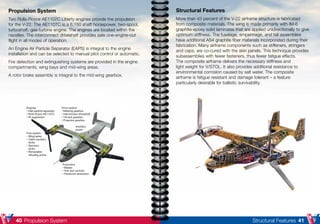
Propulsion System
Two Rolls-Royce AE1107C Liberty engines provide the propulsion
for the V-22. The AE1107C is a 6,150 shaft horsepower, two-spool,
turboshaft, gas-turbine engine. The engines are located within the
na­celles. The interconnect driveshaft provides safe one-engine-out
flight in all modes of operation.
An Engine Air Particle Separator (EAPS) is integral to the engine
installation and can be selected to manual pilot control or automatic.
Fire detection and extinguishing systems are provided in the engine
compartments, wing bays and mid-wing areas.
A rotor brake assembly is integral to the mid-wing gearbox.
Structural Features
More than 43 percent of the V-22 airframe structure is fabricated
from com­posite materials. The wing is made primarily with IM-6
graphite-epoxy solid laminates that are applied unidirectionally to give
opti­mum stiffness. The fuselage, empennage, and tail assemblies
have additional AS4 graphite fiber materials incorporated during their
fabrication. Many airframe components such as stiffeners, stringers
and caps, are co-cured with the skin panels. This technique provides
subassemblies with fewer fasteners, thus fewer fatigue effects.
The composite airframe delivers the necessary stiffness and
light weight for V/STOL. It also provides additional resistance to
environmental corrosion caused by salt water. The composite
airframe is fatigue resistant and damage tolerant – a feature
particularly desirable for ballistic survivability.
Proprotors
• Blades
• Hub and controls
• Pendulum absorbers
Fuel system
• Wing tanks
• Cabin auxiliary
tanks
• Sponson
tanks
• Retractable
refueling probe
Engines
• Inlet particle separator
• Rolls Royce AE1107C
• IR suppressor
Auxiliary
power
Drive system
• Midwing gearbox
• Interconnect driveshaft
• Tilt-axis gearbox
• Proprotor gearbox
Propulsion System Structural Features
42 43
Cockpit and Avionics
The V-22 Integrated Avionics System (IAS) is a fully
integrated avionics suite using a combination of
off-the-shelf equipment and specially developed
hardware and software. The functionality integrated
into the IAS is as follows:
• Controls and Displays
	 Provides aircrew and maintenance personnel with the resources to 	
	 monitor cockpit information and control aircraft functions.
• Mission Computers
	 Provides dual redundant processing and control for all functions of 	
	 the IAS.
• Navigation
	 Provides primary navigation data. This data is gathered from the 		
	 inertial navigation sensors and radio navigation sensors.
	 Navigation data includes: position, heading, altitude, geo	graphic 		
	 frame velocities, radar altitude, radio navigation (data such as 		
	 distance and bearing to ground stations), and marker beacon station 	
	 passage.
	 An optional enhanced suite can include Terrain Following/		
	 Terrain Avoidance (TF/TA) Multimode Radar and Traffic Collision 		
	 Avoidance System (TCAS).
• Communications
	 Provides for internal and external radio control and inter-			
	 communications, VHF/UHF radio communication, SATCOM, and IFF.
• Turreted Forward Looking Infra-Red System
	 Provides for reception of infrared energy and its conversion to video 	
	 signals to assist the aircrew in piloting and navigation.
• Dual Digital Map
	 Provides a real-time, color, moving map imagery on the multi-function 	
	 displays. It may be operated independently by both operators. The 	
	 aircraft’s position is shown with respect to the display, and multiple 	
	 overlay options are available.
• Electronic Warfare Suite
	 Provides detection and crew notification of missiles, radars, and laser 	
	 signals that pose a threat to the aircraft.
	
	 The suite also includes dispensers for expendable
	 countermeasures.
	 An optional enhanced suite includes active jamming systems, 		
	 additional countermeasure launchers, and other systems.
Cockpit & Avionics Cockpit & Avionics
44 45
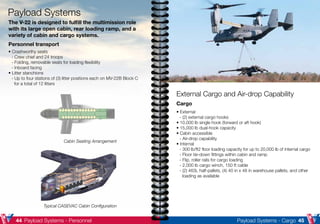
The V-22 is designed to fulfill the multimission role
with its large open cabin, rear loading ramp, and a
variety of cabin and cargo systems.
Personnel transport
• Crashworthy seats
	- Crew chief and 24 troops
	 - Folding, removable seats for loading flexibility
	- Inboard facing
• Litter stanchions
	 - Up to four stations of (3) litter positions each on MV-22B Block C 	
		 for a total of 12 litters
External Cargo and Air-drop Capability
Cargo
• External
	 - (2) external cargo hooks
• 10,000 lb single hook (forward or aft hook)
• 15,000 lb dual-hook capacity
• Cabin accessible
	 - Air-drop capability
• Internal
	 - 300 lb/ft2 floor loading capacity for up to 20,000 lb of internal cargo
	 - Floor tie-down fittings within cabin and ramp
	 - Flip, roller rails for cargo loading
	 - 2,000 lb cargo winch, 150 ft cable
	 - (2) 463L half-pallets, (4) 40 in x 48 in warehouse pallets, and other 	
		 loading as available
Payload Systems - Personnel Payload Systems - Cargo
Payload Systems
Cabin Seating Arrangement
Typical CASEVAC Cabin Configuration
46 47Personnel Insertion/Extraction Personnel Insertion/Extraction
The V-22 provides alternate means for personnel
insertion and/or extraction when landing is not
practical or desired.
The rescue hoist is an electrically driven system, capable of hoisting
devices into the cabin like the stokes litter, two-man rescue team,
forest penetrator, or a stokes litter with attached floatation device.
Optional fastrope equipment can be installed that provides for
two fastropes in the cargo area. One mounting system is located
above the end of the cargo ramp so that the rope can hang
vertically at a nominal distance of 14 inches aft of the ramp floor;
the second is located above the aft cargo hook bay.
Personnel Insertion/Extraction
Fast rope system at the rear cabin
Parachute operations have also been conducted with the V-22
48 49
The V-22 is capable of sustained cruise speeds in excess of
275 ktas and an unprecedented V/STOL aircraft mission radius.
Standard day capabilities are shown in the figures below.
Hover Performance
V-22 Standard Day Hover Envelope (OGE)
Cruise Flight Envelope
V-22 Airplane Mode Flight Envelope (Standard Day)
Internal Payload Mission
External Payload Mission
Self-Deployment Mission
0
4,000
8,000
12,000
16,000
20,000
100 200 300 400 500 600 700
Mission Radius - nm
Payload-lb
(2) MAT
(3) MAT
Integral
Fuel
Sea Level - ISA
Vertical Takeoff / Vertical Landing (VTOL)
Mission Auxiliary Tanks:
Short Takeoff/Run-On Landing (STOL)
Short Takeoff/Vertical Landing(STOVL) (1) MAT
Cruise speed for 99% best range
20 min landing fuel reserve
57,000 lb max GW
V-22 Performance Charts V-22 Performance Charts
‡
Example HOGE
Transport Capability
3000 lb, 70 nm
payload at 10k'
PA is 3,000 lbs with
70 nm range post
pickup/drop
7500 lb, 200 nm
payload at 6k'
PA is 7,500 lbs with
200 nm range post
pickup/drop
A/P Mode cruise, 99% best range
500 gal water blivot
Lightweight 155mm howitzer
2,000
4,000
6,000
8,000
10,000
12,000
14,000
16,000
18,000
20,000
22,000
50 51
Restricted Visibility Landings
The V-22 is capable of landing without visual
reference to the ground via manual pilot control or
automatic hovering autopilot functions.
Where sand or dusty conditions occur, the V-22 may conduct a
Restricted Visibility Landing (RVL) based on cockpit instrumentation.
The aircraft displays indicate attitude, altitude, drift vector, drift
acceleration, and power settings, which allows the aircraft to use its
INS systems to land in complete brown-out conditions. RVL landings
may use a coupled hover approach from 50 ft to vertical landing, or
pilots may manually fly to a no-hover direct landing.
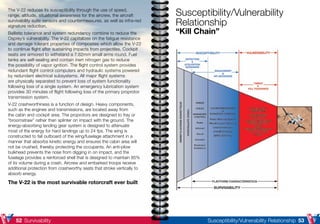
Survivability is a function of three key elements: susceptibility,
vulnerability, and crashworthiness. Susceptibility is the probability
of being hit; vulnerability is the probability of surviving, if hit; and,
crashworthiness is the probability the occupants will survive an
emergency landing or ground impact without serious injury.
Restricted Visibility Landing Survivability
Appendix 1
Survivability
Ballistic Tolerance:
• Advanced Composite Construction
• Reduced Vulnerable area
• Fuel System Fire Protection
• Redundant Fly-by-Wire Controls
• Redundant Electrical Power
• Redundant Hydraulics
• Swashplate Actuator Armor
• Crewstation Armor
IR Signature:
• Advanced IR Suppressors
• Cooled Nacelles
• No Exhaust on Airframe
• Low IR-Reflective Paint
• Low Secondary IR Sources
Acoustic Signature:
• Low Rotor Tipspeed in Airplane Mode
• Low Noise at High Speed
• Unique Sound Propagation
	 -Up / Down / Sides
• Greatly Reduced Engagement Window
Speed and Range:
• Twice Legacy Speed
• 2–5 X Legacy Range
• Reduced Exposure Time
• Fly Around the Threat
52 53
The V-22 reduces its susceptibility through the use of speed,
range, altitude, situational awareness for the aircrew, the aircraft
survivability suite sensors and countermeasures, as well as infra-red
signature reduction.
Ballistic tolerance and system redundancy combine to reduce the
Osprey’s vulnerability. The V-22 capitalizes on the fatigue resistance
and damage tolerant properties of composites which allow the V-22
to continue flight after sustaining impacts from projectiles. Cockpit
seats are armored to withstand a 7.62mm small arms round. Fuel
tanks are self-sealing and contain inert nitrogen gas to reduce
the possibility of vapor ignition. The flight control system provides
redundant flight control computers and hydraulic systems powered
by redundant electrical subsystems. All major flight systems
are physically separated to prevent loss of system functionality
following loss of a single system. An emergency lubrication system
provides 30 minutes of flight following loss of the primary proprotor
transmission system.
V-22 crashworthiness is a function of design. Heavy components,
such as the engines and transmissions, are located away from
the cabin and cockpit area. The proprotors are designed to fray or
“broomstraw” rather than splinter on impact with the ground. The
energy-absorbing landing gear system is designed to attenuate
most of the energy for hard landings up to 24 fps. The wing is
constructed to fail outboard of the wing/fuselage attachment in a
manner that absorbs kinetic energy and ensures the cabin area will
not be crushed, thereby protecting the occupants. An anti-plow
bulkhead prevents the nose from digging in on impact, and the
fuselage provides a reinforced shell that is designed to maintain 85%
of its volume during a crash. Aircrew and embarked troops receive
additional protection from crashworthy seats that stroke vertically to
absorb energy.
The V-22 is the most survivable rotorcraft ever built
Susceptibility/Vulnerability
Relationship
“Kill Chain”
Survivability Susceptibility/Vulnerability Relationship
54 55
Appendix 2
Shipboard Compatibility
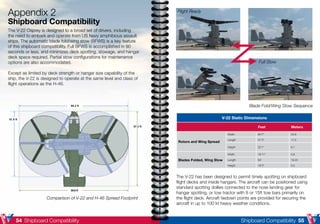
The V-22 Osprey is designed to a broad set of drivers, including
the need to embark and operate from US Navy amphibious assault
ships. The automatic blade fold/wing stow (BFWS) is a key feature
of this shipboard compatibility. Full BFWS is accomplished in 90
seconds or less, and minimizes deck spotting, stowage, and hangar
deck space required. Partial stow configurations for maintenance
options are also accommodated.
Except as limited by deck strength or hangar size capability of the
ship, the V-22 is designed to operate at the same level and class of
flight operations as the H-46.
84.5 ft
51.0 ft
57.3 ft
84.3 ft
84.6 ft
51.0 ft
57.3 ft
84.3 ft
Comparison of V-22 and H-46 Spread Footprint
	 Blade Fold/Wing Stow Sequence
The V-22 has been designed to permit timely spotting on shipboard
flight decks and inside hangars. The aircraft can be positioned using
standard spotting dollies connected to the nose landing gear for
hangar spotting, or tow tractor with 8 or 15ft tow bars primarily on
the flight deck. Aircraft tiedown points are provided for securing the
aircraft in up to 100 kt heavy weather conditions.
V-22 Static Dimensions
Rotors and Wing Spread
Width 84’7” 25.8
Length 57’3” 17.5
Height 22’1” 6.7
Blades Folded, Wing Stow
Width 18’11” 5.8
Length 63’ 19.20
Height 18’3” 5.5
Feet Meters
Shipboard Compatibility Shipboard Compatibility
Flight Ready
Full Stow
56 57
Tiltrotor technology exploratory development began in 1950. It
transitioned to military development in the mid-1980s, and has
matured today into the V-22 Osprey tiltrotor aircraft.
Tiltrotor technology development has been as evolutionary as it
has been revolutionary. Although various convertiplane concepts
were explored during the late 1940s and early 1950s, the Bell
XV-3 was the first tiltrotor that successfully converted from vertical
to horizontal flight. The XV-3 (1958) 4,800-pound prototype used
transmissions, driveshafts, gearboxes and electric motors inside
the fuselage to tilt its wingtip mounted rotor systems. The XV-3 was
powered by a 450 hp Pratt & Whitney R-985 radial, reciprocating
engine, which was also located in the fuselage. The XV-3 made 250
test flights, including 110 full conversions from helicopter mode to
airplane mode and back. The XV-3 demonstrated the feasibility of
tiltrotor technology.
The XV-3 was flown well into the 1960s, to further the understanding
of tiltrotor technology. Other turbine powered experimental
convertiplanes followed in the 1960s, including the Hiller X-18, the
Curtiss Wright X-19 and the Bell X-22A, a four engine ducted fan
built under a U.S. Navy contract to study the possibility of a Vertical
and Short Takeoff and Landing tactical transport. All, including the
XV-3, had limited payload and performance and were not considered
suitable for operational service.
Appendix 3
History & Development
History & Development History & Development
With the technical feasibility of tiltrotors established by the XV-3,
the U.S. Army and NASA proposed developing a new turbine
powered tiltrotor aircraft, the XV-15. In July 1972, Bell Helicopter
was awarded a NASA contract to build and test two XV-15s.
Each weighed 13,000 pounds and was powered by two 1,550
shaft horsepower Lycoming T53 turboshaft engines. The aircraft
flew in helicopter mode in May 1978 and April 1979, respectively.
On July 24, 1979, an XV-15 flew in airplane mode, achieving
an altitude of 4,000 feet and airspeed of 160 knots. Later, the
envelope was expanded to 21,000 feet altitude with cruise
speeds reaching 300 knots. In 1981, an XV-15 dazzled a Paris
Air Show audience that included Secretary of the Navy John
Lehman, with a demonstration of takeoffs and landings, low-
speed maneuvers, 360-degree turns and high-speed flyovers.
The XV-15’s Paris Airshow debut was the catalyst for the next
generation of tiltrotors.
58 59
JVX
In December 1981, the Department of Defense formally began
the Joint Services Advanced Vertical Lift Aircraft (JVX) Program to
meet the needs of all four military services for a vertical takeoff and
landing (VTOL), medium-lift, tactical transport aircraft. The need to
replace the Services medium lift helicopters was well documented.
U. S. Marine Corps CH-46E and CH-53D medium lift helicopters
began military service in the early 1960s and were experiencing
technical obsolescence, escalating maintenance costs, reduced
reliability, availability and maintainability (RAM) and significant
performance degradation. Current and projected CH-46E and
CH-53D deficiencies included:
• Inadequate payload, range and airspeed
• Lack of ability to communicate, navigate and operate in adverse
	 weather conditions, day or night
• No self-deployment or aerial refueling capability
• Insufficient threat detection and self-protection capabilities
• Unacceptably high maintenance and inspection rates
• Limited communication capability for embarked troop commanders
SOCOM uses a variety of fixed and rotary wing aircraft to perform
special operations missions, the oldest of which were the MH-
53J/M Pave Low II medium lift helicopters, with an average age of
30 years. The MH-53J/M lacked the self-deployment capability and
performance required to maximize the probability of success for
assigned clandestine missions. Current and projected SOCOM aircraft
deficiencies include:
• Inadequate combat radius to execute multiple, concurrent major 		
	 theater war and national missions without incurring additional 		
	 support requirements, i.e., numerous in-flight refueling sorties and an 	
	 increased operational signature
• Inadequate growth potential for emerging, self-protection avionics 	
	 systems due to aircraft space and weight considerations
History & Development History & Development
V-22 Development
A two-and-a-half year preliminary design effort for JVX began in April
1983 to reduce program risk for full scale development. More than
8,600 hours of wind tunnel modeling were completed. A full scale
composite fuselage section and a wing were built and static tested,
and a large scale rotor performance test was conducted to verify
performance estimates. In 1984, the government designated the JVX
as the V-22, and shortly thereafter, Secretary of the Navy John Lehman
named it the Osprey.
60 61
V-22 Full Scale Development
Bell Boeing began Full Scale Development (FSD) in June 1985. The first
FSD aircraft was rolled out on May 23, 1988, and flew on March 19,
1989. One month later in April 1989, the Administration decided that
the V-22 was too expensive and requested no more funding for V-22
development or production, in effect cancelling the program. Congress,
however, continued to fund the development program, while calling
for an independent cost and operational effectiveness analysis (COEA)
to evaluate the V-22 against conventional helicopters. The Institute
for Defense Analysis (IDA) conducted this exhaustive assessment
and concluded, as had several previous studies, that the V-22 was
more cost and operationally effective than any alternative helicopters.
Based on this study, Congress continued funding V-22 development.
During FSD, Bell Boeing built six developmental V-22s, a ground test
article and a full scale static test article. Five V-22s flew, accumulating
764 flight hours in 645 flights. The Osprey came full circle in October
1992, when Vice President Dan Quayle announced an Engineering and
Manufacturing Development (EMD) contract award for four production
representative V-22 aircraft.
Engineering and Manufacturing Development
The $2.3B Engineering and Manufacturing Development (EMD)
program contract award called for Bell Boeing to modify two of the
previous full scale development aircraft and to design, test, qualify
and build four new production representative aircraft for Operational
Evaluation testing. The EMD design effort incorporated fixes and
lessons learned from the FSD contract phase to reduce weight
and incorporate recurring unit cost reduction and producibility
improvements. Tooling was designed and built to produce initial
production lots. The first flight of EMD aircraft #7 occurred in
December 1996. The EMD program was completed in 1999. During
the EMD Flight Test Program, the V-22 achieved 275 knots in level
flight, attained 25,000 feet altitude, flew at 60,500 pounds maximum
gross weight and achieved 3.9 g’s at 39,500 pounds.
V-22 Development V-22 Development
62 63
In April 1997, the Under Secretary of Defense of Acquisition,
Technology and Logistics approved V-22’s entry into low rate initial
production and delegated future production decisions to the Navy. Also
in 1997 the Quadrennial Defense Review (QDR) restructured the V-22
program from a buy of 425 MV-22Bs for the Marine Corps, to 360.
Because of the decrease in total numbers and the continued aging of
the CH-46E/CH-53D fleets, the QDR also recommended accelerating
production to a maximum rate of 30, vice 24 per year, to complete
fielding in 2012, vice 2021.
Following two mishaps in 2000, at the suggestion of the Marine Corps
Commandant, then Secretary of Defense Cohen established a panel
to conduct an independent, high-level review of the V-22 program.
The Panel was to assess the safety of the aircraft and recommend any
proposed changes or corrective actions and report the results. Any
milestone production decisions would be delayed until completion of
the Review Panel’s work.
The Panel’s April 2001 report found no evidence of an inherent
safety flaw in the V-22 tiltrotor concept, and recommended the
program be continued.
The V-22 return to flight phase commenced in 2002. Proceeding
under an incremental time-phased block procurement strategy, Block
A aircraft began to be delivered to the fleet in 2003. Incorporating
upgraded flight control software, improved hydraulics and wiring in the
nacelles, and other reliability and maintainability enhancements, these
aircraft now constitute the training squadron inventory.
IOC and Initial deployments
The Corps established VMX-22 in August 2003 as its tiltrotor
operational test squadron. Operational Evaluation was completed by
VMX-22 in June 2005 and found the MV-22B operationally effective
and suitable.
In Sep 2005, an Acquisition Defense Memorandum (ADM) approved
Full Rate Production for the MV-22B and CV-22.
VMM-263, the first fleet tiltrotor squadron, stood up in March 2006,
beginning the medium lift fleet transition from CH-46E to MV-22B.
Initial Operational Capability (IOC) was reached in June 2007, and
the first combat deployment of the MV-22B took place soon after in
October 2007.
The MV-22B was continuously combat deployed to Operation Iraqi
Freedom for 18 months from 2007 to 2009. In May 2009, the first MV-
22B ship based MEU deployment began. Later that year in November,
the MV-22B deployed to Operation Enduring Freedom.
Low-rate Initial Production
Low-rate Initial Production Low-rate Initial Production
64 65
Transition Task Forces, chaired by HQMC Deputy Commandant
for Aviation, oversees all Type/Model/Series transition plans.
The medium lift assault support fleet is transitioning from the
CH-46E to the MV-22B. Beginning in 2003, this transition has
been tracking to schedule and at the rate of two squadrons per
year will be completed in 2017.
Squadron transitions from CH-46E to MV-22B take
approximately 18 months from the time the HMM stands
down to the time the newly formed VMM is ready to enter pre-
deployment training.
V-22 deliveries are occurring on time and are supporting this
transition. In FY-09, the last remaining CH-46E HMM squadron
stood down on the East Coast and the West Coast transition
began in FY-10.
Appendix 4
USMC Medium Lift Transition
USMC Medium Lift Transition USMC Medium Lift Transition
66 67
The V-22 represents a revolutionary change in design and versatility. It
brings capabilities not found in helicopters – a leap forward in speed,
range and altitude performance.
Numerous major studies and analyses have shown that the V-22 is
more cost and operationally effective than any helicopter (including
compound/coaxial helicopter designs), or any combination of
helicopters in the medium lift assault role. Compared to a range of
current and advanced helicopter designs:
• The V-22 has superior speed, range and survivability:
	 - Increases the tactical options available to the operational 		
		 commander
	 - Dramatically reduces the risk of friendly force casualties in post-	
		 assault ground operations
• When equal lift capability aircraft fleets are considered:
	 - Significantly fewer V-22s were required to accomplish the specified 	
		 missions
	 - Likewise, proportionately fewer support assets and personnel 		
		 were required
• When equal cost aircraft fleets are considered:
	 - The V-22 fleet is more effective than any of the helicopter 		
		 alternatives
	 - Lower through-life costs for the tiltrotor
• For the same payload, range and cruise speed as the V-22, a 		
	 compound or coaxial helicopter would require 20% more fuel and 	
	 have a higher empty weight. Subsequently, the unit and operational 	
	 cost of a comparable compound or coaxial helicopter would be far 	
	 greater than the V-22.
	 - In addition, it would be difficult to self deploy the desired 2,100 nm
	 given the lower cruise efficiency associated with a compound or	
	 coaxial helicopter.
	 - Futhermore a compound or coaxial helicopter experiences 		
		 significant vibrations in high speed flight, while the V-22 enjoys 		
		 lower vibrations like other fixed wing turboprop aircraft.
Appendix 5
Studies and Analyses
Studies & Analyses Studies & Analyses
68 69
Appendix 6
Current & Future Capabilities
70
179638
Approved for Public Release - Unlimited Distribution
NAVAIR PMA-275 Control Number 10-28

Osprey 2010 Guidebook

  • 1.
  • 2.
    2 3 TABLE OFCONTENTS Executive Summary......................................................................................4 Marine Corps Vision and Strategy 2025.....................................................6 V-22: From Concept, To Development, To Reality......................................7 Tactical, Operational, and Strategic Reach.................................................8 Mission Snapshots Operation Enduring Freedom, Afghanistan................................................12 Operation Unified Response, Haiti.............................................................13 Shipboard Deployment: 22nd Marine Expeditionary Unit...........................14 Operation Iraqi Freedom...........................................................................16 Humanitarian Relief, SOUTHCOM.............................................................19 Exercise Flintlock......................................................................................20 CV-22 Responds, Rescue Request...........................................................21 Misconceptions and Statements of Fact..................................................22 General Characteristics..............................................................................34 Design Features..........................................................................................35 Multiservice Configurations MV-22B U.S. Marine Corps.......................................................................36 CV-22 U.S. Special Operations Command................................................38 Top Tier Suppliers........................................................................................39 Propulsion System......................................................................................40 Structural Features.....................................................................................41 Cockpit Avionics.........................................................................................42 Payload Systems.........................................................................................44 Personnel Insertion/Extraction..................................................................46 Performance Charts....................................................................................48 Restricted Visibility Landings.....................................................................50 Appendix 1: Survivability............................................................................51 Appendix 2: Shipboard Compatibility........................................................54 Appendix 3: History and Development......................................................56 Appendix 4: USMC Medium Lift Transition...............................................64 Appendix 5: Studies and Analyses.............................................................66 Appendix 6: Current and Future Capabilities............................................68 Marines take extraordinary pride in the comment attributed to journalist Richard Harding Davis, “The Marines have landed, and the situation is well in hand.” Our history has repeatedly validated that statement. Our training and organization en- sure our fellow Americans that they should never doubt the outcome when Marines are sent to do our Nations work. Our confidence comes from the selfless sacrifices we witness every day by the courageous young men and women who volunteer to serve. We must ensure we continue to provide the tools they need to get the job done. Our Marines deserve the very best equipment we can give them – and the V-22 is exactly that. The Osprey is not a one-for-one replacement for any of our current, aging helicopters. The capability this aircraft represents does not just deliver Marines and equipment faster; it changes the entire calculus of planning and fighting at the tactical and operational level for our joint force and MAGTF commanders. None of us knows what the 2025 battlefield will look like. What we do know is what the Marine Corps will look like: It will be fast, light, agile, expeditionary and lethal. The Osprey is now and will be a cornerstone of that force. Since 2001, the Marine Corps has been fighting shoulder to shoulder along- side our joint and allied partners overseas, supporting an extremely high operational tempo in two theaters while growing our force, introducing new aircraft and systems, and looking beyond the current fight. As we continue to shape naval aviation in the years ahead, the Osprey will be a key compo- nent of our future warfighting vision. Semper Fidelis James T. Conway General, U.S. Marine Corps Commandant of the Marine Corps Message from the Commandant
  • 3.
    4 5Executive SummaryProgram of Record The V-22 Osprey is the world’s first production tiltrotor aircraft. Unlike any aircraft before it, the V-22 successfully blends the vertical flight capabilities of helicopters with the speed, range, altitude, and endurance of fixed-wing transports. This unique combination provides an unprecedented advantage to warfighters, allowing current missions to be executed more effectively, and new missions to be accomplished that were previously unachievable on legacy platforms. Comprehensively tested and in full rate production, the V-22 provides strategic agility, operational reach, and tactical flexibility – all in one survivable, transformational platform. Mission and Description The V-22 Osprey Program is charged by the Department of Defense (DoD) with developing, testing, evaluating, procuring and fielding a tiltrotor Vertical/Short Takeoff and Landing (V/STOL) aircraft for Joint Service application with the Navy being the lead. The V-22 program is designed to provide an aircraft to meet the amphibious/vertical assault needs of the United States Marine Corps (USMC), the strike rescue needs of the Navy, and the special operations needs of the United States Special Operations Command (USSOCOM). The MV- 22B variant is replacing the CH-46E. The CV-22 variant provides a new capability and will augment the MC-130 in the USAF/USSOCOM inventory for special operations infiltration, exfiltration, and resupply missions. The V-22’s tiltrotor technology is revolutionizing military air transport in a manner not seen since the introduction of helicopters more than 50 years ago. CV-22 US Special Operations Command EXECUTIVE SUMMARY MV-22B United States Marine Corps USMC – 360 MVs • Amphibious Assault • Sustained Land Operations • Self-Deployment USSOCOM – 50 CVs • Long-Range Special Operations • Contingency Operations • Evacuations and Maritime Special Operations USN – 48 HVs • Combat Search And Rescue • Fleet Logistic Support • Special Warfare
  • 4.
    6 7 “Though ourCorps has recently proven itself in ‘sustained operations ashore,’ future operational environments will place a premium on agile expeditionary forces, able to act with unprecedented speed and versatility in austere conditions against a wide range of adversaries…” – Marine Corps Vision and Strategy 2025 The long-held vision of tiltrotor capabilities and the advantage that the V-22 could bring to our forces has faced challenges throughout the development and production of the aircraft. The strategic discipline, commitment, and perseverance of the government/industry partnership, have brought this aircraft to the field, where it is transforming aviation. Marine Corps Vision & Strategy 2025 Critical Operational Issue Parameter Threshold Result Assault Support Amphibious Pre- Assault/Raid 200 NM (KPP) 230 NM Amphibious Ext Lift 10,000 lbs for 50 NM (KPP) 9,800 for 50 NM Land Assault External Lift 50 NM (KPP) 69 NM Cruise Airspeed 240 KTS (KPP) 255 KTS Troop Seating 24 Combat Troops (KPP) 24 Combat Troops Self Deployment Self-deployment 2100 NM (KPP) 2660 NM Survivability Ballistic Tolerance 12.7mm @ 90% velocity (KPP) Satisfactory (BLRIP-LFT&E) Interoperability Top Level Information Exchange Requirement (IER) All top-level requirements (KPP) Satisfactory From Concept To Development and Testing To Reality Marine Corps Vision & Strategy 2025 From Concept to Reality 2005 Operational Evaluation
  • 5.
    8 9 Enhanced capabilityprovides • Expanded battlespace maneuver • Complications to the enemy’s defense • Increased stand-off lowers seabasing risk • Exponential operational impact • Unprecedented survivability in assault support aircraft • Tactical agility of a rotorcraft with the performance of a turboprop aircraft Tactical, Operational, and Strategic Reach Tactical, Operational, and Strategic Reach TACTICAL, OPERATIONAL, AND STRATEGIC REACH Mission Profile • Without Mission Auxiliary Tanks System (MATS) - Approx 4.0 hrs max endurance - Approx 700 nm max range in 3.0 hrs • Ceiling 24,700’ • 325 nm combat radius - 24 passengers • 600 nm combat radius with 1 aerial refuel - 24 passengers • Additional fuel options: up to 3 MATS tanks - 1 MATS tank, 14 passengers, 3.5 hrs endurance - 2 MATS tanks, 6 passengers, 4.2 hrs endurance - 3 MATS tanks, 0 passengers, 4.9 hrs endurance
  • 6.
    10 11 MV-22B MISSIONSNAPSHOT MV-22B CV-22 MISSION SNAPSHOTMV-22B CV-22 Since the MV-22B reached initial operational capability in June 2007, followed by the CV-22 in March 2009, Ospreys have been combat deployed across the globe in support of contingency operations. The following section briefly describes operational employment examples of the USMC MV-22B and AFSOC CV-22.
  • 7.
    12 13 MV-22B MISSIONSNAPSHOT MV-22B speed and range made it the platform of choice for a variety of missions • Long-range logistics runs to Guantanamo Bay, Cuba (over 200nm) to pick up supplies for distribution • Movement of 492 personnel for site assessments at remote sites for JTF-Haiti • Movement of personnel for presence and security at multiple sites • Movement of water and nearly 13,000 rations, rice, and medical supplies “The overall advantage for using the Osprey is the efficiency with which we can get all of this done... The speed of the Osprey allows us to land multiple teams in areas all throughout northern Haiti, leave them there with enough time to get a good assessment and retrieve all these teams before nightfall — only using two Ospreys.” – Capt. Robert Shuford 24th Marine Expeditionary Unit During Operation Enduring Freedom, the MV-22B established its presence in an historic 10-aircraft, 510-mile, single-leg transit from amphibious shipping. All aircraft arrived safely at their new base two hours and 15 minutes after takeoff Missions that could not be executed using conventional rotorcraft have become commonplace, greatly enhancing the Commander’s ability to influence the Area of Responsibility (AOR). Jan 2010: The superior speed, range, and low acoustic signature of the MV-22B enabled a bold daylight raid against insurgents. The aircraft approached undetected until just before landing, with absolute tactical surprise that caught the enemy completely off guard. Range capability unprecedented for a rotorcraft enabled the MV-22B to facilitate movement of government and tribal leaders across the breadth of Afghanistan. Afghanistan Operation Enduring Freedom November 2009 to Present MV-22B Operations MV-22B Operations Haiti Operation Unified Response Jan 2010
  • 8.
    14 15 MV-22B MISSIONSNAPSHOT The MV-22B also proved to be a lifesaver, by flying an urgent ship to shore CASEVAC into Jordan, covering 147 miles in 37 minutes - a feat not possible with legacy aircraft. “If it hadn’t been for the Osprey, there’s no way we could have gotten the patient to where she needed to be to receive the care that ultimately saved her life.” – USS Bataan Corpsman “There is a whole new generation of Marines getting very comfortable with seeing the MV-22B and working with it. Once you start using the asset, you really start to understand what you can do with the improved response time and range.” – MEU Commander “The V-22 can reach the fight and be effective in the fight like no other aircraft that has ever been embarked on these ships. And in doing so, it enhances the ship’s ability to contribute to those missions.” – USS Bataan Commanding Officer MV-22B: Shipboard Operations MV-22B: Shipboard Operations Shipboard Operations 22 Marine Expeditionary Unit May to November 2009 MV-22B met all Amphibious Based Mission Requirements The MV-22B excelled in contingency missions with greater speed, range, payload, and endurance than any other rotorcraft. This increased flexibility to amphibious shipping and allowed further standoff distances from the shore. In addition, long-range ship-to-shore logistics support benefited from the aircraft’s transformational capabilities.
  • 9.
    16 17 CASEVAC 25 Dec07: Urgent CASEVAC patient required transport from Mudaysis to Al Asad (80 nautical miles, one way) “Golden Hour” Preserved In a scenario that conventional assault support assets could not execute, the MV-22B launched from Al Asad, flew to Mudaysis, performed pickup, and returned to Al Asad in under one hour. Economy of Force: A Classic Example To match this response time using conventional assets, helicopters would have to be staged and ready at the pickup point, along with associated security, maintenance, and fuel requirements. Operation Iraqi Freedom October 2007 to April 2009 In its combat debut, the MV-22B’s speed and range immediately provided an operational reach that revolutionized assault support capability. Often the aircraft of choice for missions where speed, range, and survivability were critical, the MV-22B was widely lauded as an assault support platform. During consecutive Operation Iraqi Freedom deployments over a period of 18 months, three Marine Medium Tiltrotor Squadrons (VMMs) logged • More than 6,000 sorties • Nearly 10,000 flight hours • More than 45,000 passengers moved • More than 2.2 million pounds of cargo moved The MV-22B broadened the ground commander’s area of influence for boots on the ground. The MV-22B flew into every threat zone, performing every available assault support mission, including • Raids, assaults, Aero Scout, VIP, general support, MEDEVAC, Tactical Recovery of Aircraft and Personnel (TRAP), Rapid Ground Refueling (RGR) • MV-22B speed and range enabled Iraqi government officials to make frequent visits to remote areas, spreading the influence of Iraqi governance. No combat losses were incurred during this deployment, thanks to the aircraft’s inherent survivability and tactics that keep the aircraft out of range of small arms and RPGs for most of the flight. “Turns Texas into Rhode Island.” – BGen Alles, CG ACE MNF-W “I could dominate [Al Anbar Province], because I had V-22s…I couldn’t do what I did with just helicopters.” – MGen Kelly, CG MNF-W MV-22B: Operation Iraqi Freedom MV-22B: Operation Iraqi Freedom MV-22B MISSION SNAPSHOT
  • 10.
    18 19 CV-22 MISSIONSNAPSHOT CV-22: Operation Iraqi Freedom CV-22: Humanitarian Relief Operation Iraqi Freedom July – November 2009 In July 2009, six CV-22 aircraft from the 8th Special Operations Squadron (SOS) departed Hurlburt Field, FL, for their first operational deployment to Iraq. The CV-22s conducted a successful 7,000 nautical mile self-deployment in support of Operation Iraqi Freedom. The aircraft completed the transatlantic crossing in 7 days while completing three aerial refuelings along the way. While deployed the CV-22’s primary mission was to conduct long-range infiltration, exfiltration and resupply missions for special operations forces. During the deployment, the squadron executed and completed 45 direct action assault force INFIL/EXFIL missions and 123 combat service support missions, delivered over 30,250 pounds of cargo, and transported over 2,349 passengers. The CV-22s also supported the Iraqi Special Operations Forces (ISOF) in several operations to apprehend suspected terrorists. Although the new aircraft was flown by U.S. Air Force personnel, the troops and mission were led by the elite ISOF soldiers. The CV-22 has proven its value to the warfighter and commanders on the battlefield. The exceptional range, speed and versatility this aircraft brings to the fight is unmatched by conventional helicopters. Humanitarian Relief SOUTHCOM June 2009 While deployed to SOUTHCOM in support of ongoing operational missions, three CV-22 aircraft from the 8th SOS contributed air power to a large scale humanitarian relief effort to the country of Honduras. Taking advantage of the CV-22’s unique payload and flight capabilities, the aircraft and crews made three different deliveries of critical items to a small remote northeastern village. In total, approxi- mately 43,000 pounds of goods were delivered. These goods had been waiting to be delivered for some time, and with the CV’s unique lift-off/landing capabilities the much needed items, such as non- perishable food, hospital beds, and textbooks were finally delivered to the remote village. The CV-22 Osprey’s power, range and speed bring unique capabilities to a very broad spectrum of humanitarian relief, as proven in this and other documented V-22 relief efforts.
  • 11.
    20 21CV-22: ExerciseFlintlock 09 CV-22: Rescue Request CV-22 MISSION SNAPSHOTExercise Flintlock 09 October – November 2008 Four CV-22 aircraft from the 8th Special Operations Squadron (SOS), Hurlburt Field FL successfully completed their first self-deployment mission. The deployment covered some 5,300 nautical miles across the Atlantic Ocean to Bamako, Mali in support of Exercise FLINTLOCK-09. The exercise is a regularly scheduled training exercise in the Trans-Sahara region designed to build relationships and to enhance African nations’ ability to patrol and control their sovereign territory. The exercise included personnel from 15 countries and the CV-22 served as a platform for multinational training. Specifically, the aircraft was used to transport Malian and Senegalese special operations forces (SOF) and leadership teams throughout the vast exercise region. The primary mission for the CV-22 was long range vertical lift, inserting SOF teams so they could practice ground maneuvers, then return in order to extract the teams. The CV-22 proved to be a game changer during this exercise. Because of its long range capability, the teams were able to traverse the vast distances of the African continent in less time than a conventional helicopter. Taking advantage of the aircraft’s unique tiltrotor capabilities, missions over 500 nautical miles were routinely completed, infiltrating small teams and bringing them back without having to aerial refuel, and all within a four-hour window. This mission would have taken the MH-53 two to three times as long to complete. CV-22 Responds Rescue Request On October 6th, 2007, the 58th Special Operations Wing (Kirtland AFB) was contacted by civil authorities and the Air Force Rescue Center to help locate a missing aircraft. The CV-22 from the 71st SOS joined two HH-60G helicopters and an MC-130P in the search, becoming the first Osprey tiltrotor aircraft to conduct a real-world search and rescue mission. The downed aircraft was located in the San Juan Mountain range at elevations over 11,000 feet. Because of the speed, range, and ability to fly at higher altitudes, the CV-22 was the first aircraft to arrive at the crash site.
  • 12.
    22 23 Myth: TheV-22 can’t operate in the heat Fact: VMM-162 completed all mission tasks in Iraq throughout the summer of 2008, when ambient temperatures ranged well above 120 degrees F. It operated in dust storms with ¼-mile visibility when other rotorcraft could not. During their deployment, VMM-162s flew 2,371 hours, carried 12,841 passengers, and transported more than 407,000 pounds of cargo. Myth: The V-22 can’t operate in cold environments Fact: The V-22 can operate in temperatures as low as -54 degrees C (-65 degrees F) and demonstrated protracted cold- weather capability during operational test in Nova Scotia and Minnesota. Myth: The V-22 has an abnormal mishap rate Fact: The V-22 experienced a mishap rate of 77.3 prior to fleet introduction. By comparison, the CH-53E rate was 159.0 and the F-14A rate was 78.7, normalized to a rate per 100,000 hours. Myth: The V-22 has an abnormally low readiness rate at this stage of its lifecycle Fact: All newly introduced aircraft face readiness challenges early in the operational phase of their life cycle. V-22 readiness rates are on par with other types of aircraft at similar periods, and a clear roadmap exists, developed by the government-industry team to increase readiness levels. CV-22 Deployment [photo of CV-22]Setting the Record Straight Misconceptions & Statements of Fact Setting the Record Straight Setting the Record Straight
  • 13.
    24 25 Myth: TheV-22 can’t operate on ship Fact: VMM-263 safely and successfully conducted the first MV-22B shipboard deployment aboard USS Bataan with the 22nd Marine Expeditionary Unit in 2009. The aircraft can operate seamlessly with Harrier and helicopter patterns. Myth: V-22 exhaust damages the flight decks of Navy ships Fact: When the MV-22B nacelles are positioned vertically for takeoff, the engine exhaust gases are directed toward the flight deck. As a precautionary measure, flight deck portable heat shields were utilized aboard LSD and LPD class ships during the first MV-22B shipboard deployment. Subsequent testing and analysis determined that instead of these heat shields, a nacelle modulation technique was a more suitable and effective method to protect the flight deck. This nacelle modulation, wherein the nacelles are periodically rotated a small number of degrees, prevents heat build up in the deck plating and thus negates any chance of damage. Myth: The V-22 was “protected” and “babied” during Operation Iraqi Freedom Fact: The MV-22B and CV-22 flew into all threat zones in Iraq, including “black zones”—the most dangerous areas. It performed extremely well across the full range of assault support missions, including raids and heliborne assault, exceeding the capabilities of legacy helicopters in speed, agility, and survivability. Myth: The V-22 hasn’t been combat tested Fact: Every mission flown in Iraq and Afghanistan is a combat mission. A combination of performance and tactics unique to the MV-22B keep the aircraft outside much of the threat envelope—including small arms, RPGs, and shoulder-fired surface-to-air missiles (MANPADS)—during transit. During ingress and egress, when the aircraft must penetrate the threat envelope, the speed, agility, and low aural signature of the MV-22B combine to reduce exposure to threats and improve survivability. Ballistic tolerance, proven during Live Fire Test and Evaluation, protects crew and passengers in case of engagement. Hydraulic and flight control redundancy, widely separated engines, robust single-engine flyaway capability, and the extensive combat experience of the MV-22B community combine to make this the most survivable rotorcraft in history. Setting the Record Straight Setting the Record Straight
  • 14.
    26 27 Myth: TheV-22 can’t land in the desert Fact: Unlike any other aircraft in the inventory, the V-22 has systems that allow it to land in total brown-out conditions. The flight control system can automatically hold the aircraft position over the ground; or pilots can reference the exact drift information and fly the aircraft manually to the deck without looking outside. The ability of the V-22 to operate in brown-out conditions far exceeds that of legacy aircraft. Myth: The V-22 is unsafe because it can’t autorotate Fact: The V-22 is a tiltrotor and does not rely on autorotation for a survivable power-out landing. The wide separation of the engines and the ability to drive both rotors with one engine make a power-out landing extremely unlikely. However, if required, the V-22 can glide for a predictable run-on landing in airplane mode, much like a turboprop. Myth: The V-22 can’t operate in high-threat environments Fact: A high-threat environment is one in which integrated air defenses–such as networks of radar-guided surface-to-air missiles, along with a robust command and control network to direct those systems–are present and operating. We do not operate any of our assault-support platforms in that kind of environment without appropriate reduction or mitigation provided by attack platforms. The V-22 has operated successfully in low- and medium-threat environments where small arms, RPGs, and shoulder-launched heat-seeking missiles are present. Myth: Excessive V-22 downwash prohibits hoisting, fastrope, and over water hover work Fact: Recognizing the rotor downwash of the V-22 is similar to that of the CH-53E, and after incorporating lessons learned from previous Operational Test periods, procedures have been developed to effectively mitigate downwash effects on personnel working below or in the vicinity of the aircraft as well as personnel exiting the aircraft via fastrope, rappel, or helocast operations. These procedures are safe, effective, and in use today. Setting the Record Straight Setting the Record Straight
  • 15.
    28 29Setting theRecord Straight Setting the Record Straight Myth: The V-22 is not maneuverable Fact: The V-22 has excellent low-speed maneuverability. With abundant excess power and cyclic-, collective-, and vector- thrust control, it is very maneuverable and agile across its entire flight envelope. The unique ability to transition rapidly (in less than 30 seconds) to airplane mode is perhaps the greatest contributor to V-22 performance and survivability. Myth: The V-22 can’t operate above 8,000 feet Fact: The V-22 consistently operates above 10,000 ft as part of its normal transit flight profile. The V-22 can operate in airplane mode up to 25,000 ft. In helicopter mode, at 10,000 ft Density Altitude, the V-22 can carry 3000 lbs (that’s the equivalent of 10 passengers) with a 70 nautical mile range post-pickup. Although all rotorcraft have diminished capability as altitude increases, the ability of the V-22 greatly exceeds the capability of the medium lift aircraft it replaces. Myth: The V-22 has inadequate defensive weapons Fact: The aircraft can be equipped with either an M-240 7.62 mm or a .50 cal ramp mounted machine gun. In addition, the USMC has fielded a new belly mounted, all aspect, crew served, defensive weapon system armed with a GAU 7.62 mm minigun. This system’s operational use began with the first VMM to deploy to OEF. These systems taken either singularly or in combination provide more than adequate defensive suppressive fires.
  • 16.
    30 31 Readiness ofnewly introduced aircraft typically trends downward after Initial Operational Capability (IOC) until the logistics infrastructure matures sufficiently to support the aircraft in the field. This is particularly true for aircraft, such as the V-22, that represent a significant leap in technology. The CH-46, CH-53, F/A-18, AV-8B, and others all experienced this trend upon introduction. Fleet introduction of the Osprey was accelerated one year ahead of the programmed Material Support Date, adding additional stress to the developing infrastructure. Yet, despite the heightened logistics risk, it was the right decision to introduce the MV-22B’s extraordinary capability to the U.S. Marine Corps engaged in combat. Executing Missions, Improving Readiness The proven and versatile V-22 Osprey tiltrotor aircraft is today transforming the way the USMC and AFSOC execute missions around the globe. The two services now have numerous consecutive and highly-successful deployments to their credit, covering Operation Iraqi Freedom, Operation Enduring Freedom, South America, Africa, and amphibious operations with Marine Expeditionary Units (MEUs). 2010 finds one Marine tiltrotor squadron conducting high-intensity combat operations in Afghanistan while a second performs contingency operations with the MEU, such as the humanitarian assistance/disaster relief operations in Haiti. The Air Force is poised for another combat operation in support of National objectives. Since June 2007 when the USMC achieved the Initial Operational Capability of the V-22, the transition of tactical helicopter units to tiltrotor squadrons has continued at the rate of two squadrons per year. Cognizant of the contribution their preeminent assault support capability would make to the warfighter, the USMC deployed its Marine medium tiltrotor squadrons without delay to Operation Iraqi Freedom, Operation Enduring Freedom, and the MEUs. The Air Force Special Operations Command joined this record with CV-22 deployments that began in 2008. Enabling a concurrent aggressive deployment schedule and steady transition is an active streak since August 2007 of production aircraft delivered by Bell-Boeing on time or ahead of schedule. This superior performance continues to the present, where we find the USMC preparing to transition its eighth operational squadron and AFSOC its second. Readiness Plan Early readiness rates Readiness Plan Readiness Plan
  • 17.
    32 33 This intenseperiod of deployments and transition was performed against a backdrop of steadily increasing aircraft production, expanding Marine and Air Force transitions, and a rapidly burgeoning record of flight hours, over 50% of which have occurred in the last two years. This rapid increase in aircraft utilization has led to a renewed focus on meeting unforeseen challenges while continuing to complete complicated mission requirements. As a new aircraft in its first few years of Fleet operations, the V-22 program has put a priority on reviewing and improving its aircraft readiness and operating costs. This natural transition of focus occurs while tactical V-22 squadrons are continuously deployed, sometimes with two squadrons forward simultaneously. While V-22 wartime operational performance has been exceptional, readiness and operating costs are two remaining issues facing the V-22 program. The government-industry team has a coordinated strategy to solve these issues which is spiral in nature and will provide incremental improvements over time. The team is executing this strategy, having improved many aspects of maintainability, component reliability, and overall affordability. With the commitment of funds in January 2010, we are now accelerating the incorporation of these improvements onto fleet aircarft. Successful component modification, improved maintenance and diligent supply support practices are intended to reduce component removals and increase component availability. While simultaneously maintaining an emphasis on its hard-won production excellence and these initial readiness advances, government and industry partners are engaged in the next iteration which aims to raise parts production capacity to meet demonstrated demand while designating additional candidates for potential redesign and retrofit. The V-22 Osprey is a successful in-service aircraft with an impressive and expanding list of combat contributions to its name. With the steady application of time, engineering effort, and sharply-focused funding, the V-22 is poised to take its next big step. The government- industry team anticipates bringing high readiness at a reasonable cost to what has proven to be the most effective and survivable rotorcraft in the inventory. We have the capacity and the determination to realize our clear and executable future. Readiness Plan Readiness Plan
  • 18.
    34 35 The V-22has been designed to the most stringent safety, reliability, readi- ness, all-weather operations, survivability, crash worthiness, and performance requirements of any rotary wing aircraft ever built. The V-22’s self-deployability and large payload capacity over long distances position it to support numerous missions worldwide. Helicopter Mode 18 ft 5 in 15 ft 4.2 in 38 ft 1 in 83 ft 11 38 ft 1 in 18 ft 5 in 84 ft 7 in 45 ft 10 in 57 ft 4 in 57 ft 4 in 25 ft 22 ft 1 in 17 ft 11 in Airplane Mode General Characteristics General Characteristics Airframe Performance @ 47,000 lb Max cruise speed - (MCP) Sea Level (SL), kts (km/h). . . . . . . . 262 (485) Max RC, A/P mode SL, fpm (m/m). . . . . 3,200 (975) Service Ceiling, ISA, ft (m). . . . . . . . . . 25,000 (7620) OEI Service Ceiling ISA, ft (m), . . . . . . 10,300 (3139) HOGE ceiling, ISA, ft (m). . . . . . . . . . . 5,400 (1,646) Weights Takeoff, vertical, max, lb (kg). . . . . . . 52,600 (23859) Takeoff, short, max, lb (kg). . . . . . . . . 57,000 (25855) Takeoff, self-deploy, lb (kg). . . . . . . . . 60,500 (27443) Cargo hook, single, lb (kg). . . . . . . . . . 10,000 (4536) Cargo hook, dual capability, lb (kg). . . 15,000 (6804) Fuel Capacity MV-22, gallons (liters). . . . . . . . . . . . . . . 1,721 (6513) CV-22, gallons (liters). . . . . . . . . . . . . . . 2,025 (7667) Engines. . . . . . . . . . . . . . . . . . . . . . . . . . . . . . . . . . . . Model. . . . . . . . . . . . AE1107C (Rolls-Royce Liberty) AEO VTOL normal power, shp (kW). . 6,150 (4586) Crew Cockpit – crew seats. . . . . . . . . . . . . . . . 2 MV/3 CV Cabin – crew seat/troop seats. . . . . . . . . . . . . 1/24 Top Level V-22 Design Requirements Airframe Composite materials were a key technology that enabled the development of the V-22 and reduced cost and weight, improved reliability, and increased bal- listic tolerance. The past two decades of extensive research and development on composite materials in the aerospace industry has directly benefitted the V-22 structural design. Design Features
  • 19.
    36 37 Mission Equipment •Single and dual point external cargo hooks • Advanced cargo handling system • Fastrope • Rescue hoist • Paradrop static lines • Ramp mounted defensive weapon system • Up to three mission auxiliary fuel tanks • Belly mounted, crew served all quadrant defensive weapon system Avionics • Dual avionics MIL-STD-1553B data buses • Dual 64-bit mission computers • Night Vision Goggle (NVG) compatible, multifunction displays • Three inertial navigation systems • Global positioning system • Digital map system • SATCOM • VOR/ILS/ marker beacon • Radar altimeter • FM homing system • Dual VHF/UHF/AM/FM radios • Digital intercommunications system • Turreted Forward Looking Infra-Red (FLIR) system • Identification, Friend or Foe (IFF) transponder • Tactical Air Navigation (TACAN) system • Troop commander’s communication station • Flight incident recorder • Missile/radar warning and laser detection The V-22 is developed and produced utilizing incremental, time-phased upgrades (“Blocks”) • Block A - Safe and operational • Block B - Combat capability improvements plus enhanced maintainability • Block C - Mission enhancements and upgrades Inherent Features • Composite/aluminum airframe • Triple redundant fly-by-wire flight controls • Rolls-Royce AE1107C engines • Interconnect drive shaft • 5000 psi hydraulic system • 240 kVA electrical capacity • Blade fold/wing stow • Anti-ice and de-ice systems • Vibration, structural life, and engine diagnostics • Engine air particle separators • Loading ramp • Aerial refueling probe • 5.7’ W x 5.5’ H x 20.8’ L cabin • Onboard oxygen and inert gas generating system (OBOGS/OBIGGS) Multiservice Configurations MV-22B U.S. Marine Corps Multiservice Configurations Multiservice Configurations
  • 20.
    38 39 CV-22 U.S.Special Operations Command The CV-22 is being developed and produced in parallel with the MV-22B configuration in incremental upgrades (“Blocks”) • Block 0 - MV-22B Block A plus basic special operations capabilities • Block 10 - MV-22B Block B plus improved special operation capabilities • Block 20 - MV-22B Block C plus mission enhancements and upgrades MV-22B Block B and CV-22 Block 10 have the same propulsion system, and a 90% common airframe. The primary differences are in the avionics systems. CV-22 Unique Equipment • Multimission Advanced Tactical Terminal (MATT) integrated with digital map, survivor locator equipment, and the electronic warfare suite • Multimode Terrain Following/Terrain Avoidance (TF/TA) radar • Advanced, integrated defensive electronic warfare suite - Suite of Integrated RF Countermeasures (SIRFC) - Directed IR Countermeasures (DIRCM) • Additional tactical communications with embedded communication security • Upgraded intercommunications • Computer and digital map upgrades • Flight engineer seating accommodation • Crash position indicator V-22 Top Tier Suppliers Supplier System Bell Helicopter Prime Contractor Boeing Prime Contractor BAE Flight control system EFW Digital map, MFD, DEU Engineering Fabrics Fuel cells General Dynamics Mission computer Honeywell ECS system and components, LWINS, VF generator, CDS, FDP, TCAS, SDC, IR suppressor, heat exchanger ITT AN/ALQ-211 (SIRFC) Moog Flight control actuators, vibration suppression actuators MRA Structural components Northrop Grumman DIRCM Raytheon FLIR, MMR, MAGR, IFF, mission planning, maintenance system Rolls Royce Engines Smiths Standby altimeter, AIU, rudder actuator, CF generator, flight incident recorder, lighting controllers, forward cabin control station, transmission blowers Vought Empennage, fiber placement skins CV-22 U.S. Special Operations Command V-22 Top Tier Suppliers
  • 21.
    40 41 Propulsion System TwoRolls-Royce AE1107C Liberty engines provide the propulsion for the V-22. The AE1107C is a 6,150 shaft horsepower, two-spool, turboshaft, gas-turbine engine. The engines are located within the na­celles. The interconnect driveshaft provides safe one-engine-out flight in all modes of operation. An Engine Air Particle Separator (EAPS) is integral to the engine installation and can be selected to manual pilot control or automatic. Fire detection and extinguishing systems are provided in the engine compartments, wing bays and mid-wing areas. A rotor brake assembly is integral to the mid-wing gearbox. Structural Features More than 43 percent of the V-22 airframe structure is fabricated from com­posite materials. The wing is made primarily with IM-6 graphite-epoxy solid laminates that are applied unidirectionally to give opti­mum stiffness. The fuselage, empennage, and tail assemblies have additional AS4 graphite fiber materials incorporated during their fabrication. Many airframe components such as stiffeners, stringers and caps, are co-cured with the skin panels. This technique provides subassemblies with fewer fasteners, thus fewer fatigue effects. The composite airframe delivers the necessary stiffness and light weight for V/STOL. It also provides additional resistance to environmental corrosion caused by salt water. The composite airframe is fatigue resistant and damage tolerant – a feature particularly desirable for ballistic survivability. Proprotors • Blades • Hub and controls • Pendulum absorbers Fuel system • Wing tanks • Cabin auxiliary tanks • Sponson tanks • Retractable refueling probe Engines • Inlet particle separator • Rolls Royce AE1107C • IR suppressor Auxiliary power Drive system • Midwing gearbox • Interconnect driveshaft • Tilt-axis gearbox • Proprotor gearbox Propulsion System Structural Features
  • 22.
    42 43 Cockpit andAvionics The V-22 Integrated Avionics System (IAS) is a fully integrated avionics suite using a combination of off-the-shelf equipment and specially developed hardware and software. The functionality integrated into the IAS is as follows: • Controls and Displays Provides aircrew and maintenance personnel with the resources to monitor cockpit information and control aircraft functions. • Mission Computers Provides dual redundant processing and control for all functions of the IAS. • Navigation Provides primary navigation data. This data is gathered from the inertial navigation sensors and radio navigation sensors. Navigation data includes: position, heading, altitude, geo graphic frame velocities, radar altitude, radio navigation (data such as distance and bearing to ground stations), and marker beacon station passage. An optional enhanced suite can include Terrain Following/ Terrain Avoidance (TF/TA) Multimode Radar and Traffic Collision Avoidance System (TCAS). • Communications Provides for internal and external radio control and inter- communications, VHF/UHF radio communication, SATCOM, and IFF. • Turreted Forward Looking Infra-Red System Provides for reception of infrared energy and its conversion to video signals to assist the aircrew in piloting and navigation. • Dual Digital Map Provides a real-time, color, moving map imagery on the multi-function displays. It may be operated independently by both operators. The aircraft’s position is shown with respect to the display, and multiple overlay options are available. • Electronic Warfare Suite Provides detection and crew notification of missiles, radars, and laser signals that pose a threat to the aircraft. The suite also includes dispensers for expendable countermeasures. An optional enhanced suite includes active jamming systems, additional countermeasure launchers, and other systems. Cockpit & Avionics Cockpit & Avionics
  • 23.
    44 45 The V-22is designed to fulfill the multimission role with its large open cabin, rear loading ramp, and a variety of cabin and cargo systems. Personnel transport • Crashworthy seats - Crew chief and 24 troops - Folding, removable seats for loading flexibility - Inboard facing • Litter stanchions - Up to four stations of (3) litter positions each on MV-22B Block C for a total of 12 litters External Cargo and Air-drop Capability Cargo • External - (2) external cargo hooks • 10,000 lb single hook (forward or aft hook) • 15,000 lb dual-hook capacity • Cabin accessible - Air-drop capability • Internal - 300 lb/ft2 floor loading capacity for up to 20,000 lb of internal cargo - Floor tie-down fittings within cabin and ramp - Flip, roller rails for cargo loading - 2,000 lb cargo winch, 150 ft cable - (2) 463L half-pallets, (4) 40 in x 48 in warehouse pallets, and other loading as available Payload Systems - Personnel Payload Systems - Cargo Payload Systems Cabin Seating Arrangement Typical CASEVAC Cabin Configuration
  • 24.
    46 47Personnel Insertion/ExtractionPersonnel Insertion/Extraction The V-22 provides alternate means for personnel insertion and/or extraction when landing is not practical or desired. The rescue hoist is an electrically driven system, capable of hoisting devices into the cabin like the stokes litter, two-man rescue team, forest penetrator, or a stokes litter with attached floatation device. Optional fastrope equipment can be installed that provides for two fastropes in the cargo area. One mounting system is located above the end of the cargo ramp so that the rope can hang vertically at a nominal distance of 14 inches aft of the ramp floor; the second is located above the aft cargo hook bay. Personnel Insertion/Extraction Fast rope system at the rear cabin Parachute operations have also been conducted with the V-22
  • 25.
    48 49 The V-22is capable of sustained cruise speeds in excess of 275 ktas and an unprecedented V/STOL aircraft mission radius. Standard day capabilities are shown in the figures below. Hover Performance V-22 Standard Day Hover Envelope (OGE) Cruise Flight Envelope V-22 Airplane Mode Flight Envelope (Standard Day) Internal Payload Mission External Payload Mission Self-Deployment Mission 0 4,000 8,000 12,000 16,000 20,000 100 200 300 400 500 600 700 Mission Radius - nm Payload-lb (2) MAT (3) MAT Integral Fuel Sea Level - ISA Vertical Takeoff / Vertical Landing (VTOL) Mission Auxiliary Tanks: Short Takeoff/Run-On Landing (STOL) Short Takeoff/Vertical Landing(STOVL) (1) MAT Cruise speed for 99% best range 20 min landing fuel reserve 57,000 lb max GW V-22 Performance Charts V-22 Performance Charts ‡ Example HOGE Transport Capability 3000 lb, 70 nm payload at 10k' PA is 3,000 lbs with 70 nm range post pickup/drop 7500 lb, 200 nm payload at 6k' PA is 7,500 lbs with 200 nm range post pickup/drop A/P Mode cruise, 99% best range 500 gal water blivot Lightweight 155mm howitzer 2,000 4,000 6,000 8,000 10,000 12,000 14,000 16,000 18,000 20,000 22,000
  • 26.
    50 51 Restricted VisibilityLandings The V-22 is capable of landing without visual reference to the ground via manual pilot control or automatic hovering autopilot functions. Where sand or dusty conditions occur, the V-22 may conduct a Restricted Visibility Landing (RVL) based on cockpit instrumentation. The aircraft displays indicate attitude, altitude, drift vector, drift acceleration, and power settings, which allows the aircraft to use its INS systems to land in complete brown-out conditions. RVL landings may use a coupled hover approach from 50 ft to vertical landing, or pilots may manually fly to a no-hover direct landing. Survivability is a function of three key elements: susceptibility, vulnerability, and crashworthiness. Susceptibility is the probability of being hit; vulnerability is the probability of surviving, if hit; and, crashworthiness is the probability the occupants will survive an emergency landing or ground impact without serious injury. Restricted Visibility Landing Survivability Appendix 1 Survivability Ballistic Tolerance: • Advanced Composite Construction • Reduced Vulnerable area • Fuel System Fire Protection • Redundant Fly-by-Wire Controls • Redundant Electrical Power • Redundant Hydraulics • Swashplate Actuator Armor • Crewstation Armor IR Signature: • Advanced IR Suppressors • Cooled Nacelles • No Exhaust on Airframe • Low IR-Reflective Paint • Low Secondary IR Sources Acoustic Signature: • Low Rotor Tipspeed in Airplane Mode • Low Noise at High Speed • Unique Sound Propagation -Up / Down / Sides • Greatly Reduced Engagement Window Speed and Range: • Twice Legacy Speed • 2–5 X Legacy Range • Reduced Exposure Time • Fly Around the Threat
  • 27.
    52 53 The V-22reduces its susceptibility through the use of speed, range, altitude, situational awareness for the aircrew, the aircraft survivability suite sensors and countermeasures, as well as infra-red signature reduction. Ballistic tolerance and system redundancy combine to reduce the Osprey’s vulnerability. The V-22 capitalizes on the fatigue resistance and damage tolerant properties of composites which allow the V-22 to continue flight after sustaining impacts from projectiles. Cockpit seats are armored to withstand a 7.62mm small arms round. Fuel tanks are self-sealing and contain inert nitrogen gas to reduce the possibility of vapor ignition. The flight control system provides redundant flight control computers and hydraulic systems powered by redundant electrical subsystems. All major flight systems are physically separated to prevent loss of system functionality following loss of a single system. An emergency lubrication system provides 30 minutes of flight following loss of the primary proprotor transmission system. V-22 crashworthiness is a function of design. Heavy components, such as the engines and transmissions, are located away from the cabin and cockpit area. The proprotors are designed to fray or “broomstraw” rather than splinter on impact with the ground. The energy-absorbing landing gear system is designed to attenuate most of the energy for hard landings up to 24 fps. The wing is constructed to fail outboard of the wing/fuselage attachment in a manner that absorbs kinetic energy and ensures the cabin area will not be crushed, thereby protecting the occupants. An anti-plow bulkhead prevents the nose from digging in on impact, and the fuselage provides a reinforced shell that is designed to maintain 85% of its volume during a crash. Aircrew and embarked troops receive additional protection from crashworthy seats that stroke vertically to absorb energy. The V-22 is the most survivable rotorcraft ever built Susceptibility/Vulnerability Relationship “Kill Chain” Survivability Susceptibility/Vulnerability Relationship
  • 28.
    54 55 Appendix 2 ShipboardCompatibility The V-22 Osprey is designed to a broad set of drivers, including the need to embark and operate from US Navy amphibious assault ships. The automatic blade fold/wing stow (BFWS) is a key feature of this shipboard compatibility. Full BFWS is accomplished in 90 seconds or less, and minimizes deck spotting, stowage, and hangar deck space required. Partial stow configurations for maintenance options are also accommodated. Except as limited by deck strength or hangar size capability of the ship, the V-22 is designed to operate at the same level and class of flight operations as the H-46. 84.5 ft 51.0 ft 57.3 ft 84.3 ft 84.6 ft 51.0 ft 57.3 ft 84.3 ft Comparison of V-22 and H-46 Spread Footprint Blade Fold/Wing Stow Sequence The V-22 has been designed to permit timely spotting on shipboard flight decks and inside hangars. The aircraft can be positioned using standard spotting dollies connected to the nose landing gear for hangar spotting, or tow tractor with 8 or 15ft tow bars primarily on the flight deck. Aircraft tiedown points are provided for securing the aircraft in up to 100 kt heavy weather conditions. V-22 Static Dimensions Rotors and Wing Spread Width 84’7” 25.8 Length 57’3” 17.5 Height 22’1” 6.7 Blades Folded, Wing Stow Width 18’11” 5.8 Length 63’ 19.20 Height 18’3” 5.5 Feet Meters Shipboard Compatibility Shipboard Compatibility Flight Ready Full Stow
  • 29.
    56 57 Tiltrotor technologyexploratory development began in 1950. It transitioned to military development in the mid-1980s, and has matured today into the V-22 Osprey tiltrotor aircraft. Tiltrotor technology development has been as evolutionary as it has been revolutionary. Although various convertiplane concepts were explored during the late 1940s and early 1950s, the Bell XV-3 was the first tiltrotor that successfully converted from vertical to horizontal flight. The XV-3 (1958) 4,800-pound prototype used transmissions, driveshafts, gearboxes and electric motors inside the fuselage to tilt its wingtip mounted rotor systems. The XV-3 was powered by a 450 hp Pratt & Whitney R-985 radial, reciprocating engine, which was also located in the fuselage. The XV-3 made 250 test flights, including 110 full conversions from helicopter mode to airplane mode and back. The XV-3 demonstrated the feasibility of tiltrotor technology. The XV-3 was flown well into the 1960s, to further the understanding of tiltrotor technology. Other turbine powered experimental convertiplanes followed in the 1960s, including the Hiller X-18, the Curtiss Wright X-19 and the Bell X-22A, a four engine ducted fan built under a U.S. Navy contract to study the possibility of a Vertical and Short Takeoff and Landing tactical transport. All, including the XV-3, had limited payload and performance and were not considered suitable for operational service. Appendix 3 History & Development History & Development History & Development With the technical feasibility of tiltrotors established by the XV-3, the U.S. Army and NASA proposed developing a new turbine powered tiltrotor aircraft, the XV-15. In July 1972, Bell Helicopter was awarded a NASA contract to build and test two XV-15s. Each weighed 13,000 pounds and was powered by two 1,550 shaft horsepower Lycoming T53 turboshaft engines. The aircraft flew in helicopter mode in May 1978 and April 1979, respectively. On July 24, 1979, an XV-15 flew in airplane mode, achieving an altitude of 4,000 feet and airspeed of 160 knots. Later, the envelope was expanded to 21,000 feet altitude with cruise speeds reaching 300 knots. In 1981, an XV-15 dazzled a Paris Air Show audience that included Secretary of the Navy John Lehman, with a demonstration of takeoffs and landings, low- speed maneuvers, 360-degree turns and high-speed flyovers. The XV-15’s Paris Airshow debut was the catalyst for the next generation of tiltrotors.
  • 30.
    58 59 JVX In December1981, the Department of Defense formally began the Joint Services Advanced Vertical Lift Aircraft (JVX) Program to meet the needs of all four military services for a vertical takeoff and landing (VTOL), medium-lift, tactical transport aircraft. The need to replace the Services medium lift helicopters was well documented. U. S. Marine Corps CH-46E and CH-53D medium lift helicopters began military service in the early 1960s and were experiencing technical obsolescence, escalating maintenance costs, reduced reliability, availability and maintainability (RAM) and significant performance degradation. Current and projected CH-46E and CH-53D deficiencies included: • Inadequate payload, range and airspeed • Lack of ability to communicate, navigate and operate in adverse weather conditions, day or night • No self-deployment or aerial refueling capability • Insufficient threat detection and self-protection capabilities • Unacceptably high maintenance and inspection rates • Limited communication capability for embarked troop commanders SOCOM uses a variety of fixed and rotary wing aircraft to perform special operations missions, the oldest of which were the MH- 53J/M Pave Low II medium lift helicopters, with an average age of 30 years. The MH-53J/M lacked the self-deployment capability and performance required to maximize the probability of success for assigned clandestine missions. Current and projected SOCOM aircraft deficiencies include: • Inadequate combat radius to execute multiple, concurrent major theater war and national missions without incurring additional support requirements, i.e., numerous in-flight refueling sorties and an increased operational signature • Inadequate growth potential for emerging, self-protection avionics systems due to aircraft space and weight considerations History & Development History & Development V-22 Development A two-and-a-half year preliminary design effort for JVX began in April 1983 to reduce program risk for full scale development. More than 8,600 hours of wind tunnel modeling were completed. A full scale composite fuselage section and a wing were built and static tested, and a large scale rotor performance test was conducted to verify performance estimates. In 1984, the government designated the JVX as the V-22, and shortly thereafter, Secretary of the Navy John Lehman named it the Osprey.
  • 31.
    60 61 V-22 FullScale Development Bell Boeing began Full Scale Development (FSD) in June 1985. The first FSD aircraft was rolled out on May 23, 1988, and flew on March 19, 1989. One month later in April 1989, the Administration decided that the V-22 was too expensive and requested no more funding for V-22 development or production, in effect cancelling the program. Congress, however, continued to fund the development program, while calling for an independent cost and operational effectiveness analysis (COEA) to evaluate the V-22 against conventional helicopters. The Institute for Defense Analysis (IDA) conducted this exhaustive assessment and concluded, as had several previous studies, that the V-22 was more cost and operationally effective than any alternative helicopters. Based on this study, Congress continued funding V-22 development. During FSD, Bell Boeing built six developmental V-22s, a ground test article and a full scale static test article. Five V-22s flew, accumulating 764 flight hours in 645 flights. The Osprey came full circle in October 1992, when Vice President Dan Quayle announced an Engineering and Manufacturing Development (EMD) contract award for four production representative V-22 aircraft. Engineering and Manufacturing Development The $2.3B Engineering and Manufacturing Development (EMD) program contract award called for Bell Boeing to modify two of the previous full scale development aircraft and to design, test, qualify and build four new production representative aircraft for Operational Evaluation testing. The EMD design effort incorporated fixes and lessons learned from the FSD contract phase to reduce weight and incorporate recurring unit cost reduction and producibility improvements. Tooling was designed and built to produce initial production lots. The first flight of EMD aircraft #7 occurred in December 1996. The EMD program was completed in 1999. During the EMD Flight Test Program, the V-22 achieved 275 knots in level flight, attained 25,000 feet altitude, flew at 60,500 pounds maximum gross weight and achieved 3.9 g’s at 39,500 pounds. V-22 Development V-22 Development
  • 32.
    62 63 In April1997, the Under Secretary of Defense of Acquisition, Technology and Logistics approved V-22’s entry into low rate initial production and delegated future production decisions to the Navy. Also in 1997 the Quadrennial Defense Review (QDR) restructured the V-22 program from a buy of 425 MV-22Bs for the Marine Corps, to 360. Because of the decrease in total numbers and the continued aging of the CH-46E/CH-53D fleets, the QDR also recommended accelerating production to a maximum rate of 30, vice 24 per year, to complete fielding in 2012, vice 2021. Following two mishaps in 2000, at the suggestion of the Marine Corps Commandant, then Secretary of Defense Cohen established a panel to conduct an independent, high-level review of the V-22 program. The Panel was to assess the safety of the aircraft and recommend any proposed changes or corrective actions and report the results. Any milestone production decisions would be delayed until completion of the Review Panel’s work. The Panel’s April 2001 report found no evidence of an inherent safety flaw in the V-22 tiltrotor concept, and recommended the program be continued. The V-22 return to flight phase commenced in 2002. Proceeding under an incremental time-phased block procurement strategy, Block A aircraft began to be delivered to the fleet in 2003. Incorporating upgraded flight control software, improved hydraulics and wiring in the nacelles, and other reliability and maintainability enhancements, these aircraft now constitute the training squadron inventory. IOC and Initial deployments The Corps established VMX-22 in August 2003 as its tiltrotor operational test squadron. Operational Evaluation was completed by VMX-22 in June 2005 and found the MV-22B operationally effective and suitable. In Sep 2005, an Acquisition Defense Memorandum (ADM) approved Full Rate Production for the MV-22B and CV-22. VMM-263, the first fleet tiltrotor squadron, stood up in March 2006, beginning the medium lift fleet transition from CH-46E to MV-22B. Initial Operational Capability (IOC) was reached in June 2007, and the first combat deployment of the MV-22B took place soon after in October 2007. The MV-22B was continuously combat deployed to Operation Iraqi Freedom for 18 months from 2007 to 2009. In May 2009, the first MV- 22B ship based MEU deployment began. Later that year in November, the MV-22B deployed to Operation Enduring Freedom. Low-rate Initial Production Low-rate Initial Production Low-rate Initial Production
  • 33.
    64 65 Transition TaskForces, chaired by HQMC Deputy Commandant for Aviation, oversees all Type/Model/Series transition plans. The medium lift assault support fleet is transitioning from the CH-46E to the MV-22B. Beginning in 2003, this transition has been tracking to schedule and at the rate of two squadrons per year will be completed in 2017. Squadron transitions from CH-46E to MV-22B take approximately 18 months from the time the HMM stands down to the time the newly formed VMM is ready to enter pre- deployment training. V-22 deliveries are occurring on time and are supporting this transition. In FY-09, the last remaining CH-46E HMM squadron stood down on the East Coast and the West Coast transition began in FY-10. Appendix 4 USMC Medium Lift Transition USMC Medium Lift Transition USMC Medium Lift Transition
  • 34.
    66 67 The V-22represents a revolutionary change in design and versatility. It brings capabilities not found in helicopters – a leap forward in speed, range and altitude performance. Numerous major studies and analyses have shown that the V-22 is more cost and operationally effective than any helicopter (including compound/coaxial helicopter designs), or any combination of helicopters in the medium lift assault role. Compared to a range of current and advanced helicopter designs: • The V-22 has superior speed, range and survivability: - Increases the tactical options available to the operational commander - Dramatically reduces the risk of friendly force casualties in post- assault ground operations • When equal lift capability aircraft fleets are considered: - Significantly fewer V-22s were required to accomplish the specified missions - Likewise, proportionately fewer support assets and personnel were required • When equal cost aircraft fleets are considered: - The V-22 fleet is more effective than any of the helicopter alternatives - Lower through-life costs for the tiltrotor • For the same payload, range and cruise speed as the V-22, a compound or coaxial helicopter would require 20% more fuel and have a higher empty weight. Subsequently, the unit and operational cost of a comparable compound or coaxial helicopter would be far greater than the V-22. - In addition, it would be difficult to self deploy the desired 2,100 nm given the lower cruise efficiency associated with a compound or coaxial helicopter. - Futhermore a compound or coaxial helicopter experiences significant vibrations in high speed flight, while the V-22 enjoys lower vibrations like other fixed wing turboprop aircraft. Appendix 5 Studies and Analyses Studies & Analyses Studies & Analyses
  • 35.
    68 69 Appendix 6 Current& Future Capabilities Current & Future Capabilities
  • 36.
    70 179638 Approved for PublicRelease - Unlimited Distribution NAVAIR PMA-275 Control Number 10-28