

Wind Load
On High Rise
Building
Introduction
 Wind is essentially the large scale Horizontal
movement of free air. It plays an important role in
design of tall structures because it exerts loads on
Building.
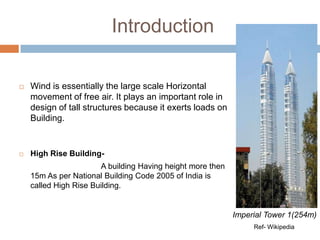
 High Rise Building-
A building Having height more then
15m As per National Building Code 2005 of India is
called High Rise Building.
Imperial Tower 1(254m)
Ref- Wikipedia
What is Wind?
Wind means the motion of air in the atmosphere.
The response of structures to wind depends on
the
characteristics of the wind.
Causes of Wind-
 Wind is caused by air
flowing from high
pressure to low pressure.
Since the Earth is rotating,
however, the air does not
flow directly from high to
low pressure, but it is
deflected to the right (in the
Northern Hemisphere; to
the left in the Southern
Hemisphere), so that the
wind flows
mostly around the high and
low pressure areas.
Variation of Wind Velocity with
Height-
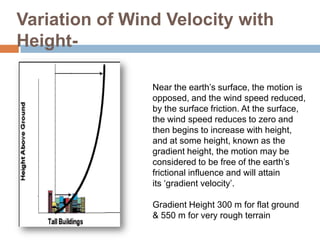
Near the earth’s surface, the motion is
opposed, and the wind speed reduced,
by the surface friction. At the surface,
the wind speed reduces to zero and
then begins to increase with height,
and at some height, known as the
gradient height, the motion may be
considered to be free of the earth’s
frictional influence and will attain
its ‘gradient velocity’.
Gradient Height 300 m for flat ground
& 550 m for very rough terrain
How wind force governing for tall structure?
with increase height of building
•Construction cost per unit area decrease
•Increasing lightness in weight per unit area
•More danger against high velocity of wind force
at high level.
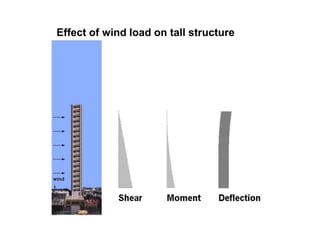
Effect of wind load on tall structure
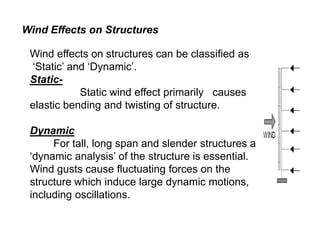
Wind Effects on Structures
Wind effects on structures can be classified as
‘Static’ and ‘Dynamic’.
Static-
Static wind effect primarily causes
elastic bending and twisting of structure.
Dynamic
For tall, long span and slender structures a
‘dynamic analysis’ of the structure is essential.
Wind gusts cause fluctuating forces on the
structure which induce large dynamic motions,
including oscillations.
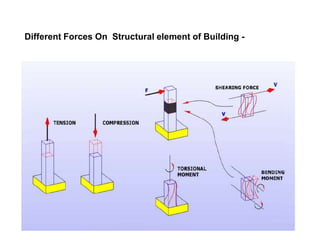
Different Forces On Structural element of Building -
Variation of wind pressure with Height of building-
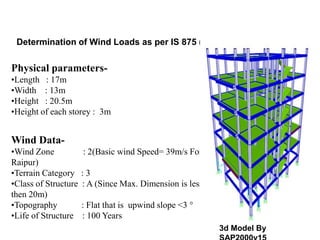
Determination of Wind Loads as per IS 875 (Part 3)
Physical parameters-
•Length : 17m
•Width : 13m
•Height : 20.5m
•Height of each storey : 3m
Wind Data-
•Wind Zone : 2(Basic wind Speed= 39m/s For
Raipur)
•Terrain Category : 3
•Class of Structure : A (Since Max. Dimension is less
then 20m)
•Topography : Flat that is upwind slope <3 °
•Life of Structure : 100 Years
3d Model By
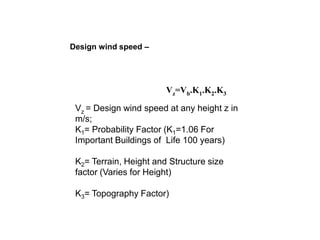
Design wind speed –
Vz=Vb.K1.K2.K3
Vz = Design wind speed at any height z in
m/s;
K1= Probability Factor (K1=1.06 For
Important Buildings of Life 100 years)
K2= Terrain, Height and Structure size
factor (Varies for Height)
K3= Topography Factor)
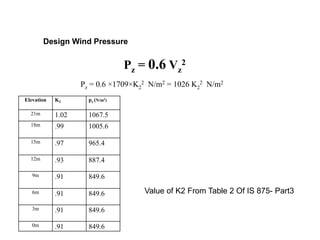
Design Wind Pressure
Pz = 0.6 Vz
2
Pz = 0.6 ×1709×K2
2 N/m2 = 1026 K2
2 N/m2
Elevation K2 pz (N/m2)
21m 1.02 1067.5
18m .99 1005.6
15m .97 965.4
12m .93 887.4
9m .91 849.6
6m .91 849.6
3m .91 849.6
0m .91 849.6
Value of K2 From Table 2 Of IS 875- Part3
0
5
10
15
20
25
0 200 400 600 800 1000 1200
Elevation
Pz (N/mm2)
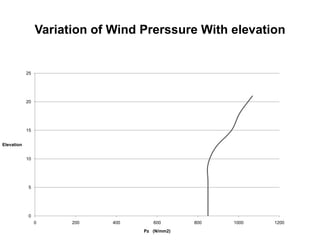
Variation of Wind Prerssure With elevation
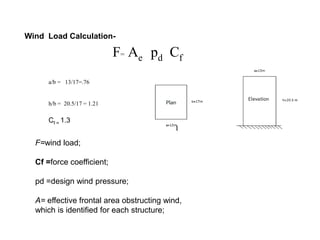
Wind Load Calculation-
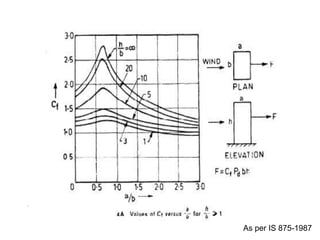
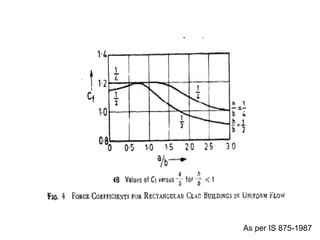
F= Ae pd Cf
a/b = 13/17=.76
h/b = 20.5/17 = 1.21
Cf = 1.3
F=wind load;
Cf =force coefficient;
pd =design wind pressure;
A= effective frontal area obstructing wind,
which is identified for each structure;
As per IS 875-1987
As per IS 875-1987
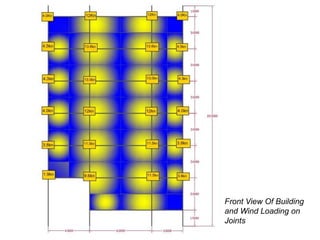
Front View Of Building
and Wind Loading on
Joints
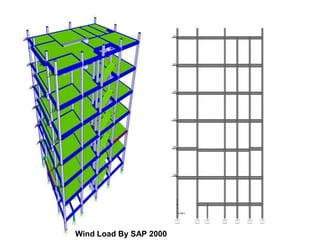
Wind Load By SAP 2000
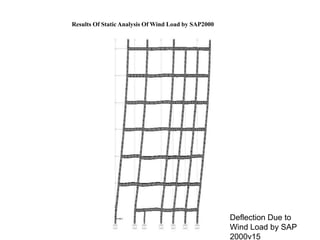
Results Of Static Analysis Of Wind Load by SAP2000
Deflection Due to
Wind Load by SAP
2000v15
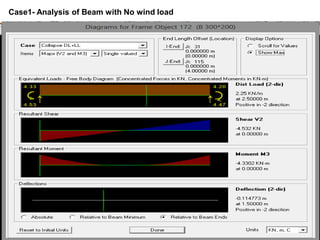
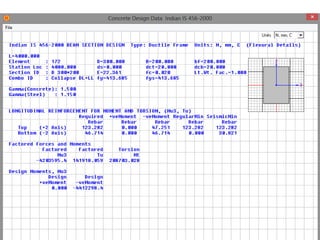
Case1- Analysis of Beam with No wind load
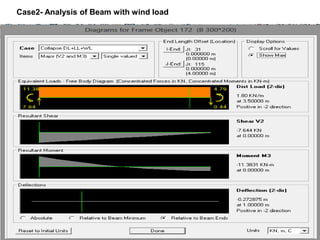
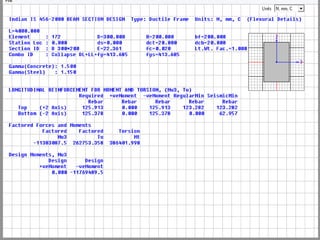
Case2- Analysis of Beam with wind load
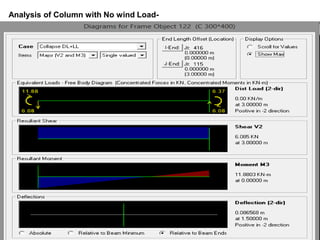
Analysis of Column with No wind Load-
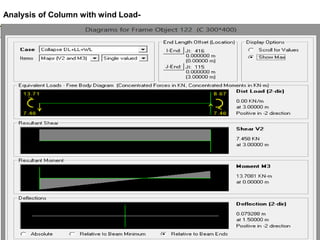
Analysis of Column with wind Load-
Main Conclusions
In the Static Analysis of the RCC Building the
comparison has been made in two cases in first case without
considering the wind load and Considering the wind load in
second case. Results from SAP2000 Shown that the Bending
moment and shear Force increase due to wind load hence
wind load governing factor for design of High rise building .
•http://en.wikipedia.org/wiki/The_Imperial_(Mumbai)
References
•http://www.weatherquestions.com/What_causes_wind
.htm•IS 875-Part3 ( 1987) Indian Standards Code of Practice for Design Wind Loads.
•Special Publication of BIS SP64 Wind Load Explanatory Hand Book .
•Wind And Earthquake Resistant Buildings Structural Analysis And Design By Bungale S. Taranth.
Thank You

Effect of wind Load On High Rise Building

  • 1.
    Wind Load On HighRise Building
  • 2.
    Introduction  Wind isessentially the large scale Horizontal movement of free air. It plays an important role in design of tall structures because it exerts loads on Building.  High Rise Building- A building Having height more then 15m As per National Building Code 2005 of India is called High Rise Building. Imperial Tower 1(254m) Ref- Wikipedia
  • 3.
    What is Wind? Windmeans the motion of air in the atmosphere. The response of structures to wind depends on the characteristics of the wind.
  • 4.
    Causes of Wind- Wind is caused by air flowing from high pressure to low pressure. Since the Earth is rotating, however, the air does not flow directly from high to low pressure, but it is deflected to the right (in the Northern Hemisphere; to the left in the Southern Hemisphere), so that the wind flows mostly around the high and low pressure areas.
  • 5.
    Variation of WindVelocity with Height- Near the earth’s surface, the motion is opposed, and the wind speed reduced, by the surface friction. At the surface, the wind speed reduces to zero and then begins to increase with height, and at some height, known as the gradient height, the motion may be considered to be free of the earth’s frictional influence and will attain its ‘gradient velocity’. Gradient Height 300 m for flat ground & 550 m for very rough terrain
  • 6.
    How wind forcegoverning for tall structure? with increase height of building •Construction cost per unit area decrease •Increasing lightness in weight per unit area •More danger against high velocity of wind force at high level.
  • 7.
    Effect of windload on tall structure
  • 8.
    Wind Effects onStructures Wind effects on structures can be classified as ‘Static’ and ‘Dynamic’. Static- Static wind effect primarily causes elastic bending and twisting of structure. Dynamic For tall, long span and slender structures a ‘dynamic analysis’ of the structure is essential. Wind gusts cause fluctuating forces on the structure which induce large dynamic motions, including oscillations.
  • 9.
    Different Forces OnStructural element of Building -
  • 10.
    Variation of windpressure with Height of building-
  • 11.
    Determination of WindLoads as per IS 875 (Part 3) Physical parameters- •Length : 17m •Width : 13m •Height : 20.5m •Height of each storey : 3m Wind Data- •Wind Zone : 2(Basic wind Speed= 39m/s For Raipur) •Terrain Category : 3 •Class of Structure : A (Since Max. Dimension is less then 20m) •Topography : Flat that is upwind slope <3 ° •Life of Structure : 100 Years 3d Model By
  • 12.
    Design wind speed– Vz=Vb.K1.K2.K3 Vz = Design wind speed at any height z in m/s; K1= Probability Factor (K1=1.06 For Important Buildings of Life 100 years) K2= Terrain, Height and Structure size factor (Varies for Height) K3= Topography Factor)
  • 13.
    Design Wind Pressure Pz= 0.6 Vz 2 Pz = 0.6 ×1709×K2 2 N/m2 = 1026 K2 2 N/m2 Elevation K2 pz (N/m2) 21m 1.02 1067.5 18m .99 1005.6 15m .97 965.4 12m .93 887.4 9m .91 849.6 6m .91 849.6 3m .91 849.6 0m .91 849.6 Value of K2 From Table 2 Of IS 875- Part3
  • 14.
    0 5 10 15 20 25 0 200 400600 800 1000 1200 Elevation Pz (N/mm2) Variation of Wind Prerssure With elevation
  • 15.
    Wind Load Calculation- F=Ae pd Cf a/b = 13/17=.76 h/b = 20.5/17 = 1.21 Cf = 1.3 F=wind load; Cf =force coefficient; pd =design wind pressure; A= effective frontal area obstructing wind, which is identified for each structure;
  • 16.
    As per IS875-1987
  • 17.
    As per IS875-1987
  • 18.
    Front View OfBuilding and Wind Loading on Joints
  • 19.
    Wind Load BySAP 2000
  • 20.
    Results Of StaticAnalysis Of Wind Load by SAP2000 Deflection Due to Wind Load by SAP 2000v15
  • 21.
    Case1- Analysis ofBeam with No wind load
  • 22.
    Case2- Analysis ofBeam with wind load
  • 23.
    Analysis of Columnwith No wind Load-
  • 24.
    Analysis of Columnwith wind Load-
  • 27.
    Main Conclusions In theStatic Analysis of the RCC Building the comparison has been made in two cases in first case without considering the wind load and Considering the wind load in second case. Results from SAP2000 Shown that the Bending moment and shear Force increase due to wind load hence wind load governing factor for design of High rise building .
  • 28.
    •http://en.wikipedia.org/wiki/The_Imperial_(Mumbai) References •http://www.weatherquestions.com/What_causes_wind .htm•IS 875-Part3 (1987) Indian Standards Code of Practice for Design Wind Loads. •Special Publication of BIS SP64 Wind Load Explanatory Hand Book . •Wind And Earthquake Resistant Buildings Structural Analysis And Design By Bungale S. Taranth.
  • 29.