Presented by:- Presented to :-
Praveen kumar Akash pandey sir
1. INTRODUCTION
2. TYPES OF WIND LOAD
3. EFFECTS OF WIND LOAD
4. SOME BASIC QUESTIONS ON WIND
 Wind load is the load placed by the wind speed and it is
air density onto a building, with high velocity winds, low
pressure areas are created on the building which creates
section pressure. Some are so strong that they can pull of
the corner of a roof.
 The effect of wind on the structure as a whole is
determined by combined action of external and internal
pressures acting upon it .
 We can use wind load analysis the structure having more
then 10 to 30 meters.
 It is design as per IS code :875(part 3) -1987
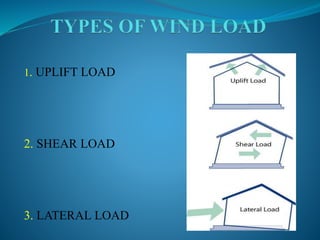
1. UPLIFT LOAD
2. SHEAR LOAD
3. LATERAL LOAD
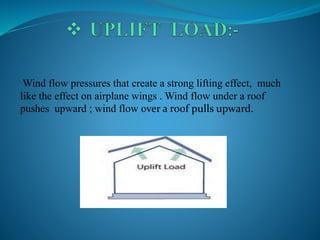
Wind flow pressures that create a strong lifting effect, much
like the effect on airplane wings . Wind flow under a roof
pushes upward ; wind flow over a roof pulls upward.
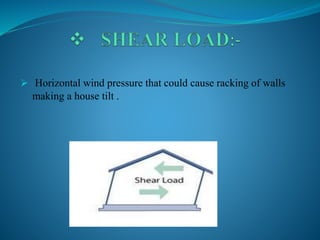
 Horizontal wind pressure that could cause racking of walls
making a house tilt .
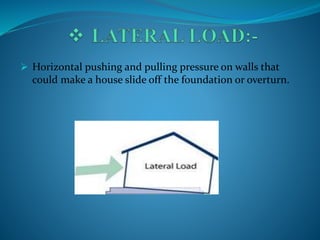
 Horizontal pushing and pulling pressure on walls that
could make a house slide off the foundation or overturn.
“Wind effects on structures can be classified as static and
dynamic .
Static :-
Static wind effect primarily causes elastic bending and
twisting of structure.
Dynamic :-
For tall , long span and slender structures a Dynamic
analysis of the structure is essential wind gusts cause
fluctuating forces on the structure which induces large
dynamic motions , including oscillations .”
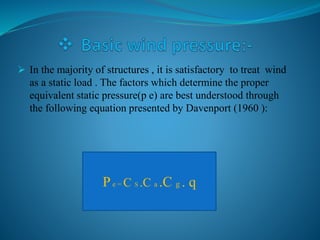
 In the majority of structures , it is satisfactory to treat wind
as a static load . The factors which determine the proper
equivalent static pressure(p e) are best understood through
the following equation presented by Davenport (1960 ):
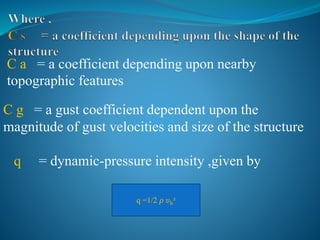
Pe = C S .C a .C g . q
C a = a coefficient depending upon nearby
topographic features
C g = a gust coefficient dependent upon the
magnitude of gust velocities and size of the structure
q = dynamic-pressure intensity ,given by
q =1/2 𝜌 𝜐h
2
𝜌=air density
𝜐H = design wind velocity at height H
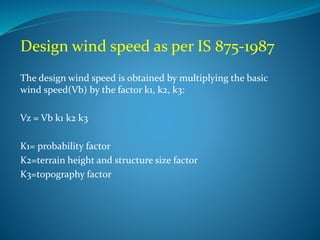
Design wind speed as per IS 875-1987
The design wind speed is obtained by multiplying the basic
wind speed(Vb) by the factor k1, k2, k3:
Vz = Vb k1 k2 k3
K1= probability factor
K2=terrain height and structure size factor
K3=topography factor
383475603-Presentation-on-Wind-Load.pptx

383475603-Presentation-on-Wind-Load.pptx

  • 1.
    Presented by:- Presentedto :- Praveen kumar Akash pandey sir
  • 2.
    1. INTRODUCTION 2. TYPESOF WIND LOAD 3. EFFECTS OF WIND LOAD 4. SOME BASIC QUESTIONS ON WIND
  • 3.
     Wind loadis the load placed by the wind speed and it is air density onto a building, with high velocity winds, low pressure areas are created on the building which creates section pressure. Some are so strong that they can pull of the corner of a roof.  The effect of wind on the structure as a whole is determined by combined action of external and internal pressures acting upon it .  We can use wind load analysis the structure having more then 10 to 30 meters.  It is design as per IS code :875(part 3) -1987
  • 4.
    1. UPLIFT LOAD 2.SHEAR LOAD 3. LATERAL LOAD
  • 5.
    Wind flow pressuresthat create a strong lifting effect, much like the effect on airplane wings . Wind flow under a roof pushes upward ; wind flow over a roof pulls upward.
  • 6.
     Horizontal windpressure that could cause racking of walls making a house tilt .
  • 7.
     Horizontal pushingand pulling pressure on walls that could make a house slide off the foundation or overturn.
  • 8.
    “Wind effects onstructures can be classified as static and dynamic . Static :- Static wind effect primarily causes elastic bending and twisting of structure. Dynamic :- For tall , long span and slender structures a Dynamic analysis of the structure is essential wind gusts cause fluctuating forces on the structure which induces large dynamic motions , including oscillations .”
  • 9.
     In themajority of structures , it is satisfactory to treat wind as a static load . The factors which determine the proper equivalent static pressure(p e) are best understood through the following equation presented by Davenport (1960 ): Pe = C S .C a .C g . q
  • 10.
    C a =a coefficient depending upon nearby topographic features C g = a gust coefficient dependent upon the magnitude of gust velocities and size of the structure q = dynamic-pressure intensity ,given by q =1/2 𝜌 𝜐h 2
  • 11.
    𝜌=air density 𝜐H =design wind velocity at height H
  • 12.
    Design wind speedas per IS 875-1987 The design wind speed is obtained by multiplying the basic wind speed(Vb) by the factor k1, k2, k3: Vz = Vb k1 k2 k3 K1= probability factor K2=terrain height and structure size factor K3=topography factor