CLINICAL PRACTICE GUIDELINES
Sushil Kumar Sompur MD
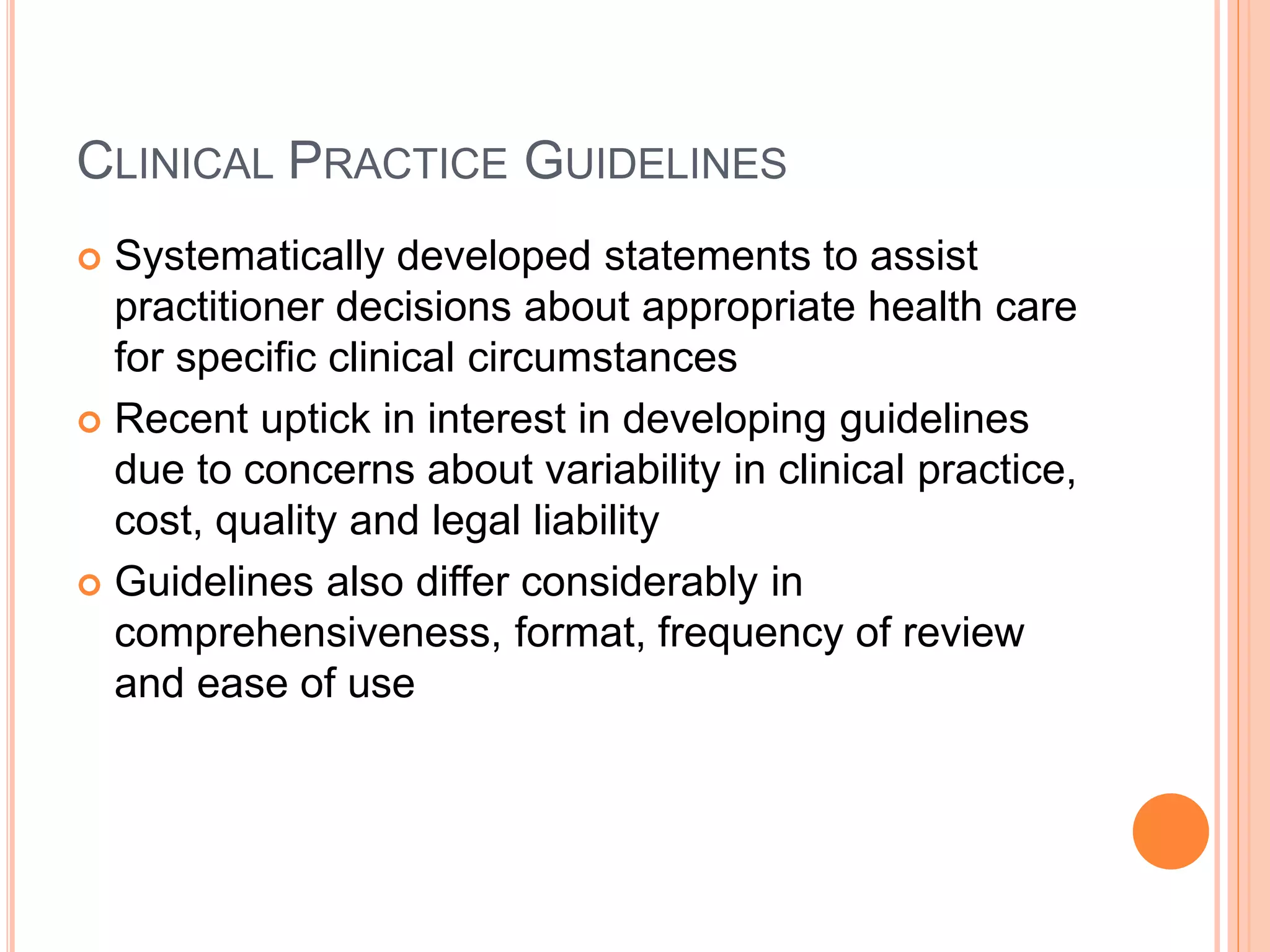
CLINICAL PRACTICE GUIDELINES
 Systematically developed statements to assist
practitioner decisions about appropriate health care
for specific clinical circumstances
 Recent uptick in interest in developing guidelines
due to concerns about variability in clinical practice,
cost, quality and legal liability
 Guidelines also differ considerably in
comprehensiveness, format, frequency of review
and ease of use
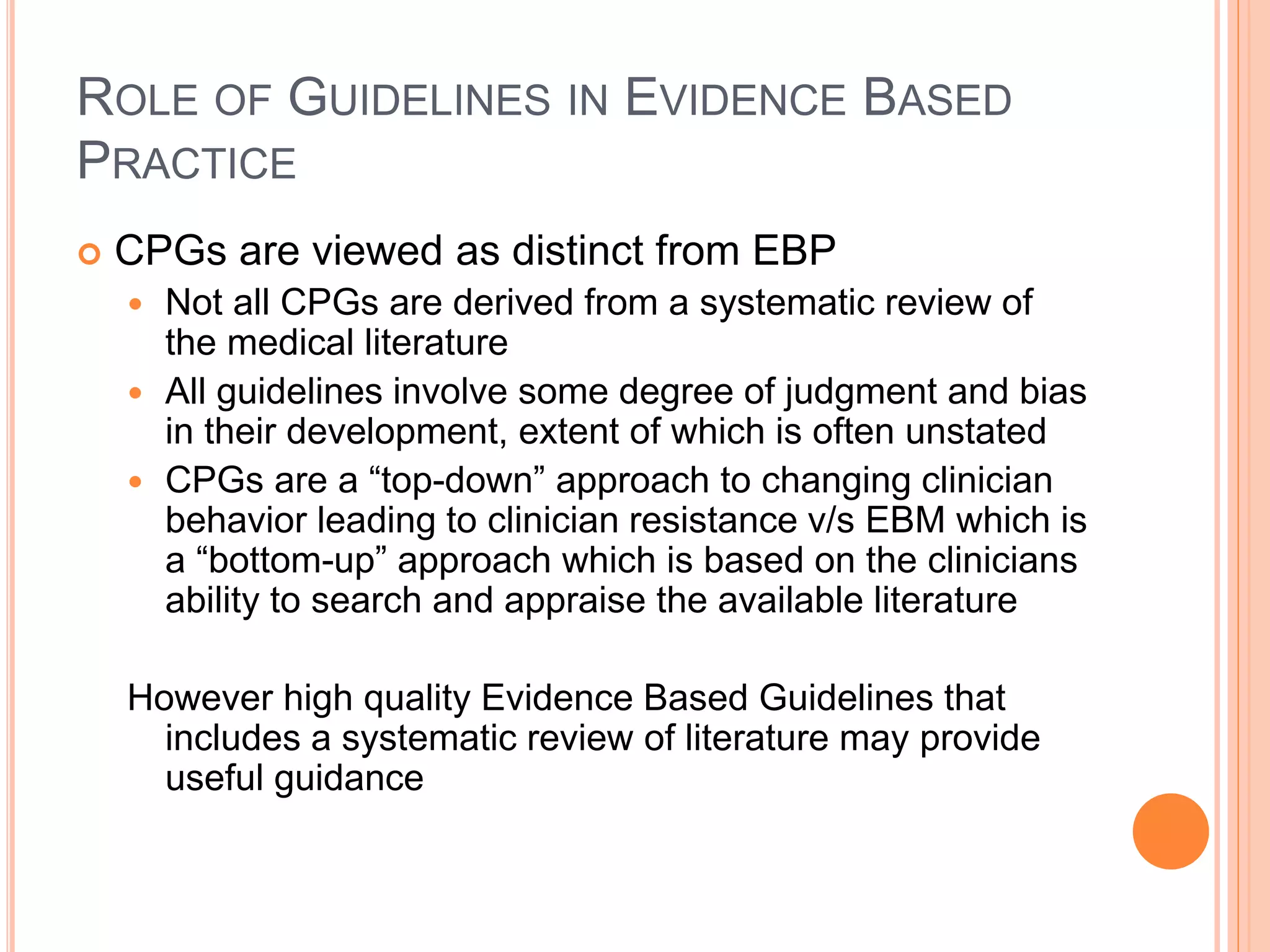
ROLE OF GUIDELINES IN EVIDENCE BASED
PRACTICE
 CPGs are viewed as distinct from EBP
 Not all CPGs are derived from a systematic review of
the medical literature
 All guidelines involve some degree of judgment and bias
in their development, extent of which is often unstated
 CPGs are a “top-down” approach to changing clinician
behavior leading to clinician resistance v/s EBM which is
a “bottom-up” approach which is based on the clinicians
ability to search and appraise the available literature
However high quality Evidence Based Guidelines that
includes a systematic review of literature may provide
useful guidance
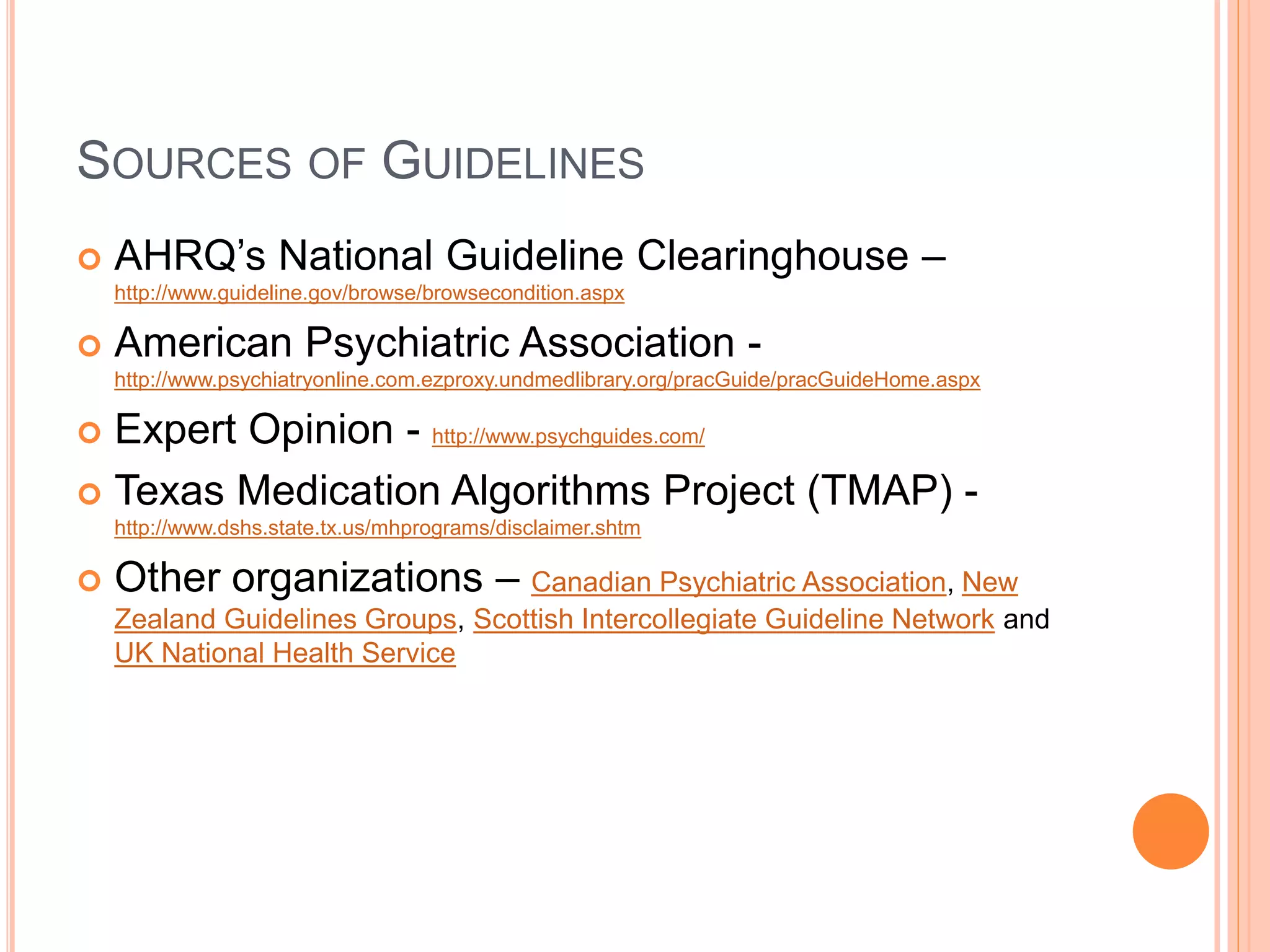
SOURCES OF GUIDELINES
 AHRQ’s National Guideline Clearinghouse –
http://www.guideline.gov/browse/browsecondition.aspx
 American Psychiatric Association -
http://www.psychiatryonline.com.ezproxy.undmedlibrary.org/pracGuide/pracGuideHome.aspx
 Expert Opinion - http://www.psychguides.com/
 Texas Medication Algorithms Project (TMAP) -
http://www.dshs.state.tx.us/mhprograms/disclaimer.shtm
 Other organizations – Canadian Psychiatric Association, New
Zealand Guidelines Groups, Scottish Intercollegiate Guideline Network and
UK National Health Service
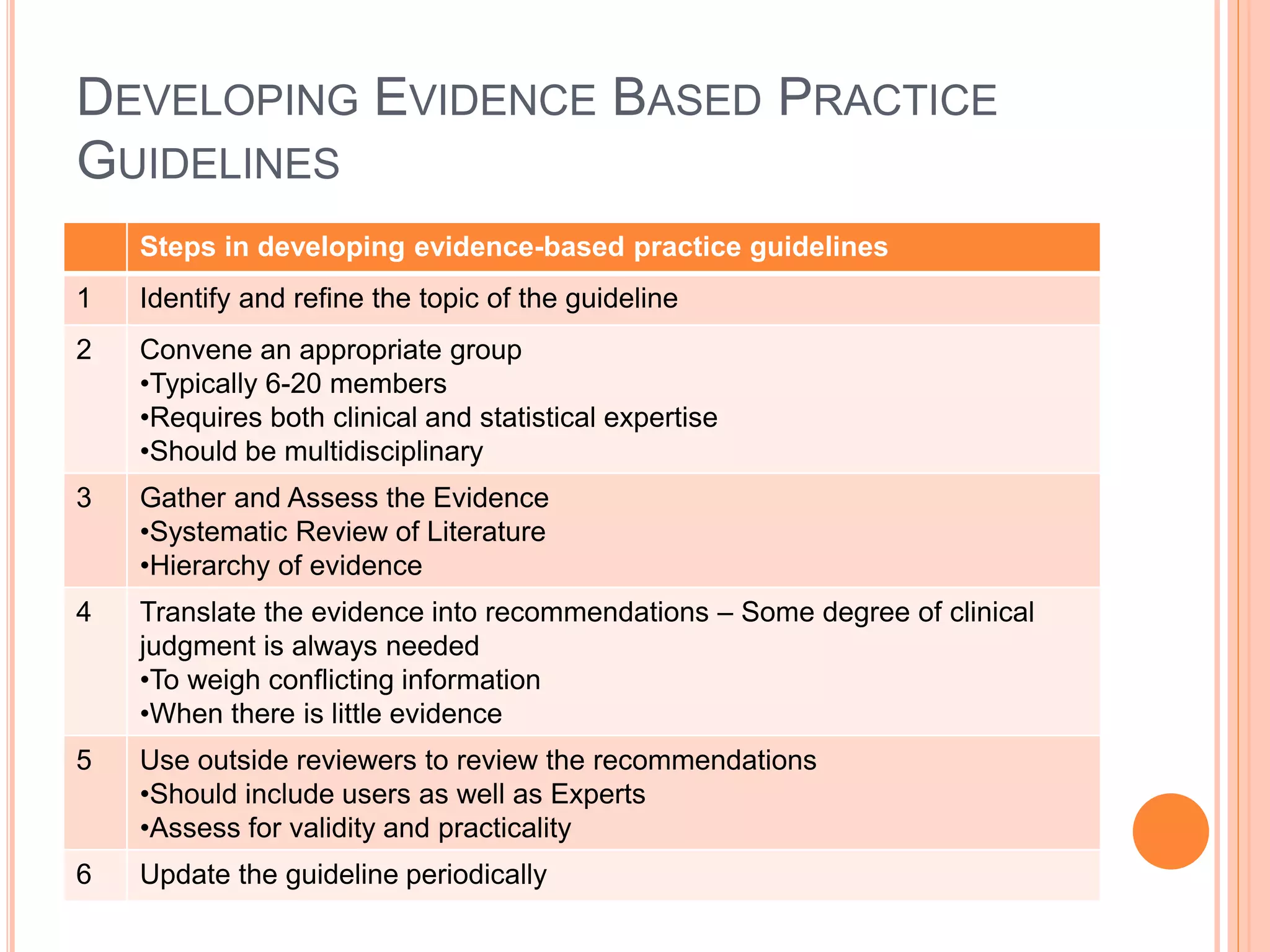
DEVELOPING EVIDENCE BASED PRACTICE
GUIDELINES
Steps in developing evidence-based practice guidelines
1 Identify and refine the topic of the guideline
2 Convene an appropriate group
•Typically 6-20 members
•Requires both clinical and statistical expertise
•Should be multidisciplinary
3 Gather and Assess the Evidence
•Systematic Review of Literature
•Hierarchy of evidence
4 Translate the evidence into recommendations – Some degree of clinical
judgment is always needed
•To weigh conflicting information
•When there is little evidence
5 Use outside reviewers to review the recommendations
•Should include users as well as Experts
•Assess for validity and practicality
6 Update the guideline periodically
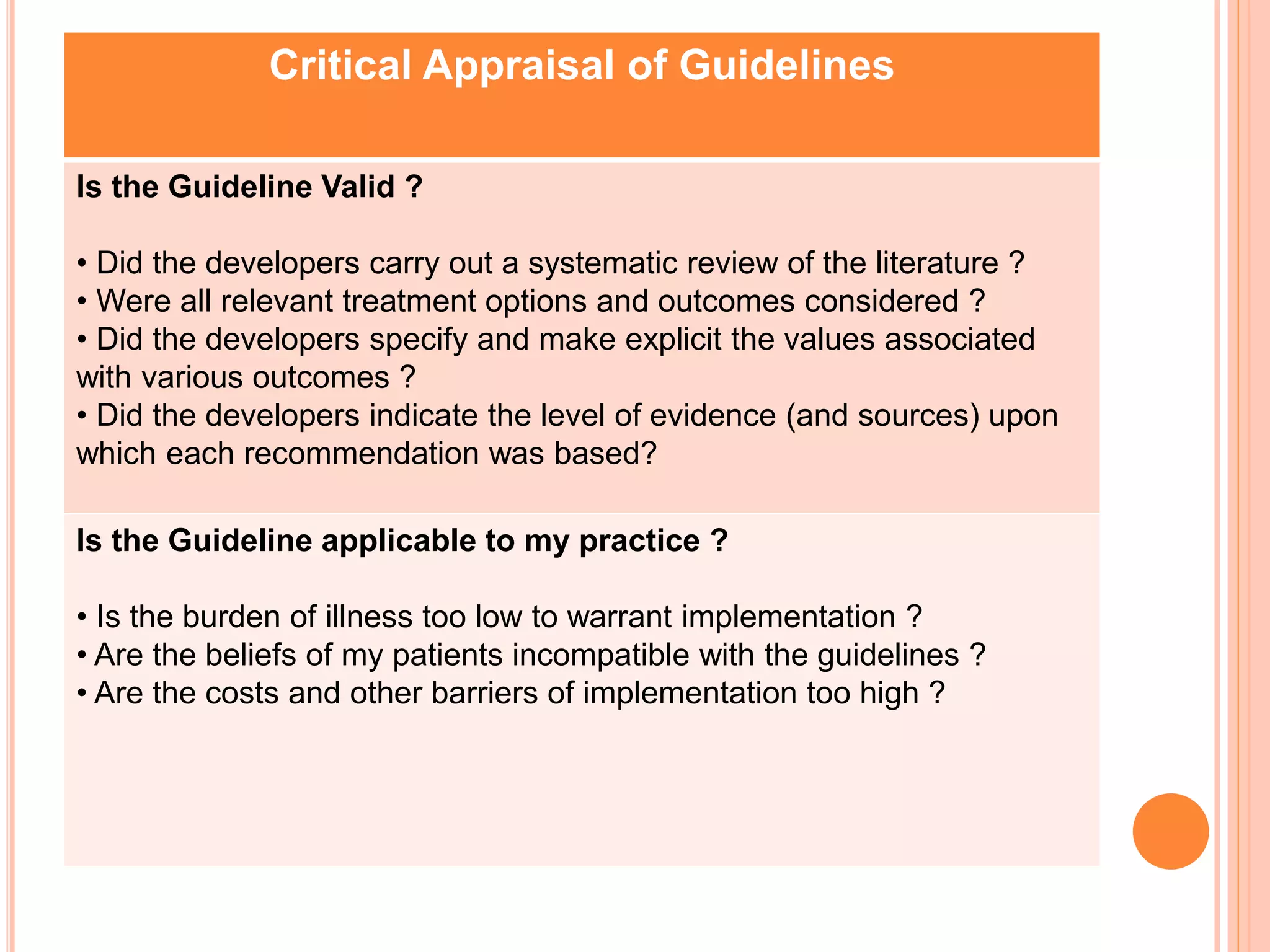
Critical Appraisal of Guidelines
Is the Guideline Valid ?
• Did the developers carry out a systematic review of the literature ?
• Were all relevant treatment options and outcomes considered ?
• Did the developers specify and make explicit the values associated
with various outcomes ?
• Did the developers indicate the level of evidence (and sources) upon
which each recommendation was based?
Is the Guideline applicable to my practice ?
• Is the burden of illness too low to warrant implementation ?
• Are the beliefs of my patients incompatible with the guidelines ?
• Are the costs and other barriers of implementation too high ?
THANKS !

Clinical Practice Guidelines

  • 1.
  • 2.
    CLINICAL PRACTICE GUIDELINES Systematically developed statements to assist practitioner decisions about appropriate health care for specific clinical circumstances  Recent uptick in interest in developing guidelines due to concerns about variability in clinical practice, cost, quality and legal liability  Guidelines also differ considerably in comprehensiveness, format, frequency of review and ease of use
  • 3.
    ROLE OF GUIDELINESIN EVIDENCE BASED PRACTICE  CPGs are viewed as distinct from EBP  Not all CPGs are derived from a systematic review of the medical literature  All guidelines involve some degree of judgment and bias in their development, extent of which is often unstated  CPGs are a “top-down” approach to changing clinician behavior leading to clinician resistance v/s EBM which is a “bottom-up” approach which is based on the clinicians ability to search and appraise the available literature However high quality Evidence Based Guidelines that includes a systematic review of literature may provide useful guidance
  • 4.
    SOURCES OF GUIDELINES AHRQ’s National Guideline Clearinghouse – http://www.guideline.gov/browse/browsecondition.aspx  American Psychiatric Association - http://www.psychiatryonline.com.ezproxy.undmedlibrary.org/pracGuide/pracGuideHome.aspx  Expert Opinion - http://www.psychguides.com/  Texas Medication Algorithms Project (TMAP) - http://www.dshs.state.tx.us/mhprograms/disclaimer.shtm  Other organizations – Canadian Psychiatric Association, New Zealand Guidelines Groups, Scottish Intercollegiate Guideline Network and UK National Health Service
  • 5.
    DEVELOPING EVIDENCE BASEDPRACTICE GUIDELINES Steps in developing evidence-based practice guidelines 1 Identify and refine the topic of the guideline 2 Convene an appropriate group •Typically 6-20 members •Requires both clinical and statistical expertise •Should be multidisciplinary 3 Gather and Assess the Evidence •Systematic Review of Literature •Hierarchy of evidence 4 Translate the evidence into recommendations – Some degree of clinical judgment is always needed •To weigh conflicting information •When there is little evidence 5 Use outside reviewers to review the recommendations •Should include users as well as Experts •Assess for validity and practicality 6 Update the guideline periodically
  • 6.
    Critical Appraisal ofGuidelines Is the Guideline Valid ? • Did the developers carry out a systematic review of the literature ? • Were all relevant treatment options and outcomes considered ? • Did the developers specify and make explicit the values associated with various outcomes ? • Did the developers indicate the level of evidence (and sources) upon which each recommendation was based? Is the Guideline applicable to my practice ? • Is the burden of illness too low to warrant implementation ? • Are the beliefs of my patients incompatible with the guidelines ? • Are the costs and other barriers of implementation too high ?
  • 7.