The Culture of Health Care
Evidence-Based Practice
Lecture g
This material (Comp2 Unit 5) was developed by Oregon Health & Science University, funded by the Department
of Health and Human Services, Office of the National Coordinator for Health Information Technology under
Award Number IU24OC000015. This material was updated in 2016 by Bellevue College under Award
Number 90WT0002.
This work is licensed under the Creative Commons Attribution-NonCommercial-ShareAlike 4.0 International
License. To view a copy of this license, visit http://creativecommons.org/licenses/by-nc-sa/4.0/.
Evidence-Based Practice
Learning Objectives
• Define the key tenets of evidence-based medicine (EBM) and its
role in the culture of health care (Lectures a, b).
• Construct answerable clinical questions and critically appraise
evidence answering them (Lecture b).
• Explain how EBM can be applied to intervention studies, including
the phrasing of answerable questions, finding evidence to answer
them, and applying them to given clinical situations (Lecture c).
• Describe how EBM can be applied to key clinical questions of
diagnosis, harm, and prognosis (Lectures d, e).
• Discuss the benefits and limitations to summarizing evidence
(Lecture f).
• Describe how EBM is used in clinical settings through clinical
practice guidelines and decision analysis (Lecture g).
3
Techniques for Specifying
Recommendations
• Clinical practice guidelines
• Decision analysis
4
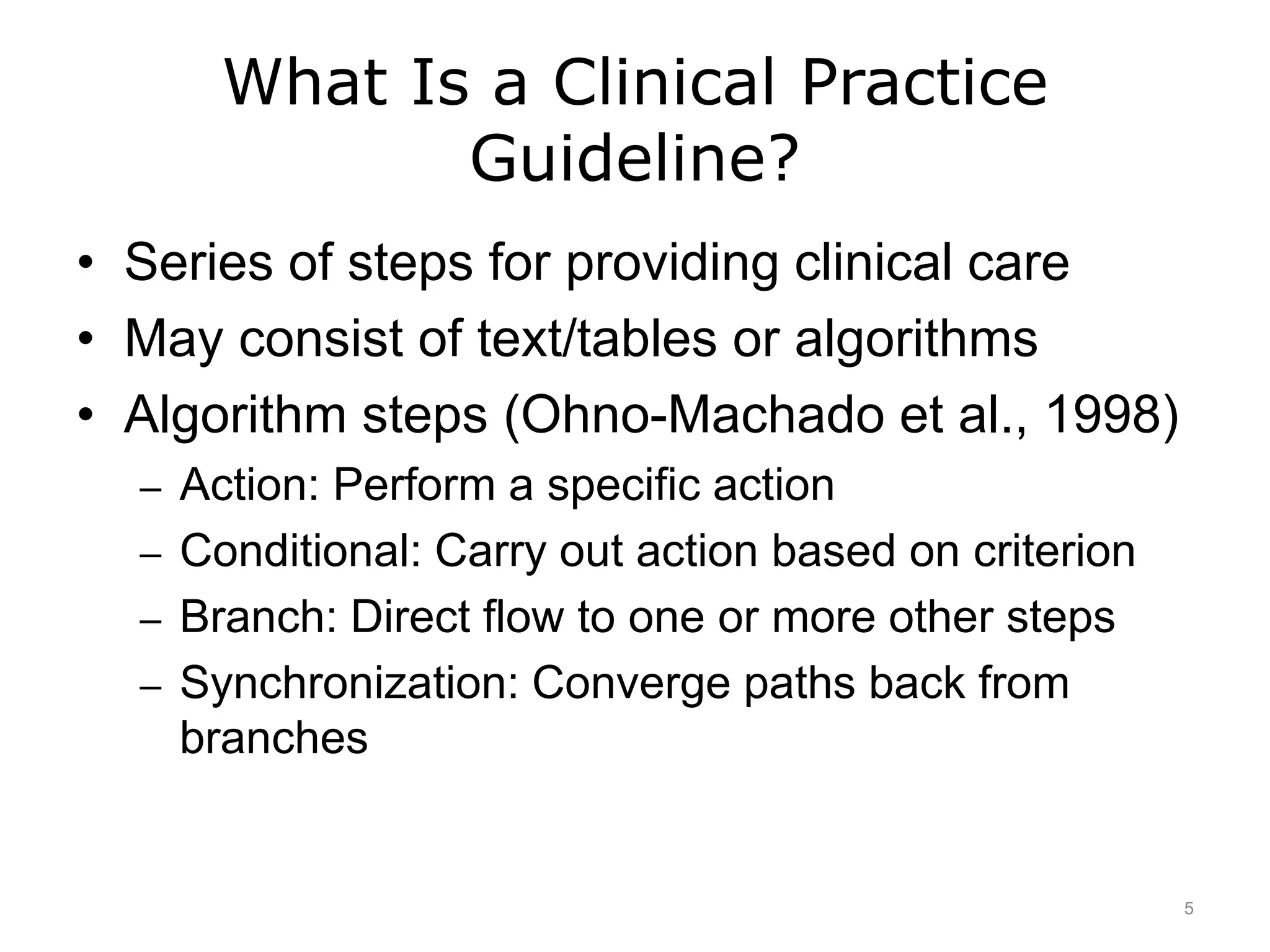
What Is a Clinical Practice
Guideline?
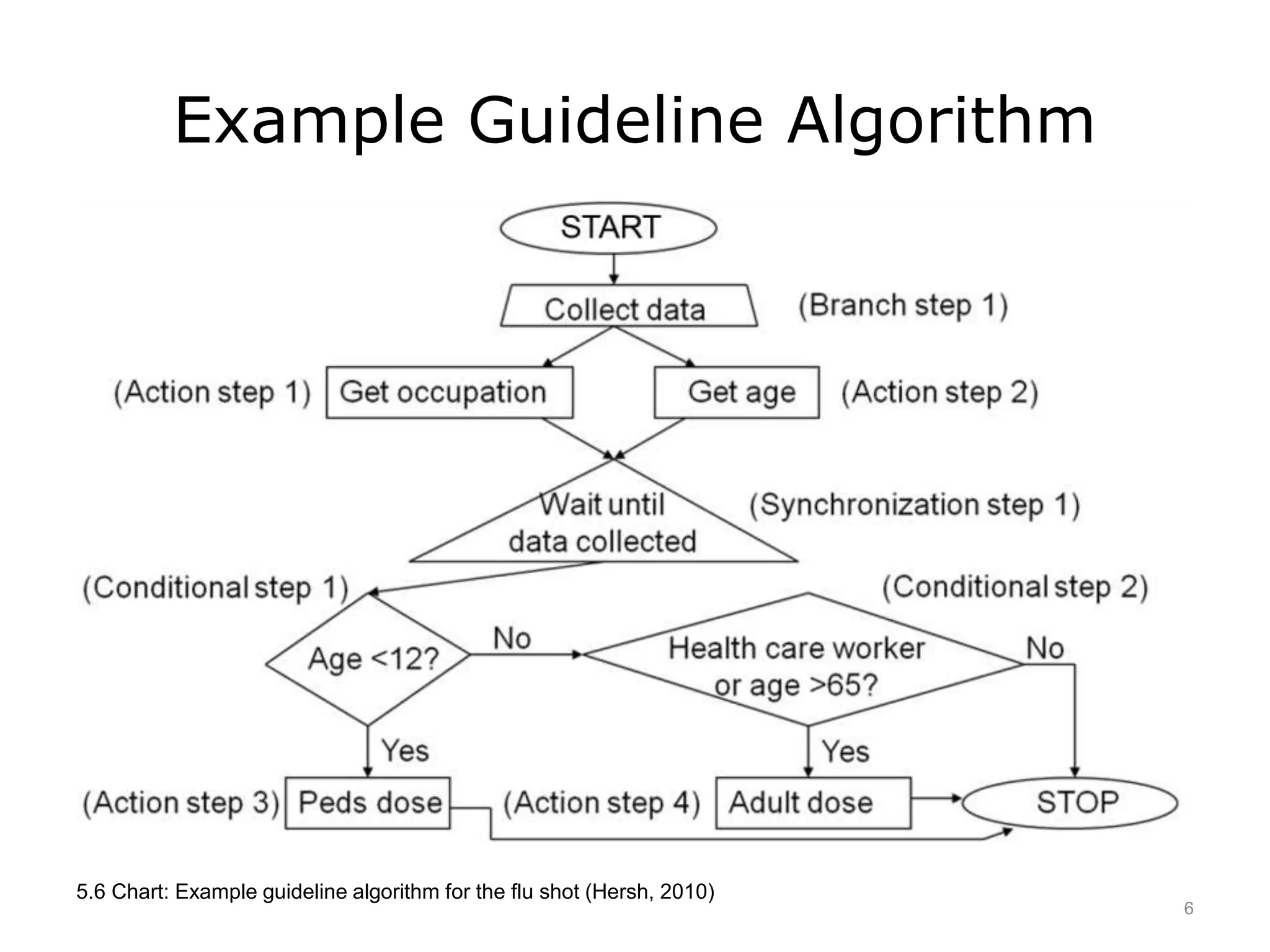
• Series of steps for providing clinical care
• May consist of text/tables or algorithms
• Algorithm steps (Ohno-Machado et al., 1998)
– Action: Perform a specific action
– Conditional: Carry out action based on criterion
– Branch: Direct flow to one or more other steps
– Synchronization: Converge paths back from
branches
5
Example Guideline Algorithm
5.6 Chart: Example guideline algorithm for the flu shot (Hersh, 2010)
6
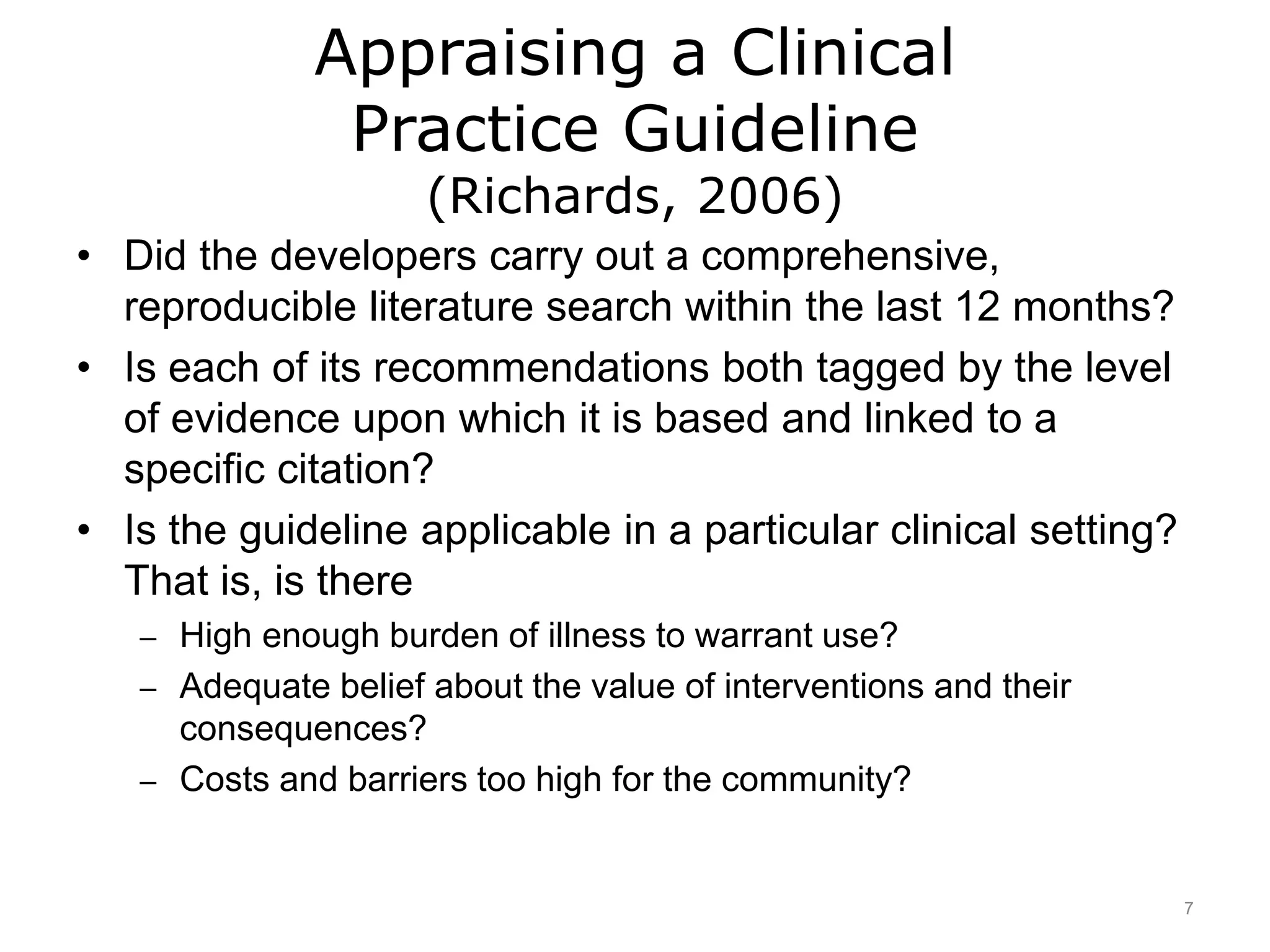
Appraising a Clinical
Practice Guideline
(Richards, 2006)
• Did the developers carry out a comprehensive,
reproducible literature search within the last 12 months?
• Is each of its recommendations both tagged by the level
of evidence upon which it is based and linked to a
specific citation?
• Is the guideline applicable in a particular clinical setting?
That is, is there
– High enough burden of illness to warrant use?
– Adequate belief about the value of interventions and their
consequences?
– Costs and barriers too high for the community?
7
Should They Be Distributed on
Paper or Electronically?
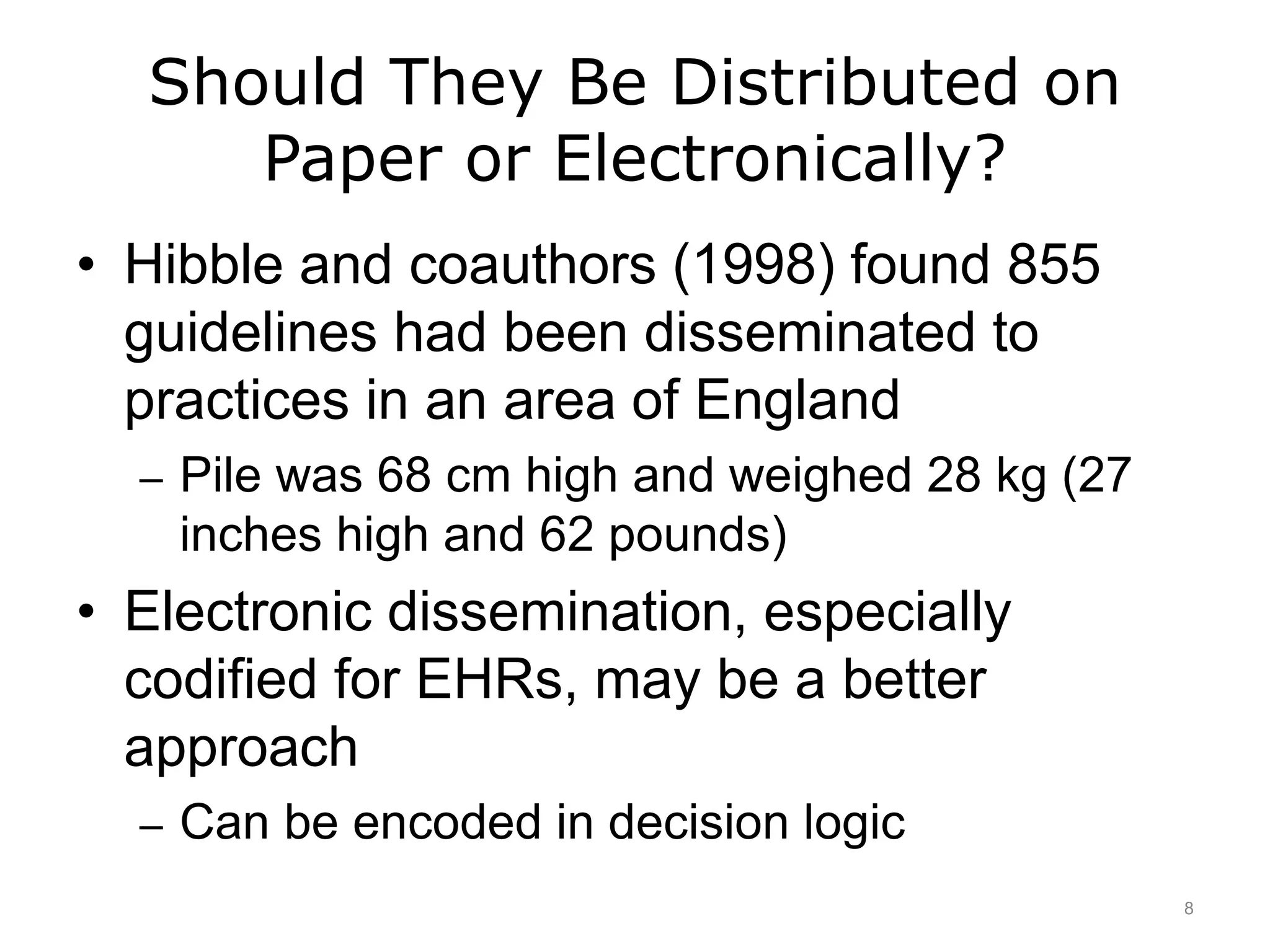
• Hibble and coauthors (1998) found 855
guidelines had been disseminated to
practices in an area of England
– Pile was 68 cm high and weighed 28 kg (27
inches high and 62 pounds)
• Electronic dissemination, especially
codified for EHRs, may be a better
approach
– Can be encoded in decision logic
8
Physicians Do Not Adhere
to Guidelines
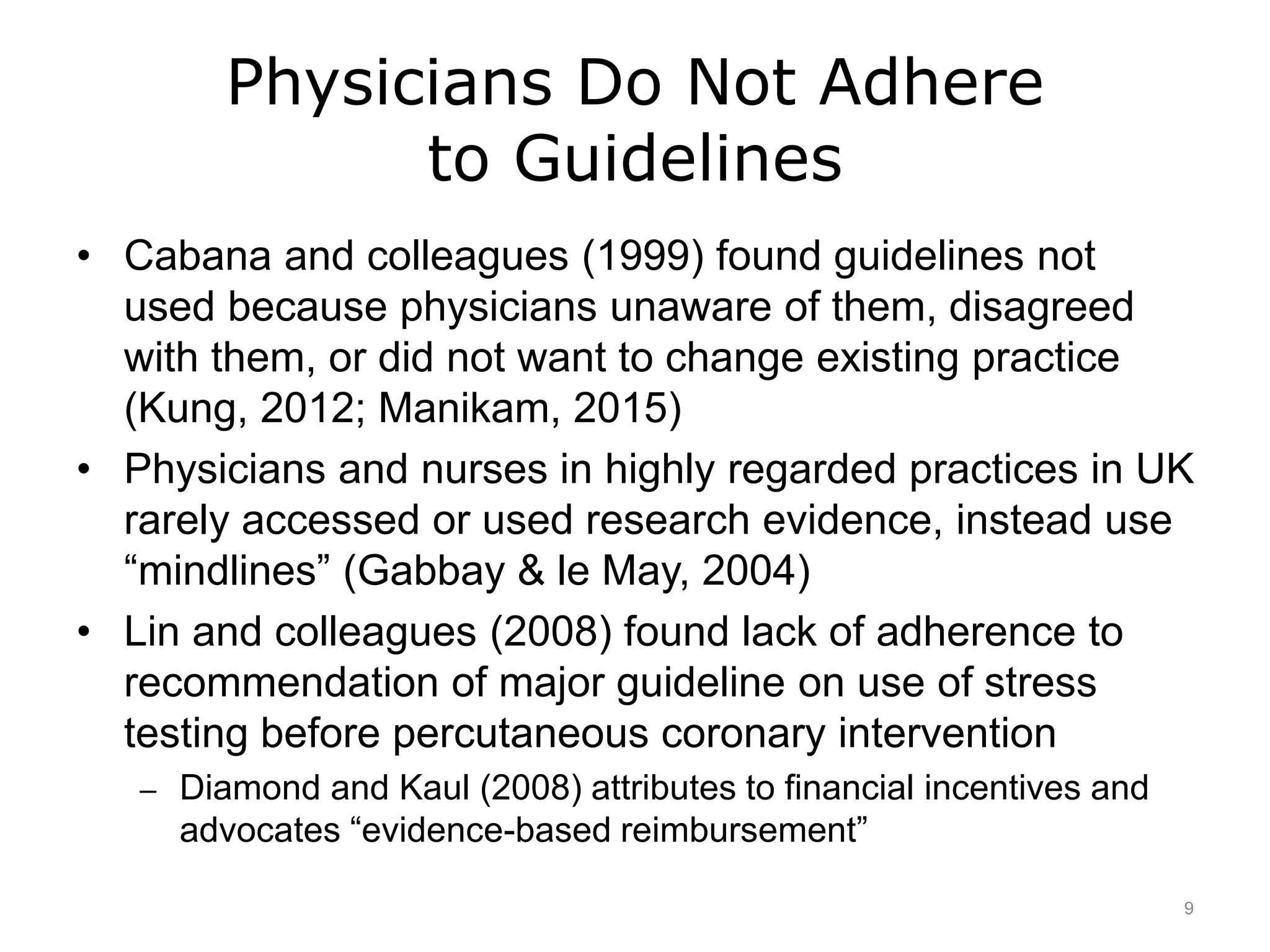
• Cabana and colleagues (1999) found guidelines not
used because physicians unaware of them, disagreed
with them, or did not want to change existing practice
(Kung, 2012; Manikam, 2015)
• Physicians and nurses in highly regarded practices in UK
rarely accessed or used research evidence, instead use
“mindlines” (Gabbay & le May, 2004)
• Lin and colleagues (2008) found lack of adherence to
recommendation of major guideline on use of stress
testing before percutaneous coronary intervention
– Diamond and Kaul (2008) attributes to financial incentives and
advocates “evidence-based reimbursement”
9
Limitations of Guidelines
• May not apply in complex patients—for 15 common
diseases, following best-known guidelines in elderly
patients with comorbid diseases may have undesirable
effects and implications for pay-for-performance
schemes (Boyd et al., 2005)
• Difficult to implement in EHRs—issues include precise
coding of logic and integration into workflow (Maviglia et
al., 2003)
• May be influenced by pharmaceutical industry—87% of
authors have ties to industry, 58% receive financial
support for research, and 38% serve as employees or
consultants (Choudhry, Stelfox, & Detsky, 2002; Norris,
2011) 10
The Future of Guidelines
• Many health care systems are convinced
they help standardize and improve care
and/or lower cost (Bristow, 2013)
• Use will likely increase with proliferation of
electronic health records and/or quality
improvement efforts (Peleg, 2013)
• Growing number are available from
National Guidelines Clearinghouse (link at
http://www.guideline.gov)
11
Decision Analysis
• Applies a formal structure for integrating
evidence about beneficial and harmful
effects of treatment options with
associated values and preferences
• They can be applied to guide decision
making of single patient or to inform
decisions about clinical policy
12
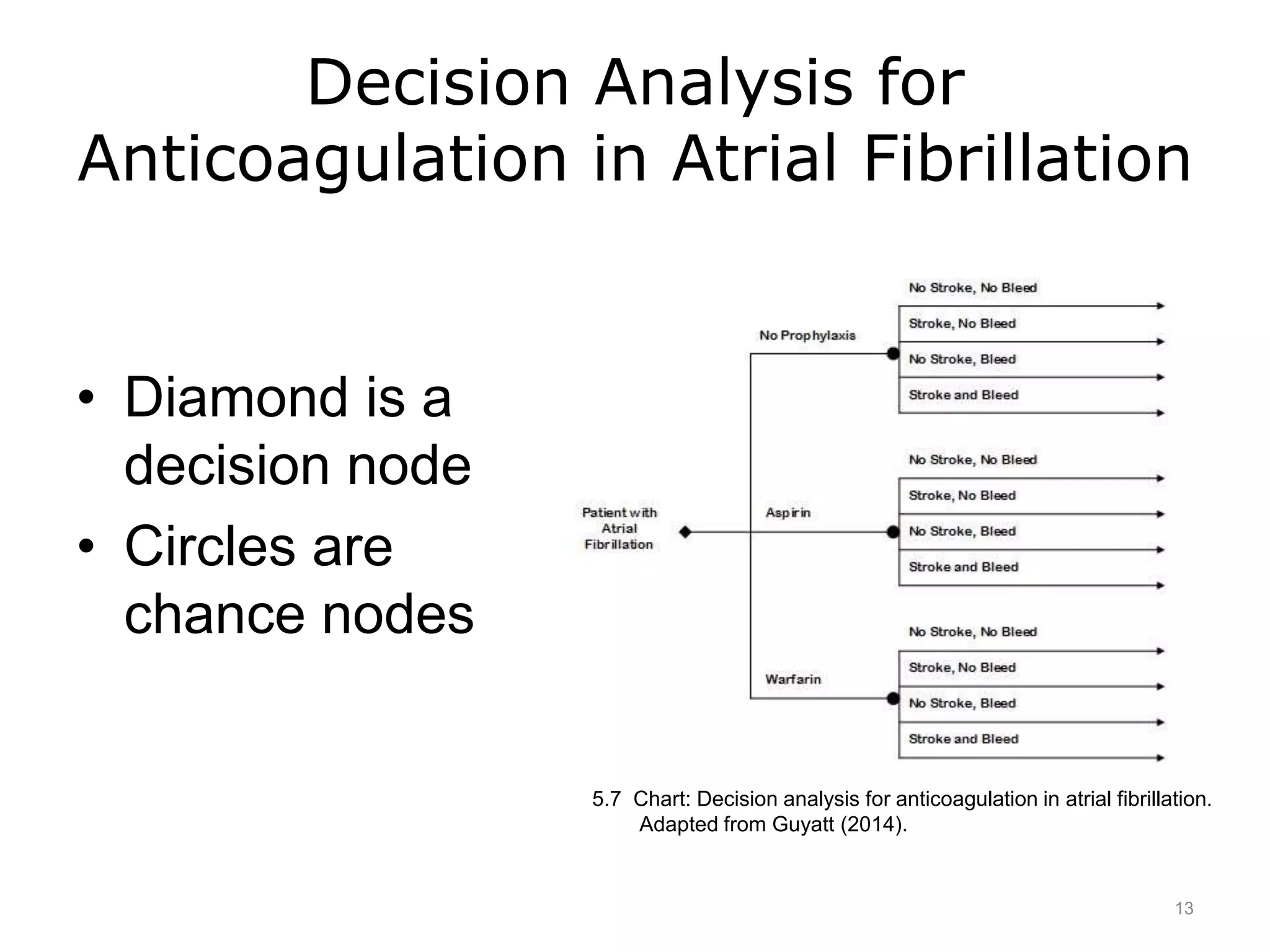
Decision Analysis for
Anticoagulation in Atrial Fibrillation
• Diamond is a
decision node
• Circles are
chance nodes
5.7 Chart: Decision analysis for anticoagulation in atrial fibrillation.
Adapted from Guyatt (2014).
13
Using a Decision Analysis
• Elicit utility values for outcomes from
patient, such as risk of adverse events
from disease or treatment
• Calculate probabilities of events based on
best evidence
• “Fold back” decision tree to calculate
overall utility
14
Limitations of Decision Analysis
• Presents idealized situation that may not
apply to a patient but give a framework for
making decisions and/or deviating from
standard approach
• Decision analyses are time-consuming on
individual level and may be dependent on
quantification of values and fuzzy
situations
15
Evidence-Based Practice
Summary – Lecture g
• Two main approaches for making
recommendations based on evidence
• Clinical practice guidelines provide steps
and decision points for providing clinical
care
• Decision analysis allows elucidation of a
framework for making optimal decisions
16
Evidence-Based Practice
Summary
• EBM provides a set of tools and a disciplined
approach to informing clinical decision
making
• Helps to find the best evidence to answer the
four basic types of clinical questions:
interventions, diagnosis, harm, and prognosis
• Provides two approaches to making
recommendations: clinical practice guidelines
and decision analyses
17
Evidence-Based Practice
References – Lecture g
References
Boyd, C., Darer, J., Boult, C., Fried, L., Boult, L., & Wu, A. (2005). Clinical practice guidelines and
quality of care for older patients with multiple comorbid diseases: Implications for pay for
performance. Journal of the American Medical Association, 294, 716–724.
Bristow, R. E., Chang, J., Ziogas, A., & Anton-Culver, H. (2013). Adherence to treatment guidelines for
ovarian cancer as a measure of quality care.Obstetrics & Gynecology, 121(6), 1226-1234.
Cabana, M., Rand, C., Powe, N., Wu, A., Wilson, M., Abboud, P., & Rubin, H. (1999). Why don’t
physicians follow clinical practice guidelines? A framework for improvement. Journal of the
American Medical Association, 282, 1458–1465.
Choudhry, N., Stelfox, H., & Detsky, A. (2002). Relationships between authors of clinical practice
guidelines and the pharmaceutical industry. Journal of the American Medical Association, 287,
612–617.
Diamond, G., & Kaul, S. (2008). The disconnect between practice guidelines and clinical practice—
Stressed out. Journal of the American Medical Association, 300, 1817–1819.
Gabbay, J., & LeMay, A. (2004). Evidence based guidelines or collectively constructed “mindlines”?
Ethnographic study of knowledge management in primary care. British Medical Journal, 329,
1013.
Guyatt, G., Rennie, D., Meade, M., & Cook, D. (2014). Users’ guides to the medical literature:
Essentials of evidence-based clinical practice, 3rd ed. New York: McGraw-Hill.
18
Evidence-Based Practice
References – Lecture g Continued
References
Hibble, A., Kanka, D., Penchion , D., & Pooles, F. (1998). Guidelines in general practice: The new
Tower of Babel? British Medical Journal, 317, 862–863.
Khodambashi, S., & Nytrø, Ø. (2015). Lessons Learnt from Evaluation of Computer Interpretable
Clinical Guidelines Tools and Methods: Literature Review. Studies in health technology and
informatics, 216, 980. Retrieved from
https://www.researchgate.net/profile/Soudabeh_Khodambashi2/publication/281409241_Lessons_
Learnt_from_Evaluation_of_Computer_Interpretable_Clinical_Guidelines_Tools_and_Methods_Lit
erature_Review/links/55e5d7ac08aebdc0f58b88c0.pdf
Kung, J., Miller, R. R., & Mackowiak, P. A. (2012). Failure of clinical practice guidelines to meet
institute of medicine standards: two more decades of little, if any, progress. Archives of internal
medicine, 172(21), 1628-1633. Retrieved from
http://archinte.jamanetwork.com/article.aspx?articleid=1384245
Lin, G., Dudley, R., Lucas, F., Malenka, D., Vittinghoff, E., & Redberg, R. (2008). Frequency of stress
testing to document ischemia prior to elective percutaneous coronary intervention. Journal of the
American Medical Association, 300, 1765–1773.
Manikam, L., et als. (2015). What drives junior doctors to use clinical practice guidelines? A national
cross-sectional survey of foundation doctors in England & Wales. BMC medical education, 15(1),
1. Retrieved from http://bmcmededuc.biomedcentral.com/articles/10.1186/s12909-015-0510-3
19
Evidence-Based Practice
References – Lecture g Continued 2
References
Maviglia, S., Zielstorff, R., Paterno, M., Teich, J., Bates, D., & Kuperman, G. (2003). Automating
complex guidelines for chronic disease: Lessons learned. Journal of the American Medical
Informatics Association, 10, 154–165.
Norris, S. L., Holmer, H. K., Ogden, L. A., & Burda, B. U. (2011). Conflict of interest in clinical practice
guideline development: a systematic review. PloS one, 6(10), e25153. Retrieved from
http://journals.plos.org/plosone/article?id=10.1371/journal.pone.0025153
Ohno-Machado, L., Gennari, J., Murphy, S., Jain, N., Tu, S., Oliver, D., . . . Barnett, G. (1998). The
GuideLine Interchange Format: A model for representing guidelines. Journal of the American
Medical Informatics Association, 5, 357–372.
Peleg, M. (2013). Computer-interpretable clinical guidelines: a methodological review. Journal of
biomedical informatics, 46(4), 744-763.
Richards, D. (2006). Guidelines and the killer B’s. Evidence-based Dentistry 7, 1–2.
Charts
5.6 Chart: Example guideline algorithm for the flu shot (Hersh, William, OHSU, 2010
5.7Chart: Decision analysis for anticoagulation in atrial fibrillation. Adapted from Guyatt, 2014
20
The Culture of Health Care
Evidence-Based Practice
Lecture g
This material was developed by Oregon Health &
Science University, funded by the Department of
Health and Human Services, Office of the National
Coordinator for Health Information Technology
under Award Number IU24OC000015. This
material was updated in 2016 by Bellevue College
under Award Number 90WT0002.
21

Evidence Based Practice Lecture 7_slides

  • 2.
    The Culture ofHealth Care Evidence-Based Practice Lecture g This material (Comp2 Unit 5) was developed by Oregon Health & Science University, funded by the Department of Health and Human Services, Office of the National Coordinator for Health Information Technology under Award Number IU24OC000015. This material was updated in 2016 by Bellevue College under Award Number 90WT0002. This work is licensed under the Creative Commons Attribution-NonCommercial-ShareAlike 4.0 International License. To view a copy of this license, visit http://creativecommons.org/licenses/by-nc-sa/4.0/.
  • 3.
    Evidence-Based Practice Learning Objectives •Define the key tenets of evidence-based medicine (EBM) and its role in the culture of health care (Lectures a, b). • Construct answerable clinical questions and critically appraise evidence answering them (Lecture b). • Explain how EBM can be applied to intervention studies, including the phrasing of answerable questions, finding evidence to answer them, and applying them to given clinical situations (Lecture c). • Describe how EBM can be applied to key clinical questions of diagnosis, harm, and prognosis (Lectures d, e). • Discuss the benefits and limitations to summarizing evidence (Lecture f). • Describe how EBM is used in clinical settings through clinical practice guidelines and decision analysis (Lecture g). 3
  • 4.
    Techniques for Specifying Recommendations •Clinical practice guidelines • Decision analysis 4
  • 5.
    What Is aClinical Practice Guideline? • Series of steps for providing clinical care • May consist of text/tables or algorithms • Algorithm steps (Ohno-Machado et al., 1998) – Action: Perform a specific action – Conditional: Carry out action based on criterion – Branch: Direct flow to one or more other steps – Synchronization: Converge paths back from branches 5
  • 6.
    Example Guideline Algorithm 5.6Chart: Example guideline algorithm for the flu shot (Hersh, 2010) 6
  • 7.
    Appraising a Clinical PracticeGuideline (Richards, 2006) • Did the developers carry out a comprehensive, reproducible literature search within the last 12 months? • Is each of its recommendations both tagged by the level of evidence upon which it is based and linked to a specific citation? • Is the guideline applicable in a particular clinical setting? That is, is there – High enough burden of illness to warrant use? – Adequate belief about the value of interventions and their consequences? – Costs and barriers too high for the community? 7
  • 8.
    Should They BeDistributed on Paper or Electronically? • Hibble and coauthors (1998) found 855 guidelines had been disseminated to practices in an area of England – Pile was 68 cm high and weighed 28 kg (27 inches high and 62 pounds) • Electronic dissemination, especially codified for EHRs, may be a better approach – Can be encoded in decision logic 8
  • 9.
    Physicians Do NotAdhere to Guidelines • Cabana and colleagues (1999) found guidelines not used because physicians unaware of them, disagreed with them, or did not want to change existing practice (Kung, 2012; Manikam, 2015) • Physicians and nurses in highly regarded practices in UK rarely accessed or used research evidence, instead use “mindlines” (Gabbay & le May, 2004) • Lin and colleagues (2008) found lack of adherence to recommendation of major guideline on use of stress testing before percutaneous coronary intervention – Diamond and Kaul (2008) attributes to financial incentives and advocates “evidence-based reimbursement” 9
  • 10.
    Limitations of Guidelines •May not apply in complex patients—for 15 common diseases, following best-known guidelines in elderly patients with comorbid diseases may have undesirable effects and implications for pay-for-performance schemes (Boyd et al., 2005) • Difficult to implement in EHRs—issues include precise coding of logic and integration into workflow (Maviglia et al., 2003) • May be influenced by pharmaceutical industry—87% of authors have ties to industry, 58% receive financial support for research, and 38% serve as employees or consultants (Choudhry, Stelfox, & Detsky, 2002; Norris, 2011) 10
  • 11.
    The Future ofGuidelines • Many health care systems are convinced they help standardize and improve care and/or lower cost (Bristow, 2013) • Use will likely increase with proliferation of electronic health records and/or quality improvement efforts (Peleg, 2013) • Growing number are available from National Guidelines Clearinghouse (link at http://www.guideline.gov) 11
  • 12.
    Decision Analysis • Appliesa formal structure for integrating evidence about beneficial and harmful effects of treatment options with associated values and preferences • They can be applied to guide decision making of single patient or to inform decisions about clinical policy 12
  • 13.
    Decision Analysis for Anticoagulationin Atrial Fibrillation • Diamond is a decision node • Circles are chance nodes 5.7 Chart: Decision analysis for anticoagulation in atrial fibrillation. Adapted from Guyatt (2014). 13
  • 14.
    Using a DecisionAnalysis • Elicit utility values for outcomes from patient, such as risk of adverse events from disease or treatment • Calculate probabilities of events based on best evidence • “Fold back” decision tree to calculate overall utility 14
  • 15.
    Limitations of DecisionAnalysis • Presents idealized situation that may not apply to a patient but give a framework for making decisions and/or deviating from standard approach • Decision analyses are time-consuming on individual level and may be dependent on quantification of values and fuzzy situations 15
  • 16.
    Evidence-Based Practice Summary –Lecture g • Two main approaches for making recommendations based on evidence • Clinical practice guidelines provide steps and decision points for providing clinical care • Decision analysis allows elucidation of a framework for making optimal decisions 16
  • 17.
    Evidence-Based Practice Summary • EBMprovides a set of tools and a disciplined approach to informing clinical decision making • Helps to find the best evidence to answer the four basic types of clinical questions: interventions, diagnosis, harm, and prognosis • Provides two approaches to making recommendations: clinical practice guidelines and decision analyses 17
  • 18.
    Evidence-Based Practice References –Lecture g References Boyd, C., Darer, J., Boult, C., Fried, L., Boult, L., & Wu, A. (2005). Clinical practice guidelines and quality of care for older patients with multiple comorbid diseases: Implications for pay for performance. Journal of the American Medical Association, 294, 716–724. Bristow, R. E., Chang, J., Ziogas, A., & Anton-Culver, H. (2013). Adherence to treatment guidelines for ovarian cancer as a measure of quality care.Obstetrics & Gynecology, 121(6), 1226-1234. Cabana, M., Rand, C., Powe, N., Wu, A., Wilson, M., Abboud, P., & Rubin, H. (1999). Why don’t physicians follow clinical practice guidelines? A framework for improvement. Journal of the American Medical Association, 282, 1458–1465. Choudhry, N., Stelfox, H., & Detsky, A. (2002). Relationships between authors of clinical practice guidelines and the pharmaceutical industry. Journal of the American Medical Association, 287, 612–617. Diamond, G., & Kaul, S. (2008). The disconnect between practice guidelines and clinical practice— Stressed out. Journal of the American Medical Association, 300, 1817–1819. Gabbay, J., & LeMay, A. (2004). Evidence based guidelines or collectively constructed “mindlines”? Ethnographic study of knowledge management in primary care. British Medical Journal, 329, 1013. Guyatt, G., Rennie, D., Meade, M., & Cook, D. (2014). Users’ guides to the medical literature: Essentials of evidence-based clinical practice, 3rd ed. New York: McGraw-Hill. 18
  • 19.
    Evidence-Based Practice References –Lecture g Continued References Hibble, A., Kanka, D., Penchion , D., & Pooles, F. (1998). Guidelines in general practice: The new Tower of Babel? British Medical Journal, 317, 862–863. Khodambashi, S., & Nytrø, Ø. (2015). Lessons Learnt from Evaluation of Computer Interpretable Clinical Guidelines Tools and Methods: Literature Review. Studies in health technology and informatics, 216, 980. Retrieved from https://www.researchgate.net/profile/Soudabeh_Khodambashi2/publication/281409241_Lessons_ Learnt_from_Evaluation_of_Computer_Interpretable_Clinical_Guidelines_Tools_and_Methods_Lit erature_Review/links/55e5d7ac08aebdc0f58b88c0.pdf Kung, J., Miller, R. R., & Mackowiak, P. A. (2012). Failure of clinical practice guidelines to meet institute of medicine standards: two more decades of little, if any, progress. Archives of internal medicine, 172(21), 1628-1633. Retrieved from http://archinte.jamanetwork.com/article.aspx?articleid=1384245 Lin, G., Dudley, R., Lucas, F., Malenka, D., Vittinghoff, E., & Redberg, R. (2008). Frequency of stress testing to document ischemia prior to elective percutaneous coronary intervention. Journal of the American Medical Association, 300, 1765–1773. Manikam, L., et als. (2015). What drives junior doctors to use clinical practice guidelines? A national cross-sectional survey of foundation doctors in England & Wales. BMC medical education, 15(1), 1. Retrieved from http://bmcmededuc.biomedcentral.com/articles/10.1186/s12909-015-0510-3 19
  • 20.
    Evidence-Based Practice References –Lecture g Continued 2 References Maviglia, S., Zielstorff, R., Paterno, M., Teich, J., Bates, D., & Kuperman, G. (2003). Automating complex guidelines for chronic disease: Lessons learned. Journal of the American Medical Informatics Association, 10, 154–165. Norris, S. L., Holmer, H. K., Ogden, L. A., & Burda, B. U. (2011). Conflict of interest in clinical practice guideline development: a systematic review. PloS one, 6(10), e25153. Retrieved from http://journals.plos.org/plosone/article?id=10.1371/journal.pone.0025153 Ohno-Machado, L., Gennari, J., Murphy, S., Jain, N., Tu, S., Oliver, D., . . . Barnett, G. (1998). The GuideLine Interchange Format: A model for representing guidelines. Journal of the American Medical Informatics Association, 5, 357–372. Peleg, M. (2013). Computer-interpretable clinical guidelines: a methodological review. Journal of biomedical informatics, 46(4), 744-763. Richards, D. (2006). Guidelines and the killer B’s. Evidence-based Dentistry 7, 1–2. Charts 5.6 Chart: Example guideline algorithm for the flu shot (Hersh, William, OHSU, 2010 5.7Chart: Decision analysis for anticoagulation in atrial fibrillation. Adapted from Guyatt, 2014 20
  • 21.
    The Culture ofHealth Care Evidence-Based Practice Lecture g This material was developed by Oregon Health & Science University, funded by the Department of Health and Human Services, Office of the National Coordinator for Health Information Technology under Award Number IU24OC000015. This material was updated in 2016 by Bellevue College under Award Number 90WT0002. 21