HAZARDOUS WASTE
MANAGEMENT
Submitted by:-
S.INDRAKUMAR SINGH
M .Sc ENVIRONMENT AL
SCIENCE
2ndYr, Roll No.13
CONTENTS
• I.Hazardous Waste rule
• II.Characteristics ofHW
• III.Listed waste
• IV.Types of Hazardous waste
• V.Effects of HW on Human Health
• VI.Effects of HW on Environment
• VII.TreatmentMethods
• VIII.Conclusion
• IX.Reference
I.HAZARDOUS WASTE RULES
• HAZARDOUS WASTES (Management &
Handling) RULES,1989notified under the
ENVIRONMENT (Protection) ACT, 1986
• amended in 2000
• and again in 2003
Contd.
• The Hazardous Waste (Management &
Handling) Rules, 1989 and amendments made
thereafter are now superseded by the new
• Hazardous Waste (Management,Hazardous Waste (Management,
Handling & TransboundaryHandling & Transboundary
Movement) Rules, 2008Movement) Rules, 2008..
Hazardous Waste as defined
in the Rules
• Any waste which by reason of any of itsAny waste which by reason of any of its
physical, chemical, reactive, toxic, flammable,physical, chemical, reactive, toxic, flammable,
explosive or corrosiveexplosive or corrosive characteristics causescharacteristics causes
danger or is likely to cause danger to healthdanger or is likely to cause danger to health
or environment, whether alone or when inor environment, whether alone or when in
contact with other wastes or substances, andcontact with other wastes or substances, and
shall include wastes listed in Schedules I, IIshall include wastes listed in Schedules I, II
& III of the Rules& III of the Rules
Chapters in HWM Rule
• There are 7 chapters namely:-
• 1.Preliminary
• 2.Procedure for handling hazardous waste
• 3.Procedure for recycling ,reprocessing or reuse of
hazardous waste
• 4.Import and Export of hazardous waste
• 5.Treatment,storage and disposal facility for
hazardous waste
• 6.Packaging ,labelling and transport ofhazardous
waste
• 7.Miscellanious
Schedules in Hazardous waste
mangement rule
• There are also 7 schedule
• 1.List of processes generating hazardous waste
• 2.List of waste constituents with concentation limits
• 3.List of Hazardous waste applicable for import with prior
informed consent
• 4.List of Hazardous waste requiring Registration for
Recycling /Reprocessing
• 5.Specification of used oil suitable for reprocessing/recycling
• 6.Hazardous waste prohibited for import and export
• 7.List of Authorities and Corresponding Duties
Forms in HWM Rules
1..Application for obtaining Authorisation for
collection/reception/treatment/transport/storage/disposal of
hazardous waste
2.Form for grant /renewal of authorisation by SPCB/PCC for
occupiers,reprocessors ,refuses and operates of facilities for
collection ,reception,treatment,storage,transport and
disposal of hazardous waste
3.Format for maintaining recordsof hazardous waste by
theoccupier or operator of a facility
4.Form for filling Annual Returns by the Occupier or Operator
of facility
5.Form of Application forgrant/renewal of registration of
industrial units possessing environmentally sound management
facilities for reprocessing/recycling
6.Formfor filling annual returns and records on reyclable
hazadous waste by the recyclers
CONTD.
7. Application for iport or export of hazardous waste for
recycling/reproceesing/reuse
8.Application for Transboundary movement of hazardous waste
9.Transboundary movement -Movement Document
10..Format for maintaining records of hazardous waste
imported and exported
11.Transport Emergency
12.Marking of Hzardous waste container
13.Hazardous Waste Manifest
14.Format of Accident Report
15.Application for filling Appeal against the order passed by
CPCB/SPCB/PCC of the Union Territory
Is a waste Hazardous or notIs a waste Hazardous or not
????
1.Waste is hazardous if
i. it is listed in Schedule I
ii. Or, if it falls in Schedule II (analysis required)
2. For the purpose of regulation of Import & Export, a waste
is considered as hazardous if it is listed in Schedule-III
Storage of Hazardous Waste
1.Till disposal for recycling/ treatment/ land filling, HWs
are to be stored onsite in bags/ containers in a covered
area.
2.Storage permitted for a period not exceeding 90 days
– SPCB may extend the storage period, in case of
i. Small generator, generating HW upto 10 TPA
ii. Recyclers, reprocessors and facility operators upto 6
months of their annual capacity
iii.Generators who do not have access to any TSDF in the
concerned State
iv. Wastes which need to be specifically stored for
development of a process for its recycling, reuse.
Transportation of Hazardous
Waste
1.HWs to be properly packed and labelled for
transport to ensure safe handling
2.HW Containers shall be marked as per Form-12
Information on hazardous nature of wastes and
measures to be taken in case of emergency
shall be provided to the transporter in Form-11
3.Transport to be in accordance Motor Vehicles
Act, 1988 and related guidelines
4.Manifest System (Form-13) to be maintained
Import and Export of HW
1.MoEF is the nodal agency
2.Schedule III to be used for regulating HW export and import.
3.Export & Import ban on 30 items (Schedule VI)
4.Import shall be permitted only for recycling or recovery or re-
use and not for disposal.
5.Export may be allowed to an actual user of the waste or
operator of a disposal facility with the Prior Informed consent
of the importing country
6.Wastes listed in Part-D of Schedule III can be imported by
traders registered with the SPCB on behalf of actual users
II.Characteristics of Hazardous
Waste
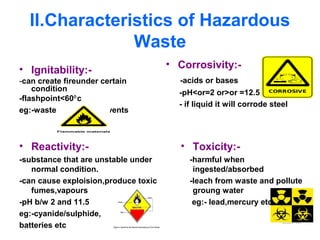
• Ignitability:-
-can create fireunder certain
condition
-flashpoint<60 c⁰
eg:-waste oils,used solvents
• Corrosivity:-
-acids or bases
-pH<or=2 or>or =12.5
- if liquid it will corrode steel
• Reactivity:-
-substance that are unstable under
normal condition.
-can cause exploision,produce toxic
fumes,vapours
-pH b/w 2 and 11.5
eg:-cyanide/sulphide,
batteries etc
• Toxicity:-
-harmful when
ingested/absorbed
-leach from waste and pollute
groung water
eg:- lead,mercury etc
III.Listed Hazardous Waste
• F-Listed
• K-Listed
• P-Listed
• U-Listed
F-LISTED
The f -list contains hazardous wastes from non
specific sources,i.e various industrial processes
that may have generated the waste.the list consist
of solvents commonly used in de greasing,metal
treatment bath and sludge,waste water from metal
plating operations and dioxins containing chemicals
or their precursor.
Eg:-
- Benzene
- toluene
K-LISTED
The k- list contains waste generated by specific
industrial process.
Eg:-
i.Waste including wood preservation.
ii.pigment production.
iii.Petroleum refining.
iv.Explosive manufacturing.
v.Pesticide production.
P-LISTED
Consists of discarded commercial chemical product,
off specification chemicals, container residues and
residues from spillage of material.
U-LISTED
The U - list differs from p - list by the quantity at
which the chemical is regulated.
It includes toxic waste such as:-
1.Pesticides applicators.
2.Laboratories.
3.Chemical formulators.
IV.Types of Hazardous waste
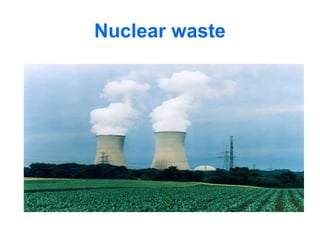
• 1. Nuclear waste
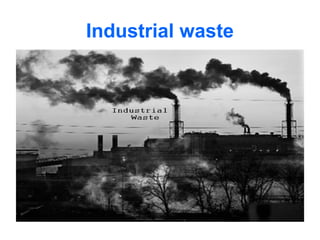
• 2. Industrial waste
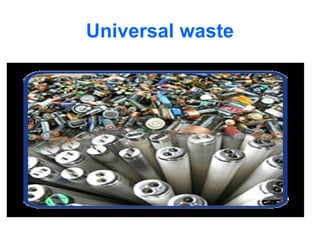
• 3. Universal waste
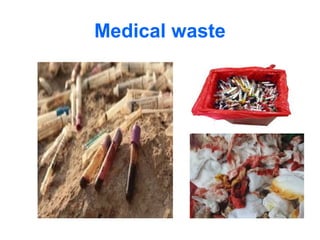
• 4. Medical waste
• 5. Household waste
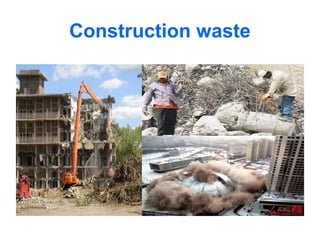
• 6. construction waste
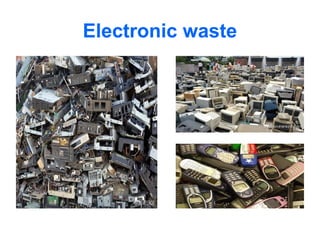
• 7. Electronic waste
Nuclear waste
Industrial waste
Universal waste
Medical waste
Construction waste
Electronic waste
V.Effects of Hazardous waste
Human Health
• 1. Cancer
• 2. Respiratory problems
• 3. Heart disease
• 4. Exposure effects etc
VI.Effects of Hazardous waste on
Environment
• 1.Global warming
• 2.Air Pollution
• 3.Water Pollution
VII.Treatment of Hazardous
waste
There are 5 types by which the hazardous waste can be
treated:-
1.Physical treatment
2.Chemical treatment
3.Thermal treatment
4.Biological treatment
5.Disposal method
1.Physical treatment
It includes:-
1.Filteration and separation.
2.Screening,sedimentation,adsorption,
centrifugation,stripping
3.whenever a wastecontaining liquid and solid
must be treated.
Filteration and separation
1.Filteration is the method for separating solid
particles from a liquid using a porous medium.the
application of filtration of treatment of hazardous
waste fall into the following categories:-
2.Clarification:-method in which suspended solid
particles are less than 100ppm and the aim is to
produce a clear aqueous effluent, which can be
discharged directly or further processed.
3.De watering:- in this method the slurry is
concentrated by the removal of liquids to form a
solid.
2.Chemical Treatment
1.Chemical Methods are:-
i.Chemical precipitation.
ii.Chemical oxidation and reduction
iii.Neutralization
2.Toreduce the hazard of a particular
waste
3.To make thecomplete breakdown of
HW into non -toxic form
Chemical oxidation and
reduction
In these reactions the oxidation state of one
reactant is raised,while the other reactant is
lowered.
Eg:-
this kind of treatment is used for the waste of
1.Sulphide.
2.Cyanide.
3.Many organic wastes such as pesticides and
phenols.
Solidification and stabilization
1.Solidification is the process in which certain
materials are added that leads to the production
of solids.
2.Stabilization is the process by which a waste is
converted to more chemically stable form. It
involves the chemical reactions which transform
the toxic component to a new non-toxic
compound.
3.Thermal treatment
It involves 2 processes
Incineration:`-it is a term commonly used to
describe all systems of burning carried out in a
multi chambered incinerator.
Temperature of secondary chamber:-1100 c
Residence time:-1 sec.
Pyrolysis:-it is the chemical decomposition or
change brought about by heating in the absence of
oxygen.
Temperature:- 425-760 c
Incineration
1.Able to aachieve 99.9% destruction and removal
efficiency to hazardous components in waste
2.Primary products are CO2,Vapour andAsh
3.Sulphur bearing waste gives off SO2,CO2,H2O
when incinerated
4.Byproducts are sometime more harmful
5.Two type of Incinerator
i.Liquid Injection
ii. Rotary Kins
4.Biological treatment
1.Composting
2.Anaerobic and aerobic treatment
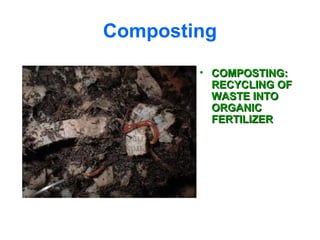
Composting
• COMPOSTING:COMPOSTING:
RECYCLING OFRECYCLING OF
WASTE INTOWASTE INTO
ORGANICORGANIC
FERTILIZERFERTILIZER
Aerobic treatment
Aerobic treatment:-under proper conditions
micro organisms grow.they need carbon and
energy source,nutrients such as
nitrogen,phosphorous and a source of
oxygen.
 Temperature and pH must be controlled
 Toxic substances should be removed.
5. Disposal Methods
• 1.The option for disposal include land
disposal,underground disposal and deep well
injection.
• 2.Choice of disposal method should be
based on evaluation of economics and
potential pollution
• 3.To prevent Environmental pollution from
Landfill , itis essential that site selection
are taken into account
VIII.Conclusion
ON the basis of the above study it is recommended
that HW should be produced in aslittle quantities
as possible .The laws andregulation formulatedfor
the treatment and disposal of HW should
bestrictly implemented.They should be recycledor
treated properly and if they are non biodegradable
then disposed in a way that they do not cause any
damage to our Healthand Environment.
IX.REFERENCE
• 1.HWM and Handling Rule 2008.
• 2.Images from internet(google).
• 3.HWM notes and from pdf files
Hazardous Waste Management

Hazardous Waste Management

  • 1.
    HAZARDOUS WASTE MANAGEMENT Submitted by:- S.INDRAKUMARSINGH M .Sc ENVIRONMENT AL SCIENCE 2ndYr, Roll No.13
  • 2.
    CONTENTS • I.Hazardous Wasterule • II.Characteristics ofHW • III.Listed waste • IV.Types of Hazardous waste • V.Effects of HW on Human Health • VI.Effects of HW on Environment • VII.TreatmentMethods • VIII.Conclusion • IX.Reference
  • 3.
    I.HAZARDOUS WASTE RULES •HAZARDOUS WASTES (Management & Handling) RULES,1989notified under the ENVIRONMENT (Protection) ACT, 1986 • amended in 2000 • and again in 2003
  • 4.
    Contd. • The HazardousWaste (Management & Handling) Rules, 1989 and amendments made thereafter are now superseded by the new • Hazardous Waste (Management,Hazardous Waste (Management, Handling & TransboundaryHandling & Transboundary Movement) Rules, 2008Movement) Rules, 2008..
  • 5.
    Hazardous Waste asdefined in the Rules • Any waste which by reason of any of itsAny waste which by reason of any of its physical, chemical, reactive, toxic, flammable,physical, chemical, reactive, toxic, flammable, explosive or corrosiveexplosive or corrosive characteristics causescharacteristics causes danger or is likely to cause danger to healthdanger or is likely to cause danger to health or environment, whether alone or when inor environment, whether alone or when in contact with other wastes or substances, andcontact with other wastes or substances, and shall include wastes listed in Schedules I, IIshall include wastes listed in Schedules I, II & III of the Rules& III of the Rules
  • 6.
    Chapters in HWMRule • There are 7 chapters namely:- • 1.Preliminary • 2.Procedure for handling hazardous waste • 3.Procedure for recycling ,reprocessing or reuse of hazardous waste • 4.Import and Export of hazardous waste • 5.Treatment,storage and disposal facility for hazardous waste • 6.Packaging ,labelling and transport ofhazardous waste • 7.Miscellanious
  • 7.
    Schedules in Hazardouswaste mangement rule • There are also 7 schedule • 1.List of processes generating hazardous waste • 2.List of waste constituents with concentation limits • 3.List of Hazardous waste applicable for import with prior informed consent • 4.List of Hazardous waste requiring Registration for Recycling /Reprocessing • 5.Specification of used oil suitable for reprocessing/recycling • 6.Hazardous waste prohibited for import and export • 7.List of Authorities and Corresponding Duties
  • 8.
    Forms in HWMRules 1..Application for obtaining Authorisation for collection/reception/treatment/transport/storage/disposal of hazardous waste 2.Form for grant /renewal of authorisation by SPCB/PCC for occupiers,reprocessors ,refuses and operates of facilities for collection ,reception,treatment,storage,transport and disposal of hazardous waste 3.Format for maintaining recordsof hazardous waste by theoccupier or operator of a facility 4.Form for filling Annual Returns by the Occupier or Operator of facility 5.Form of Application forgrant/renewal of registration of industrial units possessing environmentally sound management facilities for reprocessing/recycling 6.Formfor filling annual returns and records on reyclable hazadous waste by the recyclers
  • 9.
    CONTD. 7. Application foriport or export of hazardous waste for recycling/reproceesing/reuse 8.Application for Transboundary movement of hazardous waste 9.Transboundary movement -Movement Document 10..Format for maintaining records of hazardous waste imported and exported 11.Transport Emergency 12.Marking of Hzardous waste container 13.Hazardous Waste Manifest 14.Format of Accident Report 15.Application for filling Appeal against the order passed by CPCB/SPCB/PCC of the Union Territory
  • 10.
    Is a wasteHazardous or notIs a waste Hazardous or not ???? 1.Waste is hazardous if i. it is listed in Schedule I ii. Or, if it falls in Schedule II (analysis required) 2. For the purpose of regulation of Import & Export, a waste is considered as hazardous if it is listed in Schedule-III
  • 11.
    Storage of HazardousWaste 1.Till disposal for recycling/ treatment/ land filling, HWs are to be stored onsite in bags/ containers in a covered area. 2.Storage permitted for a period not exceeding 90 days – SPCB may extend the storage period, in case of i. Small generator, generating HW upto 10 TPA ii. Recyclers, reprocessors and facility operators upto 6 months of their annual capacity iii.Generators who do not have access to any TSDF in the concerned State iv. Wastes which need to be specifically stored for development of a process for its recycling, reuse.
  • 12.
    Transportation of Hazardous Waste 1.HWsto be properly packed and labelled for transport to ensure safe handling 2.HW Containers shall be marked as per Form-12 Information on hazardous nature of wastes and measures to be taken in case of emergency shall be provided to the transporter in Form-11 3.Transport to be in accordance Motor Vehicles Act, 1988 and related guidelines 4.Manifest System (Form-13) to be maintained
  • 13.
    Import and Exportof HW 1.MoEF is the nodal agency 2.Schedule III to be used for regulating HW export and import. 3.Export & Import ban on 30 items (Schedule VI) 4.Import shall be permitted only for recycling or recovery or re- use and not for disposal. 5.Export may be allowed to an actual user of the waste or operator of a disposal facility with the Prior Informed consent of the importing country 6.Wastes listed in Part-D of Schedule III can be imported by traders registered with the SPCB on behalf of actual users
  • 14.
    II.Characteristics of Hazardous Waste •Ignitability:- -can create fireunder certain condition -flashpoint<60 c⁰ eg:-waste oils,used solvents • Corrosivity:- -acids or bases -pH<or=2 or>or =12.5 - if liquid it will corrode steel • Reactivity:- -substance that are unstable under normal condition. -can cause exploision,produce toxic fumes,vapours -pH b/w 2 and 11.5 eg:-cyanide/sulphide, batteries etc • Toxicity:- -harmful when ingested/absorbed -leach from waste and pollute groung water eg:- lead,mercury etc
  • 15.
    III.Listed Hazardous Waste •F-Listed • K-Listed • P-Listed • U-Listed
  • 16.
    F-LISTED The f -listcontains hazardous wastes from non specific sources,i.e various industrial processes that may have generated the waste.the list consist of solvents commonly used in de greasing,metal treatment bath and sludge,waste water from metal plating operations and dioxins containing chemicals or their precursor. Eg:- - Benzene - toluene
  • 17.
    K-LISTED The k- listcontains waste generated by specific industrial process. Eg:- i.Waste including wood preservation. ii.pigment production. iii.Petroleum refining. iv.Explosive manufacturing. v.Pesticide production.
  • 18.
    P-LISTED Consists of discardedcommercial chemical product, off specification chemicals, container residues and residues from spillage of material.
  • 19.
    U-LISTED The U -list differs from p - list by the quantity at which the chemical is regulated. It includes toxic waste such as:- 1.Pesticides applicators. 2.Laboratories. 3.Chemical formulators.
  • 20.
    IV.Types of Hazardouswaste • 1. Nuclear waste • 2. Industrial waste • 3. Universal waste • 4. Medical waste • 5. Household waste • 6. construction waste • 7. Electronic waste
  • 21.
  • 22.
  • 23.
  • 24.
  • 25.
  • 26.
  • 27.
    V.Effects of Hazardouswaste Human Health • 1. Cancer • 2. Respiratory problems • 3. Heart disease • 4. Exposure effects etc
  • 28.
    VI.Effects of Hazardouswaste on Environment • 1.Global warming • 2.Air Pollution • 3.Water Pollution
  • 29.
    VII.Treatment of Hazardous waste Thereare 5 types by which the hazardous waste can be treated:- 1.Physical treatment 2.Chemical treatment 3.Thermal treatment 4.Biological treatment 5.Disposal method
  • 30.
    1.Physical treatment It includes:- 1.Filterationand separation. 2.Screening,sedimentation,adsorption, centrifugation,stripping 3.whenever a wastecontaining liquid and solid must be treated.
  • 31.
    Filteration and separation 1.Filterationis the method for separating solid particles from a liquid using a porous medium.the application of filtration of treatment of hazardous waste fall into the following categories:- 2.Clarification:-method in which suspended solid particles are less than 100ppm and the aim is to produce a clear aqueous effluent, which can be discharged directly or further processed. 3.De watering:- in this method the slurry is concentrated by the removal of liquids to form a solid.
  • 32.
    2.Chemical Treatment 1.Chemical Methodsare:- i.Chemical precipitation. ii.Chemical oxidation and reduction iii.Neutralization 2.Toreduce the hazard of a particular waste 3.To make thecomplete breakdown of HW into non -toxic form
  • 33.
    Chemical oxidation and reduction Inthese reactions the oxidation state of one reactant is raised,while the other reactant is lowered. Eg:- this kind of treatment is used for the waste of 1.Sulphide. 2.Cyanide. 3.Many organic wastes such as pesticides and phenols.
  • 34.
    Solidification and stabilization 1.Solidificationis the process in which certain materials are added that leads to the production of solids. 2.Stabilization is the process by which a waste is converted to more chemically stable form. It involves the chemical reactions which transform the toxic component to a new non-toxic compound.
  • 35.
    3.Thermal treatment It involves2 processes Incineration:`-it is a term commonly used to describe all systems of burning carried out in a multi chambered incinerator. Temperature of secondary chamber:-1100 c Residence time:-1 sec. Pyrolysis:-it is the chemical decomposition or change brought about by heating in the absence of oxygen. Temperature:- 425-760 c
  • 36.
    Incineration 1.Able to aachieve99.9% destruction and removal efficiency to hazardous components in waste 2.Primary products are CO2,Vapour andAsh 3.Sulphur bearing waste gives off SO2,CO2,H2O when incinerated 4.Byproducts are sometime more harmful 5.Two type of Incinerator i.Liquid Injection ii. Rotary Kins
  • 37.
  • 38.
    Composting • COMPOSTING:COMPOSTING: RECYCLING OFRECYCLINGOF WASTE INTOWASTE INTO ORGANICORGANIC FERTILIZERFERTILIZER
  • 39.
    Aerobic treatment Aerobic treatment:-underproper conditions micro organisms grow.they need carbon and energy source,nutrients such as nitrogen,phosphorous and a source of oxygen.  Temperature and pH must be controlled  Toxic substances should be removed.
  • 40.
    5. Disposal Methods •1.The option for disposal include land disposal,underground disposal and deep well injection. • 2.Choice of disposal method should be based on evaluation of economics and potential pollution • 3.To prevent Environmental pollution from Landfill , itis essential that site selection are taken into account
  • 41.
    VIII.Conclusion ON the basisof the above study it is recommended that HW should be produced in aslittle quantities as possible .The laws andregulation formulatedfor the treatment and disposal of HW should bestrictly implemented.They should be recycledor treated properly and if they are non biodegradable then disposed in a way that they do not cause any damage to our Healthand Environment.
  • 42.
    IX.REFERENCE • 1.HWM andHandling Rule 2008. • 2.Images from internet(google). • 3.HWM notes and from pdf files