STRIDOR
DEFINATION
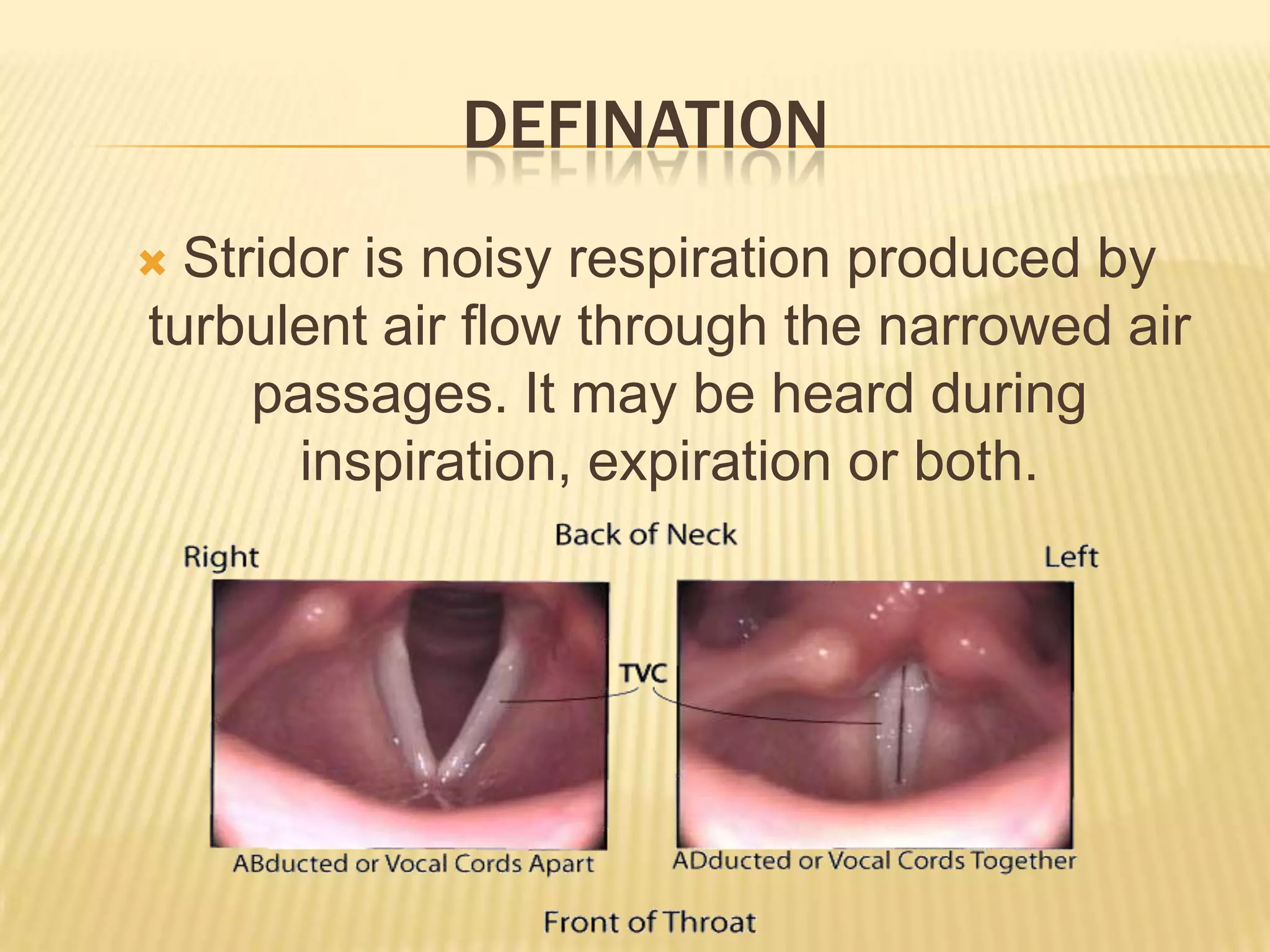
 Stridor is noisy respiration produced by
turbulent air flow through the narrowed air
passages. It may be heard during
inspiration, expiration or both.
TYPES OF STRIDOR
 INSPIRATORY STRIDOR – It is often
produced in obstructive lesions of
supraglottis or pharynx.
 EXPIRATORY STRIDOR - It is produced in
lesions of thoracic trachea, primary and
secondary bronchi.
 BIPHASIC STRIDOR - It is seen in lesions of
glottis, subglottis and cervical trachea.
Types Of Stridor And Probable Site of Obstruction
Common Causes Of Stridor In Children & Infants
Diagnosis Of Stridor In Children
Diagnosis Of
Stridor In Children
Part - 2
MANAGEMENT
 Stridor is a physical sign not a disease.
 Stridor is usually diagnosed on the basis of history
and physical examination, with a view to revealing
the underlying problem or condition.
 Attempt should always be made to discover the
cause. It is important to elicit :
 Time of onset
 Mode of onset
 Duration
 Cyanotic spells
 Aspiration or ingestion of a foreign body
 Laryngeal Trauma
PHYSICAL EXAMINATION
 Stridor is always associated with respiratory
distress. There may be recession in
Suprasternal Notch, Sternum, Intercostal
Spaces & Epigastrium during inspiratory
efforts.
 Note whether the stridor is
inspiratory, expiratory or biphasic. Which
indicates probable site of obstruction.
 Snoring or snorting – Nasal Or
Nasopharyngeal cause.
 Gurgling sound and muffled voice -
Pharyngeal Cause.
 Horse cry or voice – Laryngeal Cause
 Expiratory wheeze – Bronchial Obstruction
 Associated fever – Infection ex: Acute
Laryngitis
ASSOCIATED CHARACTERISTICS OF STRIDOR
RADIOGRAPHY
 X-ray of chest and soft tissue neck both
anteroposterior and lateral views.
 Fluoroscopy to see chest movements both
during inspiration and expiration.
 Tomography of chest for mediastinal mass.
 Angiography , if aberrant vessels are
suspected
 CT scan/MRI.
TREATMENT
 Once the diagnosis has been made treatment of
exact cause can be made.
 Use of nebulized racemic adrenaline epinephrine in
cases where airway edema may be the cause of the
stridor.
 Use of dexamethasone.
 Use of inhaled Heliox (70% helium, 30% oxygen); the
effect is almost instantaneous. Helium, being a less
dense gas than nitrogen, reduces turbulent flow
through the airways.
 Some conditions (ex: epiglottitis, bacterial tracheitis)
may require antibiotics, while steroids may be useful
in other situations.
THANK YOU

Stridor

  • 1.
  • 2.
    DEFINATION  Stridor isnoisy respiration produced by turbulent air flow through the narrowed air passages. It may be heard during inspiration, expiration or both.
  • 3.
    TYPES OF STRIDOR INSPIRATORY STRIDOR – It is often produced in obstructive lesions of supraglottis or pharynx.  EXPIRATORY STRIDOR - It is produced in lesions of thoracic trachea, primary and secondary bronchi.  BIPHASIC STRIDOR - It is seen in lesions of glottis, subglottis and cervical trachea.
  • 4.
    Types Of StridorAnd Probable Site of Obstruction
  • 5.
    Common Causes OfStridor In Children & Infants
  • 7.
  • 8.
    Diagnosis Of Stridor InChildren Part - 2
  • 10.
    MANAGEMENT  Stridor isa physical sign not a disease.  Stridor is usually diagnosed on the basis of history and physical examination, with a view to revealing the underlying problem or condition.  Attempt should always be made to discover the cause. It is important to elicit :  Time of onset  Mode of onset  Duration  Cyanotic spells  Aspiration or ingestion of a foreign body  Laryngeal Trauma
  • 11.
    PHYSICAL EXAMINATION  Stridoris always associated with respiratory distress. There may be recession in Suprasternal Notch, Sternum, Intercostal Spaces & Epigastrium during inspiratory efforts.  Note whether the stridor is inspiratory, expiratory or biphasic. Which indicates probable site of obstruction.
  • 12.
     Snoring orsnorting – Nasal Or Nasopharyngeal cause.  Gurgling sound and muffled voice - Pharyngeal Cause.  Horse cry or voice – Laryngeal Cause  Expiratory wheeze – Bronchial Obstruction  Associated fever – Infection ex: Acute Laryngitis ASSOCIATED CHARACTERISTICS OF STRIDOR
  • 13.
    RADIOGRAPHY  X-ray ofchest and soft tissue neck both anteroposterior and lateral views.  Fluoroscopy to see chest movements both during inspiration and expiration.  Tomography of chest for mediastinal mass.  Angiography , if aberrant vessels are suspected  CT scan/MRI.
  • 14.
    TREATMENT  Once thediagnosis has been made treatment of exact cause can be made.  Use of nebulized racemic adrenaline epinephrine in cases where airway edema may be the cause of the stridor.  Use of dexamethasone.  Use of inhaled Heliox (70% helium, 30% oxygen); the effect is almost instantaneous. Helium, being a less dense gas than nitrogen, reduces turbulent flow through the airways.  Some conditions (ex: epiglottitis, bacterial tracheitis) may require antibiotics, while steroids may be useful in other situations.
  • 15.