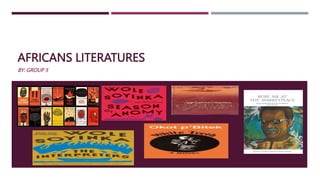
AFRICANS LITERATURES
BY: GROUP 5
• Africa, the “Cradle of the humankind” according to scientist, has a literature that is filled with the human
spirit, desiring freedom and contentment. African literature consist of oral tradition and written literature
ranging from local languages brought by the colonizers (English, Portuguese, and French). The
experiences of colonization and post-colonization shape the African literature.
AFRICA
• The colonization and slave trade has awaken the African psyche ( the soul and mind) incredibly. The
literary works are the vehicle, specifically the newspaper, in exposing the psychological social impact
of colonization.
• African writers express their cry for freedom from oppressions through their poetry and
narrative works. Though they use European language to produce their literary works, the cry
for independence has reached to the climax, so strong and effective, with the embodiment of
nationalism, gained worldwide acclaim. They will use their literary works as voices against
their government with a constant theme of corruption.
NUMEROUS NOTABLE AFRICAN WRITERS;
 CHINUA ACHEBE (Nigeria)
 WOLE SOYINKA (Nigeria)
 KOFI AWOONOR ( Ghana)
 NGUNGI WA THIONG’O (Kenya)
 OKOT P’ BITEK (Uganda)
• NADINE GORDIMER ( South Africa)
• JACQUES RABEMANANJARA (Madagascar)
• ES’KIACMPHAHLELE (South Africa)
• THOMAS MAFOLO (Lesotho)
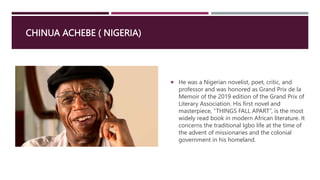
CHINUA ACHEBE ( NIGERIA)
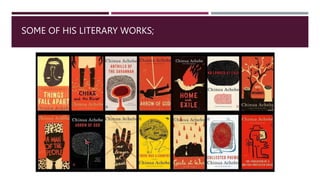
 He was a Nigerian novelist, poet, critic, and
professor and was honored as Grand Prix de la
Memoir of the 2019 edition of the Grand Prix of
Literary Association. His first novel and
masterpiece, “THINGS FALL APART”, is the most
widely read book in modern African literature. It
concerns the traditional Igbo life at the time of
the advent of missionaries and the colonial
government in his homeland.
SOME OF HIS LITERARY WORKS;
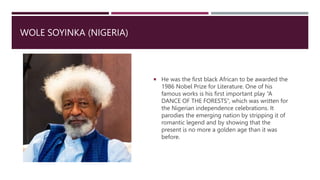
WOLE SOYINKA (NIGERIA)
 He was the first black African to be awarded the
1986 Nobel Prize for Literature. One of his
famous works is his first important play “A
DANCE OF THE FORESTS”, which was written for
the Nigerian independence celebrations. It
parodies the emerging nation by stripping it of
romantic legend and by showing that the
present is no more a golden age than it was
before.
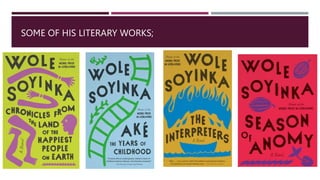
SOME OF HIS LITERARY WORKS;
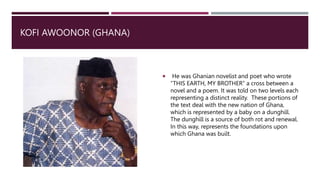
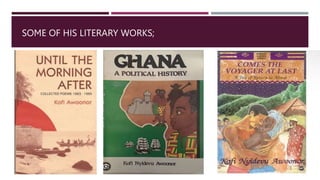
KOFI AWOONOR (GHANA)
 He was Ghanian novelist and poet who wrote
“THIS EARTH, MY BROTHER” a cross between a
novel and a poem. It was told on two levels each
representing a distinct reality. These portions of
the text deal with the new nation of Ghana,
which is represented by a baby on a dunghill.
The dunghill is a source of both rot and renewal.
In this way, represents the foundations upon
which Ghana was built.
SOME OF HIS LITERARY WORKS;
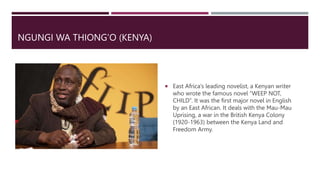
NGUNGI WA THIONG’O (KENYA)
 East Africa’s leading novelist, a Kenyan writer
who wrote the famous novel “WEEP NOT,
CHILD”. It was the first major novel in English
by an East African. It deals with the Mau-Mau
Uprising, a war in the British Kenya Colony
(1920-1963) between the Kenya Land and
Freedom Army.
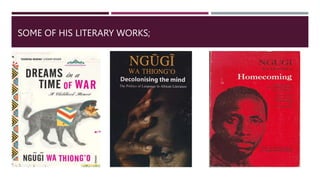
SOME OF HIS LITERARY WORKS;
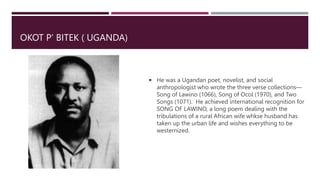
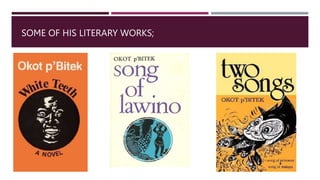
OKOT P’ BITEK ( UGANDA)
 He was a Ugandan poet, novelist, and social
anthropologist who wrote the three verse collections—
Song of Lawino (1066), Song of Ocol (1970), and Two
Songs (1071). He achieved international recognition for
SONG OF LAWINO, a long poem dealing with the
tribulations of a rural African wife whkse husband has
taken up the urban life and wishes everything to be
westernized.
SOME OF HIS LITERARY WORKS;
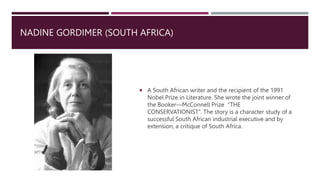
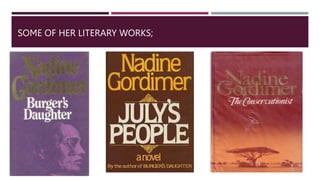
NADINE GORDIMER (SOUTH AFRICA)
 A South African writer and the recipient of the 1991
Nobel Prize in Literature. She wrote the joint winner of
the Booker—McConnell Prize “THE
CONSERVATIONIST”. The story is a character study of a
successful South African industrial executive and by
extension, a critique of South Africa.
SOME OF HER LITERARY WORKS;
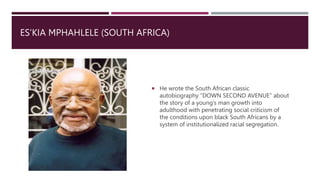
ES’KIA MPHAHLELE (SOUTH AFRICA)
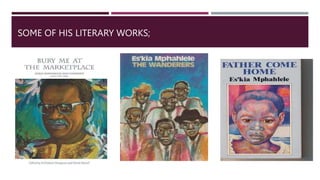
 He wrote the South African classic
autobiography “DOWN SECOND AVENUE” about
the story of a young’s man growth into
adulthood with penetrating social criticism of
the conditions upon black South Africans by a
system of institutionalized racial segregation.
SOME OF HIS LITERARY WORKS;
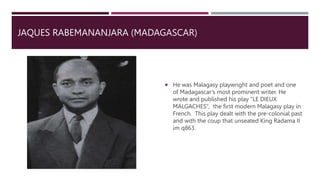
JAQUES RABEMANANJARA (MADAGASCAR)
 He was Malagasy playwright and poet and one
of Madagascar’s most prominent writer. He
wrote and published his play “LE DIEUX
MALGACHES”, the first modern Malagasy play in
French. This play dealt with the pre-colonial past
and with the coup that unseated King Radama II
im q863.
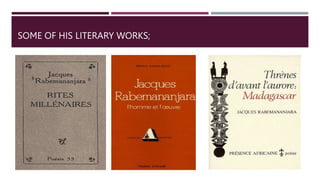
SOME OF HIS LITERARY WORKS;
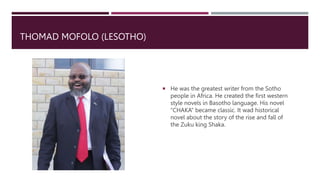
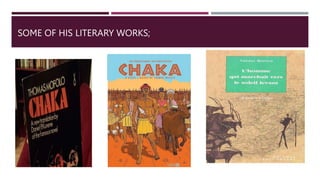
THOMAD MOFOLO (LESOTHO)
 He was the greatest writer from the Sotho
people in Africa. He created the first western
style novels in Basotho language. His novel
“CHAKA” became classic. It wad historical
novel about the story of the rise and fall of
the Zuku king Shaka.
SOME OF HIS LITERARY WORKS;
THANK YOUÙUUU!!!!!!

AFRICA-GR5.pptx

  • 1.
  • 2.
    • Africa, the“Cradle of the humankind” according to scientist, has a literature that is filled with the human spirit, desiring freedom and contentment. African literature consist of oral tradition and written literature ranging from local languages brought by the colonizers (English, Portuguese, and French). The experiences of colonization and post-colonization shape the African literature. AFRICA • The colonization and slave trade has awaken the African psyche ( the soul and mind) incredibly. The literary works are the vehicle, specifically the newspaper, in exposing the psychological social impact of colonization. • African writers express their cry for freedom from oppressions through their poetry and narrative works. Though they use European language to produce their literary works, the cry for independence has reached to the climax, so strong and effective, with the embodiment of nationalism, gained worldwide acclaim. They will use their literary works as voices against their government with a constant theme of corruption.
  • 3.
    NUMEROUS NOTABLE AFRICANWRITERS;  CHINUA ACHEBE (Nigeria)  WOLE SOYINKA (Nigeria)  KOFI AWOONOR ( Ghana)  NGUNGI WA THIONG’O (Kenya)  OKOT P’ BITEK (Uganda) • NADINE GORDIMER ( South Africa) • JACQUES RABEMANANJARA (Madagascar) • ES’KIACMPHAHLELE (South Africa) • THOMAS MAFOLO (Lesotho)
  • 4.
    CHINUA ACHEBE (NIGERIA)  He was a Nigerian novelist, poet, critic, and professor and was honored as Grand Prix de la Memoir of the 2019 edition of the Grand Prix of Literary Association. His first novel and masterpiece, “THINGS FALL APART”, is the most widely read book in modern African literature. It concerns the traditional Igbo life at the time of the advent of missionaries and the colonial government in his homeland.
  • 5.
    SOME OF HISLITERARY WORKS;
  • 6.
    WOLE SOYINKA (NIGERIA) He was the first black African to be awarded the 1986 Nobel Prize for Literature. One of his famous works is his first important play “A DANCE OF THE FORESTS”, which was written for the Nigerian independence celebrations. It parodies the emerging nation by stripping it of romantic legend and by showing that the present is no more a golden age than it was before.
  • 7.
    SOME OF HISLITERARY WORKS;
  • 8.
    KOFI AWOONOR (GHANA) He was Ghanian novelist and poet who wrote “THIS EARTH, MY BROTHER” a cross between a novel and a poem. It was told on two levels each representing a distinct reality. These portions of the text deal with the new nation of Ghana, which is represented by a baby on a dunghill. The dunghill is a source of both rot and renewal. In this way, represents the foundations upon which Ghana was built.
  • 9.
    SOME OF HISLITERARY WORKS;
  • 10.
    NGUNGI WA THIONG’O(KENYA)  East Africa’s leading novelist, a Kenyan writer who wrote the famous novel “WEEP NOT, CHILD”. It was the first major novel in English by an East African. It deals with the Mau-Mau Uprising, a war in the British Kenya Colony (1920-1963) between the Kenya Land and Freedom Army.
  • 11.
    SOME OF HISLITERARY WORKS;
  • 12.
    OKOT P’ BITEK( UGANDA)  He was a Ugandan poet, novelist, and social anthropologist who wrote the three verse collections— Song of Lawino (1066), Song of Ocol (1970), and Two Songs (1071). He achieved international recognition for SONG OF LAWINO, a long poem dealing with the tribulations of a rural African wife whkse husband has taken up the urban life and wishes everything to be westernized.
  • 13.
    SOME OF HISLITERARY WORKS;
  • 14.
    NADINE GORDIMER (SOUTHAFRICA)  A South African writer and the recipient of the 1991 Nobel Prize in Literature. She wrote the joint winner of the Booker—McConnell Prize “THE CONSERVATIONIST”. The story is a character study of a successful South African industrial executive and by extension, a critique of South Africa.
  • 15.
    SOME OF HERLITERARY WORKS;
  • 16.
    ES’KIA MPHAHLELE (SOUTHAFRICA)  He wrote the South African classic autobiography “DOWN SECOND AVENUE” about the story of a young’s man growth into adulthood with penetrating social criticism of the conditions upon black South Africans by a system of institutionalized racial segregation.
  • 17.
    SOME OF HISLITERARY WORKS;
  • 18.
    JAQUES RABEMANANJARA (MADAGASCAR) He was Malagasy playwright and poet and one of Madagascar’s most prominent writer. He wrote and published his play “LE DIEUX MALGACHES”, the first modern Malagasy play in French. This play dealt with the pre-colonial past and with the coup that unseated King Radama II im q863.
  • 19.
    SOME OF HISLITERARY WORKS;
  • 20.
    THOMAD MOFOLO (LESOTHO) He was the greatest writer from the Sotho people in Africa. He created the first western style novels in Basotho language. His novel “CHAKA” became classic. It wad historical novel about the story of the rise and fall of the Zuku king Shaka.
  • 21.
    SOME OF HISLITERARY WORKS;
  • 22.