Zoonotic Diseases (Part-1)
Dr .Waseem Safdar (waseem.safdar@numspak.edu.pk) NDBS NUMS
Medical Microbiology
(MIC-663)
Dr .Waseem Safdar Medical Microbiology (MIC-663) NDBS - NUMS
➢ The word ‘zoonoses’ is derived from the Greek words zōon meaning
‘animal’ and nosos means ‘disease’
➢ The term ‘zoonoses’ was coined by Rudolf Virchow during his study
on Trichinella in 1855,
➢ ‘A zoonosis is any disease or infection that is naturally transmissible
from vertebrate animals to humans’
➢ Around 60% of the emerging human infections are zoonotic in nature
and among these pathogens more than 70% originated from wildlife
species
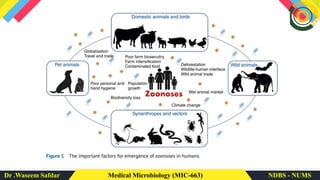
Zoonoses
Dr .Waseem Safdar Medical Microbiology (MIC-663) NDBS - NUMS
Classification of Zoonoses
Zoonoses can be grouped into three categories
➢ Based on aetiological agents
➢ Based on the reservoir host(s)
➢ Based on the transmission cycle
Dr .Waseem Safdar Medical Microbiology (MIC-663) NDBS - NUMS
Based on aetiological agents
• Bacterial zoonoses (anthrax, tuberculosis, Lyme disease, and
plague),
• Viral zoonoses (such as rabies, acquired immune deficiency
syndrome- AIDS, Ebola, and avian influenza),
• Parasitic zoonoses (such as trichinosis, toxoplasmosis, trematodosis,
giardiasis, malaria, and echinococcosis),
• Fungal zoonoses (such as ring worm),
Dr .Waseem Safdar Medical Microbiology (MIC-663) NDBS - NUMS
Based on aetiological agents
• Rickettsial zoonoses (Q-fever),
• Chlamydial zoonoses (psittacosis),
• Mycoplasma zoonoses (Mycoplasma pneumoniae infection),
• Protozoal zoonoses, and
• Diseases caused by acellular non-viral pathogenic agents (such as
transmissible spongiform encephalopathies and mad cow disease)
Dr .Waseem Safdar Medical Microbiology (MIC-663) NDBS - NUMS
Based on the reservoir host(s)
▪ Anthropozoonoses: The zoonotic diseases which can be
transmitted to humans from lower vertebrates.
▪ Zooanthroponoses (also known as ‘reverse zoonotic disease
transmission’): Those zoonotic diseases which can be transmitted
to lower vertebrate animals from infected humans. Therefore,
these infections are primarily of human origin
▪ Amphixenoses: The zoonoses which are maintained in both
humans and lower vertebrate animals, which may be transmitted in
either direction
Dr .Waseem Safdar Medical Microbiology (MIC-663) NDBS - NUMS
Based on the transmission cycle
Direct zoonoses: Those zoonotic diseases which are perpetuated in nature by
a single vertebrate species (e.g. anthrax, rabies, Q fever, etc.).
Cyclozoonoses: Zoonotic diseases which require two or more vertebrate
hosts to complete the transmission cycle. These can be further classified as
follows.
– Obligatory cyclozoonoses: The zoonotic diseases in which the involvement
of humans as a host is compulsory to continue the transmission cycle (e.g.
taeniasis).
– Non-obligatory cyclozoonoses: The zoonotic diseases in which humans are
accidentally involved in the transmission cycle of the pathogen (e.g.
hydatidosis).
Dr .Waseem Safdar Medical Microbiology (MIC-663) NDBS - NUMS
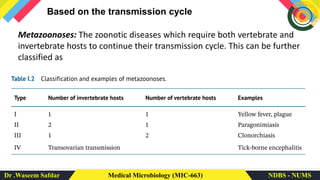
Based on the transmission cycle
Metazoonoses: The zoonotic diseases which require both vertebrate and
invertebrate hosts to continue their transmission cycle. This can be further
classified as
Dr .Waseem Safdar Medical Microbiology (MIC-663) NDBS - NUMS
Based on the transmission cycle
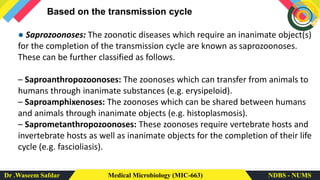
● Saprozoonoses: The zoonotic diseases which require an inanimate object(s)
for the completion of the transmission cycle are known as saprozoonoses.
These can be further classified as follows.
– Saproanthropozoonoses: The zoonoses which can transfer from animals to
humans through inanimate substances (e.g. erysipeloid).
– Saproamphixenoses: The zoonoses which can be shared between humans
and animals through inanimate objects (e.g. histoplasmosis).
– Saprometanthropozoonoses: These zoonoses require vertebrate hosts and
invertebrate hosts as well as inanimate objects for the completion of their life
cycle (e.g. fascioliasis).
Dr .Waseem Safdar Medical Microbiology (MIC-663) NDBS - NUMS
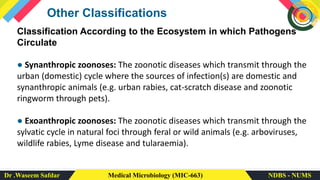
Other Classifications
Classification According to the Ecosystem in which Pathogens
Circulate
● Synanthropic zoonoses: The zoonotic diseases which transmit through the
urban (domestic) cycle where the sources of infection(s) are domestic and
synanthropic animals (e.g. urban rabies, cat-scratch disease and zoonotic
ringworm through pets).
● Exoanthropic zoonoses: The zoonotic diseases which transmit through the
sylvatic cycle in natural foci through feral or wild animals (e.g. arboviruses,
wildlife rabies, Lyme disease and tularaemia).
Dr .Waseem Safdar Medical Microbiology (MIC-663) NDBS - NUMS
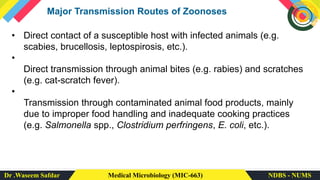
Major Transmission Routes of Zoonoses
• Direct contact of a susceptible host with infected animals (e.g.
scabies, brucellosis, leptospirosis, etc.).
•
Direct transmission through animal bites (e.g. rabies) and scratches
(e.g. cat-scratch fever).
•
Transmission through contaminated animal food products, mainly
due to improper food handling and inadequate cooking practices
(e.g. Salmonella spp., Clostridium perfringens, E. coli, etc.).
Dr .Waseem Safdar Medical Microbiology (MIC-663) NDBS - NUMS
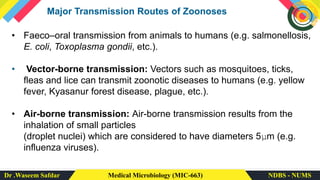
Major Transmission Routes of Zoonoses
• Faeco–oral transmission from animals to humans (e.g. salmonellosis,
E. coli, Toxoplasma gondii, etc.).
• Vector-borne transmission: Vectors such as mosquitoes, ticks,
fleas and lice can transmit zoonotic diseases to humans (e.g. yellow
fever, Kyasanur forest disease, plague, etc.).
• Air-borne transmission: Air-borne transmission results from the
inhalation of small particles
(droplet nuclei) which are considered to have diameters 5μm (e.g.
influenza viruses).
Dr .Waseem Safdar Medical Microbiology (MIC-663) NDBS - NUMS
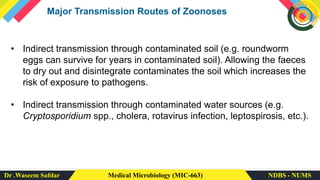
Major Transmission Routes of Zoonoses
• Indirect transmission through contaminated soil (e.g. roundworm
eggs can survive for years in contaminated soil). Allowing the faeces
to dry out and disintegrate contaminates the soil which increases the
risk of exposure to pathogens.
• Indirect transmission through contaminated water sources (e.g.
Cryptosporidium spp., cholera, rotavirus infection, leptospirosis, etc.).
Dr .Waseem Safdar Medical Microbiology (MIC-663) NDBS - NUMS
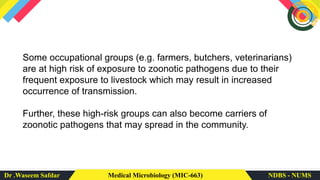
Some occupational groups (e.g. farmers, butchers, veterinarians)
are at high risk of exposure to zoonotic pathogens due to their
frequent exposure to livestock which may result in increased
occurrence of transmission.
Further, these high-risk groups can also become carriers of
zoonotic pathogens that may spread in the community.
Dr .Waseem Safdar Medical Microbiology (MIC-663) NDBS - NUMS
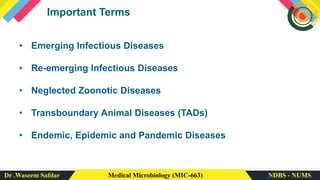
Important Terms
• Emerging Infectious Diseases
• Re-emerging Infectious Diseases
• Neglected Zoonotic Diseases
• Transboundary Animal Diseases (TADs)
• Endemic, Epidemic and Pandemic Diseases
Dr .Waseem Safdar Medical Microbiology (MIC-663) NDBS - NUMS
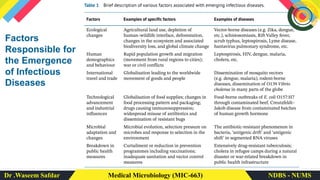
Factors
Responsible for
the Emergence
of Infectious
Diseases
Dr .Waseem Safdar Medical Microbiology (MIC-663) NDBS - NUMS

Zoonosis

  • 1.
    Zoonotic Diseases (Part-1) Dr.Waseem Safdar (waseem.safdar@numspak.edu.pk) NDBS NUMS Medical Microbiology (MIC-663)
  • 2.
    Dr .Waseem SafdarMedical Microbiology (MIC-663) NDBS - NUMS ➢ The word ‘zoonoses’ is derived from the Greek words zōon meaning ‘animal’ and nosos means ‘disease’ ➢ The term ‘zoonoses’ was coined by Rudolf Virchow during his study on Trichinella in 1855, ➢ ‘A zoonosis is any disease or infection that is naturally transmissible from vertebrate animals to humans’ ➢ Around 60% of the emerging human infections are zoonotic in nature and among these pathogens more than 70% originated from wildlife species Zoonoses
  • 3.
    Dr .Waseem SafdarMedical Microbiology (MIC-663) NDBS - NUMS Classification of Zoonoses Zoonoses can be grouped into three categories ➢ Based on aetiological agents ➢ Based on the reservoir host(s) ➢ Based on the transmission cycle
  • 4.
    Dr .Waseem SafdarMedical Microbiology (MIC-663) NDBS - NUMS Based on aetiological agents • Bacterial zoonoses (anthrax, tuberculosis, Lyme disease, and plague), • Viral zoonoses (such as rabies, acquired immune deficiency syndrome- AIDS, Ebola, and avian influenza), • Parasitic zoonoses (such as trichinosis, toxoplasmosis, trematodosis, giardiasis, malaria, and echinococcosis), • Fungal zoonoses (such as ring worm),
  • 5.
    Dr .Waseem SafdarMedical Microbiology (MIC-663) NDBS - NUMS Based on aetiological agents • Rickettsial zoonoses (Q-fever), • Chlamydial zoonoses (psittacosis), • Mycoplasma zoonoses (Mycoplasma pneumoniae infection), • Protozoal zoonoses, and • Diseases caused by acellular non-viral pathogenic agents (such as transmissible spongiform encephalopathies and mad cow disease)
  • 6.
    Dr .Waseem SafdarMedical Microbiology (MIC-663) NDBS - NUMS Based on the reservoir host(s) ▪ Anthropozoonoses: The zoonotic diseases which can be transmitted to humans from lower vertebrates. ▪ Zooanthroponoses (also known as ‘reverse zoonotic disease transmission’): Those zoonotic diseases which can be transmitted to lower vertebrate animals from infected humans. Therefore, these infections are primarily of human origin ▪ Amphixenoses: The zoonoses which are maintained in both humans and lower vertebrate animals, which may be transmitted in either direction
  • 7.
    Dr .Waseem SafdarMedical Microbiology (MIC-663) NDBS - NUMS Based on the transmission cycle Direct zoonoses: Those zoonotic diseases which are perpetuated in nature by a single vertebrate species (e.g. anthrax, rabies, Q fever, etc.). Cyclozoonoses: Zoonotic diseases which require two or more vertebrate hosts to complete the transmission cycle. These can be further classified as follows. – Obligatory cyclozoonoses: The zoonotic diseases in which the involvement of humans as a host is compulsory to continue the transmission cycle (e.g. taeniasis). – Non-obligatory cyclozoonoses: The zoonotic diseases in which humans are accidentally involved in the transmission cycle of the pathogen (e.g. hydatidosis).
  • 8.
    Dr .Waseem SafdarMedical Microbiology (MIC-663) NDBS - NUMS Based on the transmission cycle Metazoonoses: The zoonotic diseases which require both vertebrate and invertebrate hosts to continue their transmission cycle. This can be further classified as
  • 9.
    Dr .Waseem SafdarMedical Microbiology (MIC-663) NDBS - NUMS Based on the transmission cycle ● Saprozoonoses: The zoonotic diseases which require an inanimate object(s) for the completion of the transmission cycle are known as saprozoonoses. These can be further classified as follows. – Saproanthropozoonoses: The zoonoses which can transfer from animals to humans through inanimate substances (e.g. erysipeloid). – Saproamphixenoses: The zoonoses which can be shared between humans and animals through inanimate objects (e.g. histoplasmosis). – Saprometanthropozoonoses: These zoonoses require vertebrate hosts and invertebrate hosts as well as inanimate objects for the completion of their life cycle (e.g. fascioliasis).
  • 10.
    Dr .Waseem SafdarMedical Microbiology (MIC-663) NDBS - NUMS Other Classifications Classification According to the Ecosystem in which Pathogens Circulate ● Synanthropic zoonoses: The zoonotic diseases which transmit through the urban (domestic) cycle where the sources of infection(s) are domestic and synanthropic animals (e.g. urban rabies, cat-scratch disease and zoonotic ringworm through pets). ● Exoanthropic zoonoses: The zoonotic diseases which transmit through the sylvatic cycle in natural foci through feral or wild animals (e.g. arboviruses, wildlife rabies, Lyme disease and tularaemia).
  • 11.
    Dr .Waseem SafdarMedical Microbiology (MIC-663) NDBS - NUMS Major Transmission Routes of Zoonoses • Direct contact of a susceptible host with infected animals (e.g. scabies, brucellosis, leptospirosis, etc.). • Direct transmission through animal bites (e.g. rabies) and scratches (e.g. cat-scratch fever). • Transmission through contaminated animal food products, mainly due to improper food handling and inadequate cooking practices (e.g. Salmonella spp., Clostridium perfringens, E. coli, etc.).
  • 12.
    Dr .Waseem SafdarMedical Microbiology (MIC-663) NDBS - NUMS Major Transmission Routes of Zoonoses • Faeco–oral transmission from animals to humans (e.g. salmonellosis, E. coli, Toxoplasma gondii, etc.). • Vector-borne transmission: Vectors such as mosquitoes, ticks, fleas and lice can transmit zoonotic diseases to humans (e.g. yellow fever, Kyasanur forest disease, plague, etc.). • Air-borne transmission: Air-borne transmission results from the inhalation of small particles (droplet nuclei) which are considered to have diameters 5μm (e.g. influenza viruses).
  • 13.
    Dr .Waseem SafdarMedical Microbiology (MIC-663) NDBS - NUMS Major Transmission Routes of Zoonoses • Indirect transmission through contaminated soil (e.g. roundworm eggs can survive for years in contaminated soil). Allowing the faeces to dry out and disintegrate contaminates the soil which increases the risk of exposure to pathogens. • Indirect transmission through contaminated water sources (e.g. Cryptosporidium spp., cholera, rotavirus infection, leptospirosis, etc.).
  • 14.
    Dr .Waseem SafdarMedical Microbiology (MIC-663) NDBS - NUMS Some occupational groups (e.g. farmers, butchers, veterinarians) are at high risk of exposure to zoonotic pathogens due to their frequent exposure to livestock which may result in increased occurrence of transmission. Further, these high-risk groups can also become carriers of zoonotic pathogens that may spread in the community.
  • 15.
    Dr .Waseem SafdarMedical Microbiology (MIC-663) NDBS - NUMS Important Terms • Emerging Infectious Diseases • Re-emerging Infectious Diseases • Neglected Zoonotic Diseases • Transboundary Animal Diseases (TADs) • Endemic, Epidemic and Pandemic Diseases
  • 16.
    Dr .Waseem SafdarMedical Microbiology (MIC-663) NDBS - NUMS Factors Responsible for the Emergence of Infectious Diseases
  • 17.
    Dr .Waseem SafdarMedical Microbiology (MIC-663) NDBS - NUMS
  • 18.
    Dr .Waseem SafdarMedical Microbiology (MIC-663) NDBS - NUMS