2ND YEAR
2ND YEAR
2ND SEMISTER
2ND SEMISTER
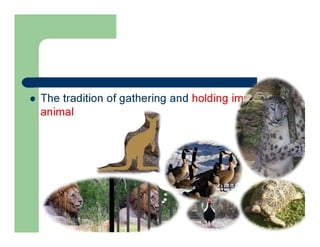
 The tradition of gathering and holding impressive
animal
CHAPTER-1
Introduction of zoo
Definition:
 A zoological garden, zoological park,
menagerie
- is a facility in which animals are confined
within enclosures, displayed to the public, and
in which they may also be bred
 "Zoo" accredited by the Association of Zoos
and Aquariums (AZA)
where:
 exotics are primarily kept in cages or
enclosures
 exotics are exhibited outside of the park to the
public for educational purposes
 exotics are bred and studied by scientists
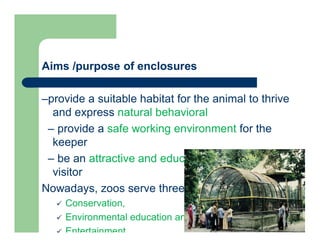
Aims /purpose of enclosures
–provide a suitable habitat for the animal to thrive
and express natural behavioral
– provide a safe working environment for the
keeper
– be an attractive and educational exhibit for the
visitor
Nowadays, zoos serve three main purposes:
 Conservation,
 Environmental education and
 Entertainment
History
Early
• The tradition of gathering and holding impressive
animal(A)
• display as many animals as possible in order to attract
greatest no visitors
• had little or no understanding of the behavior, habitat or
needs of the animals
• displaying of animals in small, dirty, heavily barred cages
that resulted in abnormal behavior
Modern
• little education was provided for the visitor
 zoos were established primarily because of
interest in part scientific of zoological society
members in exotic animal life
 Exotic animals obviously had a great power of
attraction
 increase in free time and better transportation,
resulted private and public
A number of changes have taken place in the
world since the founding of the early public zoos:-
(goal, policy & Mgt)
 Change in human society:
– Technology
– increasing amount of free time
– great diversity of places and ways to spend free time
has developed
 Changes in the biological sciences:
– theory of evolution by natural selection
– transformed biological
 Changes in nature:
Design of zoological park
 Architects, Designers, expertise, Education
Officers, Zookeepers, Horticulturists,
Maintenance staff, Graphics designer and
Naturalistic enclosures
 public viewing, safety, information
 Funding (Sponsorship, Donations)
 a better understanding of the relationship
between animals and their environment
 Signage
Factors to be Considered when
Designing an Enclosure of Zoos
1. Needs of the Animal
 Animal’s natural habitat: Temp, hum, day length,
structure Sleeping facilities (trees, rocks, open areas,
water etc)
 Behaviour and ecology: -what is the animal designed
to do and how it lives
-How active are they- Level of
activity
-When are they active?
- how and where do they feed
and get water
 Social groupings: do they live alone or in groups
 Retreat from Public
– Refuges –area away from other animals and
visitors
– Visual barriers – dividers– keeps out of
sight/eye contact
– Den, cubing dens, nest boxes - areas away
from other animals
– Safe working environment – cleaning and
servicing must be safe
– Isolation areas for veterinary/ other access
2. Needs of the Staff/Zoo
 Security of enclosure
 Ease of access for maintenance, cleaning,
feeding, etc
 Ease of viewing for health checks
 Suitable off limits areas with appropriate
holding facilities
 Breeding programs provided for (i.e. if
breeding is to occur)
3. Needs of the Public
• Clear view of animal
• Does the enclosure cater for all, i.e.
young, wheelchair bound, etc
• Aesthetically appealing
• Educational value – appropriate graphics
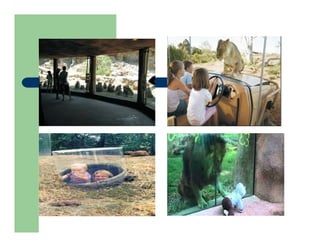
Visitors come to see the animals
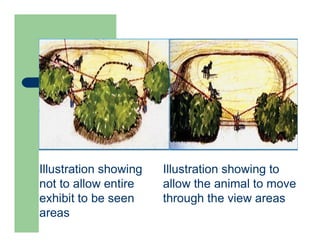
Illustration showing to
allow the animal to move
through the view areas
Illustration showing
not to allow entire
exhibit to be seen
areas
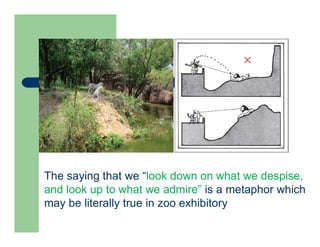
×
The saying that we “look down on what we despise,
and look up to what we admire” is a metaphor which
may be literally true in zoo exhibitory
Barriers -advantages and
disadvantages
o Glass not always recognized as a barrier by
the animals
e.g. some reptiles, birds
o Can invade personal space (get too close for
animals comfort)
e.g. apes
o gives a good view
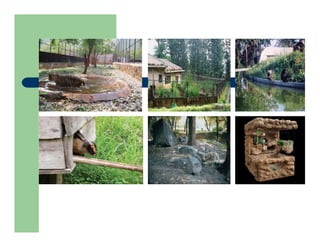
Environmental enrichment
 in search of, catching and eating food VS the
captive animal has its meals brought to it, often
ready to eat
 scatter feeding, unpredictable feeding times,
hiding food
 increasing the complexity of the environment
 Use of different substrates on the floor of the
enclosure
 Novel objects are often introduced to stimulate a
range of behaviors
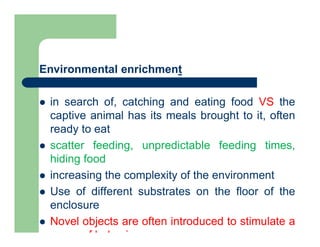
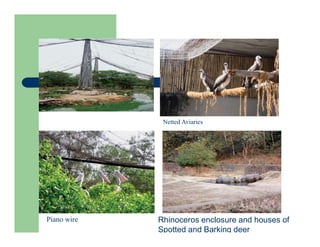
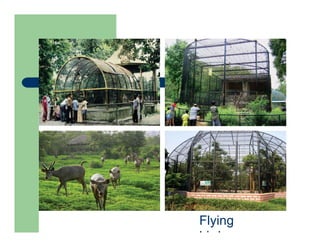
Netted Aviaries
Piano wire Rhinoceros enclosure and houses of
Spotted and Barking deer
Types of enrichment
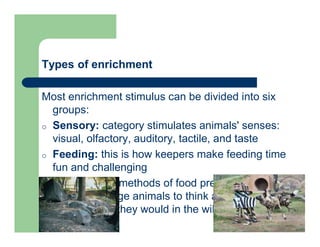
Most enrichment stimulus can be divided into six
groups:
o Sensory: category stimulates animals' senses:
visual, olfactory, auditory, tactile, and taste
o Feeding: this is how keepers make feeding time
fun and challenging
-Different methods of food presentation
encourage animals to think and work for their
food as they would in the wild
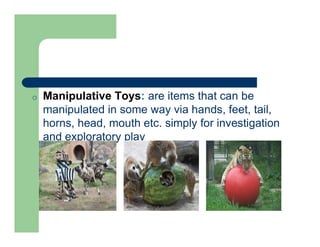
o Manipulative Toys: are items that can be
manipulated in some way via hands, feet, tail,
horns, head, mouth etc. simply for investigation
and exploratory play
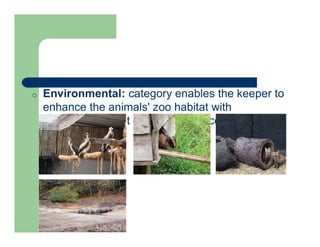
o Environmental: category enables the keeper to
enhance the animals' zoo habitat with
opportunities that change or add complexity to
the environment
o Social: the opportunities to interact with other
animals
o Training: training animals with positive
reinforcement
E.g.: Introduce Novel objects
Building materials
• Material must be:- strong and safe
• non-toxic
• cleanable and disposable: pathogens and
parasite must be minimized
• Ecological sound : they should be from
sustainable or renewable resources
Flying
birds
Constraints on Enclosure Design and Building
 Space :what area has been allocated for the
enclosure?
 Existing-Buildings:
 Money: must work within the set budget
 Current knowledge of husbandry:
Quize-1
1.What is ZOO?(1pts)
2.What are the aims or purposes of
zoos?(2pts)
3. List 3 main reason of the
establishment of Early
zoos?(2pts)
Appearance and types of zoos
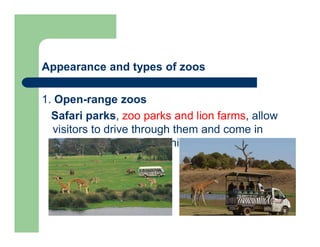
1. Open-range zoos
Safari parks, zoo parks and lion farms, allow
visitors to drive through them and come in
close contact with the animals.
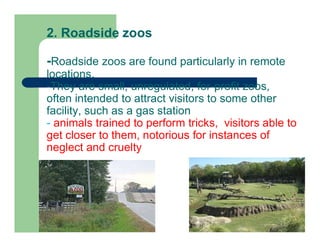
2. Roadside zoos
-Roadside zoos are found particularly in remote
locations.
-They are small, unregulated, for-profit zoos,
often intended to attract visitors to some other
facility, such as a gas station
- animals trained to perform tricks, visitors able to
get closer to them, notorious for instances of
neglect and cruelty
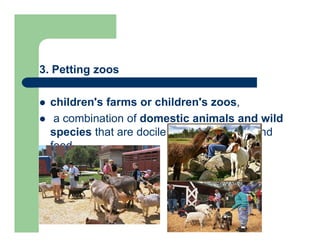
3. Petting zoos
 children's farms or children's zoos,
 a combination of domestic animals and wild
species that are docile enough to touch and
feed
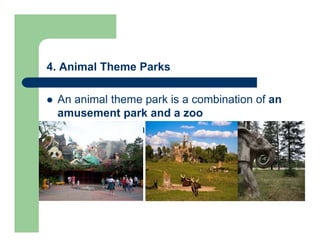
4. Animal Theme Parks
 An animal theme park is a combination of an
amusement park and a zoo
 Mainly for entertaining and commercial
purposes
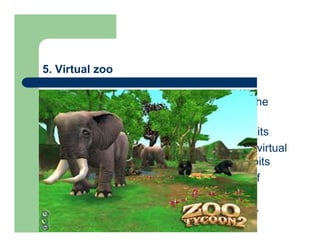
5. Virtual zoo
A virtual zoo is a new concept that uses the
zoo model in a web format
 view exhibits about animals and their habits
 For example, instead of actual animals a virtual
zoo will have articles and photos as exhibits
 Many of these projects focus on photos of
animals or the sale of animal products.
 Some virtual zoos are strictly educational.
Why Zoos & Aquariums Matter
– reconsider their role in environmental problems and
conservation action, part of solution
– role in conservation education and animal care
– Visitors believe they experience a stronger
connection to nature as a result of their visit
– Visitors bring with them a higher-than-expected
knowledge about basic ecological concepts
– reinforce the values and attitudes of the visitor
– motivations and these motivations directly impact
how they conduct their visit and what meaning they
derive from the experience
Positive Aspects of Zoos/Aquariums
– Taxonomic knowledge of staff
– Public awareness about issues
– Creating positive memories
– Animal handling skills of staff
– Money for conservation
Negative Aspects of Zoos/ Aquariums
– Lives of animals
– Cost of operation
– Lack of links to the field
– Limited evidence of learning
– Visitor behavior toward animals
Chapter-2
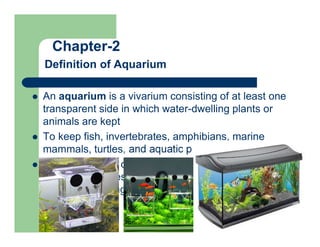
Definition of Aquarium
 An aquarium is a vivarium consisting of at least one
transparent side in which water-dwelling plants or
animals are kept
 To keep fish, invertebrates, amphibians, marine
mammals, turtles, and aquatic plants
 Can be used for ornamental decoration, entertaining
children and guests, breeding aquatic animals, or
simply for viewing pleasure
Aquarium classification based on their
salinity:
1. Freshwater aquaria: are the most popular kind
of aquarium due to their lower cost and ease of
maintenance
2. Marine aquaria: generally require more complex
equipment to set up and maintain than freshwater
aquaria
3. Brackish water aquaria: combine elements of
both marine and freshwater fish keeping
4. Reef aquarium: is a type of marine aquarium
that houses coral. Since corals are quite
sensitive, this kind of aquarium is considered to
one of the hardest to maintain
Another classification is by temperature
(Fresh water Aquaria)
 Coldwater aquarium which may include fish such
as the goldfish is a fairly simple-to-maintain type of
aquarium.
– many aquarists maintain a tropical aquarium as these
fish tend to be more colorful
 Chiclid aquarium is a type of tropical aquarium
that habitat fish of the big chiclid family
– These aquariums usually decorated with rocks and
strong plants
A Biotope aquarium tries to mimic some natural
Based on serves as possible environment
A. Public aquarium
– a number of smaller aquaria, as well those too large
for home aquarists
– Dolphinaria are specifically for dolphins
– Aquatic and semi aquatic animals, may also be kept
by public aquaria
– establishments of a marine mammal park or a
marine park.
B. Virtual aquariums
– A virtual aquarium is a computer program which
uses 3D graphics to reproduce an aquarium on a
Basics of Aquarium Management
 For a public aquarium it is all about keeping
the organisms alive and in a healthy state
 For a laboratory it is about keeping the
organisms in a healthy state so they can be
used for various experiments
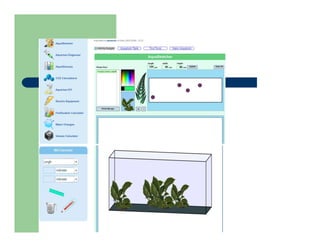
 An aquarium is much more than just a glass
cage with water and fish
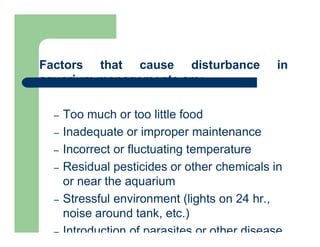
Factors that cause disturbance in
aquarium managements are:
– Too much or too little food
– Inadequate or improper maintenance
– Incorrect or fluctuating temperature
– Residual pesticides or other chemicals in
or near the aquarium
– Stressful environment (lights on 24 hr.,
noise around tank, etc.)
– Introduction of parasites or other disease
The major points considered in Aquarium
Management
– Introduction:
– Water:
– Animal handling:
– Feeding:
– Filtration:
– Tank techniques:
– Tank maintenance:
Materials
 Two basic materials are used for aquarium
construction ;glass and acrylic
Glass aquaria are usually preferred by
aquarists over the acrylic ones because of-
– Their resistance to scratching,
discoloration and much more
accessible price
– They are also nearly twice as heavy as
the latter
– They also provide less insulation and
are not made in as many interesting
 Acrylic aquaria are the primary competitor
with glass
– stronger than glass, and much lighter
– allows for the formation of unusual shapes,
such as the hexagonal tank Compared to
glass
– easy to scratch; but unlike glass, it is
possible to polish out scratches in acrylic
Laminated glass
• is sometimes used, which combines the
advantages of both glass and acrylic
• Large aquaria might instead use stronger
materials such as fiberglass-reinforced
plastics
• However, this material is not
transparent
Aquarium Location
– where you can best enjoy the beauty
and serenity of your new aquarium
– Avoid placing your aquarium near
windows, heating and cooling ducts
– It is not essential to place the aquarium
on a stand, but it is essential to place it
on a flat surface of considerable strength
Styles/Design
 Aquariums have been fashioned into coffee
tables, sinks, and even toilets
 Or cuboid, hexagonal, angled to fit in a corner
(L-shaped), and bow-front (the front side curves
outwards)
– Macquarie an aquarium made from the shell of an
Apple Macintosh computer
– A Kreisler tank a circular aquarium designed to hold
delicate animals such as jellyfish
Daily maintenance consists of checking the
fish for signs of stress and disease
– Aquarists must make sure that the water has a
good quality
– it is not cloudy or foamy
– the temperature of the water is appropriate for the
particular species of fish
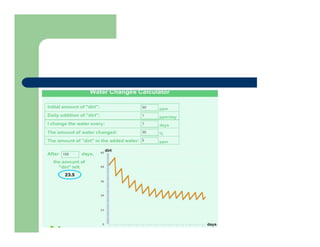
Typical weekly maintenance includes
 changing around 20% of the water while
cleaning the gravel
 A good habit is to replace the water extracted
 Tap water is not considered to be safe for fish to
live in because it contains chemicals that harm
the fish.
 Tap water used must be treated with a suitable
water conditioner, such as
– a product which removes chlorine and
– chloramines, and
– neutralizes any heavy metals present
 Most fish and plant species tolerate only a
limited temperature range:
– Tropical aquaria, with an average temperature
of about 25 °C (77 °F), are much more
common
– Cold water aquaria are better suited to a
cooler environment
 sudden changes in temperatures, can cause
shock and lead to disease
 Water temperature can be regulated with a
Water movement can also be important in
simulating a natural ecosystem. Water
movement can be controlled via:
a)Aeration from air pumps,
b)power heads, and
c) Careful design of internal water flow such
as location of filtration system points of inflow
and outflow.
Aquarium supplies
 A way to keep the aquarium clean, fresh and
looks appealing to the visitors is by using
Biological loading - is a measure of the burden
placed on the aquarium ecosystem by its
inhabitants
 High biological loading presents a more
complicated tank ecology, which in turn means that
equilibrium is easier to upset
 Several fundamental constraints on biological
loading depend on aquarium size
– The water's surface area limits oxygen intake
– The bacteria population depends on the
physical space they have available to colonize
– Physically, only a limited size and number of
CHAPTER-3
Animal Identification Method
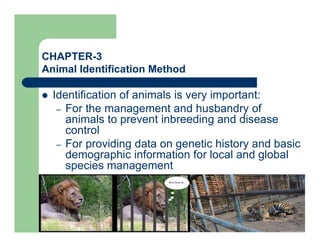
 Identification of animals is very important:
– For the management and husbandry of
animals to prevent inbreeding and disease
control
– For providing data on genetic history and basic
demographic information for local and global
species management
 Various I.D methods
 Restraint; physical, chemical and a combination
of both
Current international methods used in
animal identification
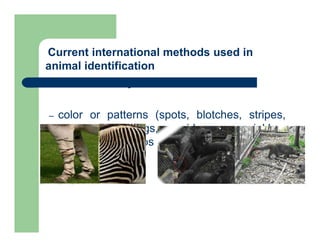
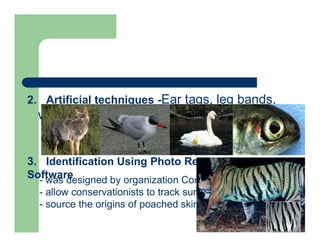
1. Identification by natural marks
– color or patterns (spots, blotches, stripes,
facial markings, ridges, wrinkles,
pigmentation, flaps of skin, whiskers or other
physical traits)
2. Artificial techniques -Ear tags, leg bands,
wing tags and Tattoos
3. Identification Using Photo Recognition
Software
- was designed by organization Conservation Research
- allow conservationists to track surviving tigers
- source the origins of poached skins
Drawback:
– The biggest problem with ear tags is their lack of
permanence
– Ear tags may be lost by being torn out or by
falling out when the front and back pieces separate
– Problems may ensue when adult sized tags are
placed on new born animals
Remedial measures:
A. Replacement of the torn ear tag as soon as it is
detected
B. One piece colored ear tags may be used instead
of two- piece tag.
C. Animals should be tagged only when their tissues
become considerably mature (i.e. tagging should
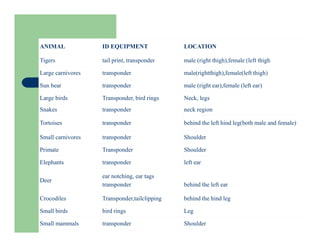
ANIMAL ID EQUIPMENT LOCATION
Tigers tail print, transponder male (right thigh),female (left thigh
Large carnivores transponder male(rightthigh),female(left thigh)
Sun bear transponder male (right ear),female (left ear)
Large birds Transponder, bird rings Neck, legs
Snakes transponder neck region
Tortoises transponder behind the left hind leg(both male and female)
Small carnivores transponder Shoulder
Primate Transponder Shoulder
Elephants transponder left ear
Deer
ear notching, ear tags
transponder behind the left ear
Crocodiles Transponder,tailclipping behind the hind leg
Small birds bird rings Leg
Small mammals transponder Shoulder
WHY KEEP RECORDS?
 Good records maintain and transmit accurate
information about the animal collection so that the
information:
 Document complete history of animal
 Provides meaningful archival material for the future
 Provides legal documentation, including proofs of title
and reports for permits
 Provides genetics history (pedigree) and basic
demographic information used in local and global
species management
Studbooks
A stud book- also called a breed
registry is a list of all of the known
individual animals in a breed
– If an animal is registered in a stud book, it
is considered to be “pure blood,” and is
accompanied with registration papers
– In addition, most pureblood animals are
tattooed or micro chipped so that they
can be readily identified throughout life
Open stud book
– is where animals may be registered even
if their parents or earlier ancestors were
not previously registered with that
particular entity
– Usually an open stud book has strict
studbook selection criteria that require an
animal to meet a certain standard of
conformation, performance or both.
Closed stud book
– only allows registration of animals whose parents
are also registered with that particular breed
– In some cases, an open stud book may eventually
become closed once if the breed type is deemed to
be fully set
– A closed stud book will no longer accept any
outside blood for improvement of a particular breed
of animal
– the registered animals are the foundation for the
breed, with all subsequent offspring tracing back to
the foundation stock
– It allows the breed to stay very pure to its type,
Functions
 The creation/maintenance of coordination with the
Population Management Center (PMC)
 general biology and species ecology data
 status and distribution information about the in situ
populations
 bibliography of relevant publications
 Monitoring and documenting all ex situ births, death, and
transfer information
 Maintaining an accurate database that allows detailed
genetic and demographic analyses
 Recommending breeding decisions to enhance genetic
diversity
 Assessing the population status
Scientific/common name
 When corresponding with another institution
 The common name chosen for a species can
be quite confusing since animals sometimes
acquire very localised names
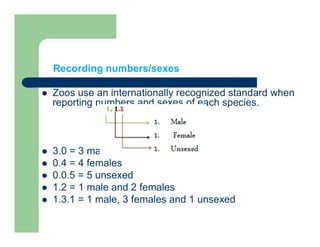
Recording numbers/sexes
 Zoos use an internationally recognized standard when
reporting numbers and sexes of each species.
 3.0 = 3 males
 0.4 = 4 females
 0.0.5 = 5 unsexed
 1.2 = 1 male and 2 females
 1.3.1 = 1 male, 3 females and 1 unsexed
Who records the data?
 Any keeper on a section who makes an
observation (behavioral, reproductive)
 moves an animal to a new enclosure,
 receives or transfers an animal in or out of their
section,
 treats an animal etc.
Where is the data recorded?
All entries should be written on the Daily Report
Everything entered onto the Daily report (with the
exception of Seal training – recorded at Seals) is
What data to record?
1.All entries must use the animals
2. births/deaths/arrivals/departures
3. Enclosure moves
4. SEX- if a young animal was recorded
5. Seasonal changes e.g.: bird moult.
6. Weights and measurements.
7. Reproductive.
8. Behavioral.
9. Medical
Types of records
Animal records contain -animal populations
-scientific genetic
management
A. Accession log/ stock or inventory register
 An accession log or stock register keeps track of all
births, acquisition, deaths and disposition
 An Accession log is a quick and easy reference for
your collection and should be kept updated in a
timely fashion
Accession number
 Accession No.= Local ID # = Specimen # is the number
you provide to your animal for individual logical
identification
 The best way to assign a Local ID # to your collection is
to keep it simple, just start at “1” and go from there
 An accession number should not be used to indicate
anything about the animal
 the animals are coded, for e.g. 98MO34 the animal
was received in 1998, mammal (M) and the 34th
mammal received in that year
When to give an accession number to an
animal?
A. When it is born
B. When you get an animal from the wild
C. When you get an animal from another
Institution, you will give it your own accession
number (even though the other zoo has given it
an accession number as well
D. When you get an animal from another
Institution and tell them the accession number
you have given it
E. Both zoos will have both numbers
B. Deaccession
The process by which a specimen is permanently
removed from the collection due to death or title
transfer, and its record file closed and archived
(files are never discarded)
 To archive – to move non –current (inactive) files
to a safe storage place where they may be
consulted as necessary
Marking Of Animals For Identification
why mark animals?
The ideal identification system is;
1. Permanent, resistant to loss or tearing
2. Easy to read from a distance
3. Easy to apply, and
4. Gives all information we desire at a glance
5. Allow the animal to be as free of pain and
/ or stress as possible
6. Be cost effective
An ideal mark should not;
1. Cause death
2. lethal effects on fitness, e.g. reduced growth or
reproductive rates
3.Influence the behaviorof marked individuals
4.Influence the behavior of other animals towards
the marked individual
5. It should not alter over time e.g. colored ear
tags may fade -causing confusion)
Zoo mengistu-2010
Zoo mengistu-2010

Zoo mengistu-2010

  • 1.
    2ND YEAR 2ND YEAR 2NDSEMISTER 2ND SEMISTER
  • 2.
     The traditionof gathering and holding impressive animal
  • 3.
    CHAPTER-1 Introduction of zoo Definition: A zoological garden, zoological park, menagerie - is a facility in which animals are confined within enclosures, displayed to the public, and in which they may also be bred  "Zoo" accredited by the Association of Zoos and Aquariums (AZA)
  • 4.
    where:  exotics areprimarily kept in cages or enclosures  exotics are exhibited outside of the park to the public for educational purposes  exotics are bred and studied by scientists
  • 5.
    Aims /purpose ofenclosures –provide a suitable habitat for the animal to thrive and express natural behavioral – provide a safe working environment for the keeper – be an attractive and educational exhibit for the visitor Nowadays, zoos serve three main purposes:  Conservation,  Environmental education and  Entertainment
  • 6.
    History Early • The traditionof gathering and holding impressive animal(A) • display as many animals as possible in order to attract greatest no visitors • had little or no understanding of the behavior, habitat or needs of the animals • displaying of animals in small, dirty, heavily barred cages that resulted in abnormal behavior Modern • little education was provided for the visitor
  • 7.
     zoos wereestablished primarily because of interest in part scientific of zoological society members in exotic animal life  Exotic animals obviously had a great power of attraction  increase in free time and better transportation, resulted private and public
  • 8.
    A number ofchanges have taken place in the world since the founding of the early public zoos:- (goal, policy & Mgt)  Change in human society: – Technology – increasing amount of free time – great diversity of places and ways to spend free time has developed  Changes in the biological sciences: – theory of evolution by natural selection – transformed biological  Changes in nature:
  • 9.
    Design of zoologicalpark  Architects, Designers, expertise, Education Officers, Zookeepers, Horticulturists, Maintenance staff, Graphics designer and Naturalistic enclosures  public viewing, safety, information  Funding (Sponsorship, Donations)  a better understanding of the relationship between animals and their environment  Signage
  • 10.
    Factors to beConsidered when Designing an Enclosure of Zoos 1. Needs of the Animal  Animal’s natural habitat: Temp, hum, day length, structure Sleeping facilities (trees, rocks, open areas, water etc)  Behaviour and ecology: -what is the animal designed to do and how it lives -How active are they- Level of activity -When are they active? - how and where do they feed and get water  Social groupings: do they live alone or in groups
  • 11.
     Retreat fromPublic – Refuges –area away from other animals and visitors – Visual barriers – dividers– keeps out of sight/eye contact – Den, cubing dens, nest boxes - areas away from other animals – Safe working environment – cleaning and servicing must be safe – Isolation areas for veterinary/ other access
  • 12.
    2. Needs ofthe Staff/Zoo  Security of enclosure  Ease of access for maintenance, cleaning, feeding, etc  Ease of viewing for health checks  Suitable off limits areas with appropriate holding facilities  Breeding programs provided for (i.e. if breeding is to occur)
  • 13.
    3. Needs ofthe Public • Clear view of animal • Does the enclosure cater for all, i.e. young, wheelchair bound, etc • Aesthetically appealing • Educational value – appropriate graphics Visitors come to see the animals
  • 14.
    Illustration showing to allowthe animal to move through the view areas Illustration showing not to allow entire exhibit to be seen areas
  • 15.
    × The saying thatwe “look down on what we despise, and look up to what we admire” is a metaphor which may be literally true in zoo exhibitory
  • 16.
    Barriers -advantages and disadvantages oGlass not always recognized as a barrier by the animals e.g. some reptiles, birds o Can invade personal space (get too close for animals comfort) e.g. apes o gives a good view
  • 18.
    Environmental enrichment  insearch of, catching and eating food VS the captive animal has its meals brought to it, often ready to eat  scatter feeding, unpredictable feeding times, hiding food  increasing the complexity of the environment  Use of different substrates on the floor of the enclosure  Novel objects are often introduced to stimulate a range of behaviors
  • 19.
    Netted Aviaries Piano wireRhinoceros enclosure and houses of Spotted and Barking deer
  • 21.
    Types of enrichment Mostenrichment stimulus can be divided into six groups: o Sensory: category stimulates animals' senses: visual, olfactory, auditory, tactile, and taste o Feeding: this is how keepers make feeding time fun and challenging -Different methods of food presentation encourage animals to think and work for their food as they would in the wild
  • 22.
    o Manipulative Toys:are items that can be manipulated in some way via hands, feet, tail, horns, head, mouth etc. simply for investigation and exploratory play
  • 23.
    o Environmental: categoryenables the keeper to enhance the animals' zoo habitat with opportunities that change or add complexity to the environment
  • 24.
    o Social: theopportunities to interact with other animals o Training: training animals with positive reinforcement E.g.: Introduce Novel objects
  • 25.
    Building materials • Materialmust be:- strong and safe • non-toxic • cleanable and disposable: pathogens and parasite must be minimized • Ecological sound : they should be from sustainable or renewable resources
  • 26.
  • 28.
    Constraints on EnclosureDesign and Building  Space :what area has been allocated for the enclosure?  Existing-Buildings:  Money: must work within the set budget  Current knowledge of husbandry:
  • 29.
    Quize-1 1.What is ZOO?(1pts) 2.Whatare the aims or purposes of zoos?(2pts) 3. List 3 main reason of the establishment of Early zoos?(2pts)
  • 30.
    Appearance and typesof zoos 1. Open-range zoos Safari parks, zoo parks and lion farms, allow visitors to drive through them and come in close contact with the animals.
  • 31.
    2. Roadside zoos -Roadsidezoos are found particularly in remote locations. -They are small, unregulated, for-profit zoos, often intended to attract visitors to some other facility, such as a gas station - animals trained to perform tricks, visitors able to get closer to them, notorious for instances of neglect and cruelty
  • 32.
    3. Petting zoos children's farms or children's zoos,  a combination of domestic animals and wild species that are docile enough to touch and feed
  • 33.
    4. Animal ThemeParks  An animal theme park is a combination of an amusement park and a zoo  Mainly for entertaining and commercial purposes
  • 34.
    5. Virtual zoo Avirtual zoo is a new concept that uses the zoo model in a web format  view exhibits about animals and their habits  For example, instead of actual animals a virtual zoo will have articles and photos as exhibits  Many of these projects focus on photos of animals or the sale of animal products.  Some virtual zoos are strictly educational.
  • 35.
    Why Zoos &Aquariums Matter – reconsider their role in environmental problems and conservation action, part of solution – role in conservation education and animal care – Visitors believe they experience a stronger connection to nature as a result of their visit – Visitors bring with them a higher-than-expected knowledge about basic ecological concepts – reinforce the values and attitudes of the visitor – motivations and these motivations directly impact how they conduct their visit and what meaning they derive from the experience
  • 36.
    Positive Aspects ofZoos/Aquariums – Taxonomic knowledge of staff – Public awareness about issues – Creating positive memories – Animal handling skills of staff – Money for conservation Negative Aspects of Zoos/ Aquariums – Lives of animals – Cost of operation – Lack of links to the field – Limited evidence of learning – Visitor behavior toward animals
  • 37.
    Chapter-2 Definition of Aquarium An aquarium is a vivarium consisting of at least one transparent side in which water-dwelling plants or animals are kept  To keep fish, invertebrates, amphibians, marine mammals, turtles, and aquatic plants  Can be used for ornamental decoration, entertaining children and guests, breeding aquatic animals, or simply for viewing pleasure
  • 38.
    Aquarium classification basedon their salinity: 1. Freshwater aquaria: are the most popular kind of aquarium due to their lower cost and ease of maintenance 2. Marine aquaria: generally require more complex equipment to set up and maintain than freshwater aquaria 3. Brackish water aquaria: combine elements of both marine and freshwater fish keeping 4. Reef aquarium: is a type of marine aquarium that houses coral. Since corals are quite sensitive, this kind of aquarium is considered to one of the hardest to maintain
  • 39.
    Another classification isby temperature (Fresh water Aquaria)  Coldwater aquarium which may include fish such as the goldfish is a fairly simple-to-maintain type of aquarium. – many aquarists maintain a tropical aquarium as these fish tend to be more colorful  Chiclid aquarium is a type of tropical aquarium that habitat fish of the big chiclid family – These aquariums usually decorated with rocks and strong plants A Biotope aquarium tries to mimic some natural
  • 40.
    Based on servesas possible environment A. Public aquarium – a number of smaller aquaria, as well those too large for home aquarists – Dolphinaria are specifically for dolphins – Aquatic and semi aquatic animals, may also be kept by public aquaria – establishments of a marine mammal park or a marine park. B. Virtual aquariums – A virtual aquarium is a computer program which uses 3D graphics to reproduce an aquarium on a
  • 41.
    Basics of AquariumManagement  For a public aquarium it is all about keeping the organisms alive and in a healthy state  For a laboratory it is about keeping the organisms in a healthy state so they can be used for various experiments  An aquarium is much more than just a glass cage with water and fish
  • 42.
    Factors that causedisturbance in aquarium managements are: – Too much or too little food – Inadequate or improper maintenance – Incorrect or fluctuating temperature – Residual pesticides or other chemicals in or near the aquarium – Stressful environment (lights on 24 hr., noise around tank, etc.) – Introduction of parasites or other disease
  • 45.
    The major pointsconsidered in Aquarium Management – Introduction: – Water: – Animal handling: – Feeding: – Filtration: – Tank techniques: – Tank maintenance:
  • 46.
    Materials  Two basicmaterials are used for aquarium construction ;glass and acrylic Glass aquaria are usually preferred by aquarists over the acrylic ones because of- – Their resistance to scratching, discoloration and much more accessible price – They are also nearly twice as heavy as the latter – They also provide less insulation and are not made in as many interesting
  • 47.
     Acrylic aquariaare the primary competitor with glass – stronger than glass, and much lighter – allows for the formation of unusual shapes, such as the hexagonal tank Compared to glass – easy to scratch; but unlike glass, it is possible to polish out scratches in acrylic
  • 48.
    Laminated glass • issometimes used, which combines the advantages of both glass and acrylic • Large aquaria might instead use stronger materials such as fiberglass-reinforced plastics • However, this material is not transparent
  • 49.
    Aquarium Location – whereyou can best enjoy the beauty and serenity of your new aquarium – Avoid placing your aquarium near windows, heating and cooling ducts – It is not essential to place the aquarium on a stand, but it is essential to place it on a flat surface of considerable strength
  • 50.
    Styles/Design  Aquariums havebeen fashioned into coffee tables, sinks, and even toilets  Or cuboid, hexagonal, angled to fit in a corner (L-shaped), and bow-front (the front side curves outwards) – Macquarie an aquarium made from the shell of an Apple Macintosh computer – A Kreisler tank a circular aquarium designed to hold delicate animals such as jellyfish
  • 51.
    Daily maintenance consistsof checking the fish for signs of stress and disease – Aquarists must make sure that the water has a good quality – it is not cloudy or foamy – the temperature of the water is appropriate for the particular species of fish Typical weekly maintenance includes  changing around 20% of the water while cleaning the gravel  A good habit is to replace the water extracted
  • 52.
     Tap wateris not considered to be safe for fish to live in because it contains chemicals that harm the fish.  Tap water used must be treated with a suitable water conditioner, such as – a product which removes chlorine and – chloramines, and – neutralizes any heavy metals present
  • 53.
     Most fishand plant species tolerate only a limited temperature range: – Tropical aquaria, with an average temperature of about 25 °C (77 °F), are much more common – Cold water aquaria are better suited to a cooler environment  sudden changes in temperatures, can cause shock and lead to disease  Water temperature can be regulated with a
  • 54.
    Water movement canalso be important in simulating a natural ecosystem. Water movement can be controlled via: a)Aeration from air pumps, b)power heads, and c) Careful design of internal water flow such as location of filtration system points of inflow and outflow. Aquarium supplies  A way to keep the aquarium clean, fresh and looks appealing to the visitors is by using
  • 55.
    Biological loading -is a measure of the burden placed on the aquarium ecosystem by its inhabitants  High biological loading presents a more complicated tank ecology, which in turn means that equilibrium is easier to upset  Several fundamental constraints on biological loading depend on aquarium size – The water's surface area limits oxygen intake – The bacteria population depends on the physical space they have available to colonize – Physically, only a limited size and number of
  • 56.
    CHAPTER-3 Animal Identification Method Identification of animals is very important: – For the management and husbandry of animals to prevent inbreeding and disease control – For providing data on genetic history and basic demographic information for local and global species management  Various I.D methods  Restraint; physical, chemical and a combination of both
  • 57.
    Current international methodsused in animal identification 1. Identification by natural marks – color or patterns (spots, blotches, stripes, facial markings, ridges, wrinkles, pigmentation, flaps of skin, whiskers or other physical traits)
  • 58.
    2. Artificial techniques-Ear tags, leg bands, wing tags and Tattoos 3. Identification Using Photo Recognition Software - was designed by organization Conservation Research - allow conservationists to track surviving tigers - source the origins of poached skins
  • 59.
    Drawback: – The biggestproblem with ear tags is their lack of permanence – Ear tags may be lost by being torn out or by falling out when the front and back pieces separate – Problems may ensue when adult sized tags are placed on new born animals Remedial measures: A. Replacement of the torn ear tag as soon as it is detected B. One piece colored ear tags may be used instead of two- piece tag. C. Animals should be tagged only when their tissues become considerably mature (i.e. tagging should
  • 60.
    ANIMAL ID EQUIPMENTLOCATION Tigers tail print, transponder male (right thigh),female (left thigh Large carnivores transponder male(rightthigh),female(left thigh) Sun bear transponder male (right ear),female (left ear) Large birds Transponder, bird rings Neck, legs Snakes transponder neck region Tortoises transponder behind the left hind leg(both male and female) Small carnivores transponder Shoulder Primate Transponder Shoulder Elephants transponder left ear Deer ear notching, ear tags transponder behind the left ear Crocodiles Transponder,tailclipping behind the hind leg Small birds bird rings Leg Small mammals transponder Shoulder
  • 61.
    WHY KEEP RECORDS? Good records maintain and transmit accurate information about the animal collection so that the information:  Document complete history of animal  Provides meaningful archival material for the future  Provides legal documentation, including proofs of title and reports for permits  Provides genetics history (pedigree) and basic demographic information used in local and global species management
  • 62.
    Studbooks A stud book-also called a breed registry is a list of all of the known individual animals in a breed – If an animal is registered in a stud book, it is considered to be “pure blood,” and is accompanied with registration papers – In addition, most pureblood animals are tattooed or micro chipped so that they can be readily identified throughout life
  • 64.
    Open stud book –is where animals may be registered even if their parents or earlier ancestors were not previously registered with that particular entity – Usually an open stud book has strict studbook selection criteria that require an animal to meet a certain standard of conformation, performance or both.
  • 65.
    Closed stud book –only allows registration of animals whose parents are also registered with that particular breed – In some cases, an open stud book may eventually become closed once if the breed type is deemed to be fully set – A closed stud book will no longer accept any outside blood for improvement of a particular breed of animal – the registered animals are the foundation for the breed, with all subsequent offspring tracing back to the foundation stock – It allows the breed to stay very pure to its type,
  • 66.
    Functions  The creation/maintenanceof coordination with the Population Management Center (PMC)  general biology and species ecology data  status and distribution information about the in situ populations  bibliography of relevant publications  Monitoring and documenting all ex situ births, death, and transfer information  Maintaining an accurate database that allows detailed genetic and demographic analyses  Recommending breeding decisions to enhance genetic diversity  Assessing the population status
  • 67.
    Scientific/common name  Whencorresponding with another institution  The common name chosen for a species can be quite confusing since animals sometimes acquire very localised names
  • 68.
    Recording numbers/sexes  Zoosuse an internationally recognized standard when reporting numbers and sexes of each species.  3.0 = 3 males  0.4 = 4 females  0.0.5 = 5 unsexed  1.2 = 1 male and 2 females  1.3.1 = 1 male, 3 females and 1 unsexed
  • 69.
    Who records thedata?  Any keeper on a section who makes an observation (behavioral, reproductive)  moves an animal to a new enclosure,  receives or transfers an animal in or out of their section,  treats an animal etc. Where is the data recorded? All entries should be written on the Daily Report Everything entered onto the Daily report (with the exception of Seal training – recorded at Seals) is
  • 70.
    What data torecord? 1.All entries must use the animals 2. births/deaths/arrivals/departures 3. Enclosure moves 4. SEX- if a young animal was recorded 5. Seasonal changes e.g.: bird moult. 6. Weights and measurements. 7. Reproductive. 8. Behavioral. 9. Medical
  • 71.
    Types of records Animalrecords contain -animal populations -scientific genetic management A. Accession log/ stock or inventory register  An accession log or stock register keeps track of all births, acquisition, deaths and disposition  An Accession log is a quick and easy reference for your collection and should be kept updated in a timely fashion
  • 72.
    Accession number  AccessionNo.= Local ID # = Specimen # is the number you provide to your animal for individual logical identification  The best way to assign a Local ID # to your collection is to keep it simple, just start at “1” and go from there  An accession number should not be used to indicate anything about the animal  the animals are coded, for e.g. 98MO34 the animal was received in 1998, mammal (M) and the 34th mammal received in that year
  • 73.
    When to givean accession number to an animal? A. When it is born B. When you get an animal from the wild C. When you get an animal from another Institution, you will give it your own accession number (even though the other zoo has given it an accession number as well D. When you get an animal from another Institution and tell them the accession number you have given it E. Both zoos will have both numbers
  • 74.
    B. Deaccession The processby which a specimen is permanently removed from the collection due to death or title transfer, and its record file closed and archived (files are never discarded)  To archive – to move non –current (inactive) files to a safe storage place where they may be consulted as necessary
  • 75.
    Marking Of AnimalsFor Identification why mark animals? The ideal identification system is; 1. Permanent, resistant to loss or tearing 2. Easy to read from a distance 3. Easy to apply, and 4. Gives all information we desire at a glance 5. Allow the animal to be as free of pain and / or stress as possible 6. Be cost effective
  • 76.
    An ideal markshould not; 1. Cause death 2. lethal effects on fitness, e.g. reduced growth or reproductive rates 3.Influence the behaviorof marked individuals 4.Influence the behavior of other animals towards the marked individual 5. It should not alter over time e.g. colored ear tags may fade -causing confusion)