ZIP Idea Lab
© Kevin Popović 2016. Developed for San Diego State University
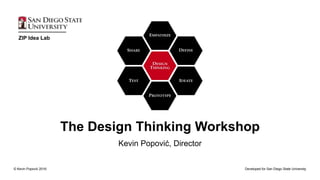
The Design Thinking Workshop
Kevin Popović, Director
© Kevin Popović 2016. Developed for San Diego State University
What is Design Thinking?
Kevin Popović
ZIP Idea Lab
© Kevin Popović 2016. Developed for San Diego State University
d. School | Hasso Plattner Institute of Design at Stanford
ZIP Idea Lab
ZIP Idea Lab
© Kevin Popović 2016. Developed for San Diego State University
ZIP Idea Lab
MISSION:
Redesign the gift-giving experience for your partner. Start by gaining empathy.
MISSION:
Redesign the gift-giving experience for your partner. Start by gaining empathy.
© Kevin Popović 2016. Developed for San Diego State University
ZIP Idea Lab
MISSION:
Reframe the problem.
MISSION:
Reframe the problem.
© Kevin Popović 2016. Developed for San Diego State University
ZIP Idea Lab
MISSION:
Ideate: Generate alternatives to test.
MISSION:
Ideate: Generate alternatives to test.
MISSION:
Iterate based on feedback.
© Kevin Popović 2016. Developed for San Diego State University
ZIP Idea Lab
MISSION:
Build and test.
© Kevin Popović 2016. Developed for San Diego State University
ZIP Idea Lab
MISSION:
Build and test.
© Kevin Popović 2016. Developed for San Diego State University
ZIP Idea Lab
© Kevin Popović 2016. Developed for San Diego State University
ZIP Idea Lab
MISSION:
Group gather and debrief.
MISSION:
Group gather and debrief.
More Design Thinking
@KevinPopovic
MGT353 Creativity + Innovation
ZIP Idea Lab @ SDSU
ZIP Idea Lab @ SDSU - Design Thinking Workshop

ZIP Idea Lab @ SDSU - Design Thinking Workshop

Editor's Notes

  • #3 The Kick-Off: What is Design Thinking? Instead of just telling you about design thinking, we want to immediately have you jump right in and experience it for yourself! We are going to do a design project for about the next 45 minutes! This is going to feel rushed; that’s okay. Roll up your sleeves and really lean into the project! Ready? Let’s go!
  • #4 Our Design Thinking is based on what we have learned from- d. School | Hasso Plattner Institute of Design at Stanford
  • #5 Although we agreed with their steps in our current thinking, we do add another step in sharing – and demonstrate our model in a configuration that can represent process and the lateral thinking taught by D school. Design thinking starts with Empathy.
  • #6 Empathize with the SDSU community: How could we build a Design Thinking lab that would serve the most people? We could reach out to different parts of the SDSU community via lectures, workshops and surveys to gather information, to hear what people tell us they need most.
  • #7 1—Interview your Partner : EMPATHIZE Your challenge is to design something useful and meaningful to your partner. The most important part of designing for someone is to gain empathy for that person. Example: While there are lots of ways to gain empathy for someone else, a simple, easy way to do that is to have a conversation and ask open ended questions. “When was the last time you gave a gift? How did it go? What was your favorite part? Least favorite part?
  • #8 2—Dig deeper: EMPATHIZE Try to dig for stories, feelings, emotions. Ask ‘Why?’ often. Forget about the gift, find out what’s important to your partner. Example: For example, if your user mentioned that it’s challenging to decide on which gift to purchase, ask why? Maybe it’s because they don’t really know what the other person wants; or maybe it’s because they’re afraid of what the gift says about THEM as the giver – any answer will lead you to understand your user (the gift giver) better. The key is to identify anywhere you’re making assumptions and then ask a question to test whether your assumption is valid.
  • #9 Define the needs that would serve the most people within our community. From posting problems heard (as proof we’re listening), to including the community in prioritization (voting, ratings and comments), we can synthesize our learning into a few needs and insights. We can use these insights when creating our solution and to develop our problem statement.
  • #10 3—Capture findings: DEFINE Try to synthesize your learning into a few “needs” that you have discovered, and a few “insights” that you find of interest. Needs should be verbs – think about it this way – in the process of giving a gift, what is your user actually trying to accomplish? What does the gift giving do for them? Insights are discoveries that you might be able to leverage when creating solutions.
  • #11 4—Take a stand with a point-of-view: DEFINE This is your point of view (POV) Take stand by specifically stating the meaningful challenge you are taking on. It should feel like a problem worth tackling This is a statement that you’re going to address with your design, so make sure its juicy and actionable Example: Maybe you found that your partner is really trying to reunite the family; or reignite a lost love; or infuse adventure into a boring suburban existence; or reconnect with an old friend; or demonstrate his own creativity!
  • #12 We will Ideate ways we could work together to meet these needs. Sketching and drawing our ideas as we think – they don’t have to be perfect but we will go for volume. As many ideas as we can generate. Drawings with a human touch could be great content for social media to expand the feedback on solutions. The more we listen the more we will hear. We’ll ask ourselves: How might this solution fit into the context of our community?
  • #13 5—Sketch to Ideate: IDEATE Rewrite your problem statement at the top of the page. Now you are creating solutions to the new challenge you’ve identified You don’t have to draw well, stick figures and squiggly lines are okay GO FOR VOLUME! This is time for idea generation, not evaluation.
  • #14 6—Share solutions and capture feedback: IDEATE Spend the time listening to your partner’s feedback. Fight the urge to defend your ideas. This is not about validation. This is an opportunity to learn more about your partners feelings and motivations. (remember: empathy)
  • #15 7—Reflect & generate a new solution: IDEATE Now take a moment to consider what you have learned about your partner, and about the solutions you generated. From this new understanding of your partner and his or her needs, sketch a new idea. The solution may be a variation on an idea from before or something completely new. Ask yourself: How might this solution fit into the context of your partner’s life?
  • #16 We’ll build a prototype a solution: we will create an overview of the Design Thinking Lab (physical) as well as any virtual facilities or resources. We’ll create experiences around each part of the lab – something people can engage with.
  • #17 8—Build! – PROTYPE Create a physical prototype of your solution Create an experience or make something that your partner can engage and react to. Feel free to focus the prototype on one aspect of the overall solution,
  • #18 And we will Test over time, measuring progress towards goals based on a plan, success and identify areas for improvement. Our prototypes will not be precious, and are only meant to gather more data – enough to develop another prototype for another test.
  • #19 9—Share your solution and get feedback: Prototype/Test Your prototype is not precious, but the feedback and new insights it draws out are! Don’t defend your prototype, instead, watch your partner use and misuse it.
  • #20 In order to build a community at SDSU, and our brand abroad we must Share what we learn. The more we share what we learn the more people will understand how we can impact the way we solve problems. By sharing – extending what we learn – we may attract key partners on a better solution outside our current universe.
  • #22 10—Group gather and debrief Questions for the end of the exercise: Spend 5-8 minutes per. How did engaging with a real person, testing with a real person, change the direction your prototype took? What was it like showing unfinished work to another person? How did the pace feel? Quick iterative cycles – how did it feel relative to how you normally work? Design thinking is an iterative, self-directed process. Based on what you learned – what would you go back and do next? What would you do over again? 5. What principle, what tool, would you infuse into the work tomorrow?!
  • #23 After the video questions, try these exercises: Set all the prototypes in the middle of the room Who had a partner who created something you really like? Who sees something they are curious to learn more about? Who wants to share their experience? What part felt most uncomfortable for you? What felt most natural? How did the time pressure impact your work? How did it feel to show someone else unfinished work / work in low resolution? As a user, how did you interact with your partners lowly-resolved prototype? How did the level of resolution impact your experience as a user?
  • #26 The notion of design as a "way of thinking" in the sciences can be traced to Herbert A. Simon's 1969 book The Sciences of the Artificial,[2] 
  • #27 and in design engineering to Robert McKim's 1973 book Experiences in Visual Thinking.[3] 
  • #28 and in design engineering to Robert McKim's 1973 book Experiences in Visual Thinking.[3] 
  • #29 Peter Rowe's 1987 book Design Thinking, which described methods and approaches used by architects and urban planners, was a significant early usage of the term in the design research literature.[4]  Rolf Faste expanded on McKim's work at Stanford University in the 1980s and 1990s,[5][6] teaching "design thinking as a method of creative action."[7]Design thinking was adapted for business purposes by Faste's Stanford colleague David M. Kelley, who founded IDEO in 1991.[8] Richard Buchanan's 1992 article "Wicked Problems in Design Thinking" expressed a broader view of design thinking as addressing intractable human concerns through design.[9]
  • #30 Rolf Faste expanded on McKim's work at Stanford University in the 1980s and 1990s,[5][6] teaching "design thinking as a method of creative action. "[7]Design thinking was adapted for business purposes by Faste's Stanford colleague David M. Kelley, who founded IDEO in 1991.[8] Richard Buchanan's 1992 article "Wicked Problems in Design Thinking" expressed a broader view of design thinking as addressing intractable human concerns through design.[9]
  • #31 "[7]Design thinking was adapted for business purposes by Faste's Stanford colleague David M. Kelley, who founded IDEO in 1991.[8]  .[9]
  • #32 Richard Buchanan's 1992 article "Wicked Problems in Design Thinking" expressed a broader view of design thinking as addressing intractable human concerns through design.[9]
  • #34 This book introduces design thinking, the collaborative process by which the designer’s sensibilities and methods are employed to match people’s needs with what is technically feasible and a viable business strategy. In short, design thinking converts need into demand. It’s a human-centered approach to problem solving that helps people and organizations become more innovative and creative.
  • #35 https://youtu.be/UAinLaT42xY