REVOLUTIONIZING
CYBERSECURITY:
IMPLEMENTING
ZERO TRUST
SECURITY MODELS
INTRODUCTION TO ZERO
TRUST
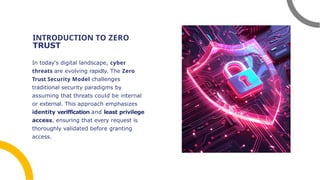
In today's digital landscape, cyber
threats are evolving rapidly. The Zero
Trust Security Model challenges
traditional security paradigms by
assuming that threats could be internal
or external. This approach emphasizes
identity veriffication and least privilege
access, ensuring that every request is
thoroughly validated before granting
access.
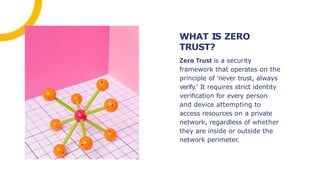
Zero Trust is a security
framework that operates on the
principle of 'never trust, always
verify.' It requires strict identity
verification for every person
and device attempting to
access resources on a private
network, regardless of whether
they are inside or outside the
network perimeter.
WHAT IS ZERO
TRUST?
KEY PRINCIPLES OF ZERO
TRUST
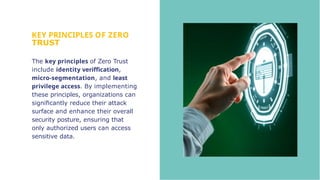
The key principles of Zero Trust
include identity veriffication,
micro-segmentation, and least
privilege access. By implementing
these principles, organizations can
significantly reduce their attack
surface and enhance their overall
security posture, ensuring that
only authorized users can access
sensitive data.
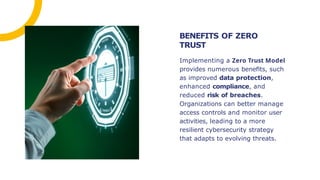
Implementing a Zero Trust Model
provides numerous benefits, such
as improved data protection,
enhanced compliance, and
reduced risk of breaches.
Organizations can better manage
access controls and monitor user
activities, leading to a more
resilient cybersecurity strategy
that adapts to evolving threats.
BENEFITS OF ZERO
TRUST
Challenges in
Implementation
Transitioning to a Zero Trust Security
Model can present challenges,
including the need for cultural shifts
within organizations and the
integration of legacy systems.
Additionally, organizations must
invest
in training and technology to ensure
that all employees understand and
adhere to the new security
protocols.
The Zero Trust Security Model represents a
fundamental shift in how organizations approach
cybersecurity. As cyber threats continue to
evolve, adopting this model will be crucial for
protecting sensitive data and maintaining trust.
Organizations that embrace Zero Trust will be
better equipped to navigate the complexities of
modern cybersecurity landscapes.
CONCLUSION: FUTURE
OF CYBERSECURITY
Digital Premium Solutions offers expert Network Se
curity Services in Lucknow to safeguard your
business from cyber threats. We provide
customized solutions to protect sensitive data,
prevent unauthorized access, and ensure secure
communication across your network. With our
advanced security tools and monitoring, we help
businesses maintain a safe and secure IT
environment, minimizing risks and enhancing
overall network performance. Trust Digital
Premium Solutions for reliable and effficient
network security.
ABOUT DIGITAL
PREMIUM
SOLUTIONS
Thanks
!
Do you have any
questions?
info@websofy.com
+91 9335785354
www.digitalpremiumsolution.com
@digitalpremiumsolution

Revolutionizing Cybersecurity: Implementing Zero Trust Security Models

  • 1.
  • 2.
    INTRODUCTION TO ZERO TRUST Intoday's digital landscape, cyber threats are evolving rapidly. The Zero Trust Security Model challenges traditional security paradigms by assuming that threats could be internal or external. This approach emphasizes identity veriffication and least privilege access, ensuring that every request is thoroughly validated before granting access.
  • 3.
    Zero Trust isa security framework that operates on the principle of 'never trust, always verify.' It requires strict identity verification for every person and device attempting to access resources on a private network, regardless of whether they are inside or outside the network perimeter. WHAT IS ZERO TRUST?
  • 4.
    KEY PRINCIPLES OFZERO TRUST The key principles of Zero Trust include identity veriffication, micro-segmentation, and least privilege access. By implementing these principles, organizations can significantly reduce their attack surface and enhance their overall security posture, ensuring that only authorized users can access sensitive data.
  • 5.
    Implementing a ZeroTrust Model provides numerous benefits, such as improved data protection, enhanced compliance, and reduced risk of breaches. Organizations can better manage access controls and monitor user activities, leading to a more resilient cybersecurity strategy that adapts to evolving threats. BENEFITS OF ZERO TRUST
  • 6.
    Challenges in Implementation Transitioning toa Zero Trust Security Model can present challenges, including the need for cultural shifts within organizations and the integration of legacy systems. Additionally, organizations must invest in training and technology to ensure that all employees understand and adhere to the new security protocols.
  • 7.
    The Zero TrustSecurity Model represents a fundamental shift in how organizations approach cybersecurity. As cyber threats continue to evolve, adopting this model will be crucial for protecting sensitive data and maintaining trust. Organizations that embrace Zero Trust will be better equipped to navigate the complexities of modern cybersecurity landscapes. CONCLUSION: FUTURE OF CYBERSECURITY
  • 8.
    Digital Premium Solutionsoffers expert Network Se curity Services in Lucknow to safeguard your business from cyber threats. We provide customized solutions to protect sensitive data, prevent unauthorized access, and ensure secure communication across your network. With our advanced security tools and monitoring, we help businesses maintain a safe and secure IT environment, minimizing risks and enhancing overall network performance. Trust Digital Premium Solutions for reliable and effficient network security. ABOUT DIGITAL PREMIUM SOLUTIONS
  • 9.
    Thanks ! Do you haveany questions? info@websofy.com +91 9335785354 www.digitalpremiumsolution.com @digitalpremiumsolution