Page 1
Page 2
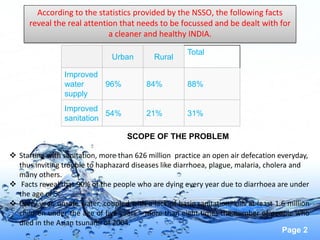
According to the statistics provided by the NSSO, the following facts
reveal the real attention that needs to be focussed and be dealt with for
a cleaner and healthy INDIA.
Urban Rural
Total
Improved
water
supply
96% 84% 88%
Improved
sanitation
54% 21% 31%
SCOPE OF THE PROBLEM
 Starting with sanitation, more than 626 million practice an open air defecation everyday,
thus inviting trouble to haphazard diseases like diarrhoea, plague, malaria, cholera and
many others.
 Facts reveal that 90% of the people who are dying every year due to diarrhoea are under
the age of 5.
 Every year, unsafe water, coupled with a lack of basic sanitation, kills at least 1.6 million
children under the age of five years – more than eight times the number of people who
died in the Asian tsunami of 2004.
Page 3
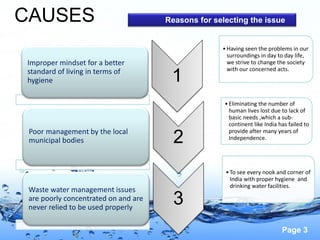
CAUSES
Improper mindset for a better
standard of living in terms of
hygiene
Poor management by the local
municipal bodies
Waste water management issues
are poorly concentrated on and are
never relied to be used properly
1
•Having seen the problems in our
surroundings in day to day life,
we strive to change the society
with our concerned acts.
2
•Eliminating the number of
human lives lost due to lack of
basic needs ,which a sub-
continent like India has failed to
provide after many years of
Independence.
3
•To see every nook and corner of
India with proper hygiene and
drinking water facilities.
Reasons for selecting the issue
Page 4
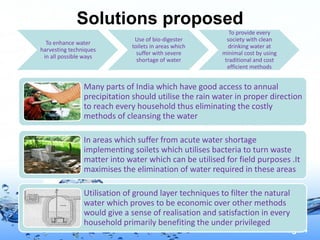
Solutions proposed
To enhance water
harvesting techniques
in all possible ways
Use of bio-digester
toilets in areas which
suffer with severe
shortage of water
To provide every
society with clean
drinking water at
minimal cost by using
traditional and cost
efficient methods
Many parts of India which have good access to annual
precipitation should utilise the rain water in proper direction
to reach every household thus eliminating the costly
methods of cleansing the water
In areas which suffer from acute water shortage
implementing soilets which utilises bacteria to turn waste
matter into water which can be utilised for field purposes .It
maximises the elimination of water required in these areas
Utilisation of ground layer techniques to filter the natural
water which proves to be economic over other methods
would give a sense of realisation and satisfaction in every
household primarily benefiting the under privileged
Page 5
• Its very economic
• Reduces the workload and cost of budget allocation in maintaining a sewage treatment plant
• Existing revenues on such projects has been a mere waste due to lack of knowledge amongst
village people, dominantly due to concentration on land allotment. These methods would
enable the entire family to learn the ethics of water conservation and proper hygiene
facilities, resulting in reduced deaths everyday.
• Usage of alum and lime in every locality can help in elimination of fluorinated water.
Merits over
existing ones
• Traditional methods that have become exhaustive should be back in use as these don’t require
even electricity to purify the water, thus eliminating the use of costly equipment like aqua
guard.
• This is achieved by making less bore wells for a majority of people who live on a dense area,
mainly targeting larger populations of UP, MP, Orissa and Maharashtra , which extremely face
drought conditions every year.
• Floods that have hit Uttarakhand, Assam and even other north eastern states that receive a
heavy downpour in many months of the year, must be utilized by the people. If planned in an
effective manner these natural calamities would serve as a boon rather than crying havoc on
these.
Implementation
•Water springs must be extracted in areas like rajasthan , wherein annual
precipitation is very low. Moreover, the disputes between states in terms of
water crisis must not happen at the cost of human lives. The judicial system
must be more stricter in this regard. For example Tamil nadu must utilise
maximum amount of water from Rameshwaram and Cauveri .
Brief stages
involved in
the setup
Page 6
In spite of so many dams in India, many of them being
inefficient , the government has failed every time in
providing basic water resources to the “aam janta”.
These dams must be refurbished and be made use of.
People must involve more and be willing to know
every module, every project that their authorities
undertake.
The setup process starts from local
authorities taking serious responsibilities
in managing wastewater plants ,
distribution of funds in managing the
implementation of treating the water
and making strong, efficient sanitary
systems should be made more
transparent .
In forests areas, wherein grassland systems act as a
very efficient water treating systems, the
electricity spent in crores on the water treating
plants would be reduced
Water springs must be extracted in
areas like Rajasthan , wherein annual
precipitation is very low. Moreover,
the disputes between states in terms
of water crisis must not happen at
the cost of human lives.
The judicial system must be more
accountable in this regard. For example
Tamil Nadu must utilise maximum
amount of water from Rameshwaram
and Kaveri
Page 7
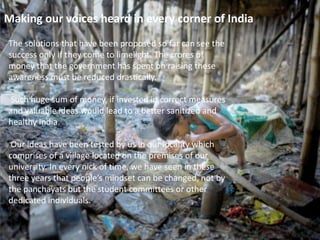
Making our voices heard in every corner of India
The solutions that have been proposed so far can see the
success only if they come to limelight. The crores of
money that the government has spent on raising these
awareness must be reduced drastically.
Such huge sum of money, if invested in correct measures
and valuable ideas would lead to a better sanitized and
healthy India.
Our ideas have been tested by us in our locality which
comprises of a village located on the premises of our
university. In every nick of time, we have seen in these
three years that people’s mindset can be changed, not by
the panchayats but the student committees or other
dedicated individuals.
Page 8
What has the government done so far?
• Nearly thousands of projects the Government has sanctioned, projects in all of
India’s rural districts,building about 57 million individual household sanitary
latrines (IHHLs) still falls short of the estimated119 million units needed to meet
the Government’sgoal of eradicatingopen defecation.This shows the
ineffectivenessand poor planning of theirs.
• In addition to stateallocatedfunds, the most recent five-yearplan allocates7,816
crores for urban sanitationprojects. Such huge amount of money hasn’t come to
the notice of even one village panchayat in the recent many years. Transparency
has never been there in any part of these projects, leading to utmost failure and a
deepening crisis.
• According to the recent five year plan(i.e. 12th five year plan) the major effort is on
sanitation and healthy water supply to all. But maximum no. of deaths confirm
that efforts to improve human lives are never taken seriously by any political party
or individual.
• Current scenario in rural areas
• Nearly 50% of projects were going failed due to lack of community involvement.
• In rural areas 200 million plus women spend max time in collecting water. the men
should also take charge by collectingwater from the near by pumps, wells.
Page 9
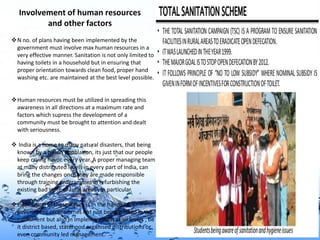
Involvement of human resources
and other factors
N no. of plans having been implemented by the
government must involve max human resources in a
very effective manner. Sanitation is not only limited to
having toilets in a household but in ensuring that
proper orientation towards clean food, proper hand
washing etc. are maintained at the best level possible.
Human resources must be utilized in spreading this
awareness in all directions at a maximum rate and
factors which supress the development of a
community must be brought to attention and dealt
with seriousness.
 India is a home to many natural disasters, that being
known by a billion population, its just that our people
keep crying havoc every year. A proper managing team
at many distributed levels in every part of India, can
bring the changes once they are made responsible
through training programmes in refurbishing the
existing bad state of rural areas , in particular.
Elimination of these issues is in the hands of
government programmes not just being passed in the
parliament but also in implementing it at all levels , be
it district based, statehood organised distributions or
even community led management.
Page 10
Breaking the barriers and achieving
success
Although since 1986, govt has launched so many plans that
resolve to eliminate such problems, even the world bank and
other many international agencies have always supported in
providing maximum extension to help us get rid of these
issues, we as a country have failed in developing our own
people and their basic needs because of so many political,
social barriers.
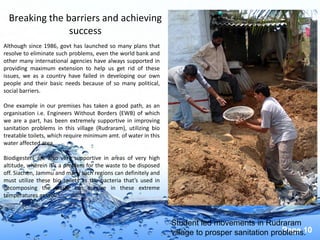
One example in our premises has taken a good path, as an
organisation i.e. Engineers Without Borders (EWB) of which
we are a part, has been extremely supportive in improving
sanitation problems in this village (Rudraram), utilizing bio
treatable toilets, which require minimum amt. of water in this
water affected area.
Biodigesters are also very supportive in areas of very high
altitude, wherein it’s a problem for the waste to be disposed
off. Siachen, Jammu and many such regions can definitely and
must utilize these bio toilets as the bacteria that’s used in
decomposing the waste can survive in these extreme
temperatures as well.
Student led movements in Rudraram
village to prosper sanitation problems.
Page 11
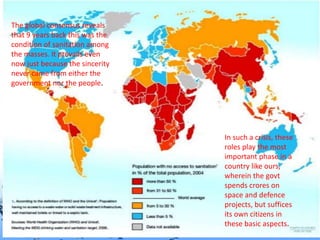
The global consensus reveals
that 9 years back this was the
condition of sanitation among
the masses. It prevails even
now just because the sincerity
never came from either the
government nor the people.
In such a crisis, these
roles play the most
important phase in a
country like ours,
wherein the govt
spends crores on
space and defence
projects, but suffices
its own citizens in
these basic aspects.

zenith555

  • 1.
  • 2.
    Page 2 According tothe statistics provided by the NSSO, the following facts reveal the real attention that needs to be focussed and be dealt with for a cleaner and healthy INDIA. Urban Rural Total Improved water supply 96% 84% 88% Improved sanitation 54% 21% 31% SCOPE OF THE PROBLEM  Starting with sanitation, more than 626 million practice an open air defecation everyday, thus inviting trouble to haphazard diseases like diarrhoea, plague, malaria, cholera and many others.  Facts reveal that 90% of the people who are dying every year due to diarrhoea are under the age of 5.  Every year, unsafe water, coupled with a lack of basic sanitation, kills at least 1.6 million children under the age of five years – more than eight times the number of people who died in the Asian tsunami of 2004.
  • 3.
    Page 3 CAUSES Improper mindsetfor a better standard of living in terms of hygiene Poor management by the local municipal bodies Waste water management issues are poorly concentrated on and are never relied to be used properly 1 •Having seen the problems in our surroundings in day to day life, we strive to change the society with our concerned acts. 2 •Eliminating the number of human lives lost due to lack of basic needs ,which a sub- continent like India has failed to provide after many years of Independence. 3 •To see every nook and corner of India with proper hygiene and drinking water facilities. Reasons for selecting the issue
  • 4.
    Page 4 Solutions proposed Toenhance water harvesting techniques in all possible ways Use of bio-digester toilets in areas which suffer with severe shortage of water To provide every society with clean drinking water at minimal cost by using traditional and cost efficient methods Many parts of India which have good access to annual precipitation should utilise the rain water in proper direction to reach every household thus eliminating the costly methods of cleansing the water In areas which suffer from acute water shortage implementing soilets which utilises bacteria to turn waste matter into water which can be utilised for field purposes .It maximises the elimination of water required in these areas Utilisation of ground layer techniques to filter the natural water which proves to be economic over other methods would give a sense of realisation and satisfaction in every household primarily benefiting the under privileged
  • 5.
    Page 5 • Itsvery economic • Reduces the workload and cost of budget allocation in maintaining a sewage treatment plant • Existing revenues on such projects has been a mere waste due to lack of knowledge amongst village people, dominantly due to concentration on land allotment. These methods would enable the entire family to learn the ethics of water conservation and proper hygiene facilities, resulting in reduced deaths everyday. • Usage of alum and lime in every locality can help in elimination of fluorinated water. Merits over existing ones • Traditional methods that have become exhaustive should be back in use as these don’t require even electricity to purify the water, thus eliminating the use of costly equipment like aqua guard. • This is achieved by making less bore wells for a majority of people who live on a dense area, mainly targeting larger populations of UP, MP, Orissa and Maharashtra , which extremely face drought conditions every year. • Floods that have hit Uttarakhand, Assam and even other north eastern states that receive a heavy downpour in many months of the year, must be utilized by the people. If planned in an effective manner these natural calamities would serve as a boon rather than crying havoc on these. Implementation •Water springs must be extracted in areas like rajasthan , wherein annual precipitation is very low. Moreover, the disputes between states in terms of water crisis must not happen at the cost of human lives. The judicial system must be more stricter in this regard. For example Tamil nadu must utilise maximum amount of water from Rameshwaram and Cauveri . Brief stages involved in the setup
  • 6.
    Page 6 In spiteof so many dams in India, many of them being inefficient , the government has failed every time in providing basic water resources to the “aam janta”. These dams must be refurbished and be made use of. People must involve more and be willing to know every module, every project that their authorities undertake. The setup process starts from local authorities taking serious responsibilities in managing wastewater plants , distribution of funds in managing the implementation of treating the water and making strong, efficient sanitary systems should be made more transparent . In forests areas, wherein grassland systems act as a very efficient water treating systems, the electricity spent in crores on the water treating plants would be reduced Water springs must be extracted in areas like Rajasthan , wherein annual precipitation is very low. Moreover, the disputes between states in terms of water crisis must not happen at the cost of human lives. The judicial system must be more accountable in this regard. For example Tamil Nadu must utilise maximum amount of water from Rameshwaram and Kaveri
  • 7.
    Page 7 Making ourvoices heard in every corner of India The solutions that have been proposed so far can see the success only if they come to limelight. The crores of money that the government has spent on raising these awareness must be reduced drastically. Such huge sum of money, if invested in correct measures and valuable ideas would lead to a better sanitized and healthy India. Our ideas have been tested by us in our locality which comprises of a village located on the premises of our university. In every nick of time, we have seen in these three years that people’s mindset can be changed, not by the panchayats but the student committees or other dedicated individuals.
  • 8.
    Page 8 What hasthe government done so far? • Nearly thousands of projects the Government has sanctioned, projects in all of India’s rural districts,building about 57 million individual household sanitary latrines (IHHLs) still falls short of the estimated119 million units needed to meet the Government’sgoal of eradicatingopen defecation.This shows the ineffectivenessand poor planning of theirs. • In addition to stateallocatedfunds, the most recent five-yearplan allocates7,816 crores for urban sanitationprojects. Such huge amount of money hasn’t come to the notice of even one village panchayat in the recent many years. Transparency has never been there in any part of these projects, leading to utmost failure and a deepening crisis. • According to the recent five year plan(i.e. 12th five year plan) the major effort is on sanitation and healthy water supply to all. But maximum no. of deaths confirm that efforts to improve human lives are never taken seriously by any political party or individual. • Current scenario in rural areas • Nearly 50% of projects were going failed due to lack of community involvement. • In rural areas 200 million plus women spend max time in collecting water. the men should also take charge by collectingwater from the near by pumps, wells.
  • 9.
    Page 9 Involvement ofhuman resources and other factors N no. of plans having been implemented by the government must involve max human resources in a very effective manner. Sanitation is not only limited to having toilets in a household but in ensuring that proper orientation towards clean food, proper hand washing etc. are maintained at the best level possible. Human resources must be utilized in spreading this awareness in all directions at a maximum rate and factors which supress the development of a community must be brought to attention and dealt with seriousness.  India is a home to many natural disasters, that being known by a billion population, its just that our people keep crying havoc every year. A proper managing team at many distributed levels in every part of India, can bring the changes once they are made responsible through training programmes in refurbishing the existing bad state of rural areas , in particular. Elimination of these issues is in the hands of government programmes not just being passed in the parliament but also in implementing it at all levels , be it district based, statehood organised distributions or even community led management.
  • 10.
    Page 10 Breaking thebarriers and achieving success Although since 1986, govt has launched so many plans that resolve to eliminate such problems, even the world bank and other many international agencies have always supported in providing maximum extension to help us get rid of these issues, we as a country have failed in developing our own people and their basic needs because of so many political, social barriers. One example in our premises has taken a good path, as an organisation i.e. Engineers Without Borders (EWB) of which we are a part, has been extremely supportive in improving sanitation problems in this village (Rudraram), utilizing bio treatable toilets, which require minimum amt. of water in this water affected area. Biodigesters are also very supportive in areas of very high altitude, wherein it’s a problem for the waste to be disposed off. Siachen, Jammu and many such regions can definitely and must utilize these bio toilets as the bacteria that’s used in decomposing the waste can survive in these extreme temperatures as well. Student led movements in Rudraram village to prosper sanitation problems.
  • 11.
    Page 11 The globalconsensus reveals that 9 years back this was the condition of sanitation among the masses. It prevails even now just because the sincerity never came from either the government nor the people. In such a crisis, these roles play the most important phase in a country like ours, wherein the govt spends crores on space and defence projects, but suffices its own citizens in these basic aspects.